Antonio Canova’s Studio and House
In short. Antonio Canova's Studio and House occupies the corner between Via delle Colonnette and Via Antonio Canova, in the Campo Marzio rione, a few dozen meters from the Mausoleum of Augustus and the Ara Pacis.
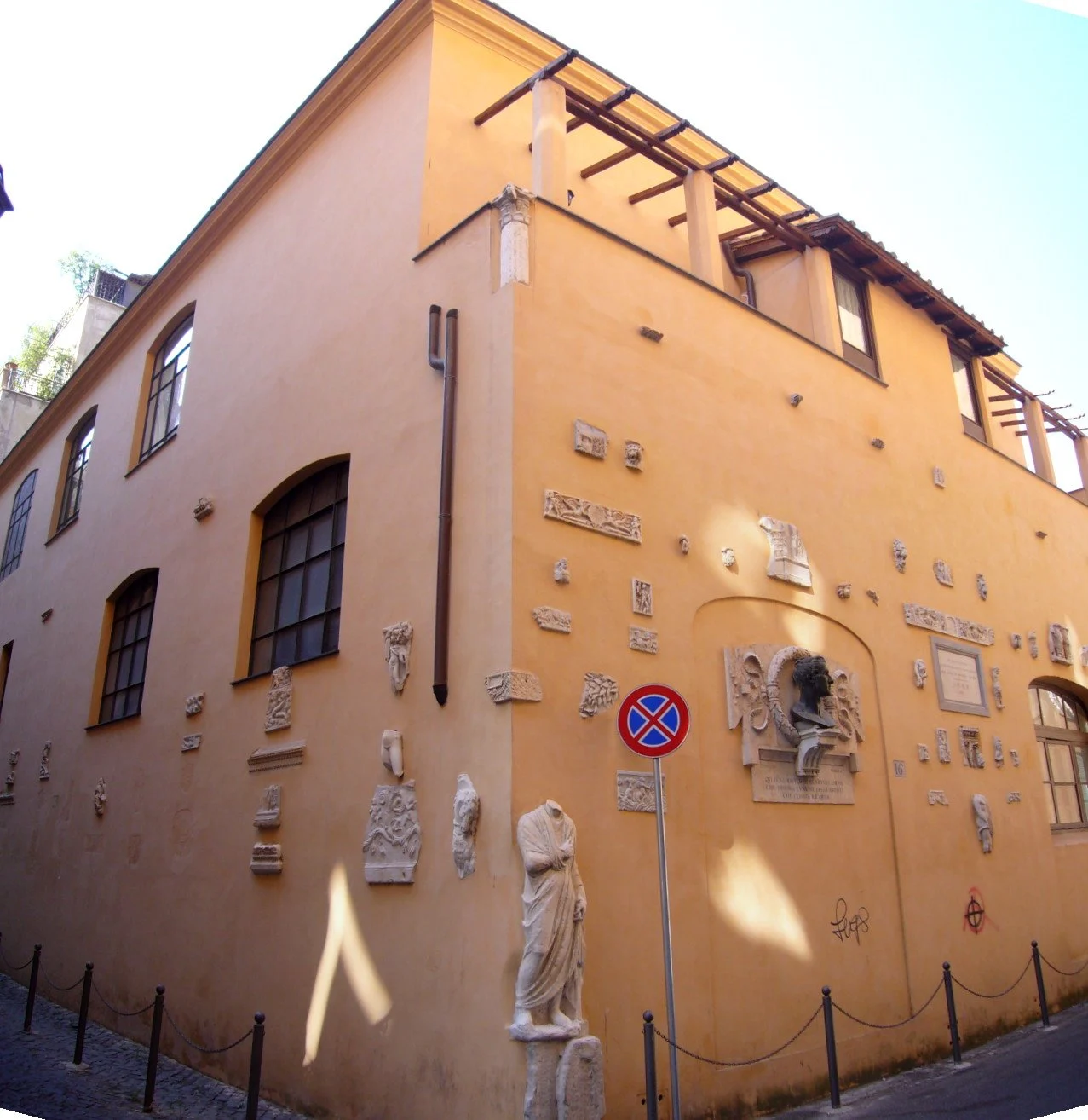
Antonio Canova's Studio and House occupies the corner between Via delle Colonnette and Via Antonio Canova, in the Campo Marzio rione, a few dozen meters from the Mausoleum of Augustus and the Ara Pacis. The first thing to say, so you avoid a wasted trip, is that it is not a museum: the building is privately owned, has no ticket office, has no published opening hours and cannot be visited the way you visit a house museum. What you see, and what is worth the five-minute detour anyway, is the facade: a low, simple wall, with arched doors and windows, literally studded with fragments of statues, lintels, reliefs and pieces of sarcophagi from Roman antiquity, walled into the surface as if they were building stones. Almost none of the passersby heading up toward Piazza del Popolo can explain what they are. They are the remains of the archaeological collection that the most famous sculptor in Europe kept in here as study material, and the building that holds them was for almost 20 years the factory of European neoclassicism, the place where the marbles now admired at the Galleria Borghese, the Vatican Museums, the Louvre and the Hermitage were carved. The lines that follow tell what this building is, how Canova came to it, how people worked in here, why the facade looks the way it does, and why the most important chapter in the life of its owner concerns not a sculpture but a diplomatic negotiation conducted in Paris in the autumn of 1815.
Where Antonio Canova's Studio and House is and how to get there
The main entrance of Antonio Canova's Studio and House is at number 27 Via delle Colonnette, in the Campo Marzio rione, with the long facade continuing along Via Antonio Canova, the street that bears the sculptor's name precisely because he lived and worked there. Some cadastral records and some sources give the numbers 26A and 27: it is the same property, which over time has had slightly different numbering.
On foot from the center of Rome
The most natural way to get there is on foot, because the building sits in an area that almost everyone crosses without noticing. From Piazza del Popolo it takes seven or eight minutes: take Via di Ripetta, the western arm of the trident, pass the Ara Pacis complex and turn left onto the first side street after the Mausoleum square. From Piazza di Spagna the route is slightly longer, a good 10 minutes passing along Via del Babuino and then cutting toward the Tiber. It is the walk Canova himself used to make, since his second studio, the one later passed to his pupils, was right on the Babuino. From Via del Corso, at the Church of San Giacomo in Augusta, it takes three minutes going down toward the river.
By public transportation
The most convenient metro stop is Flaminio on Line A, from which you go down through Piazza del Popolo and continue along Via di Ripetta, for a total of a little over 10 minutes on foot. Spagna, also on Line A, works well too, with a route similar in length but entirely flat. Several surface lines run along the Lungotevere and Via del Corso. It is still best to check the updated route on the Roman transit company's website, because the trident area is subject to traffic restrictions and lines are rerouted fairly often. The neighborhood is inside the limited traffic zone of the historic center: arriving by car is not recommended and surface parking is practically nonexistent.
How to recognize the right building
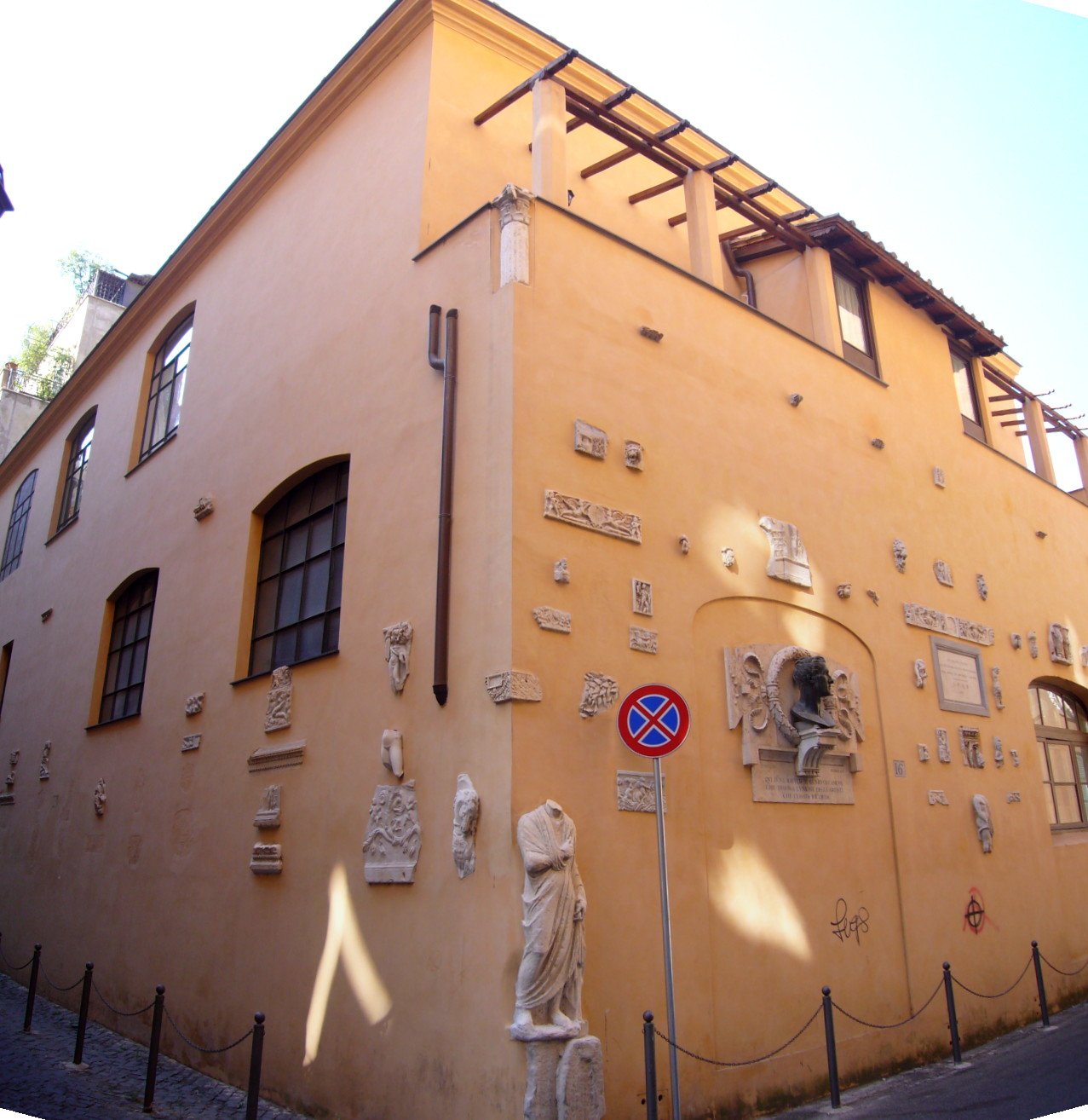
There is no tourist sign, no line, nothing that marks a monument. There is only one visual landmark and you cannot get it wrong: the wall full of pieces of ancient marble set in at different heights, heads, fragments of cornices, carved slabs, embedded in the plaster. On Via Antonio Canova side, between numbers 18 and 19, there is a large Latin plaque. A little farther on, a bronze bust of the sculptor stands above another plaque. At Via delle Colonnette entrance there are two modern inscriptions, one indicating the property and one declaring the studio of significant interest under the law of June 1, 1939, number 1089, the old Italian law protecting the artistic heritage.
Can you visit Antonio Canova's Studio and House? What you really see today
Antonio Canova's Studio and House is neither a state nor a municipal museum, has no ticket, has no published opening hours and is not part of any of the city's museum circuits: it is a private property, protected by the Italian state, and anyone who comes here sees the facade from the street. This is the point worth settling right away, because enthusiastic descriptions circulate online that suggest the opposite, and every year a certain number of visitors come all the way here expecting a house museum like Keats's on Piazza di Spagna.
A private building, not a house museum
After Canova's death the property changed hands several times, as told further on, and in the 20th century it hosted artists' studios and associations. The available documentary sources indicate that from the late 1970s the building was used as an art gallery, and that in recent years cultural initiatives and literary meetings have been held there. These are, however, private activities with their own calendars, not a museum service: there is no ticket office, there is no regular schedule, and the possibility of getting in depends entirely on what is going on at that moment. Anyone who wants to try must check case by case if there is an event open to the public. No publicly available source gives an ordinary visiting schedule, and any hours you read around should be treated with caution until confirmed directly by whoever manages the space.
The protection order and the two plaques at the entrance
The declaration of significant historical and artistic interest for the Canova Studio dates from the 1950s and rests on protection law number 1089 of June 1, 1939, as the inscription at Via delle Colonnette entrance states. The protection order does not oblige the owner to open to the public: it requires that the building not be altered, demolished or transformed without authorization, and it is the reason why the facade with the ancient fragments has come down to us intact, through a century of building renovations in the center of Rome. It is a protection of the fabric, not of access: a distinction that perfectly explains the paradoxical situation of a building recognized as a monument and at the same time inaccessible.
What remains of the original studio
What you see today is a portion of what it was. The sources on the topography of the rione agree on one point: the part of the complex facing Via di Ripetta was over time assigned to services of the adjoining San Giacomo hospital, and this considerably reduced the size of the old workshop. Canova, at the moment of greatest expansion, effectively controlled an entire city block bounded by Via delle Colonnette, Via di Ripetta, Via San Giacomo and Via della Frezza. Walking around that block today, with a map in hand, is the best way to grasp the scale of the enterprise: not a workshop, but a small manufacturing plant.
The facade studded with ancient fragments: what those marbles are
The facade of Antonio Canova's Studio and House is characterized by many fragments of statues, lintels and sculptures from ancient Rome walled directly into the exterior wall, and it is the element that makes the building immediately recognizable even to those who don't know which house it is. They are not period-style 19th-century decorations, they are not copies and they are not an architect's whim: they are real ancient pieces, which were part of the archaeological collection with which the sculptor had surrounded himself and which, in part, today appear set into the walls of the building, including the exterior ones.
Reliefs, lintels, fragments: what you can make out from the street
Looking calmly at the wall surface you can tell several kinds of material apart. There are architectural elements, that is, pieces of cornice, lintel and entablature, recognizable by the regular moldings and the kymatia, the continuous ornamental bands that ran along ancient buildings. There are slabs with figured relief, where you can make out drapery, profiles, limbs, sometimes a fragment of a scene. There are pieces of freestanding sculpture, reduced to stumps, set into the wall as independent decorative elements. A precise piece-by-piece description requires the scientific catalog of the collection, which exists in specialist literature but is not displayed on site: on the facade there is no explanatory panel, no caption, no numbering. This is exactly what makes the wall so disorienting for those who walk past it.
Why a sculptor walled antiquity into his own house
The reason is both practical and ideological. Practical, because for a neoclassical sculptor the ancient marbles were the textbook: the position of a shoulder, the way drapery slides over a thigh, the rendering of a curl of hair were learned by looking at and touching the original, not a drawing. Having those pieces within reach, in the courtyard and on the walls of one's own workshop, meant having antiquity as a daily coworker. Ideological, because walling ancient fragments into the facade of one's own house was, in Rome, a gesture in a well-known language: cardinals, antiquarians and collectors had been doing it for centuries to declare, without writing a word, that they belonged to the lineage of the ancients. Canova adopted that language and applied it to his own workshop, turning the exterior wall into a sign understandable to anyone passing by.
A study collection, not decor
It must be said clearly, because it is the point that jumps out only to those who know the context: the finds that Canova kept here had come into his possession in different ways, and served as working material. They were not a gallery to show to paying visitors, they were the cultural equipment of an artistic enterprise. This changes how you look at that wall: it is not a display window, it is a storeroom turned monument. The fact that the pieces are still there, after two centuries, in a city that has seen entire collections dismantled and sold, is in itself a small miracle of continuity.
How the studio came about: from 1779 to the block on Via delle Colonnette
Antonio Canova, born in Possagno in 1757 and trained between Asolo and Venice, arrived in Rome at the end of 1779 and settled there permanently from the following year, then stayed almost without interruption until his death. He did not buy a house right away: Via delle Colonnette property came only in 1803, when he was already the most sought-after artist in Europe.
Arrival in Rome and hospitality at Palazzo Venezia
In his first Roman period Canova was a guest at Palazzo Venezia, seat of the embassy of the Serenissima to the Holy See, welcomed by the Venetian ambassador Girolamo Zulian, who was his first great Roman patron. For a young sculptor from the Venetian provinces, that address was worth more than any recommendation: it meant entering directly the diplomatic and noble circuit that decided commissions in Rome. From there Canova moved on to work in rented premises in the area between Via San Giacomo and the port of Ripetta, the same one where he would later buy his house. In Via San Giacomo studio he completed in April 1787 the tomb of Clement XIV, the work that definitively opened the Roman market to him.
The 1803 purchase from the Augustinians
In 1803 Canova decided to buy a house that would also serve as a studio, and chose a group of small buildings owned by the Augustinians of Santa Maria del Popolo, which he rebuilt, turning them into a single structure. The date is not accidental: 1803 is the year immediately after his appointment as inspector general of Fine Arts for Rome and the Papal State, and it coincides with the moment when Canova, by now famous throughout Europe and sought after by French, English, Russian and Austrian clients, needed a stable production facility and no longer rented premises. Buying instead of renting, for an artist, meant declaring that he was not going away.
The 1806 expansion and Canova's block
Three years later, in 1806, a couple of adjoining small houses belonging to the nuns of Sant'Apollonia were added to the building, and the sum of the two purchases gave rise to a complex that his heir, the friend and collaborator Antonio D'Este, called a statuary workshop. The biographical sources document that the expansion continued until it effectively covered the block between Via delle Colonnette, Via di Ripetta, Via San Giacomo and Via della Frezza, where crews of workers operated under the sculptor's direction. It is worth pausing a second on that word, workshop: not atelier, not studio, not bottega, but officina, that is, a place of organized production.
Why Campo Marzio in particular
The choice of the area was anything but sentimental. Marble passed through here. The river port of Ripetta, the monumental landing inaugurated in 1704 on a design by Alessandro Specchi with the collaboration of Carlo Fontana, was a few dozen meters away, and from there barges carrying timber, wine, coal and blocks of stone came up the Tiber to Rome. For a sculptor who worked Carrara marble by the ton, having the workshop a stone's throw from the quay meant saving the most expensive and riskiest part of the transport, the last stretch by road. The port was demolished at the end of the 19th century with the construction of the Tiber embankment walls, decided after the flood of 1870 and begun in 1875, and today practically nothing of it remains. But it is the reason why Canova bought his house exactly here and not in Trastevere or on the Corso.
A curiosity about Antonio Canova's Studio and House
On Via Antonio Canova facade, between numbers 18 and 19, a plaque placed in 1917 by the Unione degli Artisti bears a date that looks like a typo: I GENNARO MMDCLXX, that is, January 1, 2670. It is not a misprint and it is the building's most amusing curiosity. The years are counted ab urbe condita, from the founding of Rome conventionally fixed at 753 BC, and 2670 years after that date you arrive precisely at 1917. It is a quirk that during the years of the First World War periodically came back into fashion in Roman artistic and patriotic circles, and here it has remained carved in marble.
A plaque signed by two big names
The same plaque has an authorship that is rarely noticed. The design is attributed to the architect Cesare Bazzani, one of the most prolific designers of Umbertine and early 20th-century Rome, and the execution to Ettore Ferrari, the sculptor of the monument to Giordano Bruno in Campo de' Fiori. Above the inscription is a bronze bust of Canova by Giuseppe Guastalla, modeled on Canova's self-portrait kept at the Accademia Nazionale di San Luca. In a few square meters of wall, then, a Latin inscription of 1822, one of 1871 and one of 1917 live side by side, with three different visual languages and three different ways of understanding memory.
The statuary workshop: how people really worked in here
Antonio Canova's Studio and House was a place of production with stable crews of workers, not the solitary hermitage of a Romantic artist: Canova's method called for the marble to be roughed out and brought to size by specialized collaborators, with the sculptor intervening personally in the final phase. Understanding this mechanism changes the way you look at any Canova statue in the museums.
From the clay sketch to the plaster model
The path of a work began with drawings and small clay sketches, where Canova looked for the pose and the relationships between masses. From the sketch he moved on to a full-size model, again in clay, which was then cast in plaster. The plaster is the heart of the system: it is the definitive document of the idea, the one that is kept, that can be replicated and that serves as the reference for the move to marble. It is also the reason why Canova's plasters are first-rate museum objects, and not simple trials: in the gipsoteca of Possagno, the sculptor's native town, the most important collection of them is kept.
The reference nails and the fine-tuning
On the plaster model, metal reference points were fixed, small nails that marked the coordinates of the salient parts of the figure. With a three-pointed compass and a frame those points were transferred onto the marble block, allowing the roughers to remove material to a controlled distance from the final surface, without ever risking going beyond it. It is a procedure for transferring measurements, not an improvisation: it allows several hands to work on the same block while remaining faithful to the model. The result, at the end of the roughing out, is a complete but dull statue, without skin.
The roughers and the master's final touch
At that point Canova stepped in, and he stepped in on the last layer: the definition of the surfaces, the way light slides over a cheek or catches in a fold. It is the phase that contemporaries called the final touch and that justifies the fame of his marble flesh. Some accounts report that he also worked at night, by candlelight, to check how raking light revealed defects in the surface. The story recurs in the Canova literature and should be taken for what it is, a well-rooted tradition more than a notarial record, but it describes well the logic of the method: light as a tool of verification.
Antonio D'Este, the secretary and administrator
An enterprise of this size needed someone to keep the books, and that someone was Antonio D'Este, a Venetian sculptor who had trained alongside Canova, who in the workshop effectively played the role of secretary and administrator: he coordinated daily operations, kept contact with clients, followed negotiations. It was D'Este who called the complex a statuary workshop, and it was D'Este, together with his son Alessandro, who inherited it. The Memorie di Antonio Canova that bear his name, published in Florence in 1864 edited by a descendant, remain one of the most important direct sources on the sculptor's life, with all the caution due to a text written by a friend and an heir.
Something nobody tells you about Antonio Canova's Studio and House
The thing that practically no guide tells is that the building you see today is a fragment: a substantial part of the old complex, the one facing Via di Ripetta, was absorbed over time by the services of the adjoining San Giacomo hospital, and the size of the former studio today is much reduced compared with the original. Whoever stops in front of Via delle Colonnette facade is looking at the entrance of a factory of which a good part of the body is missing.
An entire block, not a small palazzo
The biographical sources indicate that at the phase of greatest expansion Canova came to buy the whole block between Via delle Colonnette, Via di Ripetta, Via San Giacomo and Via della Frezza. Try walking around it: it is four streets, a perimeter that at an easy pace takes a few minutes. Inside that perimeter there were marble storehouses, rooms for the plaster models, roughing-out benches, living quarters. It was not an artist's house, it was an urban production plant, with the noise, the dust and the comings and goings that a production plant involves. In today's residential neighborhood, elegant and quiet, it is an image that takes effort to reconstruct.
The hospital that took the back
The San Giacomo hospital, facing Via del Corso with its main front and with wings extending toward Via di Ripetta, is one of the oldest healthcare institutions in the city. During the 20th century its expansion swallowed up spaces in the area behind, including part of what had been the Canova complex. The hospital was later decommissioned as an emergency healthcare facility and its fate has been a matter of public discussion for years: whoever passes by often sees construction sites, fences and unused portions. The practical advice is not to trust online maps on the status of individual entrances, which here change with the construction work.
The advice I give you for visiting Antonio Canova's Studio and House
The most useful advice for Antonio Canova's Studio and House is to treat it as a five-minute stop within a longer route, and not as a destination in itself: the building cannot be visited inside, so it makes sense to fit it into a walk that starts at the Ara Pacis and ends at Piazza del Popolo, spending the time saved in a museum where Canova's works can really be seen.
The right time for the facade
The street is narrow and oriented so that direct sun reaches it for a limited part of the day. The best light for reading the walled-in fragments is the indirect, diffuse light of mid-morning or late afternoon, when the reliefs are not flattened by contrast and the shadows in the moldings give back the volume. With the sun overhead, around noon in summer, the marbles flatten and many carvings disappear.
The route that makes sense to build
A half-day itinerary that really works is this: start at the Ara Pacis, stop at the Mausoleum of Augustus, a five-minute detour to the studio on Via delle Colonnette, walk up Via di Ripetta to Piazza del Popolo, and from there climb to the Pincio for the view. Those who still have energy walk down toward Piazza di Spagna along Via del Babuino, where the other Canova studio is, and end the day at the Galleria Borghese, where the Paolina Borghese is the most famous Canova piece in Rome. The Galleria Borghese has timed entry with mandatory reservation: book it in advance, otherwise the end of the itinerary falls through.
What to bring and what not to expect
Nothing special is needed, except the patience to look at a wall for a few minutes and maybe a phone with a decent zoom. Don't expect restrooms, don't expect a bookshop, don't expect anyone to ask for information: the street is residential and the door is closed. If you are with children, it works to turn the stop into a search game, asking them to find as many figured fragments as possible: it lasts 10 minutes and holds their attention, where a lecture wouldn't last two.
Canova and the recovery of Italian artworks after Napoleon
In the autumn of 1815 Antonio Canova was sent to Paris by Cardinal Ercole Consalvi, Secretary of State of Pius VII, with the task of obtaining the return of the artworks that the Papal State had had to surrender to France under the Treaty of Tolentino of 1797, and that diplomatic mission is, for historical impact, the most important chapter of his life. It is also the least told by the guides, which prefer to remember the Graces about him.
The Treaty of Tolentino and what had left Rome
With the treaty signed at Tolentino in 1797, imposed by General Bonaparte on Pope Pius VI, the Papal State had to cede money, territories and a quantity of artworks and manuscripts. The sources report the delivery of hundreds of ancient manuscripts from the Vatican Library and about a hundred paintings and busts, as well as material taken from the treasures of Ravenna, Rimini, Perugia, Loreto and Pesaro. It was not an improvised plunder: it was a contractual clause, negotiated and put in writing, with lists and commissioners in charge of the selection. The works took the road to Paris and largely ended up in the Napoleon Museum, that is, the Louvre, where they were displayed as trophies of the new capital of the arts.
Why they chose Canova in particular
The choice of Canova as plenipotentiary was not a tribute to an aging artist. Canova had been, since 1802, inspector general of Fine Arts for Rome and for the Papal State, appointed by two chirographs of Pius VII dated August 10 and October 1, 1802, with oversight of the Vatican and Capitoline museums: he held, that is, an office that centuries earlier had been Raphael's. He also had an international stature that no career diplomat could claim: he had portrayed Napoleon and his relatives, he was personally known to the courts of half of Europe, and he was perceived as a figure above political parties. Sending him meant sending someone who in Paris could not simply be shown the door.
August 1815: the departure and the French wall
Canova left Rome on August 12, 1815 and reached Paris on August 28. He found a situation worse than expected: the French government put up total resistance and the director of the Louvre, Dominique Vivant Denon, the man who had built that museum precisely with the spoliations, put every possible obstacle in the way. Complicating everything was a technical problem: the archival documentation available to the papal delegate was very limited, and to identify the pieces he had to rely to a large extent on officials of the allied armies. Anyone who imagines the scene as a police operation with lists in hand has in mind a film that doesn't match the documents.
September 1815: the turning point
The situation was unblocked by military means more than diplomatic ones. On September 20 British troops under Wellington proceeded to the forced removal of the property belonging to the Netherlands, and the example was followed by the Prussians and Austrians: at that point the French line of the museum's untouchability had in effect collapsed. On September 27 Metternich arranged for Canova to be able to present his requests directly to Denon, and on September 30 the return was obtained. It was not a gesture of spontaneous justice: it was the result of a balance of power changed after Waterloo, within which Canova's personal reputation weighed at the decisive moment.
What came back and what stayed in France
By October 10 about 40 pieces of sculpture and more than 30 paintings were secured, kept under Austrian military guard to avoid incidents with the Parisian population, which by now considered those works its own. On October 25 Canova was able to write to Consalvi that the convoy had left that morning with Raphael's Transfiguration and the Apollo, that is, the Apollo Belvedere. Many other works, however, did not come back. A census published in 1936 and taken up in the literature on the Napoleonic spoliations calculates that, of 506 paintings brought to France from Italy, 248 remained across the Alps, 249 returned and 9 were untraceable. The figures vary depending on the criteria adopted and not all scholars accept them in the same way: the solid fact is that the recovery was partial, and that a substantial part of the heritage is still in French museums.
The debatable choices and the question of the Wedding at Cana
Canova had to give up pieces that were materially impossible to move or recover. The most cited case is Paolo Veronese's Wedding at Cana, the enormous canvas taken from Venice, which stayed at the Louvre where it still is. The sources also report that Canova, faced with works by now scattered in the departmental museums of the French provinces, chose in some cases not to insist, acting according to his own interpretation of the pontiff's will. These are decisions for which he was reproached then and which continue to be discussed. Whoever judges them, however, should be put in front of the real situation, that is, one man alone, with few papers, in a hostile capital, who had to choose between bringing something home and bringing nothing home.
London, the Parthenon marbles and a refusal in 1803
With the Paris operations concluded, on November 1, 1815 Canova went to London, where the British Parliament was debating the purchase of the marbles that Lord Elgin had taken away from the Parthenon. His aesthetic judgment was considered authoritative and his presence was solicited from many sides. The interesting thing is that Canova, in 1803, had already dealt with Elgin: he had been asked to restore those sculptures and he had refused, arguing that laying hands on such masterpieces would be a sacrilege. It is a position that today we would call respect for the authenticity of the original, and that back then was anything but obvious, in an era when restoring ancient statues with new additions was standard practice.
The return to Rome and the Braccio Nuovo
Canova returned to Rome on the evening of January 3, 1816. The works followed by different routes: part arrived with the first convoys, other materials were shipped from Antwerp in the spring of 1816 and reached Civitavecchia in June. The return posed a problem that is both museological and political: where to put those statues. The answer was the Braccio Nuovo of the Vatican Museums, the great gallery designed by Raffaele Stern and completed by Pasquale Belli, inaugurated in 1822, which still displays, among others, the Augustus of Prima Porta. Canova had a direct role in the arrangement and installation of the Vatican collections of those years, starting with the Chiaramonti Museum. The way those rooms are still visited today bears his stamp.
Marquis of Ischia and the 3,000 scudi
In 1816 Pius VII rewarded Canova with the title of Marquis of Ischia and an annual allowance of 3,000 scudi. The detail that completes the portrait is that the sculptor turned that income over to the Accademia Nazionale di San Luca, the Roman artistic institution of which he was president, earmarking it for the support of artists. He was not a man indifferent to money, but on the question of recovering the works he behaved like someone who considered the assignment a civic duty and not a business deal.
Another well-known fact, yet rarely mentioned
In Rome there are two distinct Canova sites and they are constantly confused: Antonio Canova's Studio and House on Via delle Colonnette, which is the workshop owned by the sculptor and today is private and not visitable, and the Atelier Canova Tadolini at Via del Babuino 150/A, which is the studio later passed to his pupil Adamo Tadolini and his descendants, today open to the public as a venue with a cafe and restaurant among the plasters. Anyone searching online for Canova's studio in Rome almost always ends up at the second, and that is why many believe they have visited his workshop when they have visited something else entirely.
What the Canova Tadolini really is
Adamo Tadolini, from Bologna, born in 1788, arrived in Rome in 1814 and entered Canova's orbit as a pupil, continuing his neoclassical line. Via del Babuino studio passed to him and stayed with the Tadolini family for generations of sculptors, including his son Scipione and his grandson Giulio: this explains why the space has remained full of models, plasters and sketches, which today coexist with the restaurant tables. Tadolini died in Rome in 1868 and is the author, among other things, of the Saint Paul in Saint Peter's Square and of the equestrian monuments to Simón Bolívar erected in Lima in 1859 and in Caracas in 1874.
The difference in one line
The simplest formula to avoid mistakes: on Via delle Colonnette stood Canova's house and workshop, and you look at it from outside. On Via del Babuino is the studio of his pupils and heirs, and you go inside. If the goal of the day is to see plasters and workshop tools, the destination is the second. If the goal is to put your feet where Canova had his own house and his ancient marbles, the destination is the first, knowing that you stop on the sidewalk.
A third place that almost nobody considers
To really understand Canova's working method the best place is not in Rome: it is the gipsoteca of Possagno, in the province of Treviso, set up in the sculptor's native town, where the great collection of plaster models is kept with the reference nails still in place. Anyone passing through the Veneto who has seen Via delle Colonnette facade should put it on the schedule: it is the missing piece of the story, and it makes understandable everything that in Rome you can only imagine.
The right photo to take at Antonio Canova's Studio and House
The photograph that tells Antonio Canova's Studio and House better than any other is the close-up detail of an ancient fragment walled into the plaster, framed so that you see both the carved marble and the modern wall around it: it is an image that explains the meaning of the building in one stroke, much more than an overall view.
The detail versus the wide shot
The wide shot works badly here, and it is worth knowing before you arrive. The street is narrow, the building is low and has no interesting perspective backdrop, so an overall photo of the facade almost always turns out flat and hard to read. The value of this place is on the close scale: a mutilated head surrounded by plaster, an ancient cornice sticking out of the wall, a carved profile half a meter from a mailbox. It is the coexistence of the find and the everyday that makes the photograph.
The corner of the two streets
If you want an overall view anyway, the right spot is the corner between Via delle Colonnette and Via Antonio Canova, stepping back as far as possible onto the opposite sidewalk and keeping the framing slightly diagonal, so that both fronts of the building are seen together. With a moderate wide-angle lens, or with the phone's panorama mode kept short, you get an image that conveys the length of the complex.
The plaques and the bust
The third subject is the group of inscriptions on Via Canova front: the large Latin plaque of 1822, the one of 1871 and the 1917 plaque topped by the bronze bust. Photographed together, in a single vertical frame, they tell three eras of memory layered on the same wall. A technical tip: the darkened bronze and the light marble differ greatly in brightness, so it is best to expose for the marble and recover the shadows in processing, otherwise the inscription is illegible.
Some important events that happened here in history
The history of the building reads as a sequence of changes of ownership that reflects 200 years of Roman history: from the purchase of 1803 to the inheritance of 1822, from the failed auction of 1875 to the redemption of 1880, from the settling in of the Unione degli Artisti in 1912 to the state protection order of the 1950s, up to its use as an art gallery from the late 1970s.
1803 and 1806: the birth of the workshop
The first act is the purchase of the original core from the Augustinians of Santa Maria del Popolo in 1803 and its rebuilding into a single body. The second is the addition, in 1806, of the adjoining small houses of the nuns of Sant'Apollonia. In three years Canova goes from tenant to owner of a production complex. These are the years when he works for the Bonapartes and for the European courts, when his fame reaches its peak and when he needs to be able to host several marble jobs at once.
1822: the death and the will
Canova died in Venice on October 13, 1822. By will he left this statuary workshop, together with all the tools of the art he had used in life, to his friend Antonio D'Este and to D'Este's son Alessandro, whom he had taught and loved more than anyone else. This is what the large plaque in Latin says, which the heirs had placed on the facade in that same 1822. It is a provision worth reading carefully, because it leaves not only a property: it leaves the tools, that is, the concrete possibility of continuing to work. The sculptor's body rests in Possagno, in the temple he himself designed, while in Venice, in the Basilica dei Frari, stands the funerary monument erected by his pupils on a design that Canova had conceived years earlier for the tomb of Titian.
1875 and 1880: the auction and the redemption
In 1875 the house was put up for auction and at first found no buyers: Canova's name, 50 years after his death, was not enough to raise the bids. It was then bought by a blacksmith, and only in 1880 did the Roman painter and patron Archimede Tranzi manage to buy it back, making it his own studio. That step explains one of the two plaques still read today at Via delle Colonnette entrance, the one indicating the Tranzi property. It is also the episode that says better than any other how far the critical fortunes of neoclassicism had collapsed in those years.
1912 and 1917: the Unione degli Artisti
In 1912 the Unione degli Artisti settled in the building, and in 1917 placed there the plaque with the bronze bust of Canova and with the date calculated from the founding of Rome. The text of the inscription itself records the end of that experience, remembering the Unione as an association now ceased: a commemorative plaque of itself, placed at a time when the country was at war and artistic associations were dissolving for lack of members.
From the state protection order to today
The recognition of significant historical and artistic interest, applied in the 1950s on the basis of the 1939 law, closes the phase of risk and opens the current one: a private, protected building, used since the late 1970s as an art gallery and seat of cultural initiatives. Anyone passing in front of it today sees a wall that has lived through the Kingdom, two world wars, the Republic and half a century of transformations of the historic center, without losing a single fragment of ancient marble.
Who has come through Antonio Canova's Studio and House
Canova's Roman studio was an obligatory stop on the Grand Tour: sovereigns, aristocrats, collectors, artists and writers came to see the works in progress, and the list of visitors documented by the biographical sources includes names such as John Flaxman, Lord Elgin, Stendhal, Madame Récamier, Chateaubriand and Byron.
Foreign artists and sculptors
Among the first to frequent the workshop were the British sculptors, who came to Rome to train and to buy: John Flaxman and Richard Westmacott are recorded as present in 1793, in years when England absorbed an enormous share of Roman artistic production. Lord Elgin went there in the spring of 1803, and from that meeting came the request, refused, to restore the Parthenon marbles. The studio functioned, in short, also as a place of bargaining, where deals were struck that would fill English country houses.
Writers and travelers
Stendhal is recorded visiting in 1811, attracted in particular by the monument to Clement XIII. Juliette Récamier returned there starting in 1813 and was portrayed by the sculptor. Chateaubriand was another of the frequent visitors. Samuel Rogers, English poet and banker, stopped by in November 1814. Byron arrived in the spring of 1817, in a visit arranged by mutual friends with the declared idea of bringing together two men of genius. For a cultured traveler of those years, leaving Rome without having seen Canova's studio was like leaving without having seen the Pantheon: a gap to hide from friends.
Clients and sovereigns
The clients also came through here, and they were of high rank. The Bonapartes, for whom Canova worked at length and with growing political discomfort, the Roman nobility led by the Borghese, the Russian, Austrian and British courts, which ordered groups and funerary monuments. The sources report that the plaster models of works in progress were shown to visitors to the studio: the model of the seated Letizia Ramolino Bonaparte, for example, was shown in this way in 1805. It was a form of sophisticated commercial communication, which allowed whoever came in to see the work before the marble existed.
Who passes by today
Today in front of the closed door on Via delle Colonnette pass mostly residents, a few scholars and the few travelers who have read somewhere about the walled-in fragments. Anyone looking for Canova in the city finds him at the Galleria Borghese with the Paolina, at the Vatican Museums with the Perseus, in Saint Peter's Basilica with the funerary monuments, and at the Galleria Nazionale d'Arte Moderna with Hercules and Lichas. This address remains the invisible starting point of all those works.
Frequently asked questions about Antonio Canova's Studio and House
Can you visit Antonio Canova's Studio and House?
Antonio Canova's Studio and House is not a museum and has no published opening hours: it is a private property, protected by the state, and what you see is the facade from the street. Since the late 1970s the building has been used as an art gallery, with cultural initiatives on their own calendar, so the only chance of getting in is if an event open to the public is under way. It is best to check case by case and not take any schedule for granted.
Where exactly is Antonio Canova's Studio and House?
Antonio Canova's Studio and House is at the corner of Via delle Colonnette and Via Antonio Canova, in the Campo Marzio rione, with the main entrance at number 27 Via delle Colonnette. Some sources give numbers 26A and 27. It is a few minutes on foot from the Mausoleum of Augustus, the Ara Pacis and Via di Ripetta, and about 10 minutes from Piazza del Popolo.
How much is a ticket to Antonio Canova's Studio and House?
There is no ticket for Antonio Canova's Studio and House, because it is not a museum facility with a ticket office: looking at the facade is free and open to all, since it is on a public street. Any admission tied to exhibitions or meetings hosted in the gallery that occupies the building follows its own rules, decided by the organizers each time.
What are the ancient fragments walled into the facade?
The fragments walled into the facade of Antonio Canova's Studio and House are authentic pieces of statues, lintels and sculptures from ancient Rome, from the archaeological collection that the sculptor kept in the workshop as study material. They are neither copies nor 19th-century decorations: they were working tools, and today they appear in part set into the walls of the building, including the exterior ones.
What is the difference between the Canova Studio and the Atelier Canova Tadolini?
Antonio Canova's Studio and House on Via delle Colonnette was the sculptor's personal house and workshop and today is not visitable, while the Atelier Canova Tadolini at Via del Babuino 150/A is the studio later passed to his pupil Adamo Tadolini and his descendants, today open to the public as a cafe and restaurant among plasters and models. They are two different places and they are constantly confused.
How much time do you need to see Antonio Canova's Studio and House?
For Antonio Canova's Studio and House, 5 to 15 minutes is enough, because the visit consists of looking at the facade and reading the three plaques. It makes sense to include it in a longer walk among the Ara Pacis, the Mausoleum of Augustus and Piazza del Popolo, which with stops comfortably fills half a day and gives context to this short stop.
What did Canova do to recover the works taken away by Napoleon?
In 1815 Antonio Canova was sent to Paris as plenipotentiary of Pius VII to obtain the return of the works ceded to France with the Treaty of Tolentino of 1797. Leaving Rome on August 12 and reaching Paris on August 28, he overcame the resistance of the Louvre director Vivant Denon and obtained the return on September 30. On October 25 the convoy left with Raphael's Transfiguration and the Apollo Belvedere. The recovery was nonetheless partial and many works remained in France.
Is Antonio Canova's Studio and House suitable for children and is it accessible?
Antonio Canova's Studio and House is viewed from the sidewalk of a flat street in the historic center, so it is reachable without steps and without barriers by those who move by wheelchair or with a stroller. With children it works as a fragment hunt, looking for as many carved pieces as possible in the wall. It is a short stop, with no restrooms or covered spaces in the immediate vicinity.
One last piece of advice for planning the itinerary
This address gives the best to those who reach it already knowing what to expect: five minutes in front of a wall, with in mind the story of what that wall contained. Placed between two big stops in Campo Marzio it works very well and gives the kind of satisfaction that crowded monuments no longer give. Visited as the main destination of a morning, it disappoints everyone. Whoever wants to complete the picture should put the Galleria Borghese on the schedule for the Paolina and, if you happen to pass through the Veneto, the gipsoteca of Possagno.
Anyone planning a broader itinerary in the center of Rome, combining this stop with the other stops in the Campo Marzio rione and along the Tiber bank, can find useful planning tools at Tour Leader Pro, while for a wider picture of transport and destinations in Lazio, Italy Planner is a good resource.