Rome ZTL and Driving in the City: Which Zones, Hours, and How to Avoid the Fine
In short. Rome's ZTL is not just one: the limited traffic zones active in the city are more than 10, with different perimeters, hours and rules, and to these are added the Fascia Verde, which concerns the type of engine and not the time of day,…
Rome's ZTL is not just one: the limited traffic zones active in the city are more than 10, with different perimeters, hours and rules, and to these are added the Fascia Verde, which concerns the type of engine and not the time of day, and the permanent pedestrianizations of the center. The result is that a driver who hasn't studied the map beforehand passes under an electronic gate convinced he is on a normal street and receives the fine months later, when he is already back home. The rules change often, most recently with the new Fascia Verde regulation in force since November 1, 2025 and with the start of the ZTL Appia Antica in September 2026: here you will find the mechanism of each zone, the hours as published by Roma Servizi per la Mobilità, the procedure hotels inside the ZTL must follow, where you can really park and the answer to the real question: do you need a car in Rome or not.
A note on method. The hours and rules given here are those published on the official channels of Roma Capitale and Roma Servizi per la Mobilità at the time of writing. Traffic ordinances in Rome change frequently, even with temporary measures tied to construction sites, events or air quality emergencies, and no information page can replace consulting the official portal the day before leaving. Where a piece of information is not confirmed by an institutional source, we say so here instead of making it up.
Do you need a car in Rome? The short answer
To visit the historic center of Rome you don't need a car and it is almost always an obstacle, because the monumental area falls almost entirely within limited traffic zones, pedestrian areas or streets with paid parking. For day trips out of town in Lazio, instead, it remains the most efficient tool, because many destinations have no direct and convenient rail connection. The double answer is not a way of avoiding a choice: it is the geography of Roman transport.
Why in the center a car is a burden
The area of the historic center is small and dense. From the Colosseum to Piazza Navona you walk in a little over 20 minutes, and the same goes from the Pantheon to Piazza di Spagna or from the Trevi Fountain to the Capitoline Hill. Inside this area, when the ZTLs are active, a private car without authorization cannot enter. In the other hours the problem becomes parking, because between the Tiber and Via del Corso the free spaces are very few and looking for one costs more than the walk you wanted to avoid.
Why out of town a car is useful
Outside the Raccordo the argument is reversed. To reach Hadrian's Villa in Tivoli, the Castelli Romani Park, Lake Bracciano or Lake Nemi, public transport exists but imposes changes, waits and rigid schedules that take useful hours away from the day. Whoever plans two or three outings out of the city in a week's stay has a concrete advantage in renting the car only for those days, returning it before going back into the center.
The most delicate case: sleeping inside the ZTL
The situation that generates the most fines is that of those who arrive in their own car and have booked a hotel inside a ZTL. The point is not if you can enter, because in many cases you can, but who has to do what and in what order: the procedure goes through the property and not the guest, and whoever skips it gets the fine even though entitled to enter. The chapter on hotels in the ZTL explains it in detail.
What a ZTL is and how it works in Rome
A limited traffic zone is an urban area in which access and circulation of motor vehicles are forbidden to everyone except the authorized categories, in time slots set by a municipal ordinance. In Rome the control is entrusted to electronic gates, fixed cameras that read the plate of every passing vehicle and compare it with the list of permits valid at that moment.
The principle: the plate is checked, not the driver
The system doesn't look at who is driving or where they are headed: it looks at the plate and the time. If that plate, in that minute, is not among those authorized at that gate, the violation is recorded automatically. There is no one to explain yourself to: no toll booth, no barrier, no officer. Many visitors realize they entered a ZTL only months later, when they receive the violation notice at their address or, with a rental car, the charge from the company followed by the notice.
Daytime and nighttime: two different logics
Rome's ZTLs are divided into daytime and nighttime. The daytime ones protect the monumental area during working and visiting hours, Monday to Saturday, in slots that start early in the morning. The nighttime ones were created to manage the nightlife in the districts with a high density of bars and restaurants and operate on weekend nights.
August and holidays
According to Roma Servizi per la Mobilità, in August the nighttime ZTLs are not in operation while the daytime ones remain active with the usual hours. The daytime ZTLs of the center, moreover, are not active on holidays. The exceptions are the nighttime ones of Trastevere and San Lorenzo, which the portal indicates as active on holidays too. They are small differences on paper and heavy ones in practice, because they concern the days when a tourist is most inclined to move by car.
What is not a ZTL
Three things must be kept distinct. The ZTL limits access at certain hours to those without a permit. The pedestrian area forbids circulation permanently or in fixed slots, regardless of the ordinary permit. The Fascia Verde doesn't look at the time but at the environmental category of the vehicle: the engine counts, not the hour. A resident of the center with a ZTL permit can have a car too old for the Fascia Verde and therefore not be able to drive even in front of their own home.
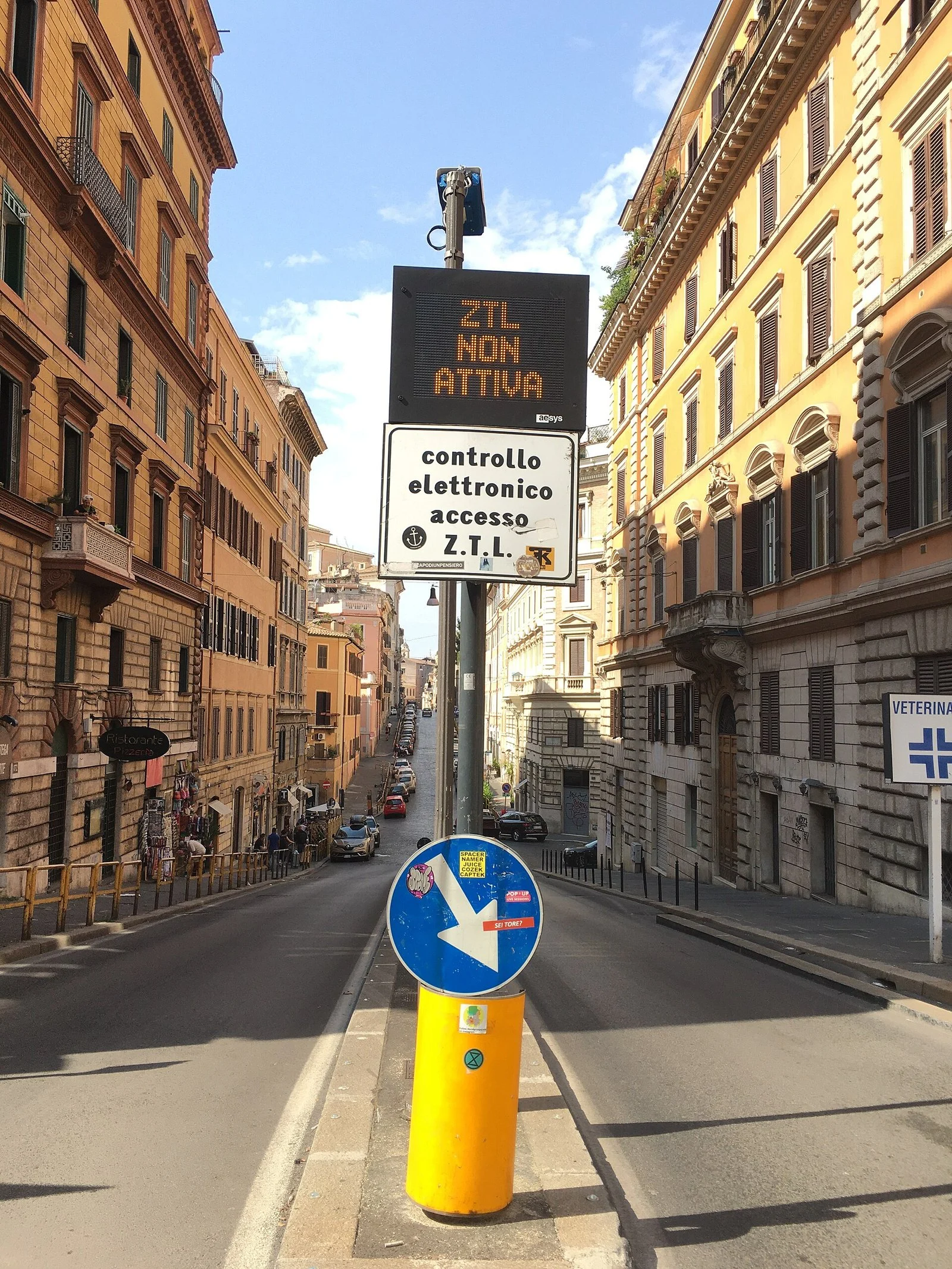
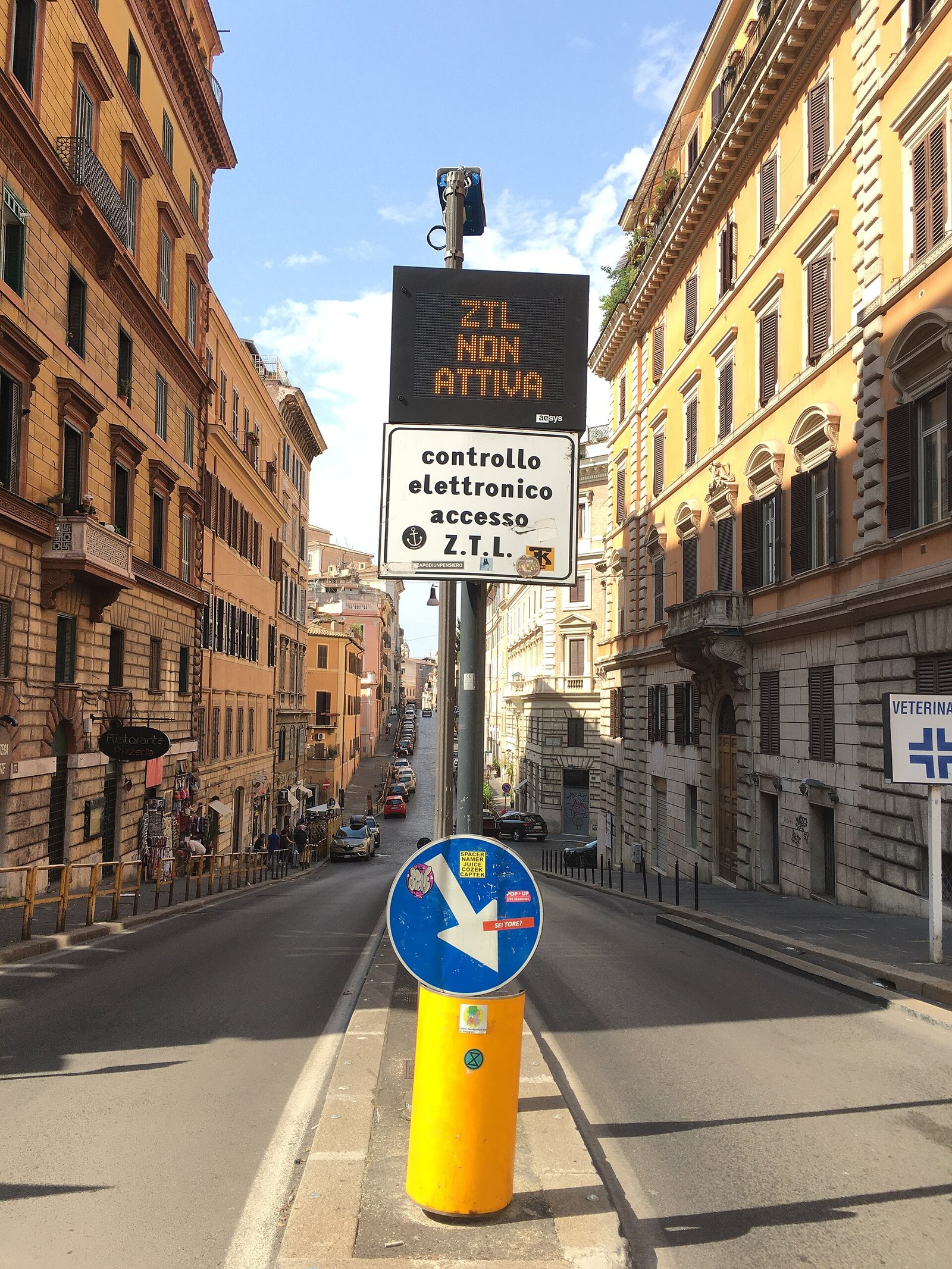
Image: an electronic ZTL gate on a street in the center of Rome, with the illuminated panel and the camera on the pole.
ZTL Centro Storico: the biggest and the most feared
The ZTL Centro Storico of Rome is active, according to the hours published by Roma Servizi per la Mobilità, Monday to Friday from 06:30 to 18:00 and on Saturday from 14:00 to 18:00, holidays excluded. There is a nighttime version of the same zone, on Friday and Saturday nights from 23:00 to 03:00, holidays excluded and suspended in August.
What it includes
The perimeter encloses much of the monumental center between the Tiber and the eastern districts: the Pantheon, Piazza Navona, Campo de' Fiori, the area of the Trevi Fountain, the Capitoline Hill and the streets toward the Roman Forum. The boundary can't be deduced by eye and follows no natural limit: the only serious way to check it is the official map on the portal of Roma Servizi per la Mobilità.
Who can enter
Access is reserved for residents and the categories entitled with a ZTL permit, people with disabilities holding the badge provided by law, taxis and chauffeured hire vehicles and the other categories identified by the ordinances, among them rescue services and police. Electric and hydrogen vehicles follow a specific regulation with a dedicated registration. Mopeds and motorcycles, in the daytime ZTLs of the center, have free access, except for the ZTL Tridente.
A mistake that repeats: Saturday afternoon
On Saturday the ZTL Centro Storico is active only from 14:00 to 18:00, and it is the time that catches more drivers unprepared: in the morning the area is open and many take for granted that it stays so all day. Whoever enters at 13:40 to drop off luggage and leaves again at 14:20 passes twice under the same gate, and the second passage is with the zone active.
ZTL Tridente, zone A1
The ZTL Tridente, indicated in the official acts as ZTL A1, is active Monday to Friday from 06:30 to 19:00 and on Saturday from 10:00 to 19:00, holidays excluded: it is the Roman ZTL with the widest window, and it covers the hours when the shopping district is most crowded.
What it includes
The Tridente is the triangle of streets that opens from Piazza del Popolo along Via del Corso, Via di Ripetta and Via del Babuino, with Piazza di Spagna and the Trinità dei Monti staircase at the center: the greatest density of shops and hotels in the center, and therefore of attempts to enter.
Motorcycles and mopeds: here the rule changes
In the ZTL Tridente the ban also concerns mopeds and motorcycles, which are instead admitted in the other daytime ZTLs of the center: to ride here on a two-wheeler you need a dedicated permit, for which Roma Servizi per la Mobilità publishes a specific service. It is a difference that escapes even many Romans.
Loading and unloading: an experiment under way
From September 7 to December 7, 2026, an experimental loading and unloading regulation applies in the ZTL A1 Tridente and in the neighboring areas of the Centro Storico, which for category N commercial vehicles introduces a ban on access from 08:00 to 18:00 and a ban on circulation, parking and stopping from 09:30 to 18:00, loading bays included. Differentiated slots are provided for some types, among them postal vehicles and catering, and police, emergency vehicles, waste collection and pharmaceutical transport remain excluded. Since it is a fixed-term experiment, whoever organizes a delivery after December 7, 2026 must check which regulation is in force on that date.
ZTL Trastevere: two zones in the same district
Trastevere has two overlapping limited traffic zones: a daytime one, Monday to Saturday from 06:30 to 10:00, and a nighttime one, Wednesday to Saturday from 21:30 to 03:00, holidays included and suspended in August. Whoever visits the district must think in terms of two distinct windows on the same day.
The morning daytime one
The daytime ZTL of Trastevere occupies a short and unusual slot, the first hours of the morning, when deliveries, service vehicles and through traffic toward the center are concentrated on streets that can't bear that load. For a visitor it means that the district, from the point of view of the car, effectively opens at mid-morning.
The nightlife one
The nighttime ZTL was created to contain evening traffic in the area of the bars and restaurants, on the nights from Wednesday to Saturday. Whoever goes to dinner in Trastevere and counts on leaving the car on an inner street must know that after 21:30, on those days, going back to the vehicle is possible but entering by car is not. The district is explored on foot: from the basilica of Santa Maria in Trastevere to the basilica of Santa Cecilia it is a few minutes, and as many from the Museo di Roma in Trastevere to the climb toward the Janiculum. For a complete picture of the district you will find the stops in order on the page about Trastevere and what to see.
The nighttime ZTLs: Testaccio, San Lorenzo and the center
Rome's nighttime ZTLs follow two calendars: Trastevere and San Lorenzo from Wednesday to Saturday from 21:30 to 03:00, holidays included. Centro and Testaccio on Friday and Saturday nights from 23:00 to 03:00, holidays excluded. In August they are not in operation.
Testaccio
The Testaccio district has an exclusively nighttime ZTL, on Friday and Saturday nights, in the area of the bars and restaurants along Monte dei Cocci and around the ex Mattatoio. By day it is accessible and remains one of the few central quarters with rotating on-street parking, especially around the Nuovo Mercato Testaccio. The walking stops are on the page about Testaccio and what to see.
San Lorenzo
San Lorenzo has a nighttime-only ZTL, with the same calendar as Trastevere: Wednesday to Saturday from 21:30 to 03:00. The university district that grew around the basilica of San Lorenzo fuori le Mura concentrates many bars and restaurants on a grid of narrow nineteenth-century streets. By day circulation is free, but parking is almost entirely paid.
The center at night
The nighttime ZTL of the Centro Storico covers Friday and Saturday from 23:00 to 03:00 and is suspended in August, with an effect above all on the areas of bars and restaurants between Piazza Navona, the Pantheon and Campo de' Fiori. For an evening in the center without a car, the page on Rome at night lines up what stays open and how to get around.
Monti, Appia Antica and the pedestrian zones
Not all the districts of the center have an autonomous ZTL: Monti, for example, does not appear in the official lists as a limited traffic zone in its own right, and the part of the district inside the perimeter of the Centro Storico follows the rules of that ZTL. Since the boundary runs through the urban fabric, the check must be done address by address on the official map.
Monti
Monti is the district lying, broadly, between Via Cavour, Via Nazionale and the valley of the Forums. The lower and western part, which descends toward the Roman Forum and the Trajan's Markets, is affected by the regulation of the Centro Storico and by the pedestrianizations of the archaeological area. The upper part toward the Esquilino is more permeable but almost entirely paid parking. The walking route is on the page about Monti and what to see. The practical recommendation is simple: you don't enter Monti by car to park, you get there by metro A or B.
ZTL Appia Antica, the novelty of September 2026
Since September 19, 2026 the ZTL Appia Antica is in operation, active on Saturday and Sunday from 07:00 to 19:00, all year except August. Residents and those domiciled in the area, workers with a contract at businesses inside the zone and vehicles engaged in maintenance for the Capitoline Administration can enter. The permit is free and is requested by certified email from Roma Servizi per la Mobilità. It changes a lot for those planning a day in the Appian Way Park, because the weekend is exactly when most visitors used to arrive by car. The Catacombs of San Callisto and the Villa of the Quintilii remain reachable by public transport and, in the case of the villa, with the entrance on Via Appia Nuova.
On the same road is added the Sunday and holiday closure to motor vehicles on the stretch between Viale di Porta Ardeatina and the Raccordo, indicated by the portal in the slot from 09:00 to 18:00, with the usual exceptions for rescue, public transport and authorized categories.
Via dei Fori Imperiali and Via del Corso
Via dei Fori Imperiali on weekdays is reserved for public transport, taxis, chauffeured hire vehicles and holders of the disabled badge, while on Sunday, on holidays and on the last Saturday of the month the whole stretch is pedestrianized. Via del Corso is permanently pedestrianized between Largo Goldoni and Via delle Convertite. These are stable measures, not ZTLs: here there is no ordinary permit that allows a private car to pass.
Image: the schematic map of Rome's limited traffic zones, with the historic center, the Tridente, Trastevere and the outer perimeter of the Fascia Verde.
ZTL Merci and ZTL VAM: the zones that concern heavy vehicles
Alongside the ZTLs for cars, Rome has two regulations dedicated to goods: the ZTL Merci, which regulates distribution in the Centro Storico, and the ZTL indicated in the official acts as AF1 VAM, inside the railway ring, which concerns large vehicles.
ZTL Merci in the Centro Storico
The distribution of goods in the Centro Storico requires a permit for a fee and follows slots differentiated by weight and environmental category. According to Roma Servizi per la Mobilità, trucks up to 35 quintals of the Euro 4, 5 and 6 classes have a window that starts at 05:30, while for those over 35 quintals it opens at 07:00. For electric and alternative-fuel vehicles over 65 quintals a dedicated regulation applies. Euro 0, 1, 2 and 3 vehicles are excluded from the ZTL Merci and from the ZTL Trastevere. Whoever organizes setups or deliveries in the center must move well in advance: the permit is not obtained the same day.
ZTL AF1 VAM, the railway ring
The ZTL AF1 VAM coincides with the area enclosed by the railway ring, excluding the perimeters of the ZTL Merci, the ZTL Trastevere and the ZTL Centro Storico, which have their own rules. It concerns trucks longer than 7.5 meters, with a ban indicated from 05:00 to 24:00 every day. Vehicles without a permit for a fee can enter by registering online with digital identity and notifying the entry: the authorization is electronic, with no paper badge. The portal indicates validity until December 31, 2026, so whoever uses it for work must recheck the expiry at the start of 2027.
The acronym VAM appears in the acts and on the portal without an explicit expansion, and journalistic sources associate it from time to time with different things, including a hypothesis of charging for access to the center discussed in past years. To avoid confusion, here we treat it for what the official portal describes: a ZTL on the railway ring for vehicles over 7.5 meters.
The Fascia Verde: it's not a time, it's the engine
The ZTL Fascia Verde of Rome, in the regulation in force since November 1, 2025, bans access, circulation and parking for certain categories of vehicles from Monday to Saturday 24 hours a day, midweek holidays excluded. Unlike the other ZTLs it doesn't limit based on the permit but on the environmental class of the vehicle, and it also applies to residents of the area.
Which vehicles cannot enter
According to the official page of Roma Servizi per la Mobilità, the permanent ban concerns gasoline, LPG and methane cars Pre Euro 1, Euro 1 and Euro 2, and diesel, dual fuel and bi-fuel cars Pre Euro 1, Euro 1, Euro 2 and Euro 3. For motorcycles, mopeds and quadricycles it concerns gasoline and diesel vehicles Pre Euro 1 and Euro 1, while for diesel mopeds and motorcycles Euro 2 the portal indicates an exemption until October 31, 2026.
The exemptions
The following remain admitted, among others: vehicles serving people with disabilities with a badge, rescue, police and public transport vehicles, diplomatic vehicles, vehicles of the environmental services and historic vehicles in the cases provided by law, as well as gasoline cars powered by LPG or methane registered before November 1, 2024. The full list is the one published on the portal: it's best to read it in full, because the categories are many and worded in technical terms.
The emergency smog measures
To the ordinary regulation are added temporary measures that trigger when the monitoring stations record repeated exceedances. The portal describes two levels: after 4 consecutive days of exceedance the ban extends to other classes, among them gasoline Euro 3 and diesel Euro 4. After 10 consecutive days the limitation reaches, in a daytime slot, diesel Euro 5 and Euro 6 as well. The checks are indicated on Monday and Thursday on regional data. For a visitor it means that a limitation can appear with a few days' notice: traveling in winter with a diesel, checking the portal before leaving is not excess caution.
How big the Fascia Verde is
The perimeter of the Fascia Verde is much wider than that of the central ZTLs and includes a good part of the consolidated city. The mobility portal offers an interactive map where you enter an address and get the answer: it is the tool to use, because the descriptions in words of the boundary circulate in different versions that don't coincide.
Ecological Sundays and traffic blocks
Rome's ecological Sundays are days on which the circulation of motor vehicles is suspended inside the ZTL Fascia Verde in two time slots, according to a calendar set every year by the Administration. For the 2026 and 2027 season the announced dates are November 15, 2026, December 6, 2026, January 24, 2027, February 21, 2027 and March 21, 2027, with the block in the slots from 07:30 to 12:30 and from 16:30 to 20:30.
Who moves anyway
During the block slots, travel on foot, by bicycle and with electric and hybrid vehicles remains possible, as well as the exempted categories, and public transport stays in service. For those visiting the city they are among the best days of the year for walking in the center: the background noise drops noticeably.
How to check the dates
The calendar can be supplemented or changed during the season, and in the past the number of Sundays has changed compared with the initial announcement. The valid dates are those published by Roma Capitale and Roma Servizi per la Mobilità: whoever arrives by car on a winter weekend must check them, because the block concerns a very large area and not only the center.
Electronic gates, fines and appeals
The control of access to Rome's ZTLs is done with electronic gates, fixed stations equipped with approved cameras that read the plate of passing vehicles: when the gate is active and the plate is not authorized, the detection results in a violation notice served on the owner of the vehicle.
How to recognize a gate
The gates are signaled by signs that indicate the start of the zone and the hours in force and, in most cases, by an illuminated panel on the activation status. The panel is an aid, not a guarantee: the ban comes from the ordinance and the vertical signage remains the reference even when the panel is off because of a fault.
When the fine is triggered
The fine is triggered on passing under the gate during the hours in force without an access title. You don't need to stop or park, the distance traveled doesn't count: the passage is the offense. Two practical consequences: turning around right after the gate cancels nothing, because the detection has already happened, and each gate is a separate detection, so a pointless loop in the center can produce several notices on the same day. On the amounts we give no figures: the fines are set by the Highway Code, are updated periodically and vary according to the offense charged, so the only correct reference is the one indicated on the notice.
Rental cars and foreign plates
Whoever drives a rental car doesn't receive the notice directly: it goes to the owner company, which communicates the driver's data to the enforcing body and generally charges the customer a sum for handling the case, provided for in the contract. The fine itself arrives later, at the driver's address. The same mechanism, with longer times, concerns foreign plates: it is the reason why a fine taken in spring can arrive at the end of the year.
If you believe you are right
Against a ZTL violation notice, the ordinary remedies of the Highway Code apply: an appeal to the Prefect or to the Justice of the Peace, each with the strict deadlines indicated in the notice. Documentable cases have a basis: a valid permit not registered, a medical emergency, a detour imposed by a construction site or an event, signage that was physically absent. Not having seen the sign is not one. Before appealing it's best to get the authorization paperwork from the accommodation, because without it the appeal remains an assertion.
Hotels inside the ZTL: the procedure that saves you from the fine
Whoever has booked a hotel inside a ZTL in Rome doesn't have to ask for any permit on their own: it is the accommodation, if accredited to the system of Roma Servizi per la Mobilità, that communicates the customer's plate so that passing under the gate doesn't generate a fine. It is the point that generates the most misunderstandings, and it is also the easiest to solve: a phone call made at the right time is enough.
How the mechanism works
Accommodations inside the limited traffic zones can accredit themselves with Roma Servizi per la Mobilità and access an electronic system through which they communicate the plates of their customers. It is not a permit issued in advance: the property enters the plate and the passage is traced back to the authorization. The deadline within which the communication must be made relative to the passage is set by the Administration and is close, several non-institutional sources indicate 72 hours, but we find no confirmation on the official pages consulted, so we don't give it as certain. The operating rule stays the same: communicate the plate to the property before arrival, or at the latest at check-in.
What to ask when booking
Three questions, to be asked in writing so that a record remains. If the address falls inside a ZTL, and which one. If the property is accredited for communicating plates, and to whom the plate should be communicated. If there is a parking space or a partner garage, and at what rate. A vague answer to the second question is a signal: many small properties, especially non-hotel accommodations, are not accredited, and then the only correct solution is to leave the car outside the ZTL and reach the lodging on foot or by public transport.
The mistakes that cost dearly
The first mistake is arriving without notifying anyone, convinced that the reservation is enough: nobody sees it, the gate reads the plate. The second is communicating the wrong plate, which is frequent with rental cars. The third is entering the ZTL several times during the stay, taking for granted that the authorization covers all passages: it must be clarified with the property which and how many passages are covered. The fourth is relying on the GPS navigator, which calculates the shortest route and doesn't know the status of the gates at that minute.
The solution we recommend most often
For a stay of two or three nights, the simplest option remains leaving the car in a park-and-ride lot connected to the metro and never bringing it into the center: it costs less than a garage, eliminates the risk of a fine and saves the time lost looking for a space. Whoever needs the car for a day trip picks it up that day and brings it back in the evening.
Where you can really park in Rome
In Rome parking is divided into three families: park-and-ride lots connected to public transport, paid parking in structures and on-street parking, where the color of the lines determines the rule.
The park-and-ride lots
The park-and-ride lots let you leave the car at rates discounted for long stays and continue toward the center by public transport. They are at stations of metro lines A, B and C, stops of the metropolitan railways and bus terminals. Among the main ones, Anagnina, Battistini, Cipro and Arco di Travertino on A. Laurentina, Ponte Mammolo, Rebibbia, Magliana, Ostiense, Annibaliano, Conca d'Oro and Jonio on B and B1. Pantano, Grotte Celoni, Giardinetti and Borghesiana on C. Other hubs serve the regional railways, from Saxa Rubra to La Storta, from Nuovo Salario to Tiburtina.
The rates are modest and structured by duration, with 12 and 16 hour formulas, and monthly and annual Metrebus pass holders get free parking at the participating facilities. Atac also reports night-time charging at some facilities from October 1, 2026. Since the rates are updated, we don't set them here: the reference is the Atac parking page, where each facility has its own sheet.
Parking structures near the center
There are parking structures on the edges of the center, some with non-binding rates, among them those flagged by the mobility portal at the Auditorium Parco della Musica, at Ostiense station, at Metronio, at Trieste and at Trastevere. The hourly cost is higher than that of the park-and-ride lots, but remains lower than that of a fine. A point often overlooked: being inside a parking lot doesn't cure how you got there. If to reach it you crossed an active gate, the fine has already been triggered.
The blue lines
The blue lines indicate paid parking. You pay at the parking meter, with coins or card at the enabled stations, or with the apps partnered with Roma Capitale, among them easyPark, Telepass, MooneyGo, ParkingMyCar, Tabnet, ParkAppy, DropTicket and Smarticket. The hourly rates indicated by Atac distinguish between areas inside and outside the ZTLs, with discounted formulas for short and long stays and a monthly pass, and in some non-residential areas a reduced proximity rate applies. Since rates and perimeters are reviewed regularly, and a program is under way to convert spaces that are free today into paid parking, the reference is the parking meter and the Atac interactive map.
Two useful exemptions to know: electric and hybrid vehicles park for free on the blue lines after registration, without needing a badge, and the same goes for vehicles powered by LPG combined with a hybrid engine. Car sharing vehicles are also exempt from payment.
White, yellow and pink lines
White lines indicate free parking at no charge: in the center they are by now rare and, where they exist near hospitals, they may have a duration limit with an obligation to use a parking disc. Yellow lines are reserved for specific categories, among them vehicles serving people with disabilities, rescue vehicles, public transport stops and, on some streets, loading and unloading: parking there without a title exposes you to towing as well as a fine. Pink lines are the spaces reserved for pregnant women and parents with small children.
Image: a park-and-ride lot on the outskirts of Rome, with parked cars and the entrance of the metro station in the background.
Car sharing, sharing and alternatives to your own car
In Rome shared mobility includes car sharing, scooters, bicycles and electric scooters, run by private operators with the exception of the municipal Car Sharing Roma service. It is the most sensible alternative for those who need a car for a few hours and don't want to deal with either ZTLs or parking.
What is active
The mobility portal indicates two car sharing operators as active, among them the municipal Car Sharing Roma service, in station-based mode, with reserved spaces and booking in the central and semi-central areas, at EUR, at Acilia and at Ostia. Alongside operate three electric scooter services, two electric bicycle services and one scooter service, all with a minimum age of adulthood and reduced speed limits in pedestrian areas. The picture changes even within a few months: it's best to check on the portal which services are active at the time of the trip.
Why car sharing solves the ZTL problem
Car sharing vehicles are among the categories that can access the limited traffic zones and are exempt from paying for parking on the blue lines: you take a car for an hour, cross the city and leave it without thinking about permits, parking meters and gates. It isn't useful for a day trip out of town, because the service areas remain within the municipal territory and the time-based rates weigh on long distances, but for trips within the city it is the best solution.
Renting a car in Rome: when it makes sense and when it doesn't
Renting a car to visit the city of Rome almost never makes sense, because the vehicle sits in a paid garage for much of the stay and every trip carries a risk of entering a ZTL. Renting it for the two or three days dedicated to outings from Rome, instead, pays for itself in time gained.
The calculation worth making
Before booking, four items must be lined up: daily rate, cost of the parking space for all the nights of the stay, fuel and tolls, residual risk of a fine. Against that total you must set the cost of tickets for the same destinations and the actual travel time. In most cases the calculation says the same thing: rental limited to the days of the trips, pickup and return on the outskirts or at the airport, no car in the center.
Where to pick up the car
Picking up the car at a location near a peripheral metro station, or at the airport arriving by train, avoids crossing the center in both directions and eliminates at the root the riskiest part of a Roman rental. Whoever picks up in the center must have the operator indicate the exit route that doesn't cross active gates, and must not trust the navigator.
What to ask at signing
Three things. How fines are handled and what amount is charged for the administrative handling. What the environmental class of the vehicle is, because a not-recent diesel can be excluded from the Fascia Verde and in that case the rental is unusable in the city. If the vehicle has telepass and devices for parking. This is information the contract contains but that is often read only afterward.
The day trips out of town where a car is really useful
The car finds its usefulness when you leave the Raccordo: Tivoli, the Castelli Romani, the lakes to the north and the coast are reachable by public transport, but with schedule constraints that in a single day make the difference between two visits and one.
Tivoli and the Aniene valley
You reach Tivoli by train or by bus, but the day that puts together Hadrian's Villa and Villa d'Este works better by car, because the two sites are far apart and the local connection imposes waits. Whoever drives must however check the parking rules in the center of Tivoli, which has its own municipal regulation.
The Castelli Romani
The Castelli Romani Park is the case where the car really changes the day: Frascati, Nemi and the other towns are close to each other but connected by slow public transport, and Lake Nemi is inconvenient to reach without your own vehicle. On good-season weekends parking in the small towns is very limited and temporary closures are put in place.
The lakes to the north
Lake Bracciano with the Odescalchi Castle and the Bracciano Martignano Park is served by the regional railway, but going around the lake and reaching the shores require a car.
Ostia and the coast
For Ostia Antica you don't need the car: the Roma Lido railway connects the center to the archaeological site and to the village of Ostia Antica, and the parking lot at the excavations fills up early on summer weekends. It is the day trip worth doing without a car.
Destinations within Rome that seem far and aren't
Some destinations seem to require a car and don't. The EUR is on metro line B. The Centrale Montemartini is a few minutes from Garbatella station. The MAXXI and the Auditorium Parco della Musica are served by tram 2 from the Piazzale Flaminio station. The Baths of Caracalla are a 10 minute walk from the Circo Massimo metro, next to the Circus Maximus. The Coppedè district is reached by tram. Bringing the car to these places only adds the parking problem.
How to organize your stay without a car
Rome is visited on foot and by metro, and most itineraries built over two or three days never require a car: the distances between the main places are walkable and the three metro lines cover the axes you need.
The ready-made itineraries
Those short of time will find the stops in order on the itinerary pages: a weekend in Rome in two days, three days in Rome and a week in Rome. All three are built on routes on foot and by public transport, and show how much of a stay takes place inside the ZTLs: almost all of it.
When the weather or tiredness change the plans
On rainy days the temptation to use the car is strong and is almost always a mistake, because traffic gets worse. The indoor alternatives are on the page about Rome when it rains, while those traveling with children will find routes calibrated to their distances on the page about Rome with children. To keep costs down, finally, the page on free museums in Rome and the one on free Rome flag the free-entry openings, which on the first Sundays of the month often coincide with the days of greatest crowding.
The areas where a car is more useless than elsewhere
There are quarters where bringing a car is time lost from the start. The quadrilateral between the Tiber, Via del Corso, the Capitoline Hill and Piazza Navona, with narrow streets and almost no parking. The area of the Vatican and of St. Peter's Basilica, where lines and security measures often change traffic flow. The riverfront around Castel Sant'Angelo and the Tiber Island. And the archaeological valley between the Mouth of Truth, the Circus Maximus and the Colosseum, where the restrictions add up to the pedestrianizations.
Frequently asked questions about Rome's ZTL
What are the hours of the ZTL of the historic center of Rome?
The ZTL Centro Storico of Rome is active Monday to Friday from 06:30 to 18:00 and on Saturday from 14:00 to 18:00, holidays excluded, according to the hours published by Roma Servizi per la Mobilità. There is also a nighttime ZTL on the same area, in operation on Friday and Saturday nights from 23:00 to 03:00, holidays excluded and suspended in the month of August. The hours can be changed by ordinance: they must be rechecked on the official portal before setting out.
Can I enter the ZTL in Rome if I booked a hotel?
Yes, whoever stays in a hotel located inside a ZTL in Rome can enter, but only if the property is accredited with Roma Servizi per la Mobilità and communicates the vehicle's plate through the electronic system provided. The reservation alone authorizes nothing, because the gate reads the plate and doesn't know about reservations. It's best to communicate the plate to the property when booking, get written confirmation that it will be entered and ask how many passages are covered.
What is the difference between the ZTL and the Fascia Verde in Rome?
The ZTL limits access to an area in certain time slots to those without a permit, while the Fascia Verde bans circulation based on the environmental class of the vehicle, Monday to Saturday 24 hours a day, midweek holidays excluded, in the regulation in force since November 1, 2025. A modern car without a ZTL permit doesn't enter the center but can drive in the Fascia Verde. A very old car with a ZTL permit can be excluded from the Fascia Verde.
Are Rome's ZTLs active in August?
In August Rome's nighttime ZTLs are not in operation, while the daytime ZTLs remain regularly active with the usual hours, as Roma Servizi per la Mobilità indicates. The ZTL Appia Antica too, operating on Saturday and Sunday from 07:00 to 19:00, is indicated as suspended in the month of August. The suspension concerns only the limited traffic zones: the permanent pedestrian areas, such as the central stretch of Via del Corso, stay closed to traffic all year.
How do I know if the ZTL gate was active when I passed?
The activation status of a ZTL gate in Rome depends on the ordinance that governs that zone, and the vertical signage at the entrance gives the days and hours in force. Most gates also have an illuminated panel that signals if it is active at that moment. The panel is an aid and doesn't replace the sign: if it is off because of a fault, the time indicated by the signage remains valid. The official hours are published on the portal of Roma Servizi per la Mobilità.
How much does it cost to park on the blue lines in Rome?
Parking on the blue lines in Rome is charged by the hour, with different rates between the areas inside the ZTLs and those outside, and with discounted formulas for short stays, for prolonged stays and with a monthly pass, according to the rate table published by Atac. Payment is made at the parking meter or through the partnered apps. Since rates and perimeters are reviewed periodically, the valid reference is the one displayed on the parking meter and on the Atac parking map.
Can electric vehicles enter Rome's ZTLs?
For electric and hydrogen vehicles Roma Servizi per la Mobilità provides a dedicated access regulation for the limited traffic zones, with a specific registration service: access is not automatic and must be requested following the procedure indicated on the portal. Electric and hybrid vehicles also enjoy free parking on the blue lines after registration, with no paper badge. The conditions and any expiry dates of the benefits must be checked before the trip.
When are the ecological Sundays in Rome?
The ecological Sundays in Rome announced for the 2026 and 2027 season are November 15, 2026, December 6, 2026, January 24, 2027, February 21, 2027 and March 21, 2027, with the circulation block inside the ZTL Fascia Verde from 07:30 to 12:30 and from 16:30 to 20:30. The calendar can be supplemented during the season and the valid dates are those published by the institutional website of Roma Capitale. Travel on foot, by bicycle and with electric and hybrid vehicles remains allowed.
Is it worth renting a car to visit Rome?
To visit the city of Rome, renting a car is not worth it, because the monumental area is almost entirely included among limited traffic zones, pedestrian areas and paid parking, and the vehicle sits in a garage for much of the stay. Renting makes sense instead limited to the days dedicated to day trips out of Rome, picking up and returning the vehicle at a peripheral location or at the airport so as not to cross the center.
Who wrote this page
This page is curated by the editorial team of Tour Leader Pro, the Roman project office that designs and coordinates visits, itineraries and cultural events in Rome and Lazio. The hours, fares and access conditions given here were checked on the publication date against the official sources named in the text: it's best to recheck them before you leave, because they change often. If you find outdated information, let us know.
If you are building a Roman itinerary and have to make transfers, opening hours and access constraints fit together, for yourself or for a group, you will find planning tools at Tour Leader Pro, which gathers materials made for those who lead visits and for those who organize on their own.
For the overall picture on rail connections, rentals, airports and destinations in Lazio beyond the center of Rome, from the Castelli to the lakes to the coast, Italy Planner is a good resource.