Nemi (RM)
In short. Nemi si trova in Piazza Roma, 00074 Nemi (RM), sitting right on a sheer drop above the lake of the same name in the central sector of the Alban Hills, within the boundaries of the Castelli Romani Regional Park.
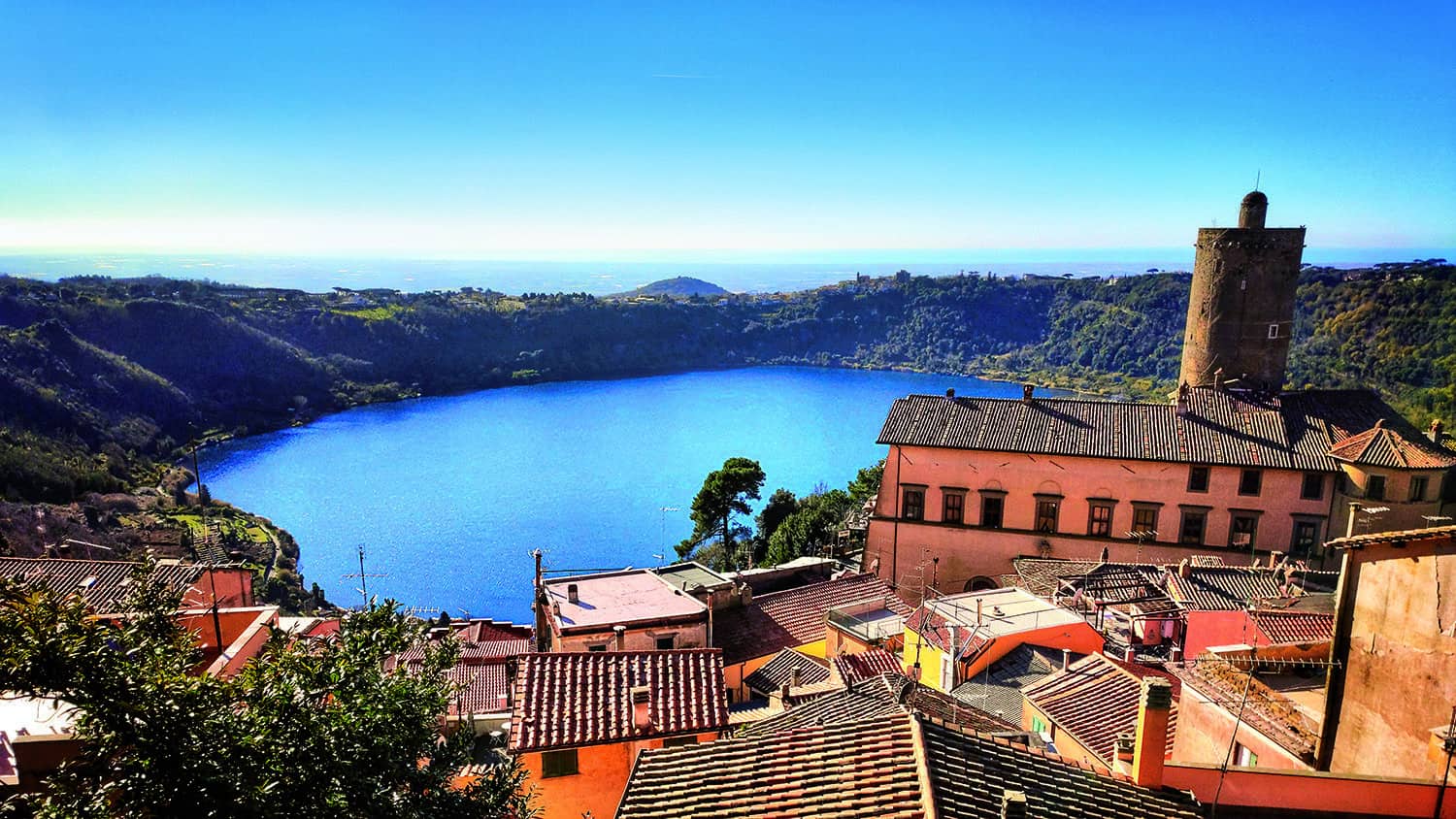
Nemi si trova in Piazza Roma, 00074 Nemi (RM), sitting right on a sheer drop above the lake of the same name in the central sector of the Alban Hills, within the boundaries of the Castelli Romani Regional Park. You can get there by car from via dei Laghi (Strada statale 217), which climbs from Ciampino toward the Alban craters. If you prefer public transport, you should know that the Castelli Romani area is served by Cotral regional buses departing from the Anagnina terminus, on the extension of Metro A. Check schedules and stops on the operator's official website before setting out. The village itself is open and free to visit: you can stroll freely through the historic center and along the lookout. The ticket that matters is for the Museo delle Navi Romane, in via Diana, which displays what remains of the place's most famous archaeological story: full price 5 euros, reduced 2 euros, open from 9 to 19 with last entry at 18, closed on Mondays, as well as January 1 and December 25. The sanctuary of Diana Nemorense, at the foot of the crater, is a separate archaeological area, and it's worth checking access each time with the Comune and the Soprintendenza. Below you'll find the full visit: village, temple, museum, lake and history, told in full.
Nemi is the smallest comune in the Castelli Romani, just under 2,000 inhabitants, perched 521 meters above sea level on a spur that overlooks the lake on one side and opens the view toward the sea on the other. From here you can go down to Ariccia and Genzano di Roma, reach Albano Laziale and the nearby Lake Albano, and within a few minutes' drive you reach all of the Castelli Romani Park. If you want to keep the stops of a day trip together, you can save them in Il mio viaggio and build your itinerary at your own pace.

Why It's Called Nemi: Diana's Woodland
The name Nemi comes directly from the Latin "nemus," which means woodland. Not just any woodland: with that word, often extended to "nemus Dianae," "nemus Aricinum," "nemus Artemisium" or "Cynthiae fanum," the ancients referred to the temple of Diana that stood on the shores of the lake. The entire forest around the water was dedicated to the goddess of woods and hunting, and that cult lasted until paganism was outlawed by the Theodosian decrees of 391. In the Middle Ages the area continued to be called simply "Nemus," in the forms "massa Nemus" and "castrum Nemoris," and this is how the name entered Italian. The scholar Emanuele Lucidi also records archaic variants of the place name, already out of use by the late 18th century, such as "Nemore," "Neme," and "Nemo." So anyone arriving in Nemi sets foot in a place whose name bears the signature of a goddess: the woodland is the goddess, and the goddess is the woodland.
Nemi, the Lake and Diana's Mirror
Lake Nemi fills a small volcanic crater with steep, wooded rims. The ancients called it "speculum Dianae," Diana's mirror, because its still surface reflected the moon and the sanctuary standing beside it. It is a closed basin, with no significant inflowing streams, fed by springs and regulated, since very ancient times, by an outlet channel cut into the rock. The setting has not changed much: anyone looking out from the village lookout sees the same oval of water that pilgrims heading to the temple once saw. The color shifts from green to blue depending on the light, and on clear days the crater floor holds a stillness that has fed legends and superstitions for centuries.
A Curiosity About Nemi (RM)
The curiosity worth the trip is not a monument but a rule of blood. The temple of Diana Nemorense was presided over by a priest called Rex Nemorensis, the King of the Grove, and that title was won in a way that even the ancients considered savage. Only a runaway slave could aspire to it: he had to enter the sacred grove, break a branch from a specific tree that no one else was allowed to touch, and then face the reigning priest in a fight to the death. If he killed him, he took his place. From that moment on he lived with a sword in hand, knowing that another runaway would sooner or later come to do to him what he had done to his predecessor. Strabo, in the "Geography," speaks of a barbaric, Scythian rite and describes the priest always armed, looking around while waiting for an attack. Ovid, in the "Fasti," puts it bluntly: that king reigns with strong arms and swift feet, and dies by the example he himself set. It is not a romantic fantasy of the 19th century: it is a custom attested in ancient sources, although its origin is lost in myth.
The Branch That Opens the World of the Dead
The branch the slave tore off was not a scenic detail. Ancient tradition identified it with the bough that, on the order of the Sibyl, Aeneas gathered before descending into the world of the dead in the sixth book of Virgil's Aeneid. It is the famous golden bough: whoever picks it has the right to cross the threshold that separates the living from the dead. At Nemi that symbolic gesture became flesh, because breaking the branch meant challenging death for real, in a duel. This welding of the Virgilian myth and the Nemorensian rite is the reason the small lake of the Castelli Romani ended up, many centuries later, at the center of one of the most influential books of modern anthropology.
Something Nobody Tells You About Nemi (RM)
Few know that Lake Nemi gave its title to a masterpiece, and those who do often tell it crooked. In 1890 the Scottish anthropologist James George Frazer published "The Golden Bough", "Il ramo d'oro", starting precisely from the riddle of the King of the Wood of Nemi: why did a priest have to be killed by his successor? From that question Frazer built a monumental comparative inquiry into the rites of the sacred king and of the gods who die and are reborn, a work that grew edition by edition, from the two volumes of 1890 to the 12 of the early 1900s, up to the one-volume abridgement of 1922. The little-known detail is the title: Frazer took it from a painting by William Turner of 1834 called "The Golden Bough". Frazer believed that painting depicted Lake Nemi, and he wrote so. In reality Turner had painted Lake Avernus, the other volcanic body of water tied to the descent to the underworld. The error of a great scholar ended up tying the name of Nemi forever to a canvas that portrays another lake. It is the kind of short circuit that makes this place more interesting than its size would lead you to suspect.
Egeria, the Nymph Who Wept Until She Became a Spring
Alongside the cult of Diana lived two others, less famous but just as rooted. The first is that of Egeria, the nymph advisor of Numa Pompilius, the second king of Rome. The legend, also collected by Ovid, tells that at the king's death Egeria wept so much and for so long that Diana, out of pity, turned her into a perennial spring. That spring is connected by tradition to the remains near the aqueduct of the Mole, on the eastern shore of the lake. The second cult is that of Virbius, the name under which Hippolytus, the son of Theseus, was venerated: according to Pausanias it was Hippolytus himself, brought back to life and hidden at Aricia, who founded the sanctuary and established that the priesthood be won in a duel between runaway slaves. Diana, Egeria and Virbius form the small trinity of the wood: the goddess, the nymph of the waters and the risen hero. A few lines of a guide do not do them justice, but knowing they exist changes how you look at the forest around the lake.

The Sanctuary of Diana Nemorensis at Nemi
The sanctuary of Diana Aricina, or Nemorensis, occupied an area of about 45,000 square meters, with a perimeter of 200 meters by 175, supported on the downhill side by triangular substructures and on the uphill side by large semicircular niches, which probably held statues, above which ran an upper terrace. Inside the platform opened two porticoes of the Doric order, one with columns plastered in red, the other with columns of dark gray peperino. The complex included statues, rooms for the priests, lodgings for pilgrims, votive cells, a temple, hydrotherapy baths and even a theater. Of all this today you can read a wall of large niches, a portion of the pronaos with at least one votive altar and some columns. Most of the sacred building, which spread over more than 5,000 square meters, is still buried: the niches that emerge from the ground for several meters let you guess how imposing the whole must have been.
Diana Nemorensis at Nemi: From the Excavations to the Museums of Europe
Heavily frequented until the late imperial age, the sanctuary was abandoned with the affirmation of Christianity and partly stripped of marbles and decorations. Then the forest took it back almost entirely. The excavations began in the 17th century, carried out above all by foreign amateurs and scholars, and that is why most of the finds, statues of splendid workmanship first among them, today are scattered in the museums of half of Europe. Other pieces are in the Museum of the Roman Ships and in the Roman museums of Villa Giulia and the Baths of Diocletian. Anyone who wants to go deeper into the sacred area can read the page dedicated to the Sanctuary of Diana Nemorensis. Here it is enough to say that you walk on one of the most important places of worship of ancient Latium, religious center of the Latin League after the destruction of Alba Longa, around the middle of the seventh century BC.

The Festivals of Diana and the Origins of Ferragosto
The great festival of the goddess, the Nemoralia, was held at the sanctuary on the Ides of August. On the nights around August 13, the woods and shores lit up with torches and oil lamps, reflected in the still water of the lake, while women climbed in procession to fulfill vows and ask Diana for protection, also patroness of childbirth. Many scholars see in this celebration one of the pagan roots of Ferragosto, later absorbed and redefined by the Christian calendar. It is the kind of continuity you can see for yourself in Nemi: beneath the food festival and the café tables of the historic center runs a religious memory more than 2,000 years old.
The Museo delle Navi Romane in Nemi
The Museo delle Navi Romane stands on the lakeshore, on Via Diana. It was built in the 1930s to protect the hulls just recovered from the water, and it is an unusual building, because it was designed to fit its contents: a double concrete hangar matching the exact dimensions of the two ships, which were just under 80 meters long. The project was carried out free of charge by architect Vittorio Ballio Morpurgo, who wanted it with large glass surfaces and created a walkable terrace on the roof, from which the lake offers a new viewpoint, from the shore but at an elevated position. The opening took place on April 21, 1940. After the ships burned in 1944, the museum remained closed for a long time.
What You Can See Today at the Museo delle Navi Romane in Nemi
Restored, the museum today houses a stretch of the ancient Via Sacra, 1:5 scale models of the two ships, built in the shipyards of Castellammare di Stabia between 1950 and 1952 based on the many technical drawings made by Navy engineers at the time of the recovery, illustrated panels, the material that survived the fire, and finds from the temple of Diana. In front of the entrance stands the profile of one of the ships, reconstructed by the master shipwrights of the Torre del Greco shipyards. The initiative came from a private association, the Dianae Lacus, which started the project to fully rebuild one of the vessels: the reconstruction will be full-size and navigable within the limits set by scientific data, and once finished, the ship should be moored in the lake in front of the museum to host studies, guided tours, shows, exhibitions and concerts. Those who want details about the museum can also check the page for the Museo Nemorense delle Navi Romane. Admission is five euros for a full ticket and two euros for a reduced ticket, opening hours run from 9 to 19 with last entry at 18, and the closing day is Monday.

The Ships of Caligula in Lake Nemi
The two ships are Nemi's most spectacular memory of the Roman era. Measuring 64 and 71 meters respectively, for centuries they have captured the imagination of anyone who knew they lay at the bottom of the lake. Their use was guessed to be festive and even orgiastic, but the most widely accepted hypothesis today is that they were sacred ships of Diana, or of Isis. Many guesses have also piled up about who commissioned them, which scholarly consensus has narrowed down to the emperors Tiberius or Caligula. Attempts to recover them were made repeatedly starting in the 1400s, to the point that at one stage the existence of three ships was hypothesized. Only between 1929 and 1932 was a massive expedition organized that, by draining the lake by a full 22 meters, managed to bring the two boats ashore and house them in the museum built for the purpose.
The Fire of 1944
Their end was brutal. On the night between May 31 and June 1, 1944, the museum and both ships went up in flames. Responsibility was officially attributed to retreating German soldiers. In just a few hours, what 20 centuries of water had preserved burned, and today only the models, the few salvaged materials, and the drawings remain of the original hulls. It is a loss that Nemi still feels, and it explains why the full-size reconstruction has become, for the town, a kind of redemption.
The Roman Emissary of Lake Nemi
Hidden in the valley of the lake is another remarkable work: the artificial emissary. Tradition dates it to the 5th century BC, therefore before Roman rule. It is a tunnel 1635 meters long and 80 centimeters wide, cut into the rock, that connects the lake to Vallericcia, beyond the crater rim, with the dual purpose of keeping the water level constant and irrigating the valley. The walls still show the marks left by the workers' rudimentary tools. They dug from the two opposite ends and met in the middle with a minimal gap, proof of surprising technical skill for the period. The mouth has an entrance chamber in square-cut peperino stonework and a very effective system of sluice gates. From Vallericcia the channel continues in the open air, passes through Cecchina and reaches Ardea, where it flows into the sea. Restored in the 1920s to help drain the lake during the recovery of the ships, it can be walked along in full today.
The Villa of Caesar near Nemi
Among the Roman remains in the area there is also the villa of Gaius Julius Caesar. Its existence in the Arician territory, near the temple of Diana, is attested by Cicero and Suetonius: the villa was probably built between 61 and 58 BC, but, according to Suetonius, it did not satisfy Caesar, who had it razed to the ground. Later studies have however shown that the definitive abandonment of the site should be placed between the 3rd and 4th centuries, a sign that something continued to live there well beyond the dictator.
What to See in Nemi: the churches of the village
The historic center of Nemi preserves a small collection of religious architecture, some still standing, others reduced to ruins. It's worth visiting them in order, because each one tells a piece of the town's story.
The Church of San Nicola in Nemi
The church of San Nicola was built after the Edict of Milan of 313, which liberalized Christian worship. Today it is completely in ruins, and its remains can be seen near the Acquedotto delle Mole, on the eastern shore of the lake. Next to it, the remains of a complex with apses, tunnels and masonry emerge, most likely a thermal bath installation. Tradition places the spring of the nymph Egeria above it. The structure is dated between the 1st century BC and the 4th century, that is, in the period of the greatest splendor of the temple of Diana, and it bears witness to how densely populated with buildings the sacred valley was.
The Romitorio of San Michele Arcangelo and the Church of Santa Maria
Not far away stood the Romitorio di San Michele Arcangelo, a small hermitage that dotted the woods. The church of Santa Maria, also in ruins today, stood on the opposite shore of the lake at an uncertain date and housed, until its demolition, the icon of the Virgin of Versacarro. It was abandoned in 1637, when the Capuchin Friars Minor left the site, which Ascanio I Colonna had granted them as a residence in 1534, to move to the new convent built for them in Genzano di Roma, next to the church of San Francesco d'Assisi. Nothing of this Santa Maria remains, and it is hard even to pinpoint exactly where it stood.
The Parish Church of Santa Maria del Pozzo in Nemi
The town's main church is the parish church of Santa Maria del Pozzo. It was built to replace the palace chapel erected by the Cistercians, which stood on an area now occupied by the Ruspoli castle and which was demolished in the 16th century to make room for the expansion of the castle itself. The chapel was dedicated to Mary "de puteo," of the well, because it stood next to a well at which, according to tradition, the Virgin appeared to some young women of the town. The remains of that well were found during the castle's restoration. The church, which the Frangipane wanted to dedicate to the Immaculate Conception, has nonetheless kept the name Santa Maria del Pozzo, although the inscription on the façade, added only in 1934, would have it dedicated to the Assumption.
The Triptych by Antoniazzo Romano in Nemi
The interior deserves attention. The church has a single nave with six side chapels and a transept, and it houses the 16th-century altarpiece from the old chapel, with the image of the Madonna del pozzo and the town's patron saints, the apostles Philip and James. The most precious piece, however, is a wooden triptych of the Antoniazzo school, that is, attributed to the circle of Antoniazzo Romano, datable between the second half of the 15th century and the early 16th century. It depicts Christ at the center, flanked by Saint John the Baptist and Saint John the Apostle and Evangelist. Antoniazzo was the leading Roman painter of the later 15th century, an artist who combined local tradition with the Tuscan and Umbrian innovations: finding an echo of him in a village parish church shows how much the area was swept up in the artistic currents of Rome under the popes.
The Sanctuary of the Santissimo Crocifisso in Nemi
The sanctuary of the Santissimo Crocifisso, formerly dedicated to Santa Maria di Versacarro, was founded in 1637 by Marquis Mario Frangipane to house the Franciscan fathers after the Capuchins had moved to Genzano. The friars arrived in 1645 and the new church was dedicated to the Madonna di Versacarro. In 1669 a wooden Crucifix was displayed there, the work of Brother Vincenzo da Bassiano, which tradition says was found miraculously already finished: from then on the place took the name Sanctuary of the Crucifix. In 1675 Father Felice da Napoli painted some works on the walls. The ancient icon of the Virgin of Versacarro was stolen in February 2002 and found on March 30, 2006 in Messina by the police, a happy ending that Nemi still remembers with relief.
Palazzo Ruspoli, the Castle of Nemi
Palazzo Ruspoli looks down over the town from above. Built in the Middle Ages by the Counts of Tusculum and renovated in the Renaissance, it is organized around a cylindrical tower around which the baronial building developed. Inside, it keeps ancient marble fragments and 18th-century tempera decorations by the painter Liborio Coccetti, spread across several rooms, and others from the 19th century. Surrounded by a hanging garden, it is one of the most beautiful palaces in all the Castelli Romani. The truth, though, has to be told without beating around the bush: today it is in a state of abandon, with propped-up doors and ceilings, fireplaces and floors removed, blackened and crumbling wall decorations, in sharp contrast with the restored outer facades, which from outside give the deceptive image of a building in perfect condition. It's a shame, and it's good to know before you climb up, so you don't expect a castle open to visitors on a par with the others.
The Osteria della Fajola and the Corsican Soldiers
On the edge of the territory, along the current State Road 217 Via dei Laghi, the old coach road between Rome and Naples, on the borders between Nemi, Rocca di Papa and Velletri, stands the Osteria della Fajola, also called Casale dei Corsi. For more than 500 years it was the passing point for travelers headed to Velletri and the Naples area, or to Rome, until the reopening of Via Appia, at the end of the 18th century, moved the traffic elsewhere. The building, small in size, worked as a post station with an inn for wayfarers. From 1658 a garrison of Corsican soldiers was quartered there, posted to guard a road perpetually infested with banditry: Stendhal even wrote about the brigands of the Fajola in his "Chroniques italiennes". A barracks and even a church, dedicated to Saint Anthony of Padua, were built for the garrison. Other gendarmes took over from the Corsicans, present until around 1866. Of the complex only the perimeter walls remain today, and they were recently subjected as well to an invasive intervention that gutted the most significant thing that remained, the great barrel vault of the inn.

The Advice I Give You for Visiting Nemi (RM)
My advice is not to reduce Nemi to a stop for eating strawberries with cream. You can do it in half an hour, sure, but it's a waste. Better to come up in the morning, park outside the historic center, which is narrow and not suited to cars, and start from the viewpoint to get the measure of the crater. Then walk down toward the lake: the road that leads to the Museum of Roman Ships and the sanctuary area is the part almost everybody skips and that instead gives meaning to all the rest. The best time is late spring, when strawberries are in season and the light on the water is clear. Avoid the Sundays of June in the middle of the day of the food festival if you don't like crowds, or else count it in as part of the show. One last thing: check the museum's hours before leaving and keep a plan B for lunch, because on days of heavy turnout the few tables in the center fill up fast. Nemi rewards those who give it half a day, not those who rush through it.
Nemi with Kids
For a family, Nemi works well, as long as you pace things. The ship museum is the right size for curious kids: the giant hulls, the models and the story of the recovery, with the lake drained down by 22 meters, strike the imagination more than a lot of explanations. The viewpoint is safe and scenic, and the lake can be reached with a walk. The historic center has steep alleys and a few flights of steps, so a light, folding stroller is preferable. The strawberries with cream, at the end of the tour, are the reward no child disputes.
Nemi and the Castelli Romani in a Day
Nemi lends itself to being a stop on a wider itinerary. A few minutes away are Genzano di Roma, famous for the Infiorata, and Ariccia with its porchetta and monumental bridge. Farther out are Albano Laziale, Castel Gandolfo overlooking Lake Albano, Marino with its grape festival and Frascati with its villas. If you want to walk, you can climb toward Rocca di Papa and the ridge of Monte Cavo, the ancient Mons Albanus. To the south, Velletri completes the picture. Building a loop of two or three villages in one day is the best way to understand the Castelli, and Nemi is one of its most beautiful high points.
Another Well-Known Fact, Yet Seldom Cited
Everybody knows that people eat strawberries in Nemi. Almost nobody knows how old and how well documented this vocation is. The first records of the food festival, kept in the municipal archives, date it to 1922: it is therefore a festival more than a hundred years old, not a recent tourist invention. The Nemi strawberry, grown in two varieties, the seasonal one and the everbearing one, has been a product of the territory for centuries, favored by the humid microclimate of the crater and by the volcanic soils. The Nemi wild strawberries were sung and made famous by the song in Roman dialect "'Na gita a li Castelli" by Franco Silvestri, from 1926, brought to success by Ettore Petrolini: a piece that has done more for Nemi than any advertising campaign. For a few years now, alongside the food festival, there has also been the Flower Show, at the end of which the winning florist receives the Golden Strawberry, a strawberry covered in gold with a galvanic bath. The food festival proper traditionally falls on the first Sunday of June, but it is wise to confirm the date on the official channels of the Comune, because the calendar can change from year to year.
Then there is a detail that escapes those who eat strawberries without thinking: the harvest is still in large part the work of women's hands. The pickers, the "fragolare", have entered the imagination of the town and its representations, so much so that the figure of the woman picking the fruit has become almost a local emblem. Behind the bowl with the cream, in short, there is a farming chain made of patience and bent backs among the rows, which deserves at least a thought.
The Patron Saints' Feast of Saints Philip and James
Less touristy but felt more deeply by the people of Nemi is the patron saints' feast of the apostles Saints Philip and James, on May 1. It is celebrated with a solemn procession during which the banner of the patron saints is carried through the streets of the village, along with the relic of the saints. It is the Nemi that passing visitors rarely see, that of the community that recognizes itself in its saints and in its calendar, and that holds together, with no apparent contradiction, Christian devotion and the very long pagan memory of Diana's grove.
The Sacred Grove and the Forest of Nemi
One aspect that hurried guides neglect is the forest. The sanctuary of Diana was not an isolated temple, but the center of a sacred grove, the "nemus" from which the town takes its name, where a tangle of prohibitions and rites held sway. The whole woodland cover around the water was consecrated to the goddess, and that sacred character explains why the rite of the broken branch had such force: touching the forbidden tree meant violating a space entirely devoted to the divinity. The grove, with its oaks, was also the domain of the hunt of which Diana was the lady, and at the same time a place of healing, given that people flocked to the temple as to a miraculous sanatorium. Today the plant cover of the crater, protected by the Castelli Romani Regional Park, gives back at least in part that sense of a closed and secluded forest: whoever walks along the shores, under the trees, moves through the same landscape that the ancients believed to be inhabited by the goddess.
Diana Nemorensis, a Goddess of Thresholds
Diana Nemorensis was not just any deity. Protector of the woods, of the hunt and of fertility, she was invoked above all by women, in particular for childbirth, and she watched over thresholds: between the forest and the cultivated land, between life and death, between the slave and the free man, given that only a runaway slave could aspire to her priesthood. This dimension of a border goddess is what attracted modern scholars and what makes the Nemi cult more complex than the simple veneration of a nature deity. Around her revolved, as we have seen, Egeria of the waters and Virbius of the underworld: a constellation of figures of passage, all tied to the moment when a limit is crossed.
The History of Nemi
The story of Nemi is long and layered, from Latin myth to feudal wars, and it is worth retracing in full, because every stone of the village carries a mark of it.
Nemi in the Pre-Roman Era
In ancient times the territory of Nemi belonged to the Latin city of Aricia, whose founding tradition traced back to Hippolytus, called Virbius, son of the mythical founder of Athens Theseus, or to the Sicilian commander Archilochus. In the territory of this city stood the sanctuary of Diana Aricina or Nemorensis, dedicated to the goddess protecting the woods and fertility. Its location near the northern shores of Lake Nemi has been recognized since the seventeenth century. The Nemorensis temple became the religious center of the Latin League after the destruction of Alba Longa, around the middle of the 7th century BC, and it was frequented until the early fifth century BC, with a major expansion phase between the second century BC and the first century BC.
Nemi under Roman rule
In Roman times the temple of Diana continued to be very heavily frequented, also as a sanatorium considered miraculous, although in the present territory of Nemi no particularly important settlements arose. The most notable Roman remains are the two commemorative ships, of which we have already spoken. Around them, for centuries, hypotheses about their use and their commissioner have intertwined, until the recovery in the early twentieth century and the burning in 1944. The story of those boats, sacred or ceremonial as they may have been, sums up on its own the relationship between Nemi and the great history of Rome.
Nemi in the early Middle Ages
The Liber Pontificalis mentions a "massa Nemus" donated by the emperor Constantine I, between 306 and 337, to the cathedral of San Pancrazio in Albano Laziale, during the pontificate of Pope Silvester I. At the time, therefore, Nemi was not yet a village. In the Middle Ages the term "massa" indicated a group of farms belonging to a lord, a monastery or a church, at most with a few peasant houses. The inhabited center arose only when the castle was built, around the 9th century. The powerful Counts of Tusculum were in all likelihood the ones who seized the farming community of the valley and fortified its highest point, a strong and wild position that dominated the lake and was unassailable on three sides. Thus arose what the texts of the time repeatedly call "castrum Nemoris," the citadel of the woods. The farmers and fishermen scattered through the valley found it safer to gather around the stronghold, and they built the oldest part of the village, the one that is still called Pullarella today.
Nemi in the late Middle Ages
With the decline of the Counts of Tusculum, in 1090 the Frangipane took over the lordship. Already in 1153, however, Pope Anastasius IV granted the castle to the Cistercian monks of the Abbey of Tre Fontane, on Via Laurentina. Pope Lucius III, in 1183, confirmed to the Cistercians possession of the castle, its dependencies and the lake, probably to settle a dispute with the Gandolfi brothers, who claimed rights over a tower of their family in the Nemi territory, near present-day Genzano. The dispute was settled in 1218 with the renunciation by the Gandolfi. The Cistercians, considering the unhealthy and malarial location of the Abbey of Tre Fontane, obtained as early as 1225 the right to move in summer to the healthier fief of Nemi and to the convent of Santa Maria ad Nives di Palazzolo, on Lake Albano, which had been their dependency since 1237.
Nemi between the Western Schism and feudal families
During the Western Schism, between 1378 and 1417, the antipope Clement VII granted Giordano Orsini, lord of Marino, the lordship of Nemi and other castles, seeking military support. But after the Battle of Marino, on April 30, 1379, won by the papal army, and the flight of the antipope to Avignon, it remains uncertain whether Orsini ever actually took possession of the fief. At the beginning of the 15th century, Pope Boniface IX granted Nemi to Tebaldo Annibaldi as a reward for services rendered in the crusade against the Caetani and Colonna in 1399. The fiefs were revoked upon the pope's death in 1405, but the heirs regained them thanks to a bull of the antipope John XXIII of 1411. In 1412 Riccardo Annibaldi returned the fief to the Cistercians, though he reoccupied it around 1420 and lost it again shortly afterward. In 1423 the monks leased it for three years to Giordano Colonna, nephew of Pope Martin V. In 1428 the Colonna definitively bought it for 15,000 florins.
From the Colonna to the Borgia
In 1479 the Colonna sold the fiefs of Nemi and Genzano as security to Cardinal Guillaume d'Estouteville, who in 1483 passed them on to his natural sons Agostino and Girolamo. With the infamous apostolic brief "Coelestis altitudine potentia," in 1501, Pope Alexander VI granted his grandsons Giovanni and Rodrigo Borgia, aged three and two, around 40 fiefs in Lazio each, Nemi included. Cardinal Francesco Borgia, archbishop of Cosenza, was appointed administrator, given the minority of the holders. The feudal history of Nemi, in these pages, reads like a chess match between popes, cardinals and families, played out through bulls, sales and resales.
Nemi in the modern age
With the death of Alexander VI in 1503 and the fall of the Borgia, the fief returned to the Colonna. Under Marcantonio I Colonna the community of Nemi had its ancient Statute transcribed, dating back to the time of the Cistercians: the new version, the work of the notary Bernardino Paganelli, was presented on August 31, 1514. In the mid-16th century a dizzying succession of changes of ownership began. In 1550 Ascanio I Colonna sold the fief, with the right of repurchase, for 4,000 scudi to Giuliano Cesarini. In 1559 he resold it to Marcantonio II Colonna, who already in 1560 ceded it, with the same agreement, to Silverio de Silveriis Piccolomini for 7,300 scudi. After the passage to Francesco Cenci in 1566, in December 1571 Marcantonio Colonna, fresh from his victory at Lepanto, gave up the right of repurchase, and in 1572 the fief was sold to Muzio Frangipane.
The Frangipane and the Modern Face of Nemi
Muzio was succeeded by his son Mario Frangipane, to whom is owed a large part of what the town has that is modern and worthy of note, to use the words of Gaetano Moroni. He had the castle beautified, formerly that of the Cistercians and fortified by the Colonna. In 1637 he had the complex of the Observant Friars Minor built with the new church, dedicated in 1645 to the Virgin of Versacarro, to compensate for the transfer of the Capuchins to Genzano. In 1639 he started the church of Santa Maria del Pozzo, completed in 1650. At his death he named Cardinal Antonio Barberini as fiduciary heir, who respected his wishes by giving the fief to the Frangipane of Croatia: the marquisate thus passed to Nicola Frangipane, Duke of Tersatto. The Croatians were followed by the Frangipane of Friuli and, finally, the last of the family, Antigono Frangipane, in 1781 sold Nemi to Luigi Braschi Onesti, nephew of Pope Pius VI, who raised the fief to a duchy in 1786. The Braschi took care to beautify the ducal palace and improve the land, ordering the planting of many olive trees in place of the unproductive woodland.
Nemi in the Contemporary Era
After the parenthesis of the Roman Republic, between 1798 and 1799, and of the Napoleonic occupation, between 1807 and 1814, the fief returned to the Braschi. In 1835 Pio Braschi sold Nemi to Giulio Cesare Rospigliosi with the right of repurchase, to take it back a few years later. For a long time Nemi remained one of the most secluded towns of the Castelli Romani: the abandonment of the postal road between Rome and Naples, which roughly followed the current Via dei Laghi, after the reopening of Via Appia Nuova around 1780, isolated the village even further. And yet its very scenic position, with the lake and the woods, drew many foreign visitors of the Grand Tour. In 1924 and in the following years, archaeological digs were carried out on the shores of the lake to find the site of the temple, with the discovery of other buildings in the Giardino area. Between 1927 and 1932 the recovery of the ships was completed. The Second World War only grazed Nemi, to wound it where it was dearest, with the fire at the museum in 1944.
Nemi and Fascism
A little-told chapter concerns the 1920s. Fascism appeared in the Castelli on April 27, 1921, with a propaganda tour by some squadristi in Frascati, Marino and Albano. In Nemi the Fascists did not have an easy time, obstructed by the Partito Popolare Italiano: in July 1923 squadrista gangs burst in against the popolari shouting slogans against the pope, and in March 1924 it came to the arrest of the parish priest and some Catholics, which was denied right after the protests of "L'Osservatore Romano". The local fascio, moreover, struggled to take off until 1925, divided internally: in 1924, of the 21 members, 12 were former socialists, four former communists, three former popolari, one a former republican and one a former anarchist. It is the portrait of a town that did not let itself be lined up easily.
Nemi's Coat of Arms and Diana's Grove
Nemi's heraldry also points back to the goddess. The town coat of arms was officially recognized on October 26, 1962 and the gonfalon approved on November 20 of the same year, but the image comes from far back: it comes from the manuscript of the 1514 Statute, where it is drawn on the table of chapters. It is a shield set in a flaming border, charged with two small crosses and bearing the legend "Diane Nemus". In the shield are three mounts in the Italian style, rising from the water, topped by bare trees. The inscription, in an imperfect Latin, without the diphthong in the word "Dianae", recalls the name by which the territory was known in antiquity: Diana's grove. Even the stone of the coat of arms, in short, repeats the same thing the place name says.
The Right Photo to Take in Nemi (RM)
The photo to take home from Nemi is the one of the village hanging over the crater, shot from the viewpoint in the historic center, with the lake opening its wooded basin below the houses. The best light is early morning or late afternoon, when low sun carves the shapes of the town and the water, without wind, gives back the reflection the ancients called the mirror of Diana. If you're aiming for the iconic shot, look for the framing where Palazzo Ruspoli and the bell tower rise above the row of houses on the cliff edge, with the lake as a continuous background. Anyone with time should go down to the shore, in front of the Museo delle Navi Romane: from there the viewpoint flips, and the town becomes a small crown of rooftops on the rim of the crater. A recommendation from someone who has gone back often: skip the extreme wide-angle, which flattens the crater, and let a bit more sky in, because it's the emptiness of the basin, not the fullness of the village, that tells you what Nemi really is.

Some important events that happened here in history
Three events, above all, made Nemi famous well beyond the borders of the Castelli. The first is very ancient and symbolic: here, for centuries, the violent succession of the Rex Nemorensis took place, the priest of Diana who won the title by killing his predecessor, a rite that Strabo, Ovid and Suetonius have handed down to memory. It was also at Nemi that Emperor Caligula, according to Suetonius, intervened in that archaic cult by having an aging priest, who had reigned far too long, challenged by a stronger opponent: proof that even the wildest rite could end up under the hand of the prince.
The recovery of the ships, among the largest underwater excavations in history
The second event is the recovery of the Roman ships. Between 1929 and 1932, to bring the two imperial boats sunk in the lake back to shore, a colossal expedition was set up: the water level was lowered by 22 meters, partly draining the crater, and hulls dozens of meters long, which had lain on the bottom for nearly two millennia, were dragged onto dry land. It was one of the most spectacular underwater archaeology feats ever attempted, followed by the press from all over the world. The third event is its tragic coda: on the night between May 31 and June 1, 1944, while retreating, soldiers set fire to the museum, and the ships that the water had guarded burned within a few hours. In three gestures, the sacred duel, the recovery and the pyre, you can read almost all of Nemi's arc between myth and the twentieth century.
Who Has Passed Through Nemi (RM)
Emperors, popes, warriors and writers have passed through Nemi. In ancient times the lake was linked to the emperors Tiberius or Caligula, to whom the two ceremonial ships are attributed, and it was Caligula himself who, according to Suetonius, laid hands on the cult of the grove. In the feudal era the village passed from hand to hand among the great Roman families and the popes who arbitrated them: the Counts of Tusculum, the Frangipane, the Colonna, the Borgia of Alexander VI, the Estouteville, the Cesarini, the Cenci, and finally the Braschi, related to Pope Pius VI. Marcantonio Colonna, the victor of the Battle of Lepanto in 1571, had dealings with the fief precisely during the years of his naval glory.
Nemi and the Grand Tour travelers
But the visitors who made Nemi famous in Europe were the Grand Tour travelers, drawn by the setting of the lake and the woods between the 1700s and 1800s. Local tradition recalls among them the historian Barthold Georg Niebuhr, the composer Charles Gounod, the writer Charles Didier and Massimo d'Azeglio. The weightiest name, for the place's posthumous fame, is however that of James George Frazer, the anthropologist who drew from the enigma of the King of the Grove his book "The Golden Bough." Thanks to him, and to the error by which Lake Nemi came to be associated with a painting by Turner, this small crater in the Castelli has become a reference point in world culture, cited in studies, novels and poems far removed from Italy. Not many villages of 2,000 inhabitants can claim to be at the origin of a book that changed the way everyone looks at the myths of all peoples.

Where to Eat and What to Buy in Nemi
Nemi's historic center lives on strawberries and sweets. Along the main street, stalls and small shops serve the famous fragoline with cream, along with the crostatine and the strawberry jams that are the local food souvenirs. It's not chef-driven cooking, it's village tradition, and it should be taken for what it is: a simple pleasure enjoyed looking out over the crater. Anyone looking for a proper meal will find trattorias serving Castelli dishes, from pasta to cheeses to the local wines. The practical advice is still the same as always: on weekends when there's a food festival, tables are scarce, so it's worth arriving early or booking ahead.
The King of the Grove and the Burned Ships: Two Stories That Never End in Nemi
In Nemi there are two stories that locals have kept telling for generations, and they are very different from each other: one about a priest who won the post by killing his predecessor, and one about two huge ships pulled out of the lake and then burned in a night in 1944. The first comes from ancient sources and was later reinterpreted by a Scottish anthropologist in a way that spread around the world. The second is recent, documented history, but there's still no agreement on how it ended. It's worth separating the pieces, because they're almost always mixed together out there.
Rex Nemorensis: What the Ancient Sources Really Say
That in the sacred grove above the lake there was a priest called rex nemorensis, the king of the grove, and that he succeeded by way of a duel, is attested by ancient authors. Strabo writes it in his Geography, Pausanias does too, Ovid in the Fasti and the Ars amatoria, and Servius comments on it in his notes to the Aeneid. The picture that emerges is this: the post was reserved for a runaway slave, who, to challenge the priest in office, first had to break a branch from a tree in Diana's grove, and then defeat him in combat. Whoever won took the dead man's place and remained king until another, stronger runaway arrived.
There is also one specific historical episode, reported by Suetonius in his Life of Caligula: the emperor, finding that the priest in office had lasted too long, sent against him a stronger opponent to have him replaced. This is documented in the sources, it's not folk tale. What the sources don't say, though, is almost everything else: they don't explain how long the rule had existed, how often it was actually applied, or whether in imperial times it was still a living practice or already a ritual survival that Romans themselves viewed with curiosity. Scholars have debated these points for a long time, and there is no shared answer.
Frazer and The Golden Bough: A Modern Reading, Not an Ancient Source
The worldwide fame of Nemi's priest does not come from Latin authors, but from a book: The Golden Bough by James George Frazer, first published in 1890 and then expanded for years until it became a multi-volume work. Frazer starts right from the grove of Nemi, from the scene of the runaway breaking the branch, and draws from it a general theory about the sacred king who must be killed when his strength declines, then applies it to half the world through a comparison of hundreds of different cults and rites.
Here it's important to be clear, because this is where it's most often confused: Frazer's reconstruction is a modern interpretation, not an ancient testimony. Over the course of the twentieth century, anthropology heavily criticized his method, that is, the habit of putting together practices from very distant eras and continents as if they were variants of a single thing, and drawing universal laws from them. Today The Golden Bough is read mostly as a classic of the history of ideas and of literature, and his explanation of the Nemi rite is not considered established. The rite remains. The theory built on top of it is something else. If you want to see the places where all this took place, you'll find the archaeological and natural context on the page dedicated to Lake Nemi.
Caligula's Ships: From the Lake Bottom to the Museum
The other story is closer to us. That there were two large hulls from the Roman era on the lake bottom had been known for centuries: fishermen pulled up fragments, and already in the fifteenth and then the sixteenth century there were attempts to reach them, with methods that look alarmingly risky today. In the late nineteenth century, some recoveries brought up decorative pieces, bronze heads and materials, some of which were partly dispersed. The real recovery came, however, between 1928 and 1932, when the lake level was lowered by reusing the ancient Roman outlet: the two ships, over 70 meters long, emerged almost whole.
They were ceremonial vessels, not warships or cargo ships: mosaic floors, lead pipes, bronze decorative fittings, systems that taught a great deal about how Roman shipyards worked. To preserve them, a dedicated museum was built on the shore, opened in the 1930s, and it is in that building that the story ends badly. Today, in their place, you can see scale models and the surviving materials at the Museo delle Navi Romane.
The 1944 Fire: Two Versions, No Unanimous Conclusion
On the night between May 31 and June 1, 1944, while the front was moving through the Castelli Romani, the museum caught fire and the two ships were destroyed. That is the fact, with its date. The causes, however, are still debated today.
The inquiry carried out right after, in 1944, concluded that it was arson set by German soldiers in retreat, and that is the version that entered common memory and was repeated for decades. More recent studies, however, have reopened the question, arguing that the ignition may have been accidental and linked to Allied artillery fire that was hitting the area in those days. Both reconstructions are still in play. They rely on documents and testimonies read in different ways, and at this point there is no unanimous conclusion: anyone who tells you the matter is closed, one way or the other, is oversimplifying. What doesn’t change is the outcome, that is, the loss of two artifacts with no equivalents anywhere in the world.
Treasures and Presences in the Lake: Here We’re Talking Local Lore
Around all of this, Nemi has built its repertoire of legends, and it’s worth labeling them for what they are: folk tradition, not historical fact. People tell of a treasure of Caligula still on the bottom, of gilded beams and statues that would surface when the water is low, and of spirits tied to the goddess and the emperor that would wander the shores of Diana’s mirror. None of these things has documentary evidence, and you won’t find them in any excavation report.
They are interesting for another reason, though: they show how a village lived for centuries beside a lake that gave back pieces of bronze and never explained where they came from. The treasure legend grows out of real finds, and the forest ghosts grow out of a cult that really did exist in Nemi. Keeping the two apart takes nothing away from the story: it just gives it the right place, next to history instead of in place of history.
Quick Questions About Nemi (RM)
Where is Nemi?
Nemi is a comune in the Metropolitan City of Rome Capital, in the Castelli Romani, perched 521 meters above sea level on the crater of its lake, inside the Castelli Romani Regional Park. The main address for the center is Piazza Roma, 00074 Nemi (RM).
How do you get to Nemi from Rome?
By car, take Via dei Laghi, the Strada statale 217, which climbs from the area around Ciampino toward the Alban craters. By public transport, the Castelli Romani area is served by Cotral regional buses leaving from the Anagnina terminus, at the end of the Metro A extension. Check timetables and stops on the carrier’s official website.
How much does the Museo delle Navi Romane di Nemi cost?
The full ticket costs five euros and the reduced ticket two euros. It’s still worth checking rates and any free admission on the official website of the Direzione regionale musei del Lazio before your visit.
What are the opening hours of the Museo delle Navi Romane di Nemi?
The museum is open from 9 to 19, with last entry at 18. It is closed on Mondays, as well as January 1 and December 25.
Can you visit the Sanctuary of Diana Nemorense?
The archaeological area of the Sanctuary of Diana sits at the foot of the crater, near the museum. Access arrangements and hours may vary: check with the Comune and the Soprintendenza, or at the ticket office of the Museo delle Navi Romane, before planning your visit.
When is the strawberry festival in Nemi?
Nemi’s strawberry festival traditionally falls on the first Sunday of June, but the date should be confirmed each year on the Comune’s official channels, since the calendar can change.
Why is Nemi famous for strawberries?
The humid microclimate of the crater and its volcanic soils have favored the cultivation of fragoline for centuries. The festival is documented since at least 1922, and Nemi’s strawberries were made famous by the song "’Na gita a li Castelli" from 1926, brought to success by Ettore Petrolini.
What is the Rex Nemorensis of Nemi?
He was the priest of Diana at the Nemorense sanctuary. According to ancient sources, the title was won by breaking a branch of the sacred tree and killing the serving priest in a duel: only a runaway slave could challenge him. This rite is the starting point of James Frazer’s "Il ramo d’oro."
What ships were in Lake Nemi?
Two large ceremonial ships from the imperial age, about 64 and 71 meters long, attributed to Tiberius or Caligula. Recovered between 1929 and 1932 by partly draining the lake, they were destroyed by a fire in 1944. Today the museum displays scale models and the surviving materials.
Is Nemi suitable for children?
Yes. The Museo delle Navi Romane, with the hulls and the story of the recovery, engages even the youngest visitors. The belvedere and the walk toward the lake complete the visit. The historic center has steep alleys and some staircases, so it’s better to bring a lightweight stroller.
How long does it take to visit Nemi?
Half a day is the right amount of time: it lets you see the historic center and the belvedere, go down to the Museo delle Navi Romane and the sanctuary area, and treat yourself to strawberries. Those who want to combine other Castelli villages can make it a full day.
What Can You See at Palazzo Ruspoli in Nemi?
Palazzo Ruspoli, the castle that dominates the town, keeps a cylindrical tower, marble fragments and 18th-century decorations by Liborio Coccetti. It should be said that the building is in a state of abandonment inside, despite its restored exterior facades, so it cannot be visited as a fully equipped castle.
Why Is Lake Nemi Called the Mirror of Diana?
Because its calm, enclosed surface reflected the moon and the sanctuary of the goddess that stood beside it. The ancients called it "speculum Dianae." The cult of Diana Nemorensis made the lake one of the most important sacred sites in ancient Lazio.
What Is the Connection Between Nemi and Ferragosto?
On the Ides of August, around the 13th, the Nemoralia, the feast of Diana, was celebrated at the sanctuary with torches and night processions along the lake. Many scholars recognize in it one of the pagan roots of Ferragosto, which was later reabsorbed by the Christian calendar.
What Is There to See Around Nemi?
Nearby are Genzano di Roma with its Infiorata, Ariccia with its porchetta and monumental bridge, Albano Laziale, Castel Gandolfo on Lake Albano, Marino, Frascati with its villas, and Rocca di Papa toward Monte Cavo. All of them can be reached in a few minutes by car.
Is Nemi Accessible to People with Disabilities?
The historic center has narrow, sloping streets and a few staircases, so in some spots it is challenging. The belvedere and the lake area are easier to get around. For the Museo delle Navi Romane and the archaeological paths, it is best to ask the museum's ticket office in advance about current access conditions.
When Is the Best Time to Go to Nemi?
Late spring is the best time, with seasonal strawberries and clear light on the water. If you want to avoid the crowds, stay away from food festival Sundays in the middle of the day. If you are looking for a quiet atmosphere, choose a weekday morning, when the village is calm and the lake looks its best.
Does Nemi Have the Orange Flag?
Yes. Nemi has received the Touring Club Italiano Orange Flag, the tourism and environmental quality mark awarded to small inland villages that combine valuable heritage with careful hospitality.
What Is the Roman Emissary of Lake Nemi?
It is a tunnel more than 1,600 meters long, carved into the rock in very ancient times, that connects the lake to Vallericcia to regulate its level and irrigate the valley. Restored in the 1920s during the recovery of the ships, it can be walked today.
Nemi, to Wrap Up
Nemi is one of those places that people tend to underestimate because of its size. People go for the strawberries and discover that they are walking on the site of a cult that spanned 2,000 years, at the origin of a book that changed anthropology, above a lake that swallowed and gave back the ships of an emperor. In the end, the advice is simple: go without rushing, start from the belvedere, walk down to the water, and give it time to tell its story. The village is small, but the history it holds is among the greatest of the Castelli Romani.
This article was written by the editorial team of TourLeaderPro, contact them for Private/Corporate/V.I.P. Tours and Experiences.
Planning a trip to Rome? The English-language guides to visiting the city are on ItalyPlanner.com.