Lake Nemi
In short. Lake Nemi occupies the bottom of an extinct volcanic crater in the Alban Hills, about 30 kilometers south of Rome, and is the smaller and more secluded of the two bodies of water that Romans simply call the Castelli lakes, together with Lake Albano.
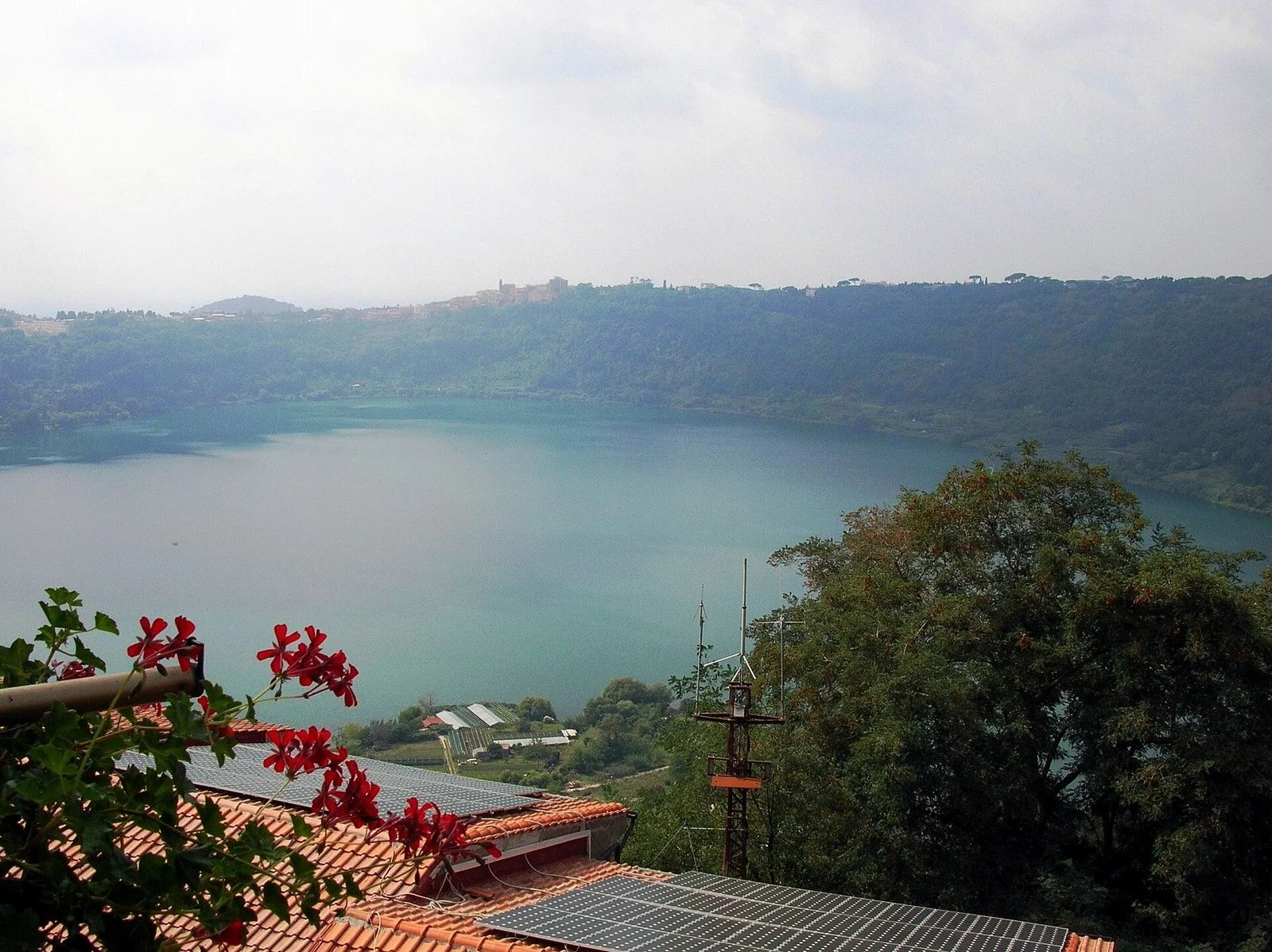
Lake Nemi occupies the bottom of an extinct volcanic crater in the Alban Hills, about 30 kilometers south of Rome, and is the smaller and more secluded of the two bodies of water that Romans simply call the Castelli lakes, together with Lake Albano. The ancients called it speculum Dianae, the mirror of Diana, because on its northern shore stood one of the richest and most debated sanctuaries of ancient Lazio, dedicated to the goddess of the woods and presided over by a priest who, according to Greek and Latin sources, won the office by killing the man who held it before him. From that detail, reported by Strabo and taken up by Suetonius, came at the end of the 19th century one of the most widely read books of anthropology ever, “The Golden Bough” by James George Frazer, which made this body of water a mental place even before a geographical one. On the bottom of the same lake there then lay two colossal ships commissioned by Caligula, brought back to light between 1928 and 1932 by emptying the lake with pumps, and burned in May 1944 in circumstances still debated today. The lines that follow tell what this flooded crater is from a physical point of view, what the ancient sources really say about the rite of the sacred grove, what remains of the ships, and how to visit the lake today between the village overlooking the cliff, the museum on the shore and the wild strawberries that gave the town its second name.
Where Lake Nemi is and how to get there
Lake Nemi is in the territory of the municipalities of Nemi and Genzano di Roma, in the metropolitan city of Roma Capitale, within the Castelli Romani Park, about 30 kilometers as the crow flies from the center of Rome. The basin is sunk in a hollow with steep edges: the town of Nemi looks down on it from a cliff about 200 meters above the water's surface, while the shore itself can be reached only by going down a narrow, winding road or on foot along the trails that cut across the slope.
By car from Rome
The most convenient route from the Grande Raccordo Anulare is the exit toward Via Appia Nuova in the direction of the Castelli, then the detour onto Via dei Laghi, which runs along the ridge between the two craters and offers more than one overlook. From there you go down toward Nemi following the signs for the historic center. Anyone who prefers the low road can pass through Albano Laziale, Ariccia and Genzano di Roma along the Appia, and take from Genzano the road that goes down to the lake shore and continues to the museum.
By public transport
There is no direct connection between Rome and Nemi: the easiest way is to reach Genzano di Roma by a Cotral bus from the Anagnina terminus of metro line A, and from Genzano take the local connection that in less than 10 minutes brings you to the center of Nemi. Some city runs also go down to the lake shore and the museum, but frequency is reduced and on holidays the service may be suspended or very sparse: it's best to check updated times on the channels of Cotral and the urban transport operator before leaving, because on this route the schedules change with the season. Alternatively you can arrive by train at Velletri and continue by bus, a longer solution but useful for those returning to Rome in the evening.
Walking down to the lake
From the village of Nemi a footpath starts that goes down toward the shore losing a little under 200 meters of elevation in a couple of kilometers, crossing the chestnut woods and the cultivated terraces that cover the flank of the crater. It's a real trail, with uneven stretches and slippery ground after rain, not a paved stroll: you need closed shoes with a lugged sole, and you should count on the climb back being decidedly harder than the descent. Anyone who doesn't feel up to redoing the elevation uphill can organize the walk one way only and go back up by car or by the local connection, when it's running. For those with less time, the level stretch along the shore between the museum and the farming areas is the simplest and the most photographed.
What Lake Nemi is: the physical data and their discrepancies
Lake Nemi has a surface of about 1.67 square kilometers, a perimeter on the order of five and a half kilometers and an elevation that sources place between 316 and 325 meters above sea level depending on the figure and the time of survey. The basin has no surface inflows worthy of the name and is fed by the water table and by springs that surface on the bottom, which makes it very sensitive to variations in underground water circulation. On the elevation it is best to be clear right away, because it is the typical case in which the figures you read around don't match, and they don't match for a precise reason.
Why the depth figures don't add up
The maximum depth of the lake is given by some sources at around 33 or 34 meters, by others at around 25 meters. It's not a transcription error: the higher figures date back to surveys prior to the great tampering of the 20th century, when the Enciclopedia Italiana recorded a maximum depth of 34 meters, an average depth of 19.5 meters and a volume of about 32.5 million cubic meters. The partial drainage ordered in the 1920s to recover the ships lowered the level by more than 20 meters, and when the water rose again it never reached the previous level. To that reduction another, slow and recent one has been added, tied to water withdrawals and drought. The result is that today's lake is measurably lower than the one described in manuals a century ago, and anyone who gives a flat number without saying which moment it refers to is oversimplifying too much.
The ancient outlet carved in the rock
The level of the lake was already regulated in antiquity by an artificial outlet, a tunnel dug through the wall of the crater about 1650 meters long, which carries the excess water toward the Ariccia valley passing under the town of Genzano. The traditional dating places the work around the 4th or 3rd century BC, in an era when the same technique was applied to Lake Albano with the far more famous outlet of Castel Gandolfo. It is an underrated hydraulic work: a tunnel of that length, dug by hand in volcanic material and kept at a constant slope, is a remarkable technical result for the era, and it has worked for more than 2,000 years.
How the crater formed: the geology of the lake
The crater that hosts Lake Nemi formed during the final phase of activity of the Vulcano Laziale, the edifice that built the entire relief of the Alban Hills, and is the product of hydromagmatic eruptions, that is of explosions generated by the violent contact between rising magma and water present in the subsoil. Geological estimates place the formation of the basin at least 36,000 years ago, within the concluding phase of the volcanic activity of the area.
The mirror of Diana: the sanctuary of Diana Nemorense
On the northern shore of Lake Nemi, on a flat strip carved out between the water and the slope, stood the sanctuary of Diana Nemorensis, one of the most important and most frequented in ancient Lazio, whose sacred area covered a surface on the order of 45,000 square meters within an enclosure of about 200 meters by 175. The very name of the place comes from there: nemus in Latin is the sacred grove, the wood consecrated to a deity, and the town of Nemi inherited that term almost unchanged.
The lucus, the woods and the goddess
Diana Nemorensis was an archaic deity tied to the wild world, to springs and to the decisive passages of human existence, childbirth in particular. Her cult was served by a sacred grove, the lucus, and by a spring, and ancient tradition associated her with two figures that recur in all the versions of the local myth: Virbius, identified with the Greek Hippolytus resurrected and transferred to Italy, and the nymph Egeria, adviser of King Numa Pompilius. The sanctuary also had a political dimension, because it was a meeting place for the Latin communities and its importance grows precisely in the phase of formation of the league of the cities of Latium.
What was inside the sacred enclosure
The complex was not a simple temple but a small religious city: the platform, supported on the valley side by triangular substructures and on the hill side by a wall of large semicircular niches, hosted two porticoes of the Doric order, one with columns plastered in red and the other with columns of dark gray peperino, statues, rooms for the priests, lodgings for pilgrims, cells for keeping votive gifts, hydrotherapy baths and even a theater. The quantity of ex votos returned by the excavations, largely anatomical terracottas, tells of a sanctuary frequented by ordinary devotees, not only by the aristocracy.
Excavations, dispersals and finds that ended up far away
The history of the Nemi excavations is also a history of dispersal. The first investigations date to the second half of the 17th century by the Frangipane marquises, but it is in the 19th century that the site is systematically explored by foreign scholars and collectors, with the result that a considerable part of the materials is today kept in European and American museums rather than on the spot. An important share of what came to light in the campaigns carried out on behalf of a British diplomat ended up in England, where it still is. It is one of the reasons why the sanctuary, though famous, remains hard to read for those who visit it: the pieces that would explain it are elsewhere.
How to visit the archaeological area today
It has to be said clearly, because it's the question almost everyone asks: as things stand the area of the sanctuary is not open to free individual visits. The site, largely still to be brought to light, can be visited only during special openings or guided visits organized with the authorization of the competent Soprintendenza, and anyone who wants to enter must check beforehand with the protection bodies whether and when it is possible. From the road that runs along the shore you can still glimpse the wall of the niches and some masonry structures. The site has a page dedicated to the Sanctuary of Diana Nemorense, which goes into detail on the construction phases, the plan and the state of the excavations: here the sanctuary is told as one of the pieces of the lake, there as a monument in itself.
The rex nemorensis: what the ancient sources really say
The rite of the rex nemorensis, the priest of Diana at Nemi who obtained the office by killing his predecessor, is attested in several ancient authors and is therefore not a modern invention: the difficulty is not its existence but its interpretation. It is worth separating the two things precisely, because it is exactly here that popularization does the most damage.
Strabo: the sword and the flight
The most detailed testimony is that of the Greek geographer Strabo, in the fifth book of his Geography, who describes the priesthood of Nemi as reserved for a fugitive slave who has killed the man who preceded him in the office. Strabo adds that the priest always goes about armed with a sword, looking around waiting for an attack, and defines the custom as a barbaric and Scythian element, that is foreign to Greek and Roman custom. It is a judgment worth noting: already an ancient author considered that rite an anomaly to be explained, not a normality.
Suetonius and Caligula's intervention
Suetonius, in the Life of Caligula, reports that the emperor had the sitting rex nemorensis, who had held the priesthood for many years, replaced by sending against him a stronger opponent. The episode is brief but very weighty, for two reasons: it shows that in the 1st century AD the office still existed and was effectively tied to a duel, and it shows that imperial power could manipulate its outcome when it suited. It is also the only point where Caligula's name crosses the cult of the lake before the story of the ships.
Pausanias and Ovid
Pausanias, in the Description of Greece, links the sanctuary of Aricia to the myth of Hippolytus divinized as Virbius and specifies that the prize for the winner of the duel was the priesthood, and that the contest was not open to free men but only to slaves who had fled their masters. Ovid, in the third book of the Fasti, sums up the same idea in a poetic formula: the priest reigns by strength of arm and speed of leg, and dies by the example he himself has set. Servius too, in his commentary on the Aeneid, touches on the subject. The sources are therefore Greek and Latin, of different eras, and agree on the essential core.
What is documented and what is reconstruction
Documented: the existence of a priest of Diana at Nemi called rex nemorensis, the rule by which the office was won in a duel, the fact that the candidates were fugitive slaves, the persistence of the rite at least until the 1st century AD. Not documented in the same way: the precise sequence of the ritual, the exact role of the branch broken from the sacred tree as a condition for the challenge, the frequency with which the duel actually took place, and above all the overall religious meaning attributed to it. That meaning is modern reconstruction, and the most influential modern reconstruction has a precise name.
Frazer and “The Golden Bough”: how Nemi became a worldwide case
The rite of Nemi owes its planetary fame to “The Golden Bough” by James George Frazer, the work of comparative anthropology published starting in 1890 and then expanded into a dozen volumes, which opens precisely with the scene of the armed priest keeping watch over the tree in the woods of Nemi and from there builds a general theory about the sacred king destined to die.
The thesis of the book in a few lines
Frazer interprets the rex nemorensis as the local survival of a universal model: the sacred sovereign whose vitality coincides with the fertility of the land and who for this reason must be periodically killed and replaced, because an aging king would bring with him the exhaustion of the harvest. Nemi becomes the visible link of a chain that Frazer extends all the way to European agrarian rites and Mediterranean cults of death and rebirth. The section devoted to the figure of the Nemi priest is titled, not by chance, the king of the wood.
What later research disputes
Here comes the most important distinction of the whole chapter. 20th-century anthropology and the history of religions have criticized in depth Frazer's comparative method, which sets side by side materials from very distant eras and cultures to build a single model, and have called into question the very idea of ritual regicide as a widespread institution. That at Nemi the priesthood was won in a duel is a datum of the sources. That the duel was a fertility rite with the function described by Frazer is his interpretation, elegant and debated, not an established fact. Anyone who tells Nemi as the field proof of the theory of the sacred king is mistaking the explanation for the phenomenon.
A curiosity about Lake Nemi
Lake Nemi is the only Italian lake where the pesce re (pejerrey) lives permanently, a freshwater species of South American origin introduced in the 20th century to promote sport fishing and which here found conditions suitable for settling. It is a detail that always surprises, because in a basin so loaded with ancient history you expect anything but an exotic fish peculiarity. The introduction of non-native species into the volcanic lakes of Lazio was a widespread practice between the 1920s and the 1960s and permanently changed the biological balances of these basins, which being closed and with no inflows have a very limited capacity for recovery.
There is a second aspect, less immediate. The entire lake bed is, from the archaeological point of view, a protected context: between the Renaissance recovery attempts, the 20th-century drainage and the later campaigns, the bottom has been crossed and moved several times, and what remains buried in the sediments has never been completely explored. It is therefore not right to imagine the lake bed as an intact deposit waiting for sensational discoveries, but not as an already exhausted area either. It is a heavily studied and heavily disturbed zone at the same time, which makes every new hypothesis hard to verify.
Caligula's ships: what they were and how they were recovered
The two Roman ships recovered from the bottom of Lake Nemi between 1929 and 1932 measured, according to the measurements taken after recovery, about 71 meters in length by 20 in width for the first and about 73 meters by 24 for the second, with fluctuations in the data reported by the different sources, and they remain the largest Roman vessels of which direct material evidence has ever been had. They were neither warships nor transport ships: they were floating structures of display, attributed to the age of Caligula on the basis of lead stamps with the emperor's name found on board.
What they were really for
On the function, interpretations don't entirely coincide. The most accredited hypothesis reads them as floating palaces tied to the cult and to imperial display on a sacred lake, therefore ceremonial ships of the sanctuary more than vessels for sailing. Some scholars have insisted on the character of luxury residence, others on the link with the cult of Diana and with the tradition of votive ships in lake sanctuaries. What is certain is the use of extraordinary technical solutions: mosaic floors and fine marbles, lead piping, water pumping systems, ball bearings for rotating platforms, bronze protomes of great quality such as wolf, lion and Medusa heads that decorated the ends of the beams.
Five centuries of failed attempts
The presence of the wrecks on the bottom was no secret: the fishermen of the lake had always pulled up fragments of wood and bronze nails, and the documented attempts to reach them begin in the 15th century. In the 16th century the military engineer Francesco De Marchi went down to the wreck with primitive diving equipment and left a description that is the oldest source of any substance. Other attempts in the 18th and 19th centuries ended worse, with material torn away and damage to the structures: part of what was removed on those occasions has been lost or scattered in private collections.
The partial drainage of the 1930s
The solution adopted in the 20th century was radical: instead of going underwater, the water was removed. The decision was announced in 1927 and the pumping plant went into operation on October 20, 1928, effectively following the route of the ancient outlet to discharge the water into the valley. The level of the lake was lowered progressively: on September 7, 1929, with the waters down about 22 meters, the first ship emerged completely. The second was freed in the following months and operations ended in 1932. The operation was carried out by the industrial engineering of Italy of the time with an exceptional deployment of means and was used with great emphasis by the propaganda of the regime, which made it a symbol of the revival of Romanità.
Something nobody tells you about Lake Nemi
What almost no guide explains is that the Museum of the Roman Ships of Nemi was designed and built around two ships that are no longer there, and this explains the feeling of strangeness that strikes many visitors as soon as they enter. The building, inaugurated on April 21, 1940 to a design by the architect Vittorio Ballio Morpurgo, was born as a made-to-measure container: two large parallel halls, each sized for the hull it was to receive. When the hulls burned in 1944, what remained was a museum with the shape of the ships and without the ships inside.
Those who arrive without knowing it go in convinced they will see two Roman vessels and find instead two enormous empty spaces occupied by the scale models and by what was saved: the metal finds, the bronze protomes, the materials that had been taken elsewhere or that the fire did not consume, and a documentary apparatus on the recovery. The visit absolutely makes sense, but it must be approached for what it is, that is the story of a recovery and a loss, not the display of two wrecks. The contrast between the size of the halls and the absence of what they were meant to contain is, in its way, the most eloquent thing about the museum.
There is then a detail that strikes those who know the story: the architectural structure is itself a document of that historical moment, a building of 1940 conceived as a monument to the discovery rather than as a museum in the modern sense. Over time the layout has been revised several times and testimonies from the surrounding territory have also been placed there, including materials referable to the sanctuary.
The 1944 fire and the controversy over responsibility
The two ships of Nemi were destroyed by a fire that broke out in the museum in the night between May 31 and June 1, 1944, during the passage of the front over the Castelli Romani in the weeks before the liberation of Rome, and the question of who or what started that fire is still controversial. On this point it is only right to report the versions as versions, without closing them in a conclusion that the sources do not authorize.
The reconstruction of the 1944 inquiry
An inquiry conducted immediately after the events concluded that the fire was deliberate and indicated as responsible, in all likelihood, German soldiers who had placed an artillery position in the immediate vicinity of the museum and who were in the area in the hours when the fire developed. This version has become the current one, has been taken up by decades of popularization and has entered local collective memory to the point that the municipal administration of Nemi has recently raised the question of compensation from Germany.
The recent study and the hypothesis of Allied artillery
A long-term piece of research conducted by the archaeologist Flavio Altamura and the historian Stefano Paolucci, collected in a volume published in 2023, re-examined the whole file: the photographs commissioned by the original inquiry, the testimonies of the custodians, the correspondence of the protection offices, the reports of the Allied officers, applying to the materials the criteria of modern fire investigation. The two scholars' conclusion is that the blaze was set off by Allied artillery shells aimed at the German position installed next to the museum, with holes in the roof compatible with that type of impact, and therefore that it was a wartime episode and not a deliberate act of vandalism.
Why the question remains open
The two reconstructions are not equivalent on the documentary level, but it can't be said either that the second has closed the case in a universally accepted way. The debate has continued, with different positions among scholars, local administrators and public opinion, and further, minority readings have also circulated. What can be stated with certainty is that the ships burned on that night in 1944, that German troops operated in the area with a battery close to the museum, that the Allied front was advancing and bombarding that zone, and that the rest is a matter of discussion. Presenting it as an established fact in one sense or the other would be incorrect.
The Museum of the Roman Ships today: models, hours, tickets
The Museum of the Roman Ships is on Via Diana, on the northern shore of Lake Nemi, and is open from 9:00 to 19:00 with last entry at 18:00, closed on Mondays as well as on January 1 and December 25, with a full ticket of €5 and a reduced one of €2 according to the rates published by the Direzione regionale Musei nazionali Lazio. There is also a circuit ticket that includes the archaeological museum of Palestrina at a cost of €12. Being a state museum, the usual legal free admissions and concessions apply, and the museum takes part in national free-entry initiatives: it's best in any case to check updated hours and rates on the official site before the visit, because works and temporary closures have followed one another at this site over the years.
The one-to-five scale models
The heart of the visit today is the 1:5 scale reproductions of the two ships, displayed one behind the other in a wing of the museum, built on the basis of the surveys made after recovery. At one-fifth scale, a hull of just over 70 meters becomes a model of about 14 meters, which conveys the proportions better than any description: you walk beside an object that is already imposing on its own and multiply it mentally by five. It's the only way we have today to physically perceive those dimensions.
The page dedicated to the museum
The site has a specific page on the Nemorense Museum and the Roman Ships, which goes deeper into the layout, the history of the institution and the visiting information: here the museum appears as one of the stops on the tour of the lake, there it is treated as a museum institution in its own right, with detail on the collections. Anyone planning a visit to the museum alone will find that page more useful.
The advice I give you for visiting Lake Nemi
The practical advice is not to treat Lake Nemi as a single destination but as two distinct ones, the village up high and the shore down below, and to decide beforehand which of the two you really want to do, because linking them on the fly is the reason many go home dissatisfied. The elevation difference between the town and the water is about 200 meters, the road that joins them is narrow and winding, and the public connection has sparse runs: anyone who arrives at noon thinking of doing it all in two hours ends up seeing the lake only from above.
The half day that works best
The most successful combination, for those with a morning, is to arrive early at the museum on the shore, visit it unhurried, walk a stretch along the bank up to the cultivated plots, then drive back up to the village for lunch and spend the early afternoon among the town's streets and the viewpoints. In this order you avoid the double parking problem: in the morning the shore is free, at midday the town is emptying of its morning visitors. The reverse order works much worse.
What to expect
On the shore services are limited: a few seasonal refreshment points and little else, so water and a snack in your backpack solve it. Swimming in the lake is not allowed and access to the water is anyway awkward almost everywhere. Those traveling with small children will do well to consider that the descent trail is not suitable for strollers and that the level stretch along the shore is the only really comfortable part. Those with walking problems can count on the museum, which is accessible, and on the town's viewpoints, reachable on the level once the car is left.
Combining the lake with the rest of the Castelli
Nemi is a few kilometers from Castel Gandolfo, Rocca di Papa and Velletri, and Via dei Laghi lets you build an itinerary that touches both craters on the same day. Those aiming for a food and wine tour can include Frascati, Marino or Grottaferrata. Those who prefer walking will find in the Boschetto delle Faete and in the park's trails a network of well-marked routes.
Another well-known fact, yet rarely cited
In the spring of 2017 the bottom of Lake Nemi was scanned with sonar equipment in search of a presumed third ship of Caligula, and the search found no ship: the only wreck identified turned out to be a small fishing boat sunk about a century ago. It's a story told little because it contradicts a convenient legend, but it is worth reporting in full, precisely because it shows how the difference between hypothesis and proof works.
Where the idea of the third ship comes from
The hypothesis was based on a reading of the 16th-century descriptions of Francesco De Marchi, interpreted as referring to a hull still submerged and of enormously greater size than the two recovered ships. The promoter of the search, an architect from Genzano, believed he had identified in old documents the trace of this third vessel. The Comune of Nemi authorized and supported the operation, and the equipment, comprising side-scan sonar and a sub-bottom profiler, was made available by a regional environmental protection agency.
The result and what it teaches
The surveys covered the lake bed without returning anything compatible with a large ancient wreck. The archaeological superintendency took no part in the project and expressed a cautious attitude from the start, in the absence of historical, archaeological or documentary evidence to support the hypothesis. The interesting point is not the disappointment but the method: a search conducted with serious instruments on a weak hypothesis still produces a useful datum, namely exclusion. After 2017, claiming the existence of a third ship on the bottom requires new proof, not repeated quotations.
The wild strawberries of Nemi and the festival
The fragolina of Nemi belongs to the wild strawberry species, Fragaria vesca in the semperflorens variety, weighs on average about 1.2 grams with a range from half a gram to a little over two, has an elongated, tapered shape, bright red color and whitish flesh veined with red at full ripeness, with a very intense aroma. It is a traditional product of the territory, not a shrunken supermarket strawberry: flavor and yield depend on the microclimate of the hollow and on the type of volcanic soil.
A crop documented for over a century
The presence of strawberries and flowers among the typical products of Nemi is already documented in the Italian parliamentary agrarian inquiry conducted between 1877 and 1884, so it is an agricultural specialization established for at least 150 years, with a period of peak production placed between the 1930s and the 1950s. There are historical depictions of a Roman strawberry festival celebrated on June 13, a sign of a supply flow from the Castelli to the markets of the capital that goes back a long way.
The fragolarole
The figure of the pickers, called locally fragolarole, has become the symbol image of the town: women who picked the fruit on the terraces on the flank of the crater and carried it into town in little baskets. During the festival the pickers parade in traditional costume and hand out strawberries in the square, and it is the part of the festival that keeps a real link with agricultural work, beyond the folkloric frame.
The Sagra delle Fragole and the Mostra dei Fiori
The Sagra delle Fragole of Nemi is traditionally held on the first Sunday of June, together with the Mostra dei Fiori, and is an event with over a century of history behind it, which in 2026 was scheduled for June 7. On that day the village is closed to traffic, fills with stalls and visitors, and reaching it by car in the central hours becomes very difficult: anyone who wants to take part must arrive early or count on a walk from the outer parking lots. The precise dates and the program are published every year by the Comune and are best checked close to the event, because the exact day may vary.
The right photo to take at Lake Nemi
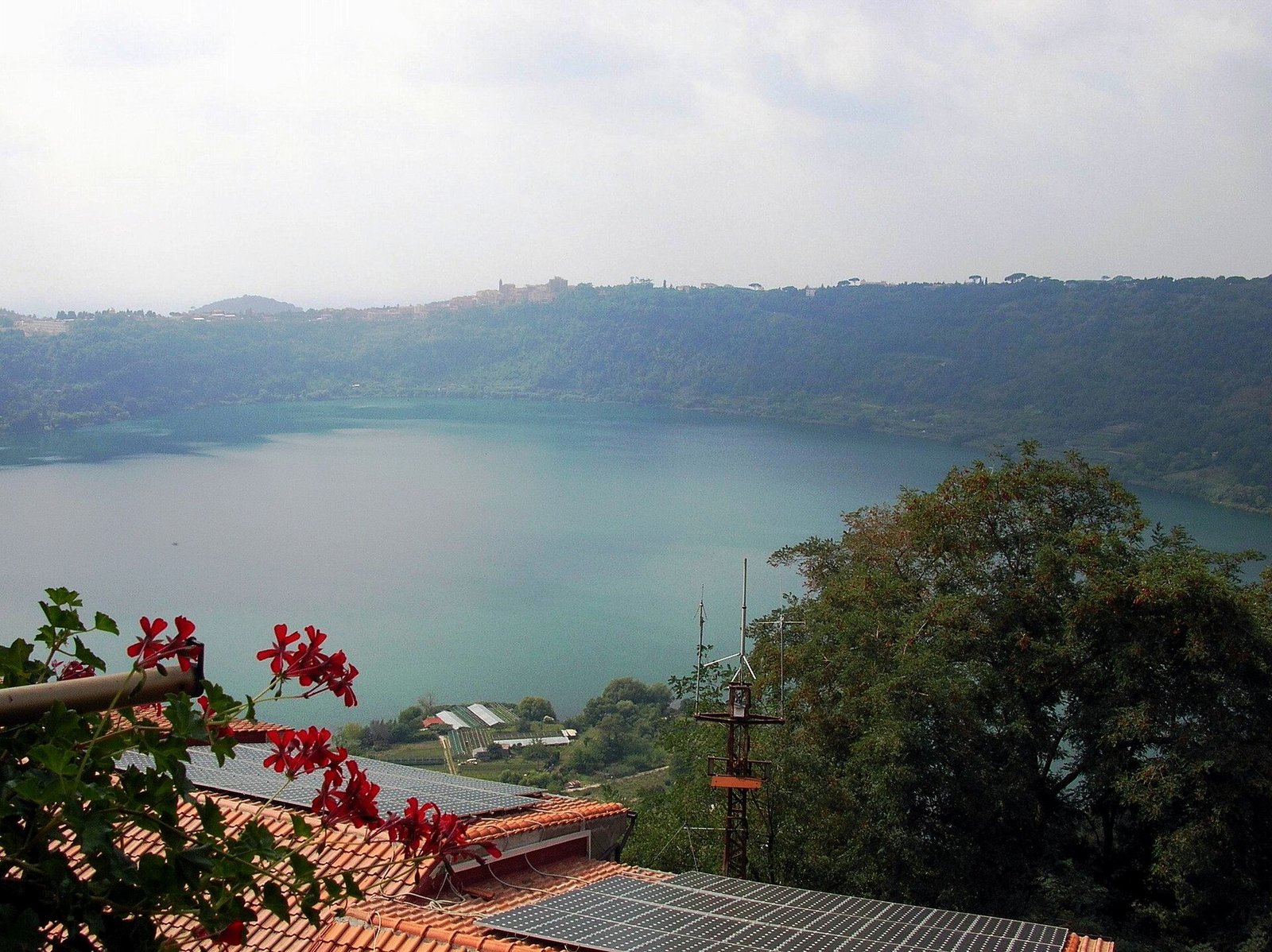
The photograph that really tells Lake Nemi is the one taken from the village viewpoint, with the town in the foreground on the edge of the cliff and the mirror of water 200 meters below: it's the only framing that conveys at once the depth of the crater and the relationship between the settlement and the water, which is what makes this place different from all the other lakes of Lazio.
The spot and the hour
The two most effective overlooks are the panoramic terrace on the castle side and the wide spots along the road that goes down from the town, where the parapet lets you frame without branches in the way. The best light is that of the late afternoon, when the sun lights the opposite side of the crater and the water turns dark and compact, exactly the mirror effect that gave the lake its ancient name.
Include the town, not just the water
The most common mistake is to photograph only the surface of the lake, which without a reference for scale comes out flat and anonymous. It is enough to include in a corner a row of houses clinging to the edge, or the cylindrical tower of the castle, and the image gains measure. A second subject that always works is the road that goes down in hairpins on the flank of the crater, shot from above at an angle: it tells the elevation difference better than any caption.
Some important events that happened here in history
The history of Lake Nemi is concentrated around four moments that changed the place permanently: the building of the sanctuary of Diana between the archaic and the imperial age, the launching of the ships in the age of Caligula, the 20th-century drainage and the fire of 1944. Around these are arranged minor episodes that are anything but marginal.
The lake that is getting lower, from the 2000s to today
The last chapter is under way. For at least a decade environmental associations, local committees and administrations have reported a progressive lowering of Lake Albano and Lake Nemi, attributed to the combination of lower rainfall, increased withdrawals from the water table and leaks from water networks. Estimates circulated locally speak, for the Albano basin, of reductions on the order of a meter over a few years and of several meters compared with the mid-20th century. These are figures that come in large part from civic monitoring and committee surveys, not all confirmed by institutional sources, and they should be taken as an indication of a trend more than as a definitive datum. On the trend, however, consensus is broad, and intervention plans on the area's aqueduct system have been announced.
Who has passed through Lake Nemi
Lake Nemi is one of the places in Lazio with the longest list of illustrious visitors relative to its size, and the reason is twofold: it was a fixed stop of the Grand Tour for its painterly fame, and it then became a destination for scholars because of the story of the rex nemorensis and that of the ships.
Grand Tour travelers and painters
Between the 18th and 19th centuries the lake enters permanently the repertoire of the landscape painters who worked in the Roman countryside and of the European travelers who came down to the Castelli. The image of the circular basin seen from above, with the town on the edge, becomes a codified subject, replicated in drawings, engravings and paintings that today are in collections across half of Europe. Many of those travelers arrived from Ariccia along Via Appia, and the sequence Albano, Ariccia, Genzano, Nemi was the canonical itinerary of the excursion.
James George Frazer and the anthropologists
Frazer built on Nemi the opening and the load-bearing structure of “The Golden Bough” and, through that book, the lake entered the culture of the 20th century well beyond classical studies: whole generations of readers knew the name of Nemi before knowing where it was. Behind him, and partly against him, historians of religion and archaeologists passed through the site who worked on the real stratigraphy of the sanctuary, scaling down the Frazerian reconstruction and giving back a more sober and better documented picture.
Archaeologists, engineers and restorers of the 20th century
The recovery of the ships involved a heterogeneous group of figures: archaeologists, hydraulic engineers, technicians of Italian mechanical industry, photographers and draftsmen who documented every phase. The coordination of the operation was entrusted to professionals from the industrial world, in a rare case of collaboration between archaeology and big business. The architect Vittorio Ballio Morpurgo, author of the museum of 1940, had worked in the same years on other highly visible works in the center of Rome. After 1944 it fell to others to rebuild on paper what the fire had erased, and it is to that work that the models on display today are owed.
The village of Nemi, sheer above the lake
The town of Nemi stands between 520 and 526 meters above sea level on the northern rim of the crater, has a little under 2,000 inhabitants and is one of the smallest centers of the metropolitan city of Rome, recognized among the Most Beautiful Villages in Italy and awarded the Orange Flag of the Touring Club Italiano. Its layout is dictated by the morphology: a single main street running along the edge of the precipice, with the houses facing the void on one side and the cliff on the other.
The terrace and the viewpoints
The town has more than one panoramic point. The Terrazza degli Innamorati, open to the public in February 2015, is dedicated to the mythological figures of the lake valley and gathers the tales about Diana, Virbius, Egeria and the king of the wood. The other overlooks are spread along the main street and in the small squares between the houses, and are freely accessible. On a short visit the viewpoints are, frankly, what is worth the most: from there you understand the geography of the whole crater in five minutes.
The page dedicated to the town
The site has a page dedicated to the village of Nemi, which goes deeper into the built-up area, its administrative history, the monuments and the life of the town: here the town appears as one of the elements of the lake system, there it is the main subject. Those looking for information on the municipality, the village's events and services will find that page more complete.
What to see around Lake Nemi
Lake Nemi occupies the center of an area in which each town is a few kilometers from the next, which makes it easy to build day itineraries without covering great distances. Via dei Laghi links the Nemi crater to the Albano one and is the backbone of any tour.
Lake Albano and Castel Gandolfo
Lake Albano is bigger and deeper than Lake Nemi, has an equipped and accessible shore, and hosts on its banks Castel Gandolfo with the Papal Palace and its gardens. The comparison between the two basins is instructive: same volcanic origin, two very different tourist destinies.
Genzano, Ariccia and the Appia
Going down toward the Appia you meet Genzano di Roma, which shares with Nemi a portion of the lake shore, and Ariccia, whose name is tied in antiquity precisely to the sanctuary of Diana, which the Greek sources in fact call the sanctuary of Aricia. Farther down, Albano Laziale preserves an archaeological heritage of the imperial age that is often overlooked.
The mountain and the trails
Toward the interior of the park you climb to Rocca di Papa and the routes of the Boschetto delle Faete, while on the Tusculan side are Monte Porzio Catone and the Monte Porzio Catone Observatory. Those who love the minor lakes of Lazio can continue toward Lake Giulianello or, on the opposite side of the province, toward Lake Martignano.
Frequently asked questions about Lake Nemi
Where is Lake Nemi?
Lake Nemi is in the Castelli Romani, in the territory of the municipalities of Nemi and Genzano di Roma, about 30 kilometers south of Rome, within the Parco regionale dei Castelli Romani. It occupies the bottom of a volcanic crater of the Vulcano Laziale complex and is reached from Via dei Laghi or from Via Appia passing through Albano, Ariccia and Genzano.
How deep is Lake Nemi?
The maximum depth of Lake Nemi is given by the sources as between 25 and 34 meters, with a historical figure of 34 meters recorded before the partial drainage of the 1930s and lower values in later surveys. The discrepancy comes from the fact that the emptying carried out between 1928 and 1932 lowered the level by more than 20 meters and the water never returned to the original level, a reduction later accentuated by recent water withdrawals.
Can you still see Caligula's ships at Nemi?
No, Caligula's ships no longer exist: the two hulls recovered between 1929 and 1932 were destroyed by a fire that broke out in the Museum of the Roman Ships in the night between May 31 and June 1, 1944. In the museum today you see the 1:5 scale reproductions of the two vessels, the surviving metal finds and bronze protomes, and the extensive photographic documentation produced during the recovery.
Who burned the ships of Nemi in 1944?
Responsibility for the 1944 fire of the ships of Nemi is still controversial: the inquiry conducted immediately after the events concluded it was deliberate and indicated the German soldiers who had an artillery position near the museum, while a study published in 2023 by Flavio Altamura and Stefano Paolucci attributes the blaze to Allied artillery shells aimed at that position. The two reconstructions continue to be debated and there is no unanimously accepted conclusion.
How much is a ticket to the Museum of the Roman Ships of Nemi?
A ticket to the Museum of the Roman Ships of Nemi costs €5 full price and €2 reduced according to the rates published by the Direzione regionale Musei nazionali Lazio, with a €12 circuit ticket that includes the archaeological museum of Palestrina. The museum keeps hours of 9:00 to 19:00 with last entry at 18:00 and is closed on Monday, January 1 and December 25: it's best to check updated hours and rates on the official site before the visit.
Is the rex nemorensis of Nemi a legend or history?
The rex nemorensis of Nemi is attested by ancient sources and is not a modern legend: Strabo, Suetonius, Pausanias and Ovid describe a priest of Diana, a fugitive slave, who won the office by killing his predecessor in a duel. What belongs instead to modern reconstruction is the interpretation of the rite as sacred regicide tied to fertility, proposed by James George Frazer in “The Golden Bough” starting in 1890 and widely debated by later research.
Can you visit the sanctuary of Diana at Nemi?
The archaeological area of the sanctuary of Diana Nemorense, on the northern shore of Lake Nemi, is not currently open to free individual visits: the site, largely still to be excavated, can be visited only during special openings or with guided visits authorized by the competent Soprintendenza. Anyone who wants to enter must inquire beforehand with the protection bodies, while from the road along the shore the wall of the niches and some masonry structures remain visible.
When is the Sagra delle Fragole of Nemi held?
The Sagra delle Fragole of Nemi is traditionally held on the first Sunday of June, together with the Mostra dei Fiori, and in 2026 was scheduled for June 7. It is an event with over a century of history, during which the pickers in traditional costume hand out the wild strawberries in the square: the village is very crowded and traffic restricted, so it's best to arrive early and check the date and program on the Comune's channels.
Is Lake Nemi suitable for children?
Lake Nemi is suitable for children as long as you choose well which part to visit: the level stretch along the northern shore and the visit to the Museum of the Roman Ships, accessible along the whole route, work well even with the little ones. The trail that goes down from the village to the shore, with about 200 meters of elevation difference and uneven ground, is on the other hand not suitable for strollers and needs careful consideration for the climb back.
One last tip for planning the day
Lake Nemi pays off most if you approach it as a place to understand and not only to look at: half an hour of viewpoint, an hour of museum and a walk on the shore are enough to put together the crater, the sanctuary, the ships and the wild strawberries, which are four different stories of the same piece of land. Anyone with a whole day can widen the tour to the other crater and the towns of the Appia, building an itinerary that covers 2,000 years without ever exceeding 20 kilometers of travel.
Those organizing a broader itinerary among the Castelli Romani and the volcanic lakes of Lazio, crossing this stop with the other stops of the Alban area and of Via Appia, can find useful planning tools on Tour Leader Pro, while for a broader picture of transport and destinations in Lazio Italy Planner is a good resource.