Genzano di Roma (RM)
In short. Genzano di Roma is about 30 kilometers south of the capital, on the outer slope of the crater that now holds Lake Nemi, in the Alban Hills: the town hall is at 435 meters above sea level, the municipal territory drops to 106 meters and…

Genzano di Roma is about 30 kilometers south of the capital, on the outer slope of the crater that now holds Lake Nemi, in the Alban Hills: the town hall is at 435 meters above sea level, the municipal territory drops to 106 meters and rises to 480, and the population is just over 22,000. You get there by car along Via Appia Nuova (State Road 7) to the turnoff for the Castelli, or by the Rome-Velletri railway, which stops at Genzano di Roma station on the regional line FL4 leaving from Roma Termini: from the station to the historic center it's a couple of kilometers uphill, covered by the city buses and by the Cotral line buses that connect the town to Albano Laziale, to Ariccia and to the Anagnina terminus of metro line A. The village has no entrance ticket: you visit it on foot, for free, and the only expenses are a museum, a lunch or a slice of freshly baked bread. The only time it's worth finding out beforehand is the week of the Infiorata, straddling Corpus Domini between May and June, when access to the center is regulated and the grandstands along the route require a ticket: the hours and the cost of the seats are published year by year by the Municipality of Genzano di Roma and should be checked on the official website, because they change with every edition.
Anyone planning a day in the Castelli Romani can place Genzano within a broader itinerary that takes in Nemi, Ariccia and Albano Laziale, the three towns that Genzano borders or almost borders and with which it shares history, cuisine and lake.
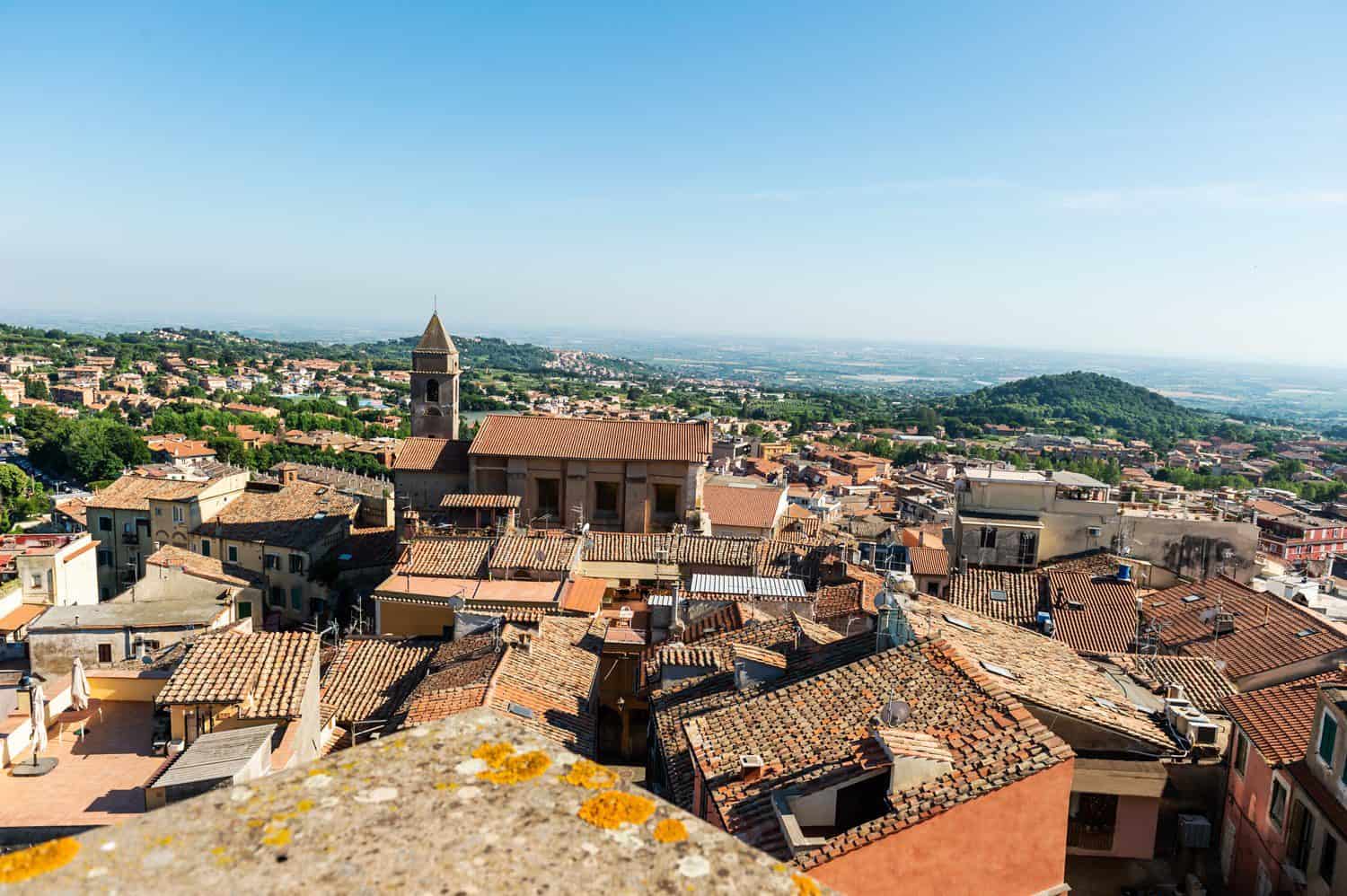
Where Genzano di Roma is and how the town is laid out
The shape of Genzano tells its history better than any sign. The old town, the medieval one, clings to the rim of the Nemi crater. The new town, from the eighteenth century, opens like a fan toward the valley. In between runs the backbone of the built-up area, the long uphill street that the people of Genzano still call Via Sacra and that on modern documents bears the name Via Italo Belardi, once Via Livia. This is the street of the Infiorata, and it is also the axis on which the Cesarini, the lords of the fiefdom, laid out in the eighteenth century an urban plan with a double trident: three tree-lined avenues that opened in a fan from the countryside and three built-up streets that answered them inside the town. Anyone looking at a map of Genzano immediately recognizes that geometry, rare for a village of the Castelli, and understands that here the urban plan was designed at a drawing table and not grown by chance.
The municipal territory takes in a slice of the Castelli Romani Regional Park and part of the shore of Lake Nemi, the volcanic body of water that the ancient Romans called the Speculum Dianae, the mirror of Diana. Genzano shares that basin with the town of Nemi, perched on the other slope, and the boundary between the two runs right on the water. Toward Rome, instead, the town spreads over the plateau cultivated with vineyards and olive groves that slopes down toward the countryside of the Agro. This double nature, the wooded crater on one side and the open countryside on the other, explains why Genzano di Roma is at once a lake town and a bread town, of woods and of wheat.
The history of Genzano di Roma, from the monks to the Cesarini
The name and the origins
The place name Genzano appears for the first time in a bull of Pope Lucius III dated April 2, 1183. Scholars do not agree on the origin of the name, and the two hypotheses are best taken for what they are. The first, antiquarian in flavor, ties the hill on the edge of the lake to the cult of the goddess Cynthia, one of the epithets of Diana, worshipped in the sacred grove of Nemi: from Cynthia it would have become Genzano. The second, proposed by the scholar Nicola Ratti, derives the name from fundus Gentianus, the agricultural estate of the gens Gentia, a Roman family that would have owned those lands. Neither of the two is documented as certain: they are etymological hypotheses, and they should be told as such.
The Cistercians and the castle of 1255
In 1153 Pope Anastasius IV granted the territory to the Cistercian monks of Tre Fontane Abbey, at Acque Salvie, outside Rome. It was they who, in 1255, built the large fortified castle, and the first settlement slowly formed near it, the one that is still called Genzano Vecchio today. For two centuries the village remained a monastic and agricultural possession, suspended on the rim of the crater. In 1428 the Cistercians sold Genzano to the Colonna for 15,000 florins, and with the Colonna the castle entered the game of the great baronial families of Lazio.
The arrival of the Cesarini and the great transformation
The turning point came in 1564, when the fief passed to Giuliano Cesarini, Marquis of Civitanova. Under the Cesarini, and then the Sforza Cesarini who inherited from them, Genzano went through two centuries of economic and urban growth that changed its face. In 1636, Giuliano III Cesarini began the reconstruction of Santa Maria della Cima Church and commissioned the paintings of Francesco Cozza for the occasion. A few years later, in 1643, he laid out the famous olmate, the great avenues shaded by four rows of elms that climbed toward the town and that remain, in Genzano's memory, the ancestor of the Infiorata's Via Sacra.
The father's design was completed by his daughter. Livia Cesarini, born in 1646 and died in 1712, married Federico Sforza and brought the fief and the project as her dowry. It was under her, around 1708, that New Genzano with its double trident was laid out, coordinating the work with Roman architects of the caliber of Tommaso Mattei and Ludovico Gregorini. From Livia descends the branch of the Sforza Cesarini that would mark the town's history until the nineteenth century, and to her we owe, indirectly, the very shape of the Genzano you visit today.
Palazzo Sforza Cesarini in Genzano di Roma
Palazzo Sforza Cesarini is the building that dominates the town, at the top of the climb, at the start of that Via Belardi that becomes the carpet of the Infiorata in June. The family's baronial residence was built in the early eighteenth century, around 1713, and the Gregorini workshop worked on its definition, the same architects active on the construction site of New Genzano. The facade closes off the view of Via Sacra like a stage set: those coming up from below find it in front of them as a backdrop, and the effect is intentional, because the palace had to assert the lord's presence over the whole fabric of the village.
The most surprising part of the complex is not the facade, though, but what opens up behind it, namely the park. Behind the palace opens a romantic nineteenth-century garden looking directly onto Lake Nemi, a green balcony suspended over the crater. Among centuries-old oaks, sequoias, cedars and holm oaks, the Sforza Cesarini gardeners scattered artificial grottoes, fake ruins and viewpoints, following the taste of the landscape garden that spread across Europe in the early nineteenth century. The fake ruins, in particular, are a piece of learned scenery: ruins built on purpose to look ancient, an architectural caprice meant to move those who strolled there. A large part of the park is now public property and is opened to the public on occasions and at hours that the municipality of Genzano di Roma announces on its website. It's best to check them before going up, because it isn't an always-accessible garden like any ordinary city park.

A colorful detail that deserves checking on site concerns the building's perspective devices: local tradition attributes to the palace some optical tricks meant to correct the view of the facade from the bottom of the climb. It's a fascinating tale and consistent with the stage-set culture of the time, but it should be taken as tradition, not as documented technical fact: visitors can judge with their own eyes by walking up and down Via Belardi.
Who the Sforza Cesarini family were
It's worth a few words on the lords who shaped the town, because their name appears everywhere in Genzano di Roma. From the Cesarini of Giuliano and Giuliano III we move, with Livia's marriage, to the Sforza Cesarini. From this branch came Giuseppe Sforza Cesarini, born in 1705, a figure tied to Roman theatrical life and remembered in connection with the Teatro Argentina, one of the great historic theaters of the capital. The tombs of some members of the family are in San Francesco Church, in town, where the family wanted its burial vault. The fact that a village in the Castelli had for centuries a family able to build a theater in Rome says a lot about the weight Genzano had at its best.
The Infiorata of Genzano di Roma
If Genzano is known worldwide, it owes it to the Infiorata. Every year, for Corpus Domini between the end of May and the beginning of June, the people of Genzano lay along the climb of Via Belardi a carpet of flower petals that covers about 2,000 square meters and turns the street into a long open-air painting. It isn't an improvised decoration: it's a collective work that engages the town for days and has its roots in the eighteenth century.
The history of the Infiorata
The tradition of decorating the streets with flowers for the passage of the Blessed Sacrament was born in Rome in the seventeenth century and spread to the Castelli. In Genzano it is traced back to the second half of the eighteenth century: local memory gives 1778 as the year of origin, while some reconstructions place the first great infiorata that covered the whole street in 1782. Whatever the exact date, what is certain is that here the practice took root like nowhere else, becoming an uninterrupted event that in 2024 reached the hundreds of editions. The Infiorata of Genzano has been recognized by the Ministry of Tourism as a Heritage of Italy for tradition, a title that certifies its cultural value.
How an Infiorata is made
The work begins well before the day of the festival. The craftspeople, the so-called maestri infioratori, draw the outlines of the pictures on the asphalt with chalk and lime, then fill every space with petals, often working at night and at dawn so the flowers don't wilt. The carpet is traditionally organized into a series of large pictures, usually 13, each several meters on a side, plus the decoration of the staircase that closes the climb. The subjects alternate religious themes, reproductions of artworks, geometric motifs and civic compositions. Covering the whole street takes enormous quantities of petals, on the order of hundreds of quintals of flowers and plant materials, which today come in large part from specialized greenhouses. It's a trade handed down in Genzano from generation to generation, and it's the reason the town exports its infioratori to half of Italy.

The procession on Sunday and the spallamento on Monday
The carpet lives for two days. On Corpus Domini Sunday the Blessed Sacrament goes up the flowered street in procession, trampling the petals in a rite that is the very meaning of the work: the Infiorata is made to be crossed by the sacred and then consumed. Monday evening brings the final act, called the spallamento in Genzano: it's the children who throw themselves onto the carpet and undo it by running, in a liberating stampede that closes the festival and that the people of Genzano await with the same emotion as the opening. Anyone who wants to see the work intact must go up early on Sunday morning, before the procession. Anyone who wants to experience its popular soul goes on Monday evening.

The churches of Genzano di Roma
Santa Maria della Cima, the Old Duomo
At the top of the old village, where Via Sacra reaches its highest point, stands Santa Maria della Cima Church, which the people of Genzano call the Old Duomo. It was Giuliano III Cesarini who, in 1636, wanted it rebuilt in Baroque forms, and for the decoration he called the painter Francesco Cozza, a pupil of Domenichino and a prominent figure of the Roman seventeenth century. The church holds the relics of the saints Tigri and Vincenza and keeps 14 stations of the Way of the Cross that would later pass to the new church. For centuries it was the town's main parish, the religious focus of the village clinging to the crater, and it remains the symbolic goal of the Infiorata, which climbs precisely toward it.
The Collegiate Church of the Santissima Trinità, the New Duomo
When, at the end of the eighteenth century, the opening of the post road to Naples shifted the town's center of gravity downhill, Genzano acquired a new church, bigger and worthy of the times. The Collegiate Church of the Santissima Trinità was begun around 1781 to a design by the brothers Giulio and Giuseppe Camporese, Roman architects, and opened for worship in 1808, becoming a parish collegiate church in 1820. It is a neoclassical building, rare among the churches of the Castelli, with a Latin cross plan, three naves and 11 altars. Under the dome, the four pendentives hold the figures of the four Evangelists. On the walls are the 14 stations of the Way of the Cross from the old church and works from different periods. Here you can measure the arc of Genzano di Roma: from the Old Duomo perched on the hill to the New Duomo stretched out below, the town tells the story of its move downhill through its two mother churches.
San Francesco and the other churches
San Francesco Church, in Baroque forms, holds the burials of members of the Sforza Cesarini family and is worth a stop for anyone who wants to close the circle on the history of the town's lords. Genzano's religious fabric is completed by the Cappuccini church and its Franciscan convent, by San Giuseppe Lavoratore Church and by other minor buildings scattered between the old village and the new neighborhoods. They aren't monuments you queue for, but tiles of a mosaic that helps in reading the town's growth.
Genzano IGP country bread
There's a second reason, besides the flowers, why Genzano's name travels across Italy: the bread. In 1997 Genzano country bread was the first Italian bread to receive the Protected Geographical Indication mark, recognized at the European level. It's no small detail: it means that, by law, that bread can be called that only if produced entirely within the territory of the municipality, according to a precise specification.
The Genzano loaf, round or long, weighs from half a kilo up to two and a half kilos, has a brown crust a few millimeters thick and a pale, soft crumb with an irregular open structure. The secret lies in few ingredients and a lot of patience: soft wheat flour, natural sourdough starter, water and salt, with a long, natural rising. The dark, characteristic crust comes from a dusting of bran, the cruschello, which coats the loaf before baking. The oven, traditionally wood-fired, works at high temperature and gives this bread a shelf life that for centuries made it the bread of the Romans, brought into the city on the carts of the Genzano bakers. Anyone who passes through Genzano di Roma and doesn't go into a bakery to buy a loaf still warm misses half the town.
Lake Nemi and the woods
At the foot of Genzano opens Lake Nemi, one of the two volcanic lakes of the Alban Hills, set in a crater and surrounded by woods. The ancients called it Speculum Dianae, the mirror of Diana, because on its shores stood the famous sanctuary of Diana Nemorensis, guarded by the rex Nemorensis, the priest-slave who by the rite could obtain the office only by killing his predecessor. It is one of the darkest and most fascinating legends of Roman antiquity, the one that opened the pages of The Golden Bough to James Frazer.
The lake is also tied to an extraordinary archaeological story and a burning loss. On its bed for centuries lay two enormous ships of the emperor Caligula, floating palaces tens of meters long sunk after his death in AD 41. Between 1928 and 1932, by lowering the level of the lake with pumps, the ships were recovered and brought to light in an undertaking that caused a stir worldwide. On the night between May 31 and June 1, 1944, however, a fire destroyed them almost completely: a commission blamed the blaze on the retreating German troops, while other reconstructions have put forward different hypotheses. Of the recovery, fragments and testimonies remain, kept at the Museum of Roman Ships on the shore of the lake. The wooded slope that runs down from Genzano toward Nemi is part of the Castelli Romani Regional Park and can be walked along trails that offer glimpses of the water that are hard to forget.

What to eat and what to buy in Genzano di Roma
Genzano's table is the hearty one of the Castelli Romani, built on bread and wine. Besides the IGP loaf, the town shares the same culture of the fraschetta and porchetta that you breathe in Ariccia, the neighbor just to the north: many visitors pair the day in Genzano with a meal stop in the area. The wines of the Castelli, mostly white, go with bruschetta, cured meats and cheeses. In September, the Festa del Pane Casareccio fills the streets with stalls, bruschetta feasts and tastings, and adds guided visits to the lake to the food offer: it's the time of year when the town celebrates itself away from the crowd of the Infiorata, and it is perhaps the best occasion to get to know it at a leisurely pace.
The urban layout of Genzano di Roma: the double trident
It's worth returning to the urban layout, because it's what makes Genzano different from any other town in the Castelli. Between Rome and Naples, in the seventeenth and eighteenth centuries, the trident was the noble form for designing city entrances: three streets fanning out from a square, as at Piazza del Popolo in Rome. In Genzano the Cesarini doubled the idea. On one side they designed the trident of the olmate, three great tree-lined avenues climbing from the countryside toward the town. On the other, inside the built-up area, they laid out a trident of built streets that answered the first. The result is that double trivium, elm-lined trident and built trident, which historians of urban planning cite as a rare example of a Baroque founded city in a feudal setting. The project, begun by Giuliano III around 1643 and completed under Livia Cesarini in the early eighteenth century, was coordinated by Roman architects, among them Tommaso Mattei and Ludovico Gregorini. Walking through Genzano di Roma with this key in your pocket changes the stroll: the perspectives that seem casual are instead calculated, designed so the gaze would run to a backdrop, almost always a church or the palace.
Via Sacra and the olmate
The spine of the whole system is Via Sacra, today Via Italo Belardi, once Via Livia in honor of Livia Cesarini herself. It's the street that climbs straight from the bottom of the town to Santa Maria della Cima Church, and it is the same one on which the carpet of the Infiorata is laid every year. The olmate, the avenues flanked by four rows of elms, were the scenic prelude to this climb: those arriving in Genzano were channeled, stage by stage, into a visual direction that culminated on the top of the hill. The original elms disappeared long ago, victims of the diseases that decimated this tree across Europe in the twentieth century, but the route remained, and with it the idea of a street conceived as a stage. It's no accident that the tradition of decorating the street with flowers took root right here and not elsewhere: urban scenography and floral scenography are two faces of the same taste.
The rite of the Nemi woods and The Golden Bough
Below Genzano, Lake Nemi holds one of the most disturbing stories of antiquity. In the sacred wood that surrounded the sanctuary of Diana Nemorensis lived the rex Nemorensis, the king of the wood: a priest who held the office until a rival killed him to take his place. Whoever aspired to the role had first to tear a branch from a specific tree inside the sacred precinct, then face the reigning king in a duel. It was a succession by ritual murder, an archaic survival that even in the imperial age astonished the Romans themselves. From this image, the branch torn in the Nemi wood, the Scottish anthropologist James Frazer took the title and opening of his The Golden Bough, the work that at the end of the nineteenth century founded the comparative study of myths and rites. Those who look out over the lake from Genzano today are looking at the same sheet of water that the Romans called Speculum Dianae and that has fed 2,000 years of legends. It's a context that gives depth to the trip: beneath the town of bread and flowers lies a dark myth that has run through all of European culture.
Wine, fraschette and the cuisine around Genzano di Roma
Genzano belongs to the wine civilization of the Castelli Romani, that of the whites grown on the volcanic soils of the Alban crater. In the area the tradition of the fraschetta, the country inn where people once brought their own food and bought only the wine, is still alive above all in nearby Ariccia, the recognized capital of porchetta, but the whole district shares its spirit. At a Genzano table you find the IGP country bread, cured meats, fresh cheeses, bruschetta dressed with Castelli olive oil and, in the right season, porchetta. The typical meal is simple and substantial, meant to go with wine and to restore anyone who has walked uphill. For those visiting Genzano di Roma, pairing the day with a lunch in a local fraschetta is the most authentic way to understand the material culture of these towns: food here is not a side dish to the visit, but part of the monument.
How to plan your visit to Genzano di Roma
Lining up the things to see helps avoid wasting the day. The natural route starts at the bottom of the town, at the base of Via Belardi, climbs Via Sacra looking at the eighteenth-century perspectives, touches Palazzo Sforza Cesarini and its park overlooking the lake, reaches the top with Santa Maria della Cima, and then descends toward the Collegiate Church of the Santissima Trinità in the new part. A detour leads to San Francesco Church with the tombs of the Sforza Cesarini. Those with time add the descent to Lake Nemi and a walk in the woods of the Castelli Romani Regional Park. The food stop, with the purchase of bread at a bakery in the center, closes the loop. For those who want to combine more towns, Genzano goes very well with Nemi on the other shore of the lake and with Ariccia on the road toward Rome, making up a full and varied day in the Castelli.
The festival calendar of Genzano di Roma
The town has two big events and many small ones. The first is the Infiorata, tied to Corpus Domini between May and June: it's when Genzano fills with visitors from all over Italy and abroad, with Via Belardi turned into the long carpet of petals. The second is the Festa del Pane Casareccio, in September, dedicated to the town's symbolic product: for a few days the streets fill with stalls, with bruschetta feasts made with the IGP loaf and with tastings, and guided visits to Lake Nemi accompany the food offer. They are two complementary festivals: the first celebrates flowers and devotion, the second bread and the countryside. Anyone who wants to know Genzano di Roma at its most authentic, without the crush of the Infiorata, should aim for precisely the Festa del Pane, when the town celebrates itself at a more human pace. Alongside these two poles, throughout the year, come the religious observances of the parishes, the seasonal food festivals and the events organized by the municipality, whose updated calendar can be consulted on the official website.
When to go to Genzano di Roma
Each season has its character. Late spring, with the Infiorata, offers the most famous spectacle but also the biggest crowds. Summer is hot and quieter, good for the coolness of the woods and for glimpses of the lake. Autumn, with the Festa del Pane and the low light on the crater, is the season I recommend to anyone who wants to really understand the town: few tourists, bakeries at work, warm colors. Winter is quiet and suits anyone looking for a short trip outside Rome without crowds. In every season the same practical warning holds: the historic center is uphill, and Via Sacra should be tackled with comfortable shoes and without hurry.
A curiosity about Genzano di Roma (RM)
The curiosity few people know concerns a trade. Genzano is not only the town of the Infiorata: it's the town of the infioratori. The technique of composing large carpets of petals, handed down from family to family over more than two centuries, has made the people of Genzano true professionals of floral decoration, in demand all over Italy when a city wants to stage its own infiorata for a patron saint's festival or an important visit. In practice, the town has turned a religious devotion into an exportable craft skill, a knowledge of the hands worth as much as a patent. Anyone watching the petals being laid along Via Belardi sees at work not hobbyists but people who have performed that gesture since they were children, lying on the asphalt filling a chalk outline with their fingertips. It's a curiosity that flips the view: the Infiorata of Genzano di Roma is not an event that happens to the town once a year, but the visible tip of a trade that lives all year round, in the hands of those who keep it.
One thing nobody tells you about Genzano di Roma (RM)
What the hurried guides don't tell you is that Genzano is a split town, and that understanding its doubleness changes the visit completely. There is an Old Genzano, medieval, grown in a spiral circling the Cistercians' castle on the edge of the crater, made of narrow lanes and houses clinging to the slope. And there is a New Genzano, eighteenth-century, designed on the drawing board by the Cesarini with its double-trident layout, geometric and scenic. The two towns don't resemble each other and weren't formed the same way: one was born of chance and defense, the other of design and ambition. Via Belardi, the street of the Infiorata, is the hinge that holds them together, the spine that climbs from the bottom of New Genzano to the Santa Maria della Cima of Old Genzano. If you walk that climb knowing you are crossing two towns in one, every bend makes sense: at the bottom the orderly perspectives of the eighteenth century, at the top the tangle of the Middle Ages. It's the piece of information that turns a stroll into a reading.
The advice I give you for visiting Genzano di Roma (RM)
My advice is to choose the season and the hour carefully, because Genzano di Roma is a different town depending on when you arrive. If the reason for the trip is the Infiorata, the only way to see it properly is to walk up Via Belardi on Corpus Domini Sunday very early in the morning, when the carpet has just been finished and the raking light brings out the colors: toward noon the crowd is such that you can barely walk and photograph even worse. If instead you want to know the real town, the everyday one, it's best to avoid the Infiorata week entirely and come on an autumn weekday, perhaps right next to the September Festa del Pane: you find parking, the bakeries are open, the palace park can be enjoyed without a crush and the lake below has its best colors. In any case, comfortable shoes: here you go up and down constantly, and Via Sacra is a real climb. Half a day is enough for the center, a full day if you want to add the lake, a lunch in the Castelli and a walk in the woods.

Another well-known fact, yet rarely cited
Everyone knows Genzano makes the best bread of the Castelli. What is rarely mentioned is that this bread has an official first and a precise date: in 1997 Genzano country bread was the first bread in Italy to obtain the European Protected Geographical Indication. Before it, no bread on the peninsula had a Community mark that locked in its name and method. The well-known fact, then, has a little-told side: when you buy a Genzano loaf you aren't buying just good bread, but a product protected by law, which may be called that only if mixed, risen and baked within the municipal boundaries, with soft wheat flour, sourdough starter and the dusting of bran that gives it the dark crust. It's a bread that in the twentieth century went up to Rome on carts before dawn to supply the capital's markets, and that has made little Genzano di Roma a name known to anyone in the city who ever asked the baker for a proper loaf.
The right photo to take in Genzano di Roma (RM)
The photograph you take home from Genzano is just one, and it must be sought from the top of Via Belardi looking down. Stand at the top of the climb, in front of the facade of Palazzo Sforza Cesarini or on the churchyard of Santa Maria della Cima, and frame the street that runs straight down to the valley: on Infiorata days you will have beneath you the whole carpet of petals plunging in color all the way to the bottom, with the geometry of the pictures shrinking in perspective, and it's the image that has traveled the world. Outside the week of flowers, the same framing still gives a nice eighteenth-century urban perspective, with the buildings closing the street as a backdrop. The second shot to get is from the palace park, looking out over Lake Nemi: from up there the dark water of the crater, framed by woods, is a view that repays the climb. For the Infiorata, the best light is that of early Sunday morning, when the low sun enters the street and brings out the petals without the noon crowd.

Some important events that took place here in history
The history of Genzano di Roma has its memorable days and its terrible days. Among the first, the birth of the double-trident layout in the early eighteenth century, when Livia Cesarini completed the urban design her father had wanted and turned a medieval village into a small provincial capital planned on the drawing board. Among the first must also be placed the season of the great eighteenth-century Infiorate, which, starting from the years 1778 and 1782, gave the town the event that would mark its identity for centuries to come.
The darkest day, instead, belongs to World War II. Between January 31 and April 14, 1944, during the months of the Anzio breakthrough and the slow Allied advance toward Rome, Genzano was hit by bombings that razed more than 80 percent of the homes and killed 109 citizens. The most harrowing episode took place in the square in front of Santa Maria della Cima: a bomb dug a crater so deep that it caused the vault of a cave used as a shelter to give way, burying more than 50 people. It's a wound that the rebuilt town still carries in its stones, and that explains why so many houses in the center look twentieth-century while standing on ancient foundations. In the same spring of 1944, on the lake below, the fire destroyed Caligula's ships: two catastrophes close in time and space, which make those months the most painful period of local memory.
Who passed through Genzano di Roma (RM)
Genzano di Roma has seen first-rate figures pass through, and sometimes stay. The family that marked its history, the Cesarini and then the Sforza Cesarini, counted figures of national weight. Giuliano Cesarini, the marquis who in 1564 began the rebirth of the fief. Livia Cesarini, the architect of the new Genzano in the early eighteenth century. Giuseppe Sforza Cesarini, of the eighteenth-century branch, tied to Roman theatrical life and to the Teatro Argentina of the capital.
Among artists, the seventeenth century brought to Genzano Francesco Cozza, the painter called by Giuliano III to decorate Santa Maria della Cima. Local tradition also remembers the link with Carlo Maratta, one of the greatest Roman painters of the seventeenth century, attracted, according to the Genzano account, by the town's urban layout. In the twentieth century, the draw of the Infiorata has brought curious visitors, photographers and reporters from all over the world along Via Belardi, and the town has received visits of religious importance: Genzano's memory preserves the recollection of the passage of Pope Paul VI in the early 1960s. But the real protagonists who pass through Genzano, in the end, remain the infioratori who climb the street each year with baskets of petals, and the pilgrims of taste who come up for a freshly baked loaf: two silent crowds that keep the town alive far more than any illustrious name.
The post road and the town's move downhill
A little-told episode explains why Genzano has two centers and two mother churches. Around 1780 the new post road was opened, known as Via Corriera, which connected Rome to Naples through the Castelli. Until then the heart of the town had stayed up high, in the medieval village centered on Santa Maria della Cima. The arrival of the great traffic artery gradually shifted the center of gravity downward, where the carriages, merchants and travelers passed. It was in that new part, more convenient and flat, that they decided to build the great neoclassical church of the Santissima Trinità, begun shortly after. In a couple of generations the town slid downhill following the road, and this double center of gravity, the old one on top and the new one below, is still today the key to reading its form. Whoever visits Genzano di Roma walking Via Belardi from top to bottom retraces, without knowing it, the same arc: from the city of monks and marquises to the city of travelers and trade.
Palazzo Sforza Cesarini and its park: what to look at
Back to the palace, it's worth saying what to look for with your eyes when you get there. The main facade closes off Via Sacra like a stage set, and it's designed to be seen from below, as the backdrop of the climb: it's the first effect to catch, standing at the bottom of the street and looking up. The second is the relationship between the building and the landscape: while the front faces the town, the back looks out over the void of the Nemi crater, and the garden uses this double exposure to play between the built and the natural. Inside the nineteenth-century park, the things to look for are the artificial grottoes and the fake ruins, scenic caprices built to look ancient, and the big trees from all over the world, sequoias and cedars beside the oaks and Mediterranean holm oaks, a sign of the collecting taste of romantic gardens. The best view remains the one over Lake Nemi: from here the crater opens beneath your feet, wooded and dark, with the village of Nemi perched opposite. Since the park isn't always open like an ordinary public garden, the wise thing is to check days and hours on the website of the municipality of Genzano di Roma before going up.
Art in Genzano di Roma: Francesco Cozza and the painting tradition
The decoration of Genzano's churches carries names that matter in the history of Roman art. Francesco Cozza, called by Giuliano III Cesarini to Santa Maria della Cima around the middle of the seventeenth century, was a painter of Calabrian training who passed through the workshop of Domenichino, one of the greats of Bolognese classicism transplanted to Rome. His works in Genzano belong to that season in which the lords of the fief wanted their village church to speak the learned language of the capital, not the humble one of the provinces. Whoever enters Santa Maria della Cima should look at the paintings with this awareness: they aren't stopgap decorations, but a sign of the ambition of the Cesarini, who wanted a piece of Rome in Genzano.
Local tradition also links the name of Carlo Maratta to the town, the painter from the Marche who dominated the Roman scene in the second half of the seventeenth century and in the early years of the eighteenth. The Genzano account has it that Maratta was attracted by the village's innovative urban design and stayed there. It should be taken for what it is, a handed-down tradition rather than a precisely documented fact, but it says something true about the climate of the time: Genzano, at its best, was no ordinary town, and was able to draw the attention of the artists who set the fashion in Rome. In the twentieth century, the fame of the Infiorata would do the rest, bringing generations of photographers and painters along Via Belardi in pursuit of that carpet of color.
Genzano di Roma after the war: the reconstruction
The town's present face bears the marks of twentieth-century reconstruction. After the 1944 bombings, which had knocked down more than 80 percent of the homes, Genzano had to get back on its feet quickly, and many houses in the center were rebuilt on ancient foundations with postwar materials and forms. This explains an apparent contradiction that the attentive visitor notices right away: a very ancient urban layout, that of the eighteenth-century double trident, clad in places with modern building. The town did not hide its wound behind fake antiquities: it rebuilt honestly, and today the Baroque layout and twentieth-century stone live side by side, elbow to elbow. For this reason too Genzano di Roma is not a postcard village frozen in time, but a living community of more than 22,000 inhabitants, with its old part to read and its modern part to cross.
What to see near Genzano di Roma
Genzano is the ideal starting point for touring the Castelli Romani, and it's worth not stopping at the town alone. A few minutes away is Nemi, perched on the other shore of the lake and famous for its wild strawberries. Heading down toward Rome you meet Ariccia, with its monumental bridge, Palazzo Chigi and the porchetta fraschette. A little farther on is Albano Laziale, with its Roman memories. Widening the circuit you reach the big names of wine and villas, from Frascati to Grottaferrata with its Greek abbey, all the way to Castel Gandolfo on Lake Albano and Marino, famous for its grape festival. If you want to build your own itinerary, you can start from the page of my trip and put the day together as you like.
Quick questions about Genzano di Roma (RM)
Where is Genzano di Roma?
Genzano di Roma is in the Castelli Romani, about 30 kilometers south of the capital, on the outer slope of the Lake Nemi crater. The town hall is at 435 meters above sea level and the town has just over 22,000 inhabitants.
How do you get to Genzano di Roma from Rome?
By car, you take Via Appia Nuova to the turnoff for the Castelli. By train there's the regional line FL4 Roma Termini-Velletri, which stops at Genzano di Roma station. From the station you go up to the center on city buses. Alternatively, Cotral buses connect the town to Albano, to Ariccia and to Metro A at Anagnina.
How much does it cost to visit Genzano di Roma?
The village can be visited on foot for free. The only expenses are those of a possible museum, a lunch or purchases at the bakeries. During Infiorata week, access to the center is regulated and seats along the route require a ticket, the cost of which is set every year by the municipality.
When is the Infiorata of Genzano di Roma held?
The Infiorata is held for Corpus Domini, between the end of May and the beginning of June, with dates that change every year because the feast is movable. The carpet is displayed on Sunday and undone on Monday evening. The exact dates are published each year by the municipality of Genzano di Roma.
How big is the Genzano Infiorata?
The floral carpet covers about 2,000 square meters along the climb of Via Italo Belardi, the old Via Sacra, and is traditionally made up of a series of large pictures, usually 13, plus the decoration of the final staircase.
Why is Genzano bread famous?
Because in 1997 it was the first Italian bread to receive the European Protected Geographical Indication mark. It's recognizable by its brown crust dusted with bran, its pale, soft crumb, and by the fact that, by specification, it must be produced entirely within the municipality of Genzano.
What to see in Genzano di Roma in half a day?
In half a day you walk Via Belardi going up from Palazzo Sforza Cesarini to Santa Maria della Cima, visit the Collegiate Church of the Santissima Trinità, look out over Lake Nemi from the palace park and buy bread at a bakery in the center.
Can you visit Palazzo Sforza Cesarini?
The palace and its romantic park overlooking Lake Nemi are in part public property and are opened on occasions and at hours set by the municipality of Genzano di Roma. It's best to check the openings on the official website before the visit, because it isn't always accessible.
Is Genzano di Roma suitable for children?
Yes. The town can be explored on foot, the palace park and the lakeshore lend themselves to a walk, and the Infiorata, with its colors and with the spallamento entrusted to the children on Monday evening, is a spectacle the little ones enjoy. The only caution is the climb of Via Sacra, tiring with a stroller.
Is Genzano di Roma accessible to people with mobility difficulties?
The historic center is uphill and in many places cobbled, so it is demanding for anyone using a wheelchair, especially along Via Belardi. The lower, eighteenth-century part is easier. On Infiorata days the placement of the barriers can change the accessible routes: it's best to find out in advance.
Where to park in Genzano di Roma?
On ordinary days there's space in the parking lots of the lower part of the town, avoiding the lanes of the historic center. During the Infiorata and the Festa del Pane, traffic in the center is closed or diverted and it's best to leave the car on the outskirts, following the signs set up for the event.
How far is Genzano di Roma from Lake Nemi?
Genzano looks directly onto the crater of Lake Nemi: the water is at the foot of the town. The opposite shore is occupied by the village of Nemi, while the wooded slope between the two towns is part of the Castelli Romani Regional Park and can be walked.
What to eat in Genzano di Roma?
IGP country bread is the symbol of the local table, excellent with cured meats, cheeses and bruschetta. With it people drink the white wine of the Castelli and eat the hearty cuisine of the area, with the porchetta of Castelli tradition that is at home in Genzano and in nearby Ariccia.
When is the Festa del Pane in Genzano?
The Festa del Pane Casareccio is held in September, with stalls, bruschetta feasts, tastings and guided visits to the lake. It's the best occasion to get to know the town away from the crowd of the Infiorata, with the bakeries in full swing.
What's the difference between Genzano and Nemi?
They are two towns facing the same lake from opposite slopes. Genzano is bigger, famous for the Infiorata and for IGP bread. Nemi is a small perched village, famous for wild strawberries and for the Museum of Roman Ships. They're easy to visit together in the same day.
Is Genzano di Roma worth visiting outside the Infiorata?
Yes. Outside the week of flowers you can enjoy the town at a leisurely pace: the climb of Via Sacra, the two mother churches, the palace with the park on the lake and the bread bakeries are enough to fill a day, and what's more you find parking and there's no crush. Autumn, with the light on the crater, is the season I prefer.
How much time do you need to visit Genzano di Roma?
For the center alone, half a day is enough. If you add Lake Nemi, a walk in the woods and a lunch in the Castelli, you comfortably fill the whole day, which is the best way to do justice to the area.
Can Genzano di Roma be visited in a day from Rome?
Absolutely. The closeness to the capital and the rail and road connections make it a very convenient day trip, on its own or combined with the other Castelli Romani such as Ariccia, Albano Laziale and Nemi.
Is Genzano di Roma in the Castelli Romani?
Yes, Genzano di Roma is one of the towns of the Castelli Romani, the district of the Alban Hills south of Rome. It borders Ariccia, Nemi, Lanuvio and Velletri, and is part of the Castelli Romani Regional Park, with which it shares the wooded territory around Lake Nemi.
Why Is Genzano di Roma Called That?
The name already appears in a papal bull of 1183. On its origin there are two unresolved hypotheses: one links it to the cult of the goddess Cynthia on the lake, the other to a fundus Gentianus, the estate of the Roman Gentia family. Neither is proven: they remain traditional explanations.
What Do the Pictures of the Infiorata di Genzano Represent?
The large panels of the carpet alternate religious subjects tied to Corpus Domini, reproductions of works of art, geometric motifs and civic themes. Every year the Infiorata committee chooses the designs, which are then traced on the asphalt and filled with petals by the master flower artists.
Can You Swim in Lake Nemi?
Lake Nemi is a small volcanic basin protected within the Castelli Romani Regional Park, not equipped as a swimming lake. Its vocation is natural and archaeological, with the Museum of the Roman Ships on the shore. The shores are enjoyed mostly on foot, along the paths of the woods.
Is Genzano di Roma Expensive or Cheap to Visit?
It's an affordable destination. The village can be toured for free on foot, bread and local products cost little and the museums of the area have low prices. The biggest expense, if anything, is the ticket for the grandstands of the Infiorata, the only moment of the year when access to the route is regulated with a fee.
In Closing
If I had to say in one line why to come back to Genzano di Roma I would say this: it is one of those towns that repays whoever takes it seriously. Anyone who arrives only for the photograph of the Infiorata and leaves at noon takes home a nice view and nothing else. Anyone who instead takes the time to climb Via Sacra on foot, to read in the stone the leap between medieval Genzano and the eighteenth-century one, to look out over the lake from the palace park and to go into a bakery to buy a still-warm loaf, discovers a whole town, with its history of monks and marquises, of flowers and bread. The advice stays the same: come on an autumn weekday, walk slowly, and leave the Infiorata as a reward for a second visit.
Article written by the editorial team of TourLeaderPro, contact them for Private/Corporate/V.I.P. Tours and Experiences.
Planning a trip to Rome? The English-language guides to visit the city are on ItalyPlanner.com.