Grottaferrata (RM)
In short. The Greek Abbey of San Nilo, the heart of Grottaferrata, is at Corso del Popolo 128, in Grottaferrata (RM), postal code 00046.
The Greek Abbey of San Nilo, the heart of Grottaferrata, is at Corso del Popolo 128, in Grottaferrata (RM), postal code 00046. It's easy to reach by public transport: from Rome, take Metro Line A to the Anagnina terminus, then a Cotral bus to Grottaferrata, which stops a few steps from the abbey enclosure. By car, leave the Grande Raccordo Anulare toward the Castelli Romani along Via Anagnina or Via Tuscolana. The enclosure and courtyard of the abbey are open every day from 9:00 to 19:00. The monastic church keeps the hours 9:00-12:30 and 15:30-19:00. The Archaeological Museum of the Abbey is open Friday and Saturday from 10:00 to 18:00 and on the first and third Sunday of the month from 9:00 to 14:00, with a full ticket of €5.00 and a reduced ticket of €2.00 for ages 18-25. Entry to the church and the courtyard is free. Group guided tours are arranged in advance with the secretariat. For hours, extraordinary closures and fares, it's always worth checking the abbey's official website before you leave, because monastic communities set access around liturgical needs.
Grottaferrata is an elegant town in the Castelli Romani, just outside the metropolitan ring, which grew up around an Italo-Byzantine monastery founded in 1004 and active without interruption for over a thousand years. First-time visitors expect the usual day trip out of town and find instead a piece of the Christian East set into Lazio: a Greek rite celebrated every day half an hour from the Colosseum, a library that book lovers all over the world know by name, and a fair that has filled the town every March for four centuries. To get your bearings among the museum, the basilica and the surrounding area, keep an eye on the page for the Museum of the Greek Abbey of San Nilo and the one for the Castelli Romani Park, which frames the natural setting the town sits in.
How to get to Grottaferrata and get around the town
The easiest way to reach Grottaferrata without a car is by metro. Get off at the Anagnina terminus on Line A and board one of the Cotral buses headed to the Castelli. In about 20 minutes, traffic permitting, you're in front of the abbey. If you're driving, come from the Grande Raccordo Anulare onto Via Anagnina or Via Tuscolana and follow the signs for the center. Parking near Corso del Popolo is limited, and on market or fair days you'll need a bit of patience. The town is small and easy to walk: from the abbey enclosure to the viewpoint over the vineyards, from the town hall square to the lanes with the wine cellars, everything sits within a short radius. One practical tip: allow at least half a day, because between the basilica, the museum and a stop for food and wine, time slips away fast.
Grottaferrata on foot and as a day trip from Rome
Grottaferrata works very well as a day trip. Spend the morning on the abbey and the museum, lunchtime at the fraschette and trattorias that serve porchetta, Roman-style artichokes and Castelli wine, and the afternoon on a walk toward Frascati or a look out over the vineyards. If you have a second day, the town is the ideal base for exploring the rest of the Alban Hills without going back to Rome every evening.
The name of Grottaferrata and its origins
The place name tells a precise scene. When, in 1004, San Nilo da Rossano and his companions took possession of the land donated by Gregory I of the Counts of Tusculum, they found among the ruins of a Roman villa a vaulted room, almost intact, closed off by a window with an iron grate. That grotta ferrata, meaning a grotto fitted with iron, became the landmark of the place and, little by little, gave the area the name Cryptaferrata, from which comes the Italian Grottaferrata. Greek scholars also transcribed the name in the Byzantine form that preserved its echo. It's one of those transparent etymologies that, for once, need no stretching: the town is named for an iron grate that closed a Roman crypt, and that crypt is still the core around which the monastery grew.
Before the abbey: the prehistory of the Grottaferrata area
Human presence on these heights is far older than the monastery. The necropolises of Boschetto, Villa Cavalletti and Villa Giusti document settlements of the first millennium BC, in the Latial phases that archaeologists place between 1000 and 830 BC. The Villa Cavalletti necropolis, with about 50 tombs, is among the largest of its period in the whole Alban Hills area. The one at the former Villa Giusti shows more developed structures, with pseudo-domes and rich grave goods, including rough votive statuettes. These are data that tell of a stable, organized population, well before Rome became Rome, on a plateau that combined fertile land, water and a commanding position over the countryside.
Grottaferrata in Roman times
In Roman times the area stayed dotted mostly with suburban villas of wealthy citizens. Scholarly tradition places right here, near the present abbey, one of Cicero's two Tusculan estates, and at Castel de' Paolis the villa of the gens Scribonia-Libone. The closeness to Tusculum and the passage of Via Latina made the area precocious on the Christian side too: the sources link the first evangelization of the area to apostolic preaching along the great consular roads. Archaeological confirmation of a villa near the abbey comes from the surviving Roman structures, including an imposing cryptoporticus overlooking the Acqua Marciana valley, the same plateau on which the monks would later build the monastery.
Early Christianity and the monks of the East before San Nilo
By the third century the Christian community of the Tusculan area was already well organized. This is shown by the catacombs of Ad Decimum, at the tenth mile of Via Latina near Borghetto di Grottaferrata, and by a second Christian burial ground near the twelfth mile. The real novelty, though, is eastern: in 370 John of Cappadocia, a disciple of Saint Basil the Great, founded a Basilian monastery at the fifteenth mile, near ancient Roboraria and modern Molara. Greek-rite monastic communities flourished all over Lazio and southern Italy: by the eleventh century there were hundreds of them across the Mezzogiorno, Lazio and Sicily. Grottaferrata, then, was not born as an anomaly dropped from above, but as the last and most lasting offshoot of a Byzantine presence that covered half the peninsula.
The early Middle Ages and the Saracen raids
Between the seventh and ninth centuries the popes organized the territory into patrimonia and rural massae, administered by deacons who answered directly to Rome. The Massa Marulis, around the twelfth mile of Via Latina, included at least two churches mentioned in the Liber Pontificalis. Then came the season of raids: in 846 a Saracen incursion devastated the Roman countryside, threatening Ariccia, Frascati and the slopes of the Apennines. The threat ended only in 926, when the attackers were finally driven back. Against this background of insecurity, border lands and fortified monasteries, we should read San Nilo's choice to stop right here.

The founding of the Abbey of Grottaferrata in 1004
San Nilo da Rossano arrived in Lazio in 1004, at the end of a life of wandering through southern Italy, after stopping at the Basilian monastery of Sant'Agnese on the slopes of Tusculum. Gregory I of the Counts of Tusculum gave him the land at the twelfth mile of Via Latina, occupied by the remains of the Roman villa, and there the abbey of Santa Maria di Grottaferrata began. San Nilo died on September 25, 1004, a few months after laying the foundations. He didn't see the church finished, but he left a community able to complete it. The church was consecrated on December 17, 1024 by Pope John XIX, son of John I of the Counts of Tusculum, under the title of the Madonna of Grottaferrata. The first archimandrites after San Nilo, among them Paul, Cyril and Saint Bartholomew the Younger, obtained papal recognition of the abbey's autonomy from the bishop of Frascati, laying the groundwork for an institution destined to last a thousand years.
The pope who became a monk at Grottaferrata
Among the stories interwoven with the young abbey is that of Benedict IX. Tradition has it that the pontiff, seeking penance for a scandalous life, became a Basilian monk right at Grottaferrata in 1048, and died there in 1065. His tomb was probably identified during nineteenth-century excavations under the floor of the church. It's an episode to be taken for what it is, an old and tenacious monastic tradition, not a fact documented in every detail. But it says clearly how early the monastery had become a spiritual refuge of rank in the religious geography of Lazio.
The Abbey of Grottaferrata and the Greek-Byzantine rite
What makes the Abbey of Grottaferrata unique is its liturgy. Here the monks celebrate in the Greek-Byzantine rite, the same as the great Eastern monastic tradition, in communion with Rome. It's the only Italo-Byzantine monastery in Italy that has remained active without interruption since its founding. Anyone entering the church on a Sunday morning finds Orthros early in the morning, the Divine Liturgy celebrated in Greek, and vespers in the evening. The iconostasis, the chant, the incense and the gestures belong to a world that visitors usually associate with Athens or Mount Athos, not the Castelli Romani. It isn't a folkloric re-creation. It's the daily life of a community that keeps, a short distance from Rome, the living memory of Greek Christianity in Italy. Attending a liturgy, in respectful silence, is the experience I recommend above any other to anyone who wants to truly understand why this place exists.
The iron-grated crypt and the church of Santa Maria
The original core is the Roman crypt from which the town takes its name, the vaulted room with the iron grate where the first monks gathered. Around that ancient heart the monastic church of Santa Maria developed, medieval in origin and later reshaped in Baroque forms. Over the centuries, important names in architecture and art worked on the building or came close to it: Baldassarre Peruzzi, Antonio da Sangallo the Younger, Taddeo and Federico Zuccari, Luigi Capponi, Domenichino, and local tradition even evokes an intervention by Gian Lorenzo Bernini. The facade, the Romanesque bell tower, the portal and the mosaics tell of a thousand years of layering in a few dozen meters.
Domenichino's frescoes in the Chapel of the Founding Saints
The abbey's pictorial masterpiece is the cycle that Domenico Zampieri, known as Domenichino, painted between 1608 and 1610 in the chapel of Saints Nilo and Bartholomew, the Farnese chapel, commissioned by Cardinal Odoardo Farnese, then commendatory abbot. The program interweaves the stories of the two founding saints, presented as framed pictures in the middle register, with the celebration of the Virgin to whom the church is dedicated. In the small dome appear the four Evangelists and, at the center, God the Father, while allegories of the virtues and the patron saints flank the altar. It's one of the finest works of the young Domenichino, and anyone who loves early seventeenth-century Roman painting finds here, away from the crowds of the big museums, a setting to look at slowly, one compartment at a time. In front of the original, it's worth looking for the rendering of gestures and the narrative clarity that would make the painter's fortune.

The library and the book restoration workshop of Grottaferrata
Anyone who works with old books knows Grottaferrata for a precise reason. The abbey, recognized as a National Monument in 1874, holds a state library that is a rare, almost unique testimony in the world to the Greek-Catholic monastic presence in Italy: Greek codices, liturgical commentaries, texts of Sacred Scripture, and pieces that take curious visitors' breath away, such as a sixteenth-century herbal with watercolor reproductions of natural specimens, the geographical atlases of Willem and Joan Blaeu, medical incunabula. The reading room, paneled in olive wood, including burl, was fitted out under the patronage of Cardinal Mattei. Alongside the library there is a workshop for the restoration of books and parchment, among the most esteemed on the international scene, heir to a manual tradition the monks have cultivated for centuries: manuscripts and volumes from all over Europe have passed through here. The workshop isn't open to free visits like a museum room, but its mere existence explains why scholars and restorers consider the abbey an absolute point of reference.
The Museum of the Greek Abbey of San Nilo
The Archaeological Museum of the Abbey lets you retrace the history of the area and of the monumental complex in a few well-ordered rooms. You move from the Roman finds of the villa on which the monastery rose to medieval sculptural and architectural fragments, from liturgical furnishings to testimonies of the long Byzantine story. It's a human-sized museum, visited in a good hour, and it has the merit of tying the objects to the place where they were born: the view from the windows is already part of the collection, because you look at the same plateau and the same valley the monks saw a thousand years ago. The full ticket is €5.00, the reduced ticket €2.00 for young people between 18 and 25. The museum is open Friday and Saturday from 10:00 to 18:00 and on the first and third Sunday of the month from 9:00 to 14:00. If you come on another day, the church and courtyard are still open, and the basilica alone repays the climb.

San Nilo da Rossano, the founder who came from Calabria
To understand Grottaferrata you have to know the man who wanted it. Saint Nilus was born in Rossano, in Calabria, in a land that was then deeply Greek in language and liturgy, and he lived much of his life as a monk and ascetic in southern Italy, moving from community to community and earning a reputation as a spiritual father heard by bishops and the powerful. Already old, after a long journey north, he arrived in Lazio in 1004 and settled on the slopes of Tusculum, where Gregory I of the Counts of Tusculum offered him land among the Roman ruins. Very old, he refused the title of abbot and entrusted the leadership of the community to Bartholomew the Younger, his disciple, who in effect brought the work to completion. Saint Nilus died on September 25, 1004, a few months after the founding. His legacy was not a finished building, but a rule of life and a community able to last 1,000 years. The memory of the two founding saints, Nilus and Bartholomew, is the thread that runs through all the art of the abbey, from the Domenichino cycle to the icons of the church, and it is the reason the March fair is still held today around their feast.
The walls, the commendatory abbots and the modern history of the abbey
The abbey was held in commendam from 1428 to 1824, and the list of its commendatory abbots is a catalog of the great ecclesiastical aristocracy. Pope Martin V introduced the commenda in 1428 by appointing his relative Oddone de Variis. Eugene IV abolished it in 1432, entrusting the archimandrite's office to Pietro Vitali, who recovered the properties and took part in the council for the reunification of the Catholic and Orthodox Churches in the years 1431-1439. In 1462 Pius II restored the commenda in favor of Cardinal Bessarion, the great Greek humanist, who reorganized the library and had the Platea, or Regestum Bessarionis, drawn up, a meticulous inventory of the holdings. When Bessarion died, in 1472, Cardinal Giuliano della Rovere, the future Julius II, took over.
Julius II's walls at Grottaferrata
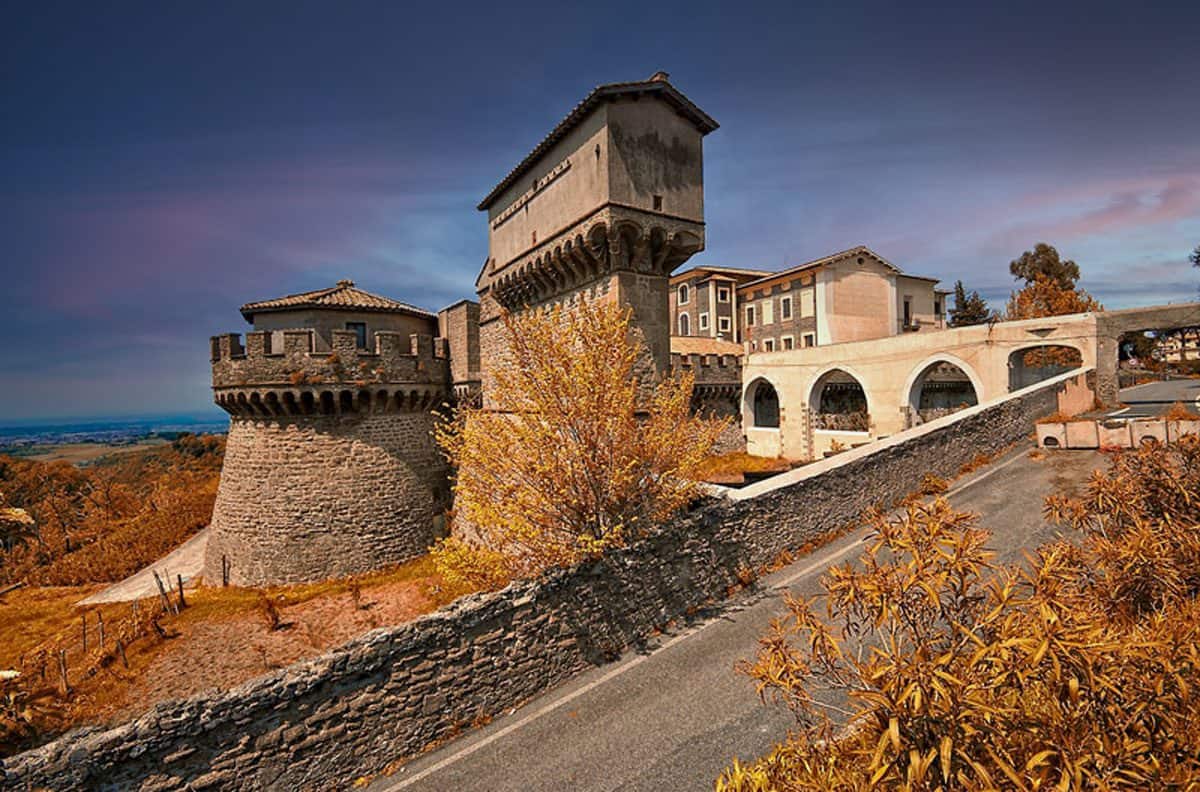
It is to Giuliano della Rovere that we owe the ring of walls that still gives the abbey the look of a fortress today. After the assault by Fabrizio I Colonna in the summer of 1482, the cardinal had the mighty walls raised quickly, substantially completed by October 1492, to protect the cenobium from the surprise attacks that had repeatedly sacked it over the centuries. The result is that crenellated enclosure, with its moat and bridge, which surprises the visitor who expects a simple convent and finds a castle instead. After the election of Alexander VI, della Rovere took refuge in the better-defended Ostia and then in France. Returning as pontiff in November 1503 as Julius II, he granted the commenda to the Colonna.
Farnese, Barberini and the last commendatory abbots
Between 1512 and 1535 the commenda belonged to Cardinal Ippolito de' Medici. Other cardinals followed, until with Alessandro Farnese the Younger, from 1564, the era of the Farnese began, continued by Cardinal Odoardo Farnese, the patron who commissioned the Domenichino. It was in this period that the palace of the commendatory abbot inside the enclosure was built and frescoed. After Odoardo's death the series of the Barberini began: Francesco the elder from 1626, then Carlo, then Francesco the younger until 1738. In the 1700s commendatory abbots from several families followed one another, up to Ercole Consalvi, the last, in office until the abolition of the commenda in 1824. It is an arc that reflects in miniature the balance of papal power, with Grottaferrata as a coveted prize and as a strategic refuge at the gates of Rome.
The National Fair of Grottaferrata, four centuries of March
If there is one event that identifies Grottaferrata in the imagination of Romans, it is the National Fair in March. Its roots go back to the 1600s: in 1761 Pope Clement XIII regulated the fair with a motu proprio in two periods, March and September, but the March fair already had a century of documented life, and the September one went back even to the late 1400s. Since 1996 the event has been held on a large paved square near Viale San Nilo, an area of about 14,000 square meters, a large part of it covered under big tent structures. Even today the fair lasts nine days around the feast of the founding saint: in 2026 the 426th edition was celebrated, from March 21 to 29, at Piazzale San Nilo. Stalls, farm machinery, crafts, food and shows fill the town with a crowd that comes from all over Lazio. If you come on those days, count on traffic and hard parking, and enjoy the fair for what it is, a real popular festival, not a sagra built for tourists.
The history of Grottaferrata from the Middle Ages to the modern era
Sacks, emperors and mercenaries
The strategic position came at a price. William I of Sicily, known as the Bad, sacked the abbey's lands in 1155. Frederick I Barbarossa repeated the feat in 1163, forcing the monks to take refuge at Subiaco with the Benedictines, taking valuables with them. In 1241 Emperor Frederick II of Swabia sacked the abbey again, carrying off prized Roman bronzes. During the Great Western Schism, in April 1379, the archimandrite Girolamo hosted anti-papal mercenaries: on April 21 those French and Breton bands clashed with the papal captain Alberico da Barbiano at Marino, in the Valley of the Dead between Marino and Castel de' Paolis. These episodes explain well why Julius II, a century later, decided to turn the monastery into a fortress.
Grottaferrata as a municipality: from 1848 to unification
On June 3, 1848 Pope Pius IX granted Grottaferrata municipal autonomy. The first mayor was Giovanni Passamonti, a merchant who worked to provide the new municipality with essential services. Urban development began along the axis of today's Corso del Popolo, with a better water supply. Luigi Passamonti modernized the mapping, and from 1868 a local establishment came to mint coins of the Papal State. After unification, the architect Agostino Mercandetti designed in 1872 the urban appearance of the Corso and the sewer system, while the town expanded toward Frascati and toward Squarciarelli along the state road.
Villas, villinos and ceramics between the 1800s and 1900s
Between the end of the 1800s and the early 1900s Grottaferrata became a vacation spot for the Roman middle class, which built eclectic and Liberty villas there. New outlying churches arose, Sacro Cuore between 1918 and 1928 and San Giuseppe in 1889. And in 1921 the famous art ceramics factory of the Tidei brothers was born in Squarciarelli, which gave the village work and fame. It is the lesser-known face of Grottaferrata, that of a town that, besides the 1,000-year-old monastery, had a middle-class and artisan season of its own that was quite respectable.
Grottaferrata in the Second World War and the Anzio cannon
The war grazed Grottaferrata more than people think. Allied bombings hit the town only marginally: on September 8, 1943 the Squarciarelli aqueduct was hit, on January 30, 1944 the German military airfield at Molara was destroyed. But the most sensational episode concerns the artillery. The Germans hid two Krupp K5 railway guns of 238 millimeters in the tunnel of the Rome-Frascati railway at Colle Oliva, near Villa Senni, to bombard the Anglo-American beachhead at Anzio. While other positions in the Castelli were destroyed by air raids, one of those guns survived: the Americans nicknamed it Anzio Annie, and today it is on display at the museum of the Aberdeen Proving Ground in Maryland. On June 4, 1944 Anglo-American forces reached Grottaferrata after the last clashes on Monte Cavo, heading toward Marino, where the Germans briefly resisted at San Rocco.

The churches of Grottaferrata beyond the abbey
The church of the Sacro Cuore
Built between 1918 and 1928 on about 3,000 square meters of property of Maria Santovetti Tanlongo and entrusted to the Salesians until 1963, when it became a parish, the neo-Gothic church received its bell tower only in the 1960s. The basilica-style interior preserves an apse mosaic and polychrome stained glass windows, a gift of Marquis Alfredo Dusmet. Next to it are an oratory, a soccer field, a theater and a movie theater.
The church of San Giuseppe in Squarciarelli
It was built in 1889 in Squarciarelli by the landowner Nicola Santovetti for 15,000 lire and entrusted to the Cistercian monks, then passed around 1905 to the Basilians and became a parish in 1919. Damaged during the war and rebuilt in simple forms, with further changes in the 1960s, it holds in its three naves the Holy Family by Silverio Capparoni and the tomb of the Santovetti family.
Casa Santa Rosa and the French Nuns
The Franciscan Missionary Sisters of Mary, known in town as the French Nuns, built Casa Santa Rosa between 1892 and 1914 on Santovetti land. Work was suspended in 1893 because of the discovery of the remains of a Roman villa, possibly linked to Cicero. The convent church was completed in 1931. The sisters took in refugees from the 1908 Messina earthquake and the 1915 Marsica earthquake, ran a convalescent home for soldiers during the Great War and served at the civil hospital of Frascati.
The historic villas of Grottaferrata
The territory of Grottaferrata is dotted with noble villas that tell four centuries of aristocratic commissions. Not all can be visited, but knowing their stories changes the way you look at the landscape: behind every gate there is a cardinal, a prince, sometimes a king in exile.
Palazzo Santovetti
The 1700s palace that hosted Pope Benedict XIV in 1741 was transformed starting in 1872, after its purchase by Antonio Santovetti, on a design by the architect Enrico Celso Donnini. The chapel preserves frescoes by Silvestro Capparoni. Until the 1950s the wines of the well-known Cantine Santovetti came out of its large cellars, appreciated all over Italy. Today the complex belongs to the Ranchella family.
Villa Cavalletti
In 1596 Marquis Ermete Cavalletti bought the estate from Cardinal Bartolomeo Cesi. The villa was built and furnished in the 1700s. After the war it passed to the Jesuits and today it houses a Catholic community and a prestigious school of theology. On the property there is one of the most extensive prehistoric necropolises of the Castelli Romani.
Villa Rossellini-Dusmet
Built in the late 1800s by Zeffiro Rossellini, grandfather of the director Roberto Rossellini, across from Villa Arrigoni-Muti, it was sold to Marquis Alfredo Dusmet in 1919 and then to the Campello. Requisitioned in 1940 as the seat of the Regia Aeronautica, it passed to the Germans in 1943, probably in connection with the Molara airfield. In the 1950s the Campello hosted the exiled King of Egypt Fārūq I there, between 1952 and 1953. In 1966 the Pallottine sisters bought it.
Villa Bracciano-Montalto-Grazioli
Founded in 1580 by Cardinal Antonio Carafa, probably on Roman remains, it had its private chapel consecrated by Pope Gregory XIII. It passed by inheritance to several cardinals: Cardinal Scipione Caffarelli-Borghese bought it in 1613 for 20,000 scudi but exchanged it the following year with Cardinal Ferdinando Taverna for the more prestigious Villa Mondragone. Later owners included Prince Michele Peretti, the Savelli and, from 1638, the Odescalchi, who sold it in 1870 to Duke Pio Grazioli. Occupied as a German command during the war, it has now been restored and operates as Park Hotel Villa Grazioli. The piano nobile shows mythological, historical and pastoral frescoes by Agostino Ciampelli, which some attribute to Annibale Carracci or Federico Zuccari, and by Giovanni Paolo Pannini. The late 1600s extensions for Prince Livio Odescalchi were designed by Giovanni Battista Fontana.
Villa Arrigoni-Muti, Villa Gavotti-Gioacchini, Villa Rasponi and Villa Senni
Villa Arrigoni-Muti was founded in 1579 by Monsignor Luigi Cerasoli and sold in 1595 to Monsignor Pompeo Arrigoni. Divided among heirs in 1692, it was later reunited by Achille Muti Bussi. Villa Gavotti-Gioacchini began as a 1500s farmhouse at Campovecchio: Marquis Lorenzo Gavotti bought it in 1614 and enlarged it, and in 1798 Alessandro Gavotti sold it for 10,000 scudi to Vincenzo Onelli, who took his own life in 1815, perhaps because of financial reverses tied to the Napoleonic period. Villa Rasponi, owned by the Scarsella and Lema in the 1700s, was bought by Eugenio Rasponi in 1821 for 8,000 scudi and preserves frescoes attributed to Domenico Cresti, known as il Passignano, to Pietro da Cortona and to Ludovico Cardi, known as il Cigoli. Villa Senni, built in the 1600s by the prelate Giovanni Giustino Ciampini, whose name gave rise to the place name Ciampino, was a German command post right above the tunnel that hid the Krupp guns, and today is a care home for the elderly.
The castles and fortified villages around Grottaferrata
The Borghetto of Grottaferrata
The Borghetto was probably built between the ninth and tenth century by the Counts of Tusculum and then passed to the Annibaldi as castrum Montis Frenelli. In the 1400s the Savelli held it, and in 1473 they exchanged it with the abbey of Santa Maria di Grottaferrata in return for the fief of Ariccia. At the beginning of the 1500s it was recorded as deserted, and attempts at repopulation failed. Today small villas stand inside. The walls, in opus caementicium in the lower part and in opus quadratum of tuff blocks in the upper part, trace an oval perimeter of about three kilometers, fortified by 13 square towers: one of the most scenic fortified enclosures to discover on foot in the surroundings.
Castel de' Paolis and the Molara
Castel de' Paolis arose around the 11th century on the remains of the Roman villa of the Scriboni-Libones. Its first documentary mention dates to 1116. An arch, part of the apse of a church and substantial walls in opus quadratum of peperino remained standing. The Molara, probably at about the current kilometer 22 of Via Anagnina near the ancient mansio of Roboraria, hosted a Basilian cenobium 10 centuries ago and was fortified in the 13th century under Cardinal Riccardo Annibaldi. Illustrious guests are tied to Annibaldi himself: Pope Innocent IV in 1254, Charles I of Anjou with his army in 1266 and Saint Thomas Aquinas in 1274. With the decline of the Annibaldi the castle passed to the Colonna from 1427, then to the Altemps, Borghese and Aldobrandini.
The archaeology of Grottaferrata: catacombs and Roman villas
The catacombs of Ad Decimum
Discovered in 1913 at the tenth mile of Via Latina, the catacombs of Ad Decimum preserve over 800 burials datable to the fifth century, frescoes of the third and fourth centuries and an arcosolium with the Traditio Legis, the handing over of the evangelical law. Together with the catacombs of San Senatore at Albano Laziale, they are the only documented catacombs of the Castelli Romani. A third complex, perhaps found by chance at Marino along Via Appia Antica at Due Santi in 1712, has been lost.
Cicero's villa and the other Roman remains
A small portion of the excavations of Tusculum spills over into the territory of Grottaferrata, but the main settlement is in the municipality of Monte Porzio Catone. The necropolises of Villa Cavalletti and the former Villa Giusti point to prehistory, along with scattered burials found at Castel de' Paolis in 1903 and at Cipriana in 1880. One of Cicero's two Tusculan estates was in the territory of Grottaferrata. Scholars have debated it for centuries, and the hypothesis most accepted today places it near the abbey of Santa Maria, confirmed by the Roman structures, including the imposing cryptoporticus overlooking the Acqua Marciana valley, where San Nilo and his companions would later build the monastery.
The nature around Grottaferrata and the Castelli Romani Park
Part of the territory of Grottaferrata falls within the Castelli Romani Regional Park, established by the Lazio Region in 1984 to protect the Alban Hills area. Originally the boundary included the entire municipal territory, then reduced in that same year 1984 because of urban and industrial expansion. The current boundaries still include the portions of Grottaferrata toward Tusculum and Molara. It's the green counterweight to a town that, however elegant, remains a short distance from the city: paths through chestnut woods, views over the Roman countryside, vineyards that run down toward Frascati. Anyone who wants to combine art and a walk finds the ideal combination here.

Eating in Grottaferrata: wine, porchetta and fraschette
You can't understand Grottaferrata without sitting down at a table. The town belongs to the wine country of the Castelli Romani, and for generations the local cellars, first among them that of the Santovetti, have produced whites meant to be drunk young and cheerful. The tradition of the fraschette, the taverns that once hung a leafy branch to signal the new wine, is alive in the nearby towns and you can feel it here too: long tables, checkered tablecloths, porchetta from Ariccia, cured meats, cheeses, artichokes in season, country bread. It's straightforward cooking, with no Michelin-guide ambitions, but it's worth the trip as much as a museum, or more. A tip: pair the visit to the abbey with a slow lunch, order the house wine by the carafe and forget about hurrying.
When to go to Grottaferrata and when to avoid it
The ideal season for Grottaferrata is the in-between one: spring and autumn, when the Castelli are green, the air is clear and the countryside is at its best. In spring artichokes arrive on the trattoria menus and the light is perfect for photography. In autumn the grape harvest fills the nearby towns with festivals dedicated to wine. Summer is hot but livable, because the height of the Alban Hills softens the sultry heat that smothers Rome, and the green of the woods offers shelter. Winter is quiet and suits anyone seeking the silence of the monastery without crowds. Only one period needs careful thought for a first visit: the nine days of the March fair, wonderful for those who love popular festivals but crowded and complicated for parking and traffic. As for days of the week, always keep in mind that the museum is open only on Friday and Saturday and on the first and third Sunday of the month. Anyone who wants to see it has to plan the visit around those dates, while the church and courtyard stay accessible every day.
Grottaferrata and Tusculum: an itinerary that stretches
If you have a whole day, you can combine Grottaferrata with the climb to Tusculum, ancient Tusculum, the settlement that dominated the Alban Hills and whose archaeological area extends largely into the municipality of Monte Porzio Catone, spilling over in small part into the territory of Grottaferrata. The hill offers Roman remains, a small theater and a very wide panorama over the countryside and Rome. It's the natural continuation of a morning spent in the abbey: from the Greek Christianity of the monastery to the ruins of the Latin city, in a few kilometers you cross two worlds. From here, by car, you can easily head down toward Frascati and its villas, closing the circle of the Tusculan Castelli in a single outing.
Grottaferrata with children and as a family
Grottaferrata works well as a destination for families too. The crenellated enclosure that looks like a castle, with its moat and towers, immediately captures the imagination of the little ones, and the museum, modest in size, can be visited without the children getting tired. Outside the complex, the town is easy to walk, with open spaces and the chance of a stroll in the greenery of the Castelli Romani Park. The winning combination is still the usual one: a short, concrete visit in the morning, lunch at a trattoria that welcomes children, and an afternoon outdoors. If you travel with strollers, keep in mind that the abbey complex is historic and laid out on several levels, and it's best to ask the secretariat about access conditions.
A curiosity about Grottaferrata (RM)
The curiosity that catches almost everyone by surprise is about the language of prayer. Half an hour from the Colosseum, every day of the year, the monks of Grottaferrata celebrate the liturgy in Greek, according to the Byzantine rite, in full communion with Rome. It isn't a revival, it isn't an exhibition. It's the only Italo-Byzantine monastery in Italy that has remained active without interruption since its founding in 1004. The town itself owes its name to an equally curious archaeological detail: the Cryptaferrata from which Grottaferrata derives was a vaulted room of a Roman villa, closed by an iron grate, which the first monks found almost intact and turned into the core of the monastery. A thousand years later, that iron grate is still set into the memory of the place. Then there's a curiosity that amuses foreign visitors: in this corner of Lazio the memory of an exiled king of Egypt, Fārūq I, who was hosted in a villa in town in the 1950s, was celebrated. Grottaferrata is like that: under the veneer of a quiet provincial town it hides a Christian East, a Renaissance fortress and a piece of twentieth-century history.
Something nobody tells you about Grottaferrata (RM)
What hurried guides skip is that Grottaferrata has a book and parchment restoration workshop among the most esteemed in the world, heir to a manual tradition cultivated by the monks for centuries. It isn't a detail for scholars. It means that ancient manuscripts and volumes from all over Europe have passed and still pass through here to be saved. Next to the workshop, the state library of the National Monument holds Greek codices, a sixteenth-century herbal in watercolor, the Blaeu atlases, medical incunabula: a collection that book lovers know and the average tourist completely ignores. The second thing rarely said is practical: the museum is open only on certain days, Friday and Saturday and the first and third Sunday of the month, while the church and courtyard are accessible every day. Anyone who arrives without checking risks finding the museum closed and not understanding why. Anyone who knows plans the visit for the right day and experiences it in full. Finally, few people say that the crenellated enclosure that looks like a castle wasn't born out of whim. They were the walls that the future Julius II had raised in a hurry after a Colonna assault in 1482.
My advice for visiting Grottaferrata (RM)
My advice is to flip the mental order of the outing. Don't treat Grottaferrata as a quick stop between one castle and another, but as a half day of its own. Arrive in the morning, enter the church when the liturgy is on and stay a few minutes in silence to hear the Greek chant: it's the experience no museum room can give you. Then visit the museum if it's one of the opening days, and take your time with Domenichino's chapel, looking at it one compartment at a time instead of snapping a photo and moving on. At lunchtime head down to a fraschetta or a trattoria, order the house wine and the artichokes if it's the season. In the afternoon, if you have the legs and the desire, stretch on to Frascati or take a short walk in the greenery of the Castelli Romani Park. If you can, avoid the nine days of the March fair for a calm first visit: the fair is splendid but turns the town into a crowd, and getting to know the abbey really takes calm. Book ahead if you're a group of more than 10 people, because guided visits to the museum are arranged with the secretariat.
Another well-known fact, yet rarely cited
That Grottaferrata hosts a 1,000-year-old abbey many people know. That for four centuries that abbey was a fief contested by the greatest families of papal power is rarely mentioned. From 1428 to 1824 it was held in commendam, and the list of commendatory abbots is a who's who of Roman history: the Medici with Ippolito, the Farnese with Alessandro the Younger and Odoardo, the Barberini with the two Francescos, the Greek humanist Bessarion, the future Julius II, up to Ercole Consalvi, the great diplomat of the Congress of Vienna. It was Bessarion who reorganized the library in the 1400s and had the inventory of the holdings compiled. It was della Rovere who ringed the monastery with walls. It was the Farnese who called the young Domenichino to fresco the chapel of the founding saints between 1608 and 1610. Put another way, the history of Italian art and politics passed several times through this seemingly secluded enclosure, and the abbey's artistic wealth is the deposit left by those patrons. It is a documented fact, not a legend, and it changes the weight of a visit that would otherwise seem merely devotional.
The right photo to take at Grottaferrata (RM)
The photo I always take home from Grottaferrata is the one of the fortified enclosure seen from outside, with the moat, the bridge and the crenellations cutting across the sky: it is the image that explains in one stroke why the abbey looks like a castle. The best light is the late afternoon, when the low sun warms the tuff of Julius II's walls and lengthens the shadows of the towers. Inside the enclosure, the second shot to look for is the courtyard with the Romanesque bell tower and the facade of the church: a square of silence that, if you catch it with the church open, fills with the golden reflection of the mosaics. For those who love details, the Domenichino chapel offers refined framings, but remember that inside churches photography should be done discreetly, without flash and without disturbing those who are praying. One last shot I recommend is the one from the edge of town toward the vineyards and the countryside of the Castelli: the same valley the monks saw 1,000 years ago, with Rome that you can sense on the horizon.

Some important events that happened here in history
The first great event is the founding itself: in 1004 Saint Nilus of Rossano laid the foundations of the monastery here and died here on September 25 of the same year, leaving his companions the task of finishing it. The church was consecrated on December 17, 1024 by Pope John XIX. The sackings that marked the Middle Ages followed: William the Bad in 1155, Barbarossa in 1163, Frederick II of Swabia in 1241, who carried off Roman bronzes. In April 1379, in the middle of the crisis of the Western Schism, the mercenaries who clashed with Alberico da Barbiano at Marino set out from the abbey. In 1482, after the assault by Fabrizio Colonna, construction began on the walls wanted by the future Julius II. In 1761 Pope Clement XIII regulated with a motu proprio the fair, which still enlivens the town every March. On June 3, 1848 Pius IX granted Grottaferrata municipal autonomy. And in the Second World War, between 1943 and 1944, the territory lived through the affair of the Krupp railway guns hidden in the tunnel of Villa Senni to strike Anzio, until the arrival of Allied troops on June 4, 1944. 1,000 years of Italian history, read through a single enclosure of walls.
Who passed through Grottaferrata (RM)
The list of those who passed through Grottaferrata is surprisingly illustrious. Saint Nilus of Rossano passed through, the Calabrian founder, and tradition has it that Pope Benedict IX retired here and died here, having become a Basilian monk around 1048. Emperors and commanders passed through as enemies: Frederick Barbarossa and Frederick II of Swabia, who carried out the sackings. The cream of the ecclesiastical aristocracy passed through as patrons: the humanist Cardinal Bessarion, who reorganized the library, Giuliano della Rovere, the future Julius II, who made it a fortress, the Farnese, the Medici, the Barberini, and Ercole Consalvi, the last commendatory abbot, a protagonist of the Congress of Vienna. Domenico Zampieri, known as il Domenichino, worked here when very young, and left one of his most beautiful cycles. In the fortified surroundings of the Molara, Cardinal Annibaldi hosted Pope Innocent IV in 1254, Charles I of Anjou with his army in 1266 and Saint Thomas Aquinas in 1274. And in the 1900s, in a villa in town, the exiled King of Egypt Fārūq I found refuge. Few places this compact have seen so many protagonists of history file by.
Quick questions about Grottaferrata (RM)
Where is Grottaferrata?
Grottaferrata is a municipality of the Castelli Romani, in the province of Rome, just outside the Grande Raccordo Anulare. The Greek Abbey of Saint Nilus, its symbol monument, is at Corso del Popolo 128, postal code 00046.
How do you get to Grottaferrata from Rome by public transit?
Take Metro Line A to the Anagnina terminus, then a Cotral bus bound for the Castelli, which stops near the abbey. By car, leave the Raccordo toward Via Anagnina or Via Tuscolana.
How much is a ticket to the Museum of the Abbey of Grottaferrata?
The full ticket to the Archaeological Museum of the Abbey is €5.00, and the reduced ticket is €2.00 for young people aged 18 to 25. Entry to the church and the courtyard is free. It's best to check current fares on the official website before your visit.
What are the opening hours of the Abbey of Grottaferrata?
The enclosure and the courtyard are open every day from 9:00 to 19:00. The monastic church keeps the hours 9:00-12:30 and 15:30-19:00. The museum is open Friday and Saturday from 10:00 to 18:00 and on the first and third Sunday of the month from 9:00 to 14:00.
Which rite is celebrated at the Abbey of San Nilo?
The monks celebrate in the Greek-Byzantine rite, in communion with Rome. It's the only Italo-Byzantine monastery in Italy active without interruption since its founding in 1004. Attending a Sunday liturgy in silence is a rare experience.
Do I need to book to visit Grottaferrata and the abbey?
You don't need to book for a free visit to the church. Guided visits to the museum are arranged in advance with the secretariat, in particular for groups of more than 10 people.
How long does it take to visit Grottaferrata?
For the abbey, the church and the museum, allow at least half a day. Add lunch at a fraschetta and a walk in the town or in the Castelli Romani Park, and you comfortably fill a whole day.
Can you take photos inside the abbey?
Inside churches, photography must be done discreetly, without flash and without disturbing those who are praying. Outside, the fortified enclosure and the courtyard offer the best shots, especially in late afternoon light.
When is the National Fair of Grottaferrata held?
The National Fair of Grottaferrata is held every March, around the feast of San Nilo, for nine days at Piazzale San Nilo. In 2026 the 426th edition took place, from March 21 to 29. It has seventeenth-century roots.
Who founded the Abbey of Grottaferrata?
The abbey was founded in 1004 by San Nilo da Rossano, a Calabrian monk of the Byzantine tradition, on land donated by Gregory I of the Counts of Tusculum. The church was consecrated in 1024 by Pope John XIX.
Who painted the frescoes of the abbey?
The frescoes of the chapel of Saints Nilo and Bartholomew, the Farnese chapel, were painted by Domenichino between 1608 and 1610, commissioned by Cardinal Odoardo Farnese. They are among the finest works of the young painter.
Why is Grottaferrata called that?
The name comes from Cryptaferrata, the grotta ferrata: a vaulted room of a Roman villa, closed by an iron grate, which the first monks found and turned into the core of the monastery. Hence the Italian place name.
Is Grottaferrata suitable for children?
Yes. The enclosure that looks like a castle, the moat and the walls appeal to the little ones, and the museum is a manageable size. A walk in the greenery of the Castelli rounds out a family day well.
Is the abbey of Grottaferrata accessible to people with disabilities?
The courtyard and the church are largely level, but since it's a historic complex on several levels, it's best to ask the abbey's secretariat for up-to-date access conditions before your visit.
What to see near Grottaferrata?
Within a few kilometers there are Frascati with its Tusculan villas, Marino with its grape festival, Monte Porzio Catone and the Tusculum area, as well as the lake towns such as Castel Gandolfo, Albano Laziale, Ariccia and Nemi.
Is the food good in Grottaferrata?
Yes, very. The town is Castelli wine and fraschette country: porchetta, cured meats, cheeses, artichokes in season and country bread, to go with the house white. A stop at the table is an integral part of the visit.
Is Grottaferrata part of the Castelli Romani?
Yes, Grottaferrata is one of the municipalities of the Castelli Romani, in the Alban Hills, and part of its territory falls within the Castelli Romani Regional Park. You can combine it with a visit to Hadrian's Villa in Tivoli in a wider itinerary in Lazio.
The verdict on Grottaferrata
The verdict is simple: Grottaferrata is one of those places that Romans themselves underrate and that careful travelers love at first sight. It doesn't have the spectacle of the lake at Castel Gandolfo or the grand name of Tivoli, but it offers something no other place in the Castelli has, a Greek monastery alive for a thousand years, with a famous library, a Domenichino cycle and an enclosure that looks like a castle. Go on a weekday, step into the church during the liturgy, take your time at the museum and finish with a slow lunch and a glass of local wine. You'll return to Rome with the feeling of having seen a piece of the Christian East without taking a plane, and with the urge to get back on the road toward the other towns of the Alban Hills.
Article written by the editorial team of TourLeaderPro, contact them for Private/Corporate/V.I.P. Tours and Experiences.
Planning a trip to Rome? The English guides for visiting the city are on ItalyPlanner.com.