Boschetto delle Faete – Rocca di Papa
In short. The Boschetto delle Faete is the equipped area and loop trail that the Castelli Romani Regional Park has carved out on the wooded slope of Rocca di Papa, above the town, starting and ending at the upper square of the town.
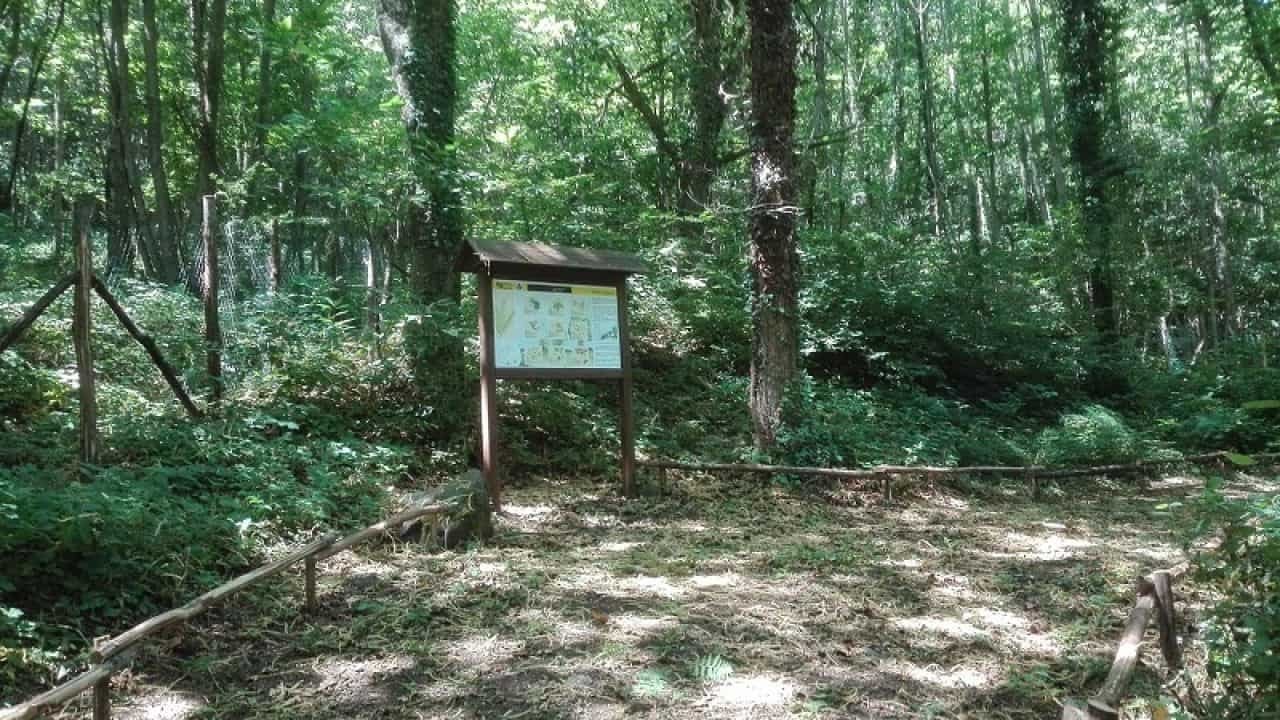
The Boschetto delle Faete is the equipped area and loop trail that the Castelli Romani Regional Park has carved out on the wooded slope of Rocca di Papa, above the town, starting and ending at the upper square of the town. The loop measures about seven kilometers, runs entirely inside the woods, and at its highest point touches the Maschio delle Faete, 956 meters above sea level, the highest peak of the Alban Hills. The trail is marked, fenced in several stretches by low wooden fences, and accompanied by signs and panels explaining the chestnut grove, the understory, the shrubs and the flowers. You start from Piazza Giuseppe Di Vittorio, in Rocca di Papa. The town hall is at Viale Enrico Ferri 65 and the Park Authority at Via Cesare Battisti 5, telephone 06 9479931. Entry to the Boschetto delle Faete is free, no reservation is needed, there is no ticket booth: it is a public wood inside a protected regional natural area. From Rome you get there in a little over half an hour from the Grande Raccordo Anulare via Via dei Laghi, about 40 kilometers from the center. The total elevation gain of the loop is around 300 meters, spread over climbs that are never brutal but continuous: you need closed shoes with a lugged sole, water, and four or five comfortable hours if you want to look at something instead of walking head down.
I'll head off a point that causes a lot of disappointment: the Boschetto delle Faete is designed for families and schools, but it is not a paved track. A stroller can't get through on the full route. It gets through on the first equipped stretch, the one near the town, where the surface is packed earth and there are benches. Beyond that, the trail narrows, becomes stony, crosses different slopes with gradients that change constantly. With small children you do the educational section and turn back. With children from seven years up you do the whole loop, allowing for a long stop under the chestnut trees.
Where the Boschetto delle Faete is and how to get there
Rocca di Papa occupies the inner flank of the great crater of the Vulcano Laziale, climbing between 680 and 780 meters above sea level in its built-up core, with the highest point of the center around 779 meters. The Boschetto delle Faete begins where the houses end, in the upper part of town, and climbs toward the ridge joining Monte Cavo to the Maschio delle Faete. This position explains everything else: the cool climate even in July, the beech forest at elevations where elsewhere it wouldn't hold, the double panorama over the sea and the Apennines.
By car from Rome to the Boschetto delle Faete
The most convenient route is Via dei Laghi, State Road 217, which you take from the Appia after Ciampino and which climbs with wide curves up to the junction for Rocca di Papa. Alternatively you take Via Appia as far as Albano and climb the hairpins. From the Grande Raccordo Anulare, without traffic, it is about 35 or 40 minutes. The road is open all year, but in January and February snow at this elevation is not a rare event: before leaving in winter it is worth checking the municipal ordinances on carrying chains.
By public transport to Rocca di Papa
The suburban carrier of Lazio is Cotral. You look up the timetables on the company's official website by entering the departure stop and the arrival stop, and the toll-free customer service number is 800 174 471. The practical advice: the bus run toward the Castelli Romani has good frequency on weekdays and much sparser service on Sunday, which is the day when people would like to walk. If you come by bus, arrive early and plan the return before leaving, not after the afternoon snack.
Where to park for the Boschetto delle Faete
Parking in the upper part of Rocca di Papa, around Piazza Di Vittorio and along Via Comunale di Monte Cavo, exists but is limited, and on a spring Sunday it fills up by 10 in the morning. Whoever arrives late leaves the car lower down, in the Campi d'Annibale area or along the carriage road, and allows 20 more minutes of climbing. It's no drama: that climb is already woods.

What the Boschetto delle Faete really is
The Boschetto delle Faete was born as an area equipped for educational purposes, that is, as a piece of woodland that the Park Authority chose to tell about instead of just protecting. The difference shows when you walk. Along the route there are wooden structures, notice boards, small huts and information panels that reproduce the typical habitat of the chestnut wood, with thematic insights on the flowers and shrubs of the understory. They are not generic signs: they talk about that slope, those species, what you have in front of your eyes at that moment.
The equipped area of the Boschetto delle Faete
The equipped part is the first you meet climbing from town. Packed-earth surface, low fences, benches spread along the route for a short rest. The fences have a double function: they keep children on the trail and they keep feet out of the understory, which in a chestnut grove is the fragile part. The benches are wooden and not many: on crowded days you find a seat, but with no guarantees.
The Locanda delle Api and the nest boxes
Inside the Boschetto delle Faete a Locanda delle Api and a series of nest boxes for micro mammals and small birds have been built. The Locanda delle Api is a bee hotel, a hollow structure that offers shelter to wild apoids, the solitary ones that don't make hives and that pollinate much of the wild flora. The nest boxes serve the songbirds that nest in cavities and the small tree-dwelling mammals. They are small installations, easy to miss if you walk distracted, and they are the smartest piece of the whole setup: they tell children that the woods are inhabited, and they say it without a word.
The Vivaro Wood and Mountain Workshop
The wooden structures of the Boschetto delle Faete don't come from a catalog. They were produced by the Park's workers in the Wood and Mountain Workshop of the Casa del Parco, in the Vivaro locality, together with three trainees who did a course of study at the Authority. It was declared by Stefano Cresta, head of the Authority's environmental area. It is a detail worth telling the kids: the panel they are reading was cut and mounted by a person who works in the park, a few kilometers from there.
The educational route for schools
The Authority's stated goal is a structured educational route, useful first of all to the students of the schools of Rocca di Papa and then to those of the other municipalities of the Park. The president of the Authority, Gianluigi Peduto, linked the Boschetto delle Faete to the Villa Barattolo educational nature trail, whose approach it takes up, and indicated the double purpose of the project: a leisure walk inside the nature of the place and a tool to raise awareness of the value of a protected natural area that has a lot to offer if adequately protected. In the same statement the president thanked those who worked on the redevelopment of the area, in particular the young people of the training program, the Authority's staff and the Municipality of Rocca di Papa, stressing the Park's commitment to training the youngest as future allies of sustainable development of the territory.
Why the Boschetto delle Faete works for adults too
Here I express a firm opinion. Educational areas designed for schools are almost always boring for anyone over 15: signs with little drawings, secondhand notions, routes of 400 meters. The Boschetto delle Faete escapes the rule because the equipped section is only the beginning of a real loop, which climbs to the ridge and touches the highest peak of the Alban Hills. You start by reading the entry on the understory and you finish at 956 meters with the Circeo on the horizon. It is a rare progression and worth the trip.
The Faete Circuit step by step
What follows is the classic route of the loop, in the order in which you meet it starting from town. It is better to read it before and not during: the trail is marked, but the junctions are many and the Park's signage uses numbers, not names.
From Piazza Di Vittorio to the crossing with Via Sacra
You start from Piazza Di Vittorio, in Rocca di Papa, and take Via Comunale di Monte Cavo. It is asphalt, uphill, among the last vegetable gardens and the last houses. You walk until you cross the paving of Via Sacra near a votive shrine dedicated to Santa Rita. The shrine is the good landmark: small, plastered, easy to recognize. From there on you change era.
The viewpoint above the Boschetto delle Faete
Continuing uphill you reach the viewpoint, and the panorama that opens is the reason it is worth getting up early. You see the Artemisio system, the Circeo promontory, the Tyrrhenian Sea and the Pontine Islands. In front of you, at the same time, the two volcanic lakes: Lake Albano and Lake Nemi. Seeing them together, from the same point, is not possible from almost any other viewpoint in the Castelli Romani: it is the advantage of being on the inner ridge of the caldera.
The junction with the Monte Cavo carriage road
You continue until you cross the carriage road to Monte Cavo. You turn right and walk on asphalt for 650 meters, the least pleasant stretch of the loop: the road is narrow, cars climb toward the antennas, and it is best to keep wide. After those 650 meters you leave the asphalt and head into the trail that starts on the left.
The ridge of the Monti delle Faete
The trail follows the ridge of the Monti delle Faete and aims for the Maschio. It runs along a narrow route, with many crossings from one slope to the other and the resulting changes of vegetation: the exposure changes, the humidity changes, the plant changes. Broom, holm oak and wild thyme live together with maples, chestnuts and beeches on the same altitudinal level, separated only by the side of the mountain they are on. Anyone walking with an eye on the botany has here the most instructive stretch of all the Castelli Romani: in 20 minutes you cross three different plant worlds without gaining 100 meters of elevation.
The summit of the Maschio delle Faete
You arrive near the top of the Maschio delle Faete, 956 meters above sea level, the highest elevation of the Alban Hills. A warning: the summit is not a bare knoll with the cross and the summit register. It is a wooded top, and the best view is a little before and a little after, in the gaps between the trees. Whoever expects a 360-degree panoramic balcony is disappointed. Whoever expects a dense wood on a volcanic peak finds exactly that.
Trail 516 toward the Orti di Barbarossa
At the top you cross trail 516, which leads to the Orti di Barbarossa locality and Via dei Corsi. It is a variant useful to know for two reasons: it shortens the return if the weather worsens and it opens a second loop for those coming back a second time. For the classic Faete Circuit, though, you don't take it.
The descent toward the Campi d'Annibale
You continue along the trail on the right and take the descent, which crosses stretches of mixed wood and chestnut groves down to the Campi d'Annibale driveway, in the Madonnella locality. This is the stretch in which the chestnut grove shows itself for what it is: a wood managed by people for centuries, with wide stumps, re-formed shoots, traces of orderly cutting. It is not a primary forest and never was.
Madonnella, trail 517 and the Vivaro
At Madonnella you cross trail 517, which ends in the Vivaro locality at the federal equestrian center. The Vivaro is the plateau of the Pratoni, the high plain that stretches south of the ridge: open meadows, horses, and the Casa del Parco with the wood workshop where the structures of the Boschetto delle Faete come from. Here too: a useful variant, not part of the loop.
La Forcella, the 509a link and Colle Jano
200 meters farther on you reach the locality of La Forcella. You turn right and, at the junction with the 509a link, you climb left to the top of Colle Jano. The name deserves a note: Jano points to Janus, and place names of this kind in the Alban Hills are often the surviving trace of a pre-Latin cult. A trace, not proof: toponymic philology is a terrain where you slip quickly.
Valle dei Caprai and the return to Rocca di Papa
From Colle Jano the route descends, in places quite steeply, inside a chestnut wood, to the rest area of Valle dei Caprai. It is the right place for the last break: you have almost arrived and you are still inside the woods. You then continue on the trail to a barrier on the left. Past the barrier you are back in the built-up area of Rocca di Papa, a few minutes from the starting point.
How much time the Faete Circuit takes
Seven kilometers seem few and are deceptive. The route changes surface constantly, the descent from Colle Jano is steep, and the ridge stretch forces you to watch where you put your feet. A trained walker finishes the loop in two and a half hours. A family with children takes four and a half hours, stops included, and is right to. Whoever plans the outing for 15:00 in November is left in the dark in the woods: in winter you start in the morning, no discussion.

Via Sacra that crosses the Boschetto delle Faete
The reason this loop is worth more than other similar routes in the Castelli Romani has a precise name: Via Sacra. The trail crosses it a little above town and runs alongside it for a stretch. It is a Roman artery built in the 7th century BC, paved with basalt blocks of black lava, and still preserved today in conditions that have no equal in all of Lazio. You walk on a pavement 2,700 years old, in the open air, with no ticket and no barriers.
What a Via Sacra paving stone is like
It is worth stopping to look at the stones instead of treading on them absentmindedly. The upper part of the slabs is a smoothed polygon, fitted to its neighbors without mortar. The underside is wedge-shaped and sinks into the roadbed. It is the reason the road has held for millennia: every stone works like a tooth, and the weight that presses on it wedges it in deeper instead of shifting it. The stone is leucitite, the lava of the Alban Hills, the same one with which the Romans paved the Appia.
The paving and modern maintenance
The visible stretch along the Faete Circuit alternates intact pieces with reworked ones. Some paving stones are in place from antiquity, others were repositioned in later interventions. Telling them apart with the naked eye is hard and I don't do it lightly. The practical rule for the walker is another, and it is about respect: you don't dislodge the paving stones, you don't move them to take a photo, you don't take away chips. It seems obvious, it isn't.
Where Via Sacra led
The road climbed from the base of the mountain to the summit of Monte Cavo, for about six kilometers, and served for religious processions and triumphal celebrations. At the top stood the Temple of Iuppiter Latiaris, the temple of Jupiter Latiaris, the federal sanctuary of the Latin peoples. Along that climb passed Latins, Aequi and Volsci headed to the sanctuary to pray and take omens from the deity.
The Temple of Jupiter Latiaris above the Boschetto delle Faete
The sanctuary on the summit of Monte Cavo was the religious reference point of the whole Latin area before Rome became Rome. Ancient tradition attributes its establishment as a common temple of the Latins, Hernici and Volsci to Tarquinius Priscus. Under Tarquinius Superbus, in 534 BC, it reached its greatest splendor as the seat of the Feriae Latinae. Here the distinction between documented fact and literary tradition has to be held firm: the sources are late and reconstruct after the fact, while the archaeology of the summit has been compromised by later constructions.
The Feriae Latinae
The Feriae Latinae were a movable feast, with no fixed date, generally celebrated in spring and dedicated to Jupiter Latiaris. Probably born before the founding of Rome, it brought together the representatives of the cities of the Latin League. The old local account speaks of 47 Latin peoples gathered to solemnly celebrate the pact of friendship. The rite included a procession with offerings of lambs, cheeses and milk, then the sacrifice of a white bull whose meat was divided among the representatives of the cities, and finally a great bonfire lit on the summit of Monte Cavo. During the festival conflicts were suspended, as at the Greek Olympics. When Rome took the lead of the League, it was the Roman consuls who set the date of the celebration each year.
The lesser triumphs on the mountain
The Temple of Jupiter was also the place of celebrations for victorious commanders and emperors, who climbed there to pay homage to the deity on returning from military undertakings. In Roman practice the mountain hosted the triumph that the Senate had not granted in the city: whoever did not obtain the procession on the Capitoline Hill could celebrate it up here. A consolation prize with a view over the Tyrrhenian, which says a lot about how much that sanctuary counted in the sacred hierarchy of Lazio.
The end of the sanctuary and the hermitage of San Pietro
In 391 AD the celebration of pagan rites was prohibited. The Temple was destroyed and on its remains a hermitage dedicated to Saint Peter was built, founded according to tradition by a Dalmatian hermit. The hermitage became a convent in 1727, entrusted to the Passionists, and in the 1800s it was turned into a hotel. Of the ancient temple, today, practically nothing remains on the surface: what truly remains is the road that led to it, and the road you meet along the Faete Circuit.
The Maschio delle Faete, the summit of the Alban Hills
The Maschio delle Faete reaches 956 meters above sea level and is the highest peak of the Monti delle Faete group and of the whole Alban Hills complex. It lies in the municipal territory of Rocca di Papa and is visible from Rome: when from the city you look southeast and see the double profile of the Castelli Romani, the left-hand hump is the Maschio, the one with the antennas is Monte Cavo. The mountain is completely covered with vegetation, with chestnut and oak woods that climb all the way to the top.
The geology of the Maschio delle Faete
The Maschio delle Faete is not just any mountain: it is a volcanic edifice inside another volcanic edifice. The Vulcano Laziale went through three phases. The first ends around 360,000 years ago and builds the main edifice with massive explosions and pyroclastic flows. The second, around 280,000 years ago, generates a minor edifice exactly where the Maschio delle Faete stands today, inside the original volcano. The third, between 200,000 and 19,000 years ago, is hydromagmatic: magma and groundwater meeting, phreatomagmatic explosions, and the birth of the craters that would host the lakes. On the dating of the last eruptive manifestations research doesn't agree: a traditional reading pushes them up to about 5,000 years ago, more recent studies place them around 36,000 years ago. The volcano is classified as quiescent, with gas emissions and moderate seismicity.
The Tuscolano Artemisia caldera
The rim of the ancient crater draws a horseshoe running from Monte Tuscolo to Monte Artemisio and exceeds 700 meters of elevation at several points. The ridge joining the Maschio delle Faete to Monte Cavo formed the edge of a large volcanic caldera. Walking the Faete Circuit means walking on that rim, with the inner crater to the south, that is, the Campi d'Annibale, and the Pratoni del Vivaro opening just beyond. No sign explains it this clearly, and yet it is the key to reading the whole landscape you cross.
The panorama from the Maschio delle Faete
The Maschio delle Faete is one of the best observation points over Rome, on a par with Monte Cavo. On tramontana days, when the air dries out, you can make out the Circeo, the Tyrrhenian, the outline of the Pontine Islands and, inland, the chain of the Lepini and Simbruini. The good window is early morning in autumn and winter. In summer the haze eats everything by 10.
Monte Cavo seen from the Boschetto delle Faete
Monte Cavo, 950 meters, is the second peak of the Alban Hills and the bulky neighbor of the Maschio delle Faete. It is a volcanic cone, visible from Rome, and today hosts a radio and television broadcasting hub that serves the capital and a good part of Lazio. Over the years the antennas have fueled controversy over electromagnetic pollution and over the dignity of a place that for centuries was the federal sanctuary of the Latins. Whoever walks the Faete Circuit sees it continually, from different angles, and sooner or later wonders how the sacred summit became a pylon.
Climbing Monte Cavo after the Boschetto delle Faete
Whoever still has legs and time can add Monte Cavo to the day, climbing from the carriage road or from the surviving stretches of Via Sacra. It is not a long route, but it adds to the seven kilometers of the loop and has to be weighed beforehand, not in the middle of the afternoon. Access to the summit and to the areas occupied by the installations is regulated: respect the signs on site and don't climb over anything.
The wood of the Boschetto delle Faete: chestnuts, beeches, understory
The name Faete points to the beech, and the beech forest of this slope of the Alban Hills is one of the scientific reasons the Park protects the area. The beech, at our latitudes, usually wants elevations above 1,000 meters: here it comes down much lower thanks to the humidity and the thermal inversion of the volcanic basins. It is a phenomenon known as depressed beech forest, and the Alban Hills preserve significant examples.
The chestnut grove of the Boschetto delle Faete
The chestnut dominates much of the route and dominates, more generally, the woods of the Castelli Romani Park. It is not spontaneous vegetation in the strict sense: it is a wood cultivated for centuries, for the fruit and for the timber, which largely replaced the original oak wood. You recognize it by the enormous stumps, by the shoots that restart in a radial pattern after cutting, by the light that filters differently than in a mixed wood. In October the understory fills with burs and the temptation to gather is strong: gathering fruit in the woods is regulated and in many stretches the chestnut groves are private property. You look, you don't fill your backpack.
The beeches and the slope species
On the ridge, where the trail passes from one slope to the other, the vegetation changes within a few tens of meters. On the cool, shady side beeches and maples appear. On the warm side exposed to the south come the holm oak, broom and wild thyme, Mediterranean scrub species that in theory shouldn't be found at the same elevation as a beech forest. Finding them on the same altitudinal level, separated only by exposure, is the clearest lesson in ecology that the Faete Circuit offers.
Flowers and shrubs of the understory
The panels of the Boschetto delle Faete devote space to the flowers and shrubs of the understory, and it is the part visitors skip most often. In spring the chestnut grove lights up with cyclamens, anemones, butcher's broom in berry, and the forest floor changes color every three weeks. The best time for flowering is between April and the first half of May. Whoever comes in August finds uniform green and nothing else.
The Park's fauna around the Boschetto delle Faete
The fauna of the Castelli Romani Regional Park includes the wolf, the fox, the badger, the pine marten, the porcupine, the hedgehog, the hare and the wild boar. Among birds, the buzzard and the peregrine falcon, the green woodpecker and the great spotted woodpecker, the tawny owl, the little owl, the long-eared owl, the barn owl and many songbirds. The hazel dormouse, the small rodent of hazel groves, is used by the Authority as an indicator of the health of the wood. Realism: of these animals, walking in broad daylight with children talking, you see a woodpecker, maybe a buzzard in flight and the tracks of the wild boar. The rest you know is there.
The wild boar and the rules of common sense
The wild boar in the Castelli Romani is abundant and used to people. The rules are three and simple: you don't approach it, you don't feed it, and if you meet a female with young you back away slowly without getting in between. The dog must be kept on a leash, always, and it is not a rulebook affectation: a loose dog chasing a boar comes back with the boar behind it.

The Castelli Romani Regional Park
The Castelli Romani Regional Park was established in 1984 by regional law and extends over about 15,000 hectares. It includes the territories of Albano Laziale, Ariccia, Castel Gandolfo, Frascati, Genzano di Roma, Grottaferrata, Lanuvio, Lariano, Marino, Monte Compatri, Monte Porzio Catone, Nemi, Rocca di Papa, Rocca Priora, Velletri and Pomezia. The Authority's seat is in Rocca di Papa, at Via Cesare Battisti 5, telephone 06 9479931. Within the perimeter fall Lake Albano, also called Lake Castel Gandolfo, and Lake Nemi, the two surviving crater lakes of the Vulcano Laziale.
What the Park Authority does around the Boschetto delle Faete
The Authority manages the trail network, the official mapping, the environmental education programs and the research activities on flora, fauna and geology. It organizes excursions and workshops, partly free, and runs campaigns against poaching. The calendar of initiatives is consulted on the Authority's official website: it changes from season to season and there is no point freezing it on a page.
The signage of the Park's trails
The Park's trails are numbered, and the numbers you meet along the Faete Circuit are 516 toward the Orti di Barbarossa, 517 toward the Vivaro and the 509a link before Colle Jano. The signage on the ground is made of numbers and trail marks, not place names: if you look for signs saying Boschetto delle Faete along the ridge, you won't find them. It is worth downloading the Park's official map before leaving and memorizing the three numbers.
What you can and can't do in the Park
Inside a protected regional natural area precise rules apply: you don't light fires, you don't camp freely, you don't pick plants, you don't leave trash, dogs go on a leash and motor vehicles stay on the roads open to traffic. Fire, in particular, is the serious issue: a chestnut grove dried out by an August without rain burns fast and doesn't come back within a generation.
Rocca di Papa, the town below the Boschetto delle Faete
Rocca di Papa has about 18,000 inhabitants and climbs the slope of the Vulcano Laziale with a gradient that, on foot, you feel in full. The first document that names it dates to 1181, under the pontificate of Lucius III. In 1328 it underwent the siege of Emperor Louis the Bavarian. In 1427 it passed to the Colonna, who held it until 1870. In 1855 the citizens proclaimed a short-lived republic against papal authority. The earthquake of August 26, 1806 caused casualties and heavy damage, and remains the great trauma of local memory.
The medieval quarter
The upper part of town preserves the medieval layout: narrow alleys, stairways, houses crowded together. Piazza Vecchia dates to the 1300s, to the time of the Bavarian occupation, and is the point where the town reads best. Half an hour before or after the walk at the Boschetto delle Faete is enough to cross it, and it is worth spending: you understand why people settled right there, on a defensible spur with water nearby.
The churches of Rocca di Papa
The parish church is Santa Maria Assunta, completed in 1827. The sanctuary of the Madonna del Tufo is documented from 1592 and remains the most deeply felt devotional place in town. The convent of Santa Maria ad Nives of Palazzolo has origins going back to the 11th century and looks out over Lake Albano from a natural terrace that few people know. The opening hours of the places of worship vary and should be checked on site beforehand.
The Town Hall
The Town Hall was built in the 1930s along Corso della Costituente and for a long time also housed school classrooms. The municipal offices are now at Viale Enrico Ferri 65. It is a building of the regime, recognizable in its proportions and materials, and tells a phase of the town's history that the medieval quarter doesn't tell.
The Campi d'Annibale
The Campi d'Annibale are the high plain that opens behind the built-up area, inside what was anciently the main crater of the Vulcano Laziale. The floor is made of pyroclastic materials and the plain is closed between Monte Cavo and the Maschio delle Faete, which face each other at close range. There are two explanations for the name: tradition has it that Hannibal camped here during the march on Rome. The alternative hypothesis, more cautious, derives it from the feudal family of the Annibaldi della Molara. The second explanation is the one historians take seriously, the first is the one told to tourists. I give you both, saying which is which.
The Geophysical Museum of Rocca di Papa
The Geophysical Museum of Rocca di Papa occupies the building of the Geodynamic Observatory built in 1886, and preserves historic seismic instruments along with exhibits devoted to the Earth sciences. The location is not accidental: the Alban Hills are a quiescent and seismically active volcano, and a geodynamic observatory here was a reasoned scientific choice, not a 19th-century whim. For hours, openings and guided visits it is best to contact directly the institution that runs it: the openings are tied to calendars and reservations that change over the course of the year. For a full day, the museum is the natural complement to the Boschetto delle Faete: first you walk on the volcano, then you go and see the instruments that listen to it.
The Boschetto delle Faete with children
The Boschetto delle Faete was born for the youngest and this vocation shows. But it has to be used with judgment, because between the equipped section and the full loop there is an enormous difference.
Up to five years old
You do the equipped educational stretch, read the panels, look for the nest boxes and the Locanda delle Api, take a bench and head back. A full hour and a half, without pushing. The stroller holds up on the packed earth at the start and then becomes a weight to carry in your arms: a baby carrier or a child-carrier backpack solves it better.
From six to 10 years old
The full loop is within reach, provided you start early and break it up with real stops. The game that always works is counting the changes of woodland along the ridge: chestnut, beech, holm oak, chestnut again. Children notice it before adults, if someone tells them to look.
From 11 years up
At this age the Faete Circuit becomes a real walk and can be loaded with content: Via Sacra, the federal sanctuary, the caldera, the triumph denied by the Senate. History told while walking goes in better than history read in class, and this route offers more of it than you find in half a day at a museum.
When to go to the Boschetto delle Faete
Spring
Between April and the first half of May the understory blooms, the light still filters through branches not completely closed, and temperatures are ideal. It is the best season, no argument. The price to pay: on Sunday the parking fills up early.
Summer
The advantage of the Boschetto delle Faete in summer is the coolness: at 900 meters, under continuous tree cover, you can walk even in July when in Rome you can't breathe. The disadvantage is the haze, which closes the panorama by mid-morning. You set out at seven and finish before lunch.
Autumn
October and November are the season of the chestnut grove: colors, burs, mushrooms popping up everywhere that you don't touch without authorization. The air after a weather front is the clearest of the year and the panorama from the ridge reaches as far as the Pontine Islands. Watch out for the short days: after 16:00 in the woods it gets dark earlier than elsewhere.
Winter
With the cold the wood goes bare and you see the structure of the terrain better, the low walls, the ancient tracks. Snow in Rocca di Papa falls a few days a year and turns the route into something memorable, but also more demanding: slippery ground, covered trail marks, a treacherous descent from Colle Jano. If you have no experience on snow, wait for the thaw.
Equipment and safety on the Faete Circuit
Hiking shoes or at least closed shoes with a lugged sole: smooth sneakers on the descent from Colle Jano are the fastest way to ruin your day. Enough water, because along the loop there are no reliable drinking fountains. One extra layer in your pack: between the town and the ridge the thermometer drops by quite a few degrees and the wind on the crest is almost always there. A charged phone and a map downloaded offline, because the signal in the woods comes and goes. None of this advice is original. All of it is ignored by half the people I meet on the trail.
Accessibility of the Boschetto delle Faete
The initial equipped stretch is the most accessible and allows a short walk on packed earth. The full loop is not passable by wheelchair or by stroller, because of slope, trail width and surface. Those with particular needs should assess the equipped area alone in advance, or contact the Park Authority for up-to-date information on facilitated routes.
What to do in bad weather
A summer thunderstorm on the ridge of the Monti delle Faete is no joke: you are at elevation, exposed on the crest passages, with tall trees around. At the first sign you go down, you avoid ridges and isolated trees, and you head back toward town. Trails 516 and 517 also serve this purpose: knowing the escape routes before you need them.
Where to eat and what's around the Boschetto delle Faete
Rocca di Papa has trattorias and bakeries in the historic center and along the main streets, and the Castelli Romani tradition here is what you would expect: porchetta, fraschette, wine from the hills. The sandwich prepared before climbing remains the most practical solution for the walk, because along the loop there is no refreshment. The real lunch comes afterward, in town, when the legs have finished their work.
The other Castelli Romani half an hour away by car
Within a radius of 20 kilometers is concentrated one of the densest territories of Lazio. Nemi with its lake and its strawberries, Castel Gandolfo overlooking Lake Albano, Ariccia with the monumental bridge and the fraschette, Genzano di Roma with the June infiorata, Albano Laziale with the remains of the Castra Albana, Marino with the grape festival, Frascati with the Tusculan villas, Grottaferrata with the Greek abbey, Monte Porzio Catone and Monte Compatri on the Tusculan slope. The professional's advice: you don't visit three in a day. You pick one and do it well, after the walk.
The Appian Way Regional Park as a comparison
Anyone looking for another walk on Roman paving, without going far from Rome, finds in the Appian Way Regional Park the natural point of comparison. The two experiences are complementary: the Appia is plain, monuments and crowds. The Faete Circuit is elevation, woods and silence. Whoever wants to understand how a Roman road worked walks both.
Escorts and guides in the area
Frequently asked questions about Boschetto delle Faete, Rocca di Papa
How much does it cost to visit the Boschetto delle Faete?
The Boschetto delle Faete, in Rocca di Papa, has no entrance fee: it is a public wooded area inside the Castelli Romani Regional Park, with no ticket booth and no obligation to reserve. The only expenses of a day are transportation and possibly lunch in town.
How long is the Faete Circuit?
The Faete Circuit, the classic loop of the Boschetto delle Faete, measures about seven kilometers, starting and returning at the upper square of Rocca di Papa. The route is marked by the Park Authority with numbers, not names, and has several junctions that are worth studying before setting out.
How do you get to the Boschetto delle Faete?
The starting point of the Boschetto delle Faete is Piazza Di Vittorio, in Rocca di Papa, from where you take Via Comunale di Monte Cavo, paved and uphill among the last houses of the town. From there the trail crosses Via Sacra a little above and continues toward the ridge that joins Monte Cavo to the Maschio delle Faete.
Is there a panorama from the summit of the Maschio delle Faete?
No, from the summit of the Maschio delle Faete, at 956 meters, the wood covers the top right to the tip and there is no 360-degree viewpoint. The panorama on the Faete Circuit is found elsewhere along the route, not on the highest peak of the Alban Hills.
Is the Boschetto delle Faete suitable for children?
Yes, the Boschetto delle Faete was born with an educational vocation for the youngest, with wooden structures, notice boards and information panels along the equipped stretch. Up to five years old it is best to stay on the educational stretch, a full hour and a half without pushing. For the full loop you need more trained legs.
Where do you eat near the Boschetto delle Faete?
Rocca di Papa, the town from which the Boschetto delle Faete starts, has trattorias and bakeries in the historic center and along the main streets, with porchetta, fraschette and Castelli Romani wine. Along the loop there is no refreshment, so it is best to bring a sandwich and save the real lunch for town, after the walk.
What shoes do you need for the Faete Circuit?
To walk the Faete Circuit you need hiking shoes or at least closed shoes with a lugged sole, because the descent of Colle Jano on a surface of leaves and stones is treacherous in smooth footwear. It is also best to bring enough water, since along the loop there are no reliable drinking fountains.
When to go to the Boschetto delle Faete?
Spring, between April and the first half of May, is the best season for the Boschetto delle Faete: the understory blooms, the light filters through branches not yet completely closed and temperatures are ideal. The only disadvantage is that on Sunday the parking fills up early.
The Park organizes guided excursions with its own staff, and authorized tour guides and escorts who cover the Castelli Romani work in the area. For organized groups, corporate outings or private visits, the professional network of TourLeaderPro gathers licensed escorts who work in Rome and in the Alban Hills area. Those organizing a multi-day program based in Rome will find operational guidance also in the section dedicated to the capital of TourLeaderPro.
For those traveling from abroad
For a day outside Rome without a train and without crowds, the answer is the Castelli Romani. The English-language guides devoted to day trips from the capital are on ItalyPlanner, while the overview of things to see in the city, useful for fitting the trip into the program, is in the ItalyPlanner guide to Rome.
A curiosity about Boschetto delle Faete - Rocca di Papa
The real curiosity of this place is not Via Sacra and not the summit: it is the beech. The place name Faete comes from the beech, and the beech in central Italy normally lives above 1,000 meters of elevation. Here, on the Monti delle Faete, it comes down much lower and lives at the same altitude alongside the holm oak, broom and wild thyme, which are Mediterranean scrub species. The reason is the shape of the terrain. The volcanic basins of the Alban Hills generate thermal inversion: cold air stagnates on the crater floor, humidity stays high, and the beech finds conditions that elsewhere it would find 200 or 300 meters higher up. Ecologists call the phenomenon depressed beech forest and have studied for decades its surviving patches in the Lazio Apennines. Walking on the ridge of the Faete Circuit you cross this anomaly several times in a few minutes: you pass from the cool slope, where the beech dominates and the understory is sparse, to the warm slope, where the holm oak and the aromatic shrubs appear, and then back again. The same meters of elevation, the same mountain, the same day. Only the side the slope faces changes. There is no sign that explains it in these terms, and this is the biggest limit of the setup: there is an open-air ecology laboratory along the trail, and almost nobody notices it. If you have to take home a single notion from this walk, take this one: in the Alban Hills altitude counts less than exposure, and the plant landscape is read by turning your head, not by looking at the altimeter.
Something nobody tells you about Boschetto delle Faete - Rocca di Papa
Better to know beforehand: the summit of the Maschio delle Faete has no panorama. It is the highest peak of the Alban Hills, 956 meters, and the wood covers it right to the tip. Whoever climbs convinced of finding a 360-degree viewpoint with the elevation sign gets up there and looks around for something that isn't there. The panorama, on this loop, is found elsewhere: at the viewpoint you meet climbing from town, before the junction with the Monte Cavo carriage road, and in the gaps between the trees along the ridge. That viewpoint, and not the summit, is the point from which you see the Artemisio, the Circeo, the Tyrrhenian, the Pontine Islands and the two crater lakes together. The second thing nobody says concerns the trail numbers. The Park's signage on the ground is numerical: 516, 517, link 509a. Whoever looks for arrows saying Boschetto delle Faete or Maschio delle Faete along the ridge looks for them in vain, and stops undecided at the junctions. Bring the three numbers written down, or the Park's official map downloaded on your phone before leaving, because in the woods the signal is not reliable. The third thing, the most practical: there is no water along the loop. No drinking fountain to count on, no kiosk, no bar. You load up on water in town and it is enough for everyone, including the children who ask for double when it is hot.
The advice I give you for visiting Boschetto delle Faete - Rocca di Papa
Walk the loop counterclockwise, that is, as described here: first the climb on asphalt and Via Sacra, then the ridge, then the descent from Colle Jano toward Valle dei Caprai. The reason is technical. That descent is steep and on a surface of leaves and stones: doing it uphill, as happens to those who start the loop the other way around, means reaching the ridge already worn out, with the best part to walk tired. Doing it downhill at the end, on the other hand, costs a bit of attention to the knees and nothing more. Second piece of advice: set out by 8:30, in any season. The morning light on the ridge is what lets you see the Circeo, the parking in town at that hour is still free, and before nine the wood belongs to those who walk rather than those who shout. Third: give 20 minutes to Via Sacra instead of just crossing it. Sit on the edge of the paving, look at how the polygons are fitted together, look for the point where the ancient pavement breaks off and resumes. It is worth more than three panels read standing. Fourth: don't add Monte Cavo to the day if you have children or if you started late. Seven kilometers of loop are already a full and honest day. The ambition of adding up the two peaks produces returns in the dark, and the dark in a chestnut grove arrives sooner than anyone expects.
Another well-known fact, yet rarely cited
It is known that the Boschetto delle Faete crosses a volcano. What is rarely cited is that the volcano is inside another volcano, and that this walk follows its rim. The Vulcano Laziale built its main structure in a first phase that ended around 360,000 years ago, with explosions and pyroclastic flows of enormous size. Then, around 280,000 years ago, a smaller one formed inside that edifice: the system we today call the Maschio delle Faete. The third phase, between 200,000 and 19,000 years ago, was hydromagmatic, with the magma meeting groundwater and digging the craters that would host Lake Albano and Lake Nemi. The rim of the ancient crater draws a horseshoe from Monte Tuscolo to Monte Artemisio, with elevations that exceed 700 meters. The ridge joining Monte Cavo to the Maschio delle Faete, the one the trail passes over, was the edge of a large caldera. And the Campi d'Annibale, the plain that opens behind the town, occupy the now extinct main crater. The second little-cited fact concerns the present: the Vulcano Laziale is classified as quiescent, not extinct, and continues to show gas emissions and moderate seismicity. It is not an alarm, it is a scientific clarification that explains why in 1886, in Rocca di Papa, someone thought it sensible to build a geodynamic observatory. On the last eruptions research is debating: a traditional reading takes them up to about 5,000 years ago, later studies place them around 36,000. The question is open and is written that way, without choosing one for narrative convenience.
The right photo to take at Boschetto delle Faete - Rocca di Papa
The right photo is not the summit and not the selfie with the sign. It is the paving of Via Sacra shot in the morning, with the raking light coming in among the chestnuts and drawing the edges of the polygons. You need a precise condition: low sun and trees still without leaves, so between November and March, by 9:30. At those hours the black lava stone takes on a sheen that vanishes completely at noon, and the joints between one paving stone and the next become a readable pattern. Get low, almost on the ground, with the road running off diagonally toward the woods: the compressed perspective gives the idea of a road that climbs, which is exactly what Via Sacra did. The second photo to take home is from the viewpoint, and has only one rule: wait for the tramontana. On days with wind from the north the air dries out and Lake Albano, Lake Nemi, the Pontine plain and the profile of the Circeo all come into the same frame. You need a moderate telephoto, around 70 to 100 millimeters equivalent, to compress the planes and make the Circeo look as close as it really appears to the eye when the air is clear. Third photo, the one nobody takes and which tells the place better than the others: the detail of the Locanda delle Api, with the holes in the wood and, with a bit of luck, a solitary bee going in. Small, not very spectacular, true. Avoid instead the photo under the chestnut canopy at midday in summer: the contrast between patches of light and deep shadow is not something any sensor can recover.
Some important events that happened here in history
The first event is the construction of Via Sacra itself, in the 7th century BC: a paved road of about six kilometers from the base of the mountain to the summit, built when Rome was a village and the federal sanctuary of the Latins was the religious center of the region. The second is the establishment of the Temple of Iuppiter Latiaris as the common sanctuary of the Latins, Hernici and Volsci, which ancient tradition attributes to Tarquinius Priscus. The third is the greatest splendor of the sanctuary under Tarquinius Superbus, in 534 BC, as the seat of the Feriae Latinae: the movable spring festival in which the representatives of the Latin cities climbed in procession with offerings of lambs, cheeses and milk, sacrificed a white bull and divided its meat, and lit a great bonfire on the summit. During the Feriae wars were suspended, as at the Greek Olympics. When Rome took the lead of the League, it was the Roman consuls who set its date each year. The fourth event is the end: in 391 AD the prohibition of pagan cults, the destruction of the temple, and the construction on its remains of a hermitage dedicated to Saint Peter. The fifth carries us to the Middle Ages of the town: in 1181 the first documentary mention of Rocca di Papa under Lucius III. In 1328 the siege by Emperor Louis the Bavarian. In 1427 the passage to the Colonna, who held the fief until 1870. In 1855 the short-lived republic proclaimed by the citizens against papal authority. The sixth is the earthquake of August 26, 1806, with casualties and serious damage, the fact that more than any other marked local collective memory and that helps to understand why in 1886 the Geodynamic Observatory arose here. The seventh belongs to our time and is the redevelopment of the Boschetto delle Faete by the Park Authority, with the wooden structures produced at the Vivaro and the transformation of a wooded slope into an educational route open to all.
Who passed through Boschetto delle Faete - Rocca di Papa
More important people have passed over these slopes than have gone through many Roman museums, and almost all on foot. For centuries the representatives of the cities of the Latin League climbed up here, together with Latins, Aequi and Volsci headed for the sanctuary of Jupiter Latiaris: they were annual processions, with animals in tow, along the same paving you meet today a little above Rocca di Papa. Roman consuls climbed up as soon as they took office, required to sacrifice on the mountain before attending to anything else, and so did the victorious commanders whom the Senate had not judged worthy of the triumph on the Capitoline Hill: for them the celebration up here remained, the lesser triumph, a consolation with a view over the Tyrrhenian. Local tradition, which I report as tradition and not as fact, has it that Hannibal camped on the plain behind the town during the march on Rome, and the name of the Campi d'Annibale would derive from that camp. The historiographically sounder hypothesis instead ties the place name to the feudal family of the Annibaldi della Molara. In the Middle Ages Emperor Louis the Bavarian passed through, who in 1328 besieged Rocca di Papa, and from 1427 the Colonna, lords of the fief for over four centuries. On the nearby summit, a Dalmatian hermit founded the hermitage on which the Passionist convent arose in 1727. When the structure was turned into a hotel, in the 1800s and 1900s, guests of rank stayed there, among them King Edward VIII and the Swedish writer Amelie Posse. Today the school groups of Rocca di Papa and of the other municipalities of the Park pass through, the trainees who built the panels at the Vivaro Wood Workshop, and the families who on Sunday morning look for a wood half an hour from the Grande Raccordo Anulare. The company has changed. The road, underfoot, is the same.
Quick questions about Boschetto delle Faete - Rocca di Papa
How much does it cost to visit the Boschetto delle Faete?
Nothing. The Boschetto delle Faete is a public wooded area inside the Castelli Romani Regional Park: access is free, there is no ticket booth and no need to reserve.
How long is the route of the Boschetto delle Faete?
The full loop, the so-called Faete Circuit, measures about seven kilometers, starting and returning at the upper square of Rocca di Papa.
How long does the Faete Circuit take?
Two and a half hours for a trained walker, four or five hours for a family with children, stops included. The surface changes constantly and the final descent requires attention, so the seven kilometers are worth more than seven kilometers on the flat.
Can you do the Boschetto delle Faete with a stroller?
Only the first equipped stretch, the one near the town, where the surface is packed earth. On the full loop the stroller doesn't get through: narrow trail, slopes and stony surface. A baby carrier or child-carrier backpack is better.
How far is the Boschetto delle Faete from Rome?
About 40 kilometers from the center of Rome and a little over half an hour from the Grande Raccordo Anulare, taking Via dei Laghi.
How do you get to the Boschetto delle Faete by public transport?
With Cotral suburban buses to Rocca di Papa, then on foot toward the upper part of town. The timetables are consulted on the company's official website by entering the departure and arrival stops. The toll-free number is 800 174 471.
Where exactly do you start?
From Piazza Di Vittorio, in Rocca di Papa. From there you take Via Comunale di Monte Cavo until you cross the paving of Via Sacra, near a votive shrine dedicated to Santa Rita.
How high is the Maschio delle Faete?
956 meters above sea level. It is the highest peak of the Monti delle Faete and of the whole Alban Hills complex.
Is there a panorama from the Maschio delle Faete?
Not from the summit, because it is covered by the wood. The panorama opens from the viewpoint you meet climbing from town and in the gaps along the ridge: Artemisio, Circeo, the Tyrrhenian, the Pontine Islands and Lakes Albano and Nemi.
What is the difference between the Maschio delle Faete and Monte Cavo?
The Maschio delle Faete, 956 meters, is the highest peak and is wooded right to the top. Monte Cavo, 950 meters, is the second peak, hosted the Temple of Jupiter Latiaris and is now occupied by the radio and television broadcasting installations.
Is the Boschetto delle Faete suitable for children?
Yes, and it was born precisely for them: educational panels, nest boxes, the Locanda delle Api, benches and fences. Up to five years old you do the equipped stretch, from six or seven years old you tackle the full loop.
Can you bring the dog to the Boschetto delle Faete?
Yes, on a leash. Inside a protected natural area the leash is mandatory, and in a wood frequented by wild boar it is also the most sensible thing to do.
Is there water along the route?
No. Along the loop there are no reliable drinking fountains or refreshment points: you load up on water in town before leaving.
Do you need trekking equipment?
You need closed shoes with a lugged sole, water, one extra layer for the ridge wind and the map downloaded offline. Nothing technical beyond that is needed.
What is the best time for the Boschetto delle Faete?
April and the first half of May for the flowering of the understory, October and November for the colors of the chestnut grove and for the clear air. In summer you go early, for the coolness of the woods and before the haze closes the panorama.
Can you go in winter?
Yes, and the bare wood lets you read the terrain better. With snow, which in Rocca di Papa falls a few days a year, the route becomes more demanding: slippery ground, covered trail marks and a treacherous descent from Colle Jano.
What trails do you cross along the Faete Circuit?
The 516 toward the Orti di Barbarossa and Via dei Corsi, the 517 that goes down to the Vivaro near the federal equestrian center, and the 509a link before the climb to Colle Jano.
What is Via Sacra you meet along the route?
A Roman road of the 7th century BC, paved in black lava stone, which climbed for about six kilometers to the sanctuary of Jupiter Latiaris on the summit of Monte Cavo. It is preserved in excellent condition and you meet it a little above Rocca di Papa.
Can you gather chestnuts or mushrooms?
Gathering in the woods is regulated and many chestnut groves are private property. Without the required authorizations you gather nothing.
Is the Boschetto delle Faete wheelchair accessible?
The initial equipped stretch, on packed earth, allows a short walk. The full loop is not passable by wheelchair because of the slope, width and surface of the trail.
What are the Campi d'Annibale?
The high plain behind Rocca di Papa, inside what was the main crater of the Vulcano Laziale, closed between Monte Cavo and the Maschio delle Faete. According to tradition the name derives from Hannibal's camp, according to the historically sounder hypothesis from the feudal family of the Annibaldi.
Can you combine the visit with the Geophysical Museum of Rocca di Papa?
Yes, and it is the most sensible pairing of the day. The museum occupies the Geodynamic Observatory of 1886 and preserves historic seismic instruments: you walk on the volcano in the morning and in the afternoon you see the instruments that listen to it. Hours and visiting arrangements must be asked directly of the institution that runs it.
Are there bars or restaurants along the trail?
No. You eat a packed lunch along the route and have lunch afterward, in the trattorias of the center of Rocca di Papa.
How many municipalities does the Castelli Romani Park include?
The Park, established in 1984 by regional law, extends over about 15,000 hectares and includes the territories of Albano Laziale, Ariccia, Castel Gandolfo, Frascati, Genzano di Roma, Grottaferrata, Lanuvio, Lariano, Marino, Monte Compatri, Monte Porzio Catone, Nemi, Rocca di Papa, Rocca Priora, Velletri and Pomezia.
Among the day-trip walks out of Rome without mountaineering pretensions, the Faete Circuit remains the first choice, and not for the elevation gain. It is the only one where, in the same afternoon, you set foot on a paving 2,700 years old, cross the rim of a caldera, see two volcanic lakes at a glance and return to town to eat. Go early in the morning, bring your water, and on Via Sacra stop longer than you had planned.
Article written by the editorial team of TourLeaderPro, contact them for Private/Corporate/V.I.P. Tours and Experiences.
Planning a trip to Rome? The English-language guides for visiting the city are on ItalyPlanner.com.