INGV – Rocca di Papa Geophysical Museum
In short. Via dell'Osservatorio 40, 00040 Rocca di Papa (RM), at 760 meters above sea level on the rim of the crater of the Alban Volcano: the Geophysical Museum of the National Institute of Geophysics and Volcanology is currently temporarily closed.
Via dell'Osservatorio 40, 00040 Rocca di Papa (RM), at 760 meters above sea level on the rim of the crater of the Alban Volcano: the Geophysical Museum of the National Institute of Geophysics and Volcanology is currently temporarily closed. The notice is published by the institute on the museum's portal, which refers to mid-September for updates on reopenings to the public and on bookings for school visits. Guided visits for individual visitors are in turn suspended. It's not a permanent closure and the building is not decommissioned: the seismic station keeps recording, the scientific presence remains active, the door to the public is ajar pending a calendar. Before getting in the car it's best to phone 06 9496345 or 06 518601, or write to museoroccadipapa@ingv.it, which is the channel the institute uses to manage both classes and groups. The official portal is museoroccadipapa.ingv.it. Admission has never had a published price list: access is by booked guided visit, led by the institute's staff, and there is no ticket window. You get here from Rome along via Anagnina past Grottaferrata, or along via Appia toward Marino and then along via dei Laghi. Once in Rocca di Papa you park in Piazza Giuseppe di Vittorio, the Campi d'Annibale parking lot, and continue on foot along via dell'Osservatorio following the signs. There is no subway and no railway station in town: public transport is the regional intercity bus from the Anagnina terminus of metro line A, with schedules that thin out a lot on weekends.
Anyone thinking of the Castelli Romani as a single itinerary will find it useful to start from the general page on Castelli Romani Park, which frames the natural perimeter this observatory sits within, and from the page of the town, Rocca di Papa.
What the INGV - Rocca di Papa Geophysical Museum really is
Here we are not in front of a museum built to be a museum. We are inside a 19th-century scientific observatory that kept working for 130 years and that, at a certain point, opened its rooms to the public without ceasing to measure. It's a difference you feel as soon as you enter: the instruments are not didactic replicas put there to show how it used to work, they are the machines that actually performed that function, in this building, on these pillars.
The institution has changed its name over the years and today the National Institute of Geophysics and Volcanology presents it as the Museo delle Geoscienze di Rocca di Papa, with the acronym MUGEOS and the specification “ex Geofisico.” The historic name remains the one by which the place is known throughout the Castelli Romani, and it's the one you'll find written on the road signs that take you up through the town. The scientific scope of the exhibition, however, is wider than the old name suggests: seismology, satellite geodesy, geochemistry of volcanic fluids, satellite radar remote sensing, astronomy. The museum organizes its contents into six thematic areas declared by the institute: Colli Albani, Seismic Station, GNSS Station, Telescope, Geochemistry, SAR interferometry.
In our view it's one of the few museums in Lazio where the adult visitor leaves with a new notion and not with a feeling. The drawback is that you can't visit it whenever you want. The merit is that, when you do visit it, you visit it well, because it's researchers who tell it and not an audio guide.
The Geodynamic Observatory: why it was born right here
The Casamicciola earthquake and the Royal Geodynamic Commission
The date of origin of all this is not a Roman date. It's July 28, 1883, when the Casamicciola earthquake razes half of Ischia to the ground. The Italian Parliament reacts by establishing a Royal Geodynamic Commission, chaired by Senator Pietro Blaserna, professor of Physics at the University of Rome. In 1887 the Commission instructs the Central Office of Meteorology to equip the country with a National Seismic Network: until then Italy recorded earthquakes in scattered order, each observatory with its own instruments and its own conventions.
It is in that context that Michele Stefano de Rossi proposes to plant a permanent observatory at Rocca di Papa. The proposal is accepted for precise technical reasons: the town is at the center of the volcanic apparatus of the Colli Albani, therefore on ground that moves enough to provide material for study, and it is far from city traffic, therefore with contained background noise. Together with the observatories of Pavia, Catania and Casamicciola, Rocca di Papa becomes part of the first-order network, the backbone of the system.
Who Michele Stefano de Rossi was
Born in Rome on October 30, 1834 and died right in Rocca di Papa on October 23, 1898, de Rossi is a figure that Italy has forgotten with a lightness that continues to amaze me. Together with the Swiss François-Alphonse Forel he develops the seismic intensity scale that bears their two names, the Rossi-Forel, and which is the foundation on which Giuseppe Mercalli will build his own scale and all its later variants. When you hear on television today “sixth degree Mercalli,” you are hearing the direct descendant of a work begun by a Roman who spent his days up here.
In 1874 he founds the Bullettino del Vulcanismo Italiano, which he directs and edits for over 20 years and through which he sets up the first national network of geodynamic observatories: a journal that works as infrastructure, a very rare thing. He designs instruments of his own, including the tromometer in the version that later became standard, with a copper wire a meter and a half long, a 100-gram weight and a needle that moves on a graduated scale to measure the movements of the ground. He had also developed a microseismograph that he needed for mapping underground spaces.
The biographical detail almost nobody connects: his brother was Giovanni Battista de Rossi, the archaeologist who in 1849 identified the Catacombs of San Callisto on the Appia Antica. It was that brother who introduced him to frequenting the underground, which for one became Christian archaeology and for the other geophysics. Two different ways of going down beneath Rome.
The construction of the Rocca di Papa observatory and the octagonal hall
The design of the Geodynamic Observatory is by de Rossi and dates to 1886. The actual construction is by the engineer Alessandro Giannantoni and takes place between 1888 and 1889. Activity begins in 1890, with de Rossi as director until his death in 1898.
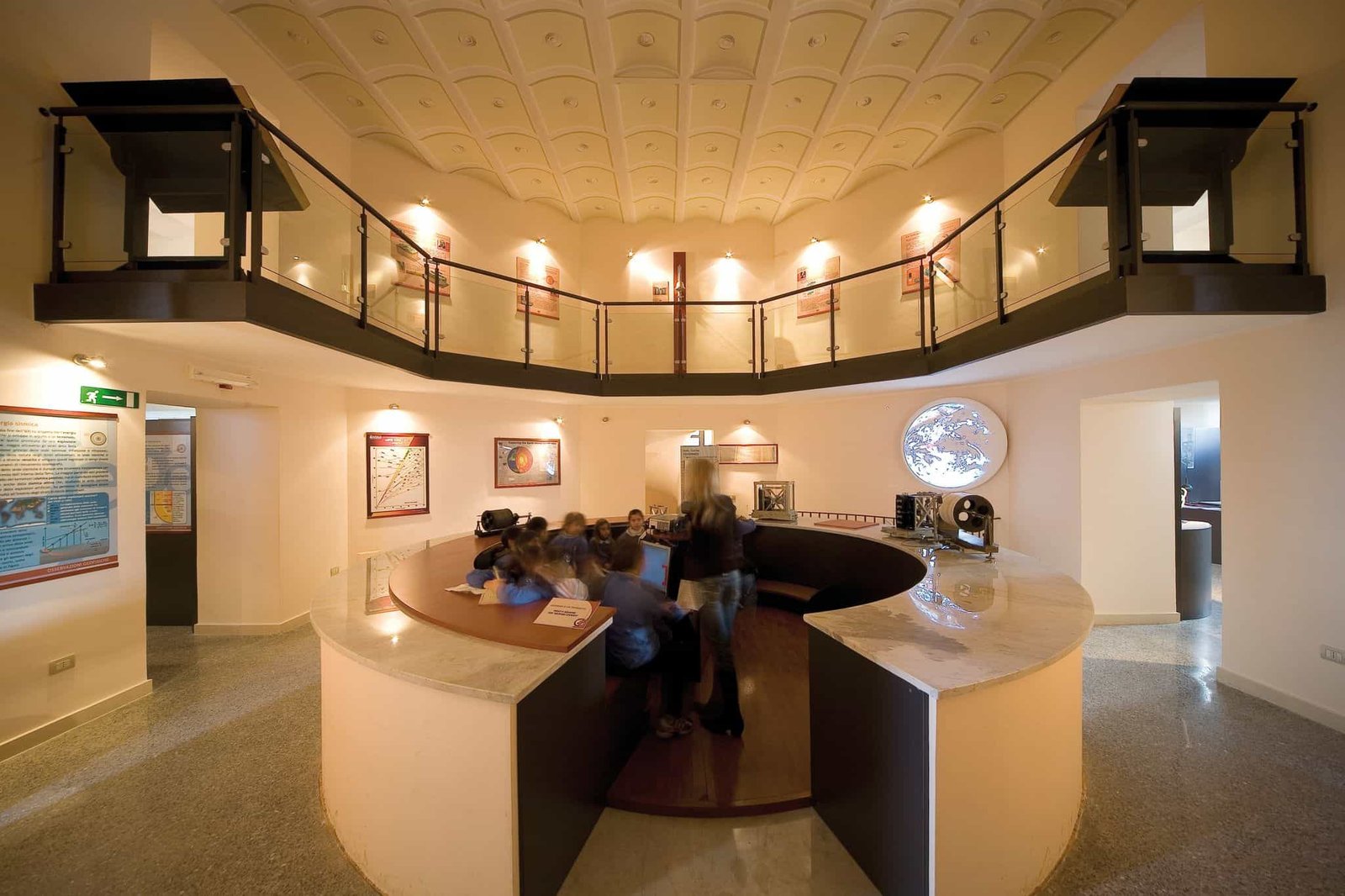
There is a description of the original structure from 1922 signed by Father Bernardo Paoloni, and it's worth reading because it tells of an architecture conceived as an instrument. The building “stands on volcanic ground on the rim of the crater of the extinct Alban Volcano” and has “a large central hall of octagonal shape” that contains the seismic pillar, with rectangular rooms around it intended for a laboratory and a library. The seismic pillar is the conceptual heart of everything: a block that goes down to the bedrock, isolated from the rest of the masonry, so that the instruments resting on top feel the earthquake and not the seismologist's footsteps. The octagon around it serves to distribute the loads without discharging them onto the pillar.
The silence of 1931 and the reactivation of 1951
The history of the observatory is not a continuous line of successes. In January 1931 the seismological observations cease: the location no longer meets the requirements of modern seismometry, which in the meantime had become much more demanding about ambient noise. The director in office until that January, Giovanni Agamennone, closes a season. From 1936, with the transfer to the National Institute of Geophysics, the directorship is held by Antonino Lo Surdo.
In 1944 the building is occupied by German troops, in a season when the Castelli Romani are a real war zone: whoever knows the history of Marino and of Albano Laziale in those months knows how heavily the Anzio front weighed on these towns. In 1951 the observatory is reactivated as a fundamental point of the National Seismic Network, and since then it has never stopped.
The transformation into a museum comes from an agreement between the Comune of Rocca di Papa and the National Institute of Geophysics and Volcanology signed on May 16, 2000. The renovation works, overseen by the architect Ilia Monachesi, lead to the inauguration of February 26, 2005. In July 2023 the institute announced an agreement with the State Property Agency for the Museo delle Geoscienze, which concerns the future of the property.
Visiting the Rocca di Papa Geophysical Museum, room by room
The museum is laid out on two levels, each of which addresses a different theme. The thread declared by the institute is just one: how we came to model the interior of the Earth starting from observations made on the surface. Put like that it sounds abstract. Followed in sequence, it's the story of how humanity learned to see inside a planet without being able to open it.
The path on the interior of the Earth at the Rocca di Papa Geophysical Museum
The visitor is guided by panels, by instrument captions and by exhibits of geophysical interest, with a substantial presence of educational and playful machines and of geophysical equipment that is partly working. The path retraces the evolutionary stages of scientific research and of the individual disciplines in the attempt to discover the interior of the Earth, volcanoes and earthquakes. It's a museum layout that is dated in its graphics and very solid in substance: whoever is looking for the wall touch display will be disappointed, whoever wants to understand how the existence of a liquid core is deduced from the propagation of seismic waves comes out well served.
The Michele Stefano de Rossi room
There is a room dedicated to the founder, which collects original equipment from his small villa. It's the room I recommend looking at most slowly, because it contains objects that are at once measuring instruments and handcrafted artifacts: brass, wood, glass, taut wires, counterweights. In the second half of the 19th century the scientific instrument was built to measure, often on the scholar's own design, by workshops that worked like precision carpentry shops. Look at the micrometer screws and the supports: that is the craftsmanship that made seismology possible before electronics.
The seismic platform and the earthquake under your feet
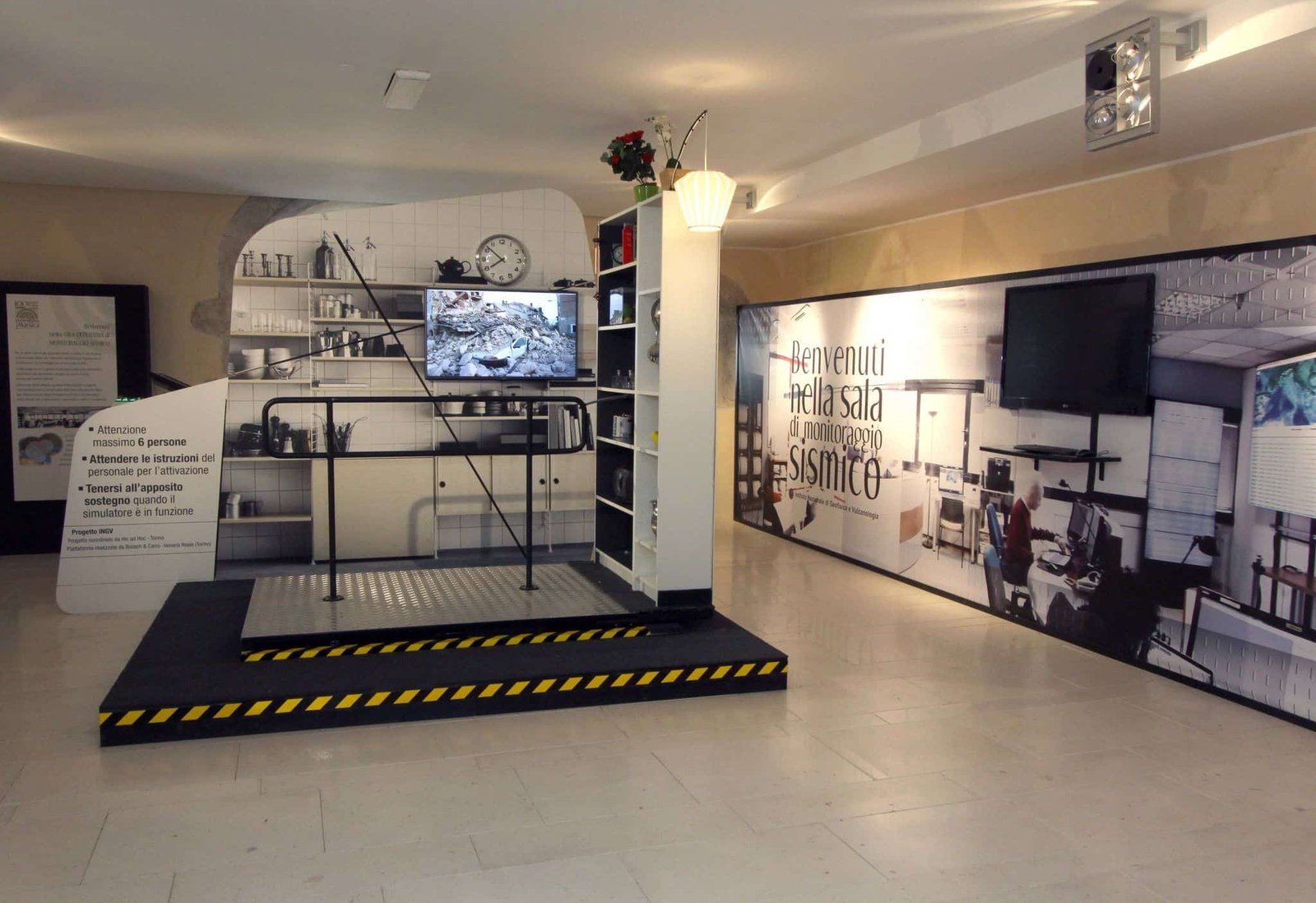
The exhibition includes a seismic platform that lets you physically feel the stresses of an earthquake. It's the exhibit that kids remember for years and that adults underestimate until the moment they step onto it. The educational value is precise: it makes you understand that a quake is not a numerical abstraction, it's an acceleration that the body registers before the head. Whoever designs earthquake-resistant buildings works on exactly those accelerations.
Geomagnetism and the interactive exhibits
Interactive installations show the nature of geomagnetism, that is, of the Earth's magnetic field, its deep origin and its behavior over time. It's the section that explains why a compass works, why the magnetic poles migrate, and why certain minerals keep the memory of the orientation of the field at the moment they cooled. A large part of the dating of the lava flows of the Colli Albani rests on this last point.
The RDP seismic station, which records while you look
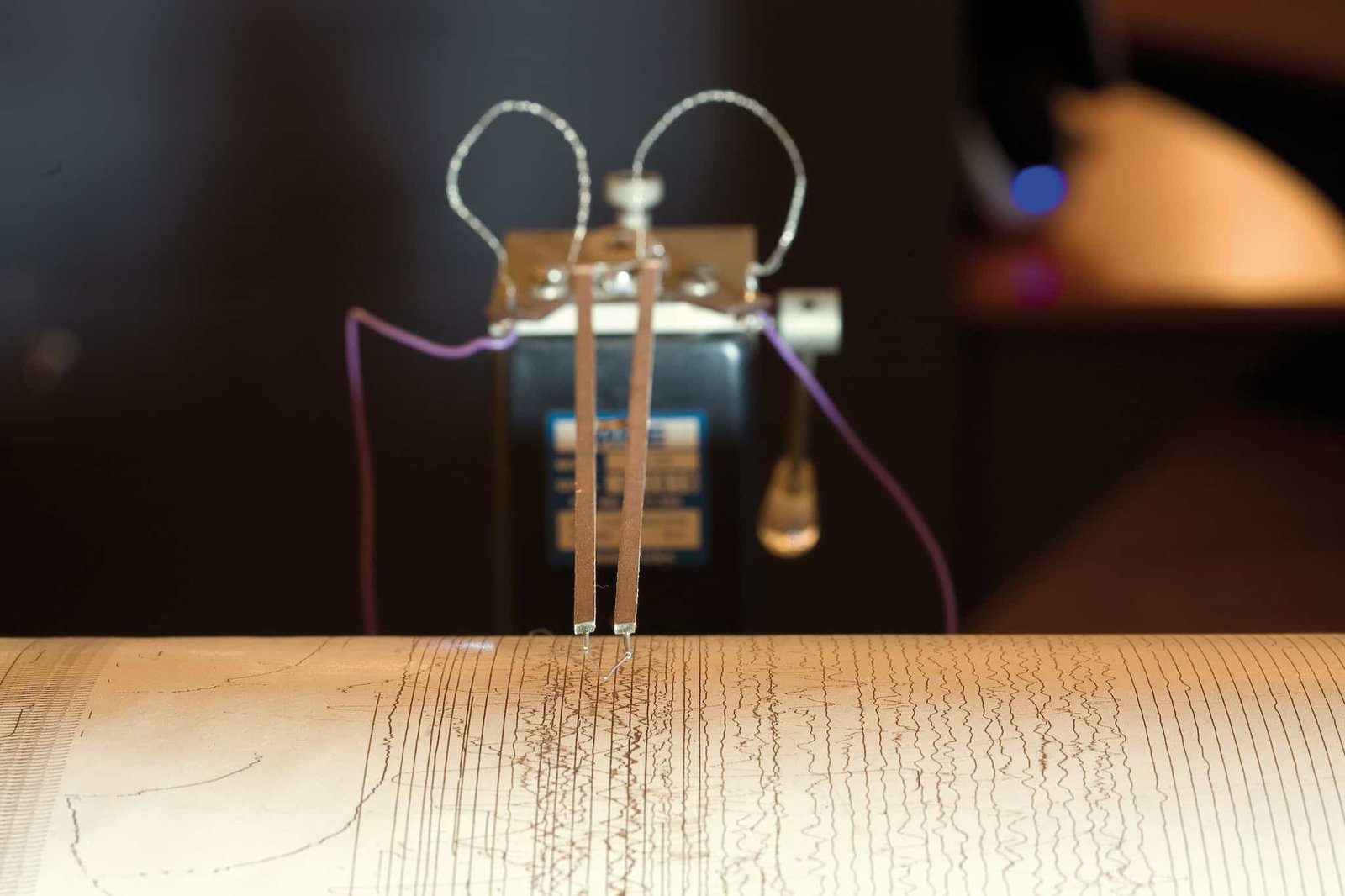
In the museum there is a modern seismograph that records seismic activity incessantly. The international code of this measuring point is RDP, a code that seismologists have been reading in bulletins for decades. Seeing the pen, or today the digital trace, scroll while the group crosses the room produces an effect that no panel can achieve: the museum doesn't talk about earthquakes in the past tense, it is measuring them right now. If someone walks heavily on the floor, the trace feels it. Try asking the guide to show you the effect.
The GNSS station and the ground that moves by millimeters
The geodesy and geodynamics section revolves around the GNSS station, that is, the satellite receiver that measures the position of the antenna with millimeter precision and follows its displacement over the years. It's the way today we notice the breathing of a volcano: if the ground rises or sinks, the time series shows it long before any human being perceives it. On the Colli Albani the uplift of the ground is one of the monitored phenomena.
The telescope and sky observation
One section of the museum is dedicated to astronomy and sky observation. The altitude, the clear horizon and the position set back from the glowing dome of Rome make the place reasonable for looking up, and in September 2024 the museum hosted an International Observe the Moon Night at the fortress of Rocca di Papa. It must be said with professional honesty: the sky of the Castelli Romani is not that of the Apennines, the light pollution of the metropolitan area is very much visible. The fact remains that at 15 kilometers as the crow flies from the Grande Raccordo Anulare few places do better.
Geochemistry and SAR interferometry
The two most recent sections of the thematic layout concern the monitoring of volcanic activity through the geochemistry of fluids and remote sensing with SAR interferometry. The first measures what comes out of the ground, in particular carbon dioxide and hydrogen sulfide. The second compares radar images acquired from satellite at different times to build maps of ground deformation on a regional scale. They are the two techniques with which the institute keeps a quiescent volcano under control without having to put a person on top of it every day.
The terrace of the Rocca di Papa observatory
The terrace above the building dominates the Castelli Romani and Rome. It's the reason this place entered the history of radio, and I talk about it at length further on. From the parapet, on a clear day, you can make out the basin of Lake Albano, the ridge of Castel Gandolfo and, toward the west, the line of the Tyrrhenian Sea.
The Alban Volcano as told by the Rocca di Papa Geophysical Museum
The museum exists because the volcano exists. Without the Colli Albani, Rocca di Papa would be a mountain town like many others and nobody would have built a first-order observatory there. It's worth understanding what you're walking on.
A volcanic system less than 30 kilometers from Rome
The institute defines the Colli Albani as a complex volcanic system of central Italy, located less than 30 kilometers southeast of Rome, in which signs of activity persist: hydrothermal circulation, seismicity and ground uplift. The system includes three partially overlapping volcanic edifices. The oldest is the Alban Volcano, responsible for explosive eruptions and an extensive ignimbrite basement, for a total volume estimated at hundreds of cubic kilometers.
The caldera and the two younger stratovolcanoes
That initial violence generated a vast caldera, which the institute quantifies at about 10 by 12 kilometers, inside which effusive and Strombolian eruptions of much more modest energy followed one another. Along the margins of the caldera two younger stratovolcanoes developed, the Tuscolano-Artemisio and the Faete, the latter capable of lava fountains, Strombolian activity and sub-Plinian eruptions. The caldera rim of the Tuscolano-Artemisio draws a horseshoe that runs from Monte Tuscolo to Monte Artemisio, with elevations a little over 700 meters and a maximum of 939 meters at Monte Artemisio.
The Campi d'Annibale, the crater where you park
The point that always amuses groups: the parking lot where you leave the car to go up to the museum is inside a crater. The Campi d'Annibale, near Rocca di Papa, are the ancient, now extinct crater of the Faete apparatus. The shape reads very well from above and reasonably well from the ground too, if you stand in the middle of the plateau and look at the ring of rises that closes it. The name, which everyone links to the Carthaginian commander camped here during the Second Punic War, probably derives from the Annibaldi family, owners of the fief. The two etymologies have coexisted for centuries and the second has a lot more going for it than the first.
The lakes of Albano and Nemi, craters filled with water
Of the many crater-shaped basins that dotted the area, many were drained over the centuries. Two remain, and it's hard to find a better calling card for volcanology in Italy: Lake Albano and Lake Nemi, formed when smaller craters were filled by water. They are maars, that is, phreatomagmatic explosion craters, the type of structure that arises when magma meets groundwater and turns it into steam in a fraction of a second.
The recent eruptions and the problem of dating
Here we have to be precise, because the literature is not in agreement and the visitor has a right to know. The most recent volcanism begins about 200,000 years ago, with tuff cones and maars on the western and northern slopes. The Albano eruptive center produced scoria deposits dated to about 36,000 years ago. More recent chronostratigraphic reconstructions, however, push the activity into the Holocene through lahars, mudflows linked to lake overflow events. Less recent studies indicated volcanic manifestations up to about 5,000 years ago. The shared picture is that the volcano is quiescent, not extinct: a distinction that is explained well on the museum's panels and that is always lost in everyday language.
Peperino, the stone that built the Castelli
Peperino is the material you see everywhere in the towns around here, from thresholds to portals to window frames. It arises from many violent phreatic explosions, produced by the meeting of groundwater and magma, with the release of large quantities of volatile compounds. It's a gray stone, dotted with dark inclusions that gave it its name by resemblance to peppercorns, soft to work just after quarrying and able to harden in the air. Whoever strolls through Marino or Ariccia has the museum of applied geology right before their eyes without realizing it.
Gas, uplift and seismic swarms
The chemical character of the products is ultrapotassic, strongly enriched in potassium, and the interaction between magma and carbonate rocks feeds a hydrothermal circulation that is still active. The present danger doesn't come from lava: it comes from the ground. The soil emits hydrogen sulfide and carbon dioxide, and the institute points to these gases as the main natural risk associated with the Roman volcanic district. They are gases heavier than air, which stagnate in depressions and cellars and which in the area have produced real accidents over the years. The area is classified as moderate seismic risk, with historical earthquakes documented in 1438, 1806, 1829, 1899 and 1927.
A curiosity about the INGV - Rocca di Papa Geophysical Museum
On August 11, 1932 Guglielmo Marconi carried out from this terrace an ultra-short-wave radio link between Rocca di Papa and Capo Figari, in Sardinia. The distance covered was about 270 kilometers. A decisive role in the experiment was played by the yacht Elettra, Marconi's floating laboratory, which operated as an intermediate station to guarantee the continuity of the link: a configuration that made it possible to overcome the limits imposed by direct propagation of the signal and that improved the reliability of radiotelegraph and radiotelephone transmission.
Why it is a curiosity and not a footnote: in the summer of 1932 the scientific community held that ultra-short waves were usable only in direct line of sight, that is, as far as the eye reaches. 270 kilometers of open sea and the curvature of the Earth were, on paper, an insurmountable obstacle. Marconi chose this terrace for an elementary geometric reason: from 760 meters above sea level, with the sea horizon clear toward the west, the height gained moves the optical limit forward by tens of kilometers. The same hill that served the seismologists to stay away from noise served the radio engineers to be up high.
The memory of that summer did not remain only in books. On April 21, 2023 the institute announced the start of operation of the historic Marconi Station: a radio post with the special call sign IY0ORP issued by the Ministry of Economic Development, equipped with transceivers and antennas to operate both in voice and in Morse telegraphy, through which radio amateurs from all over the world can connect over the air with the museum. The activation took place on Saturday, April 22, the Saturday before April 25, Marconi's birth date. The station is run by the radio amateurs of the Frascati section of the Italian Radio Amateurs Association, in collaboration with the Coordination of Italian Marconi Stations. It's the kind of detail I like very much: a museum that instead of displaying a commemorative plaque puts the signal back on the air.
One thing nobody tells you about the INGV - Rocca di Papa Geophysical Museum
This place doesn't work like a civic museum. It has no continuous opening hours, no ticket office, no custodian who lets you in if you happen to show up on a Sunday afternoon. It's an operational site of a research body that dedicates a part of its time to the public, and the practical consequence is that access always goes through an agreed reservation. It's not rare to see families climb all the way to via dell'Osservatorio on an August afternoon and find the gate closed, with the look of people who feel they've been the victim of a spite. It's not spite: it's the operating model.
The second thing almost nobody says concerns the hierarchy of audiences. The institute's priority goes to schools: the educational service is the main reason the museum opens, and bookings for school visits are the most structured and most stable channel. Guided visits for the general public are the most fragile part of the calendar, the one that gets suspended first when people are lacking or when the building requires work. If you are an organized group, an association, a cultural club, you have many more chances of getting a date than if you call as a single couple.
The third concerns logistics, and I say it as a professional: the final walk up from Piazza Giuseppe di Vittorio is not trivial. You walk at altitude, on a town road with real slopes, often in the sun. Anyone with walking difficulties has to factor in this stretch and ask the institute in advance which solutions are possible, because a scientific building from 1889 on two levels was not born accessible and was not designed to be.
Last, and perhaps the most useful: there is an official virtual tour, published by the institute on its portal in the dedicated section. It doesn't replace the experience of the seismic platform, but it lets you see the rooms when the doors are closed and it's an excellent way to decide whether the place really interests you before organizing the climb.
My advice for visiting the INGV - Rocca di Papa Geophysical Museum
Phone first. Always. Don't trust what you read elsewhere about hours, don't even trust the municipal signs: the source is the institute, at 06 9496345, at 06 518601 or at the mailbox museoroccadipapa@ingv.it. Ask three things in a single call: whether there are openings to the public scheduled, whether they accept groups on agreed dates, and how long the guided visit lasts, because everything else about the day depends on this last piece of data.
The second piece of advice is not to come up here only for the museum. Do it, but set it into a day on the Colli Albani, because the value of this visit grows enormously if you have seen with your own eyes what the panels talk about. The recommended itinerary is this: morning at Lake Albano to understand what a maar is by looking at it from above, then the climb to Rocca di Papa with a stop at the Castelli Romani on the scenic stretch, a visit to the museum in the middle of the day, and in the afternoon the descent to Frascati or Grottaferrata. The things seen in the morning become readable in the afternoon.
Third: bring shoes with a real sole and a sweatshirt even in July. At 760 meters, with the wind rising from the basin, the temperature difference with Rome can be six or seven degrees, and at the end of the day you feel it. The fourth piece of advice concerns timing: if you go by car, avoid planning the climb at the hours when the town clogs up, because via dell'Osservatorio and the roads that serve it are narrow and the Campi d'Annibale parking lot is the only reasonable solution.
A clear opinion that some will not share: this is not a museum for very small children sent here at random on a free afternoon. It's an extraordinary museum for kids from eight years old and up and for curious adults, and it's almost wasted on anyone who arrives with no questions in their head. Arrive with one question and you'll leave with three.
Another well-known fact, yet rarely cited
Everyone knows that Guglielmo Marconi invented the radio. Almost nobody knows that he founded the research body that today runs this museum. On November 13, 1936 the Istituto Nazionale di Geofisica was born with a presidential provision signed by Marconi, then president of the National Research Council, who in the 1930s had proposed the creation of a body capable of coordinating studies and research on the physical phenomena of the Earth and their practical applications. Marconi endowed the body with initial resources and an ambitious scientific program.
The link with Rocca di Papa is direct and closes a perfect circle. The museum you are visiting occupies an observatory that in 1936 passes precisely under the Istituto Nazionale di Geofisica, that is, under the body just created by the man who four years earlier had used the terrace of that same building for the link with Capo Figari. Until then the observatory had reported to the Central Office of Meteorology and Geodynamics, under royal decrees 3534 of 1876 and 4636 of 1887. From 1936 the chain of command is another, and the signature at the bottom of the decree is Marconi's.
The last link: INGV as we know it today was born with legislative decree 381 of September 29, 1999, from the merger of five pre-existing bodies, the Vesuvius Observatory of Ercolano, the Istituto Nazionale di Geofisica of Rome, the International Institute of Volcanology of Catania, the Institute of fluid geochemistry of Palermo and the Institute for research on seismic risk of Milan. It's the body that monitors the national territory seismically and volcanologically under an agreement with the Civil Protection: when the magnitude of an earthquake appears on television a few minutes after the shock, that number passes through a network of which this hill is a historic node.
The right photo to take at the INGV - Rocca di Papa Geophysical Museum
The photo everyone takes is the panorama from the terrace, and it has its reasons: from up there the view runs over the Castelli Romani and Rome, and on a clear day, with the tramontana having cleaned the air, you can make out the line of the sea. If you want that shot, the good window is the first hour after dawn or the last hour before sunset, when the raking light draws the volcanic reliefs and the basin of the Campi d'Annibale stops being a parking lot and goes back to being a crater.
But the right photo, the one I truly recommend, is another and has to be looked for inside. Frame one of the historic instruments in the foreground, brass and wood, and leave in the blurred background the trace of the modern seismograph recording in real time. In a single frame you have 130 years of seismology: the hand of the 19th-century craftsman and the digital data that at the same instant travels to the monitoring room. It's a photograph that tells the museum better than any panorama, and nobody takes it.
Technical note for those who photograph seriously: inside the building the light is scarce and the display cases reflect. Bring a fast lens, lean against the glass with a rubber lens hood if you have one, and forget the flash, which will give you back only your own reflection. On permission to photograph, ask the guide at the start of the visit: in a research site there are areas where the instruments in operation call for some caution, and it's a question that takes two seconds.
One last subject that almost everyone ignores: the building seen from outside, from below, with the Colonna Fortress behind it. The observatory is right up against the ancient fortress that occupies the highest point of the town, at 753 meters: putting a medieval military structure and a 19th-century scientific observatory in the same frame is the cheapest way to explain to anyone what the Castelli Romani are.

Some important events that happened here in history
July 28, 1883, the earthquake that did not happen here but decided everything. The Casamicciola quake on Ischia provokes the reaction of Parliament and the birth of the Royal Geodynamic Commission chaired by Pietro Blaserna. Without that catastrophe there would have been no National Seismic Network, and without the network there would have been no permanent observatory at Rocca di Papa.
1887, the assignment. The Commission entrusts the Central Office of Meteorology with the task of establishing the National Seismic Network. De Rossi proposes Rocca di Papa and the proposal is accepted for the seismological and volcanological characteristics of the area, at the center of the Colli Albani apparatus.
1888-1889, the building site. The engineer Alessandro Giannantoni builds the Geodynamic Observatory on the 1886 design. In 1890 the observatory begins to work, with de Rossi as director.
October 23, 1898, the death of the founder. Michele Stefano de Rossi dies in Rocca di Papa, in the town of his observatory. He leaves an intensity scale that will carry his name in textbooks around half the world and a network of observatories that Italy did not have before him.
January 1931, the silence. The seismological observations cease: seismometry has changed and the location no longer meets the technical requirements. With Giovanni Agamennone the first age of the observatory closes.
August 11, 1932, the radio. Marconi carries out the ultra-short-wave link between this terrace and Capo Figari, in Sardinia, about 270 kilometers, with the yacht Elettra as intermediate station.
November 13, 1936, the new landlord. The Istituto Nazionale di Geofisica is born with a provision signed by Marconi. The observatory passes from the Central Office of Meteorology and Geodynamics to the new body, under the direction of Antonino Lo Surdo.
1944, the war. The building is occupied by German troops. In those months the Castelli Romani are the rear area and then the battlefield of the Anzio front.
1951, the reactivation. The observatory becomes operational again as a fundamental point of the National Seismic Network, a role it still keeps today under the code RDP.
May 16, 2000, the agreement. The Comune of Rocca di Papa and the National Institute of Geophysics and Volcanology sign the agreement that turns the observatory into a museum, with the declared aim of bringing back to life a state-owned asset with a centuries-old history.
February 26, 2005, the inauguration. After the long renovation overseen by the architect Ilia Monachesi, the museum opens to the public.
August 9, 2022, the reopening. The institute announces the reopening of the museum after the season of closures. From August 2022 the direction is entrusted to Fawzi Doumaz. On September 12 of the same year the museum opens its doors on the occasion of the world equestrian championships hosted in the Pratoni del Vivaro area.
April 21, 2023, the Marconi Station. The amateur radio post IY0ORP goes into operation. On the following May 16 the museum joins the itineraries of the Museumgrandtour, the territorial museum system of the Castelli Romani and Prenestini. On July 24 the agreement between the institute and the State Property Agency for the Museo delle Geoscienze is announced.
September 12, 2024, the Moon. The museum hosts the International Observe the Moon Night at the fortress of Rocca di Papa, with public observation of the sky.
Who has passed through the INGV - Rocca di Papa Geophysical Museum
Michele Stefano de Rossi is the first name and the most important, because he did not pass through: he lived and died here. Designer of the building in 1886, director from 1890 to 1898, father of modern Italian seismology, co-author with François-Alphonse Forel of the intensity scale that precedes the Mercalli one. Whoever walks in these rooms walks in his laboratory.
Guglielmo Marconi is the second, and his presence here is documented twice: as an experimenter in the summer of 1932, when he chose the observatory terrace for the microwave link with Capo Figari, and as the founder in 1936 of the body that would take over the observatory. Few structures in Italy can say they had the same man first as a guest and then as an institutional authority.
Pietro Blaserna, senator of the Kingdom and professor of Physics at the Sapienza, chaired the Royal Geodynamic Commission from which the entire story descends. He was one of the figures who built post-unification Italian physics, and his name remains tied to the Roman physics institute.
Giovanni Agamennone directed the observatory until January 1931. A seismologist of long standing, he belongs to the generation that ferried the discipline from qualitative observation to systematic instrumental recording.
Antonino Lo Surdo, a physicist, took over the direction from 1936 with the transfer to the Istituto Nazionale di Geofisica. His name is tied to the Stark-Lo Surdo effect and to the season of Italian physics between the two wars.
Father Bernardo Paoloni did not direct the observatory, but in 1922 he left the description that is still cited today when the octagonal hall and the seismic pillar are described. Italian seismology of the time has a very strong religious component, with observatories run by orders and congregations: Paoloni belongs to that tradition.
Alessandro Giannantoni, the engineer who physically built the building between 1888 and 1889, deserves a line because he translated a scientific idea into masonry: a seismic pillar works or doesn't work depending on how it was founded, and that is building-site expertise.
Ilia Monachesi, an architect, signed the long renovation that led to the inauguration of February 26, 2005 and that made visitable a building born for a completely different purpose.
And then, without proper names, the radio amateurs. Since 2023 the IY0ORP station connects this building with operators all over the world: people who will never climb to Rocca di Papa and who nevertheless, in a certain sense, have passed through it over the air.
The educational service and the schools at the Rocca di Papa Geophysical Museum
The liveliest part of this institution is the educational service, which the institute describes as a search for new strategies in science communication to bring the public closer to seismic and volcanic risk, to environmental protection and to research work. The offering is articulated and worth knowing even if you are not a teacher, because it gives the measure of what you can ask for when you book.
The workshops of the Rocca di Papa Geophysical Museum
The volcanological workshop is aimed at primary schools and lower secondary schools and tackles volcanology by building models with everyday materials. The seismological workshop uses springs, wood and rocks to make people understand the propagation of seismic waves and the seismic vulnerability of buildings: it's the passage where kids discover why two identical buildings behave differently during the same shock. The magnetic workshop works on magnetic fields, magnets and minerals and is designed for preschool and primary school.
Activities for the youngest
The effervescent readings offer a journey through planet Earth suited to children from three to five years old. There are drawing games and origami to understand the Earth system, and two games dedicated to emergency behavior, titled “E adesso cosa faccio” and “E adesso cosa prendo,” aimed at primary schools: they teach what to do during a shock and what to put in an emergency backpack. It's civic education of the highest level, disguised as a game.
The Treasure Hunt 2.0
Designed for primary and secondary schools, it uses QR codes and an application for mobile devices. It's the kind of activity that works because it uses the kids' smartphones instead of fighting them, and that turns the museum path into a sequence of problems to solve.
The Rocca di Papa Geophysical Museum with children
If you have kids, the real question is at what age it's worth it. The answer: from eight years old and up the visit works fully, because the child already has the tools to understand what “wave” and “depth” mean and is impressed by the seismic platform in a productive way. Between five and eight it works halfway, and depends enormously on who is guiding. Under five, the institute has a dedicated activity, the effervescent readings, and that is the right route.
The practical advice is not to make the visit coincide with the end of a long day. The walk up and the altitude tire people, and a tired child in front of a panel on geomagnetism is a lost battle. If you have to combine the museum with something else, put the museum first and the rest after. In the area, walks in the Castelli Romani Park work well as a complement and, for those who want to stay on the theme of Earth sciences, the geopaleontological museum of Rocca di Cave, which does a parallel and complementary job on rocks and fossils.
What to see around the Rocca di Papa Geophysical Museum
The Colonna Fortress and the Bavarese quarter
A few steps from the observatory, at the highest point of the town at 753 meters, is the medieval fortress. The fief belonged to the Colonna family from 1427 to 1870, a very long rule that left its name to the fortress. Below, the quarter that everyone calls Bavarese keeps the form it took in the 14th century: piazza Vecchia, today piazza XX Settembre, is the ancient center of the castle, and the name of the quarter recalls the siege laid to the town in 1328 by Emperor Louis the Bavarian, an episode that even ended up in the colors of the municipal banner. The present name of the town appears for the first time in 1181, in a letter from Pope Lucius III.
Monte Cavo and Via Sacra
On the summit of Monte Cavo, the ancient Mons Albanus, stood the temple of Iuppiter Latialis, Latial Jupiter: the federal sanctuary of the Latin League, that is, the political and religious place in which the peoples of Latium recognized themselves before Rome absorbed them. The excavations carried out between the 19th and 20th centuries did not bring back the temple. What remains, and is very well preserved, is Via Sacra that climbed to it starting from the Appia Antica near Aricia: a roadway 2.55 meters wide, flanked by peperino sidewalks. Walking on it is one of the most underrated archaeological experiences in Lazio, and from Rocca di Papa the starting point is within walking distance.
Towns to pair with Rocca di Papa in a day
The range is wide and depends on what interests you. For the Baroque and a square designed by Gian Lorenzo Bernini, Ariccia with Palazzo Chigi. For wine and villas, Frascati. For the Greek abbey of Byzantine rite, Grottaferrata. For the lakes, Nemi and Albano. For the June infiorata, Genzano di Roma. If you want to stay at altitude and play the card of the highest town, Rocca Priora is a stone's throw away.

When to go and when to avoid
The best period is late spring, between April and June, and then September and October. The reason is twofold: the climate at altitude is ideal and these are the months when a research body has its most active calendar, because they coincide with the school year and with the season of public initiatives. August is the worst month of all, and not because of the heat: it's the period when the facility tends to shut down.
Watch out for hazy days too. From this terrace the panorama is half the experience, and with the summer mugginess the plain gets blended into a white fog that erases everything. Days of tramontana after a cold front are the ones when you see the sea. In winter, finally, remember that at 760 meters snow is not a rarity and the roads of the Castelli Romani become complicated quickly when it snows.
Quick questions about the INGV - Rocca di Papa Geophysical Museum
Where exactly is the Rocca di Papa Geophysical Museum?
At via dell'Osservatorio 40, 00040 Rocca di Papa, in the province of Rome, inside the Geodynamic Observatory, right up against the Colonna Fortress and above the historic center of the town, at about 760 meters above sea level.
Is the Rocca di Papa Geophysical Museum open today?
The institute reports that the museum is temporarily closed and refers to mid-September for updates on openings to the public and school bookings. Guided visits for the public are suspended. Check on the official portal or by phone before leaving.
How much is the ticket for the Rocca di Papa Geophysical Museum?
The official portal does not publish a fee. Access is by guided visit booked with the institute: ask directly for the conditions when you book.
Do you need to book to visit the Rocca di Papa Geophysical Museum?
Yes, always. It is not a museum with a free-access ticket office: prior contact with the institute is the rule, both for schools and for the public.
How do you book a visit to the Rocca di Papa Geophysical Museum?
By writing to museoroccadipapa@ingv.it or by phoning 06 9496345 or 06 518601. Bookings for school visits have a dedicated procedure on the museum's portal.
How do you get to the Rocca di Papa Geophysical Museum by car?
From Rome take via Anagnina past Grottaferrata, or via Appia toward Marino and then via dei Laghi. Once in town you park in Piazza Giuseppe di Vittorio, the Campi d'Annibale parking lot, and continue on foot following the signs for the museum.
Can you get to Rocca di Papa by public transport?
Rocca di Papa has no railway station or subway. The connection is the regional intercity bus from the Anagnina terminus of metro line A. Frequencies thin out a lot on weekends and holidays: check the carrier's updated schedule before setting out.
Where do you park in Rocca di Papa?
In Piazza Giuseppe di Vittorio, the Campi d'Annibale parking lot, indicated by the institute as the reference parking point. From there you walk up along via dell'Osservatorio.
How long does the visit to the Rocca di Papa Geophysical Museum take?
The duration depends on the type of guided visit agreed and on the age of the group. It's a piece of data worth asking for at the booking stage, because it conditions the organization of the rest of the day.
Is the Rocca di Papa Geophysical Museum accessible by wheelchair?
The building is a scientific observatory built between 1888 and 1889, laid out on two levels, and the final approach on foot has demanding slopes. Anyone with accessibility needs must report them to the institute at the booking stage and ask which solutions are practicable.
Can you take photographs inside the Rocca di Papa Geophysical Museum?
Ask the guide at the start of the path: in a site that houses scientific instruments in operation, specific cautions may apply. In any case the flash is useless in front of the display cases and should be avoided.
Is the Rocca di Papa Geophysical Museum suitable for children?
Yes, with distinctions. From eight years old and up the visit works very well, thanks to the interactive exhibits and the seismic platform. For the youngest the institute offers dedicated activities, such as the effervescent readings designed for the three-to-five age range.
What can you see inside the Rocca di Papa Geophysical Museum?
Historic and modern geophysics instruments, a room dedicated to Michele Stefano de Rossi with original equipment, interactive exhibits on geomagnetism, a seismic platform, a working seismograph and sections on the geology of the Colli Albani, seismic station, GNSS station, telescope, geochemistry and SAR interferometry.
Does the seismograph of the Rocca di Papa Geophysical Museum really work?
Yes. The measuring point is identified by the code RDP and continues to record seismic activity, feeding the institute's network. The station has been active as a point of the National Seismic Network since 1951.
What is the difference between the Museo Geofisico and MUGEOS?
It's the same institution. The institute presents it today as the Museo delle Geoscienze di Rocca di Papa, with the acronym MUGEOS, indicating in parentheses the historic name of Museo Geofisico, which remains the best known in the area.
Who runs the Rocca di Papa Geophysical Museum?
The Istituto Nazionale di Geofisica e Vulcanologia, the public research body born in 1999 from the merger of five pre-existing institutes and which carries out seismic and volcanic monitoring of the national territory. The direction of the museum has been entrusted since August 2022 to Fawzi Doumaz.
Is it true that Marconi did experiments at Rocca di Papa?
Yes. On August 11, 1932 Guglielmo Marconi carried out from the terrace of the observatory an ultra-short-wave link with Capo Figari, in Sardinia, over a distance of about 270 kilometers, with the yacht Elettra as intermediate station.
What is the Marconi Station IY0ORP?
It's the amateur radio post activated in April 2023, with a special call sign issued by the competent ministry, run by the radio amateurs of the Frascati section of the Italian Radio Amateurs Association in collaboration with the Coordination of Italian Marconi Stations. It allows radio amateurs from all over the world to connect over the air with the museum.
Is the volcano under Rocca di Papa extinct?
No: it is considered quiescent, not extinct. Hydrothermal circulation, seismicity and ground uplift persist. The emissions of carbon dioxide and hydrogen sulfide from the ground are indicated by the institute as the main natural risk of the Roman volcanic district.
When did the last eruption take place?
The datings do not agree. The Albano eruptive center produced scoria deposits dated to about 36,000 years ago. More recent chronostratigraphic reconstructions push the activity into the Holocene through mudflows linked to lake overflows. Older studies indicated manifestations up to about 5,000 years ago.
Can you visit the Rocca di Papa Geophysical Museum online?
Yes. The institute publishes a virtual tour of the museum in the dedicated section of its portal, useful for seeing the rooms when openings to the public are suspended.
Is the Rocca di Papa Geophysical Museum part of a museum circuit?
Yes. Since May 2023 it has been included among the itineraries of the Museumgrandtour, the museum system that brings together the sites of the Castelli Romani and Prenestini.
Is there a bookshop or a cafe at the Rocca di Papa Geophysical Museum?
Don't expect the services of a big city museum. It is a research site open to the public by reservation: for a coffee or lunch you go down into town, where the options are many.
What to see near the Rocca di Papa Geophysical Museum?
The Colonna Fortress and the Bavarese quarter two steps away, the Campi d'Annibale, Monte Cavo with the Roman Via Sacra, and in a day the towns of the Castelli Romani, from Frascati to Castel Gandolfo.
Is it worth climbing all the way up here just for the museum?
If you are passionate about Earth sciences, yes, without hesitation. For everyone else the advice is to include it in a day on the Castelli Romani: the museum gives its best when you have already seen in person the volcanic landscape it talks about.
There are bigger, richer, better-funded scientific museums in Italy. There are very few in which the coincidence between content and container is as total as here: seismology is explained inside the building that founded it, radio waves are discussed on the terrace from which they were sent, you look at a volcano while standing inside its crater. That coincidence is worth the phone call, it's worth the wait for a date and it's worth the walk up. Do it when they reopen, and do it with a question ready to ask whoever accompanies you: here the questions are collected by people who look for answers for a living.
Article written by the editorial team of TourLeaderPro, contact them for Private/Corporate/V.I.P. Tours and Experiences.
Planning a trip to Rome? The English-language guides to visit the city are on ItalyPlanner.com.