Rocca Priora (RM)
In short. Rocca Priora is the highest municipality of the Castelli Romani: 768 meters above sea level, on the eastern ridge of the Colli Albani, about 40 kilometers from the center of Rome and less than 20 minutes by car from the Grande Raccordo…
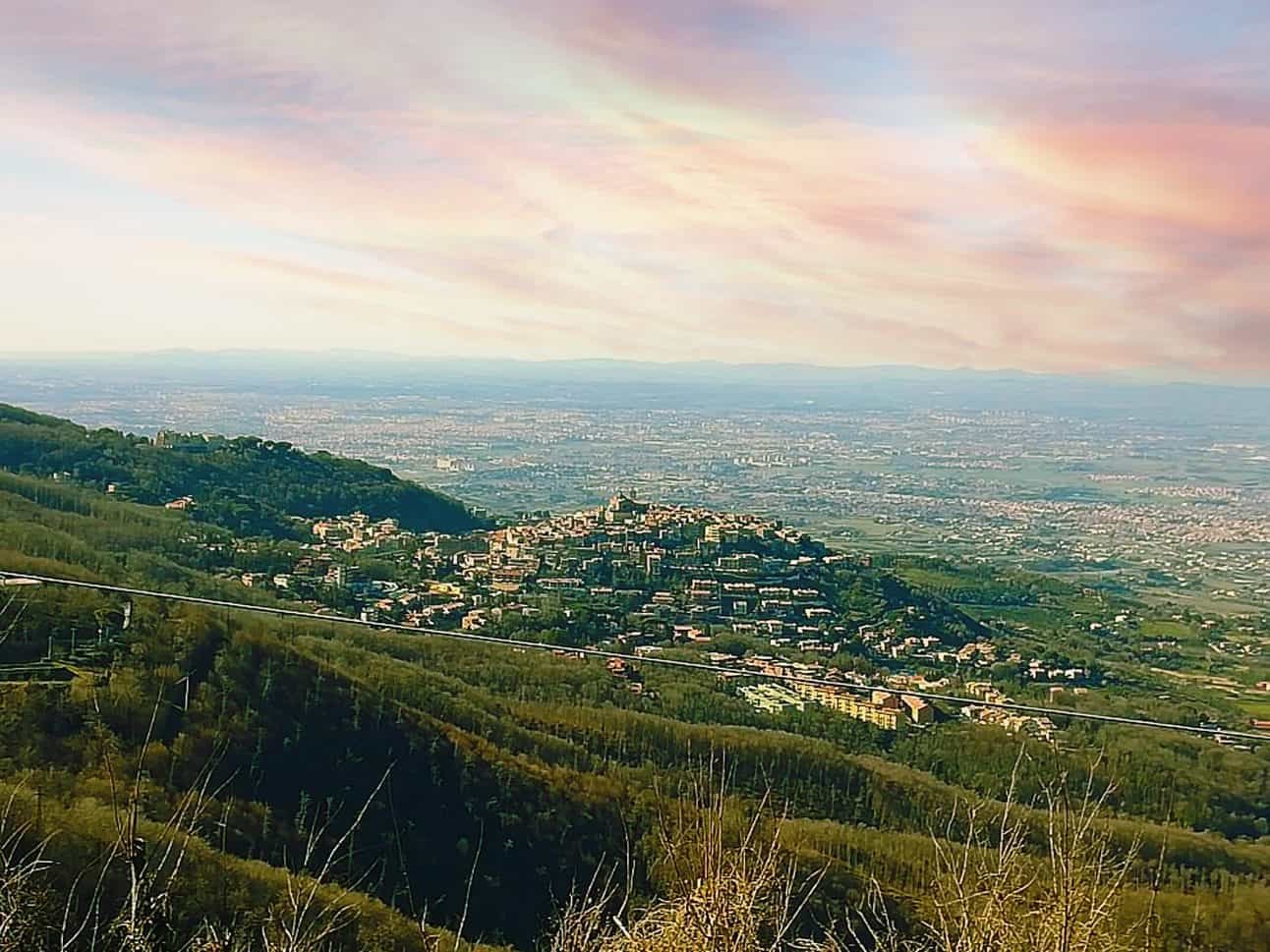
Rocca Priora is the highest municipality of the Castelli Romani: 768 meters above sea level, on the eastern ridge of the Colli Albani, about 40 kilometers from the center of Rome and less than 20 minutes by car from the Grande Raccordo Anulare by taking Via Tuscolana. The town hall is in Piazza Umberto I, 00079 Rocca Priora (RM), switchboard 06 99180087. The town has 12,073 inhabitants according to the 2024 ISTAT survey and includes the hamlet of Colle di Fuori. There is no ticket to pay: the village is a living town, visited on foot and freely, at any hour of the day and any time of year. Whoever arrives by car from Rome leaves the Raccordo at the Tuscolana exit and continues along provincial road 215 Tuscolana, or else climbs from Via dei Laghi passing through Rocca di Papa. Whoever prefers public transport takes metro Line A to Anagnina and from there the Cotral intercity bus, whose schedules are consulted in the timetable search of the official site cotralspa.it, which is the only reliable source because the runs change between the school period and summer. The reference railway station for those coming from outside the region is Roma Termini, from which you continue by metro. Bring a sweatshirt even in July: here the temperature is on average about five degrees lower than in the capital.
Rocca Priora is part of the Castelli Romani Regional Park, and it is the only town of the area where the word winter still has a full meaning.

Where Rocca Priora Is and Why Elevation Matters
The town occupies the summit of a rise that closes the Vulcano Laziale complex on the east, the same edifice that carved out the basins of lakes Albano and Nemi and left the Castelli Romani the dark, fertile soil in which the vine grows. From here the gaze runs toward the Monti Tiburtini, the Prenestini and the Ernici, and descends along the Valle del Sacco, the Latin Valley of the ancients, which for centuries was the natural corridor between Rome and Campania. Anyone who has driven the Autostrada del Sole exiting at Roma Sud has crossed that corridor without knowing it: from the Rocca Priora viewpoint you read it all at once, like a relief map.
The highest peak of the Colli Albani, the Maschio delle Faete, measures 956 meters and falls in the territory of Rocca di Papa. Rocca Priora, with its 768 meters of elevation for the built-up center, is however the municipality whose town sits higher than any other in the whole area, and this record is not an almanac curiosity. It determines the climate, it determined the economy for at least three centuries, it explains why the most beloved sanctuary of the town is dedicated to the Madonna della Neve and not to some ordinary Marian devotion.
The Roads That Climb to Rocca Priora
The provincial network that serves the municipality is dense and worth knowing, because the GPS tends to always suggest the same climb and it is not always the best. Provincial road 215 Tuscolana runs for about 18.5 kilometers in the municipal territory in the direction of Rome and Artena. Provincial road 18/c links Via dei Laghi to the Pratoni del Vivaro and continues toward Velletri for about 10 kilometers. The 72/a Anagnina, the 5/e Fontana Chiusa and the 50/a6 Montagna Spaccata are short stretches, between one and three kilometers, that connect the center with the main routes. The 32/a leads to Colle di Fuori in 5.5 kilometers. The 15/c reaches Via Latina. The 58/b descends toward Carchitti. The practical advice is to go up by the Tuscolana and come back down by Via dei Laghi, or vice versa: you get two different landscapes with the same gas.
Parking in Rocca Priora without Wasting Time
The historic center is compact and uphill, with lanes that don't admit medium-sized cars. Whoever arrives on spring weekends and on snow Sundays finds the town full. It is best to leave the car along the access roads to the town, in the permitted stretches, and climb the last minutes on foot. The elevation gain is modest, the slope is not: those with walking difficulties should do the math before leaving.
The Climate of Rocca Priora (RM): The Town Where Rome Goes to Breathe
The municipality's climate classification is zone E, with 2,548 degree days: a value that in Rome nobody sees even from afar and that places Rocca Priora, on the bureaucratic map of home heating, closer to certain Apennine towns than to the Lazio coast. Average annual rainfall comes close to 1,000 millimeters. Summer is cool and the mercury rarely goes above 32 degrees. Winter regularly brings temperatures below zero and snowfalls that can be heavy.
The temperature difference with the capital, on average around five degrees, is the reason why Romans come up here in the weeks of the dog days. It is an old movement: the families who could afford it spent the worst months in the hills, and the villeggiatura in the Castelli is a custom documented for centuries. In our judgment, on July days when the muggy heat stifles Rome, a climb to Rocca Priora is worth more than any air-conditioned museum: you arrive in 40 minutes and change season.
Snow in Rocca Priora, Today
When it snows on the Castelli, Rocca Priora is almost always the first town to turn white and the last to melt. On the Sundays after a snowfall the town fills with Roman cars and traffic on the provincial roads becomes demanding. If you are going up to see the snow, leave early and count on chains or winter tires, which on the roads at altitude are often mandatory by ordinance. Information on traffic and on any closures can be found on the town hall's channels.
The Snow Industry: How Rocca Priora Sold Winter to Rome
Before industrial icehouses existed and long before the refrigerator, Rome consumed ice. Apothecaries consumed it to preserve medicines, butchers and fishmongers to keep their goods, the nobles to cool drinks, hospitals for patients with fever. That ice did not come up from anywhere. It came down. And it came down mostly from here.
The mechanism was simple and very hard work. After the snowfall the men of the town gathered the snow, carried it into pits dug in the ground or made from natural cavities, pressed it in layers alternating it with straw, chestnut leaves and branches, and sealed it. The pit, protected by the woods and the shade, kept the compact block until summer. On the nights between June and September the ice was cut, wrapped and loaded onto carts and mules that went down toward Rome in the cool hours, arriving at dawn. Whoever controlled the pits controlled a market that admitted no seasonal competition: in summer you either bought from them or you didn't buy.
The Papal Edicts and the Snow Contract
A business of this scale could not escape the Papal State, which in fact put its hands on it with laws and edicts that regulated the gathering, the transport and the price, and that the people of Rocca Priora long remembered as oppressive. The snow contract became a revenue item of the fief on a par with timber, and the leaseholders of the Apostolic Chamber who succeeded one another in managing the territory from the 16th century on regarded it as the main resource to exploit. Here you touch with your hand a truth that Castelli tourism tends to forget: these towns did not live on scenery, they lived on contested resources.
The Snow Pits of Rocca Priora
A few ancient snow pits still survive in the municipal territory, generally in the form of a circular masonry cavity, often overgrown with vegetation and not always signposted. Don't expect an equipped museum route: they are rural structures, and finding them requires the help of someone who knows the paths or of a local guide. It is worth asking in town, though, because seeing a snow pit changes the way you look at the woods around it: that forest was not decoration, it was thermal insulation.

What to See in Rocca Priora (RM)
The historic center can be walked in barely an hour if you only walk, in three or four hours if you go into the churches, climb to the viewpoint and give time to the cultural hub. What follows is the reasoned list of what deserves it, with what is worth looking at in each place.
The Castle of Rocca Priora: Palazzo Savelli
The building that dominates the town and that today houses the town hall is the result of a layering eight centuries long. At the base is the castle of the Annibaldi, the Roman baronial family that controlled this stronghold after the destruction of Tusculum. On top of the castle the Savelli, who took over in 1382, built their baronial palace, enlarging and renovating it several times. In the 19th century the whole complex was rebuilt to a design by the architect Vespignani, who gave it the look of a fortified palace that you see today, with the crenellation and the historicist taste typical of papal patronage of that century.
Look at it from below, from the road that climbs, before entering the square: from there you grasp the military logic of the site, which no photograph from above gives back. The stronghold is not at the top of the hill for beauty, it is at the top of the hill because from there you could see armies arriving from the Latin Valley half a day ahead. A clear judgment: the palace, taken on its own, is not an architectural masterpiece and whoever arrives expecting an intact medieval manor will be disappointed. It is worth a great deal instead as a document of what the papal 19th century did with its own ruins, and as an observation point over the town.
The Pointed Arch with the Savelli Coat of Arms
In Via Monsignor Giacci is kept a pointed arch bearing the coat of arms of the Savelli family. It is the most explicit sign left in town of the long Savelli lordship, the one that between 1382 and the end of the 16th century made Rocca Priora first a castle and then a marquisate. A heraldic coat of arms on a passage arch was not ornament: it was a declaration of ownership addressed to anyone who entered.
The Medieval Buttresses of Via Monsignor Giacci
Along the same street you see the medieval buttresses that supported the wall of the settlement. They are poor structures, in local stone, and go unnoticed by those who walk looking at the shop windows. Stop: the line of the buttresses draws the perimeter of the original castrum, and lets you rebuild in your mind how small the 11th-century core was compared with the town of today.
The War Memorial
The war memorial of Rocca Priora is one of those structures you walk past absentmindedly and that instead tell the demographic history of the town better than a statistic. The names carved belong in large part to families still present in town: small communities pay for wars in proportion, and here the proportion can be read on the stone.
The Rocca Priora Viewpoint
The viewpoint at the top of the town is the reason why many come up here, and it doesn't disappoint. On clear days, above all after a storm or with the tramontana, you can make out Rome, the Monti Tiburtini and Prenestini, the Ernici and the opening of the Valle del Sacco. The best moment is not noon: it is the first hour after dawn in winter, when the air is clear and the plain below is still covered with fog, or the last hour of light before sunset in autumn.
The Churches of Rocca Priora (RM)
The town's religious heritage is less showy than that of Frascati or Grottaferrata, but it is coherent and readable, and in at least one case it tells a story that exists nowhere else.
The Church of Santa Maria Assunta in Cielo
The parish church is a large three-aisled building, marked off by octagonal travertine pillars. The octagonal pillar is the element that dates the layout: it is a 15th-century solution, common in the churches of Lazio of that century, and shows that the building was born as a 15th-century construction, then reworked in the following centuries like almost all the parish churches of the Castelli. Inside are kept some old paintings and a few fragments of fresco.
The advice for the visit: go in and stand at the back of the central nave, looking toward the altar. The succession of pillars in pale travertine against the plaster is the only thing that, in the present building, still speaks the language of the 15th century. The rest is layering, and has to be read as such. The church is open according to the times of the services: whoever wants to be sure of finding it accessible should make the visit coincide with Sunday morning or with the hour before the weekday Mass, and in any case check with the parish.
The Sanctuary of the Madonna della Neve in Rocca Priora
This is the place that explains the town. The devotion to the Madonna della Neve is born in Rome, tied to the basilica of Santa Maria Maggiore and to the legend of the miraculous snowfall of August 5 on the Esquiline. But in Rocca Priora that devotion takes on an economic meaning as well as a spiritual one. Here snow was not a wonder: it was the wage. An old chapel, built with a propitiatory function so that it would snow, was enlarged in the 17th century by a contractor who had grown rich on the snow trade. The link between the money earned with ice and the stone of the church is direct, documented by the very story of the enlargement, and is worth more than any caption.
At the beginning of August the sanctuary is at the center of the town's most characteristic festival, with the procession during which artificial snow is fired from the edges of the road in memory of the prodigious snowfall. It is one of those festivals that can seem folkloric to those watching from outside and that are instead a very precise act of collective memory: the community stages the goods that kept it alive.
The Convent and Picture Gallery of San Silvestro
About three kilometers from the built-up area, in a position decidedly higher than the town, stands the convent of the Carmelite Fathers named after San Silvestro, whose foundation dates to the 15th century. The location outside the center is no accident: contemplative orders sought silence and separation, and this place still offers them, surrounded by woods. The complex hosts a picture gallery. Since it is a convent, access follows the times of the religious community that lives there: whoever intends to visit should get in touch in advance with the convent itself or with the town hall, because a climb made for nothing here costs half a day.
San Rocco, San Biagio and the Geography of the Saints of Rocca Priora
The patron of Rocca Priora is San Rocco, celebrated on August 16. The choice is not neutral: San Rocco is the saint invoked against the plague, and his presence in the calendar of a town almost always indicates the memory of an epidemic overcome. To the same family of devotions belongs San Biagio, bishop and martyr, whom local tradition remembers as the liberator of Rocca Priora from the plague. Two anti-plague saints in the same calendar say that this community, like all those of the Castelli, went through contagion more than once, and that it went through it counting on itself.

The Monsignor Francesco Giacci Cultural Hub and the Benedetto Robazza Museum
The cultural hub named after Monsignor Francesco Giacci is the facility the town hall has assigned to the town's cultural activities, and it hosts the Luigi Porcari municipal library. Inside the hub, since April 28, 2018, is the Museo Mario Benedetto Robazza, the institution that more than any other surprises those who come up to Rocca Priora expecting only a scenic village.
Who Benedetto Robazza Was
Benedetto Robazza, born on March 2, 1934 and died on June 26, 2020, is one of the least predictable biographies in 20th-century Italian sculpture. Raised in Trastevere, fatherless during the Second World War, deprived of his younger brother in 1941, he enlisted in the Navy in 1952 and was a petty officer and amateur boxer before returning to Rome in 1956 and devoting himself to sculpture. He had no academic degrees: he trained in practice, and only later studied gemology in Belgium.
His works have traveled much more than he did. He made the bronze bust of the footballer Luciano Re Cecconi. The work titled Amore e solidarietà was donated to President Sandro Pertini and to Pope John Paul II. He sculpted reliefs in memory of Aldo Moro and the victims of terrorism, and a Christ for the cathedral of Altamura. A bronze portrait of Ronald Reagan by him is placed in the Roosevelt Room of the White House. To Rocca Priora he donated a marble horse and made a fountain.
Dante's Inferno in 18 Panels
The piece that alone justifies the climb is the gilded bronze frieze arranged on 18 panels devoted to Dante's Inferno. Robazza had already tackled the same subject in a high relief of 90 square meters in marble resin: the Dante cycle is the theme he returned to for decades. Look at the panels in sequence and not one by one, as you would look at an ancient frieze. The choice of gilding on bronze, which in an academic artist would have been judged excessive, works here because the raking light separates the bodies from the background and gives back the movement of the souls.
The Museo Robazza is the most underrated thing in the Castelli Romani. Nobody looks for it, almost nobody knows it exists, and anyone with an interest in 20th-century sculpture would gladly spend an hour there. The opening hours have to be checked with the town hall before going up, because a facility of this size does not keep continuous hours.
Colle di Fuori and the School of Duilio Cambellotti
Colle di Fuori is the hamlet of Rocca Priora, born around 1860 on the initiative of citizens from Capranica Prenestina and linked to the main town by provincial road 32/a over 5.5 kilometers. The reason it deserves a detour has nothing to do with the view.
In 1912 a school was built there to a design by Alessandro Marcucci, with panels painted by Duilio Cambellotti. It is a chapter of Italian civic history that school textbooks tell little about: the movement for the reclamation and literacy of the Agro Romano, driven by the poet and writer Giovanni Cena, who from 1904 founded popular schools for peasants, by the doctor Angelo Celli, founder of the Society for Studies against Malaria, and by Sibilla Aleramo. Cena, born in 1870 and died in 1917, was from Piedmont and brought to the Agro the idea that the fight against malaria and the fight against illiteracy were the same problem.
Cambellotti, one of the greatest Italian decorators of the early 20th century, put his talent at the service of those rural schools by painting teaching panels for children who had never seen an illustrated book. Anyone who knows his work for the Greek Theater of Syracuse or his Liberty stained-glass windows finds here the social face of the same artist. Knowing that one of those schools was built at Colle di Fuori changes the weight of the hamlet.
Nature around Rocca Priora (RM): Woods, Trails and Natural Monument
The municipal territory falls in large part within the Castelli Romani Regional Park, established in 1984 by regional law 2 of 1984 and spread over about 15,000 hectares and 18 municipalities, among them Albano Laziale, Ariccia, Castel Gandolfo, Frascati, Genzano di Roma, Grottaferrata, Lanuvio, Lariano, Marino, Monte Compatri, Monte Porzio Catone, Nemi, Rocca di Papa, Rocca Priora and Velletri. The prevailing forest cover is the chestnut grove, the legacy of centuries of silviculture that has shaped the woods of the Colli Albani more than any natural event.
The Madonna della Neve Natural Monument
The wooded area adjacent to the built-up center of Rocca Priora is protected as the Madonna della Neve Natural Monument, managed by the Castelli Romani Regional Park since 2007. It is the wood that wraps around the sanctuary and that the people of Rocca Priora, not wrongly, consider part of the town. Its conservation protects not only an ecosystem, it protects the historic landscape of the snow industry, because without that tree cover the pits would never have kept the ice until August.
The botanical and wildlife richness of the area is remarkable. In the Castelli Romani Park fox, badger, squirrel, buzzard, tawny owl, woodpecker are recorded, and in recent years the documented return of the wolf. Walking early in the morning you see more tracks than animals, which is normal and even reassuring.
The Monumental Trees and the Site of Community Importance
In the old woodland formations of the territory you meet specimens of considerable size, with circumferences reaching three meters. The area, together with the nearby wetland of Doganella, is recognized as a site of Community importance: a designation of the European Natura 2000 network that constrains management and signals the presence of rare habitats. If you walk here, stay on the trails: in wetlands trampling off the track does damage out of proportion to the pleasure of the shortcut.
The Trails of Rocca Priora
Three routes deserve to be mentioned. The Sentiero delle Fonti links the town's historic water points and is the easiest walk, suitable even for those who walk little. The Sentiero del Cerquone-Doganella crosses the wetland and the oak woods that crown it, and is the one that gives the most from the naturalistic point of view, above all in spring. The Cammino Naturale dei Parchi is a long-distance itinerary that runs along the central Apennine ridge for about 430 kilometers between Lazio and Abruzzo: whoever arrives in Rocca Priora following that thread is not a day tripper, he is a walker with weeks of road ahead.
A little south of the municipal territory open the Pratoni del Vivaro, the large grassy plateau that occupies the floor of an ancient crater between Rocca di Papa and Rocca Priora. It is the place of horses and kites, and with low fog it is one of the least Roman landscapes Lazio can offer.

The History of Rocca Priora (RM), from the Latin Name to the Municipality
Few local histories are documented with the continuity of this one, and it is worth running through it in full because it explains the shape of the town.
Corbium, Coriolanus and the Latin Origins
Many scholars have recognized, in the place where the settlement of Rocca Priora stands, the site of the ancient Latin center of Corbium, which Coriolanus occupied during his march on Rome in 486 BC. The location has to be taken for what it is, that is an identification proposed by historiography and not an archaeological certainty: of Corbium there is no excavated, readable urban fabric. That an ancient settlement stood up here is however consistent with the logic of the territory, because the hill controls the passes toward the Latin Valley. In the 3rd century AD, the Latin center having disappeared, a Roman villa settled on the area.
The Castrum Arcis Perjuriae and the Counts of Tusculum
The modern name derives from the medieval Perjura. According to the Sublacense Chronicle, at the end of the 11th century on the top of the hill stood a small settlement, the Castrum Arcis Perjuriae, which Agapitus of the Counts of Tusculum is said to have given to his daughter. The document is valuable because it places the castle, like the neighboring ones of Rocca di Papa and Molara, among the possessions of the Tusculans, the dynasty that in the 11th century dominated the Colli Albani and made and unmade popes.
The destruction of Tusculum in 1191 overturned the balance of the whole area. Rocca Priora passed under the control of the Annibaldi and, as happened in neighboring Monte Porzio Catone and Monte Compatri, took in refugees from the destroyed city. Part of the blood of Rocca Priora comes from Tusculum: that is a historical fact, not a point of parochial pride.
From the Colonna to the Annibaldi: The 13th Century
In 1252 a tenimentum Rocce Perjurie appears in a deed dividing the property among the Colonna brothers. In 1269 the place name is already recorded in the form Rocca Priora, in the list of possessions of the Convento di Palazzolo. In this period the castle must have been under the control of the Annibaldi, even though the first certain news of their lordship comes from the record of a Leone di Riccardo, called de Rocca Perjura, who belonged to that family.
In 1347 Pope Clement VI addressed to the Annibaldi, like the other Roman nobles, the famous letter with which he sought support against Cola di Rienzo. Rocca Priora also appears in the list of lands of the Roman Province subject to the Comune of Rome for the salt tax, with a consumption of 10 rubbie of salt per half year: a figure that, compared with those of Frascati and Monte Compatri, indicates a fairly populated castle.
The Savelli, the Popes and the Destructions of the 16th Century
In 1382 the castle passed to the Savelli, who held it throughout the 16th century. It was not a quiet possession. In the war of repression of 1436, conducted by Cardinal Vitelleschi on behalf of Pope Eugene IV against the Roman barons hostile to the pontiff, the papal militias seized it and the castle was granted in vicariate to the condottiero Simonetto di Castel Piero. In 1447 Pope Nicholas V returned it to the Savelli. Pope Alexander VI assigned it to his son Giovanni Borgia, but at the pontiff's death, in 1503, the Savelli recovered it.
On the destruction of the town the sources diverge: according to one tradition Rocca Priora was razed by the papal militias led by Renzo da Ceri in the conflict between Pope Clement VII and the Colonna. According to another it was destroyed by the imperial troops who, after the sack of Rome in 1527, were moving down toward the Neapolitan territory. In both cases the town one visits today is the reconstruction of what was there before.
The Statute of 1547 and the Marquisate
In 1538 Rocca Priora figured in the list of communities of the Patrimonium Petri that paid tribute to the Apostolic Chamber. In 1547 the Statute of Rocca Priora was issued, whose rubrics are still preserved: a 16th-century municipal statute is a remarkable document, because it fixes in writing rights of use of the woods, obligations, penalties and the calendar of activities, that is the material constitution of a peasant community. Pope Sixtus V reassigned the fief to the Savelli, allowing them to raise the castle to a marquisate.
The Chamber Leaseholders and the Visit of Paul V
The Savelli intervened with many building works of enlargement and renovation, until a serious economic crisis forced them to give up: on December 3, 1596 the properties were taken over by the Apostolic Chamber. In 1597 the Chamber ordered that the fief be leased to the highest bidder and the contract was won by Domenico de Cavalieri, the first chamber leaseholder. After him came Lelio Petroni and Francesco Ravenna, all with the aim of exploiting the natural resources of the stronghold, the snow trade and the timber trade.
In 1605, a few months after his election, Pope Paul V Borghese paid a visit to the castle of Rocca Priora and received an extraordinary welcome there from the population and the authorities. In memory of the event the community placed a dedicatory plaque on the facade of the palace that had hosted him. A papal visit to a chamber fief was not a courtesy ceremony: it was an act of government, and the plaque served to fix it in memory.
The 18th Century: Earthquake, Frost and Repopulation
The century began badly. The earthquake of 1703, which hit central Italy hard, and the very harsh winters that followed, among them the infamous winter of 1709, caused a notable population decline in Rocca Priora and in all the Castelli Romani. To bring people back to the land and restart productive activities the Apostolic Chamber granted lands to whoever agreed to move: a substantial migratory flow followed from several areas of the peninsula, which has left a trace in the town's surnames.
Throughout the 18th century, because of the neutrality policy of the Papal State, the territory saw the passage of foreign troops headed for the Kingdom of Naples, and the communities were obliged to support them during the encampments in the surrounding countryside. Maintaining an army in transit meant hay, bread, firewood and wine taken from people who already had little of it.
From the Roman Republic to the Municipality of 1870
Between 1797 and 1798 Rocca Priora experienced the republican ferment brought by Napoleon with the first Roman Republic, to which the villages of the Castelli looked for the birth of the sister republics. Having then returned to the disposal of the Apostolic Chamber, the land was sold in 1806 partly to Lucien Bonaparte, brother of the emperor, partly to the Rospigliosi family, which kept control until 1870, the year in which Rocca Priora was constituted as a Comune. The end of temporal power coincides here, as in so many centers of Lazio, with the birth of modern administration.
Rocca Priora Today
The Comune is run by Mayor Claudio Fatelli, in office since June 11, 2024. The town has two historic sports clubs, the A.S.D. Rocca Priora RDP Calcio, in red and blue colors, and the Atletica Rocca Priora: in a town of 12,000 inhabitants the football team is a social fact before it is a sporting one.
The Remains of the Papal Fortress above Rocca Priora
About six kilometers from the town, in the territory of Monte Porzio Catone, at 753 meters of elevation, are the remains of a papal fortress that enjoys one of the widest panoramas of the entire Castelli Romani area, with a view that on clear days reaches the sea. The fortress was erected at the end of the 12th century at the wish of Pope Eugene III and kept its defensive role for almost four centuries, until, in the middle of the 16th century, Pope Paul III Farnese ordered its demolition. From that moment the structure was used as a quarry of building materials, which is the ordinary fate of decommissioned fortifications: the squared stone was too valuable to stay standing without serving any purpose.
The advice: combine the climb to the fortress with a visit to Monte Porzio Catone or to Tuscolo, because on their own the ruins take 20 minutes, while the ridge deserves a whole afternoon.
Festivals, Traditions and Folklore in Rocca Priora (RM)
The calendar of festivals in Rocca Priora is dense and, rarely, it is still a calendar in which the population takes part more than one staged for visitors. The precise dates and programs of each edition can be found every year on the official channels of the town hall, which remain the only reliable reference.
The Festa di Sant'Antonio Abate
It is celebrated in January, in honor of the patron saint of animals, and includes the blessing of the beasts and the parade of allegorical floats made mostly of wood and decorated with fruit and bread. It is the oldest festival in structure, because it descends directly from the agricultural calendar: Sant'Antonio Abate fell at the dead point of the peasant year, when the stable was the center of the household economy. Whoever wants to understand what this town was before commuting to Rome should come in January, not in August.
The Festa di San Biagio
San Biagio, bishop and martyr, is remembered as the saint who freed Rocca Priora from the plague. The festival falls in the heart of winter, when it is really cold up here, and for just this reason it keeps a quiet, small-town character that the summer celebrations have inevitably lost.
The Festa del Narciso
In May the town celebrates the Festa del Narciso, tied to the bloom that colors the meadows and clearings of the Colli Albani. It is the moment of the year when the trails around Rocca Priora are at their best: mild temperatures, woods in new leaf, flowering meadows.
The Madonna della Neve and the August Snowfall
At the beginning of August the festival of the Madonna della Neve is held, with the procession during which artificial snow is fired from the edges of the road, in memory of the day when, according to tradition, the Madonna made it snow on Rocca Priora. August snow in a town that kept itself alive with snow for centuries is a staging of rare coherence: the miracle told is also the economic cycle that allowed the community to survive.
San Rocco, the Patron, and the Sagra della Bruschetta
On August 16 San Rocco, the town's patron, is celebrated. Around Ferragosto the Sagra della Bruschetta is also held, the most attended food event of the Rocca Priora summer. Unrequested but sincere advice: you get to the sagre of the Castelli early or late, never at peak hour, and you buy the wine from the producer, not at the counter with the longest line.
What to Eat in Rocca Priora
The cooking is that of the Castelli Romani, that is Roman hill cooking: pasta all'amatriciana and alla gricia, abbacchio, porchetta, coratella, hand-pulled fettuccine, and above all bruschetta, which has a sagra dedicated to it here. The bread of the Castelli, baked in a wood-fired oven, with a thick crust and a dense crumb, is the base of everything: a bruschetta made with industrial bread is something else and doesn't deserve the name.
On wine a clarification is needed that is clear to Romans and not to visitors. Rocca Priora is high and cold, and the great white designations of the Castelli have their productive heart lower down, on the tuff slopes around Frascati, Marino and Genzano. Up here you drink the wine of the Castelli, not necessarily the wine of Rocca Priora. In the town's cellars and fraschette, ask about the origin: those who produce it will gladly tell you.
The Fraschette and the Long Lunch
The fraschetta is the osteria of the Castelli: long tables, paper tablecloths, cold cuts, cheeses, house wine and few but substantial dishes. It is a way of eating that presupposes time. If you have two hours, go in. If you have 40 minutes, get a porchetta sandwich and sit at the viewpoint, which is still a very good deal.

What Is around Rocca Priora (RM)
The greatest merit of Rocca Priora as a base for the day is its position: from here you reach in a good half hour almost all the towns of the Castelli and several historical-archaeological centers of the eastern province. Going down toward the west you reach Rocca di Papa and Lake Albano. To the north you touch Monte Compatri and Monte Porzio Catone, and a little farther Frascati with its Tusculan villas. To the south you descend to the Pratoni del Vivaro, to Nemi and to Velletri. Toward the east open the Monti Prenestini, with Palestrina and the sanctuary of Fortuna Primigenia, Genazzano, Olevano Romano and Segni with its polygonal walls. Not far away there is also Lariano, and farther south Artena.
Anyone interested in religious history should not miss the Greek Abbey of San Nilo in Grottaferrata, the only Italo-Albanian monastery of the Byzantine rite left in Lazio, half an hour by car.
Visiting Rocca Priora (RM): Practical Advice
How Much Time You Need
For the historic center and the viewpoint alone, two hours are enough. Adding the parish church, the sanctuary of the Madonna della Neve and the Museo Robazza you get to half a day. If you want to walk one of the trails or climb to the convent of San Silvestro, the day is full.
Rocca Priora with Children
The town works well with children for two reasons: the woods, which allow short and safe walks, and the snow in winter, which half an hour from Rome is a small event. The historic center, by contrast, is steep with few sidewalks: with a stroller it is best to limit yourself to the square and the viewpoint. In summer the lower temperature makes even the central hours of the day bearable, which in Rome with children are impractical.
Accessibility
Rocca Priora is a ridge village, with marked slopes, stairways and historic paving: whoever moves in a wheelchair will find the main square, the town hall area and the viewpoint passable, while the inner lanes present barriers that are hard to overcome. For the access conditions of the individual public facilities it is best to turn directly to the town hall.
When to Go and When to Avoid
The best period is between the end of April and mid-June, when the woods are at their peak and the heat has not yet arrived, and then from mid-September to the end of October, with the chestnut groves turning and the air clear. The Sundays of January and February after a snowfall are spectacular and very crowded. The worst moment, for someone looking for quiet, is the Ferragosto weekend, when the sagre fill the town. Anyone traveling for the day from Rome should keep in mind that the evening return on the Tuscolana on holiday days requires patience.
Getting Around without a Car
It can be done, but it requires organization. The connection is entrusted to the Cotral intercity buses departing from the Anagnina hub, terminus of metro Line A. Frequencies are good at weekday peak hours and sparser on Sundays and in the summer period. Anyone intending to go up by public transport should consult the timetable search on the official Cotral site before leaving and check above all the time of the last return run, which is the detail that ruins days.
Frequently Asked Questions about Rocca Priora (RM)
How much does it cost to visit Rocca Priora?
Visiting Rocca Priora costs nothing, because the historic center, the viewpoint and the streets of the town are freely accessible at any hour. Any entrance fees may concern individual initiatives or organized guided visits, but the town itself is visited for free.
How far is Rocca Priora from Rome?
Rocca Priora is about 40 kilometers from the center of Rome and less than 20 minutes from the other towns of the Castelli Romani. The town occupies the summit of a rise on the eastern edge of the volcanic complex that gave rise to lakes Albano and Nemi.
How much time do you need to visit Rocca Priora?
For the historic center and the Rocca Priora viewpoint alone, two hours are enough. Adding the visit to the parish church, the sanctuary of the Madonna della Neve and the Museo Robazza you get to half a day, while a walk on the trails or the climb to the convent of San Silvestro requires a whole day.
Is Rocca Priora good for a trip with children?
Rocca Priora works well with children above all thanks to the woods that surround the town, which allow short, easy walks suitable even for the smallest. The compact historic center also lends itself to a visit on foot without routes that are too long.
What to see in Rocca Priora?
In Rocca Priora it is worth seeing the castle of Palazzo Savelli, now the town hall, the parish church of Santa Maria Assunta in Cielo with its 15th-century octagonal travertine pillars, and the Polo culturale Monsignor Francesco Giacci, which hosts the Museo Mario Benedetto Robazza.
What is the best time to visit Rocca Priora?
The best time to visit Rocca Priora is winter, arriving early in the morning: with cold air and the tramontana the horizon opens as far as Rome, the Tiburtini, the Prenestini and the Ernici. It is the moment when the town, the highest of the Castelli Romani, shows its panoramic position at its best.
Why was Rocca Priora linked to the snow and ice trade?
Rocca Priora sold its winter to nearby Rome, before the invention of the refrigerator: the snow gathered on the town was compressed in covered pits, layered with straw and branches, and then carried down the valley as ice to preserve medicines, meat and fish and to cool drinks in the capital.
What do you eat in Rocca Priora?
The cooking of Rocca Priora is that of the Castelli Romani, with pasta all'amatriciana and alla gricia, abbacchio, porchetta, coratella and hand-pulled fettuccine. Bruschetta with the bread of the Castelli, baked in a wood-fired oven with a thick crust and dense crumb, has a sagra dedicated to it here.
For anyone organizing a visit to the Castelli Romani with a group, or wanting a guide who handles logistics and timing, licensed professionals exist: the TourLeaderPro tour guiding network regularly works in Rome and the area of the Colli Albani.
A Curiosity about Rocca Priora (RM)
The real curiosity is not that it snows in Rocca Priora. It is that for centuries this town sold its winter to the capital, and that this trade left traces in every fold of local life, from place names to religious devotion. The ice gathered up here supplied Rome in the months when in Rome ice did not exist: the snow was compressed in covered pits, layered with straw and branches, sealed and kept until summer, then cut at night and carried down the valley on carts and mules so that it would reach the city before the sun.
The detail that strikes most is the institutional consequence. The Papal State understood the value of the raw material at once and regulated the sector with laws and edicts that the people of Rocca Priora judged oppressive, turning snow into a revenue item of the fief exactly like timber. When the Apostolic Chamber, in 1597, put the fief up for auction and assigned it to Domenico de Cavalieri, what the first chamber leaseholder was buying was not a view: it was the right to exploit water in its solid state.
Then there is the devotional side, which is the most beautiful part. A chapel had been built up here with a propitiatory function, so that it would snow: the community prayed for the raw material of its own work, as fishermen pray for a calm sea. In the 17th century that chapel was enlarged by a contractor who had grown rich on snow, becoming the Santuario della Madonna della Neve. In the end, in Rocca Priora, the money made from winter became consecrated stone. Anyone who enters that sanctuary today is entering a 17th-century economic ledger, and it is one of the few occasions in which a church of the Castelli Romani tells so clearly who paid for it and with what.
Something Nobody Tells You about Rocca Priora (RM)
No guide writes it, but the hamlet of Rocca Priora is worth the detour more than the main town, at least for those with an interest in Italian civic history. Colle di Fuori was born around 1860 thanks to citizens from Capranica Prenestina, and in 1912 a school designed by Alessandro Marcucci and decorated with panels painted by Duilio Cambellotti was built there. Cambellotti was not a provincial decorator: he is one of the greatest names of Italian applied arts of the early 20th century, the man of the sets for the Greek theater of Syracuse and of a graphic output that defined the taste of an era.
What was an artist of that caliber doing in a hamlet of the Castelli Romani? The answer is the movement for the reclamation of the Agro Romano, driven by Giovanni Cena, a Piedmontese writer who lived between 1870 and 1917 and who from 1904 promoted the founding of popular schools for the peasants of the Agro, and by the doctor Angelo Celli, founder of the Society for Studies against Malaria. Sibilla Aleramo worked with them. The idea, radical for liberal Italy, was that malaria and illiteracy were the same disease, and that they should be fought together, with quinine and with the alphabet.
This is the reason why at Colle di Fuori there is a signature rural school: because a group of intellectuals decided that the children of day laborers deserved beautiful classrooms. The fact that almost nobody knows it, and that no tourist itinerary of the Castelli Romani points it out, says a lot about how we tell heritage: we celebrate the cardinals' villas and forget pedagogy. The second thing nobody says concerns the present instead: Rocca Priora is a town of 12,000 inhabitants, not a half-abandoned village to photograph. Whoever goes up expecting the museum-like silence of depopulated villages finds a town that works, with the traffic of school pickup and the line at the bakery.
The Advice I Give You for Visiting Rocca Priora (RM)
Go up in winter, and go up early. It is the opposite of what everybody does, and it is the way this town shows itself for what it is. With cold air the horizon opens as it never does in summer: from the viewpoint, on a January morning with the tramontana, you can make out Rome, the Tiburtini, the Prenestini, the Ernici and the escape of the Valle del Sacco toward the south, and the low fog that fills the plain makes the hills look like an archipelago. In August, with the haze, the same panorama shrinks to a gray smear.
The sequence I recommend is this. Arrive by 9:00, park along the access road and climb on foot. First the viewpoint, while the air is clean. Then the parish church of Santa Maria Assunta in Cielo, then the round of the lanes passing by the Savelli arch and the medieval buttresses of Via Monsignor Giacci. Mid-morning the Museo Robazza, checking the hours with the town hall first. A long lunch in a fraschetta. In the afternoon, if the day holds, the walk in the woods of the Madonna della Neve Natural Monument to the sanctuary, which is the right way to reach it: on foot, through the woods, as those who went to fetch the ice reached it.
Two practical warnings that are worth more than any itinerary. The first: up here the weather changes fast and the temperature is five degrees lower than in Rome, so bring an extra layer even in May, and in winter winter tires or chains on board, because on the provincial roads at altitude the obligation kicks in by ordinance and without notice. The second: don't trust the hours found on generalist sites for churches, museum and convent. They are small structures, run by small communities, and the only serious reference is the town hall or the parish. Whoever organizes a day in the Colli Albani for a group should have someone phone in advance: it saves a climb made for nothing.
Another Well-Known Fact, Yet Rarely Cited
That Rocca Priora is the highest municipality of the Castelli Romani everyone knows. Almost nobody, though, connects that elevation to the geological story that produced it. The town occupies the eastern rim of the Vulcano Laziale, the edifice that built the entire hilly region southeast of Rome. The largest crater, now emptied, corresponds to the depression of the Pratoni del Vivaro, and the ridge that joins the Maschio delle Faete, with its 956 meters the highest peak of the Colli Albani, to Monte Cavo is the remnant of the rim of that caldera. Rocca Priora sits on that rim. The scenic hill on which you drink your coffee at the viewpoint is, in geological terms, the edge of a volcano.
Very concrete consequences derive from this. The volcanic soil made the Colli Albani one of the most productive farming areas of Lazio and explains the success of the wines of the Castelli. The elevation explains the climate: 1,000 millimeters of rain a year, climate zone E with 2,548 degree days, summers that rarely exceed 32 degrees and winters with temperatures steadily below zero. The climate explains the snow, the snow explains the town's economy until the 19th century, and the economy explains the sanctuary. It is a causal chain that starts from an extinct volcano and ends at an August procession: told this way, local history stops being a list of dates.
A second well-known and underrated fact concerns the strategic position. The hill controls the pass toward the Latin Valley, which throughout antiquity and throughout the Middle Ages was the road between Rome and the South. That is why Corbium was up here according to many scholars, why there was a Roman villa in the 3rd century, why in the 11th century the Counts of Tusculum placed a castrum here and why in the 13th century the Colonna and Annibaldi fought over it. Nobody builds fortresses for the view.
The Right Photo to Take at Rocca Priora (RM)
The photograph everyone takes is the one from the viewpoint toward the plain, and you take it home without effort. It is not, however, the photograph that tells Rocca Priora, because a panoramic view looks like all the other panoramic views of the Castelli Romani.
The framing I recommend is another: the bulk of Palazzo Savelli with the bell tower of the parish church of Santa Maria Assunta in Cielo, shot from below, from the road that climbs to the town, so that the two buildings overlap as they do in the historic view of the village. Into a single frame go temporal and religious power, the castle of the Annibaldi turned baronial palace of the Savelli and then 19th-century town hall, and the 15th-century church that serves as its counterpoint. It is the photograph that explains the social structure of the town without needing a caption.
On timing: the best light for this framing is that of late afternoon, when the raking sun detaches the crenellation from the sky. At noon the contrast flattens everything. If you come in winter after a snowfall, wait for the sky to open: the combination of snow on the roofs and clear sky lasts a few hours and is the only occasion of the year when this village looks Alpine. The third photograph, the one nobody takes, is inside the woods of the Madonna della Neve Natural Monument: large chestnut trees, trunks reaching three meters in circumference, filtered light. A camera with a fast lens and a light tripod are enough. Avoid instead the extreme wide angle on the panorama: it squashes the distances and turns the Prenestini into an insignificant line.
Some Important Events That Happened Here in History
The first episode is the one at the origin of the place's name in ancient memory: the occupation of Corbium by Coriolanus during the march on Rome of 486 BC, according to the identification, proposed by many historians, between Corbium and the site of the settlement of Rocca Priora. It is a story on the border between history and literary tradition, and has to be taken as such, but it marks the first entry of this hill into the story of Rome.
The second is 1191, the year of the destruction of Tusculum. The city that for a century had controlled the Colli Albani and influenced papal elections was razed to the ground, and its inhabitants scattered into the neighboring castles. Rocca Priora, like Monte Compatri and Monte Porzio Catone, took in the refugees and passed from the rule of the Counts of Tusculum to that of the Annibaldi. An event that in one line of chronicle changes the human makeup of half an area.
The third is the war of repression of 1436. Cardinal Giovanni Vitelleschi, armed hand of Pope Eugene IV against the Roman barons hostile to the pontiff, conducted a campaign that in the Castelli Romani left ruins and grudges: the papal militias seized Rocca Priora, which was granted in vicariate to the condottiero Simonetto di Castel Piero. In 1447 Pope Nicholas V returned it to the Savelli, but the episode shows how fragile baronial possession was in front of the will of a determined pope.
The fourth is the destruction of the town in the first three decades of the 16th century, for which the sources diverge on responsibility: one tradition attributes it to the papal militias of Renzo da Ceri in the conflict between Clement VII and the Colonna, another to the imperial troops who, after the sack of Rome in 1527, were moving down toward the Kingdom of Naples. In one case and the other the present village is the result of a reconstruction.
The fifth is from 1547, and is civic: the issuing of the Statute of Rocca Priora, whose rubrics are preserved. A statute is the document with which a community fixes in writing the rules for use of the woods, pastures and waters, the penalties and the calendar of work. For a town whose wealth was snow and timber, those rubrics were the economic constitution.
The sixth is December 3, 1596, when the Savelli properties, overwhelmed by an economic crisis, were taken over by the Apostolic Chamber: the end of more than two centuries of lordship and the beginning of the season of the chamber leaseholders, opened the following year by the award of the contract to Domenico de Cavalieri.
The seventh is from 1605: the visit of Pope Paul V Borghese to the castle of Rocca Priora, a few months after his election, welcomed by the population and the authorities with extraordinary honors, recalled by a dedicatory plaque placed on the facade of the palace that hosted him.
The eighth is double and catastrophic: the earthquake of 1703 and the very harsh winters of the years immediately after, among them the infamous one of 1709, which together caused a sharp population decline across the whole area and forced the Apostolic Chamber to grant lands to whoever agreed to move up here. The 18th-century repopulation is the reason why many Rocca Priora families have their origin in other Italian regions.
The ninth is the two-year period 1797-1798, with the arrival of French republican ideas and the first Roman Republic, looked to by the villages of the Castelli as a model for their own sister republics. The 10th is 1806, when the territory was sold partly to Lucien Bonaparte and partly to the Rospigliosi, and 1870, the year in which Rocca Priora was constituted as a Comune. The 11th, less dramatic and brighter, is 1912: the construction of the school of Colle di Fuori with the panels by Duilio Cambellotti, within the literacy campaign of the Agro Romano. The 12th is recent: April 28, 2018, with the inauguration of the Museo Mario Benedetto Robazza.
Who Has Passed through Rocca Priora (RM)
The first name is that of a pope: Paul V, born Camillo Borghese, who went up to the castle in 1605 and was welcomed by the community with a ceremony that the plaque on the facade of the hosting palace made permanent. Before him, other pontiffs had put their hands on the fate of this stronghold without necessarily going up there: Clement VI, who in 1347 wrote to the Annibaldi to obtain their support against Cola di Rienzo. Eugene IV, who in 1436 had it occupied by the militias of Cardinal Vitelleschi. Nicholas V, who in 1447 returned it to the Savelli. Alexander VI, who assigned it to his son Giovanni Borgia. Sixtus V, who allowed the Savelli to raise it to a marquisate. Paul III Farnese, who a few kilometers from here ordered the demolition of the papal fortress erected by Eugene III.
From the lay side the most illustrious name that appears in the records is that of Lucien Bonaparte, brother of Napoleon, who in 1806 bought part of the territory sold by the Apostolic Chamber, together with the Rospigliosi family, which kept control until 1870. Among the barons, the Annibaldi and the Savelli marked the town irreversibly, and before them the Counts of Tusculum, the dynasty that at the end of the 11th century assigned the Castrum Arcis Perjuriae. In the 13th century the Colonna also had interests here, as the deed dividing the property of 1252 shows.
The most interesting chapter, though, is that of the intellectuals of the early 20th century. To Colle di Fuori there came, with the movement for the reclamation of the Agro Romano, Giovanni Cena, a Piedmontese poet and writer, promoter from 1904 of schools for peasants. Angelo Celli, doctor and founder of the Society for Studies against Malaria. Sibilla Aleramo, one of the most important women writers of the century. Alessandro Marcucci, who designed the school of 1912. And Duilio Cambellotti, who painted its panels. It is a company you don't expect in a town of the Castelli Romani, and it weighs as much as a baronial dynasty.
Finally Benedetto Robazza, a Roman sculptor born in 1934 and died in 2020, who left in Rocca Priora a marble horse, a fountain and the core of the works now displayed in the museum named after him. An artist whose sculptures reached the hands of Sandro Pertini, of John Paul II and the White House chose this town to deposit his work: it is the best possible recommendation for those wondering if it is worth going up.
Quick Questions about Rocca Priora (RM)
How much does it cost to visit Rocca Priora?
Nothing. Rocca Priora is a lived-in municipality and the historic center, the viewpoint and the streets are freely accessible at any hour. Any entrance fees may concern individual initiatives or organized guided visits, but the town itself costs nothing.
How far is Rocca Priora from Rome?
The town is about 40 kilometers from the center of Rome and less than 20 minutes by car from the Grande Raccordo Anulare by taking Via Tuscolana. In normal traffic conditions, from the Raccordo to the town hall square it takes between 25 and 35 minutes.
How do you get to Rocca Priora by public transport?
With metro Line A to Anagnina and then with the Cotral intercity buses. The schedules have to be checked on the timetable search of the official site cotralspa.it, because they change between the school period, summer and holidays. The most important information to check is the time of the last return run.
What is the elevation of Rocca Priora?
The built-up center is at 768 meters above sea level, which makes it the highest municipality of the Castelli Romani. The highest peak of the Colli Albani, the Maschio delle Faete, with 956 meters, falls instead in the territory of Rocca di Papa.
How many inhabitants does Rocca Priora have?
The population recorded by ISTAT in 2024 is 12,073 inhabitants. The municipality includes the hamlet of Colle di Fuori.
Does it really snow in Rocca Priora?
Yes, and it is the town of the Castelli Romani where it snows most often and most heavily. It is the coldest municipality of the area, with winters that regularly bring temperatures below zero. Anyone going up on snow days must have winter tires or chains on board.
How much cooler is it in Rocca Priora than in Rome?
On average about five degrees less. In summer the temperature rarely exceeds 32 degrees, which makes the town a classic destination for Romans in the weeks of the dog days.
How much time do you need to visit Rocca Priora?
Two hours for the historic center and the viewpoint. Half a day adding the parish church, the sanctuary of the Madonna della Neve and the Museo Robazza. A whole day if you add a walk in the woods or the climb to the convent of San Silvestro.
What is absolutely worth seeing in Rocca Priora?
Palazzo Savelli, the town hall, the church of Santa Maria Assunta in Cielo, the Santuario della Madonna della Neve, the Museo Benedetto Robazza inside the Polo culturale Monsignor Francesco Giacci, the pointed arch with the Savelli coat of arms and the medieval buttresses of Via Monsignor Giacci, the War Memorial and the viewpoint.
Can you visit the castle of Rocca Priora?
Palazzo Savelli houses the seat of the town hall, so the spaces accessible to the public are those of the municipal offices during opening hours. It is not a castle turned into a museum with a visitor route: whoever wants to access particular rooms must ask at the town hall, in Piazza Umberto I.
Why is there a sanctuary dedicated to the Madonna della Neve in Rocca Priora?
Because snow was for centuries the town's main economic resource. A propitiatory chapel, built so that it would snow, was enlarged in the 17th century by a contractor who had grown rich on the ice trade, and became the present sanctuary.
What was the snow industry of Rocca Priora?
The gathering, preservation and sale of snow to Rome. The snow was pressed in covered pits and layered with straw and branches, kept until summer, then cut and carried at night toward the city. The Papal State regulated the trade with laws and edicts, and the activity continued until the rise of icehouses.
Can you still see the snow pits in Rocca Priora?
A few ancient snow pits survive in the municipal territory, but they are rural structures not always signposted or equipped for visiting. To find them it is best to be accompanied by someone who knows the trails or to ask for information in town.
What festivals are there in Rocca Priora?
The Festa di Sant'Antonio Abate in January with the blessing of the animals and the wooden allegorical floats decorated with fruit and bread. The Festa di San Biagio. The Festa del Narciso in May. The festival of the Madonna della Neve at the beginning of August with artificial snow along the route of the procession. The festival of the patron San Rocco on August 16. The Sagra della Bruschetta around Ferragosto. Programs and exact dates of each edition can be found on the official channels of the town hall.
Who is the patron of Rocca Priora?
San Rocco, celebrated on August 16. The town also venerates San Biagio, remembered by local tradition as the saint who freed it from the plague.
Is Rocca Priora part of the Castelli Romani Park?
Yes. The Castelli Romani Regional Park was established in 1984 by regional law 2 of 1984, extends over about 15,000 hectares and includes 18 municipalities. The Madonna della Neve Natural Monument, the wooded area adjacent to the built-up center of Rocca Priora, has been managed by the Park since 2007.
What trails can you walk in Rocca Priora?
The Sentiero delle Fonti, the Sentiero del Cerquone-Doganella and the Cammino Naturale dei Parchi, a long-distance itinerary along the central Apennine ridge for about 430 kilometers between Lazio and Abruzzo. The territory, together with the wetland of Doganella, is recognized as a site of Community importance.
What animals do you meet in the woods around Rocca Priora?
In the Castelli Romani Park there are fox, badger, squirrel, buzzard, tawny owl, woodpecker and, in recent years, the wolf, whose return is documented. The prevailing forest cover is the chestnut grove.
Is Rocca Priora good for children?
Yes, above all for walks in the woods and for the winter snow. The historic center is however steep with few sidewalks, so with a stroller it is best to limit yourself to the square and the viewpoint.
Is Rocca Priora accessible by wheelchair?
Only in part. The main square, the town hall area and the viewpoint are passable, while the lanes of the historic center present slopes and paving that are hard to overcome. For the access conditions of the individual public facilities it is best to turn to the town hall.
Can you take photographs in Rocca Priora?
Outdoors yes, without limits. Inside the churches and the museum the rules of the individual facility apply, in general no flash and no tripod: ask before shooting.
What is the best time to visit Rocca Priora?
Between the end of April and mid-June, and then between mid-September and the end of October. The Sundays after winter snowfalls are spectacular but very crowded. The Ferragosto weekend is the moment with the most people in town.
What is the difference between Rocca Priora and Rocca di Papa?
They are two distinct neighboring municipalities. Rocca di Papa is lower in elevation as far as the town goes, but includes in its territory the Maschio delle Faete and Monte Cavo, the highest peaks of the Colli Albani, and is more oriented toward the lakes. Rocca Priora is the municipality whose built-up center sits highest and faces east, toward the Valle del Sacco.
What do you eat in Rocca Priora?
Roman hill cooking: bruschetta, porchetta, abbacchio, coratella, fettuccine, amatriciana and gricia, with the wood-fired bread of the Castelli. The Sagra della Bruschetta around Ferragosto is the main food event.
Where is the town hall of Rocca Priora?
In Piazza Umberto I, 00079 Rocca Priora (RM), inside Palazzo Savelli. The switchboard is 06 99180087. The mayor in office since June 11, 2024 is Claudio Fatelli.
What to see around Rocca Priora?
Rocca di Papa, Monte Compatri, Monte Porzio Catone, Frascati and its Tusculan villas, Grottaferrata with the Greek Abbey of San Nilo, the Pratoni del Vivaro, Nemi and Lake Albano. Toward the east Palestrina, Genazzano, Olevano Romano, Segni, Lariano and Artena.
Do you need to book to visit Rocca Priora?
For the town, no. For the Museo Benedetto Robazza, for the convent of San Silvestro and for any guided visits, it is instead best to get in touch in advance with the town hall or with the facilities themselves, because the opening hours are not continuous.
Why Go Up to Rocca Priora (RM)
On this town, a precise judgment: Rocca Priora is not a destination for a list, it is a destination for a season. Whoever goes up in August in the middle of the sagra crowd sees an ordinary town. Whoever goes up on a cold January morning, with snow on the roofs and the horizon clean as far as the Ernici, understands in a quarter of an hour why up here an entire community built its fortune on winter and then thanked the Madonna by making it snow in midsummer. Go when it is cold, walk in the woods to the sanctuary and stop at the viewpoint before the sun warms the air. And give an hour to the Museo Robazza: it is the thing nobody expects and the one you will talk about on the way home.
If you are preparing a day in the Castelli Romani and want to go beyond the most beaten destinations, also look at the pages devoted to the other towns of the area and to the itineraries of Lazio: the English guide to the region on ItalyPlanner Lazio and the collection of day trips from Italian cities are useful for those traveling with foreign friends, while those organizing groups find professional services in Rome on the TourLeaderPro Rome page.
Article written by the editorial team of TourLeaderPro, contact them for Private/Corporate/V.I.P. Tours and Experiences.
Planning a trip to Rome? The English guides to visit the city are on ItalyPlanner.com.