Lake Albano (RM)
In short. Lake Albano fills a volcanic crater in the Castelli Romani area, about 20 kilometers southeast of Rome, in Rome Province (RM).
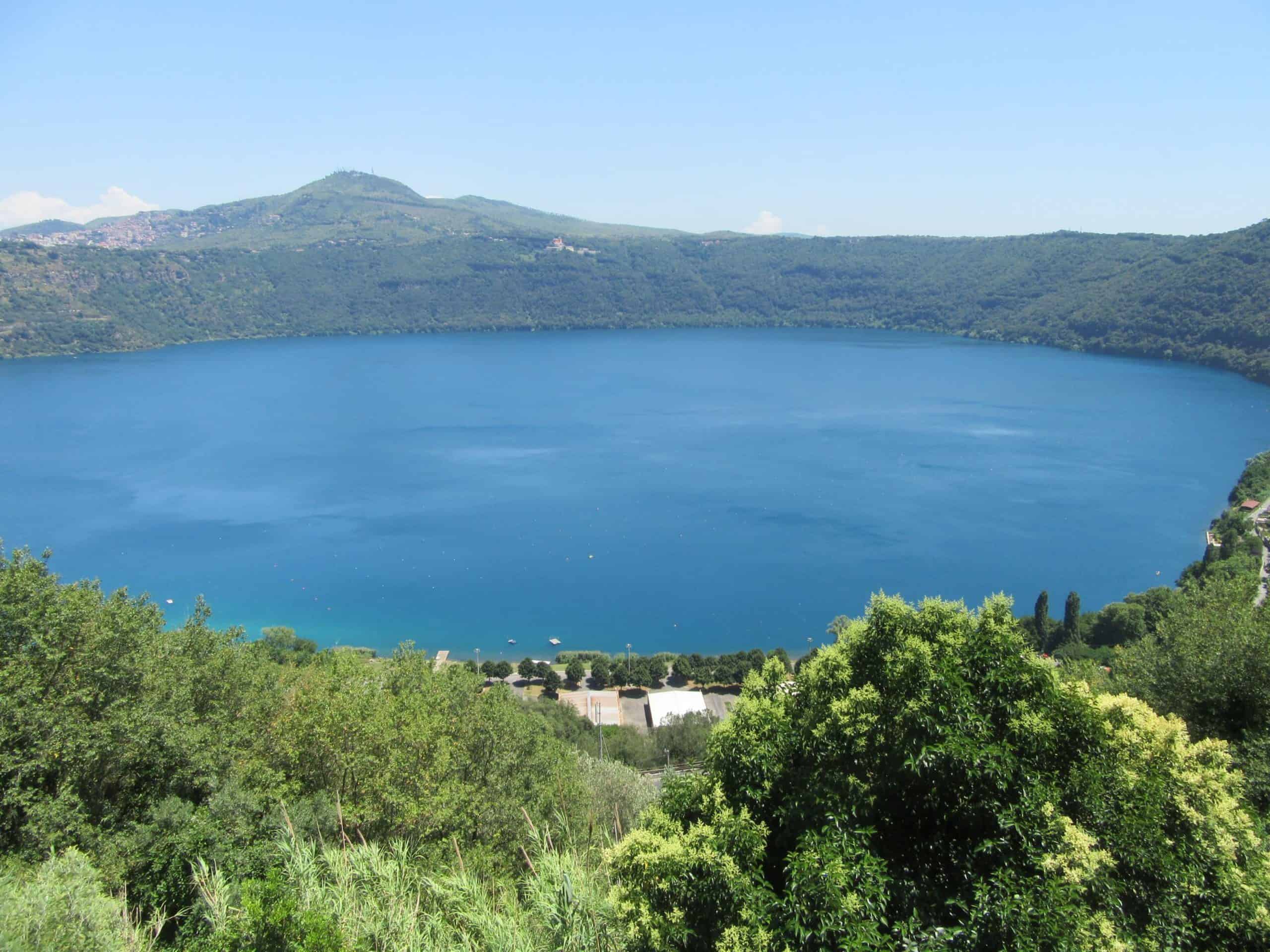
Lake Albano fills a volcanic crater in the Castelli Romani area, about 20 kilometers southeast of Rome, in Rome Province (RM). Its shores fall mostly within the territory of Castel Gandolfo, with stretches touching the municipalities of Albano Laziale, Marino and Rocca di Papa. There is no entrance ticket: the lake and its shores are public space, with free beaches alternating with beach clubs and sports clubs along the northern shore. You get there by car from Via Appia (State Road 7), taking State Road 140 of Lake Albano at Due Santi, the one everyone calls the Olympic Lake road. By train, take the Rome-Albano regional line that leaves from Termini and stops at Castel Gandolfo, then walk down to the water. Regional buses also serve the towns of the Colli. Parking on the lakefront is paid almost everywhere in the warm season, and on weekends in July and August it fills up early. For swimming, check first with the local municipality, because the swimming ban is switched on or lifted stretch by stretch depending on water tests.
If you want to place the lake within its natural setting, the wider context is on the page of the Castelli Romani Regional Park, the body that protects the whole volcanic area.

Where Lake Albano (RM) is and how to get there
The basin is an elongated oval, with its long axis running from northwest to southeast, and it measures about three and a half kilometers in length by just under three in width. The surface is around 600 hectares, and the water level is nearly 300 meters above sea level. No town sits directly on the shore: the settlements are all up high, on the crater rim or the nearby hills, and you reach the lake by going down.
The main road access to Lake Albano is State Road 140, built for the 1960 Olympics and for that reason nicknamed the Olympic Lake road. Today it falls under provincial jurisdiction along with all its branches. The road starts at kilometer 21+400 of Via Appia, at the Due Santi junction in the municipality of Marino, and after a couple of kilometers it splits into two branches. The first climbs to the town of Castel Gandolfo following the Olmata, the 19th-century avenue leading to the Papal Villas, crosses State Road 216 Maremmana III, which runs along the crater rim between Marino and Albano, then heads down again with wide bends, crosses the Rome-Albano railway with a broad hairpin and reaches the beach. The second branch, opened from scratch in the 1950s, cuts through the crater wall at its lowest point with a long tunnel and comes out at a roundabout right on the lakefront. The two branches join again along the coastal road that runs the whole northern shore and climbs the eastern ridge with another hairpin, until it joins State Road 217, Via dei Laghi.
The practical advice is simple: if you can, leave the car and take the train. Castel Gandolfo station drops you a few minutes from the lake overlook, and on summer weekends you skip the line of cars that clogs the tunnel and the lakefront parking lots.
A lake inside a volcano: the geology of Lake Albano (RM)
The slopes of Monte Cavo, the highest peak of the Castelli at 949 meters, separate Lake Albano from the other large body of water of the group, nearby Lake Nemi. The two craters are only the most recent of a long series of eruptive centers: both open on the edges of the Alban Hills volcanic complex, the so-called Vulcano Laziale, recognizable in the amphitheater of the Tuscolano-Artemisio edifice. The boundaries of the volcanic area draw a large circle that, starting from Albano Laziale, passes through Castel Gandolfo, Rocca di Papa, Marino, Grottaferrata, Rocca Priora, Velletri and Genzano di Roma.
In the final phase of volcanic activity, the meeting of masses of magma with the water tables favored the formation of many lakes. Of those, Lake Albano and Lake Nemi are the only ones that have survived to this day. Eruptive activity has ceased, or is dormant, for millennia. Some studies have suggested that the last eruptions date back to about 5,000 years ago, with episodes of boiling and overflowing of the lake and consequent mudflows of pyroclastic material, the lahars, poured over the whole Ciampino plain. The volcano is not dead, it is asleep: even today there are small-scale phenomena, toxic gas emissions, ground deformations and frequent small earthquakes, often in swarms, some of which were destructive in the past.
The elongated shape of the basin is no accident: scholars explain it as the union of two distinct volcanic craters, welded into a single body of water, which makes the lakebed more complex than the smooth surface lets you imagine. This is the reason why, going down to the water from different points of the rim, the lake changes look: more open and bright on the Castel Gandolfo side, more closed and shady on the eastern slope, where the crater walls drop steeply under the woods. The Alban Hills complex, after all, has not entirely stopped its activity: it is classified as a quiescent volcano, and the small earthquakes that now and then shake the Castelli remind us that under those quiet woods a powerful geological machine is still at work.
From an environmental point of view, Lake Albano is a microcosm isolated from the surrounding landscape. Like all volcanic lakes, it has no active inflowing or outflowing rivers able to guarantee a substantial water exchange: the only outlet is the artificial one dug by the Romans, which we will discuss further on. The water comes only from the catchment area, that is from the rain running down the crater walls, and from a few underwater springs. This hydrological closure is the reason why the lake is so deep and, at the same time, so delicate: with its roughly 170 meters of depth Lake Albano is the deepest in Lazio, but a basin without outlets disposes poorly of what it receives, and every excess discharge weighs on the waters for a long time.
There is one aspect of its depth that is worth explaining. In a lake this deep and closed, the deep waters tend not to mix with the surface ones, and on the bottom a layer forms that stays without oxygen for a long time. It is in those conditions that the archive sediments mentioned above mature, and it is from that submerged world, together with the residual volcanic activity, that the gas emissions recorded now and then along the shores come. A lake like this is never completely still: it breathes slowly, and those who study it treat it as a living organism.
The name of Lake Albano
Lake Albano is also known as Lake Castel Gandolfo, from the name of the town that overlooks its shore and within whose territory a large part of the coast falls. The two names are interchangeable and both point back to the ancient history of the place: Albano recalls Alba Longa, the Latin city that tradition places right on these heights, and Castel Gandolfo the town of the popes that in modern centuries has tied its fate to this body of water. In maps and official place names the form Lago di Albano prevails, and it is the one you will find on the road signs of State Road 140.
A curiosity about Lake Albano (RM)
The curiosity that almost no visitor knows concerns the water level, which in Lake Albano is not stable at all. Between the 1960s and the second decade of the 2000s the lake level dropped by several meters, so that a beach you now walk on dry, on the northern side, had been submerged for centuries. It was precisely this retreat of the waters, in 1984, that brought back to light the stakes of a prehistoric village that had stayed hidden underwater for nearly 4,000 years. The drop depends partly on withdrawals for water and agricultural use, partly on the rainfall pattern, and it remains one of the indicators most closely followed by scholars of the basin.
There is also a detail that explains the personality of the lake: being a closed crater, Lake Albano works as an enormous thermometer and an enormous recorder. The muddy bottom preserves layers of sediment that scientists read like the pages of an archive, because year after year they deposit the history of the climate, of the eruptions and even of human activity on the shores. Few lakes in Italy tell their past so well to those who know how to question them. In our view this is the real wonder of the place: not the postcard view, which is there too, but the idea of walking on the rim of a sleeping volcano that keeps a diary of 5,000 years in reserve.
The flora and fauna of Lake Albano (RM)
The woods that run down to Lake Albano
The steep walls of the crater saved from the plow and from concrete a mixed forest of great value. Among the tall and medium-sized trees you can recognize holm oak, linden, hornbeams, hazel, downy oak, maple, alder, elms and black poplar. The shrub layer is just as rich: laurel, manna ash, holly, broom, hawthorn, black elder, privet, butcher's broom and dogwood. Those who go down into the undergrowth in spring find cyclamens, anemones, violets and buttercups, and in good season some wild strawberries and mushrooms.
The animals of Lake Albano
The land fauna is the typical one of the Lazio woods, hedgehog, badger, fox and squirrel, made shyer, however, by the strong human presence along the shores. Among the water birds you can see the cormorant, the coot, the moorhen and the mallard, to a lesser extent the kingfisher, along with colonies of non-resident gulls that come and go. On the rocky ridges sightings of birds of prey are not rare.
The fish of Lake Albano
The fish fauna is the most interesting component, also from an economic point of view. The native freshwater species include the Italian roach, the pike, the barbel, the chub, the eel, the trout, the tench, the stickleback and the rudd. Over time many non-native species introduced by humans have been added: the carp, the pumpkinseed, the agone and the European perch, and even species of marine origin such as the mullet, the sand smelt and a small crustacean, Palaemonetes antennarius. The coexistence of native and non-native fish is one of the ecological knots of the lake, because the imported species often take space away from the native ones.

Something nobody tells you about Lake Albano (RM)
What no hurried guide tells you is that Lake Albano has a bottom inhabited by history. In Roman times, and even afterward, naumachiae were staged on the water, spectacular mock naval battles with boats and extras. The result is that the lakebed holds not only geological sediments, but also finds that fell or sank during those performances and during the centuries of use of the shores. The lake, in short, is a submerged archaeological site, as well as a natural basin.
There is more. Along the eastern shore, inside the woods, a path winds to the ruins of a Roman villa and lets you read on the ground the layering of 2,500 years of human presence. It is a little-trodden route, shady, far from the noise of the beach clubs on the north side. The advice, for those looking for the real lake and not just the beach, is exactly this: leave the crowded lakefront and take the east path, where the noise of the boats fades and what remains is the water, the trees and the ancient stones.
The Roman outlet of 398 BC: the engineering that saved Rome
The most extraordinary work of Lake Albano can't be seen from the beach: it is hidden inside the rock. According to tradition, around 398 BC, during Rome's long war against the Etruscan city of Veii, the Romans dug through the crater wall a drainage tunnel, an outlet meant to come into operation when the lake level exceeded a certain threshold. It was a feat of hydraulics very advanced for its time. The historian Livy recounts that its construction came from a prophecy of the Delphic oracle: Rome would bring Veii down only on the day the waters of the lake were channeled and used to irrigate the fields. Legend, military calculation and agricultural need are intertwined in a single work.
The technical data remain impressive. The elevation of the outlet is 293 meters above sea level, about 70 meters lower than the crater rim. The tunnel is roughly 1450 meters long, on average just over a meter wide and two meters high, and it was dug by hand in the volcanic rock following a slope calculated with remarkable precision, to let the water flow to the locality of Le Mole, below Castel Gandolfo, where it once powered mills. That a fifth-century BC conduit still works today says everything about the mastery of Roman engineers. If I had to name a single cultured reason to love this lake, I would choose the outlet: an idea from 2,400 years ago that keeps working in silence.
The prehistory of Lake Albano: the Villaggio delle Macine and Alba Longa
The first documented human settlement on the shores of Lake Albano is a pile-dwelling village brought back to light in 1984, when the lowering of the waters uncovered the northern beach. It is called Villaggio delle Macine, because of the stone millstones found on the spot. Its dating oscillates between the 20th and 19th centuries BC and the Middle Bronze Age, between the 17th and 16th. According to scholars the village should be linked to the urban horizon of the mythical Alba Longa, the Latin metropolis, mother of cities in the etymological sense of the word, which tradition says was razed by the Romans around the sixth century BC at the hands of King Tullus Hostilius. Here history fades into myth: Alba Longa is the city from which, according to legend, Romulus and Remus descended, and finding on the lake bottom the traces of such an ancient settlement means touching the very roots of Latin civilization.
My advice for visiting Lake Albano (RM)
My advice is not to reduce Lake Albano to a day at the beach. The lakefront on the north side, with its restaurants, pedal boat rentals and beach clubs, is pleasant but crowded, and on weekends in July and August it becomes a row of umbrellas and cars looking for parking. The right way to experience the place is another: arrive early in the morning, do the full loop of the lake on foot following the circuit that stretches for about 10 kilometers along the paths and the coastal road, and alternate the scenic stretches of the Castel Gandolfo slope with the shade of the woods on the eastern side.
Plan for three or four hours for the loop at an easy pace, closed shoes, water with you because the fountains are few, and the camera ready on the Castel Gandolfo side, where Bernini's dome of the collegiate church and the small white domes of the Vatican Observatory look out over the water. End the day at one of the towns up high, at the table: a porchetta in Ariccia, a glass of white in Marino. Forget swimming if you haven't checked first with the municipality that the stretch is open: the swimming ban is switched on often and it is not worth risking a fine or, worse, the wrong water.
What to see around Lake Albano (RM)
No real town sits on the shores, but the crater rim and the nearby heights are a ring of towns of great historical and artistic importance. It is worth giving each of them at least half a day.
Castel Gandolfo, the Pope's town on Lake Albano
Castel Gandolfo is the closest and best connected center, and a large part of the lake coasts falls within its municipal territory. Inhabited since the 10th century, it belonged to the Genoese Gandolfi family, then to the Savelli and finally, from 1596, to the Apostolic Camera, that is directly to the Holy See. Pope Urban VIII was the first to choose it for his summer holidays, having Carlo Maderno build the first core of the Papal Palace. Alexander VII then commissioned from Gian Lorenzo Bernini the San Tommaso da Villanova Collegiate Church, whose dome dominates the view of the lake. Many popes expanded the complex over the centuries. After the abandonment that followed the end of temporal power, in 1929 the Papal Villas were recognized by the Italian State as an extraterritorial zone of the Holy See, a status they still keep. Inside the perimeter of the Villas are the Vatican Observatory, the astronomical observatory with the small white domes also visible from the water, and the ruins of the residential part of the great villa of Emperor Domitian. Since 2016, by decision of Pope Francis, the Papal Palace is no longer a summer residence but a museum open to the public.
Albano Laziale above Lake Albano
Albano Laziale stays hidden from the view of the lake by Colle dei Cappuccini. Its historic center stands largely on the Castra Albana, the military camp of the Severan age that forms its core. A suburbicarian episcopal see already from the fourth century, it had a season as a free commune around the year 1000, then passed to the Savelli, who made it a stronghold until its purchase by the Reverend Apostolic Camera in 1697. In the 18th century the town benefited from ecclesiastical rule with the founding of cultural institutions and with the rearrangement of Via Appia, which again became the preferred road between Rome and Naples in place of the old route through Marino and Velletri. In that period Albano was enriched with villas and patrician residences: the present public park of Villa Doria, Palazzo Pamphilj, Palazzo Corsini now home to the ASL, Villa Ferrajoli which hosts the Civic Museum, Villa Venosa, Palazzo Rospigliosi. Today Albano, together with the populous districts of Cecchina and Pavona, is one of the largest municipalities of the province and an important commercial and school center.
Ariccia south of Lake Albano
To the south the crater closes in the residential area of Monte Gentile, in the municipality of Ariccia. The town is the heir of ancient Aricia, an important Latin center, setting of the famous battle of 505 or 504 BC and later a posting station on Via Appia. After Aricia declined in the Middle Ages, the settlement moved from the Vallericcia valley, once itself a small volcanic lake like Albano and Nemi, to the hill of the ancient acropolis. Refounded by the Savelli in the 15th century, Ariccia was bought in 1661 by the Chigi, who gave it the Bernini architecture of the Santa Maria Assunta Collegiate Church, the Galloro Sanctuary and the Palazzo Chigi with its park and the Baroque scenography of Piazza di Corte. Later Pope Gregory XVI had built the viaducts that shortened Via Appia: the most imposing, the Ariccia bridge, was inaugurated in 1854 by Pius IX and for a long time remained among the highest in Europe. Ariccia is known to the general public for its fraschette and for its porchetta, a gastronomic presidium of the Castelli.
Rocca di Papa and the Palazzolo convent
The lake is dominated from the east by Rocca di Papa, resting on the slopes of Monte Cavo. The town belonged to the Annibaldi, the Orsini and finally the Colonna. In 1855 the people of Rocca di Papa launched a singular revolutionary experience against feudal and papal rule, remembered as the Republic of Rocca di Papa. After Unification it became a well-served resort town, and in 1906 the funicular of the Tranvie dei Castelli Romani connected it to Rome via Grottaferrata, in service until 1963. In 1886, in the Papal Fortress at the top of the town, the Geodynamic Observatory was set up, now turned into the Rocca di Papa Geophysical Museum. Outside the town, on a sheer drop over the lake, stands the Santa Maria ad Nives Convent in Palazzolo, founded by hermits in the 11th century, Cistercian in the 13th, then Carthusian until 1449 and finally home to the Friars Minor of the Observance. In 1629 Cardinal Girolamo Colonna built a panoramic villa next to it, still known as Villa del Cardinale. In the 18th century the convent had its greatest splendor, tied to Portugal thanks to the patronage of Cardinal Josè Maria de Fonseca de Evora, and it remained an extraterritorial possession of the Kingdom of Portugal until 1910.
Marino and the Grape Festival
To the north, above Bosco Ferentano, the bell towers of Marino rise. Mentioned from the 11th century, it was a fief of the Frangipane, who built there the Gothic Santa Lucia Church, now the Civic Museum dedicated to Umberto Mastroianni and the only surviving Gothic monument of the Castelli, then of the Orsini and finally of the Colonna, who made it an advanced stronghold toward Rome. In the mid-16th century Ascanio I Colonna and his son Marcantonio II, famous papal admiral at the Battle of Lepanto in 1571, started an urban plan whose greatest result was Palazzo Colonna, designed by Antonio da Sangallo the Younger and left unfinished. A century later Filippo I and Cardinal Girolamo Colonna opened Corso Trieste and raised the San Barnaba Basilica. Marino is famous above all for its wine: in 1925 the first Grape Festival in Italy was held here, which still carries the name of the town and of its white wine around the world.
The churches, the nymphaea and Domitian's villa
On the shores of Lake Albano the modern landmark is the Madonna del Lago Church, built starting in 1966 to a design by Francesco Vacchini, technical director of the Fabbrica di San Pietro, at the wish of Pope Paul VI. The same pontiff, by then ill, consecrated it on August 25, 1977. Among the archaeological remains are the already mentioned Villaggio delle Macine, the mouth of the artificial outlet, the Doric Nymphaeum and the Bergantino Nymphaeum, monumental spaces tied to the Roman villas that dotted the slopes of the crater, first of all the villa of Emperor Domitian.

The nymphaea and Roman villas of Lake Albano (RM)
In Roman times the slopes of the crater were one of the most coveted residential areas of the suburbs. The patrician villas came with nymphaea, monumental spaces dedicated to the nymphs and to water, often dug into the rock or facing the lake, places of coolness and of display. Two are still the most famous today: the Doric Nymphaeum, so called for its architectural order, and the Bergantino Nymphaeum, a large apsed space tied to the imperial villa. It was precisely these remains, together with the mouth of the outlet, that attracted in the 18th century the pencil of Giovanni Battista Piranesi, who made engravings from them famous all over Europe. The largest complex was the villa of Emperor Domitian, whose ruins are preserved inside the perimeter of the Papal Villas of Castel Gandolfo, a rare case of continuity between the ancient imperial residence and the modern papal one, which rose almost on the same ground 15 centuries apart.
Those who want to read this layering on the ground should take the path that winds through the woods along the eastern shore of Lake Albano: it is here, far from the beach clubs, that you meet the ruins of a Roman villa and grasp the sense of a landscape inhabited without interruption for 2,500 years. The enhancement of these remains is entrusted to the lakeside municipalities, to the Castelli Romani Regional Park and to the provincial bodies, which over the years have worked to make the most interesting stretches readable and accessible.
Another well-known fact, yet rarely cited
Everybody knows that Castel Gandolfo is the town of the popes, but few stop to think about how unusual the border is that runs right above Lake Albano. Since 1929 the Papal Villas have been extraterritorial territory of the Holy See: this means that looking out over the lake from certain points of Castel Gandolfo you are, ideally, looking from one State to another. Inside that perimeter the Vatican Observatory still keeps one of the oldest astronomical observatories of the Catholic world, and in the gardens are preserved the ruins of the villa of Domitian, one of the largest imperial complexes of the Roman suburbs.
The little-cited fact is yet another: until the 21st century the lake had private owners. The surface of the water was for a long time a good that was bought and sold, along with the privileges, that is the exclusive rights over the mills powered by the outlet, over fishing and over leather tanning in Albano. In 1822 the Apostolic Camera sold the lake to the Polish prince Stanislao Poniatowski. From him it passed to Marquis Lorenzo Lezzani and in 1884 to the Duke of Gallese, Giulio Hardouin. Only in recent times has the body of water become public property. That a lake could have an owner sounds almost absurd today, and yet for centuries it was so.
The 1960 Olympics and Lake Albano as a competition venue
The moment that changed the face of Lake Albano was the Rome Olympics of 1960. The lake was chosen as the venue for the rowing and canoeing events, and for the occasion the sports facilities were built with the stadium, the starting platforms and the service buildings, along with the infrastructure to reach them: State Road 140 of the Olympic Lake with its long tunnel and even a cestovia, a cabin cable car that stayed in operation until 1974, of which the abandoned pylons remain today on the sides of the crater, somewhat melancholic witnesses of that season of enthusiasm. The economic boom also brought mass holidaymaking down here: dozens of restaurants, beach clubs and venues rose on the lakefront, drawing Romans and locals in the warm season.
Human settlement, it must be said, had started earlier. Already at the beginning of the 20th century the towns of the Colli had offered themselves as a holiday destination a short distance from Rome, and the northern edge of the crater had filled with small villas along State Road 216 between Marino and Castel Gandolfo, so much so that the locality was for a period called Castel Marino and is now known simply as the Villini. In 1889 the Rome-Albano railway had already cut across the crater with two stops. And in those same years archaeologists began to study the antiquities of the lake systematically: the great topographer Giuseppe Lugli graduated in 1913 with a thesis on the villa of Domitian and in 1919 made over the area the first archaeological reconnaissance flight, aboard the airship Roma of the Regia Aeronautica.
Boating and sports on Lake Albano (RM)
Lake Albano presents no particular difficulties for rowing or sailing, and it is one of the liveliest basins in Lazio for water sports. Along the coastal road you find several sailing clubs, such as the Circolo Vela Castel Gandolfo and the Vela Il Cantone, as well as windsurf and canoe schools, including dragon boat, the long paddled boat with a large crew, and pedal boat and rowboat rentals. It is a lake that lends itself well to introducing young people to rowing sports, as shown by the choice made of it for the 1960 Olympic events, but it is also able to test expert sailors when the wind picks up. Those who sail must keep two things in mind: the presence of algae up to the water surface in some stretches near the shore, and a wind that is very variable in direction and intensity, with sudden gusts. Given the shape of the coasts, the Scirocco can reach even 30 knots, which makes the lake technical and fun for expert sailors and treacherous for beginners. There is also an electric boat that takes visitors on guided tours along the shores. One rule holds for everyone, and it is absolute: motorized boating is forbidden on Lake Albano. It is the reason why the water, when you cross it by pedal boat or canoe, gives back a silence that has by now been lost on larger lakes.

The water of Lake Albano (RM): pollution and cleanup
The beauty of the lake should not make us forget its fragility. A closed basin with no active outlets, it has trouble disposing of wastewater, and the disorderly growth of piers and beach establishments on the northern side, often enlarged beyond the rules, has put the waters under heavy strain. In 2000 Lake Albano was classified as a primary vulnerability area in the regional water plan. In the early 2000s, inspections repeatedly recorded pollution levels over the limits, mostly due to sewage discharged from the homes around the lake. In one case, near the outlet, fecal streptococci exceeded the permitted value by tens of times. Over the years the mayors of Albano Laziale and Castel Gandolfo alternated bathing bans with their later revocations, stretch by stretch, depending on the readings of the regional environmental agency.
It's worth reconstructing the story with a few dates, because it shows well how complicated it is to govern a resource divided among several municipalities. The northern areas, where piers and beach establishments had multiplied, were already polluted beyond the allowed levels in 2004, albeit within the derogation limits. In July of that year the mayor of Albano Laziale, Marco Mattei, issued for the Albano stretch of shore an order banning immersion and rowing, but revoked it the following month, perhaps faced with the impossibility of enforcing it. The next year, with order number 54 of April 14, 2005, the same mayor banned sports and recreational activities in the water again. In 2006, near the outlet, fecal streptococci reached the point of exceeding the legal value by 30 times, and in 2007 the readings of the regional environmental agency confirmed out-of-norm levels in many areas. The bathing ban was extended, first to some stretches and then to the whole Albano shore, while the mayor of Castel Gandolfo, Maurizio Colacchi, in turn alternated bans and revocations until 2008. The cause, always the same, was the intestinal fauna produced by sewage discharged from the homes around the lake.
The turning point came with the sewer network around the lake, the work that collects and carries away wastewater along the whole perimeter of the lake, promoted by the Rome Province together with the municipalities of Marino, Rocca di Papa and Castel Gandolfo. The project section dates from April 2007, work began in November 2008 and the plant was inaugurated on June 25, 2009. From the following year the waters were already less compromised, and in 2010 Castel Gandolfo was able to lift the bathing ban. The situation remains delicate all the same, and for this very reason swimming should always be checked beforehand with the relevant municipality. The frank advice from those who know the lake is to treat it with respect: it is a closed ecosystem, and every wrong move on the shore weighs on the bottom for a long time. Paradoxically, it was the environmental troubles themselves that brought scholars' attention back to a basin whose botanical, archaeological and historical importance had long been neglected in the postwar period.
The Right Photo to Take at Lake Albano (RM)
The photo you bring home from Lake Albano is not the one taken from the lakefront with your feet in the water. The real postcard is taken from above, from the Castel Gandolfo overlook or from the hairpin bends that descend from the town: from up there the crater shows itself whole, the dark oval of water set between wooded walls, with the Bernini dome of the collegiate church of St. Thomas of Villanova and the little white domes of the Vatican Observatory in the foreground. It is the shot that has tempted painters from half of Europe for two centuries, and it still holds up.
The right moment is early morning, when the raking light comes in from the east and draws the relief of the crater, or late summer afternoon, with the low sun lighting up the Castel Gandolfo side. Whoever feels like walking should find a second shooting point on the trail along the eastern shore, where the woods frame the water and, backlit, the rusty pylons of the old Olympic gondola lift stand out: a less postcard image and more a story, which brings together the nature of the volcano and the memory of the 20th century. Avoid the middle hours of Ferragosto, when haze and crowds flatten everything.
Some Important Events That Happened Here in History
Few bodies of water have seen so much history pass by. In the sixth century BC, according to tradition, the Romans razed nearby Alba Longa, the mother city from which their own lineage descended. Around 398 BC they dug the outlet, the hydraulic work tied to the prophecy of Delphi and the victory over Veii. In Roman and imperial times the lake was the stage for naumachiae, the staged naval battles that still leave finds on the bottom, and its slopes were covered with patrician and imperial villas, first among them that of Domitian.
In 1233 a bull of Pope Gregory IX lists the lake among the properties of the abbey of Grottaferrata, the Basilian monastery founded by Saint Nilus of Rossano in 1004 under the protection of the Counts of Tusculum. In 1822, with a notarial deed dated September 22, the Apostolic Camera sold the body of water to Prince Poniatowski, starting the brief chapter of private ownership. In 1960 the lake hosted the Olympic rowing events, the event that handed it over to mass tourism. In 1977 Pope Paul VI, already ill, personally consecrated the Madonna del Lago Church on August 25. He would die the following year during the summer stay at Castel Gandolfo. Two years later, on September 2, 1979, Pope John Paul II also visited the sanctuary. In 1984 the lowering of the waters gave back the Villaggio delle Macine, and in 2009 the inauguration of the circumlacustrine sewer network marked the beginning of the slow recovery of the basin.
Who has passed through Lake Albano (RM)
The list of those who have stopped on the shores of Lake Albano runs through the centuries. Among the oldest visitors is Pius II, the humanist pope who lived between 1405 and 1464, who loved to travel and to note down his impressions in the Latin Commentarii. The ruins of the lake attracted in the 18th century the engraver Giovanni Battista Piranesi, who dedicated two splendid prints to the mouth of the outlet and to the Doric Nymphaeum, helping spread across Europe the archaeological appeal of the site.
In the Grand Tour the lake became a much-loved subject for landscape painters. It was portrayed, among others, by the Englishman John Robert Cozens, the German Jakob Philipp Hackert, the Frenchman Jean-Baptiste Camille Corot, the Russian Sil'vestr Ščedrin, and later Oswald Achenbach and the American George Inness: a small international gallery that testifies to how much this crater marked the European imagination. For Grand Tour travelers, who came down from Rome toward the Castelli along Via Appia, Lake Albano was an almost obligatory stop on the sentimental and artistic route: the combination of ancient ruins, woods and recessed water answered exactly the taste for the picturesque that those visitors were looking for, and many went home with a notebook full of sketches of this body of water. On the side of ownership history, those who passed through here were the Polish prince Stanislao Poniatowski, Marquis Lorenzo Lezzani and Duke Giulio Hardouin of Gallese. And then the popes, who have had their summer residence at Castel Gandolfo for four centuries, from Urban VIII to Alexander VII and on to Paul VI and John Paul II. To study the lake, not only to admire it, was instead Giuseppe Lugli, the topographer who in 1919 flew over it in an airship for the first archaeological reconnaissance from above.

Lake Albano (RM) with kids and accessibility
Lake Albano is a convenient destination for families, especially on the northern side, where the lakefront runs flat along the water and alternates free beaches, equipped beach clubs, pedal boat rentals and kiosks. For kids, a ride on a pedal boat on the motor-free water, an ice cream along the shore and watching coots and mallards are enough to fill an afternoon. The complete loop of the lake, on the other hand, with its 10 kilometers and the uphill stretches on the eastern ridge, is demanding for the little ones: better to stick to the flat coastal stretch and head back.
On accessibility it is best to be honest: the main lakefront is largely walkable, but the paths in the woods on the east shore are unpaved, narrow and at times steep, not very suitable for strollers and wheelchairs. Those with mobility needs will find it easier to enjoy the lake from the coastal promenade and from the Castel Gandolfo overlooks, reachable by car or train, rather than venturing onto the full loop. The fountains along the route are few, so it is best to bring water, and in the warm season a hat, because some stretches of the lakefront are exposed to the sun for long stretches.
When to go to Lake Albano (RM)
Lake Albano can be visited all year, but it changes a lot with the season. Spring and autumn are the best times for the walk around it and for photography: the woods are in full color, the light is soft, the shores are quiet. Summer brings the life of the lakefront, the open restaurants, the pedal boats and the boats, but also the weekend crowds and the traffic toward the parking lots: if you want the beach, come early in the morning. Winter gives a different lake, silent and severe, with the crater often wrapped in haze and the towns up high almost deserted. The best period is the end of September, when summer has withdrawn, the fraschette of Ariccia reopen the porchetta season and the lake goes back to those who know how to walk it.
Who has owned Lake Albano (RM) over the centuries
The story of who has ruled these waters deserves a chapter of its own, because few lakes in Italy have changed hands so many times. In 1233 a bull of Pope Gregory IX lists the lake among the appurtenances of the abbey of Santa Maria di Grottaferrata, the powerful Basilian monastery founded by Saint Nilus of Rossano in 1004 thanks to the protection of the Counts of Tusculum. That baronial family, which had its stronghold in ancient Tusculum, secured for the monastery several properties in its own sphere of influence, and this explains the interests the abbey kept until the 15th century in the territories of Castel Gandolfo and Ariccia. The 19th-century scholar Gaetano Moroni, author of the monumental Dizionario di erudizione storico-ecclesiastica, maintains that afterward the lake passed to the Apostolic Camera, the papal state domain, although he does not explain his reasoning.
Documentary certainty arrives only with the sale: on September 22, 1822, by deed before the notary De Gregori, the Apostolic Camera ceded the lake to the Polish prince Stanislao Poniatowski, a representative of a nobility of royal blood exiled after the partition of the Polish-Lithuanian Commonwealth in 1795, who had found a second homeland in Rome and then in Florence and who already owned a palace and some land in Albano. Having moved to Tuscany, the prince alienated the property in favor of Marquis Lorenzo Lezzani, a man who had quickly grown rich through papal contracts and was raised to nobility in 1841. In 1884 the lake passed again, to the Duke of Gallese Giulio Hardouin, father of the better-known diplomat Luigi Hardouin di Gallese. It may seem strange that anyone had an interest in owning a mass of water, but along with the lake came the privileges: the exclusive rights over the mills of Albano and Castel Gandolfo, powered by the water of the outlet, over fishing and over leather tanning. Only in recent times has the surface of the lake become public property.
Lake Albano and Lake Nemi: two twin craters
You can't fully understand Lake Albano without its twin, Lake Nemi, which opens a short distance away beyond the ridge of Monte Cavo. They are the only two surviving lakes of the Vulcano Laziale, both set in deep craters, both without active natural outlets, both full of Roman memory. But they have different characters. Albano is larger, deeper, more touristy, open to beaches and water sports. Nemi is smaller and more secluded, the famous mirror of Diana, overlooked by the village of the little strawberries and tied to the recovery of the ships of Emperor Caligula. If you have a whole day you can join them in a single Castelli itinerary, going up from Albano toward Rocca di Papa and then down to Nemi and Genzano: two volcanic lakes in a few hours, with the woods of the Castelli Romani Regional Park in between.
What to eat around Lake Albano (RM)
Going down to the lake without stopping at the table in the towns up high would be a mistake, because the Castelli Romani are one of the richest pantries of Lazio. The signature dish is the porchetta of Ariccia, a gastronomic presidium served in the fraschette, the popular taverns where loose wine was once sold, signaled by a leafy branch hung at the door, and where today you eat porchetta, cured meats and cheeses at wooden tables. Wine is the other great tradition: Marino has celebrated its Grape Festival since 1925, the first of its kind in Italy, and its DOC white goes well with the rich flavors of porchetta. A little further on, Genzano di Roma is the home of the famous naturally leavened bread, and in Grottaferrata the abbey and the restaurants of the center complete the tour. The formula is simple: do the loop of the lake in the morning, go up to a town at lunchtime and plan the return to Rome after coffee, when the traffic of the Castelli has thinned out.
Quick questions about Lake Albano (RM)
Where is Lake Albano?
In the Castelli Romani, about 20 kilometers southeast of Rome, in Rome Province. Its shores fall mostly in the municipality of Castel Gandolfo and partly in those of Albano Laziale, Marino and Rocca di Papa.
How do you get to Lake Albano?
By car from Via Appia, taking State Road 140 of the Olympic Lake at Due Santi. By train on the Rome-Albano regional line from Termini, getting off at Castel Gandolfo. By regional buses that serve the Castelli.
Do you pay a ticket to enter Lake Albano?
No, the lake and its shores are public space. What you may pay for is parking on the lakefront and entry to the private beach clubs.
Can you swim in Lake Albano?
It depends on the stretch and on the period. The swimming ban is switched on or lifted depending on water tests, so it is best to always check first with the local municipality.
How deep is Lake Albano?
The maximum depth is around 170 meters, which makes it the deepest lake in Lazio.
How big is Lake Albano?
The surface is about 600 hectares, with an oval shape about three and a half kilometers long and just under three wide.
Why is Lake Albano a volcanic lake?
It occupies a crater of the Alban Hills volcanic complex, the Vulcano Laziale. It has no active natural inflowing or outflowing rivers and is fed by rain and underwater springs.
What is the outlet of Lake Albano?
A drainage tunnel dug by the Romans around 398 BC through the crater wall, about 1450 meters long, which comes out at Le Mole below Castel Gandolfo. It served to regulate the level of the lake.
Can you walk around Lake Albano?
Yes, the loop along the paths and the coastal road measures about 10 kilometers and takes three or four hours at an easy pace. You need closed shoes and water with you.
Can you go boating on Lake Albano?
Yes, by rowboat, pedal boat, canoe and sail, with rentals and clubs along the coast. Motorized boating is instead forbidden.
Which town overlooks Lake Albano?
No town is directly on the shore. On the crater rim and on the nearby heights stand Castel Gandolfo, Albano Laziale, Ariccia, Rocca di Papa and Marino.
Is Lake Albano suitable for kids?
Yes, the flat lakefront, the pedal boats and the equipped beaches make it a convenient destination for families. For the walking loop with small children it is better to choose only the northern stretch.
What to see near Lake Albano?
Castel Gandolfo with the Papal Palace and the Villas, Albano Laziale with its Roman historic center, Ariccia with Palazzo Chigi and the fraschette, Rocca di Papa with the Geophysical Museum, Marino with its wine tradition.
Can you visit the Papal Palace of Castel Gandolfo?
Yes, since 2016 it is no longer the summer residence of the popes and has been opened to the public as a museum, together with the gardens of the Papal Villas.
Is there a prehistoric village in Lake Albano?
Yes, the Villaggio delle Macine, a Bronze Age pile-dwelling settlement that re-emerged in 1984 with the lowering of the waters on the northern beach.
Has Lake Albano hosted the Olympics?
Yes, in 1960 the Olympic rowing and canoeing events were held here. The pylons of the cestovia built for the occasion still remain today.
When is the best time to visit Lake Albano?
Spring and autumn are ideal for walking and photographing, summer for the beach and the life of the lakefront (with more crowds), winter for the silence of the crater.
How far is Lake Albano from Lake Nemi?
A few kilometers: the two craters are separated by the slopes of Monte Cavo and belong to the same Alban Hills volcanic complex.
Where do you park at Lake Albano?
On the lakefront of the northern coast, where the spaces are almost all paid in the warm season and run out early on summer weekends.
Why is Lake Albano also called Lake Castel Gandolfo?
Because Castel Gandolfo is the town that overlooks the shore and within whose territory a large part of the coasts falls. The two names indicate the same lake. In official place names the form Lago di Albano prevails.
Are there restaurants on Lake Albano?
Yes, the lakefront of the northern coast is dotted with restaurants, kiosks and beach clubs, especially active in the warm season. Many offer the cuisine of the Castelli Romani.
How far is Lake Albano from Rome?
About 20 kilometers as the crow flies from the center of Rome, reachable by car from Via Appia or by train on the regional line that stops at Castel Gandolfo.
Can you still see the Olympic facilities on Lake Albano?
The pylons of the cestovia built for the 1960 Olympics remain, along with traces of the rowing facilities along the coast. Some structures have been dismantled or abandoned over time.
If I had to sum up in one sentence why it's worth coming all the way down here, I would say this: Lake Albano is not a beach with a view, it is a sleeping volcano that has held together for 3,000 years prehistory, Roman engineers, popes and Olympic athletes. Walk it slowly, look at it from above at Castel Gandolfo, and forget the rush: it is a place that gives itself only to those who dedicate a whole morning to it, and that repays with interest those who have the patience to listen.
Article written by the editorial team of TourLeaderPro, contact them for Private/Corporate/V.I.P. Tours and Experiences.
Planning a trip to Rome? The English-language guides to visiting the city are on ItalyPlanner.com.