Giove
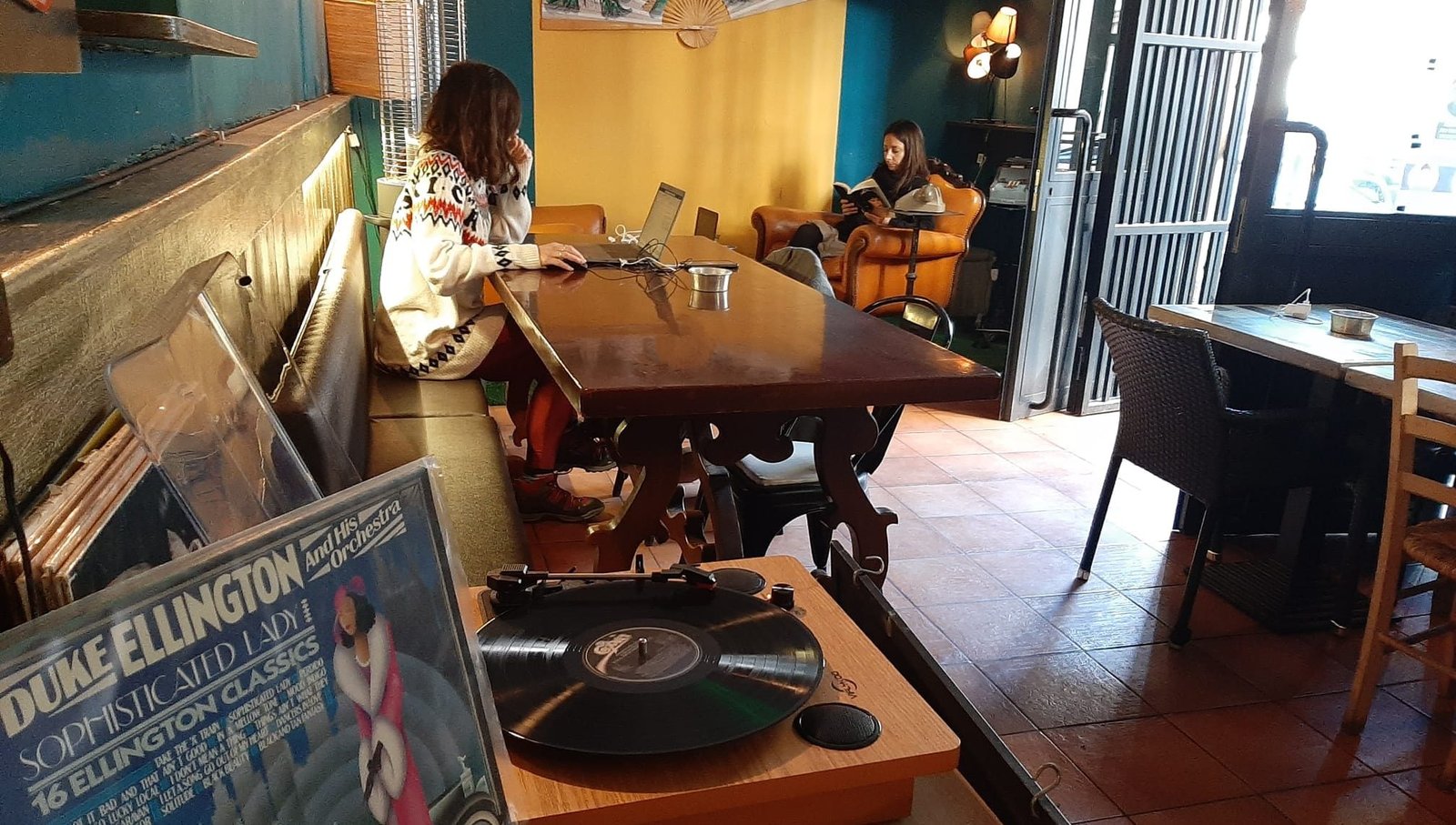
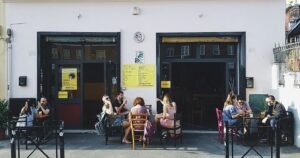
Giove is a multipurpose space in the Pigneto, at Via Ettore Giovenale 54, in Rome: an address that holds together, behind a single roller shutter, things that usually live in four different venues. During the day it's a place where you sit down with your computer and work. In the afternoon it becomes a bar. In the evening it lights up with live music. And in between, depending on the hours and the days, a food offering passes through too. The formula is called, in the jargon, a hybrid space, and it's one of the things the Pigneto has learned to do better than any other quadrant of the city.
The reference listing classifies it at the same time as a bar, restaurant, club, music club, social space, coworking space and hybrid space. This isn't a confusion of categories. It's exactly the description of the place. Giove doesn't try to be just one thing, and the fact that it can't fit inside a single box is its distinguishing trait. Anyone who arrives expecting a silent office with soundproofed booths is thrown off. Anyone who arrives expecting a concert hall with a barrier in front of the stage is thrown off in just the same way. Anyone who arrives expecting nothing usually feels right at home.
The name, of course, plays on something. Jupiter (Giove) is the king of the gods of the Roman pantheon, the one of the temple on the Capitoline Hill, the one with the lightning bolts. Giove is also the largest planet in the solar system, the one with the red spot and Galileo's moons. Here, though, Giove is a venue in the Pigneto, and it's worth keeping that in mind right away, because the overlap produces funny mix-ups: people searching online regularly end up reading about space probes or Latin mythology instead of about an address behind the Casilina. The name, on the other hand, is impossible to forget, and for a place that lives on word of mouth that's not a minor detail.
What follows explains how a venue like this is put together, how to get there, what surrounds it, why the street has the name it has, and what happened in this part of Rome before anyone put a counter and a stage here. Because Via Ettore Giovenale is not just any side street: it carries the name of a Roman condottiero of the 1500s, it runs parallel to one of the most photographed streets in the neighborhood, and it crosses the heart of a borgata that Italian cinema made famous all over the world.
What kind of place Giove is
The hybrid space, explained properly
A hybrid space is not a bar that occasionally does something else. It's a venue designed from the start to change function during the day, with furnishings, systems and rules meant to hold up under four different uses without having to take everything apart each time. You understand it as soon as you walk in: the tables are large and just low enough to sit at with a laptop but also with a plate. The power outlets aren't hidden behind the refrigerator but spread along the walls. The lighting has at least two settings, one for reading and one for the evening. And somewhere there's a corner that looks useless by day and turns out to be the stage at night.
The reason this formula has caught on in Rome, and especially in quadrants like the Pigneto, is simply economic. A venue that opens only in the evening pays rent 24 hours a day and takes in money for five. A venue that opens only by day does the opposite. A venue that manages to stay open from morning to night spreads its fixed costs over many more hours and, above all, builds a community instead of a clientele: the same people who work at the back table in the morning come back in the evening for the concert, and vice versa. It's a model that works where the density of self-employed workers is high and where the neighborhood already has a nightlife. The Pigneto has both in abundance.
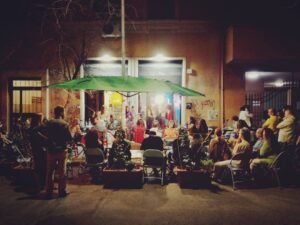
The practical consequence is that a place like Giove has very different internal rhythms depending on the hour. Over the course of 12 hours, the same room changes its background noise three times. In the morning the dominant sounds are keyboards and phone calls at half voice. In the afternoon come the moved chairs, the overlapping conversations, the sound of the coffee machine working at full speed. In the evening the background becomes music, first recorded and then, when there's a program, played live. Anyone who visits the place in only one of these time slots takes home a partial idea of what it is, and often a wrong one.
How the coworking part works
The coworking part of a hybrid venue almost never resembles a real coworking space, the kind with a reception desk, badges and meeting rooms you can book by the hour. It's more like a bar that has decided to treat people who work well: a stable connection, outlets, tables that can take an elbow, and a declared tolerance toward people who stay three hours and spend little. The pact, unwritten but very clear, is one of reciprocity: you occupy a table for a long time, I give you power and connection, and in return you order something with some regularity and free up the seat when the room fills up.
Anyone who doesn't know this pact tends to upset the balance in two opposite ways. The first is staying seven hours with one coffee, which turns the place into a library without a budget. The second is walking in, asking if you need a reservation for the coworking, being told no and concluding that the coworking doesn't exist. It exists, but it's informal. The common-sense rule in places like this is simple: order something every couple of hours, don't take a table for six by yourself, and watch what the others do. The Pigneto has a scene of freelancers, translators, video editors, illustrators, musicians and small productions that knows this grammar by heart.
A warning about calls. In a hybrid, loud video calls are what makes people fight more than anything else. Not because there's a ban, but because the room is a single space with no dividing walls: someone talking into headphones at a normal volume goes unnoticed, someone who uses speakerphone gets everyone's stares. If your work involves a lot of spoken meetings, a hybrid has to be chosen knowingly and used at the hours when the room is empty, that is, early in the morning, not at six in the evening.
How the Music Side Works
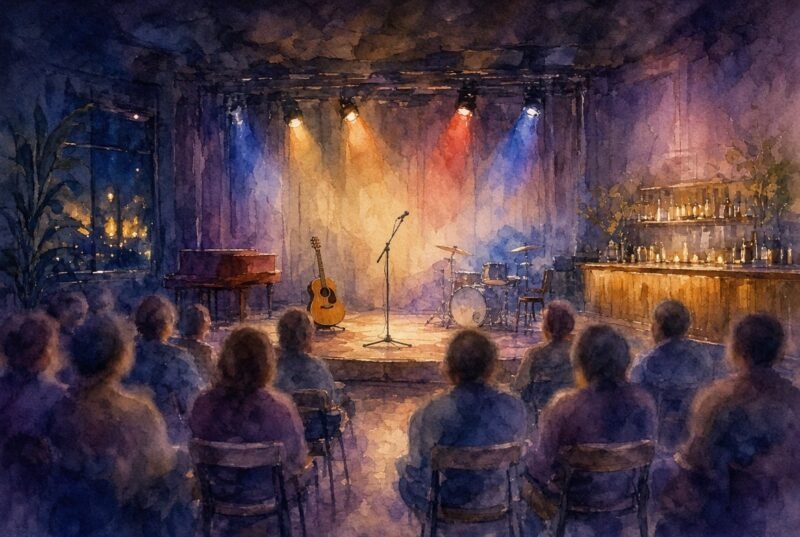
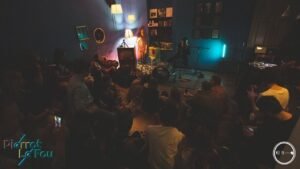
Live music in a venue of this size has its own rules. The stage, when there is one, is low and small, and the distance between those who play and those who listen is measured in centimeters, not meters. There's no backstage worthy of the name: musicians unload from the sidewalk, set up in front of the audience, and at the end of the night take down their gear while someone is still drinking. The sound engineer, if there is one, works from a desk wedged into a corner. If there isn't, the band handles the sound. This produces concerts that are technically imperfect and humanly memorable, which is more or less the reason people go.
The repertoire, in places like this, is typically wide: singer-songwriter, oblique jazz, played electronics, things at the edges of genres, projects that find no room elsewhere in Rome. Theme nights alternate with DJ sets, and every now and then there are record presentations, open jam sessions and nights when the people playing are also the ones who normally serve at the bar. The border between audience and artists, in a hybrid, is porous by design.
It's worth explaining one point that always escapes people coming from outside Rome. Many spaces of this kind operate on a membership basis, that is, they ask for a membership card to get into the nights with live music. It's not a commercial trap: it's the legal form that in Italy lets a small venue host concerts without the costs of a dance hall. Where it's required, the card is made on the spot in two minutes, with an ID, and is valid for a whole year. Not all the hybrid venues in the neighborhood use this scheme, so the sensible thing is to ask beforehand rather than show up with 10 people and no IDs.
Where Giove Is and How to Get There
The Address
Via Ettore Giovenale 54, Rome. We're in the Pigneto, in the Prenestino-Casilino quadrant, on one of the inner side streets of the grid of roads that descend from the Casilina ring road toward Via di Acqua Bullicante. It's a narrow street, with low buildings, iron doors, scooters leaning against the wall and sidewalks that in some stretches are barely wide enough for two people side by side. It has nothing of a showcase street: anyone passing by in the daytime, not knowing what they're looking for, sees rolling shutters and keeps walking.
The street number helps with orientation. At 56, that is, one door away, there's another venue. A bit further on, at the higher numbers, a wine bar. And less than a hundred meters away, turning onto Via Braccio da Montone and Via Gentile da Mogliano, you find a historic bar, a record store and a couple of independent spaces. So that stretch of Giovenale isn't an isolated address: it's a piece of a concentration of venues within a radius of barely a hundred 20 meters. Anyone arriving for the first time and feeling lost in the dark just has to look where people are stopping on the sidewalk.
A tip on method for those who don't know the neighborhood: the streets of the inner Pigneto have very similar names, all named for Italian condottieri, and are easily confused. Giovenale, Fanfulla da Lodi, Braccio da Montone, Gentile da Mogliano, Conte di Carmagnola, Perugino di Montone. Anyone who types the name into the navigator from memory easily ends up on the wrong side street 200 meters away. It's better to copy the full address, with the street number, instead of trusting your memory.
By Subway
The simplest way is Line C. Pigneto station runs under Via del Pigneto and is the reference stop for the whole quadrant. The work sites for the station opened in July 2007, the works ended in January 2015 and it opened to the public on June 29, 2015, together with the rest of the stretch that connected Parco di Centocelle to the then temporary terminus. From the station it's a few minutes' walk to the street number, cutting along the pedestrian part of Via del Pigneto or running alongside the Casilina ring road.
The same station has been planned for years as a future interchange with the regional rail lines FL1 and FL3, once the railway station of the same name, run by the network operator, is built. It's a construction project the neighborhood follows with a mix of hope and resignation, and one that comes up in conversations at the counter with the regularity of a catchphrase. In the meantime, for those arriving from regional trains, the reference remains another stop.
On the subject of hours, there's a warning that in Rome makes the difference between a successful evening and a night spent looking for a ride. A venue that programs concerts almost always closes after the last metro run. Anyone planning to go back underground must either accept leaving before the end, or factor in a surface night bus, or arrange things differently. It's an obvious consideration, but it saves the evening for those who make it before and not after.
By tram and bus
The surface reference is piazzale Prenestino, reachable by following the Casilina ring road for about 350 meters from the metro station. The tram lines 5, 14 and 19 pass there, connecting the quadrant with Termini and with the northern sector of the city. The tram, for those arriving from San Lorenzo or from the center, is often the most sensible solution: it doesn't run into traffic, doesn't require parking, and drops you at walking distance from the entrance to the neighborhood.
City buses cover the rest, with stops along the Casilina and along the Prenestina. Those arriving from outside Rome and staying in the center find the tram convenient. Those staying toward the east, along the Casilina or Prenestina route, often arrive on foot or by bicycle. The neighborhood is flat and the internal distances are short: from the pedestrian heart to the street it's a few minutes' walk.
By car, by bicycle, on foot
By car the advice is blunt: better to avoid it. The inner streets of the Pigneto are narrow, one-way for long stretches, and free spots on program nights are a mirage. Anyone who insists ends up circling for 20 minutes and parking at distances that make having taken the car pointless. Anyone who absolutely has to arrive motorized does well to aim for the outer arteries, leave the vehicle there, and walk the last few minutes.
By bicycle, instead, the neighborhood is very convenient. It's flat, the distances are short, and the Casilina ring road offers a continuous route toward Porta Maggiore and toward San Lorenzo. Shared scooters also work well, with the one warning that the pedestrian part of via del Pigneto has to be covered on foot, walking the vehicle by hand, not riding in the middle of the tables.
On foot, finally, you can see the whole Pigneto in a good half hour. And it's the right way to get to know it: the difference between the working-class buildings of the 1920s, the villini with their small gardens, the converted warehouses and the facades covered in murals can only be grasped by walking. Anyone who arrives at eight in the evening and goes straight to the venue misses three quarters of the reason it's worth coming all the way here.
A curiosity about Giove
The tastiest curiosity concerns the name itself, and it's not the one you'd imagine. It's not the mythology, it's not the planet: it's the fact that the name of the venue and the name of the street tell two Roman stories 2,000 years apart, and by pure chance they are printed on the same address. Jupiter, the god, had his most important temple on the Capitoline Hill, barely four kilometers from here as the crow flies. Ettore Giovenale, the one on the street sign, was a Roman condottiero of the 1500s. Putting the king of the gods and a captain of fortune on the same doorbell is a short circuit that nobody designed and that works very well.
Then there's a second level, more prosaic and more useful. Being called Giove, in 2026, means fighting with search engines every day. Anyone who types the bare name finds mythology, astronomy, space missions, a municipality in the province of Terni that is called exactly Giove, and an industrial quantity of other things before getting to a venue in the Pigneto. The practical consequence, for those looking for information, is that the name must always be accompanied by the neighborhood or the street. The consequence for the venue is that physical word of mouth counts for more than online visibility: people come here because someone told them about it at the next table, not because they read a review.
Third curiosity, and perhaps the most significant. The name of the venue is bare, two syllables, with no adjectives and no subtitles. In a neighborhood where venues are named after movie quotes, wordplay in Romanesco, references to obscure records and incomprehensible acronyms, choosing a word this big and this naked is almost a provocation. Small names for big places, enormous names for small places: in the Pigneto the second rule often applies, and this address is its most literal example.
One last note, for lovers of coincidences. Giove, in Latin Iuppiter, is the god of the sky and of thunder, and in Roman tradition he presided over oaths and pacts. A venue that runs on an informal pact between those who occupy a table and those who grant it, and that rests on a balance of trust among customers, members and managers, couldn't have chosen a more fitting mythological godfather. Clearly it's a reading after the fact, but it's a reading the Pigneto would like.
The Pigneto, That Is, the Neighborhood Around This Venue
How a Borgata Came to Be
The Pigneto is not a historic rione: it's a borgata born outside the walls, in the early twentieth century, in a strip of countryside crossed by the great consular roads and cut in two by the railway cut. The name comes from an estate with a pine grove, and for decades the area was a piece of agricultural periphery with low houses, vegetable gardens, workshops and a working-class population that arrived in waves. The two- and three-story buildings you see today along the inner side streets are largely from the Twenties and Thirties, built with economical criteria and with those little interior courtyards that give the area the air of a village wedged into the city.
The most recognizable urban feature is the scale. In the Pigneto the heights are modest, the streets are narrow and you can see the sky. Anyone coming from the Umbertine districts of the center, with big six-story buildings and canyon-like streets, immediately notices the difference: here the light reaches the street, the balconies are wrought iron, the windows have shutters and on good days you can hear radios from the kitchens. It's a periphery that looks nothing like the idea of a periphery that visitors have.
The second feature is the social mix. The Pigneto has never stopped being a working-class neighborhood, and at the same time for at least 20 years it has been the cultural laboratory of East Rome. Side by side, on the same landing, live families who have been here for three generations, out-of-town students, self-employed culture workers, foreign communities that arrived starting in the Nineties and people who moved recently because the neighborhood cost less than the center. This coexistence produces vitality and also friction, and the debate over the so-called movida is the form in which the friction has shown itself publicly for at least 15 years.
Pedestrianization and Its Effects
The central stretch of Via del Pigneto is pedestrian, and this is the urban planning choice that more than any other has shaped the neighborhood's current look. The neighborhood market occupies the street in the morning, the tables occupy it in the afternoon and evening, and the result is a linear square a few hundred meters long that works as a collective living room. Anyone who sees the Pigneto only at night thinks that stretch has always been like that. Anyone who passes at eight in the morning instead finds the fruit stalls and the line at the greengrocer, and understands that the street has two overlapping lives.
The effect on the side streets is less obvious and very important. Once the main street got saturated with tables and signs, the pressure shifted to the inner streets: Fanfulla da Lodi, Braccio da Montone, Gentile da Mogliano, Ettore Giovenale. That's where, over the last 15 years, the less conventional venues have opened, the ones that couldn't afford the rent on the main street and that built their identity on cultural programming instead of on passing trade. An address like this one exists, to use a simplification, thanks to that geography.
Pedestrianization also generated the problem the neighborhood has been discussing for years: coexistence between those who live here and those who come to spend the evening. Night noise, garbage, double-parked cars on the side streets are the recurring topics at neighborhood meetings. Anyone visiting the Pigneto as a tourist would do well to know this and to behave accordingly: lowering your voice when you leave a venue at midnight is not an obligation written anywhere, but it's the difference between being a guest and being a problem.
Pasolini, Accattone and the Cinematic Face of the Neighborhood
The Pigneto entered the Italian imagination thanks to the movies. Pier Paolo Pasolini shot a large part of Accattone here, his first film as a director, released in 1961: the dirt roads, the low walls, the boys sitting in the sun and the faces of the Roman subproletariat that make up that film are, largely, these streets. The neighborhood you see in the shots is very different from today's, and precisely for that reason the comparison is striking: the same alignments of small buildings, the same corners, a social world completely changed.
Pasolini used a bar in the neighborhood, on one of the inner side streets, as a logistical base, and that bar is still an address known to anyone who deals with the film memory of Rome. It's not the only film shot here: the Prenestino-Pigneto quadrant also appears in postwar neorealism, and the most famous scene of Italian cinema of those years, Anna Magnani's in Rome, Open City, was shot on a street in this sector of the city. Walking through the Pigneto with those images in mind is an exercise that completely changes your perception of the places.
It's worth adding a clarification, because it's a frequent confusion. The Pasolinian Pigneto is not a museum and is not signposted: there are no plaques on every corner, there's no official route with signs, and the filming locations have changed to the point that recognizing them requires documentation. Anyone who arrives thinking they'll find a neighborhood preserved as a set is disappointed. Anyone who arrives knowing that the link is historical and not scenographic enjoys the walk much more.
Something nobody tells you about Giove
What nobody tells you is that a hybrid venue should be chosen by the hour, not by the venue. It sounds like a platitude and it isn't. Reviews, lists and friends' suggestions treat places as if they were stable entities: nice, ugly, expensive, cheap, noisy, quiet. A hybrid venue is none of these things in absolute terms: it's all of them, in rotation, over the course of the same day. Going at 11 in the morning expecting atmosphere and going at 11 at night expecting silence are two different ways of getting the same address wrong.
The operational translation is simple. If the goal is to work, the good time is the morning and the very early afternoon: a half-empty room, low background noise, available staff, large tables free. If the goal is to be in company without shouting, the window is the late afternoon, before the bulk of the evening arrives. If the goal is the music, you go late and accept that there will be no trace of tables. There is no moment that satisfies all three needs, and anyone who tries ends up dissatisfied with all three.
The second thing nobody says concerns the relationship between these spaces and their programming. A neighborhood hybrid venue doesn't have a stable schedule published months ahead like a theater. The nights are defined at the last minute, often with a week or 10 days of notice, and the main channel through which they're communicated is social media profiles and flyers in the window, not a website with an updated calendar. Anyone who plans an evening in Rome three weeks ahead, looking for official confirmations, will come away empty-handed and wrongly conclude that nothing is happening. Things do happen: they just get announced late.
Third thing. The quality of the experience in a place like this depends much more on the room than on the service. In a restaurant you judge the dish, in a bar you judge the counter. In a hybrid space you judge who's there. A night with 40 right people is memorable even with a mediocre sound system. A night with four distracted people is flat even if everything else is perfect. This makes online judgments particularly unreliable for this category of venue: two people can both be right while describing opposite nights.
Fourth, and it applies to the whole Pigneto. Weeknight evenings are often better than the weekend. On Friday and Saturday the neighborhood fills with people from outside the neighborhood, the venues work at full capacity and the community component gets diluted. On Tuesday or Wednesday, instead, the people who are there are usually there for a reason: a specific concert, a presentation, a regular appointment. Anyone who wants to really understand how this part of Rome works should come on an ordinary day, not on the night when everyone comes.
The advice I give you for visiting Giove
The advice, in one line: go twice in the same week, at two different hours, and treat them as two distinct places. It's the only way to understand a hybrid venue. Make the first visit by day, with a computer or a book, ordering something and staying a couple of hours: it serves to take the measure of the room, to see where the outlets are, to figure out how much the sun heats that side of the street and to get yourself recognized. Make the second in the evening, after dinner, when the room has changed skin. The difference between the two will be more instructive than any description.
Before leaving home
Check the program on the venue's channels the same day, not a week before. As I said, the announcements come late and change. Verify if the night requires a membership card and, if so, bring an ID: making it on the spot takes two minutes if you have your documents and becomes a waste of time if you don't. If you plan to work, bring the charger and don't take for granted that you'll find a free outlet at peak hour.
If you're coming as a group, give notice. A small venue with a single room doesn't improvise 10 seats at nine in the evening, and showing up with 10 people without notice on a concert night is the fastest way to end up standing on the sidewalk. A message the day before solves the issue. If instead there are two or three of you, nothing is needed: you walk in and see.
Once inside
Look around before choosing a table. In hybrid venues there is almost always an area that becomes the stage area or dance area in the evening, and sitting there at eight means having to move at 10 30. If you think you'll stay a long time, take a table on the side. If instead you're coming only for the concert, don't occupy the large tables: in these places space is the scarce resource and the local etiquette is very sensitive on the subject.
Talk to the people who work at the counter. It's not a courtesy: it's the most reliable source of information about the neighborhood. In a hybrid venue in East Rome, whoever works behind the counter knows the programming of the other venues, knows which night is worth it on the next street, knows if the 10 o'clock concert will really start at 10, and can tell you where to go to eat when the kitchen here closes. No written guide replaces this kind of information.
Don't photograph people without asking. It seems obvious, but it isn't: in small venues with low light, a raised phone is very visible and creates discomfort. It counts double during concerts, where, by the way, the result is almost always terrible. I'll come back to this further on, because the right photo in a place like this exists, but it's not the one you'd instinctively want to take.
On spending and pacing
Adjust to the rhythm of the room. If you're working and the room fills up, order again or free up the table: it's the pact I was talking about. If you're spending the evening, remember that neighborhood venues run on average spending and not on expensive bottles, so there's no need to overdo it to feel at ease. The kitchen, where there is one, is often a simple offering meant to accompany, not to replace dinner at a restaurant: anyone arriving very hungry at nine in the evening would do well to ask first what's available.
A note of common sense that holds for all of East Rome: water and non-alcoholic drinks in these places are treated exactly like everything else, with no raised eyebrows. Those who drive, those who work at the table, those who simply don't drink alcohol don't have to invent excuses. It's something that in Rome in 2026 is by now settled, and foreign visitors, used to other dynamics, are always glad to hear it.
On the way out
The final advice concerns the sidewalk. The moment when a neighborhood venue creates problems for residents is not when the music plays inside, but when 30 people go out to smoke and talk under the windows. Via Ettore Giovenale is narrow, the houses are low and voices rise straight to the bedrooms. Stepping out, lowering your tone and moving a few meters away is the minimum courtesy that allows places like this to keep existing. It's not an imposed rule: it's the reason why some venues survive and others close after three years of complaints.
Another well-known fact, yet rarely cited
The fact is this: the street that hosts the venue carries the name of a knight who fought in 1503 in the Challenge of Barletta, and the parallel street, a few dozen meters away, carries the name of another knight from the very same team. Anyone who went through Italian schools knows the Challenge of Barletta. Almost no one, walking through the Pigneto, realizes they're crossing the complete lineup of that day.
Who Ettore Giovenale was
Ettore Giovenale, nicknamed Peraccio Romano, was an Italian condottiero born in Rome, and the nickname itself attests to his city origin. The year of his birth is not known precisely. He was a friend of Giovanni Capoccio, also a Roman knight and also among the 13. He fought in Apulia against the French and for this very reason was chosen to take part in the challenge of 1503. He died in 1530.
His later career illustrates well what it meant to be a captain of fortune in 16th-century Italy, that is, changing flags according to convenience and alliances. During the Italian War of 1521 he was in the service of the Duke of Ferrara, who at that point was allied with the French, that is, exactly the side he had fought against at Barletta. In 1521, on the occasion of an attack by soldiers of the Papal State near Modena, he fled with his men and for this was dismissed by the duke. He then passed into the service of the Papal State in the War of the League of Cognac. In the autumn of 1526, at Sorbara, he defeated with his men a unit of Spanish cavalry and infantry headed for Bologna, putting them to flight. Shortly afterward he was recalled to Rome to take part in the defense of the city against the troops of the Colonna family, which had allied with the Spanish.
To sum up: a Roman who fights for Spain at Barletta, then for Ferrara with the French, then for the Pope against the Spanish, and who ends up defending Rome from a Roman family. It's a biography that explains 16th-century Italy better than many textbooks, and that has an almost literary quality. The fact that it ends up on a street sign in the Pigneto, above the roller shutter of a venue with live music, is one of those short circuits that make Rome the city it is.
The Challenge, briefly and without rhetoric
The context is the partition of the Kingdom of Naples between France and Spain, agreed in the Treaty of Granada of November 11, 1500 between Louis XII of France and Ferdinand II of Aragon, and immediately disputed by both sides because it left undefined the assignment of an intermediate strip of territory. From the summer of 1502 hostilities reopened. The Spanish, outnumbered, dug in at Barletta, then an important Adriatic commercial center, and made it their headquarters.
On January 15, 1503, some French prisoners captured near Canosa di Puglia were invited to a banquet. During dinner the nobleman Charles de Torgues, known as la Motte, challenged the worth of the Italian fighters, accusing them of cowardice. The Spaniard Íñigo López de Ayala defended them. The challenge arose from the quarrel: 13 knights per side, originally 10, with the horses and weapons of the defeated as the prize, a ransom set at 100 ducats for each prisoner, four judges and two hostages per side. The fight was held on February 13, 1503 on the plain between Andria and Corato, on land that was neutral at the time under the jurisdiction of the Republic of Venice, and it ended with the victory of the Italians.
The Italian team was put together by Prospero and Fabrizio Colonna, who contacted the strongest fighters of the time. Ettore Fieramosca was named captain, and he also handled the exchange of letters with the French counterpart. The Italians spent the night in Barletta and attended mass in the city's cathedral before the fight. In the list of the 13, alongside Fieramosca, appear Francesco Salamone, Marco Corollario, Riccio da Parma, Guglielmo Albimonte, Mariano Marcio Abignente, Giovanni Capoccio da Spinazzola, Giovanni Brancaleone, Ludovico Abenavoli, Ettore Giovenale and Fanfulla da Lodi.
The Pigneto as a map of the captains of fortune
And here we get to the point. The inner side streets of the Pigneto are dedicated en bloc to the Italian condottieri of the 1400s and 1500s. Via Ettore Giovenale and Via Fanfulla da Lodi, which run a few dozen meters from each other, carry the names of two men who on February 13, 1503 were lined up side by side in the same formation. A little further on there are Braccio da Montone, that is Andrea Fortebraccio, and the Conte di Carmagnola, that is Francesco Bussone, and Gentile da Mogliano: other captains of fortune, from different eras and with different stories, who complete the picture.
Anyone who deals with Roman toponymy knows that this choice goes back to the naming plan of the borgata in the early 1900s and responds to a thematic logic typical of the period: to each neighborhood its own repertoire. What is striking is the unintended long-term effect. The neighborhood that in the post-war period becomes a symbol of the urban subproletariat, and then a cultural laboratory, and then an area of independent venues, walks every day on a grid of names of Renaissance mercenaries without hardly noticing.
An anecdotal but effective proof: ask around, on any evening in the Pigneto, who Ettore Giovenale was. Out of 10 people, nine will say he's a Latin poet, confusing him with Decimus Junius Juvenal, the author of the Satires. It's an understandable error and completely wrong. The Giovenale on the sign didn't write verses against the corruption of customs: he mounted a horse and fought for whoever paid. Anyone who wants to win an argument at the counter now has the cards in hand. And if you want to widen the game, along Via Fanfulla da Lodi there's a club that carries exactly the same name as the street, that is Fanfulla 5/a, and which is therefore named by rebound after another of the 13.
The right photo to take at Giove
The wrong photo we all know: the stage seen from behind heads, with the colored lights blown out and the singer reduced to a blur. It never works. The light in small venues is low and saturated, phones interpret it badly, and the result is an unreadable memory that nobody will ever look at again. In places of this kind the good photograph is made elsewhere and at another time.
The shot I really recommend
The right photo is the exterior, in the late afternoon, from the opposite sidewalk. Via Ettore Giovenale is narrow and has low buildings on both sides: in the hours when the sun is low, the light enters from the side, lights up one row of facades and leaves the other in shadow, and the street takes on a depth that disappears completely at night. Horizontal framing, the roller shutter or the sign on the side third, the perspective of the street running toward the back, a scooter leaning against the wall in the foreground. It's an image that tells the story of the neighborhood and not only the venue, and that holds up against time much better than any night shot.
The best variant is the one with the street sign in the frame. The sign with the condottiero's name, with the street number and with the wall behind is the element that makes the photo recognizable and correctly dated: whoever looks at it understands where it is, and whoever has read the knight's story has a joke ready. It's the most elegant way to photograph a venue without photographing its interior.
The interior photo, if you really must
If the urge to photograph inside is irresistible, the moment is the afternoon, with the room still half empty and natural light coming in from the window. A table, a cup, an open computer, the mismatched chairs in the background: it's the photograph that tells the daytime function, the half of the place that nobody ever photographs and that paradoxically defines it more than the evening does. It's also the hour when you can shoot without bothering anyone, which is no small detail.
During concerts there's only one rule: no flash, ever. Flash in a small room blinds the audience, disturbs the people playing, and still produces a worse photo than one without it. If you want to keep a trace of the evening, better a very short video with audio, 10 seconds, holding the phone low: it conveys the atmosphere much better than 20 blurry photographs.
Within a five-minute radius
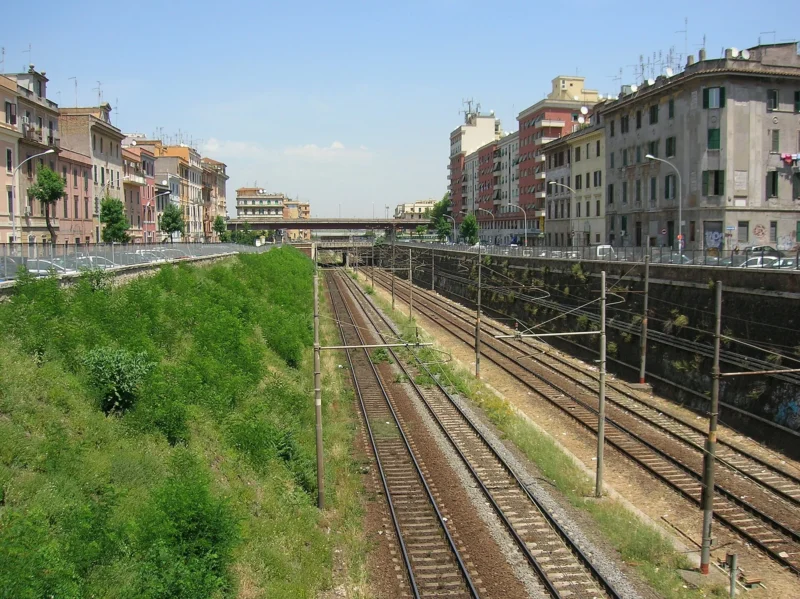
If the goal is to go home with images of the neighborhood, it's worth widening the circuit. The murals of the inner Pigneto, the small courtyards of the 1930s buildings, the railway trench seen from the bridge, the pedestrian part of via del Pigneto in the morning with the market stalls: all are subjects five minutes' walk from here and all more photogenic than the interior of a venue with low light. The advice, in general, is to photograph the context and live the venue, not the other way around.
Some important events that happened here in history
Here means two things together: this address and the piece of city that contains it. There is no official chronicle of a neighborhood venue, and whoever invented one would do a disservice. What does exist is a chronology of the quadrant that explains why a place like this is found exactly where it is, and that is worth retracing step by step.
The early 1900s: the borgata is born
At the beginning of the century the area is still suburban countryside, cut by the consular routes and by the railway. Urbanization comes in lots, with low houses built by small companies and cooperatives, and with a population arriving from the countryside of Lazio and central Italy looking for work in the capital. The two- and three-story buildings that today define the landscape of the inner side streets mostly belong to this phase, that is the 1920s and 1930s, and it's in that period that the toponymy dedicated to the captains of fortune is fixed.
The war and the post-war period
The Prenestino-Casilino quadrant is one of the sectors of Rome most marked by the Second World War, both for the bombings of the railway areas and for the episodes of the Roman Resistance. It is in this sector that Italian cinema, just after the war ended, goes looking for its most celebrated images: the most famous scene of Rome, Open City, with Anna Magnani running after the truck, was shot on a street in this part of the city, and since then that frame has become a kind of emblem of the neighborhood and of neorealism as a whole.
1961: Accattone
Pier Paolo Pasolini shoots a good part of his first film as a director here, Accattone, which is released in 1961. The Pigneto of the shots is a neighborhood of dusty roads, low walls, boys in the sun, houses without plaster. The film delivers the quadrant to the national and international imagination as the place of the Roman urban subproletariat, and that definition will weigh, for better and for worse, for the next 50 years. The bar that Pasolini used as a logistical base during the shoot is on one of the inner side streets and is still one of the most cited addresses in the film geography of Rome.
The 1980s and 1990s: the factory stops, the neighborhood changes
The eastern quadrant of Rome progressively loses its productive base. The plants close, the warehouses stay empty, and within a few years a season of reuse from below opens: occupied spaces, social centers, rehearsal rooms, workshops. The best-known case in the area is that of the former textile plant a short distance away, where an unauthorized construction site tapped into a water table and generated an urban lake, today one of the most distinctive places in the city. Anyone who wants to understand how East Rome built its contemporary cultural identity has to start there: it's the ex Snia and the lago ex Snia, and they're a few minutes from here.
The 2000s: the Pigneto becomes the Pigneto
It's between the late 1990s and the early 2000s that the neighborhood takes on its current look. The pedestrianization of the central stretch of via del Pigneto turns a market street into a linear square. The first independent venues open. Students, cultural workers and small businesses arrive. And rents begin to rise. In parallel, the neighborhood's reputation consolidates as the center of Rome's alternative nightlife, with everything that implies in terms of conflict with residents. It's in this phase that the inner side streets, cheaper than the main street, become the ground of the most experimental venues.
June 29, 2015: Metro C arrives
The Pigneto station of Line C opens to the public on June 29, 2015, after construction sites begun in July 2007 and works concluded in January 2015. The effect on the quadrant is immediate and measurable: the Pigneto stops being a destination for those who know it and becomes reachable by anyone in 20 minutes from the center. The number of visitors grows, the pressure on the venues grows, and the public discussion on how to manage the phenomenon grows too. The station is designed as a future interchange with the regional rail lines, a completion the neighborhood has awaited for years.
Recent years
The last few years have brought the Pigneto two opposite and simultaneous trends. On one side, real estate pressure and rising rents have made it harder to open and maintain independent spaces, and several historic addresses have closed or changed management. On the other, the hybrid formula has grown, exactly the one of this venue, as an economic response to that pressure: more functions in the same space, more opening hours, more types of audience. Reading a place like Giove outside this frame means not understanding it.
It's worth being precise on this, because precision here is more useful than rhetoric. The chronology listed concerns the neighborhood and is documented. On the single address, instead, the internal affairs of a private venue, the openings, the temporary closures, the changes of management and the programming seasons leave no verifiable public trace, and inventing them would be as easy as it would be improper. Anyone who wants to reconstruct the recent history of the place has only one reliable method: ask on the spot.
Who has passed through Giove
The honest answer is that a neighborhood hybrid venue sees, over the course of a year, a quantity of people that no list of names could represent. And that the list of names, in a place like this, would also be the least interesting thing. What's worth telling are the categories, because they are what make the room.
Who works at the tables
The first category is the self-employed workers of the neighborhood, and the Pigneto has a concentration of them that few sectors of Rome can claim. Translators, editors, graphic designers, illustrators, screenwriters, photographers, developers, language teachers preparing lessons, doctoral students writing chapters, small publishers doing layouts. These are people who could work from home and choose not to, because the average Roman home is small and because working among others is the only way not to go crazy. They spend hours, order little and very often, and know the staff by name.
Who plays
The second category is the musicians. Rome has a vast independent scene that is undersized relative to the available spaces, and a small stage is a precious resource: you try out a new repertoire, you present a self-produced record, you play in front of 40 people for the first time. Through places like this pass projects at their first public outing and musicians with 20 years of career who would never have fun in a room of 1,000 people. The density of exchange is very high: whoever plays one night comes back the next week as a spectator.
Who lives here
The third category, the most important and the least talked about, is the neighbors. The people who live in the buildings of Via Ettore Giovenale, of Via Braccio da Montone, of Via Gentile da Mogliano. Some frequent the venue, others put up with it, almost all have a precise opinion on how it should work. In a dense neighborhood, an establishment with live music is a neighbor before it is a commercial business, and its survival depends on the quality of that relationship much more than on the programming. This is the thing that always escapes visitors and that the managers of the Pigneto's venues know very well.
Who passed through the street, before the venue existed
And then there's the historical level, which is the fun one. Through these streets, in 1960, passed a film crew with Pier Paolo Pasolini directing, and the faces of the neighborhood ended up in Accattone. Before that, in the post-war period, the quadrant was the natural set of neorealism. And if you want to push the game all the way, the name on the sign belongs to a man who really did fight for Rome: Ettore Giovenale, called Peraccio Romano, who in 1526 was recalled to the city to defend it from the troops of the Colonna. He never passed through this street, for the simple reason that in the 1500s this was countryside. But he is the only documented person whose name appears, every day, above the head of anyone who enters at number 54.
On the rest I prefer not to name names. In the venues of the Pigneto legend circulates in abundance, and almost always without evidence: the musician who played one night without notice, the director seen at the back table, the band that rehearsed here before becoming famous. They're nice stories to hear told at the counter, by someone who was there. Putting them in writing as if they were established facts is another matter.
What there is within 200 meters
One of the reasons this address works is that it doesn't work alone. Within a few steps, on the same street and on the immediate side streets, you can count at least half a dozen addresses with different vocations: another venue one door away, a wine shop a little further on, a historic bar that gives its name to a piece of the neighborhood, a record shop, a couple of independent spaces. The typical evening, in the Pigneto, is not spent in one place: you start in one spot, you hear the music coming from a doorway, you move. The geography is so compact that moving costs 90 seconds.
On the parallel street there's the club that carries the name of Ettore Giovenale's teammate in the challenge: Fanfulla 5/a, a rectangular room where concerts, DJ sets and screenings coexist and which is one of the reference points of East Rome's nightlife. For those who want to widen the radius by a few minutes, there's then the quadrant of the ex Snia with its lake, the green of the castagneto prenestino and, going down toward Porta Maggiore, the underground basilica of Porta Maggiore, which is one of the most surprising and least visited monuments in the city.
For those who want to build a longer musical evening, there are two directions. Toward San Lorenzo, with the basilica of San Lorenzo fuori le mura and the Verano cemetery serving as the monumental boundary of the university neighborhood, and with addresses like Largo Venue for mid-sized concerts. Toward the Casilina and the Mandrione, instead, there are Snodo Mandrione and Lanificio 159, both children of the same logic of reusing industrial spaces. For those looking for jazz, finally, look toward Alexanderplatz and the Casa del Jazz, which are on a completely different register but round out the picture of a Roman week well.
By day, those who feel like walking and seeing a Rome that the tourist circuits ignore have two easy destinations in opposite directions: the Centrale Montemartini, where ancient statues coexist with the diesel engines of a former power plant, and the Parco degli Acquedotti, which, with Line A and a quarter of an hour by bus, offers the Roman countryside within the city limits. Both are proof that the southeastern quadrant of the city is the part that rewards most those who leave the center.
When to go, in one line per season
In winter a hybrid venue gives its best in the daytime function: a warm room, low light, work at the table, no rush. Winter evenings in the Pigneto are more intimate, the sidewalk is less crowded and the concerts have a more select audience. It's the right season for those looking for the neighborhood and not the showcase.
In spring and autumn the neighborhood explodes. These are absolutely the best seasons for the Pigneto: temperatures that allow you to stay outside, a dense program, days long enough to fit in a walk before the evening. If I can choose, I recommend the second half of May or the first half of October.
In summer, and in Rome summer is long, the city moves outdoors and the indoor programming thins out. Many venues close for a few weeks between August and the beginning of September, and those that stay open work mainly on the sidewalk. Anyone visiting Rome in that period should turn toward the arenas and the outdoor festivals, and consider neighborhood venues as the starting point of the evening more than as the destination.
September, finally, is the month when everything restarts. The seasons are announced, the calendars fill up, and the neighborhood returns to its normal density after the break. Today, September 12, 2026, we are exactly in that window: it's the best time of the year to put your nose back into the side streets of the Pigneto and see what they've put on the bill.
Three frequently asked questions
Do you need to book? For a daytime table, no, you walk in and see. For an evening with music and for large groups, a message the day before avoids disappointment. For nights that require an associative membership card, where applicable, what you mostly need is an ID.
Can you really work there? Yes, at the right hours, with the common-sense rules listed: order regularly, don't monopolize the large tables, keep calls at a low volume or take them outside. Anyone looking instead for an office with a meeting room and a printer should look for a structured coworking space, which is another category of service.
Is it suitable for people who don't know Rome? Very much so, on one condition: arriving with the right attitude. It's not a venue for a list of must-see places, it has no view, it has no signature dish to photograph. It's a piece of neighborhood life that accepts guests. Whoever treats it that way comes back. Whoever is looking for a stop to tick off would do better to stay in the center.
Frequently asked questions about Giove
Where is Giove?
Giove is at Via Ettore Giovenale 54, in Rome, in the Pigneto neighborhood, in the Prenestino-Casilino quadrant. It's an inner side street of the grid of streets that runs down from the Circonvallazione Casilina toward Via di Acqua Bullicante, a narrow street with low buildings and iron doors, far from the more touristy streets of the neighborhood.
What kind of place is Giove?
Giove is a hybrid space in Pigneto that changes function over the course of the day, with coworking, a bar, a kitchen and a stage for live music in the same room. It was designed from the start to handle these different uses without having to take everything apart each time, with large tables and power outlets meant both for working and for eating.
Can you work on a computer at Giove?
Yes, you can work on a computer at Giove at the right times of day, usually during the daytime, before the place switches to its evening program with live music. The common-sense rules asked of you are to order regularly, not to monopolize the large tables and to keep phone calls at a reasonable volume.
Do you need to book at Giove?
For a daytime table at Giove you don't need to book, you walk in and sit down freely. For an evening with live music or for large groups, though, it's better to send a message the day before so you don't end up without a seat.
Do you need a membership card to enter Giove?
For the Giove evenings that require a membership card, where it is required, your ID is the most important thing to bring with you. Not every evening has this requirement, so it's best to find out in advance about the type of event scheduled that night.
Is Giove open on Sunday?
Giove's weekly opening days are not specified in the available information, so it is not possible to confirm for certain whether the place is open or closed on Sunday. Before planning a visit, it's best to check the hours directly on the place's own channels.
What is the best time of year to go to Giove?
At Giove, winter is the right season for the daytime function, with the room warm, the light low and no rush, while winter evenings in Pigneto feel more intimate, with a more select audience at the concerts. Spring and autumn remain the best seasons of all for experiencing the neighborhood, thanks to the more pleasant temperatures.
In closing
Via Ettore Giovenale 54, Rome, in the heart of Pigneto: a multipurpose space that over the course of a single day is a co-working space, a bar, a kitchen and a stage for live music. It's not a place to look at, it's a place to use, and in Rome the two get confused more often than would be reasonable. The hybrid formula is not a passing fad but a precise answer to the geography and the costs of this quadrant, and understanding it means understanding how the Rome that lives outside the historic center works today.
The street does the rest of the work. Walk to the pedestrian part of Via del Pigneto, look at the plaques of the condottieri on the side streets, look up at the murals, take the bridge over the railway cutting. Then come back, sit down, order something and stay as long as you need to form your own idea. It's the only guide that really works.
If this part of Rome interests you and you're putting together a broader itinerary, here are two useful tools. For those who organize trips and lead groups, the toolbox of TourLeaderPro helps build days that really work in the field, with realistic timing and alternatives ready. For those planning a trip to Italy on their own or with family, ItalyPlanner is the place to start to fit together cities, days and transfers without losing half your time to the unexpected. In both cases, Pigneto deserves a whole evening and not half an hour in passing.
Practical information
Giove
Via Ettore Giovenale, 54
Rome
A multipurpose space in the heart of Pigneto: from co-working to live music, all topped off with drinks and food offerings.
Contact Information
Via Ettore Giovenale, 54
Roma Roma Città, Roma Città
Nearby

Upcoming events nearby
 Periferie Umane (Human Suburbs), final performance at Teatro Sala Vignoli, Nov 21 and 22, 2026100 m
- RCC One Stand Up at Maison Rosé, November 22100 m
- Gelo, Comedy Happening with Saverio Raimondo at Maison Rosé, November 19, 2026100 m
- Queer Panic! at Maison Rosé, WORQ IT Presents100 m