Sanctuary of Diana Nemorense
In short. The Sanctuary of Diana Nemorense occupies the flat terrace that stretches along the northern shore of Lake Nemi, in the municipality of Nemi, Metropolitan City of Rome Capital, about 30 kilometers from the center of the capital along the line of Via Appia.

The Sanctuary of Diana Nemorense occupies the flat terrace that stretches along the northern shore of Lake Nemi, in the municipality of Nemi, Metropolitan City of Rome Capital, about 30 kilometers from the center of the capital along the line of Via Appia. Its ruins are in the locality of Giardino, under the ridge on which the village climbs, in a natural amphitheater that is the crater of an extinct volcano. The complex covered about 45,000 square meters, with a main terrace of 200 meters by 175, supported on the downhill side by triangular substructures and closed on the uphill side by a wall of large semicircular niches that still today rise out of the ground for several meters. By far the larger part of the sanctuary is still underground. The archaeological area is not open to free individual visits: protection is the responsibility of the competent Superintendency and entry happens on the occasion of extraordinary openings, agreed days and authorized guided visits, so before getting in the car you need to check the access conditions with the Superintendency and the Municipality of Nemi. The place where you can instead see, displayed and explained, the materials that come from here is the Museum of the Roman Ships, at Via Diana 13-15, 00040 Nemi (RM), phone +39 06 9398040: regular hours Tuesday through Sunday 9.00-19.00 with last entry at 18.00, closed Monday, January 1 and December 25, ticket full price €3 and reduced €2, free admission on the first Sunday of the month, April 25, June 2 and November 4. Careful though: the museum is affected by an extraordinary closure for PNRR works announced until September 7, 2026, and the room dedicated to the cults has itself been closed for the redoing of the flooring, so the verification call before leaving is not excess caution but the only way of not walking into a closed door. You get there easily from Via Appia to Genzano di Roma and from there you go down to the lake by Via Diana. In front of the museum there is a free parking area.
Having said the bare minimum to get oriented, the interesting part begins, because this is one of the densest places in all of ancient Lazio and one of the very few Italian archaeological sites from which, literally, a book was born that changed the way the West thinks about religion. Here the sanctuary is told slowly.
Where exactly is the Sanctuary of Diana Nemorense and why geography matters
Lake Nemi is a crater. Not a mountain lake, not an artificial reservoir: the mouth of a volcanic complex of the Alban Hills, extinct, filled with water, closed by very steep walls that rise for over a hundred meters above the surface of the water. It's small, a little over a kilometer and a half across, and it's deep, and precisely because it's small and deep and sheltered from the wind, its surface sits still like a metal plate. The ancients called it speculum Dianae, the mirror of Diana, and anyone who looks out over it understands in three seconds that it wasn't a poetic metaphor but a technical description.
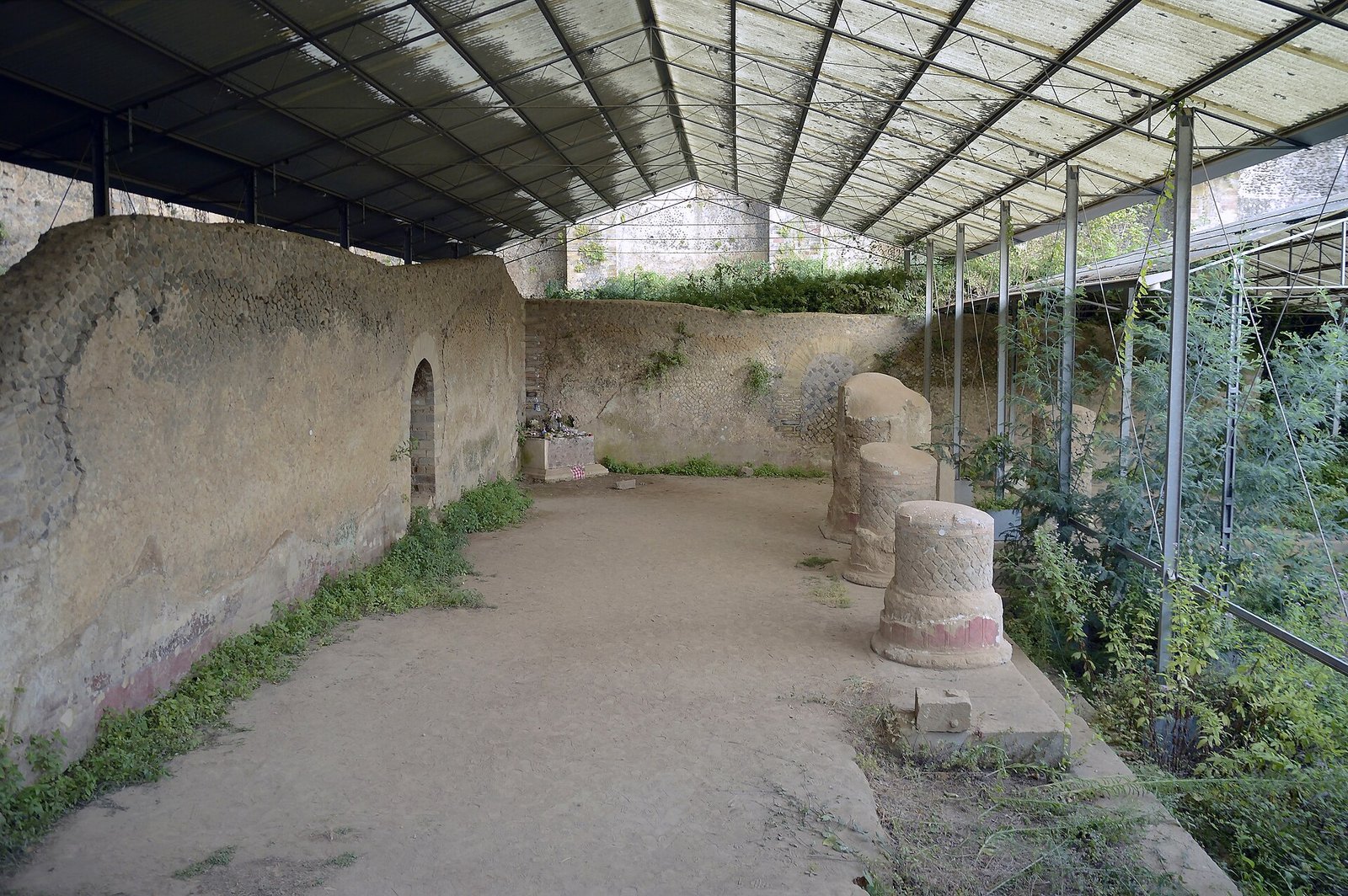
The Sanctuary of Diana Nemorense is not on the rim of the crater, where a fortress would be, and not on the bottom, where a pier would be. It's halfway up the slope, on a kind of natural step that the northern side offers about 40 meters above the water level, oriented so as to look at the lake and to be looked at by the lake. It's a choice of staging, not of convenience. The builders who in the course of the second century BC gave the complex the monumental form that can still be recognized under the scrub had before their eyes the same model that had produced the sanctuary of Fortuna Primigenia at Palestrina and that of Hercules Victor at Tivoli: take a slope, cut it into artificial terraces, hold them up with concrete, and turn a hill into an architecture that can be seen from kilometers away. Here the variant is that the spectator is not the plain, it's the water.
The result is that the Sanctuary of Diana Nemorense is one of the very rare Roman sanctuaries built to be reflected. On the nights of the August festival, when the woods filled with torches, the surface of the lake gave back the fire, doubling it. It's not a fanciful reconstruction: the ancient sources speak precisely of the reflected glow, and the topography of the place makes the effect inevitable. It's a detail worth keeping in mind, because it explains why this sanctuary, which from a strictly architectural point of view is not the largest in Lazio, has stayed in literary memory more than almost all the others.
The relationship with Aricia and with Via Appia
Administratively the sanctuary did not belong to Nemi, which in antiquity did not exist as an independent center: it was in the territory of the Latin city of Aricia, today's Ariccia, which is a little over four kilometers away, beyond the rim of the crater, at the foot of Monte Albano. Hence the alternative name under which the complex appears in the sources and in the bibliography: sanctuary of Diana Aricina. Aricia was the first stop on Via Appia leaving Rome, the stage that Horace tells in his satire of the journey to Brindisi, and it was a rich city. A substantial part of its wealth came precisely from the sanctuary, from the traffic of pilgrims that climbed up to it and from the medical reputation that derived from it.
Those arriving from the Appia left the consular road at Aricia and took a secondary road that went down to the lake: the clivus Virbii, so called from the name of the god who with Diana and Egeria formed the triad venerated in the woods. A stretch of the paving of this road has been detached and put in a museum, and is visible in the right wing of the Museum of the Roman Ships. Walking on it with your eyes, knowing that those stones carried to the sanctuary pregnant women, the sick, magistrates and runaway slaves, is one of the most effective mental exercises this museum allows.
What you see today at the Sanctuary of Diana Nemorense
I'll be frank, because frankness serves better than enthusiasm here: anyone expecting an equipped archaeological site, with ticket office, routes, panels and bookshop, will be disappointed. The Sanctuary of Diana Nemorense is today an area largely covered by vegetation and farmland, with powerful but disjointed wall remains, excavation and restoration sites that open and close, and a use that depends on the safety conditions of the moment. The official entry for the site classifies it as not visitable freely, and the good practice is to contact the Superintendency or the authorized associations that organize guided visits.
That said, what emerges is imposing. The most recognizable element is the wall of the large niches: a long curtain in concrete masonry marked by large semicircular niches, which served at the same time as a retaining wall for the slope and as a scenic backdrop, and which probably housed statues. It's the same solution the Romans applied to the great sacred terraces and to hillside villas, and it's the reason why the sanctuary, seen from far away, must have looked like a theater wall as tall as a three-story house.
You then recognize portions of triangular substructures on the side toward the lake, the remains of the pronaos of the temple with at least one altar, some columns, service rooms, and the perimeter of the terraces. The excavations of recent decades have brought back to light the nymphaeum, the portico and structures older than the great temple. But the sentence that you read in every serious report is always the same: most of the sanctuary is still underground. It's not scientific modesty, it's a topographical observation. Out of 45,000 square meters, the investigated area remains a fraction.
The view from the village of Nemi
If you can't get down into the area, there is a fallback that is not a fallback at all. From the panoramic terrace of the village of Nemi, next to the castle, you look straight down and see the whole amphitheater of the crater: the lake, the northern shore, the plateau of the sanctuary. From there the logic of the place reads better than from inside. You understand where the artificial shelf ends, where the ground starts to climb again, how big the complex really was. It's the same view that drove the northern painters mad in the 19th century, and it has the advantage of being free, always available and excellent even under a cloudy sky.
Who Diana Nemorensis was, the goddess of the Sanctuary of Diana Nemorense
The Diana who was worshipped here is not the hasty goddess of school textbooks, the huntress with the bow who serves as the Latin stand-in for Artemis. She is something older, more layered and frankly more disturbing. Diana Nemorensis, that is, Diana of the woods, is an Italic divinity who in the course of the fourth century BC is Hellenized and progressively overlaid on Artemis, but who keeps under the Greek varnish a base of very concrete functions: she protects hunting and game, grants fertility to men and women, assists women in childbirth, heals the sick, and presides over passages, thresholds, crossroads, the boundary between the wild and the cultivated.
The ancients perceived her as threefold. Horace calls her diva triformis, the goddess of three forms, and in Ode 3.22 he invokes her as montium custos nemorumque virgo, guardian of the mountains and virgin of the woods. Virgil and Catullus call her Trivia, the goddess of the crossroads, of the three-way intersections. The Hungarian scholar Andreas Alföldi, in a 1960 essay in the American Journal of Archaeology, reconstructed the look of her cult image starting from a series of Republican coins. In the oldest issues three female figures stand side by side in front of a barely suggested grove, the central one rests her right hand on the shoulder of one and her left on the hip of the other, and a horizontal bar behind the necks links them, declaring that the three are one. Alföldi read in that image the threefold unity of the divine huntress, the moon goddess and the goddess of the underworld, Hecate.
The most cited numismatic document is the denarius of P. Accoleius Lariscolus, cataloged as RRC 486/1 and dated to 43 BC, which bears on the obverse the head of the goddess and on the reverse the triform cult statue in front of the sacred grove. It's a precious source because it fixes a date: in 43 BC the archaic idol was still standing and still recognizable to anyone who handled those coins. The sanctuary, put another way, was not a forgotten antique: it was a brand, and its image worked the way the profile of a monument on a banknote works today.
A Goddess Who Was Never Truly Roman
There's an institutional detail that says a great deal. When Rome conquered a city and wanted to take home its main deity, it performed a rite called evocatio: it called the god out, promised him a better temple, and transferred him formally. It was done with the Juno of Veii. It was not done with Diana Nemorensis. The goddess of Nemi stayed where she was, and the Roman temple of Diana on the Aventine, outside the pomerium, that is, outside the sacred boundary of the city, remained the seat of a deity perceived as, in some measure, a foreigner at home.
It's a point worth chewing on, because it overturns the common idea that Rome swallowed everything. Not here. Here Rome dealt with a sanctuary that was older than itself the way you deal with an independent institution, and the strangeness of its ritual, which we'll talk about shortly, remained for centuries a foreign body inside the official religion, a barbaric remnant that cultured authors cited with a touch of embarrassment.
The Practical Reading: Why People Came Up Here
The thousands of votive offerings found in the grove tell of a devotion much less literary and much more bodily. Diana here was invoked above all for two things: having children and being well. Pregnant women asked her for an easy birth. The sick asked her for healing. And since the Roman way of thanking a deity for a favor received was to offer her the model of the healed organ, the sanctuary has yielded hands, feet, eyes, ears, breasts, wombs, viscera, in terracotta and in bronze. We'll come back to these objects because they are, from the historical point of view, the most eloquent part of the whole site.
The Triad of the Grove: Diana, Egeria and Virbius at the Sanctuary of Diana Nemorense
Diana did not reign alone. In the sacred grove two lesser deities shared the space with her, and their presence is the key to understanding what this place really was.
Egeria, the Nymph of the Spring
The first is Egeria, nymph of the clear water that gushed from the basalt rock and fell into the lake in a series of little cascades at the spot still called Le Mole, because the village mills stood there. Ovid recalls the murmur of that stream over the pebbles and says he drank from it often. Pregnant women sacrificed to Egeria exactly as to Diana, and for the same reason: she was believed to grant an easy birth.
But Egeria is also, and above all, the nymph who according to tradition was the wife or lover of King Numa Pompilius, and who inspired in him, in the secrecy of the grove, the laws he gave to the Romans. Plutarch compares this story with other loves between goddesses and mortals, like that of Cybele for Attis and of the Moon for Endymion. There is a competing version that places the meetings not at Nemi but in a small grove outside Porta Capena in Rome, where another spring of Egeria came out of a cave and where the Vestals went every day to fetch the water to wash the temple of Vesta, carrying it in terracotta jugs on their heads. Frazer, with a line of reasoning that still strikes me as elegant, proposed that the original Egeria was the one at Nemi, and that the first settlers who came down from the Alban Hills toward the Tiber took her along with them, finding her a new home outside the gates.
Remains of thermal facilities have been found in the sanctuary, together with a great many clay models of human body parts. The deduction is almost unavoidable: Egeria's water was used to heal, and the sick offered the image of the diseased part. It's a practice that in Italy has never stopped, and anyone who has walked into a country shrine and seen the wall of silver ex-votos knows perfectly well what we're talking about.
Virbius, That Is, Hippolytus Brought Back to Life
The second divinity is Virbius, and he is the most novelistic character of the whole story. The legend identifies him with Hippolytus, the young son of Theseus, chaste and very handsome, who had learned the art of hunting from the centaur Chiron and spent his days hunting with Artemis as his only companion. Proud of that divine company, he scorned the love of women, and this ruined him: Aphrodite, offended, inspired in his stepmother Phaedra a passion for him, and when Hippolytus rejected her advances she falsely accused him to his father. Theseus believed the slander and begged Poseidon to avenge him. While Hippolytus was driving his chariot along the shore of the Saronic Gulf, the god of the sea sent a raging bull out of the waves. The horses bolted, threw the boy and dragged him to death under their hooves.
Up to here it's Greek tragedy. What follows is Latian geography. Diana, out of love for her hunter, convinced Aesculapius to bring him back to life with herbs. Jupiter, indignant that a mortal should come back from the gates of death, struck the overly enterprising physician with a thunderbolt and sent him to Hades. But Diana hid her favorite in a thick cloud, aged his features to make him unrecognizable and took him far away, to the valleys of Nemi, entrusting him to the nymph Egeria to live there solitary and unknown under the name of Virbius. There he reigned, and there he consecrated an enclosure to Diana. Virgil, in the seventh book of the Aeneid, places Hippolytus in the wood of Aricia and gives him a son, also Virbius, who leads a squadron of fiery horses against the Trojans.
The funniest particular, and the best proof that these myths are born to explain rites that already existed and not the other way around, is the prohibition: in the sacred wood of Nemi horses could not enter. Why? Because horses had killed Hippolytus. It was also forbidden to touch his image. Servius, the late antique commentator on Virgil, dismisses with a curt sentence the fantasies of those who wanted to see the sun in Virbius: the truth, he says, is that he is a divinity associated with Diana as Attis is with the Mother of the Gods, Erichthonius with Minerva and Adonis with Venus.
And since history loves symmetries, I'll add the tail. In the Christian Roman calendar there appears a Saint Hippolytus who on August 13 is dragged to death by horses. August 13 is the day of Diana. It's hard to believe in a coincidence, and it's one of the clearest cases of that tenacity of mythical materials that lets a character die twice as a pagan and rise a third time as a saint.
The Rex Nemorensis, the king of the woods of the Sanctuary of Diana Nemorense
And here we come to the point that made this place famous all over the world. In the wood of the Sanctuary of Diana Nemorense there grew a tree. Nobody could break off a branch of it. Nobody, with a single exception: a runaway slave. If a fleeing slave managed to tear a branch from that tree, he acquired the right to challenge the priest in office to a duel to the death. If he killed him, he took his place. And he held it until another fleeing slave managed to do the same thing to him. The title of that priest was Rex Nemorensis: the king of Nemi, the king of the woods.
It's not a village legend collected by a folklorist. It's an institution documented by a group of first-rate ancient authors, Greek and Latin, covering at least three centuries.
Strabo: a Scythian remnant
The geographer Strabo, who writes between the end of the first century BC and the first decades of the first century AD, in the fifth book of the Geography (V, 3, 12) describes the rite with a mix of precision and ethnographic disgust. In the sacred practices of that place, he says, a barbaric and Scythian element prevails: they make priest simply a fugitive slave who has killed with his own hand the man previously consecrated to that office. And therefore the priest is always armed with a sword, and looks around expecting the assault, ready to defend himself. The word chosen, Scythian, is a condemnation: for a Greek of the Augustan age it means savage, not ours, steppe stuff.
Pausanias: the founding myth
Pausanias, in the Description of Greece (II, 27, 4), tells the Aricia version. When Hippolytus was killed because of the curses of Theseus, Asclepius resurrected him. Back in life, the young man refused to forgive his father, rejected his prayers and went off to the Aricians, in Italy. There he became king and consecrated an enclosure to Artemis, where (his words) down to my own days the prize of the winner of a single duel is the priesthood of the goddess, and the contest is not open to any free man, but only to slaves who have fled from their masters. Pausanias travels in the age of the Antonines, that is, in the full second century AD: his testimony shows that the mechanism, or at least its fame, was still alive when the empire was at its height.
Ovid: two lines worth a treatise
Ovid, in the Fasti (III, 271), treats the wood of Nemi as a place sacred to a very ancient cult and condenses the rule into a couplet that is hard to forget: regna tenent fortes manibus pedibusque fugaces, et perit exemplo postmodo quisque suo. The kingdom is held by men strong in arm and swift of foot, and each then dies by the example he himself has given. It's the finest epigram ever written on the nature of power obtained by violence, and it has the advantage of having cost the author two lines instead of 300 pages.
Suetonius: Caligula loses patience
The technical name of the office comes to us from Suetonius, in the Life of Caligula (35), in a passage worth reading in full in substance. Among the emperor's oddities, the historian says, there was this one: for the king of Nemi, since he had held that priesthood for many years now, he suborned a stronger opponent. In Latin: Nemorensi regi, quod multos iam annos poteretur sacerdotio, validiorem adversarium subornavit.
This passage is extraordinary for at least three reasons. The first is that it gives us the date: we are between 37 and 41 AD, and the thing still works. The second is that it tells us that the mechanism, at that time, was already under external control: if the emperor has to hire a challenger, it means that spontaneous challengers no longer showed up with the frequency of the past, and that access to the duel was in some way regulated. The third is the tone: Suetonius lists it among the vices. Not among the antiquarian curiosities, among the vices. For a Roman of the Flavian age, having a priest killed out of boredom was exactly the kind of thing you expected from Caligula.
Modern scholars have observed that the Suetonian context suggests a theatrical event: by the time of the early principate succession by murder had by now been turned into a gladiatorial combat in front of an audience. Which, if you think about it, is the most Roman of all possible evolutions: an archaic and terrible rite that ends up becoming a show with people in the stands.
Servius and the double etiology
Servius, in the commentary on the Aeneid (2.116 and 6.136), provides the alternative version: the cult of Diana at Nemi was supposedly established by Orestes, who after killing Thoas, king of the Tauric Chersonese (Crimea), fled to Italy with his sister Iphigenia, carrying with him the image of the Tauric Diana hidden in a bundle of branches. After his death, the myth says, his bones were transported from Aricia to Rome and buried in front of the temple of Saturn, on the slopes of the Capitoline, next to the temple of Concord. In this reading the flight of the slave represents the flight of Orestes, and the duel is the memory of the human sacrifices offered to the Tauric Diana, which, transported to Italy, would have taken a milder form.
That the sanctuary had two incompatible founding myths, Orestes on one side, Hippolytus on the other, is not a defect of the documentation: it's the proof that both are explanations constructed after the fact. Orestes was brought in when the blood needed justifying, Hippolytus was brought in when the horses and the healing needed justifying. The rite came first. The stories came afterward, as always.
What the sources don't say
A note of honesty has to be added that popular accounts often omit: of the material existence of the Rex Nemorensis there is no archaeological proof at the site. No inscription names him, no structure has been identified as his dwelling, no grave goods document him. We know that the Romans believed that rite existed, and we know it very well. We know that at least until Caligula something resembling that rite was practiced. But the king of the woods, for the excavation, remains invisible. Whoever tells you they have seen his tomb or his tree is selling you poetry, which is a legitimate commodity, as long as it is declared as such.
The golden bough and the Sanctuary of Diana Nemorense
The branch that the slave had to tear off was not just any branch: the common opinion of the ancients identified it with the Golden Bough that, by order of the Sibyl, Aeneas plucked before facing the descent into the world of the dead in the sixth book of the Aeneid. The connection is made explicitly by Servius, and it's a very heavy connection, because it puts in communication two images that at first sight have nothing to do with each other: the pass for the afterlife and the title to challenge to a priestly duel.
What do they have in common? That both are authorizations to cross a threshold. Aeneas with the branch passes from the world of the living to that of the dead and comes back. The slave with the branch passes from the condition of a fugitive without rights to that of king-priest, and gets there by crossing the death of another. In both cases the branch is the proof that someone has obtained permission to violate a boundary that is normally uncrossable. It's a coherent mental structure, and it's precisely the structure that in 1890 would set off something in the head of a Scottish scholar from Glasgow.
I'll add a botanical detail that generates a disproportionate amount of discussion. The ancient tradition is not unanimous on the species of the tree, and modern scholars have proposed the oak, the holm oak, the wild olive, and of course the mistletoe that grows on the oak, the latter being Frazer's favorite hypothesis, since he needed a plant that lived on another plant without touching the ground. Whoever tells you with certainty which tree it was is anticipating conclusions that the documentation does not allow. What we can say is that it was a specific tree, in a specific spot, and that the whole community knew which one it was. In sacred woods it works like this: the tree is not sacred because it belongs to a species, it's sacred because it's that one.
James Frazer and the book born from the Sanctuary of Diana Nemorense
In 1890 the Scottish anthropologist James George Frazer published in London a work in two volumes titled The Golden Bough (Il ramo d'oro in Italian). His declared aim was only one: to explain the strange rule that governed the succession to the priesthood of Diana at Aricia. Not the origin of religion, not the structure of magical thought, not comparative mythology: the rule of Nemi. He writes it himself in the preface to the abridged edition, in that tone between resigned and self-satisfied of someone who knows he has overdone it: when I first set about trying to solve the problem, more than 30 years ago, I thought the solution could be set out very briefly, but I soon realized that to make it probable or even just intelligible it was necessary to discuss certain more general questions. The result is that the two volumes of the original work had swollen to 12, and that in 1922 the author had to publish an abridged edition in a single volume to make it accessible.
It's probably the most striking case in the history of scholarship of a hypothesis that devours its own object. Frazer starts from the Sanctuary of Diana Nemorense and ends up crossing African divine kings, ritual regicide, the scapegoat, the Saturnalia, Adonis, Attis, Osiris, Demeter, sympathetic magic, midsummer fires, mistletoe, Balder and the theory of the external soul. The reader who reaches the end, after hundreds of pages of comparative ethnography, has almost forgotten the starting point, and then Frazer, who was also a very great writer, brings the lake back before his eyes with the last chapter, titled Farewell to Nemi (Addio a Nemi).
The thesis, in a few lines
Frazer's thesis is that the king of the wood at Nemi was not an Italic anomaly but a specimen of a universal figure: the sacred king, incarnation of the spirit of vegetation, whose physical strength coincides with the fertility of the earth, and who therefore must be killed as soon as his strength declines, to transfer that spirit into a younger and more vigorous body. The golden bough would be the mistletoe, which lives on the oak without touching the ground and which keeps outside the body the soul of the king, exactly as in fairy tales the ogre keeps his own life inside an egg inside a duck inside a chest.
From there Frazer builds the scheme that everyone knows even without having read it: humanity would have passed from magic to religion to science. In magic man counts on his own forces and believes he can manipulate an established natural order. When he discovers the error he entrusts himself to invisible beings, and religion is born. When this too proves insufficient he returns in part to the magical assumption of an inflexible regularity, but this time drawn from observation, and science is born.
What research thinks of it today
I'll be clear, because a lot of confusion is read on this: Frazer's reconstruction is no longer accepted by scholars. The comparative method that places a Latian rite next to a custom of central Africa and a Babylonian festival, casually skipping millennia and continents, was dismantled piece by piece over the course of the 20th century. The idea of a single linear evolution of human thought is considered a 19th-century projection. And the reading of the rex nemorensis as a spirit of vegetation has no confirmation in the data.
And yet. And yet The Golden Bough remains one of the most influential books ever written in English, and its influence has been above all literary. Without Frazer there is no The Waste Land by T. S. Eliot, who cites him in the notes. The mythological framework of a good deal of modernist literature is indebted to his pages. And generations of readers have met comparative anthropology through that book. It also has the merit, rare in nonfiction, of being very well written. The description with which it opens, the priest who prowls with a drawn sword under the trees, day and night, looking around because the man he is waiting for is the one who will have to kill him, is a piece of prose that no handbook of the history of religions has ever equaled.
The opening of the book, and the wrong picture
Frazer opens the volume with a rhetorical question: who does not know Turner's picture of the Golden Bough? And he goes on with a portrait of the lake that deserves to be quoted in the current Italian translation, because it is the text that built the mental image of Nemi for a century of readers: the scene, all suffused with that golden luminescence of imagination with which Turner's divine mind impregnated and transfigured the most beautiful aspects of nature, is a dream vision of that little lake of Nemi, ringed by woods, which the ancients called the mirror of Diana. Whoever has seen that water gathered in the green bosom of the Alban hills will never be able to forget it.
The picture he speaks of is The Golden Bough by Joseph Mallord William Turner, oil on canvas, 104.1 by 163.8 centimeters, shown at the Royal Academy in 1834, bought by the collector Robert Vernon even before it was shown in public, given to the National Gallery in 1847 with the Vernon bequest and moved to the Tate in 1929, where it is inventoried as N00371. Frazer put it as the frontispiece of the first edition, and left it to us for decades: the frontispiece was removed only from the editions printed from 1959 on.
There is a problem, though, and we'll come back to it further on because it deserves a chapter of its own. The picture does not depict Lake Nemi.
The Latin League, Aricia and the Political Role of the Sanctuary of Diana Nemorense
Whoever imagines this place as a silent hermitage in the middle of the woods misses half the story. The Sanctuary of Diana Nemorense was, for a long stretch of the archaic age, the political center of a coalition of cities. Not a place of prayer: an institutional seat.
The context is that of the Latin League, the federation of the communities of Latium vetus. The oldest federal sanctuary stood on Monte Cavo, the ancient Mons Latiaris, second peak of the Alban Hills, where Jupiter Latiaris was worshipped. According to a widely shared reconstruction, the role of federal sanctuary passed to the sanctuary of Diana around 500 BC, after the end of Alba Longa, and the complex became the common point of reference of the Latin cities, including those in open conflict with Rome. Administering it fell to Aricia, in whose territory it stood.
The Lost Inscription of Egerius Baebius
Of this political function there is an extraordinary document, and the fact that it is lost does not make it any less precious. The text of the dedication of the sacred grove was copied for its curiosity, as evidence of the political union of the Latin cities, by Cato the Elder, and passed down, perhaps in incomplete form, by the grammarian Priscian. It goes like this:
Lucum Dianium in nemore Aricino Egerius Baebius Tusculanus dedicavit dictator Latinus. Hi populi communiter: Tusculanus, Aricinus, Lanuvinus, Laurens, Coranus, Tiburtis, Pometinus, Ardeatis Rutulus.
That is: the sacred grove of Diana in the Aricine forest was dedicated by Egerius Baebius of Tusculum, Latin dictator. These peoples in common: the Tusculan, the Aricine, the Lanuvian, the Laurentine, the Coran, the Tiburtine, the Pometine, the Ardeate Rutulian.
Eight communities. Tusculum, Aricia, Lanuvium, Laurentum, Cora, Tivoli, Suessa Pometia, Ardea. Rome is not there. The document fixes an implicit date of great value: Suessa Pometia was sacked by the Romans in 495 BC and vanishes from history, so the dedication predates that year. Recent studies tend to place it in the late 6th century BC. It means that when Rome was only just becoming a republic, the Sanctuary of Diana Nemorense was already the sacred parliament of its neighbors.
A Power That Isn't Inherited
One consistency deserves a mention, and it is rarely pointed out. The sanctuary belonged in common to a group of cities, that is, to none of them in particular. And the priest who presided over it got the office not by birth, not by election, not by appointment, but by a trial of strength, and held it only as long as he managed to defend it. That the keeper of a shared power was by definition a man without a dynasty, without a family, without property and without a future, a runaway slave, is a symmetry that may be a coincidence, but it has a rather elegant institutional logic: none of the cities of the league could put one of its own men at the head of the common sanctuary, because the office was not conferred, it was conquered.
I don't give it as certain, because no ancient source says it explicitly. But it's the kind of reasoning that makes this place much more interesting than a bloodthirsty curiosity.
The Architecture of the Sanctuary of Diana Nemorense: Terraces, Large Niches, Concrete
Let's move on to the stones, which are the part you can still touch. The Sanctuary of Diana Nemorense as we see it today is essentially the product of a single, gigantic building operation carried out toward the end of the 2nd century BC, which reorganized from scratch a sacred area already frequented for centuries.
Before then the layout was of a disarming simplicity. The archaic sanctuary was a clearing in the dense woods, fenced by a wooden palisade. A clearing of this kind, in Latin a lucus, produced a sacred space, a templum: because the word templum does not originally indicate a building but a sector of sky and earth cut out by the augur. The cult must have revolved around an altar inside the enclosure, an altar that, it must honestly be said, has not yet been identified.
Around 300 BC the first monumental building rose in the clearing, the temple that the archaeological literature conventionally calls Temple K (or KKK in the 19th-century documentation), dated from the construction technique and the associated architectural terracottas. 200 years later came the great building site.
The system of terraces
The late Republican project tackled the typical problem of Italic hillside sanctuaries: how do you build an architecture on an inclined slope. The Roman answer was as brutal as it was effective: you build the slope. The complex was articulated on a series of artificial terraces made entirely in Roman concrete, with the declared aim of creating a sacred architectural landscape.
The main terrace measures 200 meters by 175. On the downhill side it is held up by triangular substructures. On the uphill side it leans against a massive wall marked by semicircular niches, which supports the upper terrace and which in all probability housed statues in its cavities. The overall surface of the sacred area is estimated at about 45,000 square meters, with a perimeter on the order of 200 meters per side.
Anyone who knows Palestrina will recognize the grammar immediately. The sanctuary of Fortuna Primigenia, that of Hercules Victor at Tivoli and that of Jupiter Anxur at Terracina belong to the same season and the same idea: using the new technology of cement conglomerate to impose on the landscape a geometry that had previously been unthinkable. Roman concrete is the real revolution of that century, more than the wars. It allows building vaults, filling, leveling, supporting enormous thrusts with unskilled labor. The Sanctuary of Diana Nemorense is one of the laboratories in which that revolution is put to the test.
The two Doric porticoes
On the platform ran two porticoes of the Doric order, and the difference between the two is one of the most concrete details that can be told about this place. One had columns plastered and painted red. The other had columns of dark gray peperino, the local volcanic stone, left exposed. The renovated temple was framed by an enormous three-armed portico.
The detail of the red deserves a pause. In the popular imagination, ancient architecture is white. It wasn't. It was colored, often violently, and red plaster on columns was a common and deliberate choice. Try mentally putting the color back on these gray ruins and you'll understand why ancient visitors spoke of them as something sumptuous.
The donation cells, the lodgings, the services
A sanctuary of this scale is not made only of temples. In the enclosure there were donation cells where the offerings were kept, rooms for the priests, lodgings for pilgrims, storerooms, mosaic floors. You have to imagine it as a hospitality machine: people arriving on foot from Aricia, who need to sleep, eat, buy the votive object, have it consecrated, wait their turn, leave again. A big-draw ancient sanctuary resembles a Marian shrine of today more than a neighborhood church, with all the economy that follows: workshops of coroplasts turning out ex-votos in series from a mold, guides, custodians, sellers of oil lamps.
A temple of unusual form
On the appearance of the main temple we have a rather singular first-hand testimony. Vitruvius, in the fourth book of the De architectura (IV, 8, 4), cites the temple of Diana at Nemi among the buildings of archaic and Etruscan form, that is, according to the Tuscan scheme: nearly square plan, squat and widely spaced columns, wide pediment, strong podium, three cells or one cell with wings. For an architect of the Augustan age, used to the Greek canon, it was an old-fashioned form. That the building kept that appearance even after the late Republican rebuilding is the sign of a conscious choice: the antiquity of the rite was to be shown, not hidden. It's the same reason why certain churches keep a Romanesque apse inside a Baroque shell.
The theater, the baths and the nymphaeum of the Sanctuary of Diana Nemorense
Among the things that surprise most anyone expecting an exclusively religious place is the presence, inside the sacred enclosure, of buildings that today we would call entertainment and wellness. At the Sanctuary of Diana Nemorense there were a small theater, a bath building and a monumental nymphaeum.
There is no contradiction: in the ancient world sacred and civil functions lived together in the same enclosure without the slightest embarrassment. The theater served for the performances connected with the goddess's festivals. The baths, fed by the water of the spring, had a therapeutic and ritual function together, which explains why the complex is described as having hydrotherapy baths. The nymphaeum was the point where the water was monumentalized, that is, turned from a natural phenomenon into architecture.
The theater and part of the bath building were excavated between 1924 and 1928, in the same years in which the undertaking of draining the lake was being prepared. From those excavations come remarkable works now kept in Rome: among the materials from the theater are a relief with theatrical masks of the first century, displayed in Palazzo Massimo, and second-century frescoes with writing objects, scripts and stage tools, kept at the Baths of Diocletian. They are rare documents: the material life of those who worked on the stage is almost always invisible, and here it appears painted on a wall.
The nymphaeum and the recent excavations
The nymphaeum has become one of the focal points of contemporary research. The investigations carried out between 1989 and 2009 on the terraces and the nymphaeum produced the reference volume on this site, Il Santuario di Diana a Nemi. Le terrazze e il ninfeo. Scavi 1989-2009, signed by Filippo Coarelli, Giuseppina Ghini, Francesca Diosono and Paolo Braconi and published by L'Erma di Bretschneider in 2014. Anyone who wants to go beyond popularization has there the obligatory starting point, together with the contribution by Ghini and Diosono on the recent acquisitions from the new excavations, published in the proceedings of the conference Sacra Nominis Latini.
Diana the healer: the anatomical ex-votos of the Sanctuary of Diana Nemorense
If I had to point to a single category of finds able to tell what really happened up here, I would choose without hesitation the anatomical ex-votos. They are poor, repetitive, mass-produced objects, and they are the most human testimony this sanctuary has left.
It worked like this. A man or a woman had a problem: a pain in the belly, failing eyesight, a foot that wouldn't heal, a difficult pregnancy, infertility. He or she climbed to the sanctuary, made the vow, and if the favor came, returned to fulfill the vow by offering the goddess the model of the body part concerned, in terracotta or bronze. At Nemi eyes and models of the abdominal organs are documented in particular, besides the usual series of hands, feet and limbs. Production was standardized: they were stamped from a mold, fired, sold on the spot.
But the find that makes this sanctuary a case study in the history of ancient medicine is another: from the excavations come ex-votos depicting surgical instruments. It's the same type of offering found in the sanctuaries of Asclepius, and it establishes a direct parallel between Diana and the Greek god of medicine. It's not an arbitrary comparison: the local mythology, with Hippolytus killed and resurrected precisely by Asclepius, ties the two figures at the root.
Aricia, city of doctors
The economic consequence of all this is documented: the therapeutic vocation of the sanctuary contributed to the development of Aricia as an influential and prosperous center of care and medicine. A healing sanctuary generates a health-related industry around it, exactly as today. And the position was ideal: the complex stood near a road junction south of Rome, so that anyone leaving or arriving along Via Appia passed by there. The religious traffic, as scholars call it, was continuous, and thousands of people climbed up to ask the goddess for help.
The Pantanacci stipe
A few kilometers away, in the locality of Pantanacci, on the border between Genzano di Roma and Lanuvio, a votive deposit of exceptional richness was identified in 2012, rescued at the last minute from clandestine diggers. The materials of the Pantanacci stipe, including anatomical offerings of great interest, have flowed in part into the Museum of the Roman Ships in Nemi, where they are displayed together with the votives of the sanctuary of Diana and those of Velletri and Campoverde. Seeing them side by side lets you understand something that a single site doesn't show: that the Alban Hills were studded with healing places of worship, and that the Sanctuary of Diana Nemorense was the greatest among peers, not an isolated one-off.
The Nemoralia: the night of the torches at the Sanctuary of Diana Nemorense
Diana's day was August 13, the Ides of the month, and the festival celebrated here was called Nemoralia. It was not a minor occasion: it was celebrated, according to tradition, since at least the sixth century BC, and it coincided with the traditional date of the founding of the cult. In time the festival of Diana came to be celebrated all over Italy, including the temple on the Aventine in Rome.
Testimonies from the first century BC describe the faithful climbing to the sanctuary carrying torches and garlands. Frazer, who on this follows the ancient sources with precision, gives back the scene: during the annual festival, held at the hottest time of the year, the goddess's wood shone with a multitude of torches, whose reddish glow was reflected by the lake, and far and wide across Italy that day was observed with sacred rites at every domestic hearth. Bronze statuettes found in the enclosure represent the goddess herself holding a torch in her raised right hand. And the women whose prayers had been answered arrived at the sanctuary crowned with garlands and with lit torches, to fulfill their vows.
Stop for a moment on this image, because it's the moment when the Sanctuary of Diana Nemorense becomes understandable. Mid-August, the heavy heat of the Alban Hills, the darkness rising from the crater, and a procession of fires coming down from the rim toward the water. Below, the lake sending it all back doubled. A mirror, exactly. It's no surprise that the place has left such a deep trace in literary memory: it's one of those rare cases in which natural scenery and rite coincide perfectly.
The crowned dogs and the truce for the beasts
There are ritual details that deserve to be remembered because they escape any reconstruction made at a desk. On the day of the festival the hunting dogs were crowned and wild animals were not molested: a hunting truce in honor of the goddess who presides over the hunt, which is exactly the type of paradox that ancient religion is fond of. The young people underwent a ceremony of purification in honor of the goddess. The wine was brought out, and the banquet consisted of a kid goat, flatbreads served piping hot on plates of leaves, and apples still hanging in clusters on the branches.
This last particular, the apples left attached to the branch and brought to the table like that, has a concreteness that moves you. It's the mid-August peasant festival, with the first fruit, the kid goat and the hot bread: the same one that is still celebrated today in a thousand Italian towns, under other names and other saints.
The perpetual fire and the lamp for Claudius
Fire did not appear only on the night of the festival. Diana at Nemi also bore the title of Vesta, which indicates the maintenance of a perpetual sacred fire in the sanctuary. A large circular base at the northeast corner of the temple, raised on three steps and with traces of mosaic paving, probably supported a round temple of Diana in her guise as Vesta, like the round temple of Vesta in the Roman Forum. And a terracotta head of a Vestal was found on the spot. The cult of a perpetual fire tended by consecrated maidens appears to be common in Lazio from the earliest times to the latest.
A clarification, because the question has been debated: studies have made clear that Vesta was not simply identified with Diana Nemorensis, as had been supposed. A votive inscription from the age of Nerva, that is, the end of the first century AD, indicates that Vesta was worshipped in the wood of Nemi as a distinct divinity. They are two presences side by side, not an overlap.
There is then a dedication that I find particularly touching in its bureaucratic devotion: someone, whose name we don't know, consecrated in a small shrine at Nemi a lamp perpetually lit for the safety of the emperor Claudius and his family. The terracotta oil lamps found in the wood may have served the same function for humbler people. The analogy with the Catholic custom of lighting votive candles in churches is so obvious as to need no comment, and indeed Frazer did not let it slip by.
The foreign gods: Isis and Bubastis in the Sanctuary of Diana Nemorense
During the late Republican age, at the same time as or shortly after the great rebuilding, buildings combining sacred and profane functions were added to the complex, and further shrines were built to house other divinities introduced into the sanctuary. Among these, in particular, the Egyptian goddesses Isis and Bubastis.
It's a fact that changes the perception of the place. The Sanctuary of Diana Nemorense was not a conservatory of Latin antiquities closed to the world: it was a living, updated place of worship, which in the second and first centuries BC opened itself to fashionable eastern divinities exactly as ports and commercial cities did. Isis, in that period, was spreading rapidly in Italy. Bubastis, the Egyptian cat goddess, had ties with fertility and childbirth that made her perfectly compatible with the functional profile of Diana in this sanctuary.
The picture that comes out is that of a plural sacred area, where beside the goddess of the woods there stood the nymph of the spring, the resurrected hero, the keeper of the fire and the goddesses of the Nile. A polytheism that works by accumulation, not by replacement. Whoever arrived with a specific problem found the right counter.
The sudden end: the landslide that sealed the Sanctuary of Diana Nemorense
On how and when the sanctuary stopped functioning there are two readings, and it's right to present both instead of choosing one for narrative convenience.
The first, supported on the basis of stratigraphic data, is that the use of the complex ceased abruptly, probably at some point in the second half of the second century AD. The Alban Hills lie in a seismically active zone, and an earthquake followed by an immense landslide would have covered the sanctuary under many thousands of cubic meters of earth. For posterity it was a stroke of luck: the natural catastrophe sealed a quantity of objects in their original context, which is the reason why, when serious digging began in the 19th century, many sculptures were still where they had fallen.
The second reading, found in current summaries, describes a sanctuary frequented until the late imperial age and abandoned with the rise of Christianity, then progressively stripped of marbles and decorations and finally covered by vegetation.
The two reconstructions are not necessarily incompatible: a destructive event of the mid-second century may have struck part of the complex without erasing the use of the area, which would then have died out slowly over the following centuries. What is certain, and is read in all the reports, is the final outcome: looting of the valuable materials, collapse, woods. From late antiquity to the modern age the Sanctuary of Diana Nemorense stops being a place and becomes a place name.
What "stripped" means
It's worth explaining what materially happens to an abandoned ancient building, because the word spoliation sounds vague. First the metals disappear: clamps, dowels, bronze roof tiles, melted statues. Then the worked marbles, which are sold. Then the smooth marbles, which go to the kiln to make lime, and this is the end of a large part of ancient sculpture. Then the squared blocks, which become houses and retaining walls for vineyards. What remains is the concrete, which is good for nothing and can't be taken apart. And that's exactly why what survives of this sanctuary is mostly the large niches and the substructures. Not because they were the most important parts, but because they were the only ones not worth carrying away.
The first excavations: the Frangipani and the letter of Giovanni Argoli
The rediscovery of the Sanctuary of Diana Nemorense is a story four centuries long, and it's by no means an edifying story. It begins with scholarly curiosity, continues with collecting, degenerates into trade and ends, very late, with protection.
News of occasional finds at the site goes back already to the mid-16th century: finds in 1554 are mentioned. But the first research carried out with some character of officialdom goes back to the second half of the 17th century and is owed to the marquises Mario and Pompeo Frangipani, lords of Nemi. The news reached us by a curious route: a letter sent by the scholar Giovanni Argoli, secretary of Cardinal Lelio Biscia, to Giacomo Filippo Tomasini, who published it in full in his De donariis ac tabellis votivis liber singularis, printed in Padua in 1654, starting on page 13.
The backstory is delightful, and I tell it because it says a lot about the mechanisms of 17th-century antiquarian culture. Cardinal Biscia, while vacationing at Genzano, had received as a gift from Mario and Pompeo Frangipani some votive terracottas found on their property at Nemi. From that gift came the request to his secretary to write about them, and from Argoli's letter, dated 1637, came the first modern description of the sanctuary. Tomasini published the text accompanied by the imagunculas sinopica delineatas, the little figures drawn in red chalk.
Argoli reports that the Frangipani excavations had brought to light a great many votive terracottas and a fragmentary statue, believed to be the image of the goddess herself. The Latin description is memorable for its brutal honesty: simulacrum numinis ipsum, venatorio habitu succintum, mutilum tamen, mancumque, quid deterius est, capite ancisum. The statue itself of the divinity, girded in hunting dress, mutilated however, and maimed. And what is worse, beheaded.
In the following centuries research and observations followed one another, among them those of Antonio Nibby, who in his Analisi storico-topografico-antiquaria della carta de' dintorni di Roma devoted to the area of Aricia pages still worth consulting. But the decisive, and devastating, phase was still to come.
Lord Savile, the Orsini prince and the great looting of the Sanctuary of Diana Nemorense
The land on which the sanctuary stands was called, and is called, il Giardino. It belonged to the prince who lived in the castle of Nemi, today known as Castello Ruspoli from the name of the later owners. At the end of the 19th century the owner was Prince Filippo Orsini.
On March 30, 1885 the excavations conducted by Lord John Savile Lumley, British minister in Rome from 1883 to 1887, in collaboration with Orsini, began in the Giardino del Lago. The first trenches immediately yielded a multitude of terracotta models and statuettes, together with inscribed marble fragments naming Diana. In the underground rooms of the temple bronze objects appeared, among them a ladle with the name of Diana engraved, and over a thousand coins. Savile dug what is probably the oldest monumental building of the sanctuary, Temple K, and had its plan surveyed. The photographic plates of that campaign are kept in Nottingham and remain a primary source for the topography of the site.
How the loot was divided
The agreement with the Italian authorities provided that Savile would keep half of the finds and that the other half would go to Orsini, owner of the land. The prince sold a large part of his share to the art collectors of Rome. Savile donated his, 1,586 finds plus a series of photographs, to the museum of Nottingham Castle, just established.
Orsini, however, didn't stop. The main aim of his undertakings was explicitly to bring to light art objects, above all sculptures, to sell on the international market. After Savile he worked with the Roman art dealer Luigi Boccanera between 1886 and 1888, then with Eliseo Borghi and Alfredo Barsanti in 1895. And since the sanctuary had been destroyed in antiquity, probably by a landslide, a great many sculptures had stayed in place. Orsini's success was therefore extraordinary, and the finds appeared in a short time in the museums of Europe and the United States.
It has to be said clearly: this was not archaeology, it was mining applied to ancient art. The context, that is, the most precious information an excavation produces, the relationship between the objects and the place where they lie, was destroyed almost entirely. We know that hundreds of sculptures come from here. For a great many of them we don't know from which room, at what level, in relation to what. It's an irreparable loss, and whoever visits the display cases of Nottingham or Copenhagen today should know it.
The end of the run
At the beginning of the 20th century the castle of Nemi passed to the Ruspoli, and in the same period the Italian State issued new and strict legislation on antiquities. This finally put an end to the looting and therefore to the destruction of ancient sites, at least on paper. The Sanctuary of Diana Nemorense stopped feeding the market with valuable art objects, and the materials found over the course of the 20th century were destined for the Museo Nazionale Romano.
From Nemi to Nottingham: Fundilia Rufa and the portraits of the Sanctuary of Diana Nemorense
Among the thousands of objects that came out of this sanctuary, one has a personality so marked that it has become the emblem of the whole scattered collection: the herm portrait of Fundilia Rufa, kept at Nottingham Castle.
Fundilia was a Roman woman of rank, datable to the Claudian age, that is, the first half of the first century AD. Her face has marked classical features and a hairstyle outside the usual patterns. Whoever has studied her describes it as an exceptional piece, without parallels among the herms of the Roman world. Which, in a genre of production so standardized, is a heavy judgment.
But the best part is who had the portrait made. It was her freedman, that is, her former slave who had been set free: Gaius Fundilius Doctus. The name carries the relationship stamped on it, since freedmen took the family name of the former master, and the cognomen, Doctus, "the learned one", is a stage name. Fundilius was an actor, and described himself as parasitus Apollinis, parasite of Apollo, which was the technical title designating membership in the guild of actors. He had more than one statue made in honor of his former mistress, and had one made of himself too, today in Copenhagen.
Why a freedman actor dedicates statues in the sanctuary
Here there is a lesson in Roman sociology worth more than a chapter of a textbook. A freedman was a free man, but with a second-hand freedom, with residual obligations toward his patron and with a biography everyone knew. The way to build respectability was to display the link with the family you came from. Dedicating a portrait to your former mistress, in a frequented and prestigious sanctuary, was at the same time an act of piety, a declaration of belonging and an advertising campaign.
That the sanctuary chosen for this operation was precisely the one in which, according to tradition, a runaway slave could become king by killing a priest adds to the story a counterpoint that no novelist would have dared invent. On one side the slave who wins the crown with the sword in myth. On the other the freedman who wins respectability with marble in reality. It's the same sanctuary, and it's probably the same need.
The acrolithic cult statues
When the sanctuary was renovated at the end of the second century BC, the shrines were enriched with new cult statues. Of some the remains are preserved, and the two best-known pieces are today in two different countries: the colossal head of Diana in the Ny Carlsberg Glyptotek in Copenhagen and the life-size male bust of Asclepius Virbius in Nottingham.
Both are made with the acrolithic technique, and it's a technique worth understanding because it explains many things. In an acrolith only the parts of exposed skin, face, arms, feet, are sculpted in marble. The body consists of a wooden or metal core covered with a garment of cloth or metal sheet. The economic advantage is obvious, because marble was very expensive. But there is also a symbolic advantage: the acrolith recalls the oldest chryselephantine cult images, which combined gold and ivory in the same way. Building an acrolith meant declaring a venerable antiquity.
In the storerooms of the University of Pennsylvania museum a female head larger than life has also been recognized, made with the same technique and of roughly the same date as the two preceding ones, which long escaped the attention of scholars. A socket cut into the hair above the forehead shows that the marble was originally adorned with a diadem made of another material, probably bronze. What identity that head has is not easy to establish. The matronly look does not at all exclude that it is Diana.
Copenhagen, Philadelphia, Boston: where the marbles of the Sanctuary of Diana Nemorense ended up
The dispersal of the materials of the Sanctuary of Diana Nemorense is a textbook case of the Roman antiquities market of the late 19th century, and for once we also have the documents that tell the maneuvers behind the scenes.
The two great buyers were the Danish brewer Carl Jacobsen, founder of the Ny Carlsberg Glyptotek in Copenhagen, and, a few years late, the University of Pennsylvania museum. Jacobsen operated in Rome through his agent Wolfgang Helbig, and was used to having no serious competitors. When in October 1895 Professor Arthur L. Frothingham of Princeton arrived in Rome, new director of the American Academy and intermediary of the Philadelphia museum on the Roman market, the Dane was alarmed. In a letter to Helbig of November 18, 1895 kept in the archives of the Glyptotek, Jacobsen wrote a sentence that serves as an epigraph for the whole era: he will take the cream, and leave us only the skim milk.
The Drexel donation
At the beginning of 1896 Frothingham was complaining that there were absolutely no antiquities for sale, neither in Etruria nor in Rome. A few months later he changed his tune: he reported that a group of marbles found in the area of Lake Nemi had appeared on the market. He bought them, as a letter of his of December 8, 1896 attests. The payments appear in the accounting registers of the museum on February 17, 1897 for $603 and on March 9, 1897 for $2,490.29. In the summer of 1897 the marbles were shipped to the United States.
The money was not the museum's: it was Lucy Wharton Drexel's (1838-1912), wife of the Philadelphia banker Joseph William Drexel, described by a curator of the time as a woman of ample means. Mrs. Drexel was originally a passionate collector of fans, and donated them to the museum in growing quantities, until the curator Sara Yorke Stevenson elegantly suggested she invest her money in something more serious, that is, ancient sculpture. The passage has a comic side: half of Philadelphia's collection of late Republican sculpture exists because someone managed to gracefully divert a collector of fans.
The donation consists of 45 pieces, inventoried as MS3446-MS3484, MS4034-4038 and MS6012a-b. It includes fragments of one or more cult statues, votive statues and statuettes, a herm, a relief, marble votive vases and several marbles of practical use: architectural elements, parts of furnishings, weights. It has been called the largest collection of late Republican sculpture in Hellenistic style from a known Italian context.
Who bought what
Jacobsen, in 1896, bought for Copenhagen two marble amphorae and a large female head, identified as the head of a cult statue depicting Diana, while the pieces that went with that lot took the road to Philadelphia. In 1898 the Dane bought some more marbles at an auction in Palazzo Savelli in Rome, which may come from Nemi. In the same year Frothingham ended his relationship with the American museum, and no more marbles arrived in Philadelphia from Nemi.
The result of all this is that today the sculptures of the sanctuary are found mainly in the Ny Carlsberg Glyptotek in Copenhagen, in the Castle Museum in Nottingham and in the University of Pennsylvania Museum in Philadelphia, with significant groups also at the Museum of Fine Arts in Boston and at the British Museum in London, where four of the bronze statuettes of draped men and women holding libation paterae and incense boxes are kept. In Italy the materials are divided among the Museum of the Roman Ships in Nemi, the Museo Nazionale Romano, with its seats at the Baths of Diocletian and Palazzo Massimo, and the National Etruscan Museum of Villa Giulia, where in the Villa Poniatowski complex objects from the seventh to the first century BC from the locality of Giardino are displayed.
A collection that nobody can see all together
This is the point I'd like to stay with you. The Sanctuary of Diana Nemorense produced one of the most important sets of late Republican sculpture existing in the world, and there is not a single place on earth where you can see it. To get a complete idea you have to go to Nemi, to Rome, to Nottingham, to Copenhagen, to Philadelphia, to Boston and to London. An exhibition dedicated to the treasures of Nemi set up in Nottingham in 2013 brought international attention back to the question, and the research projects that since the 2000s have been linking the scattered collections have begun to recompose virtually what the market had dismembered. It's slow work, and it doesn't give back the lost context, but it's better than nothing.
Caligula's ships, the lake and the Sanctuary of Diana Nemorense
You can't tell the story of this sanctuary without telling the story of the two ships, because the story of the ships is the reason the museum that today houses the sanctuary's materials exists, and it's probably the most incredible Italian archaeological undertaking of the 20th century.
On the bottom of Lake Nemi lay two Roman imperial ships, attributed to the emperor Caligula. That they were there everyone knew: the legend was handed down among the inhabitants, supported by the chance recoveries of fishermen. Their use has been debated at length, with every sort of conjecture, and the most accredited hypothesis today is that they were ships sacred to Diana or to Isis, which ties them directly to the sanctuary and to the Egyptian divinities introduced there.
Five centuries of clumsy attempts
The story of the recoveries is a tragic comedy. The first known attempt goes back to 1446, when Cardinal Prospero Colonna, lord of Nemi, entrusted the undertaking to none other than Leon Battista Alberti. We owe the account to Flavio Biondo in the Italia illustrata: some expert Genoese swimmers explored the ship closest to shore, determining its distance and depth, then recovery was attempted with a floating platform equipped with ropes and hooks. It didn't work, and some pieces were carried off.
In 1535 the Bolognese Francesco De Marchi made a series of dives with a wooden bell equipped with glass portholes, which protected the upper part of the body leaving arms and legs free, and gave an account of it in his Architettura militare. He determined the dimensions and state of preservation of the hull closest to shore.
Then three centuries passed. On September 10, 1827 the cavaliere Annesio Fusconi, in front of a large audience and using a Halley's bell equipped with an air pump, reached the wrecks and removed marbles, enamels, mosaics, fragments of metal columns, bricks and nails. The recovered timber was then used to make souvenirs. Bad weather interrupted the work, the material was plundered, Fusconi gave up the undertaking and in 1839 published in Rome a volume with a splendidly wrong title, Memoria archeologico-idraulica sulla nave dell'imperator Tiberio.
The last private intervention was that of Eliseo Borghi in 1895, the same Borghi who was digging in the sanctuary on behalf of the Orsini, commissioned by the family and with ministerial authorization. A diver brought back to light the beautiful bronze ferrule of a rudder worked in relief with a lion's head, as well as small bronze pillars, animal protomes, gilded copper roof tiles, mosaics, porphyry slabs and, a technically astonishing detail, spherical and cylindrical rollers, which led to the hypothesis of rotating platforms on ball bearings on board. Most of the material was bought by the Museo Nazionale Romano. The rest took the road to the antiquities market.
The draining of the lake
After Borghi the ministry ordered the attempts to stop, since they were taking the hulls apart piece by piece. The assignment of the studies went to the engineer Vittorio Malfatti, lieutenant colonel of the Naval Engineers, who between 1895 and 1896 identified with certainty the position and state of the two ships, surveyed the lake and explored the accessible part of the Roman outlet, the tunnel dug by the ancients to regulate the water level. Malfatti discarded the idea of raising the hulls and proposed lowering the level of the lake. The report was applauded and filed away.
In 1926 a new commission chaired by the archaeologist and senator Corrado Ricci confirmed Malfatti's conclusions and set out the program: partial emptying of the lake down to a depth of 22 meters through the outlet, investigations on the emerged ships, exploration of the bottom, raising of the hulls and their housing in a museum to be built for the purpose. On April 9, 1927 Mussolini announced the decision to recover the ships.
The undertaking was made possible by an industrial consortium: the engineer Guido Ucelli, general director of Costruzioni Meccaniche Riva of Milan, offered means and labor, and together with Elettricità e Gas di Roma and Laziale di Elettricità established the Industrial Committee for the Uncovering of the Nemi Ships. The conditions of the outlet proved worse than expected, the tunnel had collapsed in several places, and in four months, from June to October 1928, 70 workers organized in three eight-hour shifts removed the debris, widened the tunnel, straightened its course and leveled the floor. The route of the discharge was designed so as to avoid flooding the sanctuary of Diana: a detail that says how present the sanctuary was in the minds of the designers.
On October 20, 1928 the pumping plant went into operation. By December 31 about 5 million cubic meters of water had been extracted, half of what was needed to make the stern of the first ship emerge. On March 28, 1929 the highest structures of the first hull surfaced. On September 7, 1929, with the level lowered by a full 22 meters, the first ship was completely out. At the end of January 1930 the second also surfaced. The work was interrupted because of costs and resumed on November 6, 1930. At the end of 1932 the second wreck was also recovered.
What those ships were
The numbers remain impressive even today. The first hull measured 71.30 meters long by 20 wide, the second 73 by 24. The hull was covered on the outside by a wool fabric soaked in waterproofing substances, in turn covered by sheets of lead held in place by very dense nailing. Among the two large anchors recovered, one in wood with a lead stock five meters long was at the time the only complete known specimen of its type. The other, of the type called Admiralty, had until then been considered an invention of the English captain Rodger in 1851. Discovering that the Romans already had it is the kind of historical humiliation that archaeology periodically inflicts on modern technology.
The Museum of the Roman Ships and the memory of the Sanctuary of Diana Nemorense
To house the two hulls a dedicated building was constructed, designed by the architect Vittorio Ballio Morpurgo: the Museum of the Roman Ships, put up between 1933 and 1939 on the shore of the lake. It was the first Italian museum designed according to its own contents, and anyone entering the big hall today still perceives its logic: a space born to contain two enormous objects and nothing else. In 1935 the first ship was towed inside. On January 20, 1936 the second was also positioned. The facade was completed afterward, and the museum was inaugurated on April 21, 1940.
For the success of the undertaking, which had an echo in scientific circles all over the world, Victor Emmanuel III granted Guido Ucelli, by motu proprio decree of February 26, 1942, the title of nobleman and the predicate di Nemi. Ucelli chose as his motto Secundo adversoque vento, with the wind favorable and contrary. He could not know how prophetic it would be.
The night of May 31, 1944
In the night between May 31 and June 1, 1944, a violent fire devastated the museum and destroyed the ships. Only what had been brought to Rome earlier was saved. The hulls, the anchors, a rudder and some smaller vessels were lost.
The causes are still debated, and it's right to report the debate without passing off a single version as certainty. The commission of inquiry set up immediately afterward, architects, engineers, the fire chief, an artillery expert, collected the testimony of the custodians. In the preceding days a German battery of four cannons had positioned itself near the building and the soldiers had settled inside, sending away the custodians and their families. On May 31 the area had been bombed and in the evening shelled, with the firing ending around 20.15. An hour later a custodian noticed a light wandering inside the building. At 22, almost two hours after the end of the shelling, the fire broke out. The commission ruled out aerial bombs and artillery shells and concluded it was of malicious origin.
Almost 80 years later, a study of 2023 signed by Flavio Altamura and Stefano Paolucci reexamined the documentation and overturned that judgment, attributing the destruction to the Allied bombings. The question remains open and continues to produce literature. What is not in dispute is the outcome: two of the best-preserved ancient vessels in the world were lost forever, and what remains are the 1:5 scale models displayed in the museum, the photographic documentation and the materials brought to safety.
The museum today
The museum reopened in 1953, was closed again in 1962 and definitively reopened in 1988. The current display divides the space in two. The left wing is dedicated to the ships: the reconstruction of the roof with bronze tiles, two anchors, the covering of the bow wheel, original or reconstructed shipboard equipment, a noria, a piston pump, a pulley block, a platform on ball bearings, the two 1:5 scale models and the full-scale reconstruction of the stern apostis of the first ship, on which the bronze copies of the boxes with animal protomes have been placed.
The right wing is the one that directly concerns anyone coming for the Sanctuary of Diana Nemorense: it is dedicated to the settlement of the Alban territory in the Republican and imperial age, with particular attention to places of worship. Displayed there are votive materials from Velletri (San Clemente), from Campoverde in the Latina area, from the Pantanacci stipe at Genzano and from the sanctuary of Diana at Nemi, as well as the materials of the Ruspoli Collection. In this wing is also the museum-displayed stretch of the Roman paving of the clivus Virbii, the road that led from Ariccia to the sanctuary.
I repeat the practical note because it's decisive: the museum is affected by an extraordinary closure for PNRR works announced until September 7, 2026, and for the redoing of the flooring the section dedicated to the cults has been closed to the public. The regular visit lasts about an hour, there is no need to book except for groups and schools, the building is accessible along the whole route, and in front there is free parking. Before leaving, a call to +39 06 9398040 or a message to drm-laz.naviromane@cultura.gov.it settles every doubt.
The contemporary excavations at the Sanctuary of Diana Nemorense
Modern research on the sanctuary restarts in 1989, when the Archaeological Superintendency for Lazio launches on the main terrace a long-term program of investigations, in a phase directed by Giuseppina Ghini. It's the moment when the site stops being a quarry of sculptures and finally becomes an archaeological problem.
The following campaigns have seen collaboration between Italian and foreign institutions: the University of Perugia and the Ludwig-Maximilians-Universität in Munich have worked on the site under the direction of Filippo Coarelli, Paolo Braconi and Francesca Diosono, on the basis of an agreement between the municipal administration, the Superintendency and the universities, and with the participation of over 80 researchers from the main European universities. For a site that for a century had been a hunting ground for antiquarians, it's a complete reversal of perspective.
What is emerging
The most significant results concern the earliest phase. In the area in front of the great temple structures earlier than the construction of the temple itself have been identified, already partially emerged in 2017, which go back at least to the sixth century BC and show a notable decorative richness. And the votive materials found turn out to be even older than the walls, which points to earlier eras that archaeologists hope to investigate in future campaigns.
The significance of this finding should not be underestimated. It means that the hypothesis of a flourishing cult at Nemi as early as the 6th century BC, put forward on literary and chronological grounds since the 1930s, now finds confirmation in the structures, and that the picture of a federal sanctuary of the Latin cities in the Archaic period, at a time of conflict with Rome, grows stronger. Iron Age votives were already known from the site, but none had been found in situ. Modern stratigraphic excavation exists precisely to fill gaps of this kind.
The quantity of offerings becomes substantial from the 4th and 3rd centuries BC, and the documented votive offerings do not go back, in the current reading, beyond the 4th century. It's one of those discrepancies that research can only resolve by digging further, and it's the reason this site will keep making news.
A Dig With Great Promise
Very ambitious restoration and enhancement projects have been announced for the future of the area, with the aim of making the Sanctuary of Diana Nemorensis the main archaeological hub of the Castelli Romani. I advise caution on the timing: archaeological digs have a relationship with the calendar all their own. But the direction is the right one, and whoever reads these lines a few years from now may find a site that is permanently open to visitors. In the meantime, the right way to get information is to check the channels of the Soprintendenza and the Comune di Nemi.
The Landscape Around the Sanctuary of Diana Nemorensis
The sanctuary can't be understood without its surroundings, and the surroundings here are first-rate. We are inside the Parco Regionale dei Castelli Romani, in a system of craters, chestnut and holm oak woods, hilltop villages and vineyards that is one of the most layered cultural landscapes in Italy.
The village of Nemi is tiny and perches on the rim of the crater, with the castle, the medieval fortress later turned into a residence and now known as Castello Ruspoli, standing as the head of the town, and with a viewpoint that is, without exaggeration, one of the most beautiful in Lazio. The town is famous for its wild strawberries, grown in the cool, damp hollow below the town, and for the festival that celebrates the harvest every year. The fragolare, the women who do the picking in traditional costume, are an institution that has been photographed since the 1930s.
A short distance away are Genzano di Roma, with its famous infiorata and its DOP bread, Ariccia, with the monumental bridge, the Bernini piazza, Palazzo Chigi and the porchetta tradition, Castel Gandolfo on Lake Albano with the Papal Villas, and Lanuvio, with the civic museum that displays the materials from the Pantanacci votive deposit. It's an area where archaeology, landscape and food are less than 10 minutes by car from one another, which makes it remarkably easy to build a day.
The Trail Around the Lake
For walkers, the loop around the lake is the best way to understand the topography. The route that descends from the village toward the shore and continues along the northern bank passes right through the area where the sanctuary lies, and lets you see the standing walls and terraces from outside, even when the fenced area is not accessible. It's a walk on natural ground, with a real climb on the way back, and it should be tackled with sturdy shoes and without hurry. In spring and fall it's splendid. At noon in August it's a terrible idea.
Turner, the Vedutisti and the Literary Fortune of the Sanctuary of Diana Nemorensis
Between the 18th and 19th centuries Lake Nemi became an obligatory stop on the Grand Tour. Its position, an hour by carriage from Rome, on the Appian Way, in a landscape that sums up the volcanic, the wooded and the ancient at a glance, made it irresistible to travelers from the north, and the list of those who passed through includes names such as Barthold Georg Niebuhr, Charles Gounod, Charles Didier and Massimo d'Azeglio.
The pages that remain are often better than many essays. Hans Christian Andersen describes the descent along the amphitheater-shaped slope between vast vineyards and plane-tree woods where the vines wound among the branches, with Nemi on the opposite side mirrored in the blue lake, and the garlands made as he walked, the dark branches of olive trees and the paler tendrils of vines woven with yellow wild wallflowers. He closes by saying that everything was new and splendid to him, and that his soul throbbed with silent bliss.
The French critic Hippolyte Taine, by contrast, gives the gloomy version, which is just as true. The ancient name of the lake, speculum Dianae, comes spontaneously to his lips, and he sees it as it must have been in the remote centuries when rites of blood were celebrated there, surrounded by vast black forests, deserted, the silence broken only by the bellowing of stags or the step of the does that came to drink. The lake gleamed, tragic and chaste, and its metallic wave with steel-colored reflections was the mirror of Diana.
Gabriele d'Annunzio, with his usual lack of restraint and his usual effectiveness, drew from it a poem in which the sun spreads a murky fire over the ducal woods while a gloomy pallor reigns on the waters, the livid, mute waters threaten, and an unknown fear grips the wayfarer: parvemi andar lungh'esso un lido letale, uno Stige. Anyone who has looked out over the lake at dusk on an overcast day knows that for once d'Annunzio wasn't exaggerating.
Turner's Painting and a Misunderstanding That Lasted a Century
Towering above them all is Joseph Mallord William Turner, and right here lies one of the most elegant misunderstandings in the history of scholarship. Turner painted Virgilian episodes several times: Lake Avernus: Aeneas and the Cumaean Sibyl between 1814 and 1815, The Bay of Baiae, with Apollo and the Sibyl in 1823, and in 1834 he exhibited The Golden Bough at the Royal Academy, which Ruskin considered the sequel to the Baiae painting. The image derives from Turner's reading of Christopher Pitt's translation of the Aeneid.
The scene depicts the sixth book of the poem: Aeneas wants to descend to the Underworld to consult his dead father, and the Sibyl of Cumae explains that to enter he must offer Proserpina a golden bough picked from a sacred tree. The painting shows the landscape around Lake Avernus, which is the entrance to the Underworld. On the left the Sibyl holds a sickle and the severed bough. In the background the Fates dance, and in the foreground a serpent creeps in. The painting, oil on canvas measuring 104.1 by 163.8 centimeters, belongs to the Tate with inventory number N00371.
Frazer chose it as the frontispiece of The Golden Bough and described it, on the first page of the book, as a dream vision of the little woodland lake of Nemi. But the lake painted by Turner is not Nemi. It is Avernus, in Campania, as the Virgilian series to which the painting belongs shows. Frazer misidentified the subject, and his error spread for decades through millions of copies. Scholarship has brought it to light, in particular Mary Beard, who in the early 1990s analyzed the relationship between Frazer and his own cover image.
I find it a perfect anecdote, and not out of a taste for pedantry. The most famous book ever written about this sanctuary opens with a wrong sentence about a wrong painting, and yet it created a mental image of the place so powerful that it survived its own correction. That's how the fortune of places works: not through accuracy, but through the strength of the image. Which, I would add, takes nothing away from Turner, who painted a masterpiece, or from Frazer, who wrote an immense book. It only takes something away from our trust in captions.
How to Organize Your Day Around the Sanctuary of Diana Nemorensis
I'm moving on to the practical part, because a page that tells you everything and doesn't say how to do it is of little use.
The premise is the one already given, and I repeat it because it's the pivot of any planning: the archaeological area is not open to free individual visits. Anyone who wants to enter has to plan ahead, checking with the competent Soprintendenza and with the Comune di Nemi for extraordinary openings, guided visit days or initiatives organized by authorized associations. Building a trip on the assumption that you can get in is the best way to end up outside a gate.
The Classic Half-Day Loop
From Rome take Via Appia toward the Castelli and arrive at Genzano di Roma, from where you go down to the lake along Via Diana. The first stop is the Museo delle Navi Romane, whose right wing dedicated to the cults provides the keys to interpretation: the votives, the paving of the clivus Virbii, the materials from the sanctuary. One hour is enough. The second stop is the village of Nemi, which you reach by climbing the slope: viewpoint, castle, a stroll through the town, and the wild strawberry, which here is more a civic duty than a dessert. The third stop, if conditions allow, is the overlook onto the sanctuary area from the shore, or the guided visit you've arranged.
The Full Day in the Castelli
If you have the whole day, the best way to spend it is to combine Nemi with Ariccia, which is a few minutes away and directly tied to the history of the sanctuary, being the heir of the ancient city that administered it. In Ariccia you see the monumental bridge, Piazza di Corte with Palazzo Chigi and the church of Santa Maria dell'Assunzione, and you stop at one of the fraschette for lunch. Then you go down to Genzano, arrive in Nemi in the afternoon, and finish at the viewpoint as the light fades over the lake. It's the right moment: at sunset the hollow fills with shadow and the water becomes exactly what Taine described.
By Public Transportation
The connection is possible but requires patience: you reach the Castelli by suburban services from Rome and then switch to local lines, which in the villages have sparse frequencies and different schedules on holidays. If you don't have a car, work out the return times before you leave, and seriously consider spending a night there: the Castelli seen in the evening are something else entirely compared to the Castelli seen between two buses.
When to Go to the Sanctuary of Diana Nemorensis
The season makes an enormous difference, and not only for the weather.
Spring is probably the best time: the woods are in new leaf, the green is the sharp green that Northern painters came looking for, and the temperatures allow walking. Between the end of May and the first days of June the local calendar comes alive with the festivals of the neighboring towns, which is an advantage for the atmosphere and a disadvantage for traffic and parking.
Fall is the recommended season. The chestnut groves of the Colli Albani in October and November are worth the trip on their own, the light is low and slanting, and the lake takes on the metallic color that convinced the ancients to call it a mirror. There are fewer people, you eat better, and the ruins under the undergrowth are easier to read because the grassy vegetation recedes.
Summer has only one argument in its favor, but it's a powerful one: August 13 is Diana's day, and standing on the rim of the crater on that date, knowing that 2,000 years ago the hollow below you filled with torches reflected in the water, is an experience no museum can provide. For the rest, the heat of the Colli Albani at noon in August is less ferocious than Rome's but not at all negligible, and the closed hollow traps the humidity.
Winter is for those who love empty places. The lake with a low sky and fog rising from the water is a Gothic novel set, the villages are deserted, and the sense of the ancient solitude of the woods is at its maximum. You have to factor in short days, penetrating dampness and possible closures, though.
A Warning About the Local Weather
The lake hollow has a microclimate of its own. It can be sunny in Rome and heavily clouded here, and you feel the temperature difference between the capital and the 600 meters of altitude of the village. Bring an extra layer even in seasons that seem mild, and expect the trails to stay muddy for days after rain: the volcanic ground absorbs little and is quite slippery.
Frequently Asked Questions About the Sanctuary of Diana Nemorensis
Can you visit the Sanctuary of Diana Nemorensis freely
No. The archaeological area is not open to free individual visits. Access happens during extraordinary openings, agreed-upon days and guided visits authorized by the protection authority. Before planning anything you have to check the conditions with the competent Soprintendenza and with the Comune di Nemi.
Where is the Sanctuary of Diana Nemorensis
On the northern shore of Lake Nemi, in the Giardino locality, in the comune of Nemi, metropolitan city of Rome Capital, about 30 kilometers from Rome along Via Appia route. In antiquity the area belonged to the territory of the Latin city of Aricia, present-day Ariccia.
How big was the Sanctuary of Diana Nemorensis
The sacred area covered about 45,000 square meters. The main terrace measures 200 meters by 175, supported on the downhill side by triangular substructures and on the uphill side by a wall of semicircular niches that held up an upper terrace.
What can you see today of the Sanctuary of Diana Nemorensis
The wall of niches, portions of the substructures, the remains of the temple's pronaos with at least one votive altar, a few columns, service rooms and the perimeter of the terraces. Most of the complex is still underground.
Where are the finds from the Sanctuary of Diana Nemorensis
Scattered across half the world, as a result of the 19th-century excavations carried out for sale. The largest groups are at the Ny Carlsberg Glyptotek in Copenhagen, the Castle Museum in Nottingham and the University of Pennsylvania Museum in Philadelphia, with pieces at the Museum of Fine Arts in Boston and the British Museum. In Italy they are at the Museo delle Navi Romane in Nemi, the Museo Nazionale Romano and the Museo Nazionale Etrusco di Villa Giulia.
Who was the Rex Nemorensis
The priest of Diana at Nemi. According to ancient sources, a runaway slave who managed to break off a branch from a sacred tree in the grove gained the right to challenge him to a fight to the death. If he won, he took his place and kept it until another did the same to him. Strabo, Pausanias, Ovid, Servius and Suetonius write about it.
Is the Rex Nemorensis documented archaeologically
No. There is no archaeological evidence at the site of that priesthood: no inscription, no identified structure, no grave goods. We know that the ancients believed the rite existed, and that Caligula intervened in it. The rest is literary testimony.
What does the Sanctuary of Diana Nemorensis have to do with Frazer's Golden Bough
It has everything to do with it: the book was born here. James George Frazer declares in the preface that the primary aim of the work is to explain the rule governing succession to the priesthood of Diana at Aricia. From that problem the inquiry expanded to 12 volumes.
Why is Lake Nemi called the mirror of Diana
Because it is a small, deep crater sheltered from the wind, with a water surface that stays as still as a sheet of metal. The ancients called it speculum Dianae. On the nights of the August festival the water reflected the worshippers' torches, doubling their glow.
When was the festival of Diana celebrated at Nemi
On August 13, the Ides of the month. The festival was called Nemoralia and was celebrated, according to tradition, from at least the 6th century BC. Worshippers climbed up with torches and garlands, hunting dogs were crowned and wild animals were not harassed.
Is the Museo delle Navi Romane in Nemi open
The museum is affected by an extraordinary closure for PNRR works announced until September 7, 2026, and the section dedicated to the cults is closed for the redoing of the flooring. The regular hours are Tuesday to Sunday 9.00-19.00 with last admission at 18.00, closed Monday, January 1 and December 25. Full ticket 3 euros, reduced 2 euros. It's always a good idea to check by calling +39 06 9398040.
Can you still see Caligula's ships
No. The two hulls recovered between 1929 and 1932 were destroyed by the fire at the museum on the night between May 31 and June 1, 1944. The museum displays the 1:5 scale models, two anchors, the covering of the bow wheel and shipboard equipment.
How much time do you need to visit Nemi and its lake
Half a day for the museum, the village and the viewpoint. A full day if you add Ariccia and Genzano, which are a few minutes away and complete the historical and culinary picture.
Is the Sanctuary of Diana Nemorensis suitable for children
The museum is, and the ships work very well with kids. The archaeological site, not being equipped for free visits, is another matter. The walk around the lake is doable with children used to walking, keeping in mind the climb on the way back.
How do you get to the Sanctuary of Diana Nemorensis by car
From Rome follow Via Appia to Genzano di Roma and from there go down to the lake via Via Diana. In front of the Museo delle Navi Romane there is a free parking area.
A Curiosity About the Sanctuary of Diana Nemorensis
The curiosity I like best concerns a prohibition, and it's one of those details that a civilization carries along for centuries without knowing why anymore. In the sacred grove of Nemi horses were not allowed to enter. It wasn't a recommendation, it was a ritual prohibition, and we know the official explanation: Virbius, that is Hippolytus brought back to life, had been killed by bolting horses that dragged him under their hooves along the shore of the Saronic Gulf, and from then on those animals were excluded from the precinct of the goddess who had saved him. It was also forbidden to touch his image.
Now, try to imagine the practical consequences. A sanctuary that received pilgrims from all over Lazio, served by a dedicated road that climbed up from Aricia, frequented by magistrates, the sick and matrons, and in which the normal means of transport of the ancient world could not enter. It means there was a point, along the clivus Virbii, where everyone got off the cart and continued on foot. It means stables, shelters, keepers, a whole micro-economy of the obligatory stop. Above all it means that the last stretch of the approach to the Sanctuary of Diana Nemorensis was, by definition, a walk. And anyone who has visited sacred places of any religion knows that the last stretch on foot is not a logistical inconvenience, it is part of the rite.
Then there's the ironic side. The goddess of the grove was the protector of hunting, and in the ancient world hunting was also done on horseback. The sanctuary of a hunting deity that banned horses from entering is a contradiction so glaring that no one would have invented it deliberately. It is exactly the kind of layering that is produced when a very ancient rite survives inside a religious system that has changed in the meantime, and to which some narrative explanation has to be stuck on. The myth of Hippolytus, in this sense, is not the cause of the prohibition. It's the patch put on a prohibition whose reason had been lost.
Something Nobody Tells You About the Sanctuary of Diana Nemorensis
Here it is, and it's a small bombshell for book lovers: the painting that opens the most famous book ever written about this sanctuary does not depict this sanctuary. It doesn't even depict its lake.
James George Frazer opened The Golden Bough in 1890 with a rhetorical question, who does not know Turner's picture of the Golden Bough?, and described that canvas as a dream vision of the little woodland lake of Nemi, which the ancients called the mirror of Diana. He put the image as the frontispiece of the first edition and left it there for almost 70 years: it was removed only from the 1959 editions on. Millions of readers around the world built their own mental image of the Sanctuary of Diana Nemorensis by looking at that reproduction.
The fact is that The Golden Bough, exhibited by Turner at the Royal Academy in 1834, belongs to a series of Virgilian paintings that includes Lake Avernus: Aeneas and the Cumaean Sibyl and The Bay of Baiae, with Apollo and the Sibyl, and it depicts the landscape around Lake Avernus, in Campania, which in the Aeneid is the entrance to the Underworld. The Sibyl of Cumae stands on the left with the sickle and the severed bough, the Fates dance in the background, a serpent creeps in at the front. There is no Nemi anywhere. Frazer misidentified the subject, and the error was brought to light by scholarship, in particular by Mary Beard in the early 1990s.
The interesting point is not the error itself (anyone can get a caption wrong), but the fact that it didn't matter at all. The image worked anyway. The public looked at Avernus and saw Nemi, for decades, and in doing so fed the fame of a real place that wasn't in the painting. It's a very hard lesson about the nature of the fortune of places: places don't become famous because they are well described, they become famous because someone puts a strong enough image next to their name. That it's actually theirs is a detail that only interests archivists. It's worth knowing, so that when you see that reproduction somewhere you'll know exactly what you're looking at.
The Advice I Give You for Visiting the Sanctuary of Diana Nemorensis
The advice is unpleasant and begins with a phone call. Before putting this place in an itinerary, pick up the receiver: call the Museo delle Navi Romane at +39 06 9398040 or write to drm-laz.naviromane@cultura.gov.it, and check if the museum is open, given that an extraordinary closure for PNRR works has been announced until September 7, 2026 and that the section dedicated to the cults is closed for the redoing of the flooring. Then contact the Soprintendenza and the Comune di Nemi to find out if there are openings or guided visits to the archaeological area on those dates, since it is not accessible freely. Once that's done, you know what you're going to see and you won't find yourself in front of a gate.
The second piece of advice concerns the order of the visit, and it's the most important. Do the museum first, the landscape after. It's counterintuitive, because the temptation to run to the viewpoint as soon as you arrive is very strong, and I understand those who give in to it. But the anatomical votives, the paving of the clivus Virbii, the fragments of the sanctuary and the materials from the Pantanacci votive deposit are the keys to reading the landscape, and without them the hollow remains a nice view and nothing more. With them, when you then look out from the rim, you no longer see a lake in the middle of the woods. You see a road climbing up from Aricia, a point where you get off the cart, a concrete terrace, a portico with columns painted red, a crowd waiting to fulfill a vow. That is the difference between looking and reading.
The third piece of advice is mental and concerns expectations. Don't come up here looking for a staging of the king of the grove. There's no tree, no tomb, no dueling path, and anyone who points them out to you is improvising. What there is, and it is much more, is a place where for at least eight centuries tens of thousands of people brought their most concrete fear, not giving birth, not healing, not seeing again, and entrusted it to a deity in exchange for a piece of terracotta. If you come looking for that, the Sanctuary of Diana Nemorensis will give you much more than you expect. If you come looking for the gladiator priest, it will give you a meadow and some masonry.
Another Well-Known Fact, Yet Rarely Cited
Everyone knows that the 19th-century excavations scattered the sanctuary's heritage across half the world. It's written everywhere, and the matter is generally dismissed with an indignant sentence about foreign plunderers. What almost no one tells is how the mechanism worked, and who authorized it.
The land was private: it belonged to Prince Filippo Orsini, who lived in the castle of Nemi. The excavations begun on March 30, 1885 were carried out by Lord John Savile Lumley, British minister in Rome, in collaboration with the owner, and the agreement with the Italian authorities provided that the finds be split in half: one part to the foreign financer, one part to the landowner. Savile took his share, 1,586 finds and a series of photographs, to the Castle Museum in Nottingham. Orsini sold most of his to Roman collectors, and then continued on his own, with the dealer Luigi Boccanera between 1886 and 1888 and with Eliseo Borghi and Alfredo Barsanti in 1895, with the explicit aim of obtaining art objects to place on the international market. Borghi's 1895 work on the ships was even authorized by the Ministry of Public Instruction.
So it was not a clandestine raid. It was a legal, contracted activity, with agreed shares and ministerial permits. The Italian owner was not the victim of the operation, he was its director. And the end of the run did not come from a stirring of conscience, but from a regulatory reform: at the beginning of the 20th century the State issued new and strict rules on antiquities, and from that moment the materials began to flow into the Museo Nazionale Romano instead of onto the market. It's a story that should be told more often, because it dismantles the comfortable fable of the villains who came from outside and restores the real picture: a system in which protection did not yet exist, and in which therefore everything that was legal was also possible. The Sanctuary of Diana Nemorensis was not looted in secret. It was dismantled in broad daylight, with the paperwork in order.
There's a final note that makes it even more bitter, and it doesn't concern the statues. It concerns the lost information. Because the sanctuary had been buried in antiquity, probably by a landslide, a great many sculptures were still lying where they had fallen: from an archaeological point of view it was a dream situation, with sealed contexts. That unrepeatable condition was crossed by excavations that were looking for objects and not information. The statues were saved, and they are in museums. The context was not. And the context, for an archaeologist, is worth more than the statues.
The Right Photo to Take at the Sanctuary of Diana Nemorensis
The right photo is not the one of the ruins. Better to know right away, to save time: the niches and the substructures, photographed up close, give gray, unreadable images in which you can't tell either the scale or the function. They serve for documentation, not for memory.
The right photo is from the viewpoint of the village of Nemi, at blue hour, with the town behind you and the crater hollow in front. Frame it horizontally, placing the line of the northern shore, the one the sanctuary stretches along, on the lower third, and letting the water occupy the central part. The subject is not a monument: it is the shape of the crater, that is, the reason the sanctuary is there and not elsewhere. If the day is still, the lake surface gives back the entire sky, and at that point you have really photographed the speculum Dianae, not just any lake with some ruins at the back.
If you want the variant few people try, wait for a fall or winter morning with damp air: in the closed hollow the fog forms on the water and rises slowly along the slopes, and the woods emerge in layers. It's the photograph that best gives back the lake described by Taine, tragic and chaste, with the metallic wave with steel-colored reflections. Technically you need little: a tripod, long exposures, and the patience to stand still for half an hour while the light changes. Humanly you need more, because it's cold and there's no one to comment with.
One last recommendation, of the kind a guide has to make even if it seems obvious: if you're lucky enough to enter the archaeological area during an opening, photograph someone's hand resting on the concrete of a niche. It's not an artistic photo, it's a useful one: without a reference for scale, no image of those walls communicates how big they are. And scale, at this sanctuary, is the whole point.
Some Important Events That Happened Here in History
The first event worth fixing doesn't have a precise date but a document: the dedication of the sacred grove by Egerius Baebius of Tusculum, Latin dictator, on behalf of eight communities: Tusculum, Aricia, Lanuvium, Laurentum, Cora, Tibur, Suessa Pometia and Ardea. The text, copied by Cato the Elder and handed down by the grammarian Priscian, must be dated before 495 BC, the year in which Suessa Pometia was sacked by the Romans and vanished from history. Recent scholarship places it in the late 6th century BC. This is the moment when the Sanctuary of Diana Nemorensis formally becomes the federal sanctuary of a league of cities, and the fact that Rome does not appear on the list says everything about the political context of the time.
The second event is a building one, and it transforms the place. Around 300 BC the first monumental building rises in the fenced clearing, the temple that archaeologists call Temple K. About 200 years later, toward the end of the 2nd century BC, the sanctuary is entirely rebuilt on a series of artificial concrete terraces, with the great three-armed portico, the two Doric colonnades, the theater, the baths, the nymphaeum and the shrines for the Egyptian deities Isis and Bubastis. It is the passage from sacred place to architectural machine, and it is contemporary with the great renovations of Palestrina and Tivoli.
The third event is a matter of imperial chronicle, and we owe it to Suetonius. Between 37 and 41 AD the emperor Caligula, judging that the king of Nemi had held the priesthood for too many years by now, bribes a stronger opponent to eliminate him. The historian lists it among the emperor's vices. The passage is proof that the institution was still alive in the Julio-Claudian era and, at the same time, that it was by then subject to outside control.
The fourth event is a natural catastrophe, and it has an uncertain date but very clear consequences: probably in the second half of the 2nd century AD an earthquake followed by an immense landslide covers the sanctuary under many thousands of cubic meters of earth, sealing the contexts. Use of the area, according to other reconstructions, continues until the late imperial age, then ceases with the establishment of Christianity. The stripping of marbles and decorations follows, and then the forest.
The fifth event is 1637: the letter of Giovanni Argoli, secretary of Cardinal Lelio Biscia, which documents the excavations of the marquises Mario and Pompeo Frangipani and the discovery of a great many votive terracottas and of a statue of the goddess in hunting dress, mutilated and beheaded. The text is published in 1654 by Giacomo Filippo Tomasini. It is the birth certificate of the modern rediscovery.
The sixth event is March 30, 1885, the day Lord Savile Lumley opens the trenches in the Giardino del Lago. Out of them come thousands of terracottas, marbles inscribed with Diana's name, a bronze ladle with the dedication to the goddess, more than 1,000 coins and the plan of Temple K. It is the beginning of the great season of excavations, and it is also the beginning of the dispersal.
The seventh event concerns the lake more than the sanctuary, but ties them together forever. On October 20, 1928 the pumping plant starts operating that begins to drain Lake Nemi through the Roman outlet, with a discharge route designed on purpose not to flood the sanctuary. On September 7, 1929 Caligula's first ship is completely out of the water. At the end of January 1930 the second surfaces. In 1932 the operation is concluded. The museum built to house them is inaugurated on April 21, 1940, and in the night between May 31 and June 1, 1944 a fire devastates it, destroying the hulls.
The eighth and last event is still going on. Since 1989 systematic archaeological research has taken possession of the main terrace again, and the campaigns conducted by the University of Perugia and the Ludwig-Maximilians-Universität of Munich, under the direction of Filippo Coarelli, Paolo Braconi and Francesca Diosono, have brought to light structures earlier than the great temple that date back at least to the 6th century BC, with votive materials even older than the masonry. The story of this place, put differently, is not finished being written.
Who Passed Through the Sanctuary of Diana Nemorense
Let's start with the people whose names we know because they wrote them themselves. Fundilia Rufa, a Roman matron of the Claudian era, received here a portrait herm that is today the most famous piece of Nottingham Castle and that scholars consider without parallel in the Roman world. It was commissioned by her freedman Gaius Fundilius Doctus, an actor, who styled himself parasitus Apollinis and who had himself carved too. His statue is today in Copenhagen. A former slave who dedicates portraits to his former mistress in a prestigious sanctuary is, in a single line, the whole sociology of Roman social mobility.
Then there is Caligula, who didn't cut a good figure here: Suetonius tells that he had the priest in office killed because in his judgment he had lasted too long. The emperor tied his name to the lake below the sanctuary forever anyway, because the two gigantic ships sunk in the crater are attributed to him, today considered in all likelihood boats sacred to Diana or to Isis. And there is an unknown devotee from the age of Claudius, who consecrated in a small shrine a lamp kept burning perpetually for the safety of the emperor and his family: we don't know who he was, but we know what he cared about, which is more than we know about many famous figures.
Among the ancients who wrote about this place, the list is an awe-inspiring one: Cato the Elder copied the inscription of the dedication. Strabo described the rite with disgust, calling it Scythian. Ovid fixed it in two verses of the Fasti and said he had often drunk from the water of Egeria. Horace called the goddess diva triformis. Virgil placed Hippolytus in the grove of Aricia in the seventh book of the Aeneid. Vitruvius noted that the temple was of archaic, Etruscan form. Pausanias, traveling in the Antonine age, reported that in his days the priesthood was still the prize of a duel. Suetonius handed down to us the technical name of the office. Servius linked the branch of the grove to the Golden Bough of the Aeneid.
In the modern age scholars and plunderers passed through, often in the same person. Leon Battista Alberti was commissioned in 1446 by Cardinal Prospero Colonna to recover the ships, and failed. Francesco De Marchi dived in 1535 with a wooden bell and glass portholes. Annesio Fusconi went down in 1827 with a Halley's bell in front of a large audience and brought up souvenirs. Antonio Nibby studied the topography of the Ariccia area. Lord John Savile Lumley, British minister in Rome, opened the 1885 excavations. Prince Filippo Orsini was his partner and then his continuer with Luigi Boccanera, Eliseo Borghi and Alfredo Barsanti. Carl Jacobsen and Arthur Frothingham, with the money of Lucy Wharton Drexel, competed for the marbles on the Roman market.
Then there are the travelers, who dug up nothing and left us the best pages. Hans Christian Andersen went down the amphitheater-shaped slope among the vineyards and remembered the soul that throbbed within him with silent bliss. Hippolyte Taine handed us the nocturnal portrait of the speculum Dianae. Gabriele d'Annunzio drew from it verses in which the livid, mute waters threaten the wayfarer. And among the foreign visitors of the Grand Tour local chronicles record names such as Barthold Georg Niebuhr, Charles Gounod, Charles Didier and Massimo d'Azeglio.
Finally there are those who worked here with trowel and notebook, and who are the reason we can tell something solid today: Guido Ucelli, the engineer who made the recovery of the ships possible and who was granted the noble predicate of Nemi with the motto Secundo adversoque vento. Corrado Ricci, who chaired the 1926 commission. Vittorio Ballio Morpurgo, who designed the museum. And in our own time Giuseppina Ghini, Filippo Coarelli, Paolo Braconi and Francesca Diosono, with the more than 80 researchers from European universities who keep digging on the terraces of the Sanctuary of Diana Nemorensis. The king of the grove is gone, but the line of people who come here looking for something has never been interrupted.
Let's close with the one thing to keep in mind on the rim of the crater, which is worth more than any list of dates. Frazer, at the end of his immense book, returns to Nemi to take his leave: the temple of the sylvan goddess is gone and the King of the Wood no longer stands guard over the Golden Bough, but the woods of Nemi are still green, and as the sunset dies away in the west there comes, carried on the wind, the sound of the bells of Ariccia ringing the Angelus. Le roi est mort, vive le roi. It's not a decorative phrase: it is the observation that this place has kept doing the same thing for two millennia, changing only the name of the deity and the way of calling the people. Stay until the light is completely gone, and you'll understand why a Scottish professor built 12 volumes on top of it.
Article written by the editorial team of TourLeaderPro, contact them for Private/Corporate/V.I.P. Tours and Experiences.
Planning a trip to Rome? The English-language guides to visiting the city are on ItalyPlanner.com.