Monte Porzio Catone Observatory Museum
In short. The Museum of the Observatory of Monte Porzio Catone is at Via Frascati 33, 00078 Monte Porzio Catone, in the Rome Province, about 20 kilometers southeast of the capital, on the slopes of the Tusculum.
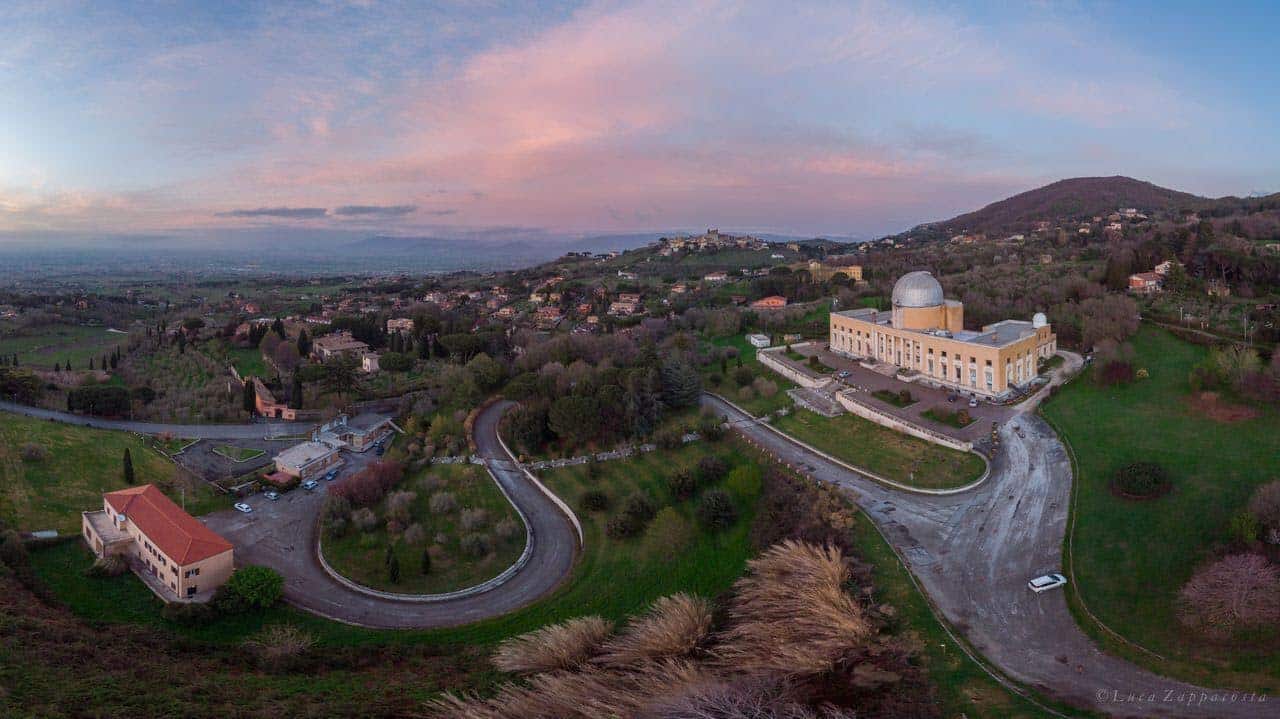
The Museum of the Observatory of Monte Porzio Catone is at Via Frascati 33, 00078 Monte Porzio Catone, in the Rome Province, about 20 kilometers southeast of the capital, on the slopes of the Tusculum. You can visit by reservation only: there is no open entry with continuous hours, and anyone who shows up at the gate without a reservation stays outside. The monthly calendar of openings for individual visitors is published online by the museum services management. Individual guided visits start from the AstroLAB. The full ticket costs 10 euros, reduced rate A 8 euros (young people between 18 and 25, teachers, people under partner agreements), reduced rate B 5 euros (ages 6 to 18 outside school visits). Entry is free for children up to 5 years old, for INAF staff and associates, for accredited journalists, for ICOM members and for people with disabilities together with their companion. Guided visits for groups and classes, up to 20 people, run from 150 to 300 euros per group depending on the itinerary chosen: AstroLAB only, AstroLAB plus the dome of the MPT telescope, or the full route with the Observatory. Reservations are made by email at inaf.oar@sistemamuseo.it and prenotazioni.cultura@orologionetwork.it. Schools and groups who want the visit led by the researchers write instead to dd.oaroma@inaf.it. The Observatory switchboard answers at 06 9428641. By car, take the A1 and exit at the Monte Porzio Catone toll booth. By public transport, go to Anagnina station on metro line A and take a Cotral bus toward Rocca Priora. There is a parking lot inside the compound, and the facilities are accessible to people with disabilities. The institution's official website is that of the INAF Osservatorio Astronomico di Roma.
Anyone who comes up here convinced they will find a provincial museum with four dusty display cases makes a misjudgment that ruins their day, because they arrive with barely an hour to spare and they need three. This is the museum of a living research institute, where the researchers who accompany you into the room have just finished analyzing data that came from Arizona or the Canary Islands, and it is also the place where one of the most grotesque diplomatic episodes of 20th century Italy ended up: an astronomical observatory built to be seen, not to see. If you want to place it in its territory, it's worth reading first the page dedicated to the Castelli Romani Park, the system of volcanic hills into which this white building wedged itself in 1939.

How to get to the Museum of the Observatory of Monte Porzio Catone
Monte Porzio Catone is a town of a little over 8,000 inhabitants at an elevation of 451 meters, bordering Frascati, Grottaferrata, Monte Compatri and the territory of Rome. The Observatory is not in the historic center: it occupies an isolated plateau on the slope that faces the city, in a position you can sense from the road below because of the ancient substructures that surface there, called the Cappellette for centuries. It's a detail worth keeping in mind when you set up the navigator, because the street number on Via Frascati runs along the stretch that connects the two towns and the institute's gate arrives almost by surprise.
By car to the Museum of the Observatory of Monte Porzio Catone
The facility's official direction is blunt: A1 motorway, Monte Porzio Catone exit, then you climb. From south Rome it takes, in normal traffic, a little over half an hour from the Grande Raccordo Anulare. Alternatively you go up along Via Tuscolana to Frascati and from there continue toward Monte Porzio: it's a slower route and much more beautiful, among vineyards, tuff walls and late 16th century villas. Parking is inside the compound and is included in the visit, which in the Castelli Romani is not at all a given: anyone who has tried to park in Frascati on a Sunday in October knows what I'm talking about. A serious warning: the last few 100 meters are uphill with tight curves, and in winter, after a night frost, the road surface can be treacherous. The observing evenings are held in the dark, so the drive back is on unlit roads full of wild boar. Go slowly.
By public transport to the Museum of the Observatory of Monte Porzio Catone
The combination indicated by the museum services management is metro line A to Anagnina, then a Cotral bus toward Rocca Priora. From Anagnina the bus takes about 40 minutes and the useful stop is along Via Frascati. By train you instead reach Frascati on line FL4 departing from Roma Termini, with stops at Tuscolana, Casilina, Capannelle and Ciampino, runs at hourly frequency on the Frascati branch and a one-way ticket of 2.10 euros. From the Frascati station you then need a local bus or a taxi to cover the last uphill kilometers. Watch out for a practical point that confuses quite a few people: the old Monte Porzio Catone station, opened on June 12, 1916, belonged to the San Cesareo-Frascati branch of the Roma-Fiuggi-Alatri-Frosinone railway, a line that no longer exists. If the navigator proposes that station as an arrival point, it sends you to a ruin. It must be added that the Castelli branch of the FL4 regularly suffers summer suspensions for track works, with replacement buses that leave from and arrive at Anagnina instead of Termini: before planning a trip by train it's best to check the status of the line.
On foot and by bike to the Monte Porzio Catone Observatory Museum
There is a minority of visitors who climb on foot from Frascati by the old road. It's about three and a half kilometers with an elevation gain you feel in your legs, and in summer, around two in the afternoon, it's a terrible idea. In spring, instead, it's one of the most beautiful walks of the Colli Albani, with the view opening up progressively onto the plain and the metal dome appearing and disappearing behind the holm oaks. Whoever arrives by bike will find a place to lock it near the AstroLAB, but keep in mind that after an observing evening the night descent toward Frascati, without lighting, is a risk not to be taken.
Tickets, reservations and hours of the Monte Porzio Catone Observatory Museum
The rule that governs everything is just one: reservation required. The Observatory is not a civic museum with an open ticket office and fixed hours, it's a research site of the largest Italian astronomical body that opens its outreach facilities on scheduled days. The monthly calendar of openings for individual visitors is published online by the company that manages public services, and individual visits start from the AstroLAB. Whoever wants to go on a specific day has to write and wait for confirmation, not show up and hope.
Prices of the Monte Porzio Catone Observatory Museum for individual visitors
The full ticket is 10 euros. Reduced A, 8 euros, concerns young people between 18 and 25, teachers and holders of agreements. Reduced B, 5 euros, is valid for the 6 to 18 age bracket outside school visits. Free are children up to 5 years old, INAF staff and members, journalists, ICOM members, people with disabilities and those accompanying them. 10 euros for three hours of visit led by competent staff, with access to a holographic theater and a telescope, is an honest price: in the same city there are temporary exhibitions that ask 18 for 40 minutes of panels.
Groups, schools and educational visits at the Monte Porzio Catone Observatory Museum
For groups and classes, up to 20 people, the rate is per group and not per head, and ranges between 150 and 300 euros depending on the package: AstroLAB alone, AstroLAB with the dome of the MPT telescope, or the full route that includes the Observatory spaces. Visits in a foreign language cost more. The educational route led directly by the INAF researchers, reserved for schools of every level, has instead a declared rate of 200 euros per class, lasts about three hours, provides for a maximum of 25 students per shift and two shifts per morning. Whoever organizes must send, within 20 days of the date, the confirmation form signed by the school principal and fill in the online form for electronic invoicing. To this visit you can add one hour of archaeological route in the area of the Roman villa inside the grounds, with a supplement to be agreed with the archaeological group that takes care of it.
Why at the Monte Porzio Catone Observatory Museum you book and that's it
The reason is technical even before organizational. The rooms of the historical exhibition are carved out inside the main building, where people work: corridors, offices, library. The AstroLAB is an educational lab, not a gallery. The MPT telescope requires someone to open it, point it and explain it. None of this works with a free flow of visitors. The practical consequence for you is that places are few and run out early, especially for the observing evenings, and that writing two days ahead for a new-moon Saturday almost always means staying home. The advice is to move with three or four weeks of margin and to ask explicitly, in the email, whether the opening of the dome is planned on the chosen date.
What you visit at the Monte Porzio Catone Observatory Museum
The grounds are not a single building. The Monte Porzio Catone structures cover about 8,750 square meters of indoor area and roughly 75,000 square meters of outdoor area, and include the Main Building, the guesthouse, two caretakers' apartments, the AstroLAB, the Cupola degli Scozzesi that hosts the LightLAB, and the dome of the Monte Porzio Telescope. The last three are entirely dedicated to science outreach, to which some areas of the Main Building are also assigned: the museum rooms, the conference room named after Gratton and the library. It's useful to have this map in mind before arriving, because the visit winds among different buildings, outdoors, and in winter the wind of Tusculum is unforgiving.
The Main Building of the Monte Porzio Catone Observatory Museum
The large white body that you see from half of Rome has a basement floor, a ground floor, a first and a second floor. It was conceived in the full rationalist style of the monumental architecture of the Fascist 20 years, clad in light travertine precisely so that it would stand out from a distance against the green of Tusculum, with two eagles at the entrance. Anyone with minimal familiarity with Italian public architecture of the 1930s recognizes the language at first glance: axial symmetry, smooth surfaces, clean volumes, no decorative concession that isn't heraldic. Above the central body rises the large metal dome, and this is where the misunderstanding of all visitors begins: that dome never housed a telescope. It houses the library.
The Kircher Room of the Monte Porzio Catone Observatory Museum and the sciatheric tables
Inside the Main Building are kept some of the nineteenth-century instruments of the collection of the Astronomical and Copernican Museum of the Observatory, the heritage that tells the story of the two main Roman observatories of the nineteenth century, that of the Campidoglio and that of the Collegio Romano. The first room is dedicated to Athanasius Kircher, the German Jesuit who arrived at the Collegio Romano in 1635, a man of boundless curiosity and questionable method, who dealt with Egyptian hieroglyphs, Oriental languages, astronomy, physics and magnetism, and who put together the famous Museum of the World, the collection that would take his name.
The piece worth the trip is the sciatheric tables: four slate slabs made by Kircher or on his behalf in 1636, each of about one square meter and with a thickness of about three centimeters, engraved and painted in oil with zodiacal symbols and human figures. They are sundials, but they are much more: they carry astronomical and ecclesiastical calendars, planetary data, medical astrology content. Among these, the Sciatericon totius motus primi mobilis combines the Gregorian calendar with the phases of the moon. The original gnomons, the styles that cast the shadow, are all lost: the holes that marked their position remain. They were placed on the terrace of the Collegio Romano, where Kircher taught astronomy, mathematics and gnomonics, and served as a teaching instrument for the students. They were identified and saved in 1994 by Giuseppe Monaco, then curator of the museum. Look at them up close: the surface is scratched, the pigment is worn, and in those abrasions is the hand of four centuries of students.
The Father Secchi Room of the Monte Porzio Catone Observatory Museum
The second room is dedicated to Angelo Secchi, born in Reggio Emilia on June 28, 1818, admitted in 1833 to the novitiate of the Society of Jesus at Sant'Andrea al Quirinale, called in 1849 to the direction of the observatory of the Collegio Romano and died on February 26, 1878 at 59. In 1852 he obtained the transfer of the observatory to rooms carved out on the crossing of the church of Sant'Ignazio, and there he placed a Merz equatorial telescope with a 25-centimeter aperture. With that instrument, and with an objective prism mounted in front of the lens, he began in 1863 to observe systematically the spectra of the stars.
The result is one of the founding moments of astrophysics. Applying to the stars the method of spectral analysis developed by Gustav Kirchhoff and Robert Bunsen, Secchi published in 1867 a classification in three spectral classes, to which in 1869 he added a fourth. Before him stars were points of light to catalog by position and brightness. After him they became physical bodies whose composition could be known. In the same life he also did other things: between 1854 and 1855 he redid the measurement of the geodetic baseline on Via Appia, in 1859 he built the meteorograph, an automatic station for recording meteorological parameters, and between 1875 and 1877 he gathered his solar studies in the work Le Soleil. The equatorial-mount telescope displayed in this room is his. A firm opinion: the Italian public knows Galileo by heart and almost completely ignores Secchi, who is the father of modern astrophysics and worked a thousand meters from the Pantheon.
The AstroLAB, the interactive laboratory of the Monte Porzio Catone Observatory Museum
The AstroLAB is one of the educational laboratories of the astronomical park. It was created for schools of every level and opens to the general public on scheduled occasions, the so-called park tours. The route is divided into stages, and each stage corresponds to a room of the building: the main themes of contemporary astrophysics are tackled with multimedia devices that make the entire itinerary interactive. The declared goal, and it's the most honest way to formulate an outreach mission, is to make people understand that celestial phenomena are not the fruit of supernatural powers but of physical laws.
On this point it's best to be frank. An interactive lab works or doesn't work depending on who leads it, and here it's led by researchers and doctoral students of the institute, not by entertainers with a script. The level adapts to the audience, and this means that a fifth-grade class and a group of curious adults are told different things. If you go with small children, say so when booking: it changes the visit.
Holostage, the holographic theater of the Monte Porzio Catone Observatory Museum
The AstroLAB route closes with the installation that has made this museum a singularity in the European landscape. Holostage was inaugurated on March 15, 2022 and is the first installation dedicated to science outreach, and in particular astrophysics, that exploits the principle of holography. Its creation is tied to the SUSA project and to the experience of Naumachia, a European network that deals with holographic hardware and software. The SUSA project brings together the University of Rome Tor Vergata, the CNR, ENEA, INAF and INFN, together with Roma Capitale with Municipio VI and the Comune of Frascati, with scientific lead Maria Prezioso, professor of economic geography.
What you see. Interactive holograms, animations of galaxies, supernova simulations, depictions of black holes, in an experience built to be immersive and realistic. Lucio Angelo Antonelli, then director of the Rome Astronomical Observatory, presented it as a further step in bringing the knowledge of modern science to the general public, and above all to the youngest. The verdict: on kids between 10 and 16 the effect is huge, on adults with some notions of astrophysics a bit less, because holography impresses but adds no information. It's worth the minutes it takes anyway, and the objective fact remains that an installation of this kind, dedicated to science, did not exist anywhere before.

The LightLAB and the Cupola degli Scozzesi of the Monte Porzio Catone Observatory Museum
The LightLAB is an interactive laboratory dedicated to light, housed in the smaller building that everyone in the grounds calls the Cupola degli Scozzesi. It's designed for middle schools and high schools, and is led by physics students and graduates. It starts from the simplest phenomena of light and arrives at the laws of optics: for each phenomenon examined the students perform a different experiment, checking with their hands what they have just heard in words. The declared watchword for access to the LightLAB is experiment. The end point of the route is understanding how a telescope works, that is the instrument that allows you to draw physical information from bodies that no one will ever touch.
The name of the dome deserves a line. The institute's internal tradition ties it to the telescope of the University of Edinburgh that was installed there and that remained in operation for a few years, the only truly operational instrument this observatory has ever had on site. It's a detail that says everything about the history of the place: the big dome, the one designed for the monumental telescope, never housed one. The small one, the service one, did.
The MPT telescope of the Monte Porzio Catone Observatory Museum
The Monte Porzio Telescope, abbreviated MPT, is the institute's teaching telescope, in operation for outreach and training activities since 2000. It is an apochromatic refractor with a 199-millimeter diameter and a focal length of 1800 millimeters, mounted on a lifting column capable of guaranteeing an error of less than 10 microns. It's not a research telescope and nobody passes it off as one: it's an excellent instrument for showing the public the planets and the objects of the Messier catalog, and for solar observation, thanks to an H-alpha filter with a three-angstrom bandpass cooled by the Peltier effect.
That filter is the reason it's worth booking a daytime visit too and not just an evening. With the H-alpha the Sun stops being a white disk and becomes a living object: you see the prominences on the edge, the dark filaments on the surface, the granulation of the chromosphere. One thing is certain: the first time you look at the Sun in H-alpha you don't forget it. The students use it during educational visits, the public during the evenings organized by the DivA group, and it is the Observatory's researchers who guide the observations.
The library under the large dome of the Observatory
Here is the most beautiful architectural paradox in Italy. The large metal dome that tops the building, the one you mistake from Rome for the housing of a giant telescope, houses the Observatory library. Not as an improvised fallback, but because the telescope for which that dome had been built never arrived, and because in the meantime it had become evident to anyone that from there, with Rome lit up 20 kilometers away, you couldn't have observed much. The volume that was supposed to contain the optics contains paper. If during the visit you happen to enter, look up: the inner shell is the same one the Zeiss technicians had designed to rotate on a ring of bearings.
The astronomical park of the Monte Porzio Catone Observatory Museum and the archaeological area
The grounds are a real park, with holm oaks, pines and lawns, and under those lawns there is a Roman villa. The site, known as the villa of Matidia Augusta, occupies part of the Observatory area, between Monte Porzio Catone and Frascati, and had been visible for centuries thanks to the tall substructures that from the road below were called the Cappellette. The excavations brought to light rooms in opus reticulatum, two halls, a probable basin, a large rectangular porticoed room of which the column bases remain, and above all the large hypogea under the platform, partly communicating with small service rooms also underground.
The recovered materials tell of a long occupation: black-glaze pottery, sigillata, common ware, amphorae, thin-walled ware, balsamaria, plaster painted with figures of birds, mosaic fragments, architectural terracottas, nails, lead pipes, marble fragments, stamped roof tiles. The analysis indicates several phases of use and reconstruction of the whole complex starting from the early imperial age, probably on top of structures of the Republican era. The excavations were conducted in 1999 under the direction of Dr. Vincenza Iorio, with the participation of volunteer archaeological groups, and continued until 2006. The attribution to Matidia, niece of Trajan and mother-in-law of Hadrian, belongs to the local learned tradition and is not an incontrovertible epigraphic fact: have it told to you on site, and distrust anyone who sells it to you as a certainty. The archaeological visit is added to the astronomical one with about one more hour and a supplement to be agreed with the archaeological group that leads it.
A curiosity about the Monte Porzio Catone Observatory Museum
This observatory exists because Adolf Hitler wanted a statue. Said like that it sounds like a joke, but it is the reconstruction that emerges from the historical sources and from the studies presented at the Observatory itself.
The statue is the Discobolus Lancellotti, the marble replica of Antonine age of Myron's famous bronze, now in the Museo Nazionale Romano and visible at Palazzo Massimo alle Terme. In the ideological climate of the 1930s that body tensed in the instant before the throw had become, for German propaganda, the perfect image of the racial ideal envisioned by the regime. Leni Riefenstahl had used it in the footage of the 1936 Berlin Olympics. Hitler tried to buy it from the Lancellotti family at any price, to make it the symbol of the Games. He was met with a courteous and firm refusal, based on a law of 1909 that forbade the sale of antiquities and fine arts.
In May 1938, during the official visit to Italy, the matter was unblocked with an exchange. The text of the document with which the gift was formalized has a solemnity that makes an impression today: in his capacity as Führer, Hitler begged Benito Mussolini to accept as a gift a Zeiss telescope together with the entire furnishing for an astronomical observatory. Italy would hand over the Discobolus to Germany. Germany would give Rome an ultramodern observatory, visible from the whole city as proof of the alliance between the two regimes. Mussolini accepted, the Discobolus left quickly for Berlin, and on the slopes of Tusculum, on the rise called Monte Ciuffo, work began on a building destined to be looked at more than to look.
The curiosity the reader doesn't find in the first search result is this: the observatory was one of the very few public works carried forward during the war, and in 1942 the area was even protected by a buffer restriction established by royal decree, to prevent nearby constructions from compromising its view. They were protecting the panorama of a telescope that would never arrive.
The history of the Monte Porzio Catone Observatory Museum
1938 and 1939, the project and the first stone of the Observatory
The Rome Astronomical Observatory as a unified institution was born in 1923 from the merger of the two old city observatories, that of the Collegio Romano and that of the Campidoglio. The second was closed on August 13, 1937 and demolished right after. The new seat was inaugurated on October 28, 1938 in the old Villa Mellini, on the promontory of Monte Mario, with Giuseppe Armellini as first director. Almost simultaneously the project of a second observatory at Monte Porzio Catone took shape, conceived to house the promised large refractor. The first stone was laid in 1939, and the chosen site was Monte Ciuffo, on the slopes of Tusculum, for a reason that sounds surreal today: it had to be visible from Rome.
The Zeiss instruments that never arrived
The order, defined on the indications of a commission of Italian astronomers, included three major instruments: a 65-centimeter refractor, equal to 26 inches, a 40-centimeter double astrograph and a 1-meter Schmidt telescope, plus three domes and the auxiliary instrumentation. The following year a request was added for a coronagraph, the instrument just invented by the Frenchman Bernard Lyot that made it possible to study the solar corona without waiting for an eclipse. Zeiss simultaneously started production of the movable metal domes in Jena.
The regime's propaganda announced that the one in Rome would become the largest telescope in Europe and perhaps in the world. It was enough to know how to read a yearbook to know it wasn't true: since 1917 the Mount Wilson reflector had been operating in the United States, with a mirror 2.5 meters in diameter, and a 65-centimeter refractor was, as an optical concept, an already outdated instrument. The telescopes never reached Italy. The research presented by the scholar Natalia Ptitsyna of the Russian Academy of Sciences, in a seminar held at the Rome Observatory on November 24, 2016, indicates that the German government never completed the payment to Zeiss and that the instruments stayed in the factory.
1943, the domes dismantled and shipped back to Jena
In 1943 the building was complete and the domes, manufactured in Jena, had been transferred to Rome and mounted. Then came September 8, the start of the Resistance and the German occupation of the city. A Wehrmacht engineer unit dismantled the largest and most expensive dome, the one intended for the 65-centimeter refractor, and sent it back to Germany. According to the reconstruction presented by Ptitsyna the removal concerned the installed domes, returned to the Zeiss factory after the armistice. Nothing more was heard of the Rome Observatory until the end of the war.
The postwar period, the return of the Discobolus and the 1948 assignment
In 1946 Italy recovered the Discobolus Lancellotti along with many of the artworks taken during the occupation, and the large dome of the Observatory also came back to Italy and was reassembled in its place. The telescopes, instead, were definitively lost. During the occupation of the Soviet Union the Nazis had systematically destroyed the Soviet astronomical observatories they had managed to reach. When the Red Army arrived in Jena, all the instruments present in the Zeiss plant were requisitioned as reparation for war damage and destined to replace those destroyed. In 1948 the Monte Porzio Catone building was assigned to the Rome Astronomical Observatory. In 1965 the observing station of Campo Imperatore was inaugurated, at 2200 meters on the Gran Sasso d'Italia, which since 2017 has passed under the Abruzzo Astronomical Observatory.
1988, the researchers move up to Monte Porzio
Since 1988 the researchers of the Rome Astronomical Observatory have carried out their activity at the Monte Porzio Catone site, which offers an optimal structure from the logistical and organizational point of view. At the Monte Mario site, in Rome, the institution coordinates the outreach activity of the Astronomical and Copernican Museum and of the Solar Tower, while the main building is reserved for the headquarters of INAF, the National Institute for Astrophysics. If you want to complete the picture, you can read the page dedicated to the Monte Mario Observatory: the two sites are two chapters of the same story, and visiting them a few weeks apart is the recommended itinerary for anyone who gets passionate about the story.
One thing nobody tells you about the Monte Porzio Catone Observatory Museum
You can't observe from here. It was never possible, it was never sensible. And this is the fact that no brochure will ever put on the cover.
Anyone with even a minimal knowledge of astronomy understands immediately, looking at the position of the building, that a structure like this cannot be the seat of observational research activity: it is completely dazzled by the lights of Rome. The light pollution of the capital, 20 kilometers away and with no significant natural barrier, wipes from the sky everything that is faint. A 65 centimeter telescope placed up there could have done photometry on bright stars and little else. The size of the dome shows that the installation of an imposing instrument was planned in a position where it would inevitably have been unusable for the fundamental purpose of a structure of this kind: observing the sky.
What follows is the part that makes the story interesting instead of merely ridiculous. Deprived of the telescope, the Rome Observatory took another road and became one of the most scientifically productive institutes in the world, first as the seat of first-rank theoretical studies, then also of observational research conducted with ever larger instruments placed in the darkest places on the planet or directly in space. The astronomers who work inside that white building collect their data from the Large Binocular Telescope on Mount Graham in Arizona, from the Galileo National Telescope in the Canary Islands, from the Campo Imperatore station and from many other ground-based and space telescopes. The most visible Italian seat of national astronomical research is, literally, blind. And it works very well.
There is a second thing nobody will tell you, and it concerns the way the visit should be used. At the public evenings the telescope they will show you is the MPT, a 199 millimeter refractor: good for the Moon, for Jupiter, for Saturn, for the brightest clusters. If you arrive expecting the deep-exposure nebula you have seen in the newspapers, you will be disappointed. If you arrive knowing that you are looking into an optical tube from the same hill where a dictator wanted the biggest telescope in the world, the evening changes sign completely.
The unsolved mysteries of the Museum of the Observatory of Monte Porzio Catone
The story, so far, is documented. There remain, however, at least four questions to which nobody has yet given a definitive answer, and they are the part that makes this hill interesting to a historian of science and not only to a sky enthusiast.
Why the astronomers accepted an impossible site
If it was reasons of propaganda that pushed the regime to build the observatory where it could never have worked, it remains to be understood why the Italian astronomers did not object. The explanation was given by Professor Bianchi, then director of the Rome Observatory, to Livio Gratton, first his collaborator and then one of the architects of the rebirth of Italian astronomy. Gratton reports it in his memoirs published in the magazine Coelum: Bianchi's plan was to go along with Mussolini and Hitler so that the telescopes would arrive in Italy anyway and then, after a few years, to move them to a more suitable site, far from the lights of the capital. Most likely the site he had in mind was Campo Imperatore, on the Gran Sasso, where after the war the first observing station of the Rome Observatory was in fact built. A lucid and cynical calculation, which could even have succeeded.
A few words on Gratton, because the Observatory's conference hall bears his name and it's worth knowing who he was. Born in Trieste on July 30, 1910 and died in Rome on January 15, 1991, he graduated in physics in Rome in 1930 having studied with Enrico Fermi and Tullio Levi-Civita. He was an assistant at the Merate Observatory from 1934 to 1939, worked at the Yerkes Observatory in Wisconsin between 1947 and 1948, then at the La Plata Observatory in Argentina from 1948 to 1957 and as director of the Córdoba Observatory from 1957 to 1960. Back in Italy, he taught astrophysics in Bologna and from 1962 to 1980 in Rome. He founded and directed the Laboratory, later Institute, of Space Astrophysics of the National Research Council in Frascati, which became the most active astrophysics center in the country. He was vice president of the International Astronomical Union between 1967 and 1973 and president of the Italian Astronomical Society between 1975 and 1979. He introduced relativistic cosmology and X-ray astronomy to Italy and signed more than 150 papers. His name today is also tied to an educational astronomical park in the Castelli Romani.
Why a refractor and not a reflector
Second question, technical and unanswered. Why did the Italian astronomers ask Germany for a 65-centimeter refractor, that is a lens instrument conceptually outdated, when for the same cost they could have asked for a much larger reflector, of the kind that in the United States, France and the Soviet Union was already producing fundamental results? A refractor suffers from chromatic aberration, weighs enormously, has a bulky focal length and is not scalable beyond certain diameters: in 1938 everyone knew this. No one, to this day, has explained that choice convincingly. The hypotheses in circulation, all to be verified, range from the symbolic prestige of the great nineteenth-century refractor to the immediate availability of that product in the Zeiss catalog.
Why the Germans wasted resources dismantling a dome
Third question. In 1943, in a phase of the war in Italy that left very few resources, why did an engineer unit spend time, vehicles and transport to dismantle and send back to Germany a metal dome completely useless for the war effort? The most credited explanation is the same one that accounts for the destruction of cultural heritage in the occupied countries: according to the aberrant logic of Nazism only the Germans, and to a lesser extent their allies, were truly men. The others were subhuman and as such had no right to access science and culture. The Italians, after September 8, had moved from the first category to the second. It's not a technical explanation. It's an ideological one, and it remains the best we have.
Why an observatory in exchange for the Discobolus
Fourth question, the most elusive. Astronomy was not a particularly developed science in interwar Italy nor particularly dear to the regime, which was far more interested in chemistry and the war industry. Why then ask for an observatory and not an industrial plant? And if the proposal came from Hitler, why did Mussolini accept?
Gratton reports that, when he put the question to Bianchi, he was told that Hitler, during his first visit to Italy in 1934, on an outing to Castel Gandolfo with Mussolini, had been intrigued by the dome of the Vatican Observatory above the papal palace and had asked to visit it, being refused on the grounds that it was not Italian territory. Hence the promise to donate to Italy an observatory that would make the papal one look bad. The explanation, however, doesn't hold up: there is no record that during the 1934 visit Hitler ever went to Castel Gandolfo. In a seminar held at the Rome Observatory the hypothesis was advanced that the suggestion came from Zeiss itself, interested in obtaining a substantial order. Given the ties of German industry with the regime it is possible, but it would remain to explain how Zeiss could know in advance of the intention to exchange an Italian work of art for a German scientific facility, and through what channel it had contacted the top of the Reich. The last mystery of Monte Porzio, for now, remains open.
My advice for visiting the Monte Porzio Catone Observatory Museum
Book an observing evening, not a daytime visit, and book it at least three weeks ahead, choosing a date near the new moon or first quarter. This is the main advice and I'll justify it point by point.
First: the museum part, that is the historic rooms with Kircher's sciatheric tables and Secchi's telescope, is included in the full routes and is what gives the place its historical sense, but by itself it is short. It's the combination of the rooms, the AstroLAB, the Holostage and the telescope dome that justifies the trip.
Second: the full moon is the enemy of observation. A sky with the Moon high and full wipes out contrast and leaves you with the planets and little else. The first quarter, instead, is the perfect compromise, because the Moon sets in mid-evening and before setting gives you the terminator, the line between light and shadow where the craters have long shadows and look chiseled out. If you have to bring someone who has never looked into a telescope, bring them at first quarter and show them the Moon first: it's the only object that never disappoints anyone.
Third, and it concerns clothing. We're at 451 meters on an exposed plateau, in a facility where you pass from one building to another outdoors and where the telescope dome, out of technical necessity, is as cold as the outside air. In April, at 11 at night, it's often eight degrees colder up here than in Piazza Venezia. Bring a real jacket, not a sweater, and closed shoes: the lawns are sloped and slippery with the evening damp.
Fourth: if you have kids between six and 12, ask when booking for a visit that includes the AstroLAB and H-alpha solar observation, and keep in mind that an evening that ends at midnight, for a six-year-old, is the wrong evening. Observing the Sun through the telescope is the same thrill, in the afternoon, without the 11 o'clock psychological collapse.
Fifth: don't add anything else to the day's program. Whoever arrives here at 15:00 after doing Villa Aldobrandini in the morning and counts on coming down to dinner in Frascati at 20:00 enjoys nothing. This is a full half day, and if it's an evening it's a full evening.
The science done today at the Monte Porzio Catone Observatory Museum
It's worth understanding what happens inside the rooms you don't enter, because it's what makes the visit different from a traditional museum. The scientific activity of the site covers all the thematic macro areas of INAF: cosmology and extragalactic astrophysics, relativistic and particle astrophysics, solar physics, star formation, stars and stellar populations, the Sun and the solar system, advanced technologies and instrumentation.
How the research areas have changed
The internal composition has changed a lot in 40 years, and it is a faithful indicator of how world astrophysics has changed. In the 1980s and 1990s the area involving the most researchers, and the most productive, was stellar astrophysics, with a significant presence of scholars active in extragalactic astrophysics and solar astrophysics. From the mid-1990s groups of relativistic astrophysics and solar system astrophysics were added. Today the macro area that absorbs the majority of researchers is extragalactic astrophysics and cosmology. In practice: we've gone from the study of individual stars to the study of the universe as a whole, and this building has followed the current.
From Tusculum to Arizona: the Large Binocular Telescope
The Large Binocular Telescope stands on Mount Graham, in the Pinaleno Mountains of southeastern Arizona, at 3,221 meters, and mounts two 8.4-meter mirrors on the same mount. Ownership is divided among the partners: Arizona with 25 percent, Germany with 25 percent, Italy through INAF with 25 percent, and the remaining 25 percent split among the Research Corporation for Science Advancement, Ohio State University and other US universities. The telescope was dedicated in October 2004, saw first light with a single primary mirror on October 12, 2005, received the second mirror in January 2006 and observed with both mirrors together between January 11 and 12, 2008. A quarter of that instrument is Italian, and part of the Italian time is used by researchers who work on this hill.
The Telescopio Nazionale Galileo and Campo Imperatore
The second observing channel is the Telescopio Nazionale Galileo, the Italian infrastructure in the Canary Islands. The third is the Campo Imperatore station, at 2200 meters on the Gran Sasso, where a Schmidt telescope with a 60-centimeter aperture and the AZT24 infrared telescope with a 1.1-meter mirror operate. The latter arrived from Russia in the 1990s thanks to a negotiation conducted by Roberto Buonanno, then director of the Rome Observatory, and by Vittorio Castellani, director of the Teramo Observatory. The infrared camera mounted on it works cooled to temperatures on the order of 200 degrees below zero. The station, managed for decades by the Roman observatory, since 2017 has come under the Abruzzo Astronomical Observatory. There is a symmetry that amuses me a lot: a Russian telescope going up the Gran Sasso half a century after the telescopes destined for this hill ended up in the Soviet Union.
Who runs the institute today
The direction of the Rome Astronomical Observatory is entrusted to Ilaria Ermolli, appointed by decree of the president of INAF of February 15, 2021. She is a solar physicist, and that has something appropriate about it for a site that owns an H-alpha filter and no nighttime research telescope.
Another well-known fact, yet rarely cited
The telescopes that never arrived at Monte Porzio Catone still exist, they work, and in Russia they are still called Mussolini's telescopes today.
The large 65-centimeter refractor ended up at Pulkovo, the famous observatory at the gates of Saint Petersburg, and is still used today for studies of asteroids and comets. It's not a relic in a display case: it's an instrument in service, with more than 80 years on its shoulders, that continues to produce position measurements. The one-meter Schmidt went to Byurakan, in Armenia, and there the story becomes scientifically important: with that instrument the astronomer Benjamin Markarian conducted his famous survey of galaxies with ultraviolet excess, the catalog that bears his name and that has become one of the classic references for the study of active galactic nuclei. The other instruments of the order were distributed among minor Soviet observatories.
Take a minute to measure the irony. The Rome Observatory, today, has extragalactic astrophysics as its dominant research area. And the telescope that had been promised to it and that it never received served, in another country, to compile one of the founding surveys of the study of active galaxies. The Markarian galaxies are in the bibliography of anyone working on those topics, including the researchers who climb this hill every morning.
The fact is well known among specialists and is cited very little in Italian outreach, where the story usually stops at the joke about the observatory that can't see the stars. The interesting part comes after the joke.

The right photo to take at the Monte Porzio Catone Observatory Museum
The photograph everyone takes is the metal dome framed from below, up close, with the sky behind. It's a photo that says nothing, because the isolated dome could be that of any observatory in the world. The right photo, instead, is the one that tells the paradox of the place: the white building in the foreground and Rome in the background.
You build it like this. Find a spot in the park facing northwest, where the plateau opens onto the plain. Put the main building with its dome on the left or right of the frame, never in the center. And let the horizon with the city take up the lower third of the shot. The perfect moment is the blue hour, the 20 or 25 minutes after sunset, when the sky is still deep blue and the lights of Rome have just come on. In that single shot you have the light travertine that the regime wanted to show to the capital, the dome that never contained a telescope, and the precise reason it could not contain one: the urban glow rising from the plain. No caption is needed to explain this image.
Technical notes, for those who want them. A lens around 35 millimeters equivalent holds building and panorama together without distorting the dome. The tripod is needed, because at the blue hour you drop below a thirtieth of a second. And it's better to expose for the city lights and recover the building's shadows in post-processing, not the other way around, because a blown-out white travertine can't be recovered. If instead you're there during the day, the second photo I recommend is a close-up detail of Kircher's sciatheric tables, where you can see together the engraved hour lines, the painted zodiacal symbols and the empty holes of the lost gnomons: an image worth a chapter of the history of science. Personal photographs without flash and without a bulky tripod are normally allowed during the visits, but the rule is given by the guide at the entrance of the room, and in the telescope dome, in the evening, the white lights of screens are the most unpopular thing you can switch on.
Some important events that happened here in history
This hill has not hosted battles, but it has hosted a sequence of episodes worth a book.
May 1938, the gift. During Hitler's official visit to Italy the exchange is formalized: the Discobolus Lancellotti to Germany, a Zeiss telescope and the entire furnishing of an astronomical observatory to Italy. It is the birth certificate of the building.
1939, the first stone. On Monte Ciuffo, on the slopes of Tusculum, the construction site begins. The construction continues despite the outbreak of the Second World War and turns out to be one of the few public works carried forward during the conflict.
1942, the restriction. A royal decree establishes a buffer restriction on the area to protect the observatory's horizon from nearby constructions.
1943, the arrival of the domes and their departure. The building is completed and the domes, manufactured in Jena, are transferred to Rome and mounted. After September 8 a Wehrmacht engineer unit dismantles the largest dome and sends it back to Germany.
1946, the return. Italy recovers the Discobolus together with the artworks taken during the occupation, and the large dome returns to Monte Porzio and is reassembled. The telescopes, requisitioned by the Red Army at the Zeiss plant in Jena as reparation for war damage, take the road to the Soviet Union.
1948, the assignment. The Monte Porzio Catone building is assigned to the Rome Astronomical Observatory, which from that moment has two sites.
1988, the move of the research. The Observatory's researchers begin working permanently up here. The site becomes the operational center of the institute, and Monte Mario specializes in historical outreach and administration.
1994, the rescue of Kircher's tables. Giuseppe Monaco, curator of the museum, identifies and preserves the four sciatheric tables of 1636, which had been made for the terrace of the Collegio Romano.
1999 and following years, the excavations. The archaeological investigations in the area of the Roman villa inside the grounds, directed by Dr. Vincenza Iorio with the collaboration of volunteer archaeological groups, bring to light the hypogea, the rooms in opus reticulatum and the materials that document several building phases from the early imperial age. The campaigns continue until 2006.
2000, the teaching telescope. The Monte Porzio Telescope enters service, dedicated to outreach and training activities. It is the instrument that the public still uses today in the evenings.
March 15, 2022, the inauguration of Holostage. In the AstroLAB museum the first holographic installation in the world dedicated to science outreach is inaugurated, born from the SUSA project and from the experience of the Naumachia network.
The evenings under the stars and the Researchers' Night. For years the institute has opened its spaces free of charge on the occasion of summer outreach evenings and of the European Researchers' Night: you visit the main building and the AstroLAB, workshops for children are held at the Cupola degli Scozzesi, the public is accompanied into the archaeological area with volunteer guides, and at the close you observe through the telescope, weather permitting. In the 2026 summer edition, on July 24, the program provided for the gates to open at 18:30, free visit of the spaces until 21:00, a lecture-show at 21:00 and observation at the telescope from 22:30 to midnight, with free admission and mandatory registration by the day before. Whoever wants to get in without paying the ticket should keep an eye on these occasions: they are the evenings when you see almost the whole grounds.
Who passed through the Monte Porzio Catone Observatory Museum
The chapter on people, here, has to be built honestly. There is no document attesting to the physical presence of Hitler or Mussolini on this plateau, and writing it would only be putting on a show. The names that really passed through this institution are others, and they are more interesting.
Athanasius Kircher (around 1602 - 1680) never set foot in Monte Porzio, but his four slate tables of 1636 did, and with them a piece of the Collegio Romano where the Jesuit taught astronomy, mathematics and gnomonics from 1635. His Museum of the World, the encyclopedic collection that mixed finds, machines and curiosities, is the direct ancestor of the collection of which these slabs are part. If you are looking for the moment when Roman science passes from the Wunderkammer to the scientific museum, those four tables are an excellent observation point.
Angelo Secchi (Reggio Emilia, June 28, 1818 - Rome, February 26, 1878) is the other great absent presence. The equatorial telescope displayed in the room dedicated to him is the instrument with which astrophysics began to exist: it was he, from 1863, who systematically applied the objective prism to the stars and published in 1867 the classification in three spectral classes, extended to four in 1869. A Jesuit, director of the Collegio Romano observatory from 1849, he moved the observatory in 1852 to the crossing of the church of Sant'Ignazio. His collections have merged into the heritage of the Rome Astronomical Observatory and part is kept up here.
Giuseppe Armellini was the first director of the Rome Astronomical Observatory in the site inaugurated on October 28, 1938 at Villa Mellini, that is the institution that at Monte Porzio Catone would find its second home 10 years later.
Livio Gratton (Trieste, July 30, 1910 - Rome, January 15, 1991) is the witness who left us the account of the negotiation, gathered from director Bianchi and published in his memoirs. A student of Fermi and Levi-Civita, director of the Córdoba Observatory, founder of the CNR Institute of Space Astrophysics in Frascati, vice president of the International Astronomical Union, he is the figure who holds together the story of 1938 and the Italian astrophysics of the postwar period. The Observatory's conference room bears his name.
Roberto Buonanno, director of the Rome Observatory, and Vittorio Castellani, director of the Teramo Observatory, are the two astronomers who in the early 2000s negotiated with Russia the transfer to Italy of the AZT24 infrared telescope later installed at Campo Imperatore.
Natalia Ptitsyna, of the Russian Academy of Sciences, gave on November 24, 2016 at the Rome Observatory the seminar on the birth and fate of the Mussolini telescopes, which reconstructed with Russian documentation the part of the story that had remained obscure in Italy for 70 years.
Lucio Angelo Antonelli, director of the Observatory at the time of the inauguration of Holostage in March 2022, and Ilaria Ermolli, who runs the institute today, are the two names of the contemporary phase. And then there are the hundreds of researchers, doctoral students, technicians and students who cross these corridors every year: which is, in the end, the only list of passages that really counts in a research institute.
The Monte Porzio Catone Observatory Museum with kids
It works, but you have to choose the right format. The AstroLAB is built on a route in stages with interactive multimedia devices, and for a child between eight and 13 it's the kind of museum that is remembered, because you don't just look: you touch, you try, you get it wrong. The Holostage, with its galaxies and supernovae suspended in the air, is the part kids tell about at school the next day.
The right age for the Monte Porzio Catone Observatory Museum
Under six, admission is free, but the full visit, three hours among different buildings and abstract concepts, is beyond the attention threshold. From six to 10 I recommend the daytime formula with H-alpha solar observation: you see something spectacular in a few minutes, without the 11 o'clock collapse. From 11 up the observing evening becomes the best choice, and if the boy or girl has real scientific curiosity, the part about the Zeiss telescopes and the war hooks them better than any lab.
What to bring
Water, a warm jacket even in May, closed shoes, and no photographic expectations: the images you see at the eyepiece can't be reproduced with a phone, and insisting ruins the evening for everyone. On free-opening occasions, such as the summer evenings and the European Researchers' Night, workshops for the youngest are often provided at the Cupola degli Scozzesi.
Accessibility and services at the Monte Porzio Catone Observatory Museum
The facility declares services accessible to people with disabilities and restrooms available, and the parking is inside the grounds. Admission is free for the person with a disability and for their companion. It has to be said frankly that the grounds are a sloped park with several buildings and outdoor routes, and that access to the telescope dome generally involves a staircase: anyone with specific needs would do well to state them in the booking email, because the route can be adapted only if it is known in advance. There is no coat check service: you go in with what you have on, so light backpacks.
When to go to the Monte Porzio Catone Observatory Museum
The best season for an evening is from April to mid-June and then from mid-September to the end of October. In July and August the sky of the Castelli suffers from haze and humidity and the nights get shorter. In winter the sky is often the most transparent of the year, but up here, at nine in the evening in January, you really suffer from the cold, and evenings get canceled more easily because of cloud cover. For daytime visits any time of year is fine, with a preference for clear mornings right after a weather front, when the air is clean and the Sun in H-alpha is at its best.
Moon phases and weather
I repeat the criterion because it is what decides the quality of your evening: new moon for the deep sky, first quarter for the best compromise, full moon to be avoided. The weather should be checked the same day: observations are held weather permitting, and an evening canceled because of clouds is a real possibility, not a rare mishap. Ask when booking what the policy is in case of overcast sky, because the indoor program is still guaranteed in most cases.
Free occasions at the Monte Porzio Catone Observatory Museum
Twice a year, with good regularity, the institute opens its doors without a ticket: the summer evening under the stars and the European Researchers' Night at the end of September. These are the occasions when you see almost the whole grounds, archaeological area included, but they are also the most crowded, with mandatory registration and places that sell out in a few hours. Without diplomacy: if you want to understand the place, book a paid visit on a normal day. If you want the party, go to the free evening and count on the line at the telescope.
What to see around the Monte Porzio Catone Observatory Museum
The grounds straddle two towns and within a few kilometers there is one of the densest concentrations of villas, abbeys and craters in Italy. Here is how I usually organize the day.
The town of Monte Porzio Catone
The historic center of Monte Porzio Catone is small, uphill, with a panoramic square looking toward the plain and the church of San Gregorio Magno built in 1666 to a design by Carlo Rainaldi, one of the protagonists of the Roman Baroque. Also within the municipal territory are the Tusculan hermitage founded in 1607 and Villa Mondragone, the great sixteenth-century cardinal's residence. The hamlets bear names that tell the landscape: Camaldoli, Fontana Candida, Monte Ciuffo, Selve di Mondragone, Villa Vecchia.
Frascati and Grottaferrata
Frascati is a few minutes away and offers the classic sequence of the Tusculan villas, the Duomo and the cellars. Grottaferrata keeps the Greek Abbey of San Nilo, founded in 1004, one of the very few monasteries of the Byzantine rite still active in Italy. If I had to choose a pairing for a full day, I'd take the Observatory in the morning and the abbey in the afternoon: one is twentieth-century science, the other is the Greek Middle Ages 20 kilometers from the Colosseum, and the contrast is formative.
The other Castelli
Toward the interior is Monte Compatri, which borders Monte Porzio. On the other side of the Alban volcano you reach Rocca di Papa, where the Geophysical Museum is, the natural choice for those who enjoyed the scientific part of the day, and then Marino, Lake Albano and Nemi. The whole system of hills is described on the page of the Castelli Romani Park, and whoever wants to close the circle on Roman astronomy has the institute's other site, the Monte Mario Observatory, with the Solar Tower and the Astronomical and Copernican Museum.
Quick questions about the Monte Porzio Catone Observatory Museum
How much does a ticket to the Monte Porzio Catone Observatory Museum cost?
The full ticket costs 10 euros. Reduced A is 8 euros for young people between 18 and 25, teachers and those with agreements. Reduced B is 5 euros from 6 to 18 years outside school visits. Admission is free up to 5 years old, for INAF staff and members, for journalists, for ICOM members and for people with disabilities with their companion.
Do you need to book to visit the Monte Porzio Catone Observatory Museum?
Yes, reservation is mandatory and there are no exceptions. Individual guided visits follow a monthly calendar published online and start from the AstroLAB. You book by writing to inaf.oar@sistemamuseo.it or to prenotazioni.cultura@orologionetwork.it.
What is the exact address of the Monte Porzio Catone Observatory Museum?
Via Frascati 33, 00078 Monte Porzio Catone, province of Rome. The entrance to the grounds is on that road, in the stretch that connects Monte Porzio Catone to Frascati.
How long does the visit to the Monte Porzio Catone Observatory Museum last?
The full visit lasts about three hours. The educational route for schools has the same duration, to which you can add an hour for the archaeological part in the area of the Roman villa. The observing evenings go on until late at night.
Can you really observe the sky from the Monte Porzio Catone Observatory Museum?
Yes, with the MPT teaching telescope, a 199-millimeter apochromatic refractor, suited to the planets, the Moon and the objects of the Messier catalog. It is not scientific research observation: the lights of Rome make the site unsuited for that purpose, and the research data come from telescopes located elsewhere.
Can you observe the Sun?
Yes. The MPT is equipped with an H-alpha filter with a three-angstrom bandpass cooled by the Peltier effect, which allows good-quality solar observations: prominences, filaments, details of the chromosphere.
What is the AstroLAB?
It is the park's interactive astronomy laboratory. The route is divided into stages, one for each room of the building, and tackles the main themes of astrophysics with multimedia devices. It is designed for schools of every level and opens to the general public on scheduled days.
What is the Holostage?
It is the holographic theater inaugurated on March 15, 2022 inside the AstroLAB, the first installation in the world that applies the principle of holography to science and astrophysics outreach. It was born from the SUSA project and from the experience of the European Naumachia network.
Is there a planetarium at the Monte Porzio Catone Observatory Museum?
The site does not offer a traditional dome planetarium with a star projector. The immersive experience is entrusted to the Holostage, which works with holograms and animations, and to direct observation at the telescope.
Is the Monte Porzio Catone Observatory Museum open to the public?
Yes, but only by reservation and on scheduled dates. There are no continuous opening hours as in a civic museum.
How do you get there by public transport?
Metro line A to Anagnina, then a Cotral bus toward Rocca Priora with a stop along Via Frascati. Alternatively, the FL4 train from Roma Termini to Frascati and the last stretch by local bus or taxi.
Can you get to Monte Porzio Catone by train?
No. The station that bore that name, opened on June 12, 1916, belonged to the San Cesareo-Frascati branch of the Roma-Fiuggi-Alatri-Frosinone railway, which is no longer in service. The useful station today is Frascati, on the FL4 line.
Is there parking at the Monte Porzio Catone Observatory Museum?
Yes, the parking is inside the grounds and is available to visitors.
Is it accessible to people with disabilities?
The facility declares accessible services and restrooms available, and admission is free for the person with a disability and for the companion. Since it is a sloped park with several buildings, it's best to flag your needs already in the booking email.
Can you take photographs at the Monte Porzio Catone Observatory Museum?
Personal photographs without flash are normally allowed, but the operating rule is given by the guide before entering the room. During the evening observations, bright screens and flashes must be turned off: they ruin the dark adaptation of the whole group.
Is it suitable for kids?
Very much, from eight years up. Under six, admission is free but the length of the visit is demanding. For the youngest I recommend the daytime formula with observation of the Sun through the telescope.
How much does a visit for a school cost?
The educational route led by the INAF researchers costs 200 euros per class, lasts about three hours, provides for a maximum of 25 students and two shifts per morning. Guided visits for groups and classes managed by the museum services run from 150 to 300 euros per group up to 20 people, depending on the package chosen.
What's the difference between Monte Porzio Catone and the Monte Mario Observatory?
They are two sites of the same body. At Monte Porzio Catone is the center of the research, with the AstroLAB, the LightLAB, the teaching telescope and the historic rooms. At Monte Mario, inside Villa Mellini, are the Solar Tower, 34 meters tall, and the Astronomical and Copernican Museum, while the main building hosts the INAF headquarters.
What do you see in the museum rooms of the Monte Porzio Catone Observatory Museum?
Some of the nineteenth-century instruments of the collection of the Astronomical and Copernican Museum, distributed in a room dedicated to Athanasius Kircher, with the four slate sciatheric tables of 1636, and in a room dedicated to Angelo Secchi, with his equatorial-mount telescope and the objective prism with which the spectral classification of stars was born.
Is there really a Roman villa inside the grounds?
Yes. It is the complex known as the villa of Matidia Augusta, with rooms in opus reticulatum, a large porticoed room and imposing hypogea under the platform. The excavations, started in 1999 and continued until 2006, documented several building phases starting from the early imperial age. The archaeological visit is added to the astronomical one with a supplement to be agreed.
Why was the observatory built in a place where you can't see the stars?
Because it had to be seen from Rome. The site was chosen for propaganda reasons: the white building on Tusculum was supposed to testify to the whole city the alliance between the two regimes. The astronomers accepted, counting on moving the instruments later to a suitable site, probably on the Gran Sasso.
What happened to the promised telescopes?
They never arrived in Italy. Requisitioned by the Red Army at the Zeiss plant in Jena as reparation for war damage, they were distributed among Soviet observatories: the 65-centimeter refractor to Pulkovo, where it is still used for the study of asteroids and comets, the one-meter Schmidt to Byurakan, where it served Benjamin Markarian for his survey of active galaxies.
What is inside the large dome?
The Observatory library. The dome had been built for the 65-centimeter refractor that never arrived, and today it houses books and scientific journals.
Are there free admission days at the Monte Porzio Catone Observatory Museum?
Yes, on the occasion of the summer outreach evenings and the European Researchers' Night at the end of September, with mandatory registration and limited places. On those occasions you visit the main building, the AstroLAB and the archaeological area, and you observe through the telescope if the sky allows.
How big are the grounds?
The Monte Porzio Catone structures cover about 8,750 square meters of indoor area and about 75,000 square meters of outdoor area, and include the Main Building, the guesthouse, the caretakers' apartments, the AstroLAB, the Cupola degli Scozzesi with the LightLAB and the dome of the MPT telescope.
Can you visit the library?
The library is a research service facility and is not part of the ordinary museum route. On some special openings the spaces of the main building are accessible to the public: it's best to ask explicitly when booking.
How far in advance should you book?
Three or four weeks for an observing evening, less for a weekday daytime visit. The evenings near the new moon and the free openings sell out well in advance.
Among Italian science museums this remains, in our judgment, the most instructive, for a reason that has to do with astronomy only sideways: it is the only place where you feel firsthand what happens when politics decides where science should be put. A perfect building, in a position perfect for being admired and terrible for working, built in exchange for a statue, emptied by a war, and then become anyway one of the most productive sites of European astrophysics thanks to people who stopped looking at the sky from the window and started looking at it from Arizona. Come up here on an April evening, look at Saturn through the eyepiece, then turn toward the orange glow of the capital. You'll understand everything without anyone having to explain it to you.
Article written by the editorial team of TourLeaderPro, contact them for Private/Corporate/V.I.P. Tours and Experiences.
Planning a trip to Rome? The English guides to visiting the city are on ItalyPlanner.com.