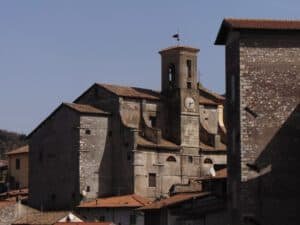
Monte Compatri (RM)
In short. Monte Compatri (RM) is a municipality of about 11,800 inhabitants on the eastern side of the Vulcano Laziale, 576 meters above sea level: the third highest of the Castelli Romani.

Monte Compatri (RM) is a municipality of about 11,800 inhabitants on the eastern side of the Vulcano Laziale, 576 meters above sea level: the third highest of the Castelli Romani. The town hall occupies Palazzo Borghese, in the historic center. The municipal territory also includes the hamlets of Pantano Borghese, Laghetto, Molara, Osa and Valle Martella. From Rome the most direct public transport is metro Line C, whose eastern terminus, Monte Compatri-Pantano, falls right inside the municipal territory. Be careful, though: the station serves the hamlet of Pantano, not the village, which is about six kilometers farther up and has to be reached by car, by taxi or with the intercity bus service. By car you leave the Grande Raccordo Anulare toward Via Casilina (SS6) or toward Via Tuscolana (SS215) and climb the provincial roads of the Castelli. The village can be visited freely and for free: there is no entrance ticket, no reservation, the churches follow the times of the services, and Convento di San Silvestro opens according to the availability of the religious community. Before climbing up for a visit at a fixed time, a phone call to the town hall or the parish is a good idea, because the hours change with the seasons.
Monte Compatri lies entirely within the Castelli Romani Regional Park, established by Lazio regional law 2 of 1984 over about 15,000 hectares and 18 municipalities. This is the key to understanding the town: a ridge village looking out over the Roman countryside, with the woods behind it and the vineyards under its walls. Whoever arrives thinking of a monumental center is left thrown off. Whoever arrives to walk, eat and look at Rome from far away leaves happy.

Where Monte Compatri Is and How to Get There from Rome
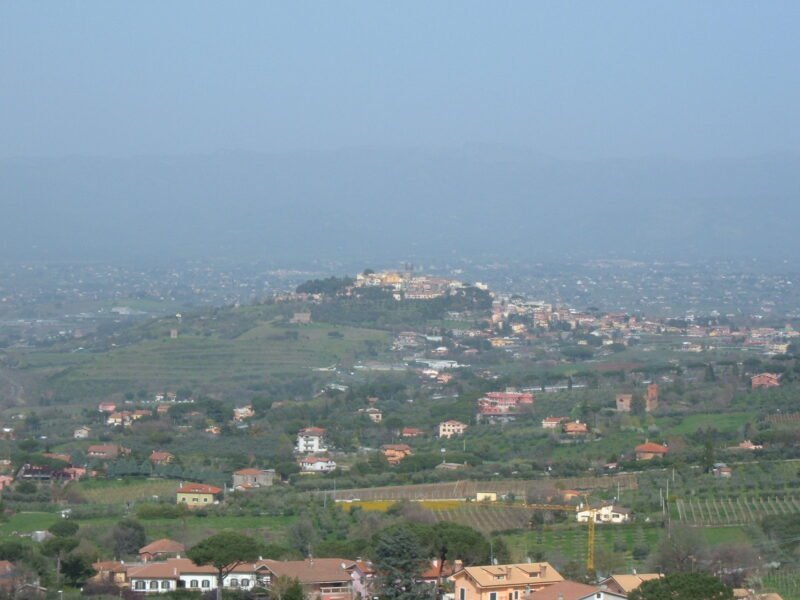
Geography matters more than it seems. Monte Compatri sits on a tuff hill facing north toward the Roman countryside and the valley of the Aniene, and south toward the great basin of the Latial crater. From the viewpoint, with the clean air of January, you can make out the outline of Rome, and on exceptional days the line of the sea. The distance from the center of the capital is about 25 kilometers, but the travel time depends entirely on the hour: at peak times Via Casilina clogs up and half an hour becomes an hour and a quarter.
By Metro: The Monte Compatri-Pantano Terminus
Rome's metro Line C ends at a station that carries the name of the town, Monte Compatri-Pantano, and it is the only Rome metro station built outside the municipal boundaries of Rome. The stretch between Pantano and Centocelle entered service on November 9, 2014, after the handover to ATAC for pre-service operation in December 2013. Today the line has 22 stations in operation. The surface route of this eastern part reuses the bed of the old narrow-gauge railway Roma Laziali-Pantano, the line that Romans simply called il trenino, and whose stretch between Pantano and Giardinetti was closed in July 2008 precisely to make room for the metro construction site.
That said, it has to be said all the way: getting off at the terminus does not mean you have arrived at Monte Compatri. The station serves the flat area of Pantano Borghese, and between that forecourt and the village square there are six kilometers of uphill road and more than 300 meters of elevation gain. Anyone without a car has to find out in advance about the runs of the regional intercity bus lines that connect the Castelli area, or else budget for a taxi. The practical advice, for those coming from outside Rome without a car, is to consider the terminus a base point, not a front door.
By Car to Monte Compatri: The Two Climbs
From the Grande Raccordo Anulare there are two reasonable routes. The first goes through Via Casilina in the direction of Frascati-Colonna and climbs to the town from the northeast. The second takes Via Tuscolana, touches Frascati and continues along the ridge toward Monte Porzio Catone, arriving at Monte Compatri from the west. The second is longer and infinitely more beautiful, with the vineyards on the right and the woods on the left. If you have time, take it.
Parking in the historic center is the real problem. The streets of the village are narrow, uphill, and in large part one-way. On weekends and during the August festivals, looking for a spot can take 20 minutes. The best solution: leave the car in the parking lots along the lower ring road and climb on foot. It is five or six minutes of stairways and lanes, and the village is better seen that way.
By Train and Bus
The municipal territory has no station on the regional railway lines that carries the name of the town in a position useful to the village. The historic railway stops present in the municipality, like Laghetto, belong to the surface system of the old line to Pantano and serve the lower part of the territory. For connections between the village and neighboring towns, and between the village and the railway stations of the area, the reference is the regional intercity bus lines. The schedules have to be checked on the carrier's website before leaving, because on holidays the runs thin out quite a lot.
Monte Compatri in Half a Day: What to Really Expect
A premise, because it is the most frequent question. Monte Compatri is not a museum spread across the town and has no cover-photo monument. It has something different and rarer: a medieval fabric that has survived almost intact, with the gate of the walls, the tower, the stepped lanes, the cellars dug into the tuff under the houses and a panorama that covers half of Lazio. You come for walking, for the wine and for the silence, not to stand in line in front of an altarpiece.
The minimum sensible visit lasts three hours: an hour and a half for the village with the Duomo, half an hour to climb to San Silvestro and the Madonna del Castagno, another hour to eat. Whoever wants to add the climb up Monte Salomone has to count on a full half day. Whoever combines Monte Compatri with Tuscolo and with Frascati has a whole day well spent, ideal for someone in Rome with a free day.
The Medieval Village of Monte Compatri, Street by Street
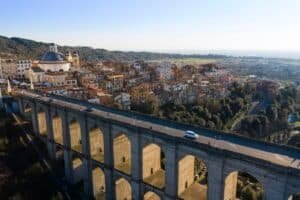
The old core reads from above like a spiral: the streets wind around the hill gaining elevation, and the houses lean one on the other following the logic of the embankment. It is a defensive structure, not an aesthetic one. Every house was the boundary wall of the house above.
The Tower and the Gate of the Walls of Monte Compatri
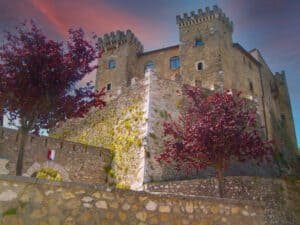
The oldest portion still readable is that of the Tower, whose dating is placed by local studies in the middle of the 15th century. Next to the tower opens the access gate to the walls, and in the stone jamb the big iron hinges on which the leaves turned are still visible. They are details that nobody photographs and that instead tell everything: the size of the hinges tells the size and weight of the gate, and so the level of threat the town expected. Stop for 30 seconds to look at them before going in.
The tower had a second life, and here the story gets interesting: when the Borghese rebuilt the baronial palace, the tower of the old medieval palace was turned into the bell tower of the Duomo. It is not an isolated case in the Castelli, but here the seam between the two eras is visible to the naked eye from the square, if you look where the facing changes texture.
Piazza Marco Mastrofini and the Fontana dell'Angelo
At the entrance of the town, in the center of Piazza Marco Mastrofini, stands the Fontana dell'Angelo: a late 19th-century monument, with the bronze figure set into a spur of tuff extracted from the nearby quarry of Monte Salomone. The gesture is simple and the reading is not: the angel commemorates those who worked, in some cases losing their lives, to bring water from the springs of Carpinello to the town at the close of the 19th century. In a ridge village running water does not arrive by gravity alone. You have to go and get it, carry it, defend it. For this reason the fountain has become more than a tourist symbol: it is the town's civic monument, and the locals call it simply the Angelo.
The square bears the name of Marco Mastrofini, the Monte Compatri priest and scholar who lived straddling the 18th and 19th centuries, a prominent local figure in the field of philosophical and mathematical studies. The name on the plaque is not decorative: it says that this town, small as it is, had an intellectual life of its own.
The Fontana del Belvedere of Monte Compatri
In a small square not far from the Duomo is the Fontana del Belvedere, much less showy than the first and much more intimate. Here, until a few generations ago, the women of the town climbed up with the copper basin balanced on their heads to collect water. The basin, in the local dialect, was called and is still called in an affectionate way, and anyone over 70 in town remembers the morning line. It is the place to stop, because the panorama that opens behind the parapet explains better than any map why a town was born right there.
The Underground Cellars of Monte Compatri
Under the houses of the historic center runs a network of cellars dug into the tuff, linked to each other by tunnels: a city under the city, born to keep wine at the constant temperature that tuff guarantees all year round. It is not a mysterious labyrinth out of legend, it is a productive infrastructure. Some of these cellars are opened during local events and host cultural and food-and-wine initiatives. Outside the events they stay private and closed. If you happen to be in Monte Compatri in the period when the cellars can be visited, go in: the temperature drops suddenly, the smell of damp tuff is unmistakable, and you understand at once why in these towns wine is a serious matter.
The Five Borghi of Monte Compatri
The town is historically divided into five districts, called borghi: Borgo Ghetto, Borgo le Prata, Borgo Missori, Borgo San Michele and Borgo Pantano. They are not administrative divisions, they are identities. Each borgo has its colors, its team of archers and its rivalry with the other four, and the whole thing explodes every August in the Sfida dei Borghi. Anyone strolling in August sees the lanes draped in banners and understands at once which district they are in.

The Duomo of Santa Maria Assunta in Monte Compatri
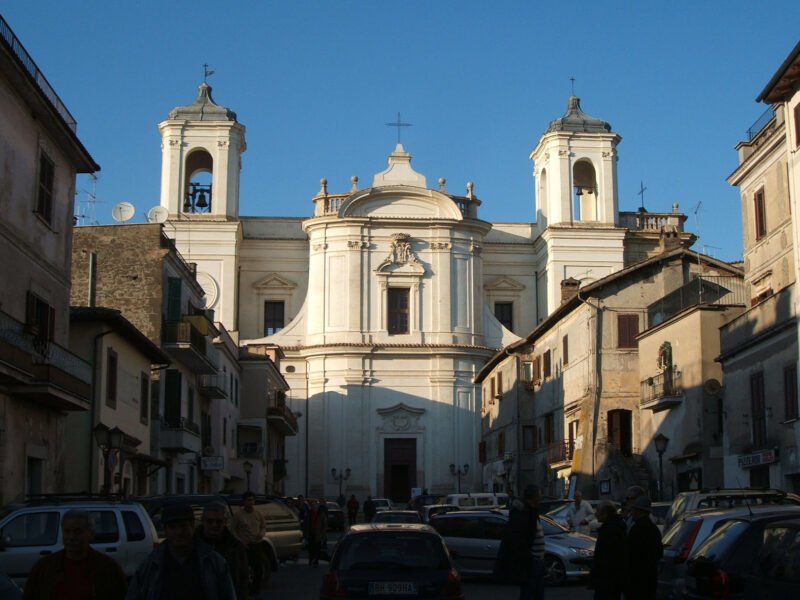
The main church of the town, which the locals call the Duomo, is the parish church of Santa Maria Assunta in Cielo. The title of duomo is local and affectionate usage: the church is not a bishop's seat, and calling it a cathedral would be incorrect. It is, however, the building that gathers seven centuries of the town's history, and it is the only monument in Monte Compatri that is worth the trip by itself.
From the Church of Santa Brigida to the Title of the Assunta
The origins are medieval and tied to the birth of the castle itself. After the destruction of Tusculum, in 1191, the refugees who climbed these hills built a church here dedicated to Saint Bridget. The title changed to that of Santa Maria Assunta in Cielo around 1600, on the eve of the great 17th-century building site. This passage explains why the feast of the Assunta, in mid-August, has remained the civic feast of the town and not only the religious one: the title of the church became the identity of the community.
The Borghese Building Site of 1630-1633: Rainaldi and Soria
Between 1630 and 1633 the church underwent a radical restoration, carried out through the work of the people and of Cardinal Scipione Caffarelli-Borghese, the nephew of Paul V whom Romans know as the patron of Galleria Borghese. The design of the facade is attributed to Carlo Rainaldi, the great Roman architect of the full 17th century, while the design of the nave is due to Giovanni Battista Soria, the architect closely tied to Borghese patronage. On May 5, 1633 Bishop Giovanni Altieri blessed the church.
It is worth dwelling on this list of names, because it says something that escapes the distracted visitor: in a town of a few thousand souls, in the 1630s, two architects were at work who in Rome were building the Baroque city. It is the effect of the fief: when the lord is a cardinal nephew with a patronage machine active in the Vatican, the same team of professionals comes down to the provinces. It almost never happens that one can read this mechanism so clearly.
Of the 17th-century layout, the description left by the archpriest Valeriano Marini in a manuscript remains: a single nave, with seven altars. Whoever enters today does not find that hall, because the 19th century passed through here decisively.
The 19th-Century Enlargement and the Consecration of 1901
In 1876 the enlargement of the church began under the direction of the architect Carimini, whose project was later modified by Leonori. The marble high altar was financed by Luigi Nardella. The new church was consecrated in 1901 by Cardinal Serafino Vannutelli. Between the two extremes, the 17th-century building site and the 20th-century consecration, run 25 years of works in a town that in the meantime had passed from the Papal State to the Kingdom of Italy: the construction of the Duomo is, in effect, the thermometer of the civic events of Monte Compatri.
A detail that tells more than a date: in 1828 the three biggest bells were placed on the old Tower, that is on the bell tower made out of the old medieval structure. The town has kept using its defensive tower as a sounding box for the hours and for the feasts, and still does.
The Paintings of the Duomo of Monte Compatri: Vanni and Passignano
Among the works kept in the church are a painting of the Death of Saint Francis, attributed to Vanni, and a Virgin and Child with saints attributed to Passignano. Attributions, not signatures: they have to be taken for what they are, critical proposals established in the local literature and not documentary certainties. Domenico Cresti, called il Passignano, was one of the leading figures of Florentine painting between the 16th and 17th centuries and worked for a long time in Rome. The reference to Vanni points to the Sienese milieu of the early 17th century. That two canvases of that level ended up in a parish church of the Castelli is no accident: the Borghese patronage comes back, with its circle of gifts and supplies.
Look at them calmly and in the right light, that is in the morning. The church has no museum-grade lighting system, and on a winter afternoon the canvases are hard to read.
Palazzo Borghese, Palazzo Annibaldeschi and the Other Palaces of Monte Compatri
Palazzo Borghese, Today the Seat of the Town Hall
Scipione Borghese rebuilt the baronial palace of the town, the one that today houses the municipal offices. It is the building that closes the front of the main square and gives the center of Monte Compatri its lordly character, in deliberate contrast with the medieval lanes that wind around it. Being the seat of the town hall, the interior follows office hours and cannot be visited as a monument: you go in for a registry matter, not for a guided visit. The exterior, however, reads very well from the square.
The Library of Palazzo Annibaldeschi
Palazzo Annibaldeschi houses the municipal library, and it is the place where the town keeps its written memory. For someone arriving as a tourist it is a short stop. For someone who really wants to understand local history, the studies on Tuscolo, on the fiefs and on place names are here. The opening hours have to be asked of the town hall, because they follow the calendar of the cultural services and change between summer and winter.
Palazzo Altemps in Monte Compatri
The village also keeps the palace that bears the name of the Altemps, the family that held the fief before the Borghese. The Monte Compatri palace is a different thing from the famous Palazzo Altemps in Rome, seat of Museo Nazionale Romano near Piazza Navona: here we are in front of the feudal residence of a branch of the same family, in a hill town. The condition of the building has made recovery work necessary, and how usable it is depends on the state of the works: ask at the town hall before counting on a visit.
Palazzo Passavanti and the Other Civic Buildings
Palazzo Passavanti, at Via Placido Martini 124, houses decentralized offices of the town hall, among them the technical office and the public works department. The street number is not a useless detail: the street is long and uphill, and whoever looks for the technical office without the number goes around in circles. Completing the picture of the civic buildings of Monte Compatri are the Monument to the Fallen of the First and Second World Wars, the monument to Placido Martini and Mario Intreccialagli and the bust dedicated to Monsignor Leandro Ciuffa.
Convento di San Silvestro above Monte Compatri
In the highest part of the territory, just outside the built-up area, you reach Convento di San Silvestro. The first settlement dates, according to local tradition, to the middle of the 15th century, while the greater part of the architectural complex you see today is late 17th century. The climb is short but steep: from the village you go up by paved road in a little over 10 minutes on foot, and the change of landscape is sharp, from the tuff of the houses to the chestnut grove.
The convent is an active religious community, not a museum with a ticket office. Access to the interior spaces and to the picture gallery depends on the availability of the friars and on the times of the services, and groups have to announce themselves in advance. This is the point on which I see weekend visitors go wrong most often: they arrive without having phoned and find the main door closed.
The Picture Gallery of Convento di San Silvestro
The convent keeps a picture gallery with paintings of the Mannerist and Caravaggesque schools. The definition has to be taken in the correct sense of the term: these are works that fall within the stylistic orbit of those languages, not certain autograph works by the leaders of the schools. It is worth going in for precisely this reason, because a convent collection tells how Roman painting of the 17th and 18th centuries circulated in the smaller centers through donations, bequests and modest commissions. It is the exact opposite of the curated museum: here you see what a community received and kept over time.
Blessed John of Jesus and Mary and the Link with Calahorra
In the convent church rest the remains of Blessed John of Jesus and Mary of Calahorra, a Spanish Discalced Carmelite, among the founders of the Italian Congregation of the Discalced Carmelites, author of works of mysticism and adviser to several popes. His presence in this convent is the reason why Monte Compatri, in 1998, twinned with Calahorra, the Spanish city where the blessed was born, in La Rioja. The town dedicated Parco Calahorra to the twinning.
Put like that it seems an administrative curiosity. In reality it is the most international thing that has happened to this village: a 16th-century Spanish religious, arrived in Italy with the Carmelite reform, ends up buried on a hill of the Castelli and four centuries later links two communities 1,600 kilometers apart. In the square dedicated to the twinning the exchanges between the two cities can still be seen today.
The Sanctuary of the Madonna del Castagno
Adjacent to the convent complex is the small church of the Madonna del Castagno, tiny and for that reason memorable. Inside is venerated an image of the Virgin painted on a chestnut stump: hence the name. The wooden structure that originally protected the painting was replaced in 1675 by a masonry chapel, and that is the frame of the present building.
The devotion of the people of Monte Compatri for this image is tied to a specific episode: in 1867 cholera raged in the Roman countryside and the town, according to local memory, had no victims. It is a devotional tradition, not a verified epidemiological fact, and it has to be told for what it is. But it explains why that chapel, as big as a living room, has remained the dearest place in the town. If you have to choose a single religious building to see in Monte Compatri besides the Duomo, choose this one.
Monte Salomone: The Extinct Volcano above Monte Compatri
In front of the built-up area rises Monte Salomone, an ancient volcanic edifice now extinct, which the sources place at 778 meters of elevation. The walk along its flanks is the main reason why many Romans go up to Monte Compatri: a route that interests those who walk for the landscape as much as those who walk for the geology, because here the ground tells the eruptive history of the Colli Albani with a clarity that elsewhere is covered by buildings.
The Climb to Monte Salomone from Monte Compatri
The mountain is reached by the paths that climb from the Tuscolo side and from the municipal territory. The elevation gain is modest for anyone who walks regularly, but the ground is uneven and becomes slippery after rain: you need hiking boots, not sneakers. There are no refreshment points along the route and phone coverage in some stretches of woods is poor. Bring water, and in summer start early: from 11:00 on, in July, the chestnut grove is not enough to make up for it.
The Panorama from the Summit and the Crater of the Vulcano Laziale
From the top the view covers the whole system of the Castelli Romani, the city of Rome and, on clear days, the line of the Tyrrhenian Sea. The most instructive thing, though, looks the other way: from the summit you can read with the naked eye the great crater of the Vulcano Laziale, on whose eastern rim Monte Compatri stands exactly. It is one of those cases where the panorama is not decoration but demonstration: you understand in 10 seconds the geological reason why the Castelli Romani have that ring shape, with the lakes of Albano and Nemi set in the secondary craters.
The tuff quarry that supplied the stone of the Fontana dell'Angelo is on this mountain. The town, literally, is built out of its volcano.
From Tuscolo to Monte Compatri: The Scenic Trail of the Castelli
The most beautiful route in the area links Rocca Priora to Frascati passing through Tuscolo, and Monte Compatri is its natural gateway. The ridge of Tuscolo reaches 670 meters above sea level and the archaeological area, of about 50 hectares, falls across four municipalities: Monte Porzio Catone, Monte Compatri, Frascati and Grottaferrata. The management of the area is entrusted to the Mountain Community of the Castelli Romani and Prenestini, of which Monte Compatri is a member.
The Roman Theater of Tusculum
The most significant building of the ancient city is the theater, built between the late Republican and the imperial age, with an original diameter of 45 meters and an estimated capacity of around 1,500 spectators. Restored, it hosts theatrical performances in the summer. Sitting on the cavea in mid-afternoon, with the Roman countryside descending in front and Rome in the background, is one of the strongest experiences Lazio can offer, and it costs zero.
Cicero and the Tusculanae Disputationes
Marcus Tullius Cicero owned a residence in the Tusculan territory, and it is here that he set his Tusculanae Disputationes. Let's put to rest, however, a legend that improvised guides have been repeating for decades: the large structure visible today and commonly indicated as Cicero's villa is in all likelihood traceable to a sanctuary dedicated to Jupiter, not to the orator's house. Cicero's villa existed, the literary record certifies it, but the ruin they show you is not that one. Whoever tells you otherwise is selling you a postcard.
The Destruction of Tusculum in 1191
Tusculum was razed to the ground in 1191, after the city had hosted the troops of the emperor Frederick Barbarossa: the Romans reacted by destroying it in reprisal. The Counts of Tusculum, the family that had dominated the region from the acropolis for at least a century, going so far as to control the papacy on several occasions, left the stage that year. Modern excavations, conducted also by international teams including the one directed by Xavier Dupré Raventós, have brought important materials to light while keeping them on site.
1191 is the date that explains Monte Compatri. The refugees from Tusculum climbed these hills and founded, or refounded, the ridge settlements that we now call the Castelli Romani. The church of Santa Brigida, the first form of the present Duomo, was born exactly from that diaspora.

The Castelli Romani Regional Park and the Territory of Monte Compatri
The Castelli Romani Regional Park was established by Lazio Region law number 2 of 1984 and extends over about 15,000 hectares, including 18 municipalities among them Monte Compatri, Rocca di Papa, Marino, Castel Gandolfo and Velletri. The protected area covers the whole edifice of the Vulcano Laziale, with Lake Albano and Lake Nemi in the secondary craters.
For Monte Compatri, belonging to the Park means two concrete things. The first: the chestnut woods that surround the town are subject to protection, and this is the reason why, going up, you still cross a continuous forest environment instead of a sprawling periphery. The second: the authority organizes guided excursions and environmental education, and whoever wants to walk accompanied has a public contact to turn to. The town is also part of the 11th Mountain Community, Castelli Romani and Prenestini, which manages among other things the archaeological area of Tuscolo.
To Parco Calahorra, dedicated to the Spanish twinning, is therefore added a much larger environmental context. I point out, for anyone looking for a comparison, that in the area the system of protected areas of Lazio includes very different environments, from the Valle dell'Aniene Nature Reserve inside Rome to the wooded ridges of the Castelli.
The Monte Compatri Colonna DOC Wine
Here we enter the chapter that the town defends with the most pride. The controlled designation of origin tied to this territory was recognized on September 17, 1973 and bears the name Montecompatri Colonna. The production zone includes the whole territory of the municipality of Colonna and portions of the territories of Monte Compatri, Zagarolo and Rocca Priora, in the province of Rome.
What the Production Regulations Say
It is a white. The grape blend provides for Malvasia bianca di Candia and Malvasia puntinata up to a maximum of 70 percent, Trebbiano in its Toscano, verde and giallo varieties for a minimum of 30 percent, with the possibility of adding Bellone and Bombino up to 10 percent. The designation admits the dry, semi-sweet and sweet versions, provides for the lightly sparkling style only in the semi-sweet and sweet versions, and includes the Superiore designation.
Translated for those who drink and don't study: expect a straw-yellow white, light in body, with the delicate nose typical of the Lazio malvasias and an easy, direct drink. It is not a wine for meditation and doesn't claim to be. It is the wine that goes with porchetta, fettuccine and pizza di polenta, and in that role it is unbeatable.
A Tiny Designation, and Why It Matters
The numbers of the designation are minuscule, on the order of a few hectares claimed and a few hundred hectoliters bottled: we are looking at an extreme niche DOC, squeezed by the bulky neighbor of the Frascati designation. This is the real wine news of the area, and nobody tells it to tourists. Whoever wants to taste a Montecompatri Colonna has to look for it actively in the cellars and osterie of the town: in large-scale retail, simply, you won't find it. It is best to ask the innkeeper directly which local producer bottles under the designation, and to buy a case if the wine convinces you, because outside the Castelli that wine does not exist.
The Cuisine of Monte Compatri and the Fraschette
The table of Monte Compatri belongs to the family of Castelli cooking, with some accents of its own. The town's food and wine offer is built on the wines of the area, on meats, cheeses, cured meats and seasonal vegetables, with two dishes worth looking for by name: the pizza di polenta and the minestra del contadino. Add the spelt bread, the dry biscuits for dipping in wine, the tozzetti and, in the cold season, the mulled wine of the square festivals.
Pizza di polenta is not a pizza: it is a mixture of cooked corn and then pan-fried again, served in slices, which comes from the poor cooking of the peasants and stands up very well to the comparison with any contemporary street food. The minestra del contadino changes from house to house, and this is the beauty of it: ask what they put in it, because the answer tells the season.
A practical warning that holds for all the Castelli: many village osterie close in the early afternoon and do not reopen until 19:30, and on weekdays in the low season some stay closed altogether. If you go up to Monte Compatri for lunch on a Tuesday in November, phone first. It happens often: a group of 15 people in front of a lowered shutter at 13:10.

The Hamlets of Monte Compatri: Pantano Borghese, Laghetto, Molara, Osa
The municipality does not end with the village. Going down toward the plain you cross the hamlets, which have their own histories and a completely different character from the historic center.
Pantano Borghese and the Metro Terminus
Pantano Borghese owes its name to the feudal family and to the reclamation of the ancient marshy basin that occupied this part of the countryside. Today it is the modern gateway of the municipality, with the terminus of Line C. The original railway layout of the area dates to 1916, to the time of the narrow-gauge railway for the Castelli and Ciociaria. The viaduct built between the late 1990s and 2008 was then assigned to the metro terminus station.
Laghetto and the Church of San Lorenzo
In the hamlet of Laghetto is the church of San Lorenzo. The name of the hamlet recalls a body of water of volcanic origin that characterized the area before the reclamations. It is the agricultural and residential face of the municipality, very far from the atmosphere of the upper village.
La Molara and Its Castle
Among the military architecture of the municipal territory is Castello della Molara, which guarded the valley on the line between Rome and the hills. La Molara belongs to that chain of medieval fortifications that dotted the Tusculan territory and that, after 1191, gradually lost their military function. The remains are on private land and have to be considered not freely visitable: respect for property, in these cases, is not a formality.
Osa and Valle Martella
Completing the picture of the hamlets are Osa and Valle Martella, the latter shared in place names with the territory of Zagarolo. They are areas of residential and agricultural expansion, without monumental interest, but useful to know about for anyone driving: the road signs name them constantly and whoever doesn't know them gets lost.
The Festivals and Events of Monte Compatri
The Monte Compatri calendar is fuller than the size of the town lets you imagine, and revolves around two poles: mid-August and Christmas.
The Sfida dei Borghi and the Procession of the Assunta
The Sfida dei Borghi takes place every year at Ferragosto and sets the five historic districts against each other: Borgo Ghetto, Borgo le Prata, Borgo Missori, Borgo San Michele and Borgo Pantano. In the preceding days, on August 13 or 14, the central square hosts a historical reenactment that retraces the stages of the town's formation, with citizens in medieval dress. The real contest is held on August 15 and consists of hitting with bow and arrows a target placed 25 meters away. Only one borgo wins. The archers who miss are dropped into a barrel full of water, which explains why the public crowds right around there.
On the evening of August 14 the community carries in procession the image of the Assunta with extras in historical costume set in the 16th and 17th centuries. It is the most photogenic event of the year and also the most crowded: if you want a decent spot along the route, be in the square at least an hour earlier. The coincidence between the civic festival of the borghi and the religious feast of the Assunta is no accident, and it takes us back to the change of the church's title that took place around 1600.
Degustando, the Spring Food and Wine Fair
Degustando is the spring food and wine fair of Monte Compatri: typical products, beer, workshops for adults and children and music occupy the village between Piazza del Mercato and Piazza della Repubblica. It is the best moment of the year to taste the territory's basket all at once without going around the cellars. The dates vary from year to year and have to be checked on the official channels of the town hall and of the organizing associations.
Christmas in Monte Compatri: Presepi in Cantina and Via dei Sapori
Christmas in Monte Compatri is built on two events: Presepi in Cantina, which opens to the public the cellars dug into the tuff and set up with nativity scenes, and Via dei Sapori, devoted to holiday gastronomy. Presepi in Cantina is the most original thing the town produces: it is the only occasion of the year when the village's underground becomes walkable, and it is worth the trip more than the August procession. The cold, though, is real: gloves and closed shoes.
Summer in Monte Compatri between Jazz and Theater
In the warm season the town hosts a jazz festival and the amateur theater program called Premio Città di Monte Compatri, besides the patron saint celebrations. They are events of local size, with admission often free and schedules announced with little notice: whoever spends the summer in Rome and looks for evenings out of town at no cost would do well to keep an eye on them.
Frequently Asked Questions about Monte Compatri (RM)
How much does it cost to visit Monte Compatri?
Visiting Monte Compatri costs nothing: the village is a lived-in town, not a paid site, and you enter and walk around freely. The only expenses are parking where applicable, lunch and any guided visits organized by local associations. The churches, Duomo included, have no ticket.
How much time do you need to visit Monte Compatri?
Three hours cover the visit to Monte Compatri: the village, the Duomo of Santa Maria Assunta and the climb to Convento di San Silvestro, which from the center takes a little over 10 minutes on foot on a paved road.
Does the Monte Compatri Pantano metro stop take you to the town?
No. The Monte Compatri Pantano station, eastern terminus of Line C, falls within the municipal territory but is in the plain of Pantano Borghese, while between that forecourt and Piazza Marco Mastrofini, in the historic center of Monte Compatri, there are about six kilometers.
Is Monte Compatri good for children?
For a family with children Monte Compatri works on two conditions: you have to accept the climb, because the village is all on a slope and the stroller is a serious problem on the stairways of the center, so a baby carrier or a child-carrying backpack is better, and it is a good idea to add something active to the program.
What do you eat in Monte Compatri?
The table of Monte Compatri belongs to the family of Castelli cooking, with two dishes to look for by name: pizza di polenta and minestra del contadino. To these are added spelt bread, dry biscuits for dipping in wine and tozzetti.
What is Montecompatri Colonna DOC wine?
Montecompatri Colonna is the controlled designation of origin tied to Monte Compatri, recognized on September 17, 1973. It is a white wine based on Malvasia bianca di Candia and Malvasia puntinata up to 70 percent, with Trebbiano toscano, produced in the territory of Colonna and in portions of Monte Compatri, Zagarolo and Rocca Priora.
When to go to Monte Compatri?
The best period for Monte Compatri runs from mid-September to the end of November, when the chestnut grove changes color, the air clears and the cellars work the new wine. October in particular is the month when the panorama from the viewpoint is at its best.
What to see in Monte Compatri?
In Monte Compatri it is worth seeing the Duomo of Santa Maria Assunta, the only monument of the town that deserves the trip by itself, Palazzo Borghese which now houses the town hall, Convento di San Silvestro in the highest part of the territory, and Monte Salomone, the ancient extinct volcanic edifice in front of the built-up area.
Monte Compatri and Scientific Research: The Laboratori Nazionali di Frascati
A few kilometers farther west, along the same ridge, are the Laboratori Nazionali di Frascati of Istituto Nazionale di Fisica Nucleare, at Via Enrico Fermi 54 in Frascati. They are one of the major Italian research facilities in the field of particle physics, nuclear physics, theoretical physics and technological research, and they host the DAFNE accelerator. The laboratories offer guided visits to the public, which can be booked through the institute's dedicated service, and have a Visitor Centre.
Why do I talk about it on a page about Monte Compatri? Because it is the most underrated combination of the Castelli Romani: in the morning a particle accelerator, in the afternoon a medieval village with cellars in the tuff, and 30 minutes by car in between. In the itineraries I build for school and corporate groups this pairing works better than any single-theme route. Not far away, on another hill, the Osservatorio di Monte Porzio Catone completes the scientific picture of the area.
Whoever organizes a day of this kind for a group, and doesn't want to manage reservations, coach and transfer times alone, finds in the TourLeaderPro tour guiding network licensed professionals who work on this territory.
A Curiosity about Monte Compatri (RM)
The curiosity of Monte Compatri is all in its name, and it is a more amusing matter than place names usually allow. Local tradition reconstructs a chain of transformations: Mons Confratuum, then Mons Cum Patruum, then Castrum Montis Compatris, Montecompatro, Montecompatri and finally Monte Compatri. The sense would be that of mountain of the brothers or of the co-patrons, that is of a hill held in joint ownership by several lords, which is historically plausible in a territory contested among the Counts of Tusculum, Annibaldi, Colonna, Altemps and Borghese.
Alongside this, a second, much bolder hypothesis circulates in town: that the name derives from the Latin computator, calculator, the same root from which English and French drew computer. Monte Compatri would then be the Calculator Mountain, that is, in a modern sense, the Smart Mountain. Someone pushes the suggestion as far as imagining here a seat of ancient Roman intelligence, noting that nearby Monte Porzio Catone bears the name of a consul and general very active in the war against Carthage, that the position is easily defended, and that inside the urban perimeter of Rome military structures were forbidden.
It has to be said clearly: this second reading is a fascinating suggestion with no documentary support. It does not stand up to historical linguistics and no academic study backs it. I tell it because it is alive in town and because it is part of Monte Compatri folklore, not because it is true. The curious thing, if anything, is another: within 10 kilometers of a village that according to a legend would be called Calculator Mountain, some of the most powerful scientific computers in Italy really do work today, in the nuclear physics laboratories. The coincidence proves nothing, but it is too good to keep quiet about.
Something Nobody Tells You about Monte Compatri (RM)
That the metro terminus bearing the town's name does not take you to the town. It is the most frequent mistake I see made, and not by naive tourists: by Romans. The Monte Compatri-Pantano station is the eastern terminus of Line C and falls within the municipal territory, so the name is correct. But it is in the plain of Pantano Borghese, and between that forecourt and Piazza Marco Mastrofini there are about six kilometers of uphill provincial road, with more than 300 meters of elevation gain. On foot it is a good hour and a half along a road that has no continuous sidewalk. Don't do it.
The second thing nobody says concerns the hours. Monte Compatri is a living town, not a tourist center: the village empties out in the early afternoon, many businesses close between 13:30 and 16:30, and in the cold months on Sunday evening the center is deserted by 20:00. Anyone who plans a visit for the winter aperitivo hour finds the shutters down and concludes that the town is dead. It isn't: it is simply a town, with its own rhythms.
Third thing, the most useful of all: the underground. The network of cellars dug into the tuff under the houses of the historic center is private and normally inaccessible. It opens only during certain events, in particular in the Christmas period with Presepi in Cantina. Whoever wants to see that part of the town has to make the visit coincide with the event, because on any other day of the year they will stroll above the cellars without knowing they have them under their feet.
The Advice I Give You for Visiting Monte Compatri (RM)
Go up by car, but don't stop in town right away. A tried itinerary starts from Frascati, continues along the ridge road toward Tuscolo, stops for an hour in the archaeological area for the Roman theater and only then comes down to Monte Compatri for lunch and for the afternoon in the village. In this order, and not the reverse, because the morning light on Tuscolo is clearly better and because arriving at Monte Compatri already knowing what Tusculum was completely changes the meaning of the Duomo, of the church of Santa Brigida and of the whole town.
Second piece of advice, on method: give the village the time of two complete loops. The first loop is done going up, from Piazza dell'Angelo toward the gate, the tower and the Duomo. The second is done coming down, through the side lanes, and serves to see what you missed on the first loop because you were looking up. Monte Compatri is a town that reads vertically, and whoever goes through it only once sees half of it.
Third piece of advice, less romantic and more concrete: shoes with treaded soles. The streets of the center are paved with basalt blocks and stone polished by use, on a constant slope, and in the rain they become a skating rink. And if you plan the climb to San Silvestro or to Monte Salomone, add water: in the village you fill the bottle at the fountains, after the last house you find nothing more.
Fourth and last: go off season. The idea of visiting Monte Compatri at Ferragosto, in the middle of the Sfida dei Borghi, is understandable but it is the only way not to see the town. If your interest is the village, and not the festival, choose a Saturday in October.
Another Well-Known Fact, Yet Rarely Cited
That Monte Compatri gives its name to a controlled designation of origin, and that almost nobody drinks it. The Montecompatri Colonna DOC was recognized on September 17, 1973, includes the whole municipal territory of Colonna and portions of those of Monte Compatri, Zagarolo and Rocca Priora, and provides for a white based on Malvasia bianca di Candia and Malvasia puntinata up to 70 percent, Trebbiano toscano, verde or giallo for a minimum of 30 percent, with Bellone and Bombino admitted up to 10 percent. The dry, semi-sweet and sweet versions are provided for, the lightly sparkling style only in the semi-sweet and sweet versions, and the Superiore designation.
So much for the technical data, which anyone can read in the production regulations. The rarely cited fact is the scale: the surface actually claimed and the volumes bottled under this designation are very small, on the order of a few hectares and a few hundred hectoliters. Put another way, there is a Lazio DOC with more than 50 years of history that produces less wine than a single medium-sized winery bottles in a week.
The reason is the market. The Frascati designation, neighboring and infinitely better known, has absorbed the demand and the commercial identity of the whole area, and many producers in the territory prefer to claim that one. The result is that Montecompatri Colonna survives as a town wine, sold almost exclusively on the spot. For the visitor this is excellent news: it means that tasting it here is the only way to taste it, and that every bottle bought in a cellar of the village is, literally, a piece of territory you won't find anywhere else. For the territory it is bitterer news, because a designation that doesn't produce is a designation at risk of disappearing.
The Right Photo to Take at Monte Compatri (RM)
It is not the Duomo, and it is not the generic panorama from the viewpoint. The photograph that sums up Monte Compatri is the one taken from the Fontana del Belvedere on a late January or February afternoon, with the parapet in the foreground, the roofs of the village running down to the right and the Roman countryside opening out to the distant outline of Rome. In those weeks the air is clear, the sun sets early and cuts across the houses from the side, and the city on the horizon becomes a line of light. In summer that same framing gives back only white haze.
The second shot to take home is vertical, and it concerns the Fontana dell'Angelo in Piazza Marco Mastrofini: the late 19th-century bronze set into the tuff spur of Monte Salomone. Photograph it from below, with the sky behind, and include the rough stone. It is that contrast between worked metal and barely roughed-out tuff that tells the story of the aqueduct, of the toil and of the mountain the stone comes from. From the ground, without the tuff in the frame, the angel becomes just another statue.
The third, for those with legs and time, is taken from the top of Monte Salomone looking south: from there the crater of the Vulcano Laziale reads in the image, with the town clinging to the eastern rim. It is a photo that explains itself and that no telephoto lens from below can replace.
A note of common sense: inside the churches and in the convent's picture gallery you don't photograph without asking, and flash is always out. During the procession of the Assunta, then, the unwritten rule is that you get out of the way when the procession passes. Nobody will say anything to you, but they will look at you.

Some Important Events That Happened Here in History
The first event is an ending, not a beginning: the destruction of Tusculum in 1191. The Romans razed to the ground the city that had hosted the troops of Frederick Barbarossa, and its inhabitants scattered over the surrounding hills. It is from that diaspora that the settlement of Monte Compatri is born, with the church dedicated to Saint Bridget that would become the Duomo. On the hill, according to the identification proposed by Tomassetti and accepted by other modern historians, stood the ancient Labicum, a colony of Alba Longa. In the 18th century the historian Francesco Antonio Vitale had instead placed Labicum on Monte Salomone, inside the same municipal territory. The two hypotheses still coexist in the literature, and neither of the two is definitively demonstrated.
The second event is the long feudal chain. After the Counts of Tusculum and the Annibaldi, the territory passed for about two centuries to the Colonna, then to the Altemps, who in the 16th century sold the fief to the Borghese. For the Borghese the possession was then raised to a principality. It is to Scipione Borghese that the rebuilding of the baronial palace is due, and the transformation of the tower of the old medieval palace into the bell tower of the Duomo.
The third event is the building site of 1630-1633, with the radical restoration of the church carried out through the work of the people and of Cardinal Scipione Caffarelli-Borghese, the facade attributed to Carlo Rainaldi, the nave designed by Giovanni Battista Soria and the blessing given on May 5, 1633 by Bishop Giovanni Altieri. The fourth is the town's 19th century: the enlargement of the church begun in 1876 with the architect Carimini, the project later modified by Leonori, the marble high altar financed by Luigi Nardella, the consecration celebrated in 1901 by Cardinal Serafino Vannutelli. In the same century fall the arrival of water from the springs of Carpinello and the erection of the Fontana dell'Angelo, and the memory of the cholera epidemic of 1867, which according to local tradition spared the town.
The fifth event is war, and here there is nothing pretty. On January 25 and 30, 1944 bombings hit the built-up area causing civilian victims. In 2004 the town administration placed a plaque in their memory. At the Ardeatine Caves, on March 24 of the same year, Placido Martini and Mario Intreccialagli were killed, tied to this community, to whom the town has dedicated a monument and, in the case of Martini, one of the main streets. Anyone walking along Via Placido Martini to go to the technical office should know who the man was whose name they read on the street sign.
The sixth event is recent and civic: the twinning with Calahorra, in Spain, signed in 1998 on the basis of the presence in town of the remains of Blessed John of Jesus and Mary, and recalled by Parco Calahorra. The seventh belongs to our time: on November 9, 2014 the stretch of Line C between Pantano and Centocelle entered service, and from that day the name of Monte Compatri appears on all the maps of the Rome metro.
Who Has Passed through Monte Compatri (RM)
The figure who more than any other left his mark on this town is Cardinal Scipione Caffarelli-Borghese, nephew of Paul V, collector, patron and feudal lord: to him are due the radical restoration of the Duomo between 1630 and 1633 and the rebuilding of the baronial palace that today houses the town hall. Anyone who knows Galleria Borghese in Rome meets here, on a village scale, the same commissioning hand.
With him came his architects. Carlo Rainaldi, author among other things of the twin churches of Piazza del Popolo, is indicated by the sources as the designer of the facade. Giovanni Battista Soria, who had already worked in Rome for the Borghese, designed the nave. Bishop Giovanni Altieri blessed the church in 1633. Two and a half centuries later other professionals of Roman rank came back to Monte Compatri: the architect Carimini for the enlargement begun in 1876, and Leonori who modified the project. The consecration of 1901 was celebrated by Cardinal Serafino Vannutelli, a leading figure of the curia of the late 19th century.
Even before that, the families that made the history of medieval Lazio had passed through the territory: the Counts of Tusculum, who from the Tusculan acropolis shaped papal elections for generations, then the Annibaldi, the Colonna and the Altemps. The name of Palazzo Annibaldeschi preserves the memory of the first of these dynasties.
On the religious side the name that counts is that of Blessed John of Jesus and Mary of Calahorra, a Spanish Discalced Carmelite, among the founders of the Italian Congregation of the Discalced Carmelites, a writer of mysticism and adviser to several popes, whose remains rest in the church of Convento di San Silvestro. On the side of scholarship, Monte Compatri gave birth to Marco Mastrofini, a priest and scholar after whom the main square is named, and honored Monsignor Leandro Ciuffa with a bust.
Finally the names that the town did not choose but wears with more pride than any: Placido Martini and Mario Intreccialagli, who fell at the Ardeatine Caves in March 1944. In a village where every square recalls a cardinal, the longest street bears the name of an anti-Fascist killed by the Germans. Anyone visiting Monte Compatri would do well not to forget it.
Monte Compatri with Children and Accessibility Issues
For a family with children Monte Compatri works, on two conditions. The first is that you accept the climb: the village is all on a slope, and the stroller is a serious problem on the stairways of the center. A baby carrier or a child-carrying backpack is better. The second is that you add something active to the program, because the town's artistic heritage is not enough to keep a seven-year-old busy for three hours. In the municipal territory there are places devoted to animals and outdoor education, among them the area known as Collina degli Asinelli, where activities for adults and children tied to these animals take place. The terms of access and the calendars have to be checked directly with the operators before showing up.
On accessibility the truth has to be told, without beating around the bush: a medieval ridge historic center, with paving stones, stairways and constantly sloping streets, is not a comfortable environment for people in a wheelchair or with mobility difficulties. The main square with the Fontana dell'Angelo and the front of the Duomo can be reached by car and on the level. The upper part of the village and the climb to Convento di San Silvestro cannot. Whoever has specific needs should make a call ahead to the town hall, which knows the passable routes better than any online map.
The August events are very well suited to children, with costumes, archers and the barrel of water in which the losers of the Sfida dei Borghi end up. But they are very crowded and end late: think about the time you will head back.
What to See near Monte Compatri
The surrounding territory is one of the densest in Lazio, and Monte Compatri works well as a base or as a stop. A few minutes away are Monte Porzio Catone, with its astronomical observatory, and Rocca Priora, the highest municipality of the Castelli. Going down toward the west you reach Frascati, with the Tusculan villas and the tradition of the fraschette, and Grottaferrata, where the Greek Abbey of San Nilo keeps a liturgy of the Byzantine rite practiced without interruption since 1004.
On the lakes side open Castel Gandolfo with Lake Albano, Marino with its grape festival, Rocca di Papa clinging to the Maschio delle Faete and Nemi with its wild strawberries and the museum of the ships. Toward the east, on the other axis, you reach Palestrina with the sanctuary of Fortuna Primigenia, one of the most imposing complexes of the Roman Republican world.
If instead you have to build a full day starting from Rome, and want to understand which of these towns is really worth the trip, the English guides of ItalyPlanner on Lazio reason on exactly this criterion, and their selection of day trips helps to avoid the classic mistake of cramming five towns into eight hours.
When to Go to Monte Compatri
The absolute best period runs from mid-September to the end of November. The chestnut grove changes color, the air clears, the cellars work the new wine and the town is not crowded. October in particular is the month when the panorama from the viewpoint is at its best and when the temperature allows both the walk up Monte Salomone and a long lunch.
Spring is the season of the fairs, with Degustando as the draw, and has the advantage of full greenery. It has the drawback of a capricious rainfall that makes itself felt on the paved streets. Summer has to be handled with care: until June it is perfect, July and August are hot even at 576 meters, and Ferragosto is very crowded because of the festivities. Winter is the most underrated season: cold and windy, with short days, but with the best visibility of the year and with Presepi in Cantina as the decisive argument for going up.
A last consideration about hours that always holds: the town is at its best in the two hours before sunset, when the light comes in raking from the west and the village lights up orange. Someone who arrives at 11:00 in the morning sees a flat town. Someone who arrives at 16:30 in October sees the one I'm talking about.
Quick Questions about Monte Compatri (RM)
How much does it cost to visit Monte Compatri?
Nothing. The village is a lived-in town, not a paid site: you enter and walk around freely. The only expenses are parking where applicable, lunch and any guided visits organized by local associations. The churches, Duomo included, have no ticket.
How much time do you need to visit Monte Compatri?
Three hours cover the village, the Duomo, the climb to Convento di San Silvestro and a stop at the table. A full half day is needed if you add the walk up Monte Salomone. A whole day if you combine Tuscolo and Frascati, which is the formula I recommend most often.
How do you get to Monte Compatri from Rome by public transport?
Metro Line C arrives at the Monte Compatri-Pantano terminus, inside the municipal territory but in the hamlet of Pantano, six kilometers from the village and 300 meters lower. From the terminus you have to continue with the regional intercity bus lines or by taxi. For anyone without constraints, driving is quicker.
Is the Line C metro station in the center of Monte Compatri?
No, and this is the most widespread misunderstanding. The name of the station indicates the municipality, not the historic center. Between the terminus and Piazza Marco Mastrofini there are about six kilometers of uphill provincial road.
What is the elevation of Monte Compatri?
The center is 576 meters above sea level, which makes it the third highest municipality of the Castelli Romani. Monte Salomone, in front of the built-up area, reaches 778 meters.
How many inhabitants does Monte Compatri have?
About 11,800, a figure referring to 2024, spread between the village and the hamlets of Pantano Borghese, Laghetto, Molara, Osa and Valle Martella.
Can you visit the Duomo of Santa Maria Assunta?
Yes, during the opening hours tied to the services. It is not a cathedral, despite the local name: it is the parish church of the town. For a group visit it is best to agree the time with the parish, avoiding the Masses.
Is Convento di San Silvestro open to the public?
Access depends on the religious community that lives there and on the times of the services. The picture gallery does not have continuous museum opening. Before going up, phone. Showing up without notice, especially with a group, often means finding it closed.
Can you visit the underground cellars of Monte Compatri?
Only during the events that open them to the public, in particular in the Christmas period with Presepi in Cantina. The rest of the year they are private property and stay closed.
What wine do you drink in Monte Compatri?
The designation of the territory is Montecompatri Colonna DOC, recognized in 1973: a white based on Malvasia and Trebbiano, produced in very small quantities and found almost only on the spot. In the town's osterie you also find the wines of the nearby Frascati designation.
When does the Sfida dei Borghi of Monte Compatri take place?
On August 15, with the historical reenactment in the days immediately before, the 13th or the 14th. The archery contest pits the five historic borghi against each other on a target placed 25 meters away.
What is Degustando?
The town's spring food and wine fair, spread between Piazza del Mercato and Piazza della Repubblica, with typical products, beer, workshops and music. The dates change every year and have to be checked on the official channels of the town hall.
Is Monte Compatri good for children?
Yes, provided you accept the slope of the village and give up the stroller in the upper part. The August festivities are much loved by children. In the municipal territory there are also outdoor educational activities tied to animals, to be checked with the operators.
Is the historic center accessible by wheelchair?
Only partially. The main square and the front of the Duomo can be reached on the level, the upper part of the village and the climb to San Silvestro cannot. The town hall is the right contact for being shown the passable routes.
Do you need to book to visit Monte Compatri?
For the town, no. You do need to book for visits to the Laboratori Nazionali di Frascati, which are a few kilometers away, and it is a good idea for restaurants on weekends and during events.
Where do you park in Monte Compatri?
In the areas along the lower ring road, then climbing on foot for five or six minutes. Looking for a spot inside the historic center, with narrow one-way streets, is a waste of time on weekends and during the festivities.
What is the difference between Monte Compatri and Monte Porzio Catone?
They are two neighboring municipalities on the same Tusculan ridge. Monte Porzio Catone is lower, more oriented toward Frascati and hosts the astronomical observatory. Monte Compatri is higher, has a more compact medieval fabric and Convento di San Silvestro. Both face the archaeological area of Tuscolo.
Can you reach Tuscolo on foot from Monte Compatri?
Yes, via the ridge paths that link Rocca Priora, Tuscolo and Frascati. The route requires proper shoes, water and a trail map: the signs on the ground are not always continuous.
What do you eat in Monte Compatri?
Meats, cured meats and cheeses of the territory, seasonal vegetables, spelt bread, and two specialties to look for by name: pizza di polenta and minestra del contadino. To finish, tozzetti and dry biscuits with wine.
Why is Monte Compatri twinned with Calahorra?
Because in the church of Convento di San Silvestro rest the remains of Blessed John of Jesus and Mary, a Discalced Carmelite born in Calahorra. The twinning dates to 1998 and gave its name to Parco Calahorra.
What is the best time to go to Monte Compatri?
From mid-September to the end of November, with October at the top of the list. In winter the visibility from the viewpoint is the best of the year. Ferragosto is spectacular for the festivities but terrible for seeing the town.
Are there guided tours in Monte Compatri?
Local associations organize openings and routes on the occasion of the events. For organized groups and itineraries in the Castelli Romani it is advisable to turn to licensed guides and tour leaders who work in the territory, like those who operate in Rome and the surrounding area with TourLeaderPro.
If I had to give a single reason for going up to Monte Compatri I would put it like this: it is one of the very few villages of the Castelli Romani where tourism has not yet rewritten the residents' day. The town lives by its own hours, the wine is drunk where it is made, and the square at six in the evening is full of local people instead of visitors. Go on an autumn afternoon, walk the same loop twice, sit at the Fontana del Belvedere and look at Rome from 25 kilometers away. It will last you longer than many museum visits.
Article written by the editorial team of TourLeaderPro, contact them for Private/Corporate/V.I.P. Tours and Experiences.
Planning a trip to Rome? The English guides to visit the city are on ItalyPlanner.com.