Leaning Tower of Rome
In short. The Torre delle Milizie is the most imposing surviving piece of medieval military architecture still standing in Rome: a block of tuff and brick a little over 50 meters tall that rises above the Trajan's Markets, at the start of largo…
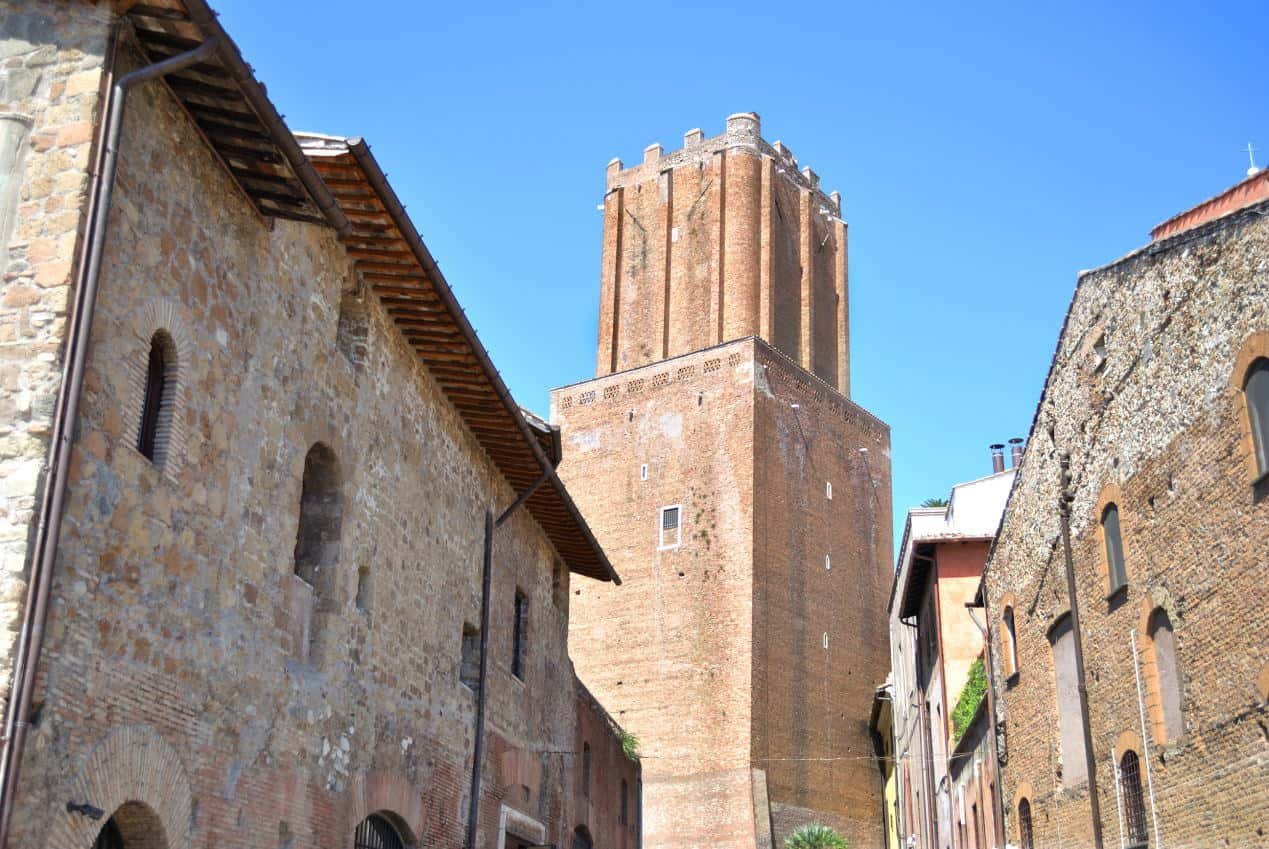
The Torre delle Milizie is the most imposing surviving piece of medieval military architecture still standing in Rome: a block of tuff and brick a little over 50 meters tall that rises above the Trajan's Markets, at the start of largo Magnanapoli, and that anyone who has walked along via Quattro Novembre or via dei Fori Imperiali has seen at least once without knowing what it was. It leans, visibly enough to have earned in Roman speech the nickname of the leaning tower of Rome, and it leans for a reason that is anything but legendary: the ground beneath it gave way, and a 14th-century earthquake did the rest, taking away the top floor. For centuries Romans have also called it the Tower of Nero, and around that name has grown the story that the emperor watched Rome burn from here. It's false, and one fact is enough to debunk it, because the tower was built about 1,200 years after the fire of AD 64. The lines that follow tell who built it and when, because the sources don't agree on who commissioned it, how it came to lean and lose a floor, how it ended up enclosed within the archaeological complex of the Trajan's Markets, and above all what you can and can't see by going there today.
Where the Torre delle Milizie is and how to get there
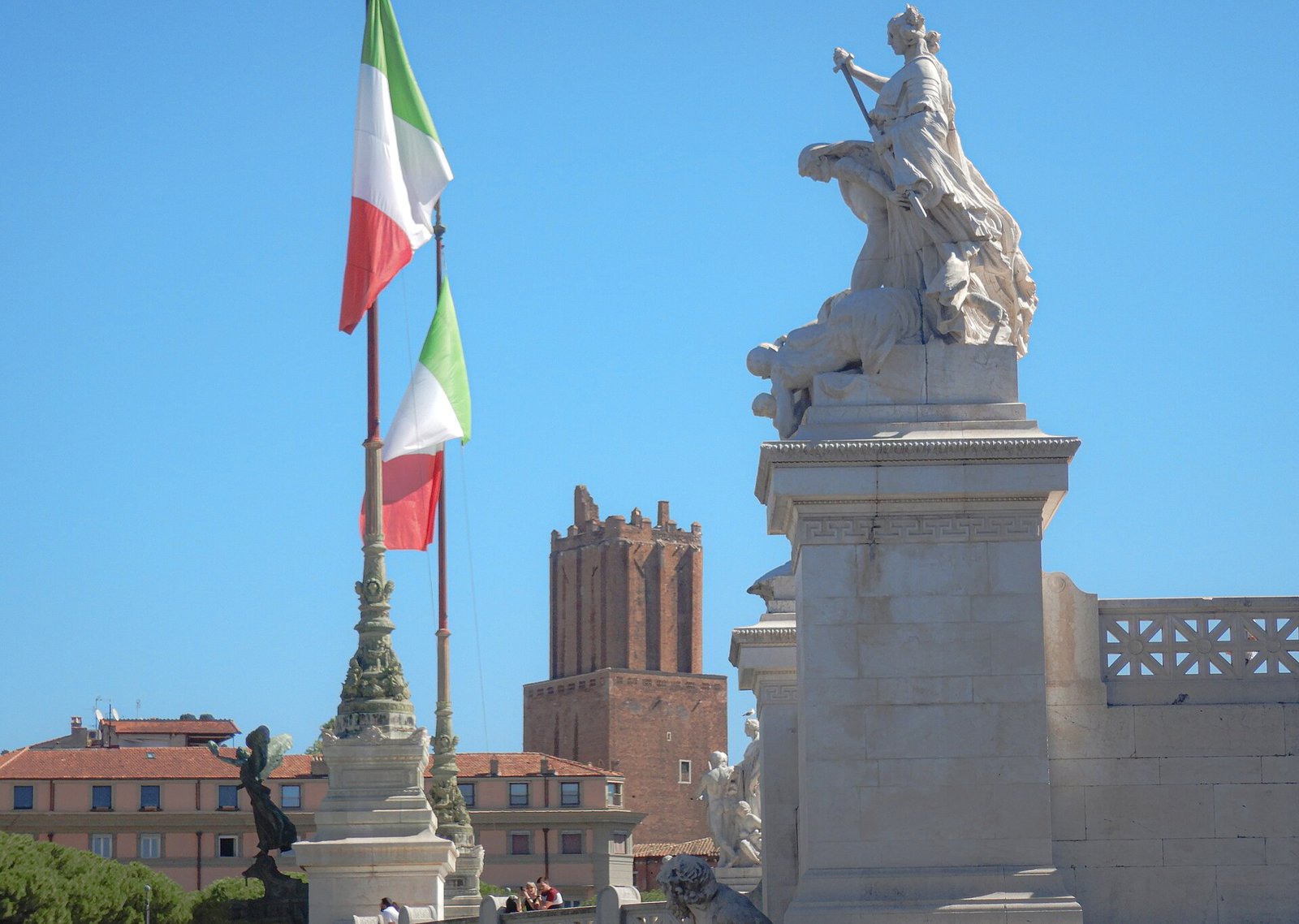
The Torre delle Milizie stands on the western edge of the Quirinal Hill, inside the Trajan's Markets complex, with access from the museum at via Quattro Novembre 94 and a view over largo Magnanapoli and salita del Grillo. It's a spot in the city that you cross constantly without noticing: it sits on the ridge that separates the Monti district from the strip of the Forums, in that stretch where via Nazionale opens onto largo Magnanapoli and the road descends toward Piazza Venezia. The tower is easy to see from afar, from the terrace of the Vittoriano, from the Capitoline Hill and from the whole stretch of via dei Fori Imperiali between Piazza Venezia and the Forums of Augustus and Nerva.
On foot from the center of Rome
From Piazza Venezia it's a good five minutes on foot: you take via dei Fori Imperiali, keep to the left up to the entrance of the Trajan's Markets museum, or you climb up salita del Grillo, the sloping little street that runs behind the complex and offers the closest view of the tower from below. From the Colosseum the walk along via dei Fori Imperiali takes about 15 minutes, and it's the best way to get there, because you pass in sequence the Roman Forum, the Forum of Nerva, the Forum of Augustus and finally the Forum of Trajan with its Column, and you see the tower gradually grow against the backdrop of the ancient remains.
By public transport
The nearest metro stop is Cavour, on Line B, from which you walk up via Cavour and turn toward the Forums, walking about 10 minutes. Alternatively you get off at Colosseo, also on Line B, and walk the whole of via dei Fori Imperiali. If you prefer the bus, on largo Magnanapoli and along via Nazionale you'll find several surface lines connecting Termini to the historic center, and other lines that cross Piazza Venezia a step from the museum entrance. Piazza Venezia hub is the simplest reference for anyone arriving from outside the area, because most of the lines that cut through the center from north to south pass through it.
If you arrive by car, keep in mind that the whole area falls within the limited traffic zone of the historic center, with electronic gates active during the hours set by the city, and that street parking nearby is paid and almost always full. The most practical solution is still to leave the vehicle in a park-and-ride lot served by the metro and complete the trip by public transport, avoiding entering the Forums area by car altogether.
What the Torre delle Milizie is: the tallest baronial tower left in Rome
The Torre delle Milizie is a 13th-century baronial tower about 50 meters tall, with a square plan a little over 10 meters on a side, and today it is the tallest medieval tower preserved in Rome. It wasn't an isolated building: it was part of a much larger fortified complex, a true urban castle known in the sources as the Castello delle Milizie, with a circuit of crenellated walls, other smaller towers and residential buildings that occupied the whole edge of the Quirinal above the Trajan's Markets. Of that castle, dismantled and absorbed in the following centuries into convents, vegetable gardens and palaces, essentially only the tower remains today.
How it's built: three stacked bodies
The structure can still be read well from the outside. The lower body, the most massive, is built of reused tuff blocks, that is, material recovered from the Roman buildings that stood there underneath and all around. The upper bodies are faced with a brick curtain, the typical medieval Roman brickwork, with tuff blocks alternating with brick in the inner structure. The three bodies narrow progressively as they rise, a solution that lightens the weight at the top and is common to almost all medieval tower architecture. The crenellation you see at the summit today isn't medieval: it's the result of the 20th-century restoration that rebuilt the lost crowning.
The measurements, and why not all sources give the same number
The base measures roughly 10.5 meters by 9.5 meters, and the current height is given by different sources as between 50 and 51 meters. The range depends on where you measure, that is, if you start from the current ground level of the Trajan's Markets or from the level of largo Magnanapoli, which are different levels, and if you include the rebuilt crenellation. The original height, the one the tower had before losing its top body, can't be reconstructed with precision, and no serious source proposes an exact figure: we know there was a third body and that it was demolished, not how tall it was.
A tower, but also a sign of power
It should be said right away that a tower like this wasn't built only for military reasons. In 13th-century Rome the great baronial families, the Conti, the Annibaldi, the Colonna, the Orsini, the Frangipane, built towers to physically control the key points of the city, but also and above all to display a supremacy visible from kilometers away. Height was a political message even before it was a defensive choice: whoever had the tallest tower in their neighborhood declared to everyone who was in charge there. Rome had dozens of them, perhaps hundreds by the most generous estimates, and the Torre delle Milizie is the one that has held up best of all.
Why it's called the Torre delle Milizie
The name derives from the fortified complex it was part of, the Castello delle Milizie, and points to the idea of a military garrison stationed in this sector of the city. Scholarly tradition has tied the place name to the presence in the early Middle Ages of Byzantine militias quartered on the Quirinal, in an area that dominated from above the Forums zone and the access roads to the center. It must be specified that this is a traditional explanation and not a fact documented by contemporary sources: the name of the Milizie is attested in the medieval period for the fortified complex, while the ultimate origin of the place name remains a hypothesis.
Magnanapoli, an equally debated name
The square the tower faces also bears a name of uncertain origin, and the two most widespread explanations deserve to be reported both. The first derives Magnanapoli from Balnea Pauli, that is, the baths of Paul, because in the medieval and modern periods the remains of the Trajan's Markets were long mistaken for a bath complex attributed to a pope named Paul. The second links it to the Latin formula Magnus Neapolitani Regni Connestabilis, great constable of the Kingdom of Naples, a title the Colonna held and which would have ended up distorted in speech starting from the worn inscriptions on their many towers in the area. Neither is proven, and it's right to present them for what they are, that is, two proposed etymologies and not an established truth.
Who built the Torre delle Milizie and when: the sources differ
The Torre delle Milizie dates to the 13th century, but the sources don't agree on who commissioned it, and anyone reading two different guides finds two different answers. This is one of the points where it's worth being explicit rather than arbitrarily choosing one version.
The Conti version
The most widespread reconstruction attributes the construction to the Conti di Segni family, the house from which came, in 1198, Lotario dei Conti di Segni, that is, Pope Innocent III, and which in the early 13th century was one of the most powerful in Rome. According to this version the tower would have been designed by the architect Marchionne Aretino, a Tuscan master also active on the building site of the parish church of Arezzo, and would have been built in the age of Innocent or shortly after, in the same decades in which the same family was building its other great Roman tower, the Torre dei Conti, at the other end of the Forums. Several sources place the construction around 1230 and generally in the first half of the century.
The Annibaldi version
Other sources instead attribute the construction of the tower to the Annibaldi, the baronial family that controlled a substantial part of the area between the Colosseum, the Suburra and the Quirinal and who in any case appear as owners of the complex during the 14th century. In this reading the Conti appear only at a later stage, as buyers or successors, and not as the original builders. Still other sources name the Arcioni family as builders in 1230, and the English encyclopedia entry traces the initial structure to an Aretino family under the pontificate of Innocent III.
What it's best to keep in mind
The honest picture is this: the tower is certainly from the 13th century, almost certainly from the first half. The commissioner is disputed between the Conti and the Annibaldi, with minor mentions of other houses, and no known document definitively closes the question. It doesn't help that in 13th-century Rome baronial properties changed hands continually through marriages, sales, confiscations and private wars, so much so that a tower could pass from one family to another within a few decades without leaving a clear documentary trace. Anyone who tells the story of the tower attributing it with absolute certainty to a single family is choosing between hypotheses, not reporting an established fact.
The building phases read on the wall
Studies carried out on the Trajan's Markets complex have identified, based on the reading of the masonry, a succession of phases that helps us understand how the monument grew by additions. Between the middle and the end of the 12th century there was already a residential building on this ridge with arcaded loggias, built by reusing the Roman structures below. In the first half of the 13th century a tall tower of tuff blocks was erected at one corner of the complex. In the third quarter of the same century the tower received the brick curtain facing that survives to this day. The tower we see, in short, wasn't born in a single building campaign but is the result of at least three different moments, and the stratigraphy of the wall shows it better than any archive document.
The hand of Pope Boniface VIII
A point on which the sources agree more concerns the involvement of Boniface VIII, the Caetani pope who ascended the throne in 1294. The tower came into the orbit of his family and was strengthened as a military stronghold in opposition to the Colonna, who had their own center of power and their own towers on the Quirinal. The war between Caetani and Colonna, which in 1297 and 1298 led to the siege and destruction of Palestrina, is the political background that explains why in those years an already tall tower was further fortified: it wasn't decoration, it was a position in an urban civil war fought street by street.
Why the Torre delle Milizie leans
The Torre delle Milizie leans because of a settlement of the foundation ground, decisively aggravated by the great mid-14th-century earthquake that made it lose its upper body. It's not an optical effect and it's not a construction choice: it's a real, documented structural failure, which required consolidation work in the 20th century.
The ground that gave way
The underlying reason lies beneath the tower and not in the tower. This sector of the Quirinal isn't virgin ground: it's an artificial edge, cut and reshaped in Roman times to make room for the Trajan's Markets and for the great excavation that built the Forum of Trajan, and beneath it run Roman rooms, substructures, cisterns and fills from different periods. Building 50 meters of tuff and brick on top of such a stratification, with medieval foundations resting partly on ancient structures and partly on fill ground, almost inevitably means running into differential settlement, that is, settling that occurs to a different degree under one side and the other. The result of differential settlement is exactly this: the tower doesn't sink, it tilts.
The earthquake of 1348, or of 1349
The decisive blow came with the great Apennine earthquake of the mid-14th century, the one that seriously damaged Rome and also brought down part of the outer ring of the Colosseum. Here a divergence in the sources needs to be pointed out, which is better reported than hidden: many guides and the English-language encyclopedia entry date it to 1348, while other Roman sources, including local pages dedicated to the tower, give the precise date of September 9, 1349. It is the same seismic sequence, which struck the central Apennines between 1348 and 1349 and whose effects on Rome are placed variously in one year or the other depending on the tradition followed. The fact itself doesn't change: the earthquake brought down the upper body of the tower, the so-called third floor, and accentuated the tilt already under way.
The lost floor
The tower we see today is mutilated. The highest body, the one that closed off the structure at the top, was demolished or collapsed following the quake, and what survives are the two lower bodies plus the 20th-century restoration crowning. That's why the tower, though the tallest left in the city, looks squatter than it was originally: in medieval images and in views from the modern period the profile of the Milizie complex is noticeably more slender than the current one. Once again, though, how tall that lost body was is not stated by any reliable source, and it would be incorrect to propose a figure.
How much it really leans
On the extent of the tilt the sources disagree, in some cases markedly: some popular pages speak of a tilt of about 13 degrees toward the Forums side, while the more cautious descriptions, including the English-language encyclopedia entry, speak simply of a slight tilt without giving degrees. 13 degrees would be an enormous figure, greater than any known leaning tower, and should be taken with great caution. What is certain, and what anyone can verify by eye by comparing the corner of the tower with a nearby building, is that the lean exists and is perceptible, while its exact measure is not something that can be taken as established on the basis of the available popular sources.
The consolidation by Antonio Muñoz
It was the superintendent Antonio Muñoz who dealt with the tower in the early 20th century, in an intervention that the sources place between 1914 and the 1920s depending on the phase considered: the foundations were consolidated, the damaged masonry was repaired and the crowning was completed with the crenellation that closes the top today, which is therefore 20th-century and not 13th-century. The tower had already been declared a national monument in 1911, and it is this status that made the public intervention possible.
A curiosity about the Leaning Tower of Rome
The tastiest curiosity concerns the name by which Romans have called this tower for centuries: Tower of Nero. And it concerns the story that name carries with it, namely that from this summit the emperor Nero watched the fire of Rome in AD 64, singing verses while the city burned.
The story is false, and the reason it's false is disarmingly simple: the Torre delle Milizie was built in the 13th century, that is, about 1,200 years after Nero's fire. In AD 64 there was no tower on this edge of the Quirinal, there wasn't even the Trajan's Markets, which would be built almost half a century later, and the hill had not yet been cut to make room for the Forum of Trajan. Watching Rome burn from a building that didn't exist takes abilities that have never been attributed even to Nero.
Where the mix-up comes from
The mix-up has an ancient root and a mechanism typical of medieval Rome. With the memory of who had built what lost, the city reinterpreted its monuments by attributing them to the most famous and most infamous figures of antiquity, and Nero was the perfect candidate for any imposing and vaguely sinister ruin. Added to this is the fact that the report of a Nero watching the fire from above really does exist in ancient sources, but referring to a completely different place: Suetonius tells that the emperor watched the flames from the Tower of Maecenas, on the Esquiline, singing of the fall of Troy, while Tacitus reports that at the start of the fire Nero was at Anzio and returned to Rome when the fire was already advanced. Neither of the two ancient versions mentions the Quirinal, and neither mentions a tower that would be born a thousand years later.
Why the legend took hold right here
There is, however, a topographical explanation for the success of the mix-up. From this point on the Quirinal, before the modern city rose all around, the gaze really did take in an enormous portion of Rome: the valley of the Forums, the Suburra, the Caelian, the Palatine, the Flavian amphitheater. Anyone looking for a plausible place from which an emperor could have contemplated the city in flames couldn't have found a better position. The legend, as often happens, is wrong in the facts but right in the intuition: that spot really is a formidable viewpoint, it just became one 1,200 years after Nero.
A second legend, even more curious
Alongside the Neronian one circulates a lesser-known but more singular popular tradition: the tower would be a sort of periscope, the emerged part of an underground palace of Augustus buried under the hill, destined to resurface together with the emperor himself when Rome returns to its ancient splendor. It's pure folklore, without any archaeological basis, but it tells very well how Romans have always imagined that beneath their city there was another city waiting. It must be labeled for what it is, that is, a legend, but it deserves to be remembered because it's one of the rare cases in which popular imagination has preferred Augustus to Nero.
One thing nobody tells you about the Leaning Tower of Rome
The thing almost no guide says clearly is the most important of all for anyone planning a visit: you can't climb the Torre delle Milizie. The Trajan's Markets museum has published an explicit notice on its website, according to which the tower is not open to visitors, and that notice is still online. Anyone who arrives thinking they'll climb to the top and look out over the Forums ends up disappointed, because the interior of the tower is not part of the museum's visitor route.
So what do you actually see?
This doesn't mean the tower is inaccessible or invisible. It means something different and more precise: you can reach it, walk around it, look at it from below and from very close, but you don't go inside. The museum route in fact includes the Giardino delle Milizie, the area set up at the upper level of the complex, above the Central Block and the Great Hall of the Trajan's Markets, crossed by the ancient route known as via della Torre. From there you are literally at the foot of the tower, with the tuff and brick facing within reach and an open view over the Imperial Forums. The garden also preserves the remains of the medieval castle that surrounded the tower and the cover of a buried cistern, visible near the modern elevator.
A necessary note on updates
Since openings in Roman archaeological complexes change with construction work and with the seasons, before leaving it's best to check the updated information on the official website of the Trajan's Markets museum or to call the information number of the City of Rome.
The advice I give you for visiting the Leaning Tower of Rome
The main advice is just one: don't treat the Torre delle Milizie as a stand-alone destination, treat it as the high point of a visit to the Trajan's Markets. You enter from the museum on via Quattro Novembre, walk through the complex from the bottom up and arrive at the Giardino delle Milizie when you've already understood what the tower was built on. Done in this order, the visit has a precise narrative sense: you start from the 2nd century AD and arrive at the 13th century by climbing in elevation, with the stratification of the city readable under your feet.
The ticket and what it costs
Access is with the ticket of the Trajan's Markets museum. The ordinary rates listed by the museum, when there are no temporary exhibitions, are €15 for the full price and €9.50 for the reduced, while during periods when a major exhibition is on the integrated ticket goes up, as happened in 2026 with the exhibition dedicated to Brâncuși, for which €19.50 for the full price and €14 for the reduced were listed. Admission is free for residents of Rome and the Metropolitan City, upon showing an ID, and for MIC Card holders. A supplement for the video guide and a presale fee for online purchase are applied. Since rates vary with the exhibitions on, it's best to check them on the museum's website before going.
The best time of day
For photography and for the view, late afternoon is by far the best time: the sun going down toward the west lights the brick facing of the tower at an angle, brings out the texture of the bricks and gives back to the valley of the Forums a relief that flattens out completely at noon. To avoid the crowd, instead, the first hour after opening works better, when the complex is almost empty and the big groups haven't yet arrived from the Forums. If you have to choose between the two needs, consider something simple: the Trajan's Markets are never as crowded as the Colosseum, so the priority can quite comfortably be the light.
The best way to fit it into a day
The most effective combination, for anyone with a morning, starts from the Forum of Trajan and the Trajan's Column seen from the balcony of via dei Fori Imperiali, continues inside the Trajan's Markets up to the Giardino delle Milizie, exits onto largo Magnanapoli and goes down toward Piazza Venezia along salita del Grillo, ending at the Capitoline Hill or at Palazzo Venezia.
Another well-known fact, yet rarely cited
The fact is this: the Torre delle Milizie has a sister, and the sister partly collapsed a few years ago. She's called the Torre dei Conti, she's at the other end of the Imperial Forums, on the edge of the Forum of Peace, and she's attributed to the same family to which most sources also attribute the Milizie.
What happened to the Torre dei Conti
On November 3, 2025, a portion of the Torre dei Conti collapsed during the restoration work under way on the building, in two successive failures that buried the workers on the site. One of them, pulled out after many hours of work by the firefighters, died. The collapse had an enormous echo, also because it happened in one of the most visible and most photographed spots in Rome, a few dozen meters from the Colosseum, and it opened a public debate on the safety of restoration sites on historic heritage.
Why it concerns the Milizie too
It concerns the Milizie for a structural reason, not a sentimental one. The two towers share the same type of construction, the same period, the same kind of foundation resting on preexisting Roman structures and fill ground, and the same long history of failures, mutilations and restorations succeeding one another from the 14th century onward. The Torre dei Conti had already lost a large part of its height following the late medieval earthquakes, exactly like the Milizie, and had already been the object of consolidation work in the 20th century. The 2025 collapse reminded everyone that Rome's medieval towers aren't inert monuments but organisms in precarious balance, watched and monitored precisely because their past reveals their fragility.
Two towers, two fates
The comparison between the two towers is instructive on the level of urban memory too. The Torre dei Conti was, in medieval descriptions, one of the most impressive buildings in Rome: when Francesco Petrarca saw it, he called it a tower unique in the world, by then split by great cracks. That phrase, it should be specified, concerns the Torre dei Conti and not the Torre delle Milizie, even though some popular accounts apply it by mistake to the latter. The Milizie, less celebrated by literary sources, have been better preserved, and today they are the most imposing remnant of medieval military architecture that Rome still has standing.
The right photo to take of the Leaning Tower of Rome
The right photo of the Torre delle Milizie isn't taken inside the museum, it's taken from salita del Grillo, the sloping little street that runs behind the Trajan's Markets complex and passes under the arch of the House of the Knights of Rhodes. From there the tower appears in a low-angle view, that is, framed from below, with the brick facing rising flush with the sky and the lean becoming immediately readable because you have a vertical reference nearby to compare it with.
The framing that makes the lean visible
The classic problem for anyone photographing a leaning tower is that the eye, and even more the lens, tends to straighten everything. To really show that the tower leans you need a sure vertical reference within the same frame: the corner of a building, a lamppost, the trunk of a tree. By putting the tower next to something that is surely plumb, the difference jumps out even in a photo taken with a phone. The automatic perspective correction that many programs apply by default should be avoided instead, because it straightens exactly what you wanted to show.
The view from above
The second shot worth having is the one from the balcony of via dei Fori Imperiali at the level of the Forum of Trajan, or better still from the panoramic terrace of the Vittoriano, if you're willing to pay for the elevator. From up there the tower enters a frame that includes the whole great hemicycle of the Trajan's Markets, Trajan's Column, the twin churches of the Forum of Trajan and, in the background, the profile of the hills. It's the image that tells better than any text the relationship between imperial Rome and baronial Rome: a 13th-century tower planted on the roof of a 2nd-century market.
What you can't photograph
Inside the museum, photography for personal use is normally allowed, with the usual limits on flash and tripods and with the rules of their own that temporary exhibitions may impose. Professional use requires authorization from Musei in Comune. Outside there is no limitation at all, because largo Magnanapoli and salita del Grillo are public streets.
Some important events that happened here in history
The Torre delle Milizie hasn't been merely a point in the landscape: for centuries it was an active military position in the struggles among the great Roman families, and it has passed through specific turning points in the city's history. Here are the documented ones.
Boniface VIII against the Colonna
At the end of the 13th century the tower enters the conflict between Pope Boniface VIII, of the Caetani family, and the Colonna, who had their power base and their own towers right on the Quirinal. The sources agree in describing the Torre delle Milizie as a stronghold reinforced against the Colonna in those years. The conflict culminated in the excommunication of the Colonna cardinals, in the siege and destruction of Palestrina at the end of the century, and closed a few years later with the Slap of Anagni in 1303: one of the most dramatic moments in the history of the medieval papacy, and the tower went through it as a silent protagonist.
1311 and the coronation of Henry VII
In 1311 the tower appears in an episode of European importance: Henry VII of Luxembourg, who had come down to Italy to be crowned emperor, established his military base in Rome here. The coronation, which took place in a climate of armed clashes with the opposing faction that controlled other parts of the city, was one of the last attempts to restore an effective imperial authority in Italy, the same attempt on which Dante Alighieri had placed great political hopes. That the imperial headquarters was this very tower shows how decisive its position was considered.
The earthquake of the mid-14th century
The quake that struck the central Apennines between 1348 and 1349 changed the look of the tower forever, with the fall of the upper body and the permanent tilt. It was the same earthquake that brought down a substantial part of the outer ring of the Colosseum, the reason why the amphitheater today has that asymmetrical profile everyone knows.
The passage to the nuns
During the modern period the complex leaves the military logic and enters the conventual one. The sources give 1619 as the year in which the property, returned to the Conti, was ceded to the nuns of the nearby church of Santa Caterina a Magnanapoli. Other reconstructions move the sale to a nun of the Massimi family back to 1574. The two reports aren't necessarily in conflict, since they may refer to different transfers of ownership, but it's worth flagging that on the exact chronology of this passage the popular sources don't coincide. The result, in any case, is that for almost three centuries the tower remains enclosed in a monastic complex, surrounded by gardens and convent buildings that almost completely hide its base.
The demolitions and excavations between the 19th and 20th centuries
Between the end of the 19th century and the first decades of the 20th the area is progressively cleared. The 19th-century demolitions are followed by excavations begun around 1910 and then, in the 1920s, by the great campaign that dismantles the convent buildings leaning against the flank of the Quirinal and brings the Trajan's Markets back to light in the form we know today. It's in this context that the tower is consolidated by Antonio Muñoz, given the crenellation that still crowns it, and that from 1927 it becomes part of the archaeological complex of the Trajan's Markets, from which it is still accessed.
The gutting for via dei Fori Imperiali
Between 1931 and 1933 the demolition of the Alessandrino district and the opening of via dell'Impero, today via dei Fori Imperiali, radically change the context of the tower, which goes from being an element set in a dense urban fabric to an isolated presence on an open archaeological area. It's the intervention that gave the area its current look, with the Forums exposed to the open sky on either side of a great road axis, and it's also the most debated intervention in 20th-century Roman urban planning, because it wiped out an inhabited district and sacrificed portions of historical stratification that today would be considered indispensable.
Who has passed by the Leaning Tower of Rome
Over eight centuries popes, emperors, restorers and writers have passed around this tower. Here is who, with what the sources actually say.
Innocent III and the Conti di Segni
The pontificate of Lotario dei Conti di Segni, Pope Innocent III between 1198 and 1216, is the political background in which the rise of the family to which most sources attribute the construction of the tower is placed. Innocent III was one of the most powerful popes of the Middle Ages, and the building fortune of his house in Rome, with the two great towers at the two ends of the Forums, is the translation into stone of that power. It makes no difference if it was he or his immediate family successors who ordered the building site: the tower belongs in any case to the political season that bears his name.
Boniface VIII
Benedetto Caetani, Pope Boniface VIII from 1294 to 1303, is the figure historically most tied to the tower after its builders: the sources indicate him as the one who acquired it and strengthened it, turning it into a stronghold against the Colonna. He is the same pope who proclaimed in 1300 the first Jubilee in history, bringing crowds of pilgrims to Rome, and whom Dante places in Hell among the simonists even though he was still alive at the time the poem is set.
Henry VII of Luxembourg
The King of the Romans who came down to Italy to take the imperial crown chose the Torre delle Milizie as his military base in Rome in 1311, during the convulsive events that led to his coronation. It's the only documented case in which the tower hosts a leading European sovereign, and it alone is enough to make clear that it wasn't a simple fortified family residence but a strategic position recognized as such on a continental scale.
Antonio Muñoz
The art historian and architect Antonio Muñoz, superintendent and then head of antiquities and fine arts of the Governatorato of Rome, is the man to whom the current look of the tower is owed: consolidation of the foundations, repair of the masonry, completion of the crenellation at the top. His figure is central and debated in the history of 20th-century Roman restoration, because to him are owed both decisive rescues and interventions of isolation and restoration that the restoration culture that followed would judge severely. Anyone looking at the Torre delle Milizie today is looking, in its upper part, at a work of his.
The nuns of Santa Caterina a Magnanapoli
For almost 300 years the permanent inhabitants of this place weren't armed barons but cloistered nuns. The convent complex of Santa Caterina da Siena a Magnanapoli enclosed the tower and its precinct, and it was that community that guaranteed its preservation, without knowing it: a building inside a convent wasn't demolished to recover its materials, which is the fate that the vast majority of Rome's medieval towers met. The survival of the Torre delle Milizie is owed, in large part, to three centuries of monastic silence.
What to see around the Torre delle Milizie
The Torre delle Milizie occupies one of the points of highest monumental density in Rome: within a radius of 300 meters are concentrated a Roman market of the 2nd century, four imperial forums, a cochlid column, two important Baroque churches, a Renaissance palace and an ancient prison. None of these stops requires more than five minutes of walking from the others.
The Trajan's Markets and the Imperial Forums Museum
The Forum of Trajan and Trajan's Column
Below the tower, on the side opposite largo Magnanapoli, opens the Forum of Trajan, the largest and the latest of the Imperial Forums, with the remains of the Basilica Ulpia and, wedged between the two twin churches, Trajan's Column, the monument that tells the Dacian wars with a continuous spiral frieze. The tower and the column are the two vertical elements that close off the perspective of this sector of the Forums, and seeing them together, one from the 2nd century and the other from the 13th, is the quickest way to understand the stratification of Rome.
The Roman Forum, the Basilica of Maxentius, the Mamertine Prison
Going down toward the Campidoglio and continuing along via dei Fori Imperiali you reach the Roman Forum, the political and religious heart of the ancient city, the Basilica of Maxentius with its three surviving barrel vaults, and the Mamertine Prison under San Giuseppe dei Falegnami, the state prison of republican Rome. They are all stops a few minutes' walk from the tower, and they form the backbone of any archaeological itinerary in the center.
The Domus Romane of Palazzo Valentini
A few dozen meters away, under the palace that houses the Metropolitan City, you can visit the Domus Romane di Palazzo Valentini, an underground route among the remains of two aristocratic houses of the imperial age with a multimedia installation that reconstructs rooms and decorations. It's the stop that best completes the visit to the Trajan's Markets, because it tells the residential and private side of the same area whose public and commercial side the Markets tell.
The churches of largo Magnanapoli
Leaving the museum toward the top you immediately meet the church of Santa Caterina da Siena a Magnanapoli, tied, as we have seen, to the modern history of the tower, and a little farther the church of Santi Domenico e Sisto with its scenic double-ramp staircase. On the opposite side of the square opens the hanging garden of Villa Aldobrandini, one of the least-known green spaces in the center, raised above the street and accessible from via Mazzarino. A little farther down, toward Piazza Venezia, stands the basilica of Santi XII Apostoli, one of the oldest Christian titular churches of the city.
Toward Monti and toward the Quirinal
From the tower you can set off in two opposite and equally rich directions. Climbing along via Nazionale and then turning toward the hill you reach the Quirinal Palace and the Quirinal Stables, home of major exhibitions. Going down instead toward the Suburra you enter the Monti district and in a few minutes reach San Pietro in Vincoli with Michelangelo's Moses. If you want to end the day on a more touristy note, the Trevi Fountain is about 10 minutes' walk to the northwest.
Frequently asked questions about the Torre delle Milizie
What is the Torre delle Milizie?
The Torre delle Milizie is a baronial tower of the 13th century about 50 meters tall, located inside the Trajan's Markets complex in Rome, and it is the most imposing remnant of medieval military architecture preserved in the city. It was part of a fortified castle, the Castello delle Milizie, of which essentially only the tower remains today.
Why does the Torre delle Milizie lean?
The Torre delle Milizie leans because of a settlement of the foundation ground, decisively aggravated by the great mid-14th-century earthquake, dated by the sources to 1348 or to September 9, 1349, which also made it lose its upper body. The site is an artificial edge reshaped in Roman times, with ancient structures and fill ground beneath the medieval foundations.
Can you climb the Torre delle Milizie?
No, the interior of the Torre delle Milizie is not open to visitors and you can't climb it: the Trajan's Markets museum has published an explicit notice to that effect, still online. You can, however, reach its foot through the Giardino delle Milizie, the area at the upper level of the complex included in the museum's visitor route, from which you walk around the tower and look at the valley of the Imperial Forums.
How much does it cost to visit the Torre delle Milizie?
To get close to the Torre delle Milizie you need the ticket of the Trajan's Markets museum, listed by the museum at €15 for the full price and €9.50 for the reduced when there are no temporary exhibitions, with higher rates when a major exhibition is on. Admission is free for residents of Rome and the Metropolitan City and for MIC Card holders. Rates should be checked on the official website because they change with the exhibitions.
Did Nero really watch the fire of Rome from the Torre delle Milizie?
No, Nero cannot have watched the fire of Rome from the Torre delle Milizie, because the tower was built in the 13th century, about 1,200 years after the fire of AD 64. The popular nickname Tower of Nero comes from a medieval reinterpretation: Suetonius places the scene on the Tower of Maecenas on the Esquiline, while Tacitus reports instead that the emperor was at Anzio when the fire broke out.
Who built the Torre delle Milizie?
On who commissioned the Torre delle Milizie the sources diverge: the most widespread reconstruction attributes it to the Conti di Segni family, with the design by Marchionne Aretino, while other sources point to the Annibaldi and some name the Arcioni around 1230. No known document closes the question, and the certain dating remains the 13th century, almost certainly the first half.
How do you get to the Torre delle Milizie by public transport?
You get to the Torre delle Milizie by getting off at the Cavour stop on metro Line B and walking about 10 minutes, or at the Colosseo stop on the same line and walking along via dei Fori Imperiali. Alternatively, the surface lines that stop at Piazza Venezia, at largo Magnanapoli and along via Nazionale will serve. The museum entrance is at via Quattro Novembre 94.
Can you take photos of the Torre delle Milizie?
Yes, the Torre delle Milizie can be photographed freely from the outside, because largo Magnanapoli and salita del Grillo are public streets without any limitation. Inside the Trajan's Markets museum photography for personal use is normally allowed with the usual limits on flash and tripods, while the temporary exhibition rooms may have rules of their own and professional use requires authorization.
Is the visit suitable for children and for people with mobility difficulties?
The visit to the Torre delle Milizie through the Trajan's Markets works well with middle and high school kids, less so with small children because of the uphill routes and the internal level changes. The complex has an elevator serving the different levels, but anyone with mobility difficulties does well to ask the museum in advance to confirm how practicable the stretch leading to the Giardino delle Milizie actually is.
One last tip for planning the itinerary
The Torre delle Milizie works best as the end of a route, not as the beginning. Anyone who arrives at its foot after crossing the Imperial Forums from below, seeing Trajan's Column and climbing the levels of the Trajan's Markets, finds a tower that makes sense: you understand what's underneath, why it was built there, why it leans and why the top floor is gone. Anyone who gets there first sees only a big crooked brick pillar. It's the same monument, but the difference between the two experiences lies entirely in the order in which you put the stops.
If you're building a wider itinerary in the center of Rome, crossing this stop with the Imperial Forums and the other stops of the Monti district, you can find useful planning tools on Tour Leader Pro, while for a broader picture of transport and destinations in Lazio, Italy Planner is a good resource.