Church of San Paolo alla Regola
In short. The Church of San Paolo alla Regola stands in the heart of the Regola district, the seventh of Rome's 22 rioni, a short walk from the Tiber and halfway between Campo de’ Fiori and the Lungotevere dei Vallati.
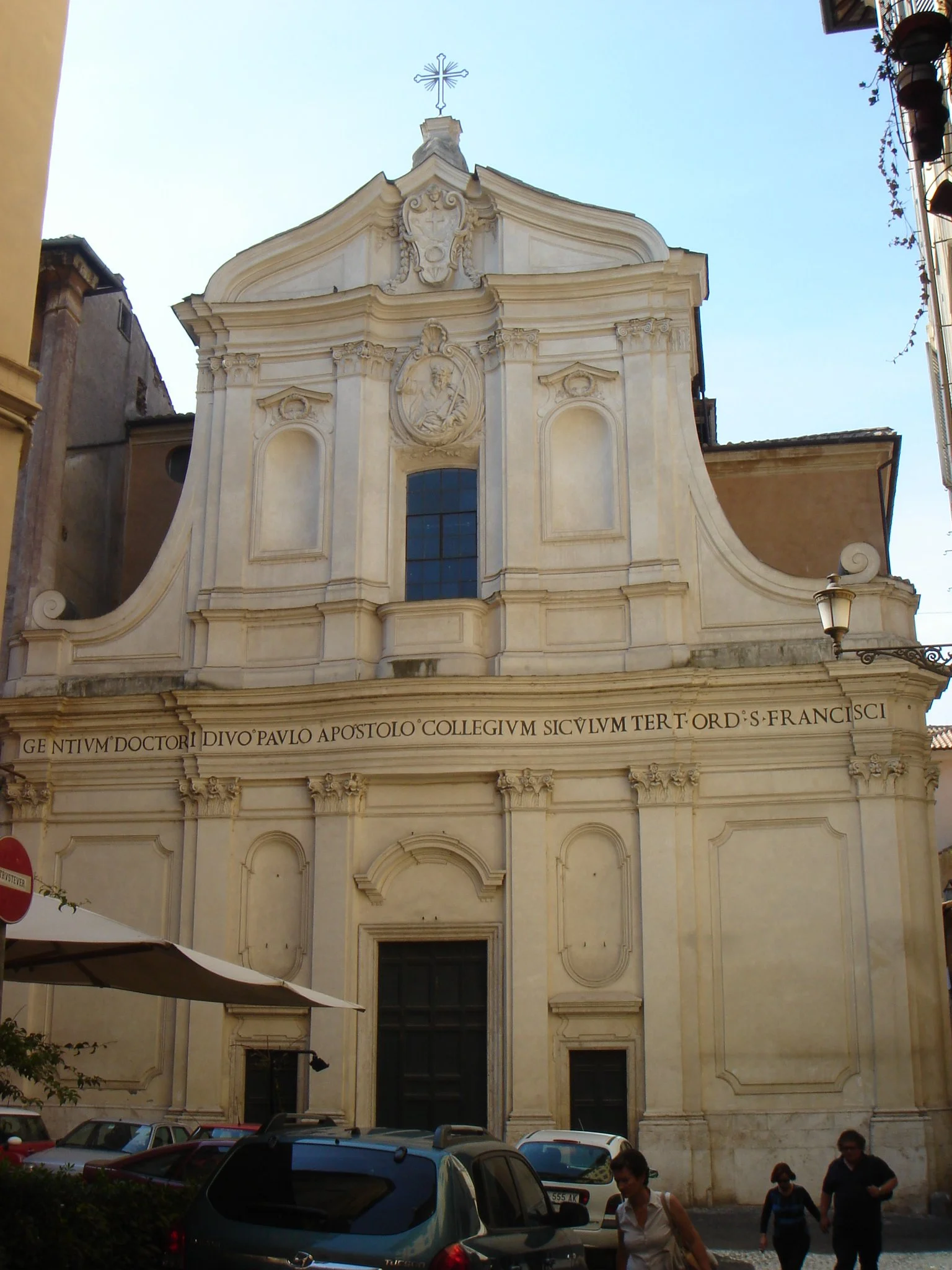
The Church of San Paolo alla Regola stands in the heart of the Regola district, the seventh of Rome's 22 rioni, a short walk from the Tiber and halfway between Campo de’ Fiori and the Lungotevere dei Vallati. It's a church that almost nobody looks for and that a great many people walk past without noticing, because it faces a small side square, off the flow of people heading down from the market toward the river. Yet under this block, and under the buildings around it, lies one of the best-layered complexes from the Roman era in the historic center: massive imperial walls four floors high, two underground and two still standing above ground, reworked and raised in the Middle Ages and then absorbed into modern buildings, with nobody, until the 1970s, truly suspecting how much was there. On top of this there is a tenacious devotional tradition that places the Roman home of the apostle Paul right here during his stay in the city. It is an old and deeply rooted tradition, but it has to be said right away, and clearly, that it is not a historical fact and is not confirmed by any ancient source. The lines that follow tell what is really under and above this square, what the sources say and what is instead medieval devotional construction, how the Baroque church you see today came about, why the district is called Regola, and how you can try to visit the underground rooms.
A Note on the Name: Church, Not Basilica
The Church of San Paolo alla Regola is not a basilica. It is a rectory, meaning a non-parish church entrusted to the care of a religious institute, in its case the Third Order Regular of St. Francis, and it is also the seat of a cardinal deaconry of the same name, established by Pope Pius XII on January 25, 1946 with the apostolic constitution Sancti Hadriani Ecclesia. The title of basilica, in the canonical sense, is granted by the Holy See through a formal act and carries precise liturgical privileges. In Rome it belongs to the four papal basilicas and a limited number of minor basilicas, and San Paolo alla Regola is not on that list. It's a distinction worth making right away, because online the church is sometimes called a basilica because of its similarity to the far more famous Basilica of San Paolo fuori le Mura, which is one of the four papal basilicas and has nothing to do with the church in the Regola district except the dedication to the same apostle.
Where the Church of San Paolo alla Regola Is and How to Get There
The Church of San Paolo alla Regola faces the square of the same name, in the Regola district, in the quadrilateral between Via Arenula, the Lungotevere dei Vallati, Via dei Giubbonari and Via di Santa Maria in Monticelli. It's a corner of the historic center a few minutes on foot from Campo de’ Fiori, the ghetto and Ponte Sisto, and this in-between position is exactly why so many visitors walk right past it without seeing it: the little square is not crossed by any of the main routes leading to the best-known monuments.
On Foot from the Historic Center
From Campo de’ Fiori it takes barely five minutes. Take Via dei Giubbonari, the street of the old jacket makers that is still one of the liveliest shopping streets in the center, and head down toward Via Arenula, taking one of the side streets on the right, for example Via dei Balestrari or Via di San Paolo alla Regola, which carries the name of the church. From Piazza Farnese the route is just as short, through Via dei Baullari and Via del Monte della Farina. From Piazza Navona it takes about 12 minutes, heading down toward Corso Vittorio Emanuele II and crossing it at Sant’Andrea della Valle. From the Tiber Island it's less than 10 minutes, going back up the Lungotevere dei Cenci and then the Vallati.
By Public Transport
The most convenient stop is on Via Arenula, the road that links Largo Argentina to Ponte Garibaldi and is served by the trams and buses that cross the historic center from north to south. The main interchange hub remains Largo di Torre Argentina, five or six minutes on foot, where many surface lines meet and where you'll also find the archaeological area of the Republican temples, now visitable on the walkway built along its perimeter. Anyone who wants to combine the two stops can start right from Largo Torre Argentina and then head down toward the river. The nearest metro station is not very convenient: Line B stops at Colosseo, Line A at Barberini or Spagna, and either way you need a stretch above ground or a good 20-minute walk. For anyone arriving from Termini, the most direct solution is still a surface bus heading down toward Largo Argentina.
The Regola District and the Origin of the Name: From the Tiber's Sand
The Regola district is Rome's seventh rione, listed in the official numbering as R. VII, and its name has nothing to do with the rules of a religious order or with the rule of St. Francis, as you sometimes read. It comes instead from renula, the fine sand, the soft sand that the Tiber deposited on its bank at every flood and that formed beaches and banks along the left side, right on this stretch of the river. From renula it became arenula, and the form survived intact in the name of the district's main street, Via Arenula, opened in the second half of the 1800s. The district's historic administrative name, attested from 1586, was Arenule et Chacabariorum, where the second part refers to the caccabari, the craftsmen who worked copper cauldrons and pots, one of the many guilds that gave their names to the streets of this neighborhood.
The Renella: A Beach in the Middle of Rome
To really understand the name you have to picture the Tiber before the embankment walls. Until 1875, when the embankment works began after the disastrous flood of 1870, the river ran in direct contact with the city. It had low quays, landing places, little stairways, warehouses facing the water and, in some stretches, real sand beaches where boats were hauled ashore, nets were spread out and laundry was washed. The renella was one of these, and it lay right here, under today's Lungotevere dei Vallati. The travertine embankment walls 10 meters high, built between 1875 and the early 1900s, wiped all this out in one generation. They protected the city from floods, and at the same time they cut the daily relationship between Romans and their river. The name of the district is one of the few remnants of that world.
The Roman Rooms Below: The Insula of San Paolo alla Regola
Under and around the church lies a complex from the imperial era known to archaeologists as the insula of San Paolo alla Regola, brought to light between 1978 and 1982 during a municipal restoration and urban renewal project for a group of publicly owned buildings between Via del Conservatorio and the church of the Santissima Trinità dei Pellegrini. The wording of the Capitoline Superintendency is blunt: that work surprisingly brought to light massive structures of the Roman era preserved over four floors in height, two underground and two above, reworked and raised almost to their present state already in the Middle Ages. It is the most important technical fact on this whole page, and it is also what sets this site apart from any other underground site in central Rome. Here there is not just a basement level, there is a Roman building still standing across four levels, with the top two not underground at all but inside the houses where people kept living for 15 centuries.
Four Stacked Levels: What It Really Means
Most of the underground Roman sites you can visit in Rome are structures buried by the gradual rise of the street level: the Basilica of Santa Cecilia in Trastevere, the Roman Houses of the Celio and the Domus Romane of Palazzo Valentini all work that way, with an ancient level now underground and a modern building constructed above. The case of San Paolo alla Regola is different for a precise reason: the Roman building was tall, and its vertical development survived. The two lower floors ended up underground because the ground rose through floods and the dumping of centuries, but the two upper ones did not. They stayed in use, and were cut, walled up, pierced, modernized and finally absorbed into the medieval and modern buildings. Anyone walking in those rooms today is not just crossing a basement level. They are crossing the vertical cross-section of a Roman apartment block.
Warehouses, Workshops and the Sail Trade
The original purpose of this whole sector, from the age of Augustus, was warehouses and activities connected to life on the river. The Tiber, along this stretch, was a heavily used transport route. Goods came up from Ostia on towed boats, were unloaded on the quays and stored in depots that faced the water directly or stood a block away. Among the activities documented in this area was also the making of tents and sails, a trade tied as much to navigation as to the temporary coverings that Rome needed for markets, shows and building sites. It's a detail that comes back insistently in the literature on this place, and for a reason we'll see further on: according to the Acts of the Apostles, tent making was the trade by which Paul of Tarsus supported himself.
Horrea: What the Roman Warehouses Were
The term horrea means warehouses in Latin, and in imperial Rome they were anything but modest buildings: multi-story structures organized around porticoed courtyards, with vaulted rooms, raised floors to keep goods away from damp, ventilation systems, service stairs and sometimes ramps for carts. The largest horrea, like the Horrea Galbana under the Aventine or the horrea of Ostia, occupied entire blocks and employed hundreds of people among porters, guards, measurers and scribes. A Roman warehouse was, in essence, an industrial building, and its architecture was designed for loading, storage and distribution. The structures of San Paolo alla Regola belong to this functional family, and that explains both their sturdiness and the reason they have lasted so long: they were built to bear enormous weights.
On the Exact Dating, Caution Is in Order
On the precise chronology of the different phases of the complex, popular descriptions diverge, and it's better to say so openly than to pick a date and present it as certain. The documentation of the Capitoline Superintendency speaks generically of structures of the Roman era, while other sources point to use of the area as warehouses from the Augustan age and place the surviving walls in the full imperial period. That the complex had more than one phase is certain, because the layered walls that emerged in the excavations say so themselves. What the date of each phase is, and in particular which century the two underground levels belong to, is something the specialist publications pin down and that general descriptions report inconsistently. Anyone looking for the exact chronology should turn to the archaeological literature, not to popular guides.
The Middle Ages Built Inside the Roman
The most fascinating part of the complex is perhaps not the Roman one but the one that came after. The excavations showed layered walls that attest four floors of construction with uses that changed over time, set on a street layout that is, with minimal variations, the one that has come down to us. It means that the streets of this part of the Regola district still follow the Roman axes today. Anyone walking along Via di San Paolo alla Regola or Via del Conservatorio follows, without knowing it, a route that is 2,000 years old. And it means that the medieval builders, instead of demolishing, reused. They walled up the Roman arches, built new vaults inside the old ones, and added floors on top using the existing walls as free foundations. It's the mechanism that allowed Rome to survive itself, and here you can read it vertically, floor by floor.
The Case di San Paolo, Seven Buildings from the 1200s
A short distance from the church, along Via di Santa Maria in Monticelli, another important piece of this story survives: the so-called Case di San Paolo, a complex of seven closely connected medieval buildings that date to the end of the 13th century. They are houses with porticoes, with low columns with wide shafts, brick facing in the lower part and tufa blocks in the upper part, a real tower at the far end and loggias with a roof. Between 1913 and 1924, during construction of the Ministry of Grace and Justice, these buildings were slated for demolition and were saved only by the intervention of a preservation association, the Amici dei Monumenti, which obtained that they be absorbed into the new ministry rather than torn down. The rescue was not painless, though: in 1938 a restoration by the Superintendency of Monuments of Lazio profoundly changed their outer appearance and inner layout, opening large windows, raising roofs and adding peperino elements imitating the original ones. Anyone looking at them today sees a Middle Ages that was partly reinvented in the 1930s, and it's right to know that.
The Tradition of St. Paul's House: What It Says and What It Doesn't Prove
The tradition that places the Roman home of the apostle Paul at San Paolo alla Regola is a devotional tradition, not a historical fact. No reliable ancient source points to this place, or to any other specific place in Rome, as the apostle's residence. It has to be said this bluntly at the outset, because many popular descriptions present it as settled, and it isn't. This takes nothing away from the interest of the tradition, which is old, documented in its medieval stages and able to have shaped the devotional topography of a whole district. It only removes the mistake of taking it for history.
What the Acts of the Apostles Really Say
The starting point is the closing chapter of the Acts of the Apostles, which tells of Paul's arrival in Rome as a prisoner awaiting judgment, after he appealed to Caesar's tribunal as a Roman citizen. The text says he stayed two years under relaxed custody, in lodgings he rented, free to receive whoever he wanted and to preach freely. What the text does not say is where. It names no streets, no neighborhoods, no buildings. Every Roman location of Paul's house, this one included, comes later and is the product of medieval devotional elaboration, not of a continuous documentary memory.
The Tent-Making Trade and the Jewish Quarter
The argument on which the tradition leans most heavily is circumstantial, and it must be acknowledged that it is not trivial. The Acts of the Apostles indicate that Paul practiced the trade of tent maker and used it to support himself during his missionary journeys. This sector of the Campo Marzio, facing the river, hosted exactly that kind of activity, tied to sails and tarpaulins, and it was also one of the districts where Jewish communities that had come to Rome in the late Republican and imperial periods had settled. Apostolic preaching, according to the account in Acts, normally began precisely from the synagogues and Jewish communities of the cities. So the reasoning is: Paul made tents, tents were made here, Jews lived here, therefore Paul was here. It is a plausible argument as general context and completely worthless as proof of a specific address, because the same chain of plausibility holds for the entire river front of the city.
The 1245 Parchment and the Contrada Pauli
The medieval document at the base of the whole construction is a parchment of 1245 in which the area is indicated with the formula in loco ubi dicitur Pauli, that is, in the place called of Paul. For a good part of the Middle Ages the area was called Contrada Pauli. The scholars who support the tradition fill in the formula by understanding the word schola, and so read the reference as the school of Paul, the place where the apostle supposedly taught catechesis. The more cautious scholars note that the Latin formula, as it has reached us, says only that the place carried Paul's name, which is compatible with a devotion already in existence but does not explain it and certainly does not ground it in a memory from the first century.
The Alternative Hypothesis: A Misunderstanding Born from a Bas-Relief
There is an alternative explanation, worth reporting in full because it's the kind of hypothesis that makes an account honest. According to some scholars the tradition would not arise from a Pauline memory at all, but from a misreading of a bas-relief kept in the nearby church of Santa Maria in Monticelli, showing an old teacher instructing in the medieval oratory attached to that church. From that figure of a teacher the idea of a schola would have arisen, and from the schola the identification with Paul, the teacher of the nations par excellence. If that's how it went, the Contrada Pauli would be the product of a 13th-century iconographic misunderstanding and not of an apostolic memory. Neither reconstruction is proven, and it's right to keep both on the table.
Two Houses, 100 Meters Apart
There is a detail that the defenders of the tradition tend to play down and that deserves attention instead: Paul's house, in this district, is indicated in two different spots. One tradition places it under the church of San Paolo alla Regola, where the apostle's room, turned into a chapel, is still shown today. Another places it in the Case di San Paolo on Via di Santa Maria in Monticelli, about a hundred meters away. Those who support the tradition read the double indication as a confirmation, in the sense that two converging memories would prove the apostle's presence in the area. Those who dispute it read exactly the same fact as the typical symptom of a local legend that multiplies and moves. The second reasoning is methodologically sounder: devotional traditions tend to produce more places for the same event, while documentary memories tend to stay anchored to a single point.
The Apostle's Room Turned into a Chapel
Inside the church they still point out a room identified as the one where Paul supposedly lived, turned into a chapel. According to the tradition reported by the local tradition, here the apostle supposedly wrote some of the letters composed during his Roman imprisonment, specifically those to the Colossians, to Philemon, to the Ephesians and to the Philippians. Here too an honest clarification is needed: biblical criticism has been debating for over a century both the place where those letters were written, which several scholars place in Ephesus or Caesarea rather than Rome, and the direct Pauline authorship of some of them. The attribution of the room is therefore a construction of devotion in several layers, and it should be viewed as such: as a place of memory, not as a reconstructed crime scene.
The Relationship with Santa Maria in via Lata: Two Parallel Traditions
The very same tradition about St. Paul's Roman imprisonment is claimed by another church in Rome, the Basilica of Santa Maria in via Lata, on the Corso, where under the floor there is a crypt carved out of a Roman building of the imperial era later turned into a warehouse and a place of worship. Two different churches, in two different districts, both with Roman structures in their basements, both with a devotional memory tying them to the same person and the same two years: it is the simplest demonstration that we are dealing with medieval devotional constructions and not a single, continuous historical memory.
Why the Two Traditions Coexist Without Excluding Each Other
The interesting thing is that the two traditions have never fought each other. They have coexisted for centuries, each with its own devout public, without any authority ever feeling the need to arbitrate. The reason is that they answer different needs. Santa Maria in via Lata, on the urban Via Flaminia and at a point of maximum foot traffic, offers a scenic crypt, a well tied to a miraculous episode and the double memory of Paul and of Luke, who according to medieval devotion supposedly wrote the Acts of the Apostles here. San Paolo alla Regola, off to the side and far less visited, offers instead the context: the district of tents and sails, the river front, the Jewish community, that is, the set of circumstances that makes the apostle's presence in this part of the city historically plausible even without being proven. The first has the scene, the second has the backdrop.
The Baroque Church: Bergonzoni, Coli, Sardi
The church you see today is a Baroque building, rebuilt from scratch at the end of the 1600s and completed in the early 1700s, which preserves almost nothing of the earlier medieval structure except a few reused elements. The design of the reconstruction is due to the Bolognese architect Giovanni Battista Bergonzoni, who drew a Greek-cross plan topped by a dome, with four chapels at the corners covered by smaller domes: a compact central scheme, suited to a narrow, irregular lot like that of this block, and very far from the longitudinal single-nave scheme that 17th-century Rome had made almost obligatory for convent churches.
The Facade of 1728
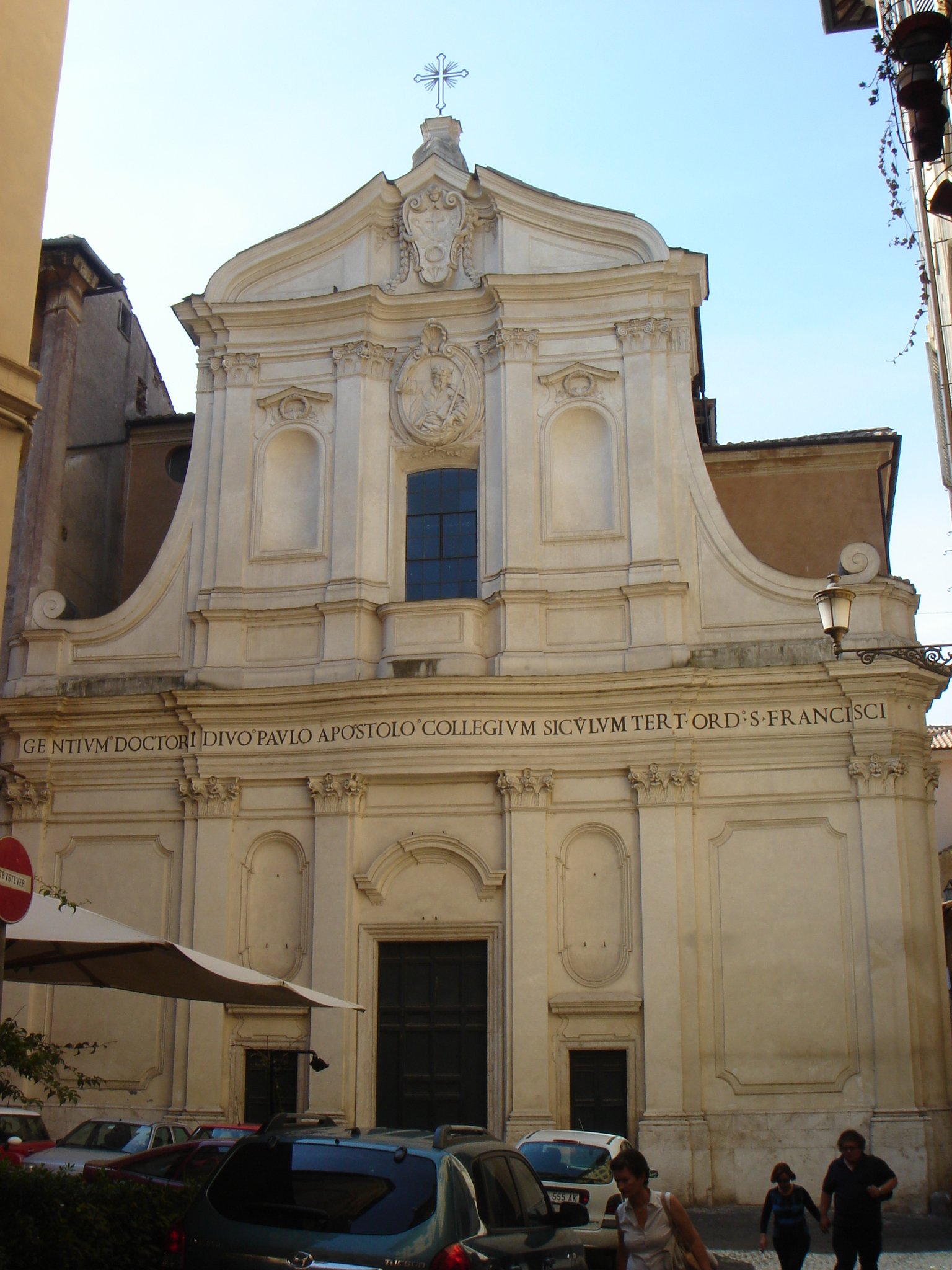
The church was completed only in 1728 with the facade, the work of Giuseppe Sardi from a design by Giacomo Coli. It is a two-order facade: the lower one has six pilasters framing the central portal and two small side doors, the upper one a large window with a sort of little balcony in front and an oval with a depiction of St. Paul. Between the two orders runs the dedicatory inscription GENTIUM DOCTORI DIVO PAULO APOSTOLO COLLEGIUM SICULUM TERT ORD S FRANCISCI, that is, to the teacher of the nations, the divine Paul the apostle, the Sicilian College of the Third Order of St. Francis: a dedication that says in five words who was in charge here in the 1700s and to whom the church was dedicated.
The Sicilian College and the Sicilian Franciscans
In 1619 the church, after being served for a long time by the Augustinians, was entrusted to the Franciscans of the Third Order Regular of St. Francis of the so-called Sicilian Nation, who set up a Collegium Siculum there, housed in the building next to the church and still standing today on its left. The building rises over four floors of five framed windows each. At ground level, between the doors of the segmental-arched coach houses, there is a small lintelled door topped by a decorated oval window protected by a grille. The college enjoyed the direct protection of King Philip IV of Spain, under whose crown Sicily then stood, and had a sizable library, specialized in philosophy and theology, and a substantial archive. Both were destroyed in the turmoil of the first Roman Republic, in 1799: a heavy documentary loss, which is also the reason the inner history of this church can be reconstructed today only in fragments. Attached to the church is also the Oratory of San Giacomo, seat of the university of the Cappellari, that is, the guild of hat makers, the same one that gave its name to the nearby Via dei Cappellari.
A Discrepancy over the Convent's Dates
On the adjoining convent the sources don't agree, and it's best to report both. Some descriptions identify the building to the left of the church as the seat of the Collegium Siculum already from 1619. Others state that the adjoining convent, now home to a community of the Sodalizio di Vita Cristiana, was built between 1740 and 1750 by the Discalced Augustinians. The two statements may refer to two distinct buildings on the same block, or one of the two may be inaccurate. Anyone who wants the exact fact should consult the specialist literature on the district, in particular the volumes on rione VII Regola in the series on the rioni of Rome.
Inside the Church: The Plaque of 1096 and the Madonna delle Grazie
The interior holds two elements of particular interest, both older than the building that houses them. The first is a plaque dated 1096, set into the wall above the high altar, coming from the church of San Cesareo, which stood in the nearby Piazza della Trinità dei Pellegrini next to the old oratory and was demolished to make room for the Hospice of the Convalescents and Pilgrims. The plaque was dedicated to St. Caesarius, deacon and martyr, and is today the oldest testimony physically present in the building. The second is a 1300s fresco showing a nursing Madonna, known as the Madonna delle Grazie and venerated as a miraculous image: a Madonna of the milk, an iconographic type very widespread in central Italy between the 1200s and the 1400s and then progressively discouraged by the post-Tridentine Catholic reform, which looked with suspicion on the depiction of a bare breast.
A Curiosity About the Church of San Paolo alla Regola
For centuries Romans did not call this church San Paolo alla Regola. They called it San Paolino. The diminutive was not popular sloppiness but a practical necessity, because Rome already had a big, unquestionable San Paolo, the papal basilica on Via Ostiense, and calling a little district church the same thing would have caused intolerable daily confusion. The Roman people solved the problem the way they always do, with a suffix: the big one stays San Paolo, the small one becomes San Paolino.
A Diminutive That Tells the Hierarchy
The mechanism holds across all of Rome's religious place names and helps you read the street plaques: the major church keeps the full name, the minor ones take the diminutive, the trade of the guild that served them or a specification of place. In the official name of this church the specification is the district: alla Regola serves exactly to distinguish it from fuori le Mura.
Something Nobody Tells You About the Church of San Paolo alla Regola
The Roman rooms of San Paolo alla Regola were not discovered by an archaeological dig. They were discovered by a public housing construction site. Between 1978 and 1982 the City of Rome started a restoration and urban renewal project on a group of buildings it owned, between Via del Conservatorio and the church of the Santissima Trinità dei Pellegrini, that is, on ordinary houses in the historic center that needed fixing up. When they started putting hands to the walls, they realized those walls were Roman, and that they were Roman for four floors in height.
What This Discovery Changed
The consequence is that the very image of this part of the Campo Marzio changed. Before 1978 the sector between Campo de’ Fiori and the river was considered, from an archaeological point of view, little more than a buffer zone. It was known that in Roman times there were warehouses and river activities, but there was no preserved building to prove it standing above ground. Afterward, it became clear that under the minor buildings of the Regola district a Roman fabric survives that is far more intact than anyone thought, and that the medieval and modern street grid follows the ancient one with remarkable fidelity. It's the same kind of revelation that the Crypta Balbi produced for the sector immediately to the east, where an urban excavation carried out on a run-down block yielded the complete sequence from the Augustan age to the 1900s and gave rise to one of the smartest museums in Rome.
My Advice for Visiting the Church of San Paolo alla Regola
The most useful advice concerns access itself, and it has to be given plainly: the underground Roman rooms of San Paolo alla Regola are not an ordinary open archaeological site, with a ticket office and published hours, and there is no way to show up and ask to go down. They are structures in the custody of the Capitoline Superintendency for Cultural Heritage, kept inside buildings that have other uses, and visits take place on specific occasions: extraordinary openings, days dedicated to heritage, guided tours organized by reservation. Anyone who wants to see them must find out beforehand, and must do so with the Capitoline Superintendency or through the official channels of the City of Rome, because the calendar is not stable and changes from year to year.
What Is Not Confirmed
It must be said just as clearly that it was not possible to confirm, through official sources that can be consulted, either an opening time for the underground rooms or a stable, published reservation procedure. The institutional pages describing the complex document its history and archaeological substance, but don't give up-to-date visiting information. Readers should therefore not treat the Roman rooms as a stop you can plan around. Treat them as an opportunity to seize if and when it is offered, and check every piece of information directly with the body that has custody of them, by calling the Rome tourism contact center of Roma Capitale or writing to the Superintendency.
The Church Above: Better to Check There Too
A similar caution applies to the church, less strict but real. San Paolo alla Regola is a rectory, not a parish, and Roman rectories keep much shorter and more variable hours than parishes: they often open in short windows tied to services and stay closed the rest of the day. No stable official hours are published, so it's best to phone or stop by at Mass time. If you find it closed, don't treat it as a surprise. It's the normal condition of many minor churches in the historic center, and part of the game.
How to Build a Visit That Works Anyway
The smart way to approach this place is not to make it a destination but a chapter. You start from Campo de’ Fiori in the morning, when the market is still up. You go down Via dei Giubbonari looking at the signs and doorways. You reach the square of San Paolo alla Regola and read the facade with the inscription of the Sicilian College. You continue 100 meters to the Case di San Paolo on Via di Santa Maria in Monticelli, which you can see from outside with no permits needed. You pass in front of the Church of the Santissima Trinità dei Pellegrini, which is two steps away and has a remarkable hospital history. And you finish on the Lungotevere dei Vallati looking at the river from where the renella used to be. All of this takes 40 minutes, costs nothing and doesn't depend on any opening.
Another Well-Known Fact, Yet Rarely Cited
The Regola district was born and grew as the district of the river, and this fact, obvious as it is, is almost always forgotten when describing the area today. Before the embankment walls, the Lungotevere did not exist: the houses reached the water, with little stairways going down to the bank, warehouses on the ground floor and private landing places. River trade was the main economic activity of the whole sector, and the Roman layering that emerged under San Paolo alla Regola is its oldest and most concrete testimony.
The Floods That Raised the Ground
The flip side was the floods. The Tiber flooded this district regularly, and the plaques marking the water line set into many buildings in the center still recall it: the flood of 1870 was the last straw that convinced the new Italian state to build the embankments. The progressive raising of the street level, which buried the two lower levels of the Roman building, is in large part the result of that cycle: every flood brought mud, every rebuilding raised the level.
The Right Photo to Take at the Church of San Paolo alla Regola
The right photo at San Paolo alla Regola is not the frontal facade, which is squeezed by the narrowness of the square and which won't fit in the frame with a normal lens without distorting. The right photo is the one that puts two things together: the facade of the church on the right and the front of the Sicilian College on the left, shot at a three-quarter angle from the opposite corner of the little square. In that frame you can read the whole story of this block, that is, a district church and the institution that governed it, and you understand why the two were built together.
The Case di San Paolo, 100 Meters Farther On
The strongest photographic subject of the whole walk, though, is not the church. It's the Case di San Paolo on Via di Santa Maria in Monticelli, with the porticoes on low columns, the tufa-block facing, the tower and the mullioned windows. The best light is early afternoon. It's worth photographing them even knowing that their current look is partly the result of the 1938 restoration, because it's still one of the very few fronts of medieval civil building that can be read in the center of Rome, and because the contrast with the Umbertine bulk of the ministry behind them says in a single image what happened to this district between the 1800s and 1900s.
Some Important Events That Happened Here in History
The chronology of San Paolo alla Regola is built on a few documentary fixed points and on many traditional passages, and it's best to keep them distinct. The first certain, verifiable fact is late: the church appears in a bull of Pope Urban III from 1186, which lists it as a parish dependent on San Lorenzo in Damaso. From there on the sequence becomes progressively more solid.
From the 1200s to the 1600s
In 1245 a parchment records the area as the place called of Paul, the Contrada Pauli: it is the oldest attestation of the Pauline tradition in this district. The core of the Case di San Paolo, the seven medieval buildings of Via di Santa Maria in Monticelli, dates to the end of the 13th century. In 1619 the church passes to the Franciscans of the Third Order Regular of the Sicilian Nation, who found the Collegium Siculum there under the protection of Philip IV of Spain. At the end of the 1600s the reconstruction begins, designed by Giovanni Battista Bergonzoni, who gives the church the central Greek-cross plan it still has today.
The 1700s and the End of the College
In 1728 the work is completed with the facade by Giuseppe Sardi from a design by Giacomo Coli. Between 1740 and 1750, according to some of the sources, the adjoining convent is built. In 1799, during the turmoil of the first Roman Republic, the library and archive of the Sicilian College are destroyed: it is the most dramatic event in the history of this block, and the reason much of the community's internal documentation is missing today.
The 1800s and 1900s: The River, the Ministry, the Excavations
From 1875 the construction of the Tiber embankment walls erases the historic river front of the district and with it the renella that had given it its name. Between 1913 and 1924 the construction of the Ministry of Grace and Justice puts the Case di San Paolo at risk of demolition, and they are saved by the intervention of the Amici dei Monumenti and absorbed into the ministry building. In 1930 Antonio Muñoz restores the church. In 1938 the Superintendency of Monuments of Lazio heavily restores the Case di San Paolo, changing their appearance. In 1946 Pius XII establishes the cardinal deaconry. Between 1978 and 1982 the municipal renewal project brings to light the Roman structures on four levels: it is the discovery that made this block a chapter of urban archaeology and not just of church history.
Who Has Passed Through the Church of San Paolo alla Regola
The first answer to this question is also the one that must be given with the most caution: according to devotional tradition, Paul of Tarsus, the apostle of the nations, passed through here during the two years of Roman custody told in the Acts of the Apostles. It is a tradition, not an established fact, and no ancient source supports it. Anyone visiting the place should know that, and can still recognize that this memory, true or constructed, has determined the name of a contrada, a church and a street for eight centuries.
Popes, Cardinals and Institutions
On the documented side the names are different. Pope Urban III mentions the church in the bull of 1186. Pope Pius XII establishes the cardinal deaconry there in 1946, and since then the title has been held by several cardinals, among them the nuncio Giuseppe Fietta, the Irish Dominican theologian Michael Browne, who was master general of his order and a prominent figure at the Second Vatican Council, and Francesco Monterisi. King Philip IV of Spain probably never set foot here, but his formal protection of the Sicilian College is fully part of the history of this block.
Architects and Artists
On the side of the craftsmen the certain names are Giovanni Battista Bergonzoni, the Bolognese architect who authored the 17th-century design, Giacomo Coli, author of the facade design, and Giuseppe Sardi, who built it in 1728. Sardi is a name that anyone touring Rome often encounters without realizing it: his, among others, is the Rococo facade of Santa Maria Maddalena, one of the most original of the Roman 1700s. In the 1900s we must add Antonio Muñoz, restorer of the church in 1930 and a key man in the monumental policy of Rome in those years.
The Trades: Hat Makers, Cauldron Makers, Boatmen
But the people who really passed through here in great numbers, day after day for centuries, left no name. They were the hat makers who gathered in the Oratory of San Giacomo attached to the church, the caccabari who beat copper and who gave the second half to the district's historic name, the boatmen and porters who unloaded goods on the renella, the tent and sail makers who worked in the warehouses whose walls still lie under our feet. They are the population that built this piece of the city, and paradoxically they are also the only ones of whom the most solid material traces remain: the walls.
What to See Nearby
San Paolo alla Regola sits at the center of one of the densest quadrants of the historic center, and from here a disproportionate number of things can be reached on foot in a few minutes. To the north is Campo de’ Fiori with the market and the statue of Giordano Bruno, and just beyond it the Palazzo della Cancelleria, one of the first great Renaissance palaces in Rome. To the west, toward Via Giulia, you find Palazzo Spada with the Galleria Spada and its famous Borromini perspective, and the tiny Church of Sant’Eligio degli Orefici, attributed to Raphael.
Toward the River and the Ghetto
Going down to the Lungotevere you reach Ponte Sisto in a few minutes and, on the other side, Trastevere. Heading south along the bank you meet the Tiber Island with its hospital, a thousand years old, the remains of the Ponte Rotto in the middle of the current, and a little farther the Theater of Marcellus with its arches absorbed into the Savelli palace. In the ghetto, between Via del Portico d’Ottavia and Piazza Mattei, you find the Turtle Fountain, which many consider the most beautiful minor fountain in Rome.
For Those Who Want to Stay on the Underground Theme
Anyone who comes here attracted by urban archaeology has, within a quarter of an hour's walk, two other sites that tell the same story by different means: the Crypta Balbi, where an entirely excavated block shows the sequence from the Augustan age to the 1900s, and the Stadium of Domitian under Piazza Navona, where you walk inside the foundations of a building for shows whose shape survived in the layout of the square. Lined up, the three sites explain better than any book how the layering of this city works.
Frequently Asked Questions About the Church of San Paolo alla Regola
Where is the Church of San Paolo alla Regola?
The Church of San Paolo alla Regola is in the square of the same name, in the Regola district, in the historic center of Rome, between Via Arenula and the Lungotevere dei Vallati. It's about five minutes on foot from Campo de’ Fiori, 10 from the Tiber Island and a short distance from the church of the Santissima Trinità dei Pellegrini. The most convenient transport stop is on Via Arenula, while the main interchange hub is Largo di Torre Argentina.
Is it a basilica or a church?
The Church of San Paolo alla Regola is not a basilica. It is a rectory entrusted to the Third Order Regular of St. Francis and is the seat of a cardinal deaconry established by Pius XII in 1946. The title of basilica is a formal grant from the Holy See that this church has not received, and the confusion often comes from the similarity to the Basilica of San Paolo fuori le Mura, which is one of the four papal basilicas of Rome.
Can you visit the underground Roman rooms of San Paolo alla Regola?
The underground Roman rooms of San Paolo alla Regola are not an ordinary open archaeological site and have no published hours or ticket office. The complex, in the custody of the Capitoline Superintendency for Cultural Heritage, can be visited only on extraordinary openings or organized guided tours. It was not possible to confirm a stable reservation procedure: it's best to ask directly at the Superintendency or at the Rome tourism contact center of Roma Capitale before planning anything.
How much does it cost to visit the Church of San Paolo alla Regola?
Admission to the Church of San Paolo alla Regola, as in all churches of Rome open for worship, is free. For the underground Roman rooms there is no ordinary ticket, because they are not open continuously. Any guided tours organized by third parties may involve a fee, which varies depending on who offers them. Any figure you find online should be checked directly with the organizer before booking.
Did Paul really live here?
There is no historical proof that the apostle Paul lived at San Paolo alla Regola. It's a medieval devotional tradition, attested by a parchment of 1245 that calls the area the place of Paul. The Acts of the Apostles tell of a two-year Roman stay under relaxed custody, but don't indicate any specific place in the city. The same tradition is also claimed by the basilica of Santa Maria in via Lata, on the Corso.
How much time do you need to visit the area?
To see the Church of San Paolo alla Regola and its block, 40 minutes is enough, covering the square with the facade and the Sicilian College, the Case di San Paolo on Via di Santa Maria in Monticelli and a look at the Lungotevere dei Vallati. If you widen the walk to Campo de’ Fiori, Palazzo Spada and the Trinità dei Pellegrini, you need a comfortable half day, always on foot and with no need to book anything.
Is the Church of San Paolo alla Regola suitable for children?
The Church of San Paolo alla Regola is a short, quiet visit, so it suits those traveling with children too, but it offers no educational paths or interactive displays. For an audience of children the story works better if you focus on the underground city, explaining that under the asphalt there are Roman warehouses four floors high. For a real underground experience, though, it's best to pair it with a visit to the Crypta Balbi or the Stadium of Domitian.
Why is the district called Regola?
The Regola district takes its name from renula, the fine sand that the Tiber deposited on the bank along this stretch, forming a beach called precisely the renella. The name of Via Arenula, the district's main road, comes from the same root. The historic name attested from 1586 was Arenule et Chacabariorum, where the second part refers to the caccabari, the craftsmen who worked cauldrons and copper pots.
Is the Church of San Paolo alla Regola accessible to people with disabilities?
The Church of San Paolo alla Regola is at square level and access from the main entrance has a modest step, but the square and the surrounding streets are paved with sampietrini, which make the route tiring with a wheelchair or a stroller. The underground Roman rooms, when accessible, are reached by narrow stairs and are not suitable for anyone with mobility difficulties. It's best to check the specific conditions before the visit.
One Last Piece of Advice for Planning the Itinerary
San Paolo alla Regola is not a first-visit destination in Rome, and there's no reason to pretend otherwise: anyone with three days who has never seen the city should go elsewhere. It's instead a precious stop for those who come back, who have already worked through the obligatory list and start to wonder what the fabric of this city is really like beneath the monumental surface. In that light this block is worth a lot, because it brings together in 200 square meters a Roman building four floors high, a medieval contrada born from a devotional misunderstanding, a Baroque church built by a Sicilian community and an Umbertine ministry that swallowed up half a district.
If you're building a broader itinerary in the historic center, linking this stop to the Campo Marzio, the Tiber front and the ghetto, you can find useful planning tools at Tour Leader Pro, while for a more general picture of getting around and destinations in Lazio, Italy Planner is a good resource.