Isola del Cinema
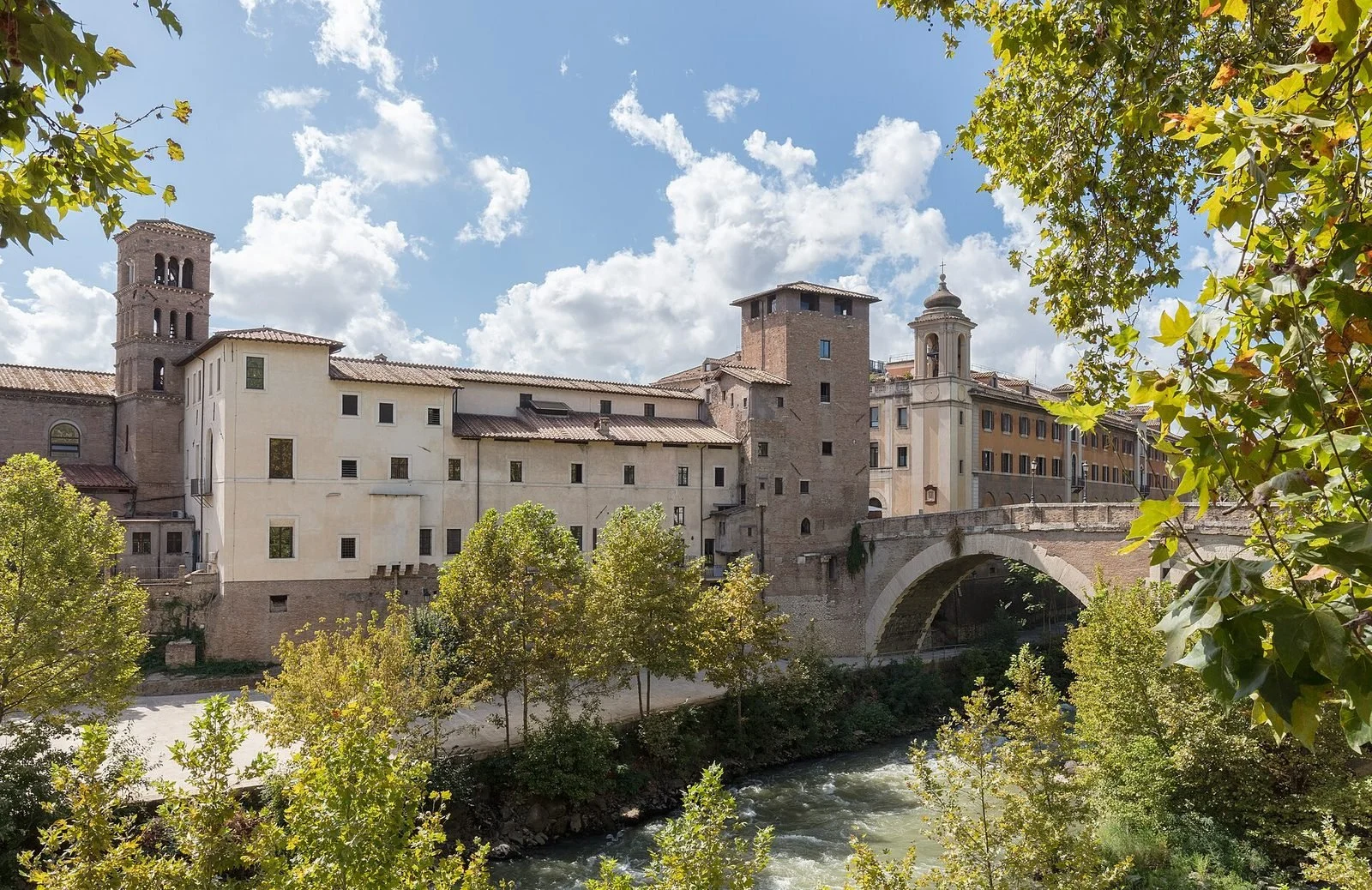
Isola del Cinema is the open-air film series that every summer takes over Tiber Island and the Tiber embankments around it, with screens set up in the middle of the river and evening screenings running from June to the beginning of September. It was born in the second half of the 1990s and has since become the most recognizable summer lineup of open-air cinema in Rome, the one that holds up even in August, when most of the other arenas close. The pages that follow explain what this event is, how an evening works, how you get there and what to expect sitting on a river embankment on a Roman July night. One premise: program, exact dates, number of screens, fares and entry formulas change with every edition, and you won't find them written here as if they were fixed. Here is what stays true from one summer to the next, and where to check the rest.
What Isola del Cinema is and what it isn't
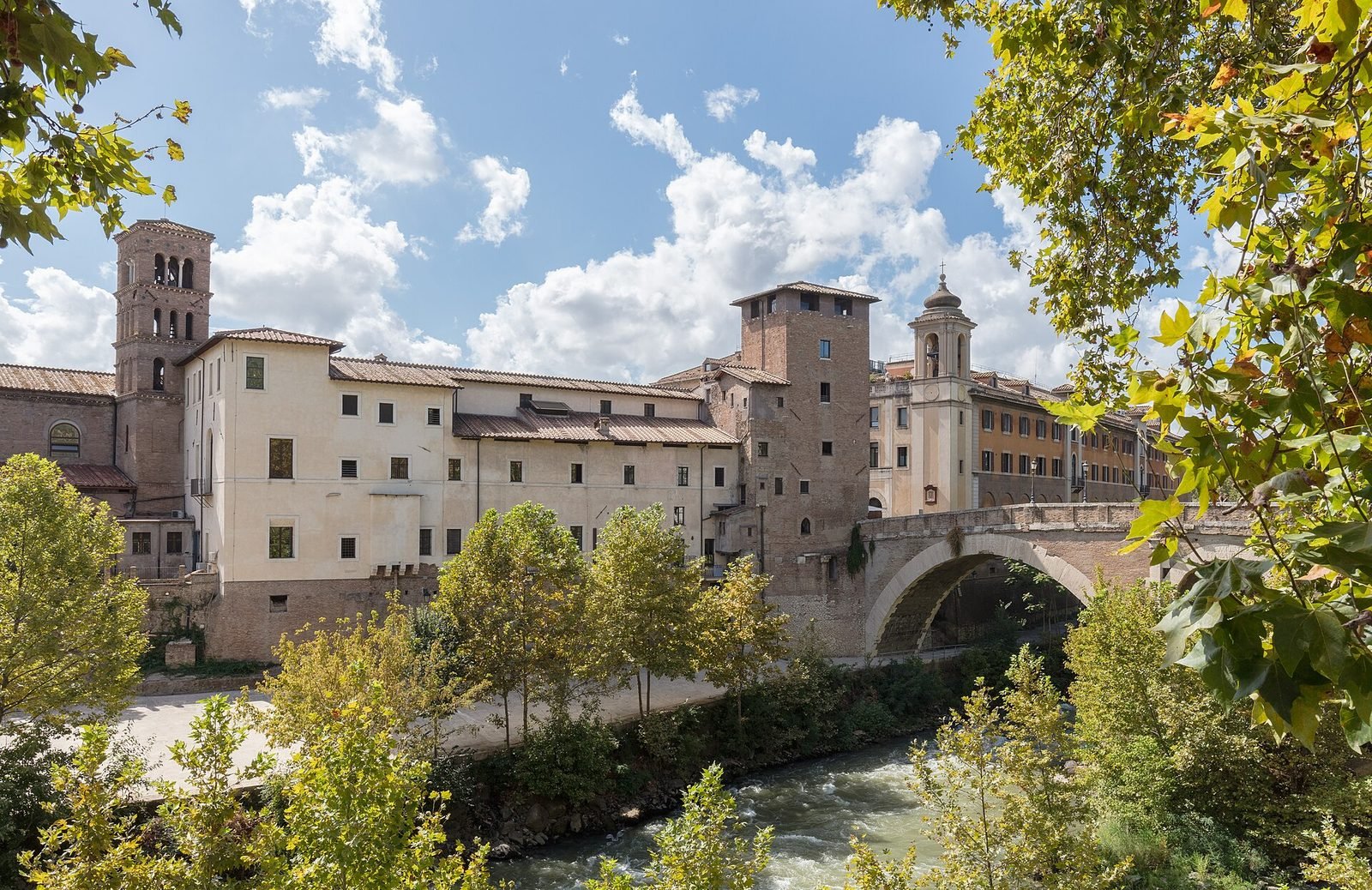
Isola del Cinema is a summer film festival, largely with controlled entry, held on the island in the middle of the Tiber, between Ponte Fabricio and Ponte Cestio, and on the lowered embankments of the river. The setup is temporary and removable, built at the start of summer and taken down in September, and it changes shape every year depending on permits, work on the embankments and the level of the river.
The typical programming brings together previews and Italian films of the season just ended, an international section, documentaries, short films and themed evenings, with talks before or after the screening. Not every edition has the same balance among these components, or the same number of active spaces.
The difference between this page and the overview of the summer arenas
The site already has a page that lines up all of Rome's open-air cinema, neighborhood by neighborhood: it's Rome's Summer Arenas, to read to understand how many arenas there are in the city, which are free, how the city's public notice works and where to find the lineups. This page instead covers a single event, the one on Tiber Island: the overview says what the options are, this one says what it's like to live one of those options and what to factor in before going.
A festival that changes every year, and why it pays to know it
The most important operational trait of Isola del Cinema is variability. Spaces used, number of screens, perimeter of the area, opening time of the gates, presence of refreshment points, ticketing system and even the name under which the event is communicated have changed several times. In recent years the setup has been particularly fluid, amid administrative procedures, work on the embankments and securing of the banks. The practical consequence is just one: any information gathered the previous summer, including the prices a friend remembers paying, must be considered expired.
What stays stable from one edition to the next
Three things have held for almost 30 years. The period: opening in the second half of June, closing between the end of August and the first days of September, Ferragosto included. The place: the island and its embankments, with no moves elsewhere. The formula: you screen in the dark, outdoors, seated on chairs set up on the stone. Everything else gets checked each time.
Where Isola del Cinema is and how to get there
Isola del Cinema takes place on Tiber Island, which is reached exclusively on foot from two bridges: Ponte Fabricio on the side of the Ghetto and Ponte Cestio on the side of Trastevere. There is no third access and you can't arrive by car right up to the entrance: the island is closed to ordinary traffic and the vehicles that access it are the hospital's service vehicles.
On foot from the historic center
From Piazza Venezia you walk about 15 minutes going down Via del Teatro di Marcello, passing the Theater of Marcellus and the Portico of Octavia, and you come out on Lungotevere de' Cenci in front of the start of Ponte Fabricio. From Campo de' Fiori the time is similar, going via Via dei Giubbonari and through the Ghetto. From Piazza Navona allow a good 20 minutes, crossing Ponte Sisto and going back up the Trastevere bank, or staying on the left bank along Via Arenula.
On the Trastevere side you start from Piazza Sonnino or from Santa Maria in Trastevere and in five or 10 minutes you're at Ponte Cestio. Whoever arrives from the Aventine or from the Circus Maximus goes down toward the Mouth of Truth, goes back up the Lungotevere passing the Ponte Rotto and finds Ponte Fabricio after a few hundred meters.
By public transit
The nearest useful stop is that of tram 8 at Piazza Sonnino, on the Trastevere bank, from which you walk five minutes to Ponte Cestio. On the Lungotevere run the bus lines that go along the left bank between the Vatican and the Pyramid, among them the 23 and the 280, with stops close to Ponte Garibaldi. The H line links Termini to Trastevere along Viale Trastevere and also stops at Piazza Sonnino.
There is no metro stop nearby. The closest is Circo Massimo on Line B, from which you need about 15 minutes on foot along the Lungotevere, or Colosseo, which is farther. Whoever arrives from Termini is quicker with the H bus or with tram 8 taken at Piazza Venezia than going down into the metro. The lines and routes of Rome's buses are reorganized fairly often, especially in summer when reduced schedules take effect: it's best to check the route on the transit company's app that same evening. Whoever gets around the city little may find our page on getting around Rome useful.
The return late at night, which is the real problem
A screening that starts at half past nine ends between half past 11 and midnight, when the daytime bus service is closed or much thinned out. Tram 8 stops running late in the evening and is replaced by a night line on the same route, and on the Lungotevere the night runs are few and the waits long. The practical advice is to decide how you'll get home before going in, not at the exit. Toward the historic center the walk is short and the streets stay busy as far as Ponte Sisto. Toward an outlying neighborhood consider a taxi: the nearest stands are at Piazza Sonnino and at Largo Argentina, and at that hour you find a car more easily there than by calling one from the Lungotevere. On how the city works in the small hours we have a dedicated page, Rome at Night.
By car, scooter, bicycle
Arriving by car is the worst solution. The whole area is inside or next to the limited traffic zone of the historic center, the Lungotevere are fast-flowing roads and parking along the river is paid where it exists, with spaces that shrink in summer because of the setups. A scooter solves the return but not the parking: the motorcycle spots on the Lungotevere run out early. The bicycle gets right under the island along the Tiber bike path, which however on event evenings is diverted in the occupied stretch: lock the bike beforehand and leave it there.
How the Tiber Island series began
Isola del Cinema was born in the second half of the 1990s, as an initiative of a group of Roman cultural operators who got permission to set up a screen on the island in the middle of the river. The date that recurs most often in the accounts is 1995, but it's a figure that circulates in the event's presentations and we report it as such: whoever wants the exact figure will find it in the history pages of the festival's official site.
The legacy of Estate Romana
The event arrives inside a precise tradition: that of Estate Romana, the program of summer events invented by the City of Rome in 1977. It was that season that established that in summer the city watches films outdoors and inside its monuments, and created the audience that 20 years later would sit on the embankments.
What has changed in recent years
From the end of the 2010s onward the setup has undergone several transformations: procedures for assigning the spaces, interruptions and restarts, work on the banks, structural checks on the embankment walls, changes to the perimeter. There have been reduced editions and re-expanded editions. We don't reconstruct the administrative chronology here, because it changes while you write it. What matters for whoever has to go is the practical rule: look at this year's program, not the one you remember.
How an evening at Isola del Cinema works
An evening at Isola del Cinema begins when it gets dark: the screenings start after sunset, roughly between 9 and half past 9 in the evening in the central months of summer, and the time shifts slightly as the season advances, because at the end of August the sun sets earlier than at the end of June. The exact time of each screening is published in the daily program and can't be deduced: it has to be read.
The arrival and the wait
The gates open an hour or two early, and in that time the area works as an evening stroll: you walk on the embankment, sit down, look at the river. Many arrive early for exactly this reason. Whoever arrives at the time printed on the ticket finds the rows taken and settles at the edges or the back.
The number of people varies enormously from evening to evening. A popular Italian film with a guest fills everything, while a documentary on a Wednesday in mid-July is watched by 20 people. There is no average crowd: it depends on the title.
The spaces and the screens
The event uses more than one space, spread between the island's plaza and the adjacent stretches of embankment. How many screens are active changes from edition to edition and even during the season. That's why you won't find a number here: it would be wrong next year.
The difference in character between the two locations, though, can be told. The space on the island level, in front of the basilica, is more intimate and sheltered from the wind, while those on the embankment, below street level, are wider, more exposed to the air of the river and noisier, because the traffic of the Lungotevere passes overhead. The first location is more comfortable for hearing the dialogue, the second is more beautiful to look at.
Original language and subtitles
Part of the programming is in the original language with Italian subtitles and part is in Italian, dubbed. Which is which is written in the program next to the title, usually with the abbreviation that indicates the version. Whoever comes from outside Italy and doesn't speak Italian should check this line before buying: it regularly happens that tourists sit down in front of a dubbed Italian comedy and leave halfway.
English subtitles are not guaranteed: on original-language evenings they are almost always in Italian, because the target audience is Italian.
Talks with authors and performers
Many evenings include a presentation before the screening, with the director, some of the cast or a critic. It lasts 10 to 30 minutes, takes place in front of the screen and has no translation. It's the part that sets a festival series apart from a neighborhood arena, and it's also the reason certain evenings start late: a quarter of an hour of slack is normal.
Tickets, entrances and reservations
Tickets for Isola del Cinema are bought on the event's official site or at the box office on site on screening evenings, and the system adopted changes from edition to edition. This is the only answer we can give that stays valid over time, and it's also the only honest one.
Why you won't find a price on this page
The fares have been revised several times, with differences among ordinary screening, preview, special event, reduced ticket and subscription. Writing a figure here would mean handing over a number that in six months will be false and that would still be cited as up to date. The recurring structure is this: you pay for the single screening, reductions exist for some categories, in certain editions there are ticket books or subscriptions, and previews can cost more than an ordinary evening. Access to the embankment stroll alone, where provided, is treated differently.
Booking or showing up
For ordinary evenings the box office on site is enough. For previews, for evenings with announced guests and for the weekends of July, booking ahead avoids being left outside. No seat is numbered in the usual formula: the ticket gives you the right to enter, not to a chair, and you get the chair by arriving early.
Where to check, in practice
The reference is the event's official site and its social channels, where the daily program comes out. The full lineup arrives a few weeks before opening and changes during the season. For the general picture of Rome's summer series, including the free ones, the page on Rome's summer arenas and the calendar of Estate Romana remain useful.
A curiosity about Isola del Cinema
Whoever sits on the embankment downstream of the island watches the film leaning against a stone ship: the southeast side of Tiber Island preserves a travertine facing from the Roman era shaped like a prow, complete with a ram, and above the side runs the relief of a staff with a serpent coiled around it. It's the staff of Aesculapius, the god of medicine, and the ship alludes to the voyage by which his cult would have arrived in Rome from Greece.
The travertine prow
The facing is not an isolated monument placed there as decoration: the ancients clad the entire island to make it look like a ship anchored in the middle of the river, with the prow pointing downstream and the stern upstream, and in the center, according to the most widespread reconstruction, an obelisk serving as the mast. Of all this today the prow fragment remains, visible from the embankment and from Ponte Palatino, eroded, blackened and often partly covered by the debris the river deposits.
That fragment is best seen in the evening, when the setup's lights illuminate the embankment from below and the relief takes on shadow. By day, with the sun high, the stone is flat and you can barely make anything out.
The serpent and the plague
Tradition tells that during an epidemic the Romans sent an embassy to Epidaurus to bring the cult of Asclepius to Rome, and that the sacred serpent, taken aboard the ship, once it had gone up the Tiber would have thrown itself into the water to land right on the island, showing where to build the temple. This is ancient tradition, not chronicle: it should be taken as the foundation story the Romans handed down, not as a reconstruction of the facts.
The solid historical fact is that a sanctuary of Aesculapius existed on the island and that since then the healing vocation has never been interrupted: the hospital that occupies half of the surface is the direct heir of that function. 23 centuries of sick people on the same piece of land in the middle of a river. The cinema, up there, arrived the day before yesterday.
One thing nobody tells you about Isola del Cinema
Less than 50 meters from the screens there is a working hospital, with an emergency room active 24 hours a day: the Fatebenefratelli occupies a good part of Tiber Island, and ambulances come and go throughout the evening, sirens included. No poster writes it, and it's the first piece of information that changes the idea you form of the place.
The sirens, and why it's not a flaw of the organization
During a film an ambulance may pass. More than one may pass. The island's medical traffic doesn't stop for a screening, and it would be wrong if it did. Whoever sits there factors it in the way they factor in mosquitoes.
The coexistence also imposes limits on volumes and hours. An arena in a park can turn up the audio, while this one has to stay within thresholds compatible with inpatient wards a few dozen meters away, and it's one of the reasons why on certain evenings the dialogue is heard less than you'd expect.
The mosquitoes, told as they are
The Tiber embankment in July and August is a humid environment, at water level, with wild vegetation on the embankment walls. The tiger mosquito is there and makes itself felt from the early hours of the evening, that is exactly during screening hours. Repellent is the most useful thing you can put in your bag, along with something that covers the ankles, the part that gets bitten first for someone seated.
Two hours still on a chair at that spot, unprotected, are paid for the next day.
The embankment is a flood bed
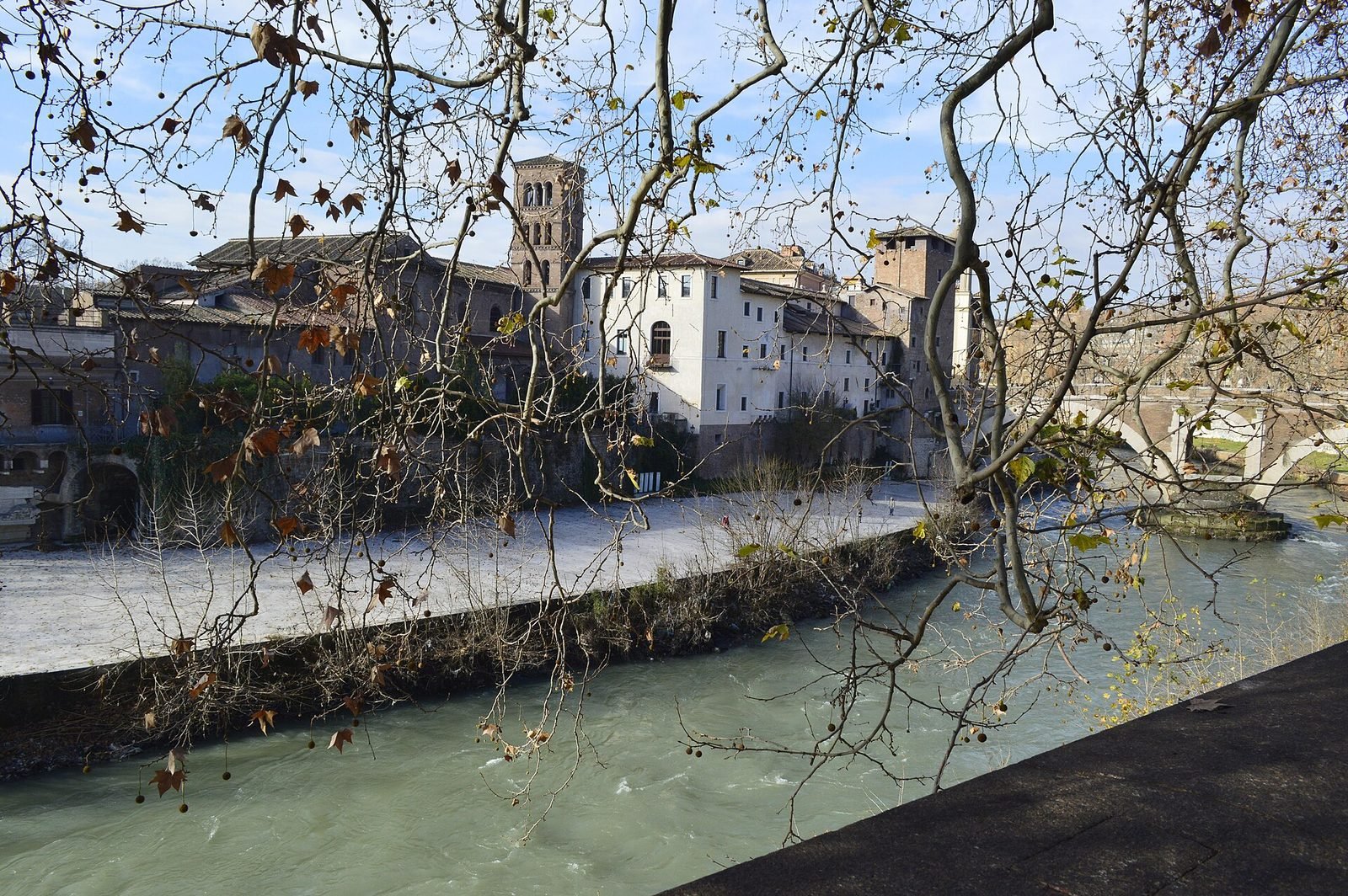
The embankments on which the arena is set up were born as a hydraulic work, not as a space for the public: they are part of the system of embankment walls built after the great flood of 1870 and are designed to go underwater when the river rises. In autumn and winter they regularly end up submerged, and every spring they have to be cleaned of mud and debris before anything can be put on them again.
This has two concrete consequences. The first is that the state of the embankment at the start of summer depends on how the winter went: after a season of strong floods the restoration work is longer and the opening may slip or the usable area may shrink. The second is that the layout of the setup is never identical to the previous year's, because it adapts to what the river left behind. If in a given edition part of the area is missing, the reason is often this, and not an artistic choice.
The work on the banks
On the embankment walls and bridges of the central stretch of the Tiber, checks and securing work have been going on for years, with barriers and closed stretches that appear and disappear. When a worksite affects a bank next to the island the access changes: you enter from only one bridge, the pedestrian route detours, the usual ramp is closed. It determines if it takes you five minutes or 20 to get in.
My advice for visiting Isola del Cinema
The operational advice is worth more than all the others put together: arrive at least 40 minutes before the printed time, because seats are not numbered and the good rows run out in the first half hour after the gates open.
Where to sit, and where not to sit
The best rows are the central ones toward the back, not the first. In the first row you look at the screen from below and keep your neck bent for two hours, while in the central rows the distance is right and you're far from the edges, that is from where people pass and from where the noise of the Lungotevere arrives strongest.
The side to avoid, on the embankment, is the one toward the wall nearest the roadway: from there the traffic covers the quiet dialogue. The side toward the water is cooler and quieter, and it's also the one where the mosquitoes are most aggressive. The reasonable compromise remains the central area, a few rows back.
What to bring
Mosquito repellent, a light sweatshirt, a bottle of water and, for those with back problems, a seat cushion. On the river, even in July, after midnight the temperature drops a few degrees and you feel the humidity: whoever arrives in a T-shirt at the end of August leaves chilled.
Closed shoes, not flip-flops: you walk on uneven stone, go down ramps and there is little light.
Which bridge to come down from
Ponte Cestio, Trastevere side, is the most convenient for those arriving by tram or by the H bus and for those who eat dinner in the area first. Ponte Fabricio, Ghetto side, is more direct from the historic center and leads to the part of the island where the box office and entrance usually are. If the active area is only one, though, the entrance may move: it's best to look at the map published by the organizers.
The right night of the week
Fridays and Saturdays in July are the fullest and noisiest evenings. On Tuesdays and Wednesdays you find a seat without rushing and hear better. In August the Roman audience drops and the foreign one grows: whoever looks for the neighborhood atmosphere finds it more in June and September than at Ferragosto. On the city in that period we have a page of its own, Rome in August.
A verdict, since one is needed
If you're looking for the best technical viewing experience, this isn't it. Open-air audio on a river embankment, with traffic overhead and a hospital next door, doesn't stand up to a movie theater. The value of Isola del Cinema is the place: two hours seated under the arches of a bridge from 62 BC, with the water running three meters away and the lit windows of Trastevere above the embankment wall. Whoever goes for the film alone would do better to go to a theater. Whoever goes to be there is right to go.
How comfortable it is, said without beating around the bush
The Isola del Cinema experience is worth it for the setting, not for the comfort: the seats are outdoor chairs set up on a stone surface, not armchairs, and two hours of film are felt in full. Let's say it before whoever goes finds it out.
The seating
Stackable plastic or metal chairs, in rows, without padded armrests and without a reclined back. On the embankment the surface is not level, so you sometimes get the wobbly chair. Whoever has lower-back problems should bring a cushion: it's the difference between reaching the end credits and getting up halfway.
The noise
Above the embankment pass the Lungotevere, fast-flowing roads open all night. The background noise is always there and rises at rush hour, and to that are added the hospital sirens and the scooters accelerating on the bridges. The audio system compensates up to a point, because the volumes are constrained by the presence of the wards.
The practical result: films with very quiet dialogue or refined sound are poorly appreciated, while comedies, genre films and documentaries with voice-over hold up very well. It's a selection criterion worth using when looking at the program.
The heat, the humidity, the smell of the river
On the embankment the air is a few degrees cooler than on the street: it's the real advantage of river arenas over those in plazas. The downside is the humidity. In the low-water weeks, with the river level low and the current slow, the still water near the banks can have a noticeable smell: it happens, and it's good to know before sitting down.
Accessibility, kids, animals
Access to the Tiber embankments is via ramps and stairways that go down from street level to river level, and this makes Isola del Cinema a place with partial accessibility, to be checked every year with the organizers before going.
Wheelchair and reduced mobility
The ramps that link the Lungotevere to the embankment have uneven slopes and stone or porphyry surfaces, some are passable with assistance, others are not. The island level, above, is instead reached on the flat from the two bridges and is the most workable part. Where the accessible screen is located in a given edition, and if a dedicated route exists, is information to ask the event directly: there is no answer valid for all seasons, and we would give a wrong indication by writing one.
Whoever arrives in a wheelchair should make a phone call first: the organization usually answers precisely, because many people ask them the question.
Kids
The evening format doesn't help small children: it starts in the dark, ends past midnight, seated on hard chairs, with mosquitoes. From age 10 up it works well when the title is suitable. The stroller on the ramps is awkward. Whoever looks for activities designed for the youngest will find a broader picture on the page Rome with Kids.
Eating before or after the film, without falling into the traps
Isola del Cinema sits between the Ghetto and Trastevere, two areas where the density of tourist places is among the highest in Rome, and where the difference between a good dinner and an expensive, mediocre one is decided within 200 meters. Here we don't name signs, by choice: lists of names age in a few months and change management. We give instead the criteria, which last.
The event's kiosks
Inside the area there are usually temporary refreshment points: kiosks for drinks, something quick, gelato. They serve so you don't have to move between one screening and the next. They cost more than the neighborhood average, as anywhere inside a fenced perimeter, and the choice is limited. Whoever wants to really have dinner eats first, outside, and uses the kiosks for the drink after the film. We don't name them one by one because they change every season along with the concessions.
The five signs you're in front of a trap
They are always the same, across the whole city, and within a 10-minute walk of the island you meet them all on the same evening. The first: the lady rolling out fresh pasta in the window or directly on the sidewalk. It's an advertising lure, not a kitchen, and should be read as such. The second: the menu with photos of the dishes, often laminated and translated into five languages. A place that needs to show you the photo of the carbonara is talking to someone who will never come back. The third: the barker at the door who invites you to sit, shows you the free table, tells you they have the best something in the area.
The fourth: the kitchen open without a break from morning to night. A kitchen that never closes is a kitchen that reheats, because no crew can sustain 15 hours of continuous service. The fifth: the position in front of the famous monument. Places facing the most photographed views directly often apply a price calibrated to the tourist in front of them, with unpriced items on the menu, cover and service charges that appear only on the bill, and different price lists inside and outside. It applies to the Lungotevere in front of the island as it does to the squares of the center.
The chain places in the center
In the center of Rome a type of place has multiplied that replicates the same sign in several points of the city, with identical menu, identical decor and often a line managed with a number ticket. As a commercial operation they work, and they are full. We don't recommend them and we don't name them. The observation that matters can be checked by anyone: Romans don't go there. If in a line of 40 people you don't hear a word of Italian, you already have the answer.
The simplest criterion there is
Look at who is seated and in what language they order. Nothing else is needed. A place with tables occupied by locals speaking Italian, with a short, badly written menu, with the kitchen closing in the afternoon, is almost always a better choice than one with the photographed window and the waiter calling you from the street. It works in the Ghetto, it works in Trastevere, it works in Testaccio and it works everywhere.
The personal list, declared for what it is
Whoever prefers to start from a selection already made can look at Daniele Dezi's personal list on Google Maps: it's a curated collection, not sponsored, built on direct experience and not on commercial agreements. It isn't an exhaustive list and doesn't claim to be. It's the starting point of someone who works in those streets.
Another well-known fact, yet rarely cited
Open-air cinema in Rome was not born with Isola del Cinema: it was born in 1977, when the City of Rome inaugurated Estate Romana and began screening films in archaeological areas and squares, with the culture councilor Renato Nicolini as the political director of the operation. The island's series arrives almost 20 years later, inside an already plowed field.
What Massenzio was
The screenings at the Basilica of Maxentius, at the Forums, were the symbol of that season: giant screens inside an ancient monument, popular admission, thousands of people seated on the ground until night. The political idea was that culture should leave the halls to take over the city's spaces, and that in summer the city should stay alive for those who didn't leave.
That season was bitterly debated by those who considered it ephemeral. The term, used then as an accusation, ended up becoming the name of a category: temporary culture, set up and taken down. It's the category an arena on an embankment belongs to.
Why this matters for those going to the island
The audience that today sits on the embankments is the product of that administrative choice of almost 50 years ago. The continuity shows in the mechanism too: Rome's summer series are largely born from municipal public notices and from grants, and the map of the arenas changes every year because the assignees change. The complete picture is in the page on Rome's summer arenas and in the one on Estate Romana.
The right photo to take at Isola del Cinema
The photograph that truly tells Isola del Cinema is not the one of the screen: it's the one of the lit island seen from outside, with the arches of Ponte Fabricio or Ponte Cestio in the foreground and the reflection of the arena's lights on the water. You take it from the neighboring bridge, not from inside the area.
From Ponte Palatino, downstream
The best spot is the parapet of Ponte Palatino, from which you also see the surviving arch of the Ponte Rotto. From there the island is framed whole, sideways, with the travertine prow at the bottom and the setup's lights reflected on the river. The right time is just after sunset, with the sky still blue and the lights already on: it lasts 20 minutes, then the sky turns black and the contrast is lost.
You need a support, because the exposures are long and the bridge vibrates when buses pass: the masonry parapet works as a tripod. Watch the traffic behind you, the sidewalk is narrow.
What you don't photograph
Screenings are not to be filmed: filming the screen is forbidden for rights reasons, and the flash, useless at that distance, bothers those around you. At the talks with guests it's best to ask first, because some presentations have restrictions agreed with the production. The hospital's patients and staff, who pass constantly, are not subjects to frame.
Some important events that happened here in history
Tiber Island has a documented history of over 2,200 years, and almost all of it revolves around two functions: the care of the sick and the crossing of the river. The cinema is the latest arrival, and by far the most recent.
The arrival of the cult of Aesculapius
After a serious epidemic that struck Rome at the end of the fourth century BC, the city imported from Epidaurus the cult of the Greek god of medicine and dedicated a sanctuary to him on the island. Modern sources don't agree on a single date: the plague is placed in 293 BC and the dedication of the temple is set between 291 and 289, depending on the reconstruction. We report the range, not a single figure.
Ponte Fabricio, 62 BC
Ponte Fabricio links the island to the bank of the Campus Martius and is the best-preserved Roman bridge in the city, still in use with its ancient structure. The inscription recalling Lucius Fabricius, the curator of roads who had it built, appears repeated on the arches. You cross it entering from the Ghetto side, and that a crowd walks over it every summer evening, more than 2,000 years later, remains the most surprising fact of the whole business.
The Pierleoni and the medieval tower
In the Middle Ages the island was controlled by the Pierleoni, who made it a fortified stronghold guarding the crossing of the river. Of that system a tower remains toward Ponte Cestio, known as the Caetani tower or the Pulzella tower because of a small relief with a female head set into the facade. Different traditions circulate about whom it depicts and no explanation is established.
The hospital, from the 16th century to today
In 1584 the hospital order of St. John of God, the Fatebenefratelli, obtained the church of San Giovanni Calibita on the island and set up a hospital there that has never stopped functioning since. The continuity between the ancient sanctuary and the modern hospital is the fact that makes this island different from any other piece of Rome: the same function, in the same place, for more than 20 centuries.
The flood of 1870 and the embankment walls
The flood of December 1870, a few months after the capture of Rome, inundated the center and convinced the new State to build the masonry embankments that now enclose the river. The works, designed by the engineer Raffaele Canevari, wiped out the port of Ripetta and the mills, largely rebuilt Ponte Cestio and created the lowered embankments: the space on which the screens are set up today. The summer arena exists because in the 19th century it was decided to confine the Tiber between two walls.
October 1943
During the German occupation of Rome, in the days around the roundup of the Ghetto on October 16, 1943, some doctors at the island's hospital admitted people in flight by inventing a nonexistent and highly contagious disease, indicated in the charts as K syndrome, to discourage checks in the wards. The episode is documented and acknowledged, and concerns a building that can be seen from every point of the event area. The Ghetto begins 50 meters away, on the other side of Ponte Fabricio.
Who has passed through Isola del Cinema
Every summer directors, actors, screenwriters and critics pass through Isola del Cinema to present their film before the screening, but the list of names changes completely with every edition and the organizers publish it in the program of the current season. We don't publish one here, and the reason is simple.
Why you won't find a guest list on this page
Attributing to a person the presence at an evening they did not attend is an error that spreads: it gets copied, picked up by other sites and becomes an established falsehood. Guests are verified on the year's official program, not on a page written earlier. Whoever wants to know who will be there this year should look at the lineup, and whoever wants to know who has been there should look at the archives of past editions.
Who passes through here every evening, anyway
There is the usual Roman audience, the ones who stay in the city in summer and make the arena a weekly appointment, the film buffs who come for a particular section of the program, the tourists who end up there after dinner in Trastevere and buy the ticket on the spot, and the doctors and nurses who come off their shift and cross the area to go home. This last is the category nobody notices and the one that says the most about where you are.
Who passed through the island over the centuries
Long before the cinema, through this rock in the middle of the river passed the sick looking for healing in the sanctuary, pilgrims headed to the basilica, merchants crossing on the two bridges, hospitaller friars, the soldiers of the medieval fortification. And the people who in October 1943 found refuge in the wards.
The island by day and the city's other arenas
Whoever arrives early can use the hour before dark to see the island in daylight: the basilica of San Bartolomeo all'Isola, the wellhead on the presbytery, the passage under Ponte Fabricio and the view of the Ponte Rotto from the downstream tip. Five minutes away are the Synagogue and the Portico of Octavia on the Ghetto side, the Turtle Fountain at Piazza Mattei and, on the opposite side, Santa Cecilia in Trastevere and the Museo di Roma in Trastevere. Whoever has time before dinner can go up the Janiculum for sunset and then come down toward Ponte Cestio.
The other arenas, if this one isn't right for you
Rome has many summer arenas and several are free. In the central quadrant there are Notti di Cinema at Piazza Vittorio in the Esquilino and Il Cinema alle Mura under the Aurelian Walls. Inside Villa Borghese the arena of the Casa del Cinema operates with the Teatro Ettore Scola, while on the outskirts there are Roma Cinema Arena at the Aqueducts Park, Cinema a Forte Antenne inside Villa Ada and the Puntasacra Film Fest at the Idroscalo of Ostia. On the same bank of the river, between Ponte Sublicio and Ponte Sisto, the village of Lungo il Tevere Roma is set up every summer, which is a stroll with stands and not a film series. In autumn the center of gravity shifts to the Festa del Cinema di Roma, at the Auditorium Parco della Musica.
Frequently asked questions about Isola del Cinema
What is Isola del Cinema?
Isola del Cinema is the open-air film series held every summer on Tiber Island, in Rome, and on the Tiber embankments around the island, with evening screenings between June and the beginning of September. The program brings together recent Italian films, international titles, documentaries and short films, with talks and presentations before the screenings. Dates, spaces and entry formulas change with every edition and should be verified on the event's official site.
How much does an Isola del Cinema ticket cost?
The price of the Isola del Cinema ticket changes with every edition and by type of evening, so there is no figure valid over time. The recurring structure provides for payment of the single screening, reductions for some categories and higher fares for previews and special events. The only reliable reference is the event's official site, where fares are published when the lineup opens.
When does Isola del Cinema take place?
Isola del Cinema takes place in the central part of summer, usually from the second half of June to the beginning of September, August included. The exact opening and closing dates are announced by the organizers a few weeks before the start and have changed several times over the years, also depending on work on the embankments and the state of the river after winter. It's best to check the official calendar before planning the evening.
How do you get to Isola del Cinema by public transit?
You reach Isola del Cinema on foot from Ponte Cestio, Trastevere side, or from Ponte Fabricio, Ghetto side: there are no other accesses. The nearest useful stop is Piazza Sonnino, served by tram 8 and the H bus, five minutes on foot. On the Lungotevere run surface lines such as the 23 and the 280. The nearest metro is Circo Massimo, on Line B, about 15 minutes on foot.
Is Isola del Cinema suitable for kids?
Isola del Cinema is poorly suited to kids under 10, because screenings start in the dark, end past midnight and are watched seated on hard outdoor chairs, with the river's mosquitoes. For older kids it works well when the title is suitable, and they like the stroll area on the embankment before the start. Strollers on the access ramps are awkward.
Is Isola del Cinema accessible to people in wheelchairs?
Isola del Cinema has partial accessibility, because the Tiber embankments are reached by ramps and stairways with uneven slopes and stone surfaces, while the island level is reachable on the flat from the two bridges. The existence of a dedicated route and the placement of accessible spaces change with the setup of each edition: it's best to contact the organization directly before going.
Are the films at Isola del Cinema in the original language?
At Isola del Cinema part of the programming is in the original language with Italian subtitles and part is in Italian. The version of each title is shown in the daily program next to the time, and it's the line to check before buying a ticket. English subtitles are not guaranteed and the evenings that include them are a minority, to be looked for in the edition's lineup.
What is the difference between Isola del Cinema and the other summer arenas in Rome?
Isola del Cinema is a single series with its own direction and its own lineup, while Rome's summer arenas are the set of all the open-air cinemas the city puts on every summer, many of them free and neighborhood-based. Whoever wants the full picture, with the selection criteria and the map by quadrant, finds everything on the page dedicated to Rome's summer arenas.
What happens if it rains or the river is in flood?
In case of rain the Isola del Cinema screenings may be suspended or canceled, because the spaces are outdoors and uncovered, and the refund or makeup conditions depend on the edition's rules. A Tiber flood in summer is rare but a rise in the level can reduce the usable area on the embankments. On uncertain evenings it's best to check the official channels a few hours beforehand.
Who wrote this page
This page is edited by the team of Tour Leader Pro, the Rome-based project office that designs and coordinates visits, itineraries and cultural events in Rome and Lazio. Hours, fares and access conditions reported here are verified as of the publication date on the official sources indicated in the text: before leaving it's best to recheck them, because they change often. If you find outdated information, let us know.
Whoever builds an evening around a screening on the island, combining it with a walk in the Ghetto or Trastevere and a dinner before the film, will find planning tools and organizational support at Tour Leader Pro, which works on itineraries built on the real hours of the places.
For the broader picture, that is for whoever is organizing a trip to Italy and wants to understand how to fit Rome together with the rest, including distances, trains and the Lazio destinations reachable in a day, a useful resource is Italy Planner.