Basilica di San Giorgio in Velabro
In short. The Basilica di San Giorgio in Velabro is at Via del Velabro 19, in the Ripa district, set against the side of the Arco degli Argentari and about 30 meters from the Arch of Janus, in the area of the Forum Boarium.
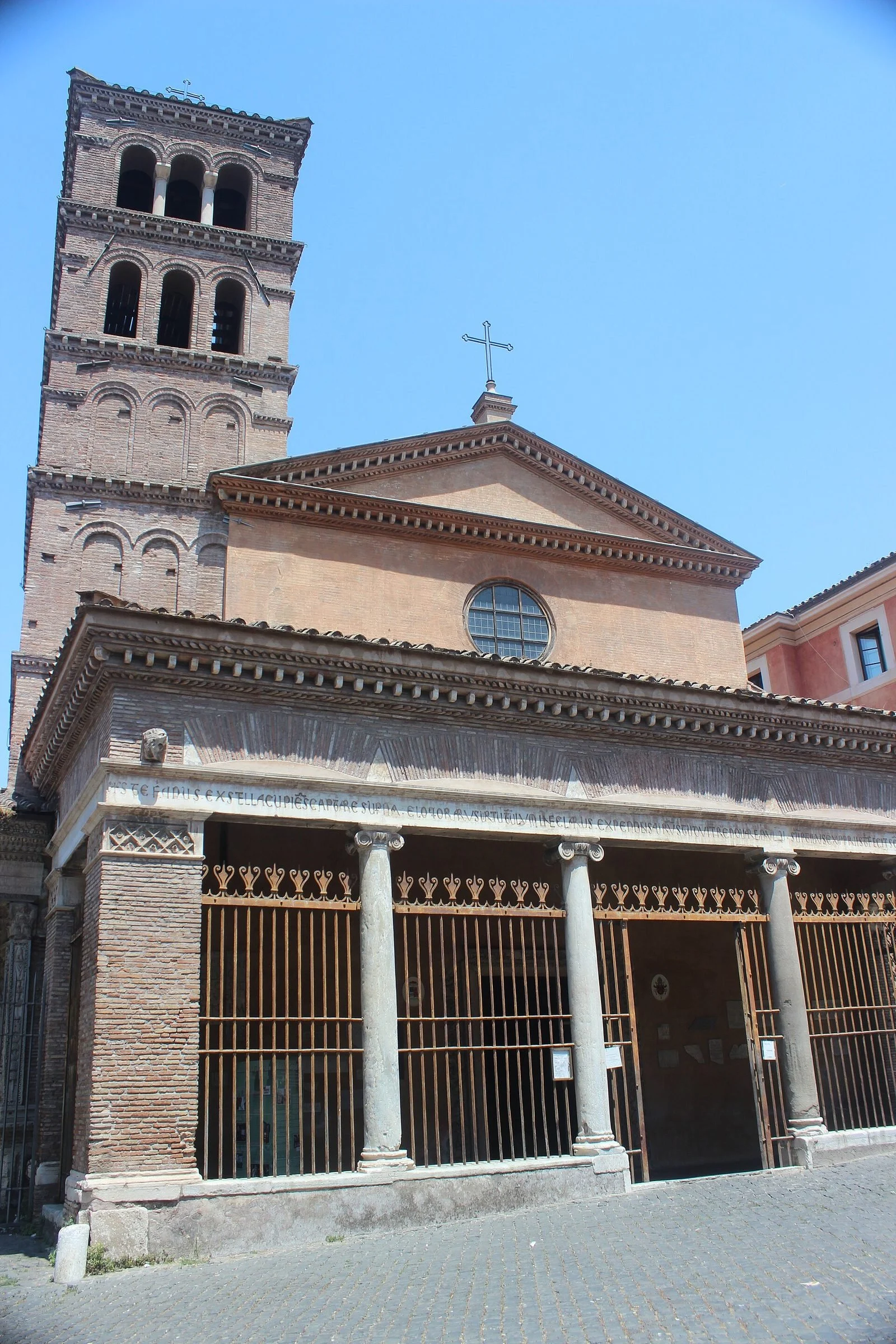
The Basilica di San Giorgio in Velabro is at Via del Velabro 19, in the Ripa district, set against the side of the Arch of the Argentarii and about 30 meters from the Arch of Janus, in the area of the Forum Boarium. It's an early medieval church with three aisles, with a Romanesque portico and bell tower, and it has two features that set it apart from almost all the other ancient churches of Rome. The first you see as soon as you enter: the columns dividing the aisles are all different from one another, in material, diameter, height and type of capital, because they come from Roman buildings dismantled and reassembled here. The second you see from outside, and it concerns 1993: on the night between July 27 and 28 a car bomb destroyed the portico, and what you look at today from the street was put back together piece by piece with the original fragments recovered from the rubble. The facade you photograph is at once ancient and reassembled, and this needs saying because it changes the way you look at it.

The lines that follow tell where the Velabrum is and why that name carries weight in the city's history, how the church came about between the 7th and 9th centuries, what you see inside, what is known and what remains disputed about the apse fresco, how access works today (badly, and we explain), and how best to fit the visit into a walking tour that takes in the Circus Maximus, the Republican temples and the Capitoline Hill.
Where the Basilica di San Giorgio in Velabro is and how to get there
The address is Via del Velabro 19, in Rome, on a short street that connects Via di San Teodoro with Piazza Bocca della Verità and that almost completely empties out in the evening. Coming from the Colosseum, you walk Via di San Teodoro along the flank of the Palatine and it takes a little over 10 minutes on foot. Coming down from the Capitoline, you go along Via del Teatro di Marcello, pass the Theater of Marcellus and arrive in just under eight minutes. Coming from the Tiber and the Tiber Island, you cross Ponte Palatino or follow the Lungotevere to Piazza Bocca della Verità and then walk back up.
By metro and bus
The most convenient metro stop is Circo Massimo, on line B, from which you walk about 10 minutes along Via dei Cerchi and then on Via del Velabro. Alternatively you get off at Colosseo, also line B, and arrive from the opposite side through Via di San Teodoro. On the surface, the reference stop is Piazza Bocca della Verità, served by the lines running along Via Petroselli and the Lungotevere: it's the same stop that serves Santa Maria in Cosmedin and the Mouth of Truth. Lines and routes change often in Rome, also because of construction: check the updated route on the public transport operator's app on the same day. For a general picture of transport and tickets we have a dedicated page on getting around Rome.
By car, and why it's best to avoid it
The whole area is inside or on the edge of the limited traffic zone of the historic center, with electronic gates active in time bands that change between weekdays and weekends. There is no parking dedicated to the church, and street parking nearby, where allowed, is paid during daytime hours Monday to Saturday. If you come from outside Rome, it's faster to leave the car in a park-and-ride connected to line B and finish by metro. The advice is not a formality: Via del Velabro is narrow, often occupied by service vehicles, and circling in search of a spot costs more time than the entire visit takes.
What you see without going in
The portico, the facade, the bell tower and the Arco degli Argentari set into the left flank can be seen freely from the street, at any hour of the day and night, with no ticket and no reservation. We make this point right away because the interior has irregular hours and a traveler passing by at seven in the evening should know that a substantial part of what makes the stop worthwhile is visible anyway. The five-tier bell tower is also easy to read from Via di San Giovanni Decollato, where the street widens just enough to step back.
The Velabrum: the hollow between the Palatine and the Capitoline
The Velabrum is the flat depression between the Palatine, the Capitoline and the Tiber, that is, the low strip connecting the Roman Forum to the bend of the river. Before the drainage works it was a marshy area, subject to floods, and its progressive drying through the Cloaca Maxima is one of the operations that make the ancient city possible as we know it. The church bears that name because it's built right there, on the ground won from the water.
The finding of the twins: where tradition places it
Roman tradition places in the Velabrum exactly the spot where the basket with Romulus and Remus ran aground and where the she-wolf found them, at the foot of the Palatine, near the Ficus Ruminalis and the Lupercal. It must be said clearly that this is literary and popular tradition, not an archaeological fact: the ancient sources report it, archaeologists have argued for decades over the identification of the Lupercal with a cavity found on the slope of the Palatine, and no material evidence allows the story to be turned into chronicle. Visitors to the church can nonetheless bear in mind that the physical landscape is the right one: a low basin, between two hills, a step from the river that overflowed. The story arises from a real geography.
The etymology of the name, which no one has settled
On the origin of the place name Velabrum there is more than one proposal and none is proven. The most cited links it to the Latin velum in the sense of boat or ferry, because in the marshy area people crossed by boat. Another traces it to the root of veho, to carry. Others still posit a pre-Roman substrate. Varro was already discussing it in antiquity, a sign that the question was open 2,000 years ago. We report the hypotheses without choosing one, because choosing would give the reader a certainty that doesn't exist.
Why so many ancient monuments are concentrated here within a few meters
The Velabrum was a commercial hub: on one side the river port and the warehouses, on the other the cattle market of the Forum Boarium, in between the streets that climbed to the Roman Forum and the Capitoline. A crossroads of this kind attracts temples, arches, moneychangers' shops and, later, churches and diaconiae. The result is a concentration that you walk through today in 10 minutes: the two best-preserved Republican temples in the city, namely the Temple of Portunus and the Temple of Hercules Victor, the Arch of Janus, the Arco degli Argentari, Santa Maria in Cosmedin, the church of San Giovanni Decollato and this basilica.
The origins of the basilica: from the 7th to the 9th century
The foundation of the Basilica di San Giorgio in Velabro is traced by the sources to Pope Leo II, whose pontificate falls in 682 and 683, while the existence in the area of a diaconia, that is, a center of assistance and grain distribution run by the Church, is attested at an earlier time. The generally accepted sequence is this: first an early medieval diaconia tied to the warehouses and traffic of the Forum Boarium, then the church proper, then a major restructuring in the Carolingian age.
The diaconia and the grain-supply function
The Roman diaconiae of the 7th and 8th centuries were not parishes in the modern sense. They were distribution structures: grain, oil, assistance to the poor, and they settled where the goods arrived. The Velabrum, with the river port a few dozen meters away and the warehouses along the Tiber, was exactly the kind of place where a diaconia made practical sense. This explains why the church arises where it does and why its plan adapts to preexisting constructions instead of imposing a new geometry.
Pope Zachary and the relics
To Pope Zachary, pontiff between 741 and 752, the sources attribute the transfer to this church of the relics of St. George from the Lateran Patriarchium, that is, from the papal complex at St. John Lateran. From that moment the dedication to St. George becomes the building's identifying trait, while previously it was also named for St. Sebastian. The double dedication leaves a trace in the apse fresco, where both saints appear.
Gregory IV and the form we see
The decisive restructuring bears the name of Pope Gregory IV, in office between 827 and 844. The sources credit him with the rebuilding of the apse, the layout of the schola cantorum, the arrangement of the presbytery and work on the service structures. It's in this phase that the building takes on the three-aisle basilica layout that can still be read today, with the central nave higher and the side aisles roofed lower. The 9th century in Rome is a moment of great ecclesiastical building activity, the same one that produced the mosaics of Santa Prassede: if you want to compare two Carolingian building sites in Rome, the two churches are 20 minutes apart by bus.
An irregular plan, and not by mistake
The plan of the basilica is irregular, slightly trapezoidal. The nave is not a rectangle: the side walls are not parallel and the width changes between the entrance and the apse. The commonly accepted explanation is that the building adapted to preexisting structures and an already built urban fabric, accumulating additions over time instead of arising from a unified design. On entering you don't notice right away. You notice, if anything, that something in the space doesn't quite add up, and this is the reason.
The Romanesque portico and bell tower
The portico and the bell tower of the Basilica di San Giorgio in Velabro are the parts any passerby sees, and they belong to the building's Romanesque season, that is, the 12th and 13th centuries. The bell tower is dated by most sources to the 12th century and rises in five tiers of mullioned windows with two and three lights supported by little marble columns, following the scheme of the Roman bell towers of that period. The portico, set against the facade, is dated to the first half of the 13th century.
The inscription of Stefano Stella
On the architrave of the portico runs an inscription recalling the patron, a prior named Stefano, indicated in the sources as Stephanus ex Stella, together with the dedication. It's a precious document for dating, because it ties the structure to a person and a role instead of a stylistic estimate. Readings of the text and the precise reconstruction of the figure vary among scholars: we report the name as it appears in current sources, without adding biographical details we couldn't verify.
The Ionic columns of the portico
The portico colonnade is trabeated, that is, it carries a horizontal architrave and not a series of arches, and rests on columns with Ionic capitals. Here too the material is reused. The result is a low, wide facade, very different from the Baroque facades found everywhere in Rome: anyone arriving from a day spent among Bernini's works and the 17th-century churches of the center finds here an architectural language four or five centuries earlier, made of horizontals and flat surfaces.
The 17th-century alterations and Muñoz's restoration
In the 1600s, under Cardinal Angelo Celsi, the portico underwent alterations: one bay was removed to make the front symmetrical and the roof structure was changed. In the 20th century came the intervention that gave the church its current appearance: between 1923 and 1926 Antonio Muñoz directed a restoration that removed the Baroque additions inside and restored the Romanesque image of the building. Muñoz worked in the same years on other medieval Roman churches, including Santa Sabina on the Aventine, with criteria that critics now debate because they tended to favor one historical phase at the expense of the others. Earlier still, in 1828, the bell tower had been restored after being struck by lightning.
Inside: the reused columns, all different from one another
The thing you notice on entering the Basilica di San Giorgio in Velabro is the columns: they are ancient, they come from dismantled Roman buildings, and no two are alike. The marble, the color, the diameter, the height and the order of the capital all change. You can recognize granite, white marbles and pavonazzetto, with Ionic capitals next to Corinthian ones. Anyone who enters expecting the regular rhythm of a classical colonnade is thrown for a few seconds, and that is the best moment of the visit.
How many there are, and why the sources don't agree
On the number the sources diverge, and we say so instead of giving a flat figure. Some descriptions speak of eight columns, others of 16 counting both rows. The discrepancy almost certainly comes from the counting criterion, that is, if the columns are counted per side or in total, and from the fact that some supports are walled-in piers and not free columns. Anyone who wants the exact number should count them on the spot: it's one of those checks that takes 30 seconds and that no online source replaces.
What reuse is and why it wasn't poverty
Reuse, or spolia, consisted of taking architectural elements from disused ancient buildings to insert them into new constructions. In Rome between the 6th and the 13th century it was the ordinary practice, not the exception, and the reading that explained it only by lack of means has been largely superseded. Cutting and transporting a granite shaft from Egypt cost far more than recovering one 500 meters away, and there was also a component of declared continuity with the imperial past. The same phenomenon is seen at San Clemente, at Santa Pudenziana and in dozens of other Roman churches.
The light, which here is a technical factor
The interior is dimly lit. The windows of the central nave are small and the artificial lighting is restrained, as in almost all medieval Roman churches restored on criteria of sobriety. To see the capitals and the apse it's best to go with the sun high, between 10:00 and 14:00, and give your eyes a minute to adjust before judging. Anyone who comes in from the street in full sun and looks straight at the apse sees almost nothing.
The ciborium and the apse fresco attributed to Pietro Cavallini
Above the high altar of the Basilica di San Giorgio in Velabro is a medieval ciborium with a pyramid-shaped cover, supported by little columns, and behind it the apse semi-dome bears a fresco with Christ at the center, the Virgin, St. George on horseback with the standard, St. Peter and St. Sebastian. These are the two elements art historians come here for. There is an open question of attribution regarding the fresco, and it's better to tell it in full than to dismiss it with a name.
The ciborium above the altar
The ciborium is the canopy structure covering the altar, typical of medieval Roman churches. The one at San Giorgio in Velabro is dated by the sources to the 12th century, with a pyramidal cover supported by little marble columns. Beneath the altar opens the confessio, that is, the recess that holds the relics and that in Roman basilicas lets the faithful approach the deposit without climbing onto the presbytery. Anyone who knows the Cosmatesque ciboria of Santa Cecilia in Trastevere or of other Roman churches will find here a plainer version, with less polychrome inlay.
The attribution to Cavallini, and why it remains debated
The apse fresco is currently attributed to Pietro Cavallini, the Roman painter active between the end of the 1200s and the first decades of the 1300s, author of the Last Judgment in Santa Cecilia in Trastevere and of the mosaics of Santa Maria in Trastevere. The attribution, however, must be presented as debated, because it is. In the past the work was assigned to Giotto. Cavallini's name prevailed after the rediscovery of the Last Judgment in Santa Cecilia, because of its stylistic affinity with that. Several scholars suppose the intervention of workshop collaborators, and the restorations the fresco has undergone, made necessary by deterioration, may have altered the original features to the point of making a judgment based on the hand difficult. Anyone reading a sign or a guide that gives the attribution as certain is reading a simplification.
The date, which depends on who the patron was
The dating also remains open and depends on a hypothesis about the patronage. If the patron was Cardinal Jacopo Stefaneschi, created cardinal in 1295, the work would be later than that year. If instead the patron was Pietro Peregrosso, who held the title until 1289, the fresco would be earlier. The two hypotheses lead to dates far apart and neither is proven. In the literature you commonly find the generic indication of the last decade of the 1200s, and it's the most honest formulation. The Stefaneschi, it should be recalled, were regular patrons of Cavallini: Bertoldo Stefaneschi commissioned from him the mosaics of Santa Maria in Trastevere, which makes the Stefaneschi hypothesis attractive but not for that reason proven.
What you really see, in the current state
The state of preservation of the fresco is problematic. The colors are impoverished, some fields are patchy, and reading it takes patience and decent light. Our verdict is blunt: anyone who comes here expecting the color rendering of the mosaics of Santa Maria in Trastevere will be disappointed, because the comparison doesn't hold. Anyone who comes to understand how a Roman apse decoration of the late 1200s was organized, with the hierarchy of figures and the relationship between Christ, the Virgin and the titular saints, finds exactly what they're looking for. They are two different visits, and it's worth knowing beforehand which one you're making.
The relics of St. George
The Basilica di San Giorgio in Velabro keeps in the confessio beneath the high altar the relics attributed to St. George, which according to the sources include the head, the sword and a fragment of the standard. Their arrival here is traced to Pope Zachary, who is said to have transferred them from the Lateran Patriarchium during his pontificate, between 741 and 752.
Who St. George was, for the little that can be said
St. George is a Christian martyr venerated from the 4th century onward, whose historical story is wrapped in a hagiographic tradition layered over centuries. The episode of the dragon, the one everyone knows and that appears in the apse fresco, is a medieval addition, spread in the West above all after the Legenda Aurea of the 13th century. It should be labeled for what it is: devotional tradition, not biography. Very little is known about the historical George, and the caution with which historiography treats him is the same with which the relics should be treated, whose authenticity cannot be verified and is not what determines their historical significance.
The Arco degli Argentari set against the flank
The Arco degli Argentari is a quadrangular marble gateway erected in AD 204 by the bankers and cattle merchants of the Forum Boarium in honor of Septimius Severus and his family, and it is physically incorporated into the left flank of the Basilica di San Giorgio in Velabro, next to the portico. The two monuments are in contact: the medieval church absorbed the Roman arch, which is how it has come down to us.
The difference between this page and the arch's page
On the site the arch has a page of its own: here we cover the church and cite the arch as an element of its flank, while the page dedicated to the Arch of the Argentarii goes into the detail of the reliefs, the dedication, the erasures and the history of the monument as such. If you want the Roman monument, read that one. If you want the church, stay here. The same goes for the Arch of Janus, the 4th-century tetrapylon a few meters away, which has its own separate page.
The erased figures and the damnatio memoriae
On the inner reliefs of the arch you notice gaps: some figures were erased. The current reading connects them to the dynastic events of the Severans and in particular to the damnatio memoriae that struck Geta after the killing ordered by his brother Caracalla in 211. The removal of name and image from public documentation was a Roman legal and political practice, not an act of vandalism, and it is found on inscriptions and monuments throughout the empire. Anyone who also has the Arch of Septimius Severus in the Roman Forum on the program can compare the official public monument and this private dedication by a guild: the difference in scale and language is the most interesting thing of the day.
Why the arch survived
The reason the Arco degli Argentari is still standing is the same one for which many Roman monuments survived: it was absorbed into a later structure that had an interest in keeping it. The mechanism is the same that saved the Portico d'Ottavia, the Curia Iulia turned into a church and Santa Maria Antiqua under the Palatine. Without Christian and medieval reuse, the ancient Rome you visit today would be a fraction of what it is.
The 1993 bombing and the reconstruction by anastylosis
On the night between July 27 and 28, 1993 a car bomb exploded in front of the Basilica di San Giorgio in Velabro and destroyed its portico. It was one of the actions of that year's season of bombings: the same night another car bomb hit the Lateran complex, damaging the facade of the Palazzo del Vicariato next to San Giovanni in Laterano, while in May Florence had been hit and in July Milan. On the date you find both July 27 and July 28 depending on the source, because the devices exploded around midnight: the correct formulation is on the night between the two days.
What was destroyed
The portico collapsed. The facade was seriously damaged, the interior suffered blast damage and the fragments of the colonnade, the architrave and the masonry ended up in the street. In the hours and days that followed, the fragments were collected, cataloged and stored: the sources speak of more than a thousand crates of recovered material. It's the fact that explains everything else, because without that recovery the reconstruction would have been a copy.
What anastylosis is
Anastylosis is the technical term for the reassembly of a building or part of one using the original fallen elements, put back in the position they had, with modern additions kept to a minimum and recognizable. The difference from a reconstruction is substantial: in anastylosis the material is the ancient one, the reassembly is documented and what is missing is filled in with distinguishable material, so that no one mistakes the addition for the original. The portico of San Giorgio in Velabro is one of the Roman cases where this method can be observed on a whole building and not on a museum fragment.
What you look at today, and how
The facade you photograph from the street is at once ancient and reassembled, and this needs saying. Some elements bear the traces of the reassembly and, according to what the sources report, some parts were deliberately left unrestored as a memory of the bombing. Looking at the portico with that knowledge changes the experience: the joints, the surface differences between the pieces, the fill-ins stop being flaws and become the document. No rhetoric is needed on this point. What's needed is knowing what you have in front of you.
When it reopened: a fact on which the sources don't agree
The date of reopening to the public after the restoration commonly circulates as July 6, 1996, with a ceremony in the presence of the President of the Republic Oscar Luigi Scalfaro, and several Italian sources report it. Other reconstructions, however, indicate a building-site duration of about five years, which would put the conclusion after 1996, and it's not clear if the two indications refer to different moments, for example the reopening for worship and the completion of the work on the portico. We are unable to resolve the discrepancy with the sources consulted and prefer to declare it rather than pick a date and present it as certain. Anyone who needs the precise date should ask the religious community that officiates the church or the competent Soprintendenza.

A curiosity about the Basilica di San Giorgio in Velabro
The Basilica di San Giorgio in Velabro is a cardinal diaconia, and among the cardinal deacons who have held its title is John Henry Newman, the English theologian who converted from Anglicanism to Catholicism, created cardinal in 1879 and canonized in 2019. The choice of this title for an Englishman was no accident: St. George is the patron saint of England, and assigning Newman the diaconia of San Giorgio in Velabro was a message anyone could read.
The other names tied to the title
The title of San Giorgio in Velabro appears in Roman documentation from very far back in time, and among those who have held it the sources also list future popes, including Boniface IX and Martin V. In recent times the diaconia was assigned to Cardinal Gianfranco Ravasi, created cardinal in 2010. The lists of titleholders are long and not always consistent for the earliest eras: the medieval information on these successions should be taken with the caution used for all lists reconstructed after the fact.
Something nobody tells you about the Basilica di San Giorgio in Velabro
Almost no guide writes it, but the Basilica di San Giorgio in Velabro is one of the churches in central Rome with the least predictable opening hours, and it's the first operational piece of information a visitor needs. The building is officiated by a religious community, the canons regular of the Order of the Holy Cross, and opening follows the needs of the community and the liturgical calendar more than a museum schedule. Finding the door closed at 11 on a Tuesday is possible.
Why the hours you read around aren't enough
On third-party portals, different time slots circulate, often copied for years and never verified. We report none of those slots, because taking them at face value would mean sending someone to Rome to run into a closed door. The right way to proceed is to call the church's number or write to the community that officiates it, a few days ahead, and ask for confirmation for the precise date and time. For a group visit or a guided one, the phone call is not an option: it's the only way not to waste everyone's time.
The wedding factor
The church is in great demand for weddings, and this is one of the concrete reasons it may be closed to visits at times when you'd imagine it open, in particular Saturday morning and Saturday afternoon. It's not information you find on tourist portals. It is, however, the most frequent explanation for a closed door on the weekend.
Plan B, which really exists here
If the church is closed, the visit is not lost. The portico, bell tower and Arco degli Argentari can be seen from outside, the Temple of Portunus and the Temple of Hercules Victor are two minutes away on foot, the Arch of Janus is around the corner and Santa Maria in Cosmedin is 300 meters away. Within a five-minute walk there is enough material for an hour and a half of visiting that doesn't depend on any door being open.
My advice for visiting the Basilica di San Giorgio in Velabro
The operational advice for the Basilica di San Giorgio in Velabro is just one and should be followed to the letter: phone first, and plan the visit for late morning, between 10:00 and 13:00, when the light coming through the high windows makes the capitals and the apse semi-dome legible. Going at sunset, which would be the right choice for the exterior, means not seeing the interior.
How much time you really need
For the interior 20 minutes is enough if you look carefully: the church is small, there are four or five elements to observe, and there's no museum route to follow. Adding the portico, the bell tower and the Arco degli Argentari brings it to 35 minutes. Anyone who widens it to the Forum Boarium, so the two Republican temples, the Arch of Janus and Santa Maria in Cosmedin, takes between an hour and a half and two hours for the whole corner, always on foot and without ever taking transport.
In what order to do things
The sequence we recommend starts from Piazza Bocca della Verità: first the two temples, which are only seen from outside and are dispatched in 10 minutes, then Santa Maria in Cosmedin if there's no line at the Bocca della Verità, then Via del Velabro to the basilica, then the Arch of Janus around the corner and finally the climb back toward the Capitoline or toward the Circus Maximus. What doesn't work is arriving here on its own, looking only at the church and leaving again: you spend more time getting there than visiting.
The code of conduct, which matters here
This is an officiated church, not a museum, and the community that lives in it has no staff dedicated to managing visitors. You enter in silence, avoid crossing the presbytery, respect any celebrations in progress and ask before photographing. The dress code follows the rule common to Roman churches: shoulders and knees covered.
When to avoid
Saturday, for weddings, and the central hours of major holidays, when the community is celebrating. Also avoid days of heavy rain, not because of the church itself but because of the route: Via del Velabro and the Forum Boarium area offer no shelter and the other stops on the tour are all outdoors. In bad weather the same half day yields much more inside the Capitoline Museums, which are a 10-minute uphill walk away.
Another well-known fact, yet rarely cited
That the Velabrum was a reclaimed marsh everybody knows. Much less cited is that the ancient walking level in this area lies several meters below the current street level, and that the Basilica di San Giorgio in Velabro and the monuments around it are in effect buildings emerged from ground that has grown over the centuries. The floods of the Tiber, before the construction of the embankment walls in the 1800s, deposited mud and debris at every overflow, and the level rose.
Why the monuments of the Forum Boarium seem sunken
The Arch of Janus, the two Republican temples and the basilica itself were freed from fill in interventions of the 19th and 20th centuries, which lowered the ground around the monuments, bringing it back, where possible, toward the ancient level. The result is the feeling, walking here, that the buildings sit in a basin: the basin is the archaeology, the raised part is the modern city. The same phenomenon is seen throughout central Rome, from Trajan's Forum to the Roman houses on the Caelian.
The Cloaca Maxima, which passes through here
The Cloaca Maxima, the great collector that drained the valley of the Forum and emptied into the Tiber, passes through this area and its outlet is a little downstream, on the river, near Ponte Rotto. It can't be visited and isn't visible from outside except for the outlet, which can be observed from the bank of the Tiber or from Ponte Rotto itself, from a suitable distance. It's the infrastructure that made the Velabrum buildable, and without it there would be neither the Forum Boarium nor the church.
The right photo to take at the Basilica di San Giorgio in Velabro
The right photo of the Basilica di San Giorgio in Velabro is taken from the corner between Via del Velabro and Via di San Giovanni Decollato, at an angle to the facade, so as to keep the portico, the bell tower and the Arco degli Argentari set into the flank in the frame. It's the only point from which the three elements fit together, and it's the reason almost all published photographs of this church are taken from there.
The right time
The facade faces in such a way that the best light arrives in the afternoon, with the low sun grazing the portico and setting the columns apart from the shaded background. Early morning instead gives a flat, uniform facade. For the interior the rule reverses, as we wrote above: late morning. Anyone who wants both in a single visit has to accept a compromise, and the compromise we recommend is to go in around noon and come back outside to photograph the facade around five, after making the tour of the Forum Boarium.
Inside: what you can do and what is advisable
Before photographing inside, you ask. If you get permission, flash is always to be excluded, both out of respect and because on a deteriorated fresco it's useless. With scarce light the technical solution is to raise the sensitivity and rest the camera on a pew or a column, avoiding the tripod, which in an officiated church is intrusive. The best subject is not the apse, which comes out badly in low light, but the sequence of uneven columns seen diagonally from the side aisle.
Some important events that happened here
The documented events concerning the Basilica di San Giorgio in Velabro are few and widely spaced in time, and lined up they tell the whole story of the building: the foundation between the 7th and 8th century, the arrival of the relics under Zachary, Gregory IV's rebuilding in the 9th century, the Romanesque season of the portico and bell tower, the 17th-century downsizing, Muñoz's restoration in the 1920s and the 1993 bombing with the reconstruction that followed.
The moments worth keeping in mind
1828 is the year the bell tower was restored after a lightning strike. Between 1923 and 1926 falls Antonio Muñoz's intervention that removed the Baroque additions. The night between July 27 and 28, 1993 is that of the car bomb. 1996, with the commonly cited date of July 6, is the year of the reopening, with the reservations we have already explained. That makes six dates in all: for a church 1,300 years old it is few, and it depends on the fact that the building has always remained on the margins of the great papal affairs.
What did not happen here
A useful warning: around minor Roman churches circulate anecdotes of martyrs, apparitions and councils that find no documentary confirmation. On San Giorgio in Velabro the serious literature is sober and reports no extraordinary episodes. Distrusting detailed stories without a source is the general rule, and it holds also for the pages that talk about the ghosts of Rome, where the material is declaredly popular tradition.
Who has passed through the Basilica di San Giorgio in Velabro
Through the Basilica di San Giorgio in Velabro have passed the popes who ordered its building phases, from Leo II to Zachary to Gregory IV, and the cardinals who held its diaconal title, among whom the sources also list future popes such as Boniface IX and Martin V. The name best known to the international public remains John Henry Newman, cardinal deacon from 1879 and canonized in 2019.
Art historians and restorers
In the 20th century the church passed through the hands of Antonio Muñoz, the official and art historian who directed the restoration of the 1920s and who shaped the image of many medieval Roman churches. On the scholarly side, the building appears in the great survey of the Christian basilicas of Rome carried out by Richard Krautheimer, which remains the starting bibliographic reference for anyone who wants to go beyond popular accounts.
Pietro Cavallini, with due caution
If the attribution of the apse fresco holds, and we repeat it because it's debated, Pietro Cavallini also passed through here, the Roman painter who left at Santa Cecilia in Trastevere the Last Judgment and at Santa Maria in Trastevere the mosaics of the apse. Anyone who wants to follow his Roman path has three stops in a day, all reachable on foot or with a single vehicle, and this is the least known of the three.
Eating around the Velabrum: how to choose
Around the Basilica di San Giorgio in Velabro, between the Forum Boarium, the Bocca della Verità and the slopes of the Capitoline, the density of places aimed at tourist foot traffic is high, and the average quality is low. By editorial choice we name no establishment, here or elsewhere: a list of signs gets old in a few months. We give instead the criteria, which stay valid.
The five trap signals
The first signal is the woman rolling fresh pasta in the window or right in the street: it's a lure designed for people walking by, not a sign of good cooking. The second is the menu with photographs of the dishes. The third is the person at the entrance inviting you to sit down, the so-called acchiappino, the touter. The fourth is the place open from morning to night with no kitchen break, which means food not made to order. The fifth concerns the places in front of famous monuments, where the price happens to adapt to the customer in front of them, with unpriced items on the menu and different price lists between the indoor room and the outside tables.
The chains in the center
In central Rome, places with a repeated sign have multiplied, with the same menu in several spots in the city and the line managed with number tickets. We don't name them and we don't recommend them. The fact that counts is another: Romans don't go there, and in a city where you eat well at normal prices away from the tourist routes, this observation alone is enough.
The simplest criterion there is
Look at who is sitting there and what language they order in. If at the tables there are people speaking Italian and ordering without looking at the photographs, the place has a local clientele. If the place is full of passing customers with backpacks and no Romans, the message is clear. It works at lunchtime on weekdays better than in the evening, and it holds across the whole city: we talk about it at more length on the page about where to eat in Rome.
The curated list
For those who want concrete suggestions without having to work them out on the spot, there is Daniele Dezi's personal list on Google Maps, a curated and unsponsored collection, built over time in the field. For those looking instead for where to stay in the area, there is a general picture on the page about where to stay in Rome, bearing in mind that the Ripa district and the Aventine are quieter and less served in the evening than other central neighborhoods.
Frequently asked questions about the Basilica di San Giorgio in Velabro
How much does it cost to enter the Basilica di San Giorgio in Velabro?
Entry to the Basilica di San Giorgio in Velabro is free, as in all the officiated churches of Rome: there is no ticket office and you don't pay to enter. The portico, the bell tower and the Arco degli Argentari set against the flank can be observed from the street without any formality. No paid guided visits regularly organized by the church are known.
What are the opening hours of the Basilica di San Giorgio in Velabro?
The hours of the Basilica di San Giorgio in Velabro are irregular and do not follow a museum calendar, because the church is officiated by a religious community and opening depends on liturgical needs. We give no time slots because those circulating on third-party portals can't be verified. Before going, it's best to phone the church or write to the community that officiates it.
How do you get to the Basilica di San Giorgio in Velabro by public transport?
You reach the Basilica di San Giorgio in Velabro by metro line B, Circo Massimo stop, and then 10 minutes on foot along Via dei Cerchi and Via del Velabro. Alternatively you get off at Colosseo, also line B, and walk Via di San Teodoro. On the surface, the reference stop is Piazza Bocca della Verità, on the lines that go along Via Petroselli.
How long does it take to visit the Basilica di San Giorgio in Velabro?
To visit the Basilica di San Giorgio in Velabro, 20 minutes inside and about 15 outside is enough, between the portico, bell tower and Arco degli Argentari. Widening to the nearby monuments, that is the Arch of Janus, the Temple of Portunus, the Temple of Hercules Victor and Santa Maria in Cosmedin, it comes to an hour and a half or two hours for the whole Forum Boarium corner, always on foot.
What is there to see inside the Basilica di San Giorgio in Velabro?
Inside the Basilica di San Giorgio in Velabro you see three aisles divided by ancient reused columns all different from one another in marble, diameter and capital, a medieval ciborium above the altar, the confessio with the relics attributed to St. George and the fresco in the apse semi-dome with Christ, the Virgin and Saints George, Peter and Sebastian. The interior is dimly lit.
Is the apse fresco really by Pietro Cavallini?
The apse fresco of the Basilica di San Giorgio in Velabro is attributed to Pietro Cavallini, but the attribution remains debated among scholars. In the past it was assigned to Giotto. Cavallini's name became established because of its resemblance to the Last Judgment in Santa Cecilia in Trastevere. Several scholars suppose the intervention of collaborators, and the restorations the work has undergone complicate the judgment on the hand.
What happened to the Basilica di San Giorgio in Velabro in 1993?
On the night between July 27 and 28, 1993 a car bomb exploded in front of the Basilica di San Giorgio in Velabro and destroyed its portico, on the same night in which another device hit the Lateran complex. The fragments were collected and cataloged, and the portico was reassembled by anastylosis with the original pieces recovered: the current facade is ancient and reassembled at once.
Is the Basilica di San Giorgio in Velabro accessible to people with disabilities?
Access to the Basilica di San Giorgio in Velabro is through the portico on Via del Velabro and involves a change of level from the street, as in many medieval Roman churches. We don't have verified information on ramps or facilitated routes and prefer to state nothing: those who use a wheelchair should ask the religious community for confirmation before planning the visit.
Can you take photographs inside the Basilica di San Giorgio in Velabro?
Inside the Basilica di San Giorgio in Velabro it's best to ask before photographing, because the church is officiated and celebrations may be in progress. Where photographs are allowed, flash should be excluded both out of respect and because on a deteriorated fresco it produces no results. A tripod is intrusive in a small space. Outside there is no restriction at all.
Who wrote this page
This page is edited by the team at Tour Leader Pro, the Rome-based project office that designs and coordinates visits, itineraries and cultural events in Rome and Lazio. Hours, fares and access conditions reported here are verified at the date of publication against the official sources indicated in the text: before leaving it's best to recheck them, because they change often. If you find outdated information, let us know.
Those building an itinerary that holds together the Forum Boarium, the Palatine and the climb back toward the Capitoline, with realistic times and a sequence that doesn't waste half days on transfers, will find planning tools and operational assistance on Tour Leader Pro, which works on Rome and Lazio with groups, schools and independent travelers.
For a broader picture, one that includes connections between Rome and the rest of the country, transport between cities and the building of a multi-day trip in Italy, Italy Planner is a good resource, covering planning on a national scale and tackling practical questions, from trains to the real distances between destinations.