Arch of the Argentarii
In short. The Arch of the Argentarii stands on Via del Velabro, leaning against the left side of the church of San Giorgio al Velabro, about 100 meters from the Arch of Janus and inside the perimeter of what in Roman times was the Forum Boarium,…
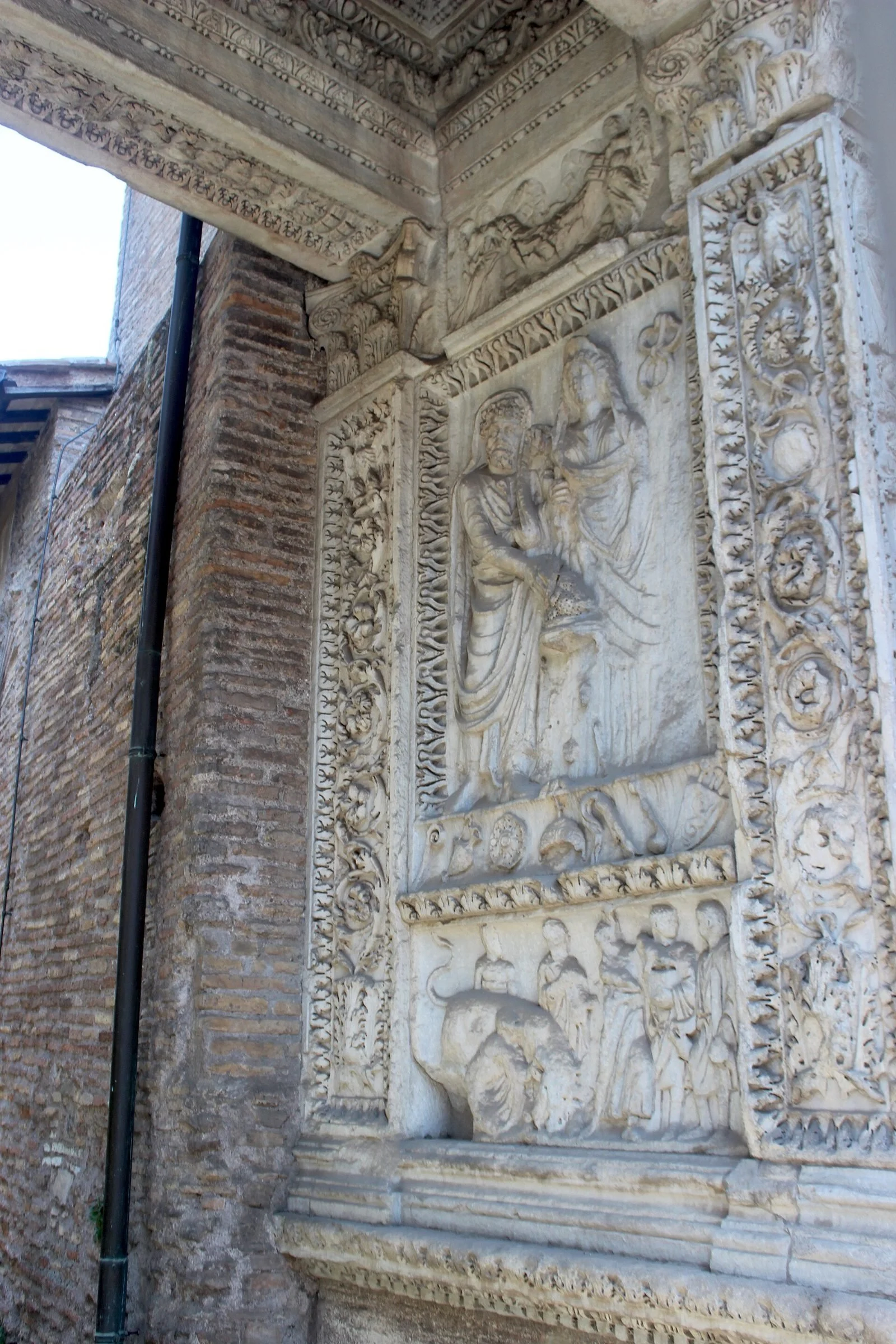
The Arch of the Argentarii stands on Via del Velabro, leaning against the left side of the church of San Giorgio al Velabro, about 100 meters from the Arch of Janus and inside the perimeter of what in Roman times was the Forum Boarium, the cattle market of Rome. It is a monumental gate: two massive piers holding up a horizontal architrave. A triumphal arch it never was. It was paid for in AD 204 by the bankers and the cattle traders who worked in that corner of the city. On top there are still the dedication inscription and the reliefs with sacrifice scenes. Inside the reliefs there are also empty spots, and those empty spots are the real reason to stop: after the killing of Geta in December 211, the damnatio memoriae decreed by his brother Caracalla had the name chiseled off the inscription and the figure off the panels. The marble around is intact, and in the middle remains a smooth surface where a person used to be. The lines that follow explain what you see on each face of the monument, who paid for it and why, which figures were erased and which remain uncertain, how it has come down to us built into the masonry of a church, and how to visit it today, which is the easiest part: you look at it from the street, for free, at any hour.

Where the Arch of the Argentarii is and how to get there
The address is Via del Velabro, rione Ripa, in the corner between the street and the side of the church of San Giorgio al Velabro, less than 200 meters from Piazza della Mouth of Truth. If you arrive thinking of looking for a gate, a ticket office or a big sign, you'll be thrown off: the monument is part of the street, you walk along it, and if you don't know it's there you walk right past without noticing. It happens often, because a few meters away is the Arch of Janus, which is four times bigger and catches the attention first.
On foot from the center
From the Colosseum you walk barely 10 minutes along Via di San Teodoro, keeping the Palatine on your left, and you come out exactly in front of the church. From the Capitoline Hill the route is even shorter: you go down toward Via del Teatro di Marcello, pass under the Theater of Marcellus and in 7 or 8 minutes you're on Via del Velabro. If you come from the Circus Maximus you cross Piazza della Bocca della Verità and it takes 5 minutes. From Piazza Venezia it's about a kilometer, almost all flat.
By public transport
The most convenient surface stop is the one at Piazza Bocca della Verità, on Via Petroselli, served by the lines that connect the Theater of Marcellus to the lungotevere. The nearest subway station is Circo Massimo, on Line B, from which you walk 8 to 10 minutes along the circus valley and then cut toward the river. From Termini it's best to take Metro B toward Laurentina and get off at Circo Massimo: the complete trip, train plus walk, takes around half an hour. If you come from Trastevere you cross the Ponte Palatino and you're there in 5 minutes on foot, with the view of the Ponte Rotto included on the way.
By car, scooter, bicycle
The area is inside the limited traffic zone of the historic center and has no dedicated parking. Street parking, where allowed, is paid during weekday daytime hours. If you come from outside Rome, you're quicker leaving the car in a park-and-ride on Line B. By bicycle, the lungotevere bike path comes within 200 meters of the arch.
Accessibility
The sidewalk in front of the arch is flat and the monument is entirely visible from the street without climbing steps, so wheelchair users can look at it and photograph it without difficulty. The road surface is sampietrini cobblestones and there are uneven spots, as in the whole rione. The entrance of the adjacent church, on the other hand, has a change in level. For a broader picture of transport, museums and barrier-free routes in the city, the site has a page dedicated to Accessible Rome.
What the Arch of the Argentarii really is: a gate, not an arch
The Arch of the Argentarii is a trabeated gate: two rectangular piers topped by a horizontal block, with no vault and no curved opening. The name everyone knows it by describes what you see poorly, and this is the first thing to sort out before looking at it. A Roman triumphal arch has an arched structure, literally, with voussoirs that carry the weight sideways. Here the weight is carried by an architrave, as in a Greek portal or a house door. Those expecting the Arch of Septimius Severus of the Roman Forum in reduced format will find something else.
The measurements, and why the sources disagree
The overall height most often reported is 6.15 meters, with a passage 3.30 meters wide. Other entries give different measurements, around 6.8 meters in height and 5.86 in total width of the front: the difference depends almost certainly on what is included in the count, either only the part visible above the current street level, or the whole monument including the buried parts. We report both readings because both circulate. The figure the sources agree on is the passage opening: 3.30 meters, that is the width of a cart with oxen, which is exactly what must have passed through it.
What it is made of
The load-bearing structure is masonry faced with white marble slabs, with the base in travertine. The marble of the slabs has been attributed to the quarries of Hymettus, in Greece, which in Severan Rome was a common material for facings of this kind. The relief is carved directly in the facing slabs, not in solid blocks: if you look at it edge-on, at the corners where the marble has chipped, the thickness of the slabs is visible to the naked eye.
The ancient walking level is lower than today's
The travertine base of the arch goes below the current street level by about a meter. It's a fact that changes the way you look at it: the monument you see today is cut off at the bottom, and those passing here in the 3rd century found it proportionally taller and more slender than it looks now. The whole Velabrum area has risen over the centuries because of Tiber floods and later fill, and the same phenomenon is seen on the nearby temples and on the church threshold.
Who paid for it: the argentarii and the negotiantes boarii
The inscription says the monument was offered by the argentari et negotiantes boari huius loci qui invehent, that is by the bankers and the cattle traders of that place, the ones who brought the animals in. They are two different categories working side by side in the same market, and together they put up the money for a dedication to the imperial family. It's the reason the monument is named this way: the argentarii are not goldsmiths or silversmiths in the modern sense, they are money changers and bankers.
What work the argentarii did
A Roman argentarius changed currency, assessed the quality of metal, kept deposits, lent money, guaranteed payments and kept accounting records that counted as proof in court. In the Forum Boarium this trade had a precise technical reason: a cattle market is a market of big transactions, often made by people from outside with different coins, and you need someone to do the exchange and guarantee the sum. The argentarii's counters stood under the porticoes and near covered passages, where there was shade and there were people.
The negotiantes boarii and the ox market
The Forum Boarium takes its name from the ox (bos in Latin) and for centuries was the point where cattle arriving from the Tiber and the countryside entered the city. The animals came up from the river port, crossed the Velabrum area and were sold on the open ground between the river and the Temple of Hercules Victor. The negotiantes boarii are the wholesale traders of that market, a rich and organized category, which counted enough in Rome to be able to afford a marble dedication to the reigning emperors.
Why a guild paid for a monument to the emperors
It wasn't generosity. A dedication of this kind worked as an investment in relationships: it put in writing, in a place of passage, that this category was loyal to power, and in exchange the category obtained recognition, tolerance and a channel to the administration. The guild also gained in internal visibility, because the monument physically marked the market's territory. Severan Rome is full of dedications like this, and most have been lost. This one survived for a very practical reason, which we cover further on: a church took it.
The inscription of 204 and its erasures
The inscription of the Arch of the Argentarii, cataloged as CIL VI 1035, is still legible on the architrave of the front facing the street, and it is the document that dates the monument to AD 204. It contains the dedication to Septimius Severus, to Julia Domna, to Caracalla, to Geta and to the family of Plautianus. It also contains, and it's very easy to see, the traces of at least three later interventions that removed names and rewrote lines.
What it said
The original text named the reigning emperors with their titles, Severus's wife, the two sons and, according to the most common reading, also the praetorian prefect Gaius Fulvius Plautianus with his daughter Plautilla, who in 202 had married Caracalla. The guild of dedicants closed the text with its own title. Those passing under the gate therefore read, in a single glance, who ruled in Rome and who ruled in that market.
The three erasures, in order
The first erasure concerns Plautianus, the very powerful praetorian prefect and co-father-in-law of the emperor, who fell from favor and was killed in 205, a year after the dedication. The second concerns his daughter Plautilla, exiled in 205 and killed in 211. The third, the best known, concerns Geta, killed at the end of 211 on the order of his brother Caracalla and subjected to formal damnatio memoriae. Modern sources waver between 211 and 212 for the physical carrying out of the erasures on this monument, and the difference depends on how one dates the practical application of the measure: the decree is immediate, the hand that chisels arrives when it arrives.
How to recognize an erasure on marble
An ancient erasure looks like a lowered, flattened surface, where the chisel has taken off the layer with the letters, leaving the field slightly lower than the rest. No holes, no fractures: a plane. Against raking light you can see the shadow of the step. Where the text was rewritten, the new letters are often of a different module, narrower or wider, and the alignment of the lines doesn't match the original. On the arch's inscription these signs can be read with the naked eye, and at the hours when the light comes from the side they read much better.
The damnatio memoriae of Geta: the void you can still see
Publius Septimius Geta, younger son of Septimius Severus, was killed at the end of 211 at the will of his brother Caracalla, with whom he had inherited power at their father's death a few months earlier. After the killing the Senate decreed the damnatio memoriae: the name was to be removed from public inscriptions, the image from statues and reliefs, coins withdrawn, documents rewritten. On the Arch of the Argentarii the order was carried out, and the result is still before the eyes of anyone passing on Via del Velabro.
What it meant to erase a person in Rome
The damnatio memoriae was not a symbolic measure: it was an administrative procedure with practical consequences. The condemned man's acts were annulled, his property confiscated, his birthday removed from the calendar, his name removed from military registers. Anyone who spoke it in public took a risk. Ancient sources tell that after Geta's death the ban was applied harshly, and that even speaking his name in your own home could cost dearly. The paradox is that an erasure leaves a more visible mark than presence: smooth marble in the middle of a crowded relief draws the eye more than the figure that stood there.
What exactly you see on the panels
On the two larger panels inside the passage, where the imperial family performs a sacrifice, there are lowered surfaces next to the figures that remain. On the panel with Septimius Severus and Julia Domna the figure that stood beside them is missing, and the traditional reading identifies it with Geta. On the opposite panel, where Caracalla remains in the act of offering, the figures that stood next to him are missing: the most common reading speaks of Plautilla, his wife, and of Plautianus, his father-in-law. On individual minor figures of the lower frieze and of the outer faces the discussion is open, and some identifications proposed by scholars are not shared by everyone.
What remains uncertain
It must be said clearly: which figures were erased and who they represented is a matter of interpretation, not a closed list. The number of erasures on the reliefs, their relative chronology and the identity of the removed figures have been debated at length, with different hypotheses on more than one detail. The certain fact is that the erasures exist, are ancient and concern the Severan family group after 205. Everything else, on this monument, is reasoned reconstruction. Be wary of anyone who tells it as if it were a caption.
The twin case a few minutes' walk away
The same mechanism can be seen on the Arch of Septimius Severus in the Roman Forum, dedicated in 203, where on the attic the fourth line of the inscription was recut after Geta's fall: in place of his name appeared an honorific formula referring to the two remaining emperors, and the holes of the original bronze letters are still visible under the new letters. If you want to understand how this practice worked, you have two examples 15 minutes apart. It is one of the most effective comparisons you can make in Rome in a morning, and it costs nothing.
The reliefs: the sacrifice, the standards, the prisoners
The reliefs of the Arch of the Argentarii cover almost all the available surface of the monument, inside and out, and they are the reason scholars of Severan art have been coming back to it for two centuries. The layout follows a precise logic: the sacred and dynastic scenes are inside the passage, sheltered and in view of those who go through, the military scenes and the decorative motifs are outside, where the street sees them.
The two sacrifice panels, inside the passage
On the inner faces of the piers run two facing panels with the imperial family performing a sacrifice. On one side Septimius Severus and Julia Domna, in priestly dress, with heads veiled according to the Roman rite, perform a libation on a small portable altar or on a tripod. On the other side Caracalla repeats the same gesture. In both panels, next to the surviving figures, there are smooth surfaces where the sculpture has been removed. These are the erasures that all the literature on the monument talks about, and they are the reason this market gate ended up in the textbooks of Roman history.
The outer faces: soldiers, prisoners, standards
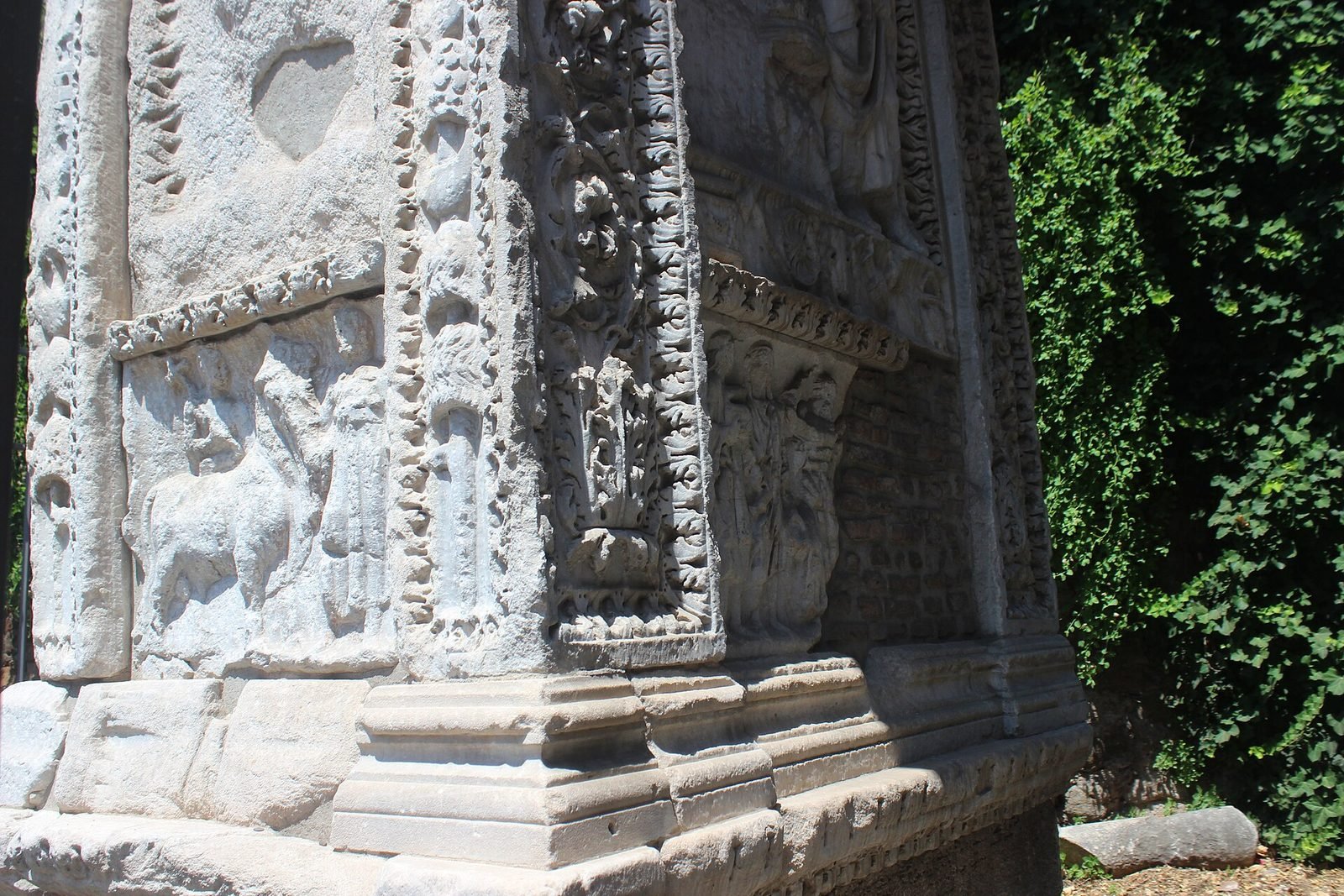
On the outer surfaces of the piers appear figures of Roman soldiers and barbarian prisoners, recognizable by their clothes and pose, together with military insignia. The standards, the signa of the legionary units, are rendered with care: poles with discs, crowns and banners, which in the Roman army had sacred value and were kept in a shrine inside the camp. Losing them was a political catastrophe, recovering them was worth a whole campaign. Putting them on an urban monument served to remind people that Severan power was born in the barracks, something Septimius Severus never had any interest in hiding.
The lower frieze: oxen toward the altar
In the lower band run scenes of immolation with animals led to sacrifice and ritual tools: the knife, the axe, the jug, the bucket for the lustral water. The presence of cattle is the most telling detail of the whole monument, because it ties the dedication to the trade of those who paid for it. Those who sold oxen had oxen carved. No explanation was needed, everyone understood it.
Hercules and the genius, next to the dedication
On the front with the inscription, on either side of the text, two figures are carved, identified as Hercules and a genius. The presence of Hercules in this area has a direct topographical reason: the Forum Boarium was his urban sanctuary par excellence, and the Temple of Hercules Victor, the little round temple you can see 200 meters away, is its most visible testimony. Roman legend tied the episode of Hercules and the giant Cacus precisely to this corner of the city, and it is an ancient literary tradition, not a historical fact.
A curiosity about the Arch of the Argentarii
The name of the Arch of the Argentarii misleads practically all visitors: the argentarii were not silversmiths or goldsmiths, they were bankers and money changers, and the monument has nothing to do with the working of precious metals. The misunderstanding comes from modern Italian, where argentiere means a silver craftsman, while the Latin argentarius indicated someone who handled money, since the everyday Roman coin was silver.
A second misunderstanding, on the same square meter
The confusion multiplies because about 100 meters away is the Arch of Janus, which has no relation to the god Janus: the name comes from the Latin ianus, which as a common noun indicated a covered passage. Two nearby monuments, two wrong names, for two different linguistic reasons. Anyone visiting this corner of the Forum Boarium should know it before arriving, because otherwise they carry away two false notions in 10 minutes.
The treasure of the Argentarii
In Roman popular tradition the rumor circulated that a treasure was hidden inside the piers of the arch, the one set aside by the bankers of the Forum Boarium. It is popular tradition, with no documentary foundation, but it has left concrete consequences: legends of this kind, attested at several monuments in Rome, often encouraged illegal digging and tampering with ancient structures. The marble of the arch bears the marks of removals and gaps, and distinguishing those due to reuse from those due to the search for an imaginary treasure is not possible.
Something nobody tells you about the Arch of the Argentarii
The Arch of the Argentarii survived because in the 7th century a church took it: the eastern pier was half built into the masonry of San Giorgio al Velabro, and part of the base of the Romanesque bell tower rests on the ancient structure. Without that embrace the monument would have ended up like almost all the other minor arches of Rome, dismantled to make lime or building material. Preservation, here, is a side effect of reuse.
The fence and the inner panels
There is a practical limit that guides rarely mention: the passage cannot be walked through freely and the monument is protected by a barrier, so the two sacrifice panels, which are on the inner faces of the piers, are seen at an angle from outside. With a telephoto lens or binoculars they read well, with the naked eye much less. Access conditions in this area have changed several times in recent years because of restoration sites, and it's best to check the updated situation with the Capitoline Superintendency before planning a visit that depends on seeing those two panels up close.
A restoration under way and a route that will change
Between 2024 and 2026 the Forum Boarium area has been the subject of an intervention funded with money from the Caput Mundi program of the PNRR, dedicated first of all to the Arch of Janus, with cleaning and consolidation of the marble surfaces and arrangement of the surrounding areas. Public communications on the project indicate the intention to integrate the Arch of the Argentarii as well into the visiting route of the archaeological area. At the date of writing, the final layout of that route, with any opening days and hours, does not appear to be settled yet: it must be checked each time on the official channels of the Capitoline Superintendency and of Roma Capitale.
My advice for visiting the Arch of the Argentarii
The practical advice for the Arch of the Argentarii is just one and concerns the light: the reliefs are shallow, carved in thin slabs, and at noon with the sun high they flatten until they become illegible. They should be looked at in raking light, that is in the first hour after dawn or the last before sunset, when the shadow slips into the grooves and the profiles come back out. Anyone passing at two in the afternoon in July sees gray marble and leaves convinced there was nothing to see.
How much time you really need
For the arch itself 15 minutes are enough, 20 if you try to read the inscription line by line. It is not a visit that fills a morning and it shouldn't be sold as one. The sensible way to fit it into an itinerary is a loop of an hour and a half that includes the Arch of Janus, the Temple of Portunus, the Temple of Hercules Victor and the basilica of Santa Maria in Cosmedin, which are all within a radius of 300 meters.
Our verdict on the Bocca della Verità line
This is an opinion, and we argue it. The line to have your photo taken with your hand inside the Mouth of Truth in the central hours of high season can take 40 minutes or more, and the result is a photo everyone has taken in front of a reused ancient manhole cover. 200 meters away there is a monument from 204 with the original inscription and the visible traces of a political condemnation, where there is nobody. Anyone who has two hours in this area and spends them all in line is getting the math wrong. If you need the photo, it's best to take it right when the portico opens, early in the morning, and win back the rest of the time.
What to bring
A small pair of binoculars or a camera with a zoom changes the visit more than any audio guide, because it lets you read the inscription and the details of the frieze without getting past the barrier. In the hot hours there is no shade on the sidewalk in front of the arch, and water must be brought from home or taken at one of the public drinking fountains in the area, which are plentiful in the rione Ripa. In winter, on the contrary, the alley stays in shadow almost all day and is noticeably colder than the open square.
Another well-known fact, yet rarely cited
That the ancient monuments of Rome have come down to us thanks to reuse is known to anyone who has read half a page of the city's history, yet it is rarely cited when explaining a single monument, and almost never in front of this one. The Arch of the Argentarii is a textbook case: it was saved because an early medieval church used it as a shoulder for its own masonry, and the Romanesque bell tower leaned on top of it.
The rule, with examples
The Pantheon is standing because in 609 it became a church. The Curia Julia of the Roman Forum keeps its ancient walls because it was turned into the church of Sant'Adriano. The Theater of Marcellus still has two orders of arches because a noble palace was built on top and still lives there. The Basilica of San Clemente sits on top of a Roman building and a Mithraeum, preserving them. The Portico of Octavia is readable because a fish market and then a whole neighborhood settled inside it.
The right photo to take at the Arch of the Argentarii
The photograph that does justice to the Arch of the Argentarii is not the frontal one of the whole monument: it is the detail of the panel with the erasure, where the smooth marble borders the surviving figure. You need raking light and you need a zoom, because the barrier keeps you at a distance. That framing tells in a single frame the thing for which the monument matters, and almost nobody takes it.
The context shot
The second useful photograph is a wide shot from the other side of Via del Velabro: you take the arch leaning against the church, the Romanesque bell tower above and, if you move a few meters, the bulk of the Arch of Janus in the background. It's the image that explains the real scale of the monument, which in close-up photos always looks bigger than it is. With a lens around 24 or 28 millimeters full-frame equivalent you keep everything in without distorting the verticals.
When to shoot
Before nine in the morning the street is empty and the light comes in low, in the last hour before sunset the marble takes on a warm tone and the drill grooves read at their best. Between May and September, in the central hours, the contrast flattens and the result disappoints whatever the equipment.
Some important events that happened here in history
The corner between Via del Velabro and the Forum Boarium has gone through 2,200 years of urban events, and the traces are almost all readable standing on the spot. Here are the main ones, in chronological order, with the data we were able to verify.
AD 204: the dedication
The guild of the argentarii and the cattle traders dedicates the monument to the family of Septimius Severus. The date is fixed by the inscription, which some sources specify as the month of December of that year. It is the moment of greatest fortune of the Severan dynasty: the year before, in 203, the much larger arch bearing the same name as the emperor had been dedicated in the Roman Forum.
205: Plautianus falls
Gaius Fulvius Plautianus, praetorian prefect and most powerful man in the empire after the emperor, is eliminated in 205. His daughter Plautilla, wife of Caracalla, is exiled. Their names disappear from public inscriptions, and on this monument the erasure is added a year after the dedication. Plautilla will be killed in 211.
211: the killing of Geta and the condemnation of memory
Septimius Severus dies at Eboracum, today's York, in February 211, leaving the empire to his two sons. At the end of the same year Caracalla has Geta killed and obtains the condemnation of his memory. The erasures on the Arch of the Argentarii are traced back to this moment: some sources place them in 211, others in 212, because the measure is immediate and the physical execution takes time.
7th century: the church takes over the monument
In the area rises the deaconry of San Giorgio, a charitable structure tied to the distribution of goods to the poor, and the eastern pier of the arch is half built into the masonry. It is the act that saves the monument. In the 9th century, under Pope Gregory IV, the church is enlarged and takes on the three-aisle layout it still keeps.
1259: the bell tower
The Romanesque bell tower of San Giorgio al Velabro is documented from 1259. It rises in five tiers over the first bay of the left aisle, and part of its base rests on the ancient structure of the arch. The overlap between Severan marble and medieval masonry is visible from the street, and it is one of the sharpest grafts you can observe in the center of Rome without going in anywhere.
July 27, 1993: the bombing
In the night between July 27 and 28, 1993, a car bomb exploded in front of the facade of San Giorgio al Velabro, causing the almost total collapse of the portico in front and serious damage to the front, the masonry structures and the interior decorations. The same night a second device hit the basilica of San Giovanni in Laterano. The attacks, part of the 1993 season of massacres, were attributed to Cosa Nostra by judicial investigations. The overall toll of that Roman night was 22 injured.
The restoration after the bombing
The rebuilding of the portico was carried out by anastylosis, that is by reassembling the original elements recovered from the rubble and replacing only what was necessary. The work recovered capitals, architectural elements, decorations and a fragment of early medieval fresco. The church was reopened for worship on July 6, 1996, in the presence of the President of the Republic Oscar Luigi Scalfaro. For the archaeological area next door the times were much longer: the Arch of Janus stayed closed and fenced off for 28 years, and became accessible to the public again only in November 2021. We won't add anything else about that night, because the monument doesn't need to be told through crime news.
From 2024 on: the Forum Boarium work site
The intervention funded by the Caput Mundi program with PNRR money, of a declared value of about 3 million euros, has involved the cleaning and consolidation of the marble surfaces, the removal of deposits and vegetation and the arrangement of the surrounding areas, starting with the Arch of Janus. In the public communications about the project the Arch of the Argentarii is indicated as destined to be integrated into the visiting route of the area. The concrete terms of that integration must be checked on the official channels, because at the time of writing they do not appear to be defined in a stable way.
Who passed through the Arch of the Argentarii
Under the Arch of the Argentarii, in 204, passed every day the herdsmen bringing oxen to market, the money changers who kept their counters under the porticoes, the slaves in charge of transport and the priests of the nearby temples. This is the public for whom the monument was built, and it is the only group we are certain passed beneath it.
The emperors, with caution
Septimius Severus, Julia Domna, Caracalla and Geta are depicted on the monument, which doesn't mean they ever passed beneath it. An honorary dedication did not require the presence of the honoree, and there is no source documenting an imperial visit to this market gate. Anyone who tells the arch as the place where Caracalla had his brother erased with his own hands is writing fiction. The administrative act was carried out by stonecutters, on written order, in a city where operations like this were done by the hundreds.
The cardinals of San Giorgio
The church leaning against the arch is the seat of an ancient cardinal title, and among the titular cardinals are figures who later became popes: Boniface IX, titular between 1381 and 1385, and Martin V, titular between 1406 and 1417, the pontiff who permanently brought the papacy back to Rome after the schism. Between the 19th and 20th centuries the title was held by John Henry Newman, an English theologian converted to Catholicism, cardinal deacon of San Giorgio al Velabro from 1879 to 1890 and proclaimed a saint in 2019.
The Grand Tour travelers
The Forum Boarium was a customary stop on 18th- and 19th-century itineraries among the Capitoline Hill, the Circus Maximus and the Baths of Caracalla, and the foreign travelers who kept a travel diary talk about it regularly. The image of the area that they hand down to us is that of a working-class, working district, very far from the orderly look it has today.
San Giorgio al Velabro, the church the arch leans against
The church of San Giorgio al Velabro, which many sources also write as San Giorgio in Velabro, was born as a deaconry between the 7th and 9th centuries and is one of the least retouched medieval interiors in the center of Rome: three aisles divided by reused ancient columns, all different from one another, a low floor, very little light. The Roman arch touches it on the side, and the bell tower sits above it.
The hours, and why we don't write them
The opening hours of San Giorgio al Velabro are irregular and change with the seasons, with celebrations and with staff availability. We don't give them, because a wrong hour is worse than no hour: if you want to go in, check the official channels of the parish and the diocese before showing up. We understand the church stays closed for part of the central hours of the day, like many Roman churches, but this is not information to build an itinerary on.
What you see inside
The interior keeps its early medieval layout, the apse with its painted decoration and the portico rebuilt after 1993. The feeling it gives is one of severity: no gilding, no polychrome Baroque marble, bare surfaces. For those coming from a day of overloaded Roman churches it is a strong contrast, and for those looking for medieval Rome it is one of the densest stops along with Santi Quattro Coronati, Santo Stefano Rotondo and the Basilica of Santa Sabina on the Aventine.
The Forum Boarium around the arch: what to see in half an hour
Within a radius of 300 meters from the Arch of the Argentarii are concentrated the two best-preserved Republican temples in Rome, a late antique four-sided arch, a medieval basilica with a Romanesque bell tower and the stretch of river with the oldest Roman bridge still in use. It is the highest density of ancient monuments accessible for free in the whole city.
The two temples
The Temple of Portunus, rectangular, and the Temple of Hercules Victor, round, have been standing for over 2,000 years for the same reason as the arch: they were turned into churches and therefore maintained. The round temple was for centuries attributed to Vesta because of its circular shape, and the old name still appears on some signs and in many guides.
The river and the bridges
200 meters away, the Ponte Rotto is the surviving stump of the Aemilian bridge in the middle of the current, and it is viewed from the Ponte Palatino. A little farther upstream, the Tiber Island is reached by the Ponte Fabricio, from 62 BC, the oldest bridge in Rome still walkable in its original structure, and you leave it on the other side by the Ponte Cestio.
The two directions to continue
Upstream you enter the Jewish Ghetto passing by the Portico of Octavia and the Synagogue, and from there to the Capitoline Hill and the Capitoline Museums. Downstream you climb the Aventine with the Orange Garden and the Rose Garden of Rome, and then descend toward the Pyramid of Cestius. If instead you're aiming for the archaeological heart, you find 10 minutes away the Roman Forum with the Temple of Saturn, the Arch of Constantine, the Markets of Trajan with the Trajan's Column and the Domus Romane of Palazzo Valentini.
Eating nearby without falling into a trap
The Forum Boarium is an awkward spot for eating: it is an area of monuments with few homes around, and the dining you find there is almost all calibrated to the tourist traffic between the Bocca della Verità and the Circus Maximus. We don't name places, by editorial choice: a list of signs goes stale in a few months and teaches nothing. We give the criteria instead, which stay valid even in 10 years.
The five signs you're about to end up in a trap
The first is the lady rolling fresh pasta in the window or at a little table on the street: it's an advertising lure, not a kitchen. The second is the menu with photographs of the dishes, which is for those who don't have to come back. The third is the tout at the door inviting you to sit: a place that is busy doesn't need to stop people in the street. The fourth is the continuous schedule from morning to night, with no kitchen break, which is only possible with an industrial kitchen. The fifth is the location: places set in front of famous monuments often adjust the price to the tourist in front of them, with items unpriced on the menu and different price lists inside and outside.
The chains in the center
In the center of Rome a model of dining with a repeated sign has spread, with the same menu at several points in the city and the line with a number ticket at the entrance. We don't name them, and the reason is simple: they are marketing products, not Roman cooking. The fact to keep is that Romans don't go there. If you want to eat the way people eat in this city, look elsewhere.
The simplest criterion there is
Look at who is sitting and in what language they order. If at the tables there are people speaking Italian with a Roman accent, if there are families, if people come in and greet by name, the place works for the neighborhood. If at the tables there are only foreigners with backpacks and the waiter switches to English before you've even opened your mouth, you're in a place that lives off passing trade. It's not an infallible rule, it's the most reliable one we know.
Where to move
The practical advice is to walk 10 minutes and get away from the monuments: the Ghetto, the inner streets of the Aventine toward Testaccio, or the residential side of Trastevere beyond Viale di Trastevere, away from the main squares. If you want the full reasoning on tourist traps, you'll find it on the page Where to eat in Rome. For those who prefer to start from a selection already made, there is Daniele Dezi's personal list on Google Maps: it is a curated collection, not sponsored, and it should be taken for what it is, the judgment of a person who works in Rome.
Frequently asked questions about the Arch of the Argentarii
How much does it cost to visit the Arch of the Argentarii?
Visiting the Arch of the Argentarii costs nothing: the monument is on Via del Velabro, on the side of the church of San Giorgio al Velabro, and is freely visible from the public street, without a ticket and without a reservation. There is no dedicated ticket office. If in the future the arch is included in a fenced visiting route of the Forum Boarium archaeological area, access conditions may change: it's best to check them on the channels of the Capitoline Superintendency.
What are the opening hours of the Arch of the Argentarii?
The Arch of the Argentarii has no opening hours, because it can be seen from the street at any hour of the day and night. The church of San Giorgio al Velabro, against which the arch leans, instead has irregular hours that vary with the seasons and with celebrations: we don't give them and we advise checking them on the official channels of the parish before going, because outdated information would make you waste the trip.
Why is it called the Arch of the Argentarii?
The Arch of the Argentarii takes its name from the argentarii, that is the bankers and money changers of the Forum Boarium, who together with the negotiantes boarii, the cattle traders, paid for the monument and dedicated it in AD 204 to the family of Septimius Severus. The argentarii were not silversmiths or goldsmiths: the Latin argentarius indicated someone who dealt with money, because the everyday coin was silver.
Why are there erased figures on the Arch of the Argentarii?
On the Arch of the Argentarii some figures were chiseled away as a result of the damnatio memoriae, the official condemnation of memory that in Rome meant removing the name and image of the condemned from public monuments. It concerned Geta, killed in 211 on the order of his brother Caracalla, and before him the prefect Plautianus, fallen in 205, with his daughter Plautilla. The erasures are still visible on the marble.
What is the difference between the Arch of the Argentarii and the Arch of Janus?
The Arch of the Argentarii and the Arch of Janus are two distinct monuments about 100 meters apart in the Forum Boarium: the first is a trabeated gate from AD 204, just over six meters tall and covered with reliefs, the second is a large four-sided arch of the 4th century, with four openings and a central vault. The first is a private dedication, the second a public structure.
Can you photograph the Arch of the Argentarii?
The Arch of the Argentarii can be photographed freely, because it is an open-air monument visible from the public street and there are no filming bans. You need a zoom for the details of the reliefs, since a barrier keeps you at a distance, and it's best to go in raking light, early in the morning or in the last hour of sun. Drone shooting is subject to severe limits across the whole historic center of Rome.
Is the Arch of the Argentarii suitable for children?
The Arch of the Argentarii works well with children precisely because of the erased figures, which are a story you can tell in two minutes and verify by looking at the marble. The stop is short, outdoors and free, and combines with the area of Piazza della Bocca della Verità. The weak point is the absence of shade in front of the arch in the central hours of summer.
Is the Arch of the Argentarii accessible to people with mobility difficulties?
The Arch of the Argentarii is observed from the sidewalk of Via del Velabro, flat and without steps, so it is reachable by wheelchair. The road surface is sampietrini cobblestones, with widespread unevenness as in the whole rione Ripa. Access to the adjacent church, instead, has a change in level. For an overall picture of museums, transport and accessible routes in the city, we refer you to our dedicated page.
Who wrote this page
This page is edited by the team of Tour Leader Pro, the Rome-based project office that designs and coordinates visits, itineraries and cultural events in Rome and Lazio. Hours, fares and access conditions given here are verified at the publication date on the official sources indicated in the text: before leaving it's best to recheck them, because they change often. If you find outdated information, let us know.
Anyone building a Roman itinerary that holds together the Forum Boarium, the Aventine and the stretch of river between the Tiber Island and Testaccio, and needs to fit together hours, travel times and guided visits, will find planning tools and organizational support at Tour Leader Pro, which works in Rome and Lazio with groups, schools and companies.
For a broader picture, including connections from the airports, regional transport and the destinations in the rest of Italy to reach starting from Rome, a good planning resource is Italy Planner.