Curia Iulia
In short. The Curia Iulia is the chamber of the Roman Senate, the brick parallelepiped that closes the northern side of the Roman Forum, a few meters from the Arch of Septimius Severus.
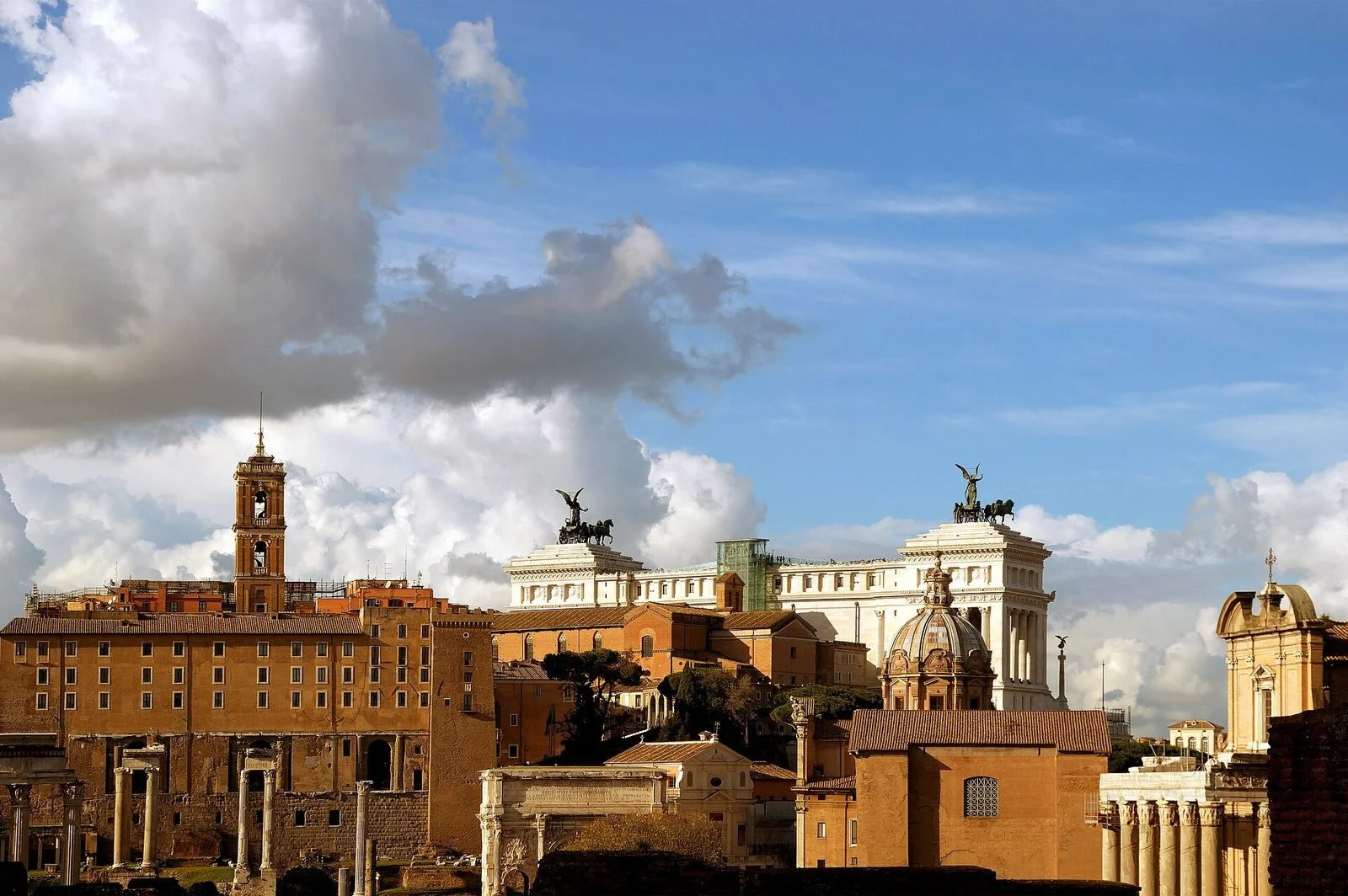
The Curia Iulia is the chamber of the Roman Senate, the brick parallelepiped that closes the northern side of the Roman Forum, a few meters from the Arch of Septimius Severus. It has to be said right away, because almost no one says it at the entrance: the building you see today is not Julius Caesar's chamber. It is the reconstruction ordered by Diocletian after the fire that devastated this sector of the Forum in AD 283. Caesar had started the project, Augustus had inaugurated it in 29 BC, but of that Augustan building under your feet very little visible remains. What you walk through is late antique, three and a half centuries younger than most visitors imagine, and precisely for this reason it is one of the very few Roman public buildings to have reached us with the roof, the walls whole and the original floor in the right place.
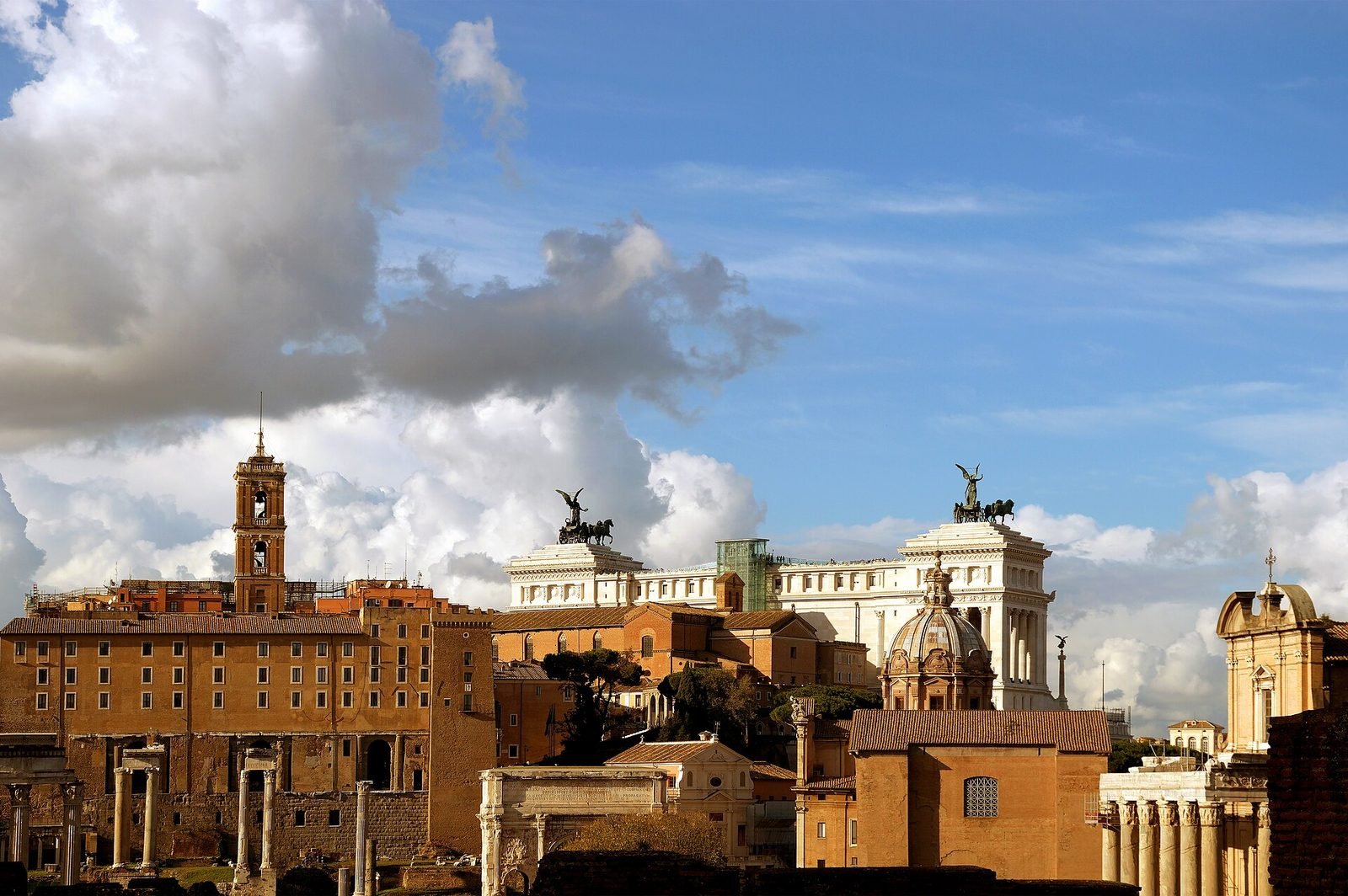
The reason for this survival can be summed up in one sentence: in the 7th century the Curia was transformed into the church of Sant'Adriano al Foro, and for 13 centuries it remained a place of worship, repaired, repaired again, plastered, decorated, but never abandoned to collapse. The excavations of the 1930s took down the Baroque church and gave back the ancient shell. The pages that follow explain what you see inside, what is certain and what remains debated, how a session of the Roman Senate really worked, why the bronze doors you see today are a copy and where the real ones ended up, and how to visit the chamber now that it is part of the archaeological area managed by the Parco archeologico del Colosseo.
Where the Curia Iulia is and how to get there
The Curia Iulia is inside the archaeological area of the Roman Forum, on the north side of the square, with the facade facing south and the left flank facing Via dei Fori Imperiali. The entrance to the chamber opens from inside the archaeological area: there is no independent access from the street, and you don't enter the Curia without the admission ticket valid for the circuit of the Roman Forum, Palatine Hill and Colosseum.
The useful entrances to the archaeological area
The accesses that lead most quickly to the Curia are the northern ones of the area, that is, the gate at Largo della Salara Vecchia on Via dei Fori Imperiali and the one that descends from the side of the Capitoline Hill. Anyone entering from the opposite side, that of the Arch of Titus near the Colosseum, crosses the whole Via Sacra before getting there, and in summer that means 20 minutes of walking on scorching paving stones with no shade. The entrances change layout fairly often because of works and flows: before setting out it's best to check the updated map of the accesses on the website of the Parco archeologico del Colosseo, which is the body that manages the area.
Subway, bus, tram
The most convenient subway stop is Colosseo on Line B, from which you walk up Via dei Fori Imperiali in a good 10 minutes. Whoever gets off at Cavour, also on Line B, arrives from the Monti district via Salita dei Borgia and comes out on Via dei Fori Imperiali at the level of the Imperial Forums, a short walk from the Forum of Trajan. The buses that run along Via dei Fori Imperiali and Piazza Venezia all drop you at a useful distance, and anyone arriving by tram can get off at Piazza Venezia or at Via Labicana depending on the line.
What you really see: Diocletian's chamber, not Caesar's
The building visible today is the reconstruction carried out under Diocletian after the fire of AD 283, the one the sources link to the reign of Carinus, and the works are placed between 284 and the first years of the following century. This is the fact that changes the visit: whoever enters thinking of treading the floor on which Cicero walked is off by almost three and a half centuries.
The measurements, with the warning that the sources don't coincide
The reported measurements diverge depending on the source and the point at which the height is taken. English-language archaeological literature usually cites a chamber of about 25.20 meters by 17.61, while several Italian popular listings round it to 27 by 18 meters. On the height there is instead greater agreement, around 21 meters at the intrados of the roof. The interesting fact is not the centimeter but the proportion: the height corresponds roughly to half the sum of length and width, which is exactly the rule that Vitruvius sets for curiae in his treatise on architecture. A late antique building constructed on a rule written three centuries earlier says a lot about how untouchable that form was considered.
The exterior: exposed brick, and it wasn't like this
The facade you photograph today is a brick wall with four corner buttresses, a central portal and three large arched windows above it, crowned by a pediment. That bare brick is an effect of history, not an ancient choice. Originally the lower part of the facade was covered with marble slabs, and the upper part carried a stucco worked in rustication that imitated stone blocks. Whoever looks at the building has to dress it mentally: below white marble, above a light surface with fake ashlar, and a roof that was not this one.
The chambers that came before: Curia Hostilia and Curia Cornelia
The Curia Iulia occupies the site of two earlier buildings, the Curia Hostilia and the Curia Cornelia, but with a different orientation, and this shift is Caesar's real political act on this corner of the Forum. Roman tradition attributed the first chamber of the Senate to King Tullus Hostilius, in the 7th or 6th century BC, hence the name Curia Hostilia. It is a tradition, not an archival fact: archaeology confirms that at that spot there was a very ancient building facing the Comitium, but the attribution to the king belongs to the stories of origins, and should be treated as such.
The blaze of 52 BC
The Curia Hostilia burned in 52 BC, and it burned in a way that no guide should tell in an anecdotal tone, because it was an episode of urban civil war. Publius Clodius Pulcher, tribune and popular leader, had been killed on Via Appia in a clash with Milo's men. The crowd carried the body into the Forum, laid it in the Senate chamber and made a pyre of it with the senators' benches and writing tablets. The fire that started from that pyre destroyed the Curia and spread to the Basilica Porcia next to it. The Roman Senate lost its chamber at the hands of a crowd that was celebrating a political funeral.
The Curia Cornelia and its erasure
After the fire, the reconstruction was entrusted to Faustus Sulla, son of the dictator, and the building took the name Curia Cornelia from the gens Cornelia to which the Sullas belonged. It had a short life. Julius Caesar had it demolished to redesign from scratch the whole northern corner of the Forum, and the erasure of a building that bore the name of his most cumbersome political adversary did not go unnoticed by any of his contemporaries. The new building was born already with a different name: Curia Iulia.
Caesar, Augustus and the inauguration of 29 BC
The Curia Iulia was inaugurated by Augustus on August 28 of 29 BC, together with other dedications of that year of triumphs, and Caesar did not see it finished because he had been killed 15 years earlier. The project had been started by him in 44 BC or shortly before, interrupted by the civil wars and resumed by his heir once the account with Antony and Cleopatra was closed.
What Augustus put inside
In the chamber Augustus placed the statue of Victory, a sculpture that according to ancient sources came from Taranto and had been brought to Rome as booty, set on an altar. He also had Greek works placed in the chamber, and attached to the Curia was a building block called the Chalcidicum or Atrium Minervae, a porticoed space of which traces remain on the eastern flank. The gesture that counts is that of the statue: putting a Victory inside the chamber where wars were decided meant declaring which side had the favor of the gods, and whoever entered to vote saw it before sitting down.
A curiosity about the Curia Iulia
The proportion of the chamber is not an aesthetic accident: it responds to a technical prescription by Vitruvius, who in De architectura establishes how a curia should be dimensioned so that the voice works. Vitruvius writes that the height of the chamber must correspond to half the sum of the length and the width, and adds an explicit acoustic reason: the hall should be fitted with moldings at mid-height to prevent the sound from dispersing upward before reaching the ear of the listener.
A chamber designed for speaking without a microphone
Put into practice: the Curia Iulia is an acoustic apparatus for 300 people seated on three levels, built so that a man standing in the center could be heard distinctly by everyone without raising his voice beyond its natural tone. Whoever enters the empty chamber today can test it for themselves, speaking in a normal voice toward the back: the reverberation is controlled, much more than you would expect from a volume 21 meters high. This is why this building, in past decades, has been used for conferences and presentations, and continues to be on occasion.
The interior: opus sectile, tiers, three large windows
The floor of the chamber is in Diocletianic opus sectile, that is, an inlay of polychrome marble slabs cut to a pattern, and it is the main reason this interior deserves the line at the entrance. It is not a mosaic of tesserae: they are shaped slabs of red porphyry, green serpentine, giallo antico and white marbles, composed in panels and rotae, that is, discs, arranged in sequence along the axis of the hall.
How authentic that floor is
Precision is needed here, because the point is often told badly. The floor is ancient in its substance and in its design, but it has undergone integrations and reassembly in the course of restorations, particularly those of the 20th century. Several sources speak explicitly of an opus sectile partly reassembled. Whoever walks on the walkway and looks down therefore sees a late antique original with modern patches, not a surface intact since AD 300. The distinction, in person, shows in the edges of the panels and in the excessive regularity of some of the reintegrations.
The side tiers and the 300 seats
Along the two long sides run three low, wide steps, which held the senators' seats. Current estimates speak of about 300 seats, arranged on these three levels facing the central aisle. The senators did not sit on fixed masonry benches but on movable seats, the sellae, placed on the steps: the number of places therefore also depended on how the chairs were arranged, and this is another reason to treat the number 300 as an order of magnitude and not as a counted fact.
The back of the chamber and the podium
At the back of the hall, in line with the entrance, is a raised podium, the station of the magistrates who presided over the session. In the walls open niches framed by small columns, meant to hold statues, which in the Diocletianic phase were covered in colored marbles. On the entrance walls remain scraps of early medieval fresco, survivors of the period when the building was a church: small fragments, easy to miss, and they are the most direct visual proof that this chamber has had two lives.
The three large windows and the light
The three large arched windows opened above the portal are the hall's only source of natural light, and they face south. The practical effect, for visitors, is that the chamber is well lit in the middle hours and early afternoon, while early in the morning and in the late afternoon the interior stays in half-light, with the floor hard to read. In the restoration of 2019 and 2020, directed by the architect Maria Grazia Filetici, the window frames were fitted with a motorized opening system for climate control and with large glass panes sized also to withstand wind pressure.
One thing nobody tells you about the Curia Iulia
The bronze doors you see at the entrance to the Curia are a modern copy. The originals, of the Diocletianic era, have been since the 17th century at St. John Lateran, where they close the central portal of the basilica, and anyone who enters the Lateran by the main front passes through them without knowing they are going under the leaves of the Roman Senate's chamber.
How they ended up there
The transfer dates to the pontificate of Alexander VII Chigi and is placed around 1660, as part of the works that affected the front of the Lateran. The ancient doors were smaller than the opening they were destined for and were adapted, with additions and a new framing, so that they could serve as the basilica's main portal. It is a textbook case of papal reuse: an ancient artifact is not destroyed, it is promoted, and by changing purpose it loses the context that explained it.
Why it matters more than an anecdote
The value of those doors is that they are one of the very few bronze architectural fittings of the late antique period to have come down to us intact, while almost all Roman bronze was melted over the centuries to make weapons, bells and coins. That they were saved precisely because a Christian basilica reused them is the same dynamic that saved the Curia itself: reuse protected what abandonment would have erased. Anyone who wants to see them doesn't have to pay anything, admission to the Lateran basilica is free, and the comparison between the copy in the Forum and the original in the Lateran is one of the few exercises in comparative archaeology you can do in Rome for free and within half an hour of subway.
The Altar of Victory and the end of the pagan Senate
The Altar of Victory placed in the Curia by Augustus was at the center of the bitterest religious clash of the Roman 4th century, the one between the prefect Quintus Aurelius Symmachus and Bishop Ambrose of Milan. The emperor Constantius II had had it removed during his visit to Rome in 357, Julian had put it back, and in 382 Gratian had it removed for good together with the tax privileges of the traditional cults.
Symmachus's relatio
In 384 Symmachus, urban prefect and voice of the senatorial party tied to the ancient cults, sent to the emperor Valentinian II an official report asking that the altar be returned to the chamber. The text is preserved and contains one of the most quoted formulas of late Latin antiquity: one cannot arrive at so great a mystery by one road alone. Ambrose replied with two letters that obtained the opposite result. The altar never came back.
The advice I give you for visiting the Curia Iulia
The practical advice is one: enter the archaeological area through the north gate, the one at Largo della Salara Vecchia on Via dei Fori Imperiali, and do the Curia as the first stop and not the last. Whoever enters from the Colosseum gets here after an hour and a half of walking, tired, with a saturated memory, and looks at the opus sectile for 40 seconds. Whoever enters from the north gets here in three minutes, with a fresh head, and the hall stays with them.
The right hours
The good light for the interior is that of the middle hours, because of the three large south-facing windows. The good light for the facade, instead, is early morning and late afternoon, when the brick takes on a warm tone and the pediment is not flattened by the sun directly overhead. The two needs conflict, and one of them has to be chosen: we recommend the first, because the facade can always be photographed decently anyway, the floor cannot.
The line, the heat and the days
The Roman Forum is visited on foot on uneven paving stones, without shade for long stretches and with no possibility of re-entering once you've left. From June to September, between 11:00 and 16:00, the temperature on Via Sacra is several degrees higher than on the street in the shade. The first hours after opening and the last two before the last entry are the least crowded slots. Closed shoes with thick soles, water, hat: the nasoni inside the area are there and the water is drinkable.
A judgment, since it's needed
The Curia is one of the three or four interiors of the Forum that are really worth the line, together with the church of Santa Maria Antiqua when it is accessible and Santi Cosma e Damiano on the side of the Imperial Forums. Many visitors spend six hours among the Forum, the Palatine and the Colosseum and do not enter the one building where you can stand inside a Roman public space with its walls whole. It is a mistake of priorities, and it is paid for in memories.
With children
The empty chamber says little to a child under 10 if nobody explains what happened in here. It works very well, instead, to tell the scene: 300 men in togas seated on three steps, one speaking standing in the center, and the vote taken by physically moving from one side of the hall to the other. The passage from words to the body, in a space where you can stand in the right place, holds attention much more than a display case.
Sant'Adriano al Foro: 1,300 years as a church
The Curia Iulia was preserved because in the 7th century it was transformed into the church of Sant'Adriano al Foro, on the initiative of Pope Honorius I, whose pontificate runs from 625 to 638. The dedication went to Hadrian of Nicomedia, an Eastern martyr, and the building entered the system of the Roman diaconiae, that is, the centers of assistance and grain distribution that the Church had organized in the late antique city.
What changes when a chamber becomes a church
The change of use required less work than you might think, and precisely for this reason it worked. The rectangular hall with the podium at the back lent itself to the liturgy without demolition: the apse took the back, the orientation stayed the same, the side tiers ended up under a new floor level gradually raised by fill. The level of the Forum rose from century to century, and the church rose with it: in the last centuries Sant'Adriano was entered from a height much greater than the Roman one.
The Baroque transformations
In the 17th century the church was profoundly reworked, with an intervention that gave it an entirely Baroque facade and interior, and whoever looked at the building from Piazza dei Fori had no way of suspecting that the Curia lay underneath. The literature usually ties those 17th-century works to Martino Longhi the Younger, but the precise attribution of the individual interventions is not clear-cut and is reported in different ways in popular sources: we flag it as a fact to verify in specialist bibliography.
Another well-known fact, yet rarely mentioned
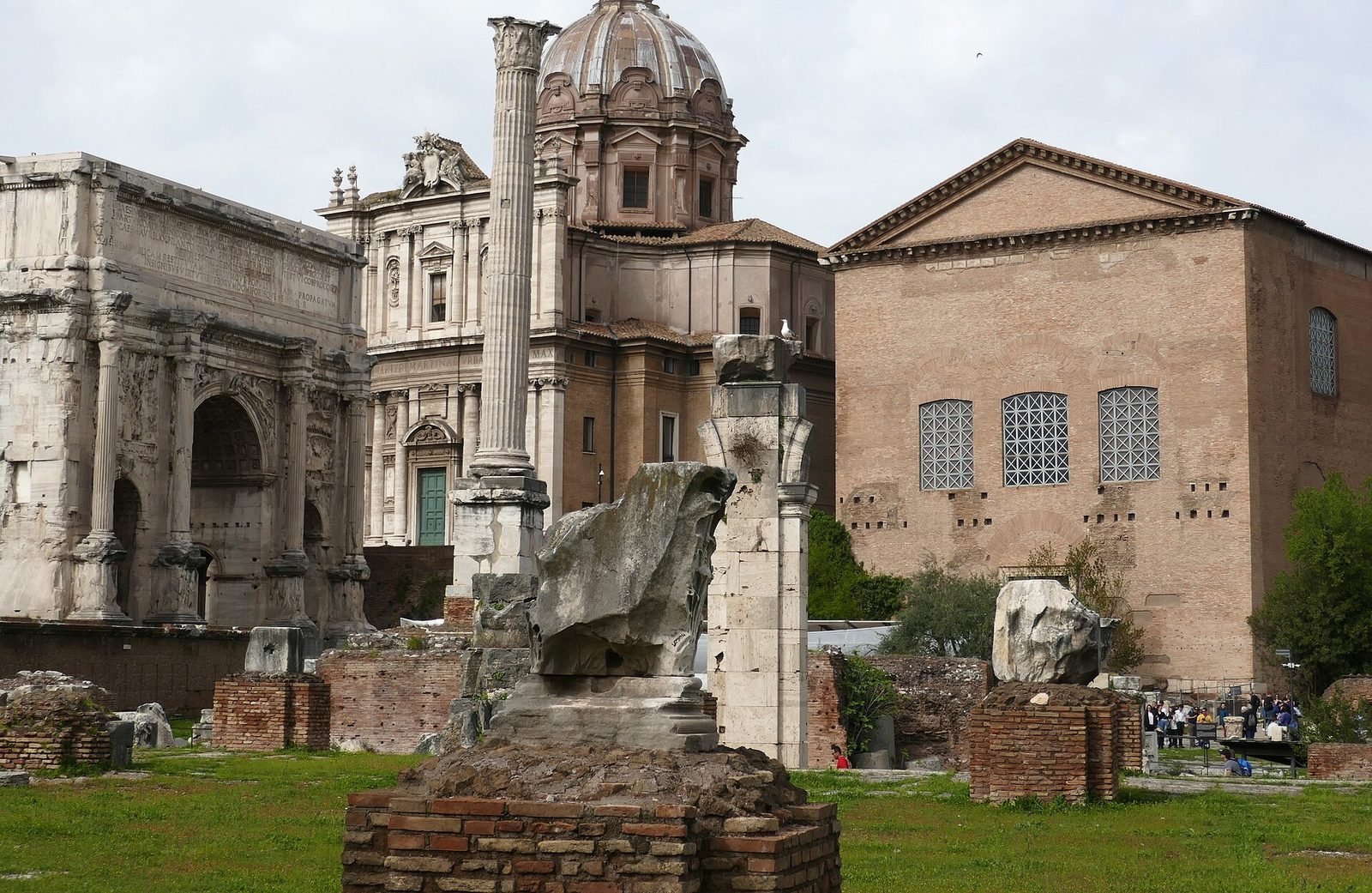
The fact is this: the Curia Iulia stopped being a church only in the 1930s, and the demolition of Sant'Adriano was an operation of the Fascist regime, with declared political aims as well as archaeological ones. The works, begun around 1930 and concluded in the second half of the decade, were directed by Alfonso Bartoli and were part of the great project of rediscovering Romanness that in those same years produced Via dell'Impero, today Via dei Fori Imperiali, and the demolition of entire neighborhoods between the Capitoline Hill and the Colosseum.
What was removed and what was rebuilt
The intervention took down the Baroque facade and interiors, lowered the floor level to the late antique one, rebuilt the roof, and reintegrated the tiers and the floor. The result is the building you visit today, and its legibility is excellent. The cost is that a historical phase of 1,300 years was erased to restore a phase of 300. No contemporary superintendency would make a choice of this kind, and archaeologists still discuss it as a textbook case.
The chronology reported differently by the sources
The dates of the project vary in the sources: some speak of restorations between 1930 and 1936, others extend the works to 1938. The divergence depends on what is counted, only the excavation and the freeing of the building or also the finishing and the arrangement of the surrounding area. We report both ranges because neither is wrong, it depends on the criterion.
A second fact that divides the sources
There is a point on which the popular sources do not agree and that is worth flagging for the reader: the fire after which Diocletian rebuilt the chamber. The great majority of the literature places it in AD 283, under Carinus, and it is the dating we use on this page. The listing of the Parco archeologico del Colosseo instead reports a fire of AD 238. The Diocletianic reconstruction is not in question, the date of the fire that made it necessary is, and anyone looking for a single answer online will find both figures.
The Plutei of Trajan, also called Anaglyfi
Displayed inside the Curia Iulia are the Plutei of Trajan, two large marble slabs sculpted on both faces, found in 1872 in the Roman Forum between the Comitium and the Column of Phocas. The official listing of the Parco archeologico del Colosseo still gives them as displayed inside the Curia, and it is the source we rely on.
An honest caution on the location
This is information to be checked before the visit, and we say so openly. Between 2024 and 2025 the Park changed the opening days of the Curia precisely to allow restoration work on the plutei, a sign that the slabs have been the subject of a conservation project. We are not able to confirm with certainty that on the date you are reading they are displayed and visible in their usual place inside the chamber. Anyone coming specifically to see the plutei should check beforehand on the website of the Parco archeologico del Colosseo or ask at the entrance.
What they depict
On one face each slab carries a scene of public life in the Forum. On the first, the emperor attends the destruction of the records of overdue tax debts, with soldiers carrying the tablets to the fire. On the second, the emperor presides over the establishment of the alimenta, the program of subsidized loans to landowners whose interest financed the upkeep of poor children in Italy. On the other face of both slabs runs instead the sequence of the animals of the suovetaurilia sacrifice: the pig, the sheep and the bull.
Why they are an urbanistic document more than a sculpture
The archaeological value of the plutei lies in the background. Behind the figures, the sculptor represented with precision the buildings that closed the southern side of the Roman Forum at the beginning of the 2nd century AD, and those backdrops are one of the few close views we have of the real appearance of the square. Archaeologists use them to reconstruct the position and elevation of structures that no longer exist, and to discuss the sequence of buildings along Via Sacra toward the Temple of Antoninus and Faustina and the Basilica of Maxentius.
What remains uncertain
The current name attributes the slabs to Trajan, but the same official listing of the Parco archeologico del Colosseo admits that the identification of the emperor depicted and the original function of the slabs remain uncertain. Part of the critics have proposed a Hadrianic dating. The original location is also debated: a fence or barrier in the area of the Comitium or near the rostra has been suggested, without any hypothesis prevailing. Anyone who tells the plutei as a closed matter is simplifying.
The right photo to take at the Curia Iulia
The photo that makes the Curia Iulia recognizable is the one from below and at three-quarter angle, taken from the side of the Arch of Septimius Severus, with the pediment and the three large windows framed in full and the Severan arch entering the left corner. It is the only framing that conveys at once the mass of the building and its position in the Forum, and it has to be done by backing up as far as the paving allows.
The time and the side
The facade faces south, so it gets sun for almost the whole day. The best light is that of the first two hours after opening, when the low sun arrives raking and separates the corner buttresses from the plane of the wall, or that of the last hour before the last entry. At midday in summer the brick flattens and the pediment loses depth: the same photo, taken three hours earlier, has twice the relief.
The interior, which is the hardest photo
Inside the chamber the problem is contrast: the three large windows blow out every exposure calibrated on the floor, and the floor disappears in every exposure calibrated on the windows. The practical solution, without a tripod, is to put your back to the windows, toward the rear, and photograph the opus sectile and the tiers with the light behind you, leaving the windows out of the frame entirely. The other photo that works is vertical, taken from the threshold toward the back, with the two rows of steps converging toward the podium.
Tripod, flash and rules
In the areas of the Parco archeologico del Colosseo, amateur photography without flash is normally allowed, while tripods, lights and professional filming require authorization. Conditions can change and are applied by the staff in the room: anyone carrying bulky equipment should ask the staff before setting it up, rather than finding out afterward.
How a session of the Senate really worked
The Roman Senate did not vote with a ballot: it voted with its feet, physically moving to the part of the chamber corresponding to the proposal one supported, with a procedure called discessio. Understanding this changes the way you look at the hall, because it explains why a wide central aisle and two facing sets of tiers are needed.
The order of speaking
People spoke by rank. The presiding magistrate set out the question, the relatio, and then questioned the senators following a rigid hierarchical order that started with the consulars, that is, those who had already been consul, and went down the ladder of the magistracies held. Those at the bottom of the list, in long sessions, never got to speak. The right to speak was not limited in time, and this made obstruction possible: a senator could speak until sunset to make the session lapse, and Cato the Younger made it a systematic political tool.
Why the Curia was not the only seat
The Senate could meet in any consecrated place inside the pomerium or within a mile of it, and in practice it often met elsewhere: in the Temple of Concord at the foot of the Capitoline Hill, in the Temple of Jupiter Stator, in the Curia of Pompey in the Campus Martius. It is this last circumstance that produces the most widespread misunderstanding about this building, and it is worth clearing up in the chapter that follows.
Some important events that took place here in history
The first event to mention is the one that did not happen here: Julius Caesar was not killed in the Curia Iulia. The Ides of March of 44 BC took place in the Curia of Pompey, the hall attached to the portico of the Theater of Pompey in the Campus Martius, today in the area of Largo di Torre Argentina, where the Senate met because the Forum was a construction site. The Curia Iulia, at that moment, had just been started and did not exist as a usable building.
29 BC: the inauguration
On August 28 of 29 BC Augustus dedicated the completed chamber, in the year of the triple triumph that closed the civil wars. In the same season of dedications fell the placing of the Altar of Victory. The political operation is readable: the victor gives the Senate a new and monumental seat, and in doing so brands it with the name of his own family and with a military symbol.
AD 283: the fire
The fire that the sources link to the reign of Carinus destroyed the northwestern sector of the Forum, and with it the Augustan chamber. It is the event that produced the building we see, and in this sense it is the decisive event in the material history of the Curia. Diocletian began the reconstruction immediately afterward.
357: the visit of Constantius II and the removal of the altar
The visit to Rome of the emperor Constantius II in 357 is documented by Ammianus Marcellinus with one of the most vivid descriptions of the late antique city, and it was on that occasion that the Altar of Victory was removed from the chamber for the first time. The same stay is linked by part of the critics also to other monumental interventions in the city, a question that returns to discussion with regard to the Arch of Janus in the Forum Boarium.
384: the controversy between Symmachus and Ambrose
Symmachus's request and Ambrose's reply on the Altar of Victory are the last great public act of the traditionalist Roman Senate, and they take place with this hall as their object. The imperial refusal symbolically closes the arc of the Curia as a place of Roman public worship.
7th century: the conversion into a church
Under Pope Honorius I the chamber becomes Sant'Adriano al Foro. It is the event that saves the building, and it should be put on the same level as the previous ones in importance, because without that conversion today in place of the Curia there would be a ruin of foundations like that of so many other buildings of the Forum.
The 1930s: the excavation
The demolition of the Baroque church and the restoration of the late antique chamber under the direction of Alfonso Bartoli close the religious history of the building and open its museum one. Since then the Curia Iulia has been a visitable archaeological monument, and since 2017 it has been within the perimeter of the Parco archeologico del Colosseo.
2019 and 2020: the restoration of the window frames
The work directed by Maria Grazia Filetici concerned the climate control and the tightness of the envelope, with motorized windows and new glazing, and reopened the chamber to a public use that includes meetings and conferences. It is the reason why, on some days, the Curia opens only in the afternoon.
Who passed through the Curia Iulia
Through this chamber have passed, in the literal sense, almost all the names of Roman political history from Augustus on, because the Curia Iulia was for centuries the ordinary seat of the Senate's meetings. Here, though, we need to distinguish the figures who really were there, in the Augustan or the Diocletianic building, from those that popular tradition associates with the place through confusion with different buildings.
Augustus and the first emperors
Augustus inaugurated the chamber and took part in the sessions as princeps senatus. Tiberius, who had a more formal idea of the Senate than his adoptive father, held very long sessions there documented by Tacitus. Claudius, censor and jurist by training, delivered speeches in the chamber whose tenor we know from an exceptional epigraphic document, the bronze tablet of Lyon, which reports his address on the admission of Gallic notables to the Senate.
Cicero: yes, but not in this building
Marcus Tullius Cicero delivered several orations before the Senate, but the Curia Iulia was inaugurated 14 years after his death, which occurred in 43 BC. The sessions he took part in were held in the Curia Hostilia, then in the Curia Cornelia, or in the temples where the Senate met. Anyone who tells of Cicero speaking inside this hall is overlapping two different buildings.
Symmachus and Ambrose
Quintus Aurelius Symmachus, urban prefect in 384, is the figure most tied to this hall in its final phase, and his opponent Ambrose of Milan is the one who determined its outcome. Neither of the two is an emperor, and it is significant that the last great episode of the Curia has as its protagonists an official and a bishop.
Alfonso Bartoli
The archaeologist who directed the excavation of the 1930s is, materially, the author of the building you visit today, in the sense that every choice of what to remove and what to reintegrate is his. It is a name you almost never hear on guided visits, and which instead explains the Curia far more than half the emperors cited above.
Tickets, hours and accessibility: what we know and what needs checking
The Curia Iulia does not have its own ticket: it is visited with the admission ticket for the archaeological area of the Roman Forum, Palatine Hill and Colosseum, managed by the Parco archeologico del Colosseo. We don't publish fares or hours here because they change frequently, with different ticket types, reductions, free entries and timed entry windows: the reference is the official website of the Parco archeologico del Colosseo and its sales circuit.
Openings of the single chamber
The point that escapes many is that the chamber can be opened on a calendar of its own, different from that of the archaeological area. In October 2024 the Park announced an opening limited to Saturday and Sunday, with closure on Monday, to allow the restoration of the plutei, and indicated a series of dates with afternoon-only opening for conferences. That calendar concerned that period and should not be assumed valid today. Before going, it's best to check the Park's notices: entering the archaeological area and finding the Curia closed is a frequent disappointment.
Mobility accessibility
Realism is needed here. The archaeological area of the Roman Forum is walked on ancient paving stones, gravel and ramps with significant slopes, and the Curia is reached by crossing part of this terrain. Entry to the chamber involves a flight of steps. The Parco archeologico del Colosseo provides easier routes and welcome services for visitors with disabilities, but the conditions have to be agreed in advance with the body: we advise writing or calling first, stating the type of aid used, rather than showing up at the gate and hoping.
Eating and drinking in the Forums area without getting fleeced
The band between Via dei Fori Imperiali, Piazza del Colosseo and Via Cavour is one of the areas of Rome most exposed to passing-trade dining, and leaving the archaeological area with four hours of walking in your legs is exactly the moment when the worst decisions are made. We don't name places, as an editorial choice: signs change management, quality and prices within a season, and a list published today is wrong in a year. We give instead the criteria, which stay valid.
The five signs that point to a trap
The first sign is the lady rolling out fresh pasta in the window or at a little table in the street. It is a scenographic lure aimed at those passing by, not a sign of real cooking: in a real kitchen the pasta sheet is made in the workshop, not on the sidewalk in front of passersby.
The second is the menu with photographs of the dishes. A place that has to show the picture of the carbonara is talking to a customer who will never come back, and knows it.
The third is the tout at the door, the person assigned to stop passersby and invite them to sit down. No place that works well needs someone tugging passersby by the sleeve at noon.
The fourth is the continuous hours from morning to night without a kitchen break. A kitchen that serves at any hour is reheating preparations made elsewhere, because there is no kitchen brigade that can sustain 15 hours of continuous service.
The fifth is the frontal position on the monument. Places that look directly onto the Colosseum or the Forums often apply a price calibrated to the tourist in front of them: menu items with no price indicated, undeclared surcharges, a different price list between the outdoor table and the indoor room. It happens almost always, and all it takes is to move 200 or 300 meters away from the archaeological perimeter for the ratio of price to quality to change.
The chains in the center
In recent years in the center of Rome places with a repeated sign have multiplied, with the same menu at several points in the city, a line managed with a ticket number and communication left entirely to social media. We don't cite any of them. The observation that counts is another: Romans don't go to those places, and in the lines you don't hear Italian spoken. A format built for an audience that renews itself every day has no reason to bet on the regular customer.
The simplest criterion there is
Before sitting down, look at who is sitting and in what language they order. A place with tables occupied by people who speak Italian, order without looking at the menu and call the waiter by name is doing something that the passing tourist is not able to verify in any other way. It holds for lunch as for dinner, and it holds everywhere in the city.
Where to head
From the Curia, in 10 minutes' walk uphill you enter the Monti district, or you go down toward the Velabrum and the Theater of Marcellus and the Ghetto. These are three directions with very different offerings, and all three have the advantage of leaving the 100-meter radius from the turnstile, which is the variable that weighs most on the bill. Anyone who wants a personal and declared reference can consult Daniele Dezi's personal list on Google Maps, a curated and unsponsored collection: none of the places marked pays to be there.
What to see around the Curia Iulia
The Curia is less than 50 meters from the Arch of Septimius Severus and less than 200 from the Mamertine Prison, and this means the whole north sector of the Forum is covered without ever walking more than five minutes between one stop and the next. It is the most efficient way to organize the visit.
Inside the archaeological area
Included in the same ticket are the Arch of Titus, the Basilica of Maxentius, the Temple of Antoninus and Faustina incorporated into the church of San Lorenzo in Miranda, the church of Santa Francesca Romana, the church of Santa Maria Antiqua with its early medieval frescoes when it is accessible, the Palatine Hill with the Palatine Museum and, with a dedicated ticket, the Domus Aurea on the Oppian Hill.
Five minutes on foot
Leaving by the north gate you are immediately at the Imperial Forums: the Forum of Trajan with Trajan's Column, the Markets of Trajan that house the Museo dei Fori Imperiali, the Casa dei Cavalieri di Rodi and the Domus Romane di Palazzo Valentini under the palace of the Metropolitan City. Toward the Capitoline Hill you climb with the Cordonata to the Capitoline Museums and the Palazzo dei Conservatori, with the terrace over the Forum that gives the view from above onto the Curia.
A quarter of an hour's walk
In the direction of the river you reach the Forum Boarium with the Arch of Janus, the Temple of Hercules Victor, the Temple of Portunus and San Nicola in Carcere, or you continue toward the Circus Maximus. In the opposite direction, a short distance from the Colosseum, are the Arch of Constantine and, a little farther down, the Baths of Caracalla. Whoever wants to complete the discussion of public power in Rome can close the circle in front of Palazzo Madama, seat of the Senate of the Republic, and pass by the Pantheon.
Frequently asked questions about the Curia Iulia
What is the Curia Iulia?
The Curia Iulia is the chamber of the Senate of ancient Rome, located on the north side of the Roman Forum. The project was started by Julius Caesar and the building was inaugurated by Augustus on August 28 of 29 BC, in place of the earlier Curia Hostilia and Curia Cornelia. The structure you visit today, however, is the reconstruction ordered by Diocletian after the fire of AD 283.
Is the building you see today Julius Caesar's?
No, the Curia Iulia visible today in the Roman Forum is the late antique reconstruction of the Diocletianic era, made after the fire of AD 283. Of the Caesarian and Augustan building what remains is above all the plan, orientation and proportions, while the elevations, facings and floor belong to the project begun by Diocletian around 284. It is the most widespread misunderstanding among visitors.
Why has the Curia Iulia been so well preserved?
The Curia Iulia was preserved because in the 7th century it was transformed into the church of Sant'Adriano al Foro, at the wish of Pope Honorius I, and remained a place of worship for about 1,300 years. Continuous use guaranteed a roof and maintenance while the rest of the Forum fell into ruin. The excavations of the 1930s, directed by Alfonso Bartoli, then removed the structures of the Baroque church, returning the chamber to its ancient appearance.
Where are the original bronze doors of the Curia Iulia?
The original bronze doors of the Curia Iulia are at San Giovanni in Laterano, where they close the central portal of the basilica. They were transferred around 1660 under the pontificate of Alexander VII and adapted to the measurements of the new opening. The leaves you see today at the entrance to the Curia in the Roman Forum are a modern copy made on the model of the originals.
What do you see inside the Curia Iulia?
Inside the Curia Iulia you see the Diocletianic-era opus sectile floor, with slabs of porphyry, serpentine and polychrome marbles, the three side tiers that held about 300 senatorial seats, the magistrates' podium at the back of the hall, the niches in the walls and scraps of early medieval fresco on the entrance walls. The Plutei of Trajan are also displayed there.
Are the Plutei of Trajan still inside the Curia Iulia?
The Plutei of Trajan are listed as displayed inside the Curia Iulia according to the official listing of the Parco archeologico del Colosseo, but between 2024 and 2025 they were the subject of restoration work that changed the opening days of the chamber. We can't guarantee that they are visible in their usual location at the time of the visit: it's best to check the Park's notices before going specifically.
How much does it cost to visit the Curia Iulia and what are the hours?
The Curia Iulia does not have a separate ticket and is visited with the admission ticket for the archaeological area of the Roman Forum, Palatine Hill and Colosseum. Fares, ticket types and hours change often and we don't give them here so as not to provide outdated data: the reference is the official website of the Parco archeologico del Colosseo. The chamber may also have an opening calendar of its own, reduced compared with that of the area.
Was Julius Caesar killed in the Curia Iulia?
No, Julius Caesar was not killed in the Curia Iulia. The assassination of the Ides of March of 44 BC took place in the Curia of Pompey, the hall attached to the portico of the Theater of Pompey in the Campus Martius, in the area of today's Largo di Torre Argentina, where the Senate was meeting in that period. The Curia Iulia was inaugurated 15 years later, in 29 BC.
How much time do you need to visit the Curia Iulia?
For the Curia Iulia alone, 15 or 20 minutes is enough, the time to look at the floor, the tiers and the plutei when they are on display. The visit, however, fits into the route of the archaeological area: for the Roman Forum and Palatine Hill you need at least three hours, which become five or six adding the Colosseum on the same day, breaks included.
Who wrote this page
This page is edited by the team of Tour Leader Pro, the Rome-based project office that designs and coordinates visits, itineraries and cultural events in Rome and Lazio. Hours, fares and access conditions given here are verified as of the publication date against the official sources indicated in the text. Before setting out it's best to check them again, because they change often. If you find outdated information, let us know.
Anyone building an itinerary that links the Curia Iulia to the rest of the Forums sector, holding together travel times, opening calendars and reservations, will find planning tools and operational support on Tour Leader Pro, which handles the design and coordination of visits in Rome and Lazio.
For the wider picture, that is, travel between cities, trains, real times and destinations in Lazio to fit into a multi-day trip, a good reference resource is Italy Planner, especially useful for those who come to Rome from elsewhere and have to decide how many days to give the archaeological center.