Temple of Hercules Victor
In short. The Temple of Hercules Victor is the round temple you see at Piazza Bocca della Verità, inside the archaeological area of the Forum Boarium, about 30 meters from the rectangular temple of Portunus.
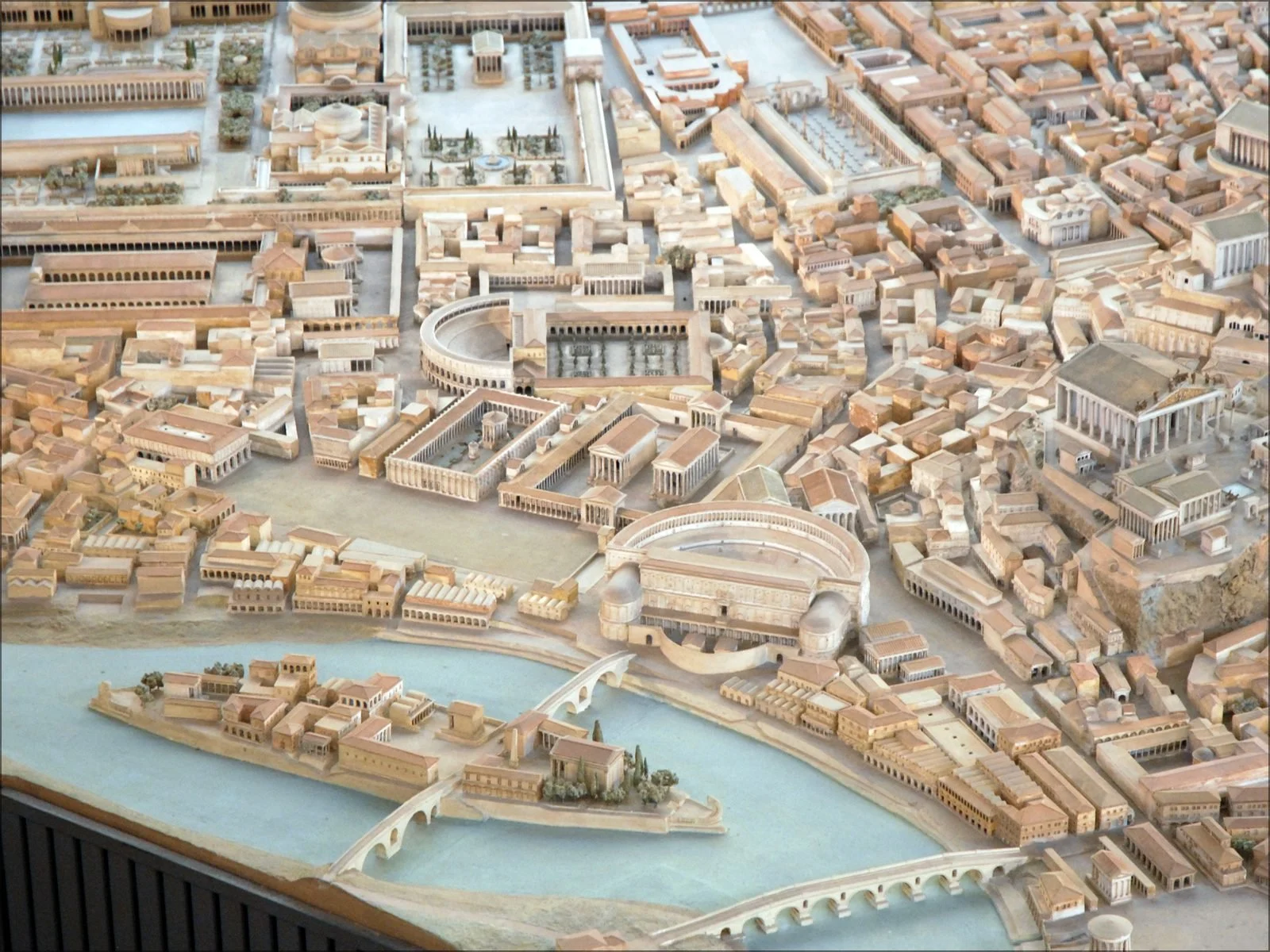
The Temple of Hercules Victor is the round temple you see at Piazza Bocca della Verità, inside the archaeological area of the Forum Boarium, about 30 meters from the rectangular temple of Portunus. It is the oldest surviving marble building in Rome: it was built at the end of the 2nd century BC entirely in Pentelic marble, that is Greek marble brought from Attica all the way here by sea and river, at a time when Rome still built almost only in tufa and travertine. 20 Corinthian columns on a circular podium, a round cella closed behind the columns, no entablature above the capitals and a roof that is not the ancient one.
The first thing to say is the simplest: it is not the temple of Vesta. You find it labeled that way on postcards, on tourist maps, on quite a few captions in photo archives and even in the spoken language of Romans, who have called it the temple of Vesta for centuries. The misunderstanding comes from the circular shape, which recalls that of the temple of Vesta in the Roman Forum. The identification with Hercules Victor, or Hercules Olivarius, is the reading most followed by archaeologists today, but it remains a debated attribution and not a documented certainty: it rests on the cultic context of the area, dominated by the Ara Maxima of Hercules, and on indirect testimonies that we take apart piece by piece further on.
The lines that follow explain what you really see from outside, why the entablature is missing, why the roof is a modern reconstruction, how the building came down to us intact while almost everything else in the Forum Boarium has vanished, and how access works: the interior is not normally visitable and extraordinary openings are limited to a set number of people.
Where the Temple of Hercules Victor is and how to get there
The temple stands in Piazza Bocca della Verità, in the rione Ripa, on the side of the square opposite the basilica of Santa Maria in Cosmedin, inside the fenced archaeological area that also hosts the temple of Portunus. Those arriving from the Tiber meet it right after the lungotevere Aventino. Those coming down from the Capitoline Hill along Via Petroselli see it appear on the right, behind the Fountain of the Tritons.
On foot from the historic center
From the Circus Maximus you get there in 7 or 8 minutes walking along Via dei Cerchi and then cutting toward the square. From the Theater of Marcellus the stretch is even shorter: you go down Via Luigi Petroselli, pass the church of San Nicola in Carcere and in 5 minutes you are in front of the enclosure. From the Colosseum you need about 15 minutes going by Via di San Teodoro and the Velabrum, a route that takes you past the Arch of Janus before coming out in the square.
By public transport
The nearest subway stop is Circo Massimo, on Line B, about 10 minutes' walk: you come out, skirt the Circus valley and keep heading toward the river. The surface buses that run along Via Petroselli and the lungotevere stop a few tens of meters from the archaeological area, at the stop named after the square. Line numbers change with some frequency, so it's best to check them on the transport company's app the same day instead of trusting a printed list.
Those arriving by train at Termini have two reasonable options: Metro B to Circo Massimo and the rest on foot, or a surface bus going down toward the Tiber. The times are equivalent, around half an hour door to door. Those coming from Trastevere cross the river on Ponte Palatino, with the ruins of the Ponte Rotto in the middle of the current on the left, and arrive directly at the side of the round temple: it is the best approach, because the monument appears all at once and not in pieces.
How to recognize the place from afar
Those who don't know the area orient themselves with three landmarks visible from a distance: the Romanesque bell tower of Santa Maria in Cosmedin, tall and dark, on the east side of the square, the white bulk of the Vittoriano on the profile of the Capitoline Hill behind, the green of the Aventine hill that closes the view toward the south. The round temple occupies the center of this triangle, inside an enclosure that separates it from the traffic of Via Petroselli. From the side of the Palatine, that is from Via del Velabro, you instead arrive behind the archaeological area and see the temple of Portunus first.

Why the Temple of Hercules Victor is still called the temple of Vesta
The wrong name is older and more deeply rooted than the right one: for centuries this building was the temple of Vesta, and on much of the tourist signage, photo catalogs and maps handed out in hotels it still is. The reason is the shape. In Rome the circular plan was associated with the cult of Vesta because the goddess's temple in the Roman Forum was round, and Renaissance scholars, finding in front of them a circular building without inscriptions, made the most immediate association.
What the attribution to Hercules is based on
The identification with Hercules rests on three elements, none of which is direct proof. The first is the context: the Forum Boarium was the area of the oldest Herculean cult in the city, with the Ara Maxima of Hercules, whose memory survives in ancient sources and whose structures have been recognized in the subsoil of the area, near Santa Maria in Cosmedin. The second is a statue base found in the area, with a dedication to Hercules Olivarius and the signature of a sculptor, which links to this sector of the city a cult of Hercules tied to the oil trade. The third is a piece of news handed down by late sources about an oil merchant, Marcus Octavius Herennius, who is said to have dedicated a temple to Hercules after an episode with pirates.
Why it remains a debated attribution
None of the three elements identifies the building. The cultic context says that Hercules was worshipped in the area, not that this temple was his. The statue base was found in the area, not inside the cella, and statue bases in Rome have always moved around. The news about the oil merchant comes from a late scholarly tradition, which reports a dedication to Hercules without describing the building in a recognizable way. The honest conclusion, which scientific publications write and tourist signs skip, is that the attribution to Hercules Victor, or Hercules Olivarius, is the most probable reconstruction on the basis of the available clues. Probable, not proven.
Not to be confused with the sanctuary at Tivoli
There is a second misunderstanding, more insidious for those searching the internet: the Sanctuary of Hercules Victor is an enormous monumental complex at Tivoli, one of the largest Republican sanctuaries in Lazio, and it has nothing to do with the little round temple of the Forum Boarium except the dedication to the same deity. Those looking for hours and tickets for Hercules Victor risk finding those of Tivoli, which is a visitable site with regular admission, and showing up at Piazza Bocca della Verità convinced they can go in. They are two different things 40 minutes apart, and it's best to know it before leaving.
How it is built: 20 columns, Greek marble, no entablature
The Temple of Hercules Victor is a tholos, that is a circular-plan temple with the round cella surrounded by a continuous colonnade, and it is built in Pentelic marble, the fine-grained white stone quarried on Mount Pentelicus in Attica, the same used in the great Athenian building sites. In Rome, at the end of the 2nd century BC, a building entirely in Greek marble was a declaration of wealth and culture: Luni marble, which would later become the standard material of imperial architecture, was not yet in use on this scale.
The podium and the stairs
The building rests on a molded circular base, which today is best read from the lungotevere side because the walking level of the archaeological area is lower than the modern square. The ancient level lies below the current street level: it is a difference in elevation that accumulated over 2,000 years among Tiber floods, collapses and rebuildings, and that makes the monument lower than it appeared to those who saw it from the ancient Forum Boarium. Those looking from behind the enclosure have in front of them a partly buried building, and this explains why in photographs the temple always looks stubbier than it is.
The columns
The columns of the outer colonnade were 20, Corinthian, fluted, on an Attic base. Publications agree on the original number. On the present state, the most common reading is that a single column has been lost and that its place in the ring of the peristyle remains empty, while all the others are standing. The Corinthian capitals are not all the same: some are the result of ancient remakings, with a replacement job that scholars have recognized by comparing the design of the acanthus leaves. The measurements you read around also vary from one publication to another, and whoever writes numbers to the centimeter is copying someone else. The order of magnitude is columns a little over 10 meters tall, on an overall colonnade diameter of some 15 meters.
The cella
Inside the ring of columns is the circular cella, a continuous wall of marble blocks with a single door. It is the part nobody photographs, because the colonnade hides it from almost every point of view, and at the same time it is the part that allowed the monument to survive: a closed, covered, reusable space. The openings in the masonry that you can glimpse from outside are not all ancient. Some date to the phases when the building worked as a church.
The entablature that is gone
Above the capitals, today, there is nothing. The entablature, that is the architrave, the frieze and the cornice that ran above the columns and closed the colonnade, has been lost. This radically changes the look of the building. The original had a continuous horizontal band that tied all the columns together and cast a sharp shadow on the colonnade, while today the capitals end in empty air and the roof rests directly above. Whoever looks at a photo of the temple and thinks they see the ancient building is looking at a fragment. The element that gave the whole its profile is missing.
The roof is a remake
The conical tiled roof that closes the temple today is modern, not ancient. It is a protective remake, put there to shelter the structures from water, and its shape does not reproduce the original roof, of which not enough elements remain for a reliable reconstruction. We say it insistently because whoever photographs the monument almost always thinks they are shooting a Roman roof. The tiles you see in every image of the round temple are not 2,000 years old. The same goes for the overall silhouette that ends up in the photographs. Without the entablature and with a protective roof, the volume you see is different from the one a Roman of the 1st century saw.
Why the marble is what really counts
The fact that makes this building important in the history of Roman architecture is the material. Before it, in Rome, marble appeared in single elements, in cladding, in statues. A whole temple in Pentelic marble means a patron able to pay for quarrying in Greece, transport by ship to Ostia and the trip up the Tiber to the docks of the Foro Boario, plus workers capable of working it. Inside the Forum Boarium, which was the river port and the cattle market, a building site like that also made logistical sense: the stone arrived where it was needed without having to be hauled uphill.
Who built it: the names that circulate and the proof that is missing
There is no document on the architect or the patron of the Temple of Hercules Victor. Two names circulate, repeated for decades in the bibliography and then passed on to the guidebooks as if they were settled: a Greek architect active in Rome in those years and a Roman oil merchant. They are proposals by scholars, built on analogy and context. They have to be reported as such.
The Greek architect
The most cited hypothesis attributes the design to a Greek architect active in Rome in the second half of the 2nd century BC, to whom the ancient sources assign other marble building sites in the city. The reasoning goes like this: in Rome, at that moment, the workers able to work Pentelic marble according to Hellenistic canons were few and traceable to a specific milieu, so the round temple belongs with great likelihood to that circle. It is a sound reasoning as a method and a fragile one as an attribution: it identifies a working environment, not a signature.
The oil merchant
The name of Marco Ottavio Erennio appears in an ancient scholarly tradition according to which an oil merchant dedicated a temple to Hercules after escaping from pirates. From this comes the link with the cult of Hercules Olivarius, that is Hercules as protector of the oil trade, and therefore with this building. The hook works well as a story and holds up poorly as proof: the source does not describe the building, does not place it precisely and gives no date.
What can be said with reasonable certainty
On the chronology the agreement is broad: end of the 2nd century BC, in the late Republican period, based on the style of the capitals, the marble-working technique and comparison with other buildings. On the function, there is agreement that it is a temple and not a civic building. On the dedicatee and the patron we remain in the field of well-argued hypotheses. When a tourist page writes that the temple was built by the merchant Marco Ottavio Erennio to a design by a Greek architect, it is turning two conjectures into two facts.
A curiosity about the Temple of Hercules Victor
The most useful curiosity concerns the name with which the temple went through the Middle Ages and the modern age: Santa Maria del Sole. After the conversion into a church, the building first took the title of Santo Stefano delle Carrozze, tied to the presence in the area of stopover and transport stations along the river, and later that of Santa Maria del Sole. Popular tradition, which we report as such and not as historical fact, explains the second name with the discovery in the Tiber of an image of the Virgin surrounded by a halo of rays.
A pagan temple turned into a Marian title
The change has its own urban logic. In the Middle Ages the Foro Boario was an inhabited and busy area, with the river port still active and a fabric of houses, towers and churches. A round, covered building with a continuous wall and a single door was the easiest container to convert in the whole area. The cella became the nave of the church, the outer colonnade stayed around it like a casing, and in certain phases the spaces between the columns were closed by walls that absorbed the peristyle into the place of worship.
How it was saved: the church that kept the temple standing
The Temple of Hercules Victor has come down to us for one reason only: in the Middle Ages it was turned into a church. Everything in the Foro Boario that did not find a Christian function was dismantled, burned to make lime or absorbed into houses and towers. The round temple, with its cella already closed and covered, lent itself to conversion without major works, and the conversion protected it for about 10 centuries.
Santo Stefano delle Carrozze, then Santa Maria del Sole
The first documented title ties the monument to Santo Stefano, with a topographic specification linked to the carriages and transport of the port area. The second, Santa Maria del Sole, appears later and stays in use until the modern age. The internal events, the altars, the painted decorations and the masonry additions piled up over the centuries and were partly removed in the works of the 19th and 20th centuries, with the aim of bringing the Roman building back to light.
The paradox of conservation
The result is a balance sheet with two faces. The transformation into a church saved the structures but erased the ancient phase of the interiors. The clearances of the 19th and 20th centuries gave back the colonnade but eliminated almost all the medieval traces that had leaned against the building. What you see today is the result of restoration choices, not a monument left intact. It is a distinction that holds for almost all of ancient Rome in the center, from the Pantheon to the temples of the sacred area of Largo Argentina, and here it can be read with rare clarity.
One thing nobody tells you about the Temple of Hercules Victor
What the guidebooks skip is that the interior of the Temple of Hercules Victor is not normally open to visitors. You get in only on special openings, with limited numbers and with an escort, organized by the Sovraintendenza Capitolina ai Beni Culturali. There is no ticket office, there are no fixed hours, there is no entrance price published on a permanent basis. Anyone who promises otherwise is selling something they don't control.
How the openings really work
The openings are announced from time to time on the official channels of the Sovraintendenza Capitolina and on the tourist information system of the City of Rome, usually a few days in advance and with mandatory booking. The spots sell out fast, because the capacity of the cella is minimal. We recommend checking the official channels instead of looking for tickets on third-party platforms, where you can find guided visits of the outer area on sale, presented ambiguously, as if they included entry.
What you see without going in
The good news is that the exterior can be seen freely, at any time, without a ticket. The colonnade, the podium, the cella, the capitals and the masonry can all be read from the sidewalk and from the perimeter of the fence, and the full circuit of the archaeological area takes a few minutes. From the point of view of someone looking at the architecture, the exterior is the monument. The cella was never conceived as a space to walk through, but as the container of the cult statue.
The advice I give you for visiting the Temple of Hercules Victor
The practical advice is one: come early in the morning, before half past eight, and allow barely 20 minutes for the round temple plus half an hour for the rest of the Foro Boario corner. At that hour the traffic on Via Petroselli is still light, the tourist buses headed for the Mouth of Truth have not unloaded yet, the light comes in low from the east and the marble can be read. From 10 on, the square changes. The line for the mask stretches under the portico of Santa Maria in Cosmedin, the sidewalks fill up and photographing the temple without groups in the frame becomes complicated.
Our verdict, plainly
The line to put your hand in the Bocca della Verità is, in our opinion, the worst investment of time in the area: half an hour or more for a ritual photograph, a few meters from two Republican temples that you can look at for free and without a line. Whoever has two hours in this corner of Rome should do the opposite of what everyone does: 10 minutes at the portico of the mask if the line is short, the rest at the temples, the Velabro and the Arch of Janus. The round temple, on the other hand, is overrated in one respect only: whoever arrives convinced they will go in is left disappointed, and that disappointment comes from the wrong expectations the web feeds.
The Foro Boario around the temple: what you see in 10 minutes
The round temple is one of the five or six ancient monuments you can see within a radius of 200 meters, in what was the cattle market and river port area of Rome. We have a page dedicated to the whole area, Forum Boarium. That one tells the ancient square as a whole, its commercial history and all the monuments that face onto it, while this one deals only with the round temple, its attribution and its visiting conditions.
The Temple of Portunus
A few meters away, inside the same fence, is the rectangular temple of Portunus, dedicated to the god of the river port, also Republican and also saved by conversion into a church. It is in tuff and travertine with a stucco coating, so the material comparison with the neighboring temple in Greek marble is immediate and instructive: two buildings of the same period, in the same square, with two completely different levels of spending. Whoever has time for only one comparison in the whole area should make this one.
The Ara Maxima of Hercules
The great altar of Hercules, the Ara Maxima, was the center of the cult of Hercules in the Foro Boario, and the ancient sources link it to the legend of Hercules killing the monster Cacus. Remains attributed to the altar have been identified in the subsoil of the area of Santa Maria in Cosmedin, where they are not visitable in the ordinary way. The ancient traditions tied to that cult, such as the ban on women entering, must be reported as traditions handed down by the literary sources, not as matters of fact.
The house of the Crescenzi and the river front
On the side of Via Petroselli, toward the Theater of Marcellus, you come to the house of the Crescenzi, a medieval building made with reused ancient materials set into the facade: capitals, cornices and frieze fragments embedded in the masonry as in a catalog. It is the plastic demonstration of what happened to Roman marbles when they were not protected by a church, and therefore the perfectly coherent counter-shot of the story of the round temple.
The river, the bridges and the port
The Foro Boario owes everything to the river. The ancient river port was here, and the goods coming from Ostia went up the Tiber as far as these docks. Today the river front is closed off by the 19th-century embankment walls, but the system of bridges remains readable: Ponte Rotto in the middle of the current, the two Roman bridges of the Tiber Island, that is Ponte Fabricio and Ponte Cestio, and a little farther downstream the front of Testaccio, where the Roman commercial port moved when traffic grew.
Another well-known fact, yet rarely cited
The fact that almost everyone knows and almost no one connects is that the Temple of Hercules Victor is the oldest surviving marble building in Rome. You read it on every sign, and nobody draws the consequence. It means that when this temple was built, the Roman Forum was still a group of buildings in tuff, travertine and wood, and that all the marble architecture we associate with Rome, from the Pantheon to the Ara Pacis, from the Colosseum to the Arch of Constantine, comes after.
Marble as an economic revolution
The arrival of marble changes the costs, the timing and the trades of a building site. You need a patron who can pay for quarrying and sea transport, you need a crew that knows how to cut and polish the material, you need a market that makes the operation repeatable. The round temple of the Foro Boario is the first surviving Roman building where all this is already in operation. A century and a half later, with the quarries of Luni at full capacity, marble becomes the norm of public architecture. The Baths of Caracalla and the Mausoleum of Augustus belong to a world where the problem is no longer getting the stone, but deciding how much of it to use.
Where the missing pieces went
Of the entablature and the crowning elements, only traces remain in place. Fragments attributed to the building and materials from the Foro Boario area are in the municipal storerooms and collections, and some evidence of the cult of Hercules in the area is on display in the Capitoline Museums, where there is also a large gilded bronze Hercules found in this sector of the city, now at the Palazzo dei Conservatori. Whoever wants to complete the discussion on reuse and on the museum presentation of Roman archaeological material can then see how the same story is told at the Centrale Montemartini and at the Crypta Balbi.
The right photo to take at the Temple of Hercules Victor
The photograph that works at the Temple of Hercules Victor is taken from Via Petroselli, at dawn or in the first hour after sunrise, holding the camera low and framing the colonnade from the bottom up so that the modern roof falls out of the frame. It is the only way to render the ancient building without the protective covering that, as explained above, has nothing Roman about it.
The light, hour by hour
The square is oriented so that the morning sun hits the colonnade from the side, drawing the flutes of the columns with long shadows. It is the best condition. At noon the light comes from above, flattens the marble and blows out the highlights, because Pentelic marble is very light in color. In the late afternoon the temple falls into shadow while the background stays lit, and exposure becomes difficult. At night the artificial lighting of the archaeological area creates a very contrasty effect that works well in black and white and badly in color.
The three vantage points worth using
The first is the north corner of the fence, from which you frame the round temple in the foreground and the Temple of Portunus behind, with the two buildings staggered. It is the photograph that tells the archaeological area in a single shot. The second is the sidewalk on the Tiber embankment side, from which you get the clean colonnade against the sky, without traffic in the frame. The third, less obvious, is the sidewalk in front of Santa Maria in Cosmedin, which lets you hold the Romanesque bell tower and the temple together. It is the framing that explains the layering of the area in a single image.
What ruins photos
Three things, always the same. The cars parked along the fence, which enter the frame at the bottom and are to be avoided by crouching down or by cropping tighter. The cables and the streetlight poles, which cut the sky above the colonnade in several directions. And the groups in line at the Bocca della Verità, which from 10 on occupy the part of the square from which the widest shots are made. Whoever wants the area empty has to arrive before half past eight, or come back after sunset.
Eating around Piazza Bocca della Verità without getting fleeced
The area of the round temple is one of the most exposed in Rome from the dining point of view: there is a heavily photographed monument, a continuous flow of groups in transit between the Circus Maximus and the Campidoglio, and very few residents who eat lunch here every day. We don't name places, here or elsewhere. A list of signs gets old in a few months and helps nobody. What you need is the method for choosing in three minutes, on the spot.
The five signs of a trap
The first sign is the lady rolling out fresh pasta in the window or in front of the door. It is a theatrical lure for passersby, not a clue to a kitchen. The second is the menu with photographs of the dishes, in several languages, displayed in the street. The third is the tout, that is the person who invites you to sit down while you walk. The fourth is nonstop hours from morning to the dead of night, with no kitchen break: a real kitchen stops. The fifth is the places set in front of famous monuments, which often adjust the price to the tourist in front of them, with items unpriced on the menu and different price lists inside and outside.
The simplest criterion of all
Look at who is sitting at the tables and what language they order in. If at 13:30 on a Tuesday the tables are occupied by people speaking Italian who came back because they always come here, the place is the right one. If instead the room fills and empties all at once every 40 minutes following the rhythm of the buses, the kitchen works on a model that has little to do with quality.
The chains in the center
In recent years the center of Rome has seen a multiplication of places with the same sign repeated at several points of the city, the same menu, the same window and the line with a numbered ticket. We don't name names. We only observe something anyone living in Rome can check for themselves: Romans don't go there, and not because they are snobs, but because for the same spend they eat better 500 meters away, off the axis of the monuments.
Where you eat better, at a reasonable distance
Leaving the tourist axis, 10 minutes on foot is enough to completely change the level of price and cooking: toward the Ghetto and the Portico d'Ottavia, across the river in Trastevere on the side streets away from the main squares, or in the direction of Testaccio, which remains the Roman neighborhood of working-class cooking with the best ratio of price to substance. The rule holds in all three directions: moving 300 meters away from the monument lowers the bill and raises the quality.
The list we use
For those who want a concrete reference without lists of signs inside the pages, there is the personal list of Daniele Dezi on Google Maps. It is a curated collection, not sponsored, updated over time based on what really passes the test of going back.
Some important events that happened here in history
The history of the Temple of Hercules Victor is measured in long phases: the construction at the end of the 2nd century BC, the conversion into a church in the Middle Ages, the clearing of the colonnade between the 19th and 20th centuries. In between there are minor episodes that left readable marks on the building and on the surrounding area.
The late Republican building site
The first event is the building site itself. Bringing blocks of Pentelic marble to Rome meant a logistics chain that started from the quarries of Attica, crossed the sea and went up the Tiber to the docks of the Foro Boario. A building site like that, in a crowded market square, occupied the area for years and marked a change of pace in the architecture of the city. The dating to the end of the 2nd century BC rests on stylistic and technical criteria, not on a foundation inscription, which does not exist.
The floods of the Tiber
The Foro Boario is the lowest part of the center of Rome and for 2,000 years it was flooded at every major flood. The inundations progressively raised the ground level with deposits of silt and rubble, and this is the main reason why today the temple sits at a lower level than the square. The building of the Tiber embankment walls, started after the great flood of 1870, put an end to the problem and at the same time closed forever the direct relationship between this square and the river.
The transformation into a church and its effects
The conversion into a Christian place of worship, which took place in the Middle Ages, is the event that determined the survival of the monument. It involved the closing or partial blocking of the spaces between the columns in some phases, the opening of rooms in the masonry of the cella, the building of an altar and the painted decoration of the interior walls. Every later intervention, up to the contemporary restorations, has had to choose what to preserve between the two overlapping histories.
The 19th- and 20th-century rearrangements
Between the early 19th century and the full 20th century the area of Piazza Bocca della Verità is redesigned several times: excavations and rearrangements in the Napoleonic period, construction of the river embankment walls, opening of the great road arteries toward the sea in the early 20th century, demolition of the structures that had absorbed the two temples and creation of the fenced archaeological area. In this season the round temple loses its external Christian additions and acquires the form it has today, isolated and readable. The precise dates of the individual interventions vary from one source to another, and it is best to consult them in the publications of the Sovraintendenza Capitolina.
The finds in the area
Among the discoveries that fed the debate on the attribution is the statue base with the dedication to Hercules Olivarius, brought to light in the area of the Foro Boario in the early 20th century. Together with other materials from the sector, including the large gilded bronze statue of Hercules kept in the Capitoline Museums, it makes up the body of clues on which the identification of the temple rests. None of these pieces was found inside the cella, and that is why the question remains open.
The recent restorations
In recent decades the monument has been the subject of cleaning and consolidation work on the marble, which gave the Pentelic its light tone back after decades of darkening from traffic. Whoever has photographs of the square taken before those works notices a very strong difference in color. The conditions of the archaeological area and the possible presence of ongoing work sites must be checked before the visit on the channels of the Sovraintendenza Capitolina.
Who passed through the Temple of Hercules Victor
The Temple of Hercules Victor appears in the graphic documentation of Rome for at least five centuries. Architects, engravers, view painters, archaeologists and photographers have surveyed it, drawn it and studied it with a continuity that few Roman monuments have behind them in terms of quantity of material produced. The fact that it is round, isolable and measurable made it a convenient subject of study.
The architects of the Renaissance
The architects who in the 16th century surveyed Roman antiquities to draw design models from them also measured and drew this building, which for its form and state of preservation was one of the most useful to study. Their drawings and their notes are an important source for reconstructing the parts now lost, and they must be consulted with caution, because they contain additions and personal interpretations that do not always correspond to the archaeological evidence.
The engravers and view painters
In the 18th and 19th centuries the temple enters the repertoire of views of Rome produced for Grand Tour travelers, almost always under the name of temple of Vesta. The engravings of that period are precious documents because they show the building when it was still a church and when the area had not been cleared, with the houses leaning against it, the street level different and the daily life of the square around it.
How to fit the temple into an itinerary that works
The Temple of Hercules Victor pays off a lot as a stop on the way and little as an isolated destination. It is seen in 15 minutes and should be linked to the monuments within the same radius of 10 minutes on foot. Below are three routes we use in practice, with the real times.
Half a day between the Aventine and the Foro Boario
You start early from the Orange Garden, go down the hill passing by the Basilica of Santa Sabina and the keyhole of the Villa del Priorato di Malta, reach the Foro Boario in 20 minutes of descent, see the two temples and the Mouth of Truth, and finish with the Arch of Janus and the Velabro. A good three hours, all on foot, no ticket except for any lines.
Long archaeological route
Whoever has a whole day and wants to keep the picture together can link the Colosseum, the Palatine with the Palatine Museum, the Roman Forum with the Arch of Septimius Severus and the Temple of Antoninus and Faustina, and finish by going down to the Foro Boario from the Velabro. Alternatively you can add the Trajan's Markets and the Mamertine Prison from the Campidoglio side, with a final climb to Santa Maria in Aracoeli.
The river walk, heading south
From the temple you can follow the Tiber downstream: Lungotevere Aventino, Testaccio, the Pyramid of Cestius and Porta San Paolo, with the option of continuing to the Centrale Montemartini. It is the route that best explains how the river port of Rome moved south as traffic grew, up to the mouth at Ostia Antica. On the opposite side, from the Janiculum, you get the overall view of the bend of the river and of the square.
With kids
The temple alone holds a child's attention for two minutes. It works instead as a stop inside a story: the tale of Hercules and the monster Cacus set right here, the cattle market, the port on the river, the mask of the Bocca della Verità 50 meters away. The legends should be told for what they are, ancient and popular traditions. The square has heavy traffic on three sides, so small children must be held by the hand along the whole perimeter.
Frequently asked questions about the Temple of Hercules Victor
What is the Temple of Hercules Victor?
The Temple of Hercules Victor is the round temple of Piazza Bocca della Verità, in the Foro Boario area of Rome, built at the end of the 2nd century BC in Pentelic marble. It is the oldest surviving marble building in the city, with 20 Corinthian columns arranged in a circle around a circular cella. The attribution to the cult of Hercules Victor, or Hercules Olivarius, is the reading most followed by scholars but remains debated.
Why is the Temple of Hercules Victor called the temple of Vesta?
The Temple of Hercules Victor is called the temple of Vesta because of its circular plan, which recalls that of the temple of the goddess Vesta in the Foro Romano. The mix-up arises in the medieval and modern age, is consolidated in views, guidebooks and photo captions, and still survives today in Roman speech and in a lot of tourist signage, even though archaeological studies have long proposed a different attribution.
Can you go inside the Temple of Hercules Victor?
The interior of the Temple of Hercules Victor is not normally open to visitors. You get in only during special openings with limited numbers, by booking, organized by the Sovraintendenza Capitolina ai Beni Culturali. There is no permanent ticket office and no fixed schedule, and the dates are announced from time to time on the official channels. The exterior, on the other hand, can be seen freely at any time from the perimeter of the archaeological area.
How much does it cost to visit the Temple of Hercules Victor?
Seeing the Temple of Hercules Victor from the outside costs nothing, because the archaeological area faces onto the public street and the colonnade is visible from the sidewalk. For the special openings of the interior the conditions change from time to time and must be checked on the channels of the Sovraintendenza Capitolina. We don't publish fares because there is no stable price list, and any figure reported elsewhere should be checked at the source.
How do you get to the Temple of Hercules Victor by public transport?
The Temple of Hercules Victor is reached from the Circo Massimo station on metro line B, with a 10-minute walk toward the Tiber, or with the surface buses that run along Via Petroselli and the Tiber embankment and stop at Piazza Bocca della Verità. The numbers of the surface lines change often, so it is best to check them the same day on the public transport company's app.
How long does it take to visit the Temple of Hercules Victor?
For the Temple of Hercules Victor 15 minutes are enough, a full lap of the fence included, because it is an exterior visit. Counting also the nearby temple of Portunus, the basilica of Santa Maria in Cosmedin with the Bocca della Verità and the detour toward the Arch of Janus and the Velabro, the time goes up to an hour and a half, which is the reasonable length for the whole Foro Boario corner.
Is the roof of the Temple of Hercules Victor original?
No, the roof of the Temple of Hercules Victor is a modern protective remake and does not reproduce the ancient covering, of which not enough elements remain for a reliable reconstruction. The entablature is missing too, that is the architrave, frieze and cornice above the columns. Whoever photographs the monument is therefore shooting a building without its original upper part, with a covering added in recent times.
Is the Temple of Hercules Victor accessible to people with mobility difficulties?
The outer circuit of the Temple of Hercules Victor is done on the sidewalk and can be traveled in a wheelchair, with traffic-light crossings on Via Petroselli and on the Tiber embankment and some narrow stretches of sidewalk. The interior, when it opens on special occasions, involves a difference in level from the street. Those with specific needs should report them at the time of booking, because the conditions depend on the individual opening.
What is the difference between the Temple of Hercules Victor and the sanctuary in Tivoli?
The Temple of Hercules Victor in the Foro Boario is a small round marble temple in the center of Rome, while the Sanctuary of Hercules Victor is a vast Republican monumental complex in Tivoli, with regulated entry and its own hours. They share the dedication to the same god and nothing else. Whoever looks for tickets online risks confusing them and showing up at the wrong place.
Who wrote this page
This page is edited by the editorial team of Tour Leader Pro, the Roman project office that designs and coordinates visits, itineraries and cultural events in Rome and Lazio. Hours, fares and access conditions reported here are checked at the date of publication against the official sources indicated in the text. Before leaving it is best to check them again, because they change often. If you find outdated information, let us know.
Whoever is building an itinerary in the center of Rome and wants to fit this stop together with the other stops of the Foro Boario, the Aventine and the Tiber bank will find planning tools and operational support at Tour Leader Pro, which works on visits, itineraries and cultural events in Rome and Lazio.
For the broader picture, that is travel between Italian cities, transport, travel times and the organization of a trip that touches several regions, a useful resource in English is Italy Planner, which covers trip planning in Italy on a national scale.