Arch of Titus
In short. The Arch of Titus closes the Roman Forum on the Colosseum side, at the top of the Velia ascent, at the point where Via Sacra reached its highest elevation before descending toward the valley of the amphitheater.
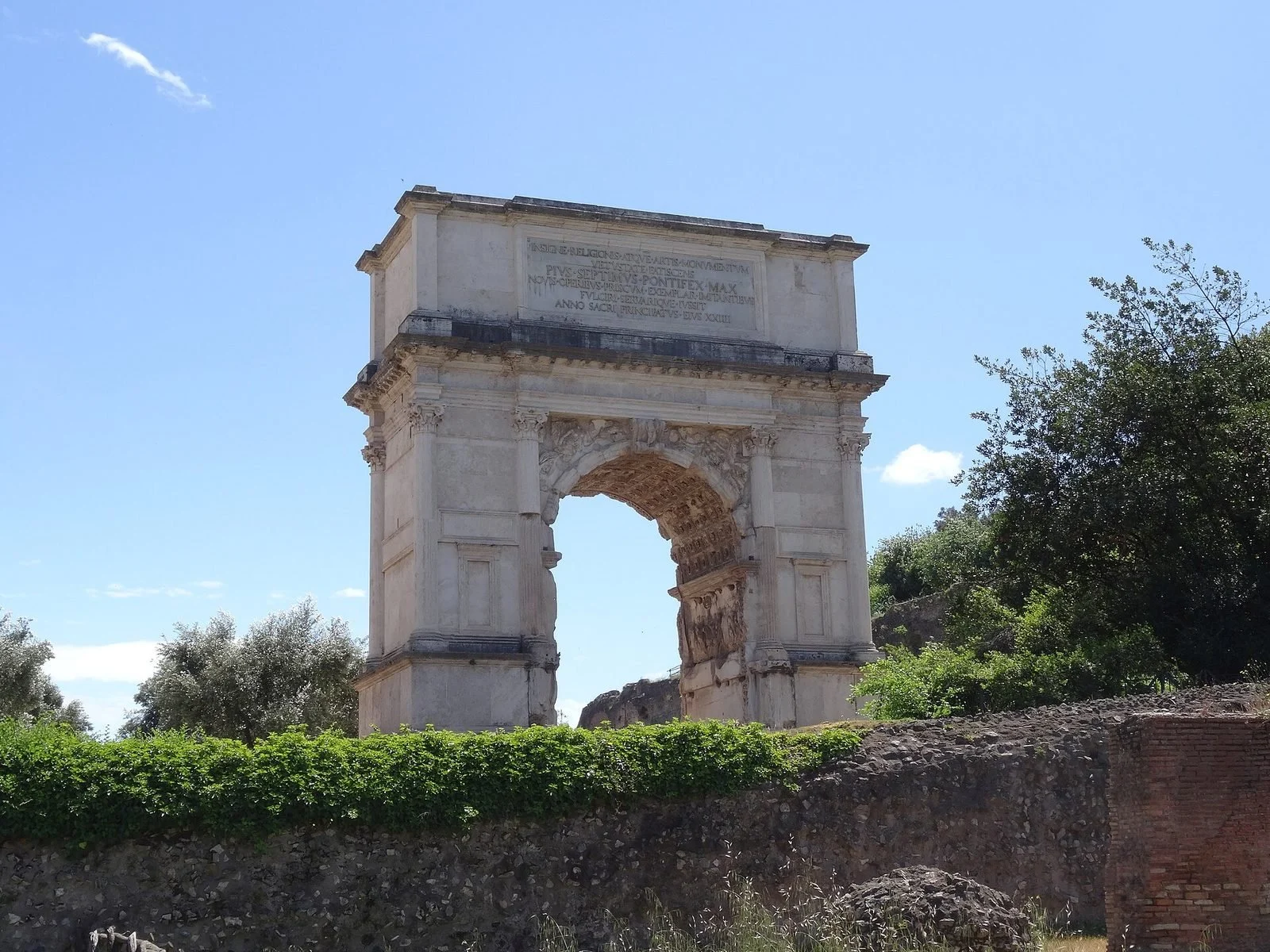
The Arch of Titus closes the Roman Forum on the Colosseum side, at the top of the Velia ascent, at the point where Via Sacra reached its highest elevation before descending toward the valley of the amphitheater. It is a single-bay arch, just over 15 meters high, built by the Senate after the death of Titus in AD 81 and dedicated to him as divus, that is as an emperor already deified. Inside the passage, on the two facing walls, are the two reliefs that have made this monument one of the most studied of the ancient world: on one side the procession carrying the spoils of the Temple of Jerusalem, with the seven-branched candelabrum, the table of the showbread and the silver trumpets. On the other Titus on the quadriga, crowned by Victory. They are images of a war won and of a city razed to the ground, and this page tells them for what they are. The arch is inside the archaeological area of the Roman Forum and the Palatine, which is visited with a paid ticket to be booked online: in the lines that follow you will find the cost, the hours by seasonal band, the entrances it is best to use, the history of the monument from the Flavian construction to the 1800s restoration by Giuseppe Valadier, and the points on which the sources do not agree.
Where the Arch of Titus Is and How to Get There
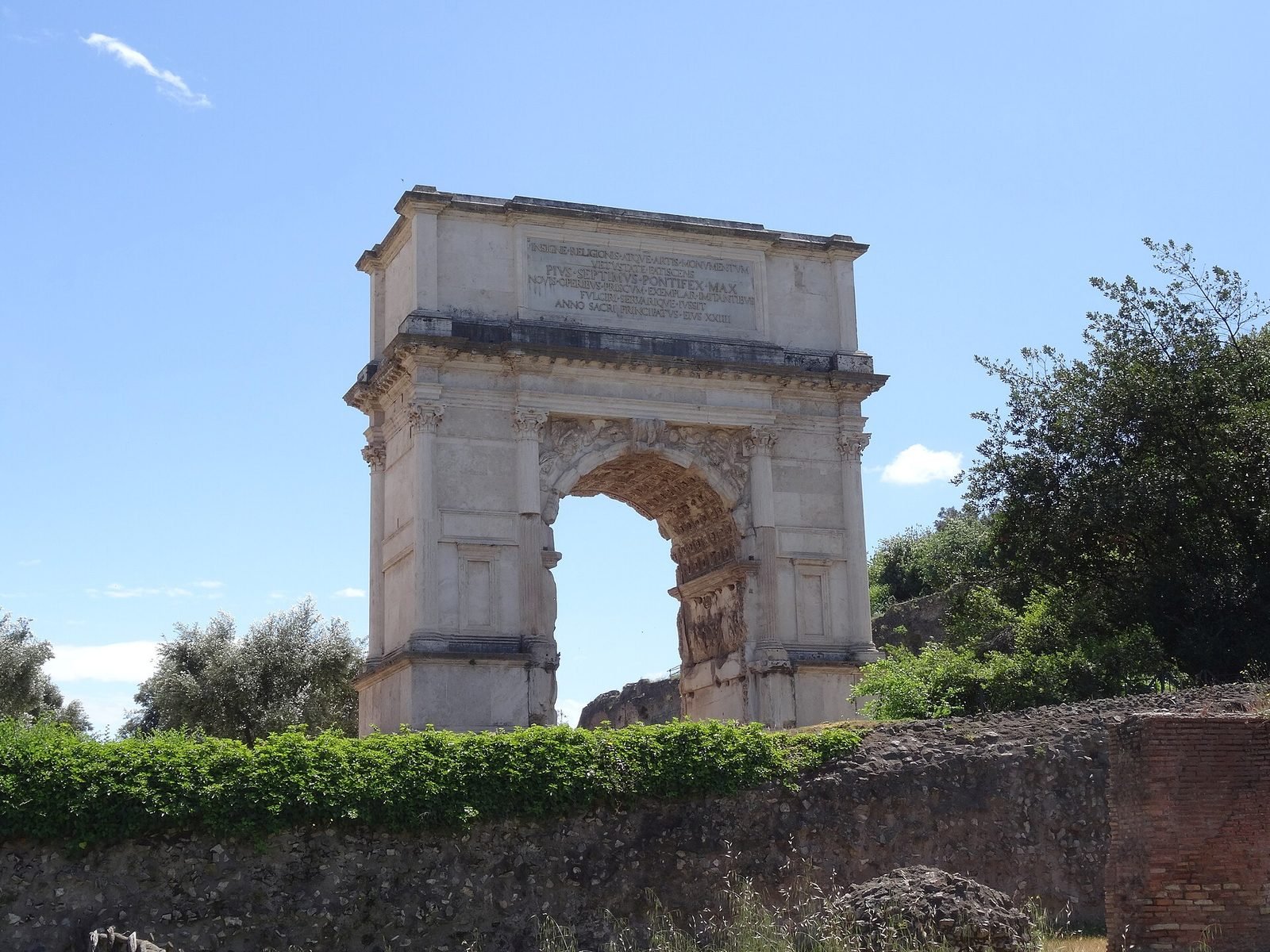
The Arch of Titus rises on the summit of the Velia, the hilly saddle that joined the Palatine to the Esquiline and that 1900s urban planning has largely leveled: from the arch you see the Colosseum below to the east and the Roman Forum opening below to the west, and this double view alone explains why the ancients had chosen that point. The monument stands along Via Sacra, the road that the triumphal procession followed in the last stretch before climbing to the Capitoline, and whoever arrives from Piazza del Colosseo entrance meets it after a few minutes' walk uphill.
The Entrances to the Archaeological Area
The Colosseum Archaeological Park indicates for the Roman Forum the accesses of Largo della Salara Vecchia 5/6, of Via del Tulliano and of Via Sacra on Piazza del Colosseo side, while the Palatine entrance is at Via di San Gregorio 30. The quickest access for those heading straight for the arch is the one on Via Sacra, which opens a few meters from the Arch of Constantine: from there the Arch of Titus is the first monumental structure you meet going up. From the Largo della Salara Vecchia entrance, on Via dei Fori Imperiali side, the route is longer and crosses the whole Forum square, with the final climb along Via Sacra. Open entrances and their functions change over time depending on building work: before leaving it is best to check the Park's official page, because in the past some accesses stayed closed for months.
By Subway and Surface Transport
The reference stop is Colosseo on subway Line B, also served by Line C at the Colosseo-Fori Imperiali station. On the surface the Park indicates bus lines 51, 75, 81, 85, 87 and 118 and tram 3, which runs along Via Labicana and Viale Aventino. Anyone arriving from Termini has the most direct connection with Metro B in the Laurentina direction: three stops and you are in Piazza del Colosseo. On passes, integrated tickets and rules of the urban network the entry on how to get around Rome is useful.
On Foot from the Historic Center
From Piazza Venezia you reach the Forum entrance in about 10 minutes along Via dei Fori Imperiali, skirting the Markets of Trajan and the Forum of Trajan with Trajan's Column. From the Capitoline Hill, coming down from the terrace of the Tabularium, the Forum opens before your eyes and the arch is recognizable at the far end, in line with Via Sacra. Whoever comes from the Circus Maximus can go up Via di San Gregorio to the Palatine entrance and reach the arch from above, passing through the Farnese Gardens: it is the longest route, but also the one that best helps you understand the topography of the area.
Tickets, Hours and Booking: How You Really Get In
The Arch of Titus cannot be visited on its own: it stands inside the archaeological area of the Roman Forum and the Palatine, which the Colosseum Archaeological Park manages with tickets and online booking. On the Park's official site the Colosseum, Roman Forum, Palatine ticket valid 24 hours is indicated at 18 euros full price, with a reduced rate of 2 euros for European Union citizens between 18 and 25. The Forum Pass SUPER, which gives access to the Roman Forum, Palatine and Imperial Forums without the Colosseum, is also indicated at 18 euros full price and 2 euros reduced. The discounted rates reported by the Park include, among others, 11.50 euros for Roma Pass holders and 14 euros for those with the ticket of certain partner museums, among them the Jewish Museum of Rome and Villa Farnesina. Prices can change and to these amounts you must add any presale fees applied by the ticketing system: the figure should be rechecked on colosseo.it before purchase.
The Hours, Which Change Three Times a Year
The Park publishes a seasonal calendar that for 2026 provides, from March 29 to September 30, opening of the Roman Forum-Palatine area at 9:00 with closing at 19:15 and last entry at 18:15. From October 1 to 24, 2026 the last entry drops to 17:30 and the closing to 18:30. From October 25, 2026 to February 28, 2027 the last entry is at 15:30 and the closing at 16:30. The closing days indicated are December 25 and January 1. Anyone visiting in winter must take into account that the last entry at 15:30 cuts out a good part of the afternoon: it is the most frequent planning mistake between December and February.
Booking
The Park sells online at ticketing.colosseo.it and opens sales 30 days before the visit date. For the combined ticket the entry time is booked on the Colosseum, while access to the Roman Forum and Palatine can happen within the 24 hours before or after that time: it is a flexibility that many visitors do not use and that instead lets you see the arch calmly at a different moment of the day. The Park recommends arriving 15 minutes before the booked time and warns that the time slot, once purchased, cannot be changed. For the Colosseum alone the combined ticket provides a maximum stay of 75 minutes.
The Free Days
Entry is free on the first Sunday of the month and, according to the Park, on April 25, June 2 and November 4. On free Sundays access is without booking, in order of arrival at the ticket offices, and the Forum Pass SUPER cannot be used. Our operational judgment is clear-cut: the first Sunday of the month in front of the Arch of Titus is one of the worst possible visiting conditions, because the passage under the bay is narrow, the flow is one-way in effect and the queue forms right there. If the goal is to look at the reliefs, 18 euros spent on a weekday are worth more than a free entry in the middle of the crush.
How Much Time You Need
For the arch itself 10 minutes is enough, if you are willing to stop under the bay and look at the two panels carefully. The problem is that the arch cannot be reached in 10 minutes: the realistic minimum visit of the Roman Forum is an hour and a half, and whoever adds the Palatine and the Palatine Museum easily reaches three and a half hours. Anyone with only one morning who wants to concentrate on the Flavian monuments can enter from Via Sacra, climb to the arch, go down toward the Basilica of Maxentius and the Temple of Antoninus and Faustina and exit from Largo della Salara Vecchia: two full hours, without rushing.
Who Titus Was and Why the Senate Built Him an Arch After His Death
Titus Flavius Vespasianus, eldest son of the emperor Vespasian, reigned a little over two years, from June 79 to September 81 AD, and died at a little over 40. The arch that bears his name was not built while he was alive: the inscription calls him divus, a title that belonged only to emperors deified after death, and this places the monument after 81, very probably under his brother Domitian, who reigned from 81 to 96.
The Military Record Behind the Reliefs
Titus's career passes through Judea. Vespasian had received from Nero the command of the operations against the Jewish revolt that broke out in 66, and when in 69, in the year of the four emperors, he was acclaimed emperor by the legions of the East, he left to his son the completion of the campaign. Titus besieged Jerusalem in the spring of 70 and conquered it in August. The Temple, the central sanctuary of Judaism, was destroyed during the siege. This is the fact from which everything else descends: the triumph celebrated in Rome in 71, the spoils displayed in the streets, and the reliefs sculpted 10 years later in the passage of the arch.
Why Precisely on the Velia
The choice of spot was not random. The top of Via Sacra, the summa sacra via, was the last uphill stretch the triumphal procession walked before entering the Forum and from there climbing to the Capitoline Hill for the sacrifice to Jupiter Optimus Maximus. Placing an arch dedicated to Titus there meant inserting the memory of his triumph at the exact point where every later triumph would pass. Anyone who climbs that ramp today out of breath is following exactly the same route, uphill, that the prisoners of 71 followed.
The inscription: three lines that say almost everything
On the attic of the arch, on the side facing the Colosseum, the ancient inscription can still be read, cataloged as CIL VI 945, in three lines of carved letters: SENATVS / POPVLVSQVE ROMANVS / DIVO TITO DIVI VESPASIANI F VESPASIANO AVGVSTO. Translated: the Senate and the Roman People to the divine Titus Vespasian Augustus, son of the divine Vespasian. The letters were originally filled with gilded bronze, as was the practice in Roman monumental epigraphy, and the anchoring holes for the clamps can still be made out on the stone.
Two words that date the monument
The decisive information is that divo repeated twice: Titus is already deified, and so is his father Vespasian. The deification of Titus came after his death, in September of 81. The arch, therefore, has to be later than that date. Anyone who writes that the arch was erected by Titus to celebrate his own victory is saying something the inscription contradicts in two words.
What the inscription does not say
What is missing is striking. The inscription mentions neither Judea, nor Jerusalem, nor the war: it is a dry dynastic dedication that names the dedicator (the Senate and the Roman People), the dedicatee and his divine parentage. The story of the war is left entirely to the images carved inside the passage, not to the text. It is a precise communication choice: the word celebrates the dynasty, the image celebrates the conquest.
The other arch of Titus, the vanished one
There was a second arch dedicated to Titus in Rome, erected in 81 at the curved end of the Circus Maximus and now vanished. What remains are fragments, a depiction on a fragment of the marble Forma Urbis, and the text of the inscription, copied in a medieval manuscript kept at Einsiedeln and later published in the Corpus Inscriptionum Latinarum as CIL VI 944. That text, unlike the one on the arch of the Velia, was explicit: it credited Titus with subduing the Jewish people and destroying Jerusalem, and claimed that no general, king or people before him had managed to do it. It is a historically false claim, since Jerusalem had already been taken and the Temple already destroyed by the Babylonians in the 6th century BC, and scholars read it as celebratory regime rhetoric. The two arches, read together, show two different registers of the same propaganda: one dynastic and restrained, the other triumphal and inflated.
The two reliefs inside the passage
The two large panels carved on the inner walls of the passage are the reason the Arch of Titus is studied in every textbook of Roman art: they measure about two meters by four each and show two moments of the same triumphal procession, placed facing each other so that anyone walking through the arch ends up physically in the middle of the procession. They are works of Roman historical relief of the Flavian period, with several planes of depth and figures that seem to come out of the background, and this depth of field is their technical novelty.
The panel of the spoils
On the south wall the procession moves from left to right and is passing under an arched gate, identified by scholars as the Porta Triumphalis, the ceremonial opening through which the procession entered the city. The bearers, crowned with laurel, carry on their shoulders the fercula, the stretchers on which the spoils were displayed. In the center, in very high relief, is the seven-branched candelabrum, the menorah, with its base. Next to it you can recognize the table of the showbread, that is, the table on which the ritual loaves were laid out in the Temple, and above it the silver trumpets, the chatzotzerot, crossed. Some bearers hold placards, the tituli, which in a triumph served to explain to the crowd what they were looking at: they are carved smooth, with no legible text.
The panel of the triumphator
On the north wall Titus stands upright on a quadriga, the four-horse chariot, held by the bridle by a female figure interpreted as the goddess Roma. Behind him a winged Victory holds the laurel crown over his head. Around them you can make out lictors with their fasces and two allegorical figures identified as the Genius of the Senate and the Genius of the Roman People. The presence in the same scene of historical figures in flesh and blood and of deities and personifications is one of the traits that art historians point to as innovative in this relief.
The vault and the apotheosis
Looking up inside the passage you see a vault with decorated coffers, and in the center a panel with a male figure carried to heaven by an eagle. It is the apotheosis of Titus, that is, his ascent among the gods after death, rendered with the conventional image of the eagle that in the imperial age accompanied the consecration of a dead ruler. The detail confirms what the inscription says: the arch was conceived as a funerary and celebratory monument at once, for an emperor already dead and already a god.
The frieze almost nobody looks at
Below the attic, on the outer faces, runs a continuous frieze of reduced size that also shows the triumphal procession, with figures a few tens of centimeters tall. It is badly damaged and goes unnoticed by nearly all visitors, who look only at the two inner panels. It is worth the effort to step back a few meters and raise your eyes: you can glimpse a procession with sacrificial animals and bearers, a third telling of the same event, on a smaller scale. On the keystones of the two fronts are carved two figures identified as Roma and the Genius of the Roman People, and in the spandrels of the arch winged Victories with standards.
The materials
The facing is in Pentelic marble, quarried in Attica on Mount Pentelicus, the same marble as the Parthenon, with parts in Luni marble, that is, from Carrara, and a travertine plinth. The four half-columns per front are of the Composite order, the capital that joins Ionic volutes to Corinthian acanthus leaves, and the Arch of Titus is one of the first Roman monuments in which this order appears in a fully defined form. The measurements commonly reported in studies are 15.40 meters in height, 13.50 meters in width and 4.75 meters in depth, with the passage about 8.30 meters high and about 5.36 wide.
The triumph of 71: what these reliefs really celebrate
The procession carved on the arch is that of the triumph celebrated in Rome in AD 71 by Vespasian and Titus for the victory in the First Jewish War. The main source on that day is Flavius Josephus, who describes it as a witness in the seventh book of the Jewish War: he was a Jewish commander who had gone over to the Roman side, and he wrote in Rome under Flavian protection. His account lists the standards, the multi-story stage machines that showed episodes of the siege, the prisoners, and the spoils carried in procession.
What had happened in Jerusalem
The Jewish revolt against Rome had begun in 66. The siege of Jerusalem lasted from the spring to the summer of 70 and ended with the capture of the city and the destruction of the Temple, the center of Jewish worship, rebuilt by Herod a few decades earlier. The population was in part killed, in part enslaved and deported. Flavius Josephus gives very high figures for the dead and for the prisoners, but modern historians consider them inflated according to the rhetorical conventions of ancient historiography, and there is no reliable count. What remains certain, and what no discussion of the numbers softens, is that a city was taken and devastated, its sanctuary destroyed and a considerable part of its inhabitants sold as slaves.
The procession, the spoils, the prisoners
The Roman triumph was not an abstract parade: it was a political liturgy in which the spoils and the captured people were shown to the city as material proof of victory. The furnishings of the Temple carved in the relief were carried through the streets of Rome together with the prisoners. According to Flavius Josephus, the ceremony ended as usual with the execution of the enemy leader: Simon bar Giora, one of the commanders of the Jewish resistance, was dragged with a rope around his neck to the Forum and killed in the prison at the foot of the Capitoline Hill, now known as the Mamertine Prison. Only after the announcement of his death did the procession climb to the temple of Jupiter Capitolinus for the final sacrifice.
Where the spoils ended up
The sacred objects were not melted down or scattered right away: Flavius Josephus tells that Vespasian had them deposited in the Temple of Peace, the great complex that the emperor had built with the proceeds of the war itself and inaugurated in 75, on the northern side of the street that today separates the Roman Forum from the Imperial Forums. The candelabrum and the table stayed there on display as public trophies. Of what happened afterward, between the sack of Rome in 410, the Vandal one in 455 and the events of the following centuries, there is no documented reconstruction: the final fate of the Temple furnishings is unknown, and all the stories about hiding places, rivers and crypts belong to popular tradition, not to historical documentation. Anyone who tells them as established facts is telling a legend. The remains of the Temple of Peace can be seen today in the area of the Imperial Forums and are illustrated at the Museum of the Imperial Forums.
How we tell it, and why
This monument puts the visitor in a difficult position, and the difficulty is part of what there is to understand. A masterpiece of Roman relief and the visual documentation of a deportation are the same stone. Under this passage the worst way to treat it is an admiring tone applied indiscriminately to the quality of the sculpture and to the content of the scene. Our criterion is simple: we say what you see, we say whose that menorah was and how it came to Rome, and we let the visitor do the rest. To place Roman Jewish history in the following centuries, the route continues in the Jewish Ghetto of Rome, at the Synagogue of Rome and in the rooms of the Jewish Museum.
A curiosity about the Arch of Titus
In the Middle Ages the arch was not called the Arch of Titus. In medieval sources and itineraries it appears as the arch of the seven lamps, arcus septem lucernarum, and the name comes from the only thing the Romans of the time could still read on the stone: the seven-branched candelabrum carved on the inner panel. The name of the emperor, which the inscription gave in large letters on the attic, had become illegible or irrelevant. The carved object had not.
A city that read images, not texts
It is an interesting case of the transmission of memory. For centuries written Latin culture remained the preserve of a minority, while carved relief kept speaking to anyone who walked past it. Medieval Rome renamed ancient monuments after what it saw on them or what they reminded it of: it happens to the Arch of Janus in the Forum Boarium, whose name comes from a linguistic misunderstanding, and it happens here, where the name of an emperor is replaced by that of a candelabrum. Popular memory keeps the image and loses the text.
And the menorah, meanwhile, kept being looked at
There is a second effect, less obvious. Precisely because the monument was identified by the candelabrum, the relief of the Arch of Titus worked for centuries as one of the few ancient depictions of the Temple menorah accessible in the West, and it influenced the form of the seven-branched candelabrum in European Jewish and Christian iconography. The stepped base seen in the relief, in particular, is debated by scholars: some think it faithfully reflects the real object, others that it is a form added by the Roman sculptors or a transport base, because it does not match the descriptions of the candelabrum in Jewish sources. The question remains open.
Something nobody tells you about the Arch of Titus
A large part of what gets photographed today is not Roman. The two side piers, much of the outer fronts, the outer columns and the attic on the Forum side are a 19th-century reconstruction in travertine. The ancient part in Pentelic marble comes down, essentially, to the central core with the passage, the two reliefs, the vault and the inscription. Anyone who looks at the arch without knowing this sees a Roman monument. Anyone who knows sees two monuments on top of each other, and the boundary between the two is visible to the naked eye.
How to recognize the boundary, in three seconds
You just need to look at the color and the surface. The ancient Pentelic marble is white, compact, with a warm golden patina that 2,000 years of exposure have deposited. The 19th-century travertine is beige, porous, full of small cavities, and above all it is smooth: the new parts reproduce the architectural outlines, but without the moldings, without the fluting of the columns and without the decorative details. It is a deliberate choice, not a lack of money or skill. The recent restoration completed in 2025 cleaned the surfaces and made this contrast even more legible than before.
Why the monument was taken apart and put back together
In the 19th century the arch was in serious condition. For centuries it had been absorbed into medieval structures that had discharged their weight onto it in an abnormal way, and when those structures were demolished what remained was left without lateral support. The work consisted of taking the endangered ancient parts apart piece by piece, numbering them, consolidating the foundations and reassembling them in the original position, filling in the missing parts with new material. It is the technique now called anastylosis, and the Arch of Titus is one of its first documented cases on a monument of this scale.
The detail of the holes in the reliefs
On the two inner panels, if you look closely at the surface, you notice holes and sockets that have nothing to do with the sculpture: they are the seats of the beams that in the Middle Ages supported the floors of the structures built inside the passage. They are wounds, and they were not filled in. Leaving them visible is itself a conservation decision, consistent with the logic that guided the whole 19th-century intervention: the monument is also its own later history, and erasing it would mean falsifying it.
My advice for visiting the Arch of Titus
The practical advice is just one and it concerns the direction of travel: enter from Via Sacra, on the Colosseum side, and not from Largo della Salara Vecchia. If you enter from the Colosseum side you reach the arch in three minutes, find it almost empty in the first hour after opening, and climb Via Sacra in the same direction as the ancient procession. If you enter from the side of Via dei Fori Imperiali you cross the whole Forum square along with everyone else and reach the arch in mid-morning, when a bottleneck has formed under the passage. It is the same ticket and the same route, in reverse order, and the difference in crowding is clear.
The right time
The first time slot after opening, at 9:00 in the long season, is the one when the arch is freest. The second useful window is the last hour and a half before closing, when the organized groups have already finished their tour: in summer that means after 17:30. The middle hours, between 11 and 15, concentrate the heaviest flow and in July and August add a serious practical problem, because on the Velia there is no shade, the paving stones reflect the heat and the climb under a high sun is tiring. Hat and water are not a detail: inside the archaeological area the refreshment points are few and far apart.
Stopping under the passage without getting in the way
The passage is narrow and sloping, and the flow goes through it constantly. To look at the reliefs calmly it is best to step under the arch and move immediately against the wall, staying beside the panel and not in front of it: from that position you see the relief at an angle, the raking light reveals the depth of the carved planes better than a frontal view, and you block nobody. It is the point where the bearers really seem to come out of the background.
The verdict, no beating around the bush
The Arch of Titus is one of the few monuments in the Forum that rewards a long stop and one of the few that almost nobody really looks at. In the normal flow people walk under it in 20 seconds, photograph it from outside and go on toward the Palatine. The content is inside the passage, not on the facade: if you give the arch only the outside photo, you have seen the box and not what is in it. If instead you have to choose what to skip for lack of time, skip the Ludus Magnus, which can be seen perfectly well from the street, and spend those 20 minutes down here. It is a trade that pays off.

The arch in the Middle Ages: inside the Frangipane fortress
Between the 11th and 13th centuries the baronial Frangipane family controlled the sector of Rome between the Palatine, the Colosseum and the Forum, and turned the ancient monuments of that area into a continuous defensive system. The Arch of Titus was part of it: a second floor was built above the vault and the arch became the base of a fortified tower, with the passages walled up and rooms made inside the passage.
Why the fortress saved the arch
The medieval fortification damaged the reliefs with its floors and walls, but it also kept the monument from meeting the fate of many other ancient buildings: dismantled and burned in lime kilns to make lime. An arch absorbed into an inhabited fortress is an arch nobody demolishes. The good state of preservation of the two inner panels, protected by the shelter of the passage and then by the walls, is also explained this way.
From the Frangipane to the Olivetans
With the decline of baronial power the area passed under church control and the arch ended up annexed to the properties of the Olivetan monastery linked to the church of Santa Francesca Romana, which stands a few steps away, on the Forum side. In the 15th century, under Sixtus IV, part of the medieval additions were removed, and other interventions followed in the following centuries, including a restoration promoted by Clement XII in 1716. The complete freeing of the arch from the structures surrounding it came only in the 19th century, however, and brought with it the problem that made Valadier's intervention necessary.
Valadier's restoration: why it is a textbook case
When the medieval structures were demolished in the 19th century, the arch was left standing with its two side piers seriously compromised and without the supports that had propped it up for centuries. The work site that followed is considered by restoration scholars one of the founding acts of the modern discipline, and the principle that guided it can be summed up in one sentence: what is added must hold up the monument without pretending to be ancient.
Travertine against marble
The reconstructed parts were made in travertine, that is, in a material different in color, grain and origin from the original Pentelic marble, and were worked in simplified form: the new columns are smooth where the ancient ones are fluted, the moldings are reduced to essential profiles, the capitals are barely sketched. The result is that the architectural outline of the arch is given back in full, but every single block declares itself. No imitation, no fake. It is the principle that 19th-century Italy would later call distinguishability of the intervention and that the codes of contemporary restoration have codified as a general rule.
The dates, which not all sources give the same
Here the data diverge and it is worth saying so. The work was started under Pius VII by the architect Raffaele Stern, who worked on it from the late 1810s, and was brought to completion by Giuseppe Valadier. Some sources give the end of the works as 1821, others place Valadier's intervention between 1821 and 1823, still others between 1822 and 1824. The modern inscription on the attic on the Forum side dates the work to the 24th year of the pontificate of Pius VII, who was elected in March of 1800: the count leads to 1823 or 1824. Anyone who cites only 1821 is reporting the date most common in popular literature, not an unambiguous fact. We report them all, because the relevant historical point is not the exact year but the method.
The inscription of Pius VII, worth reading
On the Forum side, high up, there is a second, 19th-century inscription, which begins with INSIGNE RELIGIONIS ATQVE ARTIS MONVMENTVM and declares that the pope had the monument, decayed with age, consolidated and preserved, with new works that imitate the ancient example. That formula, new works that imitate the ancient example, is the theoretical declaration of the intervention carved on the monument itself: a work site that explains in writing its own criterion. In 1823 it was a novelty.
What we think of it
The restoration of the Arch of Titus is cited in university courses as a positive example, and rightly so. But the other side has to be said too: the 19th-century operation involved the complete dismantling of an ancient monument, a choice that today would be taken only in case of ascertained danger of collapse and after much more accurate documentation than was available then. Valadier's method stayed in the textbooks. His century's casualness about taking things apart did not.
Another well-known fact, yet rarely cited
The reliefs were painted. The white marble we admire today as such is the result of the loss of polychromy, and in the case of the Arch of Titus there is an instrumental verification that documents it: in June of 2012 a research group led by Steven Fine of Yeshiva University, as part of the Arch of Titus Digital Restoration Project, examined the panel of the spoils with three-dimensional scanning and visible and ultraviolet spectrometry and detected traces of yellow ochre on the branches and on the base of the candelabrum.
What that finding really says, and what it does not
The finding is specific: yellow ochre on a defined part of a single element of a single panel. It is not the complete reconstruction of the arch's colors, and the researchers themselves presented it as the result of a pilot phase. The digital reconstructions that circulate, with the golden candelabrum on a blue background, are hypotheses built on that trace plus the known conventions of Roman architectural painting: they are plausible, and should be looked at as proposals, not as photographs. Anyone who presents them as the true appearance of the arch is skipping a step.
Why ancient polychromy keeps surprising us
The idea of classical white is a modern invention, born from the appearance in which ancient marbles were found and consolidated by Neoclassical aesthetics. Research in recent decades has documented pigments on statues, reliefs and architecture all over the ancient Mediterranean, and Rome is no exception: the permanent exhibition on colored marbles at the Capitoline Museums and the reconstruction of the Colossus of Constantine work on exactly this ground. Looking at the Arch of Titus knowing that it was colored changes the way you read it: the relief was not an exercise in monochrome elegance, it was a billboard.
The tradition of not passing under the arch: how it is documented
Among Roman Jews the custom of not walking through the passage of the Arch of Titus is attested, so as not to honor the one who had destroyed the Temple. It is a well-known fact and it should be told precisely, because the current version and the one in scholarly studies do not coincide.
What the sources say
The most widespread version, taken up by many guides and by part of the press, speaks of an uninterrupted custom lasting 19 centuries. Specialist studies are more cautious: the arch does not appear in rabbinic literature, and several researchers place the consolidation of this practice in the 19th century, when educated European tourism, Jewish included, began to visit the classical sites of Rome systematically and the monument became a recognized symbol of the destruction of the Temple. The two readings do not entirely exclude each other, because a local custom can exist for a long time without leaving written traces, but the absence of ancient attestations is a fact that has to be reported and not hidden.
December 2, 1947
The date that all sources agree in recording is that of the procession of December 2, 1947, organized by the Jewish community of Rome with Chief Rabbi David Prato after the United Nations vote on the partition of Palestine. On that occasion the Roman Jews walked through the passage, and did so in the direction opposite to that of the procession carved in the relief. The gesture was conceived as a precise symbolic answer to the scene carved on the wall, and since then the arch is also walked through on public occasions of the community. Some sources link the gesture to the proclamation of the State of Israel in May 1948 rather than to the vote of December 1947: there was more than one demonstration, in different months, and the 1947 date is the best documented.
How we behave
It is not a rule imposed on anyone and there is no ban on access: the passage is part of the public route of the Forum. When there is time, it is worth knowing the history before arriving at the arch and deciding if to pass under it or go around it, because it is possible to do so by walking along the side. It is information, not an instruction. Anyone who wants to look further into the relationship between the city and its Jewish community will find a broader picture in the pages on the places of memory in Rome and on the Ghetto.
The right photo to take at the Arch of Titus
The photograph almost everybody takes is the arch framed from the front, from below, with the Colosseum peeking through the passage in the background. It works, but it is overdone: you get it from the east side, climbing from Piazza del Colosseo, and it requires waiting for the passage to empty, which after 10 in the morning almost never happens.
The framing worth the trip
The best photograph is taken from above, from the viewpoint of the Farnese Gardens on the Palatine: from there the arch is seen isolated on the saddle of the Velia, with the Forum descending behind it and the Colosseum on the other side, and you finally understand the topographic position of the monument, which from below stays invisible. It is included in the same ticket and costs a 10-minute climb.
The light
On the front toward the Colosseum the good light is the morning one. On the front toward the Forum, the late afternoon. For the two inner reliefs the matter changes: inside the passage the light is always indirect and the contrast is low, so it is best to expose for the shadows and accept that the sky in the cut of the arch will burn out. Summer midday, with the sun straight overhead, is the worst moment of all: it flattens the carved planes and makes the panels unreadable.
Rules and common sense
Photographs for personal use are allowed in the archaeological area. For professional shooting, tripods, drones and commercial use of the images, the Colosseum Archaeological Park requires specific authorizations, to be requested in advance. The practical rule under the arch is another one: the passage is the only connection between two sectors of the route, so stopping in the middle to take photos blocks dozens of people. You step to the side, shoot, and start walking again.
Some important events that happened here in history
The top of Via Sacra is a place of passage, and almost everything that has happened here has happened in movement: processions, parades, work sites.
The triumph of 71 and the construction after 81
The procession of Vespasian and Titus in AD 71 passed along this climb before going down into the Forum and reaching the Capitoline Hill. The arch was erected here after the death of Titus, which occurred in September of 81, and was completed most probably under Domitian within the last decade of the 1st century.
The medieval fortification
Between the 11th and 13th centuries the Frangipane walled up the passages and built a fortified floor above the vault, making the arch a piece of their citadel. The traces of that work site, the beam holes, are still on the reliefs.
The procession of December 2, 1947
The Jewish community of Rome walked through the passage in the opposite direction to the carved procession, after the United Nations vote on the partition of Palestine. It is the most cited modern episode linked to this monument.
Who has passed by the Arch of Titus
No monument in the Forum has passed through the hands of so many draftsmen and so many architects as this one, for a technical reason: it was the only ancient arch left standing intact enough for its proportions to be measured.
The architects of the Renaissance
Between the 15th and 16th centuries the arch enters the survey notebooks of the architects who studied the ancient world by measuring it on the spot, and its Composite capital becomes one of the reference models of the order in architectural treatises.
The travelers of the Grand Tour
From the 17th to the 19th century the arch is a fixed stop of the journey to Italy and one of the most engraved, painted and watercolored subjects of Rome. Those views are also a documentary source: they show the arch before the 19th-century clearing, with the masonry still built up against it.
Sigmund Freud
Among the modern visitors who left a written trace of their passage under this arch is Sigmund Freud, who in 1913 sent his family a postcard with the image of the arch and noted on it, in German, that the Jew survives: three words written on the back of a photograph of the monument that celebrated his defeat. It is the most cited comment among those left by a visitor in front of these reliefs.
Frequently asked questions about the Arch of Titus
How much does it cost to see the Arch of Titus?
The Arch of Titus is inside the archaeological area of the Roman Forum and the Palatine and has no ticket of its own. On the website of the Colosseum Archaeological Park, the Colosseum, Roman Forum, Palatine ticket valid for 24 hours is listed at €18 full price and €2 reduced for European Union citizens aged 18 to 25. The Forum Pass SUPER, without the Colosseum, is also listed at €18. Check the updated rates on colosseo.it.
What are the hours for visiting the Arch of Titus?
The hours of the Arch of Titus are those of the Roman Forum-Palatine area, which the Colosseum Archaeological Park publishes by seasonal slots. In 2026 opening is at 9:00, with closing at 19:15 and last entry at 18:15 from March 29 to September 30. From October 25, 2026 to February 28, 2027 the last entry drops to 15:30. Closures are planned on December 25 and January 1.
Do I need to book to see the Arch of Titus?
For the Arch of Titus you need the ticket for the archaeological area, which the Colosseum Archaeological Park sells online at ticketing.colosseo.it, with sales opening 30 days before the date. With the combined ticket you book the time slot for the Colosseum, and access to the Forum and the Palatine is possible in the 24 hours before or after. Show up 15 minutes before the indicated time.
How do you get to the Arch of Titus by public transport?
The Arch of Titus can be reached by metro line B, Colosseo stop, also served by line C at the Colosseo-Fori Imperiali station. The Park also lists buses 51, 75, 81, 85, 87 and 118 and tram 3. From the entrance on Via Sacra, a short distance from the Arch of Constantine, the monument is about three minutes' walk uphill.
Why do Roman Jews not pass under the Arch of Titus?
The custom of not walking through the Arch of Titus comes from the refusal to honor the one who destroyed the Temple of Jerusalem in AD 70. The arch does not appear in rabbinic literature and several scholars place the consolidation of the practice in the 19th century. On December 2, 1947 the Jewish community of Rome walked through the passage in the opposite direction to the procession carved in the relief.
What do the reliefs of the Arch of Titus show?
The two reliefs inside the passage of the Arch of Titus show the triumph of AD 71: on the south side the procession carrying the spoils of the Temple of Jerusalem, with the seven-branched candelabrum, the table of the showbread and the silver trumpets. On the north side Titus on the quadriga, crowned by Victory. In the vault, a panel shows the apotheosis of the emperor carried to heaven by an eagle.
How much time do you need to visit the Arch of Titus?
For the Arch of Titus 10 or 15 minutes are enough, the time to stop under the passage and look at the two carved panels. The monument, however, can only be reached from inside the archaeological area: the realistic minimum visit to the Roman Forum is an hour and a half, and with the Palatine and the Palatine Museum you get to well over three and a half hours.
Is the Arch of Titus accessible to people with mobility difficulties?
The Arch of Titus is at the top of an uphill stretch of Via Sacra, with uneven ancient paving, and it is the most demanding point for anyone using a wheelchair, a walker or a stroller with small wheels. The Colosseum Archaeological Park publishes the updated accessible routes and the assistance arrangements: they should be checked before the visit, because they change with the work sites in progress.
What is the difference between the Arch of Titus and the Arch of Constantine?
The Arch of Titus is a single-passage arch from the end of the 1st century AD, inside the paid archaeological area. The Arch of Constantine dates to 315, has three passages, is in Piazza del Colosseo and can be viewed freely from the street. A third arch, four-sided, the Arch of Janus, is in the Forum Boarium.
Who wrote this page
This page is edited by the editorial team of Tour Leader Pro, the Roman project office that designs and coordinates visits, itineraries and cultural events in Rome and Lazio. The hours, rates and access conditions given here are verified as of the publication date against the official sources named in the text: before leaving it is worth checking them again, because they change often. If you find outdated information, let us know.
Anyone building a Roman itinerary around the Flavian monuments, lining up the Colosseum, the Roman Forum, the Palatine and the stops of the ancient center as far as the Pantheon and the Basilica of San Clemente, will find planning tools and operational support at Tour Leader Pro.
For a broader picture of travel within Italy, of the connections between Rome and the rest of Lazio and of the destinations reachable in a day, a good planning resource is Italy Planner.