Temple of Portunus
In short. The Temple of Portunus is the small rectangular temple on a high podium that you see in Piazza della Bocca della Verità, at the corner of Via di Ponte Rotto, about 50 meters from the round Temple of Hercules Victor and a short step from the Bocca della Verità.
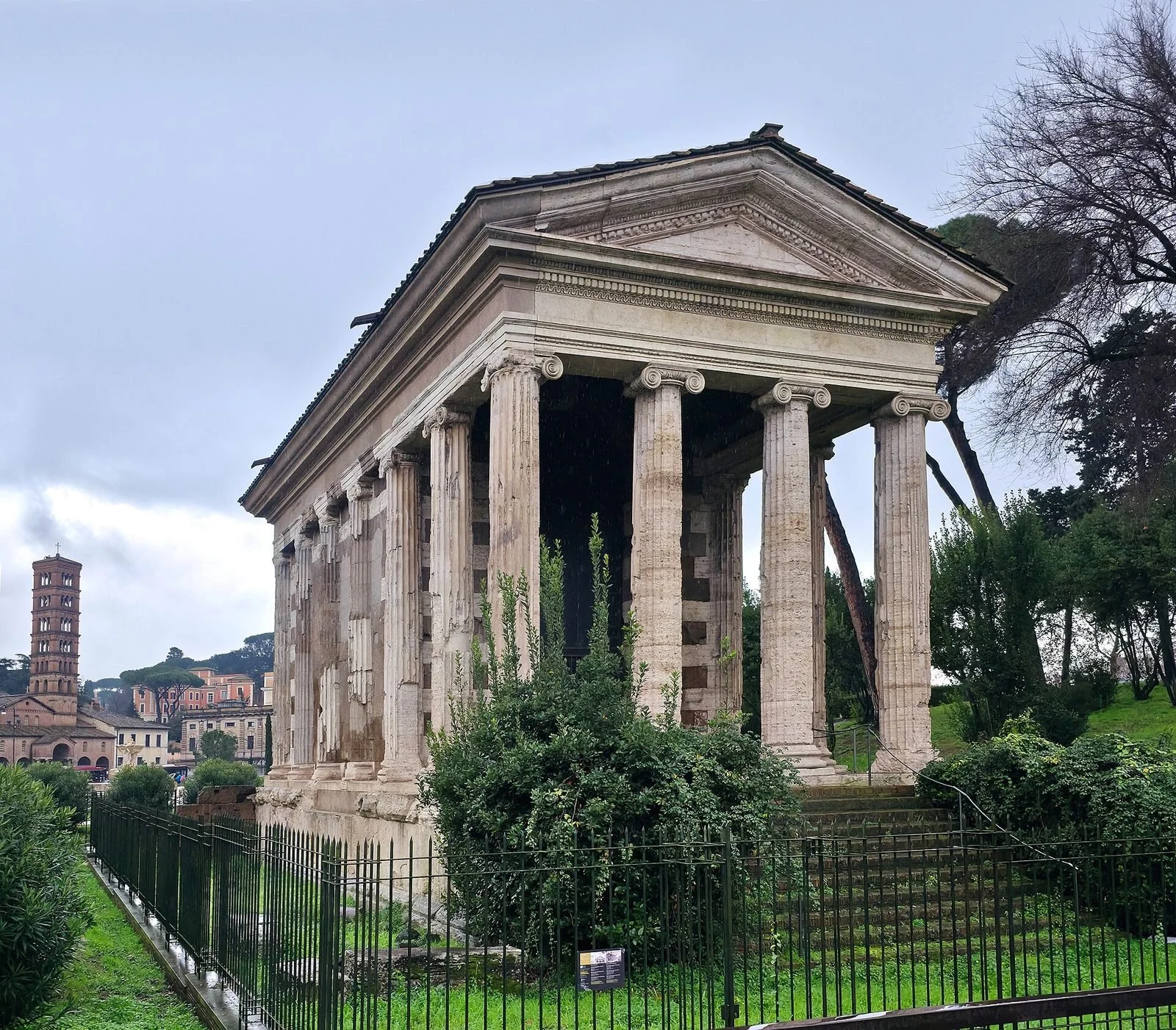
The Temple of Portunus is the small rectangular temple on a high podium that you see in Piazza della Bocca della Verità, at the corner of Via di Ponte Rotto, about 50 meters from the round Temple of Hercules Victor and a short step from the Mouth of Truth. It is one of the two best-preserved Republican temples in Rome and one of the very few sacred buildings of the ancient world to have come down to us with its roof, columns and cella in place. Almost all the older guides still call it the temple of Fortuna Virilis: the name is wrong, it has been around for five centuries and it's worth understanding where it comes from, because it's a textbook case of how a Renaissance hypothesis becomes a repeated truth. The building you see today dates to the late Republican period and rests on earlier phases. It survived because in the 9th century it was turned into a church, and it stayed a church for more than a thousand years. The interior is not normally open to visitors: it opens only on special occasions and with limited numbers, while the exterior can be looked at freely from the square, free of charge, at any hour. The lines that follow explain how it's built, when it was built, why it carries a name that doesn't belong to it, what came to light with the restoration finished in 2014 and how to organize a visit that doesn't end in 10 minutes.
The site already has a page devoted to the Forum Boarium, which tells the story of the area as a whole, the cattle market, the river port and the whole system of monuments that occupy it: this page instead covers only the single building, its architecture, its history as a church and the real conditions of access.
Where the Temple of Portunus is and how to get there
The Temple of Portunus is in Piazza della Bocca della Verità, in the Ripa district, on the Lungotevere Aventino side, inside the fenced flower bed that also holds the round Temple of Hercules Victor. The nearest metro stop is Circo Massimo, Line B, from which you walk for 8 or 10 minutes along Via dei Cerchi or skirting the valley of the Circus Maximus. If you come by bus, get off along Via Petroselli or on the Tiber embankment: they are the same stops that serve Santa Maria in Cosmedin and the line for the Bocca della Verità, so finding your bearings is immediate even for anyone who doesn't know the area.
On foot, from the most common starting points
From the Capitoline Hill the descent is short: you go down toward Via del Teatro di Marcello, pass the Theater of Marcellus and in just under 15 minutes you're in front of the temple. From the Colosseum it takes a good 20 minutes via Via di San Teodoro and Via del Velabro, with the chance to slip the Arch of Janus into the route. From the Tiber Island you get there in 10 minutes along the river, and from the opposite bank, that is from Trastevere, Ponte Palatino and five minutes of embankment are enough.
Anyone coming down from the Aventine has the most beautiful route and, in reverse, the most tiring: from the Orange Garden you go down Clivo dei Publicii and come out on the square in a few minutes, but the walk back up in August at two in the afternoon is a choice we advise against.
Car, parking and ZTL
Parking here is complicated. The area is inside or at the edge of the limited traffic zones of the historic center, street parking where allowed is paid during daytime hours Monday to Saturday, and the Tiber embankment on that stretch is a through carriageway, not a parking lot. If you come from outside Rome it's quicker to leave the car at a park-and-ride on metro Line B and get off at Circo Massimo. The advice isn't a formality: between looking for a space, paying for parking and risking the electronic gate, the time lost regularly exceeds the 20 minutes of metro.
Why it's called the temple of Fortuna Virilis, and why that's a mistake
The name temple of Fortuna Virilis appears in the antiquarian literature from the Renaissance onward and dragged on until the road signs of the 20th century, but it rests on no inscription found on the building. It's an attribution reconstructed at a desk by scholars who had two elements in front of them: an intact Republican temple in the Forum Boarium and some ancient literary sources that placed a cult of Fortuna in this area. Putting the two together seemed reasonable. It wasn't.
Where the misunderstanding comes from
Ovid, in the Fasti, describes the festival of April 1 in which Roman women honored Venus and, in a famous passage, Fortuna Virilis, with rites tied to water and bathing. The cult was set near the Tiber. Renaissance antiquarians, who were trying to give a name to every ruin in the city, linked that passage to the most intact temple left on the riverbank, and the mental label stuck to the building. From there it passed into guidebooks, engravings, architects' surveys and, through inertia, into place names.
The problem is that the Forum Boarium did have a cult of Fortuna, and it wasn't here. A few tens of meters further on, at the foot of the Capitoline Hill, the sacred area of Sant’Omobono yielded the remains of two archaic twin temples that the sources attribute to Fortuna and Mater Matuta and whose foundation tradition ascribes to Servius Tullius. That is the sanctuary of the Fortuna of the Forum Boarium that the texts speak of. Assigning the same cult to the little temple on the river too meant doubling a sanctuary that the sources don't double.
Why it's called Portunus today
The identification with Portunus, the deity who presided over harbors and river access, rests on a solid topographical argument. Varro, in the De lingua Latina, recalls the Portunalia, the festival of Portunus that fell on August 17, and links the cult to the stretch of river near the Aemilian Bridge, that is exactly this stretch of the Tiber, that of the river port of Republican Rome and of the remains now known as Ponte Rotto. A temple dedicated to the god of harbors, planted on the quay of the port, in front of the market supplied by that port, has a coherence that the Fortuna hypothesis never had. The attribution to Portunus took hold in scholarship from the 1920s and is the one accepted today by the Capitoline Superintendency and the textbooks.
It remains an attribution, not a certainty
It needs saying clearly, because pages that leave it out mislead the reader: no dedicatory inscription has been found on the building. No architrave with the god's name, no base with the name of a magistrate who financed the temple. The identification with Portunus is the most probable on the basis of topography, literary sources and chronology, and it's the one we use throughout the page too, but it remains a reconstructive hypothesis. Anyone who writes that the temple is dedicated to Portunus with the same certainty with which they write that the Pantheon bears Agrippa's name on its facade is flattening two very different levels of certainty.
How the Temple of Portunus is built: pseudoperipteral, tufa, travertine and stucco
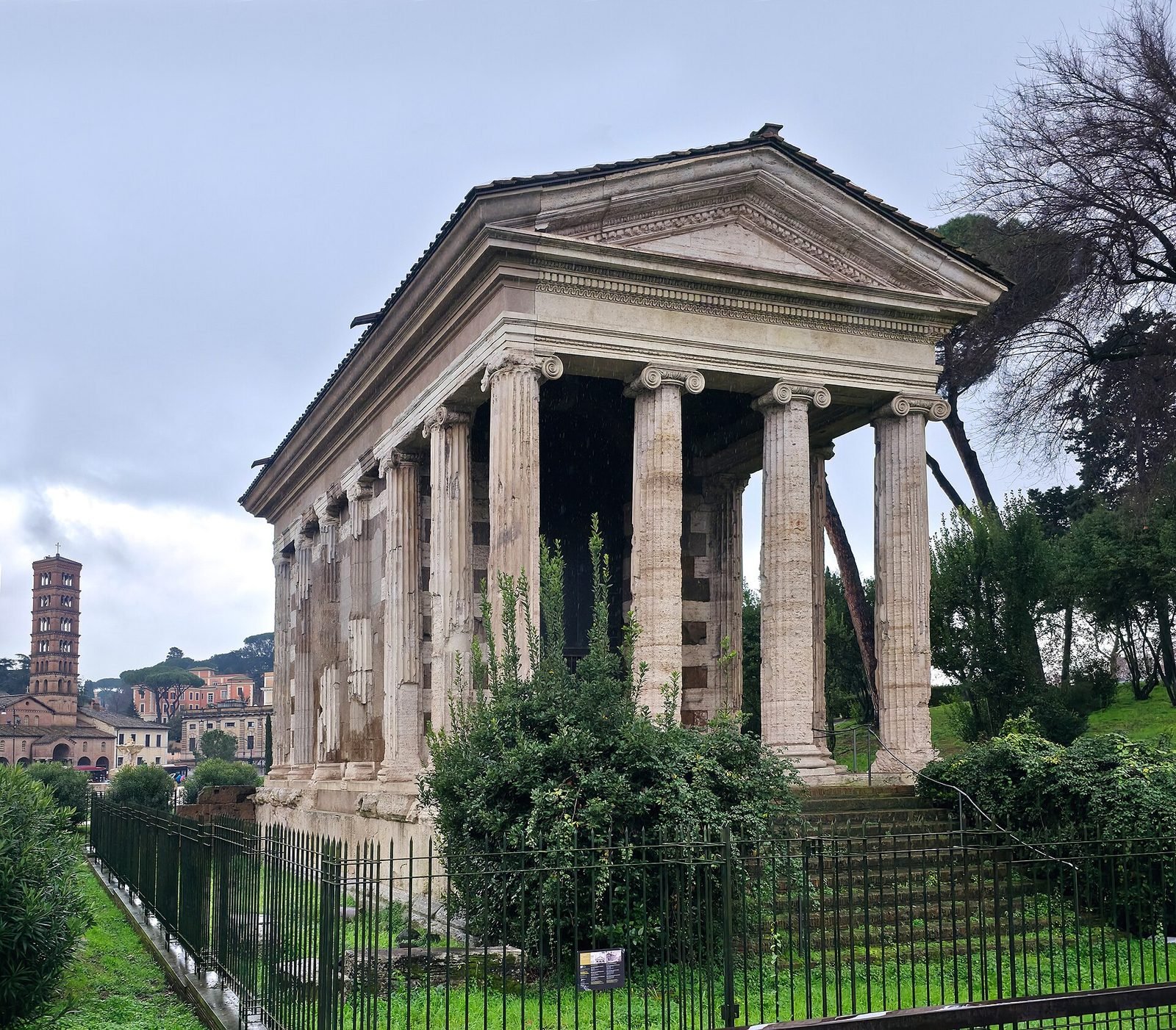
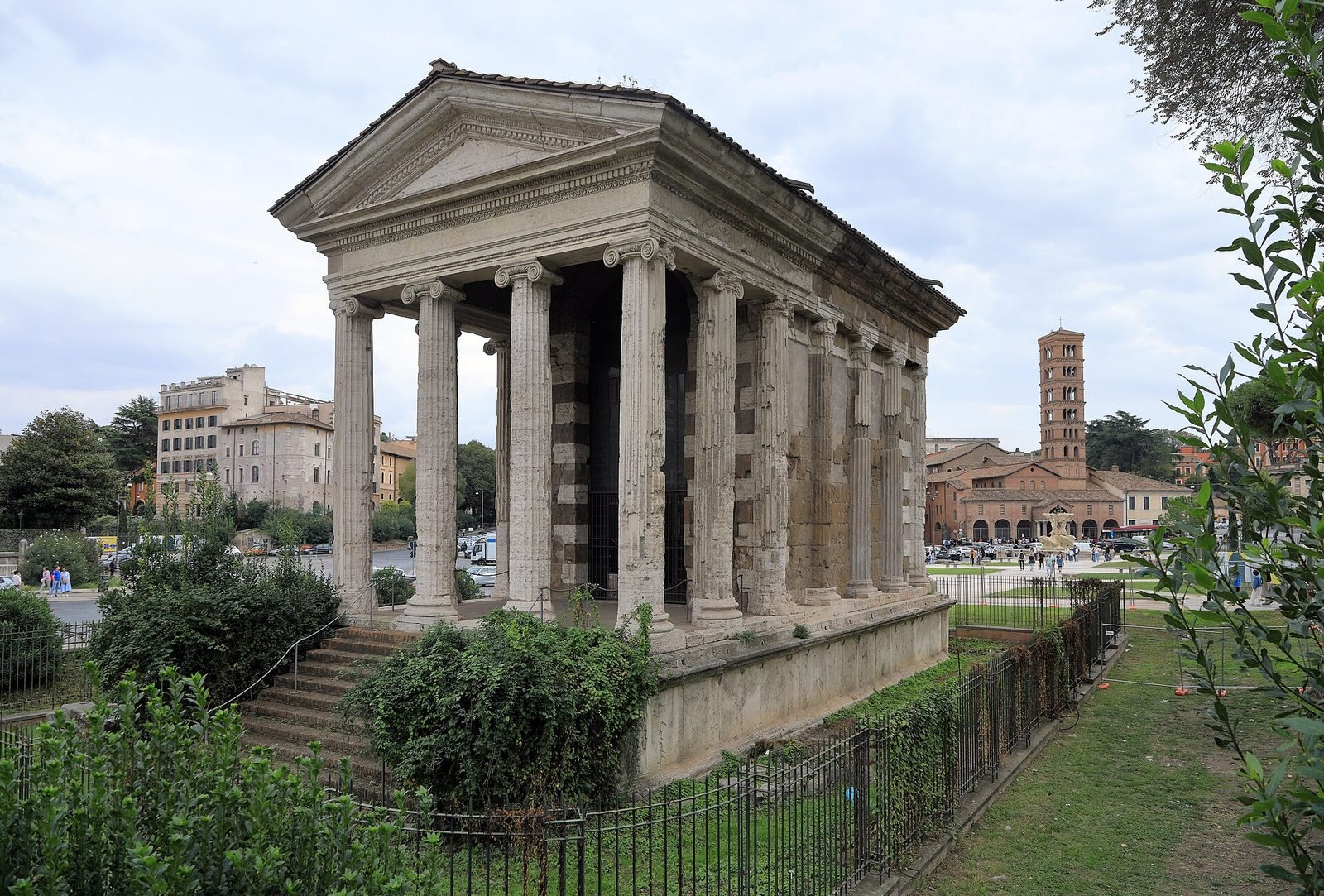
The Temple of Portunus is an Ionic, tetrastyle, pseudoperipteral temple: four free columns on the front, a deep pronaos, and all the other columns turned into half-columns attached to the outer wall of the cella. It's the formula that late Republican Roman architecture adopts when it wants the look of a temple surrounded by columns without paying for the space and the cost. Seen at three quarters, the building seems to have a colonnade that runs all the way around. Seen from the side, you realize the side columns are half-columns embedded in the wall.
What pseudoperipteral means
A peripteral temple has a free colonnade on all four sides and a walkable corridor between the columns and the wall of the cella. A pseudoperipteral temple eliminates that corridor: the cella widens to take up the whole width of the podium and the columns on the sides and back become half-columns attached to the wall, decorative and not load-bearing. The advantage is practical. The cella, that is the room that housed the cult statue, becomes much larger for the same footprint, and the temple can fit on a narrow plot in an already built-up area, as the Forum Boarium was in the Republican period. The Temple of Portunus is the most cited example of this solution in all of Roman architecture, and that is why it appears in every textbook.
The columns: four in front, the others in the wall
On the front there are four free columns, Ionic in order, with scroll capitals and vertical fluting on the shaft. Behind them the pronaos extends in depth with more free columns, so that the entrance is a real shaded portico and not a simple threshold. On the two long sides of the cella run five half-columns per side, and on the back another four, for a total that, with the free ones of the pronaos, exceeds a dozen elements. It's a count worth doing on the spot: anyone who stops in front of the long side and tries to count them understands in 30 seconds the difference between a real colonnade and a simulated one, and never forgets it.
Tufa, travertine and the trick of the stucco
The materials tell a story of building economy. The columns of the pronaos and the corners of the cella are in travertine, the hard, pale stone from the Tivoli quarries, while the other columns and most of the walls are in Aniene tufa, a local volcanic stone much poorer and much more porous. The travertine goes where the load is greatest and where the eye lands first. The tufa goes where only volume was needed. In antiquity the difference wasn't visible, because the whole building was covered in white stucco: a thin plaster, worked and smoothed, that gave the effect of marble on a structure that had nothing of marble about it.
It's the detail that completely changes the mental image of the monument. The gray and brown little temple you see today, with the grain of the tufa exposed and the paler zones of travertine, in the Republican period was a white, smooth, uniform volume, probably with painted elements in the entablature and the pediment. Republican Rome imitated Greek marble with the materials it had at its doorstep, and did it well. Real marble, in quantity, comes later, with Augustus, and it's the reason a building like the Ara Pacis belongs to a different building world from this one even though it is less than a century away.
The podium and the front staircase
The temple rests on a high podium in tufa ashlar faced with travertine slabs, with the stairway concentrated on the front. It's the classic Italic scheme, different from the Greek one: a Greek temple is climbed from all sides on a base of continuous steps, a Roman one has a single front entrance and stands on a high podium that separates it from ground level. The choice isn't aesthetic but liturgical: the rite took place outdoors, in front of the temple, on an altar placed at the foot of the stairway, and the podium served to give the celebrant a raised position above the crowd. Anyone who has in mind the podium of the Temple of Antoninus and Faustina in the Roman Forum finds the same principle here on a smaller scale.
When the Temple of Portunus was built
The building visible today is late Republican, and the most credited dating proposals fall between the end of the 2nd and the first half of the 1st century BC. Beneath it, however, there are traces of older phases, and this is the point that almost all popular pages skip.
Two readings, both in circulation
One reading, based on analysis of the materials used in the foundations, places the construction of the present building around 80-70 BC. Another, very widespread in the textbooks, proposes the second half of the 2nd century BC for the layout, with a restoration or rebuilding in the 1st century. The two proposals are not very far apart and converge on one point: the temple we see belongs to the century before Augustus. We prefer to report both, because choosing a single year and presenting it as certain would be wrong: no dating inscription has ever emerged from the building.
The earlier phases
Excavations have identified traces of earlier constructions attributable to a chronological span from the end of the 4th to the beginning of the 3rd century BC. This means that on this exact spot in the Forum Boarium a temple already stood, probably dedicated to the same deity, when Rome was still engaged in the Samnite wars. It's a continuity of cult lasting centuries, not an isolated building dropped here in the late Republican period, and it explains why the position is so close to the river landing: the cult was born with the port.
From temple to church: the reason it is still standing
The Temple of Portunus reached the 20th century intact for a simple reason: for more than a thousand years it was a Catholic church, and a church in use isn't dismantled to get lime and building material from it. It's the same reason that saved Santa Maria in Cosmedin, grown on top of ancient structures, and San Nicola in Carcere, which incorporated three temples of the Forum Holitorium into its walls. In Rome Christian reuse has preserved more ancient architecture than any protection law.
872 and the problem of the source
The date every page repeats is 872, under the pontificate of John VIII, with the temple consecrated as a church dedicated to the Virgin. Some sources give 873. The date deserves a clarification that almost nobody reports, though: the news of the consecration doesn't come from a 9th-century document, but from an inscription of 1571 set into the building, that is from testimony written 700 years after the events it recounts. It's a late source, of the kind historians accept with caution. The substance, the conversion into a church in the early Middle Ages, isn't in dispute. The precise year rests on a more fragile base than it seems, and we say so because a page that presents 872 as a fact carved in 9th-century stone says something untrue.
The church's names, in order
The dedications followed one another and the confusion is understandable. At the origin the church appears as Santa Maria in Secundicerio, from the name of the figure tied to its foundation or endowment. In the Middle Ages it also appears as Santa Maria de Gradellis, and the most accepted hypothesis is that the name derives from the steps that went down to the Tiber at that point on the bank. The title of Santa Maria Egiziaca, the one by which the building is best known in modern literature, appears for the first time in a catalog of churches of 1492 and becomes current in the 16th century. Three names, the same building, different centuries: anyone searching for archive documents has to try them all.
The Armenians of Rome, from 1571 to 1921
The least known chapter in the building's history is the Armenian one. In 1571 Pope Pius V granted the church to the Armenian community of Rome, which had lost its place of worship because of the works connected to the building of the ghetto in the area between the Theater of Marcellus and the Tiber. From that moment the ancient Temple of Portunus became the national church of the Armenians in Rome and remained so until 1921, with an attached hospice for pilgrims. Pope Clement XI, in the early decades of the 18th century, had both the church and the hospice restored and decorated. For 350 years, then, a Roman Republican temple was the religious center of an Eastern Christian community: it's the kind of layering that makes Rome hard to sum up in a caption.
When it was deconsecrated: here the sources differ
On the end of its religious function the sources don't agree, and the difference isn't a detail. Some give 1916 as the year of deconsecration, ordered to return the building to its ancient appearance. Others place the operation in the 1920s, noting that the furnishings were moved starting in 1924 and that the attached hospice was demolished in 1930, while the end of its function as the Armenian national church is dated to 1921. The two reconstructions can be reconciled if you distinguish between the formal act and the material process, which lasted years, but they remain two different dates. We also note that the version according to which the deconsecration took place in the 19th century circulates in some popular sources and finds no confirmation in those we consulted: the 19th century is the century in which the area begins to be reorganized, the 20th the one in which the temple stops being a church.
The 1930s clearance and today's flower bed
The present look of the square, with the two temples isolated inside a fenced flower bed and the traffic flowing around, is the result of the urban works between the late 19th century and the 1930s: the building of the Tiber embankment walls, which erased the direct relationship between the bank and the buildings, and then the opening of Via del Mare with the demolitions that freed the monuments from the houses built up against them. It's the same program that redrew half the historic center, from the Mausoleum of Augustus to the slopes of the Capitoline Hill. The result, for the Temple of Portunus, is ambiguous: the building can be seen from every side, something impossible for centuries, but it lives in the middle of a traffic island instead of inside an urban fabric.
The restoration and what came back to light inside
The most important restoration of recent decades was promoted by the World Monuments Fund with the support of American Express, in collaboration with the Capitoline Superintendency, and was presented as completed in July 2014. It wasn't a facade cleaning: the work covered the exterior surfaces, the tufa and travertine masonry and above all the interior of the cella, where traces of plaster and medieval paintings were preserved in precarious condition.
The early medieval frescoes
Inside the cella survive paintings from the early Middle Ages, those that belong to the first centuries of the church's life: rows of saints lined up and scenes tied to the Virgin, following a figurative scheme that finds parallels in other Roman churches of the same season, first of all Santa Maria Antiqua in the Roman Forum. Other, more recent frescoes tell episodes from the life of Mary of Egypt. It's a pictorial heritage that the literature has known for a long time but that the public has almost never seen, for the simple reason that the interior stays closed.
The traces of stucco outside
The restoration also consolidated the surviving fragments of ancient stucco on the exterior surfaces, the fragments that document the original white covering we talked about above. They are minimal portions, and anyone looking at the building from the square without knowing doesn't notice them. Anyone who instead gets close to the fence and observes the shafts of the half-columns on the side can tell the zones where the surface is still covered from those where the tufa is exposed. It's the most interesting observation you can make from the outside, and it costs nothing.
A curiosity about the Temple of Portunus
The most solid curiosity concerns the architects' trade: for four centuries the Temple of Portunus has been one of the most measured ancient buildings in Europe, and its proportions have ended up in projects built thousands of kilometers from Rome. The reason is banal and decisive: it was intact. Anyone who wanted to understand how a Roman temple was really made couldn't work it out from the ruins of the Roman Forum, where there were three columns here and a podium there. Here instead everything was there: podium, stairway, pronaos, columns, entablature, pediment, cella.
The most copied temple of modern architecture
Andrea Palladio surveyed and studied it in the 16th century, adding it to his repertoire of ancient models. Antoine Desgodetz, in the 17th century, measured it precisely and published the drawings in the collection that for generations was the reference manual for European architects on the ancient buildings of Rome. Giovanni Battista Piranesi etched it. From the 18th century onward, every young architect on a study trip to Rome stopped here with a notebook. The result is that the profile of this little temple of the Forum Boarium, with its Ionic order and its tetrastyle pronaos, reappears in the neoclassical facades of half the world, often with nobody knowing where it comes from.
Something nobody tells you about the Temple of Portunus
What almost no page says plainly is that the interior of the Temple of Portunus can't be visited. It isn't a matter of unlucky hours or closing days: the building has no ticket office, no permanent custodian, no ordinary opening calendar. Visits to the interior happen on special occasions, almost always with limited numbers and by booking, organized or authorized by the Capitoline Superintendency. Anyone who arrives in the square convinced they'll go in stays outside.
So how do you really get in
There is only one way: follow the channels of the Capitoline Superintendency and the contact center of the City of Rome at 060608, which answers every day and gives updated information on openings and initiatives. The good opportunities cluster in the periods when institutions open places that are usually closed, and anyone who lives in Rome or has a long stay planned can get a head start by also keeping an eye on the calendar of free-admission days in museums, which we cover on the page about free museums. We don't promise dates and you won't find any on this page, for the reason that any date written here would be false within a month.
The advice I give you for visiting the Temple of Portunus
The operational advice is one and we give it without detours: the Temple of Portunus should be seen early in the morning, before nine, or in the last hour of light, and fitted into a walking route that takes in the whole Forum Boarium, never tackled as an isolated stop. The square is a traffic junction, and between 10 and 6 the combination of buses, tour coaches and the line for the Bocca della Verità makes stopping much less pleasant than the photographs lead you to believe.
The right time and why
Early in the morning the traffic on Via Petroselli is still light, the sun comes from the east and lights the front of the temple from the side, bringing out the fluting of the columns and the capitals. In late afternoon the light shifts and catches the long side, the one with the half-columns, which is the architecturally most instructive side. In the middle hours, with the sun high, the building flattens and the tufa becomes a gray mass with no relief. If you have only one chance, choose the morning.
The route we recommend, in 90 minutes
You start from the Temple of Portunus, walk around the flower bed to see the temple of Hercules Victor too, cross toward Santa Maria in Cosmedin looking at the Mouth of Truth from the portico without necessarily getting in line, continue along Via del Velabro to the Arch of Janus, go back toward the Theater of Marcellus and finish at San Nicola in Carcere, where three Republican temples are incorporated into the church. It's 90 minutes of slow walking, with no tickets, with a density of Republican architecture that doesn't exist in the rest of the city.
The verdict we feel we can give
The line at the Bocca della Verità is, in our assessment, the worst investment of time in the Forum Boarium. You wait a long time, in the sun, for a photo with your hand in an ancient manhole cover, while 100 meters away two intact Republican temples can be looked at with no wait and without paying. If time is short, the Temple of Portunus and the round temple are worth the stop, the line isn't. We say it knowing it's an unpopular opinion and we back it up with a fact: in front of the mask the queue reaches as much as 40 minutes in the peak months, in front of the temples there's never a queue.
Accessibility and strollers
The square is flat and the sidewalks around the temple area are passable, with the typical limits of the Roman historic center in terms of paving and crossings. The building is observed from the fence, so there are no steps to deal with for the outside visit. Anyone with walking difficulties finds a decidedly easier situation here than on the archaeological routes of the Palatine, which involve changes of level and uneven ground. For the interior the question doesn't arise, since it isn't open in the ordinary way, but bear in mind that it's a building on a high podium with a stairway, so any special opening involves stairs.
Another well-known fact, yet rarely mentioned
The fact is this: the Temple of Portunus looked onto a port, and that port is gone. Republican Rome had its river landing right here, on the left bank of the Tiber below the Aventine, and the cattle market that gave the Forum Boarium its name lived off that movement of goods. The god Portunus presided over entrances, passages and landings. Building him a temple on the quay wasn't generic devotion, it was occupational insurance.
The port, the bridge and the trade
A few tens of meters away, the remains of Ponte Rotto mark the point where the Aemilian Bridge stood, the oldest masonry bridge in Rome, and the same stretch of river to which Varro links the Portunalia. Further downstream, toward Testaccio, the great port system of the Emporium developed in the imperial age, of which Monte dei Cocci is the accumulated industrial waste: an artificial hill made of broken oil amphorae, direct evidence of how much passed through this stretch of river. River trade in Rome wasn't a detail, it was the city's circulatory system.
The right photo to take at the Temple of Portunus
The photograph that does the Temple of Portunus best isn't the head-on one, which everybody takes and which flattens the building, but the three-quarter view from the corner of Via di Ponte Rotto and the Tiber embankment, taken in the first hour after dawn or the last before sunset. From that position the front with the four Ionic columns and the long side with the half-columns both enter the same frame, and the image explains by itself what a pseudoperipteral temple is, which is exactly what a head-on photograph can't say.
The three framings that work
The first is the three-quarter view just described, the most useful from an architectural point of view. The second is the detail of the Ionic capitals backlit in late afternoon, with a telephoto lens or the zoom on your phone: the scrolls stand out and the gray of the tufa stops dominating. The third is the context photograph, taken by backing away toward Santa Maria in Cosmedin, which frames the two temples together and conveys the real scale of the ancient sector inside the modern square.
What ruins the photo
Three things, in order of frequency. The buses and tour coaches stopped along the edge of the square, which in the middle hours get into almost every shot from ground level. The midday sun, which erases the shadows and with them the legibility of the fluting. The fence, which is low but exists: you avoid it by crouching slightly or choosing a spot where the edge stays out of frame. If you shoot with a phone you get better results with the long focal length mode than by getting too close, because the wide angle distorts the pediment.
Some important events that happened here in history
The history of the Temple of Portunus is measured in changes of function more than in spectacular events, and it's precisely those changes that decided its survival. We list the main ones, with the cautions already stated about uncertain dates.
Between the 2nd and 1st century BC: the temple we see
The present building is built in the late Republican period. The range proposed by scholars swings between the second half of the 2nd century, with later restorations, and the years 80-70 BC on the basis of the foundation materials. It's the temple that, with few structural changes, has come down to today.
872 or 873: the conversion into a church
Under the pontificate of John VIII the temple is consecrated as a Christian church, according to what an inscription of 1571 hands down. It's the act that saves the building: from that moment it is a place of worship in use and not a quarry of materials. Over time the church takes the names of Santa Maria in Secundicerio and Santa Maria de Gradellis.
1571: the church passes to the Armenians
Pope Pius V grants the church to the Armenian community of Rome, left without a place of worship following the works connected to the building of the ghetto. In the same year the inscription handing down the date of the early medieval consecration is set into the wall. The building becomes the Armenian national church and keeps that role until 1921.
2014: the end of the restoration
The restoration promoted by the World Monuments Fund with the support of American Express and in collaboration with the Capitoline Superintendency is presented as completed in July 2014, with the monument returned to the city after the work site. It's the intervention that consolidated the medieval paintings inside and the traces of stucco outside.
Who has passed through the Temple of Portunus
The list of people tied to this building is less touristy and more technical than you'd expect: they are mostly architects, scholars and popes. We report them only when the documentation allows, because a lot of secondhand anecdote circulates about illustrious visits.
Varro, the ancient source
Marcus Terentius Varro, the great scholar of the 1st century BC, is the witness on whom the identification with Portunus rests: in the De lingua Latina he recalls the Portunalia of August 17 and links the cult to this sector of the river. Without that passage, the modern attribution wouldn't exist.
Andrea Palladio
Palladio studied and surveyed the ancient buildings of Rome during his 16th-century stays, and the Temple of Portunus is among the models on which his idea of a Roman temple was formed. The success of the tetrastyle Ionic order on a high podium in modern architecture runs through here too.
Antoine Desgodetz
The French architect measured the ancient Roman buildings rigorously in the 17th century and published the surveys in a collection that for over a century was the European reference for anyone who wanted exact proportions instead of fanciful reconstructions. The plates devoted to this temple, listed under the name of Fortuna Virilis, circulated all over Europe.
Giovanni Battista Piranesi
Piranesi etched the temple in his views of Rome, helping to fix its image in the European imagination of the 18th century. His plates, like those devoted to the Colosseum and the ruins of the Forum, shaped the gaze of generations of Grand Tour travelers before they even reached the city.
Pope John VIII, Pius V, Clement XI
Three pontiffs left a direct mark on the building's history: John VIII with the early medieval consecration handed down by the inscription of 1571, Pius V with the grant to the Armenians in 1571, Clement XI with the restorations of the early 18th century. It's a sequence that covers eight centuries and explains why a pagan temple survived intact in a city that dismantled almost all the others.
What's around: the Forum Boarium in half an hour's walk
The Temple of Portunus sits inside one of the densest concentrations of monuments in Rome, and almost everything worth a stop is reachable on foot in under 10 minutes. For the area as a whole we refer you to the page on the Forum Boarium, which covers the general picture. Here we list only the stops that connect directly to the temple.
Monuments within five minutes
The round temple of Hercules Victor shares the flower bed. Santa Maria in Cosmedin with its Romanesque bell tower closes the square on the opposite side, and in the portico is the Mouth of Truth. Toward the Velabro you reach the Arch of Janus, and going up Via del Teatro di Marcello you meet the Theater of Marcellus and San Nicola in Carcere. On the river, the remains of Ponte Rotto can be seen from the parapet of the Tiber embankment.
Going up toward the Campidoglio
10 minutes of climbing bring you to the Capitoline Cordonata, the square of the Capitoline Hill and the Capitoline Museums, with the Palazzo dei Conservatori and the stairway of Santa Maria in Aracoeli. It's the combination we recommend to anyone with half a day who wants to close the circle between the Republican Rome of the river and the Capitoline one.
Going up toward the Aventine
On the opposite side you climb to the Orange Garden, the Basilica of Santa Sabina, the keyhole of the Villa del Priorato di Malta and, in season, the Rome Rose Garden overlooking the Circus Maximus. Anyone continuing beyond the Aventine reaches the Pyramid of Cestius, the Non-Catholic Cemetery and the district of Testaccio, where the Nuovo Mercato and the former Slaughterhouse tell the story of working Rome.
Across the river and further afield
Crossing Ponte Palatino you enter Trastevere, with the Basilica of Santa Maria in Trastevere. Going up the river you reach the Tiber Island, the Turtle Fountain and the cat sanctuary of Largo Argentina. Anyone who wants to fully understand the relationship between Rome, the river and the ports should devote a day to Ostia Antica, where the commercial system that fed this landing can be seen at urban scale. And anyone looking for the museum context where many materials from this area ended up will find it at the Crypta Balbi, the Palatine Museum and, for late antique and papal Rome, at Castel Sant'Angelo.
Eating around the Forum Boarium without falling into a trap
We're a short step from the Bocca della Verità, that is in one of the areas of Rome most exposed to venues built on tourist traffic. We don't name names and we won't: a list of signs gets old in a few months and teaches nothing. Instead we give the criteria we use in the field, because they work in Florence, in Venice and anywhere there's a famous monument with a line in front of it.
The five signs we recognize from outside
The first is the lady rolling fresh pasta in the window or right on the sidewalk: it's a lure meant for passersby, not a sign of a kitchen. The second is the menu with photographs of the dishes, often laminated and translated into six languages: it's for people who will never come back. The third is the barker at the door inviting you to sit, because a place that has to stop people in the street has a customer problem. The fourth is nonstop hours from morning to night with no kitchen break, which is incompatible with a real kitchen. The fifth concerns the position: places set in front of the most photographed monuments tend to adjust the price to the tourist in front of them, with unpriced items on the menu or with different price lists between the indoor room and the outside tables.
The simplest test of all
You look at who is sitting and in what language they order. If at two in the afternoon on a weekday the tables hold office workers, craftsmen and neighborhood people speaking Roman, the place holds up. If there are only suitcases and maps, you keep walking another five minutes. Five minutes, in this area, means getting out of range of the line and changing price bracket completely: just move off toward Testaccio or toward the inner lanes of the district.
The chains in the center
In central Rome places with a repeated sign have multiplied, with the same menu in several spots around the city and the line with a ticket number at the door. We don't name them and we don't recommend them. The fact that interests us is another one, and anyone can observe it: Romans don't go to them. Those lines are made up almost entirely of tourists who saw the place on social media, and the average bill is higher than at a neighborhood kitchen that works on regular customers.
Daniele Dezi's list
For those who want a concrete reference anyway and not an abstract rule, there is Daniele Dezi's personal list on Google Maps: a curated collection, updated over time and not sponsored, built on places tried in person. It isn't a ranking and it isn't advertising: it's the starting point we give anyone who asks. On the topic in general we have a dedicated page, which reasons about neighborhoods and time slots instead of signs.
Frequently asked questions about the Temple of Portunus
What is the Temple of Portunus?
The Temple of Portunus is a late Republican Ionic, tetrastyle, pseudoperipteral temple, built of Aniene tufa and travertine covered in stucco, located in Piazza della Bocca della Verità in the Forum Boarium in Rome. It is one of the two best-preserved Republican temples in the city together with the nearby round temple of Hercules Victor, and it has come down to us intact because in the 9th century it was turned into a Christian church.
How much does it cost to visit the Temple of Portunus?
Seeing the Temple of Portunus from the outside is free and needs no booking: the building can be looked at freely from Piazza della Bocca della Verità at any hour of the day. There is no ticket office, because the interior isn't open to the public in the ordinary way. Any special openings of the cella are organized by the Capitoline Superintendency, with terms and costs to be checked case by case at the contact center 060608.
Can you go inside the Temple of Portunus?
The interior of the Temple of Portunus can't normally be visited and opens only on special occasions, almost always with limited numbers and mandatory booking. The cella is small and holds fragile early medieval paintings, and this explains the choice to limit access. Anyone who wants to try to get in has to follow the channels of the Capitoline Superintendency and the contact center of the City of Rome at 060608, without trusting calendars found on unofficial sites.
Why is the Temple of Portunus also called the temple of Fortuna Virilis?
The Temple of Portunus was called the temple of Fortuna Virilis for centuries because of an attribution error born among Renaissance scholars, who linked the building to a passage in Ovid's Fasti on the festival of Fortuna Virilis celebrated near the Tiber. The identification with Portunus, deity of river ports, is based instead on Varro and on the temple's position in front of the landing, and it took hold in scholarship from the 1920s.
How do you get to the Temple of Portunus by public transport?
The Temple of Portunus is reached by metro Line B, Circo Massimo stop, from which you walk for 8 or 10 minutes toward the Tiber. Alternatively, the area is served by the bus lines that run along Via Petroselli and the Tiber embankment, with a stop at Piazza della Bocca della Verità. From Termini it takes about 25 minutes between the metro and the walk.
How much time do you need to visit the Temple of Portunus?
For the Temple of Portunus 10 or 15 minutes is enough if you just walk around the fence looking at the podium, the Ionic columns and the half-columns of the side. Included in a route that takes in the temple of Hercules Victor, Santa Maria in Cosmedin, the Arch of Janus and San Nicola in Carcere, the full tour of the Forum Boarium takes about 90 minutes of slow walking.
Is the Temple of Portunus suitable for children?
The Temple of Portunus is looked at from the outside in a few minutes and has no interior routes, so it works with children only as a short stop within a wider outing. The square is flat and accessible with a stroller, but it is surrounded by traffic and has no shaded rest areas: it's best combined with the climb up the Aventine, where the Orange Garden offers space and shade.
Can you photograph the Temple of Portunus?
Photographing the Temple of Portunus from the square is free and needs no authorization for personal use. Drone shooting is subject to the restrictions that apply over the historic center of Rome and isn't done without authorization, while for photographs intended for commercial use of properties in the care of the Capitoline administration you need to check the conditions with the Capitoline Superintendency before publishing.
What is the difference between the Temple of Portunus and the round temple next to it?
The Temple of Portunus is the rectangular building with four Ionic columns on the front, while the round temple next to it in the same flower bed is dedicated to Hercules Victor and has a circular plan with Corinthian columns. The second is built of Greek marble and is considered the oldest marble building in Rome. The first is in tufa and travertine covered in stucco. Both are Republican and both can be seen only from the outside.
Who wrote this page
This page is maintained by the editorial team of Tour Leader Pro, the Rome-based project office that designs and coordinates visits, itineraries and cultural events in Rome and Lazio. Hours, prices and access conditions given here are verified as of the publication date against the official sources named in the text: before you leave it's worth rechecking them, because they change often. If you find out-of-date information, let us know.
If you're building a Roman itinerary that ties together the Forum Boarium, the Aventine and the river, and you need realistic timings, permits and a guide who knows the access conditions to places closed to the ordinary public, you'll find design tools and operational contacts on Tour Leader Pro, which works on Rome and Lazio with the same method with which this page is written.
For the broader picture, that is for anyone arriving in Italy from abroad who has to fit Rome into a longer trip, with trains, distances, seasons and regional destinations, a useful resource is Italy Planner, which covers planning on a national scale while here we stay on the Roman detail.