Temple of Saturn
In short. The Temple of Saturn is the building with the eight columns that closes the western side of the square of the Roman Forum, at the foot of the Campidoglio, next to the Arch of Septimius Severus.
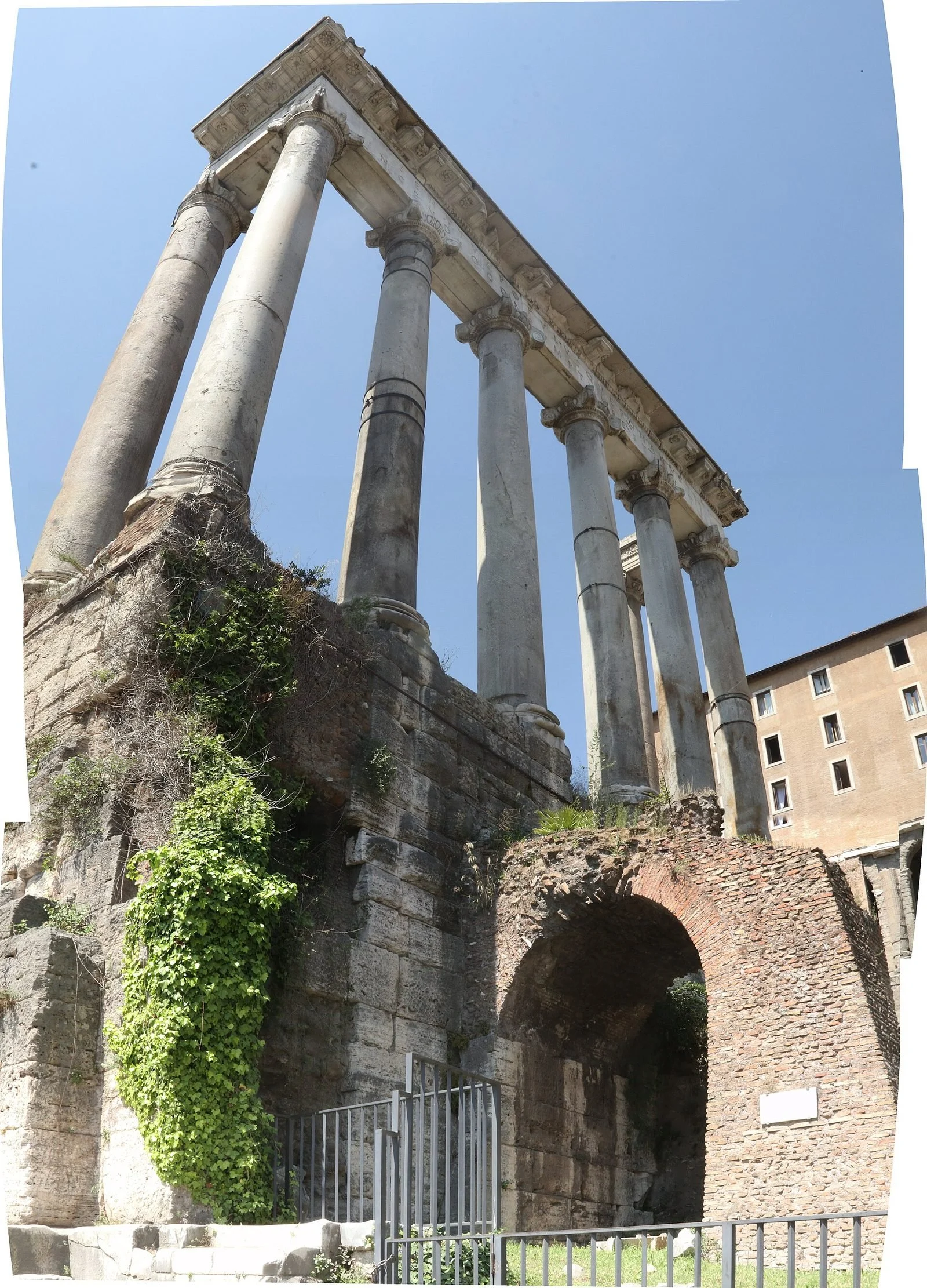
The Temple of Saturn is the building with the eight columns that closes the western side of the square of the Roman Forum, at the foot of the Capitoline Hill, next to the Arch of Septimius Severus. It is the silhouette that appears in almost every photograph taken inside the archaeological area: a broken architrave, held up by columns that are not even all the same color, above a podium of blocks. The annalistic tradition sets the dedication at 497 BC, but what stands today is much later, the result of a reconstruction after a fire, and the inscription running along the architrave says so with a formula that names no one.

Inside the podium, for centuries, was the aerarium populi Romani: the Roman State's treasury, the public money, the archives of the laws. Not a symbolic storeroom. The real treasure, guarded, administered by the quaestors, and plundered when needed by whoever had the army in hand at the moment. Outside, on December 17, the Saturnalia began, the festival in which social roles were turned upside down for a few days. The lines that follow tell what you see, what is reconstructed, what is debated and how to photograph it.
Where the Temple of Saturn is and how to get there
The Temple of Saturn is at the northwestern end of the Roman Forum, at the point where the forum square ends and the climb of the Clivo Capitolino toward the Capitoline Hill begins. The reference address for the archaeological area is Via della Salara Vecchia 5/6, on Via dei Fori Imperiali side, and the monument is reached by walking inside the area along Via Sacra to the western end of the valley. You don't enter the temple and you don't climb onto the podium: you walk around it, from the level of the square and from the ramp that climbs to the Clivo.
On foot from the Colosseum and from Piazza Venezia
From the Colosseum you walk inside the archaeological area for about 15 minutes, crossing the whole forum valley: you enter through the gate on Via Sacra near the Arch of Titus, pass the Basilica of Maxentius on the right and the Temple of Antoninus and Faustina, and arrive at the end of the square where the eight columns open out on the left relative to the Arch of Septimius Severus. From Piazza Venezia the distance is shorter, five or six minutes to the entrance on Via della Salara Vecchia. If you come from the Circus Maximus, you can consider the entrance of the Palatine on Via di San Gregorio, longer and uphill, which however lets you see the temple from the top of the hill before going down.
By metro and bus
The nearest metro stop is Colosseo, on line B, from which you walk five minutes to the entrance of Via Sacra and then a quarter of an hour inside the area to the temple. If you arrive from Termini, take line B in the direction of Laurentina and get off at the second stop. On the surface, the bus lines that serve Piazza Venezia are many and leave you a few minutes from the gate on Via della Salara Vecchia. Tram 8 reaches Piazza Venezia from Trastevere and from Gianicolense. To get your bearings among lines, tickets and schedules, it's worth reading our page on getting around Rome, which collects practical information on urban transport.
What remains standing: eight columns, an architrave, a podium
Of the Temple of Saturn there remain eight columns with a stretch of entablature, a partial pediment and the great block podium that supported the building. Six columns form the front, two belong to the sides: that is enough to read the plan, a prostyle hexastyle temple, that is with six columns on the facade and the colonnade limited to the front part. The rest of the cella no longer exists, and the visitor who arrives finds a tall, narrow scenic backdrop in front of them, without depth, which above the modern walking level seems detached from the ground.
The eight columns and their order
The columns are Ionic, with capitals that whoever looks closely recognizes immediately by the side volutes. It's a useful fact when comparing the temple with its neighbors: the three columns of the Temple of Vespasian and Titus, a few meters away, are Corinthian, with acanthus-leaf capitals, and the difference is visible even to the naked eye from 20 meters. The fact that the Temple of Saturn stayed Ionic in a late antique reconstruction, when the Corinthian largely dominated Roman public architecture, is one of the elements scholars discuss: some read in it a deliberate nod to the ancient look of the building, others explain it by the reuse of older material already available on the site.
The architrave and the pediment
Above the columns runs a stretch of entablature with the monumental inscription, and at the left corner a fragment of the tympanum remains, the triangle of the pediment. What is missing is most of the crowning and the whole roof. The surviving piece is enough, however, to establish the proportions of the front and to restore the height of the building, which in its original state dominated the end of the forum square. Whoever photographs from below sees the architrave foreshortened and the inscription almost illegible: that is why a telephoto lens or a higher position is advisable, and we talk about it further on.
The block podium and its function
The podium is the least looked-at part and the most interesting. It is a massive structure in blocks, faced in travertine, that did not serve only to raise the temple above the level of the square. Inside there were rooms, and in those rooms was the treasury of the Roman State. The side toward the square still shows the pattern of the masonry and the marks of the successive rebuildings. On the southern flank the structure leans against the Capitoline slope and the path of the Clivo Capitolino. Whoever walks around the monument should devote at least five minutes to the podium, because that is where the temple stops being a postcard and becomes a building that functioned.
The three nearby columns do not belong to this temple
It is the most common mistake among those visiting the Forum for the first time. The three very tall Corinthian columns, with the entablature carved with sacrificial instruments, are the Temple of Vespasian and Titus, a Flavian building set against the substructure of the Tabularium. The Temple of Saturn is the other one, the one with eight lower, stockier columns of uneven color. On the spot, the quickest difference to use is color: the Temple of Saturn has gray and pinkish shafts mixed together, the Temple of Vespasian and Titus has uniform white shafts.
Reused columns: gray granite, pink granite and uneven capitals
The columns of the Temple of Saturn are reused and uneven among themselves: the shafts are not all of the same marble, not all of the same diameter, not all from the same source. At least two different granites can be recognized with the naked eye, one gray and one of a pinkish tone, and the variation reads better on an overcast day than in full sun, when the white of the light flattens the tones. For a visitor used to the idea of a regular colonnade it is a surprise, and it is usually interpreted as a sign of neglect. It is instead the material proof of how a Roman public building site worked in late antiquity.
What “reused” means
A reused element (di spoglio) is an architectural piece taken from an earlier building and reassembled in a new construction. In late antique Rome reuse was the rule, and it concerned columns, capitals, bases, cornices, facing slabs. The imperial quarries of the eastern desert, which for two centuries had supplied granite to Rome, no longer worked with the same continuity, and transporting a monolithic shaft from Egypt cost enormously. A stock of material already landed at the river port and already worked was worth more than a distant quarry. The same logic is seen in the portico of the church of Santa Maria in Cosmedin, in the columns of San Nicola in Carcere and in dozens of medieval Roman buildings.
The shaft reassembled upside down
A recurring reading in popular literature, taken up by many guides, holds that one of the shafts was reassembled upside down, that is with the part that should be at the bottom turned upward. We say it as it should be said: it is an observation that circulates widely and that is based on the course of the entasis, the slight thinning that a classical shaft shows toward the top, apparently inverted in one of the elements. We find no published technical documentation, however, that confirms it in a definitive and unambiguous way, and the detail is hard to verify by eye from the ground. Whoever tells it as an established fact says more than the sources allow. Whoever dismisses it as false makes the same mistake in the opposite direction. It is a plausible reading and not proven, and that is how it should be reported.
Why the unevenness is the most honest thing about this building
The Temple of Saturn is the symbol building of ancient Rome in photographs, and it is built with pieces taken from elsewhere and put together as best they could. This contradiction says a lot about the city in which it was raised again: a capital that in the fourth century still had the means to restore the oldest temple of its public square, but spent them putting back on its feet a front with whatever it had at hand. The judgment we give is simple: the most interesting part of the monument is not its elegance, which is modest, but its eloquence. It tells a precise moment of urban history better than any intact building.
The inscription on the architrave: nobody says who restored it
On the architrave of the Temple of Saturn runs the inscription SENATVS POPVLVSQVE ROMANVS INCENDIO CONSVMPTVM RESTITVIT, that is “the Senate and the Roman People restored what had been consumed by a fire.” It is one of the most photographed inscriptions in Rome and one of the most misunderstood, because it seems to say a lot and in fact is silent on the two facts a historian would need: who paid for the restoration and when.
What the text says exactly
The formula is impersonal and collective. The subject is the Senate and the Roman People, the institutional formula par excellence, and the object is implied in the participle consumptum, referring to the temple. No emperor, no consul, no urban prefect appears in the surviving text. In an era when public restorations were normally an occasion to put a name on the facade, this absence is conspicuous. Scholars have discussed it at length, and the explanations proposed range from a senatorial claim on the oldest monument of the square to more prosaic reasons: a restoration financed with ordinary public funds and not with the wealth of a single person.
Which fire is meant
Ancient sources record several fires that hit the western sector of the Forum between the third and fourth centuries. The one most often brought up for the Temple of Saturn is the great fire that the sources place under Carinus, in the 280s of the third century, and that devastated a wide strip between the forum square and the Capitoline slopes. Another part of the literature prefers to link the restoration to a later episode or to a later maintenance intervention, without a specific event. The inscription does not name the fire, so the choice depends on how the masonry technique and the architectural elements are dated.
The dating is debated
The current dating places the visible reconstruction in late antiquity, and most studies put it in the fourth century AD. There is no consensus, however, on a year or a decade, and the proposals range over a span of decades between the end of the third and the second half of the fourth century. Whoever visits the monument finds panels and guides that give different dates, and these are not errors: they are different readings of the same set of clues. The honest formulation is that the building standing today is a late antique rebuilding, datable with good probability to the fourth century, with a margin that specialists have not closed.
497 BC, the sources that don’t agree and the rebuildings
The Roman annalistic tradition dates the dedication of the Temple of Saturn to 497 BC, one of the very first years of the Republic. It is a traditional date, handed down by ancient historians who wrote four centuries after the events, and it must be used with the caution used for all dates of archaic Rome. It has a value that remains, however: it places this building among the oldest temples of the forum square, and explains why for the Romans of the classical age the Temple of Saturn was a monument of the origins.
Livy, Dionysius and the disagreements of the ancients
The ancient authors do not tell the same story. Livy, in the second book of his work, links the dedication of the temple and the institution of the Saturnalia to the first years of the Republic, and already in his text there appears an awareness that the sources at his disposal diverged. Dionysius of Halicarnassus, who writes in Greek in the Augustan age, attributes the initiative to different figures and shows he knows alternative versions on the authorship of the dedication. In the different traditions there appear King Tarquin the Proud as the promoter of the vow, the dictator or the consul charged with the dedication, and names that change from author to author. Whoever looks on this page for a single culprit will not find one: the ancient sources themselves did not have one.
The rebuilding by Lucius Munatius Plancus in 42 BC
A much better documented passage is the reconstruction carried out by Lucius Munatius Plancus, the politician and general who was consul in 42 BC and who is also remembered as the founder of colonies in Gaul. Plancus rebuilt the Temple of Saturn with the spoils of his military campaigns, according to the Latin formula ex manubiis that indicated precisely the war proceeds due to the victorious commander. It is the intervention that precedes by centuries the rebuilding visible today.
The aerarium: the treasury of the Roman State was inside this podium
The most important fact about the Temple of Saturn does not concern the columns: inside the podium of the building was kept the aerarium populi Romani, the Roman State's treasury. Not a symbolic deposit of votive offerings. The public money, the gold and silver reserves, the documents that regulated the administrative and legal life of the Republic. For centuries, in Roman constitutional practice, saying aerarium and saying aerarium Saturni was the same thing, and this building was the treasury ministry of the greatest power of the ancient Mediterranean.
What it really contained
The ancient sources allow us to reconstruct a composite content. There was precious metal, in ingots and coin, which constituted the State's current holdings. There were financial documents, the magistrates' accounts, the lists of public debtors and credits. There were the bronze tablets with the texts of laws, plebiscites and senatus consulta, deposited so that they would be authoritative. There were records relating to armies, to provincial assignments, to public contracts. And there were the military standards of the legions when they were not on campaign, according to a report that recurs in the sources and that conveys well the mixed nature, fiscal and sacred, of the place.
Caesar and the treasury, in 49 BC
The best-known episode tied to the aerarium Saturni concerns Julius Caesar. In 49 BC, after crossing the Rubicon and the flight of Pompey and much of the Senate from Italy, Caesar entered Rome and demanded access to the State's reserve. The tribune of the plebs Lucius Caecilius Metellus opposed him and stood physically in front of the treasury door, invoking his own veto power. The ancient sources, including Plutarch in the biography of Caesar, tell that Caesar answered with a direct threat, that the tribune yielded and that the doors were forced. The episode marks a precise passage in the crisis of the Republic: the sacred reserve, protected by centuries of religious and institutional restraints, was opened because whoever wanted it had the legions. The exact place where this happened is the podium you walk around today in a few steps.
Saturn, the statue and the woolen bonds
Saturn was for the Romans the god of sowing and agriculture, and his name was already linked by the ancients to the root of satus, the sown. He was an archaic deity, felt to predate the religious order of the historical city, and his figure soon overlapped with that of the Greek Cronus, with all the mythical baggage that came with it. This overlap explains why in Latin sources Saturn is both an Italic farmer god and the deposed father of the Olympian gods.
The statue and Macrobius’s report
Nothing remains of the cult image, and what we know comes from literary sources. Macrobius, who writes in the Saturnalia between the fourth and fifth centuries gathering much older learned material, reports that the statue of Saturn was filled with oil and that the feet of the deity were bound with woolen bands all year. These are second-hand reports, collected by a late author with an antiquarian interest, and they must be reported as such: Macrobius says, Macrobius does not prove. They remain the main source on this point nonetheless and are consistent with what other Latin authors imply.
The compedes, that is the fetters
The detail of the bonds is the one that strikes most whoever hears it for the first time. The god of the Temple of Saturn was tied up. The woolen bonds, the compedes, were untied in the days of the December festival and then put back. The interpretation most widespread among scholars sees in the gesture a way of keeping the presence and benevolence of the god with the city, according to a ritual logic attested elsewhere in the ancient world for statues of tied or chained deities. Another reading links the untying of the bonds to the reversal of roles that characterized the Saturnalia. The two readings do not exclude each other, and neither is provable: they are modern reconstructions of a rite whose existence we know and not the meaning its practitioners attributed to it.
The Saturnalia of December: what really happened
The Saturnalia were the Roman festival that opened on December 17 with a public sacrifice at the Temple of Saturn and a banquet, and that in the common Roman perception was the most awaited moment of the year. December 17 is the attested fixed date. The overall length of the festival, on the other hand, varied over time, and on this the ancient sources record changes and disputes. Some authors speak of three days, others of five, still others of seven, and Macrobius himself discusses the different lengths as a question already debated in his time. The honest formulation is that the Saturnalia began on December 17 and lasted a number of days that changed over the centuries.
The reversal of roles
The trait everyone remembers is the temporary inversion of domestic hierarchies: during the Saturnalia slaves received different treatment from the ordinary, ate before or together with their masters, could speak freely, and in some descriptions were served at table by those who owned them. It is a fact documented by several Latin authors, including Horace, Martial and Seneca, and not a modern reconstruction. What must be said with equal clarity is that it was a ritual and limited suspension, not a liberation: on December 18 or 24 the social order resumed exactly as before. Anthropologists call it a ritual of inversion, and read it as a pressure valve that strengthens the structure instead of questioning it.
The pilleus and the libertas Decembris
During the festival the Romans wore the pilleus, the felt cap that was the distinctive sign of the freed slave, and replaced the toga with the synthesis, a comfortable banquet garment normally unsuited to public spaces. Horace, in the Satires, speaks of libertas Decembris, the freedom of December, to indicate the license of speech granted in those days. For a concrete image of the thing, think of an entire city center in which formal dress disappears for a week and everyone goes around with the headgear of the freedmen: the visual signal of the reversal was immediate and collective.
The relation to the calendar
The placement of the Saturnalia in mid-December follows the logic of the agricultural calendar: the autumn sowing was finished, work in the fields was at a standstill, and the sequence of festivals of that month also included the Opalia of December 19, dedicated to Ops, a deity of abundance associated with Saturn. December was therefore a compact festive block, in which the productive cycle closed and the city stopped. Whoever is curious how the Roman festive calendar worked as a whole finds a broader picture on our page about the festivals of ancient Rome.
The Saturnalia and Christmas: a debated reading, not a fact
The claim circulates everywhere that Christian Christmas derives from the Saturnalia. We present it for what it is: a debated historiographical hypothesis, not an established fact. The factual elements are that the Saturnalia ended before December 25, that December 25 in the late Roman calendar was the dies natalis Solis Invicti, and that the relationship between this solar occasion, the dating of the Christian nativity and the December festivals has been the subject of an open scholarly debate for over a century, with very different positions. Some scholars maintain a derivation, others argue that the Christian date arises from a calculation internal to the chronology of the passion, independent of the pagan festivals. Whoever tells the derivation as a certainty simplifies a question that specialists have not closed.
A curiosity about the Temple of Saturn
The curiosity we tell concerns color. The eight columns of the Temple of Saturn are not of the same marble, and this is the only case, among the most photographed monuments of the Roman Forum, in which the unevenness is so evident as to be visible in an amateur photograph taken from the level of the square. On a day of full sun the difference is lost, because the contrast flattens the tones. With an overcast sky, or in the hour before sunset, the pinkish shaft stands out clearly from the gray ones.
The bases are not all the same
Looking at the colonnade from below you notice that the bases too show moldings not entirely consistent with each other, as you would expect from an assembly that put together pieces of different origin. It's a detail that reads better with a telephoto lens or by enlarging a photograph at home, because from the ground the distance and the shooting angle hide it. Whoever can look at the monument from above, from the Capitoline Hill, has a better angle for this too.
Something nobody tells you about the Temple of Saturn
The thing almost no guide says is that the Temple of Saturn functioned for centuries as an administrative building and as a storehouse, and that this was its everyday identity for the Romans. In contemporary perception it is a monumental ruin. In the real life of the ancient city it was the place where the quaestors kept the State's accounts, where you went to consult the text of a law engraved on bronze and where contract records were deposited. A building with constant traffic of officials, scribes, porters and carts.
Why the administrative function has vanished from the story
Because it leaves no photogenic traces. A treasury can't be seen, an archive of bronze tablets was melted down centuries ago, the interior rooms of the podium are not accessible to the public. The popular account clings to what is visible, and what is visible is eight columns. The result is that the historically most relevant fact about the monument, its role as the Roman State's strongbox, almost always appears in a single caption line, when it appears. That is why on this page we have devoted a whole chapter to it.
My advice for visiting the Temple of Saturn
The practical advice we give is to see the Temple of Saturn twice on the same day, and from two different heights: first from below, inside the archaeological area, then from above, from the balcony of the Capitoline Hill on Via del Foro Romano, which is free and requires no ticket. They are two different buildings. From below you read the mass of the podium and the height of the columns. From above you understand the position in the layout of the square and the relationship with the Arch of Septimius Severus and with the Curia.
The visiting order that works best
We recommend entering the archaeological area from the gate on Via della Salara Vecchia in the morning, when the light comes from the east and lights up the front of the temple, and devoting the first hour of the visit to the western sector of the Forum, before the busiest time slot fills the route. Then continue toward the Palatine and leave from the Colosseum side. In the late afternoon you climb back up to Piazza del Campidoglio by the Capitoline Cordonata and reach the balcony over the Forum, where the sun comes from behind whoever is looking and the columns are lit from the front.
Another well-known fact, yet rarely cited
The fact is this: the Temple of Saturn survived because it was useful, not because it was revered. The ancient buildings we see standing in Rome today are almost always those that kept serving some purpose after the end of the ancient world, for example by becoming churches, fortresses, warehouses or homes. The Pantheon is intact because it became a church. The Theater of Marcellus is standing because it became a noble palace. The Temple of Portunus and the Temple of Hercules Victor in the Forum Boarium owe their preservation to conversion into places of Christian worship.
The case of the Temple of Saturn is different
This temple was not turned into a church and was not absorbed into a palace. A facade of it remains because the late antique structure was solid and because the western sector of the Forum, progressively buried, protected the podium under meters of earth until the excavations of the modern age. For centuries the area was known as Campo Vaccino, that is pasture for livestock, and the columns emerged from the raised ground for a portion of their height. The views and engravings of past centuries regularly show this situation, with the ground level much higher than the present one.
The right photo to take at the Temple of Saturn
The photograph we recommend is not taken inside the Roman Forum: it is taken from above, from the Capitoline Hill, from the balcony on Via del Foro Romano that you reach by passing to the right of the Palazzo Senatorio when you arrive in the square from the Capitoline Cordonata. From there the Temple of Saturn is seen in its entirety, with the podium, the colonnade and the architrave aligned, and in the background the forum valley descending toward the Colosseum. It is a free vantage point, with no ticket and no closing time of the archaeological area.
The hour and the direction of the light
From below, inside the area, the front of the temple receives the morning light: whoever enters early finds the columns lit from the front and the inscription legible. In the late afternoon the situation reverses and whoever photographs from the square finds the sun behind the monument, with the columns backlit: it is the framing that produces the dark silhouettes against the orange sky, much used and much repeated. From the balcony of the Campidoglio, on the other hand, in the late afternoon the sun comes from behind whoever is looking and the colonnade is lit from the side, with shadows that separate the shafts from one another.
The framing to avoid
The close frontal one from the level of the square, with the phone pointed upward. It produces a violent converging perspective, in which the columns fall backward and the architrave is reduced to a thin line. It is the photograph almost everyone takes home and almost no one looks at again. If you still want to shoot from below, it's best to step back about 20 meters toward the center of the square and keep the device level, including a portion of ground in the foreground to give scale.
Some important events that took place here in history
The events tied to the Temple of Saturn almost all concern public money and the power to access it. It is the direct consequence of the building's function: whoever controlled this podium controlled the liquidity of the Roman State.
Caesar forces the aerarium, 49 BC
At the start of the civil war Caesar demanded access to the State's reserve. The tribune Lucius Caecilius Metellus opposed him physically and was forced to give way. It is the episode in which the religious and institutional bond that protected the treasury proves weaker than military force.
The burial and the Campo Vaccino
Between the Middle Ages and the modern age the Forum was progressively buried and became a pasture area, known as Campo Vaccino. The columns of the temple remained visible only in part, emerging from a ground level much higher than today's.
The nineteenth- and twentieth-century excavations
The excavation campaigns conducted starting in the nineteenth century and continued in the twentieth brought the western sector of the Forum back to the ancient level, restoring the Temple of Saturn's real height and making the podium readable again. It is the operation that created the archaeological landscape we see.
Who has passed through the Temple of Saturn
The list of those who passed in front of this podium coincides in large part with Roman political history, because the State's accounts were settled here. We limit ourselves to documented names and to those whose concrete relationship with the building is known.
Lucius Munatius Plancus
The patron of the reconstruction of 42 BC is a figure who runs through the whole final crisis of the Republic, passing from Caesar to Antony and finally to Octavian. His name remains tied to this temple and to the founding of colonies in Gaul.
The Grand Tour travelers
Between the seventeenth and nineteenth centuries the Campo Vaccino was a fixed stop of the journey to Italy, and the columns of the Temple of Saturn appear in hundreds of views, engravings and notebooks. Goethe, who stays in Rome between 1786 and 1788, describes the area in his travel account. The Roman views of that era are the main visual documentation of the state of the monument before the excavations, and they are found in the graphic collections of Rome's city museums, including those of the Capitoline Museums.
Access, tickets and accessibility: what we can say with certainty
The Temple of Saturn is inside the archaeological area run by the Parco archeologico del Colosseo, which includes the Roman Forum, the Palatine and the Colosseum and is visited with a single entry ticket or with differentiated formulas. We do not give prices and hours here: they change with the season, with special openings and with the body's fare policies, and a wrong figure on a page like this does more harm than a missing one. It's best to consult the official website of the Parco archeologico del Colosseo before the visit, and to check there also the booking conditions, which are mandatory for some types of entry.
The temple cannot be visited from the inside
It must be said clearly: the rooms of the podium are not open to the public and there is no visiting route inside the Temple of Saturn. The monument is observed from the outside, from the level of the forum square and from the stretch of the Clivo Capitolino that runs beside it. Whoever looks for information on a visit to the rooms of the aerarium will not find it, because it is not offered.
Accessibility for those with mobility difficulties
The archaeological area has accessible routes in some of its parts and problematic stretches in others, with ancient paving stones, gravel, slopes and level changes. The western sector of the Forum, where the temple is, is among the most walkable because it is flat, but the route to get there depends on the entrance chosen. The Parco archeologico del Colosseo publishes specific guidance on accessible routes and provides dedicated services: it's best to contact the body in advance to agree on the best itinerary. For those who cannot handle the uneven ground of the area, the Campidoglio balcony on Via del Foro Romano remains an alternative on a regular surface, which lets you see the monument without entering the area.
What's around, within half an hour's walk
The Temple of Saturn occupies the densest point of monuments in all of ancient Rome, and within less than 300 meters as the crow flies you count about 10 buildings that elsewhere would be main attractions.
Inside the archaeological area
A few steps away are the Arch of Septimius Severus, the Curia, the Rostra, the Basilica Julia and the Temple of Vespasian and Titus. Continuing along Via Sacra toward the east you meet the Temple of Antoninus and Faustina, the Basilica of Maxentius and the Arch of Titus, and from there you climb to the Palatine or leave toward the Colosseum and the Arch of Constantine.
On the Campidoglio
Climbing the Capitoline Cordonata you reach Piazza del Campidoglio and the Capitoline Museums, with the Palazzo dei Conservatori. On the flank of the hill open the church of Santa Maria in Aracoeli, the Mamertine Prison with the church of San Pietro in Carcere above it, and the church of Santi Luca e Martina at the corner with the Forum.
Toward the Imperial Forums and Piazza Venezia
On the opposite side of Via dei Fori Imperiali open the Forum of Trajan with Trajan’s Column, the Trajan’s Markets, home of the Imperial Forums Museum, and a little farther the Domus Romane di Palazzo Valentini. Piazza Venezia is five minutes away, with the Altar of the Fatherland and the Ala Brasini of the Vittoriano.
Farther, but on foot
Toward the south, going down on the side of the Circus Maximus, in a quarter of an hour you reach the Forum Boarium with the Arch of Janus, the Temple of Portunus, the Temple of Hercules Victor and the Mouth of Truth. Toward the northeast, beyond Via Cavour, begins the Monti district, and from the Colosseum side you reach the Domus Aurea, which can be visited only by reservation with a guided tour.

Eating around the Roman Forum without falling into a trap
Around the Roman Forum the ratio of price to quality in dining is among the worst in Rome, and the reason is economic before it is gastronomic: a place with a monument in front of it visited by millions of people has no need at all for customers who come back a second time. We name no places, by editorial choice: a list of signs goes stale in a few months, changes management and ends up advertising someone else. We give instead the criteria, which remain valid in five years too.
The five signs that point to a trap
The first sign is the woman rolling fresh pasta in the window or on a little table in the street: it is a lure meant for passersby, not the sign of a working kitchen. The second is the menu with photographs of the dishes, which serves those who don't read the language and not those who know what they want to eat. The third is the barker at the door inviting you to sit down: no place that does well stops people on the street. The fourth is continuous hours from morning to night with no kitchen break, which means dishes kept warm and no real service shift. The fifth concerns the places set in front of famous monuments, where you may find unpriced items on the menu and different price lists between the indoor room and the outside tables: in front of an archaeological area the price adapts to the tourist in front of you.
The chains in the center
In recent years the historic center has seen a multiplication of places with a repeated sign, with the same menu in several spots of the city and the queue with a ticket number on the sidewalk. We don't name them and we don't recommend them. The observation that matters is that Romans don't go there: those lines are made up almost entirely of visitors from outside, directed by a video or a ranking. A place that nobody from the neighborhood enters tells you nothing about the neighborhood.
The simplest criterion there is
Look at who is sitting and in what language they order. If at one o'clock the tables are occupied by people who work in the area and order in Italian without opening the menu, the place is good. If they are occupied only by visitors with backpacks and a map, you keep walking another five minutes. And five minutes are enough: toward the Monti district, toward the Ghetto or toward the side streets behind Piazza Venezia the average quality and the bill both change for the better.
The list we use
Whoever prefers to start from a selection already made can consult Daniele Dezi's personal list on Google Maps: it is a curated collection, built over time for his own use and not sponsored by any of the places it contains. No restaurateur pays to be on it and no one pays to be left off. For a broader picture of Roman dining we have a page dedicated to where to eat in Rome, with the same criteria applied to the other neighborhoods.
Frequently asked questions about the Temple of Saturn
What is the Temple of Saturn?
The Temple of Saturn is a Roman temple in the Roman Forum of which eight Ionic columns, a stretch of architrave and the podium remain, at the western end of the forum square at the foot of the Campidoglio. In its podium it housed the aerarium populi Romani, that is the treasury and archives of the Roman State, administered by the quaestors.
How many columns does the Temple of Saturn have?
The Temple of Saturn keeps eight columns: six form the front and two belong to the sides, following the plan of a prostyle hexastyle temple. The shafts are reused and uneven, in granites of different color and origin, with Ionic capitals recognizable by the volutes. The three nearby Corinthian columns belong instead to the Temple of Vespasian and Titus.
When is the Temple of Saturn from?
The Temple of Saturn has a dedication traditionally dated to 497 BC by the Roman annalists, but what stands today is the late antique reconstruction following a fire, placed by most studies in the fourth century AD. Between the two phases falls the rebuilding by Lucius Munatius Plancus in 42 BC. The precise dating of the late antique rebuilding remains debated.
What does the inscription on the Temple of Saturn say?
The inscription on the architrave of the Temple of Saturn says SENATVS POPVLVSQVE ROMANVS INCENDIO CONSVMPTVM RESTITVIT, that is that the Senate and the Roman People restored what had been destroyed by a fire. The text does not name the emperor or the magistrate who financed the works, does not give the year and does not cite the titular deity: it is one of the reasons the dating is still debated.
Can you go inside the Temple of Saturn?
No, the Temple of Saturn cannot be visited from the inside: the rooms of the podium that housed the treasury are not open to the public and there is no internal visiting route. The monument is observed from the outside by walking inside the archaeological area of the Roman Forum, or from above from the Campidoglio balcony on Via del Foro Romano, which is free.
How much does it cost to see the Temple of Saturn and what are the hours?
The Temple of Saturn is inside the archaeological area of the Parco archeologico del Colosseo, which includes the Roman Forum, the Palatine and the Colosseum, and is seen with the entry ticket of the area. Fares, hours and booking conditions change with the season and with the body's policies: it's best to verify them on the Park's official website before the visit. From the Campidoglio balcony the monument can be seen for free.
What is the best spot to photograph the Temple of Saturn?
The best spot to photograph the Temple of Saturn is the Campidoglio balcony on Via del Foro Romano, which you reach to the right of the Palazzo Senatorio arriving from Piazza del Campidoglio and which is accessible without a ticket. From there the colonnade is seen in its entirety with the forum valley in the background, and in the late afternoon the sun comes from behind the photographer.
What were the Saturnalia?
The Saturnalia were the Roman festival that opened on December 17 with a public sacrifice at the Temple of Saturn and continued for a few days, with a length that changed over the centuries. They involved a temporary reversal of roles between masters and slaves, the use of the pilleus, the exchange of gifts and freedom of speech. The derivation of Christmas from the Saturnalia is a reading debated among scholars, not an established fact.
How much time do you need to visit the Temple of Saturn?
For the Temple of Saturn alone 15 minutes are enough, including the walk around the podium and the photographs. For the whole western sector of the Roman Forum, with the Arch of Septimius Severus, the Curia, the Rostra and the Temple of Vespasian and Titus, you need an hour and a half without hurrying. For the entire archaeological area, Palatine included, you easily exceed three hours.
Who wrote this page
This page is edited by the staff of Tour Leader Pro, the Rome-based project office that designs and coordinates visits, itineraries and cultural events in Rome and Lazio. The hours, fares and access conditions listed here were checked on the date of publication against the official sources named in the text. It's worth rechecking them before you go, because they change often. If you find outdated information, let us know.
If you're building an itinerary that holds together the Roman Forum, the Campidoglio and the Imperial Forums without losing hours in transfers and queues, you'll find planning tools and operational support at Tour Leader Pro, which works on Rome and Lazio with groups, schools and companies, and which also handles the access paperwork for group visits.
For those organizing a broader trip, with transfers between Rome and the rest of Italy, trains, travel times and choice of bases to stay, a useful resource is Italy Planner, while for the calendar of summer events in the city our pages on Estate Romana and on where to sleep in Rome remain the reference.