Basilica of Santa Pudenziana
In short. The Basilica of Santa Pudenziana is on Via Urbana, in the Monti district, halfway between Santa Maria Maggiore and Termini station, and the first thing you notice on arriving is that the church sits lower than the street: to enter you…
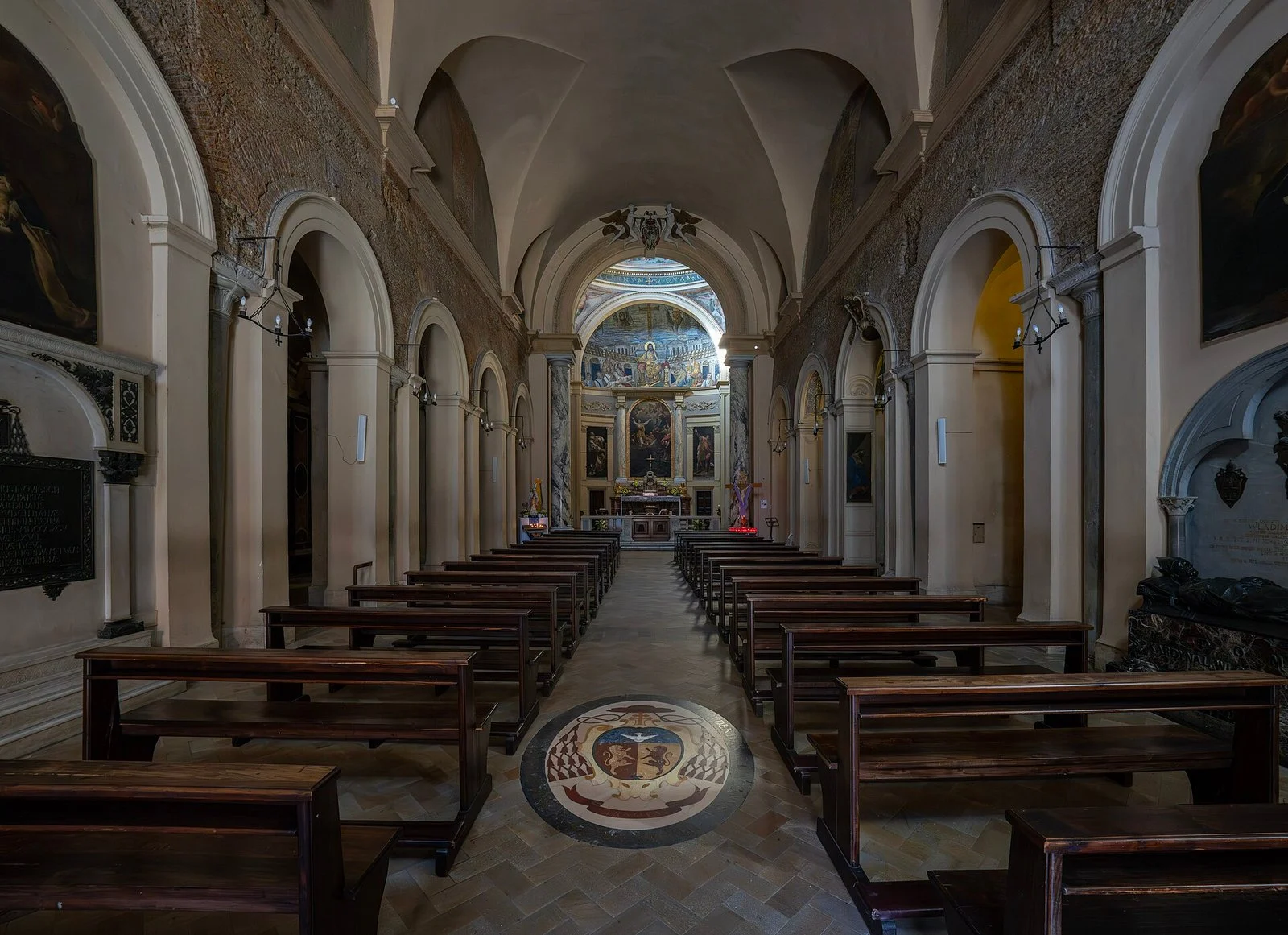
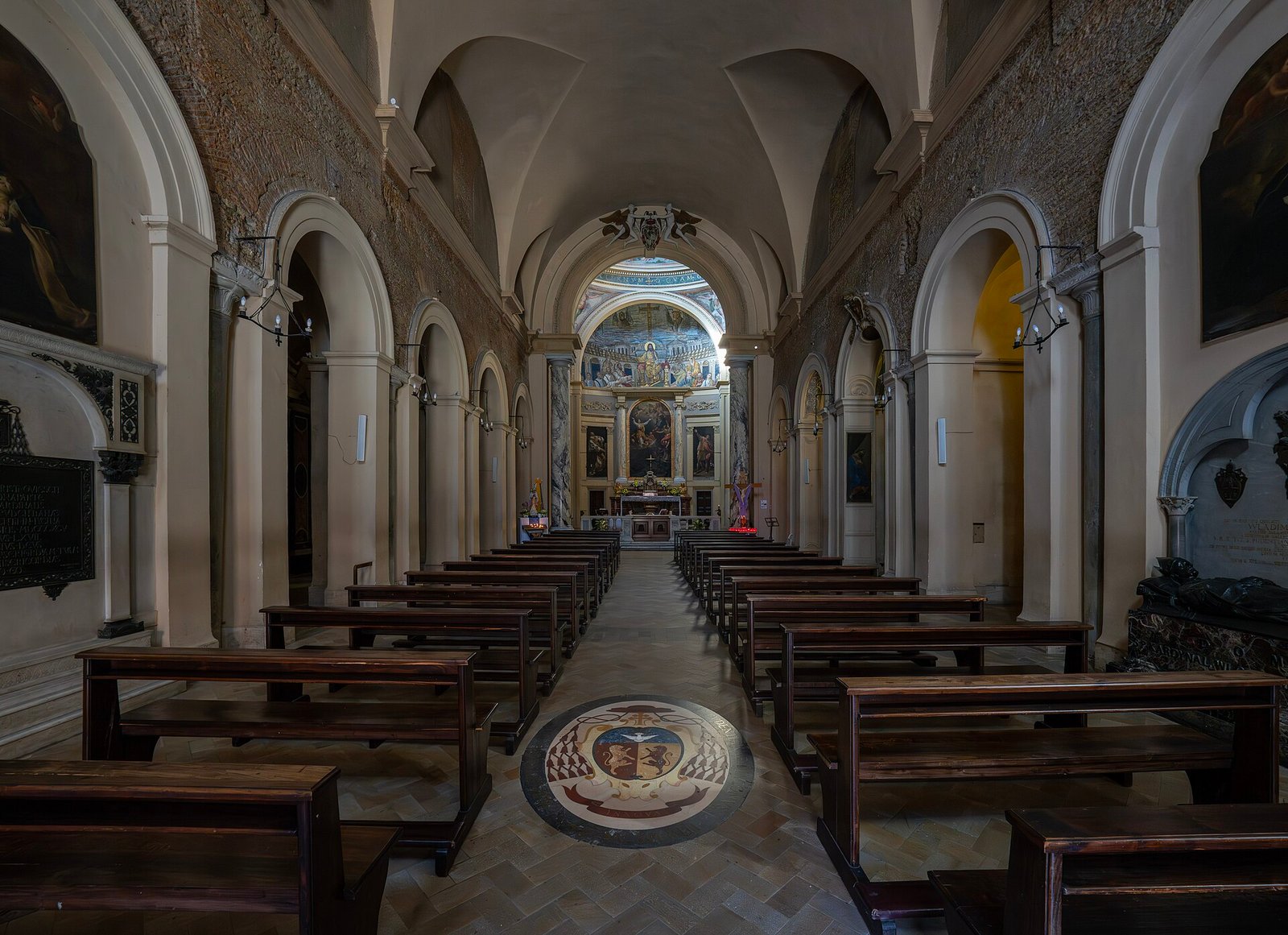
The Basilica of Santa Pudenziana is on Via Urbana, in the Monti district, halfway between Santa Maria Maggiore and Termini station, and the first thing you notice on arriving is that the church sits lower than the street: to enter you go down a staircase, because the level of the modern paving has risen by several meters compared with the ancient one. Inside is what very many art historians consider the oldest apse mosaic in Rome to have come down to us in its original setting: Christ enthroned among the apostles dressed as Roman senators, with the architecture of Jerusalem in the background, a large jeweled cross rising on Golgotha and the four symbols of the evangelists floating among the clouds. It is an image from the late 4th or early 5th century, that is, a few decades after Christianity had stopped being a persecuted religion, and it tells the exact moment when the new faith borrows the visual language of the empire to represent itself. That mosaic, however, did not arrive whole: in the 16th century a restoration literally cut it, making two apostles and the entire lower band of the composition disappear. The lines that follow tell what you see today, what is missing, what lies under the floor of the basilica (Roman baths, a two-story insula, a medieval ambulatory used for burials), which stories are documented and which are instead hagiographic traditions, and how a visit is organized in practice.
Where the Basilica of Santa Pudenziana is and how to get there
The Basilica of Santa Pudenziana has its entrance at Via Urbana 160, in the Monti district, on the slope that descends from the Viminale toward the valley of the ancient Suburra. It is one of the oldest churches in the city and at the same time one of the least visited relative to its value, crushed in the common perception by the proximity of far more famous monuments: the papal basilica of Santa Maria Maggiore is a few minutes' walk uphill toward the Esquilino, and in the same direction, at an even shorter distance, you meet the Basilica of Santa Prassede, dedicated to the woman whom hagiographic tradition names as Pudenziana's sister.
By metro and surface transport
The most convenient metro stop is Cavour, on line B: from there you walk up Via Cavour and turn into Via Urbana, a walk of a few minutes through the heart of Monti. Termini station, a hub for lines A and B as well as for the national rail network, is also within walking distance in just under a quarter of an hour, by way of Via Cavour or Via Giovanni Lanza. Anyone arriving by train from outside Rome can therefore reach the basilica without changing vehicles, simply by walking toward the Colle Oppio. The buses that run along Via Cavour and Via Nazionale all drop you a few blocks away, but the area is so compact that in practice almost all visitors get there on foot, fitting the church into a wider walk through the district.
On foot from nearby monuments
From Santa Maria Maggiore you go down in a good five minutes along Via Urbana, which leads from the square of the papal basilica straight to the staircase of Santa Pudenziana. From the Colosseum it is a 20-minute walk going up Via degli Annibaldi and crossing Monti, a route that passes next to the Basilica of San Pietro in Vincoli with Michelangelo's Moses. From the Quirinale Palace you arrive by going down Via Nazionale and cutting through the inner streets of the district. This density of short connections is the real reason Santa Pudenziana makes sense in a Roman itinerary: on its own it takes little time, but it fits perfectly between stops that almost everyone puts on the program anyway.
The staircase and the difference in level: why the church is below street level
The detail that strikes anyone who arrives in front of the facade is the difference in level between the roadway and the floor of the church. It is not a deliberate architectural effect, but the consequence of a phenomenon that repeats everywhere in Rome: over the centuries the level of the urban ground has risen progressively, through the accumulation of debris, rubble, fill and road resurfacing, and the ancient buildings that were not rebuilt from scratch stayed where they were, that is, ever lower than the city growing around them. The two-tone staircase that today leads from the sidewalk to the entrance courtyard is instead a recent work relative to the history of the building: it was made in the rebuilding of the facade ordered in 1870 and 1871 by the titular cardinal Luciano Bonaparte, under the direction of the architect Antonio Manno.
The apse mosaic: the oldest in Rome
The mosaic in the apse of Santa Pudenziana is dated by scholars between the end of the 4th and the beginning of the 5th century and is commonly described as the oldest monumental apse mosaic preserved in Rome in its original location. It is no minor record: it means that anyone entering this church looks at the oldest large public Christian image the city has preserved, made at a time when Christian iconography was literally being born and had not yet fixed its own models.
What you see in the apse basin
At the center of the composition sits Christ on a rich throne, wrapped in a golden robe edged with purple, with his right hand raised in the gesture of blessing or speech and an open codex in his left. On the book is the Latin inscription DOMINUS CONSERVATOR ECCLESIAE PUDENTIANAE, that is, the Lord protector of the Pudentian church, an epigraph that explicitly ties the image to the building that houses it. Around him, arranged on two symmetrical wings, sit the apostles, dressed not as fishermen of Galilee but as Roman senators, in togas: it is an iconographic choice that says a great deal about the historical moment, because it represents the apostolic college as an assembly of dignitaries of the empire, that is, with the visual language of Roman civil power applied for the first time in a systematic way to the Christian religious sphere.
Behind the figures runs a long porticoed hemicycle and, beyond it, opens an urban landscape of buildings with roofs, pediments and porticoes that scholars read as the representation of the heavenly Jerusalem, or alternatively of the real Jerusalem rebuilt in the Constantinian age with its great places of worship. At the top, in the center, rises a jeweled cross, that is, one covered in precious stones, planted on a height that represents Golgotha: it is the sign of victory, not of torture, consistent with an era in which Christian art still avoided representing the suffering body of the crucified. Around the cross, suspended in a sky of red and blue clouds, appear the four living creatures of the Apocalypse, the winged man, the lion, the ox and the eagle, which Christian exegesis identifies with the four evangelists Matthew, Mark, Luke and John.
The oldest surviving tetramorph
Those very four symbols constitute the second record of the mosaic of Santa Pudenziana, less known than the first but no less important: they are considered the oldest monumental representation of the tetramorph, that is, of the set of four evangelical symbols, to have come down to us in a preserved architectural context. All later depictions of this scheme, which will become one of the most widespread in Christian art of East and West for over a millennium, come afterward. Those who study early Christian iconography consider this apse an obligatory starting point, and the same goes for the scheme of Christ in majesty among the apostles, which from here on will become a model repeated in dozens of Roman apses and beyond.
The two female figures and the problem of who they are
At the sides of the composition, behind the two apostles closest to Christ, appear two female figures holding crowns raised above the heads of the two main members of the college, identified as Peter and Paul. On who these two women are there is no agreement among scholars, and it is worth reporting the main readings without passing one off as certain. The reading most widespread in the historiography interprets them as personifications of the Church of the converted Jews and the Church of the Gentiles, that is, of the converted pagans, the two components from which the early Christian community is born: in this key the image says that Christianity is universal because it includes both. A second reading, very widespread in local tradition and in guidebooks, identifies them instead with the saints Pudenziana and Prassede, the two sisters to whom hagiographic tradition ties the church. A third hypothesis, a minority one, traces them back to personifications of Victory, classical figures readapted to the new religious context. No ancient inscription settles the question definitively.
The disputed dating: Siricius or Innocent I
On the exact date of the mosaic too the sources do not agree, and it is right to say so rather than arbitrarily choosing a year. Some scholars place the work around 390, under Pope Siricius, who reigned from 384 to 399 and under whom, according to several reconstructions, the ancient place of worship was turned into a proper basilica. Others attribute it instead to the pontificate of Innocent I, pope from 401 to 417, moving the making to the first two decades of the 5th century and in some cases linking it to a precise date around 412, therefore right after the sack of Rome by Alaric's Goths in 410. The overall range remains that of about 30 years straddling the two centuries, and this is enough to confirm the work's chronological primacy over the other preserved Roman apse mosaics.
From domus to basilica: how Santa Pudenziana was born
The building history of Santa Pudenziana begins long before the church: under and inside its walls are Roman structures of the imperial age, reused and incorporated when the complex was converted to Christian use between the 4th and 5th centuries. This is one of the cases where archaeological stratigraphy is the real protagonist of the building, much more than its forms visible on the surface.
The baths and the Roman house under the church
Excavations carried out during the 20th century recognized under the basilica structures of a private bath complex of the imperial age, datable to the 2nd century AD, traditionally identified in ancient sources and in the literature as the baths of Novatus. According to the classic reconstruction, the complex arose by transforming an earlier Roman house and was then handed over or readapted for Christian use during the 4th century, up to the monumental arrangement that produced the early Christian basilica. It must be pointed out, though, in fairness, that part of the more recent literature has questioned the identification of the underlying structures with a true bath complex, holding that the archaeological evidence supporting this reading is not decisive: the debate is open and visitors would do well to regard the bath attribution as the traditional hypothesis rather than an established fact.
The titulus Pudentis and the first documentary attestations
On the documentary side, the church appears in the acts of the Roman synod of 499 under the name titulus Pudentis, that is, as one of the titular churches of Rome, those places of worship entrusted to a presbyter and tied by name to a founder or owner of the site. The tituli are the backbone of early Christian Rome, and the presence of Santa Pudenziana on that list places it among the oldest communities of the city. There are also earlier epigraphic attestations that researchers link to the church already during the 4th century, which is consistent with the dating of the mosaic and with the reconstruction that has the building already active as a structured place of worship before the end of that century.
A curiosity about the Basilica of Santa Pudenziana
The most surprising curiosity concerns the very name of the saint to whom the basilica is dedicated: according to a reading now widely accepted by scholars, Pudenziana would never have existed as a historical person, and her name would come from an adjective that by mistake became a proper name. The reasoning is this. The oldest sources call the church ecclesia Pudentiana, that is, literally, the Pudentian church, the adjective derived from the name of the owner or founder Pudens, exactly as one would say the church of Pudens. As the centuries passed, when the original context was lost and the name of the owning family no longer meant anything to those who attended the church, that adjective came gradually to be understood as the name of a saint, and so Pudenziana was born, daughter of the senator Pudens and sister of Prassede.
A name born from an adjective
The apse mosaic itself, with its inscription DOMINUS CONSERVATOR ECCLESIAE PUDENTIANAE, bears witness to precisely this adjectival use: the text does not say the church of Saint Pudenziana, it says the Pudentian church, that is, the one tied to Pudens. It is a minimal linguistic detail, yet it tells of an enormous cultural process, the one by which early medieval Rome, having lost the documentary memory of the origins of many of its places of worship, filled the gaps by generating figures of saints from the names of places. The phenomenon does not concern only Santa Pudenziana: scholars of hagiography have identified several other cases in Roman religious place names.
Something nobody tells you about the Basilica of Santa Pudenziana
The mosaic you admire today is not whole: in 1588, during the general rebuilding of the basilica ordered by the titular cardinal Enrico Caetani and entrusted to the architect Francesco Capriani, known as Francesco da Volterra, a considerable part of the composition was physically demolished. The cut affected the lower band of the apse basin, the one with the feet of the figures and the lower part of Christ's seat, and caused the permanent loss of two of the figures of the apostles: of 12, 10 remain today. It is the information that almost no hurried visit conveys, and that instead radically changes the way you look at the apse.
What was cut and why
The reason for the intervention was structural and architectural rather than ideological: the 16th-century renovation involved changing the roof, replacing the trusses with vaults, inserting pillars and reorganizing the interior space, and in this framework the profile of the apse was reduced to adapt it to the new layout. The mosaic, which for the 16th-century patrons did not have the status of untouchable document that it has today, was simply shortened. The cutting of the lower band was accompanied also by the loss of documentary elements added in earlier centuries, among them the monogram of Pope Hadrian I, who had promoted a restoration of the apse area at the end of the 8th century.
How we know what it was like before
The reason it is possible to speak with some precision about what was lost is that the earlier state of the mosaic is documented by reproductions made shortly before and shortly after the intervention. In particular, studies cite a watercolor from the late 16th century attributable to the scholar Alfonso Chacón, also known as Ciacconio, who recorded the state of the mosaic in that period. Thanks to documents of this kind, research has been able to reconstruct which parts of the composition were missing and which were instead the result of later reworkings, distinguishing the ancient mosaic fabric from what was added in the different restoration campaigns.
The later restorations and the compromised right side
The story does not end in the 16th century. During the 18th century the titular cardinal Giovanni Maria Gabrielli promoted an intervention that affected portions of the surface, filled in with painted stucco instead of actual mosaic tesserae, a practice common at the time but one that today would be considered heavily invasive. In 1831 a further restoration campaign was directed by the painter Vincenzo Camuccini, with replacement of the tesserae judged deteriorated. In the 20th century other interventions followed, between the 1930s and the early 2000s, devoted above all to countering water infiltration and consolidating the support. The overall result is that the right portion of the composition is the most compromised by reworking, while the central zone with the figure of Christ better preserves the ancient fabric.
My advice for visiting the Basilica of Santa Pudenziana
The main advice is just one and concerns opening hours: Santa Pudenziana is not a church open continuously all day, and arriving without checking means risking finding the door closed. The information published by the tourism portal of the City of Rome indicates an opening spread over the morning, roughly between 10 and noon from Tuesday to Sunday, with an additional afternoon slot on some days, and closure on Monday. The same portal explicitly notes, however, that hours may vary and invites you to contact the venue before showing up: it is a warning to take literally, because the basilica is a subsidiary place of worship of a parish and hosts an intense liturgical calendar tied to the Filipino community, with celebrations that overlap with visiting hours.
Call ahead, always
The most effective practical solution is to phone the basilica the day before or the same morning, or check the church's website, and ask two things: if the day's opening is confirmed and if a celebration is scheduled in that slot. The second question is not a detail: during Mass access to the presbytery area is obviously limited and observing the mosaic calmly becomes impossible, as well as inappropriate. Anyone traveling with a packed schedule who cannot afford a wasted stop would do well to treat Santa Pudenziana as a stop to confirm at the last minute, slotted between two more certain visits in the same area.
Sunday, when the church belongs to the Filipino community
There is a particular case worth knowing before planning: on Sunday Santa Pudenziana is the center of community life for the Filipino Catholics of Rome, and the atmosphere is completely different from that of a church to be visited in silence. Anyone arriving in those hours finds a large community, celebrations in Tagalog and English as well as Italian, songs, families, an intensity that has nothing to do with tourism. It is not a problem, quite the opposite: for many it is the most interesting thing about the visit, because it shows a living church and not a container of works of art. But anyone looking above all for the mosaic, with time and quiet to observe it, will do better to choose a weekday in the morning slot.
How much time you really need
For the basilica alone 20 to 30 minutes are enough, and it is an honest estimate: the interior is not large and the point of attraction is concentrated in the apse and the side chapel. If instead you add the guided visit to the underground rooms, the time rises considerably, because the archaeological route includes several levels and requires a guide to accompany the group. In this case it is worth allowing the whole morning or the whole afternoon for the area, pairing the nearby Basilica of Santa Prassede with its 9th-century mosaics and the Basilica of Santa Maria Maggiore, so as to build a coherent route on Roman mosaics of different periods.
The underground of Santa Pudenziana: baths, insula and medieval ambulatory
Under the basilica extends a complex of Roman rooms that goes down to about seven meters below the level of the church, one of the least known underground archaeological routes in the center of Rome. It is not a crypt in the liturgical sense, but civil structures of the imperial age that survived because the church was built over them, incorporating and protecting them.
What lies under the floor
The descriptions of the speleo-archaeological surveys report rooms attributable to a bath complex placed in the Antonine age, remains of an insula, that is, a multi-story residential building, with vaulted rooms arranged on two superimposed levels, mosaic floors with white and black tesserae and stretches of basalt paving at a higher level. Four parallel galleries are described running under the body of the basilica and a group of rooms under the facade area, some of them arranged on two floors. They are spaces that tell of an ordinary Roman block, made of houses, shops and services, that is, exactly the type of urban fabric that in Rome is harder to see than the great public monuments.
How the underground rooms are visited
Access to the underground is not free and is not included in the normal visit to the church: you go down through a staircase located in the area to the left of the basilica and the route can be done only with an escort. There are organized guided visits that include the basilica, the excavations and the Marian oratory: the Opera Romana Pellegrinaggi offers a route of this kind with a stated duration of 90 minutes, with a cost that at the time of consultation was €10 full price and €6 reduced for young people aged 6 to 17, students and clergy, with the specification that the activity cannot be bought online but must be booked by contacting the organization directly. Roman cultural associations also periodically include Santa Pudenziana and its oratory in their monthly programs of guided visits. Since calendars and rates change, the advice is to check directly with the organizer before taking availability for granted: there is not, in the sources consulted, daily access to the excavations without a reservation.
What remains inaccessible
It must be said clearly that not all the rooms identified under the complex can be visited: the speleo-archaeological documentation reports that the structures under the garden to the left of the basilica remain outside the practicable route. Those who go down, therefore, see a portion of the complex, not the whole. It is a useful clarification so as not to arrive with the wrong expectations, imagining an extensive underground route like those of San Clemente or of the Domus Romane di Palazzo Valentini, which are equipped in a completely different way and with a very different capacity to receive visitors.
Another well-known fact, yet rarely cited
The bell tower of Santa Pudenziana is one of the most beautiful Romanesque bell towers in Rome, it is very visible from the street and practically no general guidebook mentions it. It rises on the left flank of the basilica, has a square plan and is articulated in five superimposed tiers, lightened by small loggias and triple-light openings and decorated with discs of polychrome marble set in the brick masonry.
Five tiers, triple-light windows and marble discs
The scheme is the classic one of Roman bell towers of the central centuries of the Middle Ages: a brick tower that rises in regular tiers, each opened by double-light or triple-light windows divided by small columns, with the insertion of ceramic basins or discs of colored marble that enliven the surfaces with touches of color. The same language is found in the bell towers of many other Roman churches of the same season, from Santa Maria in Cosmedin to Santa Maria in Trastevere, and constitutes one of the most recognizable elements of the city's medieval urban landscape, survived even where the churches beneath have been completely baroquized.
A debated dating between the late 12th and 13th centuries
On the dating of the bell tower the sources are not perfectly aligned: some link it to the pontificate of Innocent III, who reigned from 1198 to 1216 and to whom interventions on the basilica are attributed, others describe it more generically as 13th-century. The range is therefore that between the end of the 12th and the full 13th century, in line with the great season of Roman Romanesque bell towers. The bell tower was the subject of a restoration during the 1960s, as part of a campaign of interventions on the whole complex.
The medieval frieze above the portal
The second often ignored medieval element is the sculpted marble frieze found on the facade, above the entrance portal. It is a work placed by studies around the end of the 11th century, restored in the 19th century, which presents a series of clipei, that is, circular medallions, with the figures of the saints tied to the tradition of the church, San Pastore, Santa Pudenziana, Santa Prassede and San Pudente, arranged around the central figure of the Lamb of God, the Christological symbol par excellence in medieval iconography. The portal that supports it is framed by columns with a spiral fluting and by a richly carved frame: an ensemble worth a stop of a few minutes even before going in, and one that almost everyone walks through without raising their eyes.
The right photo to take at the Basilica of Santa Pudenziana
The photo that truly tells Santa Pudenziana is that of the apse basin taken from the center of the nave, in line with the high altar, so as to include the whole semi-dome with Christ, the apostles, the jeweled cross and the symbols of the evangelists in a single frame. It is a technically not trivial shot, because the light is scarce and the contrast between the golden tesserae and the dark backgrounds is strong, but it is the only one that gives back the composition as it was conceived, that is, as a unified image seen frontally by someone standing in the hall.
How to handle the light of the apse
Without a tripod, and in Roman churches a tripod is almost always forbidden, the practical solution is to rest the camera or phone on a chair back or on a pillar to steady the shot, raise the sensitivity slightly and accept some compromise on sharpness. Avoiding the flash is essential: besides being forbidden in most churches for conservation reasons, it completely flattens the mosaic, which owes its effect instead to the irregular reflection of light on the tilted golden tesserae. If the apse lighting can be switched on, it is best to shoot in the seconds immediately after it comes on, when the light is full.
Image: the apse basin with the early Christian mosaic, Christ enthroned among the apostles, the jeweled cross and the symbols of the evangelists.
Some important events that happened here in history
The history of Santa Pudenziana is made of changes of ownership, rebuildings and demolitions more than of great political events, and it is precisely this succession that makes it an interesting case study of how a place of worship passes through 16 centuries without ever being truly still.
The early medieval restorations and the monastery
Between the end of the 8th century and the full Middle Ages the basilica was affected by interventions promoted by several pontiffs: to Hadrian I, pope from 772 to 795, is attributed a restoration that also touched the apse area and left the monogram later lost in the 16th-century cut. To Gregory VII, pope from 1073 to 1085, other works are traced, and to his era the frescoes of the Marian oratory are dated. To Innocent III, pope from 1198 to 1216, the construction of the bell tower is attributed. In 1130 the church was entrusted to the canons regular of Santa Maria del Reno, who established there a monastery destined to last centuries and to shape the layout of the whole block.
The 1588 rebuilding and the Caetani chapel
The turning point is the rebuilding promoted by Cardinal Enrico Caetani at the end of the 16th century. In 1587 Pope Sixtus V had entrusted the church to the reformed Cistercians known as the Feuillants, and the following year the construction site directed by Francesco Capriani da Volterra got under way, which radically transformed the interior: the trusses gave way to vaults, pillars were inserted that reorganized the space, the external portico was demolished and, as has been said, the apse mosaic was shortened. In the same project the Caetani chapel was born, intended for the family's burials, designed in 1588 and completed in the early 1590s, with the later contribution of Carlo Maderno.
The 19th century, Luciano Bonaparte and the new facade
In 1803 Cardinal Lorenzo Litta had the high altar remade, with the translation of the relics attributed to the titular saint. Between 1870 and 1871, Cardinal Luciano Bonaparte, grandnephew of Napoleon and titular of the church, promoted the rebuilding of the facade and the construction of the access staircase to a design by Antonio Manno: on that occasion the 16th-century wall paintings attributed to Niccolò Circignani, known as Pomarancio, were destroyed, replaced by paintings by Pietro Gagliardi. It is another episode, after that of the mosaic, in which a maintenance intervention resulted in the permanent loss of a historical layer of the building.
The demolished monastery and the arrival of the Institute of Statistics
The most significant 20th-century event concerns the urban context more than the church itself. The adjoining monastery, expropriated in the 1870s as part of the suppressions that followed the annexation of Rome to the Italian state, was demolished between 1926 and 1930 to make room for the seat of the national institute of statistics. Since then the basilica has been wedged between public and residential buildings of the early 20th century, a condition that explains why today it appears so little visible in the urban fabric despite its antiquity. Further restoration campaigns on the building were carried out between the late 1920s and the early 1930s and again in the early 1960s.
1991 and the Filipino community
The most recent event that changed the daily life of the basilica dates from 1991, when at Santa Pudenziana a missio cum cura animarum was opened for the Filipino faithful of Rome, in response to the request of the Philippine bishops' conference, motivated by the by now sizable presence of Filipino workers and families in Italy. Since then the church has been the national reference point of that community in the capital. In March 2021 the basilica hosted the Roman celebrations for the 500 years since the arrival of Christianity in the Philippines, with the participation of young people in traditional dress.
Who has passed through the Basilica of Santa Pudenziana
The name that tradition ties most closely to this place is that of Saint Peter, and it is best to tackle it right away with the caution it deserves. According to hagiographic tradition, and therefore not according to a verifiable historical source, the senator Quintus Cornelius Pudens would have hosted the apostle Peter in his own house for seven years, converting with his family and having his daughters Pudenziana and Prassede baptized. It is a beautiful and very ancient narrative, which for centuries has shaped the identity of the church and which explains why Santa Pudenziana is often presented as the oldest Christian place of worship in Rome. It must however be labeled for what it is: a hagiographic legend, that is, a devotional tale elaborated at a later time, not a documented fact. Modern studies, as we have seen, tend indeed to consider Pudenziana herself a figure born from the adjective that designated the church.
The Pudens family and the Acilii Glabriones
Behind the legend there is nevertheless a plausible historical core, and it is the reason the tradition has held for so long. The name Pudens is that of a Roman senatorial family that really existed, which part of the literature links to the branch of the Acilii Glabriones, one of the aristocratic houses among the first to approach Christianity in Rome in the 1st and 2nd centuries. The idea that an aristocratic domus in this area was made available to the nascent Christian community has in itself nothing implausible: it is exactly the mechanism by which the Roman tituli were born, that is, the early churches named after the owner of the property in which the community gathered. The documented fact, we repeat, is the titulus Pudentis attested in 499, the rest belongs to tradition.
Architects, sculptors and mosaicists
Among the artists who worked here, the most relevant names are those tied to the late 16th-century construction site: Francesco Capriani da Volterra, who directed the general rebuilding and designed the Caetani chapel, and Carlo Maderno, one of the protagonists of Roman architecture of the early 17th century, who completed the chapel and made its funerary monuments. In the same chapel worked the sculptor Pier Paolo Olivieri, author of the relief of the Adoration of the Magi finished by Camillo Mariani, the mosaicist Paolo Rossetti, author of the mosaic decorations of the vault and of the lunette between the late 16th and the early 17th century, and later Giovanni Antonio Mari, to whom are owed the statues of the cardinal virtues placed in the mid-17th century. For the 19th-century facade the name is that of the architect Antonio Manno, flanked by the painter Pietro Gagliardi.
The interior, the Caetani chapel and the Marian oratory
The interior of Santa Pudenziana today is the result of the 16th-century construction project superimposed on the early Christian layout: the space is divided by ancient reused columns in bigio marble, with capitals decorated with leaves, and the central nave is covered by a barrel vault marked by arcades. Anyone entering looking for an intact early Christian basilica will be thrown off, because what you see is a late Renaissance and baroque interior that preserves within itself, like a core, the ancient apse and the original columns.
The Caetani chapel
The family chapel of the Caetani, opening on the flank of the church, is the richest part of the interior: covered in fine marbles and stucco, it preserves the funerary monuments of Cardinal Enrico Caetani and of Duke Filippo Caetani, a marble relief of the Adoration of the Magi dated to the end of the 16th century and a mosaic decoration on the vault with the evangelists and their symbols, executed at the turn of the 16th and 17th centuries. The lunette holds a mosaic with the saints Prassede and Pudenziana gathering the blood of the martyrs, that is, the figurative translation of the hagiographic tradition that ties the two sisters to the burial of persecuted Christians. A detail worth knowing is that the chapel stands, according to the traditional reconstruction, on the spot considered the first core of worship of the complex.
The well of the holy sisters
Near the chapel is a square-plan well that tradition ties directly to that same narrative: it would be the place where Pudenziana and Prassede gathered and laid the remains and blood of the Christian martyrs. In this case too we are in the field of devotional tradition and not of historical documentation, and it must be said clearly: the well is a real and visible element, the story associated with it is a hagiographic legend consolidated over the centuries. It is still worth looking at, because it tells how a community builds its own memory around concrete objects.
The Marian oratory and its 11th-century frescoes
Behind the apse, on a raised level resting on the ancient structures, is a small room with a quadrangular plan known as the Marian oratory, decorated with a cycle of Roman frescoes datable around the years of the pontificate of Gregory VII, therefore in the last quarter of the 11th century. The subjects depicted include the Madonna and Child enthroned between the saints Pudenziana and Prassede, Saint Paul preaching to the family of Pudens, the baptism of Novatus and Timothy, the crowning of the saints Valerian, Tiburtius and of Pope Urban I, as well as the Lamb of God with the symbols of the evangelists. There is also a Crucifixion of a much later date. It is a room that is not part of the free route and that can be seen only in the guided visits that include the excavations: anyone interested in Roman medieval painting should plan the visit precisely around this access, because 11th-century fresco cycles preserved in the city are as rare as late antique apse mosaics.
The Monti district around the basilica
Santa Pudenziana is in the heart of the Monti district, the first district of Rome by numbering and one of the most characteristic, grown on the area that in ancient times corresponded in part to the Suburra, the working-class and crowded quarter of imperial Rome. Today Monti is a zone of alleys, craft workshops, venues and small squares, and the basilica represents one of its historical hubs least frequented by the main tourist flow.
What to visit on the same outing
Within a few minutes' walk are concentrated some of the most important churches of early Christian and medieval Rome: besides the already mentioned Santa Prassede, with the Carolingian mosaics of the Chapel of San Zeno, and Santa Maria Maggiore, there are the Basilica of San Pietro in Vincoli and the Basilica of Santi Silvestro e Martino ai Monti, which also has ancient underground rooms. A little farther, toward the Colle Oppio, open the Domus Aurea and the Colosseum, while in the opposite direction, toward Termini, you meet the Baths of Diocletian and the Palazzo Massimo alle Terme, where some of the most extraordinary Roman paintings and mosaics in the city are preserved.
An itinerary on Roman mosaics
The smartest way to fit Santa Pudenziana into a program is to build around it a thematic itinerary on the Christian mosaics of Rome, which lets you see in a few hours the evolution of a figurative language over a millennium: you start right here with the late 4th or early 5th century, continue with the 5th-century mosaics of Santa Maria Maggiore, reach the 9th century with Santa Prassede and can finish, moving to other parts of the city, with the medieval apses of Santa Maria in Trastevere or San Clemente. It is a route that no general guidebook proposes and that gives Santa Pudenziana back the role that is due to her, that of starting point.
Frequently asked questions about the Basilica of Santa Pudenziana
How much is a ticket for the Basilica of Santa Pudenziana?
Entry to the Basilica of Santa Pudenziana is free, as in almost all the churches of Rome open for worship. A cost exists only for the guided visits that include the underground excavations and the Marian oratory: the Opera Romana Pellegrinaggi indicated for this route a rate of €10 full price and €6 reduced, with a reservation to be requested directly because the activity cannot be bought online. Rates may vary, so it is best to confirm them with the organizer.
What are the opening hours of the Basilica of Santa Pudenziana?
The Basilica of Santa Pudenziana opens on a limited schedule, concentrated in the morning with some afternoon slots and closed on Monday, according to the tourism portal of the City of Rome, which however expressly notes the possibility of changes. Since the church hosts an intense liturgical calendar tied to the Filipino community, you need to check by phone before showing up: precise hours are not given here precisely because they are not guaranteed.
Can you visit the underground of Santa Pudenziana?
The underground of Santa Pudenziana can be visited only on a guided visit by reservation, not independently during the church's ordinary opening. The route goes down to about seven meters below the level of the basilica and includes bath rooms of the imperial age, remains of a two-story insula, mosaic floors and a medieval ambulatory used for burials. Not all the identified rooms are accessible and availability must be confirmed each time with the organizer.
How do you get to the Basilica of Santa Pudenziana by public transport?
The Basilica of Santa Pudenziana, at Via Urbana 160, is most conveniently reached by metro line B, Cavour stop, from which it is a few minutes' walk uphill toward the Monti district. From Termini too, a hub for lines A and B and the rail network, the walk is about a quarter of an hour. The surface lines of Via Cavour and Via Nazionale all drop you a few blocks from the entrance.
How long does it take to visit Santa Pudenziana?
To visit the Basilica of Santa Pudenziana 20 to 30 minutes are enough, the time to observe the apse mosaic from the center of the nave, the Caetani chapel and the medieval frieze on the facade. If you add the guided visit to the underground excavations and the Marian oratory, the time rises considerably, because that route is indicated as about 90 minutes in all, including the basilica.
Why is the mosaic of Santa Pudenziana considered the oldest in Rome?
The mosaic of Santa Pudenziana is considered the oldest monumental apse mosaic preserved in Rome in its original location, datable between the end of the 4th and the beginning of the 5th century. Scholars debate if to attribute it to the pontificate of Siricius, around 390, or to that of Innocent I, in the first two decades of the 5th century. It also contains the oldest preserved monumental representation of the symbols of the four evangelists.
Is it true that Saint Peter lived here?
Tradition ties the Basilica of Santa Pudenziana to the house of the senator Pudens, who according to the hagiographic account hosted the apostle Peter for seven years, converting along with his family. It is a devotional legend, not a historically documented fact: the certain documentation attests the church as the titulus Pudentis in the acts of the Roman synod of 499 and attributes the name to an owner of the domus, not to an apostolic stay.
Is the Basilica of Santa Pudenziana accessible to people with disabilities?
Access to the Basilica of Santa Pudenziana is through a staircase that descends from the level of Via Urbana to the floor of the church, because the building lies below the modern street level: this makes the entrance problematic for anyone with mobility difficulties. The sources consulted do not indicate an alternative step-free route, so anyone with specific needs should inquire directly at the basilica before the visit.
Can you take photographs inside Santa Pudenziana?
In the Basilica of Santa Pudenziana photographs are generally allowed, as the organizers of the guided visits to the excavations also indicate, provided there is no flash and with the respect due to an active place of worship. During celebrations, which are very frequent because of the Filipino community that uses it as a base, photographing the presbytery area is to be avoided. For the apse mosaic it is best to rest the camera on a support, given the scarce light.
One last piece of advice for anyone planning the itinerary
Santa Pudenziana is a stop to put into a route, not a destination on its own: its strength lies in the contrast with what surrounds it, that is, in the fact that it guards the oldest monumental Christian image in Rome inside a church that almost nobody visits, a few steps from basilicas full of groups. Anyone with half a day in the Monti district who uses it well leaves with a much more precise idea of how Christian Rome was born inside imperial Rome, without erasing it but building on top of it, literally.
Anyone organizing a wider itinerary in the center of Rome, combining this stop with other stops in the Monti district and the Esquilino, can find useful planning tools on Tour Leader Pro, while for a broader picture of transport and destinations in Lazio Italy Planner is a good resource.