Sant’Onofrio al Gianicolo
In short. Sant’Onofrio al Gianicolo is a 15th-century convent complex facing the street of the same name, halfway up the slope between the Tiber embankment and the Gianicolo promenade, at Piazza di Sant’Onofrio 2.
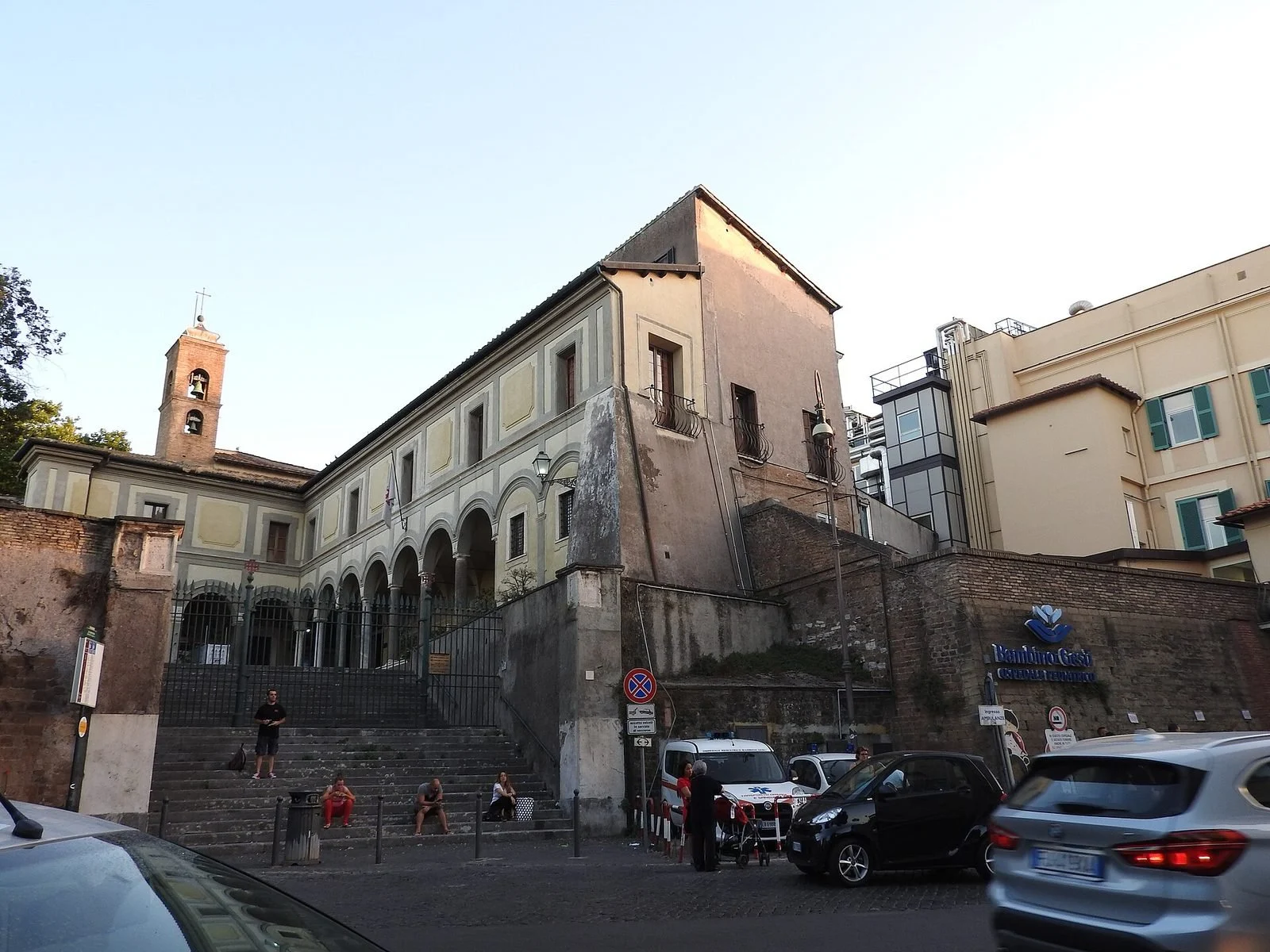
Sant’Onofrio al Gianicolo is a 15th-century convent complex facing the street of the same name, halfway up the slope between the Tiber embankment and the Janiculum Hill promenade, at Piazza di Sant’Onofrio 2. Church, three-arched portico, cloister and convent form a single block, grown by additions between 1419 and well into the 17th century, which preserves frescoes by Domenichino, the Cavalier d’Arpino and the circle of Baldassarre Peruzzi. Since 1946 the convent has been home to the Franciscan Friars of the Atonement, who keep it open for short windows of time. The practical reason to climb up here is simple: 10 minutes on foot from the colonnade of Piazza San Pietro, where in high season you walk at the pace of a procession, this is one of the quietest corners of central Rome. You hear the traffic of the Tiber embankment below, you see the domes, and often there's nobody else in the portico.

Then there's the reason the name appears in every Italian literature textbook. Torquato Tasso died in this convent on the morning of April 25, 1595, where he had been brought a few weeks earlier, while in Rome they kept putting off the poetic coronation on the Capitoline Hill that Clement VIII had promised him and that never came. The tomb is in the church, so is the 19th-century monument, and on the first floor of the convent are the rooms of the Tasso museum. On if those rooms and the cloister are open, it's best not to trust what you read around: in the lines that follow we explain what appears to be open, what appears to depend on the friars' availability and what needs checking before you climb up.
Where Sant’Onofrio al Gianicolo is and how to get there
Sant’Onofrio al Gianicolo is at Piazza di Sant’Onofrio 2, on the north side of the hill, at the junction of Salita di Sant’Onofrio and Via del Gianicolo, a little over a kilometer on foot from the colonnade of St. Peter's. The little square is small, closed on three sides and slightly sloping: if you arrive from below you come upon it suddenly, after a ramp that gives you no glimpse of anything until the last bend.
The thing to make clear right away is the elevation. The Gianicolo isn't a symbolic hill: it's a good 80 meters of height above the river, and Salita di Sant’Onofrio gains it in a few hundred meters. If you have knee problems, are pushing a stroller or are arriving at the end of the day after the Vatican Museums, you need to know before you set off, not halfway up the ramp.
On foot from St. Peter's and Borgo
The most logical route starts from Piazza San Pietro, leaves the colonnade on the Porta Cavalleggeri side or takes Via della Conciliazione toward the river, and reaches Piazza della Rovere, at Ponte Principe Amedeo Savoia Aosta. From there Salita di Sant’Onofrio starts on the right as you face the hill and climbs with a sharp curve. It's about 15 minutes from the colonnade, 20 if you take it easy, and the last third is the steepest. If you're covering the neighborhood with the Prati and Borgo itinerary, you can graft this detour onto the end of the Vatican morning without changing area.
There is also a shortcut of steps, a staircase that cuts the hairpin bends and comes out just below the square. It shortens the route and makes it harder work: you gain time, you lose breath. If you prefer a steady gradient, stay on the road for vehicles, which curves wider.
On foot from Trastevere and the Fontanone
From above the route changes completely and is much more comfortable, because you arrive downhill. If you've already climbed the hill to see the Acqua Paola fountain, the so-called Fontanone, you can continue along the Gianicolo promenade to the north, pass Piazzale Giuseppe Garibaldi with its equestrian monument, keep going past the lighthouse and go down Via del Gianicolo to the junction with the Salita. It's just under 20 minutes of walking almost always on the flat or slightly downhill, in the shade of the pines for much of the way.
It's the way we recommend if you have time: you put Sant’Onofrio at the end of a walk that starts from San Pietro in Montorio and the Tempietto del Bramante, touches the Fontanone, crosses the piazzale and ends downhill toward the river. That way you do the climb only once, at the start, and with fresh legs.
By public transport
The bus line that serves the hill directly is the 870, which starts from Via Paola, a short step from Ponte Principe Amedeo and Piazza della Rovere, and climbs along Via del Gianicolo, passing at the Salita di Sant’Onofrio. It's a line with not very high frequency and a route that can vary: check updated times and route on the official Roman public transport channels before counting on it, because on this hill temporary changes are frequent.
Alternatively, get off at one of the terminals or stops on the Tiber embankment, on the stretch between Ponte Vittorio Emanuele II and Ponte Sisto, and walk up. Roma San Pietro railway station is about a quarter of an hour's walk, slightly uphill. The metro doesn't serve the hill: Ottaviano, on Line A, is over 20 minutes on foot.
By car, taxi and parking
Arriving by car is possible but awkward. Via del Gianicolo and the Salita are narrow, partly one-way, and the few spaces in front of the church are almost always taken by residents and the convent. There is no dedicated parking: if you're coming from outside Rome, leave the car at a park-and-ride.
Accessibility
The square in front of the church is level and reachable by car or taxi, and this solves the main problem. Access to the church is through the portico, which is raised above the square: there are steps. The cloister and the upper floor of the convent, where the museum rooms are, involve further changes of level and stairs. As far as we know there is no elevator. If you have specific needs, it's wise to contact the community of friars in advance and ask what is actually reachable on the day of your visit, because the answer may depend on which rooms are open at that moment.
Hours, access and what to really expect
The hours of Sant’Onofrio al Gianicolo are short and need checking before you climb up, because it is a convent church and not a museum with a ticket office: the Franciscan Friars of the Atonement, who have lived in the convent since 1946, give on their website an opening from Tuesday to Saturday in the morning window, with Monday closed and a longer window on Sunday morning, and Sunday Mass at noon. These are indications published by the religious community and not the schedule of a public body: they can change without notice, and they do.
Why here a phone call beforehand is really worth it
For many Roman churches the advice to check the hours is a formality. Here it is essential. Sant’Onofrio is a small church kept by a small community: a funeral, a retreat, a booked group of pilgrims, an unwell friar or a restoration site is enough for the door to stay shut during theoretical opening hours. Anyone who has made the climb for nothing once doesn't forget it.
Ticket, donation, booking
We don't publish prices because there appears to be no admission ticket in the museum sense of the term: access to the church is that of a place of worship. For the convent part and for guided group visits the situation may be different and depend on arrangements made case by case, including with outside cultural associations that organize visits there. If someone promises you a fixed price for the Tasso museum, ask the community for confirmation before paying it. On this point the rule we've set ourselves is clear: no amount written without an official source stating it.
The state of the Tasso museum and the cloister: to be verified
Honesty is needed here. The Tasso museum exists, occupies the rooms on the first floor of the convent tied to the poet's last days, and holds the death mask, documents, early editions and relics. In recent years the complex has been affected by restoration work, and its state of conservation has led several times to its being flagged in the Fondo per l’Ambiente Italiano censuses of places to protect. As far as we know, at the date of publication there is no published and stable opening calendar for the museum like that of a civic museum. In practice access to the Tasso rooms and the cloister depends on the availability of whoever opens up that day.
Translated: taking for granted that you'll see the cloister and the museum is a mistake. Anyone coming to Rome specifically for those needs to arrange it beforehand. Anyone who climbs up for the church, the portico and the view still finds enough to justify the walk, and treats the rest as a bonus.
How much time you need
For the church and the portico, 25 or 30 minutes is enough, taken slowly and with your nose in the air. If you add the cloister you get to three quarters of an hour. With the Tasso rooms and a guide to tell their story you go over an hour. If you only have 20 minutes, do it anyway: the part you always see is the part that stays in your mind.
The foundation: Nicola da Forca Palena and the Hieronymites
The Sant’Onofrio al Gianicolo complex began in 1419 as a hermitage founded by Blessed Nicola da Forca Palena, a religious from Abruzzo who came to Rome from his home region, and was completed as a church and convent around 1439 thanks to the contributions of private benefactors and some cardinals of the curia. The dedication is to Saint Onuphrius, a 4th-century Egyptian hermit who according to hagiographic tradition lived for decades in the desert of the Thebaid: a choice consistent with the character of the place, which began as a hermit settlement outside the built-up area.
Who the Hieronymites were
The community founded by Nicola belonged to the Hieronymite strand, hermit congregations inspired by Saint Jerome, widespread in Italy in the 14th and 15th centuries, with an austere life and study. This has a consequence on the walls: the best-known cycle in the complex, the one in the portico, tells stories of Saint Jerome. It isn't decoration, it's the identity of the house written on the entrance wall.
The three-arched portico and Domenichino's frescoes
The portico of Sant’Onofrio al Gianicolo opens onto the square with three arches on columns and serves as a passage between the outside and the church: in the lunettes above the arches, in the early 17th century, Domenico Zampieri, known as Domenichino, frescoed episodes from the life of Saint Jerome. It's the first thing you see on arriving, and it's the reason art historians climb up here.
What the lunettes tell
The episodes concern the saint's life: the desert, penance, study and the translation of the Scriptures. Domenichino was then working in the orbit of the Carracci and was refining the way of composing landscape, with measured figures in open spaces and clear light, which would become his hallmark. The lunettes of Sant’Onofrio bear witness to that phase and can be viewed for free, standing, with no line.
The interior: apse, chapels and paintings
The church of Sant’Onofrio al Gianicolo has a single nave with a ribbed vault and side chapels, and preserves in the polygonal apse a cycle of 16th-century frescoes attributed to Baldassarre Peruzzi and his circle, with Marian scenes including the Coronation of the Virgin and the Flight into Egypt. The attribution has been debated for over a century: some readings assign them to Peruzzi, others bring in Pinturicchio and his workshop, others distinguish different hands within the same cycle. We report the disagreement because it is real and unresolved.
The side chapels
The chapels along the nave were decorated in different phases between the 16th and 17th centuries. In one of them is the Madonna of Loreto by Annibale Carracci, dated to 1604, a work that alone justifies the visit for anyone following the thread of Bolognese classicism in Rome after the Farnese chapel. If you're following a Caravaggio and post-Caravaggio route in the city, perhaps starting from the Contarelli Chapel or from the Caravaggio in Rome itinerary, here you find the opposite and contemporary side of that season.
The 15th-century cloister and the Cavalier d’Arpino cycle
The cloister of Sant’Onofrio al Gianicolo is a 15th-century layout on a rectangular plan, with loggias on octagonal pillars, and preserves in its lunettes a frescoed cycle with stories from the life of Saint Onuphrius made around the Jubilee of 1600 by Giuseppe Cesari, known as the Cavalier d’Arpino, and collaborators, among whom the literature names Claudio Ridolfi. It's the space you remember most, when you manage to see it.
Why the cloister may be closed
The cloister is part of the religious house, not an independent museum area, and it is entered through convent rooms. We add that part of the complex has been the subject of restoration work in recent years. The two things together explain why access isn't guaranteed and why asking beforehand is the only serious way to proceed.
Torquato Tasso at Sant’Onofrio: the established facts
Torquato Tasso died in the convent of Sant’Onofrio al Gianicolo on the morning of April 25, 1595, aged 51, after having himself carried up here in the preceding weeks. It's the central fact in the story of this place and it's best told with the dates in order, because around this death a considerable amount of romantic literature has been built up over four centuries, covering the facts instead of explaining them.
Who he was, in brief
Tasso was born in Sorrento on March 11, 1544, the son of the poet and court secretary Bernardo Tasso and Porzia de’ Rossi. He spent his life moving between Italian courts, served the Este family in Ferrara for a long time, and wrote the Gerusalemme liberata, the poem that made him the most read and most debated author of late 16th-century Europe. His work also includes the Aminta, a pastoral play, and an enormous mass of letters, dialogues and verse.
Sant’Anna in Ferrara
In February 1579 Tasso was shut up in the hospital of Sant’Anna in Ferrara, where he stayed for about seven years, until 1586. The sources document that in the first period the treatment was that reserved for a prisoner rather than a patient, and that conditions improved afterward. On what led to the confinement, interpretations have diverged for centuries and the contemporary sources are not unanimous. What can be said without forcing things is that Tasso went through a long personal crisis, that he had serious conflicts with the Este court, and that he wrote a great deal even during his confinement.
The return to Rome
After Ferrara Tasso moved around a lot: Mantua, Florence, Naples, Rome. In November 1594 he arrived in Rome as a guest of Cinzio Passeri Aldobrandini, cardinal and nephew of Pope Clement VIII, who granted him a pension. By then there had long been talk in those circles of crowning him poet on the Campidoglio, with the rite that had fallen to Petrarch in 1341 and that had carried enormous symbolic weight ever since.
The climb to the convent and the death
In the spring of 1595, in poor health, Tasso asked to be carried to the convent of Sant’Onofrio. Current biography places the move in the very first days of April, with April 1 as the date most often given. The sources of the time speak only generically of the last days, and on this detail precision should be taken with caution. He died on the morning of April 25, 1595. The coronation on the Campidoglio, postponed several times, never took place.
What we don't say
We don't say what he died of. The contemporary descriptions of the symptoms don't allow a diagnosis, and assigning one 400 years later, from accounts written with 16th-century medical categories, is a worthless exercise. The same goes for his mental condition in the Sant’Anna years: the sources tell of behavior, conflicts, suspicions and confinements, and these are documented things. Everything else is interpretation, often built after the fact for literary reasons.
The Tasso legend: how to tell it from the facts
The figure of Tasso dying at Sant’Onofrio is one of the great themes of European Romantic culture, and the quantity of poems, plays, paintings and melodramas that came from it has ended up overlapping with the biography. Separating the two levels is the most useful thing you can do when visiting this place.
The misunderstood and persecuted poet
The image of the misunderstood genius, locked in an asylum by a hostile court and consumed by an impossible love for Leonora d’Este, the duke's sister, belongs to the 19th-century literary tradition and finds no documentary support. Studies have shown that the love affair with Leonora is a construction of later generations, born to give a narrative explanation for the confinement. As a story it has had immense success, from Goethe onward. As a historical fact it doesn't hold up.
The crown that arrives a day late
In the popular version of the story, the laurel was supposedly brought to the poet's bedside on the very day of his death, or the day before, in a perfectly dramatic finale. What is documented is simpler and bitterer: the honor had been promised, the ceremony postponed several times for practical reasons and because of the curial calendar, and death came first. The theatrical detail of the crown at the bedside belongs to tradition, not to the documents. We flag it as such.
The poet's cell
Convent tradition points to specific rooms as the one where Tasso died, and the museum was later built on those rooms. The continuity of use and the building changes to the complex over the centuries make it hard to establish with absolute certainty which room it was exactly. That he died in this house is documented. The identification of the individual room belongs to the memory of the religious community, handed down and plausible, but not to a notarial deed.
Tasso's tomb and the Tasso museum
The tomb of Torquato Tasso is in the church of Sant’Onofrio al Gianicolo, where the poet was buried in 1595 under an extremely plain slab, replaced in the 19th century by a marble monument made by Giuseppe De Fabris and placed in 1857 in a chapel on the left side of the nave. The difference between the two tombs tells by itself how the perception of the man changed over two and a half centuries.
What the museum holds
The Tasso museum occupies rooms on the first floor of the convent and holds materials tied to the poet: the death mask, documents and autographs, early editions of the works, personal objects and mementos of the 19th-century Tasso cult. There are also items linked to the oak on the Gianicolo. If you're interested in these collections, you'll find material in Rome's historic libraries too, such as the Biblioteca Vallicelliana and the Biblioteca Angelica, which hold collections on the Italian literary 16th century.
Tasso's oak and the amphitheater
Tasso's oak stands just above the convent, along the slope of the Gianicolo, and today only a trunk remains of it: the tree was struck by lightning in 1843 and suffered further damage from an arson fire in 2011. Don't expect a big leafy oak. What you find is the remains of a monumental tree, the subject over the years of proposals for replacement and for moving the surviving fragments into a museum.
The tradition of the tree
According to tradition, the poet sat under this oak in his last weeks to look at the city. It's a popular tradition and should be taken as such: no contemporary document attests it. The success of the story is 19th-century and goes hand in hand with that of the funerary monument: over the course of the century the tree became a destination for literary pilgrimages, and its visitors include Giacomo Leopardi, who in 1822 climbed up to pay homage at the tomb, and in later times other well-known figures.
What you see today
You see a protected, stabilized trunk, with a plaque. If you arrive knowing it, you understand that the interesting thing is this: the way a city preserves a plant remnant as if it were an archaeological ruin. In 2025 the Museo di Roma in Trastevere devoted a documentary exhibition to the tree and its history, confirming how much that trunk weighs in the city's memory.
The view from the square and the road up
From Piazza di Sant’Onofrio and the open stretches of the Salita you see a portion of central Rome that includes the river, the rooftops of Borgo and, depending on the exact spot, the profile of the dome of St. Peter's and the domes of the historic center beyond the Tiber. It isn't the 180-degree open panorama of Piazzale Garibaldi, higher up: it's a narrower, lower view, cut by pines and walls, that frames instead of showing everything.
Comparison with the hill's other viewpoints
The hill has three different outlooks. Piazzale Giuseppe Garibaldi gives the wide postcard view, and is the most crowded at sunset. The terrace of the Fontanone, in front of the Acqua Paola fountain, looks more to the south and has the advantage of the noisy water behind you. Sant’Onofrio is the third, the lowest and least visited, and it has a quality the other two don't have: you're there on your own. Our verdict is that as a pure panorama it loses the comparison, and as an experience it wins hands down.
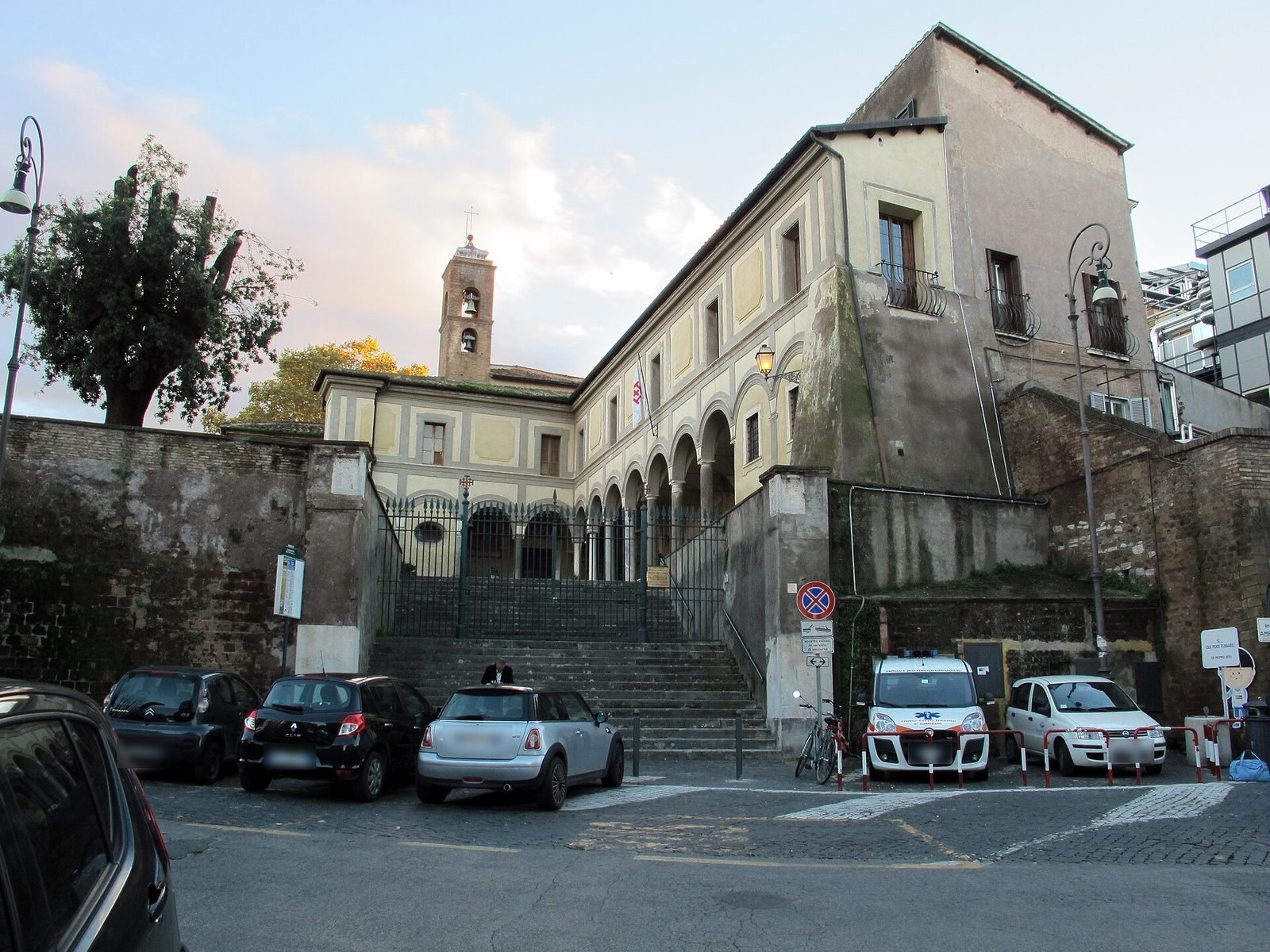
A curiosity about Sant’Onofrio al Gianicolo
The curiosity concerns the legal and symbolic status of the complex: since August 15, 1945, by order of Pius XII, the church of Sant’Onofrio al Gianicolo has been tied to the Equestrian Order of the Holy Sepulchre of Jerusalem, which makes it its own church in Rome. Since the following year the convent has been home to the Franciscan Friars of the Atonement, a congregation of American origin that also has its general procurator's office here.
The cardinal title
Sant’Onofrio is also the seat of a cardinal title. Since 2023 the title has been assigned to Cardinal Pierbattista Pizzaballa, Latin Patriarch of Jerusalem, which strengthens the link between this church on the Gianicolo and the Holy Land. In practice the titleholder is not the parish priest and does not usually officiate here: the cardinal title is an institution of the Roman Church that symbolically ties a cardinal to a church in the city.
Something nobody tells you about Sant’Onofrio al Gianicolo
What is almost never written is that a visit to Sant’Onofrio al Gianicolo fails more often than it succeeds, and that the reason isn't bad luck: it's that very many pages online report hours copied from old sources, mixing those of the church, those of the Masses and those of the museum as if they were the same thing. They are not.
Three different calendars at the same address
Under the same street number at least three opening regimes coexist. The church follows the windows given by the religious community. The Masses have their own schedule, and during a service tourist visits don't happen. The cloister and the Tasso rooms depend on the availability of whoever takes you in. Anyone who reads a schedule on an aggregator and takes it as valid for all three gets it wrong in two cases out of three.
The advice I give you for visiting Sant’Onofrio al Gianicolo
The operational advice is one and precise: come early in the morning on a weekday between Tuesday and Saturday, climbing from above and not from below, and make Sant’Onofrio the last stop of a walk on the hill instead of the first stop of the day. On Monday the community indicates it is closed, and on Sunday morning there is Mass at noon.
The route we recommend
Start from Santa Maria in Trastevere, climb up Via Garibaldi with a stop at the Tempietto del Bramante in the courtyard of San Pietro in Montorio, continue to the Acqua Paola fountain, stroll toward Piazzale Garibaldi and the Janiculum Ossuary Mausoleum, descend along Via del Gianicolo to Sant’Onofrio, reach Piazza della Rovere and head back along the river toward Castel Sant'Angelo. It's about three hours with the stops, all outdoors, almost all free.
What to avoid
Avoid fitting it into the same afternoon as the Vatican Museums. After three hours of galleries and the Sistine Chapel nobody has the head for a cycle of lunettes in a portico, and nobody has the legs for the climb. They are two experiences that cancel each other out. If you have only one day and want an overall picture, the Rome in a day itinerary explains how to spread your energy.
With children
There are no family routes or dedicated activities. The climb is demanding for short legs, the cloister isn't guaranteed, and the Tasso museum calls for a motivation that at eight years old is hardly there. If you climb up with kids, find the reward in Piazzale Garibaldi, with the puppet theater traditionally held there, and keep Sant’Onofrio as a short stop. The Botanical Garden, at the foot of the same hill, works much better for an afternoon with children.
Another well-known fact, yet rarely mentioned
The well-known fact is that the Gianicolo is not one of the seven hills of Rome, and despite this it hosts the most visible monument of the Roman Risorgimento and one of the city's best-known viewpoints: the contradiction between ancient irrelevance and modern centrality is the key to understanding Sant’Onofrio too.
Why the Gianicolo stays outside the seven hills
The seven hills of tradition, Palatine, Aventine, Capitoline, Quirinal, Viminal, Esquiline and Caelian, all lie on the left bank of the Tiber and correspond to the core of the ancient city. The Gianicolo is on the right bank, together with the Vatican, and for centuries it was borderland, of vineyards and villas, defended by walls but not densely inhabited. This marginality is precisely the reason a hermitage could be founded there in the 15th century.
1849 and the reversal
In 1849 the hill became the front line of the defense of the Roman Republic against the French expeditionary corps, and the fighting concentrated on these slopes and on the villas that stood there. From that moment the Gianicolo entered national memory and in the 19th century filled up with monuments, busts, plaques and civic rhetoric. Anyone who wants to reconstruct that story has the Museo della Repubblica Romana e della memoria garibaldina, housed in Porta San Pancrazio, and the villas that were the scene of the clashes, starting with Villa Doria Pamphilj.
The right photo to take at Sant’Onofrio al Gianicolo
The right photo at Sant’Onofrio al Gianicolo is the three-arched portico shot head-on from the square in early morning, when the raking light from the east enters under the vaults and sets the frescoed lunettes apart from the shadow at the back: it's the only hour when the outside and the inside of the portico hold the same exposure without blowing out the sky.
The framing
Step back to the opposite side of the square, keep the axis perpendicular to the facade so as not to distort the columns, and leave a few centimeters of paving at the bottom: it conveys the slope of the ground, which is a trait of the place. A moderate wide angle is more than enough, and an ultra-wide here only does damage because it curves the arches.
The second photo
The second is on the way up. Going down toward the river, after the first bend, the pines open onto the rooftops of Borgo with the domes beyond the Tiber: vertical, handheld, with the road in the foreground.
What time to avoid
Early afternoon. The portico goes backlit, the square is in hard shadow and the contrast becomes unmanageable. Late afternoon, on the other hand, works well for the road up and for the view, less for the facade. If you're after the Rome of rooftops lit in the evening, refer to Piazzale Garibaldi, higher up, or to the indications collected on the page about Rome at night.
Some important events that happened here in history
The chronology of Sant’Onofrio al Gianicolo centers on a few verifiable moments, spread over six centuries: the foundation in 1419, the completion around 1439, Tasso's death in 1595, the frescoed cycles between 1600 and the first decades of the 17th century, the funerary monument of 1857 and the change of 1945.
April 25, 1595: the death of Torquato Tasso
The poet dies in the convent on the morning of April 25, 1595, a few weeks after having himself carried there. The poetic coronation on the Campidoglio, postponed several times, never takes place. It's the date that makes this address a place of Italian literature.
Around 1600: the frescoed cloister
On the occasion of the Jubilee of 1600 the cloister lunettes are frescoed with stories of Saint Onuphrius by Giuseppe Cesari, known as the Cavalier d’Arpino, and collaborators. In the early years of the 17th century Domenichino frescoes the portico lunettes with episodes from the life of Saint Jerome, and the Madonna of Loreto by Annibale Carracci is dated to 1604.
1822: Leopardi's visit
Giacomo Leopardi, during his stay in Rome, climbs up to pay homage at Tasso's tomb. The visit, which the poet from Recanati described in his letters in words anything but enthusiastic toward Rome, is one of the episodes that consolidate the place's 19th-century fame.
1857: De Fabris's monument
The marble funerary monument by Giuseppe De Fabris is placed, replacing the very modest original burial and turning the chapel into a literary shrine of 19th-century taste.
August 15, 1945 and 1946
By order of Pius XII the church is entrusted to the Equestrian Order of the Holy Sepulchre of Jerusalem. The following year the convent becomes home to the Franciscan Friars of the Atonement, who still live there today.
Who has passed through Sant’Onofrio al Gianicolo
Over six centuries Sant’Onofrio al Gianicolo has seen an Abruzzo founder later beatified, some of the most sought-after painters of Rome between the 16th and 17th centuries, the greatest Italian poet of the late Renaissance, and a procession of 19th-century men of letters who climbed up here on a secular pilgrimage. The list that follows keeps only documented presences.
Nicola da Forca Palena
Founder of the hermitage in 1419, a religious originally from Abruzzo, later venerated as blessed. Without him this address wouldn't exist.
Torquato Tasso and his readers
Guest of Cardinal Cinzio Passeri Aldobrandini from November 1594, he climbed to the convent in the spring of 1595 and died here on April 25 of the same year. To his tomb climbed Giacomo Leopardi in 1822, during the Roman stay he detested, and after him a long line of travelers.
Domenico Zampieri, known as Domenichino
Bolognese painter trained in the Carracci workshop, author of the portico lunettes with stories of Saint Jerome, made in the early years of the 17th century. Here you look without a ticket.
Giuseppe Cesari, known as the Cavalier d’Arpino
One of the most powerful and busiest painters of late 16th-century Rome, author with his workshop of the cloister cycle around the Jubilee of 1600. In those years his workshop crosses almost every Roman building site.
Baldassarre Peruzzi and the question of the apse
Sienese architect and painter, active in Rome in the first half of the 16th century, to whom part of the critics assign the apse cycle. If you want to see his hand in a certain and documented context, you find it at Villa Farnesina, at the foot of the same hill, where the architecture is his.
The literary pilgrims of the 19th century
Over the course of the century the convent and the oak became a destination for travelers, poets and artists of the Grand Tour and the Romantic era. It's the same public that in Rome visited the Non-Catholic Cemetery and the house in Piazza di Spagna now known as Keats Shelley House: the geography of Roman literary pilgrimage runs through these three points.
Where to eat around Sant’Onofrio: how to choose
Around Sant’Onofrio al Gianicolo the food offer is thin and it needs saying right away: on the hill there's no fabric of neighborhood trattorie, because there's no neighborhood, there are religious institutions, villas and through roads. The practical advice is not to eat up here and to go down to Trastevere or toward Borgo, where the choice really exists.
The basic rule
On these pages we don't name venues. A list of signs gets old in a few months, the owners change, the cooking changes with them, and anyone who trusts a name read two years earlier gets burned. We prefer to teach you to recognize the right place on the spot, which is a skill that is useful all over Italy and not just here.
The five signs you're about to walk into a trap
There are five clues that almost always work in the field. The first: the lady rolling fresh pasta in the window or right out in the street. It's an advertising lure, not a kitchen, and no Roman has ever stopped for that. The second: the menu with photographs of the dishes. It's for people who don't have to come back. The third: the barker at the door inviting you to sit, maybe in four languages. A place that has to stop you in the street has no regular customers. The fourth: the place open from morning to night with no kitchen break. A real kitchen stops, because the people working in it stop. The fifth: the position right in front of a famous monument, with the concrete risk of unpriced items on the menu and of price lists that differ between the indoor room and the outside tables.
The simplest test of all
Look at who is sitting and in what language they order. If at two in the afternoon the tables hold people speaking Italian with a Roman accent, whom the waiter knows, and who order without looking at the menu, you're in the right place. If instead the room is made up only of customers with backpacks and cameras, and everyone orders by pointing at the photo, you have your answer. It works far better than any online rating.
The chains in the center
A word on the chain phenomenon, without naming names. In central Rome places with the same sign repeated in several spots have multiplied, the same menu, the same furnishings and often the queue with a ticket number. They are commercial operations built for a passing public. The one observation that matters is this: Romans don't go to them. We don't name them and we don't recommend them.
Where to go down
Going down the hill toward the south you enter Trastevere, where the density of venues is very high and the quality extremely variable: the inner streets, far from the main squares, remain the most reasonable choice. Going down toward the north you reach Borgo and Prati, where the offer is more orderly and less exposed to tourist traffic than along the axis of Via della Conciliazione. In both cases moving 300 meters away from the most photographed spot radically changes the bill and the plate.
The personal list
For those who want a concrete, non-sponsored reference anyway, there is Daniele Dezi's personal list on Google Maps, a curated collection of places where you eat well in Rome, kept up to date for his own use and shared. No commercial agreement, no paid sign.
A last note on the hill
On the Gianicolo, in the warm season, the kiosks and seasonal refreshment points on the piazzale work, which are for having a drink while looking at the city and not for dinner. Treat them for what they are: a break, not a meal. If you want to plan a low-cost day, find some pointers on the page about Free Rome.
What's around and how to fit the visit in
Sant’Onofrio al Gianicolo sits halfway between two worlds that hardly talk to each other: the Vatican quarter to the north, with St. Peter's and the Museums, and Trastevere to the south, and you can reach it on foot from both in under 20 minutes. Using the convent as a hinge between the two is the smartest way to fit it into a plan.
The Vatican side
Going down toward Piazza della Rovere you're a few minutes from Vatican City, the colonnade, the Vatican obelisk and Castel Sant'Angelo. On the far side of the Vatican, another little-visited route is the Passeggiata del Gelsomino, carved out along the old railway line: if you're looking for quiet corners in this area you should know it.
The Trastevere side
Going up and then down the other side you reach Santa Maria in Trastevere, Santa Maria della Scala, San Crisogono, Santa Cecilia and San Francesco a Ripa. On the way there are also the Museo di Roma in Trastevere, which devoted an exhibition to Tasso's oak in 2025, and Palazzo Corsini with its gallery.
Other literary places on the hill
A little higher up, on the slope facing Trastevere, is the Bosco Parrasio of the Accademia dell’Arcadia, the terraced garden where the Roman literary academy has met since the 18th century. It's the other poetic address on the Gianicolo, also with limited access, and it's the natural partner of Sant’Onofrio for anyone building a literary itinerary. Further south, Villa Sciarra closes the series of the hill's gardens.
If you have more days
Sant’Onofrio works well on the second or third day, when the big names have already been seen and you feel like something lower in tone. If you're organizing around three days, you'll find a useful outline in the three days in Rome itinerary, while for a short stay it's worth looking at the page on a weekend in Rome. If instead you have a week, you can afford to widen out toward the Aventine and the Ghetto, which are the other quiet side of the center.
Frequently asked questions about Sant’Onofrio al Gianicolo
Where exactly is Sant’Onofrio al Gianicolo?
Sant’Onofrio al Gianicolo is at Piazza di Sant’Onofrio 2, on the north side of the Gianicolo hill, at the junction of Salita di Sant’Onofrio and Via del Gianicolo. From the colonnade of Piazza San Pietro it's about 15 minutes on foot via Piazza della Rovere, at Ponte Principe Amedeo Savoia Aosta, where the ramp up to the convent starts.
What are the opening hours of Sant’Onofrio al Gianicolo?
The Franciscan Friars of the Atonement, who have lived in the convent of Sant’Onofrio al Gianicolo since 1946, indicate opening from Tuesday to Saturday in a morning window, closing on Monday and a wider window on Sunday morning, with Sunday Mass at noon. These are hours published by a religious community and not by a museum body: they change often and need checking with the community before you climb up.
How much does it cost to enter Sant’Onofrio al Gianicolo?
For the church of Sant’Onofrio al Gianicolo there appears to be no admission ticket in the museum sense of the term, because it is a working place of worship. For the cloister, the Tasso museum rooms and group visits the conditions may be different and need to be arranged directly with the religious community. We don't give prices because there is no published official price list.
Can you visit the Tasso museum at Sant’Onofrio?
The Tasso museum at Sant’Onofrio al Gianicolo exists and occupies rooms on the first floor of the convent, tied to the last days of Torquato Tasso, but as far as we know there is no public, stable opening calendar. Access depends on the community's availability on the day of the visit and needs to be arranged beforehand. Anyone who climbs up just for the museum without having asked for confirmation risks finding it closed.
Where did Torquato Tasso die?
Torquato Tasso died in the convent of Sant’Onofrio al Gianicolo, in Rome, on the morning of April 25, 1595, where he had had himself carried in the preceding weeks. He had arrived in Rome in November 1594 as a guest of Cardinal Cinzio Passeri Aldobrandini and was awaiting the poetic coronation on the Campidoglio promised by Clement VIII, a ceremony postponed several times that never took place.
How do you get to Sant’Onofrio al Gianicolo by public transport?
You get to Sant’Onofrio al Gianicolo with bus line 870, which starts from Via Paola near Piazza della Rovere and climbs along Via del Gianicolo, or on foot from the stops on the Tiber embankment and from Roma San Pietro station, about 15 minutes uphill. The metro doesn't serve the hill: the nearest stop, Ottaviano on Line A, is over 20 minutes on foot.
Is the climb to Sant’Onofrio al Gianicolo tiring?
The climb to Sant’Onofrio al Gianicolo covers about 80 meters of elevation from the river in a few hundred meters, with a steep final stretch and a staircase that cuts the hairpin bends: it's demanding in summer and for anyone with joint problems. If you want to avoid it, you can take a taxi to the square in front of the church, or come down from above starting from the Gianicolo promenade.
Does Tasso's oak still exist?
Of Tasso's oak, just above the convent of Sant’Onofrio al Gianicolo, only a trunk remains today: the tree was struck by lightning in 1843 and further damaged by an arson fire in 2011. Over the years there has been discussion of replacing it with a new specimen and moving the remains into a museum. The tradition that has the poet sitting under that tree is popular and undocumented.
Is Sant’Onofrio al Gianicolo accessible for people with mobility difficulties?
The square in front of Sant’Onofrio al Gianicolo is level and reachable by taxi, which solves the problem of the climb, but entry to the church is through a raised portico with steps, and the cloister and the museum floor involve further changes of level and stairs. As far as we know there is no elevator. If you have specific needs, contact the community before the visit to find out what will be reachable.
Who wrote this page
This page is maintained by the editorial team of Tour Leader Pro, the Rome-based project office that designs and coordinates visits, itineraries and cultural events in Rome and Lazio. Hours, prices and access conditions given here are verified as of the publication date against the official sources named in the text: before you leave it's worth rechecking them, because they change often. If you find out-of-date information, let us know.
If you're building a Roman itinerary that ties together the Vatican quarter, the hill and Trastevere, crossing Sant’Onofrio with the other stops of the Gianicolo walk and with the city's literary places, you'll find planning tools and operational support on Tour Leader Pro, which handles the design and coordination side of visits.
For a broader picture of getting around Italy, of connections to Rome and of the destinations in Lazio reachable in a day, a useful resource at the planning stage is Italy Planner, which covers transport, travel times and trip organization.