Piazza San Pietro
In short. Piazza San Pietro is the great colonnaded square that stands in front of the Basilica di San Pietro in Vaticano, designed by Gian Lorenzo Bernini between 1656 and 1667 at the wish of Pope Alexander VII.
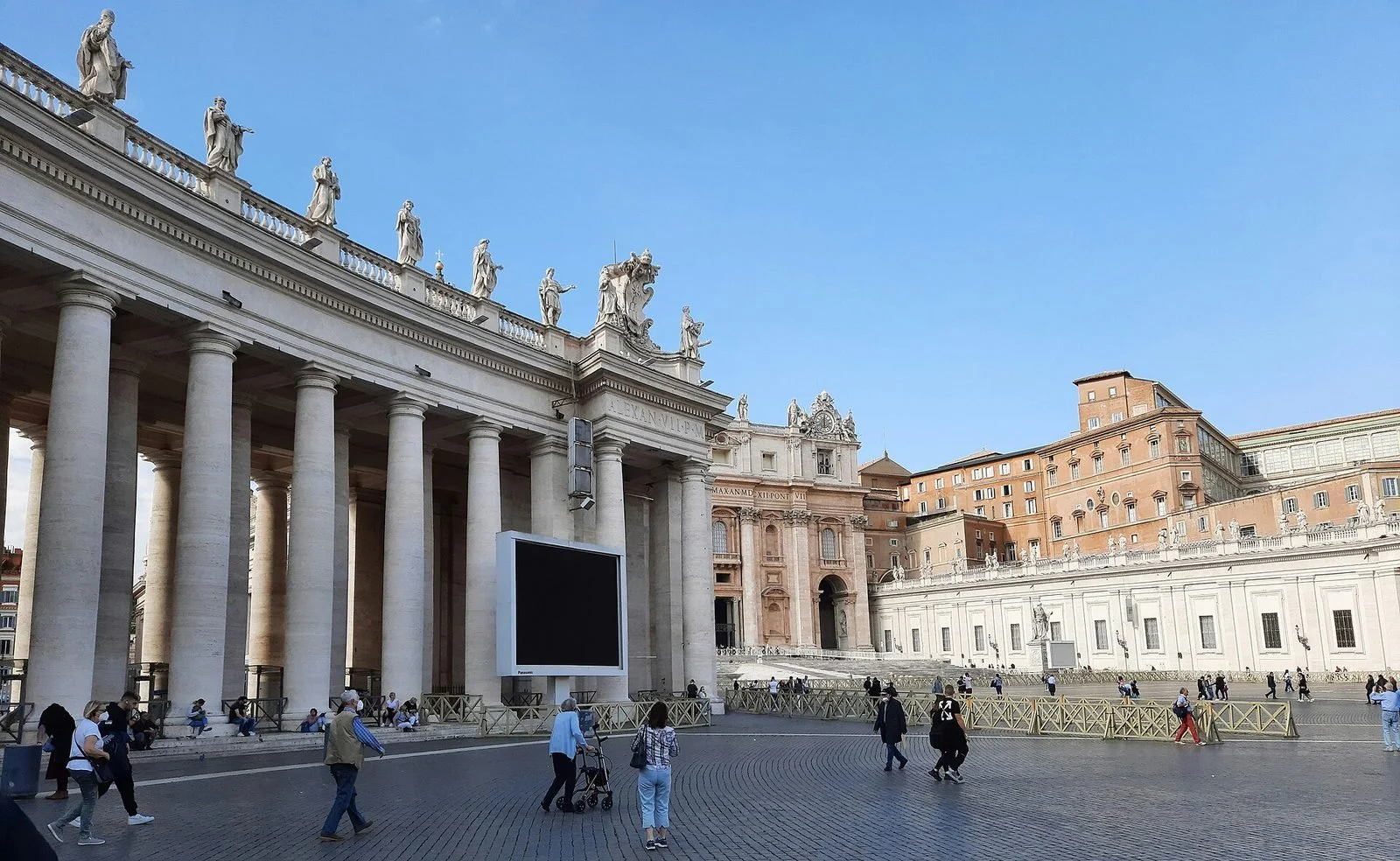
Piazza San Pietro is the great colonnaded square that stands in front of the St. Peter's Basilica in the Vatican, designed by Gian Lorenzo Bernini between 1656 and 1667 at the wish of Pope Alexander VII. The basilica's official website describes it as a round oval of 196 by 149 meters, closed by 284 travertine columns 16 meters high arranged in four rows and topped by 140 statues of saints more than three meters tall. It is territory of Vatican City, but by a clause of the Lateran Treaty it normally remains open to the public and subject to the police powers of the Italian authorities. Most people who arrive here cross it in seven minutes looking at the dome and nothing else. Yet the square is a work in its own right: it contains an Egyptian obelisk that reached Rome 16 centuries before the colonnade, two fountains that are not twins, a 19th-century sundial drawn on the paving and an invisible state border among the sampietrini. These lines tell how it is made, how it came about, what you see standing in the right spot and how you really get in today, among security checks, lines, Wednesday audiences and Sunday Angelus.
Where Piazza San Pietro is and how to get there
Piazza San Pietro is at the western end of the rione Borgo, on the right bank of the Tiber, at the end of Via della Conciliazione and about a kilometer and a half as the crow flies from Piazza Navona. If you come on foot from the center you almost always cross Ponte Sant’Angelo, pass next to Castel Sant'Angelo and take the straight avenue that leads right to the facade: just under 20 minutes from Piazza Navona, a little over half an hour from the Trevi Fountain.
By metro and surface transport
The most convenient metro stop is Ottaviano, on Line A, from which you walk about 10 minutes to Piazza del Risorgimento and then down Via di Porta Angelica. The next stop, Cipro, serves better the entrance of the Vatican Museums on Viale Vaticano, which is a different entrance and far from the square. If you come by train you get off at Roma San Pietro station, on the regional lines.
On the surface, line 19, which according to ATAC is currently replaced by buses toward Viale Giulio Cesare and Ottaviano, is the quickest way for those coming from the north, while several bus lines run down the lungotevere and stop between Piazza Pia and Borgo Sant’Angelo. On audience Wednesdays and celebration Sundays the nearest stops are suppressed for hours: it's best to check the route before leaving. Our guide on how to get around Rome explains tickets, validity and apps, and applies here too.
By car, taxi and from the airports
Arriving by car is the worst choice: limited traffic zones with bans that change on celebration days, paid street parking that is almost always full, expensive garages. Better to leave the car in a park-and-ride lot on Line A. Taxis can't get close to the colonnade and drop off at Piazza Pia. If you land at Fiumicino or Ciampino you'll find the options in the entry on from the airports to the center of Rome.
Where it's best to enter the square
There are three pedestrian entrances and they are not equivalent. From the end of Via della Conciliazione you arrive in line with the facade, and it's the perspective devised by the 20th-century architects, not by Bernini. From Via di Porta Angelica and Piazza del Risorgimento you enter under the right arm, and it's the route of those who get off at Ottaviano metro. From Largo degli Alicorni and Borgo Santo Spirito you enter under the left arm: almost always the least congested opening in the middle hours. If you want to understand the colonnade, enter from the side, into the portico, where the four rows of columns overlap at every step. The central straight avenue flattens everything into a postcard.
What Piazza San Pietro is: a square made of two pieces
Piazza San Pietro is made up of two distinct spaces, designed together but with different geometries: the straight square, trapezoidal, in front of the basilica's facade, and the oblique square, the oval enclosure embraced by the two arms of the colonnade. The oval part covers about 35,300 square meters, the trapezoidal one about 12,300.
The problem Bernini had to solve
When Alexander VII gives him the commission, in 1656, in front of St. Peter's there is an irregular open space, cluttered with houses, with the obelisk already planted in the center for 70 years and two fountains in haphazard positions. Carlo Maderno's facade is very wide and low, and from up close it hides Michelangelo's dome. The pope asks for a space able to hold the crowd at the blessings, sheltered from sun and rain, that gives dignity to a front already then considered too stretched out. The solution is twofold. The straight arms of the straight square diverge toward the basilica instead of being parallel: the perspective is shortened and the facade seems less wide and taller than it is. The oval enclosure moves the observer back just enough for the dome to reappear above the attic. It is a calculated effect, not an accident.
Round oval, not ellipse
The shape of the square is called an ellipse almost everywhere, and that is a simplification. The curve is a round oval, an oval built with a compass on several centers by joining arcs of circles. The difference is not academic: an ellipse can't be drawn with a compass, and a 17th-century construction site needed a figure that could be reproduced at full scale with ropes and stakes. The two porphyry disks on either side of the obelisk mark the centers of the circles that generate the curve.
What this page doesn't tell
The basilica, the dome, the Pietà, the baldachin and the Holy Door have their own entry: hours, the climb to the dome and the interior route are in the entry St. Peter's Basilica in the Vatican. The obelisk, its stone and its Egyptian history are treated at length in Vatican Obelisk, within the series devoted to the obelisks of Rome. The State, its institutions and the rules for entering its territory are in Vatican City, while the museums and the Sistine Chapel are visited from a different entrance and with a paid ticket. Here we talk about the square as architecture and as a place to walk through.
Bernini's colonnade: the right numbers and the wrong ones
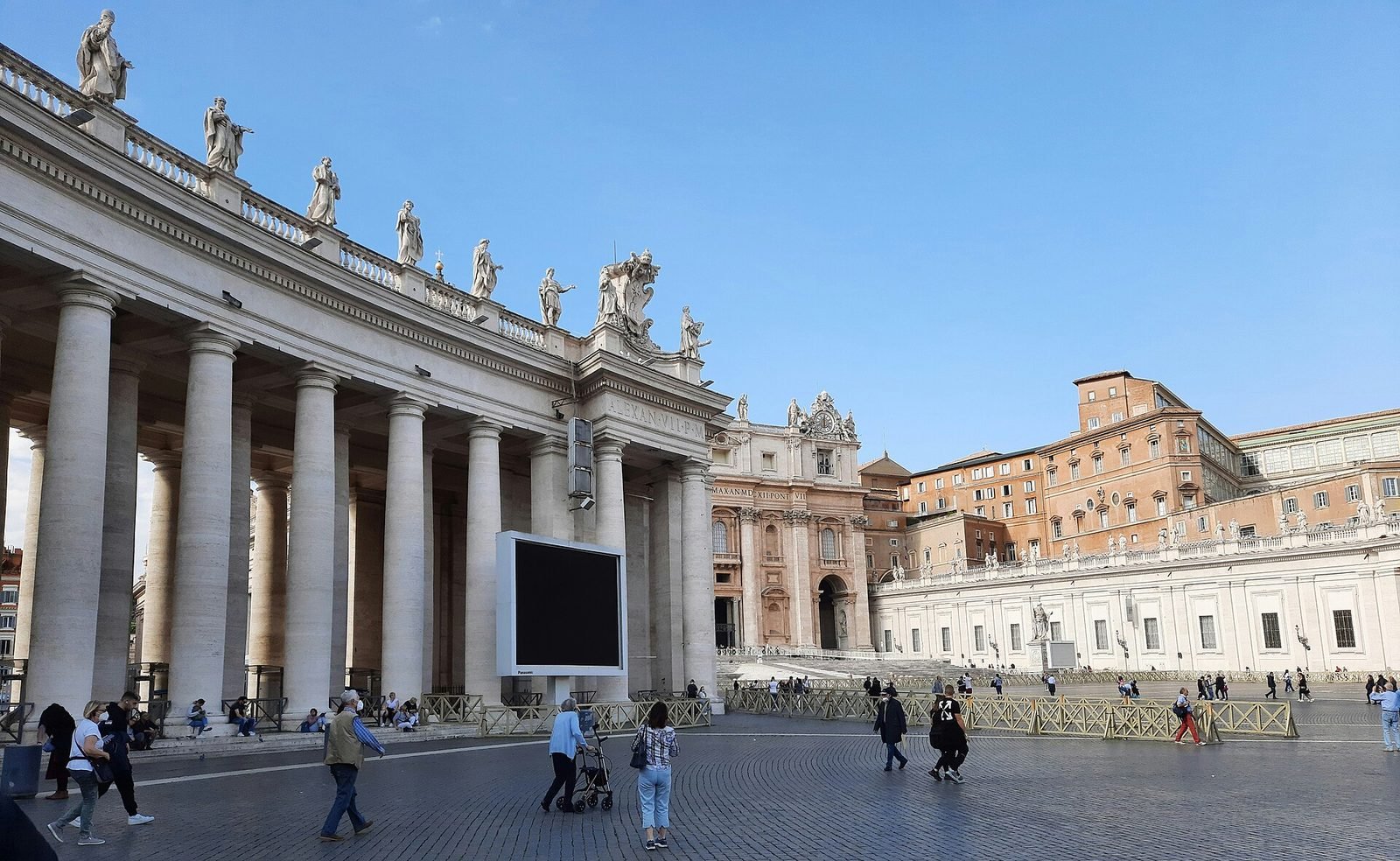
The colonnade of Piazza San Pietro was built between 1656 and 1667, in 11 years of construction, in travertine from the Tivoli quarries. The official website of the Basilica di San Pietro gives 284 columns in four rows 16 meters high and 140 statues more than three meters tall on the balustrade. These are the most reliable figures in circulation, and they should be cited knowing that almost every source gives different ones. In that same 1667 Alexander VII dies, the pope who had wanted the work.
Why the numbers never add up
We compared about 10 sources. On the columns, the most widespread Italian version speaks of 284 columns and 88 pilasters. The English Wikipedia entry gives 248 columns and 88 pilasters. The difference depends on what is counted: if the corner pilasters, the end propylaea and the columns of the straight arms of the straight square are included or not, since they form a different portico from the oval one. On the statues the range is wider: 96 counting only the entablature of the hemicycle, 140 according to the basilica, about 162 adding the straight arms.
The number 140, however, has an argument the others don't: in the 18th century, under Pius VI, the Calcografia Camerale published a series of engravings explicitly titled to the 140 statues of saints sculpted by Bernini's school and placed above the colonnade. A printed series that counts and portrays 140 of them is documentary proof, not an estimate. When you hear a guide in the square say a different number, you are hearing a different counting perimeter, not a mistake.
The statues on the balustrade
The statues crowning the balustrade depict male and female saints and were sculpted by Bernini's workshop and school, then by other sculptors, over decades. They are more than three meters tall: from the paving they look like figures slightly larger than life, and that is the impression they were meant to give. Several sources note that their module is about half that of the Christ and the apostles on the facade. With binoculars you discover recognizable attributes and faces different from one another, invisible to the naked eye.
The image of the arms
Bernini explained the design with the image of the maternal arms of the Church opening to welcome the faithful, and the metaphor is documented in 17th-century sources. The colonnade also has a practical function, though: it is a covered portico, wide enough to let a procession pass and to shelter several thousand people. In August it is the only shade for 200 meters. For the rest of his Roman work, from the Fountain of the Four Rivers to Sant’Andrea al Quirinale, there is the itinerary Bernini in Rome.
The obelisk and the 1586 construction site, 70 years before the colonnade
The Vatican obelisk was raised in the center of the square on September 10, 1586, 70 years before Bernini began the colonnade: the square was designed around it. It is a monolith of red granite about 25 meters high in the shaft alone, which approaches 40 with base, bronze lions and cross, and is the only ancient obelisk in Rome that has never fallen or been broken.
From Heliopolis to Caligula's circus
The ancient sources, Pliny first among them, have it come from Heliopolis, then moved to Alexandria and finally brought to Rome at the will of Caligula with a ship built for the purpose. On the date the texts diverge between 37 and 40 AD and no document settles the question: we report both. In Rome it was erected on the spina of the imperial circus later known as the Circus of Nero, on the southern flank of the present basilica. Christian tradition ties that circus to the martyrdom of Peter: that is why in the 16th century moving it was an operation heavy with meaning.
Domenico Fontana's construction site
Sixtus V entrusted the move to Domenico Fontana, who worked on it for 13 months between planning and preparations. The figures handed down speak of about 900 men, 75 horses and 40 winches used on the decisive day, with a timber framework to lower the monolith, drag it on rollers and raise it again on the new base. The monument was moved about 1.56 meters to the north relative to the axis of the basilica, a deviation due to the constraints of the old Constantinian basilica and which nobody ever notices.
The anecdote of the Ligurian sailor who supposedly shouted to wet the ropes during the raising, breaking the silence imposed under pain of death, is established popular tradition and finds no confirmation in the construction site's documents. It should be told as such.
The cross, the globe and the inscription
At the top there is no longer the ancient bronze globe, which according to a legend contained the ashes of Caesar and which was removed in 1586: today it is in the Capitoline Museums. In its place is a cross, in which since 1740 a relic believed to be part of the True Cross has been placed. On the base runs the inscription wanted by Sixtus V, which begins with ECCE CRVX DOMINI: a political statement as well as a devotional one. The detail of the stone and the measurements is in the entry Vatican Obelisk.
The two fountains, and why they are not twins
The two fountains of Piazza San Pietro look identical but are the work of different architects and are separated by more than 60 years: the one on the right looking at the basilica, that is to the north, was renovated by Carlo Maderno around 1613, the one on the left was built by Carlo Fontana and inaugurated on June 28, 1677. Both are fed by the Acqua Paola, the aqueduct restored by Paul V and completed in 1610, the same one that gushes from the Fontanone on the Janiculum.
The first: Maderno, and the 1667 move
A fountain already existed in this open space in the 15th century. Maderno built a new one, with the inverted basin from which the water falls in a cascade into the basin below, and placed it wherever it happened to fall in a square that then had no shape. With the construction of the colonnade the problem arose immediately: it was off axis. In 1667, by order of Bernini, it was dismantled and repositioned aligned with the obelisk and with the major axis of the oval, which meant redoing pipes, levels and vents.
The second: Carlo Fontana, and 10 years of waiting for water
The left fountain was born from a need for symmetry: a square with two centers called for two. The design is attributed by some sources to Bernini, and Carlo Fontana himself, who built it in travertine, attributed its authorship to the master. The inauguration came only in 1677, and the delay has a hydraulic explanation: the Acqua Paola didn't have enough pressure for two jets of that size, and the matter was unblocked when Clement X bought an additional share of water from Lake Bracciano.
The differences you can really see
Look at the coats of arms. On the northern fountain are the arms of Paul V Borghese, on the southern one those of Clement X Altieri: it's the sharpest difference and the easiest to verify. The silhouettes of the basins and the profiles of the pools show minimal differences, due to different workmen and to 60 years of distance, and several sources call them almost twins for exactly this reason.
The paving: wind rose, sundial and the two porphyry disks
The paving of Piazza San Pietro contains three devices that almost nobody looks at, because to see them you have to lower your eyes while everyone else keeps them raised: two porphyry disks, a wind rose of 16 marble disks and a sundial that uses the obelisk as its gnomon. The wind rose and the sundial were made in 1817 by Monsignor Filippo Luigi Gilii, an astronomer.
The two porphyry disks and the trick of the four rows
Halfway between the obelisk and each of the two fountains, set into the paving, there is a porphyry disk with an inscription marking it as the center of the colonnade. Stepping on it and looking toward the nearest arm, the four rows of columns line up and visually collapse into one: the portico becomes, for an instant, a single-row colonnade. It is the practical proof that the curve is built on precise geometric centers, and the reason why speaking of the foci of an ellipse is imprecise.
It's worth the two-minute wait, because in high season there is always someone on the disk. Try it from both disks: the alignment works on all four stretches of colonnade and the result changes depending on the arm you look at.
The wind rose and its linguistic anomaly
Around the obelisk runs a wind rose of 16 marble disks, each with the name of a cardinal point and of the associated wind. The Vatican itself points out the curiosity: on the western disk the English form west appears, while on the eastern one you read est and not east. It is the only foreign word in the series, and nobody has ever corrected the asymmetry.
The sundial
Also in 1817 Gilii laid out on the paving a meridian line with marble disks that mark the passage of the obelisk's shadow at the solstices and equinoxes. The obelisk works as the gnomon: at true noon the tip of the shadow touches the disk of the period. It still works, as long as you remember that solar noon does not coincide with 12:00 on the clock: in Rome, in summer, the difference exceeds an hour. Better to try around the winter solstice, when the shadow is long.
The border between Italy and Vatican City that runs through the square
Piazza San Pietro legally belongs to the State of Vatican City, but the Lateran Treaty of February 11, 1929 reserved a special regime for it: Article 3 establishes that the square remains normally open to the public and subject to the police powers of the Italian authorities. The text specifies that these powers are exercised up to the foot of the basilica's staircase, and that Italian forces cannot go up it or enter the church unless invited by the competent authority.
Where the line runs, and who is in charge where
The actual border line runs along the outer edge of the colonnade and closes on the front of Piazza Pio XII, where Via della Conciliazione ends. On the paving it is marked by a strip of light travertine. Thousands of people cross it every hour without noticing: it is one of the most crossed state borders in Europe and you pass it without documents and without signs.
In the square the Pontifical Gendarmerie, the Swiss Guard and the Italian State Police operate together, with distinct responsibilities. In practice: barriers, checkpoints and anti-terrorism controls along Via della Conciliazione are handled by the Italian side, those at the entrance of the basilica by the Vatican side. For visitors one detail changes: a theft report has to be made to the right authority, and which one depends on where you were. And the "normally" of the clause matters: the Vatican authorities can close the square for celebrations, setups or security, and they often do.
Piazza Retta, Piazza Rusticucci and the spina di Borgo
Until 1936 anyone coming from the center did not see Piazza San Pietro until the last moment: between Castel Sant'Angelo and the colonnade stretched the spina di Borgo, a long narrow block of houses that separated Borgo Nuovo from Borgo Vecchio and dropped the pedestrian into an irregular small square, Piazza Rusticucci. That effect of surprise no longer exists today.
The straight square
The straight square is the trapezoidal part between the two straight porticoed arms and the facade. Its sides diverge as they go toward the basilica. From the far end of the oval this divergence works against natural perspective and gives back a facade that looks narrower and more slender. It's the least photographed piece of the design and the most sophisticated: correcting a facade that cannot be demolished is solved only with the geometry of the enclosure in front.
Piazza Rusticucci and Piazza Pio XII
Piazza Rusticucci was the asymmetrical widening that served as a vestibule to the square, at the start of the two Borghi. With the demolition of the spina it was erased, and in its place Piazza Pio XII was born, regular and symmetrical. Anyone looking at a photograph taken before 1936 sees a different city: houses of three or four stories pressed almost up against the colonnade, shops, laundry hung out.
Via della Conciliazione, from 1936 to 1950
The project for Via della Conciliazione, signed by Marcello Piacentini and Attilio Spaccarelli, was started in 1936 after the Lateran Pacts and concluded in 1950, a Holy Year. The debate remains open: there are those who observe that it made the dome visible from afar and those who maintain that it destroyed the scenic effect calculated by Bernini, based on the sudden passage from the alley to the open enclosure, wiping out an entire medieval and Renaissance urban fabric.
Our opinion: architectural criticism is right on the formal level and wrong on the practical one. Without Via della Conciliazione today's flows would be unmanageable. Anyone who wants to understand what the neighborhood was like should walk Borgo Santo Spirito and Borgo Pio, which survived.
The "third arm" of the colonnade: a debated hypothesis, not a fact
You often read that Bernini had designed a third arm of the colonnade to close the square on the eastern front, and that the death of Alexander VII in 1667 stopped the work. It is a hypothesis supported by some scholars and debated by others, not a documented fact.
What the sources say
Some 17th-century drawings and engravings show the square closed by a building block on the side toward the city, with a central passage. Part of the critics read them as a completion project, meant to connect the axis of the old Via Alessandrina with that of the basilica. Another part considers them preliminary studies or variants never approved, and observes that the oval colonnade works precisely because it stays open.
Why the question remains open
The document that would close the discussion is missing: no contract, no resolution, no payment that can be tied to a third arm under construction. The honest formula is this: a project to close the eastern front is documented graphically, its authorship and its degree of definition remain a matter of debate, and it was never built.
A curiosity about Piazza San Pietro
On the paving of Piazza San Pietro, not far from the Bronze Door, there is a marble tile with the coat of arms of John Paul II that marks the exact spot where the pope was shot during the attack of May 13, 1981, at 17:19, while the open car was turning between the sectors of the square during the Wednesday general audience. It has no signs, it isn't indicated by arrows and it doesn't appear on any tourist map: you find it only by knowing it exists.
Something nobody tells you about Piazza San Pietro
The square is not open 24 hours a day as many take for granted, and the metal detector checkpoints that precede it have variable hours and configurations: access can be reduced, diverted or closed for security or for setups, and it happens often.
The security check is the real bottleneck
The filter is before the basilica, not at the entrance to the square. The official website says the check takes place in the right hemicycle of the colonnade, under the right arm looking at the facade. In the middle hours the line fills the whole portico and continues into the square, and from the outside it looks like the line for an event. It is the line for a free entrance.
The prohibited items are the typical ones: knives, pointed objects, bottles and flasks. There is no baggage deposit inside the basilica, so anyone arriving with a trolley or a trekking backpack risks having to turn back. Anyone carrying a flask will have to empty it or leave it: better to know before standing in line for an hour. The basilica offers an optional online reservation, which according to the official website has a cost, fixes a time slot and includes the digital audio guide, but doesn't replace the check. The public restrooms are under the left arm of the colonnade, and in the square there are drinking water fountains: the portico is the only real shade, and between July and August the oval enclosure in the middle hours is unbearable.
On Wednesday the square is not a square
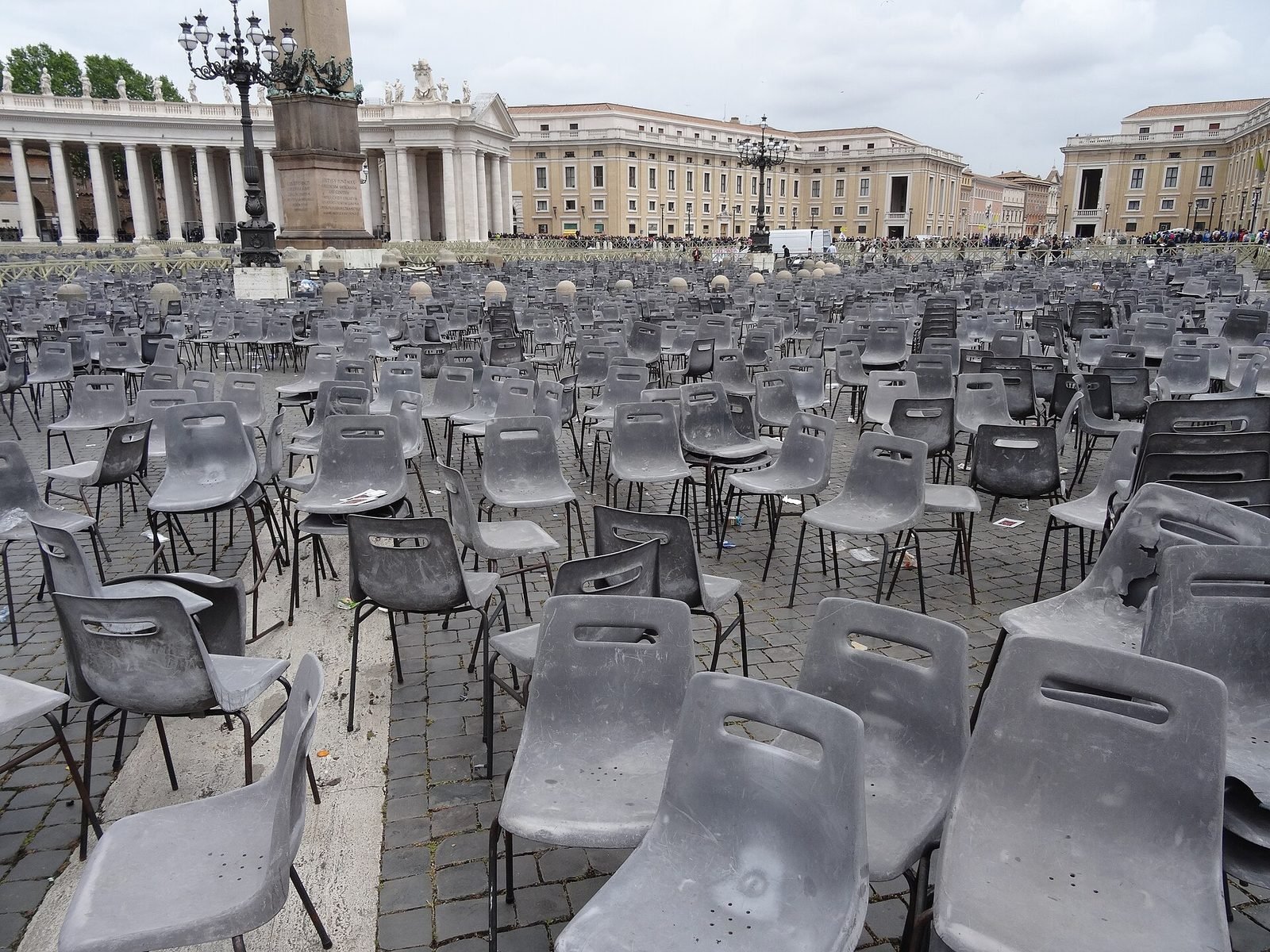
The fact that no guide highlights is that for the whole of Wednesday morning, when the general audience is held outdoors, the oval enclosure is occupied by thousands of chairs, barriers and technical structures, and access is reserved to those with a ticket. Anyone arriving that day to photograph the empty square or to try the optical effect of the porphyry disk finds a setup site. The same holds, to a lesser degree, on celebration Sundays and in the Christmas period, when the tree and the nativity scene occupy the center of the oval: the calendar for those weeks is in the entry Christmas in Rome.
The advice I give you for visiting Piazza San Pietro
The practical advice is just one and it matters more than all the others: arrive in the square when the basilica opens, at 7 in the morning, or after 18:00, and in any case avoid Wednesday morning. Since June 1, 2026 the basilica has observed hours from 07:00 to 20:00 with last entry at 19:15, and this widens the useful evening window a lot.
Before 08:00
At 07:00 you get through the check in a few minutes, the square is almost empty, the light comes from the east and cuts across the colonnade from the side, lighting the statues one by one. It's the only moment when you walk in the portico without dodging anyone and try the alignment from the porphyry disk without taking a turn. Anyone who also visits the basilica then has two hours before the first groups.
After sunset
The second window is the evening. After 18:00 the groups leave, the colonnade lighting comes on and the columns gain a relief they don't have by day. The dome stands out against a sky that is still light for a good half hour after sunset. In winter that happens around 17:00, with the square already almost deserted.
What not to do
Don't buy skip-the-line tickets for the basilica. Entrance is free and the official reservation, when available on the basilica's website, has instead a cost, which includes the digital audio guide and should be checked on the official website, and serves to fix a time slot. On third-party platforms you pay at most for a guide, never for the right of entry. The confusion comes from the Vatican Museums, which are something else, have another entrance and do have a ticket. Don't squeeze the square and the museums into the same hour: the entrance of the museums is on Viale Vaticano, on the other side of the walls, 20 minutes on foot from the colonnade.
The dress code
In the square there is no dress code. To enter the basilica there is, and it is applied strictly at the checkpoint: shoulders covered, no tank tops, pants or skirts covering the knee, hats removed. In summer quite a lot of people are turned away every day, and a shawl bought from the street vendors under the colonnade costs more than a light shirt brought from home in your backpack.
Another well-known fact, yet rarely cited
Michelangelo's dome disappears from view as you get closer to the basilica, and this is a flaw inherited from Carlo Maderno's facade, not a choice of Bernini's: from the parvis, at the foot of the staircase, you see only the lantern of the dome, and from certain positions not even that.
Why it happens
Maderno's facade, completed in 1612, is about 115 meters wide and a little under 46 high, with the attic jutting out. The lengthening of the nave toward the east, decided in the 17th century for liturgical reasons, moved the front forward relative to Michelangelo's central plan and led the body of the basilica to cover the drum. To see facade and dome together you have to stand hundreds of meters away, from Via della Conciliazione or from Ponte Sant'Angelo.
How Bernini worked around the problem
The colonnade is also an answer to this. By moving the observation point back to the center of the oval, and by balancing the width of the facade with a horizontal mass that is even wider but much lower, Bernini gets two results: the facade stops looking out of proportion and the dome comes back into the picture. He doesn't solve the flaw, he neutralizes it from a distance. You understand it by walking the route in reverse, from the staircase toward the obelisk. For the rest of Michelangelo's Roman work, from the Capitoline Hill to the Moses in San Pietro in Vincoli, there is the itinerary Michelangelo in Rome. The viewpoint on the Janiculum, in front of San Pietro in Montorio, gives you instead the whole dome seen from the south.
The right photo to take at Piazza San Pietro
The photograph to take at Piazza San Pietro is shot standing on one of the two porphyry disks, lens pointed toward the colonnade, with the four rows of columns lined up to form one. The frontal shot from the center of the oval is the same as a million others. This one explains the design instead of illustrating it. In the square you can photograph freely, in the basilica without flash, in the Sistine Chapel never. Tripods and drones require authorization and drones are in any case banned in Vatican airspace.
How to set it up, and at what time
Stand exactly on the disk, not next to it: the alignment tolerates only a few centimeters. Use a slightly telephoto focal length, 50 or 70 millimeters equivalent, because a wide angle curves the lines and breaks the effect. Keep the sky out of the frame: what matters is the vanishing of the shafts and the continuous entablature.
The northern arm, on the right looking at the basilica, catches light early in the morning, the southern one in the afternoon, and toward sunset the columns turn orange while the back of the portico stays in shadow. It's that contrast that holds the image. At noon the sun is overhead and the colonnade flattens.
Some important events that happened here in history
Piazza San Pietro has been the stage for some of the most photographed events of the 20th century and of the new century, from the attack on John Paul II on May 13, 1981 to the blessing in an empty square on March 27, 2020, up to the funeral of Pope Francis on April 26, 2025.
February 11, 1929: the square becomes a legal case
With the Lateran Treaty, signed at the Lateran and not here, the State of Vatican City is born and the square receives the status that still governs it: Vatican territory, normal opening to the public, Italian police powers up to the foot of the staircase.
May 13, 1981: the attack
At 17:19 on a general audience Wednesday, Mehmet Ali Agca shoots John Paul II while the open car crosses the sectors of the square. The pope is taken to the Policlinico Gemelli and operated on. From that episode derive, in successive phases, the security procedures that still regulate access today.
March 27, 2020: the empty square
In the midst of the pandemic, Francis presides alone over an extraordinary moment of prayer with the urbi et orbi blessing, in the rain, in a closed and deserted square. Those images remain the exact reverse of what the square was built for.
2025 and 2026: a funeral, an election, a closed Jubilee
On April 26, 2025 the square hosts the funeral of Pope Francis, who died on April 21. On May 8, from the central loggia of the basilica, Leo XIV appears for the first time, elected in the conclave that opened two days earlier. On January 6, 2026, with the closing of the Holy Door, the ordinary Jubilee ends here.
Who has passed through Piazza San Pietro
Besides the architects who built it, Piazza San Pietro has seen some of the travelers who wrote the most widely read pages on modern Rome, from Goethe to Charles Dickens: their descriptions still help to understand how it worked before the 20th-century demolitions.
The architects
Domenico Fontana works here in 1586 with the obelisk. Carlo Maderno builds the facade and renovates the northern fountain in the first decades of the 17th century. Gian Lorenzo Bernini designs and directs the colonnade from 1656 to 1667, with Mattia de’ Rossi among his closest collaborators. Carlo Fontana builds the southern fountain, inaugurated in 1677. Filippo Luigi Gilii designs the wind rose and the sundial in 1817. Marcello Piacentini and Attilio Spaccarelli sign Via della Conciliazione between 1936 and 1950.
The travelers
Goethe, on his trip to Italy between 1786 and 1788, describes the Holy Week ceremonies and the illuminated square. His Roman house on Via del Corso can be visited and is described in the entry on the Casa di Goethe. Charles Dickens, in Pictures from Italy, tells of the papal blessing from the loggia with the crowd in the enclosure and the cannon shot from Castel Sant’Angelo. Stendhal, in his Roman Walks, measures the square in steps and discusses the vanishing dome. They are useful testimonies because they record a square still closed off by the spina di Borgo: a spatial experience that can no longer be had today.
How to get in today: checks, lines, hours and accessibility
Access to Piazza San Pietro is free and open, with no ticket, while entry to the basilica, also free, goes through a security check with metal detectors that the official website places in the right hemicycle of the colonnade. Since June 1, 2026 the basilica is open from 07:00 to 20:00, with last entry at 19:15.
How long the line really lasts
There is no number that is always valid. Our operational experience, from regular escorted visits, points to three bands: before 08:00 you get through the check in a few minutes. Between 10:00 and 14:00 the line fills the portico and part of the square, with waits that at peak times exceed an hour. After 17:00 it deflates quickly. Sunday morning is not recommended, because the celebrations reduce the accessible areas.
Accessibility
The square is flat and fully walkable, with the only caveat of the sampietrini, tiring with a manual wheelchair or a light stroller: it's best to follow the smooth paved bands that run radially toward the basilica. For the basilica there are ramps and elevators, and the official website indicates partial access to the dome as well. Anyone with specific needs should contact the basilica's office in advance: dedicated routes greatly reduce the wait at the check.
General audience, Angelus and tickets from the Prefecture
The ticket for the audiences and celebrations of the Holy Father is always free and is requested from the Prefecture of the Papal Household through the portal eventi.pontificalisdomus.va, indicated by the Holy See as the official channel for lay faithful. For the Sunday Angelus no ticket is needed.
The Wednesday general audience
The general audience is normally held on Wednesday, in Piazza San Pietro when the weather allows and in the Paul VI Audience Hall in the cold months. The sources agree on a start around 10:30 and a duration of about two hours, but the time can vary and the audience can be suspended or moved: the calendar of celebrations published by the Vatican is the only reference to check before organizing.
How to get the ticket
The request is made from the Prefecture's portal, selecting event and date. The ticket has no cost and cannot be transferred for commercial purposes. Several unofficial sources say that the physical pickup takes place at the Bronze Door, at the end of the right arm of the colonnade, on the afternoon of the day before and the morning of the day itself. The time bands in circulation, from 15:00 to 19:30 and from 8:00 to 10:30, do not appear in this form on the official pages we consulted and should be verified at the time of booking, because the procedures have changed several times with the move to the online portal.
The practical advice, from someone who coordinates groups: having the ticket doesn't guarantee a good seat. The sectors fill in order of arrival and whoever wants the front rows before the parvis has to show up at the checkpoint around 08:00. Anyone who arrives at 10:00 gets in, but ends up at the back of the oval, in front of the giant screens. If the aim is to see the square and not the audience, Wednesday morning should be skipped.
The Sunday Angelus
The Angelus is held on Sunday at noon, with the pope appearing at the window of the private study in the Apostolic Palace, on the right side of the square. Access is free and without a ticket, and it lasts about 20 minutes between prayer, a short reflection and greetings. Anyone who wants to hear well should stand in the half of the square closest to the right colonnade: the window is there and the loudspeakers are oriented accordingly.
A warning about the summer period: in summer 2026 several Angelus addresses of Leo XIV were held at Castel Gandolfo and not at the Vatican. Before planning a Sunday at San Pietro in July or August it's best to check the official calendar. On the days of a papal Mass, canonization or major celebration, instead, access is by sector, with checkpoints that open several hours earlier, and Borgo changes its traffic layout for the entire day.
Around the square, and inside the Rome that produced it
Within a radius of a kilometer from Piazza San Pietro are the Vatican Museums, the Vatican Gardens, Castel Sant'Angelo and the two surviving Borghi: you can build half a day on foot without taking any transport.
The Vatican side and the Roman side
The Vatican Museums and the Sistine Chapel have a paid entrance on Viale Vaticano, 20 minutes on foot from the colonnade going around the Leonine Walls. The Vatican Gardens can be visited only with a booked guided tour. What is accessible and under what conditions is summarized in the entry on Vatican City. Toward the Tiber, Castel Sant'Angelo is 10 minutes along Via della Conciliazione and its terrace gives the overall view of the dome that you don't get from the square. Ponte Sant’Angelo leads to the historic center, while Borgo Pio and Borgo Santo Spirito preserve the neighborhood from before the demolitions, and the entry on Prati and Borgo walks them street by street. With more time you climb to the Janiculum or go down to Trastevere in 25 minutes. For eating and for choosing the area to sleep in there are where to eat in Rome and where to sleep in Rome: sleeping in Borgo makes sense for those with an early-morning audience and for nobody else, because in the evening the neighborhood empties out.
The obelisk policy and the Baroque squares
Between 1585 and 1590 Sixtus V had four ancient obelisks raised again as signals visible from afar in front of the great basilicas: the Vatican one here, the Esquiline behind Santa Maria Maggiore, the Lateran in front of St. John Lateran, the Flaminian at Piazza del Popolo. It was the first urban signage of the modern city, and the complete map is in the entry on the obelisks of Rome. The colonnade is contemporary with the Fountain of the Four Rivers in Piazza Navona and with the Triton Fountain. The staircase of Piazza di Spagna comes later, and the architecture gathered in Borromini in Rome works on the same repertoire with reversed results. The whole is in the entry Baroque Rome, and on the underground places of the first Christian centuries there is the one on the catacombs of Rome.
Frequently asked questions about Piazza San Pietro
How much does it cost to enter Piazza San Pietro?
Access to Piazza San Pietro is free and requires neither a ticket nor a reservation. Entry to the Basilica di San Pietro is also free, and goes through the security check in the right hemicycle of the colonnade. You do pay for the Vatican Museums, with a separate entrance on Viale Vaticano, and for the climb to the dome. Any offer that presents entry to the square or the basilica as paid is selling an ancillary service, not the right of access.
How many columns are there at Piazza San Pietro?
The colonnade of Piazza San Pietro has 284 travertine columns 16 meters high arranged in four rows, according to the figure published by the official website of the Basilica di San Pietro, to which 88 pilasters are added. Some international sources give 248 columns: the difference depends on the counting criterion, that is on which elements of the propylaea and the straight arms are included. On the balustrade stand 140 statues of saints more than three meters tall.
How big is Piazza San Pietro?
Piazza San Pietro measures about 196 by 149 meters in its oval part, according to the basilica's website, while other sources round to 198 by 148. The oval enclosure covers about 35,300 square meters and the straight square, the trapezoidal part in front of the facade, about 12,300. The shape is a round oval, an oval built by joining arcs of circles on several centers and traceable with a compass on the construction site, not a geometric ellipse.
How do you get to Piazza San Pietro by public transport?
To get to Piazza San Pietro by public transport the most convenient metro stop is Ottaviano, on Line A, from which you walk about 10 minutes via Piazza del Risorgimento and Via di Porta Angelica. Alternatively you get off at the Roma San Pietro railway station, on the regional lines, or use line 19, currently replaced by buses according to ATAC. On audience and celebration days the surface lines are often diverted.
Do you need a ticket for the Pope's audience in Piazza San Pietro?
For the Wednesday general audience in Piazza San Pietro you need a ticket, which is always free and is requested from the Prefecture of the Papal Household through the portal eventi.pontificalisdomus.va. The audience normally starts around 10:30 and lasts about two hours, in the square when the weather allows and in the Paul VI Audience Hall in the cold months. For the Sunday Angelus at noon, instead, no ticket is needed and access is free.
What are the hours of the Basilica di San Pietro?
The Basilica di San Pietro is open from 07:00 to 20:00, with last entry at 19:15, according to the schedule in force since June 1, 2026 announced by the basilica itself. The actual closing of the entrances depends on the flow of people and the time the checks take. On days of papal celebrations access can be suspended or limited for hours: it's best to check first the liturgical calendar published by the Vatican.
What do you have to wear to enter St. Peter's?
To enter the Basilica di San Pietro you need covered shoulders and pants or skirts covering the knee, and hats must be removed: the code is applied strictly at the checkpoint and in summer many people are turned away. In Piazza San Pietro, an open space, there is no requirement. Better to bring a light shirt in your backpack than to buy one from the street vendors on the spot.
Is Piazza San Pietro in Italy or in the Vatican?
Piazza San Pietro is territory of the State of Vatican City, but Article 3 of the 1929 Lateran Treaty establishes that it remains normally open to the public and subject to the police powers of the Italian authorities, which are exercised up to the foot of the basilica's staircase. The border is marked on the paving by a strip of light travertine along the outer edge of the colonnade, and you cross it without documents and without border controls.
How much time do you need to visit Piazza San Pietro?
For Piazza San Pietro 40 minutes are enough if you limit yourself to the square: a tour of the colonnade, the two porphyry disks, the wind rose around the obelisk, the two fountains. With the basilica you need at least two hours, security check included, which in the middle hours can take over an hour on its own. With the climb to the dome it's best to allow half a day and arrive at 07:00.
Who wrote this page
This page is edited by the editors of Tour Leader Pro, the Roman project office that designs and coordinates visits, itineraries and cultural events in Rome and Lazio. Hours, fares and access conditions reported here are verified at the publication date against the official sources indicated in the text: it's best to recheck them before leaving, because they change often. If you find an outdated piece of data, let us know.
Anyone building a Roman itinerary that holds together the Vatican, Borgo and the historic center, crossing this stop with Castel Sant’Angelo, the Vatican Museums and the Baroque squares, will find planning tools and operational support at Tour Leader Pro, which works with groups, schools and corporate clients in Rome and Lazio.
For a broader picture of transport, travel times between Italian cities and destinations to combine with a Roman stop, a good planning resource is Italy Planner.