Lateran Obelisk
In short. The Lateran Obelisk, in the center of Piazza San Giovanni in Laterano, is the tallest Egyptian obelisk in the world: a monolith of red Aswan granite 32.18 meters high, which comes close to 45.70 meters counting the modern base and the cross that crowns it.
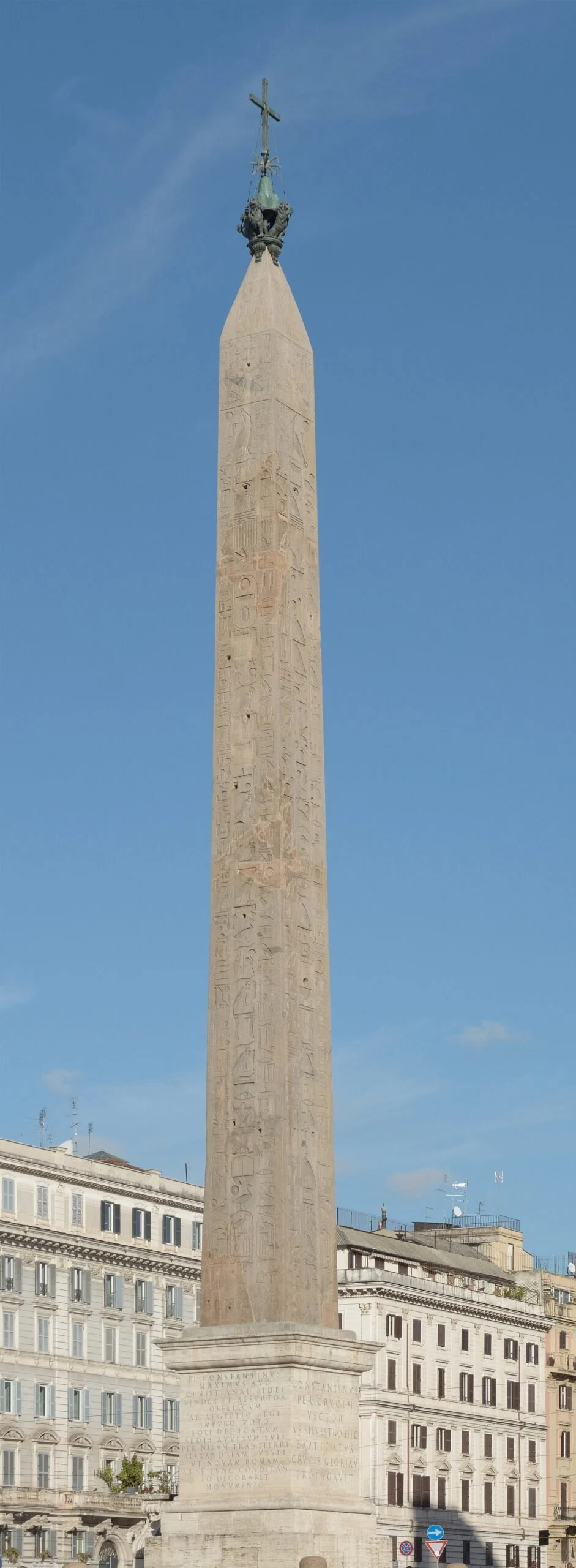
The Lateran Obelisk, in the center of Piazza San Giovanni in Laterano, is the tallest Egyptian obelisk in the world: a monolith of red Aswan granite 32.18 meters high, which comes close to 45.70 meters counting the modern base and the cross that crowns it. It is also the oldest of the obelisks of Rome, because it was cut in the Egyptian quarries in the 15th century BC for the temple of Amun at Karnak, and at the same time it is the last to arrive in the city from Egypt in ancient times, in AD 357, by the will of Emperor Constantius II. In the middle of those 17 centuries and in the 12 that followed there is a trip down the Nile to Alexandria, a ship built for the purpose, an erection in the Circus Maximus described by a contemporary historian, a fall whose date nobody recorded, seven meters of earth over the fragments, a find in three pieces in 1587 and a re-raising in 1588 that cost the monument a few meters of its original height. The lines that follow tell all this in full, with verified numbers and, where the sources don't agree, with the figures set side by side and an explanation of what they really measure.
Where the Lateran Obelisk is and how to get there
The Lateran Obelisk is in Piazza San Giovanni in Laterano, on the north side of the Basilica of St. John Lateran, between the side facade of the basilica with the loggia of the blessings and the building of the Holy Stairs. It's an outdoor monument, visible at any moment of the day and night, with no ticket, no fence and no hours: one of the very few great monuments of Rome that you can look at up close even at six in the morning on a January Monday.
On foot from the center and from the Colosseum
From the Colosseum you reach the Lateran in a walk of about 20 minutes along Via di San Giovanni in Laterano, the straight street that climbs gently toward the Caelian Hill passing next to the Basilica of San Clemente: it is one of the most beautiful and least crowded urban routes in the center of Rome, and whoever walks it crosses four layers of city in 20 minutes, from the Flavian amphitheater to the medieval basilica, from the 19th-century middle-class houses to the great papal square. Anyone starting instead from the Santa Maria Maggiore area can go down along Via Merulana, the great straight axis that connects the two basilicas and that was opened precisely in the 16th century with the same logic of linking the pilgrimage places: it's a little over 15 minutes of walking, slightly downhill, and at the end of the straight stretch the obelisk appears at the far end of the perspective, which is exactly the effect the 16th-century planners had in mind.
By public transport
The most convenient stop for the Lateran Obelisk is San Giovanni, on metro line A, from where you reach the square by walking a few minutes through Porta San Giovanni and the Aurelian Walls. San Giovanni station is also the terminus of metro line C, and its archaeological atrium, set up with the finds that emerged during the digging of the building site, is worth a 10-minute stop on its own before going back up to the surface. Alternatively the square is served by the surface tram network that connects the Lateran with the Verano, Trastevere station and the Prati district, and by several bus lines that run along Via Merulana and Viale Carlo Felice. Anyone arriving from Termini can choose indifferently the metro, with a single change or even without, or a surface bus along Via Merulana: travel times are similar, and it's best to check updated schedules and routes on the official channels of the Roman transport company, because the surface lines in the area are periodically diverted for construction work.
How tall the Lateran Obelisk really is: the figures compared
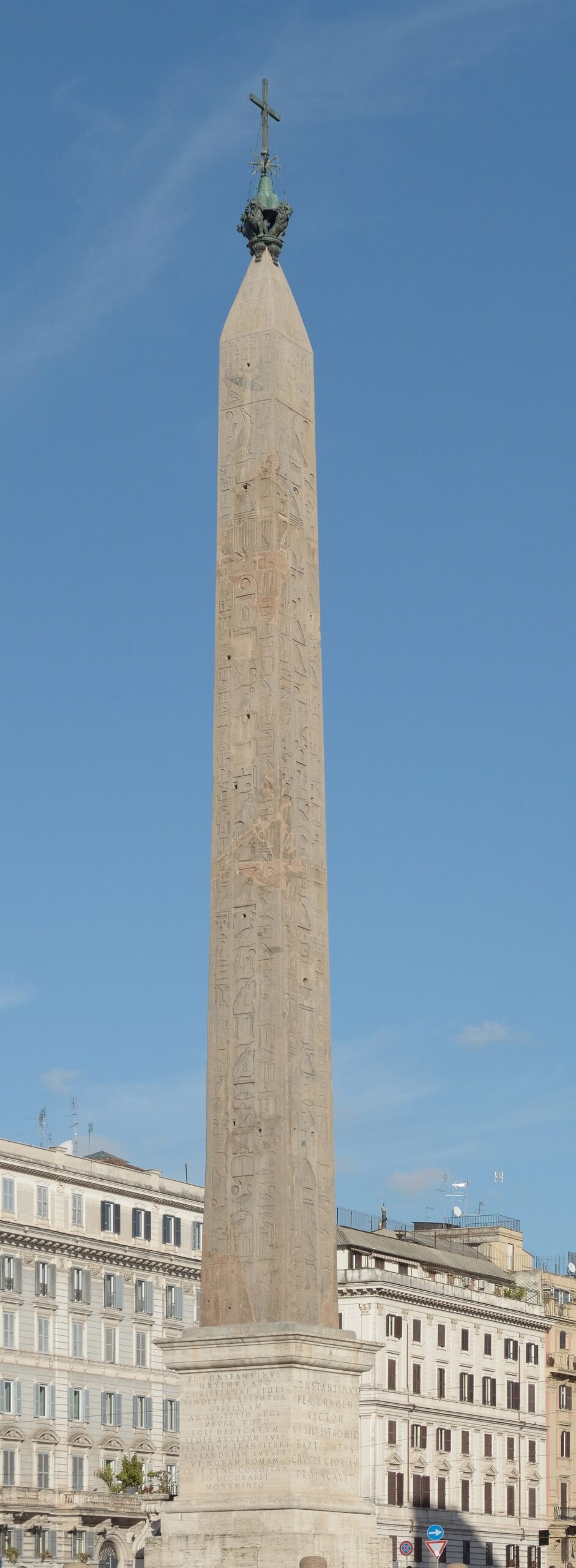
The most repeated figure is that the Lateran Obelisk measures 32.18 meters and that with the base and the cross it reaches 45.70 meters, and these are the two figures also given by the official tourist portal of Roma Capitale. They are correct numbers but they have to be read carefully, because they measure different things and because other authoritative sources give slightly different ones. It's worth clarifying the point right away, because this is where almost all the confusion you read around about the height of this monument comes from.
32.18 meters: the monolith, that is the stone
The figure of 32.18 meters refers to the granite shaft alone, that is the single block of stone that runs from the base of the monolith to the tip of the terminal pyramid, excluding the marble base it rests on and the metal cross that tops it. This is the measure that makes the Lateran Obelisk the tallest Egyptian obelisk in existence in the world, ahead of all the other ancient obelisks still standing, and the reason the record appears on every entry about it. Some sources give a slightly different value, around 32.50 meters, and the difference is explained by the measuring points chosen and the level from which you start counting: the shaft doesn't have a perfectly regular base, and depending on if you consider the actual bearing surface or the upper edge of the base you get numbers that vary by a few tens of centimeters.
45.70 meters: the whole monument, not the stone
The figure of 45.70 meters instead includes the entire monumental complex as Domenico Fontana delivered it in 1588 and as it has come down to us: the marble base with the Latin inscriptions and the heraldic coats of arms, the granite shaft, and the bronze cross that closes the monument at the top. When a guide or a sign announces that the obelisk exceeds 45 meters, therefore, they are not contradicting the figure of 32.18 meters: they are simply measuring the total height of the monument visible in the square, which is a useful figure for anyone who wants to understand the scale of the thing but is not the measure of the Egyptian obelisk as such.
The lost meters: the original height and the cut of the base
The third number is the one almost nobody cites and the most interesting: the obelisk you see today is shorter than the one the pharaohs saw standing at Karnak. Specialist sources on obelisks indicate that at the time of the find, in 1587, the monolith measured about 36 meters, and that in the work needed to put it back on its feet about four were lost: the lower part, the most damaged by the fall and by the long stay in the damp ground of the Circus Maximus, was cut off to obtain a sound, regular bearing surface on which to rest the entire weight. The University of California archaeological database dedicated to Karnak, on the other hand, gives for the original obelisk a height of 33.1 meters, calling it the tallest ever erected in the sanctuary. The two indications do not coincide, and the honest way to report them is to say that the exact height of the intact monolith is not established to the centimeter: what all the sources agree on is that the shaft visible today is cut short at the base compared to how it was cut in Egypt, and that the loss is of the order of a few meters, not a few centimeters.
The weight: 455 metric tons or 413?
On the weight of the Lateran Obelisk too the sources diverge, and the divergence has the same origin as the previous one. The official tourist portal of Roma Capitale and several Italian entries give 455 metric tons. English-language sources instead report an original weight of around 413 metric tons and a current weight, after the cut of the base, of around 300 metric tons. The range is wide and cannot be reduced to a conversion error: it depends on which body is being weighed, if the intact monolith as it left the Aswan quarries or the shortened monolith that rests today on the 16th-century base, and it also depends on the fact that nobody has ever put the obelisk on a scale. All the figures in circulation are estimates calculated from the volume of the block multiplied by the density of granite, and small differences in the geometric model adopted produce differences of tens of metric tons in the result. When you read a number precise to the kilogram on the weight of an obelisk, in short, you are reading the result of a calculation, not of a measurement.
The origin at Karnak: the unique obelisk of Thutmose III
The Lateran Obelisk was born in the 15th century BC in the red granite quarries of Aswan, in Upper Egypt, by order of the pharaoh Thutmose III, and was destined for the great sanctuary of Amun at Karnak, near Thebes. It was not an obelisk like the others, and not for a minor reason: Egyptian obelisks were almost always made in pairs and placed symmetrically at the sides of a temple entrance, while this one was conceived and remained a single piece, so much so that Egyptologists know it as the unique obelisk, a translation of the Egyptian name with which it appears in the inscriptions.
One obelisk, not a pair
The choice to erect an isolated monolith instead of a pair is documented by the hieroglyphic inscriptions carved on the shaft itself and is a notable exception in the architectural practice of the Egyptian New Kingdom. The monolith was not placed in front of a pylon as would have been normal for a pair, but in the eastern zone of the Karnak complex, in a sector of the sanctuary dedicated to the cult of the solar deities, behind the temple core of Amun-Ra. The position mattered: the eastern area of the temple faced the sunrise, and an isolated obelisk planted there had a symbolic value that a symmetrical pair at the sides of a door would not have had. According to the reconstruction of the University of California archaeological database dedicated to Karnak, with its 33.1 meters it was the tallest obelisk ever raised in the sanctuary, which nonetheless had quite a few obelisks.
The 35 years between the cutting and the erection
Thutmose III had the block extracted and worked but never saw it standing: he died before the erection took place, and the monolith stayed for decades lying in the temple enclosure waiting for someone to bring the undertaking to completion. It was his grandson Thutmose IV, reigning around 1400 BC, who had the operation carried out. The scholarly tradition indicates 35 years as the interval between the moment the block arrived at the temple and the moment it was raised, and the number 35 would appear precisely in the hieroglyphic inscriptions on one of the sides of the shaft. It must be said clearly that the precise interpretation of that datum is a matter of discussion among Egyptologists, and that popular sources report it with different nuances: some speak of the 35 years during which the obelisk lay waiting to be erected, others of 35 years taken by the workers to complete its decoration. The two readings are not equivalent, and whoever reports one as if it were a certain datum is silent about the fact that the other exists too.
The inscriptions: two hands three generations apart
On the four faces of the shaft run vertical columns of hieroglyphs, and these inscriptions tell a story in two voices. In the center of each face is the text wanted by Thutmose III. At the sides, added by Thutmose IV at the time of the erection, run two further columns per face that flank and complete those of his grandfather. It's a detail you grasp only by looking at the monument carefully or studying its reliefs, and it makes the shaft a layered document: the same stone carries the signature of two pharaohs separated by three generations and a long interval of inactivity of the building site. The texts celebrate the pharaoh in the act of making offerings to the deities, following the usual formulary of Egyptian royal titulary, and they were conceived to be read from top to bottom by someone standing at the foot of the monolith: whoever stops under the obelisk in Piazza San Giovanni in Laterano today has before their eyes, 34 centuries later, exactly the same written surface.
From Karnak to Alexandria: Constantine's project
The obelisk stood at Karnak for almost 17 centuries, until Emperor Constantine, in the first half of the 4th century AD, ordered its removal. The initial idea was not to bring it to Rome: Constantine intended to transfer it to the new capital he was founding on the Bosporus, Constantinople, as a visible sign of the shift of the empire's center toward the east. The monolith was detached, lowered and transported along the Nile to Alexandria, the great port of the eastern Mediterranean from which it was to leave for the open sea. There the project stopped.
The death of Constantine and the 20 years in Alexandria
Constantine died in AD 337 and the obelisk stayed in Alexandria, lying on the quay or in the port warehouses, for about 20 years. It's a striking detail: the largest monolith ever detached from the Egyptian quarries stayed for two decades waiting for an embarkation that nobody organized, while the empire split among Constantine's sons and their wars. When someone finally took the project back in hand, the destination had changed: no longer Constantinople, but Rome.
The transport by Constantius II and the erection in the Circus Maximus in 357
The obelisk arrived in Rome in AD 357 by the will of Constantius II, son of Constantine, and was erected on the spina of the Circus Maximus under the direction of the urban prefect Memmius Vitrasius Orfitus. The year is tied to the visit Constantius II made to Rome in that 357, his solemn entry into the old capital of the empire, and it is likely that the arrival of the monolith was planned to serve as a monumental corollary to that visit. Of the transport and the erection there is a contemporary account, that of the historian Ammianus Marcellinus, who devoted a passage of his 17th book to the matter.
What Ammianus Marcellinus tells
Ammianus Marcellinus was an officer of the Roman army and wrote his history in Latin in the second half of the 4th century, that is close to the events: he is a first-hand source, and precisely for this reason he has to be reported exactly and without decorative additions. The sense of his account is this. To carry the obelisk a ship of extraordinary size was built in Alexandria, able to take a load that no ordinary hull would have supported, and handling it required a crew of 300 oarsmen. The ship crossed the Mediterranean and went up the Tiber to a landing called vicus Alexandri, located about three miles from Rome along the river. From there the monolith was unloaded and dragged overland on wooden rollers, in a very slow march, through the Porta Ostiense and the area called the public pool, to the valley of the Circus Maximus. To put it back on its feet, an artificial forest of tall beams was built around the point of erection, connected by long, thick ropes in which the obelisk was slung. Thousands of men turned capstans like millwheels, and the monolith was raised little by little to the vertical position and set in the center of the track.
Anyone who has read the original passage knows that Ammianus lingers on the wonder of the crowd and on the slowness of the lifting with the relish of a witness, but a point of method is worth repeating: the sentences above summarize the sense of his account, they do not quote it literally. The Italian translations in circulation differ among themselves, and attributing to the Roman historian precise words that have not been verified against a critical edition would be incorrect. Anyone who wants to read the text in full will find it in the 17th book of the Histories, in any annotated edition of the Res gestae.
The lost inscription of the 24 hexameters
On the Roman base of the obelisk, the one on which the monolith rested in the Circus Maximus, there was a Latin inscription celebrating the undertaking of Constantius II: an honorary poem of 24 hexameters, that is a poetic composition in classical meter of 24 lines, distributed on the sides of the base. That base has not come down to us, but the text has: it was transcribed in 1587, at the time of the find, by someone who was able to see the fragments before they were reworked. It is one of the cases where the diligence of a 16th-century scholar saved a document that would otherwise have vanished entirely, and it is also the reason why today it is known with certainty that the obelisk of the Circus Maximus and the one in Piazza San Giovanni in Laterano are the same monument.
A curiosity about the Lateran Obelisk
The densest curiosity concerns a double record that almost all guides report halfway. The Lateran Obelisk is not only the tallest Egyptian obelisk in the world: it is also the oldest of the obelisks of Rome and, at the same time, the last to arrive in the city from Egypt in ancient times. The two things seem to contradict each other and instead describe the same fact from two different angles.
The oldest and at the same time the last to arrive
The stone was cut and carved in the 15th century BC, which makes it older than all the other Roman obelisks, including those brought by Augustus right after the conquest of Egypt. But the trip to Italy happened only in AD 357, almost four centuries after the arrival of the first Augustan obelisks and with the Christian empire well advanced: no other Egyptian obelisk reached Rome after it. The oldest monolith of the Roman collection is therefore also the one with the shortest Italian history, and this overturns the chronology that is instinctively taken for granted when looking at the obelisks scattered around the city.
The fall and the buried centuries
No source records the date on which the Lateran Obelisk fell in the Circus Maximus, and this absence is in itself a historical fact. The fall is placed generically between late antiquity and the early Middle Ages, with a recurring indication around the 7th century, but this is an estimate obtained indirectly, not a documented report. When the monolith broke, Rome was a very different city from the one that had welcomed it: the Circus Maximus no longer hosted regular races, the maintenance of public buildings had long since ceased and nobody thought to note down the event.
The possible causes: earthquake, fire, abandonment
There are three hypotheses on the cause and they do not exclude each other. The first is an earthquake: Rome suffered several of significant intensity during the first millennium, and a monolith more than 30 meters tall resting on a base is exactly the type of structure that a quake brings down. The second is a fire or a collapse of the circus structures, which would have compromised the base and made the shaft lose its balance. Some popular reconstructions explicitly speak of a collapse during a fire, but it should be pointed out that this version does not rest on an explicit ancient source. The third, the most prosaic, is simple abandonment: without maintenance, with the ground of the Murcia valley increasingly damp and unstable from the periodic flooding of the watercourses that flowed into it, the base may have given way on its own. The fact that the monolith broke into three pieces indicates in any case a violent fall onto a rigid surface, not a slow tilting.
The find of 1587: three pieces in the Circus Maximus
The Lateran Obelisk was found in 1587 along the spina of the Circus Maximus, broken into three pieces and buried at a depth of about seven meters. The dig was not a chance discovery but a targeted search: Pope Sixtus V, elected in 1585, had launched a systematic program of recovering and re-erecting the Roman obelisks, and knew from ancient sources that two Egyptian monoliths had to be on the spina of the Circus Maximus. He had them searched for, and found both.
Something nobody tells you about the Lateran Obelisk
The thing almost nobody tells is that the tallest monument in its category is shorter than it used to be, and that it is so because of a deliberate choice made in 1587. To put the broken monolith back on its feet a sound, regular bearing base was needed, able to hold hundreds of metric tons without chipping: the lower portion of the shaft, the one that had taken the impact of the fall and had stayed for centuries in contact with the damp ground, offered nothing of the kind. So it was cut away.
Four meters sacrificed to be able to stand
Specialist sources on obelisks indicate that at the time of the find the monolith measured about 36 meters and that after the reworking it measured 32.18: the difference, roughly four meters, corresponds to the part removed. Along with the stone, the final portion of the hieroglyphic inscriptions and any trace of the original fitting on the Egyptian base were lost. It's a price that the contemporary culture of restoration would never agree to pay, but that in the 16th century appeared not only reasonable but obvious: the goal was to give the city back an obelisk standing and working as an urban signal, not to preserve an archaeological fragment in its material integrity.
The re-raising of 1588: Sixtus V and Domenico Fontana
The Lateran Obelisk was put back on its feet in Piazza San Giovanni in Laterano in 1588, by the will of Pope Sixtus V and at the hands of the architect Domenico Fontana, who two years earlier had already completed the analogous and much celebrated undertaking of the Vatican obelisk. It was the second of Fontana's great lifting operations and, for the size of the load, the most demanding of all: the Lateran monolith is decidedly larger than the Vatican one.
The exact date: three different versions
On the precise date of the erection the sources do not agree, and the fact has to be reported without flattening it. The official tourist portal of Roma Capitale gives August 3, 1588 as the day of the inauguration in Piazza San Giovanni in Laterano. Other sources give August 9, 1588, still others August 10, 1588. The discrepancy is probably explained by the fact that the operations took place in several phases and that there is a difference between the day the shaft reached the vertical, the day the assembly was completed and the day of the solemn ceremony of consecration with the cross: different sources record different moments of the same undertaking. What all agree on is the year, 1588, and the month, August.
The Fontana method: timber frame, capstans, men and horses
The system devised by Domenico Fontana for the Vatican and reapplied at the Lateran was conceptually simple and practically formidable. Around the point of erection a frame of large-section wooden beams was built, a scaffolding able to hold the entire weight of the suspended monolith. From the frame hung dozens of ropes and pulleys connected to the shaft, which was slung in a wood-and-iron case to distribute the stresses and keep the stone from chipping. The ropes were driven by capstans on the ground, each moved by teams of men and by horses, and the operation required all the capstans to work in perfect synchrony, because an asymmetric effort would have made the load rotate. Fontana solved the coordination problem with a system of sound signals, trumpets and bells, that marked the timing for all the teams at the same time. The principle was not new, but the scale at which it was applied and the degree of organization required were, and the Vatican undertaking of 1586 made Fontana the most celebrated engineer in Europe.
The cross, the coats of arms and the lions of the base
The monument was not put back up as it was: it was Christianized. On top of the shaft a metal cross was placed, and the new marble base received four Latin inscriptions, dated 1588, that recall on one side the Egyptian origin of the monolith and the transport wanted by Constantine and Constantius, on the other the re-raising carried out by Sixtus V. The Lateran inscriptions insist in particular on the link between the monument and the memory of Constantine, the emperor who according to ecclesiastical tradition was baptized precisely at the Lateran: a pairing that had an evident propaganda value in the climate of the Counter-Reformation, and that has to be read as an operation of meaning wanted by the patron more than as a historical reconstruction. At the base four figures of lions attributed to Ludovico del Duca were placed. It must be pointed out that the tradition of the baptism of Constantine at the Lateran is a matter of discussion among historians and is not an established fact: the ancient sources place the emperor's baptism elsewhere and on his deathbed, and the Lateran version belongs to the medieval tradition tied to the so-called Donation of Constantine.
The Sistine program: four obelisks to mark the city
The Lateran Obelisk is not an isolated episode but the third act of a precise urban program: between 1586 and 1589 Pope Sixtus V had four obelisks raised at four key points of Rome, all at the hands of Domenico Fontana. Understanding that program is the key that holds together all the obelisks of the city, and without it the Lateran monolith remains a curious object in the middle of a square instead of the node of a network.
The four obelisks and their dates
The first was the Vatican obelisk, moved from the side of the basilica to the center of the square of St. Peter's in 1586: about 25.50 meters tall, it had been brought from Egypt in imperial times and had never fallen, but it had to be moved by a few tens of meters, and it is precisely that move that made Fontana famous. The second was the Esquiline obelisk, re-raised in 1587 in Piazza dell'Esquilino, behind Santa Maria Maggiore: about 14.75 meters tall, it comes from the mausoleum of Augustus and was paired with the one that today stands at the Quirinal. The third was the Lateran, in 1588, the largest of all. The fourth was the Flaminio obelisk, re-raised in 1589 in the center of Piazza del Popolo: about 25.90 meters tall, brought from Egypt by Augustus and found in the same dig of the Circus Maximus that had given back the Lateran one.
Why exactly those four points
The choice of places has nothing random about it. Piazza del Popolo was the northern gate of the city, the point where pilgrims arriving from Europe along Via Flaminia entered Rome: planting an obelisk there meant giving the traveler a signal visible from afar and a point of orientation as soon as they passed the gate. St. Peter's, Santa Maria Maggiore and San Giovanni in Laterano were three of the great basilicas of the Roman pilgrimage, the destinations that anyone coming to Rome for religious reasons had to visit. Placing an obelisk in front of each meant making every destination recognizable from a distance, in a city that did not yet have the great modern straight axes and in which finding your way on foot among alleys and changes in level was anything but easy. The obelisks worked, in short, as vertical urban signage, visible above the rooftops: the Sistine project is one of the first documented cases in Europe of urban planning explicitly conceived for the legibility of the city by those who don't know it.
The Sistine streets: the network that connects the points
The obelisks were the nodes. The streets were the threads. Sixtus V, in a very brief pontificate that ran from 1585 to 1590, had a series of straight arteries opened that connected the basilicas and the high points of the city to one another, going beyond for the first time the logic of the medieval fabric made of alleys and irregular open spaces. The Lateran was the head of this network: from the square of the obelisk the axes started toward Santa Maria Maggiore and toward Holy Cross in Jerusalem, and the monolith was the perspective backdrop seen at the end of the straight stretch when arriving from afar. The same pontificate completed the Acqua Felice aqueduct, which brought water to the eastern hills making livable neighborhoods that until then were semi-deserted, and had the statues of St. Peter and St. Paul placed on top of Trajan's Column and the Column of Antoninus: the logic was always the same, taking the monuments of pagan antiquity and reorienting them toward a Christian and urban function.
The cross on top: a gesture with a precise meaning
All four Sistine obelisks were crowned with a cross, and the choice was not decorative. In the language of the Counter-Reformation, placing a cross on the tip of a monument born for Egyptian solar worship and reused by imperial paganism meant declaring publicly that the monument had passed under another symbolic sovereignty. On the bases of the Sistine obelisks Latin inscriptions were carved that say this idea explicitly, and the ceremonial of consecration that accompanied the erections made it a religious act as well as a civic one. It's a chapter that has to be told for what it is, that is as a cultural and political operation of its time: without being scandalized and without sweetening it, because it is precisely that operation that saved from decay four monoliths that would otherwise have stayed buried.
The obelisks raised after Sixtus V
The Sistine program set a school and the following popes continued it for over two centuries, obelisk after obelisk: in 1651 Innocent X had the Agonal obelisk placed at the center of the Fountain of the Four Rivers in Piazza Navona, in 1667 Alexander VII placed the small obelisk of the Minerva on Bernini's little elephant, in 1711 Clement XI erected the Macuteo obelisk in front of the Pantheon and at the end of the 1700s Pius VI raised those of the Quirinal and of Montecitorio. Rome is today the city with the largest number of Egyptian obelisks erected in public spaces in the world, and the reason lies entirely in this chain of building sites that starts from 1586.
My advice for visiting the Lateran Obelisk
The Lateran Obelisk can be visited for free and at any hour, because it stands in an open public square: the most useful advice therefore does not concern tickets or reservations, which are not needed, but the time of day and the way of looking at it. The square is large, exposed and almost without shade, and this changes the experience completely depending on the hour you arrive.
The right hour and the question of shade
In the middle hours of a summer day the open space around the obelisk is one of the hottest points in the center of Rome: paved surface, no trees in the immediate vicinity of the monument and glare from every side. Anyone arriving between noon and four in the afternoon from June to September would do well to bring water and a hat and plan the stop as a short one, then moving inside the basilica, where the temperature is far more bearable. The best moment is early morning, when the raking light brings out the hieroglyphs carved on the faces of the shaft, or the hour before sunset, when the red granite takes on a warm color that it doesn't have at noon.
How much time you need and how to fit it into the day
For the obelisk itself 10 or 15 minutes are enough: the time to walk around it, to read the four Latin inscriptions of the base and to raise your eyes to the hieroglyphs. It makes little sense, though, to come to the Lateran only for the monolith, because within a radius of 300 meters there are the basilica, the baptistery, the Scala Santa with the sancta sanctorum and the stretch of Aurelian Walls with Porta San Giovanni. Putting it all together builds a full half day, which can be closed by walking down toward the Colosseum with a stop at the Basilica of San Clemente and its underground levels. For the Lateran basilica and for the Scala Santa it's best to check hours and access conditions in advance on the official channels, because they vary with liturgical celebrations and on feast days.
The square, the fountain and the Lateran context
At the foot of the Lateran Obelisk there is a 17th-century fountain in marble and travertine, fed by the Acqua Felice aqueduct, whose works were completed in 1607. The attribution is not certain: the entry of the Capitoline Superintendency recalls that the names of Pietro Bernini, Flaminio Ponzio, Domenico Fontana and Taddeo Landini have been proposed, without any of them being definitively confirmed. The funds were allocated by the Lateran Canons and the building site is believed to have been started on the occasion of the Jubilee of 1600.
The dolphins, the eagle and the dragons
The fountain is composed of a scalloped basin surmounted by a pair of dolphins holding up a shell valve, from which water spouts through two winged dragons and an eagle. Eagle and dragons are not a decorative whim: they are the figures of the family coat of arms of Pope Paul V Borghese, whose pontificate runs from 1605 to 1621 and under whom the work was completed. Other decorative elements, including lion motifs and festoons, recall instead the heraldry of Sixtus V. Whoever looks at the fountain with this code in hand reads the succession of patrons on the marble as in a document. On the occasion of the Jubilee of 2000 a protected area was created around the monument, which is the arrangement you see today.
Another well-known fact, yet rarely cited
It's well known that Rome has more Egyptian obelisks than any other city in the world, Egypt included if you count those erected in public spaces. What is cited much less often is the structural reason for this record: the Roman obelisks did not all arrive together and were not all raised together, and the fact that they are standing today depends almost entirely on a decision made between 1585 and 1590.
Without Sixtus V, they would still be underground today
In the middle of the 16th century the obelisks erected and visible in Rome were very few: most lay broken and buried under meters of earth, exactly like the Lateran one in the Circus Maximus. It was the Sistine program and the building sites that followed, continued by the popes of the next two centuries, that transformed an invisible heritage into a system of visible monuments. The density of obelisks you cross today walking around Rome, from the Pantheon to Piazza Navona, from the Pincio to the obelisks of Villa Torlonia, is not a direct legacy of antiquity: it is the result of three centuries of papal building sites that put back on their feet what antiquity had let fall.
The right photo to take at the Lateran Obelisk
The right photo at the Lateran Obelisk is not the frontal one that everybody takes as soon as they step off the sidewalk, because a monolith over 30 meters tall photographed up close with a phone becomes a distorted trapezoid with no reference of scale. The technical problem to solve is twofold: convey the idea of the height and at the same time make clear where you are.
Step back and frame the basilica
The most effective solution is to move 20 or 30 meters away toward the side of the Scala Santa and compose the frame vertically, keeping the obelisk on one of the thirds lines and the north facade of the basilica with the loggia of the blessings on the other. This way the architecture acts as a yardstick and the eye immediately understands how tall the monolith is. If there are people crossing the square, so much the better: a human figure at the foot of the base is the most readable scale reference there is.
The detail almost nobody takes home
The second photo to take is the opposite of the first: get close to the shaft early in the morning or in the late afternoon, when the light comes in raking, and shoot horizontally a portion of the hieroglyphs carved in the granite. With side light the carvings take on relief and can be read, while at noon they look flat and almost invisible. It's the image that best tells the hardest thing to believe about this monument, which is that those signs were carved in the 15th century BC and are still there, outdoors, under the sky of a Roman square.
Some important events that happened here in history
Piazza San Giovanni in Laterano was for more than a thousand years the center of papal power, before that center moved to the Vatican, and the open space on which the obelisk stands today has seen a number of events that no other Roman square can claim in comparable quantity.
The erection of 1588 as a public event
The re-raising itself was the most spectacular event the square had hosted in centuries: a building site lasting months, a timber frame as tall as a bell tower, hundreds of men and dozens of horses at the capstans, and a crowd that watched the moment the monolith reached the vertical. It should be remembered that this was Fontana's second lift after the Vatican success of 1586, and that failure would have meant not only the destruction of the monument but the professional ruin of the architect: the attention with which Rome followed the building site was the kind reserved for an undertaking whose outcome is anything but certain.
The contemporary square
In the contemporary era Piazza San Giovanni in Laterano has become the square of the great Roman public demonstrations, from union marches to political rallies, and since 1990 it hosts every May 1 the concertone, the big free concert that fills the open space with hundreds of thousands of people. The obelisk stays at the center of all this, with the stage usually set up on the side of the basilica and the crowd spread around the monolith: it is one of the rare occasions when an Egyptian monument 34 centuries old serves as the backdrop to a popular music event. The square has also known dramatic pages: in the night between July 27 and 28, 1993 a car bomb exploded in front of the basilica, on the same night as the Mafia attacks that also hit the church of San Giorgio in Velabro in the Forum Boarium, causing very serious damage to the facade and to the Palazzo del Vicariato.
Who has passed by the Lateran Obelisk
The list of who has passed next to this monolith begins at the foot of an Egyptian temple 34 centuries ago and has not yet closed. It's a list worth running through because it puts in a row people who have nothing in common except having been, at different moments, in front of the same stone.
The pharaohs, the emperors, the popes
Thutmose III ordered its extraction and never saw it standing. His grandson Thutmose IV had it erected at Karnak and added his own inscriptions. Constantine ordered its removal for the new capital on the Bosporus and died before seeing it leave Alexandria. Constantius II had it brought to Rome in 357 and dedicated it on the spina of the Circus Maximus, where the urban prefect Memmius Vitrasius Orfitus directed the works. Ammianus Marcellinus, historian and army officer, described its transport for the readers of his time and for all those who would come after. 1,200 years later Pope Sixtus V ordered its recovery and Domenico Fontana put it back on its feet where it stands today, with a ceremony in August 1588.
Travelers, engravers, crowds
From the 17th century onward the obelisk entered the itinerary of Grand Tour travelers for good, who came to the Lateran for the basilica and were struck by the monolith: the views engraved in the 18th century portray it dozens of times, often exaggerating its height relative to the square to emphasize the effect. In the 20th century the crowds of the Jubilee pilgrimages, the May Day marches and the demonstrations that made Italian political history passed in front of it. The overall count of those who have raised their eyes to this stone, adding up Karnak, the Circus Maximus and the Lateran, cannot be calculated. What can be said is that very few man-made objects have been looked at by so many people for so long.
Frequently asked questions about the Lateran Obelisk
How tall is the Lateran Obelisk?
The Lateran Obelisk measures 32.18 meters of granite shaft alone and reaches 45.70 meters counting the marble base and the cross that tops it. The first figure is the one that earns it the record of tallest Egyptian obelisk in the world, because it measures the monolith. The second describes the whole monument as it was completed in 1588. Some sources give slightly different values for the shaft, around 32.50 meters, depending on the point from which you start measuring.
How much does it cost to visit the Lateran Obelisk?
Visiting the Lateran Obelisk costs nothing: it stands in the center of Piazza San Giovanni in Laterano, in an open public space, with no ticket, no fence and no opening hours. The basilica, the baptistery and the Scala Santa that face the same square have their own access conditions instead, and for those it's best to check hours and arrangements on the official channels before going.
How do you get to the Lateran Obelisk by public transport?
You get to the Lateran Obelisk by metro, getting off at the San Giovanni stop on line A, which is also the terminus of line C, and walking a few minutes through Porta San Giovanni. The square is also served by the surface tram network and by several bus lines that run along Via Merulana and Viale Carlo Felice. It's best to check updated routes and schedules on the official channels of Roman public transport, because the surface lines in the area are periodically diverted.
Why was the Lateran Obelisk in the Circus Maximus?
The Lateran Obelisk was erected in the Circus Maximus in AD 357 because Emperor Constantius II wanted to place it on the spina of the track, where an obelisk brought by Augustus had stood since 10 BC. Putting a larger monolith next to that of the founder of the empire, in the most frequented public place in Rome, was a political gesture legible to anyone who attended the races.
When was the Lateran Obelisk found?
The Lateran Obelisk was found in 1587 along the spina of the Circus Maximus, broken into three pieces and buried at a depth of about seven meters. The dig was a targeted search wanted by Pope Sixtus V, who knew from ancient sources of the presence of two obelisks at that spot: the building site gave back both, and the second was then raised in Piazza del Popolo in 1589.
How many obelisks did Sixtus V have erected in Rome?
Sixtus V had four obelisks erected in Rome between 1586 and 1589, all at the hands of Domenico Fontana: the Vatican one in St. Peter's Square in 1586, the Esquiline one behind Santa Maria Maggiore in 1587, the Lateran one in Piazza San Giovanni in Laterano in 1588 and the Flaminio one in Piazza del Popolo in 1589. They served to make the destinations of the Roman pilgrimage and the entry points to the city recognizable from afar.
Is the Lateran Obelisk accessible to people with disabilities?
The Lateran Obelisk stands in a flat, paved public square, reachable without stairs and observable from every side, which makes it in general accessible to those who move in a wheelchair. The San Giovanni station of metro line C is equipped with elevators, while for the buildings facing the square it's best to check the specific access conditions with each facility.
How much time do you need to see the Lateran Obelisk?
For the Lateran Obelisk 10 or 15 minutes are enough, the time to walk around it and read the inscriptions of the base. It makes sense, though, to fit it into a wider visit to the Lateran complex, among basilica, baptistery, Scala Santa and Aurelian Walls, which easily takes half a day and can continue on foot toward San Clemente and the Colosseum.
Can you photograph the hieroglyphs of the Lateran Obelisk?
The hieroglyphs of the Lateran Obelisk can be photographed freely, since it is an outdoor monument in a public space. The best result is obtained early in the morning or in the late afternoon, when the raking light gives relief to the carvings: in the middle hours of the day the flat light makes them almost invisible in photographs.
One last piece of advice for those planning the itinerary
The Lateran Obelisk works better as the pivot of a day at the Lateran than as an isolated stop: anyone with few days in Rome will do well to link it to the basilica, the Scala Santa and the descent toward the Colosseum, instead of putting it in a tour of obelisks that forces you to cross the city back and forth. Anyone who has time and wants to follow the thread of the Sistine program can build a route that touches, in order, Piazza del Popolo, St. Peter's Square, the Esquiline and the Lateran: it's an itinerary done in a full day by public transport and that tells, as you walk, how a pontificate of five years rewrote the map of Rome.
Anyone planning a wider itinerary in the center of Rome, crossing this stop with the other stops of the area and with the pilgrimage basilicas, can find useful planning tools on Tour Leader Pro, while for a wider picture of transport and destinations in Lazio Italy Planner is a good resource.