Rome’s neighborhood fountains
In short. Rome's neighborhood fountains, the fontanelle rionali, are a series of small travertine fountains designed by the architect Pietro Lombardi and mostly inaugurated in 1927, spread across Monti, Pigna, Sant'Eustachio, Campo Marzio, Borgo,…
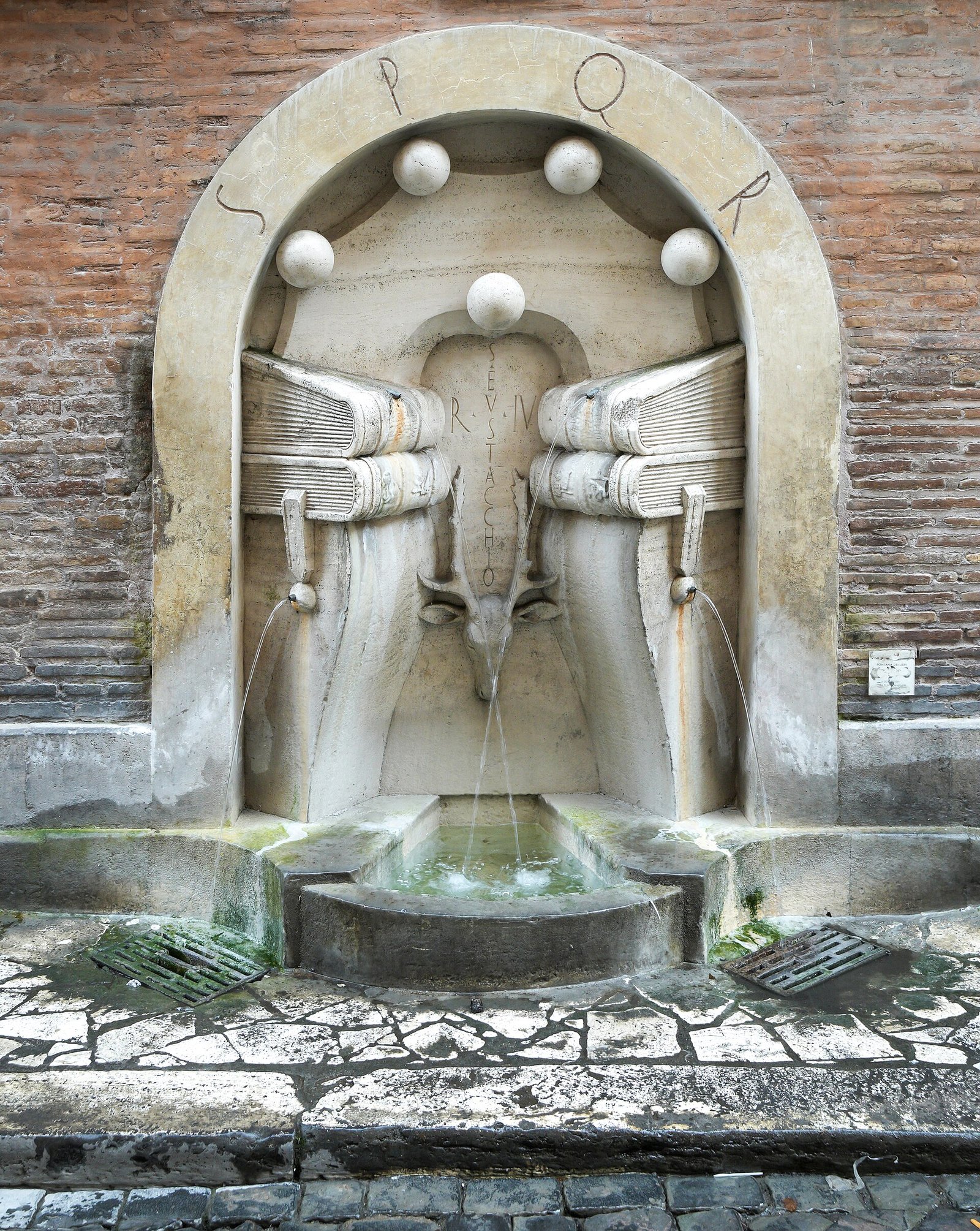
Rome's neighborhood fountains, the fontanelle rionali, are a series of small travertine fountains designed by the architect Pietro Lombardi and mostly inaugurated in 1927, spread across Monti, Pigna, Sant'Eustachio, Campo Marzio, Borgo, Trastevere, Ripa and Testaccio. You can see them for free, from the street, at any hour: no ticket, no fence, no single address. They belong to the heritage of Roma Capitale, and the Sovrintendenza Capitolina and the Turismo Roma portal publish their historical descriptions.
Each fontanella carries the sign of the rione or of the trade that characterized it: books for the Sapienza university, a barrel for the taverns of Trastevere, a rudder for the port of Ripa Grande, tiaras and keys for the Vatican Borgo, easels and palettes for the artists of via Margutta. On the exact number the sources don't agree. Turismo Roma lists nine, the page on the Fontana della Botte speaks of 10, the City's site of 11, counting the ones that were lost or moved.
Data checked on September 29, 2026 on the Roma Capitale Turismo Roma portal, on the City's institutional site and on the Sovrintendenza Capitolina site. None of these sources publishes hours or closures, because the fontanelle are on open streets and squares. The complete tour is done on foot in one day, or in two half days split between the left and right banks of the Tiber. Below you'll find the list, the locations and a route in logical order.
At a glance: address, hours, ticket
- Address: Rome, the rioni of the center. Nine fontanelle on nine different streets, from via di San Vito to piazza Testaccio.
- Operator: Roma Capitale, with the Sovrintendenza Capitolina protecting the historic fountains.
- How to get in: there's no entrance, they're all on public streets and squares.
- Price: free, no reservation.
- Hours: no published hours, you can see them day and night.
- Getting there: on foot from one rione to the next, the complete tour touches 8 rioni on both banks of the Tiber.
- Accessibility: the operator doesn't publish specific information, almost all of them are at street level.
Where they are and what you actually see
People who arrive in front of a neighborhood fountain often expect something bigger. These are small works, barely taller than a person or set against a wall, in light travertine, with two or three water spouts and a small basin. They have no steps to sit on and no squares built around them, apart from the Fontana delle Anfore. Their strength is in the detail: the sculpted subject tells you at a glance which rione you're in.
The distribution follows the geography of the historic rioni. Two fontanelle are in Borgo, between the colonnade of St. Peter's and Castel Sant'Angelo. One is in Monti, or rather just past the border, on via di San Vito. One is in piazza San Marco, at the foot of piazza Venezia. One is between the Pantheon and piazza Navona, one on via Margutta, one in Trastevere, one at Ripa Grande and the last, the biggest, in the middle of piazza Testaccio.
The material is always the same, travertine, and the language repeats too: simple shapes, stylized symbols, the coat of arms of Rome or the name of the rione carved in. That's why, seen in sequence, the fontanelle work as a collection. Seen alone, a fontanella can look like any piece of street furniture. Seen all together, they tell how the city administration of the 1920s wanted to give a recognizable face to the rioni, whose borders and numbering had just been redrawn.
What you don't see, on the other hand, is a monument to visit in the classic sense. There are no panels, explanatory plaques or signs with the date, except for the inscriptions carved in the stone. The historical information is found online, on the pages of the City's tourism portal and of the Sovrintendenza. My advice is to read the history of each fontanella first and then go looking for it, because on site nobody explains the context and the most interesting detail risks going unnoticed.
Which are the neighborhood fountains and where are they?
The list that follows takes up the nine fontanelle that the Turismo Roma portal attributes to Pietro Lombardi, with the location given by the official pages. The order is that of the walking tour proposed further on, from east to west and then to the south. For each one you'll find the reference rione, the symbol and a few details to look for. Where the official sources differ on the date or the place, we point it out in the entry for the individual fountain.
Fontana dei Monti, via di San Vito
It's on via di San Vito, along the side of the church of Santi Vito e Modesto, a few steps from the Arch of Gallienus. The subject is three mountains stacked on top of each other with the stars, the coat of arms of the rione Monti, from which the water falls into three small suspended basins. The fountain is raised above the street with a few steps. The curious thing is that via di San Vito, after the reform of the borders, falls in the rione Esquilino and no longer in Monti.
It's the most out-of-the-way fontanella on the left bank, far from the main tourist routes, and for exactly that reason you look at it calmly. The three mountains with the stars are the coat of arms of the rione, and anyone who has already seen the shield of Monti elsewhere recognizes it right away. It's best to arrive from the Arch of Gallienus, so that within a few meters you have in front of you an ancient arch, a church of ancient foundation and a fountain from the 1920s.
Fontana della Pigna, piazza di San Marco
It's on one side of the small square in front of the church of San Marco, facing piazza Venezia. Turismo Roma describes it as two stylized tulip corollas holding a pine cone, the symbol of the rione, with the water coming out of the side taps and from the top of the pine cone and falling into two small basins on the ground, protected by four bollards. The same portal says that the water comes from the Acqua Marcia and is drinkable.
The position is the most exposed of the series. Behind it is the Vittoriano, in front the traffic of piazza Venezia, to the side the basilica of San Marco. The fontanella is small compared with everything around it and many people walk past without seeing it. It's worth stopping a few minutes in the small square, where the travertine pine cone reads well and where drinking water comes in handy on hot days.
Fontana dei Libri, via degli Staderari
It's on via degli Staderari, inside a niche at the back of the Palazzo della Sapienza, between the Pantheon and piazza Navona. In the center is the stag's head of the rione Sant'Eustachio, at the sides four ancient books resting on shelves, with the water coming out of the bookmarks. The reference is to the ancient university that was housed in the palace, today the Archivio di Stato. Turismo Roma dates it to 1927.
The niche is narrow and deep, and the street doesn't leave much room to step back. Without people in front, the whole reads much better. The street connects the Senate to the Pantheon and at peak hours it's very busy. My advice is to get there before 9 or after sunset, when the street empties and you can hear the sound of the water again.
Fontana degli Artisti, via Margutta
It's on via Margutta, in the rione Campo Marzio, between piazza del Popolo and piazza di Spagna. It's a pyramid of easels, compasses, stools and palettes stacked on top of each other, with two masks, a sad one and a cheerful one, and at the top a bucket with brushes and sculptor's hammers. The water comes out of the masks and from the joint of the compass. According to Turismo Roma it was inaugurated in October 1927.
Via Margutta is much quieter than the parallel streets, via del Babuino and via del Corso. The fontanella is along the route, with no square around it, and you discover it as you walk. The temptation is to glance at it and keep going toward piazza di Spagna. It's better to look carefully at the composition instead: every tool of the trade is recognizable, and the bucket at the top holds painting and sculpture together in a single gesture.
Fontana delle Palle di Cannone, via di Porta Castello
It's on via di Porta Castello, just past the arches of the Passetto di Borgo. In the middle of a small travertine arch is the coat of arms of the city, in front a pyramid of stone balls, and a chubby mask serves as the main spout. Two side jets fill the basins at the sides. The reference is to the cannonballs of Castel Sant'Angelo, which in Borgo is a few minutes' walk away, and the symbol reads without needing any explanation.
The street is a passage between the castle and the Vatican, narrow and with parked cars. The fontanella is set against the wall and you only notice it if you look for it. The detail not to overlook is the mask, which gives an almost ironic tone to a military subject. If you arrive from Castel Sant'Angelo along the Passetto you meet it before the Fontana delle Tiare, and it's the most natural way to see them in sequence.
Fontana delle Tiare, largo del Colonnato
It's on largo del Colonnato, right up against the colonnade of St. Peter's Square and the Passetto di Borgo. It's all travertine, with a central pillar decorated with the keys of Peter and the tiaras, the headgear the popes wore at their coronation. Six spouts pour the water into three shell-shaped basins. Among the fontanelle it's the one with the plainest design, and the closest to a great monument.
The contrast with Bernini's colonnade, a few meters away, is intended or at least unavoidable. The fontanella doesn't try to compete with the square, it stays to the side, with a clean design and clear symbols. The area is very busy with people coming and going from St. Peter's, and during the basilica's opening hours the line of pilgrims and visitors passes right beside it. In the evening and early in the morning you can look at it without a crowd.
Fontana della Botte, via della Cisterna
It's on via della Cisterna, behind piazza San Callisto, in Trastevere. It's set against a brick wall and framed by a travertine arch. In the center is a barrel, at the sides two wine measures of one liter, beneath a vat for the must. The water comes out of the central hole of the barrel and falls into the vat, two more jets come out of the measures. Turismo Roma dates it to 1927 and links it to the wine trade and the taverns of the rione.
Via della Cisterna is a side street, far from the chaos of Trastevere's main squares, and it's easy to walk past it without turning in. The fontanella is clearly visible as soon as you turn the corner. The wine symbol is the most immediate of the series, and even someone who knows nothing about the rione understands right away what it's about. It's worth looking at the two one-liter measures at the sides, which are the most carefully made detail.
Fontana del Timone, Porto di Ripa Grande
Turismo Roma places it at the Porto di Ripa Grande, near the complex of San Michele a Ripa and Porta Portese. The subject is a rudder with its tiller, from which the water falls into a semicircular basin, between two small columns that recall mooring bollards. At the sides of the rudder are two coats of arms with the letters S.P.Q.R. The fontanella refers to the rione Ripa and to the river port, even though today it stands on the Trastevere side.
The area of Porta Portese and San Michele a Ripa is wide, with traffic and open spaces along the Tiber, very different from the narrow streets of the center. Here the river is close and the reference to the port of Ripa Grande is easier to understand than elsewhere, even though almost nothing visible remains of the ancient port. The fontanella is the last stop on the right bank before crossing toward Testaccio.
Fontana delle Anfore, piazza Testaccio
It's in the middle of piazza Testaccio and it's the biggest of the group. The Sovrintendenza Capitolina describes it as circular in plan, on two steps, with a pinnacle of amphorae and four radial basins decorated with coats of arms and ram's heads. It was inaugurated on October 26, 1927, moved in 1935 to piazza dell'Emporio because of ground subsidence and brought back to piazza Testaccio with the inauguration of January 24, 2015.
The City's site calls it the most monumental of the series, and the comparison with the others confirms it right away. Here the fountain is the square, not a street detail. Around it is the bustle of the rione, and the fountain has become again a meeting point for those who live in Testaccio. The amphorae, according to the City, evoke the ancient Emporio, the great commercial port of Republican Rome that stood along the river not far away.
A curiosity about Rome's neighborhood fountains
The Fontana dei Libri carries a mistake carved in stone. The inscription reads S. EVSTACCHIO R IV, that is rione number four, but according to the Turismo Roma portal Sant'Eustachio is rione VIII. None of the open sources explains where the mistake comes from, and in the text we don't try to guess. The fact remains that the most photographed fontanella of the series has declared a wrong number for almost a century, in front of the eyes of thousands of people who pass every day.
The name of the street also has a story that the fontanella helps you understand. Via degli Staderari takes its name from the artisans who made staderas, the steelyard scales with a sliding weight, active in the area according to Turismo Roma. The books, instead, speak of the Studium Urbis, the university housed in the Palazzo della Sapienza, the one with the spiral dome of Sant'Ivo alla Sapienza. Two trades, one manual and one intellectual, on the same street.
A second curiosity concerns the Fontana dei Monti. The symbol of the three mountains with the stars is that of the rione Monti, but the fontanella is on via di San Vito, which after the reorganization of the borders falls in the rione Esquilino. Anyone who looks for it on the map of Monti doesn't find it. Anyone who goes from the Arch of Gallienus toward piazza Vittorio stumbles on it without meaning to, on the side of the church of Santi Vito e Modesto.
One thing nobody tells you about Rome's neighborhood fountains
The complete series, one fontanella for each of the 22 rioni, never existed. The City's site writes that the competition asked for fountains dedicated to the 22 rioni, and the Turismo Roma page on the Fontana degli Artisti speaks of 22 similar fountains. The fontanelle that were built and have come down to us are nine, however, according to the same portal. The project was left half done, and many rioni, from Parione to Regola, never had theirs.
The Fontana delle Anfore too, which almost all the lists put at the head of the series, has a different story from the others. The Sovrintendenza Capitolina writes that it comes from a national competition of 1924 for five fountains intended for the squares of the newly built neighborhoods, won by Lombardi. Testaccio in those years was a working-class neighborhood under construction. The fountain has the size of a square and not of a street corner, and in our view it's a monumental fountain more than a fontanella.
The opposing position, then, is this. The Fontana dei Libri is the most sought after and the most photographed, and ends up overshadowing the others. It's beautiful, but it's on a narrow street, often with parked cars, and the niche is hard to photograph. In our view the most successful fontanella is the one of the Artisti on via Margutta, where the sculpted subject, the street and its history coincide without needing any explanation.
Who designed them and in what year?
The author is Pietro Lombardi, a Roman architect born in 1894 and died in 1984. The English-language encyclopedia entry dedicated to him reports his training at the Accademia di Belle Arti di Roma and his first years of work in the studios of Armando Brasini and Marcello Piacentini, two central names of Roman architecture of the early 20th century. The neighborhood fountains are the work for which Lombardi is most often remembered, even though his professional activity was much broader.
On the year of the competition the sources don't agree. The City's site gives 1924 and attributes the call to the Ufficio Antichità e Belle Arti. Turismo Roma speaks of a city competition of 1926, designed to replace the cast-iron fountains considered unseemly. The English-language encyclopedia entry gives 1925. On the inaugurations there is more agreement: the official pages date to 1927 the Fontana dei Libri, the Botte, the Artisti and the Anfore.
The aim of the call, according to Turismo Roma, was to give each rione a fountain that took up the ancient insignia, the coats of arms, the symbols and the typical elements of the place. It's a precise idea of the city. In those same years the borders of the rioni had been redrawn and the city was expanding with new neighborhoods. The fontanelle served to provide water, but also to remind Romans which rione they came from, in a language anyone could read while walking.
The style of the fontanelle reflects that season. There are no great allegorical figures of Baroque fountains, nor the decorations of the 19th century. The symbols are reduced to the essentials, the forms are geometric, the travertine worked with smooth surfaces and sharp edges. In our view it's exactly this plainness that keeps them current: after almost a century they don't look old, and they fit into the streets of the center without forcing, beside buildings of very different eras.
The comparison with the nasoni of Rome helps to understand the project. The cast-iron nasone is the same object everywhere, designed to work and nothing more. The neighborhood fontanella is born for the opposite reason: it's unique, tied to a place, designed to be looked at. Turismo Roma writes explicitly that the competition wanted to replace the cast-iron fountains, considered ugly. The result is that today the two types coexist, often a few streets apart.
The advice I give you for visiting Rome's neighborhood fountains
My advice is not to turn the tour into a treasure hunt to tick off. Nine fontanelle scattered across the two banks of the Tiber mean quite a few kilometers on foot, and anyone who chases them all in one morning ends up looking at them in a rush. It's better to split the route in two: one half day on the left bank, from Monti to via Margutta, and another on the right bank, from Borgo to Trastevere and on to Testaccio.
A second piece of advice concerns the water. Turismo Roma indicates the water of the Fontana della Pigna as drinkable and speaks of drinking water jets also for the Fontana del Timone. For the others the portal doesn't always specify. A bottle filled at one of these fontanelle, or at a nasone along the way, is in any case the simplest way to handle the tour in summer, when the middle hours of the day in Rome become heavy.
Third piece of advice: look at the fontanelle up close and then take a step back. Up close you read the details, like the masks of the Fontana degli Artisti, the keys of the Fontana delle Tiare or the bookmarks of the Fontana dei Libri. From a distance you understand the relationship with the street and the buildings around, which for these works is everything. A fontanella out of context loses half its meaning, and the context is only seen by widening your gaze.
Last piece of advice, the simplest: don't try to see them in the order they appear in the online lists, which often follow the date or the fame and not the street. Follow the geography. The route proposed further on starts from the east and goes down toward the southwest, with the river crossed once toward Borgo and again toward Testaccio. Reversing it doesn't change much, as long as you don't go back and forth several times between the two banks of the Tiber.
How much does it cost and do you need to book?
The neighborhood fountains can be seen for free and without a reservation. They are on public streets and squares, have no gates or ticket office, and no official source gives hours or closing days. The operator is Roma Capitale, with the Sovrintendenza Capitolina looking after their protection. There's no combined ticket and no official route marked on site, and you organize the tour on your own following the list of locations.
If you prefer a historical reading on site, you can turn to third-party services, such as tours organized by cultural associations or by licensed tour guides, which sometimes include a few fontanelle in their itineraries of the rioni. No official source publishes a calendar dedicated to the Lombardi series. For general information on the heritage of Roma Capitale the official channel is the Turismo Roma portal, which dedicates a page to almost all of the fontanelle.
Another well-known fact, yet rarely cited
The pine cone that gives the rione its name is not the one on the fontanella in piazza San Marco. Turismo Roma recalls that the name of the rione comes from a large bronze pine cone found in the area, among the remains of the baths of Agrippa, and today kept in the Cortile della Pigna of the Vatican Museums. Lombardi's fontanella is a quotation of it in travertine, small and stylized, set at the foot of the Vittoriano.
The fact is known to people who know Rome, but it's rarely connected to the fontanella. Anyone who goes into the Vatican Museums and then passes through piazza Venezia sees the two objects a few kilometers apart without relating them. The game of references works for other fontanelle too: the stag's head of the Fontana dei Libri recalls the legend of Saint Eustace, the cannonballs the castle, the tiaras the power of the popes in Borgo.
A second fact rarely cited concerns the third fontanella of Borgo. Turismo Roma writes that it was in piazza Scossacavalli, was taken down in 1937 and was relocated to via Cassia in 1964. The City's site gives the new position as near the Tomb of Nero. Piazza Scossacavalli disappeared with the demolition of the Spina di Borgo to open via della Conciliazione, and the fontanella is the only one of the series that ended up far from the historic center.
The right photo to take of Rome's neighborhood fountains
The right photo of the Fontana dei Libri is head-on, straight, at mid height, with the niche filling the frame and the stag's head in the center. The street is narrow and doesn't let you step back much: a wide-angle lens or the phone in wide-angle mode is best, and a moment when nobody is standing in front. The early morning hours are the quietest, before the area between the Senate and the Pantheon fills up.
At the Fontana degli Artisti the best photo frames the fontanella with a stretch of via Margutta behind it, the facades, the plants and the workshops. That's where the sculpted subject makes sense. For the Fontana delle Tiare, instead, the choice is to include a piece of the colonnade of St. Peter's, so that the fontanella becomes a detail inside a larger landscape. For the Fontana delle Anfore you need the whole square, better from a corner.
For the Fontana delle Anfore there's also an evening photo to consider. The 2015 restoration, writes the Sovrintendenza, added for the first time a lighting system with lights in the four basins. After sunset the fountain stands out from the darkness of the square and the water takes on reflections that you can't see by day. It's the only fontanella of the series that is at its best in the evening, and it closes the tour well if you finish late.
A practical warning. Many fontanelle are on streets with traffic and parked cars, like via della Cisterna and via di Porta Castello. Before photographing, it's best to look where you put your feet and not to occupy the roadway. There's no need to climb the steps or lean over the basins: wet travertine is slippery, and the fontanelle should be treated as protected works, not as a prop for the shot.
How do you get there and in what order should you see them?
The proposed route starts from via di San Vito, where the Fontana dei Monti is, reachable from the area of Santa Maria Maggiore or from piazza Vittorio. From there you go down toward the center, through the rione Monti, as far as piazza Venezia and the Fontana della Pigna in piazza San Marco. It's the longest leg of the first half of the tour, all downhill, and it crosses one of the most beautiful rioni to walk.
From the Pigna you continue west, between largo Argentina and the Pantheon, to via degli Staderari and the Fontana dei Libri. From here you go back up north along the streets parallel to via del Corso to via Margutta and the Fontana degli Artisti. With these four stops the first half day ends, on the left bank of the Tiber, with a possible break at piazza del Popolo.
The second part begins in Borgo. You cross the river, for example from Ponte Sant'Angelo, walk along the castle and arrive on via di Porta Castello for the Fontana delle Palle di Cannone. A few minutes further on, under the Passetto, is largo del Colonnato with the Fontana delle Tiare. From here you go down toward Trastevere along the right bank, or you cross the river again and walk via Giulia as far as Ponte Sisto.
In Trastevere the Fontana della Botte is on via della Cisterna, behind piazza San Callisto, a few minutes from piazza di Santa Maria in Trastevere. From there you head south to San Michele a Ripa and the Porto di Ripa Grande for the Fontana del Timone. The last stop requires crossing the river toward Testaccio and reaching piazza Testaccio, where the Fontana delle Anfore closes the tour in the middle of the liveliest square of the rione.
To reach the starting point or to get back from the end point, the reference is Rome's public transport, with the routes updated on the city's public transport planner. We don't give specific lines here because they change often with construction sites and detours. The whole tour on foot is long and should be tackled with comfortable shoes, water and breaks. If you're short on time, you can stop after the Fontana degli Artisti and put off the second half.
Some important events that happened here in history
The first certain date is October 26, 1927, the day on which the Sovrintendenza Capitolina places the inauguration of the Fontana delle Anfore in the middle of piazza Mastro Giorgio, today's piazza Testaccio. In the same month, according to Turismo Roma, the Fontana degli Artisti on via Margutta was inaugurated. 1927 is the year to which the official sources also assign the Fontana dei Libri and the Fontana della Botte, and it's the year many lists use as the date of the whole series.
A few years later came the first relocation. The Sovrintendenza tells that, because of the subsidence of the ground under piazza Testaccio, after 1932 it was decided to move the Fontana delle Anfore, with the approval of Lombardi himself in 1933, and that the move to piazza dell'Emporio took place in 1935. The fountain stayed there for 80 years, in a busy square near the Tiber, far from the market and the life of the rione.
In 1937, according to Turismo Roma, the fontanella of piazza Scossacavalli, the third one in Borgo, was taken down, swept away by the works for via della Conciliazione. The City's site adds that one of Lombardi's fontanelle was destroyed in the San Lorenzo bombing during the Second World War, without saying which. In 1964, again according to Turismo Roma, the fontanella of Borgo was relocated to via Cassia, outside the historic center.
The last event is recent. On January 24, 2015, as part of the redevelopment of piazza Testaccio, the Fontana delle Anfore returned to its original position. The Sovrintendenza writes that the restoration restored 45 supply nozzles and added the first lighting system, with lights in the four basins. Since then the fountain has been the center of the square again, and in the evening you see it lit, as it had never been even at the time of the inauguration.
Who has passed by Rome's neighborhood fountains
The first name is that of Pietro Lombardi, who won the competition and designed the series. Around him, according to the sources, there was the city administration of the 1920s, with the Ufficio Antichità e Belle Arti indicated by the City's site as the promoter of the call. Lombardi also approved the move of the Fontana delle Anfore in the 1930s, a sign that he followed his works over time and didn't just hand them over to the city.
Via Margutta brings other names with it. Turismo Roma recalls that the artistic vocation of the street goes back to the early 1600s, when the painter Orazio Gentileschi opened a studio there. The fontanella of the Artisti, with easels, palettes and hammers, pays homage to that tradition. For centuries the street has hosted workshops and studios, and even today anyone walking it finds galleries and workshops, though far fewer than once.
Then there are the everyday passersby, who are the real public of these works. The employees of the Senate and of the Archivio di Stato in front of the Fontana dei Libri, the pilgrims headed to St. Peter's in front of the Fontana delle Tiare, the families of Testaccio crossing the square of the Fontana delle Anfore. The fontanelle were designed for them, for those who live and work in the rione, much more than for those who arrive from outside with a list in hand.
Over time the fontanelle have also passed through the hands of those who restored them and put them back into operation. The best documented case is that of the Fontana delle Anfore, with the 2015 work described by the Sovrintendenza Capitolina, which concerned the nozzles, the basins and the lighting. For the other fontanelle the open official sources give no restoration dates, and it's not possible to reconstruct with certainty when they were last cleaned or repaired.
What do the documents say and what is told?
The documents, that is the official pages of the City, the Sovrintendenza and Turismo Roma, say who designed the fontanelle, where they are and when they were inaugurated, at least for the better-known ones. They also say that the Fontana delle Anfore was moved and then brought back to the square, that a fontanella of Borgo ended up on the Cassia and that one was lost in the war. On the total number and on the year of the competition, however, the documents don't agree with each other.
Tradition adds the meanings of the symbols, and here it's best to be careful. That the barrel of Trastevere speaks of the taverns and the wine trade is written by Turismo Roma. That the stag's head of the Fontana dei Libri recalls Saint Eustace is the coat of arms of the rione. Everything else, like the interpretations of the two masks of the Fontana degli Artisti as symbols of the artist's life, belongs to the current reading and not to documents signed by the author.
The legends, finally, concern the subjects more than the fontanelle. The one of Saint Eustace, the Roman soldier converted after the vision of a stag with a cross between its antlers, is an ancient hagiographic legend and is found in the coat of arms of the rione. The story of the cannonballs as projectiles actually fired from the castle at a precise target finds no confirmation in the official sources, which speak only of a generic reference to Castel Sant'Angelo.
Which fountains are mistaken for neighborhood fountains?
The most common confusion concerns the Turtle Fountain in piazza Mattei, which many online lists put next to Lombardi's fontanelle. It's a work of the late 1500s, three and a half centuries older, and has nothing to do with the series. It's in the rione Sant'Angelo, near the Ghetto, and deserves a detour, but it shouldn't be confused with the project of the 1920s.
A second confusion concerns the fontanelle with figures that speak to passersby, like the Facchino on via Lata, which is part of the talking statues of Rome. There too is a small fountain set against a wall, but the story is different and much older. The same goes for the monumental fountains of the center, from the Trevi Fountain to the Barcaccia, which belong to another scale and another era.
The third confusion is with the nasoni. In everyday speech all street fountains become neighborhood fountains, but the cast-iron nasoni are something else: serial, the same across the whole city, born in the 1800s. Lombardi's fontanelle are in travertine, designed one by one and tied to a single place. The simplest way to tell them apart is to look at the material and the subject: if there's a sculpted symbol of the rione, you're in front of a neighborhood fountain.
When are they hard to see and what should you not expect?
The fontanelle don't close, but they can be switched off, under restoration or covered by scaffolding. No official source publishes a maintenance calendar, and a job can last weeks or months. If a fontanella turns out to be covered, there's no way to see it until the work is over. To find out if there are construction sites under way, the channel to consult is the news on the site of the Sovrintendenza Capitolina and of the City, which announce work on the heritage.
A second limit concerns the context. Via della Cisterna and via di Porta Castello are streets with parked cars, and the Fontana della Botte or the one of the Palle di Cannone can end up partly hidden by a van or a scooter. On via degli Staderari, at peak hours, many pedestrians and a few cars pass. Don't expect clear, silent squares: these are street fountains, inside the daily life of the rioni, and they should be seen that way.
Finally, don't expect panels or explanations on site. The fontanelle have no explanatory signs, and anyone who arrives knowing nothing sees only a decorated fountain. The carved inscriptions, like the one on the Fontana dei Libri, are the only information on site. My advice is to prepare the tour beforehand, with the list of locations and the pages of the Turismo Roma portal, so that each stop makes sense even with nobody there to explain it.
Eating in the area
The tour of the fontanelle goes through some of the most touristy areas of Rome: the Pantheon, piazza di Spagna, Borgo, Trastevere. The signs of a trap are always the same. The tout with the menu in hand in front of the place, menus with photos of the dishes in four languages, items with no price, places open continuously from morning to night with no break in the kitchen, fresh pasta made in the window as a show for people passing by.
Romans don't avoid these places out of snobbery. They avoid them because a place that lives off tourist foot traffic doesn't need customers who come back, and behaves accordingly. The menu displayed outside can be different from the one handed to you at the table, places in front of monuments adjust the price to the customer, and cover charge or service show up only on the bill. The practical rule is to move a few streets away from the most beaten roads.
The tour also offers better chances. Testaccio, where the route ends, is a rione with a long tradition of popular Roman cooking, and the streets around piazza Testaccio are lived in and used mostly by people who live in the rione. Trastevere has side streets far from the main squares. To choose without leaving it to chance, there's the list of addresses on Google Maps. No place is named here, by choice.
What to combine in a day
The route of the fontanelle combines naturally with the monuments it meets. From the Fontana dei Monti you reach the Esquilino and piazza Vittorio. From the Fontana della Pigna, Palazzo Venezia and nearby piazza Sant'Ignazio. From the Fontana dei Libri, the Senate at Palazzo Madama and Santa Maria sopra Minerva. It's hard to go 100 meters without finding something to see.
On the right bank the combinations are just as easy. After the two fontanelle of Borgo you can visit Castel Sant'Angelo or St. Peter's Basilica. In Trastevere, besides the Fontana della Botte, it's worth stopping at the Basilica of Santa Maria in Trastevere and the Basilica of Santa Cecilia, on the way to the Fontana del Timone. Anyone who wants an overview of the rione will find everything on the page about what to see in Trastevere.
In Testaccio, after the Fontana delle Anfore, the route widens to the Pyramid of Cestius, the Non-Catholic Cemetery and the climb toward the Aventine. The rione has its own page on what to see in Testaccio. To place the whole tour in the geography of the city, the page on the 22 rioni of Rome explains borders, coats of arms and numbering.
For those traveling with kids, the fontanelle work well as a game: recognizing the symbol before reading the name, guessing the trade from the sculpted subject. The route is among the ideas collected on the page about Rome with kids and, being free, also on the one about free Rome. The advantage is that you can interrupt it at any moment without losing a ticket you've already paid for.
Frequently asked questions
How many neighborhood fountains are there in Rome?
The sources don't agree. The Turismo Roma portal lists nine attributed to Pietro Lombardi, the page on the Fontana della Botte speaks of 10, the City's site of 11, including the ones that were moved or lost. The nine visible today in the center are those of the Monti, the Pigna, the Libri, the Artisti, the Palle di Cannone, the Tiare, the Botte, the Timone and the Anfore. A tenth, made for piazza Scossacavalli, is today on via Cassia.
Who designed the neighborhood fountains?
The Roman architect Pietro Lombardi, born in 1894 and died in 1984, winner of the competition called by the city administration in the 1920s. On the year of the call the sources differ between 1924, 1925 and 1926, while most of the fontanelle are recorded as inaugurated in 1927. Lombardi worked first in the studios of Armando Brasini and Marcello Piacentini, according to the English-language encyclopedia entry dedicated to him.
Can you drink the water from the neighborhood fountains?
The Turismo Roma portal indicates the water of the Fontana della Pigna as drinkable, fed by the Acqua Marcia, and speaks of drinking water jets for the Fontana del Timone. For the other fontanelle the portal doesn't always specify. If in doubt, it's best to fill your bottle at a nearby nasone, which is part of the city's drinking water network. If a fontanella is switched off or under maintenance, there's simply no water.
Is the Fontana delle Tartarughe part of the series?
No. The Fontana delle Tartarughe in piazza Mattei is a work of the late 1500s, three and a half centuries older than Lombardi's fontanelle, and has no ties to the competition of the 1920s. It's often cited in the same lists because it's a fountain of modest size and is in a rione of the center, but it belongs to another era and another project. It still deserves a detour if you pass through the Ghetto.
Where is the Fontana delle Anfore today?
In the middle of piazza Testaccio, where it was inaugurated on October 26, 1927. The Sovrintendenza Capitolina explains that it was moved in 1935 to piazza dell'Emporio because of ground subsidence and that it returned to its original position with the inauguration of January 24, 2015, after a restoration that restored the nozzles and added lighting. Anyone who looks for it in piazza dell'Emporio, following outdated guides or maps, no longer finds it.
How much time do you need to see them all?
The complete route on foot, from the Fontana dei Monti to the Fontana delle Anfore, touches 8 rioni on both banks of the Tiber and takes a full day, with breaks. My advice is to split it into two half days, the first on the left bank from via di San Vito to via Margutta, the second from Borgo to Testaccio by way of Trastevere. If you only have a couple of hours, you can limit yourself to the three fontanelle between the Pantheon and piazza Venezia.
Is there a neighborhood fountain for each of the 22 rioni?
No. The City's site writes that the competition called for fountains for the 22 rioni, but the ones built were far fewer, and the Turismo Roma portal lists nine. Many rioni of the center, like Parione, Regola, Ponte or Colonna, don't have a Lombardi fontanella. Borgo, instead, had three, of which two are still in place and one was moved to via Cassia after the demolitions for via della Conciliazione.
Who wrote this and on what sources
The text comes from the editorial team of Tour Leader Pro, the Roman outfit that designs itineraries, tours and cultural events between Rome and Lazio. The locations, dates and descriptions given here come from the official sources cited in the text as of the date indicated at the opening: the pages of the Turismo Roma portal on the individual fountains, the City's news item on Lombardi's fountains and the Sovrintendenza Capitolina sheet on the Fontana delle Anfore. Tell us what you find changed.
Organizing a tour of the neighborhood fountains, for yourself or for a trip with several people, means above all managing distances and breaks. The nine stops are far apart, cross the river twice and pass through very crowded areas. It's best to decide in advance if to do everything in one day or split the route, and where to stop halfway. For those planning outings in the city, a useful resource for people organizing group trips is Tour Leader Pro.
Lombardi's fontanelle are the last chapter of a long Roman history of water, which begins with the ancient aqueducts and passes through the great Baroque fountains like the Fountain of the Four Rivers and the Acqua Paola Fountain. Following that history outside the city leads toward the Aqueducts Park and beyond. To put city and surroundings together, a useful resource for building a multi-day itinerary is Italy Planner.