Piazza di Sant’Ignazio
In short. Piazza di Sant'Ignazio is in the historic center of Rome, between Via del Corso and the Pantheon, in front of the church of Sant'Ignazio di Loyola.
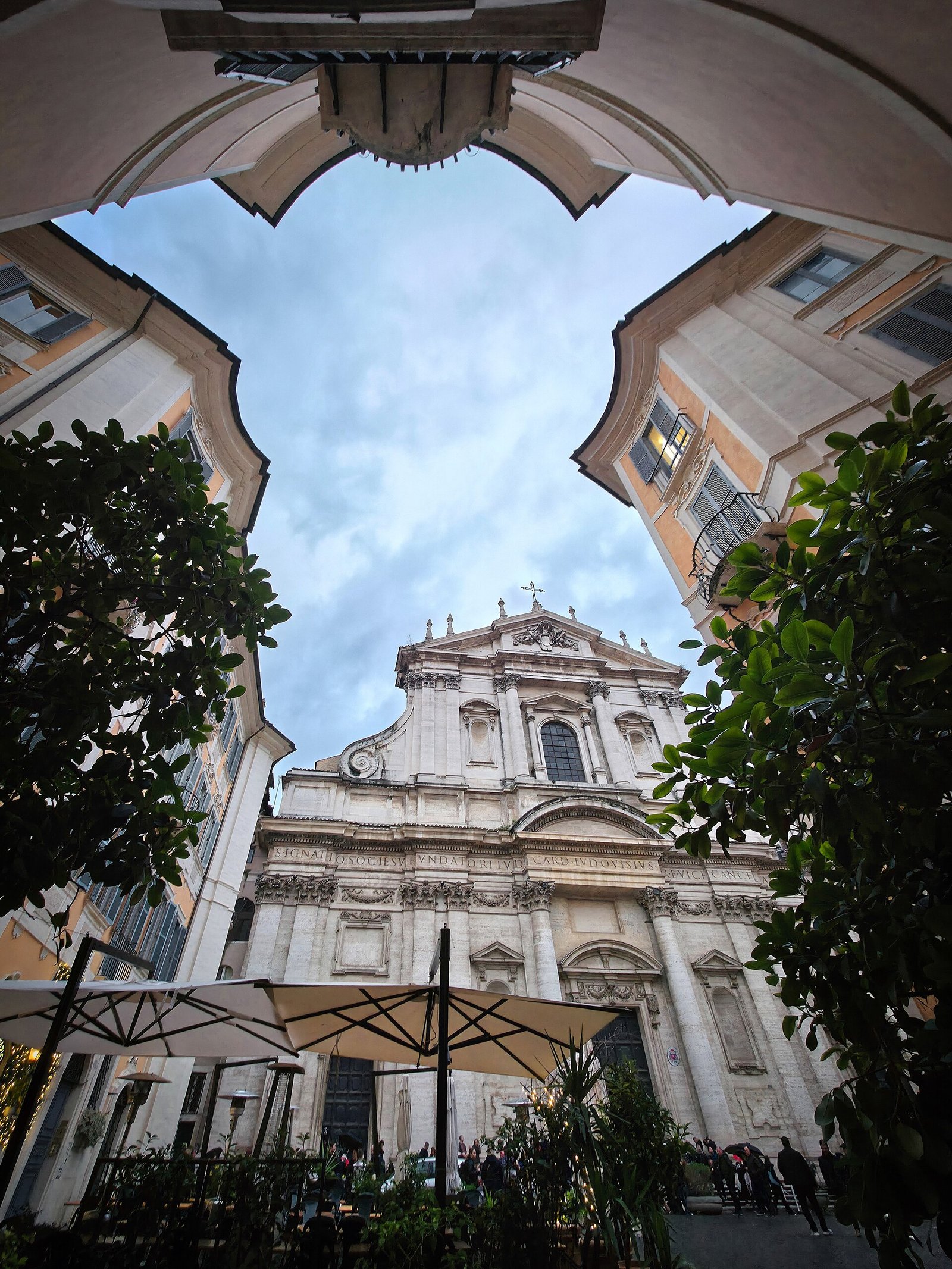
Piazza di Sant'Ignazio is in the historic center of Rome, between Via del Corso and the Pantheon, in front of the church of Sant'Ignazio di Loyola. It is public land belonging to Roma Capitale: you cross it for free, at any hour, with no ticket and no reservation. Filippo Raguzzini designed it for the Jesuits starting in 1727. The central building, at number 152, houses the Carabinieri Command for the Protection of Cultural Heritage, which is an office and cannot be visited.
It's a small piazza, almost a courtyard, closed on one side by the tall facade of the church and on the other by three small palaces with curved walls, which Romans call burrò. If you come from the Corso or from the Pantheon, you enter through narrow alleys and suddenly find it in front of you, like a stage set up in front of a theater. It's the most successful piece of Roman eighteenth-century architecture in so little space, and you can see it in 10 minutes.
Data checked on September 29, 2026 on the portal of the Ministry of Culture, for the seat of the Carabinieri Command and for the history of the Collegio Romano, on the Treccani Dizionario Biografico degli Italiani, for Filippo Raguzzini and Angelo Secchi, and on the pages of the Rome Chamber of Commerce, for the Temple of Hadrian. No source gives hours for the piazza, because there are none. The church, on the other hand, has its own hours, given in the dedicated page.
In brief: address, hours, ticket
- Address: Piazza di Sant'Ignazio, Rome, between Via del Corso, Piazza di Pietra and the Pantheon.
- Operator: public land of Roma Capitale, the central building houses the Carabinieri Command for the Protection of Cultural Heritage (number 152).
- How to enter: there is no entrance, the piazza is reached on foot from the alleys surrounding it.
- Price: free, no ticket and no reservation.
- Hours: always accessible, day and night. The church has its own hours.
- How to get there: on foot from the Pantheon, from Via del Corso or from Piazza di Pietra, buses according to the ATAC route planner.
- Accessibility: the information is not published by Roma Capitale, the piazza is level and the church has an entrance staircase.
Where it is and what you actually see
The piazza occupies a widening in the network of alleys between Via del Corso and the Pantheon. On one side rises the facade of the church of Sant'Ignazio di Loyola, on the other close the three small palaces by Raguzzini. Behind the church is the Collegio Romano, today the seat of the Ministry of Culture. A few dozen meters away, behind the small palaces, opens Piazza di Pietra with the columns of the Temple of Hadrian.
The first thing you notice is the disproportion. The facade of the church is huge and vertical, on two levels, with a staircase in front. The small palaces opposite are low, in a warm plaster color, with regular windows and beveled corners. Between the two there is a space that seems too small for the church, and in fact it is. The result is that you never see the whole facade from far away, because the piazza doesn't allow the distance.
There are three small palaces. The central one has a triangular plan and a concave facade, the two side ones follow wider curves. Between one building and the next the alleys open, starting from the corners like the wings of a stage. The Treccani Dizionario Biografico describes concave walls and beveled corners joined by cylindrical hinges, and speaks explicitly of a theatrical scene built in front of the church. If you stand on the church steps, you see it right away.
In the central building, at number 152, the Ministry of Culture indicates the seat of the Carabinieri Command for the Protection of Cultural Heritage. It is the unit that since 1969 has dealt with the prevention and repression of violations of the laws protecting cultural and landscape assets, and which the Ministry defines as an office working directly with the Minister. It is not a museum and has no windows for tourists. You look at the door from the piazza, like the rest of the facade.
For the rest, the piazza has the life of a corner of the historic center. The other buildings house homes, offices and ground-floor businesses, and part of the space is taken up by outdoor tables. The piazza lies inside the limited traffic zone of the center, and few cars pass. By day the people passing are mostly visitors headed to the church and office workers from the area. In the evening, when the facade is in shadow and the small palaces are lit by their windows, the piazza takes on a more intimate tone.
The value of the place does not depend on a single monument. None of the small palaces has a remarkable facade taken on its own: they are residential buildings, without marble and without statues. What counts is how they are arranged, how the curves answer the facade and how the alleys enter the piazza. Whoever looks at a single building finds little. Whoever looks at the whole, from the church steps, understands why architecture historians cite it as an example of the Roman eighteenth century.
A curiosity about Piazza di Sant'Ignazio
The small palaces have a nickname that comes from furniture. Romans call them burrò, a corruption of the French bureaux, that is, desks and chests of drawers. The comparison is with canterani, the bulging chests of drawers with a curved front that furnished the homes of those who could afford them in the eighteenth century. Look at the concave facades and rounded corners thinking of a piece of furniture from that era, and the name becomes obvious.
The nickname has even ended up in the street names. One of the streets leaving the piazza is called Via de' Burrò, and it leads toward Piazza di Pietra. Along that street, at number 147, the Rome Chamber of Commerce indicates one of the entrances to the Hall of the Temple of Hadrian, carved out inside the ancient temple. So a popular nickname born to mock new buildings has become the official address of a monument of the second century.
The second curiosity concerns the geometry. Historical reconstructions describe Raguzzini's design as a combination of ovals: an ellipse on each side and a semicircle in the center, with the small palaces following the curves. On paper it is an exercise with a compass. On the spot you perceive no regular figure, because the space is too small to see it all. What you perceive instead is a movement, as if the facades bent toward whoever enters.
The official name, finally, comes from the church, not from the saint in person. Ignatius of Loyola, founder of the Society of Jesus, never saw either the piazza or the church, begun 70 years after his death. His body is at the Gesù, the mother church of the Jesuits. Here the dedication comes from the Collegio Romano, the Jesuit school, which needed a large church for its students and teachers.
Something nobody tells you about Piazza di Sant'Ignazio
Before the piazza, at that spot, there were residential houses. Raguzzini's small palaces were built for the Jesuits on an area cleared by demolishing the existing buildings, and the Treccani Dizionario Biografico specifies that these were properties of the Bergamo Nation, the community of people from Bergamo in Rome. The theatrical scene in front of the church was therefore born on the rubble of a small neighborhood of Lombard immigrants, of which nothing visible remains today.
The second detail almost nobody mentions concerns the view. The piazza is designed to prevent you from seeing the whole facade of the church, not to show it. The sources describing it speak of a narrowing of the visual space: the facade can be photographed in full only at an angle, from the corners. Whoever looks for the perfect frontal point won't find it, because it doesn't exist. It's a choice, not a flaw due to haste or lack of space.
The third thing concerns the church the piazza serves. Whoever enters Sant'Ignazio for the fake dome painted by Andrea Pozzo in 1685, the perspective canvas about 17 meters in diameter that simulates the dome never built, finds inside a game similar to that of the piazza outside. Pozzo fools the eye with perspective, Raguzzini with curves. About 40 years pass between the two illusions, and they read better together.
The last detail is above the rooftops. The Dizionario Biografico recounts that in 1852 Father Angelo Secchi moved the observatory of the Collegio Romano to rooms made on the crossing of the church, using the four piers that were supposed to support the dome. The void left by the dome never made, covered inside by Pozzo's illusion, thus became one of the places of Roman science in the nineteenth century. You can't see it from the piazza, but it is right up there.
Who designed the piazza and why exactly like this?
The architect is Filippo Raguzzini, born in Naples on July 19, 1690 and died in Rome on February 21, 1771, according to the Dizionario Biografico degli Italiani. He arrived in Rome in 1723 and 1724, called by Pope Benedict XIII, Pietro Francesco Orsini, who protected him. Thanks to Cardinal Niccolò Coscia, the pope's trusted man, he obtained many public commissions. The piazza is considered his main work, and his name remains tied above all to this corner of the city.
On the dates the sources don't entirely agree. Several historical reconstructions give the construction as between 1727 and 1728, others speak generically of 1728. The Treccani Dizionario Biografico instead places the work between 1727 and 1735, so with a longer building site. The most likely reading is a project defined and started in the two years 1727 and 1728, with the completion work on the small palaces continuing in the following years.
The direct patrons were the Jesuits of the church of Sant'Ignazio, who wanted a space suited to the facade. Behind them was the will of Benedict XIII, pope from 1724 to 1730, whom historical reconstructions indicate as the promoter of a stage setting worthy of the church. The available space was small, and demolishing the whole block was not possible. Raguzzini's solution was to work with the curve instead of with distance.
The problem was this. A facade this tall, in a rectangular piazza this narrow, would have looked like a wall over the head of anyone passing. Raguzzini bent the facades opposite, rounded the corners and opened the alleys diagonally, so that the gaze of whoever enters slides along the curves instead of crashing against the church. The Dizionario Biografico says he brilliantly solved a not easy compositional question.
The style is called Roman barocchetto, or rococo, depending on the source. It is a lighter architecture than that of the 1600s, without the weight of the great orders of columns, made of plasters, thin cornices and curved surfaces. In the same years Raguzzini was also working in Trastevere, on the San Gallicano hospital, built between 1724 and 1726 and defined by Treccani as the first hospital structure of modern conception in Rome.
The architect's other Roman works help in understanding the piazza. Treccani mentions the baptistery and some chapels of the Basilica of Santa Maria sopra Minerva, between 1724 and 1726, the church of Santa Maria della Quercia for the butchers' confraternity, between 1727 and 1731, and the restorations of San Sisto Vecchio and of Santa Maria in Domnica. Minerva is a few minutes' walk away, and can be combined with the piazza in the same stroll.
My advice for visiting Piazza di Sant'Ignazio
My advice is to enter the piazza from one of the side alleys and not from the church side. Arriving from Via de' Burrò or from the alley coming from the Pantheon, the facade appears suddenly, large and close, and the small palaces stay behind you. Then it's worth climbing the church steps and turning around. From there you see the show in reverse: the three curved facades, the alleys opening between them, the piazza like a stage.
The second rule is not to stop at the piazza. Go into the church, when it is open according to the hours given in the dedicated page, and look for Pozzo's fake dome and the spot on the floor from which the illusion works best. Then go out and look at the small palaces again. Inside and outside the same theme, the eye fooled by architecture, is handled in two different ways, 40 years apart. Separating the two visits is the most common mistake.
The best time is early morning or late afternoon. At midday the piazza fills with people lining up for the church and with tables, and the facades have flat light. In the morning, before the places open, the space is free and the geometry reads well. Late in the evening the facade is in shadow and the small palaces are lit by windows and street lamps. In our judgment, 10 minutes is enough, if done with attention.
A last rule concerns respect. The small palaces are lived in and the central building houses a Carabinieri command, with personnel coming and going all day. Don't sit on the doorsteps, don't block the entrances for a photo and don't try to enter the courtyards. The church steps are for looking at the piazza, not for eating or camping out, also because they are the access to a place of worship with services under way.
Do you need a ticket or a reservation?
No. The piazza is a public street, open at any hour of day and night, with no ticket and no reservation. No official source indicates reserved access or paid visits, and there is no reservation service for seeing it. The church of Sant'Ignazio too is visited according to the rules indicated by the rectory, which you will find in the dedicated page. The Carabinieri Command, at number 152, is an office and does not receive visitors.
You do pay for something in the surroundings. The Rome Chamber of Commerce, which has its seat in the building constructed on the Temple of Hadrian in Piazza di Pietra, publishes on its site a multimedia projection on the temple, called Hadrianeum, with hours and reservation on the official page of the Chamber of Commerce. The halls may close for institutional events, and it's best to check before going.
Be wary of anyone selling tickets or tours to see the piazza. It is an open-air public space, and no official source provides for paid access. Third-party guided visits may include it as a stop on a longer route in the historic center, and in that case you pay for the service of the licensed guide, not for entry. If you want a list of free places in the center, you will find our page on free Rome.
Another well-known fact, yet rarely mentioned
Everyone knows that inside Sant'Ignazio the dome is fake. Few connect that void with the piazza and with science. The church belongs to the complex of the Collegio Romano, the great Jesuit school inaugurated on October 28, 1584 under Pope Gregory XIII, as the Ministry of Culture recalls. For almost three centuries the piazza was the antechamber of a university, frequented by students and teachers even before visitors.
The second rarely mentioned fact concerns the time of Rome. The Treccani Dizionario Biografico recounts that Father Angelo Secchi improved the time service for the noon signal, introducing at the Collegio Romano the time ball on the model of the Greenwich observatory. For years the city set its clocks by a signal that started from this block. From the piazza that device could not be seen, and today no visible trace reminds passersby of it.
The third fact concerns the library. The Ministry of Culture recalls that the palace of the Collegio Romano housed the National Library, founded by Minister Ruggero Bonghi, from 1876 to 1975, when it moved to its present seat. In the same rooms was the Kircherian Museum, established by the Jesuit Athanasius Kircher, moved to EUR in 1962. Whoever crossed the piazza in the nineteenth century was passing in front of one of the greatest concentrations of books and collections in the city.
The last fact concerns the school. Since 1871, according to the Ministry of Culture, the Ennio Quirino Visconti high school has been housed in the Collegio Romano, one of the oldest classical high schools in the capital. Since 1975 the same building has housed the central offices of the Ministry. So, a few meters from the piazza, a school and a ministry still coexist today, in the same building the Jesuits built to teach, in a relationship with the church that has lasted more than four centuries.
The right photo to take at Piazza di Sant'Ignazio
The best photo is not the one of the church. It's the one of the small palaces, taken from the church steps, with the three curved facades and the alleys opening between them. Climb to the top step, turn your back to the door and frame the whole with a normal or slightly wide-angle lens. Raguzzini's stage can only be read from that point, and it seems built on purpose to be looked at from there.
The church facade, instead, is photographed at an angle. Stand in a corner of the piazza, at the mouth of Via de' Burrò or of the opposite alley, and shoot it diagonally, with one of the small palaces acting as a wing in the foreground. A frontal shot requires a strong wide angle and distorts the vertical lines. Accepting the angle means accepting the project: the piazza doesn't grant distance, and the best photo respects that limit.
The light changes a lot during the day. The church facade is hit by sun at some hours and stays in shade at others, while the small palaces receive light in strips, filtered by the alleys. Early morning and evening are the easiest hours, with fewer people and fewer tables in the frame. At night the public lighting gives the facades a warm color, and whoever has a light tripod can take long exposures without disturbing anyone.
How do you get there from the center of Rome?
On foot, because the piazza is in a network of alleys the buses don't enter. From the Pantheon it takes a few minutes, via the streets opening east of Piazza della Rotonda. From Via del Corso you enter by the side streets at the level of Piazza Colonna and of the Galleria Alberto Sordi. From Piazza di Pietra you go through Via de' Burrò, the shortest and most direct street.
For public transport the safest choice is the route planner of ATAC, because the surface lines of the center change often due to construction, marches and detours. The nearest hubs are Via del Corso, Piazza Venezia and Largo Argentina, where many bus lines and the tram pass. The metro doesn't come close: the most convenient stops on line A remain about a kilometer away.
From the Trevi Fountain you get there in about 10 minutes, crossing Via del Corso and continuing toward Piazza di Pietra. From Piazza Navona you pass in front of the Pantheon and then take one of the alleys eastward. From Piazza Venezia you go back up Via del Corso and turn toward the Collegio Romano, passing beside Palazzo Doria Pamphilj. All routes are level.
By car it makes no sense. The piazza is inside the limited traffic zone of the historic center, parking is scarce and access is reserved for residents and authorized vehicles. If you're coming from outside Rome, it's quicker to leave the car in a park-and-ride lot and continue by public transport to the center. Taxis and cars with driver stop on the nearby main streets, and the last stretch has to be done on foot anyway.
Some important events that took place here in history
The history of the area begins with the Jesuits. The Ministry of Culture recalls that in 1558 Vittoria Frangipane donated her properties in the Campo Marzio to the Society of Jesus. From 1581, with funding from Gregory XIII, the great expansion began, and from 1582 the Jesuit architect Giuseppe Valeriano designed the palace of the Collegio Romano, inaugurated on October 28, 1584. The church would come only 40 years later, next to the school already in operation.
In 1626 the first stone of Sant'Ignazio was laid, and historical reconstructions recall that the Jesuits had the hovels in front of the building site demolished. The church opened to the public provisionally in 1650. In 1685 Andrea Pozzo painted the fake dome, and the Ministry indicates that year as the completion of the work. The consecration came in 1722. Only then, with the church finished, did the problem arise of what to put in front of the facade.
Between 1723 and 1724 Raguzzini arrived in Rome in the retinue of Benedict XIII. In 1727 the project for the piazza began, carried out in its main forms by 1728 according to several sources, with a building site that continued until 1735 according to Treccani. In 1787, again according to the Ministry, the Calandrelli Tower of the Collegio Romano was built, still active for meteorological measurements. In 1852 Secchi moved the observatory to the crossing of the church.
The nineteenth century brought the Italian state. From 1871 the Visconti high school settled in the Collegio Romano. In 1873, Treccani recalls, the law confiscating church property in Rome put Secchi's observatory at risk, and he managed to defend it, also thanks to a decree of Minister Bonghi in 1876. In that same 1876 the National Library was born in the palace. The piazza stayed the same, while the buildings around it changed function one after another.
In the twentieth century the life of the offices changed. The Kircherian Museum left the Collegio Romano in 1962 for EUR. In 1969 the Carabinieri unit for the protection of cultural heritage was born, which today has its command in the central building of the piazza. In 1975 the National Library moved and the central offices of the Ministry took their place in the Collegio Romano. Since then the piazza has been, in effect, surrounded by institutions dealing with cultural heritage.
Who has passed through Piazza di Sant'Ignazio
The first name is Filippo Raguzzini, who signed here the work for which he is best remembered. With him Benedict XIII, the pope who brought him to Rome, and Cardinal Niccolò Coscia, who according to Treccani earned him many public commissions. The pontificate of Benedict XIII was short, from 1724 to 1730. What remains, however, is the piazza, which nearly three centuries later still bears the mark of that brief season.
Before him came the Jesuits who built the church. Historical reconstructions indicate Father Orazio Grassi as being in charge of the building site, with design contributions from other architects for the facade. Then came Andrea Pozzo, Jesuit, painter and master of perspective, who painted the vault and the fake dome. Without him the church would have had a flat, bare ceiling at the center of the crossing, in place of the illusion that draws visitors every day.
In the Collegio Romano, behind the piazza, worked Athanasius Kircher, the Jesuit who lived between 1602 and 1680 and who assembled the collection from which the museum bearing his name was born, according to the Ministry of Culture. That museum stayed in the building for centuries, until the move to EUR in 1962. In the nineteenth century, on the same roofs, worked Angelo Secchi, born in Reggio Emilia in 1818 and died in Rome in 1878, according to Treccani.
Secchi is the figure who ties the piazza most closely to the history of science. His observatory, set up on the crossing of the church above the piers of the dome never built, was one of the centers of Italian astronomy in the nineteenth century. The noon signal started from there. Whoever looks up from the piazza to the roof of the church sees none of this, but is standing exactly below the spot where that work took place.
Then there is Ruggero Bonghi, Minister of Education, who wanted the National Library in the Collegio Romano and signed the decree that saved the observatory. And there are the generations of Visconti high school students, who since 1871 have entered the building behind the church every morning. The piazza, for them, has been and still is a place of daily passage, the spot where you wait for classes to begin and where you stop on the way out.
Today the names are those of the offices. The Carabinieri Command for the Protection of Cultural Heritage, headed according to the Ministry of Culture by a brigadier general, works in the central building, and from here the activities protecting cultural assets across Italy are coordinated. The Ministry of Culture has its seat a few meters away. Few piazzas in Rome concentrate in so little space so many offices dedicated to heritage.
What do the documents say and what is told?
The documents, here meaning the entries of the Dizionario Biografico and the pages of the Ministry of Culture, say who designed the piazza, for whom, on what area and with what idea. Raguzzini worked for the Jesuits on land cleared of the houses of the Bergamo Nation, and built a theatrical scene in front of the church. On these points the sources are clear. On the dates of the building site, however, the sources don't agree, between 1728 and 1735.
Tradition adds a precise intention. According to a story widespread among Romans, reported by historical reconstructions of the church, the small palaces were built in that shape to attract the passerby's attention and draw it away from the church facade, judged too tall. It is an ironic interpretation, but not entirely wrong. The piazza really does work on the gaze of whoever enters, and leads it to the curves before the church.
The nickname burrò too belongs to tradition, not to the documents. No official eighteenth-century act calls the small palaces that. It's a name born in the street, from the comparison with the bulging chests of drawers in homes, and then entered the street names with Via de' Burrò. Roman popular tradition has often done this, mocking a new work with a nickname that over time became everyone's name for it.
Then there is the legend of the dome. On why the church never had its dome, different explanations circulate, from lack of money to quarrels with the neighbors. The official sources limit themselves to saying that it was not built and that Pozzo replaced it with a painted canvas. The rest should be read as story. What is documented is that the piers meant to support it, in the nineteenth century, held up Secchi's observatory.
Finally there is the reading of architecture historians, which is neither document nor legend. Many describe the piazza as the forerunner of a modern way of looking, in which space arises from the gaze of whoever crosses it more than from the form of the buildings. It is a critical interpretation, not a fact. But on the spot it works: if you stop at different points, the piazza really does change shape, and none of the viewpoints is the right one.
How does the theatrical relationship between piazza and church work?
The relationship works the opposite way from usual. In Baroque piazzas the church is the stage and the piazza the audience. Here it's the reverse, because the small palaces are designed as wings and backdrop, with the alleys in place of side entrances, and the church, with its staircase, becomes the audience seat from which to watch. Whoever sits on the church steps is exactly in the spectator's place.
The church facade, on two levels, was built about a century before the small palaces, with a different idea of space. When it was designed, the houses still stood in front, waiting to be demolished, and in the end a narrow open space was found in front of it. Raguzzini could not widen the piazza. He could only change the way it was perceived, and he did it with curves. The result is a dialogue between two eras: the vertical and solemn 1600s of the church, the light and animated 1700s of the houses opposite.
Our position, contrary to many guides, is clear: the facade of Sant'Ignazio is the least successful part of the complex. It is tall, flat, built to be seen from afar in a piazza that doesn't allow it. Raguzzini's piazza, made of plaster and curves, is worth more than the monumental facade. Whoever comes only for the church and the fake dome treats the piazza as a corridor, and loses half the place.
The comparison with the other piazzas of the Roman Baroque helps. In Piazza Navona the Fountain of the Four Rivers and the church of Sant'Agnese in Agone dominate a vast, open space. Here everything is compressed, and the theater is made with houses instead of fountains. Whoever follows the route of Baroque Rome finds in this piazza the end of that season, and the beginning of a more domestic taste.
Borromini too had worked with curves a few decades earlier, in facades like that of Sant'Ivo alla Sapienza, a few minutes from here. Raguzzini carries that lesson from the single facade to the whole piazza, and applies it to ordinary buildings, without architectural orders and without marble. On the site you will find the itinerary on Borromini in Rome, which pairs well with this piazza to understand where the taste for bending walls comes from.
The urban context does the rest. The piazza is a knot of alleys between Via del Corso, the Pantheon and Piazza di Pietra, and from each alley you see it differently. Whoever arrives from Piazza di Pietra goes from the Roman columns of the Temple of Hadrian to the curves of the 1700s in a few steps. Whoever arrives from the Pantheon leaves the most celebrated ancient architecture in Rome and finds a theatrical stage set in front. These are jumps of scale that only the center of Rome allows.
What is around, between Piazza di Pietra and the Collegio Romano?
A few steps away, beyond Via de' Burrò, opens Piazza di Pietra. Here the columns of the Temple of Hadrian, dedicated to the emperor and his wife Vibia Sabina, are incorporated into the facade of the building that today houses the institutional seat of the Rome Chamber of Commerce. You can look at them for free from the piazza, at any hour. Inside, the Chamber of Commerce uses the halls for events and for the multimedia projection that tells the story of the temple.
On the other side, behind the church, is the Collegio Romano, with the official address of the Ministry of Culture at Via del Collegio Romano 27. The building is not a museum and the Ministry's page doesn't indicate any public visiting arrangements. You look at it from outside, from the piazza del Collegio Romano, where the main facade opens. In front is the side of Palazzo Doria Pamphilj, with its gallery.
Toward the east the piazza connects to Via del Corso, the straight street that runs from Piazza del Popolo to Piazza Venezia. On the Corso, a few minutes away, are Piazza Colonna with the Column of Marcus Aurelius and, further on, Piazza di Montecitorio with its obelisk. It is the district of politics, of the buildings of Parliament and Government, in direct contact with the alleys of Sant'Ignazio.
Toward the west are the Pantheon and Piazza della Minerva. In front of the Pantheon is the Macuteo obelisk, on the fountain of Piazza della Rotonda, and next to Santa Maria sopra Minerva the Minerva obelisk, carried by the elephant. Continuing you reach Palazzo Madama, seat of the Senate, and then Piazza Navona. Everything lies within a radius of a few minutes on foot.
The piazza is part of a system of small connected spaces, which in the historic center you cross one after another without ever leaving the shade of the alleys. If you want to understand how the districts of the center are organized, where one rione ends and the other begins, you will find on the site the page on the 22 rioni of Rome. The Sant'Ignazio area lies on the boundary between different rioni, and the alleys are the seam.
When is it closed and what not to expect?
The piazza never closes. It can happen that part of it is fenced off for work on the facades, for paving maintenance or for security needs tied to the offices based there. No official source publishes a calendar of these interventions. Even with a fence, however, the piazza can still be crossed, and the church facade and the small palaces can be seen from every corner.
Don't expect an open-air museum. There are no explanatory panels dedicated to Raguzzini, no public benches and no marked viewpoints. The only place to sit without buying anything is the church steps, to be used with respect. Don't even expect to enter the small palaces: they are homes and offices, and the Carabinieri command does not receive visitors out of curiosity.
Don't expect an empty piazza. Part of the space is taken up by outdoor tables, especially at mealtimes and on summer evenings, and this changes the perception of the design. At mealtimes the design of the curves gets lost among umbrellas and chairs. Whoever wants to see Raguzzini's geometry without clutter has to go in the early morning, when the places are still closed and the chairs are stacked.
Finally, don't expect to find the church always open. The church follows its own hours, with breaks and religious services during which tourist visits are not allowed. Updated hours are in the page on the church of Sant'Ignazio di Loyola. If you find it closed, the piazza can still be visited, and Pozzo's fake dome can wait for another pass through the area.
Eating in the area
The area between the Pantheon, Piazza di Pietra and Sant'Ignazio is full of places designed for people passing through once. The signs are always the same: the barker with the menu in hand, menus with photographs of the dishes, items without prices, places open continuously with no kitchen break, fresh pasta made in the window as a show. In the most photographed piazzas the price follows the view, not the quality.
Romans don't avoid these places out of snobbery. They avoid them because a place that lives off passing trade doesn't need customers who come back, and behaves accordingly. The menu displayed outside may differ from the one handed over at the table, and the cover charge or service appear only on the bill. The practical rule is to move a few streets away from the main piazzas and look at where ministry employees eat at lunch.
Special attention goes to the outdoor tables with a view of the church or the Pantheon. The price of a coffee or a dish sitting there can be much higher than at the counter or on a side street, and the displayed price list doesn't always make it clear. Before sitting, ask for the menu with prices and check if the cover charge and table service are indicated. For free drinking water there are the nasoni and the neighborhood fountains.
The neighborhood is full of public offices, and its everyday cooking is found on the side streets, away from the best-known facades. To choose without leaving it to chance, there is the list of addresses on Google Maps, with addresses selected across Rome and the surrounding area. No place in the piazza or in the surrounding alleys is named here, by choice, even when the tables take up half the space.
What to combine in a day
The most natural combination is the church, right away. Go into Sant'Ignazio for the vault and Pozzo's fake dome, then go out and look at the piazza again from the steps. From there you go to Piazza di Pietra for the columns of the Temple of Hadrian, and head down toward the Pantheon. In half an hour on foot you cross 16 centuries of architecture, from the ancient temple to the 1700s, without ever taking a vehicle.
The second itinerary is that of the Baroque churches. From the Pantheon you go to Santa Maria sopra Minerva, where Raguzzini worked on the baptistery, then to Sant'Ivo alla Sapienza and Piazza Navona. For those following Caravaggio, a few minutes away are the churches with his canvases, gathered in the route Caravaggio in Rome. For those following Bernini, there is the route dedicated to Bernini in Rome.
The third goes north and toward Trevi. From the piazza you cross Via del Corso, pass beside the Galleria Sciarra, with its decorated courtyard, and reach the Trevi Fountain, with the church of Santi Vincenzo e Anastasio in front of the basin. From there you can climb toward the Quirinale or continue to Piazza di Spagna. It is a day entirely on foot, almost always on level ground.
The fourth goes south, for museum lovers. From the Collegio Romano you reach in a few minutes the Galleria Colonna and the National Museum of Palazzo Venezia, at Piazza Venezia. Further down, toward Largo Argentina, are the Crypta Balbi and the Teatro Argentina. If you want to spend little, you will find on the site the page on free museums in Rome.
If you're traveling with children, you can turn the piazza into a game. Ask the little ones to find the curves of the chests of drawers in the facades, then go into the church to look for the dome that isn't there. It's a simple way to explain what an optical illusion is without a museum. On the site you will find more ideas in the page on Rome with children, and the stories of the talking statues to continue the day in the center.
From the piazza to the Pantheon is a few minutes on foot. If you prefer to buy your entry first, you will find online a Pantheon ticket with fast access and digital audio guide. It is a Tiqets affiliate link: if you buy from there Estate Romana receives a small commission, while the price for you stays the seller's. Piazza di Sant'Ignazio, on the other hand, remains free and always open.
Frequently asked questions
Do you pay to see Piazza di Sant'Ignazio?
No. The piazza is a public space of Roma Capitale, open at any hour of day and night, with no ticket and no reservation. No official source indicates reserved access or paid visits. The church of Sant'Ignazio has its own hours, given in the dedicated page. The central building houses the Carabinieri Command for the Protection of Cultural Heritage, which is an office and does not receive visitors out of tourist curiosity.
Who designed the piazza and when?
Filippo Raguzzini, a Neapolitan architect born in 1690 and died in Rome in 1771, brought to the city by Pope Benedict XIII. He worked for the Jesuits of the church of Sant'Ignazio. On the dates the sources don't entirely agree: several reconstructions indicate the two years 1727 and 1728, while the Treccani Dizionario Biografico places the work between 1727 and 1735. The project was in any case born in those years, as a theatrical scene in front of the church.
Why are the buildings called burrò?
Because they reminded Romans of furniture. Burrò is a corruption of the French bureaux, and the comparison is with canterani, the bulging chests of drawers with a curved front that furnished homes in the 1700s. The concave facades and rounded corners of the small palaces recall exactly those shapes. The nickname has also stayed in the street names, with Via de' Burrò, the street that leads from the piazza toward Piazza di Pietra and the Temple of Hadrian.
What is in the central building of the piazza?
At number 152 is the seat of the Carabinieri Command for the Protection of Cultural Heritage, as the Ministry of Culture indicates. It is the unit that since 1969 has dealt with art thefts, clandestine digs and trafficking in cultural goods, placed functionally within the Ministry as an office working directly with the Minister. It is not open to the public as a museum. For reports the Ministry publishes the Command's official phone and email on its dedicated page.
Can you see Andrea Pozzo's fake dome from the piazza?
No. The fake dome is a perspective canvas painted by Andrea Pozzo in 1685, about 17 meters in diameter, and it is inside the church, above the crossing. From the piazza you see only the facade. To see it you have to go into the church during opening hours and look for the spot on the floor from which the illusion works best. All the details are in the page on the church of Sant'Ignazio di Loyola.
How far is the piazza from the Pantheon?
A few minutes on foot, through the alleys leaving Piazza della Rotonda toward the east. It is one of the shortest walks in the historic center, all level. From the piazza you reach with equal ease Piazza di Pietra with the Temple of Hadrian, Via del Corso and Piazza Colonna. For those who want a longer route, the Trevi Fountain is about 10 minutes away and Piazza Navona a little more.
What can you see at Piazza di Pietra, right next door?
The columns of the Temple of Hadrian, dedicated to the emperor and his wife Vibia Sabina, incorporated into the facade of the building that today houses the institutional seat of the Rome Chamber of Commerce. You can look at them for free from the piazza. Inside, the Chamber of Commerce offers a multimedia projection on the history of the temple, with hours and reservation indicated on its site. The halls may close for institutional events, so it's best to check before going.
What is the best time to see the piazza?
Early morning, before the places open and the piazza fills with tables. At that hour the space is free and the geometry of the small palaces reads well from the church steps. In the middle hours the piazza is crowded and the light is flat. Late in the evening the lit facades give a more intimate image, and whoever wants to photograph without people in the frame finds the best conditions at dawn or after dinner.
Who wrote it and on what sources
The text comes from the editorial team of Tour Leader Pro, the Rome-based structure that designs itineraries, visits and cultural events across Rome and Lazio. Fees, hours and reservation methods given here result from the official sources cited in the text at the date indicated at the opening: the portal of the Ministry of Culture, the Treccani Dizionario Biografico degli Italiani, the pages of the Rome Chamber of Commerce and the ATAC site. Tell us what you find changed.
The piazza fits easily into a day on foot between the Pantheon, the Corso and Trevi, but it has a practical limit: the space is small, partly taken up by tables, and the doors of the offices must always be left clear. Whoever organizes a visit, for themselves or for others, does well to choose the morning hours and to use the church steps as an observation point. For those organizing group trips, a useful resource is Tour Leader Pro.
The piazza is one stop on a wider trip to Rome and Lazio, between the Baroque of the center, the villas of the Castelli Romani and the villages of the Sabina and the Tuscia. A couple of days in the historic center are enough for the piazzas, churches and main museums, but the rest of the region asks for time and an orderly program. A useful resource for putting together a multi-day itinerary is Italy Planner.