Macuteo Obelisk
In short. The Macuteo Obelisk is the small red granite monolith set in the middle of the fountain in Piazza della Rotonda, right in front of the portico of the Pantheon.
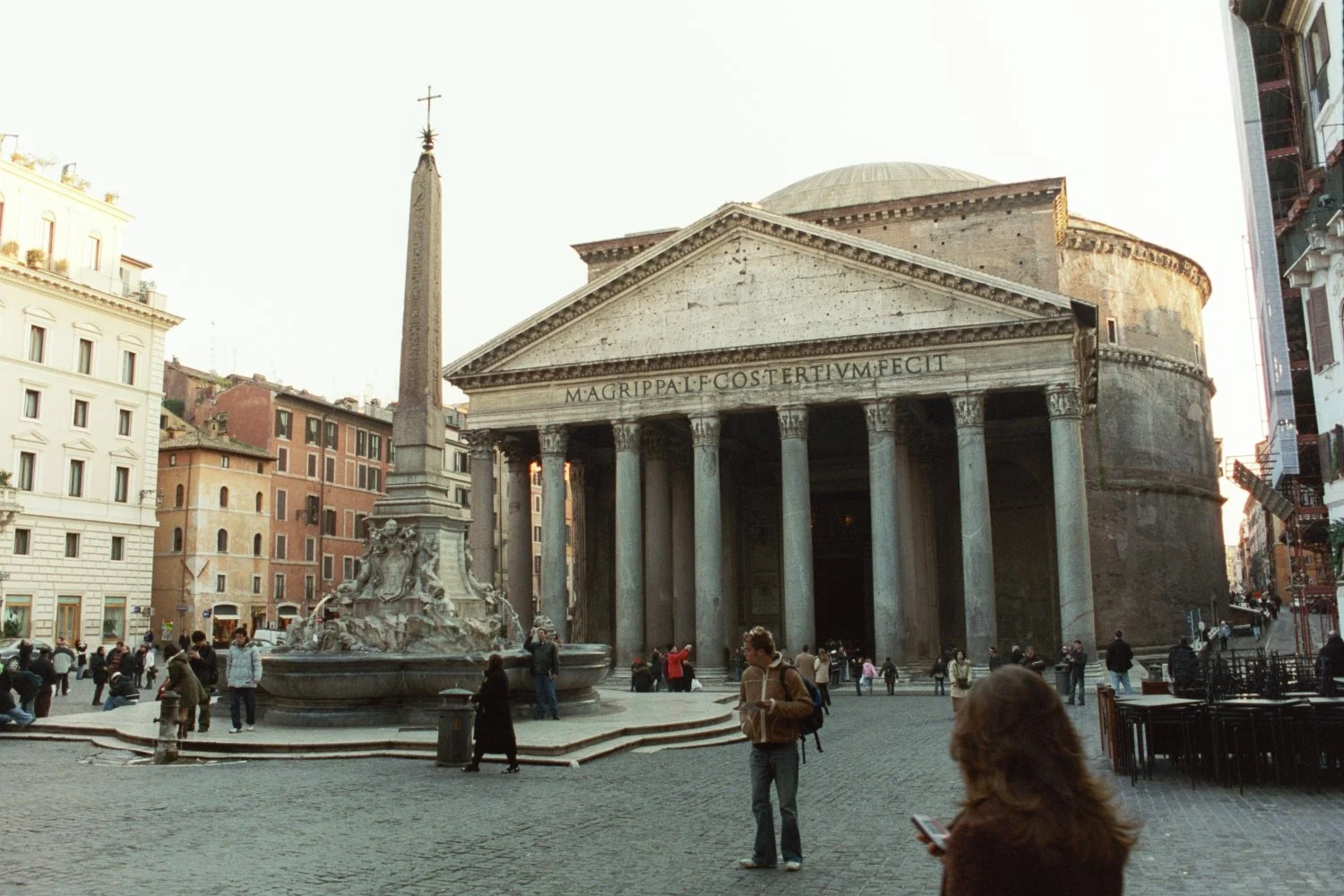
The Macuteo Obelisk is the small red granite monolith set in the middle of the fountain in Piazza della Rotonda, right in front of the portico of the Pantheon. The shaft measures 6.34 meters, which becomes 14.52 meters counting the base of the fountain and the cross on top: modest numbers compared to the giants of Piazza San Pietro or the Lateran, and for that very reason almost none of the many people who cross the square every day stop to consider what those signs carved into the granite are. They are hieroglyphs, and they bear the cartouches of Ramesses II: the monolith was cut at Aswan and raised at Heliopolis 13 centuries before Christ, then shipped to Rome in the imperial age to decorate the sanctuary of Isis and Serapis in the Campus Martius, then buried by the collapse of the ancient city, then found again in the 1300s and set up in front of a little church in rione Colonna dedicated to a Breton bishop, and finally hoisted in 1711 onto a 16th-century fountain remade expressly to receive it. The name it carries comes neither from Egypt nor from ancient Rome: it comes from that little church, San Macuto, where the monolith stood for more than three centuries before its last move. The lines that follow tell where it comes from, how it got here, what is written on it, who built the fountain that supports it, and why Piazza della Rotonda is one of the places in Rome where the reuse of ancient materials can be read better than anywhere else.
Where the Macuteo Obelisk is and how to get there
The Macuteo Obelisk stands in Piazza della Rotonda, in rione Colonna, in the middle of the basin of the fountain on the side of the square opposite the portico of the Pantheon. It is outdoors, in a pedestrian public space, and can be seen for free at any hour of the day or night. There is no ticket, no opening time, no gate. This is the first thing to make clear, because many people confuse it with something inside the Pantheon and think they have to pay for it: the obelisk and the fountain are street furniture in every respect, while the basilica is another matter and has its own rules.
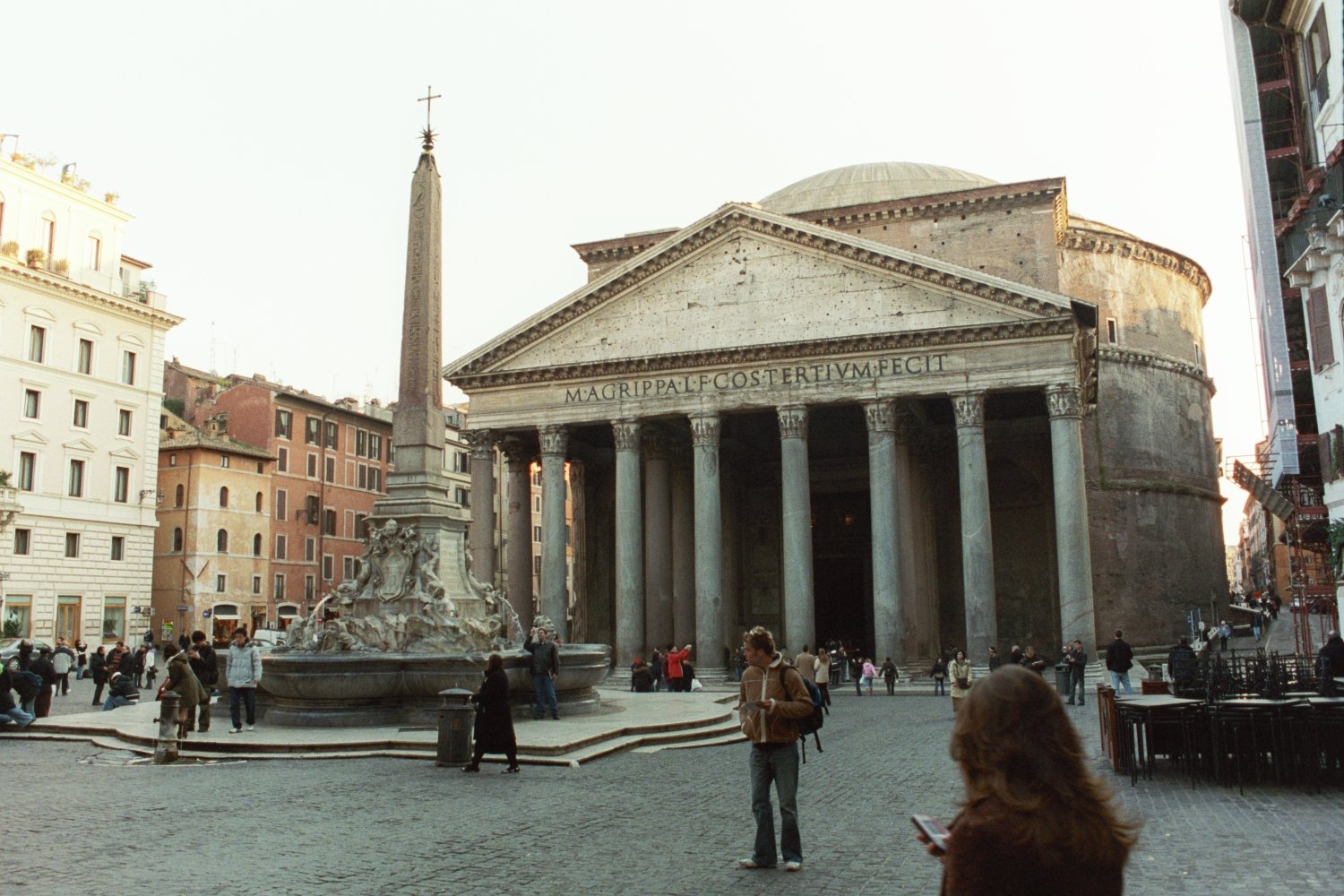
The exact position in the square
The square is an irregular rectangle of about 60 meters by 40, with the Pantheon closing off its southern side and houses of different ages on the other three. The fountain with the obelisk is not at the geometric center of the space but shifted toward the side opposite the temple, on axis with the portico: anyone coming out of the porch and looking up finds it straight ahead, and anyone arriving from Via del Pantheon or from Salita de' Crescenzi meets it from the side. The arrangement is deliberate, because the fountain and the obelisk were conceived as a stage backdrop for the temple and not as an independent object: the monolith serves as a vertical counterpoint to the horizontal mass of the portico, and closes the perspective for anyone looking from the far end of the square.
By public transport
There is no subway stop at Piazza della Rotonda and there never will be: the subsoil of the Campus Martius is so dense with archaeological layers that every idea of deep digging at that spot has been abandoned. The easiest way is to take a bus to Largo di Torre Argentina, where many surface lines crossing the historic center converge, and from there walk five or six minutes along Via dei Cestari or Via del Seminario. Alternatively, you can get to Corso Vittorio Emanuele II, also served by buses, and walk up toward the Pantheon through Piazza Sant'Eustachio. If you travel by subway you can get off at Barberini or Spagna and walk, but we are talking about a good 20 minutes on foot through a crowded historic center. Schedules and routes of the lines change fairly often because of construction sites and detours, so it's best to check the updated route on the same day on the public transport operator's app.
On foot, which is the right way
Piazza della Rotonda is the geometric center of a quadrant that is entirely or almost entirely pedestrian, and every important stop in the Campus Martius is less than 10 minutes' walk away. From the Trevi Fountain it's about 10 minutes, from Piazza Navona five, from Piazza Colonna four, from Largo Argentina six or seven. Anyone who wants to follow the sensible route for understanding this obelisk should arrive from Piazza della Minerva side, where the Minerva Obelisk stands, because the two monoliths come from the same ancient sanctuary and are less than 200 meters from each other.
What the Macuteo Obelisk is: three different objects in one
The Macuteo Obelisk is a red Aswan granite monolith 6.34 meters high, carved on all four sides with the cartouches and titulary of Ramesses II, a pharaoh of the 19th Dynasty who lived in the 13th century BC. This is the correct definition of what you see today, but it is also a partial one, because the monument you look at from the square is really the sum of three objects born in three different eras and never meant to go together.
First object: the Egyptian monolith
The shaft is the only truly ancient element. It was extracted from the red granite quarries of the Aswan region, in Upper Egypt, worked and carved on behalf of Ramesses II and raised in the solar sanctuary of Heliopolis, the city sacred to Ra that stood where the northeastern neighborhoods of Cairo now extend. The sources agree that the shaft has lost height compared to the original: they speak of about a meter lost through breaks and reductions, which would put the ancient measure at around seven and a half meters. It is not a big obelisk even by Egyptian standards: it was a monolith from a pair, that is, one of the two flanking an entrance, and not an isolated piece for an open square.
Second object: the 16th-century basin
Under the obelisk there is a fountain designed by Giacomo Della Porta and built by Leonardo Sormani starting in 1575, that is, 1,400 years after the obelisk arrived in Rome and more than 2,500 years after it was carved in Egypt. It was born as an independent fountain, with a marble basin of mixed curved lines, four masks and no obelisk on top: for 136 years it was simply the fountain of Piazza della Rotonda, full stop.
Third object: the 18th-century base
Between the basin and the shaft there is the piece that holds everything together: a travertine base designed in 1711 by Filippo Barigioni on behalf of Pope Clement XI, with four dolphins supporting the sides, the papal coats of arms on the faces and an artificial rock formation that links the mass of the monolith to the existing basin. Without this connecting piece the assembly would not have worked, because an obelisk doesn't rest on a fountain basin like a vase on a table: you need a structure that carries the weight and hides the joint between two objects of completely different scale.
What sets it apart from the other Roman obelisks
Rome keeps 13 ancient Egyptian obelisks, plus a handful of Roman and modern obelisks, and the Macuteo belongs to the low end in size. The Lateran Obelisk tops 32 meters of shaft, the Vatican Obelisk stands above 25, the Flaminio Obelisk in Piazza del Popolo comes close to 24. The Macuteo, with its 6.34 meters, belongs instead to the family of the small monoliths of the Campus Martius, the same as the Minerva Obelisk, which measures 5.47 meters. It's not a flaw: they are obelisks of different scale because they came from different contexts, and none of them was meant to stand in the middle of a 100,000-square-meter plaza.
The Egyptian origin: Heliopolis, Ramesses II and the sanctuary of Amun-Ra
The Macuteo Obelisk was raised at Heliopolis under Ramesses II, a pharaoh who reigned for about 67 years in the 13th century BC and who was, by a wide margin, the most prolific builder of obelisks in Egyptian history. The cartouches on the pyramidion and the columns of hieroglyphs along the sides give the king's prenomen and name and his royal titulary, with the epithets that link him to the solar deity: the formulas call him son of Ra, following the standard scheme of Ramesside propaganda.
Why Heliopolis
Heliopolis, in Egyptian Iunu, was the sacred city of the solar cult and the seat of the great sanctuary of Ra, later syncretized with Amun. It was the place where obelisks had their fullest theological meaning: the granite monolith with its tip sheathed in metal was a petrification of the sun's ray, an element that caught the first light of morning and reflected it onto the sacred enclosure. Setting one up at Heliopolis was not decoration, it was liturgy. Ramesses II set up quite a few, and the great number of Heliopolitan monoliths explains why the Roman emperors were able to draw on that sanctuary as if it were a warehouse: when the Romans began to bring obelisks to Italy, Heliopolis was already in decline and its monuments were available.
The problem of the twin
Egyptian obelisks were almost always raised in pairs, on the two sides of a temple's entrance pylon, and the Macuteo is no exception. The problem is that the sources do not agree on which one is its twin. Part of the popular literature and the reference English entry name the Matteiano obelisk as the twin, now at Villa Celimontana, a fragment of red granite 2.68 meters high and therefore reduced to little more than a third of its original length. Other sources, equally popular, instead pair the Matteiano with the obelisk in the Boboli garden in Florence. The question is not settled and it's best to report it as open: what can be said with certainty is that the Macuteo and the Matteiano both come from Heliopolis, both bear the cartouches of Ramesses II and both passed through the Egyptian sanctuary of the Campus Martius. That they are exactly the two elements of the same pair is a very widespread hypothesis, not a definitively established fact.
What is really written on the granite
Anyone who walks up to the basin sees the carvings on the side facing the Pantheon, but can't read them: they are hieroglyphs in vertical columns, heavily eroded in the lower part by runoff and by the centuries spent outdoors in an urban setting. The translations available in the popular literature report formulas of royal titulary and references to the filial relationship between the pharaoh and the solar god. There is no narrative text, no chronicle of deeds: Egyptian obelisks almost always carry dedications and titularies, not stories. Anyone looking on the monolith for the story of a battle will be disappointed.
The Iseum Campense: how an Egyptian obelisk ended up in the Campus Martius
The Macuteo Obelisk came to Rome to decorate the Iseum Campense, the great sanctuary of Isis and Serapis that occupied a strip of the Campus Martius between the area of the Saepta and the temple of Minerva, that is, roughly the territory now bounded by Piazza del Collegio Romano, Via del Piè di Marmo, Piazza della Minerva and Via del Seminario. It is the key fact for understanding why, within 300 meters of the Pantheon, there are two Egyptian obelisks, a quantity of Egyptian and Egyptianizing fragments and a street-name system that still preserves a trace of it.
An Egyptian temple in the middle of Rome
The cult of Isis reached Rome in the first century BC and was long opposed by the Senate, which in 53 BC ordered the demolition of the private shrines dedicated to the goddess. The sanctuary proper was built in 43 BC, but its history was intermittent: suppressions and rehabilitations alternated under Agrippa and Tiberius, until Caligula gave the cult a stable position again. A fire destroyed the complex in AD 80 and Domitian rebuilt it on a much larger scale, with later interventions by Hadrian and in the Severan age. The sanctuary remained active until the 5th century, that is, for almost 500 years.
Domitian and the import
The arrival of the Macuteo in Rome is placed around AD 80, coinciding with Domitian's reconstruction of the sanctuary after the fire. Domitian was, along with Augustus, the emperor who invested the most in transporting Egyptian monoliths to Rome, and his operation had a different character from the Augustan one: Augustus had brought obelisks as trophies of his dominion over Egypt and had set them up in civic contexts, like the Montecitorio Obelisk in the great sundial of the Campus Martius. Domitian used them instead as furnishings for a sanctuary of Egyptian worship, inside an enclosure where Nilotic references were the very theme of the place. For Domitian obelisks weren't loot: they were setting.
The other monoliths of the same sanctuary
From the Iseum Campense come, according to the most accredited reconstructions, several of the obelisks seen today in Rome and elsewhere. The Agonale Obelisk in Piazza Navona, 16.38 meters high and carved with hieroglyphs composed in the Roman age for Domitian, comes from the area of the sanctuary before being moved to the Circus of Maxentius and then hoisted by Bernini onto the Fountain of the Four Rivers. The Minerva Obelisk, with the cartouches of the pharaoh Apries who reigned between 589 and 570 BC, was found in the 1600s in the Dominicans' garden and now stands on the back of Bernini's little elephant in front of the Basilica of Santa Maria sopra Minerva. Then there are the Dogali obelisk, those of Boboli and Urbino, the Matteiano of Villa Celimontana and a quantity of sculptures now divided among the Vatican Museums, the Louvre and the Capitoline Museums. The Macuteo is a piece of this scattered group: one of the few that remained a few dozen meters from where it stood in antiquity.
The traces left in the street names
Anyone walking between the Pantheon and the Collegio Romano meets a series of clues that don't look like clues. Via del Piè di Marmo takes its name from an enormous marble foot in a sandal, a fragment of a colossal statue from the sanctuary, which stands at the corner with Via Santo Stefano del Cacco. Via della Gatta owes its name to a small marble feline sculpture placed on a cornice of Palazzo Grazioli, almost certainly coming from the same Egyptian context. Santo Stefano del Cacco takes its name, according to the current reading, from a statue of Anubis or of a cynocephalus mistaken by the Romans for a macaque. That's four or five clues in 400 meters: the Egyptian quarter of the Campus Martius is still down there and surfaces in the names of the streets.
The name Macuteo: the church of San Macuto and three centuries of waiting
The Macuteo Obelisk is called that because it stayed for more than three centuries set up in Piazza di San Macuto, in front of the church of the same name, about 200 meters from where it stands today: the name has nothing Egyptian and nothing of ancient Rome, it is a district place name. It is the clearest case, among the obelisks of Rome, of a monument christened by the place where it waited rather than by the place where it stands.
The discovery in the 1300s
The monolith reappeared during the works that affected the area of Santa Maria sopra Minerva, the Dominican church built over the ruins of the Isiac sanctuary. On the date the sources differ by a year: part of the Italian literature gives 1373, the reference English entry gives 1374. It's not a difference that changes the picture, but it's right to report it instead of choosing arbitrarily. What matters is the context: this was the height of the papal absence from Rome, the city was reduced to a few tens of thousands of inhabitants, the great building projects were at a standstill and the discovery of an obelisk produced no monumental project. The monolith was simply raised again a short distance away, on four stone blocks put together carelessly, in front of the church of San Macuto.
Who San Macuto was
The church that gave the obelisk its name is dedicated to a Breton bishop, Maclovius or Malo, originally from southern Wales and then emigrated to Brittany, where he founded a monastery at Aleth: the city that grew up around it is now called Saint-Malo. It is the only church in Italy dedicated to this saint, whose feast falls on November 15, and it is attested in Rome as early as 1192. The presence of a Breton church in the heart of the Campus Martius is explained by the national communities that in the Middle Ages organized themselves around their own place of worship, as the French did with the Church of San Luigi dei Francesi a few blocks to the west.
Why it stayed there so long
Three and a half centuries of standing in front of a neighborhood church are not an oversight: they are the rule. Until Sixtus V, that is, until the 1580s, Rome had neither the technology nor the urban planning program to raise obelisks in monumental squares. Domenico Fontana's feat with the Vatican Obelisk in 1586 changed everything: it showed that it could be done, and after that date the popes began to use obelisks as urban signals in their redevelopment plans. The Macuteo was left out of that first wave, probably because it was small, because it was already standing and because Piazza di San Macuto was not a strategic node. It fell to Clement XI, more than a century later, to decide to move it where it would make a difference.
Giacomo Della Porta's fountain: 1575, the Acqua Vergine and the masks
The fountain that today holds up the Macuteo Obelisk was built starting in 1575, 136 years before the obelisk was set on top of it, commissioned by Pope Gregory XIII and designed by Giacomo Della Porta, with the sculptural execution entrusted to Leonardo Sormani and the works finished two years later. It was born as a fountain and nothing more: where the obelisk is, there was empty space.
The program of the Gregorian fountains
The construction is part of a broader operation. The restoration of the Acqua Vergine aqueduct, completed in 1570, had put the network serving the Campus Martius back under pressure and had made possible a program of public fountains in a part of the city that for centuries had depended on the Tiber and on wells. Gregory XIII made it a policy: a whole series of fountains, largely designed by Della Porta, appeared in the squares of the center between the 1570s and 1580s. The Turtle Fountain in Piazza Mattei and the twin fountains that still flank the scene of Piazza Navona belong to the same family. They were not ornaments: they were the point where a part of the city went to get water.
What the original fountain looked like
Della Porta's design called for a basin of mixed curved lines in African gray marble, with four circular arches interrupted by carved masks. The masks were not generic: they bore the dragons, which are the heraldic emblem of the Boncompagni, the family of Gregory XIII. Anyone looking at the fountain in 1577 therefore read at once who had paid for it, following a convention that holds in Rome for almost everything: the patron signs with a coat of arms, and the coat of arms goes where people pass. The fountain was surrounded by a balustrade and raised on steps, like many Roman fountains of the period, to protect it from cart traffic and from the mud of the square.
The lowering of 1662
In 1662 the level of the square was lowered, and with that operation the balustrade and the steps disappeared. It is an important and almost always overlooked step, because it tells something that holds for the whole center of Rome: the medieval and Renaissance walking surface was much higher than the ancient one, and every papal redevelopment tended to dig down to get closer to the Roman level. Anyone looking at the Pantheon's portico today sees the columns start from a level almost coinciding with that of the square: it was not always so, and in the centuries in between the base of the temple was buried under meters of debris, with the shafts looking as if they had come out of the ground.
1711: Clement XI, Filippo Barigioni and the remaking of the basin
In 1711 Pope Clement XI had the Macuteo Obelisk moved from Piazza di San Macuto to Piazza della Rotonda and placed on top of Della Porta's fountain, entrusting Filippo Barigioni with the design of the new base and the remaking of the upper part of the basin. It is the date that produced the monument as we see it, and it is a date that says quite a lot about the 18th-century way of working with what already existed.
Barigioni's work
Filippo Barigioni received a precise technical problem: to set a six-and-a-half-meter granite monolith in the middle of a 16th-century basin that had not been designed to support anything. The solution was a travertine base rising from the center of the basin, with four dolphins linking the base of the obelisk to the water level and with the papal coats of arms on the sides. The dolphins are not a whim: they are the element that allows a visual passage from the rectangle of the pedestal to the curve of the basin, and at the same time an iconographic reference to water, which in Rome has a very long tradition, from the Barcaccia in Piazza di Spagna on down. The artificial rock formation that accompanies the dolphins serves the same purpose: to make the assembly plausible.
What is written on the base
On the base runs the inscription that commemorates the operation and that can still be read well: CLEMENS XI PONT MAX FONTIS ET FORI ORNAMENTO ANNO SAL MDCCXI, that is, Clement XI, supreme pontiff, as an ornament of the fountain and of the square, in the year of salvation 1711. It is worth reading carefully, because it declares without pretense the nature of the intervention: the pope does not say he restored an ancient monument to its dignity, he says he adorned a fountain and a square. It is an admission of decorative function that the 18th century makes without embarrassment and that 19th- and 20th-century taste would instead have masked behind the language of preservation.
The cross and the star
On top of the pyramidion there is not the Egyptian tip but a cross set above a star. The star is an element of the Albani coat of arms, and the combination of cross plus papal heraldic emblem is the standard formula with which the pontiffs of the Counter-Reformation and of the 18th century capped all the Roman obelisks: the pagan monolith is explicitly surmounted by the Christian sign, and the tip that in Egypt caught the light of the sun becomes the pedestal of a cross. It is the same scheme applied to the Vatican Obelisk, the Lateran, the Flaminio and the Agonale, with heraldic variants depending on the pope who signs. Anyone looking at the Macuteo Obelisk from below therefore sees, from top to bottom, a Christian cross, an 18th-century heraldic star, an Egyptian pyramidion of the 13th century BC, an 18th-century base with papal coats of arms and a 16th-century basin: five levels of patronage in eight meters of height.
Piazza della Rotonda, or the layering of reuses
Piazza della Rotonda is the place in Rome where the reuse of materials and meanings can be read most compactly: in a space of 60 meters by 40 live side by side a Roman temple of the 2nd century that became a Christian church in 609, a 16th-century fountain remade in the 18th century and an Egyptian obelisk of the 13th century BC that came here to decorate a sanctuary of Isis and ended up serving as a vertical counterpoint to the Pantheon. None of these objects stands where it was born and none does today what it was made for. That is what is worth looking at, far more than the measurements and the dates.
The temple that becomes a church
The Pantheon survived because it changed jobs. Built by Agrippa between 27 and 25 BC as a rectangular building oriented to the south, damaged by the fire of AD 80, restored by Domitian and finally rebuilt entirely by Hadrian between 118 and 125 in the round form we know, rotated 180 degrees from the original orientation, in 609 it was given by the Byzantine emperor Phocas to Pope Boniface IV and consecrated as Santa Maria ad Martyres. From that moment the temple of all the gods became a Marian church, and being a church protected it from the systematic dismantling that reduced half of ancient Rome to lime. In 1878 it became a national monument and received the tombs of Victor Emmanuel II and Umberto I, adding a third layer of function: pagan temple, Christian basilica, dynastic shrine. The whole history of the Pantheon as a building is told in the entry dedicated to the Pantheon, and there is no need to repeat it here: what matters on this page is the relationship between the temple and the obelisk set in front of it.
The fountain that changes purpose
Della Porta's fountain was born in 1575 as infrastructure: it was the point where the neighborhood drew the water of the Acqua Vergine, and its form, with the low, accessible basin and the spouting masks, corresponded to that function. In 1711 that function moves to the background: the basin is remade in its upper part, a base appears in the center occupying the space where before there was emptiness, and the fountain becomes the pedestal of a monument. The water keeps flowing, but the object is no longer a fountain with an obelisk on top: it is an obelisk with a fountain underneath. The change of hierarchy is the real operation of 1711, and anyone looking at the square today perceives it at once, because it presents the fountain as a base and not as the protagonist.
The obelisk that changes religion
The third reuse is the most radical. A monolith carved to celebrate a pharaoh's bond with the solar god is taken from Heliopolis, brought to Italy to decorate the sanctuary of an Egyptian deity transplanted to Rome, buried for eight or nine centuries under the rubble of the Campus Martius, found by chance during works on a Dominican church, raised again in front of a Breton church and finally surmounted by a cross at the will of a pope from the Marche. Every step keeps the piece and cancels its earlier meaning. This is what the Romans have systematically done for 2,000 years, and Piazza della Rotonda is the place where you see it best because all the layers are in view at the same time, a few meters apart, with no need to go down into an underground site or read a panel.
What this means for the viewer
The practical consequence is that Piazza della Rotonda is not read as a unified work of art: it is read as a sequence of decisions made by different people who never spoke to each other and who had incompatible aims. Agrippa and Hadrian wanted a temple, Domitian wanted an Egyptian sanctuary, Boniface IV wanted a church, Gregory XIII wanted running water, Clement XI wanted an ornament and a signature, the Kingdom of Italy wanted a shrine. The result holds together because each one worked on what existed instead of against it. This is the chapter worth taking away from here, and it holds for very many other points of the historic center: from the Church of Sant'Ignazio di Loyola built on the block of the Collegio Romano to Michelangelo's Capitoline Hill set on top of the Republican arx.
A curiosity about the Macuteo Obelisk
For 136 years the Macuteo Obelisk was a monument without a fountain and the fountain of Piazza della Rotonda was a fountain without an obelisk: the two pieces lived in parallel, 200 meters apart, from 1575 to 1711, with nobody having planned to put them together. Anyone looking at the complex today perceives it as a unified project, and instead it is an assembly.
How you can tell it's an assembly
There are material clues. The marble of the 16th-century basin and the travertine of the 18th-century base differ in color and grain, and on a day of side light the gap is noticeable even without getting closer. The line of attachment between the lower part of the basin and the part remade in the 18th century is perceptible along the profile. And above all the proportions don't quite add up: Barigioni's base is visibly a connecting piece, built to solve a problem of size between two objects that did not match, and the rock formation with the dolphins serves to disguise this forcing. Anyone who knows the Roman fountains designed together with their central element, like Bernini's Fountain of the Four Rivers in Piazza Navona, where the obelisk rises from the rock as from a single gesture, catches the difference in an instant.
The instructive comparison with Piazza Navona
The comparison with the Fountain of the Four Rivers is the quickest way to understand what distinguishes an assembly from a project. In 1651 Bernini had a fragmentary obelisk and a free site, and he designed rock, statues and monolith as a single machine, with the pierced rock holding up the shaft in an apparently impossible balance. 60 years later Barigioni had an intact obelisk and a basin already built by others, and he did what he could with what he had. The result in Piazza della Rotonda is less spectacular and more honest: it doesn't pretend to have been born all at once.
Something nobody tells you about the Macuteo Obelisk
The four masks you see today on the fountain of the Macuteo Obelisk are not the 16th-century ones: they are 19th-century copies made by Luigi Amici, and Leonardo Sormani's originals are kept at the Museo di Roma in Palazzo Braschi. Anyone photographing the grotesque faces spouting water into the basin is photographing 19th-century sculpture, not 16th-century.
When the replacement happened
The sources don't agree on the exact year: an institutional entry gives 1880, other reconstructions speak of 1886. The substance doesn't change, and the reason is the same in both cases: the original masks, exposed for three centuries to the limy water of the Acqua Vergine and to the weather, were corroded to the point of making the details illegible, and the solution adopted in the 19th century was the one then current across Europe, that is, replacing the original with a cast and housing the ancient piece in a museum. Today this practice is much debated, but in the 19th century it was considered simply good administration.
The rest of the monument, instead, is ancient
This needs saying for clarity, because talk about copies risks generating excessive suspicion: the shaft of the obelisk is authentic and ancient, with its original carvings, and has never been replaced. What is 19th-century is the masks. What is 18th-century is the base, the dolphins, the coats of arms and the cross. What is 16th-century is the layout of the basin. The granite with the cartouches of Ramesses II is the oldest part and also the least touched.
My advice for visiting the Macuteo Obelisk
The most useful practical advice for the Macuteo Obelisk is to arrive before 8 in the morning or after 10 at night, because between 10 in the morning and 8 in the evening Piazza della Rotonda is one of the most crowded areas in Italy and the obelisk simply becomes invisible behind the crowd standing around the basin. The square is open and free at every hour, so choosing the time costs nothing and is the only variable that really changes the experience.
The route that makes the visit make sense
Looking at the Macuteo on its own is of little use. The sensible route lasts 40 minutes and lines up three monoliths from the same sanctuary: you start from the Minerva Obelisk in front of the Dominican basilica, go through Via del Piè di Marmo and Via della Gatta to see the Egyptian fragments built into the urban fabric, arrive at Piazza della Rotonda and end in Piazza Navona in front of the Agonale Obelisk. Anyone with half an hour more adds the Montecitorio Obelisk, which belongs to another story, the Augustan one, and serves precisely to show the difference between two ways of using obelisks.
The relationship with visiting the Pantheon
The Pantheon has a ticket and opening hours, the obelisk doesn't. At the time of writing, entry costs €5 full price and €2 reduced for European Union citizens between 18 and 25 years old, is free for under-18s and for Rome residents, and on the first Sunday of the month access is free but you have to queue for the non-named ticket, with no online booking. Hours are from 9:00 to 19:00 with the ticket office until 18:00 and last entry at 18:30, and the only closures are December 25 and January 1. Since it is a working basilica, hours can change for services, so it's best to check the official site the same day before showing up.
The rules of the square
The urban police regulation of Roma Capitale, approved by the Capitoline Assembly in 2019, forbids sitting on the edges of monumental fountains, climbing on them and getting into the water, with monetary fines. In Piazza della Rotonda this ban is enforced with some consistency by the officers on duty, and it applies even to those who simply want to lean on the edge for a photograph. It's better to know this beforehand than to find out afterward.
Another well-known fact, yet rarely mentioned
For centuries Piazza della Rotonda was a market, and until well into the 19th century the space now occupied by small tables and crowds was full of vegetable stalls, poultry and caged birds: the fact is very well known to scholars and almost never told to visitors, who imagine a monumental square from time immemorial.
The market and its reputation
Pope Eugene IV, between 1431 and 1439, had to clear out a tangle of shacks and shops that had grown up around the columns of the portico: the operation is remembered as one of the first acts of freeing an ancient monument from the parasitic fabric. But the market did not disappear: it reorganized itself in the square. In the 19th century the area was known above all for the bird market, with cages of parrots, nightingales and little owls displayed next to the vegetable stalls. The English traveler Charlotte Anne Eaton, who visited Rome and published her impressions in 1820, described the square in very harsh terms for the filth and for the promiscuity between the temple and the foodstuffs.
Why it matters for the obelisk
The detail is not folklore. When Clement XI in 1711 set the obelisk on the fountain, he set it in the middle of a market: the monument was not born as an element of an urban drawing room but as a vertical signal inside a dirty, noisy working space. The inscription speaks of ornament of the fountain and of the square precisely because the square needed to be adorned. The monumental and silent square that visitors imagine is a product of the 20th century, not of the 18th.
The right photo to take of the Macuteo Obelisk
The right photo of the Macuteo Obelisk is taken from the north side of the square, with the obelisk in the foreground and the portico of the Pantheon behind it, holding the camera low: from that position the monolith stands out against the temple's pediment and you can read the overlap between the two monuments, which is exactly the subject. From any other spot you get either an obelisk without context or a Pantheon with a pole in front of it.
The light
The facade of the Pantheon faces north, so it stays in shadow for almost the whole day while the square is lit: it is a high-contrast condition that makes exposure difficult. The two best windows are early morning, when the raking light hits the houses on the west side and bounces onto the square softening the contrast, and dusk, when the artificial lighting of the portico balances with the still-blue sky. At noon the red granite of the obelisk looks washed out and the hieroglyphs disappear.
The detail almost nobody shoots
It is worth devoting a close-up shot to the hieroglyphs on the side facing the temple, with the side light of the morning revealing them: they are the oldest part of the monument and the least photographed, because everyone aims for the whole. A second detail that works well is the pair of dolphins on the base, with the rock formation and the coat of arms, shot up close so as to exclude the Pantheon completely: out of context the 18th-century group reads much better.
What to avoid
Avoid the extreme wide angle from the center of the square, which distorts everything and produces a crooked obelisk and a squashed portico. Avoid climbing onto the edge of the basin, which besides being forbidden by the city regulation doesn't improve the framing. Avoid the middle hours of weekends, when the density of people makes any clear field below two meters of height impossible.
Some important events that happened here in history
The chronology of Piazza della Rotonda and its obelisk concentrates in a few dates that changed the look of the place: 609, the Christian consecration of the Pantheon, the finding of the monolith in 1373 or 1374, the building of the fountain in 1575, the lowering of the square in 1662, the move of the obelisk in 1711 and the replacement of the masks in the 1880s.
From antiquity to the Middle Ages
The Isiac sanctuary is born in 43 BC, burns in AD 80 and is rebuilt by Domitian, who on that occasion brings the monolith to Rome. The complex remains in operation until the 5th century, then fades out with the cult that inhabited it. In 609 the Pantheon is given by Phocas to Boniface IV and consecrated as Santa Maria ad Martyres: it is the act that saves the building and fixes the popular name of Santa Maria Rotonda, from which the name of the square derives.
The 1300s and 1400s
Between 1373 and 1374 the monolith resurfaces during works in the area of Santa Maria sopra Minerva and is raised on four blocks in front of San Macuto. Between 1431 and 1439 Eugene IV frees the portico from the shacks and shops leaning against the columns. In 1467 the Albergo del Sole opens in the square, remembered as one of the oldest hotel businesses in the city.
From the 1500s to the 1700s
In 1570 the restoration of the Acqua Vergine is completed, in 1575 the work on Della Porta and Sormani's fountain begins and ends two years later. In 1662 the square is lowered and loses its balustrade and steps. In the 1660s Alexander VII and Bernini arrange and enlarge the space. In 1711 Clement XI has the obelisk moved and entrusts Barigioni with the new base: it is the date that closes the formation of the monument.
From the 1800s to today
Between 1809 and 1814 the Napoleonic administration plans, without result, the demolition of the blocks around the Pantheon. In 1873 an urban plan proposes widening the square, also not carried out. In 1878 the Pantheon becomes a national monument. In the 1880s the original masks are replaced by copies by Luigi Amici. In 1928 the decorative bollards are removed. Restorations follow in 1974 and between 1991 and 1992. On April 22, 2024 the latest restoration work on the fountain opens, concluded the same year, which gave color and legibility back to the surfaces.
Who has passed by the Macuteo Obelisk
Through the Macuteo Obelisk have passed, as patrons or as witnesses, the names that shaped this square: Gregory XIII and Giacomo Della Porta for the fountain, Alexander VII and Gian Lorenzo Bernini for the 17th-century arrangement, Clement XI and Filippo Barigioni for the obelisk, and the very long line of Grand Tour travelers who drew, engraved and described this corner more than any other in Rome.
The patrons
Gregory XIII Boncompagni signed the fountain with the dragons of his coat of arms. Alexander VII Chigi, with Bernini as director, gave the square the form of a scenographic basin. Clement XI Albani put the obelisk at the center, and his own heraldic star under the cross. Three popes in 136 years, three signatures superimposed on the same spot: it is the standard mechanism of Roman patronage, where each pontiff works on his predecessor's legacy by adding his own emblem to it.
The artists
Giacomo Della Porta, architect of the Gregorian fountains and continuer of the work on St. Peter's, designed the layout. Leonardo Sormani carried out the sculptural part and the masks. Filippo Barigioni designed the 18th-century base with the dolphins and the rock formation. Luigi Amici made in the 19th century the copies of the masks seen today. On the names of the individual stonecutters who carried out the dolphins, the accessible sources give no consistent indications, and it's best to say so instead of attributing them at random.
The travelers and the engravers
Piazza della Rotonda is one of the most recurrent subjects of Roman views between the 1600s and 1800s, from Gaspar van Wittel onward, and it appears in Giovanni Battista Piranesi's Views of Rome, who engraved it with the obelisk already in place and with the market active around the fountain. Charlotte Anne Eaton described it in 1820 with a severe judgment. Stendhal, who loved the Pantheon to the point of calling it the finest remnant of Roman antiquity, frequented it like all the travelers of his time. Anyone looking at these images today notices that the obelisk is always there, from the 18th century on, and that everything else changes continuously: the stalls, the signs, the street lamps, the ground level, even the little bollards of the fountain.
Restorations and the current state of the monument
The latest restoration of the fountain with the Macuteo Obelisk began on April 22, 2024 as part of a campaign by the Sovrintendenza Capitolina that also involved the twin fountains of Piazza Farnese, and ended the same year, giving the surfaces back their original color. The work adds to those documented in 1974 and between 1991 and 1992.
How it looks today
After the 2024 works the complex is visible without fences, with the water running and the surfaces clean. The shaft of the obelisk remains eroded in the lower part, as is normal for a monolith left outdoors for a large part of 3,000 years, and the hieroglyphs read better in the upper half. Anyone visiting the square should nonetheless consider that new maintenance work can start without notice, and in that case the fountain is fenced off and emptied for a few weeks.
Frequently asked questions about the Macuteo Obelisk
How much does it cost to see the Macuteo Obelisk?
Seeing the Macuteo Obelisk is completely free, because the monument stands outdoors in the middle of the fountain in Piazza della Rotonda, in a pedestrian public space that is always accessible. The ticket concerns only entry to the Pantheon, which at the time of writing costs €5 full price and €2 reduced for European citizens between 18 and 25, with free admission for under-18s.
What are the Macuteo Obelisk's hours?
The Macuteo Obelisk has no opening hours: it stands in a public square and is visible 24 hours a day, lit at night as well. The Pantheon across from it opens from 9:00 to 19:00, with the ticket office until 18:00 and last entry at 18:30, and closes only on December 25 and January 1. Since it is a working basilica, hours may vary for services.
How tall is the Macuteo Obelisk?
The Macuteo Obelisk measures 6.34 meters of shaft, which becomes 14.52 meters counting the base of the fountain and the cross on top. Some sources round the height of the monolith to about six and a half meters and note that the piece has lost about a meter compared to the original Egyptian dimensions, because of breaks and reductions over the centuries.
Why is it called the Macuteo Obelisk?
The Macuteo Obelisk takes its name from the church of San Macuto, in front of which it stood for more than three centuries from its discovery in the 1300s until the move of 1711. The church, in rione Colonna, is the only one in Italy dedicated to the Breton bishop Maclovius, from whom the French city of Saint-Malo also takes its name, and it is attested in Rome as early as 1192.
How do you get to the Macuteo Obelisk by public transport?
You get to the Macuteo Obelisk by getting off the buses at Largo di Torre Argentina or on Corso Vittorio Emanuele II and walking five or six minutes, because Piazza della Rotonda has no subway stop and cannot be reached by car because of the limited traffic zone. Routes and detours of the surface lines change often, so it's best to check them the same day.
How much time do you need to see the Macuteo Obelisk?
To see the Macuteo Obelisk 10 minutes is enough, the time to walk around the basin and look at the hieroglyphs, the base with the dolphins and Clement XI's inscription. Anyone who wants to really understand it should however allow 40 minutes for a route that also links the Minerva Obelisk and the Agonale Obelisk in Piazza Navona, which come from the same Egyptian sanctuary of the Campus Martius.
Is the Macuteo Obelisk suitable for children, and is it accessible?
The Macuteo Obelisk stands in a flat, pedestrian square with no steps on the fountain side, so it can be reached without difficulty with strollers and wheelchairs. It's good to remind children that the urban police regulation of Roma Capitale forbids sitting on the edges of monumental fountains, climbing on them and getting into the water, with monetary fines.
Where does the Macuteo Obelisk come from?
The Macuteo Obelisk comes from Heliopolis, in Egypt, where it was raised under Ramesses II in the 13th century BC, and it arrived in Rome around AD 80 to decorate the Iseum Campense, the sanctuary of Isis and Serapis rebuilt by Domitian in the Campus Martius. After the end of the sanctuary it stayed buried for centuries, until it resurfaced in the 1300s near Santa Maria sopra Minerva.
One last piece of advice for planning your itinerary
The Macuteo Obelisk works as a key to reading a whole neighborhood, not as a destination in itself. Anyone who puts it into a route that touches the Minerva, the Piè di Marmo, the Pantheon and Piazza Navona takes home the Egyptian quarter of the Campus Martius and the way Rome kept reusing the same materials for 20 centuries. Anyone who just photographs it in passing takes home a granite pole in front of a temple. The difference between the two visits is not time, which changes by half an hour, but the order in which you put the stops.
If you are planning a broader itinerary in the center of Rome, combining this stop with the other stops of the Campus Martius and with the historic squares, you can find useful planning tools on Tour Leader Pro, while for a broader picture of transport and destinations in Lazio Italy Planner is a good resource.