Obelisco Agonale
In short. The Obelisco Agonale is the red granite monolith that rises in the middle of Piazza Navona, planted on the artificial rock of Gian Lorenzo Bernini's Fountain of the Four Rivers.
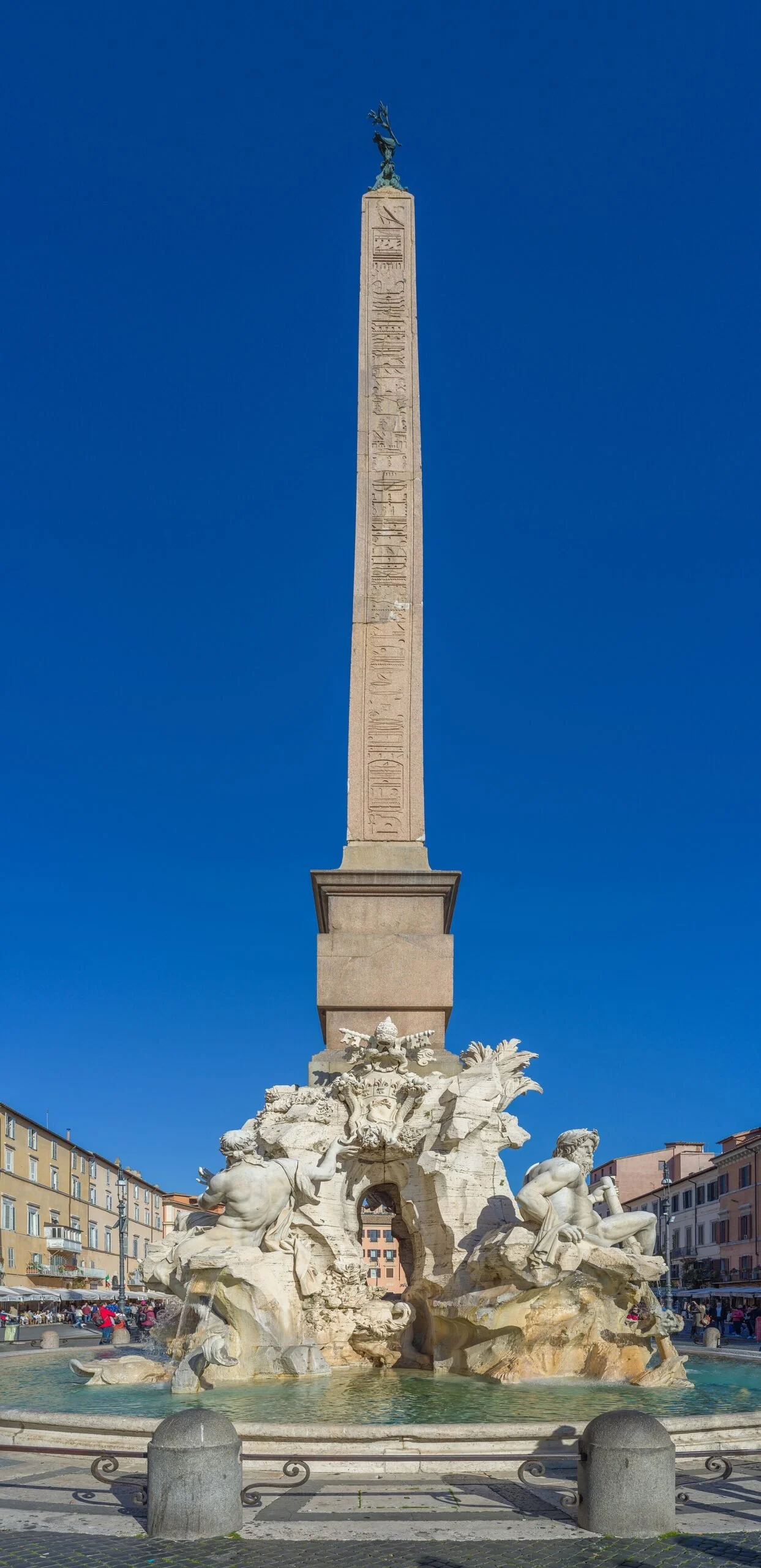
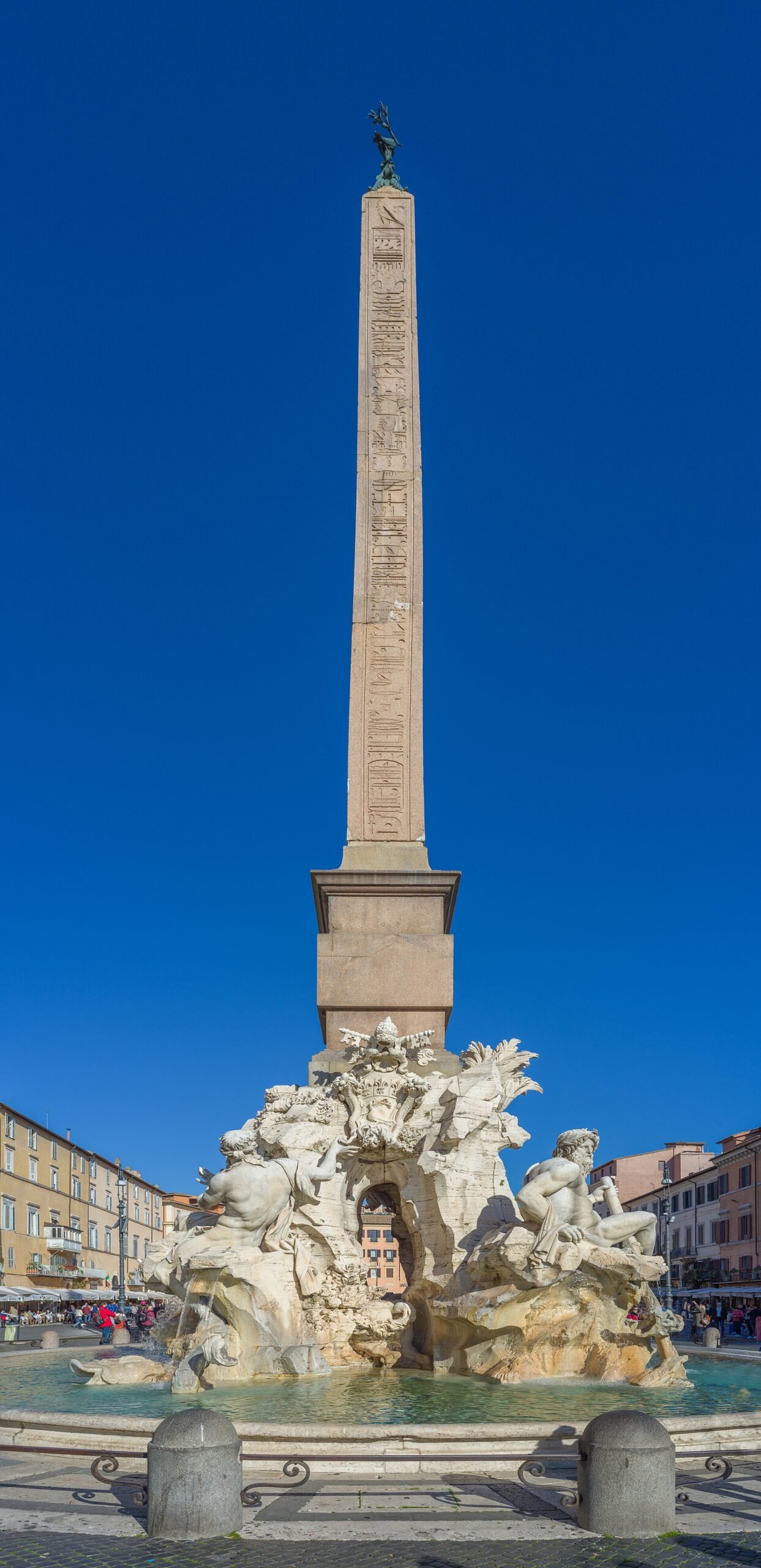
The Obelisco Agonale is the red granite monolith that rises in the middle of Piazza Navona, planted on the artificial rock of Gian Lorenzo Bernini's Fountain of the Four Rivers. Almost everyone, looking up, takes the same thing for granted: that it is an Egyptian obelisk, one of the many that Roman emperors carried off from Egypt as loot. It isn't. This obelisk was never raised on the banks of the Nile by a pharaoh: the block was quarried at Aswan, in Egypt, but it was worked and inscribed in Rome, in the Flavian age, under the emperor Domitian, and the hieroglyphs that cover its four faces don't speak of ancient pharaohs but of the Roman emperors of the Flavian dynasty. It is an Egyptian obelisk in stone and shape, Roman in commission, text and date. Before ending up where it is today it changed home at least twice: it seems to have stood in the great sanctuary of Isis and Serapis in the Campus Martius, then Maxentius had it moved to the spina of the circus of his own villa on the Appian Way, where it collapsed and lay broken on the ground for over a thousand years, until Pope Innocent X Pamphilj decided to make it the pivot of the square he considered the family's living room. The lines that follow tell what those hieroglyphs really say, how and when the obelisk arrived in Piazza Navona, what role Bernini played and why the correct name is Agonale.
A useful clarification before going on, so as not to confuse three different things that occupy the same space: Piazza Navona is the square as a whole, with the elongated shape inherited from the ancient stadium, the Fountain of the Four Rivers is the sculptural group with the cliff and the four river statues that occupies the center of the square, the Obelisco Agonale is the monolith that fountain supports, and it is an artifact much older than the Baroque around it, with an independent history that begins 15 centuries before Bernini. Here we talk about the obelisk.
Where the Obelisco Agonale is and how to reach it
The Obelisco Agonale stands in the exact center of Piazza Navona, in the rione Parione, in the heart of the historic center of Rome between Corso del Rinascimento to the east and Via di Santa Maria dell'Anima to the west. It is in the middle of a public space open day and night, with no gates, no ticket and no hours: it is one of the very few monuments in Rome you can look at at three in the morning as at 11 in the morning.
On foot from the historic center
From the Pantheon the walk is barely 5 minutes, crossing Corso del Rinascimento or slipping into the alleys that pass in front of Sant'Eustachio. From Campo de' Fiori the trip is even shorter, a little over 300 meters along Via dei Baullari and Corso Vittorio Emanuele II. From Castel Sant'Angelo you arrive in a quarter of an hour skirting the Tiber and crossing Ponte Umberto I or Ponte Sant'Angelo and Via dei Coronari, which is the more beautiful route of the two. Those coming from the Roman Forum or the Capitoline Hill go up Corso Vittorio Emanuele II in about 20 minutes' walk.
By public transport
Piazza Navona has no subway stop in the immediate vicinity, and it's good to know before leaving: it is one of the best-known gaps in the Roman network. The nearest Line A stations, Barberini and Spagna, are about 20 minutes' walk away, and it's best to count on that stretch on foot or else change to a surface bus. The surface lines that run along Corso Vittorio Emanuele II and along Corso del Rinascimento instead leave you a few steps from the square, and are the most direct solution for those arriving from Termini, the Vatican or Trastevere. The hours and routes of the lines change with some frequency, so it's best to check the updated route on the app or website of the capital's transport company the same day.
What the Obelisco Agonale is: an Egyptian obelisk made in Rome
The Obelisco Agonale is a monolith of red Aswan granite about 16.53 meters tall in the shaft alone, which with the base and the bronze dove at the top exceeds 30 meters in total height. The sources waver between 16.53 and 16.54 meters for the shaft, a one-centimeter difference that depends on the different surveys made over time and doesn't change the substance: it is a medium-sized obelisk compared to Roman giants like the Lateran one, but still of considerable size.
The paradox that surprises almost everyone
The fact worth fixing right away is this: the Obelisco Agonale is not an ancient Egyptian obelisk. The stone comes from Egypt, from the Aswan granite quarries that for millennia supplied the material for pharaonic monoliths, but the block was never erected in Egypt for a pharaoh. It was quarried, roughed out and transported to Rome in the Roman imperial age, and in Rome it received its hieroglyphic decoration. Put another way, it is a Roman work of the Flavian age made in Egyptian style, not a piece of pharaonic antiquity looted and reused.
The difference is not an academic subtlety. Roman obelisks divide roughly into two families: those truly Egyptian, carried off from Heliopolis, from Thebes or from other pharaonic sanctuaries and repositioned in Rome with an enormous logistical effort, like the Flaminian obelisk in Piazza del Popolo, and those made in the Roman age by workers who operated in Egypt or in Rome for Roman patrons. The Obelisco Agonale undoubtedly belongs to the second family, and is one of the most significant examples of the group precisely for the quality and coherence of the text carved on it.
Why it is called Agonale and not of Domitian
The official name under which the monument is cataloged, Obelisco Agonale, derives from the ancient name of the place that hosts it today: the area of Domitian's stadium was called in circo agonali, that is in the circus of the games, from the Greek agon, competition. From that term, through a long popular deformation that passes through in agone and then navone, the name Piazza Navona was also born, which therefore has nothing to do with ships or naumachiae, even though the square was indeed flooded for centuries during the summer festivals.
Many scholars and many guides, however, also call it the Obelisk of Domitian, from the name of the emperor who had it made. Both names are correct and indicate the same monument: the first identifies it by the place where it stands today, the second by the ancient patron. Anyone looking for bibliographic information will do well to try both formulas, because the archaeological literature tends to prefer the second while Roman toponymy and tourism use the first.
The hieroglyphs carved in Rome: what they really say
The hieroglyphs of the Obelisco Agonale do not celebrate a pharaoh but the Roman emperors of the Flavian dynasty: they are a hymn to Domitian and to the deified emperors Vespasian and Titus, respectively father and older brother of Domitian. It is the detail that surprises almost anyone who learns it, because it overturns the intuitive idea you have looking at an obelisk covered with Egyptian signs.
Domitian as pharaoh
In the text Domitian appears with a complete pharaonic titulary, rendered in the ways of Egyptian royal theology: he is called by formulas that qualify him as lord of the Two Lands, that is sovereign of Upper and Lower Egypt, the formula with which for 3,000 years the pharaohs had asserted their legitimacy. The figured scenes show the emperor in the presence of Egyptian deities, and in particular a coronation scene in which a goddess hands him the pschent, the double crown of the unified kingdom.
It is not an exotic whim. Since the Augustan conquest Egypt had been a province with a special status, administered directly by the emperor, and in the perception of the Egyptian population the Roman emperor was for all purposes the new pharaoh, holder of the same ritual functions. Presenting Domitian in pharaonic guise on an obelisk meant for an Isiac sanctuary in the heart of Rome meant asserting, in a language understandable to those who frequented that cult, the continuity between imperial power and the Egyptian sacred tradition.
Vespasian and Titus, deified emperors
Next to Domitian, the text names his father Vespasian and his brother Titus in the condition of divi, that is of dead emperors formally deified by the senate. The Flavian dynasty had an obvious legitimacy problem: Vespasian had come to the throne in AD 69, the year of the four emperors, emerging victorious from a civil war, and could claim no kinship with the Julio-Claudian dynasty extinct with Nero. Domitian, who reigned from AD 81 to 96, invested heavily in building a dynastic legitimacy founded on the deification of his own relatives. The obelisk is one of the pieces of that operation, rendered in a sacred language that added an Egyptian legitimation to the Roman one.
Kircher and the fanciful translations of the 17th century
When Innocent X put the obelisk back on its feet, the hieroglyphs were still completely undecipherable: almost two centuries were still missing before the Rosetta Stone and the work of Jean-François Champollion, who in the 1820s would finally open the way to true reading. The Jesuit Athanasius Kircher, the most famous scholar of Baroque Rome on Egyptian antiquities, then produced his own Latin translation of the obelisk's hieroglyphs, published in the work dedicated to this monument, and read in them mystical and theological messages of great complexity.
Those translations were, from the point of view of modern Egyptology, essentially invented: Kircher held that hieroglyphs were a symbolic and allegorical system, not a phonetic one, and built readings accordingly that have no relation to the real text. It must be said, though, that his work had considerable documentary value, because it recorded sign by sign what could be seen on the faces of the monolith at a moment when the monument had just been set upright again, and because it helped place the obelisk in a learned European discourse that enormously increased its fame.
A curiosity about the Obelisco Agonale
The tastiest curiosity concerns precisely the sequence of misunderstandings that has accompanied this monument for almost 2,000 years. It is an obelisk made by the Romans with Egyptian stone and Egyptian signs to celebrate a Roman dynasty. In the 17th century a German Jesuit translated it reading into it a Hermetic theology that wasn't there. And still today the vast majority of people who pass beneath its carved faces are convinced they are looking at a trophy carried off from the Egypt of the pharaohs. The most misunderstood monument in Rome, one might say, is also the one that more than any other tells how Roman imperial culture really worked: not passive imitation, but conscious appropriation of a foreign language to say something of its own.
The monument that spoke a language nobody could read
There is a detail that makes the paradox even sharper. Already in Domitian's time, in Rome, ordinary people passing in front of the obelisk were not able to read those signs, and probably not even the great majority of Roman Isiac priests could fully do so. The text, therefore, was not written to be read by the Roman public: it was written to exist, to be correct in the eyes of the gods and to give the monument a sacred authority that no Latin inscription could have given it. It is exactly the same logic by which certain monumental inscriptions of every era are in liturgical languages that the faithful do not master: the value is not in communication, it is in consecration.
Where it stood originally: the sanctuary of Isis and Serapis
The original location of the Obelisco Agonale is a question on which scholars do not fully agree, and it is worth saying so clearly instead of choosing one version and passing it off as certain. The most widespread and most cited hypothesis places it in the Iseum Campense, the great sanctuary dedicated to Isis and Serapis that occupied a wide area of the Campus Martius, between today's basilica of Santa Maria sopra Minerva and the Pantheon area.
The Iseum Campense, a piece of Egypt inside Rome
The Isiac sanctuary of the Campus Martius was one of the most singular presences of imperial Rome: a wide sacred complex, populated with obelisks, statues of Egyptian deities, sphinxes, basalt lions and imported or imitated furnishings, which reproduced in the heart of the capital the atmosphere of a Nilotic temple. It was badly damaged by the fire of AD 80 and Domitian had it rebuilt at great expense, which would perfectly explain the commission of a new obelisk, carved in Rome with a text celebrating his own dynasty.
From that sanctuary come, with different degrees of certainty, several other monoliths now scattered around Rome, among them the obelisk that tops Bernini's little elephant in front of Santa Maria sopra Minerva, the one in Piazza della Rotonda in front of the Pantheon and other pieces dispersed in the city and beyond. Reconstructing the map of these fragments means reconstructing piece by piece a whole vanished sanctuary, and each piece provides a tile.
The alternative hypothesis of the temple of the gens Flavia
A part of the research, however, proposes a different location: the templum gentis Flaviae, that is the dynastic sanctuary that Domitian had erected on the Quirinal, on the site of the family's birthplace house, to host the cult of his own deified relatives. The argument is consistent with the content of the hieroglyphic text, which is precisely a hymn to the Flavian dynasty and its deified members, and therefore would fit very well a building built for exactly that function.
The two hypotheses do not exclude each other in general terms, because in both cases the patron remains Domitian and the date remains the last quarter of the 1st century. What changes is the context of reading: in the first case the obelisk is an imperial votive offering placed in a sanctuary of an Eastern cult open to a community of devotees, in the second it is a dynastic monument inside a family shrine. In the current state of knowledge the point remains open, and anyone who states with absolute certainty one location or the other is choosing between hypotheses, not reporting an established fact.
The move to the Circus of Maxentius on the Appian Way
In the 4th century AD the emperor Maxentius had the obelisk moved to the spina of the circus of his own suburban residence along the Appian Way, the complex we know today as the Villa of Maxentius, at the third mile of the consular road. The circus was part of a monumental ensemble that also included the imperial palace and the dynastic mausoleum dedicated to the emperor's son, Valerius Romulus, who died very young around AD 309.
A circus built for a bereavement
The construction of the Maxentian complex on the Appian Way is tied to the premature death of Valerius Romulus, son of Maxentius, which historians place around 309, and to his deification. The circus, the palace and the mausoleum formed an ensemble conceived as a suburban imperial residence and at the same time as a dynastic shrine. Bringing an obelisk to that place meant giving the spina of the circus the same kind of solemnity that the Flaminian obelisk gave the spina of the Circus Maximus, the great model every Roman circus looked to.
The collapse and the 1,000 years on the ground
No source records when and why the obelisk fell. The circumstance is not at all unusual: of the 13 ancient obelisks standing in Rome today, nearly all had collapsed and been buried before the popes of the 16th and 17th centuries undertook their systematic recovery. Earthquakes, ground subsidence, the gradual abandonment of suburban structures and the stripping of materials did the rest. What is certain is that the monolith remained on the ground, broken, in the area of the Maxentian circus along the Appian Way for many centuries, in a countryside that in the meantime had become almost deserted again.
Anyone visiting the Appian Way Regional Park today passes exactly the spot where the obelisk lay for more than a millennium, a few tens of meters from the Mausoleum of Caecilia Metella, and within sight of those Catacombs of San Sebastiano whose visit, as we will see, played a direct role in the 17th-century recovery.
Something nobody tells you about the Obelisco Agonale
The obelisk you see today in Piazza Navona is not a single block: it was found broken into five pieces and reassembled. The sources on the 17th-century recovery agree in describing the monolith lying fragmented in the area of the Maxentian circus, and the work that allowed it to be raised consisted first of all in recovering, recomposing and reconnecting those sections.
The joints you can look for by eye
Observing the shaft from below with a bit of attention, and better still with a telephoto lens or a zoom, you can make out the horizontal lines of fracture and recomposition that cross the granite, and at certain points you notice how the pattern of the hieroglyphs shows a slight discontinuity at the joins. It is an exercise that completely changes the way you look at the monument: from a perfect and untouchable monolith to a rebuilt object, repaired, held together by 17th-century construction work.
The oldest monument in the square is the one people look at least
It is worth insisting on this reversal, because it is the best way to understand the square. Under the pavement is Domitian's stadium, of the Flavian age, which can be visited in the Underground of Piazza Navona. In the center of the square is an obelisk of the same Flavian age. Everything else, that is the facades, the church, the fountains and the palace, is 15 centuries more recent. The Baroque square grew inside and on top of a Roman layout and around a Roman monument, and the obelisk is the link that holds the two eras together: same imperial patron, same historical moment as the stadium that gives the square its shape.
Innocent X and the recovery of 1647
The recovery of the obelisk begins with a day trip. On April 27, 1647 Pope Innocent X Pamphilj went to visit the basilica of San Sebastiano, on the Appian Way, and in the course of the day he saw the great monolith lying on the ground in the area of the Maxentian circus. From that visit came the project to bring it to Piazza Navona.
Why Piazza Navona in particular
Giovanni Battista Pamphilj, elected pope in 1644 with the name Innocent X, was born and raised in a family house that overlooked Piazza Navona. The family palace, enlarged and transformed during his pontificate into the Palazzo Pamphilj that still today closes the west side of the square, was the center of the house's power: the same family whose art collection is today largely preserved in the gallery of Palazzo Doria Pamphilj, on the Corso. Transforming the home square into the family's monumental theater was a declared goal of the pontificate, and a raised ancient obelisk at the center was the strongest gesture available in the repertoire of the Roman popes, who from Sixtus V onward had made the recovery of obelisks a systematic urban and symbolic policy.
The transport
The pieces of the obelisk were transported from the Appian Way to the center of Rome during 1648, in an operation that involved covering several kilometers by road with loads of tens of tons, entering the city and crossing the urban fabric to the Campus Martius. These were undertakings that in 17th-century Rome required large crews, winches, sledges, oxen and precise technical direction, and that were celebrated as engineering feats in their own right, with medals, commemorative prints and printed reports.
The erection of August 12, 1649
The obelisk was raised in the center of Piazza Navona on August 12, 1649, on the prepared base. The sculptural group of the fountain was still in progress and would be completed in the following years, so for a period the monolith stood in a square that was still an open construction site. The bronze dove destined to crown it, about 1.70 meters tall according to the measurements reported by the sources that describe it, was placed at the top in November of the same 1649.
The competition won by Bernini and the rivalry with Borromini
The fountain that today supports the Obelisco Agonale was born from a competition called by Innocent X, and the story of that competition is one of the most told episodes in the history of Roman art. The Fountain of the Four Rivers was built between 1648 and 1651 and was inaugurated on June 12, 1651.
Bernini excluded and then winner
At the opening of the pontificate Gian Lorenzo Bernini was not on good terms with the papal court: he had been the favorite artist of the predecessor Urban VIII Barberini, and the end of that pontificate had left him in a disadvantaged position, worsened by the controversies over the bell towers of St. Peter's. The sources agree in recounting that the pope had designs prepared by the main architects of Rome without involving Bernini.
Tradition, taken up by biographers and become one of the most famous stories about the artist, has it that Bernini got around the exclusion by having a silver model of his idea made, roughly a meter and a half tall, and having it reach the pope through Donna Olimpia Maidalchini, sister-in-law of Innocent X and a figure of enormous influence in papal Rome in those years. On seeing the model, the pope is said to have given in and assigned Bernini the commission. This episode is reported consistently by the literature on the fountain, but it belongs to the genre of the 17th-century biographical anecdote and should be read with the caution that genre requires: of the outcome, that is the assignment of the work to Bernini, there is instead no doubt.
Borromini's design
Francesco Borromini, the great rival, in turn presented a proposal for the arrangement of the obelisk: a solution with large shells and mascarons at the base of the monolith, from which water would have gushed. It was an idea consistent with his language, played entirely on sculptural architectural forms, and profoundly different from the naturalistic cliff that Bernini would build. It should be recalled, in fairness, that Borromini had a not minor technical role in the overall story of the square, in particular in the water-supply project that was to bring the water needed to feed the fountains.
The legend of the Nile covering its eyes
What must be debunked instead, because you hear it repeated in front of the fountain practically every day, is the story that the statue of the Nile covers its head so as not to look at the facade of the church of Sant'Agnese in Agone built by Borromini, and that the statue of the Rio de la Plata raises its hand fearing the church will collapse on it. The reason the reading doesn't hold up is chronological: the fountain was completed before Borromini began working on the church facade. As for the Nile, the veiled head has a precise and well-documented iconographic explanation: at the time the sources of the Nile were unknown, and the veil covering the face of the river god represents exactly that geographical ignorance. It is popular tradition, in short, not art history, and as such it should be told.
The void under the monolith
The technical solution most admired by contemporaries is, however, another, and it concerns the obelisk directly. Bernini did not rest the monolith on a solid base: he built a pierced cliff, with a large void passing through the rock from side to side, over which the weight of the obelisk is discharged through the four points of support of the rock mass. The visual effect is that the monolith seems suspended over nothing, and at the time the thing raised more than one fear about the stability of the whole. It is the invention that turns an operation of placement into a coup de théâtre, and it is the reason this fountain is studied still today in every course on the history of Baroque architecture.
My advice for visiting the Obelisco Agonale
The most useful advice is the one nobody gives: go early. The Obelisco Agonale is in a public space always accessible and free, but Piazza Navona is one of the most crowded squares in Europe from late morning to late afternoon, and with the crowd you lose exactly what makes the monument understandable, that is the possibility of stepping back, looking at it whole and walking slowly around it.
The right time
Between seven and eight 30 in the morning the square is almost empty, the cafes are still opening and the little tables haven't invaded the central space. You can stop at any distance, you see the four faces of the obelisk with nobody in front, and the raking light of early morning enters the grooves of the hieroglyphs making them much more legible than they are at noon. The second good moment is after 23:00, when the artificial lighting sets the dark shaft off against the sky and the dove at the top becomes a crisp silhouette.
What to look for on the shaft
Three things, in order of difficulty. The first are the columns of hieroglyphs, which can be made out well even with the naked eye on the lit faces. The second are the figured scenes in the upper part, where the figures of the emperor and the deities appear: here you need a zoom or binoculars. The third are the lines of recomposition of the five pieces, the hardest detail and the most satisfying to spot, which requires patience and side light.
How much time you need
For the obelisk itself 10 minutes of careful observation are enough. The point is that nobody comes to Piazza Navona only for the obelisk: placed within a tour that includes the square, the two smaller fountains of the Moor and Neptune, the church of Sant'Agnese in Agone and maybe the visit to the underground of Domitian's stadium, you comfortably reach a half day. Those short on time can consider this stop a 10 or 15 minute passage within an itinerary linking the Pantheon, Campo de' Fiori and the Tiber.
With children
The square is pedestrian and safe, which makes it one of the most comfortable stops in Rome for those traveling with small children. The monument itself, to a child, is an uninteresting stone pole: it works very well instead told as a riddle, looking for the figures on the faces, counting the statues and asking them to guess which river each represents. The ice cream or granita stop is practically obligatory and should be factored in.
Another well-known fact, yet rarely cited
At the top of the obelisk there is no cross, as on almost all the other Roman obelisks raised by the popes, but a bronze dove with an olive branch in its beak. It is the heraldic emblem of the Pamphilj, and the choice says a great deal about how this family understood its relationship with the city.
Why a dove and not a cross
Sixtus V, at the end of the 16th century, had established a precise practice: every ancient obelisk raised was crowned with a cross, often accompanied by inscriptions that explicitly declared the victory of the Christian faith over pagan cults. Innocent X chose a different and more ambiguous path, because the dove with the olive branch works on two registers at once: it is a symbol of peace and of the Holy Spirit in Christian language, and it is also the Pamphilj family coat of arms, recognizable by anyone in Rome. A single object, placed at the highest and most visible point of the home square, that says at the same time a devout thing and a dynastic thing.
The city paid the bill
This is the aspect least willingly cited. The arrangement of the square and the fountain was also financed with taxes on basic necessities, among them bread and wine, in years of hardship for the Roman population. Popular discontent expressed itself in the classic form of papal Rome, that is the anonymous satire of the pasquinades posted on the talking statue of Pasquino, which stands a few meters from Piazza Navona: the tone was that of people pointing out that Romans would have preferred bread to spires and fountains. It is a counterpoint worth keeping in mind while admiring the scenery: the Baroque magnificence of this square had a documented social cost, and telling it without that cost means telling it by half.
The right photo to take at the Obelisco Agonale
The right photo at the Obelisco Agonale is not the one everybody takes, that is the frontal framing of the fountain with the monolith cut in half because it doesn't fit in the frame. To photograph this monument well you have to decide first what you want to tell: the proportion between obelisk and square, or the detail of the hieroglyphs. They are two different photographs and require two positions and two different lenses.
The overall photo
For the overall shot you need to step back to the long side of the square and use a moderate wide angle, keeping the camera as level as possible so the verticals don't fall: Piazza Navona is full of vertical lines, and a crooked obelisk among crooked facades is the most common flaw of photos taken here. If you use a phone, it's best to turn on the grid and align the shaft of the obelisk with one of the vertical lines, then correct slightly when cropping. The best time is first thing in the morning, for two reasons that add up: very few people in the frame and raking light that gives volume to the stone.
The detail photo
For the hieroglyphs you instead need a strong zoom, at least equivalent to a medium telephoto, and a face of the obelisk lit from the side. At noon, with the sun directly overhead, the grooves of the carvings cast no shadow and the text becomes almost invisible in a photograph. In the low hours of the morning or late afternoon, instead, every sign gains a shadow of its own and the result is legible. The face to choose depends on the hour: in the morning the one facing east is best, in late afternoon the one facing west.
The photo almost nobody takes
There is a little-used and very effective framing: get right up against the basin, on the side where the cliff is pierced, and photograph the obelisk through the void of the rock, framing the shaft that seems to be born out of nothing. It is the photograph that best conveys Bernini's structural invention, and it is one of those you get only by getting very close and crouching down. Another variant that works is the night photo with the lighting on and the dove standing out against the sky, which requires a stable support for the phone or camera, because exposure times get longer.
Some important events that happened here in history
The obelisk has been a witness, from 1649 on, to practically every event that had Piazza Navona as its stage, which for over two centuries was one of the most lived-in squares of the city. But its chronology begins much earlier.
Last quarter of the 1st century: the making
Under Domitian, emperor from AD 81 to 96, the block arrives at Aswan, is brought to Rome and receives the hieroglyphic apparatus that celebrates him and the deified emperors Vespasian and Titus. It is the same period in which Domitian has built, a few hundred meters away, the stadium whose foundations still determine the shape of Piazza Navona today.
Early 4th century: the move to the Appian Way
Maxentius has it transported to the spina of the circus of his own suburban villa at the third mile of the Appian Way, in a complex tied to the memory of his son Valerius Romulus. A few years later, in 312, Maxentius dies at Ponte Milvio and the complex loses its patron and its celebratory function.
April 27, 1647: the pope sees it on the ground
Innocent X, visiting San Sebastiano on the Appian Way, sees the monolith lying broken. It is the date that marks the beginning of the monument's modern story.
1648: the transport into the city
The five pieces are brought from the Appian Way to Piazza Navona and the work on the fountain begins, to Bernini's design. In the same year the sources record popular discontent over the taxes imposed to cover the expenses.
August 12, 1649: the erection
The obelisk is raised in the center of the square. In November of the same year the bronze dove of the Pamphilj is placed at the top.
June 12, 1651: the inauguration of the fountain
The Fountain of the Four Rivers is inaugurated, complete with the four river statues. From that day the obelisk takes on the look it still has today.
1825: Nibby clarifies the provenance
The excavations of Antonio Nibby on the Appian Way show that the circus from which the obelisk came belonged to Maxentius and not to Caracalla, correcting an attribution that had lasted centuries and fixing the fact that all later publications would adopt.
The 20th century and the restorations
In the course of the 20th century and the first decades of the 2000s the fountain and the obelisk have been the object of restoration and maintenance work, made necessary by the combined action of water, limescale deposits and urban pollution on the surfaces of the granite and the marbles. Those visiting the square may find, depending on the period, scaffolding or sheeting around the group: it's best to check the state of the work sites on the Capitoline Superintendency website before planning a visit motivated mainly by this monument.
Who passed by the Obelisco Agonale
The list of people tied to this monolith spans 15 centuries and includes emperors, popes, artists, scholars and generations of travelers.
Domitian and the Flavians
The ancient patron is Domitian, last emperor of the Flavian dynasty, killed in a palace conspiracy in AD 96 and struck after death by the condemnation of memory decreed by the senate. His name nevertheless remains carved on the shaft, in a script that nobody in Rome could read, and this is one of the most lasting ironies of Roman history: the damnatio memoriae erased Domitian's Latin inscriptions in half the city, but did not touch the hieroglyphs that celebrated his name.
Maxentius
The second patron is Maxentius, who ruled over Rome from 306 to 312 and whom the Constantinian narrative handed to history as the tyrant defeated at Ponte Milvio. It was he who chose this obelisk for the spina of his own circus, in a monumental complex that was at once residence, entertainment venue and family shrine.
Innocent X and Donna Olimpia
The third patron is Giovanni Battista Pamphilj, pope from 1644 to 1655, who made Piazza Navona project the most visible sign of his pontificate. Beside him, in the story, constantly appears his sister-in-law Olimpia Maidalchini, a figure of real power in the papal court of those years and protagonist of the anecdote about Bernini's silver model.
Bernini, Borromini and the sculptors
Gian Lorenzo Bernini designed the fountain and the setting up of the obelisk. Francesco Borromini presented an alternative design and worked on the water-supply question of the square. Giacomo Antonio Fancelli, Claude Poussin, Antonio Raggi and Francesco Baratta carved the four river figures under Bernini's direction. It is one of the densest lists in Roman Baroque sculpture concentrated in a few square meters.
The Grand Tour travelers
From the 18th century onward, Piazza Navona with its obelisk was a required stop for anyone making the Grand Tour, and painted and engraved views of the flooded square or of the market circulated throughout Europe. The monument thus entered the European imagination of Italy long before photography, and the image of the obelisk mirrored in the water is one of the longest-lived visual clichés of modern Rome.
Around the obelisk: what to see in Piazza Navona
The Obelisco Agonale is the geometric center of an ensemble worth reading as a whole, because every element of the square dialogues with the others.
Domitian's stadium under your feet
The elongated shape, rounded at one end, that makes Piazza Navona instantly recognizable is not a Baroque invention: it is the perimeter of the stadium that Domitian had built in the 1st century AD for athletic games on the Greek model. The remains of the ancient structures can be visited in the Underground of Piazza Navona, a few meters below the current level, and the visit is recommended to anyone who wants to understand why the square has this shape. It is worth noting the coincidence: the stadium and the obelisk have the same imperial patron and the same era, though they found themselves in the same place only 15 centuries later, through a papal decision that had nothing to do with Domitian.
Sant'Agnese in Agone and Palazzo Pamphilj
On the west side of the square stand the church of Sant'Agnese in Agone, with its concave facade and the two bell towers on which Borromini worked, and the large Palazzo Pamphilj, today the seat of the Brazilian embassy in Italy. The church stands at the spot where tradition places the martyrdom of Saint Agnes, the same saint to whom the basilica of Sant'Agnese fuori le Mura on Via Nomentana is dedicated, where according to tradition she was buried.
What is a few steps away
The location of the square makes it an ideal hub for building itineraries: to the north, beyond Corso del Rinascimento, is Palazzo Altemps with its collections of ancient sculpture from the Museo Nazionale Romano. To the east is the Pantheon. To the south is Campo de' Fiori with its morning market. To the west are the Tiber, the bridges and the route toward Castel Sant'Angelo. Those who want to complete the picture on Roman obelisks will also find interesting the curious case of the Obelisks of Villa Torlonia, two 19th-century monoliths with hieroglyphs carved in modern times, which repeat in the full 19th century the same cultural operation carried out by Domitian 18 centuries earlier.
Frequently asked questions about the Obelisco Agonale
How tall is the Obelisco Agonale?
The Obelisco Agonale measures about 16.53 meters in the red granite shaft alone, and exceeds 30 meters in total counting the base of the fountain and the bronze dove placed on top. The sources waver between 16.53 and 16.54 meters for the shaft, a difference of one centimeter due to the different surveys made over time.
Is the Obelisco Agonale really Egyptian?
The Obelisco Agonale is not an ancient Egyptian obelisk: the granite comes from the Aswan quarries, in Egypt, but the monolith was made in the Roman age under the emperor Domitian, and the hieroglyphs were carved in Rome with a text that celebrates him and the deified emperors Vespasian and Titus. It is the detail that surprises most visitors.
What do the hieroglyphs of the Obelisco Agonale say?
The hieroglyphs of the Obelisco Agonale are a hymn to the emperor Domitian and to the deified emperors Vespasian and Titus, father and brother of the patron. Domitian appears in them with a pharaonic titulary, in scenes that show him before Egyptian deities, among them a coronation with the double crown of Upper and Lower Egypt.
Where was the Obelisco Agonale before Piazza Navona?
Before Piazza Navona the Obelisco Agonale stood in the Circus of Maxentius, on the Appian Way, where the emperor had it placed at the beginning of the 4th century on the spina of the circus. Before that, according to the most widespread hypothesis, it stood in the sanctuary of Isis and Serapis in the Campus Martius, although some scholars propose the temple of the gens Flavia on the Quirinal.
When was the obelisk placed in Piazza Navona?
The Obelisco Agonale was raised in the center of Piazza Navona on August 12, 1649, at the wish of Pope Innocent X Pamphilj, after being found broken into five pieces in the area of the Circus of Maxentius and transported into the city in 1648. The bronze dove was placed at the top in November of the same year.
How much does it cost to see the Obelisco Agonale and what are the hours?
Seeing the Obelisco Agonale is free and possible at any hour, because the monument is in the center of Piazza Navona, a pedestrian public space always accessible, with no fences or ticket office. A ticket is needed instead for the visit to the underground of Domitian's stadium beneath the square, which is a separate museum facility with its own hours and fares, to be checked with the facility.
How do you get to the Obelisco Agonale by public transport?
You reach the Obelisco Agonale on foot from Corso Vittorio Emanuele II or from Corso del Rinascimento, where several city bus lines stop. Piazza Navona has no subway station in the immediate vicinity: the nearest Line A stops are about 20 minutes' walk away, so the most convenient solution is the surface bus or a walk from the Pantheon.
What is the difference between the Obelisco Agonale and the Fountain of the Four Rivers?
The Obelisco Agonale is the ancient granite monolith, made in the Roman age under Domitian, while the Fountain of the Four Rivers is the Baroque sculptural group designed by Bernini between 1648 and 1651 that supports and frames it. They are two separate works about 15 centuries apart, united in a single monument by the will of Innocent X.
Is the Obelisco Agonale accessible to people with disabilities?
The Obelisco Agonale is in a flat pedestrian square, with no steps or barriers to reach the space from which the monument is observed, and is therefore reachable by wheelchair from all the entrances of the square. The paving is sampietrini cobblestones, which are uneven and can make the route tiring: the easiest stretches are those along the edges of the square.
One last piece of advice for those planning the itinerary
The Obelisco Agonale works better as a stop within a route than as a destination in itself: a few minutes of careful observation, ideally early in the morning, fitted into a walk linking the Pantheon, Piazza Navona with its ancient underground and Campo de' Fiori. Those with more time who want to follow the story of this stone to the end can devote another half day to the Appian Way and the Villa of Maxentius, to see the exact place the obelisk comes from: it is one of the few cases in Rome where you can visit both the starting point and the arrival point of the same monument, eight kilometers and 1,300 years apart.
Those planning a broader itinerary in the historic center of Rome, crossing this stop with the other stops of the Campus Martius and the Tiber area, can find useful planning tools at Tour Leader Pro, while for a broader picture of transport and destinations in Lazio a good resource is Italy Planner.