Mausoleum of Cecilia Metella
In short. The Mausoleum of Cecilia Metella is the great cylindrical tomb that stands just before the third mile of Via Appia Antica, in Rome, and is probably the most photographed monument in the whole Appia Antica Park.
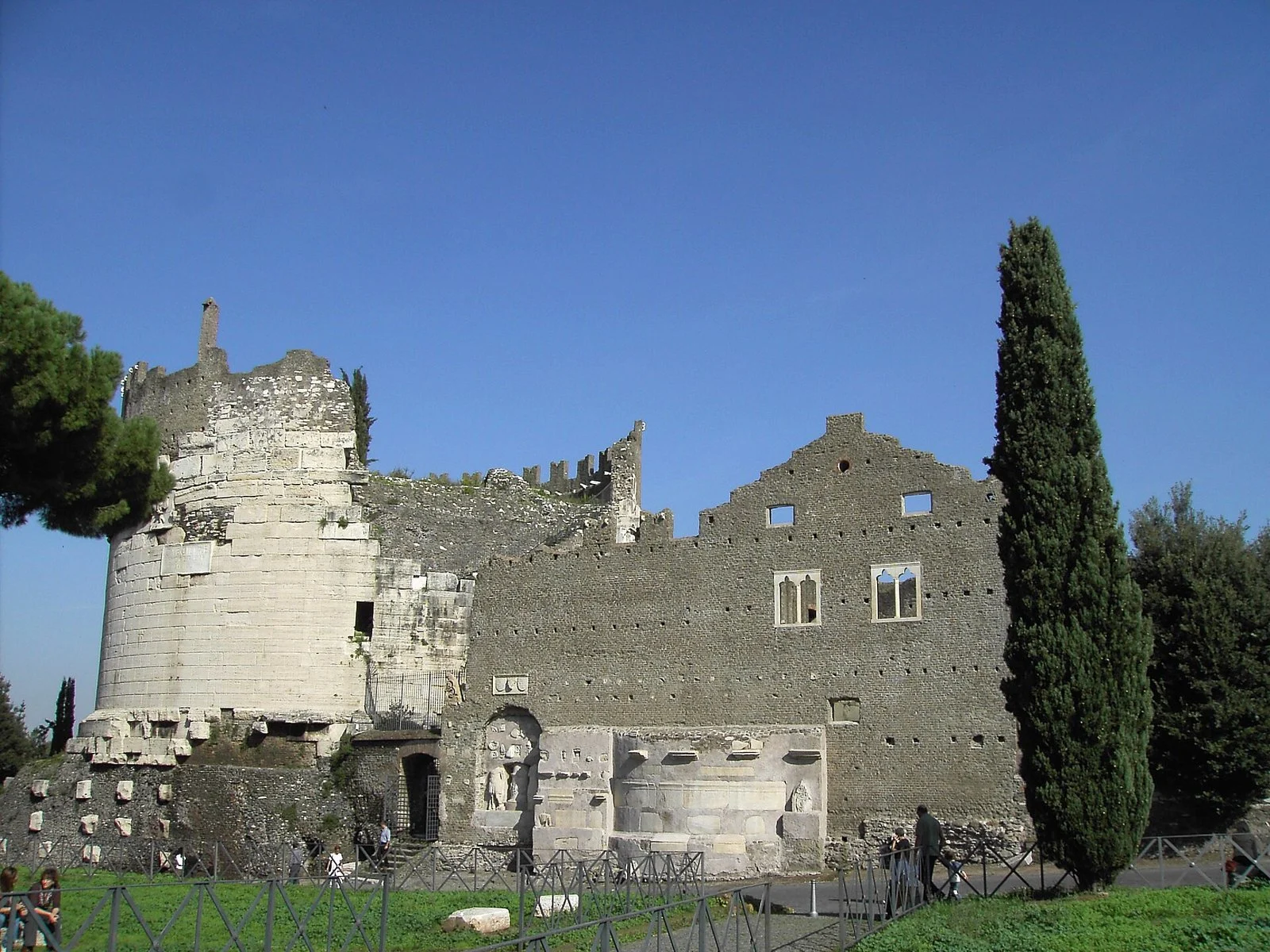
The Mausoleum of Cecilia Metella is the great cylindrical tomb that stands just before the third mile of Via Appia Antica, in Rome, and is probably the most photographed monument in the whole Appia Antica Park. A travertine drum almost 30 meters in diameter, resting on a square base, crowned by a crenellation that has nothing Roman about it because it was added in the 14th century, when the Caetani family turned the tomb into a tower and built a castle around it straddling the consular road. Whoever arrives here by bike on Sunday, when the Appia is closed to cars, finds themselves in front of a single thing that nonetheless tells two different stories: an aristocratic tomb of the end of the Roman republic and a medieval fortress that for two centuries controlled the traffic and collected the toll on one of the most important roads in Europe. The two stories did not overlap by chance, and understanding how they fit together is the best way to visit this place without limiting yourself to taking a photo from the sidewalk. In the lines that follow you'll find who Cecilia Metella really was, what the inscription says, where the nickname Capo di Bove comes from, how the Castrum Caetani is built with its church and its palace, what you see in the museum set up inside, how much it costs to get in, what hours it has and how to really get there by public transport.
Where the Mausoleum of Cecilia Metella is and how to get there
The Mausoleum of Cecilia Metella is at Via Appia Antica 161, just before the third mile of the ancient consular road, in the stretch where the Appia begins to become the postcard of paving stones, pines and tombs that everyone has in mind. It's the point where the road, after passing the church of Domine Quo Vadis and the fork for the Catacombs of San Callisto, climbs slightly and narrows between two tuff walls: the mausoleum appears suddenly on the left, enormous, and the medieval castle opens beside it on the right, with the arch that once spanned the roadway.
Where to buy tickets. The Mausoleum of Cecilia Metella with the Castrum Caetani is run by the Appia Antica Archaeological Park: single ticket or combined with Villa dei Quintili and Capo di Bove, all on the website of the Appia Antica Archaeological Park. No booking platform sells a product dedicated to this monument. Checked on September 28, 2026.
By public transport
The most direct way to get to the Mausoleum of Cecilia Metella by public transport is bus 118, which starts from the Piramide area and the Circus Maximus, runs along Viale delle Terme di Caracalla, exits through Porta San Sebastiano and goes up Via Appia Antica touching the Catacombs of San Sebastiano and the mausoleum. It's the line most visitors use, and it has the advantage of making you ride by bus along the very first stretch of the Appia, the one without visible ancient paving but dense with monuments.
The other two useful lines are the 218, which goes down Via Ardeatina and serves the area of the catacombs and the Ardeatine Caves, and the 660, which connects the Arco di Travertino stop of metro A to the stretch of the Appia south of the mausoleum, terminus included. It has to be said honestly that none of these solutions is very fast: Via Appia Antica is a narrow road, with no priority lanes, and the bus frequencies are not comparable to those of the lines in the center. It's best to allow longer times than those estimated by a navigation app, especially on spring weekends.
On Sundays the Appia is closed to traffic
A practical fact that completely changes the experience of the visit: Via Appia Antica is closed to private vehicle traffic on Sundays and holidays. It's a measure in force for many years, wanted to give the road back to those who walk and cycle, and it turns the stretch between the Quo Vadis and the mausoleum into one of the most beautiful pedestrian spaces in Rome. If you can choose the day, Sunday is by far the best time to come here, because you walk on the ancient paving without having to dodge the cars that on weekdays travel the road at speeds that are not always prudent.
The bicycle remains the vehicle this stretch of Appia seems made to welcome, and there are rental points along the road. From Porta San Sebastiano to the mausoleum it's about 20 minutes by bike and a little under an hour on foot. A sincere warning about the surface: the paving stones are polygonal blocks with wide, often uneven joints, uncomfortable and in some places risky for a bicycle with thin wheels. By car you can only get there on weekdays, on a narrow road with very few places to stop legally: whoever comes from outside Rome does better to leave the vehicle in a park-and-ride lot of metro A and finish with the bus.
What the Mausoleum of Cecilia Metella is: structure, measurements and materials
The Mausoleum of Cecilia Metella is a cylindrical drum tomb on a square base, built in the second half of the 1st century BC and dated by scholars to a range between 30 and 10 BC. The body of the construction is in opus caementicium, the conglomerate of mortar and stone chips that is the true technical invention of Roman architecture, faced on the outside with slabs of travertine. It's the type of tomb that the aristocracy of the end of the republic favored, and it belongs to the same typological family as the Mausoleum of Augustus in the Campus Martius, even though the size and proportions of the two monuments are very different.
The cylindrical drum and its measurements
Above the podium rises the cylindrical drum, the element that gives the monument its unmistakable silhouette. The diameter is about 29.5 meters, a measure that corresponds precisely to 100 Roman feet: it's no accident, because ancient builders designed on round modules of their own metric system, and finding the number 100 in a main measurement is a clue that the structure was planned on paper and not adapted afterward. Modern sources sometimes give the diameter as 29.5 meters, sometimes rounded to 30, and the difference depends simply on the point where the measurement is taken, since the outer facing is no longer continuous around the whole perimeter.
On the overall height the sources diverge in a more substantial way, and it's worth saying so openly instead of picking a number at random. Some reconstructions give for the Roman part alone a height of around 22 meters, obtained by adding a little over eight meters of podium and about 12 meters of drum. Other descriptions give a noticeably greater overall height, including the medieval crenellation and measuring from the lowest ground level. The reason for the disagreement is not somebody's mistake: it depends on what you decide to measure, the ancient monument alone or the whole of what you see today, and on the fact that the original crowning of the drum is lost and its exact height is not known. Anyone looking for a single, definitive number is looking for something that doesn't exist.
The inner burial chamber
Inside the drum opens the burial chamber, a circular-plan space that occupies the whole height of the structure and narrows upward in a conical form, closing with a circular opening at the top. Today the room is completely bare: the original funerary furnishings, the wall decoration and any object that was placed there have been scattered for centuries, and what the visitor sees is the bare masonry. You enter the chamber through the corridor carved in the base, and the effect, on entering, is that of being inside an enormous well of masonry with a circle of sky at the top.
Who Cecilia Metella was and what family she came from
Cecilia Metella was a Roman noblewoman of the end of the republic, daughter of Quintus Caecilius Metellus Creticus and wife of a Marcus Licinius Crassus belonging to the family of the more famous triumvir of the same name. She was not a political figure, she doesn't appear in the chronicles as a protagonist of public events, and of her as a person we know almost nothing: no ancient source tells her life, her character, the date of her birth or of her death. We do know exactly, though, in what network of family alliances she was placed, and that network explains why her tomb is as big as a palace.
The Caecilii Metelli, a dynasty of consuls
The gens Caecilia, and in particular the branch of the Metelli, was for over a century one of the most powerful families of the Roman republic. The Metelli collected consulships, censorships and triumphs with a regularity that had few comparisons in republican Rome, and built their influence through a systematic marriage policy, becoming related to almost all the other great senatorial houses. In the language of the time, belonging to the Metelli meant belonging to the narrow core of families that shared out the highest magistracies, and the name alone was worth a political fortune.
The father: Quintus Caecilius Metellus Creticus
Cecilia's father, Quintus Caecilius Metellus, was consul in 69 BC and earned the nickname Creticus for the conquest of the island of Crete, a military campaign conducted in the years immediately after the consulship. The nickname is important because it appears directly in the inscription of the tomb, where Cecilia is identified as the daughter of Quintus Creticus: in republican Rome a cognomen ex virtute, that is a nickname earned with a military victory, was a title of glory that was passed on to descendants and displayed on every public occasion, funerary inscriptions included.
The husband: a Crassus, but which one
On the husband the matter is slightly more tangled than it is usually told. The inscription indicates him only as Crassus, with no other elements, and the most widespread reading among scholars identifies Cecilia's husband with Marcus Licinius Crassus son of the triumvir, that is son of that Marcus Licinius Crassus who in 71 BC crushed the revolt of Spartacus, who in 60 formed with Caesar and Pompey the first triumvirate and who died disastrously in 53 in the campaign against the Parthians at Carrhae. Cecilia's husband, therefore, was not the triumvir in person but his son, a man who served as an officer under Caesar in Gaul.
Some reconstructions, however, propose variants on the exact degree of kinship or on the identification of the Crassus cited, and the ancient sources are not explicit enough to close the question definitively. What remains certain is the social placement: Cecilia Metella was the daughter of a triumphant consul and the wife of a member of the richest family in Rome, and her tomb was built to declare both these things to anyone passing on the Appia.
Who had the tomb built and why so big
The most accredited hypothesis attributes the commissioning of the mausoleum to Cecilia's son, also named Marcus Licinius Crassus, who was consul in 30 BC and who conducted military campaigns in the Balkans. The dating of the monument between 30 and 10 BC coincides perfectly with the years in which this figure was at the peak of his career, and it's a coincidence that scholars consider significant.
The point that surprises almost all visitors is this: a tomb of that size, in that position, did not celebrate the buried woman so much as the power of the family that had paid for it. In Rome at the end of the republic the funerary monument was an instrument of political propaganda to all effects, permanent and impossible to ignore, and the choice to build for a woman a tomb 100 feet in diameter on the most traveled road in Italy was a declaration addressed to the living far more than a tribute to the dead woman. The very decorative apparatus, with its trophies of arms and military scenes, speaks of victories that Cecilia had not fought but that belonged to her father and to her husband's family.
The inscription of the mausoleum: three lines that explain everything
The inscription of the Mausoleum of Cecilia Metella is carved on a marble tabula placed high on the drum, facing Via Appia, and it can still be read today from below without any instruments. The text, with the abbreviations expanded, says: to Cecilia Metella, daughter of Quintus Creticus, wife of Crassus. Three lines, barely 11 words in the original Latin form, and inside them is all the information the patron considered necessary.
What it really says and what it doesn't say
A detail that strikes anyone who notices it: the inscription does not contain a single word about Cecilia as a person. No age, no date, no praise of the domestic virtues that the Roman epigraphic tradition nonetheless provided for women, no formula of grief. There are only three names: hers, that of her father with the military nickname, that of her husband. A Roman woman, in the public language of the time, was identified through the men of her family, and this inscription shows it with an almost brutal sharpness.
A curiosity about the Mausoleum of Cecilia Metella
The nickname Capo di Bove, by which this corner of Via Appia Antica has been known for centuries and which still gives its name today to an archaeological complex a little farther along the same road, comes directly from the sculpted frieze of the mausoleum. The bucrania, that is the ox skulls sculpted in marble and alternating with floral festoons along the upper band of the drum, were the most recognizable element of the monument for those passing on the road, and in the Middle Ages people began to call simply Capo di Bove the place where the tower with the sculpted ox heads stood. The name then ended up designating the entire estate, the lava flow on which the monument stands and even the Roman-era archaeological complex that lies 400 or 500 meters farther on.
Why ox skulls, exactly
The bucranium was not a decorative ornament chosen at random to fill a space. In Roman figurative language the ox skull referred directly to animal sacrifice, the rite that accompanied the great public and religious ceremonies, and in particular to the sacrifice performed at aristocratic funerals. Associated with the plant festoons, which alluded to the garlands hung on altars during festivals, the motif built a permanent image of sacrificial rite: a funeral ceremony sculpted in stone, destined to repeat itself virtually forever before the eyes of those passing by. The same motif appears on altars, arae and Roman funerary monuments all over the Mediterranean, but rarely in a position so visible and at a height so imposing.
Three different types of bovine heads, and what they are good for to archaeologists
There is a technical detail that specialists consider precious and that the visitor almost never notices. In the frieze of the mausoleum the bovine heads are not all alike: studies of the decoration have distinguished complete bovine heads, skulls still covered with skin and completely stripped skulls. The distinction is not a whim of the sculptor but a chronological indicator, because in Roman decorative production the shift from the complete head to the bare skull happens at a moment datable to around the third decade before Christ. The simultaneous presence of the different variants on the same monument is one of the arguments archaeologists use to place the construction of the mausoleum precisely in that transitional phase, and therefore to narrow the dating to the range between 30 and 10 BC. It's a good example of how in archaeology an apparently marginal decorative detail can be worth as much as a written document.
Something nobody tells you about the Mausoleum of Cecilia Metella
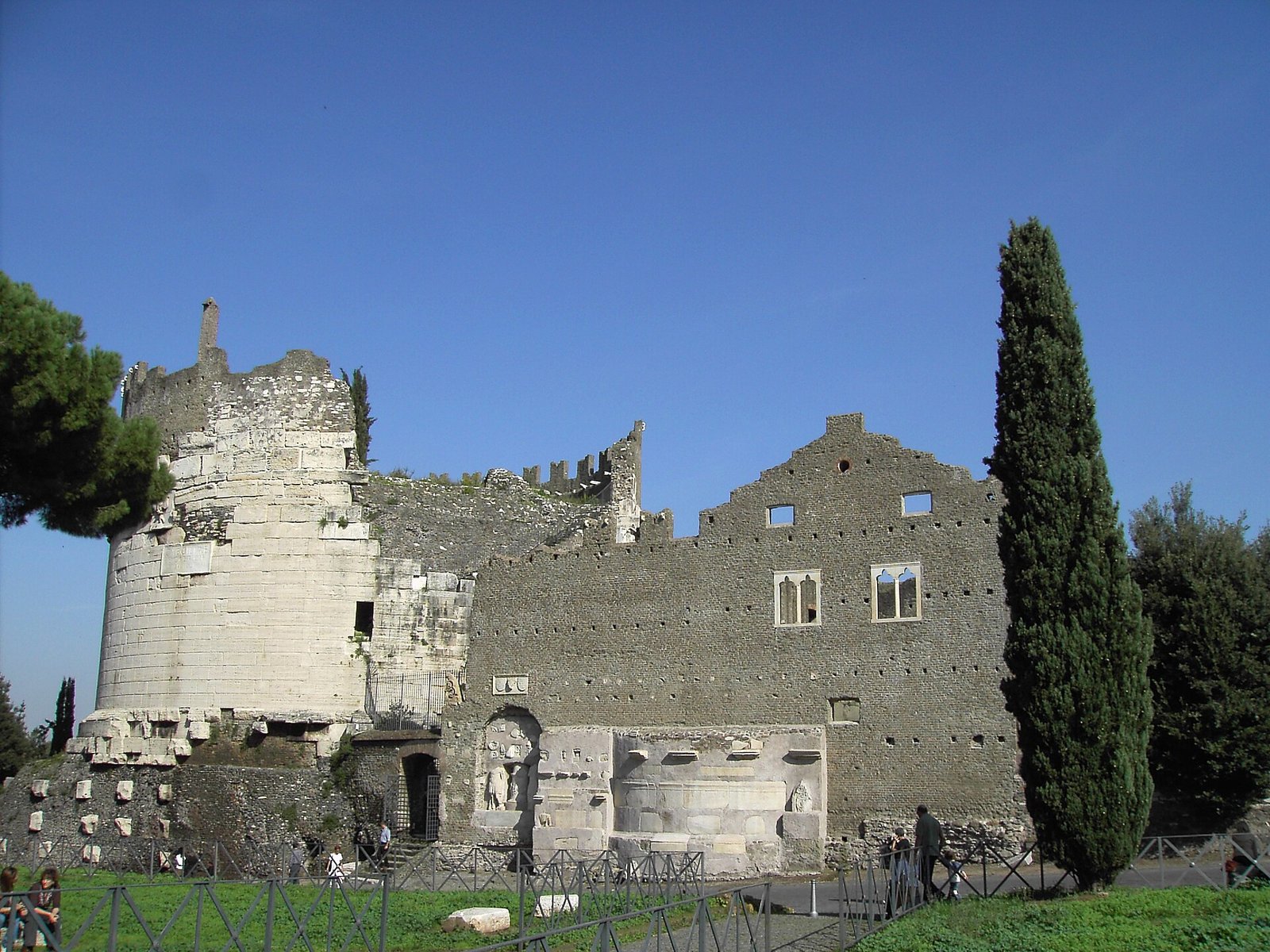
The crenellation that crowns the monument, the one that appears in every photograph and gives the mausoleum its unmistakable silhouette, is not Roman. It's an addition of the 14th century, built by the Caetani when they turned the tomb into the main tower of their castle. Anyone who looks at a photo of the Mausoleum of Cecilia Metella is looking, without knowing it, at a Roman monument wearing a medieval hat, and the form that everyone recognizes as the archetype of the Roman tomb never existed in antiquity.
The paradox of the crenellation
The paradox is that this crenellation is now an integral part of the visual identity of the monument. No superintendency would dream of removing it, because it is in turn a first-rate historical document, the material testimony of how medieval Rome reused its ancient monuments. But you have to know what it is: whoever wants to imagine the tomb as the Romans saw it has to mentally remove the merlons and replace them with an ancient crowning whose exact form remains debated, because the first element to disappear was precisely that one and the Caetani built on top of it, erasing every useful trace. The mental operation is less trivial than it seems, because the medieval image is so deeply rooted that even popular reconstructions of the Roman monument sometimes slip and give back something too similar to the tower of the Caetani.
The mausoleum's concrete studied by contemporary engineers
There is a second thing that almost no guide tells and that concerns the very matter the monument is made of. In recent years the concrete of the Mausoleum of Cecilia Metella has become the object of applied scientific research by international study groups interested in the durability of building materials. The results, published in a specialist journal of ceramic materials science between 2021 and 2022, highlighted a behavior of the ancient mortar that surprises modern engineers: the contact zone between the binder and the aggregates, instead of degrading progressively as happens in contemporary concrete, kept reorganizing itself chemically for centuries, strengthening over time instead of weakening.
One specific element of this monument drew particular attention: the mortar of the mausoleum contains volcanic material taken in all likelihood from the lava flow that outcrops exactly under the construction. Put differently, the Roman builders quarried the rock from the ground on which they were building and reused it as a component of the conglomerate, with an enormous logistical saving and with technical results that 2,000 years later attract the interest of laboratories. It's a piece of news that made the rounds of the international scientific press, and that very few visitors connect to the monument in front of them.
The Castrum Caetani: when the tomb became a fortress
The Castrum Caetani is the medieval castle that surrounds the Mausoleum of Cecilia Metella and that was built between 1302 and 1303 by the Caetani family, that of Pope Boniface VIII. It's one of the most radical transformations an ancient monument has undergone in Rome, and unlike many others it destroyed nothing: it absorbed, fortified and preserved, so much so that in all likelihood the mausoleum has come down to us intact precisely because for two centuries it was a watchtower too useful to be demolished.
Boniface VIII and the purchase of the estate
Pope Boniface VIII, born Benedetto Caetani, was one of the most unscrupulous popes in promoting the property interests of his own family. Between the end of the 13th century and the very first years of the 14th the Caetani acquired an enormous quantity of lands and castles in Lazio, and the purchase of the Capo di Bove estate, in 1302, fits exactly into this policy. The pope's nephew, who had received offices and revenues thanks to his uncle, thus found himself controlling a strategic stretch of the Appia a few kilometers from the city.
A castle straddling the consular road
The characteristic that makes the Castrum Caetani an almost unique case is that it was not built beside the road but over the road. The fortified enclosure crossed Via Appia, which passed under an arch controlled by the lords of the castle, and this means that anyone wanting to travel the consular road at that point necessarily had to pass through the gap of the Caetani. An arrangement of this kind has a single evident purpose: control of transit and the collection of a toll on men and goods.
Inside the enclosure, besides the mausoleum turned into a tower and the church, there stood a baronial palace, stables, warehouses and dwellings, that is everything needed to keep a small self-sufficient fortified community alive. The archaeological investigations conducted on the palace have distinguished a ground floor intended for service functions and an upper floor, equipped with fireplaces and more refined furnishings, attributable to the residence of the lords. It's the classic layout of the baronial castle of 14th-century Lazio, applied however to an exceptional context, because the keep was a Roman tomb already 1,300 years old by then.
The church of San Nicola a Capo di Bove
The church of San Nicola a Capo di Bove stands inside the enclosure of the Castrum Caetani, across from the mausoleum, and was built in the early years of the 14th century as the chapel of the fortified complex. Today it is reduced to its masonry structures alone, without a roof, but it remains one of the most interesting buildings of the entire site and one of the very few examples of Gothic architecture preserved in the Roman territory.
What remains and what you see
Of the church what remains today are the perimeter walls, with the pointed-arch openings that reveal its Gothic character, and the outline of the apse. The roof collapsed centuries ago and the interior is open to the sky, which produces a remarkable scenic effect especially in the hours when the light enters at a slant between the walls. The restoration work carried out by the superintendencies has consolidated the masonry and made the space walkable, integrating it into the visit route of the complex. Whoever enters finds themselves in a small, silent space, with the bulk of the mausoleum looming just beyond the wall: it's the point of the site where the overlap between ancient Rome and medieval Rome is felt most physically.
The palace, the courtyard and the museum set up inside
The baronial palace of the Caetani, leaning against the fortified enclosure next to the mausoleum, houses today the Museo dell'Appia, the collection that displays sculptures, sarcophagi, inscriptions and reliefs coming from the funerary monuments of Via Appia Antica. It's the part of the visit that many neglect, arriving all the way here to photograph the travertine cylinder and leaving without going in, and missing the museum means missing a good part of the sense of the place.
What you see in the Museo dell'Appia
The core of the collection is made up of materials recovered along the consular road over two centuries of excavations and rearrangements: architectural fragments, funerary portraits, urns, decorated sarcophagi, inscribed slabs bearing the names of freedmen, merchants, soldiers and senatorial families buried along the Appia. Seen all together, the collection tells something that you sense on the ground but don't see: that the Appia Antica, in the first kilometers outside the city, was a continuous funerary corridor, a sort of city of the dead lined up along the road, and that the monuments surviving today are a minimal fraction of those that were there.
The courtyard and the tower
The courtyard of the castle is the space that connects the different parts of the complex, and crossing it lets you read the stratigraphy of the whole: the medieval masonry resting on the Roman base, the remains of the service rooms, the bulk of the mausoleum closing off the far end. It's also the best point from which to grasp the defensive logic of the layout, because from here you understand how the tomb worked as a keep and how the enclosure was arranged around it. The mullioned openings preserved in some walls of the palace are among the best recognizable medieval architectural elements of the complex.
Holographic projections and virtual reality
In recent years the archaeological park has enriched the route with a substantial technological apparatus: holographic projections inside the burial chamber, video-mapping systems and stations for virtual reality with headsets. A practical detail that escapes many is worth pointing out: some of these services are not active on the free-entry days of the first Sunday of the month. Anyone interested specifically in the immersive experience, therefore, would do better to choose an ordinary paid day, while those who only want to see the monument and the museum can calmly take advantage of the free admission.
My advice for visiting the Mausoleum of Cecilia Metella
The single most useful piece of advice is to choose Sunday, because Via Appia Antica is closed to private traffic on holidays and the monument is reached walking or cycling on the paving stones instead of hugging a wall with cars beside you. It's an enormous difference of experience, and it costs nothing.
The right time of day and of year
The travertine of the drum reacts to light like few other materials: at noon it looks flat and very white, in the low hours of the morning and above all of the late afternoon it turns golden and the surface reveals every irregularity. If photography is also an interest, late afternoon is the time to prefer, keeping in mind however that the closing time varies a lot with the season and that in winter the site closes when the light is still good but the time for the visit has already run out.
As for the season, spring and autumn are the best periods: Via Appia Antica is an outdoor route almost without continuous shade and without frequent refreshment points, and tackling it in July or August in the middle hours is a tiring choice. Anyone coming in summer should do the visit early in the morning, bringing water, because the drinking fountains along the road are fewer than you'd like.
Combining the visit with the rest of the Appia
The mausoleum works better as the central stop of a day than as an isolated destination. An itinerary that holds up well starts from Porta San Sebastiano and the museum of the Aurelian Walls, continues along the Appia touching the catacombs and the church of the Quo Vadis, reaches the mausoleum around midday and, for those with legs and time, continues to the Villa of the Quintilii at the fifth mile. A little farther on, inland, the Aqueducts Park preserves the arches of the great Roman aqueducts. Alternatively you can detour toward the Caffarella Park, which runs parallel to the Appia and preserves the church of Sant'Urbano, a Roman temple turned into a church tied to the same family of Herodes Atticus that owned the baths of Capo di Bove.
Tickets, hours and accessibility
The Mausoleum of Cecilia Metella is run by the Appia Antica Archaeological Park, is closed on Monday and applies a schedule that changes four times a year according to the season, with last entry 30 minutes before closing. The address is Via Appia Antica 161.
The seasonal hours
According to what the archaeological park publishes, opening is from 9:00, with closing at 19:15 from April 1 to September 30, at 18:30 in the month of October, at 16:30 from November 1 to the end of February and again at 18:30 in the month of March. The weekly closing day is Monday. These hours are those of the ordinary calendar: on national holidays, at special events and during any building work they may change, and it's always best to check on the official website of the Appia Antica Archaeological Park or make a phone call before setting out.
Ticket prices
The fares published by the park provide for a full ticket at €8 that includes the Mausoleum of Cecilia Metella together with the Capo di Bove complex, a reduced ticket at €2 for citizens of the European Union between 18 and 24 years old and a discounted fare at €4 for holders of the Roma Pass. Alongside the site ticket there is a cumulative ticket at €12 that gives access to the visitable places of the park over seven days, and an annual card at €25 for unlimited entries. Entry is free for those under 18 and for the other categories provided by national legislation on state museums, and the free first Sunday of the month applies in the periods when the measure is in force.
Tickets are bought on site or online through the official portal of the state museums ticket office. Since these are fares that the ministry and the park can update, the advice is to treat these amounts as a reference and to check the exact price at the time of purchase.
The joint ticket with the Baths of Caracalla and Villa dei Quintili
Here an honest clarification is needed, because it is one of the most repeated and least updated pieces of information circulating about the Mausoleum of Cecilia Metella. For many years the Baths of Caracalla, Villa dei Quintili and the Mausoleum of Cecilia Metella formed a single museum circuit, with an integrated ticket valid for all three sites: the ministerial statistics of past years in fact count the three places as one circuit, with visitors and revenues counted together. Many guides, print and online, continue to report that formula.
The current situation is different. Cecilia Metella and Villa dei Quintili both belong to the Appia Antica Archaeological Park and are included in the park's cumulative ticket, while the Baths of Caracalla do not appear among the places of that park. Consulting the official pages of the two Appia sites you find today no mention of a ticket that also includes the baths. It must be said clearly that it was not possible to verify on an official source the existence or definitive absence of a joint formula currently on sale, and therefore neither a price nor a duration is given here for such a ticket: anyone who wants to visit the Baths of Caracalla too should make a direct check with the official ticket office before taking for granted that a single ticket covers the three monuments. Buying separately is always possible and carries no risk.
Capo di Bove, included in the ticket but temporarily closed
The €8 ticket includes, besides the mausoleum, the archaeological complex of Capo di Bove, which is at the fourth mile of the Appia at Via Appia Antica 222, a few hundred meters farther on, and which preserves the remains of a bath complex of the middle of the 2nd century AD attributed to the property of Herodes Atticus and Annia Regilla, as well as the archive and library of Antonio Cederna. Attention though: the park has announced the temporary closure of the Capo di Bove complex starting June 22, 2026 for restoration and enhancement work on the reception area, the gardens and the bath area, without indicating for now a firm reopening date. Anyone buying the ticket with the intention of visiting that site too should first check if the reopening has already taken place.
Accessibility
The mausoleum complex presents the typical difficulties of a layered archaeological site: uneven surfaces, changes in level, rough ancient paving and access to the burial chamber through a historic corridor. Some areas of the route are reachable without barriers and others are not, and the situation can vary in relation to ongoing building work. Anyone visiting with people with reduced mobility, with a stroller or with walking difficulties does well to contact the site staff in advance at the contacts published by the park, to be told the route actually practicable on the day of the visit.
Another well-known fact, yet rarely cited
In the courtyard of Palazzo Farnese, in Rome, a large marble sarcophagus has been preserved for centuries that the scholarly tradition long identified as the sarcophagus of Cecilia Metella, taken from the mausoleum and carried to the city during the Renaissance. It's a datum that appears in countless descriptions of Rome and that very many visitors repeat as an established fact. The reality is more uncertain, and the story of that attribution says a lot about how historical certainties are built.
A sarcophagus with the wrong name
The attribution to Cecilia Metella is based on the declared provenance, not on an inscription. As early as the 19th century Antonio Nibby, one of the greatest scholars of Roman topography of his time and author of fundamental works on the surroundings of Rome, proposed that the sarcophagus should more plausibly be referred to Annia Regilla, the wife of Herodes Atticus, the very wealthy Greco-Roman couple who owned vast properties right in this area, including the baths of Capo di Bove and the complex of the Caffarella valley. Nibby's observation has never found a decisive refutation, and the identification is still debated today.
Herodes Atticus, the other great owner of this road
The name of Herodes Atticus keeps coming back along this stretch of the Appia, and it's worth keeping in mind. Greek rhetorician, magnate and patron of the 2nd century AD, consul in Rome, husband of the Roman noblewoman Annia Regilla, Herodes owned in this area a vast estate, the so-called Triopion, which included the Caffarella valley and extended as far as the Appia. The baths of Capo di Bove and the temple later turned into the church of Sant'Urbano are part of that estate. The death of Annia Regilla, which happened in circumstances that in antiquity were the subject of a trial against Herodes himself, is one of the darkest stories tied to this area of Rome, and it explains the number of commemorative monuments that Herodes had erected in her memory right here.
The right photo to take at the Mausoleum of Cecilia Metella
The photo that does the most for the Mausoleum of Cecilia Metella is not the frontal one from the open area, but the one taken from Via Appia Antica looking north, that is toward Rome, with the ancient paving entering the frame in the foreground and the drum closing the scene on the left. It's the only composition that puts together the two subjects that make this place unique: the Roman road and the tomb that dominates it.
The paving in the foreground
To get that shot you have to crouch quite low, almost to knee height, so that the polygonal blocks of the ancient paving fill the lower third of the image and lead the eye toward the monument. With a wide-angle lens the depth effect is remarkable. With a telephoto you get instead a compression that brings the mausoleum closer to the road, a different but equally effective solution. On Sunday, with no cars parked along the edge, the frame comes out clean on the first try.
The crenellation backlit
A second shot that always works is the detail of the medieval crenellation against the sky, taken in the hours when the sun is low behind the monument. Backlit, the merlons become a black silhouette with sharp outlines, and the image tells exactly the misunderstanding we were talking about: a form that everyone reads as Roman and that is not Roman. If there are clouds in the sky, so much the better.
The frieze with the bucrania, up close
Whoever has a lens that can bring the subject in well should find the time for a detail of the frieze with the festoons and the bucrania, above the tabula of the inscription. It's the detail that gives the area its name and the one that almost no visitor photographs, because from below the ox skulls are hard to make out. Raking light and enough zoom give back an image worth more than 10 overall shots, and later allow you, at home, to compare the different variants of the bovine heads that archaeologists talk about.
The Appia Antica around the mausoleum: paving, miles and lava flow
Via Appia was opened in 312 BC on the initiative of the censor Appius Claudius Caecus, who had it built to connect Rome to Capua, and was then extended to Brindisi, becoming the main route of communication between Rome and the Mediterranean East. The Romans called it regina viarum, and in July 2024 it was inscribed on the UNESCO World Heritage list with precisely that formula.
How the paving is made
The paving visible around the mausoleum consists of the basoli, large polygonal blocks of lava stone fitted together without binder and laid on a succession of foundation layers designed for drainage. The Roman roadway had a width on the order of four meters, enough for two vehicles to pass at the same time, and was flanked by raised sidewalks, the crepidines, meant for pedestrians. Walking on the paving of the Appia means walking on a surface that in many stretches is the original one, worn by carts and put back in place in the restorations of the last two centuries.
The lava flow of Capo di Bove
Under the mausoleum, and under a long stretch of the Appia in this area, there is a lava flow. It comes from the volcanic complex of the Alban Hills, the Vulcano Laziale, and it is a very ancient geological event, placed by studies at a time on the order of hundreds of thousands of years ago. The foundation of the monument rests partly on tuff and partly precisely on this lava rock, which offers exceptionally solid support and explains to a good extent the stability of the structure across 20 centuries.
The flow has an importance that goes beyond the single monument, though, because it is the same stone the paving blocks of the road are made of. The lava rocks of the Alban Hills, hard, wear-resistant and available in abundance near Rome, were the material with which the Romans paved their consular roads, and in the case of the Appia the quarry and the road almost coincided. The analyses on the concrete of the mausoleum, which we have already mentioned, also indicate that the volcanic material used in the mortar was taken in all likelihood from this very outcrop: a building site that supplied itself literally from the ground it was digging.
Some important events that happened here in history
The chronology of the Mausoleum of Cecilia Metella reads like a sequence of changes of function: aristocratic tomb between 30 and 10 BC, isolated ruin in late antiquity, fortified tower from 1302, castle contested among the Roman baronial families, ruin abandoned at the end of the 15th century, obligatory pictorial subject for three centuries of European travelers, protected monument and finally museum.
1302 and 1303: the purchase and the building site of the Caetani
The crucial years are 1302 and 1303, when the Caetani acquired the Capo di Bove estate and started the construction of the castrum, replacing preexisting fortified structures that archaeological investigations date back to at least the 11th century. In a short time the Roman tomb was crowned with merlons, the arches of the enclosure were built straddling the road and the palace, the church, the stables and the dwellings rose. It's the moment when the monument changes nature irreversibly.
The passage to the Savelli and the Orsini
During the 14th century the property passed to the Savelli and then to the Orsini, two of the baronial families that were contending for control of the Roman territory in the decades when the papacy was in Avignon and Rome was in fact without a central power. The Orsini held the castle until 1435, when the complex passed to the Roman Senate. By 1485 it is recorded as abandoned: in a little more than a century and a half the fortress had exhausted its function, because military control of the Roman countryside had changed hands and the toll on the Appia could no longer be collected.
Who has passed by the Mausoleum of Cecilia Metella
The Mausoleum of Cecilia Metella is, in all likelihood, the Roman monument seen by the largest number of people over the span of 2,000 years without almost any of them having come on purpose to see it. It stood on the main road toward the south of the peninsula, and every soldier, merchant, pilgrim, courier, slave or traveler leaving Rome bound for Capua, Benevento, Taranto or Brindisi necessarily passed beside it.
Byron and the Romantic poets
Among the famous visitors of the modern age the best known is Lord Byron, who devoted a few stanzas of the fourth canto of Childe Harold's Pilgrimage to the mausoleum, the poem that told of his journey through southern Europe and the Mediterranean. In the stanzas devoted to the tomb, Byron wonders who the woman buried in such an imposing monument was and uses that question as an occasion for a meditation on the transience of glory and on the end of ancient Rome. Those pages contributed more than any archaeological treatise to making the mausoleum a place of European culture and not only of Roman archaeology.
The archaeologists and the defenders of the Appia
A separate mention is due to the scholars who worked on this stretch of road and to those who prevented its destruction. Antonio Nibby in the 19th century, with his topographical surveys of the surroundings of Rome, fixed many of the identifications still in use, including the revision of the attribution of the sarcophagus of Palazzo Farnese. In the 20th century Antonio Cederna waged against building speculation a public battle that saved the countryside around the Appia from being covered with houses, and his archive is today preserved a few hundred meters from the mausoleum, at Capo di Bove. Without that battle, the monument would today be at the center of a residential neighborhood instead of in the middle of the countryside.
Frequently asked questions about the Mausoleum of Cecilia Metella
How much does a ticket to the Mausoleum of Cecilia Metella cost?
The full ticket for the Mausoleum of Cecilia Metella costs €8 according to the fares published by the Appia Antica Archaeological Park, and also includes the Capo di Bove complex. There is a reduced ticket at €2 for European citizens between 18 and 24, a fare at €4 with the Roma Pass, a park cumulative ticket at €12 valid for seven days and free entry for those under 18. Fares can be updated, so it's best to check them at the time of purchase.
What are the hours of the Mausoleum of Cecilia Metella?
The Mausoleum of Cecilia Metella opens at 9:00 and is closed on Monday, with last entry 30 minutes before closing. Closing is set at 19:15 from April to September, at 18:30 in October and March and at 16:30 from November to February. On holidays and during any building work the hours can vary, so a check on the official website of the archaeological park before leaving is always advisable.
How do you get to the Mausoleum of Cecilia Metella by public transport?
You get to the Mausoleum of Cecilia Metella by bus 118, which runs along Via Appia Antica starting from the Piramide and Circus Maximus area, or by the 660 from the Arco di Travertino station of metro A. The 218 along Via Ardeatina is also useful for the area of the catacombs. The address is Via Appia Antica 161. On holidays the routes can change because of the closure of the road to traffic.
Why is it called Capo di Bove?
The area of the Mausoleum of Cecilia Metella is called Capo di Bove because of the frieze sculpted on the monument, where floral festoons alternate with bucrania, that is ox skulls. In the Middle Ages those bovine heads were the most recognizable element of the tomb for those passing on Via Appia, and the popular name ended up designating the entire estate, the lava flow underneath and the archaeological complex a little farther on.
How much time do you need to visit the Mausoleum of Cecilia Metella?
To visit the Mausoleum of Cecilia Metella together with the Castrum Caetani you need roughly between an hour and an hour and a half, including the burial chamber, the church of San Nicola, the castle courtyard and the Museo dell'Appia set up in the palace. Anyone who limits themselves to looking at the monument from outside takes a few minutes, but misses the most interesting part of the visit.
Is there a joint ticket with the Baths of Caracalla and Villa dei Quintili?
The Mausoleum of Cecilia Metella and Villa dei Quintili are both included in the cumulative ticket of the Appia Antica Archaeological Park, which is valid for seven days. The Baths of Caracalla do not appear among the places of that park: in the past the three sites formed a single museum circuit with an integrated ticket, but the existence of a joint formula currently on sale does not appear from the official pages consulted and has to be verified directly at the ticket office.
Is the Mausoleum of Cecilia Metella suitable for children?
The Mausoleum of Cecilia Metella works well with children, especially on Sunday when Via Appia is closed to traffic and you can arrive on foot or by bike safely. Inside, the burial chamber with the holographic projections and the multimedia stations impress the little ones a lot. Watch out, though, for the uneven surfaces, the changes in level and the absence of continuous shade along the road on hot days.
Anyone planning a complete itinerary on Via Appia Antica, fitting the mausoleum together with the catacombs, Villa dei Quintili and the other stops of the archaeological park, can find useful planning tools on Tour Leader Pro, while for a wider picture of transport and destinations in Lazio Italy Planner is a good resource.