Church of Sant’Urbano alla Caffarella
In short. Address: the Church of Sant'Urbano alla Caffarella is inside the Caffarella valley, on the high edge of the slope that looks over the Almone, and you get there from Vicolo Sant'Urbano, the little street that branches off to the left…
Address: the Church of Sant'Urbano alla Caffarella is inside the Caffarella valley, on the high edge of the slope that looks over the Almone, and you get there from Vicolo Sant'Urbano, the little street that branches off to the left from via Appia Pignatelli coming from Via Appia Antica. As a postal address you often read "Parco della Caffarella, 00178 Roma," but all the official addresses of the Appia Antica Regional Park published on the site parcoappiaantica.it carry the postal code 00179 (Centro Servizi Appia Antica, via Appia Antica 58/60, 00179 Roma. Punto Info Casale dell'ex Mulino, via della Caffarella 23, 00179 Roma. The Park Authority's offices, via Appia Antica 42, 00179 Roma). The boundary between 00178 and 00179 runs right through this area and for the street numbers on via Appia Pignatelli no official source settles the question, so if you need to mail something, call first. Entry to the Caffarella valley and to the whole Appia Antica Regional Park: free, and the Park's FAQ say so in these words, "Entry to the Appia Antica Park is free, only some sites charge a fee." Hours of the valley: the same FAQ say "The Park is always open, it would be impossible to fence it off given its size," with the explicit recommendation to walk it before sunset because there is no adequate artificial lighting. And here comes the point that really matters and that nobody tells you clearly: the interior of the Church of Sant'Urbano alla Caffarella has no public opening hours and you can't get in by just passing by. It is visited on request or on special openings. On who takes that request, the sources don't agree, and further on you'll find both versions.
How to get there by public transport: the FAQ of the Appia Antica Regional Park list lines 118 and 218 with the stop "Appia Antica/Domine Quo Vadis" for entering the Park from the Appia side, and only the 118 for the catacombs of San Sebastiano. The site of the Comitato per il Parco della Caffarella, caffarella.it, instead lists the entrances to the valley and the lines that serve them: metro line A stops Colli Albani and Arco di Travertino, buses 87, 663, 664 at Largo Colli Albani and 85, 409, 657, 660, 671 at Arco di Travertino, plus the 118 on Via Appia Antica. On the entrances the same site names via della Caffarella, via Latina, Largo Tacchi Venturi and viale Mario Leigheb, via De Bildt, via Macedonia, via Centuripe, via Cilicia, via dell'Almone. Which surface line stops exactly at the start of Vicolo Sant'Urbano on via Appia Pignatelli doesn't appear from an official transport source: check it on atac.roma.it the same day. Parking: the Park's FAQ mention free parking run by the Authority at via Appia Antica 50 Monday to Saturday until 18:00, and on holidays at Largo Galvaligi at the intersection with via Tito Omboni.
If you want to get your bearings before leaving, the valley is inside Caffarella Park and therefore inside Appia Antica Park, and the Church of Sant'Urbano alla Caffarella is the tallest and most visible monument in the valley: from the valley floor you see it as a light-colored block resting on the edge, among the trees.
How you really visit the Church of Sant'Urbano alla Caffarella
This chapter comes first because it's the only thing you need before putting on your shoes. The Church of Sant'Urbano alla Caffarella is not a parish church with the door open and the sacristan letting you in. It's a Roman temple of the 2nd century AD incorporated into a place of worship, with a cycle of 11th-century frescoes inside, and it stands in the middle of a park: the door is closed almost always, and not out of anyone's spite, but because a thousand-year-old painted cycle in an isolated building without permanent custody can't be left open to the wind.
There are two versions and the sources don't agree. First version: the site caffarella.it, in the profile dedicated to Sant'Urbano, writes verbatim that the monument is "Visitable upon request to the Sovrintendenza Comunale." Second version, the one you often read: the building was bought by the City of Rome in 2002, given to the diocese of Rome to manage and reopened for worship in 2005 as a rectory church of the parish of San Sebastiano fuori le mura. These are two different channels, one civic and one ecclesiastical, and they can perfectly well coexist: municipal ownership and designation for worship don't exclude each other. The practical problem is that online, neither on the site of the diocese of Rome nor on the pages of the Appia Antica Regional Park, is there an official page that says in plain words "you book here, at this number, on these days." So, as things stand: there is no booking method confirmed by an official source.
So what do you do, in practice. You call. The numbers published on the website of the Appia Antica Regional Park are these, and they're the right doors to knock on: Centro Servizi Appia Antica, via Appia Antica 58/60, phone 06 5135316, email infopointappia@gmail.com, open Monday-Friday 9:30-13:00 and 14:00-sunset, Saturday, Sunday and holidays 9:30-sunset, closed January 1 and December 25. Casa del Parco at Vigna Cardinali, Largo Pietro Tacchi Venturi in the Caffarella valley, phone 06 70497269 and 366 9852219, email casadelparco@parcoappiaantica.it, open every day 9:30-sunset and closed in August. Punto Info Casale dell'ex Mulino at the Tomb of Annia Regilla, via della Caffarella 23, phone 340 7643592 and 06 5135316, email info.exploaps@gmail.com and puntoappia@parcoappiaantica.it, open Saturday and Sunday 10:00-16:00 during standard time and 10:00-18:00 during daylight saving time, closed in January, July and August. The Park Authority's offices, via Appia Antica 42, phone 06 5126314. In our opinion the Casa del Parco is the right place because it's inside the valley, a walk from the church, and it's open every day except August. Ask there who opens the Church of Sant'Urbano alla Caffarella at this time and when the next opening is, and they'll tell you the truth better than any web page.
Second route, and for many people it's the one that works: the special openings. The Church of Sant'Urbano alla Caffarella periodically appears in the calendars of cultural heritage open days and in the guided visits organized by the Park and by the associations of the valley. The Appia Antica Regional Park, on its page about guided visits, writes that the Park, in collaboration with associations and other groups, has a rich program promoted on Facebook and at the visitor centers, that private visits are requested by filling out an online form, that there is a dedicated form for schools, that tours are done on foot, by bike or in an electric minicar, that there are outings in English and that in case of rain the visits are canceled. The Park's events calendar is at eventi.parcoappiaantica.it. The Comitato per il Parco della Caffarella, for its part, wrote only this on its visits page: "THE BOTANICAL VISITS IN CAFFARELLA CONTINUE GO TO THE CALENDAR AND DECIDE WHICH VISIT TO JOIN." Contact for the Comitato: Associazione Humus Onlus, via Rocca Priora 56, 00179 Roma.
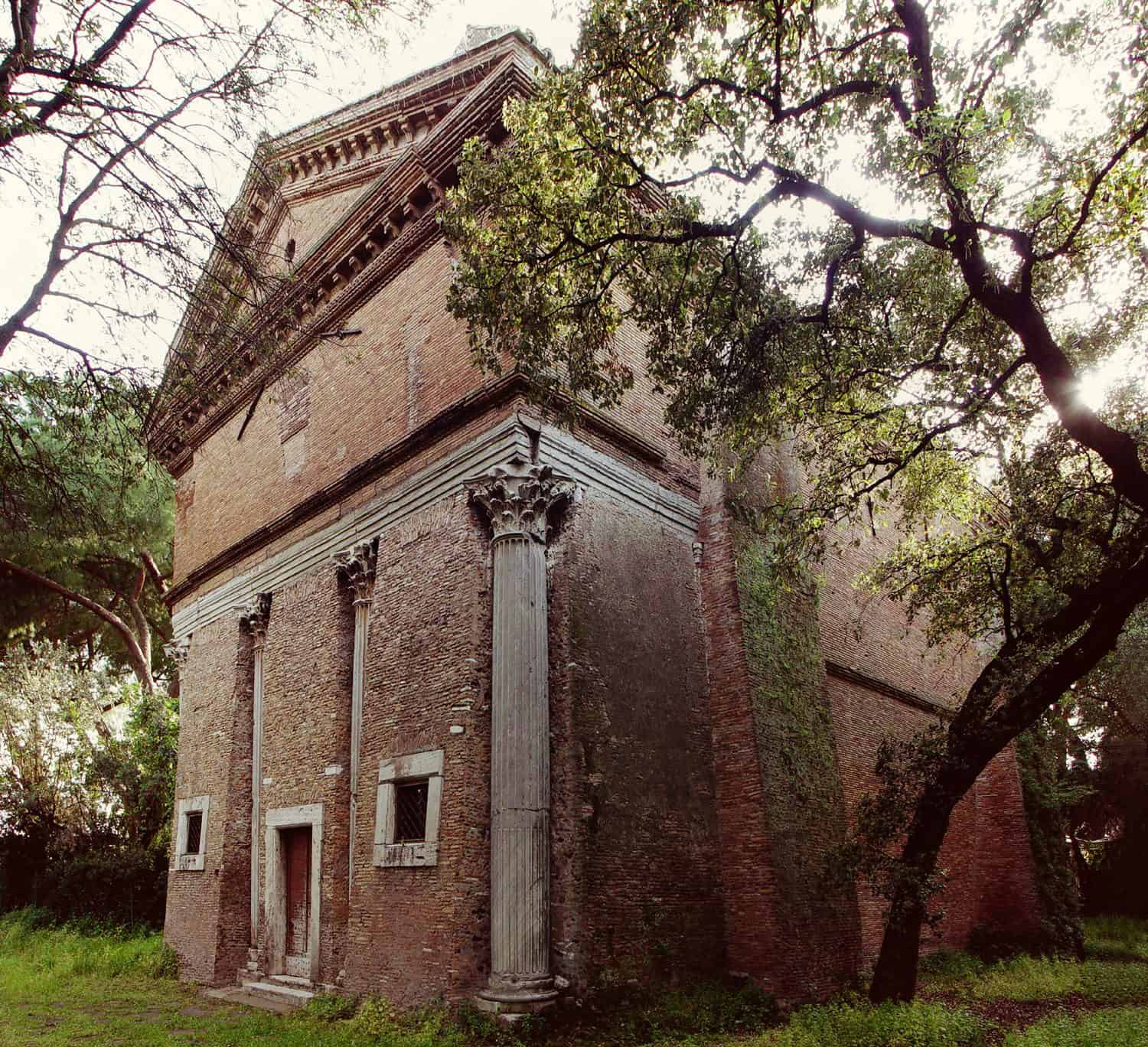
Third thing: even with the door closed, the Church of Sant'Urbano alla Caffarella can be looked at. The outside is half the monument. The front with the four walled-in columns, the Antonine bricks, the crack in the facade, the position on the edge: you always see that, for free, and it's worth the walk even if you don't go inside. My advice is not to plan an outing that depends on it being open: go to the Caffarella for the valley, and if the door is open you've won twice.
Where exactly the Church of Sant'Urbano alla Caffarella is and how to get there on foot
It's worth getting your bearings, because the first time you get lost. The Caffarella valley is an alluvial valley carved by the Almone, the sacred little river that comes down from the Alban Hills and slips under Via Appia. The valley floor is flat, green, given over to meadows and pasture, and the two slopes are steep. The Church of Sant'Urbano alla Caffarella is not in the meadow, it's up high, on the edge of the eastern slope, on the via Appia Pignatelli side. This is the detail that trips everyone up: if you enter the Caffarella from Largo Tacchi Venturi or from via Macedonia, that is from the Appio-Latino side, you see the church as a distant block on top of the embankment, and to get there you have to cross the whole valley and then climb.
The classic route is this: you enter from the Casa del Parco at Largo Pietro Tacchi Venturi, go down to the valley floor, keep the Almone on your right, pass the Casale della Vaccareccia with its stables and real cows, reach the Nymphaeum of Egeria, which is the big Roman niche with the barrel vault and water still trickling, and from there you climb toward the edge where the Church of Sant'Urbano alla Caffarella stands. Between the Nymphaeum of Egeria and the church it's a few hundred meters uphill, on dirt, and in the final stretch the path narrows among the reeds. An official measurement of the exact distance does not appear to be published: from the Nymphaeum you can see the church and it takes little time.
The other way, the shortest of all, is to arrive from above: from via Appia Pignatelli you take Vicolo Sant'Urbano and walk down to the monument. You often read that the lane branches off from the Pignatelli "about 800 m from the Catacombs of Praetextatus." It's traditional information, not confirmed by an official source, to be taken as an order of magnitude and not as a measurement. A practical warning that no profile writes: via Appia Pignatelli is a narrow road, without a continuous sidewalk, with cars moving fast. Walking against traffic with a stroller is not a good idea. If you have small children, enter from the valley floor.
One last useful bearing. The Church of Sant'Urbano alla Caffarella is administratively in the Ardeatino district, right next to the border with Appio-Latino, and we're outside the Aurelian Walls, in that strip of countryside inside Rome that 20th-century urban planning missed by a hair. The church of Domine Quo Vadis is a little further along the Appia Antica, and from there the Catacombs of San Callisto start: you're within a 20-minute walk, paths permitting.
The Roman temple inside the Church of Sant'Urbano alla Caffarella
Here we have to get it right, because it's the reason this building matters. The Church of Sant'Urbano alla Caffarella is not a church built next to a Roman ruin, and it's not a church built from the pieces of a Roman ruin. It's a Roman temple that stayed standing, with its walls, its architrave and its columns, inside which at some point they started saying Mass and never stopped keeping it up. That's the point: the survival of the building depends on its conversion. If it hadn't become a church, today it would be a little hill of bricks like many others in the Caffarella.
On the dating, the sources say this. The site caffarella.it writes "It is in reality a Roman temple, built around 160 AD." The Italian Wikipedia entry speaks more generically of a "temple of the 2nd century AD." The two don't quarrel: 160 AD falls squarely in the 2nd century and is the middle of the Antonine age.
On the dedication, on the other hand, we're in the field of attributions, and it's worth distinguishing them by degree of certainty, because mixing them up is the vice of half of Rome. Traditional name, the one you find in the old guidebooks and in the engravings: temple of Bacchus. It's a learned tradition, not a documented fact. Identification from the most recent studies, the one caffarella.it reports: the temple of Ceres and Faustina, which stood inside the Triopion of Herodes Atticus. You often read a formula that puts the two together, "called the temple of Bacchus, but consecrated to Ceres and Faustina," and sometimes also "dedicated to Appia Annia Regilla, wife of Herodes Atticus." Be careful, because here two different things get confused: the Triopion is the estate of Herodes Atticus and Annia Regilla, and inside the Triopion there were several sacred and funerary buildings. Saying this temple is "dedicated to Annia Regilla" is a hypothesis tied to the context, not a fact carved on a slab. So: probable context, dedication not certain.
A note on the name Faustina, because it's the classic trap. There are two Faustinas: Faustina the Elder, wife of Antoninus Pius, deified by her husband at her death, and Faustina the Younger, her daughter and wife of Marcus Aurelius. Usually you read "Faustina (wife of Antoninus Pius, deified by him at her death)," so the bet is on the Elder. An epigraphic source that settles the question for this temple does not appear to exist, and the question remains open. When you hear "temple of Ceres and Faustina," know that the Faustina in question is a matter of discussion and that the name reaches you from a scholarly tradition, not from an ancient sign.
Herodes Atticus, Annia Regilla and the Triopion: the story behind the Church of Sant'Urbano alla Caffarella
This is the part that makes the Church of Sant'Urbano alla Caffarella a different place from the others, and if you know it you walk through the Caffarella with another eye.
Herodes Atticus was a Greek from Marathon, very rich, an orator, a Roman senator, and he was the teacher of Greek and rhetoric to the Emperor Marcus Aurelius. This is documented. He married Annia Regilla, a Roman noblewoman from a consular family, and the valley of the Almone, that is the present Caffarella, was his wife's estate: an enormous property between Via Appia and Via Latina that Herodes turned into a Triopion, that is a private sanctuary with temples, tombs, inscriptions in Greek, statues and sacred plantings. The model was the Greek sanctuaries: a piece of countryside consecrated and monumentalized, with the family's name carved on it.
The story ends badly, and it has to be told because it's the backstory of these bricks. Annia Regilla died while pregnant, and her brother accused Herodes Atticus of having had her beaten to death by a freedman. There was a trial in Rome and Herodes was acquitted. On his guilt no serious historian takes a position: the ancient sources are partisan and the trial acquitted him. What is certain is what came after, and it's visible: Herodes filled the estate with monuments to the memory of his dead wife. The Tomb of Annia Regilla, which today stands at via della Caffarella 23 with the Park's Punto Info inside the Casale dell'ex Mulino, is one of those monuments. The Church of Sant'Urbano alla Caffarella, that is the temple, is another building of the same complex.
The Caffarella is the largest surviving conjugal funerary monument in Rome, and it's a public park where people take their dogs: hard to imagine anything more Roman. There's no sign explaining it while you walk, and maybe that's right.
From temple to church: when it really happened
On the date of the conversion two versions circulate. One speaks of a temple "transformed in the 9th century into a church consecrated to the worship of Saint Urban," the other says "It was turned into a church in the 6th century on the remains of the temple of the 2nd century AD." The 6th and the 9th can't both be true. The one to keep is the 6th century, according to the site caffarella.it, which writes: "It was transformed into a Christian place of worship probably in the 6th century and dedicated to Bishop Saint Urban." Notice the word probably: the source itself signals that it's not a date documented by a deed, and it should be taken with the same caution. Let's put it this way: early medieval conversion, placed by scholars in the 6th century, with no document dating it to the day.
Second thing to clarify about the name. The Church of Sant'Urbano alla Caffarella is dedicated to Saint Urban, bishop and martyr, and this Urban is often confused with the pope of the same name, who also died a martyr in 230. The point should be set out by degrees of certainty: Urban I was pope from 222 to 230, and this is documented by the ancient episcopal lists. His martyrdom belongs to hagiographic tradition and not to a surviving trial record. The overlap between Bishop Urban, the church's titular saint, and Pope Urban I is ancient and doesn't come undone. If a guide tells it as if they were the same person, he isn't lying, he's simplifying a tradition.
Third element, and it helps to understand why right here. The frescoes inside the Church of Sant'Urbano alla Caffarella tell stories of Saint Urban and Saint Cecilia together. In Roman tradition Urban and Cecilia are linked: it's Urban who, in the passion of Saint Cecilia, baptizes and assists the martyr. If you've seen the Basilica of Santa Cecilia in Trastevere, you've seen the other half of this story. That's why on a wall of the Caffarella, a thousand years later, the two saints stand side by side.
What you see inside the Church of Sant'Urbano alla Caffarella, room by room
Here is the building in the order in which you meet it, because the Church of Sant'Urbano alla Caffarella is small and in 20 minutes you've seen all of it, but if you don't know what to look at you come out with the idea of having seen a painted room.
From the outside you see a tetrastyle temple, that is with four columns on the front. The columns are still there, with Corinthian capitals, and the Pentelic marble architrave, from the quarries of Attica, brought from Greece, is still holding up. It's the marble of the Parthenon, and it's a detail that says everything about who paid for the building site. The rest of the walls and the upper part of the facade are in brick from the 2nd century AD, Antonine bricks, and you can see them with the naked eye. The difference between the temple and the church you read in a second: the four columns are not free-standing, they're walled in, incorporated into solid walls. Those walls aren't Roman, they're from the 1600s, and shortly you'll see why they're there.
The Roman temple had a pronaos, that is the entrance portico under the columns, and a cella, that is the closed room where the deity stood. Originally you climbed to the pronaos by an outside staircase. That staircase is still there, but you can't see it: it's buried. The ground level has risen over the centuries and the steps are under your feet. If the temple seems low and squat to you, that's why: it's missing its visible base.
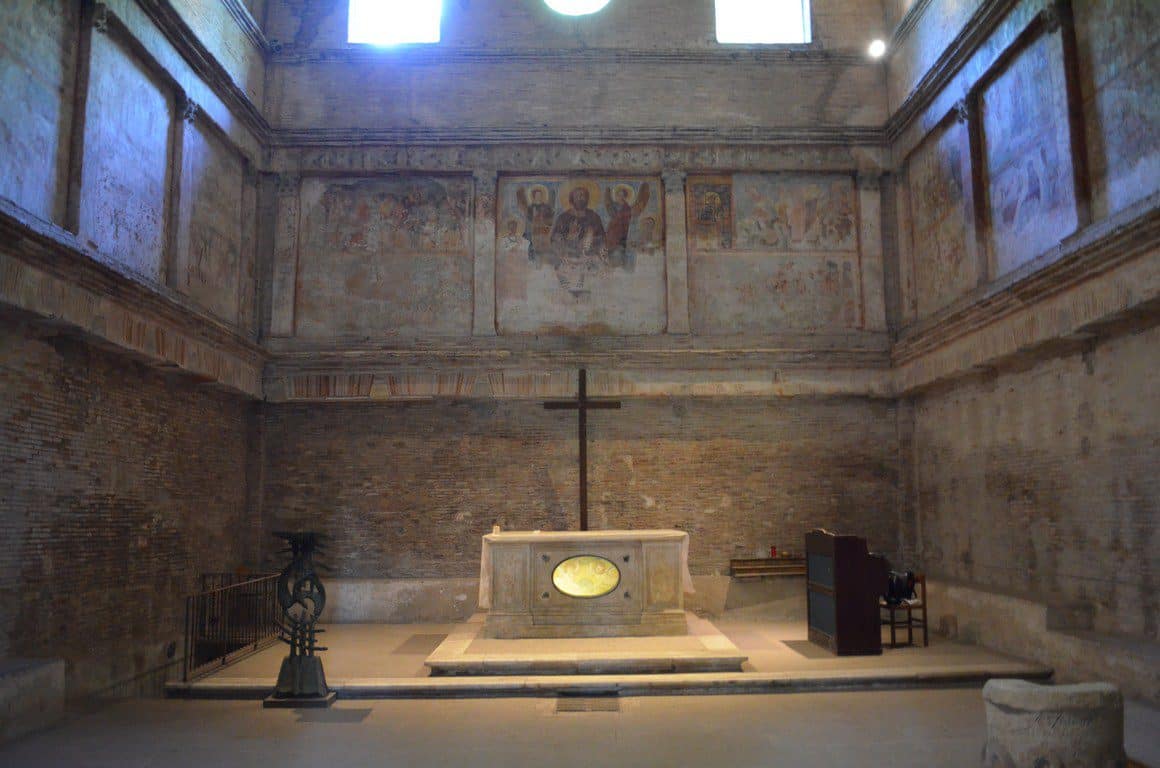
You enter through a small door. The first room you find yourself in is the former sottoportico, that is the closed-in pronaos, and here there's something worth the trip on its own: until a few decades ago this room was a custodian's private home. He lived in it. A man slept for years in the portico of an Antonine temple. From the small door you then pass into the Roman cella, which today is the liturgical hall of the church: rectangular plan, domestic dimensions, and the walls all painted.
The walls of the cella are divided into three horizontal bands. At the top, where the wall meets the vault, runs a stucco frieze with weapons, cuirasses and shields. It's classical decoration, a frieze of arms, and it has survived there for almost 18 hundred years. In the middle band is the cycle of medieval frescoes, and it's the treasure of the Church of Sant'Urbano alla Caffarella. The roof is a barrel vault. Of all the stucco decoration that covered it, what remains today is the central panel, which represents an apotheosis, that is the ascent to heaven of a deified figure: tradition calls it the apotheosis of Annia Regilla. You sometimes read "the apotheosis of Anna Regilla": it's a typo, the correct name is Annia Regilla. Still on names: you also find "Appia Annia Regilla," a form that comes from contamination with via Appia Pignatelli and with the long Roman naming system. The name under which you find her in scholarship and on the Park's signs is simply Annia Regilla.
Last piece: a narrow stairway leads down into a crypt, dug in the Middle Ages to keep the relics of saints. In a niche of the crypt remain fragments of a fresco with a Madonna and Child between Saints John and Urban, which tradition dates "to before the year 1000." It's an attribution not confirmed by an official source. If it holds, that fragment is older than the cycle above.
Bonizzo's fresco cycle, year 1011
Now let's talk about the thing for which art historians take the car and come to the Caffarella. In the middle band of the walls of the Church of Sant'Urbano alla Caffarella there is an 11th-century cycle of frescoes, arranged in 34 scenes or panels. The number 34 is also given by the site caffarella.it, which writes "The 34 scenes distributed along the walls represent episodes from the Gospel."
On the content the descriptions complement each other. The traditional one speaks of "stories of Jesus, of Saint Urban, of Saint Cecilia and of other saints." Caffarella.it explicitly names the martyrdom of Saint Lawrence, the adoration of the Magi, and the lives of Saint Cecilia and Saint Urban. So: a Christological cycle running along the walls, plus hagiographic cycles of the saints tied to the place and to the Rome of the martyrs.
Then there's the signature, and it's the piece that makes this cycle a case study. At the base of the Crucifixion are the date and the name of the author: frater Bonizzo, 1011. You sometimes read "Fratel Bonizzo." Caffarella.it writes "frater Bonizzo" with the date 1011. It's the same thing in Latin and in Italian, and there's no contradiction. But stop for a moment to think what it means: we're in the 11th century, in a Roman wall painting, and the painter signs and dates. In medieval Rome that's not the rule, it's the exception. Bonizzo is one of the very few painters of the year 1000 in Rome whose name we know because he wrote it himself.
Third thing, the most uncomfortable, and it has to be said because otherwise you'll be let down in front of the wall. Those frescoes you don't see the way Bonizzo left them. In 1634 Cardinal Francesco Barberini had the church restored, and on that occasion the cycle was reworked and repainted. The Wikipedia entry reports it too. So what you're looking at is a painting of the year 1011 under a 17th-century hand: the layout, the arrangement of the scenes, the iconography are medieval, the surface that reaches your eyes in many places is not. It's not a flaw, it's the object's biography. Paintings that nobody has retouched in a thousand years are usually the ones that haven't reached us.
Cardinal Francesco Barberini and the wall of 1634
The 17th-century chapter of the Church of Sant'Urbano alla Caffarella explains why the building has that strange air, with the columns drowned in the wall. In 1634 Cardinal Francesco Barberini, nephew of Pope Urban VIII, intervened on the church. The reason handed down, plausible and visible, is that a worrying crack had opened in the upper part of the facade. The solution was brutal and functional: close the pronaos with solid walls to support the architrave, incorporating the four columns into the masonry.
The result is for you to judge. An archaeology purist will tell you that the 1600s hid an Antonine colonnade inside a wall. In our opinion that wall is the reason the Church of Sant'Urbano alla Caffarella is still standing while half the Caffarella is a meadow with ruins in it. Between a beautiful collapsed temple and a battered standing temple, the second one every time.
A detail to look at: the crack in the facade is still visible, four centuries later. It's an observation anyone can make from outside, always, without booking anything. If you walk past, look up above the architrave.
On the date 1634 the sources agree. On the extent of the painting work inside the cella, on the other hand, as I told you above, we go into the territory of restoration assessments: how much Barberini repainted and how much he only consolidated is a matter for specialists and not for tourist profiles.

The 1800s and 1900s: abandonment, reconsecration, a custodian and a repurchase
The recent history of the Church of Sant'Urbano alla Caffarella is a seesaw, and it's the part that no general guidebook will ever give you. A warning: these 20th-century passages are traditional information, not confirmed by an official source online.
First movement: abandonment. Outside the walls, in the middle of the countryside, with no parish around, the church is left to decay several times over the centuries. You often read that the extra moenia position "allowed its desecration and the plundering of important works several times." This is a plausible interpretation, recurring in studies of suburban churches, not a fact documented case by case.
Second movement: the reconsecration. According to the account handed down, through the interest of the Barberini family and Don Giuseppe Cascioli, on May 25, 1894, the feast of Saint Urban, after a long procession, the church was reconsecrated. And after a few years of Masses it was forgotten again. May 25 as the feast of Saint Urban I is a date of the traditional calendar and holds up. The 1894 procession and the name of Don Cascioli do not appear confirmed by an official source and remain an account handed down.
Third movement, and it's the most incredible: in 1962, again according to the account handed down, the Church of Sant'Urbano alla Caffarella was annexed to an adjacent private property, becoming less and less accessible, and a custodian lived inside who had made himself a home in the old pronaos. Keep the chronology in mind: in 1962 in Rome they were building the apartment blocks for the Olympics, and a temple of 160 AD with frescoes of 1011 inside was someone's apartment.
Fourth movement: the return to the public. The account handed down gives the purchase by the City of Rome in 2002, the entrusting to the diocese of Rome and the reopening for worship in 2005 as a rectory church of the parish of San Sebastiano fuori le mura. As said above, this church doesn't appear on the site of the diocese of Rome, and caffarella.it instead points to the Sovrintendenza comunale. The two things have to be held together: public municipal ownership, ecclesiastical designation for worship. The practical consequence for you is only one: there are two possible phone numbers, and it's best to try both.
A curiosity about the Church of Sant'Urbano alla Caffarella
The curiosity is this: the Church of Sant'Urbano alla Caffarella is probably the best-preserved Roman building in all of Rome that you've never heard of, and the reason it's so well preserved is that someone lived in it. It's not a paradox, it's a mechanism. An ancient building survives if it stays useful: as a church in the Middle Ages, as a storehouse in the Renaissance, as a custodian's house in the 1900s. Ruins are buildings that have had a function taken away.
There's a second one, and it concerns the bricks. Looking at the brick facing of the Church of Sant'Urbano alla Caffarella you're looking at Roman construction at its best. The 2nd century AD is the century in which the Romans make bricks better than anyone before or after for a thousand years: thin joints, regular courses, good mortar. That's why the Church of Sant'Urbano alla Caffarella is still standing and the buildings from two centuries later, with the same recycled materials, came down.
Third curiosity. The Pentelic marble of the architrave comes from Mount Pentelicus, in Attica, and it's the same marble as the Acropolis of Athens. In a valley of sheep on the southern edge of Rome, above your head, there's a block of Greek marble that someone wanted shipped over by sea to build a temple inside his wife's garden. The logistics of that gesture, in 160 AD, are more impressive than the Colosseum.
Something nobody tells you about the Church of Sant'Urbano alla Caffarella
That you'll almost certainly find it closed. It has to be said plainly because it's the number one reason people go home angry. The online profiles of the Church of Sant'Urbano alla Caffarella tell about the temple, the frescoes, the crypt, and then end without telling you that there are no hours. You read, you get excited, you go on a Saturday morning and find a wooden door closed in the middle of the reeds.
The second thing nobody tells you is that the real problem is not the closure, it's the information. As of August 2026 an official page saying how to book a visit to the Church of Sant'Urbano alla Caffarella does not appear to exist. The site of the Comitato per il Parco della Caffarella says "upon request to the Sovrintendenza Comunale" without giving a number. The site of the Appia Antica Regional Park has no page dedicated to this monument. The site of the diocese of Rome doesn't list it. A closed public asset whose opening procedure isn't published is a half-public asset.
Third thing. When the openings happen, they're quick and with a limited number of places, because the cella is small. If you happen to find an announcement of a special opening of the Church of Sant'Urbano alla Caffarella, book the same day it comes out, not the week after. These places in Rome sell out in a few hours, and not because they're famous, but because there are 20 spots.
Fourth, and it's the one that weighs. The Caffarella is crossed every day by thousands of Romans who run, walk their dogs, play soccer. A huge share of them don't know that the block on the edge is a temple of 160 AD with frescoes signed in 1011 inside. Knowing what's up there changes the way you cross a meadow.
The advice I give you for visiting the Church of Sant'Urbano alla Caffarella
Advice number one is logistical and has already been previewed: call first, and call the Casa del Parco, Largo Pietro Tacchi Venturi, 06 70497269 or 366 9852219, open every day 9:30-sunset and closed in August according to the Park's site. It's inside the valley, the people who work there know the state of the openings day by day, and it saves you a pointless walk. If it's August and the Casa del Parco is closed, try the Centro Servizi Appia Antica, 06 5135316, which instead stays open all year except January 1 and December 25.
Advice number two, on shoes and timing. In the Caffarella you walk on dirt and grass, and the paths that climb toward the Church of Sant'Urbano alla Caffarella after rain turn into real mud, the kind that sucks your shoe off. White sneakers in the Caffarella are a bereavement. Add that the Park itself states that it cancels guided visits in case of rain: if the weather is bad, postpone.
Advice number three, on the hour. The Church of Sant'Urbano alla Caffarella looks over the valley from the east. The good light on the front with the columns is late afternoon, when the sun turns and hits the brick from the side. Early in the morning you instead have the valley backlit with mist over the Almone, which is another beautiful thing but worse for the church. If you have to pick just one hour: two hours before sunset.
Advice number four, against the mistake everyone makes. Don't come to the Caffarella only for the Church of Sant'Urbano alla Caffarella. It's a 20-minute monument inside a valley of hours. Build the day around the valley: Casa del Parco, valley floor, Vaccareccia, Nymphaeum of Egeria, climb to Sant'Urbano, and then exit toward the Appia Antica. If the monument is closed you've still done one of the most beautiful walks Rome offers inside the Grande Raccordo.
Advice number five, water and shade. In the Caffarella in summer there's no continuous shade on the valley floor and the drinking fountains aren't on every corner. From June to September bring a full water bottle and don't set off at noon. It has to be written because it's the place where every July someone gets sick, and it's 200 hectares without a bar.
Advice number six, and it counts double if you're coming from outside Rome. Don't trust the maps for the last stretch. Walking navigation apps in the Caffarella draw paths that don't exist on the ground or that end against a fence. Look at the church, keep it as a visual reference and climb toward it. With a monument in sight, the map is of little use.
Another well-known fact, yet rarely cited
The well-known fact is that in Rome there are dozens of temples that became churches. The Pantheon, San Nicola in Carcere, Santa Maria sopra Minerva in its name, San Lorenzo in Miranda in the Forum. What's cited far less is that almost all of those cases are inside the walled city, where there were population, clergy and money to maintain them. The Church of Sant'Urbano alla Caffarella is a temple-church in the countryside, isolated, with no settlement around, and this makes it a rare example: the conversion worked anyway, in a place where there was nobody.
The second rarely cited fact concerns water. The Caffarella valley is an alluvial valley carved by the Almone, and the Almone is not just any river: it was the river in which the priests of Cybele washed the goddess's black stone and her sacred furnishings every year, in the ceremony of the lavatio. So the place was already sacred before Herodes Atticus built the Triopion there, and it was still a place of water when they made the Nymphaeum of Egeria there. The Church of Sant'Urbano alla Caffarella is the last layer of a religious stratigraphy that begins long before Christianity and has never been interrupted.
Third well-known fact never told all the way through: the Caffarella has been public only very recently. Italian Wikipedia recalls that in 1996 the plan for use and expropriation of the first areas of the valley began, and that before that the property had passed through the Caffarelli, the Pallavicini, the Torlonia from 1816 and the Gerini. The site caffarella.it speaks of "14 hectares of Caffarella in front of and below Via Latina," while Wikipedia speaks of 132 hectares of public green space for the whole valley. The two figures don't measure the same thing: the first refers to a specific portion, the second to the overall extent. An official source giving the exact acreage of the public park does not appear to exist, and so there is no single figure.
Fourth, a fact about street numbers that nobody connects. The Tomb of Annia Regilla, that is the funerary monument of the woman for whom the Triopion exists, today stands at via della Caffarella 23 and houses a Park information point inside the Casale dell'ex Mulino. Open Saturday and Sunday 10:00-16:00 during standard time, 10:00-18:00 during daylight saving time, closed in January, July and August, phone 340 7643592. Going to ask for information about the Church of Sant'Urbano alla Caffarella inside the tomb of Annia Regilla is one of the most Roman things you can do in a morning.
The right photo to take at the Church of Sant'Urbano alla Caffarella
The right photo is not the one everyone takes, that is the frontal close-up of the facade. That's a flat photo, because the facade is walled in and without free-standing columns it has no depth. The right photo at the Church of Sant'Urbano alla Caffarella is taken from below, from the valley floor, with the church at the top of the edge and the meadow in front. You stand on the valley-floor path about a hundred meters from the base of the embankment, wait for something alive to enter the frame, a horse, a dog, a runner, and shoot with the church small in the upper right or left. That photo tells the real thing: an Antonine temple sitting above a pasture inside Rome.
Second photo, in our opinion the best: the detail of the architrave with the column going into the wall. You get close to the front and frame tightly the point where the shaft of the column disappears into the 17th-century masonry. In a single image you have 15 hundred years of building history, the Greek marble and the Barberini bricks swallowing it. It's a photo that doesn't require the door to be open.
Third, if you're among the lucky ones who get in: inside, don't take the panorama of the room, it doesn't come out. The cella is small, dark and the walls are covered up to the top: a shot of the whole is a brown mush. Aim at a single scene of the Bonizzo cycle, hold the camera still and use the light that's there. And if they let you photograph the signature at the base of the Crucifixion, that's the photo. A date, 1011, painted on a Roman wall.
Practical rules, said only once. Inside, don't use flash: it's the quickest way to get a monument closed to everyone who comes after you. And always ask whether you can photograph before raising your phone, because conditions change from one opening to the next and no regulation appears to be published online. Outside, in the park, photograph whatever you want.
Fourth idea, for those with patience. Come back in winter, on a low-sun day after the rain, when the valley is acid green and the Almone is running. The Church of Sant'Urbano alla Caffarella in that setting looks like a view by Piranesi, and you're not using a filter, you're using January.
Some important events that took place here in history
Here they are in a row, with the degree of certainty of each, which is the only honest way to do a chronology of a place like this.
Mid-2nd century AD, documented archaeologically. Herodes Atticus and Annia Regilla monumentalize the valley of the Almone and turn it into the Triopion, a private family sanctuary. In this setting the temple that is today the Church of Sant'Urbano alla Caffarella comes into being.
Around 160 AD, dating reported by caffarella.it. Construction of the tetrastyle brick temple with a Pentelic marble architrave. The dedication to Ceres and Faustina is the identification of recent studies. The name "temple of Bacchus" is a later learned tradition.
After the death of Annia Regilla, ancient literary tradition. The trial in Rome against Herodes Atticus, accused by his wife's brother, and his acquittal. The ancient sources exist but are partisan: we report, we don't judge.
6th century, probable dating according to caffarella.it. The temple is transformed into a Christian place of worship and dedicated to Bishop Saint Urban. You sometimes read the 9th century, but the one to keep is the 6th century, with the caution of the source itself, which uses the word "probably."
Year 1011, date painted and legible. Frater Bonizzo signs and dates the cycle of 34 scenes at the base of the Crucifixion. It's one of the very rare cases of Roman painting of the year 1000 with the author's name.
Middle Ages, not precisely datable. Digging of the crypt under the cella for the preservation of relics. In the niche remains a fresco with a Madonna and Child between Saints John and Urban, dated by tradition to before the year 1000, an attribution not confirmed by an official source.
1634, date agreed on in the sources. Cardinal Francesco Barberini intervenes on the building: he closes the pronaos with walls that support the architrave and incorporate the columns, to remedy a crack in the upper part of the facade. In the same campaign the painted cycle is reworked and repainted.
May 25, 1894, traditional information, not confirmed by an official source. Reconsecration of the church through the interest of the Barberini family and Don Giuseppe Cascioli, after a procession, on the day of the feast of Saint Urban. A few years of Masses follow and then new abandonment.
1962, traditional information, not confirmed by an official source. The church is annexed to an adjacent private property and inhabited by a custodian, who makes his own home in the old pronaos.
1996, according to Italian Wikipedia. The plan for use and expropriation of the first areas of the Caffarella begins, bringing the valley into the public domain.
2002 and 2005, traditional information, not confirmed by an official source. Purchase of the building by the City of Rome and reopening for worship as a rectory church of the parish of San Sebastiano fuori le mura.
Who has passed through the Church of Sant'Urbano alla Caffarella
First the certain ones, that is those who left a signature or a stone. Herodes Atticus, the Greek teacher of Marcus Aurelius, and Annia Regilla, his wife: they are the patrons of the complex inside which the Church of Sant'Urbano alla Caffarella stands. That they physically set foot in this cella is highly probable, given that it was their estate, but it remains a deduction from the context.
Frater Bonizzo, painter, year 1011. Of him we know practically nothing except that he was here, that he painted 34 scenes and that he wrote his own name under the Crucifixion. He's the most concrete figure in this whole story: the others we know from the sources, him we know from the wall.
Cardinal Francesco Barberini, 1634. Nephew of Pope Urban VIII, great collector, protector of artists, a man who left libraries and building sites in Rome. That he came in person to the Caffarella to see his restoration is not certain, that the building site is his is.
The 20th-century custodian, whose name we don't know. He lived in the pronaos of an Antonine temple. He's on this list next to the cardinals and Greek rhetoricians because he deserves it: nobody has spent more nights inside the Church of Sant'Urbano alla Caffarella than he did.
Then there's a category that has to be named honestly. Between the 1700s and 1800s this area was the heart of the Grand Tour, and view painters, engravers, archaeologists and English and German travelers drew the Appia, the Caffarella and the so-called temple of Bacchus. The iconographic theme exists. But a source that allows attributing a specific view of this building to a specific artist does not appear to exist, so no names are given here. A wrong name is worse than a missing name.
Finally, today's passersby, who count as much as the others. Passing through here are the volunteers of the valley's associations, the guides of the Appia Antica Regional Park, school groups on visits, the shepherds who still bring sheep onto the valley floor, and a few thousand Romans a week who run under the edge without looking up. The Church of Sant'Urbano alla Caffarella is not a dead monument: it's a monument that only lacks an open door.
What's around the Church of Sant'Urbano alla Caffarella
Inside the valley, a few minutes on foot. The Nymphaeum of Egeria, the big Roman niche with the barrel vault from which water still comes out, is the nearest neighbor and the natural companion of the visit. The Casale della Vaccareccia, Renaissance, with working stables: they're the cows you see grazing. The Constantinian Columbarium, a tomb with niches. The Tomb of Annia Regilla in the Casale dell'ex Mulino at via della Caffarella 23, today an information point. The Roman cisterns, the Monumental Cistern, the Sacred Grove, the medieval tower, the Chapel of Reginald Pole: all listed on the sites of the Park and of the Comitato per il Parco della Caffarella.
Leaving the valley toward the Appia Antica. The church of Domine Quo Vadis, which is the spot where legend places the meeting between Peter and Christ. The Catacombs of San Callisto, the largest Christian underground cemetery in Rome, and the Catacombs of San Sebastiano with the basilica above. The Villa of Maxentius with the best-preserved circus of the Roman world. Further along the Appia, the Villa of the Quintilii. The Park's FAQ say that the catacombs of San Callisto and San Sebastiano cost €10, with a reduced fare of €7 for ages 7 to 16 and free up to 6, and that the Mausoleum of Cecilia Metella and the Villa of the Quintilii are €8, with an annual Mia Appia Card at €15.
Heading back toward the center. Porta San Sebastiano, the largest gate in the circuit, with the Museum of the Walls inside, from which you walk on top of a stretch of the Aurelian Walls. A little further on the Baths of Caracalla. On the Ardeatino side, the Mausoleum of the Fosse Ardeatine. Toward the southeast, on the other side of the Appia Nuova, the Aqueducts Park.
Eating: be realistic. Inside the Caffarella there's no food service. The places to stop are outside, on the roads that border the valley, on the Colli Albani and via Latina side or on the Appia Antica where the places are few and calibrated for tourists. The advice is simple: a sandwich from home, eaten sitting on a low wall looking at the Church of Sant'Urbano alla Caffarella from below. It costs you nothing and you'll remember that lunch for years.
Church of Sant'Urbano alla Caffarella with children
No beating around the bush: the Church of Sant'Urbano alla Caffarella with children works very well, but not because of the church. It works because of the valley. The ratio is 20 minutes of monument against three hours of meadow, and children are perfectly happy with that ratio. The Caffarella has real cows and horses at the Vaccareccia, a real river called the Almone, paths where you run without cars, and the Park's FAQ list precisely the Caffarella Valley at Largo Tacchi Venturi among the areas where dogs can be let off the leash, so you get the atmosphere.
If the church door is open, then you have in hand a perfect history lesson for children from eight years up, because it's visible to the naked eye: here there was a temple 2,000 years ago, then they painted saints on it a thousand years ago, then 600 years ago they walled in the columns, then 60 years ago a gentleman lived in it. Four layers, four eras, one room. No museum explains it so well.
Practical things. Stroller: on the valley floor on compacted dirt you can push it, on the final climb toward the Church of Sant'Urbano alla Caffarella you can't, use the baby carrier or the backpack. Bathrooms: inside the valley they're tied to the information points and to the information points' hours, so plan before you go down. Water: as already said, water bottle. Shade: on the valley floor at midday in summer there's little. Mosquitoes: we're in a river valley, from May to October, toward evening, they bite.
Accessibility of the Church of Sant'Urbano alla Caffarella
Here we have to be clear because on accessibility optimism is discourteous. The Church of Sant'Urbano alla Caffarella is not wheelchair accessible as the places stand today, and the morphology of the place says so more than a sign does: the monument is at the top of the slope, the routes that lead to it are dirt and sloped, the entrance is a small door, inside the original level of the steps is buried and the crypt is reached by a narrow stair. A medieval crypt with a little stair is not accessible in any case.
On the Park in general, the FAQ say that the site publishes a table that distinguishes sites that are accessible, partially accessible and inaccessible by wheelchair, and give as examples the Maxentius Complex and the Tomb of the Scipios among the accessible ones, the Museo di Porta San Sebastiano and the catacombs among the inaccessible ones. The Church of Sant'Urbano alla Caffarella does not appear in those examples, so there is no official assessment. What counts is observation of the places, and it's best to ask the Park at 06 5135316 before planning, because there they also know whether an approach by electric vehicle is possible.
For those who walk with difficulty but do walk, a real alternative exists: arriving from above, from via Appia Pignatelli and Vicolo Sant'Urbano, which saves you crossing the valley and climbing the slope. In exchange you get a stretch of narrow road without a continuous sidewalk, which remains the weak point of that access. You decide which of the two evils is the lesser.
How much it costs to visit the Church of Sant'Urbano alla Caffarella and how to save
The simplest fact on the page: entering the Caffarella valley and reaching the foot of the Church of Sant'Urbano alla Caffarella costs nothing. The FAQ of the Appia Antica Regional Park are explicit: entry to the Park is free and you pay only at some sites. The Park has no fence and no perimeter ticket office.
The cost of entering the church itself, on the other hand, does not appear: as of August 2026 there is no fee published online, because there is no published visit procedure. When the Church of Sant'Urbano alla Caffarella opens within a guided visit organized by the Park or by an association, what you pay is the cost of the guided visit, which you have to ask of whoever organizes it. When it opens within a special cultural heritage opening day, it's usually a contribution or a free offering, but "usually" is not a price, and a price without a source isn't written here.
How to really save, in practice. First: the Caffarella is free and on its own is worth the day, so the biggest saving is paying nothing and walking. Second: if you combine it with the Appia, the Park's FAQ mention a Mia Appia Card at €15 a year that brings the Mausoleum of Cecilia Metella and the Villa of the Quintilii down to €8. If you plan to come back, the math does itself. Third: bicycles. The Centro Servizi Appia Antica, via Appia Antica 58/60, according to the site rents city bikes at €4 an hour and €16 a day, mountain bikes at €5 and €20, e-bikes at €8 and €32. The Casa del Parco in the valley rents city and mountain bikes at €3 an hour, with €15 beyond the fifth hour, and child seats free. By bike the Caffarella and the Appia can be done in a single day and you save yourself two buses.
One last saving, free: don't buy "Appia Antica and Caffarella" tours that promise entry to the Church of Sant'Urbano alla Caffarella without specifying how they get it. Ask first, in writing, whether the opening of the monument is guaranteed that day and by whom. If the answer is vague, the door will be closed.
When to go to the Church of Sant'Urbano alla Caffarella and when to avoid it
Best season, without hesitation: from mid-October to the end of May. The valley is green, the Almone has water, the light is low and the brick of the Church of Sant'Urbano alla Caffarella takes on a color it doesn't have in summer. April and May are the peak: tall grass, flowers, and the valley looks like a 19th-century painting with runners in it.
Period to avoid: July and August at midday. It bears repeating because it's serious: little shade, no bars, vertical sun on an open valley floor. Add that in August the Casa del Parco is closed and the Punto Info of the Casale dell'ex Mulino is closed in January, July and August according to the Park's site, so in August you also have fewer people to ask. If you go in high summer, go at dawn or in the last hour and a half of light.
Day of the week. On Saturday and Sunday the Caffarella is full of Romans, which makes the valley cheerful and the information points open: the Casale dell'ex Mulino opens only on Saturday and Sunday. On weekdays you have the valley almost empty, which is magnificent for photos and for the silence, but with fewer services. If your goal is to get inside the Church of Sant'Urbano alla Caffarella, the weekend gives you better odds because that's when guided visits and openings are concentrated.
Time of day. The advice that counts most of all comes back: the last two hours of light. But with a limit that the Park itself puts in writing in the FAQ: there's no adequate artificial lighting, so plan to be out of the valley before dark. In winter that means leaving at 17:00, not at 18:30.
Weather. The Park cancels guided visits if it rains. And in any case, after a day of rain the Caffarella paths stay muddy for a long time, because it's alluvial ground that holds water. Rule of thumb: if it rained yesterday, the Caffarella is doable. If it rained last night, postpone.
Quick questions about the Church of Sant'Urbano alla Caffarella
How much does it cost to visit the Church of Sant'Urbano alla Caffarella?
Getting there costs nothing: entry to the Caffarella valley and to the Appia Antica Regional Park is free, as the Park's official FAQ state. For the interior no fee appears to be published online. When you get in, you normally get in within a guided visit or a special opening, and in that case you pay for that, not a monument ticket.
What are the opening hours of the Church of Sant'Urbano alla Caffarella?
It has no public ones. This is the honest answer and it's worth reading twice. The valley around it is always open, the building is not. You get in on request or on occasion of organized openings, and the calendar has to be asked of the Park's information points.
Do I need to book to visit the Church of Sant'Urbano alla Caffarella?
Yes, or at least a prior request is needed. The site caffarella.it writes verbatim that the monument is "Visitable upon request to the Sovrintendenza Comunale." An official page indicating plainly the number, form and booking times does not appear to exist.
Who do I phone to get into the Church of Sant'Urbano alla Caffarella?
The right doors to knock on are the information points of the Appia Antica Regional Park. Casa del Parco in the valley, 06 70497269 or 366 9852219. Centro Servizi Appia Antica, 06 5135316. The Park Authority's offices, 06 5126314. These are the numbers published on the Park's official site.
How long does the visit to the Church of Sant'Urbano alla Caffarella take?
The interior can be seen in 15 or 20 minutes, because it's a Roman cella with a crypt below. But the right day lasts three or four hours, counting the crossing of the valley, the Nymphaeum of Egeria, the Vaccareccia and the climb.
How do I get to the Church of Sant'Urbano alla Caffarella by public transport?
The Park's FAQ list lines 118 and 218 with the stop "Appia Antica/Domine Quo Vadis" for the Appia side. The site caffarella.it lists for the valley metro line A at Colli Albani and Arco di Travertino, and buses 87, 663, 664 at Largo Colli Albani and 85, 409, 657, 660, 671 at Arco di Travertino. Which line stops exactly at the start of Vicolo Sant'Urbano does not appear from an official source: check on atac.roma.it.
Can I drive to the Church of Sant'Urbano alla Caffarella?
Not all the way to the monument. You get to the area and then you walk. The Park's FAQ list the Authority's free parking at via Appia Antica 50 from Monday to Saturday until 18:00, and Largo Galvaligi, at the intersection with via Tito Omboni, on holidays.
Is the Church of Sant'Urbano alla Caffarella wheelchair accessible?
No, as the places stand today: it sits at the top of a slope, the paths are dirt and sloped, the entrance is a small door and the crypt is reached by a narrow stair. The Park publishes an accessibility table for its sites, but this monument doesn't appear among the examples cited in the FAQ. If this concerns you, ask directly at 06 5135316.
Can I take photos inside the Church of Sant'Urbano alla Caffarella?
Ask whoever opens for you, because no regulation appears to be published online. In any case, no flash: they are 11th-century frescoes. Outside, in the park, you can photograph freely.
Why is the Church of Sant'Urbano alla Caffarella called that?
Because the Roman temple was transformed into a Christian place of worship and dedicated to Bishop Saint Urban, often confused with Pope Urban I, who died in 230. "Alla Caffarella" comes from the name of the valley, which in turn comes from the Caffarelli family, owners from roughly the 1500s.
Was the Church of Sant'Urbano alla Caffarella really a Roman temple?
Yes, and not a temple reused piece by piece: it's the ancient building itself, still standing. A tetrastyle temple, four columns with Corinthian capitals, a Greek Pentelic marble architrave, walls in brick from the 2nd century AD. Caffarella.it dates it "around 160 AD."
Who was the temple dedicated to before it became the Church of Sant'Urbano alla Caffarella?
Learned tradition calls it the temple of Bacchus. Recent studies, as caffarella.it reports, identify it with the temple of Ceres and Faustina, inside the Triopion of Herodes Atticus. The dedication to Annia Regilla is a deduction from the context, not a carved fact.
Who were Herodes Atticus and Annia Regilla?
Herodes Atticus was a very rich Greek from Marathon, an orator and Roman senator, teacher of Greek and rhetoric to Marcus Aurelius. Annia Regilla was his wife, a Roman noblewoman, and the valley of the Almone was her estate. When she died, her brother accused Herodes of having had her killed: there was a trial in Rome and Herodes was acquitted.
What are the frescoes of the Church of Sant'Urbano alla Caffarella?
An 11th-century cycle of 34 scenes in the middle band of the walls: episodes from the Gospel, the martyrdom of Saint Lawrence, the adoration of the Magi, the lives of Saint Cecilia and Saint Urban. At the base of the Crucifixion are the author's signature and date.
Who was Bonizzo?
The painter who signed and dated the cycle: frater Bonizzo, 1011. He is one of the very few Roman painters of the year 1000 whose name we know, and we know it because he wrote it himself on the wall.
Are the frescoes of the Church of Sant'Urbano alla Caffarella original?
The layout and the iconography are from the 11th century, but in 1634, during the restoration ordered by Cardinal Francesco Barberini, the cycle was reworked and repainted. So you're looking at a painting of the year 1011 with a 17th-century hand over it. It's not a flaw: it's the reason it has come down to us.
Why are the columns of the Church of Sant'Urbano alla Caffarella inside the wall?
Because in 1634 Cardinal Francesco Barberini had the pronaos closed with solid walls to support the architrave, because of a crack in the upper part of the facade. That crack can still be seen today from outside.
Is there a crypt in the Church of Sant'Urbano alla Caffarella?
Yes, you go down a narrow stair. It was dug in the Middle Ages to keep the relics of saints, and in a niche it keeps fragments of a fresco with a Madonna and Child between Saints John and Urban, traditionally dated to before the year 1000.
Is the Church of Sant'Urbano alla Caffarella a parish?
No. According to the account handed down, it was reopened for worship in 2005 as a rectory church of the parish of San Sebastiano fuori le mura, and a rectory is not a parish: it has no territory and no ordinary parish functions. The information does not appear confirmed on the site of the diocese of Rome.
Can you get married in the Church of Sant'Urbano alla Caffarella?
An official source on wedding celebrations in this church does not appear to exist, either way. You have to ask the diocese of Rome and the relevant parish directly.
Are there Masses in the Church of Sant'Urbano alla Caffarella?
No Mass schedule appears to be published online. If there are celebrations, they're occasional and tied to the saint's feast day or to initiatives of the rectory.
Is the Church of Sant'Urbano alla Caffarella suitable for children?
The valley, very much so: cows and horses at the Vaccareccia, meadows, the Almone river, paths without cars. The interior is interesting from eight years up, because the four historical layers can be seen by eye. The stroller holds up on the valley floor, not on the final climb.
Can you bring a dog to the Church of Sant'Urbano alla Caffarella?
In the Park yes, on a leash with a muzzle at hand, and the Park's FAQ list the Caffarella Valley at Largo Tacchi Venturi among the areas where dogs can be let off the leash. Inside the building, when it's open, obviously not.
How far is the Church of Sant'Urbano alla Caffarella from the Catacombs of San Callisto?
We're in the same Park and the same sector of the city, about 20 minutes on foot going from the Appia Pignatelli toward the Appia Antica, paths and traffic permitting. An official distance in meters does not appear to be published.
What's the difference between the Church of Sant'Urbano alla Caffarella and the Nymphaeum of Egeria?
They're two different buildings in the same landscape. The Nymphaeum of Egeria is a big Roman niche with a barrel vault tied to water, it's down low and can always be seen from outside without booking. The Church of Sant'Urbano alla Caffarella is a closed temple turned into a church, it's up high on the edge and the interior can only be visited on request.
Can you visit the Church of Sant'Urbano alla Caffarella by bike?
You can get close by bike, on the bike-and-pedestrian routes and the consolidated paths, as the Park's regulations prescribe. The Casa del Parco in the valley rents city and mountain bikes at €3 an hour according to the site, with free child seats.
What can I see together with the Church of Sant'Urbano alla Caffarella in one day?
Inside the valley: Nymphaeum of Egeria, Casale della Vaccareccia, Constantinian Columbarium, Tomb of Annia Regilla, Roman cisterns, Sacred Grove. Outside: Domine Quo Vadis, Catacombs of San Callisto, Catacombs of San Sebastiano, Villa of Maxentius, and further along the Villa of the Quintilii.
What is the best time for the Church of Sant'Urbano alla Caffarella?
From mid-October to the end of May, with April and May at the top. Avoid July and August at midday, when there's no shade on the valley floor and the valley's information points are closed.
Is the Church of Sant'Urbano alla Caffarella dangerous or isolated?
Isolated yes, dangerous no, but a common-sense rule applies that any Roman would give you: in the Caffarella you don't wander after sunset. The Park itself, in the FAQ, writes that there is no adequate artificial lighting and recommends exploring before dark.
Who manages the Church of Sant'Urbano alla Caffarella today?
The sources don't agree. Caffarella.it refers to the Sovrintendenza comunale for the visit request. The account handed down speaks of ownership by the City of Rome since 2002 and management by the diocese of Rome since 2005, as a rectory of San Sebastiano fuori le mura. The two things can coexist, but there is no single published procedure.
Is it worth going even if the church is closed?
Yes. The exterior of the Church of Sant'Urbano alla Caffarella, with the walled-in columns, the Antonine bricks and the crack in the facade, is half the monument, and the valley around it is worth the day by itself. The rule is: don't make the trip depend on the door.
The Church of Sant'Urbano alla Caffarella is the luckiest building in Rome and at the same time the most forgotten: it has survived 18 hundred years because there was always someone doing something inside it, first a priest of Ceres, then a priest, then a cardinal with the masons, then a custodian who put his bed in it. Now that it's public and restored, the only thing it lacks is an open door with hours written on it. Until that day, do this: go down into the Caffarella on a Saturday in November, arrive beneath it in the last hour of light, and stand still for five minutes looking at the bricks of 160 AD that hold up a wall of 1634 that protects a painting of 1011. Then phone the Casa del Parco and ask when they open. If one day they answer "tomorrow," drop everything and go.