Sant’Agnese in Agone
In short. Sant’Agnese in Agone is the church that closes the west side of Piazza Navona, wedged between the Pamphilj palace and the houses that follow the curve of the piazza.
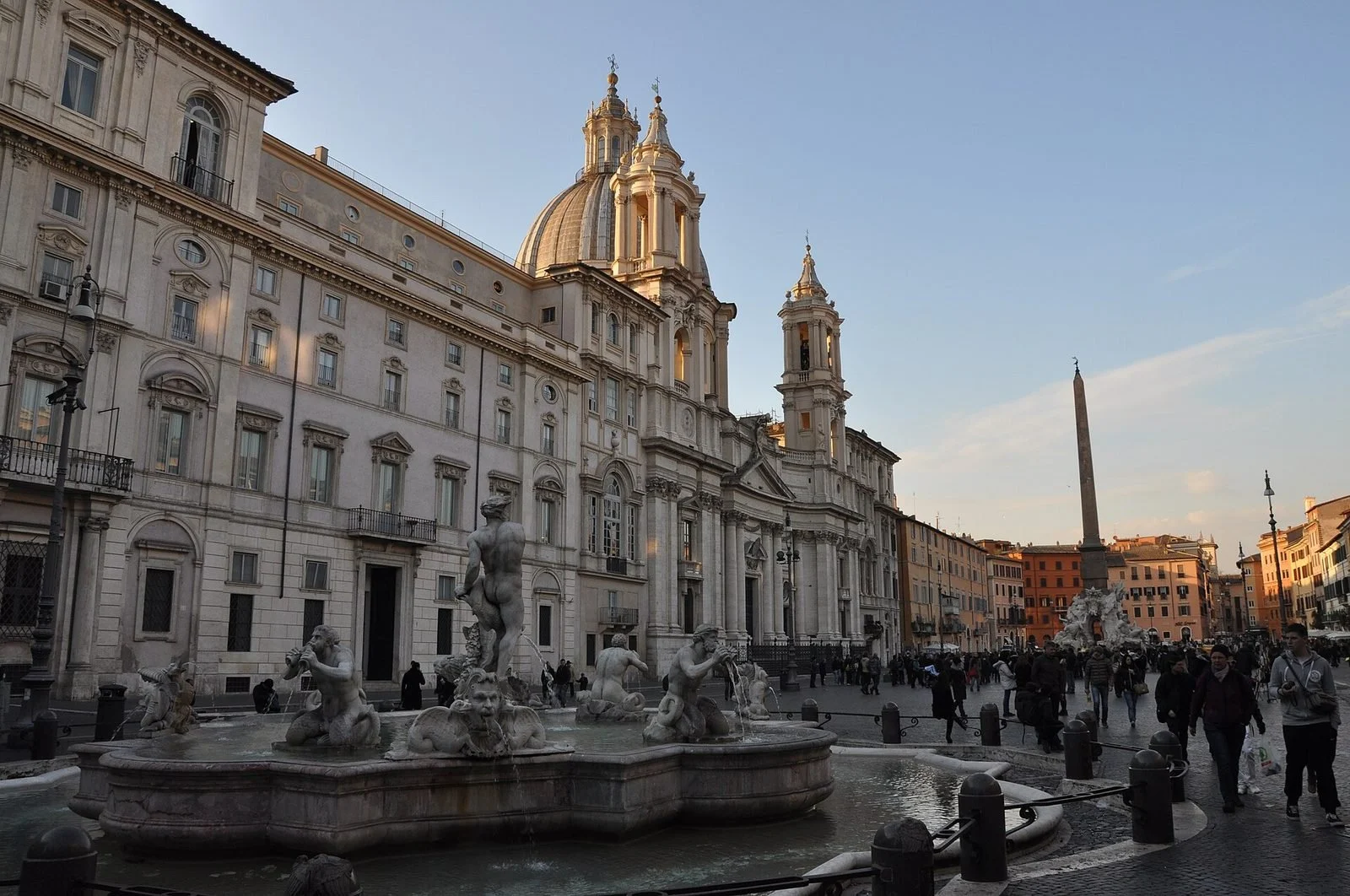
Sant’Agnese in Agone is the church that closes the west side of Piazza Navona, wedged between the Pamphilj palace and the houses that follow the curve of the piazza. It's the building with the recessed facade and the two twin bell towers that everyone photographs behind the Fountain of the Four Rivers without almost ever going in. People usually come to it for two wrong reasons: the legend that a statue on the fountain raises its arm for fear that the facade will collapse, something the dates make impossible, and the belief that it is "Borromini's church," which is only partly true. This church exists because below, five meters down, run the rooms of the Stadium of Domitian, and in one of those rooms tradition places the martyrdom of a Roman girl of 12 or 13. The marble, the dome, the bell towers and the quarrel between architects came afterward. The lines that follow explain where you go in, when it's best to try, what to look at inside, who really designed what, and why "in Agone" and "Navona" are the same word in disguise.
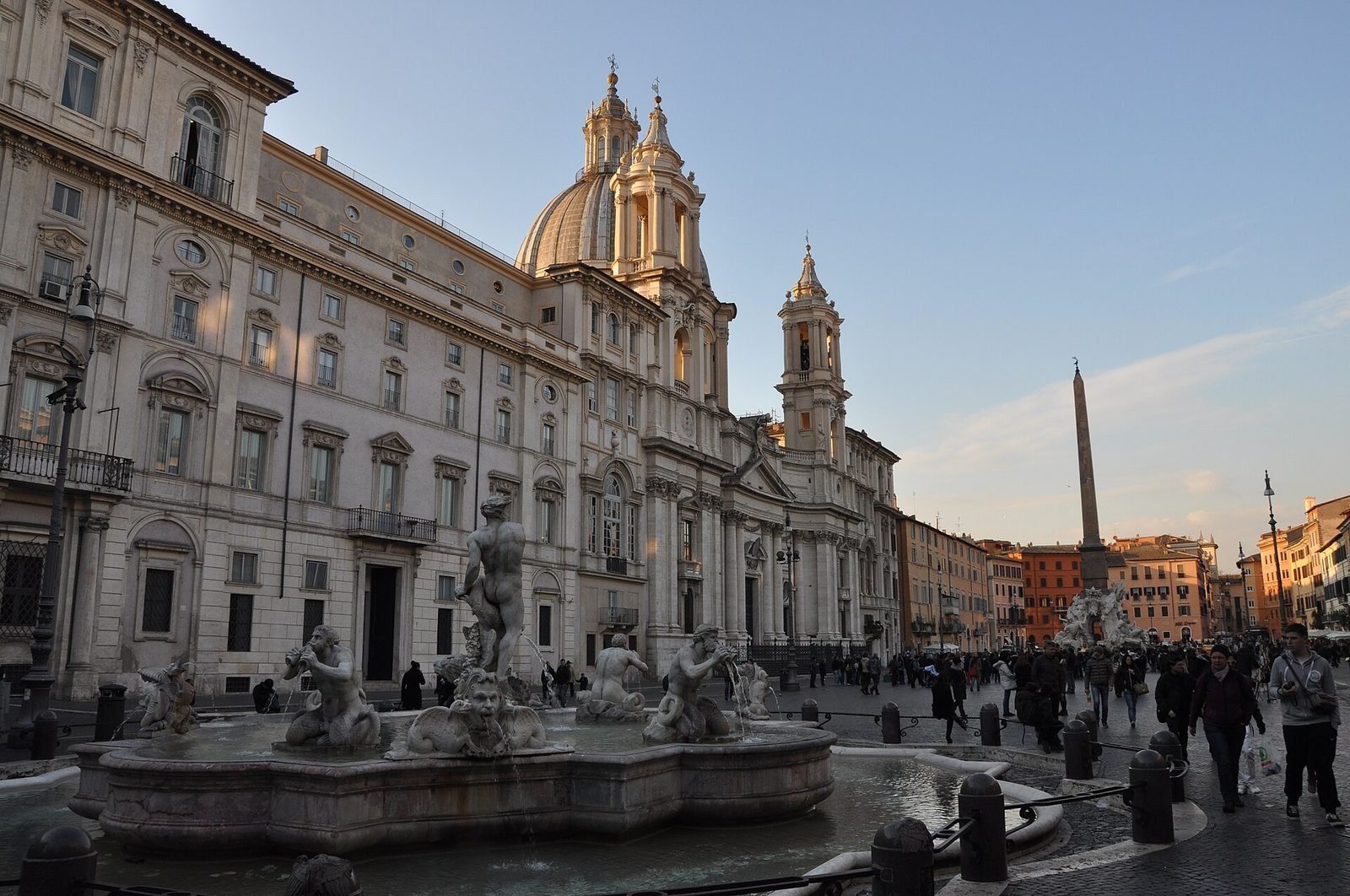
Where Sant’Agnese in Agone is and how to get there
The church occupies the western long side of Piazza Navona, exactly halfway along, with the main entrance giving onto the paving in front of Bernini's fountain. To its left, looking at the facade, is Palazzo Pamphilj, today the seat of the Brazilian embassy in Italy: the two buildings were conceived as a single body, the home and chapel of the pope's family, and for this reason the church has no forecourt of its own but faces the piazza like a stage wing. The offices of the complex have their entrance on the side of Via di Santa Maria dell'Anima, at the back: if you find that door closed, you haven't got the wrong address, you've found the service entrance.
On foot from the historic center
Piazza Navona is one of the few places in Rome where walking is always the better choice. From the Pantheon it takes five or six minutes, going by Piazza di Sant'Eustachio and Corso del Rinascimento. From Campo de' Fiori the route is similar: you cross Corso Vittorio Emanuele II at Palazzo della Cancelleria and enter the piazza from the south side, the one with the Moro Fountain. From Castel Sant'Angelo it's 10 minutes via Ponte Sant'Angelo and Via dei Coronari.
By public transport
There is no metro stop at Piazza Navona and none is planned: line A passes much farther north, between Spagna and Barberini, and from both it's at least 20 minutes on foot. The right way is the surface bus, and the arteries to keep in mind are Corso Vittorio Emanuele II to the south and Corso del Rinascimento to the east. The lines on Corso Vittorio, including the 64 that links Termini to the Vatican and that Romans advise against at rush hour because of pickpockets, drop you five minutes' walk away. The numbers change fairly often: it's best to check the updated route on the website of the Roman transport company the same day. For a general picture of how to get around the city, we have collected the information on a separate page about getting around Rome.
Hours and entry: why you won't find a table here
Entry to Sant’Agnese in Agone is open and free, as in all the churches of Rome open for worship, but the opening hours are variable and change with the seasons, with the liturgical calendar, with concerts and with celebrations. We don't publish an hours grid: it would be wrong within a few weeks, and a wrong table is worse than no table. Two rules hold almost always: closed in the middle of the lunch period, and tourist access limited by Masses on Sunday morning. If you want certainty, check the church's official website or the notice board next to the door, or phone the rectory. A church open for worship can close without notice, even for a funeral.
Our practical verdict: treat it as a stop with a moving window. Go past early and, if it's open, go in right away. Putting it off until the afternoon almost always means finding it closed.
Why it's called "in Agone" and why the piazza is called Navona
The name of the church and the name of the piazza come from the same Greek word, agon, which means contest, competition, tournament. Domitian imported it to Rome along with the type of building that served to host those competitions. The stadium he built here around 86 AD was a facility in the Greek manner, meant for running, wrestling and boxing contests and for poetry and music competitions. No chariot races, which were held at the Circus Maximus, and no gladiators, who had the amphitheater. In Latin those contests were the agones, and the place was "in agone."
From agon to Navona, step by step
The linguistic path is documented and straightforward. From medieval Latin "in agone" you move to the spoken form "n'agone," with the Roman aphaeresis that eats the initial syllables. From "nagone" you get to "navone," with the intervocalic g turning into v, a phenomenon that is nothing strange in the dialects of central Italy. From "navone" you get to "Navona." In medieval documents the area appears as campus agonis and the church as Sant'Agnese de cryptis agonis, that is, "of the grottoes of the agon": the grottoes are the vaulted rooms of the stadium, which in the Middle Ages were still standing and inhabited.
The false derivation from ships
The explanation heard most often in the piazza is that "Navona" comes from "nave" (ship), either because of the elongated shape of the piazza, which would recall a hull, or because of the lake that formed here in summer when the piazza was flooded. Both versions are false, and they take themselves apart. The elongated shape with one curved side is not that of a ship: it is exactly the plan of the arena of Domitian's stadium, with the straight side to the south where the starting blocks were and the curve to the north. And the name "Navona" appears in documents long before anyone thought of flooding the piazza for fun. The derivation from ships is a folk etymology built after the fact on a similarity of sound.
The Stadium of Domitian under the church
Under the current level of Piazza Navona, at a depth of about five meters, are preserved the remains of the Stadium of Domitian, the only masonry facility for athletic contests that ancient Rome had. The arena measured roughly 270 meters by 104, and capacity estimates in the archaeological literature range between 15,000 and 30,000 spectators: anyone who gives a single number as certain is simplifying. The piazza inherited the shape of the stadium through material continuity: the buildings around it rest in large part on the stands, and the flat surface in the middle is that of the arena, raised by the debris of 15 centuries.
The fornices and the brothels
Among those activities, say the late antique sources and the urban custom documented for other similar buildings, were the brothels. The arches at street level, the fornices, were spaces for rent, sheltered, open onto the promenade: Roman prostitution occupied them systematically, to the point that the word fornication comes precisely from fornix, the arch. This is the fact that makes the tradition about Saint Agnes topographically plausible, regardless of if the episode is historical or not: the place where tradition situates her is the kind of place that really existed in that building.
The difference in level almost nobody notices
Anyone entering Sant’Agnese in Agone from the piazza walks on a floor that is five meters above the floor the girl of the tradition walked on. You can check it by eye by going down into the underground rooms of the stadium, on Via di Tor Sanguigna: the brick and travertine arcades you see down there are the ancient level. We described them on the page about the underground of Piazza Navona, which is a ticketed archaeological route that has to be booked or bought separately: it's a different visit from that of the church, with its own management and hours, and the two places don't share a ticket office.
Who Saint Agnes was and what tradition says
Agnes is a Roman martyr venerated since the 4th century, which places her among the oldest and best attested Christian figures in the calendar of Rome: her name appears in the Depositio martyrum of 354 and her feast falls on January 21. On this the sources agree, on the rest much less. The date of death ranges between the persecution of Decius, around 250, and that of Diocletian, around 304, with the majority of scholars leaning toward the second. Tradition gives her an age of 12 or 13. The manner of death changes from account to account: beheading in the most widespread version, throat-cutting or fire in others.
The miracle of the hair
According to tradition, Agnes refused marriage to the son of the prefect of Rome, declaring herself consecrated to Christ. The sentence was conceived as infamy before punishment: public exposure naked in a brothel. At that point, says the story, her hair suddenly grew until it covered her entirely, and an angel wrapped her in a garment of light. Whoever tried to violate her fell to the ground. The scene is a well-established popular tradition and should be treated as such, not as a historical fact. It is, however, the reason this church stands here: the title "in Agone" marks the supposed place of the torment, inside the rooms of the stadium.
Two different churches, don't confuse them
There is a second church in Rome dedicated to the same saint, and it is not the same thing. The Basilica of Sant'Agnese fuori le Mura, on Via Nomentana, is built over the cemetery where Agnes was buried and keeps her main bodily relics: it is an early Christian basilica with an apse mosaic of the 7th century, catacombs open to visit and a completely different layout, and next to it is the Mausoleum of Santa Costanza with its 4th-century mosaics. Sant’Agnese in Agone, at Piazza Navona, marks instead the place of martyrdom according to tradition. In two words: fuori le Mura is the tomb, in Agone is the torment. They are six kilometers from each other and can't be visited in the same half day without rushing.
The church before the Baroque
The church you see today is entirely 17th century, but the title is much older: a place of worship dedicated to Agnes inside the structures of the stadium is documented from at least the 8th century, and appears in medieval sources with the formula Sancta Agnes de Agone or de cryptis Agonis. It was an oratory carved out of the ancient rooms, at the level of the arena and not at that of the present piazza.
Innocent X, the Pamphilj and the construction site of 1652
Giovanni Battista Pamphilj was elected pope in 1644 with the name Innocent X and reigned until his death in January 1655. His family had had a house on Piazza Navona for generations, and one of the first operations of the pontificate was to turn that block into a representative complex: the palace enlarged by Girolamo Rainaldi with the gallery frescoed by Pietro da Cortona, the fountain with the obelisk at the center of the piazza entrusted to Bernini, and the family church rebuilt from scratch with the facade on the piazza. Three simultaneous building sites on the same space, all paid for by the same patron, all meant to be looked at together.
Girolamo and Carlo Rainaldi, the first architects
The first stone was laid in August 1652 and the design was by Girolamo Rainaldi, the family's trusted architect, by then elderly, assisted by his son Carlo, who would later sign on his own some of the most recognizable facades of Baroque Rome. Their design called for a Greek cross with short arms and a facade set back from the line of the piazza, preceded by a short atrium. It was the facade that upset everything: set back as it was, and with the dome looming above, it produced from the piazza an awkward effect, with the drum seeming to crush the front instead of crowning it.
What Borromini really did
Francesco Borromini directed the construction site of Sant’Agnese in Agone from August 1653 to 1657, that is, for a little over three years, and in those three years he changed the outward look of the building irreversibly. He did not design it from scratch and did not finish it: he took a shell already raised and gave it the front that is still recognized today from every point of the piazza. The distinction between "designed" and "solved" is the key to understanding this church.
The concave facade and the widening
The Rainaldis' problem was one of space: the front of the church was too narrow compared to the height of the dome. Borromini obtained from the patrons permission to absorb portions of the side buildings, widening the front beyond the body of the church proper. Then he curved it. The facade of Sant’Agnese in Agone recedes at the center and advances at the sides, drawing a concavity that optically pushes the portal back, lowers the vanishing point and lets the drum of the dome breathe. It's a perspective trick calculated for someone looking from close up, because in Piazza Navona, with the fountain in the middle, stepping back far enough is impossible: the curve builds the distance that physically isn't there.
The two bell towers
At the ends of the widened front Borromini placed two twin bell towers. It's the choice that had the most descendants in European architecture: the pair of towers framing a central dome becomes from here on a scheme repeated for two centuries, in Italy and beyond. The function, however, is first of all optical: the bell towers hold the edges of the front, keep the dome from seeming to sit on the facade and give the church an apparent width that the plan wouldn't have. The crowning of the towers was completed after Borromini's departure and doesn't correspond in every respect to his drawings.
Why he left
Innocent X died in January 1655. With him went the patron who held the construction site together. Control passed to his nephew Camillo Pamphilj, with whom relations were terrible, and in 1657 Borromini left the job. The reconstructions speak of resignation, of dismissal, of a break over expenses and over the prerogatives of the director of works: the versions diverge and none is decisive. After 1657 the church was finished by others. We have put together his Roman works in a separate route, Borromini in Rome, which helps in understanding this facade by setting it next to the others.
A shared and contested authorship
Attributing Sant’Agnese in Agone to a single architect is wrong in every possible direction: the construction site went through three successive directions in 15 years and the final phase involved still more hands. Reconstructing the sequence is the only way to look at the building understanding what you are looking at.
The sequence, in order
From 1652 to 1653 the direction is Girolamo Rainaldi's with his son Carlo: they fix the Greek-cross plan, the layout of the piers, the height of the lower walls. From 1653 to 1657 Borromini directs: widened and concave facade, bell towers, raised drum, revision of the interior order. From 1657 Carlo Rainaldi returns, assisted and then replaced by other professionals including Giovanni Maria Baratta and Antonio Del Grande, who work on the attic and the crowning. In the following years Giovanni Battista Contini completes the bell towers. The interior decorations continue until the 1680s and beyond.
The legend of the Rio de la Plata: why it's impossible
It's the most told legend in Rome and almost everyone has heard it at least once. It goes like this: in the Fountain of the Four Rivers the figure personifying the Rio de la Plata raises his arm in front of his face because he's afraid the facade of Sant’Agnese in Agone will collapse on him, the Nile covers his head with a cloth so as not to look at it, and in response the statue of Saint Agnes on the facade turns her head the other way so as not to see the fountain. Bernini and Borromini supposedly insulted each other in this way while sculpting, in front of everyone. It's a beautiful story. It's also chronologically impossible, and a single date is enough to close it.
The dates, one by one
The Fountain of the Four Rivers was inaugurated in June 1651. The construction of the church began in August 1652, that is, more than a year later. Borromini came to direct it in August 1653, that is, more than two years later. The facade that according to the legend frightens the statue didn't exist when the statue was carved: in its place was a medieval church facing the other way, and then a building site. The Rio de la Plata, moreover, is not Bernini's work: the four river figures were executed by sculptors of his workshop from his models, and this one in particular is by Francesco Baratta. Bernini designed the whole, the rock, the obelisk, the movement of the water, but that raised arm was carved by someone else, years before there was a facade to fear.
And the statue of Saint Agnes?
The second piece of the legend doesn't hold up either. The statue of Saint Agnes that crowns the front of the church was made years after the fountain, by Ercole Ferrata, who was a sculptor from Bernini's circle and not an enemy at home. The pose of the figure answers to reasons of composition and of visibility from below, as with all crowning statues. If there were a spite, it would be a spite done by a collaborator of Bernini against Bernini himself, which no one has ever explained convincingly because it can't be explained.
What those gestures really mean
The raised arm of the Rio de la Plata belongs to the rhetorical repertoire of Baroque sculpture: it is a gesture of amazement and of shielding from the light, the kind of movement that serves to give dynamism to a seated figure and to create a void of shadow in the mass of marble. The four figures represent the rivers of the four continents then known and each has an attribute: the Danube touches the papal coat of arms, the Ganges holds an oar because it's navigable, the Rio de la Plata is surrounded by coins. The Nile covers his head for a reason that any 17th-century geographer would have recognized at once: the sources of the Nile were unknown, and the veiled head says exactly that. That veiled head works as a caption, not as a spite.
Why the legend survives anyway
A false story doesn't last four centuries by chance, and this one lasts for three reasons. The first is that the rivalry between Bernini and Borromini is authentic and documented: the legend leans on a true background and borrows its credibility. The second is that the piazza really does put the two works face to face, in a comparison the eye makes on its own. The third is that the legend is useful to anyone who has to explain the piazza in three minutes: it turns two silent monuments into a quarrel, and a quarrel is remembered while a date is not.
You can tell it, as long as you say it is popular tradition and not historical fact and as long as you add the date of 1651. The real anecdote of the piazza, namely that Bernini won the commission when the pope did not want to give it to him, by having a silver model delivered to the right rooms, is documented and just as enjoyable: we wrote about it on the page for the Fountain of the Four Rivers.
Inside the church: what to look at
The interior of Sant’Agnese in Agone is a Greek cross with short arms and chamfered corners, covered by a dome on a drum and faced entirely in polychrome marbles. Anyone coming in from the piazza finds themselves immediately under the funeral monument of the pope who wanted the church, because the tomb of Innocent X is above the entrance door and not at the back, as you would expect. It's the first anomaly of a church made of anomalies.
Marble instead of altarpieces
On the altars there are no paintings: in place of painted altarpieces there are large reliefs carved in white marble, with figures almost fully in the round. The result is an interior without narrative color, where the whole story is entrusted to white and shadow. The reliefs are the work of the most sought-after sculptors of mid-17th-century Rome. The group with Saint Agnes on the pyre is by Ercole Ferrata, the one with the martyrdom of Saint Emerentiana was begun by the same Ferrata and finished by Leonardo Retti, the death of Saint Cecilia is by Antonio Raggi, the death of Saint Alexis by Giovanni Francesco Rossi. The martyrdom of Saint Eustace was set up by the Maltese Melchiorre Cafà, who died in 1667 in a foundry accident, and finished by others. On the high altar, the Holy Family by Domenico Guidi. On some of these attributions, and above all on who finished what, the literature is not unanimous, and anyone seeking absolute precision should turn to specialist catalogs, not to a sign in the church.
The underground shrine and the remains of the stadium
Below the level of the church is preserved an older room, the shrine that tradition identifies with the place of martyrdom, carved out of the structures of the Stadium of Domitian. It is the most important part of the building from the point of view of its reason for being, and it is also the one most visitors don't see, because access isn't always allowed and depends on the conditions of the moment. Anyone who cares about it has to ask in the sacristy and be prepared for a no.
The relief by Alessandro Algardi
In the lower room there is a marble relief with the miracle of Saint Agnes's hair, attributed to Alessandro Algardi and datable to the early 1650s, therefore contemporary with the start of the building work. Algardi was Bernini's main sculptural antagonist during the pontificate of Innocent X, and his presence here is no accident: the pope preferred him, and under him he received the most important commissions. Some studies assign the physical execution to his workshop rather than his own hand, a distinction that in 17th-century Roman sculpture almost always applies.

A curiosity about Sant’Agnese in Agone
In the whole church there is not a single painted altarpiece: in place of paintings there are reliefs in white marble. For a 17th-century Roman church it's an extremely rare choice, and it has an effect you notice even without knowing the reason, because it removes from the interior all the color that usually comes from canvases and concentrates it in the marbles of the walls and the frescoes up high.
Something nobody tells you about Sant’Agnese in Agone
The church isn't oriented the way it seems: the facade on Piazza Navona is a front added in the 17th century to a building that for centuries had had its entrance on the opposite side, on what is today Via di Santa Maria dell'Anima. All the design effort of the building site, including the dismissal of the first architects, comes from this reversal.
A facade that is also part of other buildings
The wide facade you see from the piazza doesn't match the width of the church. Borromini obtained permission to absorb portions of the adjacent buildings to gain frontage, so what you are looking at is in part a scenic backdrop built in front of building blocks that have nothing to do with the church. Behind the two bell towers, for part of their height, there is no church. It's an unscrupulous procedure and visually impeccable, and it explains why the front holds up so well in a piazza where you can't step back.
My advice for visiting Sant’Agnese in Agone
The practical advice is just one and it's worth more than all the others put together: check that it's open before you set out and go early in the morning on a weekday, because entry is free but the hours are patchy and Piazza Navona after 10 becomes impassable. Everything else depends on this.
Which way to go in and what to do in the first two minutes
You enter by the central portal on the piazza. Spend the first two minutes without moving: stop three steps past the threshold, look up at the dome and the four pendentives, then turn slowly on the spot following the five altars. Only afterward go up close to the reliefs one by one. The central plan is built to be understood standing still, and whoever starts walking along the perimeter right away loses the one thing this architecture does better than others.
The mistake almost everyone makes
The most common mistake is to arrive at Piazza Navona without having decided what you want to see, go around it in 10 minutes among the portrait artists' stalls, photograph the three fountains and leave again. That way the church stays a backdrop and the underground of the stadium isn't even seen. Our opinion: Piazza Navona deserves an hour and a half done well, with the church in it and possibly the underground, or three minutes of passing through in the evening. The distracted half-hour visit is the worst of the three, because it costs time and leaves nothing.
Another well-known fact, yet rarely cited
The shape of Piazza Navona, which everyone recognizes and nobody connects to its cause, is the plan of the arena of the Stadium of Domitian preserved through building continuity: straight side to the south, curve to the north, constant width for 270 meters. It's a fact known to specialists and cited in every manual, yet in the piazza almost nobody says it out loud, and most visitors leave believing that shape was a town-planning choice of the Renaissance.
How to read the stadium from the piazza
There are three clues visible without going underground. The first is the northern hemicycle, at Via di Tor Sanguigna: the facades follow the curve of the sphendone, the semicircular end of the facility. The second is the buildings, which all have their front on the piazza and their back on narrower, lower streets: they follow the line of the stands. The third is the drop toward Via del Governo Vecchio and toward Corso del Rinascimento, which descend relative to the level of the piazza: the piazza is raised because it is filled in.
The right photo to take at Sant’Agnese in Agone
The photo that works is the one taken from the east side of the piazza, that is, from the side of the cafes facing the church, with the Fountain of the Four Rivers in the foreground on the left or the right and the concave facade opening up behind it: you need a wide-angle lens, because the piazza doesn't allow you to step back far enough, and you need the light of late afternoon, which comes from the west and lights up the travertine of the facade while the rest of the piazza goes into shade.
The photo nobody takes
The most photographically interesting detail of this facade isn't the whole, it's the way the two bell towers separate from the central body when you frame them from below, almost against the sky, from a very close point to the left of the portal. From there the concavity reads as a movement and not as a drawing. Alternatively, the dome from afar: from Ponte Sant'Angelo or from the Janiculum it stands out against the skyline of the historic center and you understand how tall it is compared to the fabric around it.
Some important events that happened here in history
The space occupied by Sant’Agnese in Agone has passed through 19 centuries without ever ceasing to be used: imperial stadium from 86 AD, inhabited quarter in the Middle Ages, city market from 1477, papal building site from 1652, monumental piazza from then on. Few places in the city have such well-documented continuity of use.
The 17th century of the Pamphilj
In 1644 Giovanni Battista Pamphilj becomes pope and the family piazza becomes the pope's piazza. Between 1648 and 1651 Bernini builds the Fountain of the Four Rivers and raises on it the obelisk brought from the Circus of Maxentius. In August 1652 the first stone of the new church is laid. In August 1653 the Rainaldi give way to Borromini. In January 1655 Innocent X dies. In 1657 Borromini abandons the building site. The church is consecrated in the 1670s, with dates that vary among the sources, while the interior decoration continues for decades.
From the 18th century to today
Around 1730 the funeral monument of Innocent X is placed, sculpted by Giovanni Battista Maini. In 1869 the market that had occupied the piazza since 1477 is moved to Campo de’ Fiori, and in the same years the tradition of the summer flooding ends. In the early 1900s the relic of the saint arrives in the church from the Lateran. Today the piazza hosts the Befana market between December and January and a continuous flow of people the rest of the year.
Who has passed through Sant’Agnese in Agone
Between 1652 and 1690 the building site of this church engaged almost all the protagonists of Baroque Rome: an entire papal family, four architects in succession and the best generation of sculptors and painters of the century.
The patrons
Innocent X, born Giovanni Battista Pamphilj, pope from 1644 to 1655, is the man who wanted all of it: palace, fountain, obelisk and church. Next to him we should remember his sister-in-law Olimpia Maidalchini, a figure of real power at the papal court, nicknamed by the Romans with a name that had nothing affectionate about it and a regular target of the satires posted on Pasquino, which is 200 meters from here. Camillo Pamphilj, the pope's nephew, inherits the building site and with it the conflicts, including the one that leads to Borromini's exit.
The architects
Girolamo Rainaldi, the family's architect, sets up the design. Carlo Rainaldi, his son, works alongside him, loses it and takes it up again, and will later sign the twin churches of Piazza del Popolo and the facade of the Basilica of Sant’Andrea della Valle. Francesco Borromini brings the front to where it stands today and leaves before the end. After him Giovanni Maria Baratta, Antonio Del Grande and Giovanni Battista Contini step in. To place Borromini in the city, it's best to start from his major works, from the Church of San Carlo alle Quattro Fontane to the spiral dome of Sant’Ivo alla Sapienza.
Sculptors and painters
Alessandro Algardi signs the relief of the lower shrine. Ercole Ferrata, Antonio Raggi, Leonardo Retti, Giovanni Francesco Rossi, Domenico Guidi and Melchiorre Cafà work on the altars. Giovanni Battista Gaulli, known as Baciccio, frescoes the four pendentives with the cardinal virtues before moving on to the Church of the Gesù. Ciro Ferri paints the dome. Giovanni Battista Maini sculpts in the 18th century the tomb of the pope, placed above the inner portal. If you want to follow the thread of Bernini through the city, you'll find it gathered in our itinerary Bernini in Rome, and if you prefer the thread of 17th-century painting you can start from Caravaggio in Rome, which also leads to the very close Church of San Luigi dei Francesi.
Eating near Piazza Navona without getting fleeced
This is where we have to be unpleasant, because Piazza Navona is the most exposed area of Rome for anyone looking for food: the concentration of places that live only off passing tourist trade is here the highest in the city, together with the one in front of the Colosseum and the one around the Trevi Fountain. We don't name restaurants, for good or ill, for a simple reason: a list of names goes stale in a few months and teaches nothing. Instead we teach how to recognize the places to avoid, which is a skill that stays with you.
The five signs Romans read at a glance
The first sign is the woman rolling fresh pasta in the window or on the street: a stage-managed lure aimed at passersby, not a clue about the kitchen. In a real kitchen the pasta is made inside, in the morning, out of sight. The second sign is the menu with photos of the dishes, often laminated and translated into six languages. It's for people who don't have to come back. The third is the tout at the door who invites you to sit down and recites the menu by heart: a place that has to stop people in the street has already said it all. The fourth is hours running nonstop from morning to late at night: a kitchen that serves at any hour doesn't prepare at any hour. The fifth is the location, that is, the table with a view of the famous monument: you pay for it, and sometimes you pay twice, because in some places the price list displayed outside doesn't match the one at the table, and unpriced items show up such as the cover charge, the bread or fish by weight.
The chains we don't recommend here
In the center of Rome, places with a repeated sign have multiplied, with the same menu in several parts of the city, often with a line and a ticket number at the entrance. We don't name them. The fact that matters is another one: Romans don't go there. Not out of snobbery, but because they know that a standardized product designed for quick passing consumption has nothing to do with the way people eat in this city. A line outside a place in the center is a marketing indicator, not a quality one.
The simplest test there is
Before you sit down, look at who is seated and what language they order in. If the tables hold only foreigners and nobody speaks Italian, you're in a place that lives off people who will never come back. If there are Roman families, office workers on a break, people greeting the cashier by name, you're in a place that has to see those same people again next week. It's a crude test and it works almost always, in any city.
Where to really look
The geographic rule is simple: move away. 200 or 300 meters change the picture, and the streets behind Corso del Rinascimento or toward the Ghetto still have neighborhood places. If you want a starting point that's already filtered, you can check Daniele Dezi's personal list on Google Maps, a curated, unsponsored collection built on real visits. On the general criterion we wrote a separate page, where to eat in Rome, which explains how the neighborhoods work and what to expect in each.
What's around it, within 10 minutes on foot
Sant’Agnese in Agone sits at the point of greatest monumental density in the Campo Marzio: within a radius of 500 meters there are at least a dozen places with a page of their own, and most can be visited for free or with tickets of a few euros. Anyone planning a half day here doesn't need to take transport even once.
On the piazza and its edges
The three fountains of the piazza are distinct monuments with separate stories: the Fountain of the Four Rivers with the Agonal Obelisk at the center, the Moro Fountain at the south end and the Neptune Fountain to the north. At the south corner opens the Museo di Roma at Palazzo Braschi, where you can see how the piazza looked before the 19th-century transformations. At the mouth of Via del Governo Vecchio is Pasquino, the ancient torso on which Romans have posted satires for five centuries, often aimed at the Pamphilj. Toward the lungotevere, the Napoleonic Museum and Palazzo Altemps, with its collection of ancient sculpture, close off the block to the north.
The nearby churches worth the detour
300 meters away are Santa Maria della Pace with Bramante's cloister, the Church of San Luigi dei Francesi with the Caravaggios of the Contarelli Chapel, the Basilica of Sant’Agostino with another Caravaggio and the Basilica of Sant’Eustachio. A little further on are Sant’Antonio dei Portoghesi, the Basilica of Santa Maria sopra Minerva and the Church of Sant’Ignazio with its painted fake dome. The complete route is on our page about Baroque Rome.
The archaeological areas within walking distance
Besides the underground of the stadium, within 10 minutes there are Largo Argentina with the Sacred Area, today visitable at the level of the Republican temples, and the Crypta Balbi, which is the museum where the urban stratigraphy of Rome is understood better than anywhere else in the city. The Pantheon is six minutes away. For anyone putting together a tour made only of free things, the information is collected on the pages Free Rome and free museums in Rome.
In the evening
After sunset the piazza empties of organized groups and fills with strollers, and the facade lit from below is one of the most recognizable nighttime backdrops of the center. The church at that hour is closed: the interior visit and the evening stroll have to be planned for two different moments. On what the city offers after dark we have collected the information in Rome at night, and anyone going on toward the river finds Campo de’ Fiori 10 minutes away and a little beyond it Galleria Spada with Borromini's perspective gallery, which is the best way to end a day devoted to this architect.
Frequently asked questions about Sant’Agnese in Agone
How much does it cost to enter Sant’Agnese in Agone?
Entry to Sant’Agnese in Agone is open and free, as in all the churches of Rome open for worship, and there is no ticket office. You pay nothing to go in, look around and take photos without flash. What is paid and separate, instead, is the underground of the Stadium of Domitian next door, on Via di Tor Sanguigna, run by a different body with its own ticket: the two places share neither an entrance nor a fare.
What are the opening hours of Sant’Agnese in Agone?
The hours of Sant’Agnese in Agone are variable and change over the year, so we don't publish a table that would be wrong within a few weeks. There are two constants: a closure in the middle of the lunch period and a limit on tourist access during Masses, particularly on Sunday morning. Before going it's best to check the church's official website, the notice board next to the door, or phone the rectory.
Is Sant’Agnese in Agone the church designed by Borromini?
Sant’Agnese in Agone is not the work of Borromini alone: the initial design is by Girolamo and Carlo Rainaldi, who started the building work in 1652, Borromini took over the direction in 1653 and left it in 1657, and the church was completed by Carlo Rainaldi and other professionals in the following decades. To Borromini we owe the concave facade, its widening and the two bell towers, that is, what you see from the piazza.
Is it true that the fountain statue is afraid the church will collapse?
No, the legend about the Fountain of the Four Rivers and Sant’Agnese in Agone is chronologically impossible: the fountain was inaugurated in 1651, the building work on the church began in 1652 and Borromini took over its direction only in 1653, so the facade did not exist when the statues were carved. The raised arm of the Rio de la Plata is a Baroque rhetorical gesture and the veiled head of the Nile alludes to the then unknown sources of the river.
What is the difference between Sant’Agnese in Agone and Sant’Agnese fuori le Mura?
Sant’Agnese in Agone, at Piazza Navona, marks according to tradition the place of the saint's martyrdom in the rooms of the Stadium of Domitian, while the Basilica of Sant’Agnese fuori le Mura, on Via Nomentana, stands over her tomb and keeps the main bodily relics. They are two distinct buildings, about six kilometers apart, of completely different eras and architecture: Baroque the first, early Christian with a 7th-century mosaic the second.
How long does it take to visit Sant’Agnese in Agone?
To visit Sant’Agnese in Agone with attention, 20 or 30 minutes are enough, because the central plan is taken in at a glance and the points to look at up close are the five altars with the marble reliefs, the four pendentives by Baciccio and the tomb of Innocent X above the door. Anyone adding the underground of the Stadium of Domitian should count at least an hour more, ticket and wait included.
Can you take photos inside Sant’Agnese in Agone?
Inside Sant’Agnese in Agone amateur photography without flash and without a tripod is generally tolerated, as in most Roman churches, but the decision rests with the rector and the signs posted at the entrance always take precedence. No photos during services. For video filming, professional equipment or commercial use of the images, a permit is needed, to be requested in advance from the rectory.
Is Sant’Agnese in Agone accessible to people with reduced mobility?
The main entrance of Sant’Agnese in Agone from the piazza has a few steps and the interior is on a single flat level, so once past the threshold the space can be walked without changes of level. The underground room, when accessible, is reached only by stairs and cannot be traversed in a wheelchair. If you have specific needs, it's best to contact the rectory in advance to check the situation on the day.
Can you visit Sant’Agnese in Agone with children?
Sant’Agnese in Agone is a short visit and suitable also for those traveling with children, because there are no lines, no obligatory routes and in 20 minutes you're out. Outside, the piazza offers the space that is missing inside. The marble reliefs of the altars, with large life-size figures and recognizable scenes, work better than a painting at holding the attention of the little ones, and the story of the ancient stadium under their feet is usually what wins them over.
Who wrote this page
This page is edited by the team at Tour Leader Pro, the Rome-based project office that designs and coordinates visits, itineraries and cultural events in Rome and Lazio. The hours, fares and access conditions given here were checked against the official sources named in the text as of the publication date: it's best to recheck them before you go, because they change often. If you find outdated information, let us know.
If you are building an itinerary in the Campo Marzio, combining this church with the underground of the stadium and the nearby archaeological areas, you'll find planning tools at Tour Leader Pro, which works in Rome and Lazio with groups, schools and companies and knows the real travel times between one stop and the next.
For a wider picture, one that includes transport from the airport, travel times between Italian cities and the destinations reachable from Rome in a day, a good planning resource is Italy Planner, especially useful for those fitting Rome into a longer trip.