Pasquino
In short. Pasquino is the marble torso propped against the northwest corner of Palazzo Braschi, in the square that since the 16th century has ended up taking its name, about 50 meters from Piazza Navona.
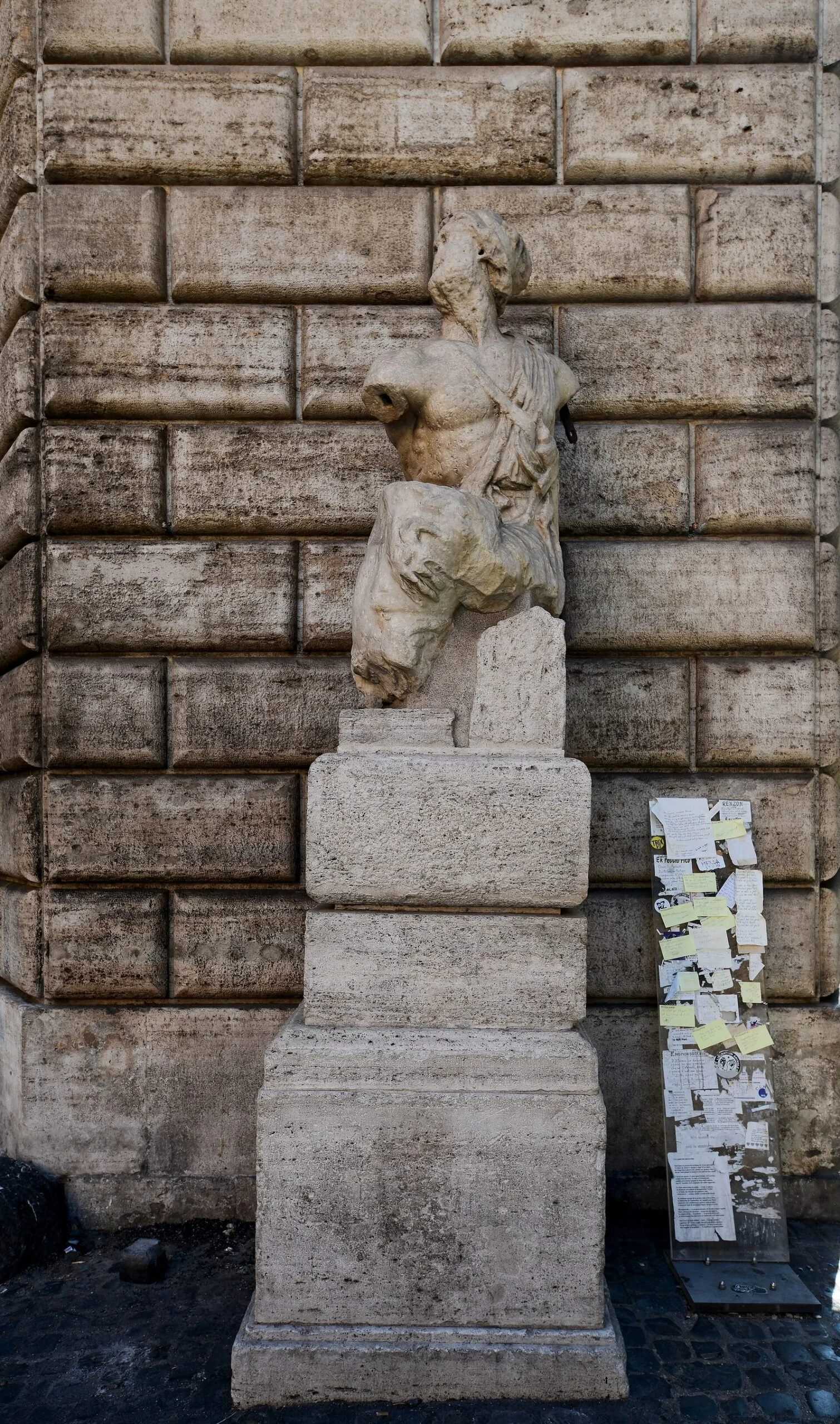
Pasquino is the marble torso propped against the northwest corner of Palazzo Braschi, in the square that since the 16th century has ended up taking its name, about 50 meters from Piazza Navona. It is the most famous of the six talking statues of Rome, and its nickname gave us the word pasquinade, which entered the Italian language and then half of Europe. What almost nobody looks at, standing in front of it, is the statue itself: people stop to read the sheets posted on the board next to it and then head off toward Piazza Navona. Yet the marble is the oldest and most debated part of the story, because it is a fragment of a Greek sculptural group of which at least 15 Roman replicas are known, and archaeologists have not closed the case on the subject it represents. This page is about the statue: what it really is, when it was found, why it has this name (and why none of the usual explanations has a document behind it) and what you see in the square today. The phenomenon of the talking statues as a whole, with the walking itinerary through all six, is told in the page on the talking statues. Here we talk about one object only.
Where Pasquino is and how to get there
Pasquino stands in Piazza di Pasquino, in the Parione district, leaning against the corner of Palazzo Braschi that faces Via del Governo Vecchio, a little over 50 meters from the southwest entrance of Piazza Navona. The statue is on public land, outdoors, visible 24 hours a day and with no ticket. It has no opening hours, no gates and no guards. The only protection is a low fence of travertine bollards installed with the 2010 restoration.
On foot, from the Historic Center
From Piazza Navona it takes only 50 meters. You leave from the side of Palazzo Braschi, level with the Moro Fountain, and turn into the lane that comes out in the little square. From Campo de' Fiori it is five or six minutes along Via dei Baullari and Via del Pellegrino. From Largo di Torre Argentina it is a good quarter of an hour along Corso Vittorio Emanuele II. From the Pantheon it is about 10 minutes, crossing Piazza Navona diagonally. From Castel Sant'Angelo, over Ponte Sant'Angelo and along Via dei Banchi Nuovi, it is 12 or 13 minutes.
By public transport
The square has no nearby subway stop, and it's good to know that before you leave. The closest stations on Line A, Spagna and Barberini, are a 20 to 25 minute walk away. The convenient connection is on the surface, along Corso Vittorio Emanuele II, where lines 40, 46, 62 and 64 run, among others. From Largo di Torre Argentina, where tram 8 from Trastevere also arrives, you finish the stretch on foot in a quarter of an hour. Atac routes change with the construction sites in the center, so it's best to check the line on the company's website.
By car and taxi
The square is inside the limited traffic zone of the Historic Center, has no parking nearby and is surrounded by very narrow lanes, mostly pedestrian. If you come from outside Rome, it's quicker to leave the vehicle in a park-and-ride lot connected to the subway. The taxi gets you to Corso Vittorio Emanuele II or Corso del Rinascimento.

What the statue of Pasquino really is
Pasquino is the surviving fragment of an ancient sculptural group, not a single statue. Two figures are carved in the same block of marble, a standing warrior holding up a second, limp body, now reduced to an eroded mass that almost no passerby recognizes as such. The warrior has lost his head, arms and a large part of his face. What remains legible is the start of what was most probably a cuirass, the twist of the torso upward and the hand gripping the companion's body.
What you actually see when you walk around the block
The practical advice is not to look at Pasquino only head on. From the side facing Piazza Navona you see almost nothing but the mutilated torso. Move 90 degrees, toward Via di Santa Maria dell'Anima, and you take in the whole composition: the lifeless body hanging, the bearer's hand on the hip, the sloping plane on which the group developed. Three steps sideways and about 20 seconds are enough.
The Pasquino group: a composition known in at least 15 copies
Archaeologists today call the Pasquino group, after the Roman statue, an entire composition of which at least 15 Roman marble copies are known, derived from a lost Greek original, most probably in bronze. It shows a warrior lifting and carrying off the battlefield the corpse of a companion. It is a rare subject, copied for centuries also because it solves a hard technical problem, how to make a dead body stay upright without the sculpture losing its balance.
That the piece in the square is a copy and not the original is agreed by all scholars. On the date, though, the sources disagree. Several recent studies place the Hellenistic prototype between 200 and 150 BC. The most widely used Italian encyclopedia entry speaks of a work in Hellenistic style perhaps from the 3rd century BC. The tourist portal of the City of Rome dates the marble you see in the square to the end of the 1st century AD, referring however to the copy and not the model. The three indications are partly about two different objects, but anyone looking for a single, certain date won't find one.
The attribution to Antigonos, and why to take it with a grain of salt
Part of the popular literature attributes the original to the sculptor Antigonos, an artist of the Pergamene circle known for being cited by ancient sources. The attribution also appears in encyclopedia entries, but it rests on no inscription or direct testimony. It is a scholarly proposal, not a fact.
Who the two figures are: a question still open
Identifying the subject is the most debated part of the story, and it's worth going through it in order because guides tend to compress it into a single sentence.
In the 16th century scholars proposed very different readings: Hercules, the giant Geryon, Alexander the Great, Hercules fighting the centaurs. Flaminio Vacca, in 1594, speaks of a gladiator in connection with another replica of the same group.
At the end of the 18th century the antiquarian Ennio Quirino Visconti proposed the identification that later became the best known: Menelaus holding up the body of the dying Patroclus, an episode from the 17th book of the Iliad. In 1936 the German philologist Bernhard Schweitzer devoted a monograph to it that cataloged all the fragments known at the time and consolidated that reading.
From then on the question has reopened. Several contemporary scholars believe that for most of the Roman replicas the likelier subject is another: Ajax carrying off the body of Achilles, a scene that is not Homeric but is attested in the later tradition. For the Sperlonga replica the prevailing reading today is yet another, Odysseus lifting the corpse of Achilles, consistent with the rest of the sculptural program of the grotto. Some have proposed Aeneas carrying Lausus. A clue comes from the Hadrian's Villa replica, where the dead figure has a wound in the back: in the Iliad Patroclus is killed precisely with a blow from behind.
To sum up: Menelaus and Patroclus is the traditional reading and still the most cited, Ajax and Achilles is the one that has gained ground for a large part of the copies, and for some replicas different identifications hold. Anyone in the square who tells you in a definitive tone that the statue certainly represents Menelaus and Patroclus is closing a discussion that is still open.
The measurements, and a figure we couldn't verify
On the exact dimensions of the torso there is no figure published uniformly by the institutional sources we consulted, unlike Marforio or Madama Lucrezia, for which precise measurements can be found. The group is larger than life, like almost all the known replicas, but we prefer not to give a number that we couldn't check against a catalog entry. Anyone who needs the technical figure should contact the Capitoline Superintendency of Cultural Heritage, which is in charge of the monument.
The other replicas of the group: Florence, the Vatican, Sperlonga
The quickest way to understand what the torso in Piazza di Pasquino represents is to look at a better preserved replica, and in Italy there are several. The most complete is in Florence, under the Loggia dei Lanzi in Piazza della Signoria, with the title of Menelaus holding up the body of Patroclus.
The Loggia dei Lanzi group
The story of that marble says a lot about Pasquino, by contrast. The fragment was bought by Cosimo I de' Medici shortly after it was found in the vineyard of Antonio Velli, half a mile outside Porta Portese, and taken to Florence with the consent of Pope Pius V. According to the memoirs of the sculptor and antiquarian Flaminio Vacca, published in 1594, the bearer figure was missing from the waist up, while the dead body was intact. The completion was commissioned by Ferdinand II. The model was worked out by Pietro Tacca, the execution is attributed to his assistant Lodovico Salvetti, and the group ended up in a niche at the southern end of Ponte Vecchio. In 1771 Anton Raphael Mengs took casts of the parts he considered ancient from this version and from another kept in Palazzo Pitti, which arrived in Florence in 1570 as a gift from Paolo Antonio Soderini and was said to have been found in the area of the Mausoleum of Augustus. After further interventions, the group was erected in the Loggia dei Lanzi in 1838.
The detail that still draws the most looks in Florence, the left arm of the dead figure hanging as if dislocated, is not ancient. It is part of Tacca and Salvetti's 17th-century restoration. Also modern are the bearer's raised left leg, the dead figure's raised right knee and the raised ground that serves as a base. Anyone looking at that group believing they are seeing a Greek original is seeing, in large part, a Tuscan baroque invention.
The fragments from Hadrian's Villa and the Vatican Museums
Five fragments of a Pasquino group were excavated at Hadrian's Villa, in Tivoli, by Gavin Hamilton in 1769. They were part of the collection of copies of Greek masterpieces gathered by Emperor Hadrian. They are now in the Vatican Museums, and the head attributed to Menelaus is displayed in the Sala dei Busti. It is the replica with the wound in the back, the most concrete argument in favor of Patroclus, at least for that copy.
The Sperlonga version
Another came to light in 1957 at Sperlonga, in the grotto of the Villa of Tiberius, together with a sculptural ensemble of the highest level dedicated to the adventures of Odysseus. It is very fragmentary, but the context has led scholars to read it differently from the others: here the majority favors Odysseus carrying off the body of Achilles. The national archaeological museum next to the grotto displays the reassembled groups, and for anyone interested in this sculpture it is the trip that clarifies more than any photograph.
The 1501 discovery and Cardinal Oliviero Carafa
The date on which all the sources agree is 1501. In that year the torso was raised at the corner of the palace where it still stands, at the wish of the Neapolitan Cardinal Oliviero Carafa. The square was then called Piazza di Parione, and the palace behind the statue was the residence of the Orsini, replaced at the end of the 18th century by Palazzo Braschi.
A building site, not an archaeological dig
The word discovery is misleading. The context was an ordinary Renaissance building site: the street of Parione was being paved and the palace was being renovated on behalf of Carafa, who was going to move in, and Bramante also took part in the works. No excavation campaign, no archaeologist. Archaeology as a discipline didn't exist yet.
The most detailed account is secondhand and comes from Lodovico Castelvetro, who had heard it from the Ferrarese poet Antonio Tebaldeo, who lived in Rome for much of his life. According to that testimony the statue did not emerge from deep underground. It was already half buried in the public street, and the protruding back served passersby as a stepping stone so they wouldn't dirty their feet in the muddy seasons. When the street was paved, that irregular block made the paving less even, and it was set upright in front of the shop that had belonged to a certain master Pasquino. If the testimony holds, 1501 is not the date of the discovery but the date it was stood up.
What Carafa did, and why it was decisive
Many people on the site considered the torso scrap material: mutilated, corroded, illegible. Carafa insisted on saving it. He had it raised on a base at the corner of the palace, applied the family coat of arms and a celebratory scroll to it, and so turned it into a public object with a writable surface at the eye level of passersby.
Without that gesture the word pasquinade would not exist, and Roman wall satire would have attached itself to another sculpture with another name. The cardinal was planning nothing of the kind. He wanted a learned ornament at the corner of his own residence.
The April 25 festival and the Latin epigrams
Carafa established an annual celebration around the statue, set for April 25, the feast of St. Mark. The torso was filled out with papier-mache, draped with fabrics and colors and dressed up each year as a different character, a god, a hero, an allegorical figure, and around it were posted compositions in Latin alluding to the disguise.
Those who wrote them were not the common people. They were humanists, curia men of letters and students, with exercises in scholastic and courtly bravura more than political satire. The proof is in print, because the Roman printer Giacomo Mazzocchi published those collections as early as 1509 under the title Carmina apposita Pasquino. The phenomenon was born inside the learned, Latin-speaking milieu of the curia, and only later went down into the street, changing language.
The Stadium of Domitian, an old hypothesis on where it came from
The first 16th-century interpretations held that the statue had served as an ornament of the Stadium of Domitian, the ancient building buried under Piazza Navona, whose underground remains can be visited today. The hypothesis is geographically plausible, because the stadium is right next door, but it remains a hypothesis. No document and no excavation data confirm it, and the fact that the torso was already half buried in the street doesn't allow us to reconstruct where it had come from.
A curiosity about Pasquino
The most disorienting curiosity is that Pasquino has never been restored. In a Rome that between the 16th and 17th centuries casually rebuilt the missing heads, arms and legs of ancient statues, often inventing them from scratch, the torso in Piazza di Parione has stayed as it was found: no head, no arms, with a corroded face.
Why nobody ever laid hands on it
The comparison with the other replicas is merciless. The marble in the Loggia dei Lanzi was completed in the 17th century with a new bust, a new arm and an invented ground support. Later a neoclassical helmet was also added, replacing the simpler one visible in Paolo Alessandro Maffei's engraving of 1704. Pasquino, no. The Roman fragment has come down to us without additions, and it is today the most honest replica from a philological point of view precisely because it is the most ruined.
The reason is that Pasquino stopped being a sculpture in the eyes of the Romans early on and became a support, a character, a notice board. Nobody restores a notice board. The aesthetic damage that would have made an antiquities collector wrinkle his nose is exactly what saved the piece.
The statue that gave a common noun to a language
The second curiosity is linguistic. Very few physical objects in Rome have generated a common noun still in use. Pasquinata means a biting, anonymous satire against a public figure, and it passed into English and French as pasquinade, into Spanish as pasquín. The phenomenon died out over a century ago and the word is still here. There were also babuinate and facchinate, from the other statues. Both are gone.
Where the name Pasquino comes from: four traditions, no document
The origin of the name Pasquino is not documented by any contemporary source. All the explanations in circulation are traditions collected decades after the events, and none rests on a deed, a register or a direct testimony. It's the point almost all guides skip, and it's the most interesting point of the whole story, because there are at least four versions around and they contradict one another.
First version: the tailor of Parione
The oldest and most elaborate version is the one collected by Lodovico Castelvetro in a work of his published in Venice in 1560, and heard from Antonio Tebaldeo. According to that account, in Parione there was a very skilled tailor called master Pasquino, in whose shop he and his many apprentices, who dressed a large part of the courtiers, spoke freely in criticism of the affairs of the pope, the cardinals and the lords of the court. After his death, when the block of marble was set upright in front of that shop, the people gave it the name of the man who had lived nearby.
The version has a strong internal coherence, because it explains the name and the function together, but it remains a secondhand testimony collected more than 50 years after the events.
Second version: the innkeeper, the barber, the shoemaker, the blacksmith
A second strand, the most widespread in popular accounts, makes Pasquino a man of the people from the district known for his sharp tongue, without agreeing on his trade: some say barber, some blacksmith, some shoemaker, some tailor. Teofilo Folengo, the author of the Baldus, makes him a restaurateur with a business in the little square. The multiplicity of variants is the significant fact: when four sources give four different trades to the same character, the likelihood that it is a retrospective construction rises considerably.
Third version: the Latin grammar teacher
A more recent hypothesis, which has the advantage of explaining the milieu in which the first sheets were born, identifies Pasquino with a Latin grammar teacher at a school near the square, and attributes the authorship of the first postings to his students, out of student high spirits, having noticed a physical resemblance between the marble and the teacher. This reading has one merit: it fits the documented fact that the first compositions posted were Latin epigrams from a school and curia setting, not popular verses in Romanesco.
Fourth version: Boccaccio
Finally there are those who link the name to the protagonist of a tale in the Decameron, the seventh of the fourth day, in which a Pasquino dies poisoned by rubbing his teeth with a sage leaf, an herb considered healthful. The name would indicate someone harmed by what passes for good. It is the most literary hypothesis and the least verifiable.
What can be said with certainty
This much can be said: the name was already in use and already famous in the first decade of the 16th century, because in 1509 there are printed collections titled after the character. Everything else is oral tradition put in writing much later, and in the specialist literature the origin is described as obscure. We point it out because in the square, and on many web pages, one of the four versions is told as established. None of them is.
One thing nobody tells you about Pasquino
The thing almost nobody says is that for some years now nothing has been posted on the statue itself. The notices are attached to a board at the foot of the monument, and putting them on the marble or the base is forbidden.
Why the board
The reason is conservation and it is concrete: glue, adhesive tape and repeated tearing on already corroded ancient marble produce cumulative damage that can't be repaired. The torso had reached the end of the 2000s in bad condition, attacked by smog and neglect, and was restored at the end of 2009 to be handed back to the city on March 10, 2010 together with the fence of travertine bollards.
The result has a paradoxical side: a gesture born to be unauthorized, nocturnal and clandestine now has an official, authorized support. Anyone expecting the statue covered in sheets, as in the 19th-century prints, is disappointed. Our opinion is that the choice is right in terms of protection and that the visitor should be warned beforehand. Otherwise they arrive, see a clean torso behind the bollards and think the tradition is over. It has moved one meter.
The only one of the six still in service
The second thing that is rarely said is that Pasquino is today the only one of the six talking statues still in service. Marforio is inside the paid route of the Capitoline Museums, in the courtyard of Palazzo Nuovo, and since 2008 is no longer reachable for free. Madama Lucrezia, at the corner of Palazzo Venezia, and the Babuino, in Via del Babuino, remain on the street but haven't received notices for generations. The Facchino is set into a wall in Via Lata. The Abate Luigi, on the side of the Basilica of Sant'Andrea della Valle, has been headless since 2013 and won't get it back. Staying in service for five centuries, for an object made of stone, is a statistic no other sculpture in Rome can show.
What you read on the board today
The content changes from week to week and is filtered by no one: verses in Romanesco, political flyers, personal outbursts, announcements from neighborhood associations, every so often an artistic intervention. On January 4, 2023 the Abruzzo artist Pep Marchegiani exhibited in front of Pasquino a work of his dedicated to an imaginary first African pope. Anyone arriving hoping for a memorable joke may come away empty-handed. Anyone who stops for five minutes takes away a piece of the city's mood that no guide can anticipate.
How the pasquinades really worked
The mechanism worked at night and relied on a simple advantage: the guards took the sheets down every morning, but always after someone had read them. The phenomenon as a whole, with the dialogue among the six statues and the chronology of the repression, is reconstructed in the page on the talking statues of Rome. Here what matters is the part that concerns this marble and this square.
The location, which is everything
Piazza di Parione, in the 16th century, was an obligatory passage between the Campo Marzio, Campo de' Fiori and the road that led to the Vatican across Ponte Sant'Angelo. Whoever posted a sheet on that corner knew it would be read by hundreds of people within a few hours. The choice of the statue is logistical, not poetic. The same joke hung in a dead-end alley would have died there.
The dialogue with Marforio
The most successful format was the back-and-forth with Marforio, the river colossus now in the courtyard of Palazzo Nuovo at the Capitoline Museums, within the route reached from the Palazzo dei Conservatori on the Capitoline Hill. Between the two statues there is a quarter of an hour's walk, and that distance was part of the device: nobody could read question and answer together, and in one morning the joke circulated by word of mouth all over the center.
The historic pasquinades, and why you won't find a list of them here
Many famous pasquinades circulate in different versions, with uncertain attributions and texts reworked by centuries of transcription. Reporting them as documents is one of the most common mistakes in guides, and we chose not to do it. The recurring targets, those that can indeed be reconstructed from the collections, were nepotism, the building greed of the papal families, new taxes and the private lives of the cardinals.
Just one example, because it's the one everyone cites: the Latin motto Quod non fecerunt barbari, fecerunt Barberini, aimed at Pope Urban VIII for the removal of the bronze from the beams of the portico of the Pantheon in 1625. The text is authentic and circulated at the time, but its popular origin is disputed. The author has been identified as Monsignor Carlo Castelli, agent of the Duke of Mantua, and the joke is found already circulating at the papal court attributed to the pope's personal physician. The most famous pasquinade in Rome is both authentic as a text and problematic as a document.
Censorship and penalties
The first official measure against the postings dates to 1523 and bears the signature of Adrian VI. Tradition has it that he wanted to have the statue thrown into the Tiber and was dissuaded by the curia cardinals. It is a handed-down anecdote, not a documented act. Sixtus V and Clement VIII also tried to get rid of the problem, without result. The harshest measure came in the 18th century, with the edict of Benedict XIII that provided the death penalty, confiscation of property and infamy for the authors of pasquinades.
The gravest case remains that of the man of letters Niccolò Franco, and a correction needs flagging here, because the sources contradict each other: several encyclopedia entries date the sentence to 1566, while the most accurate reconstruction places the arrest on September 1, 1568 and the hanging on the bridge of Castel Sant'Angelo on March 11, 1570, under Pius V. Franco did not end up on the gallows for a sheet hung on a statue, but for a violent libel against Paul IV and his family. The pasquinades were among the charges, but the file was broader.
How it ended
It wasn't repression that closed the game. The pasquinades thinned out after 1870, with the end of the temporal power: the historic target had ceased to exist. The baton, moreover, had already passed to the sonnets in Romanesco of Giuseppe Gioachino Belli, which did the same work with more refined literary means. The Teatro Belli, in Trastevere, is named after Belli.

My advice for visiting Pasquino
The most useful advice for visiting Pasquino is about the time of day. The little square is narrow, direct sun reaches it for only a few hours and the best moment to read the marble is early afternoon, in reflected light. The torso is dark, the square stays in shade for much of the day and in full sun the contrast becomes unmanageable for the eye as well as the camera.
Combining the stop with the Museo di Roma
The palace behind the statue houses the Museo di Roma, and combining the two makes sense because the museum holds views, prints and materials that tell the story of the city in which Pasquino worked. The entrance is at Piazza San Pantaleo 10, with access also from Piazza Navona 2. The permanent collection, on the second and third floors, is open Tuesday to Sunday from 10:00 to 19:00, last entry one hour earlier. It is closed on Monday, May 1 and December 25, while on December 24 and 31 the hours end at 14:00. The ticket for the permanent collection alone is listed at €13 full price and €7.50 reduced, with a €1 presale fee if bought in advance. Since February 2026 it is free for residents of Rome and the Metropolitan City with ID, and with the MIC card. When an exhibition is on, the combined rates change, so it's best to check the museum's notices page.
The verdict, without beating around the bush
Pasquino, on its own, doesn't hold up a dedicated visit. Anyone arriving in Rome for three days and putting the statue at the top of the list gets the math wrong. It is an eroded fragment in a small square, and without knowing what you're looking at it's dismissed in 90 seconds. It's worth a lot as a stop within a route, and above all if you arrive knowing three things: what the sculptural group represents, that the name has no documents behind it and that the sheets now end up on the board. With those three pieces of information, 10 minutes in the square are worth more than a generic guided visit. Without them, it's a rock.
Accessibility and services
The square is flat and paved with sampietrini cobblestones. They are uneven, and the passage around the fence is narrow, but there are no steps or level changes, and the statue can be seen in full without having to get close. There are no ticket offices or information points in the square. The nearest restrooms are those of the businesses in the area and of the Museo di Roma.
Another well-known fact, yet rarely cited
The fact that everyone knows but almost nobody puts in the right place is that the palace behind Pasquino is not the one the statue was put there for. Carafa placed it at the corner of the Orsini palace, demolished at the end of the 18th century and replaced by Palazzo Braschi, built for the family of Pope Pius VI.
A statue that outlived its own palace
Pasquino has therefore changed backdrop without changing position. It saw the building it leaned on taken down and another raised behind it, in a completely different style, and it kept working through the whole construction. Usually the opposite happens, that is, the sculpture is moved to make room for the architecture. Marforio, to stay within the same story, was moved three times in a century.
Braschi, the last papal family palace
Palazzo Braschi deserves a line of its own because it is the last great palace built in Rome by a papal family for its own nephew: a design by Cosimo Morelli, a building site straddling the 18th and 19th centuries, interrupted by the events of the Roman Republic. It now houses the Museo di Roma, and its monumental staircase surprises those who enter expecting only paintings. The detail that completes the picture is the irony of the coincidence: the anonymous satire that for three centuries had targeted papal nepotism ended up with, as a permanent backdrop behind it, the latest and costliest monument of that same nepotism.
The name of the square came later
A second rarely cited fact concerns place names. The square was called Piazza di Parione, after the district, and took the name of the statue only when the nickname of the marble was by then better known than the official place name. It is the same mechanism that renamed Via del Babuino, first Via Clementina and then Via Paolina: the sculpture won out over the street.
The right photo to take at Pasquino
The right photo to take at Pasquino is the frame that keeps the statue and the board inside it, the ancient object and today's paper in the same shot. A frontal portrait of the torso, with a marble so eroded, almost always gives a poor and incomprehensible image.
How to set up the frame
You stand at an angle to the corner of the palace, torso on the left and board on the right, and shoot vertically, including a bit of cobblestones at the bottom and the masonry at the top. The square is narrow and the horizontal forces you to frame parked cars and signs. The early afternoon light is the right one, because the dark marble and the white paper have a hard contrast in full sun.
The second photo, the one almost nobody takes
The second image to take away is the detail of the hand. From the side facing Via di Santa Maria dell'Anima you see the warrior's hand resting on the companion's body. It is the best preserved part of the group and the only point where the sculpture becomes legible again as sculpture. Your phone's zoom is enough. Nobody takes it, because everyone shoots from the front, and it's the one you need to explain to someone what this marble represents.
Two practical warnings
The sheets belong to third parties, change constantly and sometimes contain attacks on identifiable people. If you publish the photo, it's best to avoid legible close-ups. And the square is small, with constant foot traffic: the moment when the field is clear lasts a few seconds.
Some important events that happened here in history
The chronology of Pasquino begins in 1501 and reaches the restoration of 2010. That's five centuries in which the object stayed in the same corner while around it the palace, the political regime and the language of the posted sheets changed.
The 16th century
In 1501 the statue is raised at the corner of the palace at the wish of Oliviero Carafa, who applies his family coat of arms to it and establishes the annual festival of April 25. From 1509 Giacomo Mazzocchi prints the collections of Latin epigrams. In 1523 Adrian VI issues the first measure against the postings. In 1550 the Lorraine engraver Nicolas Beatrizet makes a view of the statue, among the oldest visual records of its appearance. In 1560 Castelvetro publishes in Venice the account he heard from Tebaldeo. In 1570 Niccolò Franco is hanged on the bridge of Castel Sant'Angelo.
The 17th and 18th centuries
In 1625 the removal of the bronze from the Pantheon portico generates the most famous pasquinade of all, the one against the Barberini. Between 1724 and 1730 Benedict XIII issues the edict with the death penalty, confiscation and infamy for the authors of pasquinades. At the end of the 18th century Visconti proposes identifying the group as Menelaus and Patroclus, giving for the first time an archaeological subject to an object that the Romans had treated for three centuries as a character. In the same years the Orsini palace is demolished and the construction of Palazzo Braschi begins.
The 19th and 20th centuries
In 1838, in Florence, the Medici replica of the same group is erected in the Loggia dei Lanzi. In 1870, with the breach of Porta Pia, the temporal power of the popes ends and the pasquinades thin out. In 1936 Schweitzer publishes the study that catalogs the known fragments of the group. In 1938, for the preparations for Hitler's visit to Rome, verses in Romanesco mocking the pomposity of the decorations reappear on the statue. The text circulates in several variants and is reported by 20th-century literary sources, so we flag it as an episode and not as a documented quotation. In 1957 the fragments of the replica from the villa of Tiberius emerge at Sperlonga.
The 21st century
At the end of 2009 the statue is restored, and on March 10, 2010 it is handed back to the city together with the fence of travertine bollards. From that moment the postings move to the board at the foot of the torso. On January 4, 2023 the square hosts an artistic intervention by Pep Marchegiani. The notices keep appearing, week after week, with no direction from anyone.
Who has passed by Pasquino
The political history of papal Rome has passed through this corner of marble, and the list of documented names is shorter than legend would suggest. It begins with the cardinal who saved the torso and arrives at the scholars who reconstructed its archaeological identity.
Who put it there
Oliviero Carafa, a Neapolitan cardinal and leading figure of the curia between the 15th and 16th centuries, is at the origin of everything: he saved the fragment, had it raised, put his coat of arms next to it and invented the annual festival. Bramante was among the people involved in the palace building site, although nothing links him directly to the placement of the statue. One note: Paul IV, the pope against whom Niccolò Franco wrote the libel that cost him his life, belonged to the same Carafa family as the cardinal who had put Pasquino on the pedestal.
The popes
Adrian VI is the one of the first measure of 1523 and of the anecdote about the Tiber. Sixtus V and Clement VIII in turn tried to get rid of the statue. Urban VIII was the target of the most famous pasquinade. Benedict XIII signed the harshest edict. Pius V, under whose pontificate Niccolò Franco ended up on the gallows, is also the pope who authorized the transfer to Florence of the Medici replica of the same sculptural group. It is a detail that curiously ties the two stories together, the satirical one and the archaeological one.
The men of letters
Pietro Aretino and Giambattista Marino appear in the sources as authors of satirical compositions from this milieu, written on commission. Niccolò Franco is the extreme case. Teofilo Folengo and Lodovico Castelvetro are the two 16th-century authors to whom we owe the oldest versions on the origin of the name. Giuseppe Gioachino Belli did not write pasquinades, but his sonnets in Romanesco took up their legacy.
The scholars
Ennio Quirino Visconti, at the end of the 18th century, was the first to propose that the torso represented Menelaus with the body of Patroclus. Bernhard Schweitzer, in 1936, cataloged all the known replicas and consolidated that reading. Gavin Hamilton brought to light the Hadrian's Villa fragments in 1769, Flaminio Vacca left in 1594 the testimony on the replica that later ended up in Florence, and Anton Raphael Mengs in 1771 took casts of the ancient parts for a philological reconstruction. It is they, more than the popes, who decided what we know about this marble.
The square around Pasquino and what to see nearby
Piazza di Pasquino is a widening of a few square meters, 50 paces from Piazza Navona, and works as the western antechamber of the big square: you pass through it of necessity coming from Via del Governo Vecchio or from Campo de' Fiori. Outside peak hours it is one of the few little squares in the center where you can still linger.
The first ring, within three minutes on foot
To the north opens Piazza Navona with Bernini's Fountain of the Four Rivers, built on the outline of the Stadium of Domitian, whose underground remains can be visited with entrance from Via di Tor Sanguigna. Toward Via dell'Anima is Santa Maria della Pace with Bramante's cloister. Toward the Pantheon is San Luigi dei Francesi with the three Caravaggios of the Contarelli chapel, with free entry. Beyond Corso Vittorio Emanuele II is Borromini's Church of Sant'Ivo alla Sapienza, with very limited hours to check each time.
The second ring, within 10 minutes
Toward the south you reach Campo de' Fiori with its morning market, and from there the Regola district and the Church of San Paolo alla Regola. Toward the river are the Oratorio del Gonfalone, with its 16th-century cycle of frescoes, Ponte Sant'Angelo and Castel Sant'Angelo. To the east, along Corso del Rinascimento, Palazzo Altemps displays ancient sculptures with a layout that helps you understand what Roman replicas of Greek originals were. It is the visit we recommend to anyone who has become curious about the Pasquino group. Very close by is the Napoleonic Museum.
The third ring, within a quarter of an hour
Going down Corso Vittorio Emanuele II toward the Capitoline Hill you meet the Basilica of Sant'Andrea della Valle, the fountain known as the Zuppiera of Corso Vittorio and Largo di Torre Argentina with the Republican sacred area and the cat sanctuary. Continuing you reach the Ghetto, and crossing the river Trastevere. Toward the northeast, beyond the Pantheon, you reach Piazza Colonna and from there Via del Corso, with the Church of San Marcello al Corso and, on a side street, the Facchino.
Where to really stop
The square is small and has no benches, and the tables of the businesses around it are for paying customers. The widening on Via del Governo Vecchio, 30 meters away, has a few steps and much less pressure. Anyone traveling with children finds the most comfortable stop of the tour there.
Frequently asked questions about Pasquino
Where exactly is the statue of Pasquino?
The statue of Pasquino is in Piazza di Pasquino, in the Parione district, at the northwest corner of Palazzo Braschi, about 50 meters from Piazza Navona. It is on public land, outdoors and visible at any hour of the day and night, with no ticket and no opening hours. The nearest subway stop, Spagna on Line A, is about a 20 minute walk away. The convenient connection is by the buses on Corso Vittorio Emanuele II.
How much does it cost to see Pasquino?
Seeing Pasquino costs nothing, because the statue is placed in a public square in the Historic Center and is not part of any museum route. The only possible expense is the Museo di Roma at Palazzo Braschi, the building behind the statue, which for the permanent collection alone charges €13 full price and €7.50 reduced, free since February 2026 for residents of Rome and the Metropolitan City with ID.
What does the statue of Pasquino represent?
The statue of Pasquino is the fragment of an ancient sculptural group showing a warrior in the act of holding up the body of a dead companion. The traditional identification, proposed in the 18th century by Ennio Quirino Visconti, is Menelaus holding up Patroclus. Part of the contemporary scholars consider Ajax carrying the body of Achilles more likely for many of the known replicas. The question remains open and neither reading is established.
Why is the statue called Pasquino?
The name Pasquino has no documented origin. There are at least four traditions in circulation and none rests on an archival document. The oldest, collected by Lodovico Castelvetro in 1560, speaks of a sharp-tongued tailor of the Parione district. Other versions call him an innkeeper, barber, shoemaker or Latin grammar teacher, and one links it to a character in the Decameron. The name was already in use in 1509.
Can you still stick pasquinades on the statue?
You can no longer stick sheets on the statue of Pasquino. Since the restoration completed in 2010, postings must go on a board set up at the foot of the monument, and the marble and the base are off limits for conservation reasons. The practice continues, and it is the only one of the six talking statues of Rome on which notices still appear regularly, but the surface has changed.
How long does it take to visit Pasquino?
10 minutes are enough to visit Pasquino, including reading the notices posted on the board, and a quarter of an hour if you walk around the block to spot the second body carved in the same marble. Included in a walk that takes in Piazza Navona, Santa Maria della Pace and San Luigi dei Francesi, the stop fits easily into half a day in the Historic Center.
Is Pasquino suitable for children?
Pasquino is a short, free, outdoor stop, so it poses no problem with children, but on its own a mutilated statue behind a fence holds little interest below the age of 10. It works better if told as the story of an object that talks. The game of reading the sheets on the board together and trying to work out who they are written against turns the stop into something active. The square is flat but paved with uneven sampietrini cobblestones.
Can you photograph Pasquino?
Photographing Pasquino is allowed without limits, since it is an ancient outdoor monument on public land and not a work subject to copyright. The only caution concerns the notices posted on the board. They are texts by third parties, often referring to identifiable people, and if you publish the image it's best to avoid legible close-ups. The best time for the shot is early afternoon, with diffuse light.
What is the difference between Pasquino and the talking statues of Rome?
Pasquino is one of the six talking statues of Rome, the first and the most famous, and the word pasquinade derives from its name. The other five are Marforio at the Capitoline Museums, Madama Lucrezia in Piazza San Marco, the Abate Luigi in Piazza Vidoni, the Babuino in Via del Babuino and the Facchino in Via Lata. The complete itinerary through all six measures about 3.5 kilometers and is told in the dedicated page.
Who wrote this page
This page is edited by the team at Tour Leader Pro, the Rome-based project office that designs and coordinates visits, itineraries and cultural events in Rome and Lazio. Hours, rates and access conditions given here were checked at the publication date against the official sources indicated in the text. Before you leave it's best to check them again, because they change often. If you find an outdated detail, let us know.
If you are organizing an itinerary in the Historic Center of Rome and want to combine this stop with the other stops of the Campo Marzio and the Parione district, you may find useful planning tools at Tour Leader Pro, which has been working on the city's thematic visits for years.
For a broader picture of transport, of getting between Rome and the rest of Lazio and of building a multi-day trip in Italy, a good planning resource is Italy Planner.