Villa of Tiberius – National Archaeological Museum and Archaeological Area of Sperlonga
In short. The Villa of Tiberius and the National Archaeological Museum of Sperlonga are on Via Flacca at kilometer 16.300, 04029 Sperlonga, in the province of Latina, with visitor access on Via Valle Corsara, a little over a kilometer south of the white village.
The Villa of Tiberius and the National Archaeological Museum of Sperlonga are on Via Flacca at kilometer 16.300, 04029 Sperlonga, in the province of Latina, with visitor access on Via Valle Corsara, a little over a kilometer south of the white village. The complex is state-owned and belongs to the Regional Directorate of National Museums of Lazio of the Ministry of Culture, which in its most recent documents calls it the Archaeological Park of the Villa of Tiberius and National Archaeological Museum. It is open Tuesday through Sunday: the museum from 8:30 to 19:30 with last entry at 19:00, the archaeological area from 8:30 to 16:00 in the winter season and from 8:30 to 19:00 in the summer months, because the outdoor route closes earlier for safety reasons. Closed on Mondays, on January 1 and on December 25. The full ticket listed for the museum and archaeological area together is €5.00, the reduced ticket is €2.00 for citizens of the European Union between 18 and 25 years old, and it is free under 18. There is a combined ticket for Sperlonga, Formia and Minturnae at €12.00 valid for 365 days, and since spring 2026 there is an annual pass at €15.00 dedicated to this archaeological park, which you buy online on the ministry platform Musei Italiani. On the first Sunday of the month admission is free, as in the other state institutions. You don't need to book for an individual visit. Groups of more than 15 people enter only with the radio guide system. Phone 0771 548028, email drm-laz.sperlonga@cultura.gov.it. It's best to double-check the rates and seasonal hours on the official website of the Regional Directorate of National Museums of Lazio before you get in the car, because the hours of the archaeological area change with the solar calendar.
If you are building a wider day on the Pontine coast, the context reads well starting from the page on the Riviera di Ulisse and the one on the town, Sperlonga.

What you actually visit at the Villa of Tiberius - National Archaeological Museum and Archaeological Area of Sperlonga
Here you don't visit a museum. You visit two things held together by 200 meters of path: a building from 1963 that holds what remains of four colossal sculptural groups, and the sea grotto from which those groups were torn out with pickaxes in an unspecified century of the early Middle Ages. Anyone who arrives thinking of a quick stop as an excuse for the sea makes the most common mistake on the Pontine coast. The sculptures of Sperlonga are, without rhetorical exaggeration, among the most debated pieces of European classical archaeology of the last 70 years: Bernard Andreae and Salvatore Settis, two of the heaviest names in the discipline, split over their dating, and the question is still not closed.
The route has a precise logic and it's worth respecting it. First the museum, which puts your head in order and explains who is who. Then the walk down to the south, along a slope of Mediterranean scrub, to the remains of the imperial residence. Then the fish ponds. Then the grotto, which is the point where everything you saw in the rooms finds its original setting again and suddenly makes sense. If you reverse the order, the grotto will look to you like a cave with water in it.
The official name of the Villa of Tiberius and who runs it
The name under which the place has appeared for decades on road signs and in guidebooks is National Archaeological Museum and Archaeological Area of Sperlonga. In recent documents of the Ministry of Culture and in events published in 2026, the institute appears instead as Archaeological Park of the Villa of Tiberius and National Archaeological Museum, a formula that puts the outdoor area first and no longer the indoor collection. It's not a cosmetic change: it reflects the way the institute describes itself today, that is, as a coastal park with a museum inside it, and not as an exhibition hall with an archaeological garden next to it.
Ownership is state. The reference body is the Regional Directorate of National Museums of Lazio, directed by Elisabetta Scungio, the same structure that in southern Lazio also looks after the National Archaeological Museum of Formia, the Archaeological Park of Minturnae and the Archaeological Park of Casinum. This explains why the combined tickets are built on that perimeter and not on a municipal basis, and why the Municipality of Sperlonga has no say on the hours.
One ticket for the museum and the archaeological area of Sperlonga
The question you hear a hundred times a day at the ticket office is whether you pay twice. No: the admission ticket is a single one and covers both the rooms and the outdoor route with the grotto. The delicate point is a different one, and it's about hours. The museum stays open until 19:30, the archaeological area doesn't: in winter it closes at 16:00, in summer at 19:00. If you arrive at 15:45 in January with the idea of seeing the statues first and then going down to the grotto, you won't see the grotto. It's the single mistake that ruins the most visits at this site, and you won't read it on any sign at the entrance to the town.
If you also plan to visit the National Archaeological Museum of Formia, consider the combined ticket at €12.00 valid for 365 days, which also includes Minturnae: they are two institutes of the same directorate, they are about 40 kilometers apart along the coast and they complement each other well, because in Formia you understand the urban and productive hinterland that Sperlonga lacks entirely. If instead you come back to the area often, and the Pontine coast is one of those places people visit out of habit, do the math on the annual pass: it costs a little more than two admissions.
How to get to the Villa of Tiberius - National Archaeological Museum and Archaeological Area of Sperlonga
The site is on State Road 213 Flacca, the coastal road that links Terracina to Gaeta running halfway up between the rock and the sea. The exit for the museum is at kilometer 16.300. The real entrance, with the ticket office and the parking lot, is on Via Valle Corsara, the side road that goes down toward the sea right after the inlet. If you're coming from Rome, take the A1 motorway to Frosinone, then the Frosinone Mare expressway to Via Appia and finally the Flacca. Or take Via Pontina, then State Road 148 and the Flacca from Terracina. On Sundays in July and August the second route costs you dearly in traffic: the Flacca between Terracina and Sperlonga is a two-lane road that turns into a funnel in summer.
By train and bus to the Villa of Tiberius
The reference station is Fondi Sperlonga, on the Rome Naples line via Formia: from Roma Termini it takes a little over an hour with the regional trains and the Intercity trains that stop there. From the station to Sperlonga the connection is by the Piazzoli bus service, which runs the Fondi Sperlonga line with separate winter and summer schedules. The ride takes about 20 minutes. Watch the practical point: the bus leaves you in town, not in front of the museum. From the center to the entrance on Via Valle Corsara you walk, downhill on the way there and uphill on the way back, or you take a taxi. In high season some runs continue along the Flacca and you can ask the driver for the stop closest to kilometer 16.300, but it's not a guaranteed service and you shouldn't take it for granted.
On foot from the village of Sperlonga to the archaeological area
The stretch from the historic center to the museum is about a kilometer and a half, almost all along the eastern beach and then slightly uphill. It's a lovely walk, with the white village standing out on the promontory behind you, and in spring or fall it's the best way to arrive. In August, at two in the afternoon, on the scorching sand, it's a terrible idea. Bring water, a hat and closed shoes: inside the archaeological area the ground is packed earth and gravel, and beach sandals don't hold.
The museum parking lot is small and in July and August it fills up by 10 in the morning. Anyone who arrives later ends up leaving the car along the Flacca, which is dangerous and often prohibited. It's one of the reasons why opening time is the best choice: at 8:30 the parking lot is empty, the light on the sea is still low and the grotto is in cool shade.

The 1957 discovery and the birth of the Sperlonga museum
In 1957 the bulldozers opening the route of the coastal road between Terracina and Gaeta cut into the side of the hill and brought to light a deposit of marble fragments of outsized dimensions. It was not a lucky find among many: it was the most sensational Italian archaeological find of the postwar period together with the Nemi ships burned 15 years earlier. The excavations were directed by Giulio Iacopi, who published the first organic account of them in 1963, and they yielded thousands of marble chips, from flakes the size of a fingernail to blocks that needed a truck to be moved.
What strikes anyone who knows the pace of Italian archaeology is the speed of the response. Six years after the excavation, in 1963, the National Archaeological Museum of Sperlonga was already built and inaugurated, designed by Giorgio Zama, a few dozen meters from the spot where the sculptures had been found. Four large rooms, wide windows, natural light, and from the windows your gaze falls on the remains of the ancient villa. Anyone who has seen how many finds from those years ended up in a storeroom and never came out again knows what that means.
How many fragments came out of the Sperlonga grotto
The number of recovered fragments varies, in the different publications, between 5,000 and 7,000 units, and the difference depends on how the smaller chips are counted and which campaigns are included. However you count it, it is one of the largest reassembly operations ever attempted on ancient sculpture. The work has lasted decades and is still under way on some pieces: the Scylla group, for example, has been taken apart and put back together several times as the attribution of the fragments changed.
The reason for that shattering is debated. The most widespread reading attributes the systematic destruction to monastic communities settled in the area around the sixth century, who would have torn down the pagan images. It's a plausible reconstruction and widely repeated, but it has to be taken for what it is, that is, a historical interpretation and not a fact documented by a written source. What is certain, and the brick stamps and the stratigraphy say so, is that the complex remains in use until the Tetrarchic period and is abandoned during the sixth century.
Why the Villa of Tiberius really is Tiberius's
The attribution doesn't come from folklore. Suetonius uses the term praetorium for the residence at Spelunca, which in the vocabulary of the time indicates an imperial dwelling, and the area of the villa has yielded the structures of a barracks for the guard. For centuries local oral tradition called that cave the grotto of Tiberius, long before anyone dug. And there is a family detail that scholars cite as a reasonable hypothesis: Marcus Aufidius Lurco, maternal great-grandfather of Livia, the mother of Tiberius, came from Fondi and owned land in this stretch of coast. The villa could therefore have come to Tiberius by inheritance, which would explain the stubborn affection with which he frequented it.
If you want to keep following the family thread, on the way back to Rome you can stop at the Villa of Livia at Prima Porta: it's the mother's residence, the one with the garden frescoes now at Palazzo Massimo alle Terme. Two imperial villas, two opposite ways of being in the world.
Spelunca, that is, Sperlonga
The name of the town comes from the grotto. Spelunca in Latin is the cave, and the villa took its name from its most conspicuous element, exactly as other luxury residences of the time were called by an evocative mythological or natural name. From Spelunca to Speloncae, from Speloncae to Sperlonga: the phonetic drift is linear and regular. The town, in short, is called what it is called because 2,000 years ago an emperor kept his dining room inside a cave. Few Italian place names have an equally clean genealogy.
The grotto of the Villa of Tiberius - National Archaeological Museum and Archaeological Area of Sperlonga
There are two grottoes on the promontory: a larger one that opens onto the sea and goes deep into the rock, a smaller one farther up. The one that matters is the first, and it matters because it was not left as it was. In the Augustan period it was transformed into a nymphaeum, that is, a water space consecrated to the nymphs, with an engineering work that today you can still read very well on the ground. A rectangular basin was built outside, an islet in the center of that basin and a circular pool inside the cave, and passages were opened so that sea water would flow right into the rock. The walls were covered with encrustations, with tesserae of blue and green glass paste and with shells, to emphasize the marine character of the space.
The result was a summer dining room built inside a flooded cave, with the diners reclining on an artificial island, salt water under their feet, the coolness of the rock over their heads and, all around, colossal sculptural groups telling the misadventures of Ulysses. I don't know, in the whole Roman Mediterranean, a notion of luxury more theatrical and at the same time more coherent than this one.
The rectangular basin and the islet of the triclinium
Coming out of the grotto toward the sea you find the rectangular pool, and at its center the platform on which the triclinium was set up. Whoever ate there had in front of them, in sequence, the water, the ship carved into the rock, the mouth of the cave and, turning their head, Monte Circeo. The floor was paved with mosaic, and the supports are still recognizable. The pools were not just scenery: they were part of the system of fish ponds, that is, of the fish farms that in a Roman seaside villa were at once pantry, investment and display. A host who served moray eels raised on his own property was communicating something precise to his guests.
The circular pool and the nymphaeum inside the rock
Inside the cave the pool is circular, and right at the center stood the Scylla group, which rose out of the water as if the monster were truly climbing up from the bottom. On the right side, in a secondary cavity, the blinding of Polyphemus. At the entrance to the circular basin, on the two sides, the Pasquino group on the left and the theft of the Palladium on the right. This arrangement is not a modern conjecture: it comes from the position where the largest fragments were found and from the bases still in place. Anyone who enters the grotto today without this scheme in mind sees an empty cave. Anyone who has it in mind sees a theater.
The NAVIS ARGO inscription in the Sperlonga grotto
There is a detail almost no visitor notices and that is worth the trip by itself. On a spur of rock worked in the shape of a ship's prow, a polychrome mosaic plaque survives with the inscription NAVIS ARGO and two letters, PH, over which scholars have argued for decades. Some expand them as Puppis Haemonia, the Ovidian epithet of the ship of the Argonauts, and others link them to the Phaeacians, the people who bring Ulysses back to Ithaca. In both readings the reference is to the passage of the Odyssey in which Circe warns Ulysses that the only ship ever to pass unharmed between the Planctae rocks was Argo. Inside a nymphaeum dedicated to the return of Ulysses, a sign naming the only vessel that survived that stretch of sea is an intellectual signature, not an ornament.

The sculptural groups of the Villa of Tiberius: the Marble Odyssey
The phrase Marble Odyssey is owed to the scholar Hans Peter L'Orange, and it stuck because it is exact. The four large groups do not illustrate randomly chosen episodes: they compose an argument. Two concern the Trojan War, the theft of the Palladium and the recovery of the body of Achilles, that is, the two acts indispensable for Troy to fall. Two concern the voyage home, the blinding of Polyphemus and the encounter with Scylla, that is, the two trials in which cunning saves and chance kills. At the entrance, a Ganymede carried off by Zeus's eagle, alluding to the jealousy of Hera, the remote cause of the whole Trojan affair.
Anyone who reads the sequence from left to right finds, in order, devotion to the dead companion, deception, courage, shrewdness. It is the portrait of Ulysses as a cultured Roman reader of the first century wanted him: complex, ambiguous, admirable for reasons not all of them clear. If you're looking for a more sophisticated iconographic program than this in a private Roman residence, you'll struggle to find it.
The Scylla group, the masterpiece of the Sperlonga museum
It is the most impressive piece in the museum and one of the most extraordinary of surviving antiquity. Scylla, the monster with the bust of a maiden and a body that dissolves into fish tails and dog heads, attacks Ulysses' ship, tears off the rudder and whirls it like a club, grabs the helmsman by the hair and drags him away almost horizontally. Six ravenous dogs devour the companions. The block of marble from which the whole was carved measured about 2.50 meters by 2.70, a size that, for a sculpture from a single block, is at the limit of the feasible.
What remains is mutilated and shouldn't be hidden. The human bust of the monster is lost, of the six dog heads five are in good condition and of the sixth a fragment of a paw survives, the bodies of the companions are preserved in pieces in the different postures of the fall. Yet it is more than enough. Look at the twist of the helmsman and the hand that holds him by the hair: there is in it an understanding of the physics of the human body that European art will recover only with Bernini. If I had to point to a single object worth coming all the way here for, I would point to this one, without hesitation.
The blinding of Polyphemus
The second colossal group is built as a pyramid, with Ulysses at the apex. The Cyclops, drunk, is slumped on a base of rock, his musculature still tense and his hand completely limp: the contrast between the two is the showpiece of the work. Two companions lift the stake, Ulysses pushes its point, a third recoils in horror, a fourth holds the wineskin and watches with a tension you can read in his shoulder. At the foot of the scene, the cup: the instrument of the deception left in plain view, like a signature.
The head of Ulysses found in the grotto and attributed to this group is one of the most intense heroic portraits of ancient sculpture, with a cohesion between strength and tension that stands up to anything on display in Rome. Look at it from three-quarters below, which is the angle it was conceived for: the pool made it be seen from underneath.
The Pasquino group, that is, Ulysses with the body of Achilles
Of the third group only scanty fragments remain, and the reassembly rests on comparison with the known ancient replicas, the most famous of which is the Roman statue that gave its name to the type, that time-battered torso that in Rome is called Pasquino. The subject is Ulysses lifting the corpse of a comrade-in-arms to carry it out of the melee. The most accredited identification is with the body of Achilles, whose recovery was a condition for the divine arms to return to the Greeks. One anatomical detail has convinced many scholars: the unnatural position of the heel of the lifted body, consistent with the severed tendon, that is, with the mortal wound of the son of Peleus.
Look at the helmet of Ulysses. It carries in relief a Heracles fighting a centaur, repeated in mirror image on both sides: an ornament that no one saw from the ground, executed with absolute care. It is the kind of detail that says everything about the level of the workshop.
The theft of the Palladium
The fourth group is the most damaged. It tells of the theft of the statue of Athena that protected Troy, carried out by Diomedes and Ulysses: without that theft the city could not fall. What survives is the head of Diomedes and the arm clutching the Palladium, of remarkable expressive force, and the headless figure of Ulysses in motion with his sword. The contrast intended by the sculptor is between the living musculature of the two heroes and the archaizing stiffness of the idol, which had to look centuries old even to someone looking at it in the first century. The Little Iliad told how the image came to life to foil the betrayal of one of the two accomplices: knowing that, that stiffness becomes a narrative choice.
The abduction of Ganymede at the entrance
At the mouth of the complex stood a Ganymede in colored marbles, seized by the eagle of Zeus. It's not an aside: the abduction of the Trojan prince sets off the jealousy of Hera, and the jealousy of Hera is one of the mythic roots of the Trojan War. Placed at the entrance, it works as a prologue to everything you see inside. In the rooms there are also a statuette of Circe, a relief of Venus Genetrix and herms that complete the dynastic picture: they were part of the apparatus and not simple furnishing.

The signatures of the three Rhodian sculptors at Sperlonga and the Laocoön problem
On the rudder that Scylla brandishes there is an inscription. It says, in essence: Athanodoros son of Agesandros, Agesandros son of Paionios and Polydoros, Rhodians, made it. They are the same three names that Pliny the Elder attributes to the Laocoön group, the work that resurfaced in Rome in 1506 and has been kept ever since in the Vatican Museums. When in 1957 that signature came out of the mud of Sperlonga, classical archaeology had to reopen a file it considered settled.
Bernard Andreae's reading
Andreae argued that the Vatican Laocoön is a Roman marble copy of a Pergamene bronze original datable to around 140 BC, and that the three Rhodians were copyists of the highest level, able to rework the models and not mere reproducers. In his reconstruction, the Pergamene original would have been conceived on the occasion of the diplomatic mission of Scipio Aemilianus to Pergamon between 141 and 139 BC, as a figurative plea addressed to Rome by a city that had seen what had happened to Corinth and Carthage: to remember their common Trojan roots. The marble version would date to the Tiberian period, and Tiberius would also be the patron of the Sperlonga groups. Still following this line, the theft of the Palladium would derive from a Pergamene original of the early second century, the Polyphemus from a later model by at least some 30 years, the Scylla from a Rhodian original of the years between 188 and 168 BC.
Salvatore Settis's objection
Settis challenged the framework on a lexical point that carries weight: Pliny calls those sculptors summi artifices, and in ancient vocabulary a copyist never receives a title of that kind. On the epigraphic side he documented the presence of the three in Italy in the last decades of the first century BC, that is, in the years when Rhodes enters a crisis after 42. On the archaeological side he pointed to the Second Style painted fragments and the opus quasi reticulatum of the grotto, which place the apparatus around 30 or 20 BC. The conclusion is the opposite of Andreae's: not copies of the Tiberian period, but original works of the late Republican and Augustan periods, with the attribution also confirmed for the Laocoön.
The marble that changed the cards on the table
Petrographic analyses have complicated the picture. On part of the Sperlonga materials, Docimeion marble has been identified, that is, marble from the quarries of Asia Minor, exploited on a Roman scale only from the end of the first century BC. If the marble comes from that basin and that date, the groups cannot be Hellenistic originals of the second century: they are works made for a Roman patron, perhaps during Tiberius's eight years of retreat on Rhodes, which is exactly where those workshops were.
The question always comes up, and in our view the question of the copy is today the wrong way to pose the problem. Whoever worked those blocks solved static and compositional problems that no model could solve for them. Debating whether Scylla is a copy is like debating whether a performance by Glenn Gould is a copy of Bach.

The Sperlonga museum, room by room
Giorgio Zama's building is low and horizontal, set against the slope, with four large rooms and windows that bring the light of the sea inside. It is Italian museum architecture of the early 1960s at its best: no ambition to compete with the finds, a lot of attention to where the light falls. 60 years later it holds up very well, which can't be said of many museums built since.
The room of the colossal groups in the Sperlonga museum
This is the heart of it. Here the reassembled large groups are displayed with plaster integrations, kept distinct from the ancient marble according to the criterion of modern restoration: the visitor has to be able to tell at a glance what is original and what is a hypothesis of reconstruction. Take your time in front of the Scylla and walk around it. The composition was designed to be seen from several points, and it changes substantially depending on where you stand.
The room of the heads and portraits
Next to the colossi, the museum keeps marble heads, busts and portraits that came from the villa and its decorative apparatus. Among them is the head of Ulysses from the Polyphemus group, which is the piece not to miss. Then there are theatrical masks, figures of putti, images of deities: the furnishing of a luxury residence, which told the story of the owner as much as the mythological groups did.
The display cases of the minor finds
The part that visitors in a hurry skip is the one that explains the long life of the site. There are Attic pottery, architectural terracottas, African pottery and lamps of the Christian era: materials that document the use of the place before and after the imperial villa, from the Archaic period to late antiquity. A site isn't born with the emperor and doesn't die with him, and these cases are the only point on the route where that shows.
The model and the reconstruction of the grotto
The museum offers a reconstruction of the grotto with the original placement of the groups. Look at it before you go down, not after. Five minutes in front of that reconstruction completely change what you will see 10 minutes later on the ground, and it is the most useful advice that can be given to someone coming in here for the first time.
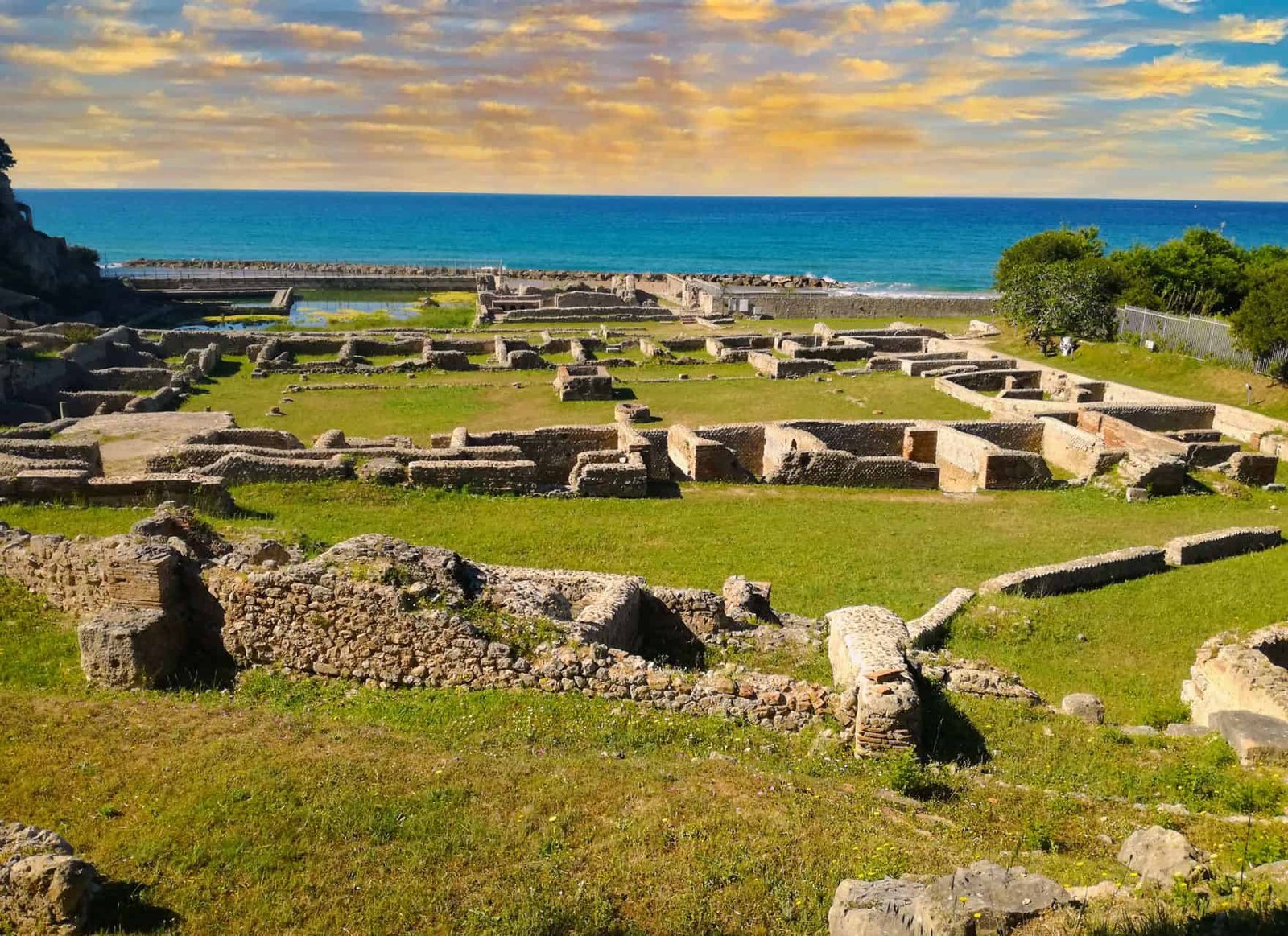
The archaeological area of the Villa of Tiberius - National Archaeological Museum and Archaeological Area of Sperlonga
Coming out of the museum you go down to the south along a slope covered in Mediterranean scrub: mastic, myrtle, spurge, a few pines. The path is short but not trivial, with uneven steps and a rough surface. In about 10 minutes you reach the remains of the residence, which spread over terraces sloping down to the sea for about 300 meters of frontage.
The terraces and rooms of the Villa of Tiberius
What you recognize on the ground is the structure of a first-rate seaside villa: the formal rooms looking onto the water, a large portico, the baths, the pool, and farther back the service structures, the barracks for the guard detachment, the stables. The first building phase dates to a moment between the beginning and the second quarter of the first century BC. The great renovation is of the Augustan period, and it is the one that extends the front on the sea and gives the complex the appearance it had when Tiberius lived there. The stamps on the bricks attest to interventions up to the Tetrarchic period.
One point worth keeping in mind as you walk: the whole complex was designed to be looked at from the sea. Anyone arriving by boat saw first the colonnaded front, then the pools, then the black mouth of the grotto. The villa was an image even before it was a house.
The fishponds
The pools you see in front of the grotto were part of a fishpond system, with the inner circular basin, the outer rectangular one and the central islet. In a Roman maritime villa the fishpond was a serious investment: prized fish raised on the estate, moray eels and sea breams, with channels for water exchange and gates. The landing structures, be they piers or quays, remain largely unknown, and underwater research on this stretch of coast has not yet given a definitive answer.
What you can't see and why
Part of the nymphaeum is the subject of an eco-compatible restoration project promoted by the Lazio Regional Directorate of National Museums and open to patronage through the public instrument of Art Bonus, with a fundraising target of 56,500 euros. It calls for laser cleaning, treatments of biological origin and reversible membrane coverings to protect the structures from salt attack without altering how the monument reads. If during your visit you find a section fenced off, the reason is almost always this.
The landscape of myth around the Villa of Tiberius - National Archaeological Museum and Archaeological Area of Sperlonga
The sculptural program of the grotto is not a literary whim dropped in from above. It makes sense because the stretch of coast where it stands was, for an educated Roman, Homeric geography under the open sky. The promontory that closes the horizon to the northwest was identified with the island of Aeaea, the home of the sorceress Circe. The Laestrygonians, the people of man-eating giants who destroy almost all of Ulysses' fleet, were located by ancient tradition around Formia. Those who feasted in the grotto of Spelunca were not looking at a panorama: they were looking at a map of myth.
Circeo and the sorceress Circe in front of Sperlonga
The Circeo National Park closes the gulf to the north. The shape of the promontory, isolated on the Pontine plain, explains by itself why the ancients believed it an island. According to the Odyssey, Ulysses stayed with Circe for over a year before recovering his clarity, freeing his companions and resuming the journey. And according to a genealogical line that mattered a lot to the Romans, from that union was born Telegonus, mythical founder of Tusculum, that is, the city from which the gens Claudia traced its origins. Tiberius was a Claudius by birth and a Julius by adoption: in the grotto he could celebrate his blood ancestor without contradicting the official ideology of the ruling house.
The islands on the horizon
From in front of the grotto, on a clear day, you can see Ponza, Palmarola, Zannone and farther south Ventotene. It's not a postcard detail: Tiberius's guests ate surrounded by real islands inside a sea that the sculptural apparatus declared mythical. The overlap between the two was the point of the entire operation.
Aeneas, Ulysses and southern Lazio
In the Aeneid, written when Tiberius was a boy, the route of Aeneas from Troy to Lazio crosses these places several times. The two great narratives of the ancient world, the return of the Greek and the founding by the Trojan, intertwine right on this coast. The villa of Spelunca is the point where that intertwining was set in marble. To truly grasp it, it's worth widening your gaze to the Riviera of Ulysses, which includes Gaeta, Formia, Itri and Minturno: a system of places that the Romans read as a single page.
A curiosity about the Villa of Tiberius - National Archaeological Museum and Archaeological Area of Sperlonga
The curiosity I like best concerns a piece of hydraulic engineering disguised as a whim. The Scylla group was not displayed on a pedestal, as you see it today in the museum: it was planted in the middle of the circular pool inside the cave, with seawater entering through openings in the rock and lapping at the base. Put differently, the monster did not represent the assault on the ship: it performed it, every day, in front of those who were eating. The water level was calculated so that the heads of the dogs would surface and the bodies of the devoured companions would stay partly submerged.
There's more, and it concerns the light. The cave is oriented so that in the afternoon hours the sun comes in at a slant through the mouth and strikes the back. The walls were covered with tesserae of blue and green glass paste and with shells: that light, reflected by the moving salt water, produced a continuous shimmer on the sculptural groups. Anyone who has seen a pool lit by low sun knows exactly what effect I mean. Transfer it onto marbles three meters tall inside a cave and you will understand why people were invited to that banquet once and talked about it for years.
The third layer of the curiosity is economic. The pools were not just scenery: they were working fish ponds. In the same water in which Scylla devoured the marble sailors swam the moray eels that would end up on the table. The kitchen, the theater and the dynastic ideology were the same installation. A Roman designer saw no contradiction among the three things, and perhaps this is the greatest cultural distance between us and them.
I'll add a fact that usually surprises people: in the villa the archaeologists have also identified the structures of a barracks. In the most refined place on the Tyrrhenian coast an armed detachment slept. The grotto with its glass paste mosaics and the guard shifts coexisted 100 meters apart, and it is the most honest portrait that can be given of Tiberius's principate.
Something nobody tells you about the Villa of Tiberius - National Archaeological Museum and Archaeological Area of Sperlonga
The thing nobody will tell you, and that ruins your day if you find it out on the spot, is that the museum and the archaeological area don't close at the same time. The museum runs until 19:30 with last entry at 19:00. The outdoor route, the one that leads to the villa, the fish ponds and the grotto, closes at 16:00 in the winter season and at 19:00 in the summer one. Arriving at 15:30 in February means seeing the statues and finding the gate of the path already closed. No travel site writes it prominently, and the ticket is the same: the difference is only in the hours.
The second thing you almost never read is that the number of recovered fragments varies noticeably from publication to publication, between 5,000 and 7,000 units. It's not sloppiness: it depends on how the minor chips are counted and which excavation campaigns are included in the count. When you hear a guide give a round, definitive figure, know that he is choosing one among several legitimate accountings.
Third thing, and this one is for those who love material details: on the groups you can still see the struts, that is, the marble supports left by the sculptor to hold the projecting parts during the work. For decades they were the main argument of those who maintained that these were marble translations of bronze originals, because bronze doesn't need struts and marble does. Look at them under the arm of Ulysses's companions in the Polyphemus: once you've seen them, you can't help seeing them.
Fourth and last: the apparatus of Spelunca set a trend. Nymphaea with Homeric groups appear shortly afterward at Baiae under Claudius, in Nero's Domus Aurea, in Domitian's villa at Castel Gandolfo and finally in the Canopus of Hadrian's villa. What you are looking at is not an eccentric one-off: it is the prototype of a genre that the imperial aristocracy imitated for a century and a half.
My advice for visiting the Villa of Tiberius - National Archaeological Museum and Archaeological Area of Sperlonga
Come at opening time, at 8:30, and come on a Wednesday or Thursday. The reason is not the heat, or not only that. At 8:30 the parking lot is free, the ticket office has no line and above all the grotto is still in shade: the raking light of the morning comes in low and lets you read the walls, the traces of the coverings, the attachment of the bases. Toward noon the contrast becomes harsh and the cave reads badly. On weekends in July and August, then, this site receives all the people the sea bounces back, and 300 people on a packed-earth path is not an archaeological experience.
The second piece of advice concerns the order of the visit, and on this I'm categorical: first the rooms, then the path. The museum puts the four groups in your head, their placement and the reconstruction of the grotto. 10 minutes later you walk on that drawing. Whoever does the opposite finds himself in front of an empty cave, gets bored, goes back up and looks at the statues without understanding where they came from. It happens often.
Third: allow an hour and a half, better two. Just under an hour is enough only for the museum. Bring water and closed shoes with a treaded sole, because the slope is uneven and slippery going down. A hat in summer is mandatory: on the path there is little shade and the glare of the sea doubles the light.
Fourth, and it concerns money: if your trip also includes Formia, the combined ticket at €12.00 valid for 365 days, which also includes Minturnae, should be compared with the cost of the single tickets. If instead you are one of those who come back to the Pontine coast three or four times a year, the annual pass at €15.00 is the obvious choice and nobody offers it to you at the ticket office unless you ask for it.
Fifth, and it's not a detail: if you come as a group of more than 15 people, you need the radio guides. It's a rule of the institute, not a suggestion, and it's worth organizing ahead of time rather than finding out in front of the turnstile.
Another well-known fact, yet rarely cited
Everyone knows that the Laocoön was found in Rome in 1506 and that Pliny attributes its execution to three sculptors from Rhodes. Almost no one connects this to the fact that the same three names, with the patronymics, are carved on a rudder bar found in the mud of Sperlonga in 1957. It is a well-known fact in scholarship for almost 70 years, repeated in every university textbook, and yet systematically absent from the tourist account of the place, which prefers to dwell on the anecdote of the collapse and on Sejanus.
The point is that this coincidence changed the history of ancient art. Before 1957 the Laocoön was a sculpture without context: an isolated masterpiece, dated by style, the object of hypotheses that varied by three centuries. After 1957 there is a second worksite signed by the same makers, with a stratigraphy, a probable patron, dating wall coverings and even analyses of the marble. Sperlonga is, literally, the document that makes it possible to discuss the Laocoön with archaeological arguments instead of impressions.
I'll add the part that is cited even less. The debate between those who read the sculptures as copies of the imperial age and those who read them as late Hellenistic originals is not a dispute for specialists: it radically changes the meaning of the entire complex. If they are copies commissioned by Tiberius, the grotto is a political manifesto built by a cultured prince. If they are originals brought here and readapted, the grotto is a collection, that is, an act of cultural appropriation of the kind the Romans had been practicing for two centuries. Two different stories, with the same marble in front of your eyes.
One last well-known element that is little mentioned: the term with which Suetonius designates the residence is praetorium. Not villa, not domus. It is the technical word for the imperial dwelling, and by itself it counts as documentary proof of ownership. The grotto of Tiberius is called that not from popular tradition, but because an ancient source says so.

The right photo to take at the Villa of Tiberius - National Archaeological Museum and Archaeological Area of Sperlonga
The photograph that sums up this place is not the Scylla in the room and it's not the white village seen from the beach. It's the shot from inside the grotto looking out, taken from behind the circular pool, with the mouth of the cave as a dark frame and inside that frame the rectangular basin, the islet of the triclinium and the open sea. Expose for the outside light and let the rock stay in silhouette: what you get is exactly the point of view of someone reclining to eat 2,000 years ago. No other shot tells the idea that was behind this place.
The right time is first thing in the morning or the last one allowed by the hours of the archaeological area. At noon the contrast between the dark interior and the dazzling exterior is unmanageable for any sensor. If you have a recent phone, turn off the automatic setting that brightens shadows: here the shadow is needed, it's half the composition.
The second photo worth taking is the ship carved into the rock with the mosaic plaque. It has to be taken up close and in raking light, otherwise the relief disappears. It's the image none of your acquaintances will have, because 99 percent of visitors walk past it without seeing it.
Inside the museum, the shot to look for is the head of Ulysses in three-quarter view from below. Not frontal: from below. It's the angle the sculpture was designed for, because in the grotto the group stood above the water level and whoever looked was lower down. The difference between the two perspectives is striking and shows right away on the screen. Always check the conditions for photography indicated at the entrance: in state institutes photography without flash and without a tripod for personal use is normally allowed, but the rules are set by the institute.
One piece of advice: don't photograph everything. This is a site to look at, and the grotto has an effect that images don't hold. Take three good shots and put the phone away.
Some important events that happened here in history
The most famous event is from AD 26. Tiberius was banqueting in the grotto when a mass of rock broke off the vault, killing some of those present and grazing the emperor. Protecting him with his own body, according to the accounts of the sources, was Lucius Aelius Sejanus, prefect of the praetorian guard, who from that moment obtained an enormous ascendancy over the prince. Suetonius and Tacitus speak of it, and the date is one of the few sure chronological anchors for the history of the complex: after that year the villa no longer appears to have been frequented by the emperor.
The political consequences of that collapse were incalculable. Tiberius left the coast and withdrew to Capri, from which he never returned to Rome. Sejanus governed in effect for five years, until his ruinous fall in 31, when he was accused of conspiracy and executed. A piece of ceiling that fell in a cave in southern Lazio shifted the axis of imperial power for a five-year period. Few archaeological episodes have such documentable political weight.
The second event is of the opposite sign and spans centuries. Between late antiquity and the early Middle Ages the sculptural groups were knocked down and reduced to countless pieces. The current reading attributes the destruction to monastic communities of the area, in an era placed around the sixth century, which is also that of the abandonment of the complex. The remarkable thing is that the fragments were neither scattered nor burned to make lime, as happened to half of Rome: they stayed right there, in the water and mud of the grotto. That is the reason the sculptures still exist today.
The third event dates to 1957. The opening of the construction site for the coastal road between Terracina and Gaeta cut through the deposit and gave back the first block. The excavations directed by Giulio Iacopi brought the whole complex to light and were published in 1963, the same year in which the museum opened its doors. The fact that six years passed between the discovery and the opening to the public remains a rare case in Italian administrative history.
The fourth event is still ongoing and concerns the restoration. The nymphaeum is the subject of an eco-compatible conservation project promoted by the competent regional directorate and fundable through cultural patronage: laser cleaning, products of biological origin, reversible coverings. The structures facing the sea suffer continuous salt attack, and without periodic work what the sixth century left standing would not make it to the next century.
Who passed through the Villa of Tiberius - National Archaeological Museum and Archaeological Area of Sperlonga
The name that weighs most of all is that of the owner. Tiberius Claudius Nero, emperor from AD 14 to 37, stepson of Augustus and adopted by him in AD 4, was here several times and here nearly died in 26. He was a man of deep Greek culture, a reader of Homer, formed during the years of retreat on Rhodes between 6 BC and AD 2: if anyone could conceive such a literary sculptural apparatus, it was he. With the emperor his court passed through here, and in 26 also Sejanus, who in this grotto earned the five years of power that would lead to his ruin.
Before Tiberius, the property probably passes through the family of Livia Drusilla, his mother. Marcus Aufidius Lurco, maternal great-grandfather of Livia, was from Fondi and owned land along this coastal strip: the inheritance hypothesis is the most economical way to explain how a late Republican villa ends up in the hands of the princeps.
On the artistic side, the three names that matter are those carved on the rudder of the Scylla group: Athanodoros son of Agesandros, Agesandros son of Paionios and Polydoros, Rhodian sculptors. That they were here in person or that only their work arrived here is precisely the point under discussion among scholars. Their name, in any case, is carved on this marble and on the Laocoon group according to Pliny the Elder, who is the ancient source that names them.
Among the ancients who wrote about this place without necessarily seeing it are Suetonius and Tacitus, who recount the collapse of 26. Among the moderns, the site was passed through by the greatest classical archaeologists of Europe in the second half of the 20th century. Giulio Iacopi, who excavated and published it. Bernhard Andreae, who made it the cornerstone of his own reconstruction of the Laocoon. Salvatore Settis, who overturned its chronology. Nicoletta Cassieri, who for years has overseen its archaeological interpretation. Hans Peter L'Orange, to whom we owe the phrase Marble Odyssey that still defines the complex today. Few towns of 2,000 residents have a bibliography of this level.
It should also be said who never passed through here, because the confusion is frequent: Ulysses. The king of Ithaca is a character of myth, not a historical visitor, and the fact that the Romans identified Circeo with the island of Circe does not make Sperlonga a stop on the Odyssey. The grotto tells of Ulysses. It did not host him.

When to go and how long the visit takes
The best season is what Romans would call the in-between one: April, May, the second half of September, October. The light is low, the path is walkable without suffering, the sea still has color and parking exists. July and August work only at 08:30 in the morning. From 11:00 on, the site becomes tiring and crowded. In winter the visit is beautiful and almost solitary, with the heavy warning of the reduced hours of the archaeological area, which closes at 16:00.
The realistic duration is an hour and a half for an orderly visit, two hours if you really stop in front of the groups and read the panels. One hour is barely enough for the museum. Anyone who arrives an hour before the archaeological area closes would do better to come back the next day.
The worst time to come to Sperlonga
Sunday afternoon in August. I say it bluntly: parking lot full, Flacca clogged, sun beating down on the path, rooms crowded. This site is not equipped for big numbers and has no reason to be. If you only have that day, go in at opening and leave before 11.
How much the Villa of Tiberius - National Archaeological Museum and Archaeological Area of Sperlonga costs and how to save
The full ticket listed is €5.00 and includes the museum and the archaeological area. The reduced ticket is €2.00 for citizens of the European Union between 18 and 25 years old. Under 18, admission is free, as in all Italian state institutes, and free admission also applies to the other categories provided by the ministerial rules on state institutes and places of culture.
The combined tickets and the annual pass for Sperlonga
The combined ticket for Sperlonga, Formia and Minturnae costs €12.00 and is valid for 365 days, with a single entry for each site. The annual pass dedicated to the archaeological park costs €15.00, lasts 12 months from purchase and is bought online on the ministry platform Musei Italiani. 10 other state sites in Lazio are included in the same initiative, with fees between €10.00 and €15.00. For anyone who frequents southern Lazio it is the most sensible option around.
Free admissions and museum cards
On the first Sunday of the month admission to state institutes is free, and this site is part of the initiative. On free Sundays attendance doubles and the parking spot has to be won early. A clarification I make often because the misunderstanding is widespread: the MIC Card is not useful here. That card costs €5.00, lasts 12 months, is reserved for residents of Rome and the Metropolitan City and for students of Roman universities, and gives access to the Rome Capital Museums System, that is, the civic museums of the capital. Sperlonga is a state museum in the province of Latina: the MIC Card has no value at its entrance. Likewise, the cards designed for the Roman civic museums are not valid here. The discounts that apply are the ministerial ones.
The Villa of Tiberius - National Archaeological Museum and Archaeological Area of Sperlonga with children
It works, and it works better than almost all the archaeological museums I know, for a simple reason: the stories are good. The one-eyed giant blinded by a stake, the monster with dog heads that eats sailors, the theft of the magic statue that protected the city. These are tales that hold a seven-year-old for a good 20 minutes, and the sculptures illustrate them with a narrative violence that needs no mediation.
The practical advice is to tell the four stories before going in, two minutes each, and then let the children be the ones to recognize the characters in the rooms. The path to the grotto is a small hike and is fine from five or six years old up, with closed shoes. With a stroller it's impracticable. Bring water: there is nothing along the route.
Accessibility of the Villa of Tiberius - National Archaeological Museum and Archaeological Area of Sperlonga
The museum, being a building of the 1960s with a horizontal layout, is the easiest part of the complex. The archaeological area is another matter: you reach it by a natural slope with an uneven surface, steps and gradients, and it can't be covered independently in a wheelchair. If you have mobility difficulties, or you are accompanying an elderly person, do the math honestly before leaving and ask the staff, at 0771 548028, which stretches are passable on the day of your visit: conditions also change depending on the restoration works in progress. The free admissions for people with disabilities and for the companion are those provided by the ministerial rules.
The beaches around the Villa of Tiberius - National Archaeological Museum and Archaeological Area of Sperlonga
The archaeological complex is set in one of the most beautiful stretches of coast on the central Tyrrhenian, and whoever comes all this way is unlikely to give up the sea. It's worth knowing what is around, because the coves of Sperlonga are not interchangeable and each has its own character.
The Bambole beach at Sperlonga
It is the cove just south of the promontory, tucked between the rocks, with very clear water and little space. The name comes from local tradition. The access is short but steep. If you're looking for half an hour of sea after the museum visit, you'll find it very convenient. If you're looking for space, no. The reference page is the one on the Bambole beach.
Bazzano beach, also called the rock of the hawks
Its second name comes from the birds of prey that nest on the rock wall behind it. It is a beach of pebbles and coarse sand, with a seabed that drops off right away, and for this reason it is loved by those who really swim. With a rough sea from the southwest wind it becomes uncomfortable. You'll find it on the page of Bazzano beach.
Canzatora beach at Sperlonga
Wider and quieter, it lends itself to long days and to families. It's the right choice if you have children and want to be comfortable after walking in the archaeological area. The reference is Canzatora beach.
The Trecento Gradini beach
The name says it all: you reach it by going down a very long staircase cut into the coast, and of course you have to climb back up. The reward is a beach that, for the sole reason of that stairway, stays relatively empty even in August. Don't bring an eight-kilogram cooler. The page is the one on the Trecento Gradini beach.
The Fontana beach and the shoreline toward Lago Lungo
North of the village the shoreline stretches out and becomes continuous sand: here is the Fontana beach, and continuing you reach the tongue of land covered with dunes, vineyards and Mediterranean scrub that separates the coastal lake of Lago Lungo from the sea. It's a different environment from the rocky one of the promontory, more open and breezy, and for walkers it is a walk with a lot of breathing room. To the northwest the shoreline continues to the Terracina beach and the Pontine plain.

What to see around the Villa of Tiberius - National Archaeological Museum and Archaeological Area of Sperlonga
Within a few minutes by car or a short walk there is material for two whole days. The village of Sperlonga is a maze of white lanes, stairways and arches on the promontory, with Torre Truglia at the tip, and it should be seen in the hour before sunset, when the whitewash takes on a light you don't find anywhere else on the Tyrrhenian.
To the southeast, along the Flacca, you reach Gaeta, with the Montagna Spaccata, the shrine of the Santissima Trinità and the Monte Orlando park with the mausoleum of Lucius Munatius Plancus. A little farther is Formia, with its national archaeological museum tied by the combined ticket to the one at Sperlonga, and then the Gianola and Monte di Scauri park, where another Roman seaside villa looks out over the sea. Still farther south, the archaeological area of Minturno.
Inland, half an hour of curves away, is Itri with its castle and the gorge where the ancient Appian Way passed. To the north, the Circeo National Park and, going up toward the Lepini Mountains, the Museums of Priverno and Fossanova Abbey. Anyone who wants to understand the coast from another point of view should take the ferry to Ponza: from there Monte Circeo goes back to looking like what the Romans believed it to be, an island. More ideas for building the itinerary are on the tourist attractions page.
Quick questions about the Villa of Tiberius - National Archaeological Museum and Archaeological Area of Sperlonga
How much is the ticket for the Villa of Tiberius - National Archaeological Museum and Archaeological Area of Sperlonga?
The full ticket listed is €5.00 and includes both the museum and the archaeological area. The reduced ticket is €2.00 for citizens of the European Union between 18 and 25 years old. Under 18 you get in free. It's best to double-check the rates on the official website of the Regional Directorate of National Museums of Lazio before your visit.
What are the opening hours?
Tuesday through Sunday. The museum from 8:30 to 19:30 with last entry at 19:00. The archaeological area from 8:30 to 16:00 in the winter season and from 8:30 to 19:00 in the summer one. Closed on Mondays, on January 1 and on December 25.
Do the museum and the archaeological area close at the same time?
No, and it is the most important thing to know before leaving. The archaeological area with the villa, the fish ponds and the grotto closes before the museum, by several hours in the winter season. Whoever arrives in the late afternoon in winter sees only the rooms.
Do I need to book a visit to the Villa of Tiberius?
Not for an individual visit. Groups of more than 15 people besides the guide are admitted only with the radio guide system, so they have to be organized in advance.
How long does the visit to the Villa of Tiberius - National Archaeological Museum and Archaeological Area of Sperlonga take?
An hour and a half for a complete, orderly visit, two hours if you really stop in front of the sculptural groups. The museum alone can be seen in a little under an hour.
Where exactly is it and how do you get there?
Via Flacca at kilometer 16.300, 04029 Sperlonga in the province of Latina, with the entrance on Via Valle Corsara. By train you get off at Fondi Sperlonga on the Rome Naples line and continue by the scheduled bus to the town. From there to the museum you walk a kilometer and a half or take a taxi.
Is there parking?
Yes, but it's small and in July and August it fills up early. Whoever arrives after 10 in the morning in high season risks having to look for a spot along the state road, which I advise against.
Is admission free on the first Sunday of the month at Sperlonga?
Yes, the site is part of the ministerial initiative that makes admission to state institutes free on the first Sunday of the month. On those days arrive at opening, because attendance is much higher than average.
Is the MIC Card valid at the Villa of Tiberius - National Archaeological Museum and Archaeological Area of Sperlonga?
No. The MIC Card gives access to the Rome Capital Museums System, that is, the civic museums of the capital, and is reserved for residents of Rome and the Metropolitan City and for students of Roman universities. Sperlonga is a state institute in the province of Latina and is not part of that circuit.
Is there a pass for the Villa of Tiberius?
Yes. Since spring 2026 the archaeological park has an annual pass at €15.00, valid for 12 months from purchase, which you buy online on the ministry platform Musei Italiani. There is also the combined ticket for Sperlonga, Formia and Minturnae at €12.00 valid for 365 days.
Can you take photographs?
In state institutes photography for personal use, without flash and without a tripod, is normally allowed. The specific rules are posted at the entrance and must be respected. For professional or commercial use you need authorization.
Is it wheelchair accessible?
The museum is the easiest part. The archaeological area is reached by a natural slope with an uneven surface and steps, and can't be covered independently. It's best to call 0771 548028 and check the conditions of the day.
Is the Villa of Tiberius suitable for children?
Very. The four sculptural groups tell stories that children follow without effort: the blinded Cyclops, the monster that attacks the ship, the theft of the sacred statue. The path to the grotto is fine from five or six years old up, with closed shoes. You can't go down with a stroller.
What is the difference between the Villa of Tiberius and the Grotto of Tiberius?
They are two parts of the same complex. The villa is the imperial residence laid out on terraces toward the sea. The grotto is the cave transformed into a nymphaeum and dining room, which stands at the southern end of the villa and which housed the sculptural groups. They are visited with the same ticket and in the same walk.
Are the original statues of Sperlonga here or in Rome?
They are here. The sculptural groups found in the grotto are displayed in the Sperlonga museum, a few dozen meters from the spot where they were found. In Rome, in the Vatican Museums, is the Laocoön group, which according to Pliny the Elder is the work of the same three Rhodian sculptors who signed the Scylla of Sperlonga.
How old is the Villa of Tiberius?
The first building phase dates to a moment between the beginning and the second quarter of the first century BC. The great renovation, the one that gives the complex its familiar appearance, is of the Augustan period. The stamps on the bricks document interventions up to the Tetrarchic period, and the site is abandoned in the sixth century.
Who discovered the Villa of Tiberius?
The find took place in 1957 during the works on the coastal road between Terracina and Gaeta. The excavations were directed by Giulio Iacopi, who published the account in 1963, the same year the museum opened.
Why are the Sperlonga sculptures in fragments?
Because they were toppled and reduced to pieces at a time placed around the sixth century. The most widespread reading attributes the destruction to monastic communities settled in the area. The fragments, however, stayed on the spot, in the water and mud of the cave, and that is the reason they can be reassembled today.
What do you actually see in the grotto of the Villa of Tiberius?
The natural cavity transformed into a nymphaeum, the inner circular pool where the Scylla stood, the outer rectangular basin with the islet of the triclinium, the traces of the coverings and the ship carved into the rock with the mosaic plaque. The sculptures, which stood here, are in the museum.
Is there a bar or a refreshment point?
The complex is not equipped for a long stay and there is nothing along the path. Bring water from home. For eating, it's best to go back up to town, where the trattorias of the village work all year.
When is it best to come to find few people?
April, May, the second half of September and October, on a Wednesday or Thursday, at the 8:30 opening. In winter the site is almost solitary, with the caveat of the reduced hours of the archaeological area.
Is it worth it with a rough sea or a cloudy day?
Yes, and for the grotto perhaps even more: with an overcast sky the contrast between the inside and the outside softens and you read the walls better. With a very rough sea, on the other hand, some stretches at water level may be closed for safety.
Can you swim in the archaeological area?
No. The grotto and the pools are a protected archaeological monument and swimming is not permitted. The coves for swimming are all a short distance away, toward the village.
What is the difference between Sperlonga and the archaeological museum of Formia?
At Sperlonga you see the sculptural apparatus of an imperial residence in its original context. At Formia you see the urban and productive fabric of a coastal Roman city, with epigraphic and funerary materials. They are complementary, and the combined ticket at €12.00 valid for 365 days exists precisely for this reason.
Are there guided tours?
The institute organizes guided tours and initiatives on the occasion of extraordinary openings and national days. The calendar is on the official website of the competent regional directorate and you can ask by calling 0771 548028.
A verdict on Sperlonga, to finish
Sperlonga, in our view, is the worst-described place in Lazio. It is sold as a half-hour stop between one beach and another, and instead it contains one of the four or five most important open questions of European classical archaeology, displayed in a museum that 60 years later still works well. If you have only one day in southern Lazio, don't give it to the white village and the photographs of the lanes. Give it to the grotto, with the museum first and the sea after.
And do something that almost no one does: sit for five minutes on the edge of the rectangular basin, in silence, looking toward Monte Circeo. There is nothing to see that you haven't already seen. But it is the exact spot where a man who ruled the world ate looking at the sea he believed was populated by monsters, and every so often understanding something requires only staying still in the right place.
Article written by the editorial team of TourLeaderPro, contact them for Private/Corporate/V.I.P. Tours and Experiences.
Planning a trip to Rome? The English guides to visiting the city are on ItalyPlanner.com.