Fontana Beach, Sperlonga Spring
In short. Fontana Beach, Sperlonga Spring is on the western shore, right up against the town center, and it is the stretch of sand most people reach first when they arrive in town.
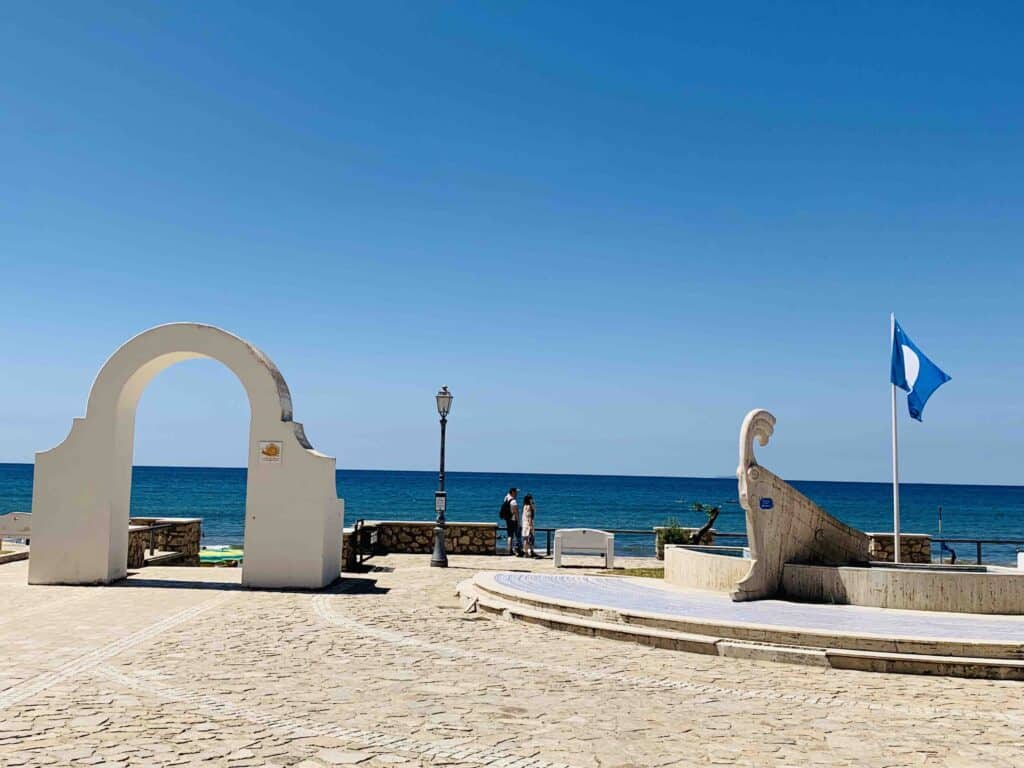
Fontana Beach, Sperlonga Spring is on the western shore, right up against the town center, and it is the stretch of sand most people reach first when they arrive in town. The name comes from the square that opens right behind it, Piazza Fontana, and from the freshwater spring that surfaces a few meters from the waterline and fills a masonry basin open to everyone. The town is Sperlonga, a little over 3,000 inhabitants in the province of Latina, one of the villages recognized among the most beautiful in Italy, perched on a limestone spur that is the last offshoot of the Aurunci Mountains toward the Tyrrhenian Sea. From Rome you get there in a couple of hours by car. The beach that opens below the square is comfortable, wide enough, closed in behind by white houses and stairs, and it has a flaw and a merit that coincide: being the easiest to reach, in August it is also the fullest. This page tells what you really find here, how the spring works, when it's best to come and how to fit the Fontana together with the rest of the coast of the Riviera di Ulisse.

Where Fontana Beach, Sperlonga Spring Is and How You Really Get There
The Sperlonga headland divides the coast into two halves that behave differently. To the southeast runs the eastern shore, the one facing Gaeta, with the more secluded bays and the water that regulars consider the clearest. To the northwest runs the western shore, a more continuous arc of sand pointing toward Terracina and the Fondi plain. The Fontana opens at the start of this second arc, at the exact point where the town comes down to the sea. It is a position that explains almost everything: those staying in the center get there in a few minutes on foot, day-trippers run into it before any other, and the result is a crowding that grows hour by hour in the central months of summer.
By Car: Via Flacca and the Last Kilometer
From Rome the most used route remains the A1 motorway to the Frosinone exit, then the expressway toward Latina and the descent to Terracina, or else Via Pontina to Terracina and from there State Road 213 Via Flacca toward Gaeta. The second option has fewer tolls and more local traffic. The first is longer in kilometers but often quicker on weekends. Those coming from Naples and the south exit at Cassino or continue to Formia and go back up the Flacca in the opposite direction. In every case the last stretch is driven on the Flacca, which runs midway up the slope above the town: the junctions for Sperlonga are signposted and lead down toward the seafront.
The real bottleneck is the last kilometer. The historic center is pedestrian and the lower part of town has narrow streets. The parking areas are spread along the seafront and on the edges of the town, are largely paid in the summer season and fill up early. Rates and hours change from year to year and should be read on the signs on site: they are not data to take for granted by reading a web page months ahead. The practical rule that has worked for years is just one: arrive early, before nine in the central months, or arrive late, after 16:00, and stay for the sunset. In the middle of the day, between 10 and noon, the Saturdays and Sundays of July and August turn the descent toward town into a standstill queue.
By Train and Bus
Sperlonga has no railway station. The reference stop is Fondi Sperlonga, on the Rome Naples line via Formia, served by regional trains and some intercity ones. From the station to town the link is the scheduled road service of Autoservizi Piazzoli, which covers the trip in about 20 minutes. The runs are more frequent in the summer season and thin out in winter, and the times should be confirmed at the stop or the ticket window the same day. From the point where the bus drops off passengers, in the lower part of town, the Fontana is reached on foot in a few minutes, and that is exactly why those traveling without a car almost always end up on this beach and not on the farther ones.
There is also a road link from the provincial capital and the neighboring towns, with frequencies designed for residents more than for people arriving with a beach towel. Anyone planning a beach day from Rome without a car has to allow for two changes and waiting times: doable, but it has to be organized with the timetables in hand.
On Foot from the Village
The most elegant way to reach the Fontana remains the descent from the historic center. From the little squares at the top, stairs and alleys go down toward the sea among white houses, arches and terraces. The difference in elevation is covered in about 10 minutes going down and a good quarter of an hour going back up, with a few breaks if the day is hot. Anyone with a stroller or difficulty walking will do well to choose the drivable road that goes around the spur instead of the stairways: the western seafront has a flat path that leads up to the square.
Those who arrive on foot from inside the town also have the advantage of the right order of things: first the upper village with its views, then the descent, then the sand. Done the other way around, with the climb back up at the end of the day under the five o'clock sun, the route is less pleasant.
What Fontana Beach, Sperlonga Spring Really Is: a Square, a Basin and a Stretch of Shore
It's worth clearing up right away a misunderstanding that circulates on maps and in conversation. The Fontana is not a beach with its own administrative boundaries, as certain bays closed between two rock walls are. It is a name in common use, born from the square and the spring, that indicates the stretch of sand immediately below and adjacent to Piazza Fontana, at the start of the western shore. Bathers call it Fontana beach or Sorgente beach interchangeably, and in both cases they mean the same place: the sand that begins below the town and continues northwest, where the later stretches then take different names.
This threshold nature is the distinctive trait of the place. Behind is the life of the town: the square with its tables, the constant passing of people, the lights that come on at sunset, the shops. In front is the open sea of the gulf. In between, a few meters wide, the border between the two. None of the other beaches in Sperlonga has such a direct relationship with the built-up area: the Bazzano Beach requires a walk or a stretch by car on the Flacca, the Canzatora Beach stretches farther north along the western shore, the Bambole Beach has to be sought out with a minimum of attention. Here you step out of a bar and have your feet on the sand.
A particular crowd follows from this. The Fontana gathers three categories that don't mix on other beaches: families staying in the center who come down twice a day, day-trippers who don't want to waste time looking around, and the town's residents who use the spring basin as a fixed afternoon stop, often without even swimming. The result is a beach that is noisy in the good sense of the word, lively, poorly suited to those seeking isolation and perfect for those who want everything within reach.
A Lido, Not a Cove
Anyone who arrives imagining a hidden cove among the rocks is thrown off. The shore here is open, straight, with sand that extends without interruption for a long stretch to the northwest. The rocks are there, but they are behind and higher up, in the headland that carries the village, not in the water in front of the shore. Those who want rocks, caves and sheer walls have to go around to the opposite side of the headland, toward the east, where the landscape changes character completely and where you find the cave and the remains of the imperial villa.
This openness has a practical effect on comfort: the Fontana gets wind and gets sun for almost the whole day, and has no walls that cast shade in the afternoon. In July and August that means an umbrella or a sunshade is not a luxury but a necessity, and that the dry sand reaches temperatures hard to take barefoot around two in the afternoon.
The Spring, the Fresh Water and the Basin of Piazza Fontana
The heart of the place is the spring. It is a flow of fresh water that surfaces very close to the shoreline and is collected in an open, accessible masonry basin, maintained by the local administration and lit in the evening. Around the basin are small statues and decorative elements that over the years have made the corner one of the most photographed spots on the seafront. The water that fills it is cold even on the hottest days, and this, more than any other feature, explains the line of people who wait their turn at the end of the afternoon to stick in their hands, their feet or their head.
On the geological side, the explanation is straightforward and fascinating. The Aurunci Mountains are a limestone massif, and limestone behaves like a sponge: rainwater seeps into the fractures, goes down, travels through the rock for kilometers and resurfaces where it meets an impermeable layer or where the water table comes into contact with sea level. The limestone coasts of the southern Tyrrhenian are dotted with coastal springs of this kind, some submerged and visible only as patches of colder water offshore, others emerged like this one. The Sperlonga spring belongs to the second category, and it is the only one on the town's seafront that has been fitted out and made usable.
A clarification in the interest of honesty, because people ask it constantly. The basin is for rinsing off, cooling down and getting the salt off your skin after a swim, and that is the use everyone makes of it. There is no official indication on record declaring the water drinkable, and no coastal spring fountain should be drunk from on the strength of word of mouth: if you're thirsty, buy a bottle at the cafés on the square, which are 20 steps away. This takes nothing away from the pleasure of the gesture, which remains one of the sharpest memories children take away from Sperlonga.
Why a Spring Right Here
The presence of fresh water at sea level is not a picturesque detail: it is the historical reason this point of the coast has been frequented for millennia. A landing place with drinking water available was worth, for ancient navigation, infinitely more than one without. Coastal springs were supply points for boats and rest stops along the coasting routes that went up the Tyrrhenian. The choice to build an imperial residence on this very stretch of coast, with the great cave turned into a summer dining room, is explained also by the availability of water and by the protection offered by the headland.
Whoever looks at the basin today sees an element of street furniture. Whoever looks at it with a few more facts in mind sees the reason the town was born where it was born and not 300 meters farther on.
A Curiosity About Fontana Beach, Sperlonga Spring
The curiosity concerns the double name, and the fact that in Sperlonga they don't consider it a double name. In conversations among residents the beach is simply called the Fontana, and the spring is called the spring. On online maps and in tourist directions both forms appear, sometimes joined in a single wording, sometimes separate as if they indicated two different places. The result is that you regularly meet people convinced they have to look for two distinct places, a beach and a fountain, who wander along the seafront with phone in hand wondering where the second one went. They are two meters from each other.
There is a second curious aspect, more subtle. Piazza Fontana is one of the very few Italian public spaces where a natural fresh-water element works as a social center in the literal sense. Not a monumental fountain fed by an aqueduct, of which there are thousands, but a flow of water that comes out of the ground exactly there and around which the life of the seafront has been organized. The square is the aperitivo meeting place, the point where people arrange to meet, the spot from which you watch the sunset. In winter, when the beach is empty, the basin keeps working and gushing, and seeing it flow on a January day with a rough sea in front is one of the most beautiful images the town offers out of season.
Third curiosity, for those who love details. The municipality has installed a webcam pointed right at this corner of the seafront, and you consult it from the Sperlonga tourism portal along with the other cameras scattered around town. It is the most practical tool there is for understanding, that same morning, how many people are there and what the sea is doing, and for deciding whether to set out or put it off to the next day. It is worth more than any generic forecast: the Pontine coast has microclimates that change within a few kilometers, and the live image tells the reality better than any bulletin.
The Sand, the Sea and the Seabed in Front of the Fontana
The sand of this stretch is light and fine-grained, with a coarser component near the waterline where the wave action works the sediment. It is not the very white, powdery sand found in some eastern bays, but it is still comfortable to walk on and easy to brush off, and children build on it without difficulty. In the stretches closest to town the shore narrows, because the headland advances. Continuing northwest it widens gradually and after a few hundred meters becomes ample.
The seabed slopes gradually, with a band of shallow water that in calm-sea periods lets you walk for several meters before losing contact with the sand. It is the feature that makes this stretch popular among families with small children and among those who don't swim much. It must be said just as clearly that the gradual slope does not eliminate the risks: with a rough sea, rip currents form along the shore, and the free stretches have no lifeguard service. Anyone taking children into the water keeps an eye on them as they would anywhere, and anyone who sees a red flag displayed at a nearby beach club treats that signal as valid for the free stretch next to it too.
On the color of the water it's worth being precise, because the reputation of the place is at stake here. The sea in front of the Fontana is beautiful, often clear, with that green that turns blue at the second band of depth. But it is not the sea of the eastern coves. The reason is simple and nothing alarming: the western shore receives more sand input and more movement, and on days with a northwest wind the backwash stirs up sediment and clouds the coastal strip for a few hours. Anyone looking for the postcard color, the kind seen in the photographs that make people decide on a vacation, should also plan a morning on the opposite side of the headland.
Wind, Waves and Orientation
The northwest exposure is the key to understanding the daily behavior of this beach. With the afternoon ponentino the shore ripples and the air becomes pleasant even on scorching days. With the libeccio or a steady maestrale the waves grow quickly and swimming becomes tiring, while the scirocco leaves the western shore relatively sheltered and makes the eastern one uncomfortable instead. It is a rule the residents apply without thinking: you look at where the wind comes from and choose the side of the headland accordingly. Anyone who spends three days in Sperlonga and learns it takes home three good beach days instead of one.
Another consequence of the orientation concerns the light. Looking northwest, the Fontana keeps the sun until the last moment of the day and gets the full sunset over the sea in the central months of summer, when the sun goes down well to the north. In spring and autumn the sun sets behind the outline of the coast toward Terracina and the phenomenon changes character, becoming softer and more colorful but less spectacular as a direct descent into the water.
What Changes After the Storm Surges
The winter storm surges reshape the shore every year. After a season of strong libeccio winds the beach finds itself narrower in some places and wider in others, with piles of beached posidonia that the municipality removes before the bathing season opens. Anyone who happens by in April or early May may find the shore still in its winter setup, with heaps of seaweed and driftwood. It is not dirt: beached posidonia protects the shore from erosion and its presence indicates healthy submerged meadows. Anyone looking for the groomed beach has to wait for the start of the season proper.
Something Nobody Tells You About Fontana Beach, Sperlonga Spring
What no guide writes is that the Fontana has two completely different lives in the same day, and the second is worth more than the first. From 10:00 to 16:00 it is a crowded urban beach, with lines at the entrances, towels side by side, constant noise, and a handling of space that resembles Ostia in August more than a village of 3,000 inhabitants. From 17:00 on it empties within an hour, the light changes, the square above starts to fill with people coming down for the aperitivo, and the stretch of sand in front of the basin becomes one of the most pleasant places on the whole Pontine coast. Anyone who has seen only the first half of the day thinks they know this beach and doesn't know it.
The second thing nobody tells you concerns the steps and the change in elevation. Many pages describe the Fontana as the comfortable beach, the one without effort, in contrast to the eastern coves that require long descents. That is only partly true: the access from the seafront is flat, but anyone staying in the upper village, which in Sperlonga is the most common situation because that is where most of the accommodations with a view are, still has to face a not-trivial climb back with bags, umbrella and tired children. The convenience of the Fontana is real for those arriving from the seafront and relative for those coming down from town.
Third point, and it concerns the water of the basin. In the central hours of August the spring becomes a place of constant passage, with lines, children playing, people washing beach gear in it. Anyone imagining a contemplative corner with flowing water and silence around has to come before nine in the morning or after sunset, when the basin stays lit and the square has moved to the tables. At those two moments the place keeps exactly the promise the photographs make, and during the rest of the day it doesn't.
My Advice for Visiting Fontana Beach, Sperlonga Spring
The advice is not to treat it as a day destination but as a logistical base, and to build the rest around it. In practice it works like this: you arrive early, leave the car at the edge of the town, spend the first part of the morning on the upper village and its web of alleys, when the light is still raking and the groups haven't arrived. Around 10 you go down to the Fontana, take the first swim and use the spring basin to rinse off the salt. In the central hours, instead of staying on a full beach, you move on for lunch and the archaeological part, because the Villa of Tiberius area and the museum are better visited when the beach is unbearable. In the late afternoon you go back to the sand for the second swim and the sunset, and you finish with an aperitivo in the square.
This scheme solves three problems at once: it avoids the two worst time bands for traffic, it spreads out the sun exposure, and it puts the cultural visit at the moment when it makes the most sense. Anyone coming for two days can repeat it by switching the side of the headland on the second day, with the morning on the eastern shore and the afternoon here again.
Second piece of advice, on gear. Bring a sunshade or umbrella if you stay on the free stretch, because there is no natural shade. Bring rubber shoes if you have children who wander along the shore, because farther along the coast outcrops and defense works appear. Bring a cooler bag, because between going to and coming back from the bar you lose a good 20 minutes in high season. And bring a bottle of water already filled from home or bought in town, for the reason given above about the spring.
Third piece of advice, more strategic. If your idea of Sperlonga is the photographs with clear water and rock, don't stop at the Fontana. This beach is the most convenient base in town, but the landscape that makes people fall in love is on the other side. Treat the Fontana for what it is, the front door, and not for what it isn't.
The Beach Clubs, the Free Stretches and the Restaurants on the Sand
Along the western shore, beach concessions and free stretches alternate, in a succession that changes from season to season and that no list written months ahead can capture precisely. The names of the clubs change, the boundaries shift by a few tens of meters, some facilities open and others close. The only reliable list remains the one you read by walking along the seafront on arrival, and the general Italian rule holds here too: the shore is public domain, passage along the waterline stays free and the stretches not under concession are accessible to everyone without paying anything.
The equipped facilities you meet before the Fontana, arriving from the northwest, offer the classic Pontine coast package: umbrellas, loungers, showers, changing rooms, restrooms, a snack point and in many cases lifeguard assistance. For those arriving with small children who need an accessible restroom, a hot shower and a lounger to lean on, the beach club option sorts out the day more simply than the free stretch. Prices vary by period, by row and by facility, and should be asked directly: any figure read online risks being a season old.
The gastronomic feature that has made this stretch recognizable is the presence of restaurants with tables set right out on the sand, with colorful tablecloths and chairs that appear in almost all the photographs of the Sperlonga seafront. You eat fish, you eat the seafood dishes of Pontine tradition, and you eat with your feet a few meters from the waterline. At lunch in high season a reservation is almost mandatory. At dinner the seafront becomes one of the most pleasant places on the coast, with the lights reflecting on the water and the square working until late.
Accessibility
The lower part of town and the western seafront have a flat route that makes the approach possible even for those with reduced mobility or pushing a stroller. On the shore, as almost everywhere in Italy, the situation depends on the individual facilities: some concessions have walkways and dedicated equipment, others don't. Anyone with specific needs does well to phone the chosen beach club in advance and ask what is actually available in the current season, because the equipment changes from year to year and generic statements don't help.
Another Well-Known Fact, Yet Rarely Mentioned
The well-known fact is that Sperlonga owes its name to a cave. The Latin form spelunca, meaning cavern, turned into the present place name, and the cavern in question is the one incorporated into the imperial residence on the eastern side, turned into a summer dining room and decorated with the sculptural groups of the Homeric cycle. Up to here many people know it. What is rarely mentioned is the logical consequence: the town bears the name of a landscape element that lies on the other side of the headland from the most frequented beach. Anyone who spends a week at the Fontana without moving never sees the thing the place is named after.
The second little-mentioned fact concerns fresh water and deep geography. The coastal springs on the Tyrrhenian side of the limestone mountains are not isolated curiosities: they are part of a hydrogeological system that carries the rainwater fallen on the inland reliefs down to sea level through karst conduits. Some of these outflows are underwater, and the fishermen of the gulf have always known them as zones where the water temperature changes abruptly. Others surface. The Sperlonga spring is the most visible and the most tamed of them all, and for that very reason it tends to be considered an artifact instead of a natural phenomenon with a catchment basin that extends for kilometers inland.
Third element, well known but underrated: the watershed date of 1958, when Via Flacca was opened. Before that road Sperlonga was a village of fishermen and farmers that was hard to reach, with an economy turned toward the hinterland and the Fondi plain. The coastal road connected it directly to Terracina and Gaeta, and together with the archaeological discovery of the previous year it made it a destination. The Fontana, being the beach of the center, was the first stretch to transform: the tables on the sand, the beach clubs, the houses rented to Romans in August are all phenomena born in that decade. The white town that now seems unchanging has less than 70 years of tourist life.
A fourth element, for those who care about conservation. The fact that the seafront has kept a low building scale and a chromatic coherence is neither accidental nor spontaneous: it is the result of precise urban planning choices that prevented here what happened on other stretches of the Pontine and Campanian coast in the same decades. Looking at the Fontana from the sea, the line of white houses climbing toward the castle is essentially the same as in the photographs of the 1960s. It is a heritage defended with regulations and not with nostalgia.
The Right Photo to Take at Fontana Beach, Sperlonga Spring
The photograph almost everyone tries to take is the frontal one: you go down onto the sand, turn toward the town and frame the white village climbing the spur. It works, but it has a technical flaw that ruins half the shots. Looking toward the headland from the western shore you have the sun in front or at three quarters for much of the day, and the result is a blown-out sky with underexposed houses. The solution is simple: take that shot in the first hour after dawn or in the last hour before sunset, when the light arrives raking and the white of the facades takes on a warm temperature.
The best photograph, though, is another one and almost nobody takes it. It has to be sought at the spring basin at the moment the square lights up, that is, in the half hour between sunset and full dark. The lit water, the small statues, the people passing in the background and the sea turning deep blue make up a scene that tells the place much better than any panorama. Technically it requires a stable support, because handheld in low light you get blur: the edge of the basin itself will do, a low wall will do. Anyone shooting with a phone should use night mode and hold still for the two seconds it takes.
Third framing, for those with time. Climbing into the village, from the viewpoints that open along the way down to the sea, you get the view from above of the western shore with the arc of sand receding to the northwest and the Fondi plain in the background. On clear days, especially after a maestrale front, you can make out the outline of the Circeo headland closing the horizon. It is the image that explains the geography better than a map, and it should be taken in the late afternoon when the sun lights the coast instead of sitting exactly behind it.
A Note on People in the Frame
La Fontana is an urban, busy beach, and in the middle hours filling the frame with umbrellas conveys nothing of the character of the place. Anyone who wants the clean shot has two roads: come out of season, between October and May, when the sand is empty and the white houses remain, or accept the crowd and use it as the subject, photographing the line at the basin, the children rinsing off, the colorful tables. The second choice produces more honest images than the first.
Some important events that happened here in history
The history of this stretch of coast reads in layers, and almost all the layers have left a visible mark a few hundred meters from the spring basin.
The Roman age and the imperial villa
In the first century AD the coast between Terracina and Gaeta was a succession of seaside residences of the Roman aristocracy, and the most famous of all stood right here: the villa that tradition links to the emperor Tiberius, built around a natural grotto used as a reception and banquet space, overlooking a fishpond. The availability of fresh water along this stretch of coast is among the reasons that made the site suitable for a residence of this rank. The ancient sources tell of a collapse of the grotto's vault during a banquet and of the role the episode played in the political events of the time, an account that historians have debated for centuries and that remains one of the most cited among those tied to the Pontine coast.
The Middle Ages, the towers and the Saracens
After the end of the ancient world the settlement moved up, onto the rock spur, for the simplest reason in the world: raids came from the sea. The fortified core formed around the 10th century and the town lived for centuries with its gaze turned to the sea horizon, waiting. The hardest blow came in 1534, when the Ottoman fleet commanded by Khayr al Din, the corsair known in the West as Barbarossa, attacked and sacked the town. A second major assault took place in 1623. From those experiences came the system of coastal watchtowers that still dots the shoreline today, of which the tower that closes the Sperlonga promontory toward the sea is the best known example.
1957 and the discovery of the marbles
In 1957 works along the coast brought to light, inside the grotto, thousands of sculptural fragments belonging to monumental groups with Homeric subjects, including the blinding of Polyphemus and scenes tied to the adventures of Ulysses. The find changed the history of studies on Hellenistic and Roman sculpture and turned Sperlonga into a name known to archaeologists all over the world. The National Archaeological Museum grew up around the fragments, which preserves and displays them together with the open-air archaeological area.
1958 and Via Flacca
The following year the opening of the coastal road completed the transformation. In a few years the town went from isolation to one of the most sought-after summer destinations of southern Lazio, with a development model that favored low-rise building and the recovery of the old village over vertical speculation. The beach below Piazza Fontana was the first to organize itself to receive the new arrivals, and still today keeps that role as a threshold between the town and the sea.
Recent decades
From the 1990s onward the Sperlonga shoreline has received repeated international recognition for the quality of its bathing waters, and the village has entered the circuit of the most beautiful villages of Italy. The arrangement of the spring basin, its evening lighting and the care of the furnishings around it belong to this recent phase, the one in which the town stopped considering its seafront merely a functional space and began to treat it as part of its calling card.
Who has passed through Fontana Beach, Sperlonga Spring
The first name is inevitable and it is that of Tiberius, who on this stretch of coast had the most famous maritime residence of Roman antiquity. That the emperor walked exactly on the stretch of shore where the basin now stands is impossible to establish and nobody should claim it. That he lived for long periods a few hundred meters from here is, instead, documented by the excavations and the sources.
In the 20th century the archaeologists who gave order to the fragments of the grotto passed through here. The work of study and reconstruction of the sculptural groups involved some of the most important figures of the discipline, Italian and German, and produced different interpretive hypotheses, at times in open conflict, discussed in conferences and publications that accompanied half a century of research. Anyone who enters the museum today sees the result of that work and seldom imagines how much it was debated.
From the 1960s the town entered the holiday circuit of the Roman entertainment and cultural world. Actors, directors, writers and journalists chose Sperlonga as a more intimate alternative to the fashionable destinations of the coast, and the western seafront, with the tables on the sand and the aperitivo square, was the place where that presence became visible. The town has always handled this presence with discretion, without building a celebrity industry around it, and that is one of the reasons it has kept its character.
Then there are the everyday passages, the ones that really matter for understanding the place. The Roman families who return to the same apartment for three generations. The fishermen who haul their boats up on the sand a little farther on. The town's children who use the square as a playground in winter. The groups that step off the bus, take a photograph of the basin and leave without having understood anything. And the residents who at seven in the evening lean out over the seafront to see what the sea is like, exactly as their grandparents did when from the sea trouble could arrive instead of tourists.
When to Go to Fontana Beach, Sperlonga Spring and When to Avoid It
The bathing season on the Pontine coast opens in practice in May and closes in late September, but the best weeks for this particular beach are the ones at the edges. From mid-May to mid-June the sea starts to be acceptable, the town works, the places are open and the sand still has room. The long light of June allows full days without the heat of August. From mid-September to mid-October the water stays warm by thermal inertia, the crowd disappears and the Fontana goes back to being what it is for 11 months of the year: the town's beach.
The two central weeks of August are the period to avoid for anyone without a calendar constraint. Not because of the sea, which stays beautiful, but because of the density: occupied sand, roads in a queue, waiting times everywhere, and a beach that loses exactly the quality that makes it pleasant, namely the direct and relaxed relationship with the town behind. Anyone who can't choose other dates should apply the two timing rules given above and consider the day a success if they manage to swim at eight in the morning and watch the sunset from the square.
Off Season
From November to March Sperlonga changes skin and becomes one of the most pleasant winter villages in southern Lazio. A large part of the seasonal businesses close, but the center stays alive because the town is lived in all year round. The Fontana in winter offers a walk along the waterline with the northwest wind, the sea at work, and the spring basin still pouring cold water while there is no one around. For anyone who loves the coast out of season it is an experience superior to the summer one, and it has the practical advantage of making a visit to the archaeological area possible without lines.
The opening hours of the museum and the archaeological area change between the summer and winter seasons, and the open-air area closes before the museum rooms. They should be checked before leaving on the official channels of the museum, because a badly planned visit forces you to choose between the two parts instead of seeing both.
Weather and Sea
Two practical pointers worth more than any seven-day forecast. The first: look at the wind direction and choose the side of the headland accordingly, as explained above. The second: use the webcams of the municipal tourism portal the same morning, which show the western seafront and the square in real time. Seeing the actual state of the water and the number of people present at nine in the morning lets you decide in 30 seconds whether to go, whether to put it off a day or whether to head straight to the other side.
The Other Beaches of Sperlonga and How They Fit with the Fontana
The Fontana makes sense inside a system, and the system is that of the beaches of the headland. It's worth understanding how they are distributed, because the wrong choice ruins a day and the right one makes it.

On the Eastern Shore
The side facing Gaeta hosts the most photogenic bays. The Bazzano Beach, which many also call the hawks' rock beach, opens in a hollow with deeply colored water and is reached from the Flacca. Farther on, toward the border with Gaeta territory, is the Arenauta Beach, known to everyone as the 300 steps beach for the staircase that leads to the sea: beautiful, tiring, and to be avoided with very small children or in extreme temperatures, because the climb back is faced at the worst time of the day. The Bambole Beach completes the picture with a more secluded stretch.
On the Western Shore
Proceeding northwest from the Fontana, the shore lengthens and meets the Canzatora Beach, which is still easy to reach but offers more space and less pressure. It is the natural choice for those who tried the Fontana in August and decided to walk a few minutes more. Farther still, the coast continues toward the plain and the long shoreline opens that runs all the way to Terracina.
A Clarification on Lago Lungo
Anyone looking for information on Sperlonga often runs into the reference to a Lago Lungo beach, a tongue of sand with dunes and Mediterranean scrub that separates a stretch of water from the sea in the plain to the northwest of the headland. The name creates confusion because there is also a Lungo and Ripasottile Lakes Reserve, which however belongs to another province and another geography: it is in the Rieti area, in an inland, lake environment, and has no relationship with the Pontine coast. The Lago Lungo of the coastal plain is a different thing, and anyone who sets a navigator without paying attention risks ending up two hours away in the wrong direction.
What's Around Fontana Beach, Sperlonga Spring
Close By: the Village and the Archaeological Area
The upper village is visited on foot in a couple of hours, with no set itinerary, letting the alleys and stairs guide you. On the opposite side of the headland, a short distance away, are the museum and the archaeological area of the Villa of Tiberius, with the cave, the fishpond and the sculptural groups. It is the visit that gives meaning to everything else and turns a beach day into a travel day.
20 Minutes Away: Terracina and Itri
Toward the northwest, Terracina combines a historic center with important ancient layers, a wide seafront and a more varied evening life. Inland, climbing among the olive groves, Itri preserves a medieval village and a castle that dominate the valley, with a landscape that changes completely from the coastal one within a few kilometers.
Half an Hour Away: Gaeta and Monte Orlando
Continuing on the Flacca to the southeast you reach Gaeta, with the gulf, the medieval quarter, the port and the Monte Orlando Park, which offers trails and views from above over the whole shoreline. Farther on still, Formia opens the southern part of the gulf and the sea links to the islands. This whole coastal strip falls within the Riviera di Ulisse, the area that joins the Circeo headland to the plain of Gaeta and within which Sperlonga occupies the central position.
An Hour Away: the Circeo, the Lakes and the Islands
Toward the northwest you enter the Circeo National Park, with the headland, the coastal dune, the forest and the coastal lakes. The reference beaches are Torre Paola and Bufalara, both in the territory of Sabaudia, as well as the shoreline of San Felice Circeo. In the Pontine hinterland you find the Gricilli Lakes, which show the wet, inland face of this territory. From the gulf there are also the links to the Pontine islands: anyone with days to spare can plan a crossing to Ponza Island or to Ventotene Island, where Cala Nave Beach remains the most immediate reference. Schedules and companies vary with the season and should be confirmed directly with the operators.
Quick Questions About Fontana Beach, Sperlonga Spring
Is Fontana Beach free or paid? Along this stretch, concessions and free stretches alternate. The shore is public domain and in the stretches not under concession access is not paid. What you do pay for, in high season, is parking the car, with rates shown on the signs on site.
Can you drink the spring water? There is no official indication of drinkability on record and it should not be taken for granted. The basin is used for rinsing off and cooling down. For drinking, the cafés on the square are a few meters away.
Is it suitable for children? Very, and it is the main reason for its popularity: gently sloping seabed, fine sand, all the town's services within reach and the spring basin working as a zero-cost attraction. On the free stretches there is no lifeguard service, so supervision remains the parents' job.
How far is it from the center of Sperlonga? It is in the center. From the lower part of town you get there in a few minutes on foot on a flat route. From the upper village the descent takes about 10 minutes and the climb back a bit more.
Can you get there without a car? Yes. Train to Fondi Sperlonga on the Rome Naples line via Formia, then the scheduled Autoservizi Piazzoli bus to town, about 20 minutes, and finally a few minutes on foot. Summer and winter frequencies follow different calendars, so the schedule of runs should be read on site before planning the return.
What is the best time of day? The early morning hours for swimming and the late afternoon for everything else. The beach faces northwest and keeps the light until the last moment. After 17:00 it empties and becomes the best place in town.
Are there restaurants on the beach? Yes, this stretch is known for the places that set tables right out on the sand. In high season it is best to book, especially at lunch.
Is the Fontana better or the eastern beaches? It depends on what you are looking for. The Fontana wins on convenience, services and town life. The eastern bays win on water color, landscape and quiet. Anyone staying more than a day sees both.
How do I know how many people are there before setting out? The webcams of the municipal tourism portal show the square and the western seafront in real time. They are the most reliable tool for deciding the same morning.
What should I put in my bag? Umbrella or sunshade, because there is no natural shade. Water brought from home or bought in town. Rubber shoes if the children wander along the shore. And a light shirt for the return, because at sunset the ponentino cools more than you would expect.
Frequently Asked Questions About Fontana Beach, Sperlonga Spring
Can you drink the spring water at Fontana Beach?
There is no official indication of drinkability on record for the spring water at Fontana Beach, in Sperlonga. It is a flow of fresh water that surfaces near the shore and is collected in a masonry basin maintained by the local administration, but there is no published data on the water parameters.
Is Fontana Beach free or paid?
Along the stretch of Fontana Beach, in Sperlonga, beach concessions and free stretches alternate. The shore is public domain and in the stretches not under concession access is not paid. What you do pay for, in high season, is parking the car, with rates shown on the signs on site.
When Is the Best Time to Go to Fontana Beach to Avoid the Crowd?
The best time to go to Fontana Beach is after 17:00: from 10:00 to 16:00 it is a crowded urban beach, with lines at the entrances and towels side by side, while from late afternoon it empties within an hour, offering a second life of the same stretch of coast that is much quieter.
What Is the Best Period for Fontana Beach?
The recommended periods for Fontana Beach, in Sperlonga, are from mid-May to mid-June and from mid-September to mid-October. In June the sea starts to be acceptable and the long light allows full days without the heat of August, with the sand still less crowded.
What to See Near Fontana Beach?
A short walk from Fontana Beach are the upper village of Sperlonga, which is visited on foot in a couple of hours among alleys and stairs, and, on the opposite side of the headland, the museum and the archaeological area of the Villa of Tiberius, with the cave, the fishpond and the sculptural groups.
Why Is the Beach Also Called Sperlonga Spring?
Fontana Beach is also called Sperlonga Spring because its distinctive element is precisely the fresh-water spring collected in the basin of Piazza Fontana. Among the residents of Sperlonga the place is simply called the Fontana, while the spring has its own separate name in local use.
Is Fontana Beach Suitable for Children?
The sand of Fontana Beach, in Sperlonga, is light and fine-grained, with a coarser component near the waterline. It is still comfortable to walk on and easy to brush off, and children build on it without difficulty, which makes it a practical beach for families.
To Organize Your Day on the Riviera di Ulisse
A day at Fontana Beach, Sperlonga Spring can be organized without any help: you arrive early, park at the edge of the town, go down to the square and stay until sunset. It is different for those who want to build a wider route, one that ties together the beach, the white village, the cave and the marbles of the imperial villa and the other stops on the Pontine coast, and who want to do it with someone who knows this territory for a living. Licensed tour guides and tour escorts of Rome and Lazio can be found on TourLeaderPro, which puts you in direct contact with professionals in good standing. It is the simplest way to line up archaeology and sea without burning half a day in wrong transfers, and to let the Italian tourism industry work as it deserves.
For the rest of the trip, from the Roman days to the other Italian coasts, the complete planning is built on ItalyPlanner, which holds itineraries, travel times, distances and stops together in a single tool. Sperlonga works as a day trip from Rome, but it gives its best inside a two- or three-day route on the Pontine shoreline: the village up high, the archaeological area on the eastern side, the beaches of the two sides chosen according to the wind, and then the descent toward Gaeta along the Flacca with the gulf opening up at every curve.