Bazzano Beach, Sperlonga
In short. Bazzano Beach, Sperlonga is on the eastern side of the Sperlonga coastline, in the province of Latina, on the stretch of coast that opens beyond the Ciannito promontory and runs southeast toward Gaeta.
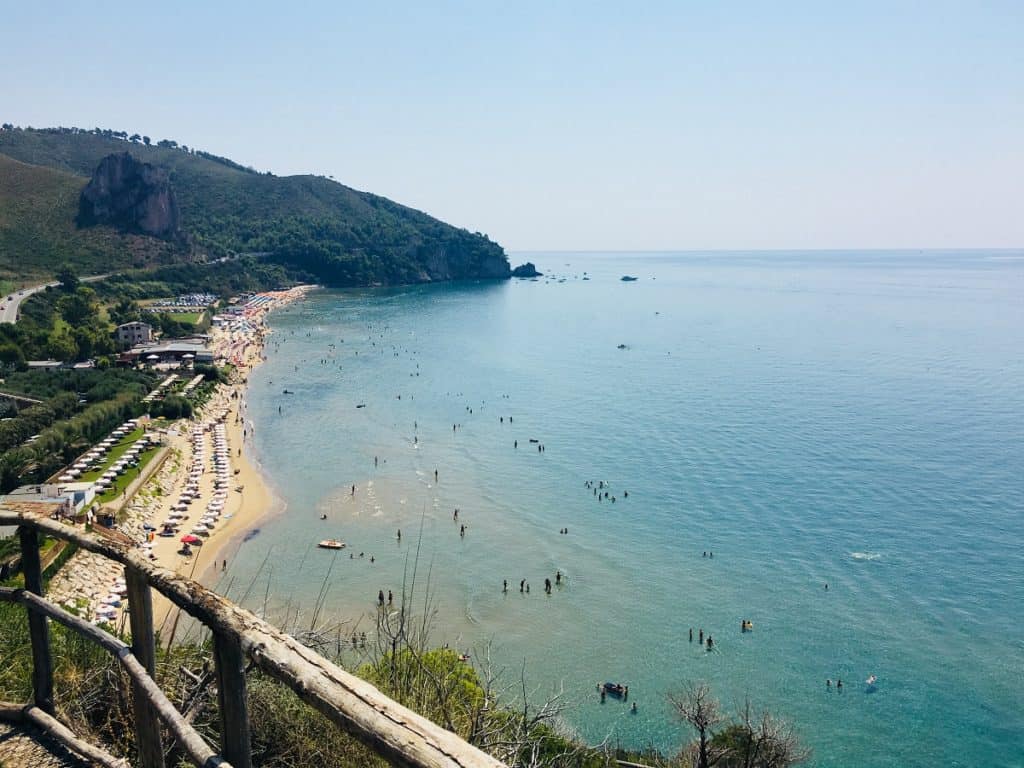
Bazzano Beach, Sperlonga is on the eastern side of the Sperlonga coastline, in the province of Latina, on the stretch of coast that opens beyond the Ciannito promontory and runs southeast toward Gaeta. It is the bay you meet right after the archaeological area of the Villa of Tiberius, more than a kilometer of golden sand enclosed between two promontories and protected at the back by a belt of greenery and Mediterranean scrub. In local speech it also goes by a second name, Spiaggia della Roccia dei Falchi, which refers to the rock wall that marks the southern limit of the bay toward Torre Capovento. You get there from Via Flacca, state road 213, the coastal road that links Terracina to Gaeta passing halfway up the slope under the white village of Sperlonga, and the day is always organized the same way: you leave the car at the edge, walk down to the beach, choose between a free stretch and a beach club. The wider context is that of the Riviera di Ulisse, the coastal district that runs from the Circeo promontory to the Gulf of Gaeta and within which Sperlonga holds the central position, a little under a hundred and 20 kilometers south of Rome. What sets Bazzano apart from the immediately neighboring beaches is a rare combination: a wide beach, water that stays clear even on the busiest days of August, services that are present but not suffocating, and a crowd that rarely reaches the levels of the nearby Piana di Sant'Agostino or of Arenauta.

Where Bazzano Beach, Sperlonga is and how to really get there
The first thing to understand about Sperlonga is that the town does not lie along the sea, but is hoisted above it. The old core occupies the San Magno promontory, a limestone spur of the Aurunci mountains that pushes into the Tyrrhenian between the Fondi plain and the Gulf of Gaeta, and that rises some 60 meters from the water level. From that point the coastline splits into two distinct riviere, facing opposite directions. To the northwest opens the western riviera, the long arc that points toward Terracina and within which are the Spiaggia della Fontana and the Spiaggia di Canzatora. To the southeast stretches the eastern riviera, the one that leads toward the archaeological area and, past the Ciannito promontory, toward the bay of Bazzano.
This geography has an immediate practical consequence, and whoever ignores it loses an hour of vacation with the swimsuit already on: you go up to the historic center, you go down to the beaches, and cars almost always stay outside the pedestrian perimeter. Bazzano, moreover, is not reached by crossing the town, but by continuing along the coastal road beyond the built-up area. Anyone who sets the navigator on the center of Sperlonga and then hopes to reach the beach on foot ends up walking for kilometers along a road that is not made for pedestrians.
By car from Rome to Bazzano Beach, Sperlonga
The most direct route from Rome remains Via Pontina, state road 148, followed south to Terracina: about a hundred and 16 kilometers of road that crosses the Agro Pontino and that, on low-season weekdays, you drive without worry. From Terracina you take Via Flacca, state road 213, and follow it toward Gaeta. The Flacca passes under Sperlonga, continues beyond the promontory and serves, one after the other, the accesses to the eastern riviera up to Bazzano.
The Flacca deserves a couple of words, because it is a road that divides. On one side it is one of the most beautiful coastal routes in Lazio: tunnels cut into the rock, curves that open suddenly onto the sea, stretches where the wall drops straight to the water and the guardrail is all that separates you from the blue. On the other side it is two lanes with no real alternatives, and on weekend afternoons in July and August it clogs predictably in the direction of the return. Anyone with a commitment in Rome in the evening should do this math in the morning, not at six o'clock with a wet towel in the trunk. The practical rule is simple: either you head back very early, before 16:00, or you head back very late, after dinner, when the queue has dissolved. The in-between window is the worst.
By train and bus to Sperlonga
Sperlonga has no railway station of its own. The reference stop is Fondi Sperlonga, a stop on the Rome-Naples line via Formia, served by regional trains and some of the Intercity trains. From Roma Termini the trip takes a little over an hour, which makes the day trip absolutely reasonable even without a car. From the station to the village you cover the distance with the scheduled bus service that links Fondi to Sperlonga. To reach the eastern riviera and Bazzano you then need the local connection along the coastal road, or a stretch on foot that in summer, at two in the afternoon, is more tiring than the map suggests.
What Bazzano Beach, Sperlonga really is: a bay, not just any stretch
On the southern Lazio coastline the word beach covers very different realities, and it is worth being precise. Bazzano is not a bit of sand wedged between two rows of umbrellas, and it is not a hidden cove to reach with a hard trek either. It is a real bay, with a recognizable geographic identity of its own: more than a kilometer long, two promontories closing it at the ends, a belt of vegetation behind it that separates it from the road, and a seabed that in the central part descends gradually while toward the south it becomes rocky and interesting.
This structure explains almost everything that can be said about the beach. The width of the beach means that, even when many people arrive, the density per square meter stays bearable: the feeling of crowding you get on other Lazio coastlines is softened here, simply because the space is bigger. The enclosure between promontories favors the renewal of the water in a different way than a straight coast, and the perceived result, the one anyone who enters the water notices, is a sea that stays clear even on days of peak crowds. The belt of greenery behind, finally, acts as a visual and acoustic filter toward the Flacca: the beach does not have the road on top of it, and this radically changes the quality of the day.
The relationship with the archaeological area
There is then an element that sets Bazzano apart from any other beach in southern Lazio, and it is the proximity of the Villa of Tiberius. The bay lies between the imperial grotto and the Capovento promontory, which means you spend the day a few hundred meters from one of the most important archaeological complexes of the ancient Mediterranean. The ruins can be visited, the museum too, and the combination of swimming and archaeology is the reason why it pays to reserve more time for this day than you would for an ordinary beach.
The name, or rather the names
Bazzano is the current name, the one you read on signs and that the people of Sperlonga use. Spiaggia della Roccia dei Falchi is the alternative name, less frequent but equally rooted, and it refers to the rock wall that closes the bay to the south, where raptors nest and where, in fact, anyone who looks up at the right hours sees something circling. On the precise origin of the place name Bazzano local accounts diverge, and I prefer not to choose one rather than tell you a derivation I am not able to document. What can be said with certainty is that the double name exists, that both are used, and that if someone arranges to meet you at the Roccia dei Falchi they are not sending you to a different place.
The sand, the sea and the seabed of Bazzano Beach, Sperlonga
The sand at Bazzano is pale, fine and impalpably soft, the kind that sticks to wet skin and comes off only with a serious shower. It is not the coarse, crunchy sand of certain Tyrrhenian coastlines, and it is not the fine gravel found farther south toward the Gulf of Gaeta. It is sand for walking barefoot for a kilometer without thinking about it, which, with a beach of this length, is not a minor detail.
The color of the water, on clear days, goes from the light green of the first few meters to an open turquoise and then to the deeper blue farther out. The gradation depends on depth and on the type of seabed, and at Bazzano the seabed changes character along the bay: in the central part it is sandy and slopes down evenly, while nearing the southern limit, toward the Roccia dei Falchi and Torre Capovento, it becomes rocky, with submerged rocks, crevices and Posidonia meadows. This difference is the key to choosing where to set up, and it is explained better below because it is the most frequent question.
Where to Set Up If You Go with Small Children
The central stretch of the bay is the right one. The sandy seabed descends gradually, with no drop-offs or sudden holes, and the water stays shallow for several meters from the shore. Small children can stand at a safe distance from the waterline, parents can keep an eye on them without going into the water at every wave, and the fine sand is the kind a child falls on without getting hurt. The beach establishments operating on the bay have lifeguard service as required by regulations for beaches under concession, and on the busiest days the presence of the lifeguards is noticeable. On the free stretches it is different and needs to be said clearly: nobody is watching your back, so the supervision of the children is entirely yours.
Where to Set Up If You Go to Swim and Snorkel
The southern zone, the one leading toward Torre Capovento, is where the seabed becomes interesting. The submerged rocks create shelters and passages, the Posidonia offers cover, and the fauna you see is the typical fauna of the coastal Tyrrhenian: white sea breams, saddled breams, damselfish, a few mullet in a school near the surface, and with a little luck an octopus among the crevices. You don't need sophisticated equipment, a mask and snorkel are enough, but a few precautions are needed.
The first: water shoes. The passage from sand to rock happens within a few meters and the rocks, even the submerged ones, host sea urchins. The second: a dive-marker float or a small buoy if you move away from shore, because in the warm season the bay is crossed by watercraft and an unmarked swimmer, seen from sea level, is practically invisible. The third: watch the wind. When it blows from the southern quadrant the water near the rocks gets cloudy and return currents along the wall make themselves felt. In those conditions snorkeling moves toward the middle of the bay, or is postponed to the next day.
A Curiosity About the Spiaggia di Bazzano, Sperlonga
The curiosity concerns the very name of the town that overlooks this coast, and once you know it you never look at Sperlonga the same way. The place name comes from the Latin spelunca, that is, grotto, cave. It is not a fanciful etymology constructed after the fact to please tourists: it is the literal reason the place is called that. The grotto in question is the large natural cavity that opens at the base of the promontory, the one Tiberius had fitted out as a summer dining room and inside which he had the sculptural groups placed that are seen today in the museum.
The reversal of perspective is this: normally one thinks that the imperial villa takes its name from the place, that is, that it is called Villa of Tiberius at Sperlonga. In reality it is the place that takes its name from the natural element around which the villa was built. First there was the grotto, then the villa, then the town that took its name from that grotto, and finally, much later, the seaside tourism that has brought hundreds of thousands of people here every year. Anyone who spends the day at Bazzano therefore finds themselves in a bay whose nearest toponymic reference is a cave that nobody, on the shoreline, is looking at.
There is a second level, and it is the most interesting part of this curiosity. Tiberius's choice was not only aesthetic. A sea grotto, in luxury Roman residential architecture, was a prized element: it provided natural coolness in August, allowed the construction of fishponds fed by the sea, and offered a scenic backdrop that no built room could have replicated. That is, the emperor did not build a villa with a grotto next to it: he built a villa around a grotto, using it as a reception room. It is an idea of architecture that 2,000 years later keeps working, and that is grasped well only by standing inside it.

The beach clubs and the free beaches: how the Bazzano beach works
On a beach more than a kilometer long, free stretches and concession stretches coexist, and the proportion between the two is the first operational piece of information needed by anyone planning the day. At Bazzano the free zones are wide and real, not the symbolic scraps found on other Lazio coastlines: you can arrive with the umbrella under your arm and plant it without asking anyone's permission. At the same time the beach clubs are there, they are equipped, and those who prefer a lounger, guaranteed shade and services find what they are looking for.
Bazzano Beach and the evening beach model
Among the beach clubs of the bay, the one that has given the most recognizable name to the stretch is Bazzano Beach, which in recent years has become a reference point for the beach nightlife of the area. It is worth understanding its setup, because it is different from that of a traditional lido and determines the kind of day you can expect.
The difference concerns the layout. A classic lido lines up rows of umbrellas parallel to the shoreline, and the number of rows determines the capacity. Here the rows of umbrellas are few, three starting from the dune according to the club's established layout, and the rest of the offering is built on loungers, arranged less rigidly. To this are added more private stations, locally called Harem, placed in a favorable position relative to the dance floor and usable as private space during evening events.
The point to grasp is that this type of beach club has two lives in the same day. In the daytime it works as a well-kept lido, with its service and its clientele. From late evening it changes function and becomes a club, with music and programming. If you are looking for a quiet beach to read until sunset, check the event calendar before booking your spot. If instead the idea of ending the beach day without going back to the hotel appeals to you, it is exactly the right place. There is no absolutely better choice: there is a choice consistent with what you want from the day, and getting it wrong is the most frequent reason for disappointment on this beach.
The free zones and what they involve
On the free stretches you bring everything you need yourself: umbrella, water, ice, a bag for trash. There are no showers, no changing cabins, no lifeguard service, and you find the sand as the sea leaves it, which in spring and after storm surges also means driftwood and washed-up seaweed. In exchange you have space, relative quiet and no closing time.
Something nobody tells you about Bazzano Beach, Sperlonga
The thing almost never said concerns the relationship between this beach and the road that makes it reachable, and it is a paradox worth bringing into focus.
Via Flacca, in the stretch that passes under Sperlonga and continues toward Gaeta, was built between the 1950s and 1960s. Before that work the eastern riviera was in fact secluded: reachable by sea, reachable on foot by those who lived there, but not something you could fit into a day trip from Rome. It is the construction of the coastal road that made Bazzano a beach anyone can visit, and that transformed Sperlonga from a village of fishermen and farmers into one of the Romans' reference summer destinations.
The paradox is that the same work that opened this coast to tourism is also the work that cut into the side of the hill and brought to light the marble deposit of the imperial villa. Without the Flacca, no one would be at Bazzano today with an umbrella. But without the Flacca, in all likelihood, the sculptural groups of the grotto would still be buried and the museum of Sperlonga would not exist. The road that brought the bathers is the same one that brought the archaeology, and the two things happened on the same construction site, in the same years.
The second element rarely mentioned concerns the real size of the site compared to what you visit. The archaeological area and the museum make up a complex that takes time: it is not a 15-minute stop between one swim and the next. Those who treat it as a quick stop come out dissatisfied and with the feeling of having seen a few fragments of marble inside display cases. Those who give it an hour and a half, calmly, understand they have in front of them one of the most debated sculptural complexes of European classical archaeology. The difference between these two experiences does not depend on the site, it depends entirely on how the day was planned.
The third and last element concerns the season. Bazzano is perceived as a July and August beach because those are the two months when everyone goes. In reality the period when this bay is at its best is another: the second half of May, the first half of June and all of September. Water already good or still warm, empty beach, better light for photographs, a free-flowing Flacca, an archaeological area that can be visited without crowds. Anyone who can choose when to come and chooses August is choosing the worst month for reasons that have nothing to do with the beach.
The advice I give you for visiting Bazzano Beach, Sperlonga
There is only one piece of advice and it comes down to one sentence: build the day around the archaeology, not around the umbrella, and you will see that the umbrella gains too.
In practice it means this. You arrive early, before 9:30, when the parking along the coastal road is still available and the Flacca is clear. You start with the archaeological area of the Villa of Tiberius and the museum, in the hours when the sun has not yet made the visit tiring and when the light inside the grotto is the good kind. You then go down to Bazzano around noon, eat something without hurry, spend the afternoon in the water. Around 17:00 the light changes, the heat drops, the beach begins to empty and the beach becomes a different and better place. You stay until the last light, and head back after dinner, when the queue on the coastal road has dissolved.
This scheme solves three problems at once: it avoids the outbound queue, it avoids the return queue, and it turns a cultural stop that almost everyone skips into the most memorable part of the day. The alternative, that is, arriving at 11:30, circling in search of parking, stretching out in the hottest hour and leaving at 17:00 in the middle of everyone else, is what the majority does, and it is also the reason why many people come back from Sperlonga tired.
The concrete things to put in your bag
Rubber water shoes are the first. They are needed for the southern part of the bay, where the sand gives way to rocks and where the sea urchins are, and they are also needed simply for walking on the scorching shoreline at noon. The second is water, in a quantity greater than seems reasonable to you: if you set up on a free stretch you have no kiosk 10 meters away, and thirst in August on an exposed beach arrives sooner than you think. The third is serious sun protection, because the pale sand reflects and exposure on this bay is full for most of the day. The fourth, and everyone neglects it, is something that gives shade early in the morning and in the evening: the beach club umbrella is rented by the day, but if you arrive at 8:30 to enjoy the empty beach, for a couple of hours you are in the sun with no shelter.
The Villa of Tiberius, the grotto and the marbles: what you really see
The Villa of Tiberius and the Museo Archeologico Nazionale of Sperlonga are, together, the reason this coast appears in university classical archaeology textbooks around half the world. Since they are a few minutes from the bay of Bazzano, it is worth knowing what to expect before entering.
The residential complex
The villa is a maritime residence of the late Republican age, expanded and transformed into an imperial residence by Tiberius. The rooms are arranged around a portico overlooking the water, following a scheme found on the Tyrrhenian coast in other luxury villas of the same period. The element that makes the site unique, however, is the incorporation of the large natural grotto into the architectural program: the cavity was transformed into a cenatio, that is, a summer dining room, and in front of it and inside it a rectangular basin, a fish pond fed by seawater and a large circular pool were carved out. At the center of the water an artificial island housed the triclinium, that is, the couches on which people ate reclining.
The sculptural groups
Inside and around the grotto stood sculptural groups of oversized dimensions, with subjects drawn from the Homeric cycle: the blinding of Polyphemus, Scylla's attack on Odysseus's ship, the theft of the Palladium, the abduction of Ganymede. The common thread is the Odyssey, and this thematic choice is one of the reasons the entire coastal area ended up being called the Riviera di Ulisse.
The scientific dispute
Bernard Andreae and Salvatore Settis, two of the heaviest names in European classical archaeology, went head to head over the dating and interpretation of the groups, with diverging readings that occupied the discipline for decades. Simplifying a lot, the crux is whether they are Hellenistic originals, copies from the Roman period or creations made specifically for the grotto, and what the relationship is with the workshop that produced the Laocoön. The question is not closed, and this is perhaps the most fascinating thing about the site: in front of those marbles you are not looking at a solved problem, you are looking at an open one.
For planning your visit, one practical recommendation applies: opening hours and days must be checked directly on the museum's official website before you leave, because they vary with the season and it's not unusual for someone to show up at the gate on the wrong day. I don't give hours or fares here for exactly this reason.
Another well-known fact, yet rarely cited
The well-known fact is that Sperlonga is one of the most beautiful villages in Italy and that its sea regularly receives quality recognitions. Everyone knows it, you read it everywhere, and it adds nothing to what you already see on arrival.
What is rarely cited, instead, is the structural reason why the sea on this coast is what it is, and it doesn't depend on luck. The eastern riviera of Sperlonga lies within the protected perimeter of the Riviera di Ulisse regional park, and the stretch between the promontory and Torre Capovento is a setting where building has not grown the way it has on other Lazio shorelines. Anyone arriving from the north coast of Rome, where the built-up land reaches practically to the sand for tens of kilometers, notices the difference here immediately: behind the beach there is greenery, not concrete.
The second well-known and little-explored fact concerns the comparison with the nearby beaches. Everyone knows that to the south, beyond Torre Capovento, there are the Piana di Sant'Agostino and the Arenauta, that is, the Spiaggia dei Trecento Gradini, and that they are splendid beaches. What is said less is that they are also beaches that in high season reach crowding levels higher than those of Bazzano, especially the Piana di Sant'Agostino, which has a very large young crowd and a notable concentration of people on weekends. Bazzano, with equal water quality, keeps a lower density, and for anyone traveling with children or simply trying to lie down without bargaining over every square meter, this is information worth more than any ranking.
The right photo to take at Spiaggia di Bazzano, Sperlonga
There are three photos to take at Bazzano, and they are very different from one another.
The first: the arc of the bay from the promontory
This is the photo that tells the story of the beach for what it is. You need a raised spot, and the southern wall toward the Roccia dei Falchi offers lookouts from which the shoreline can be read in full: the regular curve of the waterline, the band of greenery behind, the Ciannito promontory closing it off to the north and the profile of the white village glimpsed beyond. It's a photo that works well with a wide-angle lens and needs side light, so it should be taken early in the morning or in the last hour before sunset. At noon the same framing comes out flat, with burned sand and a sea without depth of color.
The second: the turquoise from the water
This is the photo you take by wading in up to your waist and turning back toward the shore, or with an underwater housing held half in the water, where the cut of the surface divides the frame into two worlds. It works well in the central part of the bay, where the sandy bottom gives back that light green that on the southern Lazio coast is a recognizable signature. Best hours: from 11 to 15, exactly when the light is awful for landscape but perfect for water, because the high sun penetrates and lights up the seabed.
The third: the white village as a backdrop
This is the photo almost nobody thinks of taking from Bazzano, because Sperlonga is instinctively associated with the western beaches. From the northern part of the beach, though, with a modest telephoto lens, the cluster of white houses on the promontory comes into the frame above the sea line, compressed by the focal length, and the result is an image that puts together in a single frame the two elements that define this coast: the medieval village and the beach. It should be taken in the late afternoon, when the sun lights the facades instead of being behind them.
Some important events that happened here in history
A beach, taken in itself, makes no history. The history is that of the promontory above it and of the coast it is part of, and on this stretch of coastline the events are of the first magnitude.
The Roman age and the imperial villa
The first chapter is the late Republican age, when maritime villas of the Roman aristocracy multiplied along this coast, equipped with fish ponds and part of a system that combined luxury residence and fish production. The second chapter is the intervention of Tiberius, who starting from a pre-existing layout transformed the Sperlonga residence into a fully imperial villa, with the natural grotto used as a dining room and the sculptural groups placed to compose a Homeric figurative program.
Tied to the imperial villa is also the episode that ancient sources recall most insistently: a collapse in the grotto during a banquet, from which Tiberius is said to have been saved by the intervention of Sejanus. It is an account handed down by the ancient historiographic tradition, with all the caution that this entails, and it should be taken for what it is: an episode reported by the sources, not an archaeologically documented fact. It remains significant, however, because it shows how central that place was in the political imagination of the time.
The Middle Ages, the walls and the raids from the sea
The third chapter is medieval, and it is the one that gave the village the form it still has. The settlement was encircled by walls and organized in concentric circles around the castle, with narrow alleys, underpasses, stairs and few controllable accesses. It is not an aesthetic choice: it is the urban translation of a constant fear, that of raids from the sea that for centuries marked the calendar of these coasts. The murals that you meet today along the walls of the historic center tell precisely about those raids, and it is the way the town has chosen to remember them.
1957, the Flacca and the discovery
The decisive chapter for the modern physiognomy of this coast is 1957. The bulldozers that were opening the route of the coastal road between Terracina and Gaeta, that is, Via Flacca that you still travel today to come to Bazzano, cut into the side of the hill and brought to light a deposit of marble fragments of oversize dimensions. It was not a lucky find among many: it was one of the most sensational Italian archaeological finds of the postwar period. The excavations, directed by Giulio Iacopi, yielded thousands of fragments, and Iacopi published the first organic account in 1963, the same year the building that still houses the museum was constructed.
The 20th century and the tourist transformation
The last chapter is the one that produced the beach as you see it today. The Flacca connected Sperlonga permanently to the rest of the coastline and made reachable in a day from Rome a village that until then was secluded. From then on Sperlonga became one of the Romans' reference summer destinations, with everything that follows in terms of summer crowding, winter emptying and an economy built entirely on four months a year. The eastern riviera, and Bazzano within it, was progressively equipped with beach clubs and services, while maintaining large shares of free beach: a balance that has been lost on other Lazio coasts and that here, for now, holds.
Who passed through Bazzano Beach, Sperlonga
On this point it is best to be honest, because on pages dedicated to beaches lists of celebrities built on nothing circulate. Of the bay of Bazzano as such there is no register of illustrious guests, and anyone who gives you a precise one is making something up. What can be said with foundation concerns the promontory, the villa and the coast.
Tiberius
The heaviest name is that of the emperor, who chose this coast as a place to stay and who made an imperial villa of the residence under the village. The grotto fitted out as a dining room, with the artificial island at the center of the circular pool, is the kind of invention built to impress high-ranking guests. Anyone who swims in front of Bazzano today is a few hundred meters from a place that, for some years, was one of the showpieces of Roman power.
The archaeologists
The second group of names is that of the scholars, and in this story they count as much as the ancient figures. Giulio Iacopi directed the 1957 excavations and signed the first organic account of them in 1963. Bernard Andreae and Salvatore Settis built around the sculptural groups of Sperlonga two divergent readings that occupied European classical archaeology for decades. For the discipline, Sperlonga is a name that weighs as much as few other Italian coastal places, and the fact that the vast majority of bathers ignore it remains one of the funniest asymmetries of this coast.
And then Ulysses, who never passed through here
It's worth keeping a line for literary memory. This stretch of coast is called Riviera di Ulisse, a name that refers to Homeric exploits and that the inhabitants have embraced with conviction, backed by the Homeric figurative program of the grotto's sculptural groups. It is tradition and suggestion, not documentation: no one can prove that the Odyssey speaks of this gulf, and whoever tells it to you as a fact is confusing myth with geography. But that name has shaped the way this coast tells its own story for at least a century, and knowing that you spend the day inside a riviera named for a castaway is information worth as much as a museum caption.
When to go to Spiaggia di Bazzano, Sperlonga and when to avoid it
The bathing season on this coast effectively opens in May and closes in October, with marked differences from one period to another.
May and June
This is the period I recommend first. The water in May is still cool and not everyone finds it acceptable, but from the second half of the month it becomes bearable and in June it's good. The beach is empty, the Flacca flows, the archaeological area is visited without a line, the light is long and the greenery behind the beach is at its best time of year. The beach clubs are open but not full, and the town works without being under siege.
July
The month when the beach starts filling up for real, with a sharp difference between weekdays and weekends. On weekdays you can still find space and the day stays pleasant, but on Saturdays and Sundays the Flacca clogs up and the parking lots fill early. If you have to come in July, come during the week.
August
The worst month for the ratio of effort to payoff, and I say it bluntly. The beach holds up better than others because it's big, but everything around it suffers: traffic, parking, lines on the coastal road, full restaurants, prices at the top of the seasonal scale. Anyone with no alternative should come anyway, but apply the rule of timing: arrive before nine, head back after dinner, and make no attempt to cross the central part of the afternoon by car.
September
For many regulars it is the best month of all. The water keeps the heat accumulated over the summer and is the most pleasant of the year, the beach empties out from the first week, the light turns golden and the whole system, from parking to restaurants, becomes manageable again. One warning only: toward the end of the month the likelihood of windy days and storm surges increases, and after a storm surge the beach stays marked for a few days.
Sea conditions
The practical point you should check before leaving is the wind. This bay, open to the southeast, takes the winds of the southern quadrant badly: with the scirocco the water gets cloudy, the waves rise and the day gets complicated. With the tramontana and with winds from the north, by contrast, the sea stays flat and the water clear. A wind forecast checked the night before is worth more than 10 reviews read on your phone, and for official information on water quality the reference remains the channels of the municipal administration and of the competent regional agency, not secondhand accounts.
The other beaches of Sperlonga and how they fit with Bazzano
Sperlonga has more beaches than the postcard tells, and knowing the differences lets you choose the right one for the day you have in mind. It's worth listing them, in no order of preference.
- The Bambole Beach, on the side facing the village, one of the most photographed stretches of the shoreline.
- The Spiaggia di Bazzano, the one discussed here, on the eastern riviera beyond the Ciannito promontory, also known as Spiaggia della Roccia dei Falchi.
- The Spiaggia di Canzatora, on the western side, a compact beach with a gently sloping bottom, traditionally chosen by families with small children.
- The Spiaggia della Fontana, also on the west, whose name refers to the spring that flows out onto that stretch of shoreline.
- The nearby Spiaggia dell'Arenauta, better known as Spiaggia dei Trecento Gradini, already in Gaeta territory and reachable only by going down a long staircase from the Flacca.
- The Piana di Sant'Agostino, still farther south, the large beach that in high season gathers the youngest and biggest crowd in the area.
A clarification that is needed, because the misunderstanding has circulated for years. When people talk about a beach of the Lago Lungo in relation to the Pontine coastline, they are referring to one of the coastal lakes of the plain, a strip of land with sand dunes, vineyards and Mediterranean scrub that separates the body of water from the sea. It has nothing to do with the Laghi Lungo e Ripasottile Reserve, which is in the Rieti area, a few kilometers from Rieti, and is an inland lake environment of the central Apennines, more than a hundred and 50 kilometers from this coast. Two almost identical names, two worlds that do not touch: the link between the coastal lakes and the dunes of the coastline is found if anything in the Circeo National Park, and in beaches like that of Torre Paola or the Bufalara.
What is around Bazzano Beach, Sperlonga
Anyone staying more than a day, or wanting to break up the sea with something else, has a particularly rich radius of 30 kilometers around.
The village of Sperlonga
The historic center of Sperlonga is visited on foot and takes an hour to go around, but it is an hour that pays off. White houses in concentric circles, shaded alleys, arches, stairs, sudden views over the gulf, the little square that opens onto the open sea. In high season the evening is crowded, and the best time to cross it remains late afternoon, when the light lowers on the facades and the groups have not yet come out into the street for dinner.
Gaeta and the gulf
Going down the Flacca you reach Gaeta, with its medieval historic center, the seaside quarter and the promontory that closes the gulf. It is a city of a different size from Sperlonga, with more services and more life even off season, and it is worth a whole evening.
Terracina and the temple
In the opposite direction, toward the northwest, Terracina offers the historic center on Via Appia and, above all, the sanctuary on the mountain that dominates the gulf from a height that on clear days gives a view as far as the Circeo and the islands. It is a detour of a little over half an hour from the beach and it completely changes the scale of the day.
The hinterland
Behind the coast rise the Aurunci mountains, and with them a hinterland that almost no bather visits. Itri, with its castle and medieval village, is reached in about 20 minutes from the Flacca and is the exact counterpart of the beach: stone, shade, silence. Farther northwest the Circeo National Park holds together dune, forest, coastal lakes and promontory, and the coast of San Felice Circeo closes the arc to the north. The Laghi dei Gricilli, in the inner plain, complete the picture of the wetland environments of the area.
The islands
From the ports of the gulf depart the connections to the Pontine islands. Anyone with an extra day who wants to see what a still different water looks like can plan a crossing: the Spiaggia di Cala Nave, on Ventotene, is the kind of place that reorganizes your personal ranking of Italian beaches. Hours and departures should be verified directly with the shipping companies, because they change with the season and with sea conditions.

Quick questions about Spiaggia di Bazzano, Sperlonga
Does Spiaggia di Bazzano have free areas?
Yes, and they are large. On a beach that is longer than a kilometer, sections under concession and free sections coexist, and the free ones are not symbolic scraps: you can arrive with your own umbrella and settle in without speaking to anyone, though you must bring everything you need, water included.
Is it suitable for children?
In the central stretch yes, because the sandy bottom slopes gradually and the water stays shallow for several meters. On the free stretches there is no lifeguard service, so supervision falls entirely to adults. At the beach clubs the service is present as required for beaches under concession.
What else is Spiaggia di Bazzano called?
Spiaggia della Roccia dei Falchi, a name that refers to the rock wall that closes the bay to the south in the direction of Torre Capovento. Both names are in use.
Can you snorkel?
Yes, and it's best done in the southern part of the bay, where the seabed turns rocky and crevices and posidonia appear. Water shoes are a must because of sea urchins, and bring a signal buoy if you move away from the shore.
How far is it from the archaeological area of the Villa of Tiberius?
A few hundred meters along the eastern riviera: the bay extends between the imperial grotto and the Capovento promontory, and the visit fits into the same day without significant transfers.
Can you get there without a car?
Yes, by train to Fondi Sperlonga on the Rome-Naples line via Formia, then a regular bus to Sperlonga and a local connection along the coastal road. From Roma Termini the train takes a little over an hour. Return times in the evening should be checked before heading down to the beach.
What's the difference between Bazzano and the Piana di Sant'Agostino?
Both are very beautiful beaches on the same stretch of coast, but with different crowds. The Piana di Sant'Agostino, already in Gaeta territory, gathers in high season a young and very large crowd. Bazzano keeps a lower density and a more family-friendly profile, though it also has its evening life at the beach clubs.
How much does an umbrella cost?
Rates change by beach club, by season band and by type of spot, and a figure written today becomes misleading after a few weeks. They should be asked for directly at the beach club before leaving. What can be said is that the eastern riviera of Sperlonga is not the budget zone of the Pontine coast.
In our judgment Spiaggia di Bazzano is the right place for anyone who has understood that a day at the sea is not measured only by the quality of the water. The water here is excellent, the beach is wide, the sand is fine: up to here, other beaches in southern Lazio hold up to the comparison. What no other bay puts together is the combination of a sea like this and an imperial grotto a few hundred meters away, with 2,000 years of European history in between and a road built in the 1950s that brought bathers and archaeologists here, to the same work site. If you come for the umbrella you'll have a good day at the sea. If you come with an hour to spend on the villa and the museum, you'll go home with something that lasts longer.
Frequently asked questions about Spiaggia di Bazzano, Sperlonga
Does Spiaggia di Bazzano have free areas?
Yes, and they are wide: on Bazzano Beach, in Sperlonga, on a beach that exceeds a kilometer in length, concession stretches and free stretches coexist, and the free ones are not symbolic scraps. You arrive with your own umbrella and set up without asking anyone, bringing with you everything you need, water included.
Is Bazzano Beach suitable for children?
In the central stretch yes, because at Bazzano Beach the sandy seabed slopes gently and the sand is pale, fine and impalpably soft, the kind that sticks to wet skin. It is a different condition from the coarse sand of other Tyrrhenian coastlines or from the fine gravel found farther south toward the Gulf of Gaeta.
What is the best time to go to Bazzano Beach?
The recommended period for Bazzano Beach is May and June: the water in May is still cool and not everyone finds it acceptable, but from the second half of the month it becomes tolerable and in June it is good. In this period the beach is empty and the nearby archaeological area can be visited calmly.
How long is Bazzano Beach?
Bazzano Beach, in Sperlonga, is a real bay more than a kilometer long, closed at the ends by two promontories. It is not a bit of sand wedged between two rows of umbrellas, nor a hidden cove to reach with a hard trek, but a bay with a recognizable geographic identity.
How do you get to Bazzano Beach by car?
Bazzano Beach is reached from Via Flacca, built between the 1950s and 1960s in the stretch that passes under Sperlonga and continues toward Gaeta. Before that work the eastern riviera, where Bazzano is located, was in fact secluded and reachable only by sea or on foot.
Why is the town above Bazzano Beach called Sperlonga?
Sperlonga, the village that dominates Bazzano Beach, takes its name from the Latin spelunca, that is, grotto: the large natural cavity that opens onto the coast and that in Roman times was turned into part of the maritime residence of the Emperor Tiberius, decorated with the famous sculptural groups.
What is there to see near Bazzano Beach?
A few minutes from Bazzano Beach are the Villa of Tiberius and the Museo Archeologico Nazionale of Sperlonga, together with the historic center of the village, which is visited on foot in about an hour among white houses in concentric circles, shaded alleys and sudden views over the gulf.
To organize your day on the Riviera di Ulisse
Article written by the editorial team of TourLeaderPro, contact them for Private/Corporate/V.I.P. Tours and Experiences. For an organized day among Sperlonga, the Villa of Tiberius and the beaches of the Riviera di Ulisse, with a licensed tour escort, start from the TourLeaderPro contact page. Tour operators building itineraries on the Pontine coast will instead find the consulting service in the section dedicated to tour operators. At your disposal are the best tour guides and authorized tour escorts of Rome and its surroundings.
Planning a trip to Rome? The English-language guides to visiting the city are on ItalyPlanner.com. For those thinking in terms of days out of town there is the guide to the best day trips from Rome, while those who want to understand how Italian free beaches really work, concessions included, will find the explanation in the guide to free beaches in Italy.