Gaeta (LT)
In short. Gaeta (LT) is reached from Rome by car in about two hours: the A1 motorway to the Cassino exit and then the expressway to Formia, or Via Pontina and the Flacca (state road 213) along the coast, which is slower but passes through Terracina and Sperlonga.

Gaeta (LT) is reached from Rome by car in about two hours: the A1 motorway to the Cassino exit and then the expressway to Formia, or Via Pontina and the Flacca (state road 213) along the coast, which is slower but passes through Terracina and Sperlonga. By train you get off at Formia-Gaeta station, on the Rome-Naples line via Formia (regional trains and Intercity from Roma Termini, from an hour and 10 minutes to an hour and a half of travel depending on the train), and from there you take the Cotral bus to Gaeta: frequent runs on weekdays, much sparser on Sunday, with the terminus in Piazzale Caboto, under the walls of the medieval quarter, and stops along Corso Italia and on the waterfront. The Formia-Gaeta ticket costs a little over €1, the ride takes half an hour. If you arrive by car you'll find blue-line paid parking along the whole Lungomare Caboto, in Piazzale 5 Febbraio at the foot of the old village, in Piazza della Libertà and in the Serapo area, rates change between winter and summer and must be read on the meter, and the free spaces of Piazzale Salvatore Bisbiglia, on the waterfront toward Formia, fill up early on summer weekends. The medieval quarter has an intermittent ZTL, active in the evening and on summer holidays: the illuminated panels at the entrance tell you if it is in operation. The churches, the castle seen from outside, the walls, the waterfronts and the free beaches cost nothing. The Santissima Trinità Sanctuary at the Montagna Spaccata (Via Santissima Trinità 3) opens Tuesday through Sunday, with split hours between morning and afternoon, and asks for a free offering, the Grotta del Turco closes a quarter of an hour before the sanctuary and is not recommended for people with mobility difficulties. The Diocesan Museum in Piazza Cardinale De Vio 7 (telephone 0771 740300) opens by reservation in August and September. The Mausoleum of Lucius Munatius Plancus, at the top of Monte Orlando, in 2026 can be visited on Friday, Saturday and Sunday of the summer months with a paid shuttle from Via Lucio Munazio Planco or on foot along the park trails, the openings change from season to season, so the date should be checked with the Pro Loco before leaving. For the beach day alone, three hours of travel round trip from Rome are enough, for old Gaeta, the sanctuary and Monte Orlando you need a full day, and two are better.
Gaeta is the natural capital of the Riviera di Ulisse, the stretch of Lazio coast that runs from Sperlonga to Minturno, and this guide covers all of it: the seven beaches, the medieval quarter palace by palace and church by church, the fortifications, the Roman sites, the park of Monte Orlando, the history from the Byzantine duchy to the siege of 1861.

Gaeta (LT), the city of a hundred churches on the Tyrrhenian Sea
Gaeta is a city of about 19,000 inhabitants in the southern part of Latina Province, 133 kilometers from Rome and less than 100 from Naples, on the promontory that closes the gulf of the same name to the south. Its shape is its history: a rocky peninsula, Monte Orlando, tied to the mainland by a narrow isthmus, with the old quarter perched on the tip and the modern city stretched along the arc of the bay toward Formia. The historic center, the Sant'Erasmo district, is listed among the Most Beautiful Villages in Italy under the name Gaeta Medievale, and the popular definition of city of a hundred churches is not a postcard exaggeration: of churches, chapels and convents, open, closed or reduced to ruins, the territory truly counts dozens, and we'll see the most important ones one by one.
The first thing to understand, so as not to get lost, is that Gaeta is a double city. There is old Gaeta, the stronghold, a tangle of alleys and stairs climbing between the castle, the cathedral and the port, and there is new Gaeta, the old Borgo, today the Porto Salvo district, which for 30 years, between 1897 and 1927, was even a municipality of its own under the name Elena. Serapo Beach, the most famous, is on the opposite side of the isthmus from the port, facing west. Anyone who gets off the bus in Piazzale Caboto has the medieval village in front and Via del Duomo climbing on the right, anyone who arrives by car on the Flacca meets first the beaches of Sant'Agostino and Arenauta, then Serapo and finally, going around the hill, the port. It's worth keeping this geography in mind, because the best way to visit Gaeta is to alternate: sea in the morning, village in the late afternoon, when the stones cool down and the churches reopen.
The name of Gaeta according to Strabo, Virgil and Aeneas's nurse
The origins of the name (Caieta in Latin, Kaieta in Greek) are wrapped in legend, and the ancient sources don't agree with each other. Strabo, in the fifth book of the Geography, doesn't speak of the city but of the gulf, which he calls Kaiatas, and derives its name from a Laconian word, kaietas, which indicated anything hollow, with an evident reference to the large inlet. The same Strabo, however, adds that others traced the name back to Aeneas's nurse. Diodorus Siculus instead ties the Gaeta area to the myth of the Argonauts and traces the name back to Aietes, the king of Colchis, father of Medea, the sorceress in love with Jason and niece of Circe, who lived a little farther north, on the promontory of Circeo. The version that won out in collective memory is Virgil's: in the seventh book of the Aeneid, Aeneas's nurse, Caieta, dies during the voyage toward the coasts of Lazio and the hero buries her on this shore, giving the land her name for eternity. Dante, in Canto XXVI of the Inferno, has Ulysses say that he stayed more than a year with Circe "there near Gaeta, before Aeneas named it," almost as if to certify the historicity of Virgil's episode. A fourth tradition, later, brings in Aiete, son of the Sun, nicknamed the Eagle, brother of Circe: the nickname supposedly passed to the city because of the shape of the promontory, which seen from the sea recalls the head of a bird of prey. These are etymologies, not history. But they are etymologies that the people of Gaeta know and cite, and it's worth arriving in the city knowing them.
Gaeta and the Riviera di Ulisse: the geographic context
The Gulf of Gaeta is an amphitheater that runs from Circeo, to the north, to the mouth of the Garigliano, to the south, with the Pontine archipelago on the horizon: from Monte Orlando, on clear days, you can see Ponza, Ventotene and, in the distance, Ischia. Behind, the Aurunci Mountains drop sheer to the sea and have forced the coastal road, the Flacca, into a course of tunnels and hairpin turns between Sperlonga and Gaeta. The Riviera di Ulisse Regional Park, established by the Lazio Region, brings together the protected areas of Gaeta, Formia, Minturno and Sperlonga: Monte Orlando, Gianola and Monte di Scauri, the villa of Tiberius. Within half an hour's drive of Gaeta are the villa and grotto of Tiberius at Sperlonga, the village of Itri with its castle, the baths and archaeological area of Minturno, the park of Gianola and Monte di Scauri. In an hour you reach Montecassino Abbey. Gaeta is the ideal base for all of this, and that is why a single day is never enough. Anyone looking for a guide for a private itinerary along the coast, or a corporate boat experience in the gulf, will find the specialists of TourLeaderPro. The English guide to the city is on ItalyPlanner.
The seven beaches of Gaeta (LT), one by one
Gaeta has seven beaches, and the people of Gaeta count them with pride like the seven hills of Rome. They differ from one another in access, sand, seabed and clientele, and should be chosen according to what you're looking for: convenience, quiet, diving, naturism. I describe them from north to south, that is, in the order in which you meet them if you arrive from Sperlonga on the Flacca.

Sant'Agostino Beach in Gaeta
Sant'Agostino Beach is the longest in the area: two kilometers of open shore, on an agricultural plain enclosed between the Flacca and the sea, the first one you meet coming from Sperlonga. It's the beach of campsites and families, very busy and well equipped, with beach clubs, restaurants and a couple of historic campgrounds right behind the sand. 60 years ago the plain was all vineyards and vegetable gardens: they picked melons, watermelons, plums, corn, and the dry soil, without irrigation, gave fruit with an aroma that the old farmers still remember as unrepeatable. Today the plain is partly built up, but the horizon remains open and the sunset, with the sun going down behind Sperlonga and Circeo, is one of the most beautiful in the gulf. Behind the beach rises the limestone wall of Monte Moneta (359 meters), one of the most popular cliffs in Lazio for sport climbing: on spring mornings you see climbers on the equipped routes while down on the beach the first swimmers spread out their towels. The beach clubs and restaurants are at kilometers 20.450-20.800 of State Road Flacca. The names change with the management, and the rule of looking on the spot always applies. The advice: Sant'Agostino in June and in September, on weekdays, is a real half-day beach, with water that deepens slowly and a sandy bottom ideal for children. In August the traffic on the Flacca and the crowding change its character.

San Vito Beach in Gaeta
After Sant'Agostino, continuing on the Flacca toward Gaeta, you reach the bay of San Vito, right after the private cove of the Grand Hotel Le Rocce and the tower of the same name on the promontory. It's a beach unlike all the others: it has no public access from land and you reach it only through the lodging facilities that face it, so it is, in practice, a guests' beach. The compensation is extremely clear water, a seabed that slopes gently, ideal for swimming and for first dives, and a series of sea caves and sunny coves that you explore by swimming or with a canoe. The sea in front is a traditional anchorage: on mistral days sailing ships and sailboats enter the bay to find shelter, and the view from the hotel terrace, with the sails still on the blue, is one of those you remember. On the beach there are facilities, beach volleyball, entertainment and games for the little ones. The facilities that give access to the shore are the hotel Il Ninfeo (Via Flacca km 22.700, phone 0771 742291), the Summit (Via Flacca km 23, phone 0771 741741) and Le Rocce (State Road Flacca km 23.300, phone 0771 740985). Anyone not staying at these hotels can still see the bay from the sea, with one of the boat excursions that leave from the port of Gaeta and run along the whole Riviera di Ulisse.

Arenauta Beach, that is, the Trecento Gradini
Arenauta Beach is the most famous among Romans who love the wild sea, and they know it by three names: Arenauta, Trecento Gradini, naturist beach. It stretches in the bay between Monte a Mare and Torre Scissura, right north of Ariana beach, and it can't be seen from the coastal road, because it is protected by the steep rock that separates it from the Flacca. The sand is fine and golden, the water transparent, the stretch of coast one of the few in Lazio left truly natural, with a large dune behind the southern end. It was one of the first naturist beaches in Lazio, in the second half of the 1970s, when it could be reached only by sea or through rough footpaths. The opening of faster connecting roads has made it more accessible and therefore more crowded in the central summer months, and organized bathing has appeared there, slow and gradual. You should know its layout before going down: in the initial part, the corner of Torre Scissura, equipped with private descents, in the center the naturist part and the staircase of the 300 steps, which is the public access and the reason for the name, in the final part the Papardò beach resort and Aeneas' Landing, with their accesses (Aeneas Landing, Via Flacca km 23.600, phone 0771 741713, Bagni Papardò, Via Flacca km 23.750, phone 0771 741344). Naturism is practiced, even in July and August, at the south end of the big beach, in front of the dune, which is the part that has stayed the wildest.
When to go is the right question, and the answer from someone who's been going for 30 years is clear: June, preferably on a weekday, when the beach is almost empty and it's lovely to walk along the shore for a kilometer without meeting anyone. Or September, when the coast shelters from the wind and the sea keeps its summer temperature. In August the staircase becomes a procession and the enchantment shrinks. Anyone going down must remember that you climb the 300 steps back up, in the hottest hours, with the water you brought: in the free part of the beach there is nothing, and that is exactly its merit.

Ariana Beach and the rock of the three dogs
The name, according to the local explanation, is a two-word phrase of the old Gaeta dialect: aria sana (healthy air). Ariana beach is small, sheltered, golden, with clear water that has earned it the Blue Flag several times, and it takes its character from the Mediterranean scrub that comes down onto it from the hill and from the so-called rocks of the three dogs, which surface in front of the shore and are the reference point for swimmers. It lies along the coastal road, State Road 213 Flacca, farther from the town center than Serapo, and precisely because of its position tucked against the hill it is almost always sheltered from the wind: it's the beach to go to when the mistral is blowing at Serapo. The flip side is the size: being very small, in summer it fills up quickly and on July and August weekends it's best to arrive early in the morning or in the late afternoon. It's ideal for a quiet day, with beach clubs and a free stretch, and for anyone who wants to snorkel around the rocks.
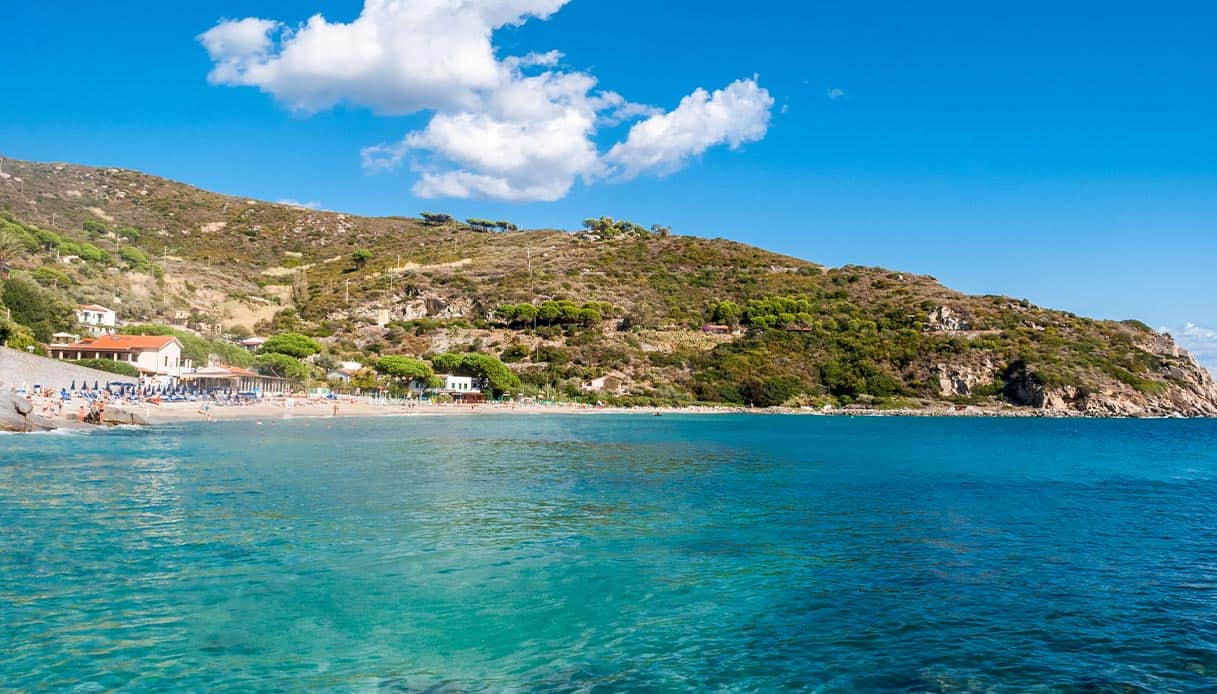
Quaranta Remi Beach and the Devil's Well
On the stretch of coast between Fontania beach and the cove that comes before the little Quaranta Remi beach opens the Devil's Well, which in Gaeta they also call the Well of the Keys: a chasm that opens suddenly in the rock, on the hill, and after a drop of 50 meters plunges into the sea. The names are picturesque, the origin unknown, and none of the explanations you hear in town stands up to verification. The Devil's Well is actually a large cave that extends both above the sea surface, with an entrance a small boat can enter, and underwater, and for the diver it is one of the most interesting sites in the gulf: the depth is a few meters and the cave hosts cave-dwelling and pre-cave fauna, sponges, bryozoans, crustaceans that come out of the crevices when darkness falls. The whole area is suited to dives that are undemanding in depth but very rich in life, which gives its best colors in the night hours: a night dive here is an experience I recommend to anyone who has a diving license and a dive center that organizes it.
The cave has, high up, a chimney that opens to the outside on the little hill above, and surfacing at night inside the cavity to look at the starry sky through that chimney is a moment that Gaeta divers describe as a rite. With your back to the well, the exploration continues keeping the foot of the rock wall on your left: you soon reach a small bay with a perfectly vertical wall, the seabed stays shallow, no more than five or six meters, and going on you find the so-called tire den, a small cave christened that way by Gianni Frignone, a very experienced Gaeta diver, because of two car tires wedged in the rock since time immemorial. It often hosts small scattered groups of corvina and has three entrances and a chimney that reaches the surface. Right after the Devil's Well there is a small cove with a lovely little beach reachable only by swimming or by boat, and this is Quaranta Remi beach, the most secret of the seven: whoever reaches it by kayak from Serapo, on a June morning, has the right to say they have seen a Gaeta that almost nobody knows.
Fontania Beach and the Nave di Serapo
Fontania was chosen in antiquity, for its position, as the home of a figure whom local tradition identifies as Gnaeus Fonteius, whose name the beach is said to bear. It is a small inlet on the southern coast of the city, a little northwest of Serapo beach, reachable on foot or by swimming, and it preserves the remains of a grand Roman villa of the 1st century AD. Behind the sandy inlet open multiple caves with rooms covered by barrel vaults. Two large caves with a single entrance are arranged on the east side, and at the back of the one on the left a small freshwater spring could explain the etymology of the name. The Roman works extend into the sea on the south side: the inlet has in the water a row of six large piers, and from this complex of submerged structures, connected to others buried in the beach, comes the hypothesis that a large pool communicating with the sea existed here, a fishpond like those of the maritime villas of Sperlonga and Circeo. The people of Gaeta have frequented this oasis since childhood, especially off-season, passing through a side lane and a gate that are the only access from land. On the beach there is a beach club with a bar and evening venue (Via Fontania, phone 339 6841107).
A very short distance from the shore the rock of the Nave di Serapo emerges, an elongated islet in which, with a little imagination, you can recognize the silhouette of a ship, and which is a biological site of fair importance. It's an ideal destination for beginner dives, because the depth is a few meters, and for nature photography enthusiasts: there you find mollusks like the octopus and the cuttlefish, nudibranchs of several species including the very common Valenciennes' glossodoris, shrimp in the night hours, crabs and rock fish. The land side, facing the coast, is of little interest. The goal is the outer side, the one facing the open sea and Punta Trinità, to be explored fully and in particular in the area where the rock ends and the sand begins. From the western end of the rock a few channels in the rock start and run straight for a good stretch. At their end, continuing for about 10 meters in the same direction, you find a small rocky plateau, which in Gaeta dialect is called prana, with a few tufts of posidonia, and there are always a few octopuses there, oysters cemented to the substrate, a small colony of sea daisies, perchie, sciarrani and a lizardfish that local divers have known for years. In summer, in the waters of the Nave di Serapo, you often see sea hares mating in long chains of individuals attached to one another.
Gaeta's coast is also an observatory of the changing Mediterranean. The steady rise in water temperature, even at depth, is shown by the arrival of species from tropical seas, and in October 2007, in the waters of Fontania, the diver and photographer Adriano Madonna photographed the crab Percnon gibbesi, first described in 1853 by Henri Milne Edwards and typical of the Atlantic coasts, from Florida to Brazil and from Madeira to the Gulf of Guinea, and of the Pacific ones from Baja California to northern Chile. Today it is a now-permanent guest of the Tyrrhenian. Back then it was news.

Serapo Beach, the beach of the people of Gaeta
Serapo is the main beach of the municipality, the citizens' beach: close, convenient, right outside your door, the beach of mothers with strollers and of kids who come down by bicycle. It stretches for about a kilometer and a half of very fine sand, light-colored, clean and light, a few minutes from the center and the medieval village, at the foot of Monte Orlando park, and it is very popular with Italians and foreigners. There used to be an endless dune here. With the opening of the glassworks, in 1911, tons of that sand ended up in the furnaces to make bottles, and the width of the shore shrank to the present one. Today there is no trace of dunes, but the sand is the same, and the sea, despite the crowd, is clean. The beach is closed to the south by Monte Orlando and the Montagna Spaccata Sanctuary, from whose viewpoint you enjoy the panorama of Serapo along its entire length. To the north it is closed by a parallel promontory, lower, where other inlets open with private or public access. In front of the shore the Nave di Serapo emerges, the ship-shaped rock we talked about. Almost the whole shore is granted in concession by the Municipality and the offering of beach clubs is wide: along Via Marina di Serapo follow one another, with numbering and phone numbers that change from year to year, historic lidos such as La Luna Rossa, Palm Beach, Serapide, Miramare, Nave di Serapo, Oriente, La Perla, Selene, Sirio, Viareggio, Aurora, Risorgimento, the military beach club, the lido of the Serapo hotel and others. There are also stretches of free beach, usually at the ends. It's the beach I recommend to anyone short on time: you come down from the village in 10 minutes, take a swim, and go back up through the sanctuary.

What to see in Gaeta (LT): palaces and civil architecture
Gaeta's civic heritage tells of two cities: that of the dukes, the Angevin and Aragonese kings, the bishops, all inside the walls of the Sant'Erasmo district, and that of the Bourbons and unified Italy, which spread outside, along the Borgo. I go through them in the order in which you meet them starting from the isthmus.
Gaeta's Town Hall and the Big Ben carillon
The town hall stands in Piazza XIX Maggio, on the eastern side of the Montesecco isthmus, on the same spot as the earlier building: a position chosen because it was central between the two built-up centers of Gaeta and Elena, when the two municipalities had just been reunited. It was built in the 1950s to a design by Amedeo Gonzales and Vincenzo Moccolupi, and completed and modified in 1957-1958 by Nello Ena and Candeloro Corbo, who added the civic tower. The exterior is characterized by the travertine and brick facing, in the taste of postwar Italy. On the right rises the civic tower, square in plan, topped by the bell chamber, where a set of bells reproduces, at the start of every hour, the Big Ben chime of London, a detail that surprises anyone hearing it for the first time while strolling along the seafront. At its base the tower is surrounded by a projecting canopy that, on the front side, carries a high relief in glazed ceramic depicting the Work of the city of Gaeta: from left, the deep-sea navigators, the glassworks, the shipyards, the farmers and winegrowers, the fishermen, the students and the emigrants. It's a social catalog of mid-20th-century Gaeta, and it deserves a minute: everything the city was before tourism is in it. The council chamber houses a copy of the painting by Sebastiano Conca, the most famous painter from Gaeta, with Saints Erasmus and Marcian blessing the city of Gaeta (1749), whose original is kept in the picture gallery of the Centro Storico Culturale Gaeta.
The Palazzo della Cultura in Gaeta and the Centro Storico Culturale
The Palazzo della Cultura is the former Cosenz barracks, on Via dell'Annunziata, built in the second half of the 19th century for the garrison of the fortress town and converted to civilian use. It houses the library and the picture gallery of the Centro Storico Culturale Gaeta, where, among other works, Roman-era architectural fragments and detached medieval frescoes are on display: from the former Santa Lucia Church come a Bishop, a Madonna and Child with a saint, Saints Peter and John the Baptist, and from San Domenico Church a Saint Ursula with the Virgins. Here you also find the original of Conca's canvas with the patron saints and the Madonna and Child that was on the high altar of the Suffragio Church, at the cemetery. Opening hours are limited and tied to the activity of the library: anyone who wants to see the Santa Lucia frescoes should ask at the town hall before going up.

The Palazzo De Vio in Gaeta and the Museo Diocesano
The palace began as a bishop's residence, probably coinciding with the transfer of the episcopal seat from Formia to Gaeta in the 9th century, and takes its name from Cardinal Tommaso De Vio, "il Gaetano," bishop of the city from 1517 to 1534, a Dominican theologian of European fame, who remodeled it in Renaissance forms. It was De Vio, as papal legate, who questioned Luther at Augsburg in 1518: the cardinal who lived in these rooms is the same one who tried, and failed, to bring the German monk back to obedience, and it's the detail to remember in front of the portal. In 1771 the palace became the seat of the seminary and stayed so until the 1960s. It ceased to be the bishop's palace in 1806, when the bishops moved to the former Piarist college. In the 19th century it underwent a major restoration and enlargement, most likely to a design by Federico Travaglini, the Neapolitan architect who worked a lot in Gaeta for Ferdinand II, with the construction of the present main facade on Via Duomo. The north facade, facing Vicolo Caetani and the sea, incorporates the old Georgia tower, at whose base opens the 10th-century postern, and has many windows in medieval style.
Today the palace, at Piazza Cardinale De Vio 7, houses the Museo Diocesano e della Religiosità del Parco dei Monti Aurunci, founded in 1956 in the rooms above the cathedral atrium and moved here at the beginning of the 21st century. It occupies three floors and collects paintings, liturgical furnishings and choir books from the churches of the city and the archdiocese. There are five works worth the visit. The Byzantine staurotheke in gold and enamel, a reliquary cross that Cardinal De Vio donated to the cathedral. The three Exultet rolls on parchment from the 11th century, the illuminated liturgical manuscripts that the deacon unrolled from the ambo on Easter night, with the images upside down relative to the text so the faithful could see them as the roll came down: Gaeta has three of them, and it's one of the most important collections in Italy together with those of Bari and Montecassino. Part of the 14th-century frescoes of the Cappella d'Oro, detached. The Triptych of the Coronation of the Virgin by Giovanni da Gaeta, dated 1456 and coming from the former Santa Lucia Church, which is the major work of the local 15th-century painter. And the Standard of Lepanto, the red silk banner with the crucified Christ between Saints Peter and Paul, painted by Girolamo Siciolante da Sermoneta in 1570, handed by Pius V to Marcantonio Colonna and hoisted on the papal flagship in the battle of October 7, 1571, then donated by the admiral to the cathedral as a vow, damaged by the bombings of 1943 and restored. The collection is completed by paintings from the 12th to the 18th century, with Luca Giordano and Francesco Solimena, goldwork from the 11th to the 19th century, and the chalice and monstrance donated by Pius IX during the Gaeta exile of 1848-1849. In August and September the museum opens only by reservation (phone 0771 740300). In the other months the hours must be asked of the archdiocese itself, which publishes them on its own site. In our opinion, it is the most underrated museum in southern Lazio.
The Stabilimento della Santissima Annunziata in Gaeta
It was founded in 1321, together with the adjoining church, as a shelter for the poor and the sick, outside the city walls of the time: a medieval hospital wanted by the city, not by a religious order, and run by laypeople, which has come down to us as an IPAB, that is, a public assistance institution. The building is characterized by the long facade on Via dell'Annunziata and by the monumental arched passage that spans the street and links it to the annex with a garden. Inside there are two courtyards, the Catalan one with the loggia, a memory of the Aragonese century, and the Baroque one. Onto the latter faces the so-called conservatory chapel, deconsecrated, with a marble portal topped by a triangular pediment by Andrea Lazzari, which held a polyptych by Giovanni Filippo Criscuolo from 1536. This last work, together with others belonging to the institute, such as the fragments of the Gothic frescoes of the Cappella d'Oro, some canvases, silver furnishings including a 14th-century Flight into Egypt, and sacred vestments, is part of the permanent display set up in the rooms of the old hospital. The ward is still visible, a single large vaulted space with a gallery at mid-height, on which stands a wooden altar with a painting by Sebastiano Conca showing the Death of Saint Joseph, from the 1740s: the sick could follow Mass from their beds without getting up, and it's the same logic as the royal grille in the Addolorata Church. The historic archive of the IPAB preserves 700 years of documents on the charitable activity, as well as diplomatic and administrative acts and wills, among them the Statuti, privilegi e consuetudini della città di Gaeta, the 16th-century codex that collects the laws and privileges of the city.
The Archbishop's Palace of Gaeta
It stands behind the cathedral, along Via Docibile, in front of the Santa Maria pier. It was built between 1732 and 1739 as a college by the Piarists, who officiated at the adjoining San Salvatore Church, and after the school closed, in 1806, it became the bishop's palace, a role it keeps. In the 19th century the facade toward the sea was redone with the construction of the present loggia on several orders, which is what you see from the port. The main facade, on Piazza dell'Episcopio, has a large marble portal attributable to Domenico Antonio Vaccaro, the Neapolitan architect and sculptor of the early 18th century who also worked in the Santa Caterina Church, and this attribution, on stylistic grounds, is generally accepted by scholars.
Palazzo San Giacomo and the Pinacoteca d'Arte Contemporanea in Gaeta
The palace, at Via De Lieto 2/4, was built by the Spina family near the Angevin castle in the 16th century. In 1750 a descendant, Francescantonio Spina, who had moved from Gaeta to Castellone (today Formia), sold the palace to Giuseppe Diaz, who in turn ceded it to the Government in 1792. The State enlarged it to turn it into a branch of the military hospital of Gaeta. Today it houses the Pinacoteca comunale d'Arte Contemporanea Antonio Sapone, which owes its name and its collection to the Gaeta gallery owner active in Nice and has staged over time exhibitions on local and international artists: Alberto Burri, Alberto Magnelli, Hans Hartung, Paul Jenkins, Alvaro Siza. It is one of the few contemporary art venues in southern Lazio and is listed in the network of contemporary art venues of the Ministry of Culture. Hours vary and should be checked on the town's website.
The Royal Palace of Ladislaus in Gaeta
Located on the street of the same name, near the Santa Lucia Church, it was the royal palace of Ladislaus of Durazzo during his stay in the city, between 1387 and 1399, when Gaeta was the capital of a king in exile from his own capital. Of the old palace, which must have been of considerable size, some elements remain incorporated into three buildings built in later periods: the imposing marble portal with the coat of arms of the House of Durazzo and the atrium with the central staircase, a second Gothic portal with a carved monogram symbolizing the Christus, and part of the original cornice, whose horizontal courses are made by alternating squared blocks of travertine and dark stone, in a two-color taste that is found in Gaeta in the bell tower of the cathedral. Whoever walks along Via Ladislao without looking up sees nothing. Whoever looks up sees an Angevin royal palace taken apart and put back together inside the houses.
The Royal Palace of Charles III, Formerly Gattola-Di Transo
It stood where the Giuseppe Mazzini elementary school is today, on Via Faustina, in the place anciently called Vetrera. Originally owned by Marquis Riccardo Maria Gattola, it passed as the dowry of his only daughter, Maria Giuseppa, to the Di Transo family in the person of don Pietro, who hosted King Charles III of Bourbon several times in his palace, since the upper castle had been permanently turned into a barracks by the Austrians. On July 13, 1738 the wedding of Charles of Bourbon and Maria Amalia of Saxony was celebrated there, an event that joined the new Neapolitan dynasty to the Saxon and Polish electoral house. In 1835 the palace was bought by the Government for use as a royal palace, and from November 25, 1848, for the whole length of his stay in Gaeta, Pope Pius IX lodged there, a guest of Ferdinand II. After Unification it became the seat of the Fortress Command and the military Garrison, and it was destroyed by German mines in October 1943. An iron bridge, demolished in 1961, connected it to the Batteria Favorita. Of the palace where a king married and where a pope prepared a dogma, nothing remains but the name of the street.
The Royal Palace of Ferdinand II in Gaeta
Still standing, it has its main entrance at number 34 on Via Annunziata, in the district called la Riccia. It was built in 1852 by Ferdinand II for his own use, demolishing old palaces of notable Gaeta families, among them the Ernandes and the Politi, who were compensated with a fee. The complex, of considerable size, has 87 rooms and originally included the Villa Reale behind it, later donated to the city by the king himself and today abandoned. An iron bridge connected the structure to the facing Cortina dell'Addolorata, while a pierced grille, still visible in the adjoining Santissima Addolorata Church, allowed the royal family to follow services without leaving the palace. The building is owned by the military state property and is used as housing for military families: it can't be visited, but the facade on Via Annunziata says enough about how much Gaeta mattered to the last Bourbon who truly loved it.
The Noble Palaces of Gaeta
The Sant'Erasmo district keeps a series of palaces of the families of the Gaeta patriciate, almost all private and to be seen from outside, with portals, coats of arms and courtyards that repay the climb. Palazzo Conca, of the painter's family. Palazzo De Vio in Piazza Cavallo. Palazzo De Boffe. Palazzo Di Transo. Palazzo Gaetani di Castelmola. Palazzo Gattola in Piazza del Pesce and a second Palazzo Gattola in Piazza Traniello. Palazzo Gioia, formerly Guastaferri. Palazzo Iannitti, formerly Gesualdo. Palazzo Oliva, formerly seat of the Sedile di Gaeta, that is, the assembly of nobles that governed the city in the Aragonese and Spanish age. Palazzo Pecorini, formerly Santilli-Basta. Palazzo Tosti. It's worth making the round in the low morning light, when the stone coats of arms take on relief.
The Military Architecture of Gaeta (LT): Castle, Walls, Gran Guardia
For nine centuries Gaeta was, above all, a fortress: the key to the Kingdom of Naples on the side facing Rome. 14 sieges, by the traditional count, from the Norman conquest of 1140 to the Piedmontese bombardment of 1861. Its military architecture is the reason the city exists as it does.
The Angevin-Aragonese Castle of Gaeta
It stands in the highest area of the medieval quarter, on top of the hill that overlooks the port, and it's the monument you see from every point of the gulf. It is made up of two adjacent buildings. The older is the Angevin castle, the west wing, of probably early medieval origin, perhaps from the 6th-7th century, fortified by Frederick II of Swabia between 1222 and 1234 and enlarged by Charles II of Anjou in 1289. Seat of the military prison from 1862 to 1980, it has an irregular plan and five round towers, one of which, domed, houses the chapel commissioned by Ferdinand II of the Two Sicilies in 1849. In the 20th century, famous prisoners were held in the military prison of Gaeta: the best known is the German war criminal Herbert Kappler, responsible for the Ardeatine Caves massacre, who stayed there for almost 30 years, after the 1948 sentence and the first detention at Forte Boccea, until the transfer to the Celio military hospital in 1976, from which he escaped on August 15, 1977. The Aragonese castle, the east wing, was built by Charles V of Habsburg after 1536 and is home to the Cavour and Mazzini barracks of the Guardia di Finanza. The building develops around a square central courtyard with four external corner towers, of which the northwest one, called the Alfonsina tower, is taller than the others. The main facade, facing north, is characterized by mighty buttresses and by the remains, at the top, of the clock's bell gable. The castle is not open to ordinary visits, because both wings are military state property. It can be visited on special occasions, and anyone who finds one of those dates should grab it.

The Walls of Gaeta and the Five Gates
The oldest circuit of walls of which there is evidence was built by Emperor Antoninus Pius at the end of the 2nd century, and that alone says how much Gaeta counted as a port. A new circuit was built probably in the 6th century, including the area of today's Via Ladislao and Via Pio IX. After the 9th-century rebuilding ordered by the hypatus Docibile I, the founder of the ducal dynasty, the wall followed the coast from near Punta Stendardo to the Santa Maria del Parco Church, incorporating the ancient forum, today's Piazza Cavallo, and continued to the present Salita degli Albito, then reaching the southern slope of the promontory and the castle. A first enlargement came under John I around 920, and some remains are visible on Via Docibile, near the junction with Via Duomo. Further works were undertaken by Frederick II of Swabia, while Alfonso V of Aragon had a deep moat dug, in the second quarter of the 15th century, later filled in, against the western side of the walls. Charles V was the author of the last enlargement: the walls enclosed the entire present historic center following the northern shoreline along the slopes of Monte Orlando, with rebuilding under Charles III of Bourbon and Ferdinand II, and large stretches are visible on Lungomare Caboto near the Santissima Annunziata sanctuary. Five gates remain, and finding them all is a fun game. The Porta Domnica, also called Dorica, in Piazza Cavallo, from the walls of Docibile I. The postern at the foot of the Georgia tower, in Vicolo Caetani, from the walls of John I. The Porta di Ferro in Piazza Commestibili, also from John I. The Porta Carlo V on Lungomare Caboto, near the remains of the San Biagio Church, which until 1928 was the only land access to the city and is characterized by a forced L-shaped path, inside which a chapel dedicated to the Madonna della Solitudine was carved out in 1660. And the Porta Carlo III, formerly dell'Avanzata, on Lungomare Caboto near the intersection with Via Firenze, from 1737, rebuilt in 1811 and preceded by a masonry bridge.
The Gran Guardia of Gaeta
Between Piazzale Caboto and Piazza Traniello, the Gran Guardia was built in 1768 to a design by Pietro Paolo Ferrara, in neoclassical style, as the seat of the garrison command, and was later used as an officers' club, before falling into disuse. The main facade is characterized by a long portico topped by a sundial from 1792. It's the first building you meet when you get off the bus and the most ignored. Yet, with its severe portico, it is the translation in stone of what Gaeta was in the Bourbon 18th century, a city of soldiers.
The Guardia di Finanza Nautical School in Gaeta
The Scuola nautica della Guardia di Finanza was transferred to Gaeta in 1948 and is in charge of training the non-commissioned officer cadets of the maritime sector. It has two sites, both in the historic center: the Cavour barracks, which also incorporates the Mazzini barracks, home of the Compagnia allievi finanzieri di mare, inside the Aragonese castle, and the Bausan barracks on the Punta Stendardo promontory. With the Navy base and the presence, for decades, of the flagship of the U.S. Sixth Fleet, the school explains why you meet so many uniforms in Gaeta: the military vocation of the fortress town did not end in 1861, it only changed flag.
The Municipal Parks, Historic Streets and Viaduct of Gaeta (LT)
The Municipal Parks of Gaeta: Piazza Traniello and Villa delle Sirene
The municipal park, named after General Vincenzo Traniello, who wanted it in 1919, is in the square of the same name in the medieval quarter. At the center of the green area stands the Monument to the Fallen, made up of a marble pedestal surrounded by four bombards and a bronze statue of winged Victory: the latter dates from 1950, is the work of Guido Galletti and replaces the original by Aurelio Mistruzzi, melted down in 1938 for wartime needs. A second municipal park, Villa delle Sirene, is in the Porto Salvo district, on Lungomare Caboto: it opened in 1924 in place of a small dock called Mandracchio and also houses a Monument to the Fallen, built to a design by Torquato Ciacchi and made up of a pedimented travertine cippus. Villa delle Sirene is the right place for a stop in the shade between the village and the Borgo, with benches facing the port.
Via dell'Indipendenza, the Street of the Borgo of Gaeta
It's the historic road axis of the Porto Salvo district, the old access road to the city, running north-south parallel to the coast, from the Spiaggia district to the Montesecco isthmus. From the Calegna district on it was demolished to open Lungomare Caboto and survives in the northernmost stretch under the name Via San Giacomo. Via dell'Indipendenza is connected to the Santa Maria di Porto Salvo Church by the Salita degli Scalzi, a monumental ex voto for the plague escaped in 1656, when the plague that devastated Naples largely spared Gaeta. In the stretch from the southern end to that stairway it is thick with shops, and it's the street of the evening struscio and of shopping, with the shops that sell tiella and olives.
Lungomare Giovanni Caboto in Gaeta
It is the city's main coastal axis, from the border with the municipality of Formia, where it becomes Viale dell'Unità d'Italia, to Piazzale Giovanni Caboto in the medieval quarter, and it crosses, from north to south, the localities of Arcella, Conca and Arzano and, in the Porto Salvo district, the districts of Spiaggia, Calegna, Mare all'Arco and Montesecco. It was built between 1956 and 1962 by demolishing the bastions of the sea front and incorporating Corso Attico, built in 1852 by Ferdinand II, and, outside the built-up area, the route of State Road 213 Flacca. Near the Santissima Annunziata sanctuary stands the 1990 Monument to Giovanni Caboto, which recalls the navigator whom a Gaeta tradition claims was born here. In front of the Porta Carlo V is the 2017 National Monument to the Submariner, because Gaeta is the city where the Navy trains its submariners. The seafront is more than five kilometers long and is, with its plane trees and palms, the evening walk of the people of Gaeta: you do it by bike or on foot, and the Favole di Luce, the light displays that transform it in winter, have become a national draw.
The Pontone Viaduct, the 25 Bridges
The Pontone viaduct, commonly called Venticinque Ponti, takes its name from the stream it crosses near the border with the municipality of Itri, and is part of the Formia-Gaeta railway. It was built in stone in 1890-1891 and, destroyed by retreating German troops in 1944 except for the first three arches on the Formia side, was rebuilt in masonry in 1952-1954. The structure is made up of 25 arches, is 359 meters long and has a maximum height of 23. The Formia-Gaeta rail line, closed to passenger traffic for decades, remains the subject of a recurring proposal to reactivate it as a tourist railway. The viaduct, meanwhile, is one of the most beautiful 19th-century engineering works in the province and can be seen well from the Flacca.
The Archaeological Sites of Gaeta (LT), from Plancus to Cicero
The Mausoleum of Lucius Munatius Plancus in Gaeta
The mausoleum of Lucius Munatius Plancus, built in 22 BC, is made of stone blocks and stands on the summit of Monte Orlando, 170 meters above the sea. It is a cylindrical drum 29 meters in diameter, faced with limestone blocks, crowned by a Doric frieze with metopes and triglyphs, inside which an annular corridor leads to four funerary chambers laid out in a cross. The man deserves to be known: Lucius Munatius Plancus was a lieutenant of Caesar, with whom he crossed the Rubicon and fought in Gaul, consul in 42 BC, founder of Lugdunum, that is, Lyon, and of Augusta Raurica near Basel, then a follower of Mark Antony and finally, with perfect timing, switched to Octavian before Actium. It was he, in January of 27 BC, who proposed the title of Augustus in the Senate. The inscription on the mausoleum, which sums up this whole cursus honorum, is one of the most quoted Latin epigraphs in the manuals. The monument belongs to the State and is open on seasonal calendars: in summer 2026, Friday to Sunday, with a paid shuttle (two euros) from Via Lucio Munazio Planco, or on foot from the park trails. The view from the top, over the whole gulf as far as Ischia, is the widest on the Lazio coast.
The Mausoleum of Lucius Sempronius Atratinus in Gaeta
The mausoleum of Lucius Sempronius Atratinus, consul in 34 BC and admiral of Mark Antony, stands on the summit of the hill of the same name in the upper part of the Porto Salvo district. It lacks its outer facing of stone blocks, which were used in the Middle Ages to build the base of the cathedral bell tower and the Scalzi stairway: whoever looks at the blocks at the base of the bell tower is actually looking at the tomb of a Roman consul taken apart. The monument is a cylinder on a square base, incorporated among the houses. It can be seen from outside, going up from the Borgo.
The Maritime Necropolis of Gaeta, the So-Called Tomb of Cicero
The so-called maritime necropolis stands in the Calegna area and can be dated around the 3rd century AD, although scholarly tradition has identified it now as the tomb of Cicero, killed in 43 BC right on this coast, near Formia, now as the tomb of Scipio Africanus. Both attributions have no documentary basis, and the tomb of Cicero shown to visitors is the one along Via Appia in Formia. The facade of the building has a wall facing of large squared blocks of stone, with a high stylobate. Inside it is divided into two spaces, the rectangular entrance corridor and the semi-basement hypogeum with a Greek-cross plan, on which, on the first floor, another cross-vaulted space rests. The town takes care of its enhancement and has made it one of the stops of the Gaeta nella storia route.
The Villa of Lucius Marcius Philippus in Gaeta
Near the border with Formia, in the Arcella locality, are the remains of the monumental villa of Lucius Marcius Philippus, consul in 56 BC and stepfather of Octavian, having married his mother Atia after the death of Gaius Octavius. Between 1907 and 1912 the remains were incorporated into the neoclassical villa of Count Stenbock-Fermor, later converted into an accommodation facility. Among the ancient structures are the long cryptoporticus, onto which opens a series of interconnected large rooms, and some exedrae that opened in the old enclosure wall. It is the clearest example of how the Roman seaside villas, from Formia to Sperlonga, went on living inside the villas of the 19th-century rich.
Monte Orlando Park in Gaeta (LT) and the Natural Areas
The territory of Gaeta includes two protected areas: the Monte Orlando urban regional park, established in 1986, and the Riviera di Ulisse regional park, which extends along the coast of the gulf and includes the protected areas of the municipalities of Gaeta, Formia, Minturno and Sperlonga, with the Gianola and Monte di Scauri park and the villa of Tiberius.

Monte Orlando, the Promontory of Gaeta
Monte Orlando is the limestone promontory 171 meters high that closes the Gaeta peninsula, a block of rock covered in Mediterranean scrub, holm oaks, pines and broom, with sheer walls to the sea on the west side and the remains of the Bourbon fortifications scattered on top. The park is explored on foot along a network of marked trails that start from the Montagna Spaccata sanctuary, from Via Munazio Planco and from the medieval quarter. In a couple of hours you do the full loop, with the Plancus mausoleum at the summit, the 19th-century batteries and powder magazines, and the viewpoints that open now onto Serapo, now onto the port, now onto the open sea. It's the place where the peregrine falcon nests and where, in spring, wild orchids bloom. I recommend going up in the late afternoon, when the sun sets behind Circeo and the rock of the Montagna Spaccata turns copper.

The Bourbon Batteries and Powder Magazines of Monte Orlando
The top and the flanks of the mountain are studded with military works: the Monte Orlando Superiore Battery, the Favorita Battery that was connected by a bridge to the royal palace, the Trabacco and Ferdinando powder magazines, the Regina Battery, the curtain walls of Charles V along the port. These are the fortifications that Cialdini bombarded in 1861 and that the Italian army kept using until the 20th century. Today they are partly recovered as exhibition spaces and partly ruins sunk in the scrub. Walking among these works you understand physically what it meant to besiege Gaeta: the mountain is a natural fortress, and the Bourbons knew it.

The Churches of Gaeta (LT): the Cathedral and the Sanctuaries
The city of a hundred churches has to be taken literally. Here you find, one by one, the churches open for worship, the deconsecrated churches and the convents in ruins. Anyone with only one day should choose the cathedral with its bell tower, the Annunziata with the Cappella d'Oro and the Montagna Spaccata. Anyone with two should add San Giovanni a Mare, Santa Lucia and San Francesco.
The Cathedral of Saints Erasmus and Marcian and of Santa Maria Assunta
The cathedral of Gaeta was built in the 11th century on a pre-existing church dedicated to Santa Maria del Parco, from the 7th century, and was consecrated by Pope Paschal II in 1106. According to the tradition of local studies, after the earthquake of 1231 it was rebuilt in Gothic forms with a seven-aisle structure. At the end of the 18th century Pietro Paolo Ferrara restored it in neoclassical style, reducing the interior space to three aisles with side chapels by means of superstructures. The neo-Gothic facade, in brick with decorations in light stone and the cast-iron statue of the Immaculate Virgin at the top, was designed by the engineer Pietro Giannattasio, begun in 1903 and completed only in 1950, and faces the narrow Via del Duomo: it is impossible to photograph in full, and this is the first lesson of old Gaeta, where everything is narrow and tall. From the pronaos, with the statues of the two patrons Erasmus and Marcian, you enter the central nave, covered by a coffered barrel vault and lit by lunette windows. Along the two side aisles open four chapels per side with Baroque altars in polychrome marble, two of which come from the Santa Caterina d'Alessandria Church, closed to worship. The apse was built at the end of the 16th century and rebuilt starting in 1619 by Jacopo and Dionisio Lazzari, the dynasty of Neapolitan marble workers and architects who dominated Gaeta's Baroque. It is raised relative to the rest of the church because of the undercroft of Sant'Erasmo beneath it, single-nave, built in the first decades of the 17th century to a design by Jacopo Lazzari, conceived as a repository for the relics of several saints, richly decorated with marble and with the frescoes and stuccoes of Giacinto Brandi, and restored between 2008 and 2010. At the back of the rectangular apse is the Baroque altar in polychrome marble, also by the Lazzari, topped by the altarpiece by Giovanni Filippo Criscuolo with the Madonna and Child and Saint Michael the Archangel surrounded by six angels, from the mid-16th century, placed where the Standard of Lepanto was originally displayed.
In the presbytery is kept the Easter candlestick, from the 13th century: a marble column fully carved, divided by the sculptor into 12 horizontal levels and four vertical bands, from which come the 48 panels that tell, in two cycles of 24 scenes, the Stories of the life of Christ and the passion of Saint Erasmus. It is, with those of Anagni and Rome, one of the greatest examples of Romanesque sculpture in Lazio, and the reason an art historian walks into this church. Behind the building, where the entrance of the first church stood, rises the bell tower: begun in 1148 by Nicola d'Angelo, the Roman marble worker who also worked in the co-cathedral of Sutri and on the Easter candlestick of Saint Paul Outside the Walls in Rome, and completed in 1279 with the octagonal little dome, it reaches 57 meters. The mighty mass, Romanesque with evident Arab-Norman influences in the mullioned windows and the majolica of the crown, is articulated in three levels. In the splay at the base of the tower are walled in Roman-era sarcophagi and two marble bas-reliefs with the story of Jonah and the pistrice, the sea monster that swallows him and gives him back, an image of resurrection addressed to sailors. The blocks of the base come from the mausoleum of Sempronius Atratinus. The bell tower of Gaeta, together with that of Amalfi, with which it has notable similarities, is considered a pinnacle of medieval art of central-southern Italy, and is the image of the city. The cathedral, closed for a long consolidation from 2008, was reopened and reconsecrated on September 27, 2014. Under the altar rest the relics of Saint Erasmus, the bishop of Antioch martyred in Formia and moved to Gaeta in 842 to keep him from the Saracens, patron of sailors of the whole Mediterranean, celebrated on June 2 with the pontifical Mass and the procession of the reliquary busts through the streets of the city.

The Sanctuary of the Santissima Annunziata and the Cappella d'Oro
The church of the Santissima Annunziata was built between May 2, 1321 and 1352, the year of its consecration, at the gates of the old city, along the only access road to the built-up area, as a place of worship attached to the hospital institution of the same name. In the 17th century the Gothic church was radically restored in Baroque forms to a design by three members of the Lazzari family: Andrea oversaw the new facade, Jacopo the chapel of the Blessed Sacrament and Dionisio the interior decorative apparatus. The facade by Andrea Lazzari is topped by the small bell gable with the majolica clock. A second, Gothic bell tower stands near the apse on the right side, while along the left flank opens the old Gothic side portal, with the frescoed lunette of the Annunciation. The interior is single-nave, dominated by the sky-blue color of the walls with the white stuccoes, and keeps the original Gothic cross vaults. Along the nave are two marble altars, each topped by an altarpiece by Luca Giordano: on the left the Adoration of the Shepherds, on the right Jesus crucified, two canvases by the great Neapolitan that would be worth the trip on their own. The hall ends with the rectangular apse, where the wooden choir by Colangelo Vinaccia stands, and the back wall is entirely taken up by the polyptych by Andrea Sabatini da Salerno from 1521, one of the masterpieces of the southern Renaissance, with the Madonna and the saints in a gilded frame. The high altar and the balustrade in polychrome marble, the faux-marble choir lofts and the case of the old organ on the left loft, restored and put back after about 70 years of absence by maestro Alessandro Girotto, who also rebuilt the case on the right side, are the work of Dionisio Lazzari, like the Crucifix. The pipe organ was built by Giuseppe de Martino at the end of the 17th century and, according to tradition, was also played by Alessandro Scarlatti.
Behind the sanctuary, with a portal on Via dell'Annunziata, opens the Chapel of the Immaculate Conception, called the Cappella d'Oro or Grotta d'Oro because the barrel vault is entirely covered with carved and gilded wooden coffers. On the walls are 19 canvases with scenes from the life of Jesus and the Madonna, by Giovanni Filippo Criscuolo, the same painter who painted the saints of the back polyptych, while the Immaculate in the center is by Scipione Pulzone, the Gaeta native who was one of the great portraitists of late-16th-century Rome. In this chapel, according to tradition, Pope Pius IX spent long hours in prayer during the exile of 1848-1849, and here the idea matured of proclaiming the dogma of the Immaculate Conception, which he did in Rome on December 8, 1854 with the bull Ineffabilis Deus. For this reason, since March 25, 2009, the church has been a sanctuary, twinned with Our Lady of Lourdes. John Paul II too, on June 25, 1989, on a visit to the city, wanted to pray in the Grotta d'Oro. The church, together with Santa Maria della Sorresca, belongs to the holdings of the IPAB Stabilimento della Santissima Annunziata. The Cappella d'Oro is the most beautiful room in Gaeta, and an hour in the late afternoon, when the light comes in low and lights up the gold of the ceiling, is worth more than any beach.
San Francesco Church in Gaeta
On the site of the present church, according to tradition, Francis of Assisi himself founded an oratory in 1222 near the place where he stayed during his time in Gaeta. This first church was rebuilt in Gothic and monumental forms at the wish of Charles II of Anjou in the 14th century and, in the 19th, Ferdinand II entrusted Giacomo Guarinelli with a radical restoration during which neo-Gothic decorations were laid over the 14th-century structure. The churchyard is preceded by a large stairway, at the center of which stands the statue of Religion with the cross in hand, by Luigi Persico, the Neapolitan sculptor who also worked on the Capitol in Washington. The slender neo-Gothic facade has a beautiful splayed portal and a large rose window, and is decorated with the marble sculptures of the two sovereigns who wanted the construction and the reconstruction, Charles II and Ferdinand II, and of the patron saint. The three-aisle interior, dominated by the yellow color of the walls, is lit by large windows with polychrome stained glass. In the polygonal apse, dominated by the statue of the Redeemer, is the neo-Gothic high altar in stucco painted as faux marble, and at the end of each side aisle an altar in polychrome marble. San Francesco, for its mass and its stairway, is the most scenic church in Gaeta, and the one from which you get the most beautiful view of the port and the gulf: on summer afternoons the stairway is the hangout of the neighborhood kids.
The Church of Santa Maria di Porto Salvo, Called degli Scalzi
Located in the district of the same name, originally inhabited mainly by fishermen, it is also called degli Scalzi because in ancient times it was run by the Discalced Augustinian friars. It was built in Baroque forms in the 17th century to a design by Dionisio Lazzari. The interior, dominated by the sky-blue color of the walls, is single-nave with side chapels, and behind the high altar in polychrome marble, in a niche with an elaborate marble frame, is kept the venerated processional statue of the Madonna di Porto Salvo, the protector of the sailors of the Borgo, which goes down in procession to the sea every summer. Attached to the church is the oratory called the Congrega dei Pescatori, with a floor of polychrome majolica, a marble altar and stucco decoration on the walls and the vault. The parish of Saints Cosmas and Damian is based on the church, and takes its name from the nearby church of the same name, badly damaged by the bombings of World War II and restored without rebuilding the destroyed bays. You reach it from the Salita degli Scalzi, the 1656 ex voto stairway built with the blocks of the Atratinus mausoleum.
The Church of San Giacomo Apostolo in Gaeta
Along Via dell'Indipendenza, in the Porto Salvo district, it was built between 1517 and 1605 in Baroque forms, single-nave with side chapels, and later altered. The most radical works were those of 1965, when the facade and the back wall of the apse were demolished, the front was rebuilt in modern style and a new square-plan apse was made, connected to the nave through the old one. Inside is kept the old Baroque high altar from the former Santa Caterina d'Alessandria Church, moved here in the 19th century. Its altarpiece, until 1993 at the center of the retable and today on the right wall of the old apse, depicts a Sacra Conversazione and is by Santillo Sannini, from 1695. It's the church of the commercial Borgo, the one the people of Gaeta step into between one errand and the next.

The Sanctuary of the Santissima Trinità at the Montagna Spaccata
The Sanctuary of the Santissima Trinità, called the Montagna Spaccata, is on the western flank of Monte Orlando, above Serapo, at Via Santissima Trinità 3. It was built in the 11th century by the Benedictines and stands on a fissure in the rock that goes down to the sea, in the Grotta del Turco. According to legend the mountain split at the moment of Christ's death, when the veil of the temple of Jerusalem was torn, and tradition says the earthquake of the Passion opened three splits in the limestone, of which this is the largest. In 1434 a boulder broke away from the top of the two ridges and lodged lower down between the walls of the fissure, above the sea entrance of the grotto. On it, in the 16th century, the chapel of the Crucifix was built, reachable by a stairway that winds into the split. On the way down, on the right wall, you notice a Latin couplet and, next to it, the so-called Turk's hand, the imprint of five fingers in the rock: the legend has it that a Turkish sailor, an unbeliever, did not believe the story of the origin of the split and rested his hand on it, and that the rock, miraculously turned soft, kept the imprint. Another stairway, of about 300 steps, goes down to the Grotta del Turco, the cavity open to the sea where the light enters from below and colors the water green: it is the reason the Montagna Spaccata is the most photographed place in Gaeta, and also the one where the line, in August, is longest.
The church, Baroque, is single-nave with a lunetted barrel vault and side chapels. The square apse houses the 20th-century high altar, topped by the canvas by Raimondo Bruno with Saint Erasmus and the Madonna entrusting Gaeta to the protection of the Santissima Trinità, from around 1850. Many pontiffs prayed here, among them Pius IX, as well as sovereigns, bishops and saints: Bernardino of Siena, Ignatius of Loyola, Leonard of Port Maurice, Paul of the Cross, Gaspar del Bufalo and Philip Neri, and tradition has it that Philip Neri lived a period as a hermit inside the Montagna Spaccata, where a stone bed is still called the bed of Saint Philip Neri. The sanctuary is the seat of the PIME missionaries, the Pontifical Institute for Foreign Missions. 2026 hours, valid until October 25: Tuesday to Sunday, the Montagna Spaccata from 9:00 to 12:00 and from 14:30 to 18:00, the Grotta del Turco from 9:00 to 11:45 and from 14:30 to 17:30. Closed Monday. Admission by free offering. It has parking and facilities, but access for people with motor disabilities presents real difficulties. Dogs, food, music and smoking are not allowed, because it remains a place of worship. The practical advice: the Montagna Spaccata at nine in the morning, when it opens, with the light entering the fissure from the sea side and no one in front of you. After 11, in summer, it's a different experience. Updates are on the sanctuary website.
The Church of the Santissima Addolorata and the Kings' Grille
The church of the Santissima Addolorata stands along Via Annunziata, on the opposite side from the Stabilimento. It is the chapel of the adjoining convent of the Crucified Sisters Adorers of the Eucharist, formerly the Mantellate Servants of Mary, who in the 19th century had set up a school for noble girls there. Built in the 14th century and originally dedicated to San Gregorio Magno, it was radically restored between 1853 and 1855 in neo-Gothic forms by Federico Travaglini, who also designed the neoclassical facade with the steep flight of stairs that links the street to the nave, set on a higher level. The interior is single-nave with two bays and cross vaults decorated with stuccoes of the Litany of Loreto. In the second bay open, on the left, the chapel of San Filippo Benizi with the polychrome wooden statue of the saint, and on the right the window with the grille from which the royal family followed the services from the palace, without mixing with the subjects. In the back wall of the apse opens a triple niche with a pointed arch that houses the sculptural group with the Madonna Addolorata at the center, from the 19th century.
The Church of Santa Maria della Sorresca
It takes its name from the miraculous event that caused its construction: on April 16, 1513 an image of the Madonna and Child, painted near the sorra warehouses of the Albito family, worked a miracle. Sorra was the salted tuna belly, one of the trades of 16th-century Gaeta, and the church was therefore born in a fish warehouse: it's the clearest case, in the city, of a devotion born from work. The present building was built in Baroque forms, perhaps to a design by Andrea Lazzari, between 1617 and 1635, and enriched with the choir loft, the high altar and the confessional, works by Dionisio Lazzari, and at the end of the following century with two side altars designed by Pietro Paolo Ferrara. Closed to worship in 1966 and never deconsecrated, it hosts occasional cultural events. The facade with the steep access stairway was built in 1855, probably to a design by Federico Travaglini, because originally the church had no monumental entrance. The Baroque interior is octagonal, covered by a dome, a central space rare in southern Lazio.
The Church of San Giovanni a Mare and the Sloping Floor
Near the cathedral, facing the sea, the church of San Giovanni a Mare was built in the 10th century by the duke of Gaeta John IV and rebuilt after the earthquake of 1213. The Baroque decorations added over the centuries were demolished in the first half of the 20th century, giving it back its medieval look. Two features make it unique: the Arab-style ribbed dome, which recalls Amalfi and Sicily, and the floor slightly sloped toward the entrance to let the sea water drain out at high tide, because the church was built on the shore, outside the city walls, partly demolished in the early 1960s. The interior has three aisles and a Latin cross plan, with surviving fragments of the frescoes of the 13th and 14th centuries that adorned walls, vaults and apses. The high altar was put together in 1928, reusing the slab of a Roman sarcophagus as the antependium. It's the church that the people of Gaeta call San Giuvanne a mare and it is the oldest, by layout, among those that are open.
The Church of San Domenico and the Terra Santa
Used for services only on the saint's feast day, August 8, it was built in the 14th century together with the convent of the Preaching Friars, suppressed in 1809. The Baroque furnishings passed in the 19th century to other churches of the diocese and the building was stripped of all Baroque decoration with the restorations of the early 1900s. It has two aisles, a larger one and a smaller one on the right, without any decoration, with the simple stone high altar at the center of the apse. Attached is the large building of the former convent, with a square cloister, dominated by the 12th-century bell tower, the only surviving element of the earlier church of Santa Maria della Maina. Under the church is the so-called Terra Santa, the old cemetery of the confraternity with niches for draining the bodies, which is opened on particular occasions and is one of the most impressive experiences of underground Gaeta.
The Church of Santa Caterina d'Alessandria in Gaeta
Near San Domenico, it was built in the 14th century as the church of the Benedictine nuns' monastery. It was restored inside in the early 18th century in Baroque forms by Domenico Antonio Vaccaro, while the neoclassical look of the exterior dates from the 1852 works of Federico Travaglini. The building, with a gabled facade in which the single portal and the circular rose window open, is single-nave with cross vaults and a wide choir loft above the entrance. The Baroque stucco moldings of the walls and the vault underline the Gothic structure beneath, which has remained unchanged. Against the back wall is the high altar in polychrome marble. It is closed to worship, and its altars ended up in the cathedral and at San Giacomo.
The Rosary Church in Gaeta
Formerly dedicated to the Apostle Saint Thomas, it stands along Via Aragonese and takes its current name from the lay confraternity of the same name, founded in 1571, the year of Lepanto, at the church of San Domenico and moved here in 1809 together with some Baroque marble furnishings, among them elements of the high altar and the presbytery balustrade. The building consists of a Gothic nave covered with extradosed cross vaults, divided into two bays: the first houses, in the wide choir loft, the choir of the confraternity members, while on the sides of the second open two 19th-century chapels. The processional statue of the Madonna and Child dates from the 18th century, and the altarpiece of the high altar is a painting by Sebastiano Conca with the Madonna of the Rosary and Saints Dominic and Catherine of Siena, from 1737: a Conca at home, in his own city, which is not common.
The Church of Santa Maria del Suffragio and the Garibaldians' Shrine
It is the main chapel of the municipal cemetery, in the Serapo district, on the slopes of the Catena hill. Built between 1850 and 1854 in a sober neoclassical style influenced by late Baroque, it is part of the complex that forms the monumental entrance to the cemetery, with the Garibaldians' shrine, a crypt under the churchyard where the volunteers who fell in the siege of 1860-1861 rest. The interior, with alternating white and sky blue, is single-nave with a square apse covered by a pavilion vault. On the high altar in polychrome marble there was originally a Madonna and Child by an unknown painter, today in the picture gallery of the Centro Storico Culturale.
The Church of Saints Charles and Anne, the Church of San Paolo Apostolo and the Madonna della Catena
Three minor churches tell the story of Gaeta outside the walls. The church of Saints Charles and Anne, in the Piaja district along the road to Formia, was built in the 17th century and heavily altered from the mid-1900s, so that it lost every Baroque reference except the structure: outside it has a small bell gable, inside a single nave with lunetted barrel vault, shallow chapels without altars and a rectangular apse. The church of San Paolo Apostolo, on the Montesecco plain between Serapo and the historic center, was built in 1964 at the wish of Archbishop Lorenzo Gargiulo, who is buried there. The building and the parish complex, modern, were designed by Antonio Petrilli and Pasquale Marabotto, with a square plan, a tall central space surrounded by a low ambulatory and, to the right of the altar, the remains of the high altar of the demolished church of San Biagio, of which the tabernacle remains. The church of the Madonna della Catena is near the urban stretch of the Flacca, on the summit that overlooks Serapo on the side opposite Monte Orlando, in the place where tradition says the Madonna appeared with the Child and a chain in her hand, a symbol of the sin to be broken. Built in the 17th century and enlarged in the 19th and 20th, it is the only church in the city with a Greek-cross plan, and its Baroque high altar comes from San Giovanni a Mare.
Santo Stefano Protomartire and the Sanctuary of San Nilo Abate
The church of Santo Stefano Protomartire, on Via dei Frassini, was built with the adjoining parish complex between 2009 and 2014 to a design by Linda De Luca and inaugurated on December 26, 2014. Home of the parish established in 1986, which at first met in temporary premises, it is a rectangular hall divided into three asymmetrical aisles by cylindrical pillars, with the square apse that houses the presbytery and the chapel of the Blessed Sacrament at the end of the right aisle. The ceiling of the central nave is of wood, with a single pitch sloping toward the entrance. The Sanctuary of San Nilo Abate, in the Serapo area, was built starting in 1965 to a design by Riccardo Morandi, the engineer of the Genoa bridge and the Agrigento viaduct, following an idea of the parish priest don Giuseppe Viola, who wanted to reinterpret in a modern key the features of the old churches of Gaeta. Consecrated in 1999 and raised to sanctuary in 2014, it has a simple three-aisle structure and is dedicated to the Calabrian monk who, according to tradition, passed through Gaeta on his way to Rome. For those who love 20th-century architecture, a Morandi in Serapo is a surprise.
The Rural Marian Chapels of Gaeta, the Madonnelle
In the countryside around the city are some chapels dedicated to the Madonna, popularly called Madonnelle, that have a unique structure: a place of worship of modest size, a masonry arch that passes over the road in front and, in some cases, the attached rectory, so that the traveler would pass under the blessing of the image. There are four. The chapel of the Madonna del Colle, on Via del Colle. The chapel of the Madonna di Casalarga, on Via Sant'Agostino. The chapel of the Madonna di Conca, on Via Conca. The chapel of the Madonna di Longato, on Via Sant'Agostino. Their existence is tied to the devotion of the peasants toward the Virgin, invoked as protector of the work in the fields and of the harvests, a devotion that has its roots in Roman religion and the cult of Ceres. These chapels took on the role of religious center during the siege of 1860-1861 and in World War II, when the displaced population moved to the countryside. Outside the old built-up area there were other chapels now gone: Santa Maria delle Grazie at Arcella, Santa Maria di Casaregola, cited in a document of 1180, the Assunta at Pizzone, the Madonnella of Serapo and Santa Maria della Treglia.
The Deconsecrated Churches and Ruined Convents of Gaeta (LT)
Here lies the reason for the nickname. Gaeta has more closed churches than open ones, and some of the closed ones are the most beautiful. They must be sought with patience, because many can be seen only from outside or during exhibitions.
The Former Church of Santa Lucia, That Is, Santa Maria in Pensulis
The church of Santa Maria in Pensulis, the oldest in the city among those still existing, was built in the 11th century by rotating by 90 degrees the orientation of an earlier, smaller building, of which it incorporated the right wall, converted into a facade, and the back one. In the 13th century the Gothic cross vaults were built. During the stay in Gaeta of Ladislaus of Durazzo and his wife Costanza Chiaramonte, who lived there with the court from 1387 to 1399, the church was the king's palatine chapel. The dedication to Lucy of Syracuse was added alongside the original one starting in the 15th century and replaced it from the 18th on. In 1646 and 1755 the church was restored and decorated with Baroque elements, demolished in 1934-1937, when it was brought back to a hypothetical original, barer look. Closed to worship in 1966 and deconsecrated in 1972, it is Romanesque, basilica plan with three aisles, the central one ending in a semicircular apse, without a transept. In the first two bays of the right aisle remain the back wall and apse of the early medieval church, with frescoes made in several phases between the 8th-9th century and the 15th, the oldest in Gaeta. Outside, on the left flank along Via Ladislao, opens a side portal with a prothyrum. From here come the Triptych by Giovanni da Gaeta in the Museo Diocesano and the detached frescoes of the municipal picture gallery.
The Former Church of San Salvatore
It is on Vicolo Caetani, between the cathedral and the De Vio palace. It rose between the 8th and 9th century and in the Middle Ages was owned by the abbey of Montecassino. From 1671 to 1806 it was run by the Piarists, who had their school in the adjoining building, today the archbishop's palace. Deconsecrated in 1814, it was largely destroyed in the bombing of the night between September 8 and 9, 1943, and its remains have been converted into an open-air exhibition space: the six reused columns that divided the space into three aisles remain, and the right side aisle is visible in its entirety, with traces of medieval frescoes. It is a ruin under the open sky in the middle of the houses, and it makes an impression.
The Former Church of San Giovanni della Porta
In the historic center, near the castle, it was founded in the 10th century and took its present shape in the medieval enlargement of the 13th-14th centuries. The structure is a Gothic single nave of two bays with a shallow apse. The decorations and the stucco altars are Baroque, and in the first bay there is a 15th-century fresco attributed to Giovanni da Gaeta with the titular saint and a Benedictine saint. The forepart with choir loft dates from the end of the 19th century and incorporated the earlier bell gable. The church has no real facade and is entered through two portals on the left flank, which gives onto a small widening. Today it is the local seat of the Consorzio universitario di economia industriale e manageriale.
The Former Church of San Giuda Taddeo
A work of Giacomo Guarinelli, along Via Angioina not far from San Francesco, it was built between 1855 and 1856 at the wish of Ferdinand II in place of the old church of Sant'Onofrio, documented from the end of the 15th century. Used by the military during the siege of 1860, it was deconsecrated the same year and abandoned. The structure has a lavish neo-Gothic decoration, outside and inside, and a single nave of three bays with cross vaults, flanked by the sacristy, in which stood three 19th-century marble altars removed after the closure. A circular rose window opens both in the facade and in the back wall. A church that lived five years: the most melancholy monument of Bourbon Gaeta.
The Former Church of Santa Maria del Monte and the Former Church of San Nicola
Santa Maria del Monte Church arose in the 14th century as a hermitage and stands along Via Aragonese, at the foot of the castle. The facade is preceded by a small open space, the old churchyard, and in the center opens the Baroque portal with a marble frame topped by a broken semicircular pediment, on the right, the small bell gable with a single opening. The roof is extradosed groin vaults, and the interior, stripped of its decorations, is a single nave of two bays, with two chapels on each side and the apse. San Nicola Church, by contrast, stands at the top of the Salita degli Albito, uphill from Santa Maria della Sorresca Church: already present in the 10th century, it acquired its present Gothic form in the 14th, and today is used as a private garden following the collapse of a large part of the vault in the bombing of September 1943. Outside it is characterized by the bell tower, probably 13th century and converted into dwellings, and the Marian shrine carved from the old side portal on the right wall, the interior preserves, in poor condition, the Baroque decorations of the 17th-18th century in stucco and scagliola, frames and altars.
The former Church of the Holy Irish Martyrs and Blessed Oliver Plunkett
It was built in the early 1930s as the place of worship of the summer residence of the Pontifical Irish College, near the border with Formia, and consecrated on October 19, 1932 by the Archbishop of Dublin Edward Joseph Byrne. In the second half of the 1900s the whole complex was converted into an accommodation facility and the church, deconsecrated, turned into a restaurant. The building keeps its original features intact: a neoclassical three-arched portico on the facade and, inside, a single hall ending in a wide polygonal apse, whose walls are decorated with monochrome frescoes with allegorical and plant motifs, with in the center the marble ciborium with mosaic elements. The Irish seminarians who came to Gaeta for the summer are a curious chapter of the city's history: today people dine under their vaults.
The former Sant'Ambrogio Church and the former Sant'Angelo dei Marzi Church
Sant'Ambrogio Church stands on the slopes of the southern side of Monte Conca, in a dominant position over the Arzano plain, first mentioned in 1231, it is abandoned, but its Gothic structure is intact, with a single nave of three bays covered by extradosed groin vaults, no apse, and inside traces of frescoes and a large stone millstone, witness to agricultural reuse. Sant'Angelo dei Marzi Church rises in the locality of Pontone, on the banks of the stream of the same name, near the border with Itri and the railway viaduct, documented from 1185, it took its present form in the 14th century and was probably attached to a cenobium, parts of which remain nearby. The building, badly deteriorated and partly overrun by vegetation, has a single nave of three bays covered by pointed extradosed groin vaults, of which only one remains, the facade, with the portal with stone jambs, was preceded by a portico. The last bay is separated from the others by a partition built when the church became a farm building, and inside it preserves many fragments of the original fresco decoration of the first quarter of the 14th century, attributable to the Cavallini circle, that is, the circle of Pietro Cavallini, the great Roman painter of Santa Cecilia in Trastevere Church: monumental figures of saints within a geometric scheme of two superimposed tiers, of which the lower one remains. According to the Codex diplomaticus cajetanus, the collection of medieval Gaeta documents, the name derives from the dedication to the archangel Gabriel, whose feast, until the Second Vatican Council, fell in March. A ruined Cavallini in the middle of the citrus groves: if anything in Gaeta were to receive a restoration, it is this.
The former convent of Sant'Agata and the former monastery of Santo Spirito di Zannone
The convent of Sant'Agata stands on the top of the hill of the same name, in the Beach district. It was founded by Bishop Francesco II Gattola in 1327 and its church consecrated in 1357, even before its suppression in 1809 it was used in several ways for military purposes, and in 1837-1838 it was temporarily turned into a cemetery. Today the whole complex is in ruins, but of the Gothic structures still clearly identifiable are the cloister with traces of 16th-century frescoes, the chapter room with the pits connecting to the underground chambers for burials, the church and the cells, on the first floor of the northeast wing, recognizable by the outline of the lost extradosed vaults. The monastery of Santo Spirito di Zannone is in the Arzano plain, inside the area of the former refinery: it was founded in 1295 by Cistercian monks and is abandoned, the ruined complex, originally enclosed by walls, consists of the monastic building flanked by the large Gothic church. A Cistercian church inside a disused refinery is the crudest image of Gaeta's 1900s.
The history of Gaeta (LT), from the Aurunci to Ferdinand II
Old Gaeta: the Aurunci, Rome and the villas of the consuls
The first settlements in the territory of Gaeta date back to the 9th-10th century BC. Later, the whole coastal area of the gulf was part of the region inhabited by the Aurunci, the Oscan people settled between the Liri, the Volturno and the Roccamonfina volcano, and only in 345 BC did the Gaeta area come under the influence of Rome, during the wars that led to the subjugation of the Volsci and the Aurunci and to the founding of the Latin colonies of Fondi and Formia. In the pre-imperial age the territory, on the border between Lazio and Campania, belonged to the Latium adiectum, the Added Latium, that is, the territories annexed to the Latium vetus after the first Roman conquests to the south, with the disappearance of the pre-Roman peoples: Volsci, Equi, Ernici, Ausoni-Aurunci. Under Augustus and his administrative reform, Gaeta fell within the single region formed by the Latium vetus and the Latium adiectum, which the Romans simply called Latium, and which ended along the Liri-Garigliano. Administratively it was joined to Campania in Regio I Latium et Campania, one of the 11 regions of Augustan Italy. During the Roman period Gaeta became a very famous holiday resort, frequented by emperors, patricians, consuls and senators. Their coming was also helped by the construction of a new road, Via Flacca, shorter than the Appia, which ran along the coast from Terracina to Formia. Many remains survive from the Roman period: on the summit of Monte Orlando, the mausoleum of Lucius Munatius Plancus, consul, prefect of the Urbs, general of Caesar (he crossed the Rubicon with him and stood at his side in the Gallic campaigns), then of Mark Antony and finally of Octavian Augustus. At Porto Salvo, the mausoleum of Sempronius Atratinus. At Fontania and Arcella, the villas. At Calegna, the burial ground. And a little further on, on Via Appia near Formia, the tomb attributed to Cicero, who was reached here and killed by Antony's assassins on December 7, 43 BC.
The Duchy of Gaeta and the Maritime Republic
With the fall of the Western Roman Empire a period of transition began, marked by raids, first by the Germanic peoples and then by the Saracens. Precisely because of its position on a natural peninsula, easy to defend, Gaeta gradually turned into a castrum. The city was fortified with walls, the castle rose on the upper part of the village, and the populations of the surrounding areas, starting with that of Formia, destroyed by the Saracens, moved inside the walls in search of protection. The first news of the castle dates back to the 6th century, in the war against the Goths. In the 10th century it is mentioned in the documents of the Codex diplomaticus cajetanus, but certain information about its existence only dates from the 12th century. The first documentation of the existence of a Gaeta fleet is from 812, when the Byzantine patrician Gregory, governor of Sicily, pressed by the Arab threat, asked the Duke of Naples and the Campanian duchies for help. Gaeta and Amalfi answered, and with their ships, joined to those of Constantinople, they defeated the Arab fleet off Lampedusa. Already in the 9th century Gaeta made itself independent of Byzantine imperial authority, and in 839 the office of hypatos was taken by Constantine, son of Count Anatolius and founder of a dynasty in which tradition recognizes the origin of the Caetani. Docibilis I, in the second half of the 9th century, was in fact the first recognized ruler of Gaeta, and his line governed for a century and a half. The duchy gradually won independence and lasted for over two centuries, with its own military strength, political and jurisdictional autonomy, civic legal institutions, its own coin, the follaro, and considerable economic development through maritime trade. In the period from 839 to 1140 Gaeta can fully be considered a maritime republic, and in fact it appears, with Amalfi, Pisa, Genoa and Venice, among the cities that some historians add to the four canonical ones.
The people of Gaeta defended their liberties with a wise and at times unscrupulous policy: alliances with the autonomous states of the Mezzogiorno against Saracen raids, but also pacts with the Muslims themselves to defend the duchy from the designs of the papacy. Particularly significant was the alliance that led to the Campanian League, promoted by Pope Leo IV for the defense of Rome: in the summer of 849 the fleet of the League, with the ships of Amalfi, Gaeta, Naples and Sorrento under the leadership of Consul Caesarius of Naples, routed the Saracens who were preparing to land at Ostia to invade and destroy Rome, and Raphael immortalized the Battle of Ostia in the Stanza dell'Incendio di Borgo, in the Vatican. In 915 Duke John I contributed to forming the Christian league that defeated the Saracens in the Battle of the Garigliano, definitively eliminating the Arab presence in southern Lazio. The duchy remained fully independent until the early 12th century, when Duke Riccardo was deposed by the Prince of Capua, and in 1140 the city was conquered by Roger II of Sicily, of the Hauteville dynasty, who was however benevolent toward Gaeta: he left it many privileges, starting with its own coinage and a significant autonomy, so much so as to allow it to keep, like Amalfi, the character of a maritime republic. With Roger II was born the unified kingdom of the South which for seven centuries, except for the period of the Spanish viceroyalty (1504-1707) and of Austrian rule (1707-1734), would remain independent and sovereign, the only one in Europe to keep its territorial limits so long, with Gaeta serving several times as de facto capital and as a border city with the Papal States.
Gaeta under the Swabians, the Angevins and the Aragonese
During the rule of the Swabian dynasty Gaeta saw its function as the key to access to the kingdom strengthened: Frederick II came to the city several times and, in the struggles between Guelphs and Ghibellines, created fortifications to defend the borders, having those of the castle built in 1223, which therefore already existed. Under the Angevins and the Durazzo (1266-1442) the city continued to hold a leading role: from 1378 it was for a few years the residence of the antipope Clement VII, ally of Queen Joanna I, and from 1387 the heir to the throne Ladislaus of Anjou-Durazzo settled there, temporarily in exile, who celebrated at Gaeta, on September 21, 1389, his wedding with Constance Chiaramonte, daughter of Manfredi III Chiaramonte, count of Modica and vicar of the Kingdom of Sicily. Once on the throne, Ladislaus was grateful to Gaeta and granted it further privileges to strengthen its autonomy. The future Queen Joanna II, sister of Ladislaus, also stayed in the city for a long time, where she chose to be crowned in 1419. From 1435 Alfonso V of Aragon made Gaeta the base for the conquest of the throne of Naples at the expense of René of Anjou, definitively defeated in 1442, here, in 1435, Alfonso had been defeated at sea by the Genoese in the Battle of Ponza and taken prisoner, and from here he set out again. With the arrival of the Aragonese dynasty some local figures, fallen out of favor, had to leave Gaeta, and among them local tradition places John Cabot, who would have taken refuge in Venice in 1461, taking citizenship 15 years later: the Gaeta birth of the navigator is a hypothesis debated by historians, not a fact, but the city has made it its own. In this period Gaeta was furnished with a new castle, the so-called Alfonsino, used as a royal palace, while the old one, the Angevin, was enlarged and joined to the new. Throughout the second half of the 15th century the city was governed by the Aragonese, among the personalities who succeeded one another in governing the fortress, in 1501 stands out the baron Diomede de Gemmis of Castel Foce, brother-in-law of the future governor of Milan Andrea Caiano. The Aragonese sovereigns, like their predecessors, understood how strategic the possession of Gaeta was and fortified it with two new circuits of walls, now vanished. Gaeta endured, by the traditional count, 14 sieges, which coincided with often crucial events, from the end of the duchy to the last, decisive one for the destinies of the Kingdom of the Two Sicilies, that of 1860-1861 by the troops of General Enrico Cialdini, who would later be named Duke of Gaeta.
Spanish and Bourbon Gaeta: Charles V, Lepanto, Charles III
With Spanish rule, which began in 1504, the unified state of the South born in 1140 lost its independence for the first time and became a viceroyalty. Gaeta's role as a stronghold was, however, even more pronounced, and the city was equipped, by order of Charles V, with brand-new bastioned fortifications on the slopes of Monte Orlando, updated against more powerful firearms, and with the Aragonese castle. In 1571 the papal fleet gathered in the port of Gaeta and, under the command of Admiral Marcantonio Colonna, sailed on June 24 to join the rest of the Christian fleet commanded by Don John of Austria. On June 20 the commander had received from Pope Pius V the Standard of Lepanto, in silk, to be raised on the flagship. In the cathedral of Gaeta, before the relics of Sant'Erasmo, protector of sailors, Colonna vowed that if he won he would donate the standard to the cathedral, placing it at the saint's feet. The battle between the Holy League and the Ottoman Empire took place on October 7, 1571 and was won by the Christian forces. On his return Colonna kept his vow, and today the standard is on display in the Diocesan Museum. In 1734 Gaeta was conquered, after a siege, by Charles of Bourbon, the future Charles III of Spain, founder of the Neapolitan branch of the dynasty. With Charles the Kingdom of Naples regained its independence after 230 years, becoming again the largest and most important state of the peninsula, and Gaeta was its northern fortress, with the palace where the king married in 1738.
Pius IX in Gaeta and the Siege of 1860-1861
On November 25, 1848 Pope Pius IX, who had fled Rome dressed as a simple priest after the killing of Minister Pellegrino Rossi and the revolt that would lead to the Roman Republic, landed in Gaeta, a guest of Ferdinand II, and remained there until September 4, 1849. For those nine months Gaeta was the institutional seat and de facto capital of the Papal States, the political and religious point of reference for all of Christendom, with the cardinals and embassies housed in the homes of the nobles. It was during this stay, according to tradition inspired by the Holy Spirit in his prayers in the Golden Chapel, that Pius IX wrote the encyclical Ubi Primum, of February 2, 1849, in which he asked the bishops of the world about the advisability of proclaiming the dogma of the Immaculate Conception, which happened on his return to Rome. 12 years later, the end. On November 5, 1860 the Piedmontese troops of Enrico Cialdini laid siege to Gaeta, where Francis II of Bourbon had withdrawn with Queen Maria Sophie after the defeat on the Volturno. Until January 19, 1861 the French fleet of Admiral de Tinan, anchored in the gulf, kept the Sardinian navy from bombarding from the sea and allowed supplies in, then Napoleon III withdrew it and the bombardment became total. On February 5, 1861 the ammunition depot of the Sant'Antonio battery exploded, with more than 300 Neapolitan artillerymen and a hundred civilians dead and a breach of 30 to 40 meters in the walls. On February 13, 1861, after 102 days of siege and 75 under fire, Francis II signed the capitulation, with military honors for the officers, and on the 14th he embarked with the queen on the French ship Mouette for his Roman exile. The Kingdom of the Two Sicilies thus ceased to exist, and a month later, on March 17, the Kingdom of Italy was proclaimed. Maria Sophie, 20 years old, who during the siege went around the batteries encouraging the soldiers, became a romantic legend of late 19th-century Europe, and Marcel Proust, decades later, would bring her into the characters of the Recherche as the Queen of Naples.
Gaeta and Elena, the Navy and the Province of Latina
The Borgo of Gaeta, the district outside the walls, became an autonomous municipality by royal decree of March 15, 1897, under the push of a small but influential circle of liberals, and took the name of Elena in honor of Princess Elena of Montenegro, future Queen of Italy. 30 years later, by royal decree of February 17, 1927, the municipalities of Gaeta and Elena were reunited under the name of Gaeta, and the Borgo became the Porto Salvo district, the fortified city the Sant'Erasmo district. In the same year 1927, on February 6, Gaeta lost its status as a stronghold to become a base of the Italian Navy, and its port formed with La Spezia the main naval base of the Tyrrhenian. From 1967 the flagship of the United States Sixth Fleet was also stationed here for decades, which left an American community in the city and a few signs in English. In administrative terms, Gaeta had been part of the old province of Terra di Lavoro of the Kingdom of Naples, with Capua as capital until 1818 and then Caserta, as one of the five district capitals until 1860. In the Kingdom of Italy the province was kept and divided into districts according to the Rattazzi law, and Gaeta was a district capital until 1927, with Caserta, Sora, Nola and Piedimonte d'Alife. When the Fascist regime in 1927 reorganized the territorial divisions, abolishing the districts and suppressing the Terra di Lavoro, it incorporated Gaeta into the province of Rome, and in 1934 into the newly created province of Littoria, today Latina. Since 1970, with the ordinary-statute regions, Gaeta has been part of Lazio. But anyone who hears it speak, who eats its tiella, who looks at the Arab-Norman bell tower of the cathedral, knows that it is a city of the Kingdom of Naples lent to Lazio. In September 1943, after the armistice, the city suffered Allied bombings and German destruction that wiped out the royal palace of Charles III, the viaduct, San Salvatore and part of the borgo. The postwar reconstruction, with the Caboto seafront, the modern city and the beach vocation, is the Gaeta you visit today.
A Curiosity About Gaeta (LT)
The first curiosity concerns the name of the modern city. For 30 years, from 1897 to 1927, half of Gaeta was not called Gaeta. It was called Elena, like the Montenegrin princess who had married Victor Emmanuel of Savoy in 1896 and who would become Queen of Italy in 1900. The Borgo, that is, the neighborhood of fishermen and merchants outside the walls of the stronghold, had asked for and obtained municipal autonomy from the government, and its liberal notables chose a name that was an act of loyalty to the new dynasty and, at the same time, a way to set themselves apart from the old city, Bourbon by history and military by vocation. The Municipality of Elena had its town hall, its coat of arms and its budget, and developed the modern city along Via dell'Indipendenza, which rightly bears that name. Then Fascism, which did not like small municipalities, merged them in 1927 and the word Elena disappeared from the maps, remaining only in the memory of families and on a few signs. That is why today's town hall stands on the isthmus of Montesecco, halfway between the two centers: it had to be central between two cities that had not yet gotten used to being one. And even today a Gaeta native from the old borgo and one from Porto Salvo, if you ask them, will tell you they are Gaetans in two different ways.
Something Nobody Tells You About Gaeta (LT)
Nobody tells you that the cathedral bell tower, the postcard image of Gaeta, is built with the stones of a Roman tomb. The stone blocks that covered the mausoleum of Lucius Sempronius Atratinus, the consul and admiral of Mark Antony buried on the hill above the Borgo, were taken apart in the Middle Ages and reused for the base of the tower begun in 1148 by Nicola d'Angelo, and later for the Scalzi staircase. The mausoleum, left without its covering, is still there, a bare cylinder among the houses of Porto Salvo that almost nobody visits. The bell tower, 57 meters tall, is the one everyone photographs. The same logic of reuse explains the Roman sarcophagi walled in at the base of the tower, the altar frontal of San Giovanni a Mare, made from the slab of a sarcophagus, and the six salvaged columns of San Salvatore. Medieval Gaeta was built by dismantling Roman Gaeta, piece by piece, and whoever learns to recognize the ancient blocks inside the modern walls starts to read the city in a different way. Another thing nobody tells you concerns the closed churches. In Gaeta the deconsecrated, ruined or converted churches outnumber the open ones, and some contain the oldest works in the city: the 8th-9th century frescoes of Santa Lucia, the saints of the Cavallini school at Sant'Angelo dei Marzi, the cloister of Sant'Agata, the Cistercian church inside the former refinery of Arzano. Exhibitions, heritage days and the special openings by the Pro Loco are the only way in, and they are worth the trip more than the most beautiful beach. Finally, the grate. In the church of the Addolorata, on the right of the second bay, there is a window with a perforated grate that looks onto Via Annunziata. From there, across an iron bridge, the royal family of Ferdinand II followed Mass from the palace without mixing with the subjects. The bridge is gone. The grate is still there, and no sign explains it.
My advice for visiting Gaeta (LT)
There is only one piece of advice and it has three parts: sleep in Gaeta at least one night, get around on foot, and reverse the order everyone follows. Anyone coming for the day from Rome almost always does the same thing: arrives at 11:00, lines up at the Montagna Spaccata under the sun, goes down to Serapo, grabs a tiella on the run and leaves at 18:00, with the medieval village seen through the window. It's the worst way. Do this instead: arrive in the late afternoon, leave the car in Piazzale 5 Febbraio or in one of the blue-line spaces on the waterfront, and climb into the Sant'Erasmo district when the light is raking and the churches reopen, from 17:00 to 19:00: cathedral, bell tower, San Giovanni a Mare Church, the alleys up to Piazza Traniello, the Gran Guardia, and dinner in the village. The next morning, at 9:00 sharp, be at the Montagna Spaccata: with nobody there, with the light coming in through the fissure, with the Grotta del Turco that at that hour is still in shadow and green, in an hour and a half you are done, and you continue on foot into the Monte Orlando park as far as Plancus's mausoleum, if it's an opening day, or at least as far as the batteries and the viewpoints. Go down to Serapo for a swim around noon, and have lunch late. In the afternoon, Annunziata Church and the Golden Chapel, the Diocesan Museum if you've booked, Via dell'Indipendenza to buy olives and tiella to take home. If you have a third day, the coast: Arenauta with its 300 steps, Sant'Agostino, or Sperlonga and Tiberius's villa. Go on foot everywhere, because old Gaeta by car is a punishment and the waterfront by bicycle is a pleasure, and if you come with a group or with family, a guide who knows the closed churches and knows how to get them opened changes the trip, and it is what the professionals of TourLeaderPro do for itineraries along the Riviera di Ulisse.
Another well-known fact, yet rarely cited
Everyone knows that the last king of the Two Sicilies surrendered at Gaeta. Few mention the fact that, for two and a half months, the siege was a French matter. When Cialdini planted the batteries on the heights of Castellone and Monte Conca, on November 5, 1860, the Sardinian fleet could have closed the circle from the sea in a few days, it did not, because anchored in the gulf was the French squadron of Admiral de Tinan, seven warships that Napoleon III had officially sent to protect the king and queen, and in fact to avoid handing Gaeta to Turin without diplomatic compensation. With the French in the roadstead, the Bourbons received supplies by sea, and the Piedmontese bombardment remained a land affair. On January 19, 1861 Napoleon III, under pressure from England and his own calculations, recalled the fleet, from that moment the Sardinian navy went into action, the city was caught between two fires, and in 25 days it was all over. The explosion of the Sant'Antonio powder magazine on February 5, with hundreds dead, opened the decisive breach. So the resistance of Gaeta did not last 102 days because of the strength of its walls, but because of a European balance that broke on a precise day. The second well-known and rarely cited fact is that the Garibaldians who fell in that siege still rest in the memorial shrine under the churchyard of the Suffragio Church, at the Serapo cemetery, and that a few meters higher up, in the Royal Palace on Via Annunziata, the families of Italian military personnel live today. History, in Gaeta, has never been removed: it has simply been furnished.
The right photo to take in Gaeta (LT)
The photo everyone takes is the one in the fissure of the Montagna Spaccata, with the limestone walls rising toward a strip of sky and the staircase going down: it's a good photo, but it comes out badly at noon, with the violent contrast between shadow and sun, and comes out well at 9:00 in the morning, when the light enters from the sea and the rock turns golden. The second photo is the Grotta del Turco from the last step, with the sea entering the cavity and turning emerald green: here the rule is to wait for the line to pass and to hold the phone low, at water level. The right photo, though, the one nobody takes, is shot from Lungomare Caboto at the height of Villa delle Sirene, in the late afternoon, looking toward the old city: the port in the foreground with the fishing boats, the cathedral bell tower standing out, the castle above, and Monte Orlando closing the scene, in winter, with the holiday lights on, it becomes another photograph. The fourth is from the sanctuary's viewpoint above Serapo, with the kilometer and a half of sand in a single glance and, on the right, the promontory of Fontania. The fifth, for those who climb to Plancus's mausoleum, is the whole gulf from 170 meters, with Ponza and Ventotene on the horizon and, on days of tramontana wind, the silhouette of Ischia. The sixth is inside the Golden Chapel, without flash, with the lens pointed toward the ceiling, but here photographing is less important than staying. A technical tip: in old Gaeta the streets are so narrow that the phone's wide-angle distorts everything, for the cathedral facade and for the San Francesco staircase it's best to back up until you find an oblique perspective, and for the bell tower the spot is the port quay, not the square.
Some important events that happened here in history
The sequence of events in Gaeta is as long as that of a capital. In 812 the ships of Gaeta and Amalfi, with the Byzantine ones, defeat the Arab fleet off Lampedusa. It is the first documented act of Gaeta's seafaring. In 839 Constantine takes the office of hypatos and the story of the independent duchy begins. In 849 the fleet of the Campanian League, with Gaeta, beats the Saracens at Ostia and saves Rome from being sacked, an episode that Raphael painted in the Vatican Rooms. In 915 Duke John I takes part in the Battle of the Garigliano that drives the Arabs out of Lazio. In 1106 Pope Paschal II consecrates the cathedral. In 1140 Roger II conquers the city and annexes it to the Norman kingdom. In 1222 Francis of Assisi, according to tradition, stays in Gaeta and founds the oratory from which the church bearing his name will be born. In 1223 Frederick II fortifies the castle. In 1321 the city founds the Annunziata hospital. In 1378 the antipope Clement VII settles in Gaeta. On September 21, 1389 Ladislaus of Durazzo marries Costanza Chiaramonte in the city, and in 1419 Joanna II chooses Gaeta for her coronation. In 1435 Alfonso of Aragon is defeated in the naval Battle of Ponza and then makes Gaeta the base for the conquest of Naples. In 1434 the boulder gets wedged in the fissure of the Montagna Spaccata and the chapel will rise there. In 1513 the miracle of the Sorresca. In 1518 the Gaeta cardinal Tommaso De Vio questions Luther at Augsburg. On June 24, 1571 the papal fleet of Marcantonio Colonna sails from Gaeta for Lepanto, and in October the standard returns to the cathedral. On July 13, 1738 Charles of Bourbon marries Maria Amalia of Saxony in Gaeta. On November 25, 1848 Pius IX lands in the city and stays nine months, preparing the dogma of the Immaculate Conception. From November 5, 1860 to February 13, 1861 Cialdini's siege closes the history of the Kingdom of the Two Sicilies. In 1897 the Municipality of Elena is born, reunited with Gaeta in 1927, the year the city becomes a Navy base. In September 1943 Allied bombings and German mines destroy San Salvatore, the royal palace of Charles III and the viaduct. In 1948 the Guardia di Finanza brings its nautical school to Gaeta. In 1967 the flagship of the American Sixth Fleet arrives. On June 25, 1989 John Paul II prays in the Golden Chapel. On September 27, 2014 the cathedral, after six years of work, is reconsecrated. Every date has a place where you can go to check it with your own eyes, and that is what makes Gaeta a city to read and not only to look at.
Who Has Passed Through Gaeta (LT)
The first to pass through, in literature, is Aeneas, who buries his nurse here. The second is Ulysses, who according to Dante stayed with Circe there near Gaeta. Then history: Cicero, who had his villa at Formia and was killed on this coast in 43 BC. Lucius Munatius Plancus, who chose Monte Orlando for his tomb. Lucius Marcius Philippus, stepfather of Augustus, who had his villa here. And Augustus himself, who according to Suetonius frequented the villas of the gulf. In the Middle Ages, Francis of Assisi, whom tradition places in Gaeta in 1222. Frederick II, who came several times. Boniface VIII, a Caetani of Anagni, whose family claimed descent from the Gaeta ducal dynasty. The antipope Clement VII. Ladislaus of Durazzo and Joanna II. Alfonso of Aragon. The saints: Bernardino of Siena, Ignatius of Loyola, Philip Neri, who according to tradition lived as a hermit in the Montagna Spaccata, Leonard of Port Maurice, Paul of the Cross and Gaspar del Bufalo, all of whom came to pray at the Santissima Trinità. The artists: Nicola d'Angelo, the Roman marble worker of the bell tower. Giovanni da Gaeta, the 15th-century painter of the Triptych. Scipione Pulzone, called il Gaetano, born here around 1544 and who became the portraitist of the popes and cardinals of late 16th-century Rome. Sebastiano Conca, born in Gaeta in 1680 and dead in Naples in 1764, the painter who decorated half of Rome and whose Rosary altarpiece has come back home. Luca Giordano and Andrea Sabatini with their canvases at the Annunziata. The Lazzari, Domenico Antonio Vaccaro, Federico Travaglini, Riccardo Morandi. The rulers: Charles V, who rebuilt the walls. Charles of Bourbon, who married here. Ferdinand II, who loved Gaeta more than any other stronghold. Francis II and Maria Sophie, who lost their kingdom here. Pius IX, who spent nine months here and wrote the Ubi Primum from here, and John Paul II, who came back in 1989. Marcantonio Colonna, the admiral of Lepanto, who made his vow here. Herbert Kappler, the man responsible for the Ardeatine Caves massacre, held for almost 30 years in the military prison of the castle. And the navigators: John Cabot, whom a contested tradition has born here, and the thousands of submariners, naval finance officers and American sailors who have made Gaeta, for a century, a city of uniforms. Whoever passes through Gaeta today, guidebook in hand, walks inside all this company.
How to Really Visit Gaeta (LT): Times, Routes, Kids, Accessibility
How Much Time You Need in Gaeta and in What Order
Half a day is enough for the Sant'Erasmo district: cathedral and bell tower, San Giovanni a Mare, the palaces and gates, the Gran Guardia, the port, in two and a half hours of walking with a few climbs. The Montagna Spaccata with the Grotta del Turco takes from one hour to an hour and a half, more with the summer line. The Monte Orlando park with the mausoleum of Plancus is a loop of two or three hours. The Annunziata with the Golden Chapel and the Diocesan Museum, an hour and a half. Each beach is half a day. The honest total, to see what is in this guide without rushing, is three days. The reasonable compromise for a weekend from Rome is two, with the borgo on the evening of arrival, sanctuary and park the next morning, sea in the afternoon, and the third day, if there is one, for the coast or for Sperlonga. Whoever wants only the sea should go straight to Serapo or Sant'Agostino and not even enter the borgo. You'll do it next time, when you have time.
Gaeta with Kids
Gaeta is a generous city with children, as long as you choose well. The Grotta del Turco with its 300 steps is an adventure that kids from six years up love and that strollers cannot do. Whoever has small children should stop at the chapel on the boulder, which is already inside the fissure. Serapo has fine sand and a seabed that slopes gently, and the beach clubs have everything you need. Sant'Agostino is even better for the space. The Monte Orlando park with the Bourbon batteries and powder magazines is a perfect exploration ground, with easy trails and shade. The shuttle to the mausoleum of Plancus solves the climb. In the borgo, the hunt for the five gates of the walls, the Roman sarcophagi at the base of the bell tower with the story of Jonah and the sea monster, and the Big Ben chime from the civic tower on the hour keep their attention. The boat excursions from the port, along the coast to the caves and to Sperlonga, are the experience kids come back talking about for days. With children, avoid the middle hours of August in the borgo, where there is little shade and many climbs.
Gaeta and Accessibility
The Caboto seafront, Via dell'Indipendenza and the Serapo area are flat and wheelchair accessible. The equipped beaches of Serapo generally have walkways and some have beach wheelchairs, to be checked with the individual beach club. The Sant'Erasmo district, instead, is a city of stairs and sloping alleys. The cathedral is reached from Via Duomo with a moderate climb, San Giovanni a Mare and the port are flat, but the castle and the upper part are not passable with a wheelchair. The sanctuary of the Montagna Spaccata declares parking, services and access for people with disabilities with objective difficulties: the church and the viewpoint can be reached, the fissure and the Grotta del Turco cannot. The Diocesan Museum is on three floors of a historic palace. Whoever has specific needs should call ahead. In Gaeta the answers are kind and precise.
How Much Gaeta (LT) Costs and How to Save
Gaeta is one of the cheapest destinations on the Lazio coast for those who love culture, because almost everything worth seeing is free or by donation: cathedral, churches, walls, gates, seafronts, the Monte Orlando park, the Montagna Spaccata by free offering. The real costs are three. Parking, with the blue lines that in summer become the heaviest item in a day's budget, and which you avoid by parking for free in Piazzale Bisbiglia and walking 15 minutes, or by arriving by train and bus. The equipped beach, where an umbrella with two loungers at Serapo in high season costs as much as in any Tyrrhenian resort, while the free beaches and the free stretches of Serapo, Sant'Agostino and Arenauta cost nothing. And the tickets of the few paid places, the Diocesan Museum, the contemporary art gallery, the shuttle to the mausoleum of Plancus (two euros in 2026), which remain modest sums. The best way to save is to come off season: from October to May parking is free or nearly so, hotels cost half, the sanctuary is empty and the city belongs to those who live in it. For the tickets of the places run by the State and the diocese, the fares are on their respective official sites, because they change from year to year.
What Is Around Gaeta (LT) Within 10 Minutes and an Hour
10 minutes away, without leaving the municipality, are all the beaches and the Monte Orlando park. A 15-minute drive is Formia, with the tomb of Cicero on the Appia, the archaeological museum and the hydrofoil port for Ponza and Ventotene. 20 minutes away, north on the Flacca, is Sperlonga, the white village and the villa of Tiberius with the museum of the sculptural groups of Ulysses. Inland, Itri, the castle and the museum of brigandage, homeland of olives. To the south, Minturno with the Roman theater and the aqueduct, and the park of Gianola and Monte di Scauri with the villa of Mamurra. An hour away, the abbey of Montecassino, the Circeo, and Naples. From the port of Gaeta and from Formia, in summer, boats leave for Ponza and Ventotene. Whoever arrives from abroad and wants an itinerary in English along this coast will find on ItalyPlanner the guide to the beaches of Lazio and the day trips from Rome.
When to Go to Gaeta (LT) and When to Avoid It
The right months are May, June, September and October: warm sea, long light, a livable city, open churches. June 2, the feast of the patron saints Erasmus and Marcian, with the pontifical Mass and the procession of the reliquary busts through the streets of the borgo, is the day to see Gaeta as it was. The novena begins at the end of May. July and August are the sea and the crowd: the evenings on the seafront are beautiful, the days in the borgo and the line at the Montagna Spaccata are hard. From November to January Gaeta lights up with the Favole di Luce, the festive lights that transform the seafront and the squares and attract visitors from all over central-southern Italy on weekends. It is another city, wintry and maritime, with hot tiella and the wind. To avoid, if possible, August weekends with a car, and Mondays for those who want the Montagna Spaccata, which is closed. To look for, the first day of tramontana after a front: the air is glass and from Monte Orlando you can see everything, all the way to Ischia.
What to Eat in Gaeta (LT): Tiella and Olives
Two words enter every conversation in Gaeta: tiella and olives. Tiella is a savory pie of leavened dough, thin, with two discs that close in a filling. The most classic is octopus with tomato, olives and parsley, then escarole, anchovies and onion, zucchini and eggs, salt cod and onions. It is the food of fishermen and farmers, born to be carried on boats and into the fields, and you buy it by the slice in the bakeries of Via dell'Indipendenza and the borgo. You eat it lukewarm, on the beach or on a bench on the seafront, and a Gaeta native will tell you the best one is his grandmother's. The olives of Gaeta are olives of the Itrana cultivar, black-violet, late harvest and preserved in brine with a method that makes them tangy and meaty. The oil of the same olives is the base of the local cooking. At the fish market and in the trattorias of the port you find fish soup, linguine with clams and the seafood of the gulf, tuna and sorra, that is, the belly cut, which gives its name to the church of the Sorresca. In the inland area, toward Itri and the Aurunci Mountains, wine and goat cheeses. I name no restaurants: they change, and the best rule, in Gaeta, is to go in where the people of Gaeta go in.
Quick Questions About Gaeta (LT)
How far is Gaeta from Rome and how do you get there without a car?
Gaeta is about 130 kilometers from Rome. Without a car, take the train to Formia-Gaeta from Roma Termini, between an hour and 10 minutes and an hour and a half, and then the Cotral bus to Piazzale Caboto, half an hour. On Sundays bus runs are sparse and the last one returns early: check the schedule before going down to the beach.
How much does it cost to enter Gaeta?
Nothing. Churches, borgo, walls, seafront and park are free. You pay for parking, the equipped beach, the Diocesan Museum, the art gallery and the shuttle to the mausoleum. The Montagna Spaccata asks for an offering.
How long does the visit to the Montagna Spaccata in Gaeta take?
One hour for sanctuary, fissure and chapel, and another half hour to go down to the Grotta del Turco and back up. In summer, with the line, double.
Is the Montagna Spaccata in Gaeta open on Mondays?
No, it closes on Mondays. It opens Tuesday to Sunday with split hours between morning and afternoon. The Grotta del Turco closes 15 minutes earlier.
Can you visit the castle of Gaeta?
Normally no. Both wings are military property, with the Guardia di Finanza in the Aragonese wing. It opens on special occasions announced by the Municipality and the Pro Loco.
What is the most beautiful beach in Gaeta?
It depends on what you are looking for. Serapo for convenience and sand, the Arenauta for nature and silence, Sant'Agostino for space and kids, the Ariana when the wind blows, Fontania and the Quaranta Remi for those with a mask or a kayak.
Is the Arenauta beach in Gaeta a nudist beach?
In part. The nudist stretch is the central and southern part of the large beach, toward the dune. The areas with beach clubs are clothed. You go down the staircase of 300 steps.
Where do you park in Gaeta?
Blue lines on the Caboto seafront, in Piazzale 5 Febbraio for the borgo, in Piazza della Libertà and at Serapo. Free in Piazzale Bisbiglia on the seafront toward Formia, a 15-minute walk from the center. In summer arrive early.
Can you visit Gaeta in a wheelchair?
Seafront, Borgo and Serapo yes. The medieval district partly, with climbs. The fissure of the Montagna Spaccata and the Grotta del Turco no.
Can you take photos in the cathedral and the Golden Chapel of Gaeta?
Yes, without flash and outside of services. In the Diocesan Museum, ask the staff.
Gaeta with kids: what to do?
Grotta del Turco from age six and up, Serapo, the Monte Orlando park with the batteries, the hunt for the five gates, the boat trip along the coast.
When is the patron saint feast of Gaeta?
June 2, Saints Erasmus and Marcian, with pontifical Mass and procession of the reliquary busts. On the eve, June 1, the evening Mass with the offering of the candles by the Municipality.
What are the Favole di Luce of Gaeta?
The artistic festive lights that from November to January transform the seafront, the squares and the borgo, with light installations and markets. On weekends the city fills up.
Do you need to book for the Diocesan Museum of Gaeta?
In August and September yes, by calling 0771 740300. In other months it is still best to call, because hours are reduced.
What is the difference between Gaeta and Sperlonga?
Sperlonga is a white village on a spur with long beaches and the villa of Tiberius: one morning. Gaeta is a real city, with a cathedral, a castle, a port, seven beaches and a thousand years of history to read: a weekend. You visit them together, they are 20 minutes apart.
What is the difference between Gaeta and Formia?
Formia is the station, the hydrofoil port and the tomb of Cicero. Gaeta is the medieval village, the Montagna Spaccata and the beaches. Whoever arrives by train sees both on the same day.
Can you go up to the mausoleum of Plancus in Gaeta?
In 2026, in the summer months, Friday to Sunday, with the paid shuttle from Via Munazio Planco or on foot along the park trails. Outside these dates, ask the Pro Loco about openings.
What do you eat in Gaeta?
Tiella, octopus or escarole, bought by the slice in the bakeries. The olives of Gaeta. The fish of the gulf in the trattorias of the port.
Is Gaeta in Lazio or Campania?
In Lazio, in the province of Latina, since 1927-1934. But in history, cooking and speech it is a city of the old Kingdom of Naples, and you feel it right away.
Is it worth sleeping in Gaeta?
Yes. The old city in the evening, without the day visitors, and the Montagna Spaccata at nine in the morning are the two things that those who come for the day never see.
The Final Verdict on Gaeta (LT)
Our conviction is this: it is the most underrated city in Lazio, because its seaside fame has done it wrong. The seven beaches are real, but the Arab-Norman bell tower, the cathedral candelabrum, the Golden Chapel, the Exultet rolls and the standard of Lepanto, the 8th-century frescoes of Santa Lucia and the ruined Cavallini-school saints among the citrus groves are worth, on their own, an art city. Go off season, sleep there, climb to the sanctuary when it opens, and leave Serapo for the hour when the stone burns. Whoever does this comes back from Gaeta with one more city, not with one more beach.
Article written by the TourLeaderPro editorial team, contact them for Private/Corporate/V.I.P. Tours and Experiences.
Planning a trip to Rome? The English guides to visit the city are on ItalyPlanner.com.