Minturno (LT)
In short. Minturno (LT) is a town in southern Lazio, at the southern tip of the province of Latina, set on the coastal foothills of the Aurunci Mountains as far as where the Garigliano River marks the historic border with Campania.

Minturno (LT) is a town in southern Lazio, at the southern tip of the province of Latina, set on the coastal foothills of the Aurunci Mountains as far as where the Garigliano River marks the historic border with Campania. The territory descends from the medieval village on the hill to the Tyrrhenian coast of Scauri and Marina di Minturno, within the strip that guidebooks call the Riviera di Ulisse. For those coming from Rome the most convenient route is the train: Minturno is on the Rome-Formia-Naples railway line and has its own station, the Minturno-Scauri station, by the sea. By car you leave the A1 motorway and take the SS7 Appia, the same consular road that passed through here 2,000 years ago. The heart of the visit, the archaeological complex of Minturnae, has its entrance on Via Ferdinando II di Borbone, snc, 04026 Minturno LT (phone 0771.680093). The archaeological area opens at 8:30 and closes at 16:00 in the winter schedule, at 19:00 in summer. The Antiquarium stays open until 19:30. On Tuesday both close at 13:30. Closing days: Monday, January 1 and December 25. The full ticket costs €5, the reduced one (ages 18-25) €2, with the free admissions provided by Ministry of Culture regulations. Before leaving it is best to recheck hours and fares on the official website of the Lazio Regional Directorate of National Museums, because the seasonal hours change.
To find your bearings among the villages and towns of Lazio worth reaching on a day trip you can start from the tourist attractions page of this site, where Minturno is listed alongside the other centers of the Pontine coast.
Where Minturno (LT) Is and How to Get There
Minturno occupies a territory on three levels: the historic village on the hill at about 130 meters above sea level, the Aurunci countryside behind it and the marina facing the Gulf of Gaeta. From Roma Termini the regional trains and the Intercity trains of the Tyrrhenian line stop at Minturno-Scauri in about an hour and a half, and the station is a short walk from the beaches: it is the most sensible way to arrive, because it avoids the summer queue on the Appia and on the Domiziana. By car, from the A1 you exit at the Cassino toll gate and descend toward the Garigliano, or you follow the SS7 along the coast. The upper village is reached by the provincial road that climbs from Scauri. Those traveling by bus find the Cotral runs that connect Formia, Gaeta and Cassino, but the frequency drops a lot off-season, so it is best to check the times the day before. Once in town the distances are short: from the archaeological complex, on the river plain, to the medieval village on the hill there are a few kilometers of scenic road.
The Archaeological Complex of Minturnae
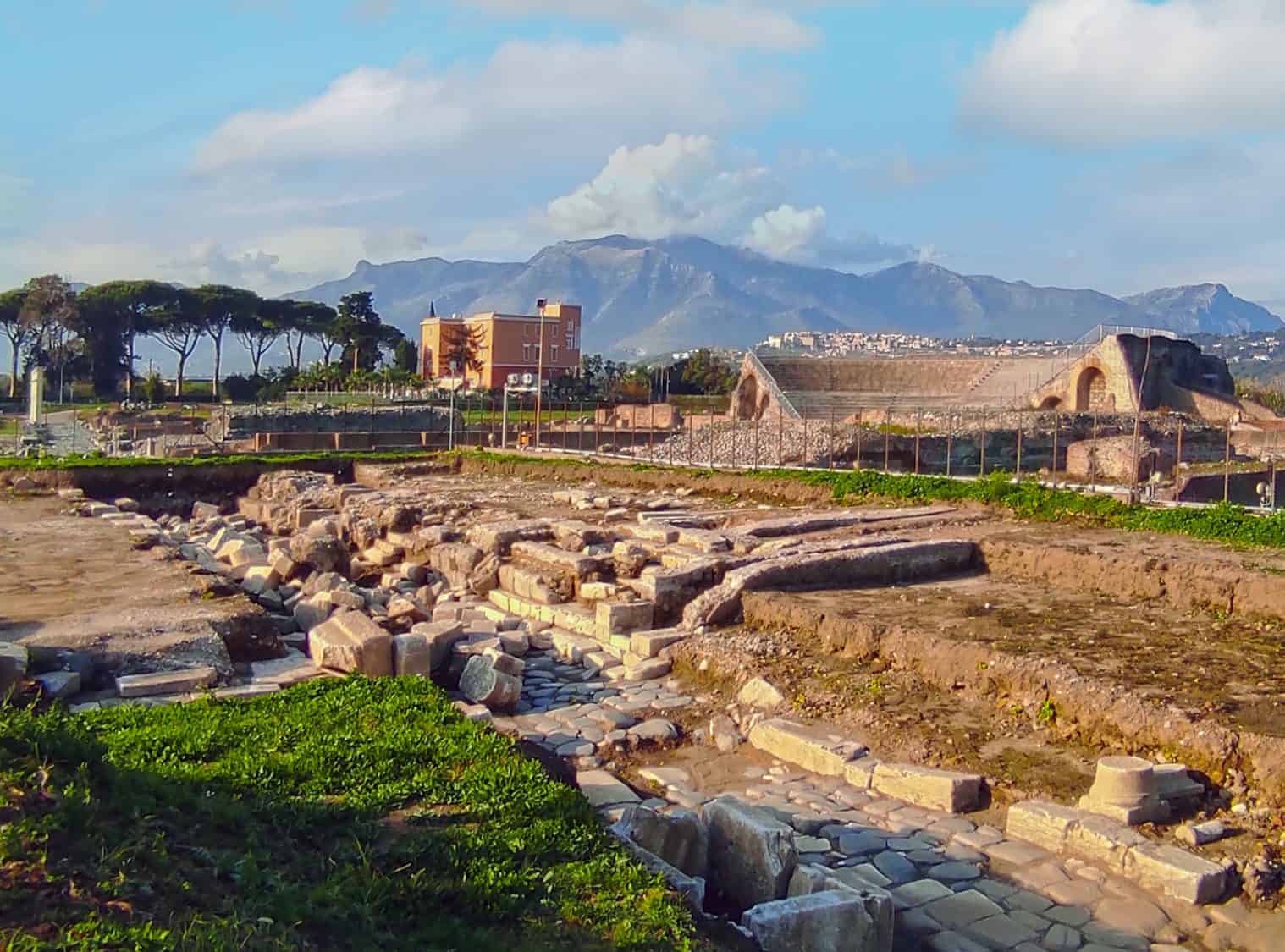
The real reason it is worth coming all the way down here is ancient Minturnae, the Roman city that stood on the right bank of the Garigliano, exactly along the route of the Appian Way. Founded as a Roman colony in 296 BC on a preexisting Ausonian center of the Aurunca Pentapolis, Minturnae grew as a commercial hub between Lazio and Campania and today preserves an archaeological park that holds together a theater, a forum, a market, a bath complex and an aqueduct. You walk on real stone, not on reconstructions: it is one of the sites where the archaeology of southern Lazio reads most clearly. You should allow at least two hours, and bring water and a hat, because the plain is open and in August the sun beats down.
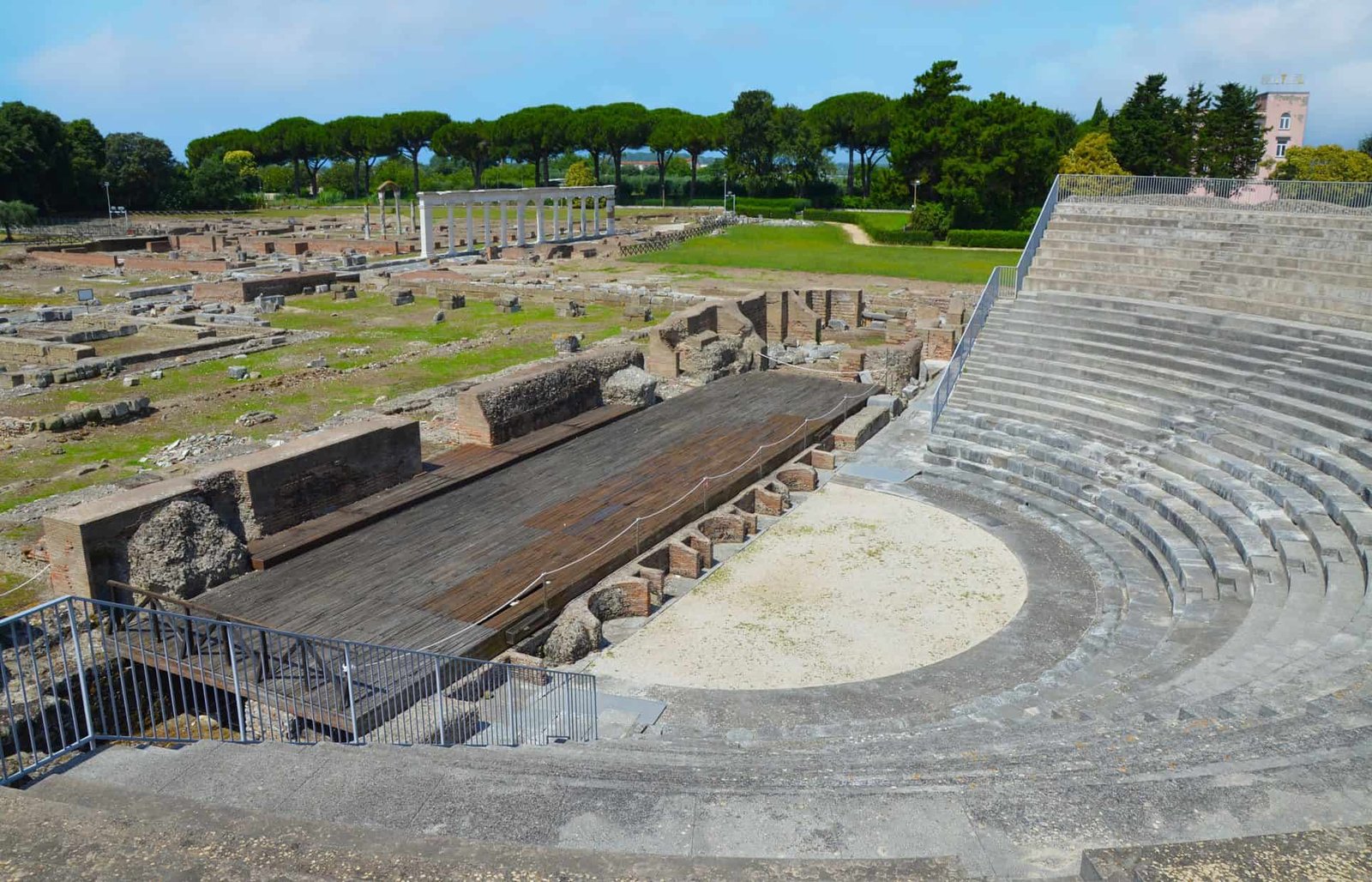
The Roman Theater of Minturnae
The theater is the monument that jumps out at you right away. Built around the 1st century AD, it was divided into the three canonical sectors of the ancient theater, the scaena at the back, the semicircular orchestra and the tiered cavea, and it held more than 4,000 spectators: a number that says how populous the colony was. The cavea leans on the natural slope of the ground in the Italic manner, and it is in the rooms beneath the tiers that the Antiquarium was created. Since 1960 the theater has gone back to doing its job: on summer evenings it hosts the Serate a Minturnae series, with drama, dance and music under the sky, and attending a show seated where the Roman colonists sat is an experience that no daytime visit gives back. If you can make the trip coincide with one of those evenings, do it.
The Antiquarium of Minturnae
The museum of the site is carved out of the spaces under the cavea of the theater and collects what has emerged from the excavations carried out from the last century onward: headless statues, sculptures, ex-votos, inscriptions, coins and assorted materials. Part of the coins was literally fished out of the Garigliano, and it is not just a colorful detail: the river was the waterway of the city and its bed has returned what the centuries had let fall there. The epigraphic and sculptural collection is rich and serves to reconstruct the events of southern Lazio between the Republican and the imperial ages. Look at the inscriptions calmly: they tell of magistrates, trades and cults of a city that is not an abstract name but a community whose incised names remain.
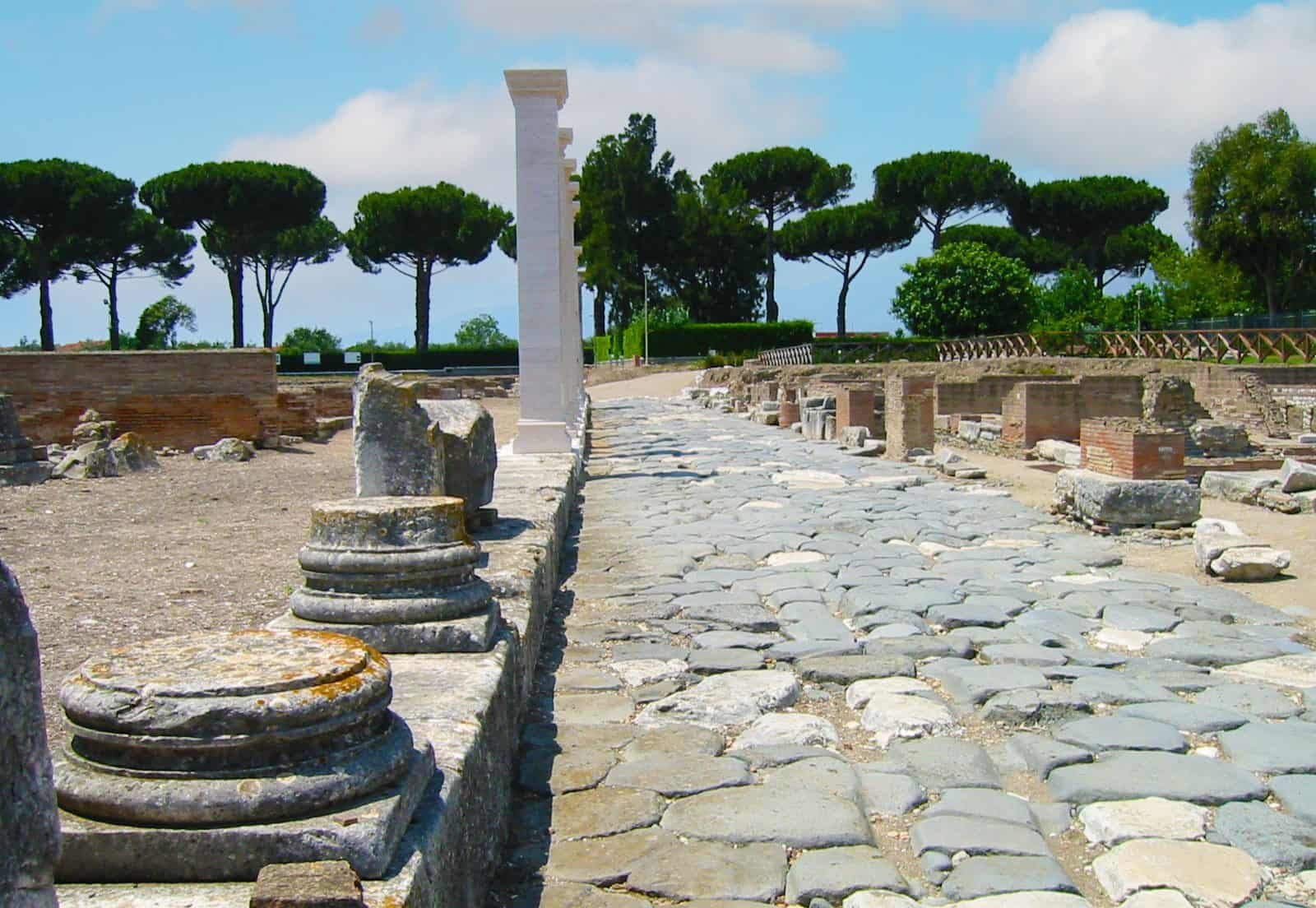
The Appian Way, the Decumanus of Minturnae
Inside the park you walk along an original stretch of the Appian Way, which here served as the decumanus maximus, the main axis of the city. It is paved with the large polygonal blocks of basaltic lava that are recognized all along the regina viarum, the dark compact stone that two millennia of carts have not worn down. Walking on it is the part of the site that strikes you most: it is not a remade road, it is the same stone on which passed the legions headed south and the medieval pilgrims headed to Rome.
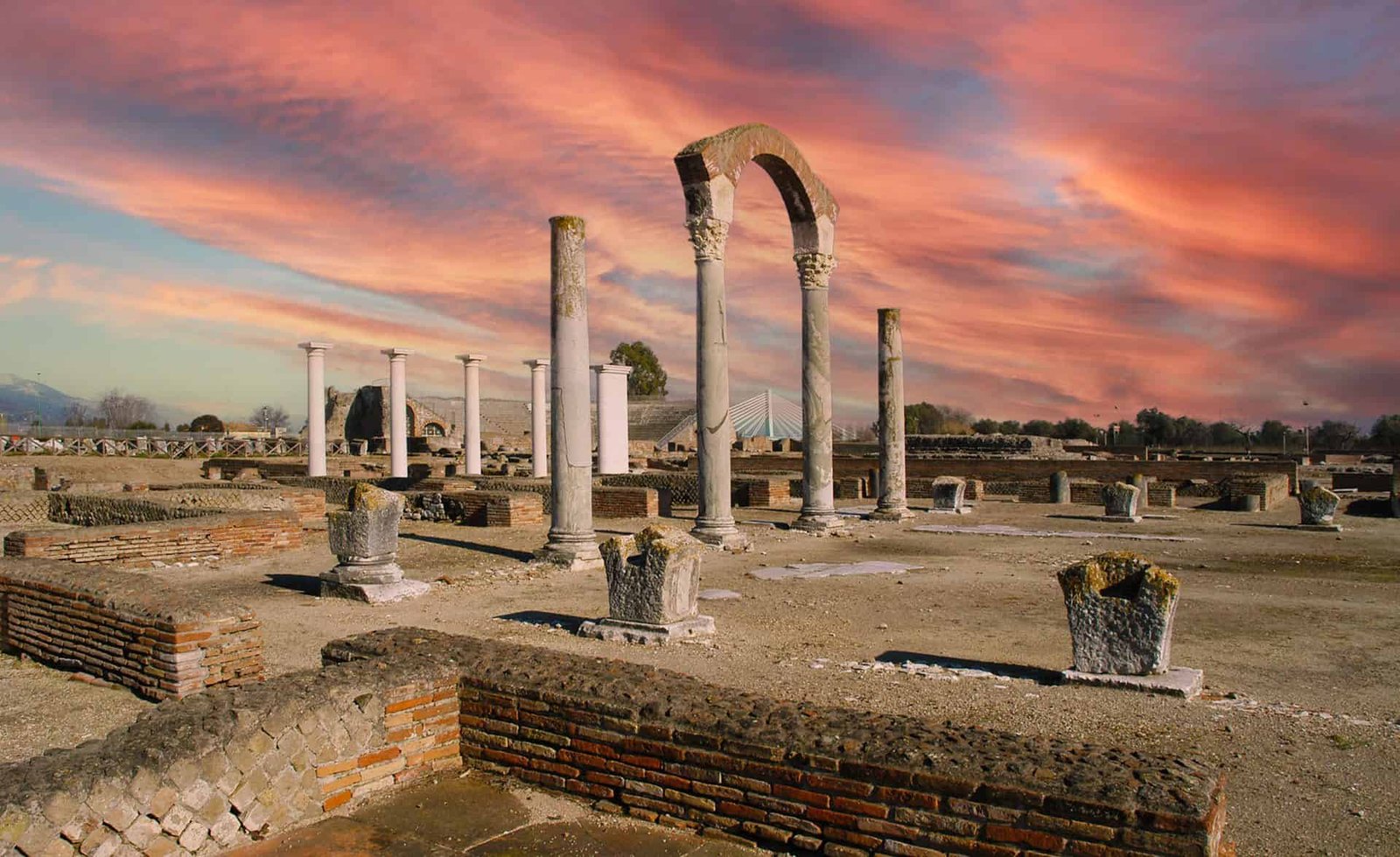
The Forum, the Capitolium and the Imperial Forum
Of the civic city remain the remains of the Republican Forum, datable to the 2nd century BC, with the Capitolium, the temple of the Capitoline triad dedicated to Jupiter, Juno and Minerva, which dominated the square as in every colony under Roman law. Alongside, the Imperial Forum developed later, a sign of urban expansion in the Augustan and later ages. Even in ruin the plan can be read, and it helps to understand how a Roman colony replicated on a small scale the urban model of the Urbe: the forum as political and religious center, the raised temples, the public buildings aligned on the axes.
The Macellum, the Tabernae and the Baths
The commercial city is documented by the macellum, the covered market, and by the tabernae, the shops lined up along the streets, where foodstuffs and manufactured goods were sold. The bath complex dates to the 2nd century AD and completes the image of a center equipped with all the services of Roman life. These are remains that visitors usually cross quickly to run to the theater, and they are wrong to do so: it is here, between a market stall and a bath basin, that the city stops being monumental and becomes everyday.
The Roman Aqueduct of Minturnae
The most scenographic sign of the site, after the theater, is the arches of the aqueduct. The conduit was about 11 kilometers long and brought to the city the water needed for the baths, the fountains and the houses. Of that route there remain imposing rows of arches that cut across the countryside toward the river. They are proof, if one were needed, that a Roman city cannot stand without water: the aqueduct is the infrastructure that made everything else possible, and its bulk even today measures the ambition of those who built it.
The Sanctuary of the Nymph Marica
Toward the mouth of the Garigliano, where the river meets the sea, stood the sacred grove and the sanctuary of the nymph Marica, the deity of the waters venerated here since the earliest age. The sources describe her in a double and unsettling way: the goddess of water that shines under the light of the sun, but also the goddess who destroys, rages, consumes and dries up, as befits a power tied together to the fertility and to the fury of the river. The tufa temple was erected toward the end of the 6th century BC and later readapted in masonry by the Romans at the end of the 1st century. Marica is not just any deity: the Latin literary tradition, and Virgil in the Aeneid, make her the mother of King Latinus, the ruler who welcomes Aeneas to Lazio. This strip of coast, in short, is hooked to the founding myth of Rome.
The Statue of Trajan Found at Minturno
Among the most famous finds of the territory is a statue of the emperor Trajan, which emerged near the banks of the Liri-Garigliano. From the ancient model replicas were made that today are found in Rome, Ancona, Benevento and London: a case in which a provincial find enters the circuit of the great collections. It is a good example of how Minturnae was not a peripheral and poor center, but a city capable of erecting imperial portraits of quality.
The Historic Center of Minturno (Traetto) and Its Churches
After the end of ancient Minturnae the inhabitants moved to the nearby hill and founded there the medieval center of Traetto, which would carry that name until the 19th century. It is the village that today is visited on the hill: narrow alleys, porticoes, remains of reused Roman masonry and a dense fabric of churches. You get around on foot, unhurried, going up and down the ramps to the castle that crowns the town.
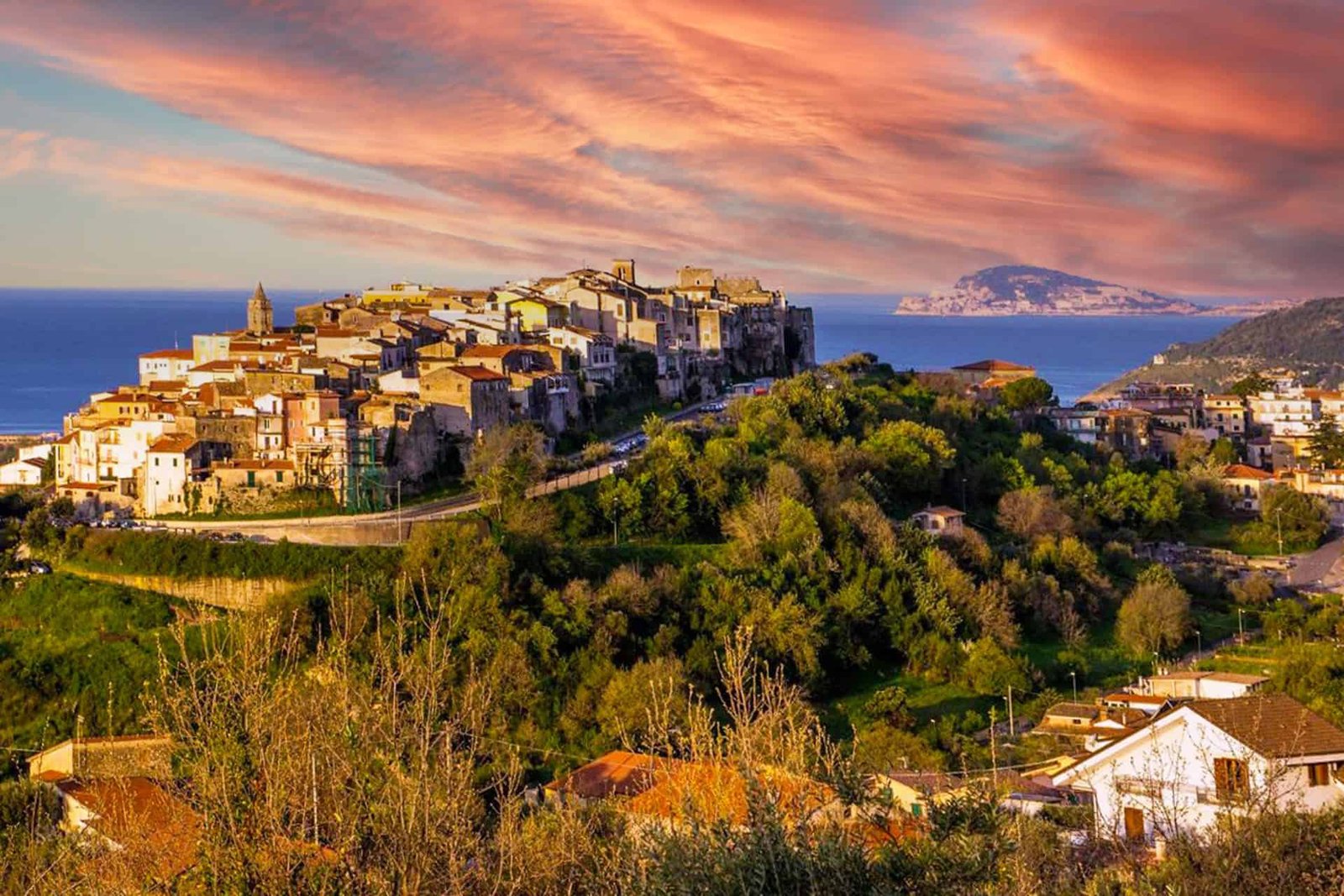
The Caracciolo Carafa Ducal Castle, the Baronial Castle of Minturno
The castle that dominates the village is the most important military construction of Minturno, known as the Ducal or baronial Castle Caracciolo Carafa. The most recent research attributes its origin to Bishop Leo, around the 9th century, a figure cited in a Cassinese document of 839. The structure shows a cylindrical tower, a patrol walkway and an inner portico with ogival arches. From the southeast entrance you pass into an entrance hall that leads into a courtyard with a pointed-arch portico and two-light windows, and from here a staircase climbs to the great Sala dei Baroni. The castle also had a tower 60 meters high, half destroyed by lightning in the 19th century. The property passed through the hands of the great families of the Mezzogiorno: in 1105 to Riccardo dell’Aquila, in the 13th century to the Caetani, in the 16th century to Giulia Gonzaga countess of Traetto and Fondi, then to Isabella Colonna, finally from 1693 to 1948 to the Caracciolo-Carafa, hence the name. On the second Sunday of July, for the sagra delle Regne, the castle is lit up by fireworks: it is the moment when the village shows itself at its best.
The Church of San Pietro Apostolo, Patron of Minturno
The church of San Pietro, between the 11th and 12th centuries, is the main one of the village and is dedicated to the patron of Minturno, San Pietro Apostolo. It preserves a pergamo, that is, an ambo, considered among the most beautiful in Italy: a sculpted medieval pulpit partly covered with Cosmatesque mosaics, the kind of liturgical furnishing that in southern Lazio reaches very high results. It is worth going in even just for that, and observing how stone and mosaic build an object at once functional and sumptuous. Devotion to San Pietro is the pivot of the religious calendar of the town.
The Church of San Francesco
The church of San Francesco was built between 1266 and 1272 at the wish of Count Ruggero II dell’Aquila, and then enlarged between 1488 and 1491 by Onorato II Caetani. On the right wall of the hall you admire the fresco of the Madonna delle Grazie, protector of Minturno, the same one to whom the great July festival is dedicated. The double date of construction and enlargement tells of two seasons of the village, the Angevin one and the Caetani one, and the stratification can be read in the masonry.
The Church of the Annunziata
The church of the Annunziata dates to the 14th century and preserves frescoes of the period, among them a Crucifixion dated 1333. Its history is a compendium of the misfortunes that have struck southern Lazio: it was damaged by Turkish pirates in 1552, by Napoleonic troops in 1799 and by a fire in 1888, to be finally reopened in 1931. That a 14th-century fresco survived all this is already a small marvel.
San Biagio, the Congrega del Rosario and the Madonna della Libera
The village also preserves the former church of San Biagio, in the historic center, and the Congrega del Santissimo Rosario in Piazza Portella, today a conference hall but with a three-nave layout and an 18th-century wooden choir. In the locality of Fontana Perrelli instead is the church of the Madonna della Libera, of the 14th century, with a three-bay portico. They are minor places only on paper: taken together they say how dense was the religious life of a community that, for centuries, measured the year by the saints and the processions.
The Museo Etnografico Aurunco
On Corso Vittorio Emanuele you visit the Museo Etnografico Aurunco, a small museum of local costumes and peasant civilization that collects objects, tools and clothing of the Aurunca material culture (phones 0771 674311 and 339 4532902: it is best to call first for the hours, which are reduced). Do not expect a big museum: it is precisely its domestic scale that makes it precious, because it preserves the world that festivals like the sagra delle Regne stage. Seen after the archaeological site, it helps to understand that the territory is not only Roman stone, but also wheat, wedge clams and processions.
The Civil and Military Architecture of Minturno
Outside the village and the archaeological park, the territory preserves some works that tell of the modern age and of the border with the Kingdom of Naples, of which Minturno was part until Unification.
The Ponte Real Ferdinando over the Garigliano
Over the Garigliano you cross, or admire, the Ponte Real Ferdinando, the first iron-chain suspension bridge built in Italy. Designed by the engineer Luigi Giura, it was built between 1828 and 1832 and inaugurated by Ferdinand II of Bourbon: an avant-garde work of the engineering of the Kingdom of the Two Sicilies, with masonry piers and the deck held by chain stays. It marked the crossing of the Appian Way over the river and is today a monument protected by the Ministry of Culture. Stop to look at it: it is a piece of the history of technology that is usually associated with Victorian England, and instead it was born here, on the border between Lazio and Campania, a few years ahead of many European counterparts.
The Scauri Paper Mill and Goethe
Along the Appian Way, near the church of the Immacolata at Scauri, remain the perimeter walls of the old paper mill, the paper factory that supplied the Kingdom of Naples. It was cited by the German writer Johann Wolfgang von Goethe: a detail that ties this corner of coast to the great European travel literature, when the Grand Tour went down toward Naples traveling precisely the Appia.
The Coastal Towers
The defense against the pirates who infested the Tyrrhenian has left its watchtowers. At Scauri the Torre dei Molini is preserved, of the 14th century. On Monte d’Oro stands the Torre Quadrata called dei Cavallari, of the 16th century. They were the eyes of the coast, the alarm system that warned the villages when the sails of the corsairs appeared on the horizon: the same raids that in 1552 damaged the church of the Annunziata.
Scauri and Marina di Minturno: The Sea
Minturno is not only archaeology and village: it is also one of the most frequented marinas of the southern Pontine area. The coast extends for about 7 kilometers of beach, divided by two promontories, Monte d’Oro and Monte d’Argento, and in July and August it fills up. The urban part of the settlement descends continuously from the hill of Traetto to the coastal localities of Scauri and Marina di Minturno, where the seafront offers entertainment by day and by night.
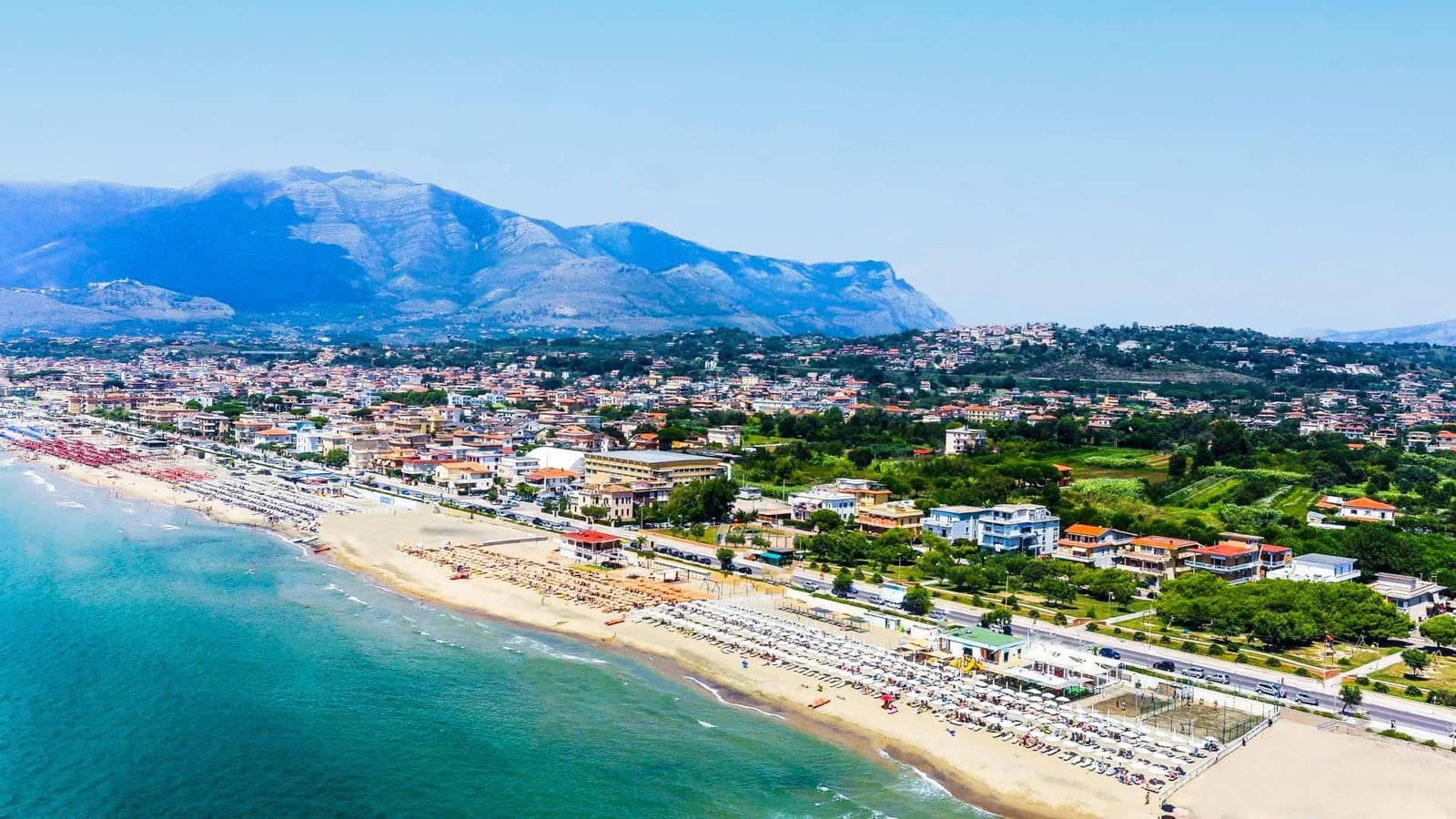
The Sassolini Beach at Scauri
Among the best-known beaches is the Sassolini beach at Scauri, which owes its name to the pebbles and the clear water under the promontory. It is here that in summer some of the events of the territory are concentrated, from food and wine to music. If you are looking for a less crowded stretch, move toward the foot of Monte d’Argento, where the coast becomes rockier and more secluded.
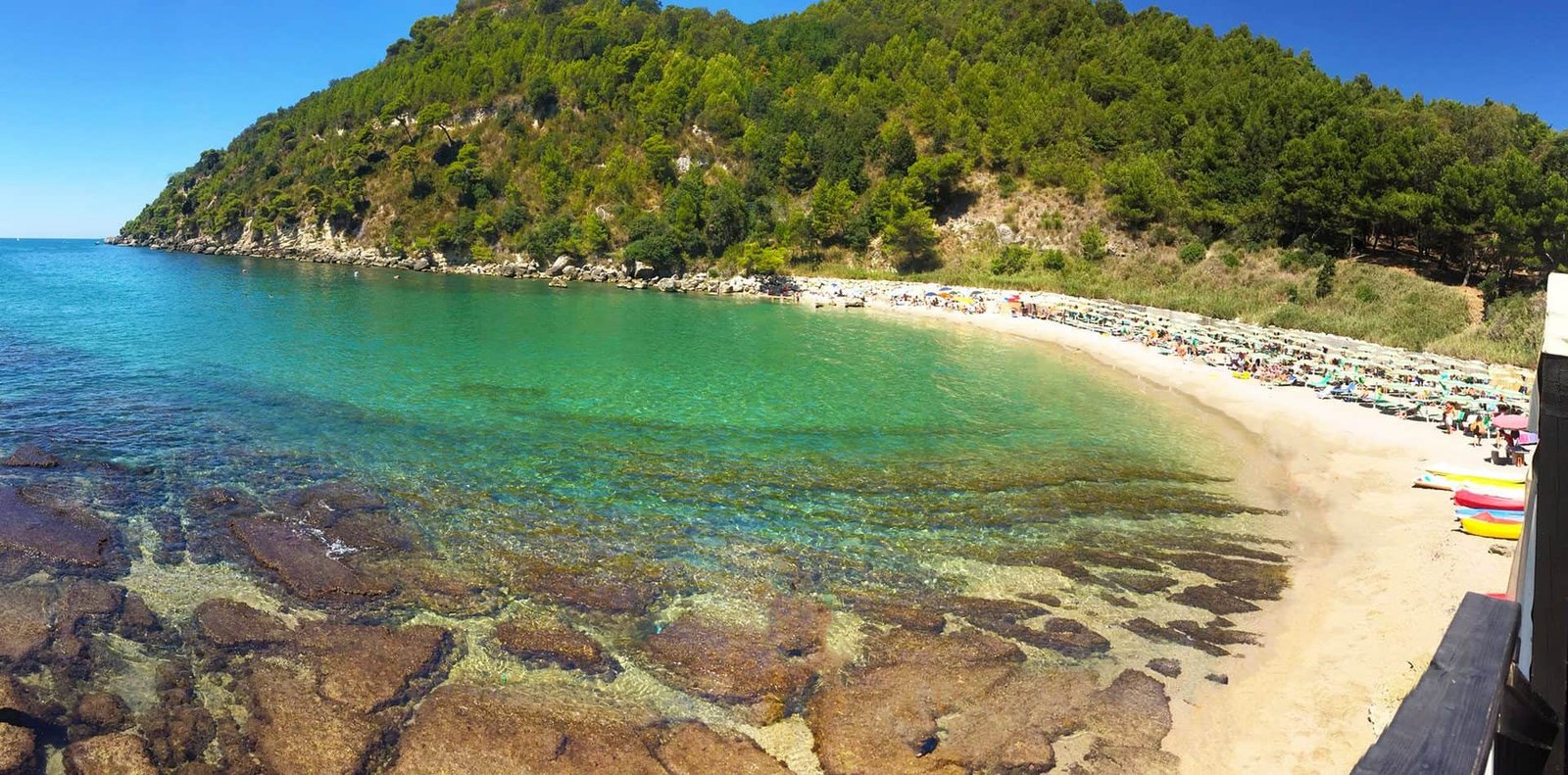
Monte d’Oro and the Scauri Coast
The promontory of Monte d’Oro closes the coast to the north and preserves, at the top, the Torre Quadrata called dei Cavallari, of the 16th century, one of the lookouts that watched the sea for corsairs. Below, the coast of Scauri alternates stretches of sand and rocky stretches, with water that stays clear at the foot of the hill. It is the part of the coast I prefer when I look for a swim with a bit of character, away from the lined-up umbrellas of the flat marina: here the beach narrows under the greenery and the landscape already resembles that of the nearby Gulf of Gaeta.
Monte d’Argento
Monte d’Argento, at the mouth of the Garigliano, is a natural monument that closes the coast to the south. It is a low promontory, covered with scrub, with a past of tower and fortified settlement that watched over the mouth. From its summit the gaze takes in the Gulf of Gaeta on one side and the river plain on the other: one of the best viewpoints of the whole Riviera di Ulisse.
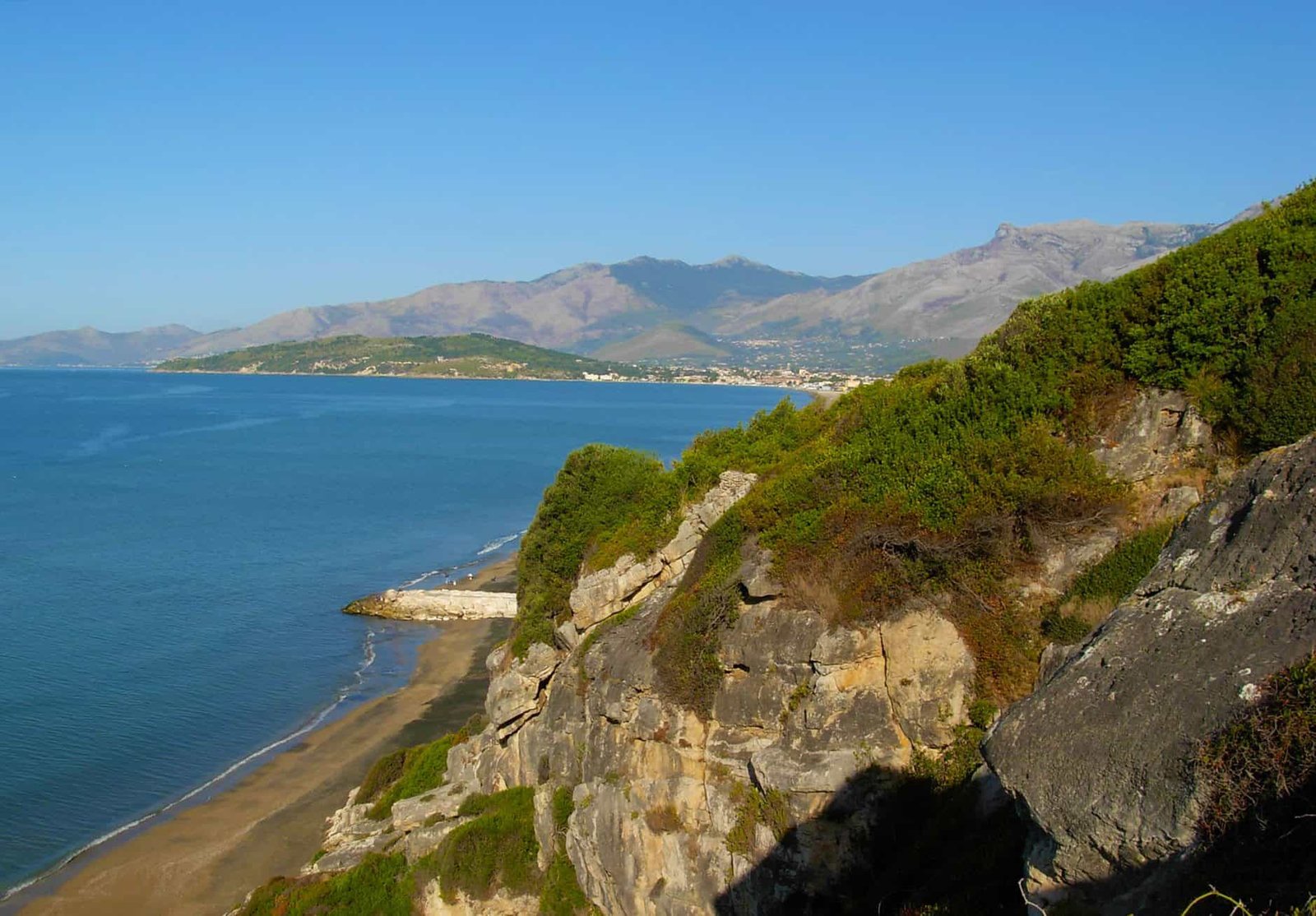
The Natural Areas Around Minturno
Behind the marina open protected green spaces. The Gianola and Monte di Scauri Regional Park, included in the system of the Riviera di Ulisse, protects a stretch of coast among Mediterranean scrub, pine woods and Roman archaeological remains overlooking the sea. The Gianola area was for a long time a WWF Blue Oasis. It is the right place for those who want to alternate the beach with a walk in the shade, among paths, coves and glimpses of the gulf. For a more demanding outing, behind the town rise the Aurunci Mountains, with their hiking routes and the regional nature park that protects them.
The History of Minturno (LT)
The story of Minturno is in reality the story of two cities: ancient Minturnae on the plain, Roman, and medieval Traetto on the hill, which is the daughter of the other. It is worth keeping them distinct to understand the territory.
Minturnae, the Roman Colony
Minturnae stood along the Appian Way, near the Garigliano, on a preexisting Ausonian center belonging to the Aurunca Pentapolis. After the defeat of the Aurunci people in 314 BC during the Second Samnite War, the Romans destroyed the cities of the Pentapolis. Minturnae was refounded as a Roman colony in 295 BC. Near the mouth of the river stood the sacred grove of the goddess Marica, and in those very marshes, in 88 BC, the consul Gaius Marius found refuge, hunted by the men of his rival Sulla. The city prospered for centuries as a node of the Appia and was finally destroyed, probably by the Lombards, between 580 and 590.
Traetto, the Medieval Village
After the end of Minturnae the survivors took refuge on the nearby hill and founded Traetto, whose name derives from the scafa, the cable ferry that joined the two banks of the Garigliano. In the 8th century the Patrimonium Traiectum arose there, a latifundium managed by a deacon directly dependent on the Pope. Surrounded by walls, the city was destroyed in 883 by the Saracens, who came in large part from Muslim Sicily, and who were then driven out in 915 by the league promoted by Pope John X. Passed under Gaeta, it was devastated again by the Hungarians. In 1061 Abbot Desiderius of Montecassino granted the inhabitants the chartae libertatis, the charters of franchise. Conquered then by the Normans of Sicily, in the 12th century it belonged to the Norman family dell’Aquila. In 1497 it was donated by Frederick of Aragon, king of Naples, to Prospero Colonna, after the confiscation from the pro-French Onorato Gaetani dell’Aquila, first duke of Traetto from 1493. There followed the Gonzaga, the Carafa of Stigliano and the Counts Carafa of Traetto. On Easter Day of 1799, during the Napoleonic occupation, the village was assaulted and taken by Franco-Polish troops as part of the reprisals against the towns that had sided with Fra’ Diavolo: 349 people of Traetto died there and many inhabitants of the neighboring towns. On July 13, 1879 Traetto took back the old name of Minturno.
Minturno, the Meaning of the Name
The name deserves a chapter of its own. Until the 19th century the village was called Traetto or Traietto, from the Latin Traiectum, that is, from the ferry over the river. The ancient name Minturnae, taken up again in 1879, instead has assonances with the chthonic goddess Manturna, personification of volcanic force. According to other readings the root mant-, ment-, mint- and the suffix -rno reveal a Tyrrhenian or pre-Aryan origin. There is no lack of more fanciful hypotheses, which break the name down into min and turn, or trace it back to the Etruscan Mintur, burning sun. These are hypotheses to handle with caution, but they say one true thing: the name is very ancient and sinks into a pre-Roman substratum that nobody reads with certainty anymore.
The Minturnese Dialect
Anyone with an ear notices it right away: in Minturno people do not speak Romanesco. The Minturnese dialect is a southern Lazio speech strongly influenced by Neapolitan, above all in prosody, that is, in the melodic line and cadence. Scholars define it as a Neapolitan modified by the speech of Lazio and Abruzzo. On the phonetic level one finds Sabine metaphony, typical of the median dialects of the provinces of Latina and Frosinone, with some minority traces of Romanesco. It is a linguistic border before it is a geographic one: here Lazio ends and, to the ear, the South begins.
Festivals and Traditions of Minturno
The calendar of Minturno is very full, between sacred and profane, and reflects a territory that runs from the farming hill to the tourist marina.
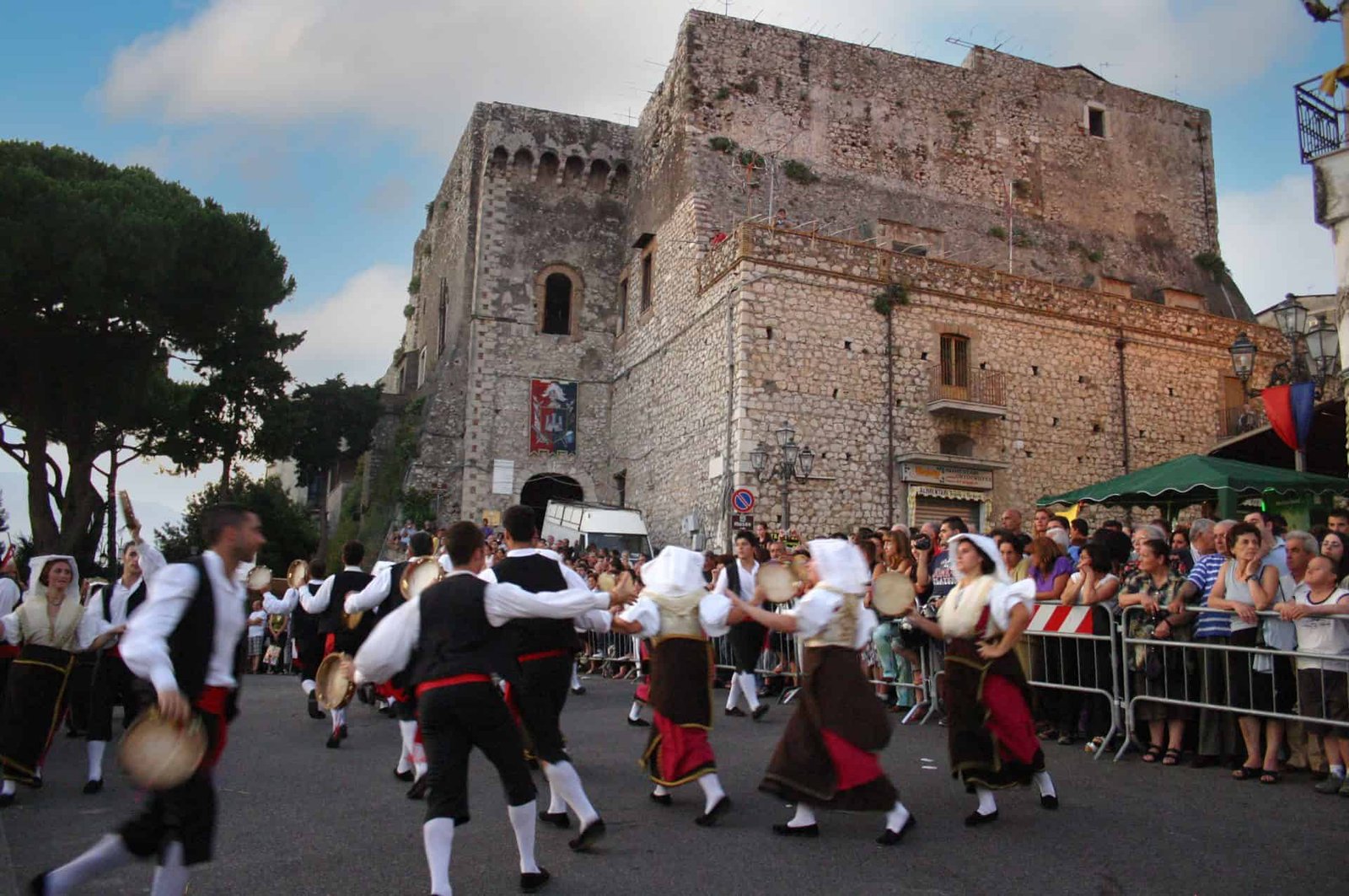
The Sagra delle Regne, the Wheat Festival
The most identity-defining is the Sagra delle Regne, on the second Sunday of July: at once wheat festival and religious event dedicated to the Madonna delle Grazie, with origins that sink into agrarian rites of the Roman age. The term Regne comes from the Latin gremia, the bundles of ears of grain: the festival stages the harvest cycle with floats, traditional costumes and the parade of the sheaves, and it closes with the fireworks that light up the castle. It is the occasion on which the Museo Etnografico Aurunco comes out of its display cases and returns to the street. If you have to choose a single day to come to Minturno, choose this one.
The Other Festivals of the Year
The rest of the calendar is dense. At Scauri Carnival brings the parade of floats and entertainment on the seafront on Shrove Tuesday. At the start of May the village re-enacts the Middle Ages with Un salto nel Medioevo. Holy Week is intense: Via Crucis of Palm Sunday takes place among the remains of Minturnae, and at Pulcherini since 1967 the Passio Christi is staged on Good Friday, one of the most appreciated performances in southern Lazio. In summer the marina lights up: at Scauri, on the Sassolini beach, the food and wine event Mare in cantina is held in the second half of July and the festival Luppolo di mare, dedicated to the sea and craft beer, on the first Friday of August. The Festival del Sud Pontino brings international folklore in the first half of August, while Arrivederci a Scauri closes the season on the second-to-last weekend of the month, with the procession of illuminated boats, competitions, shows and fireworks. In September the Visioni Corte International Short Film Festival rewards independent short film. The devotional calendar then counts the festa della pacchiana in mid-July at the Marina, San Nicandro Martire at Tremensuoli in August, Maria Bambina at Santa Maria Infante and the Nativity of Mary at Scauri on September 8, besides the fair of Santa Lucia on December 13 and the living nativity in the village at Christmas, with the exhibition Natale al Castello in the first 10 days of December. Before planning the trip around one of these dates it is best to verify it, because some shift from year to year.
Around Minturno
The municipality includes several hill hamlets that deserve a detour, and borders on towns just as interesting.
The Hamlets: Tufo, Tremensuoli, Santa Maria Infante, Pulcherini
On the hills behind the village are Tufo and Tremensuoli, small farming centers, and Santa Maria Infante, which was completely destroyed during the war and rebuilt in modern times. Pulcherini is known for the re-enactment of the Passion of Christ that since 1967 is held every Good Friday. They are towns of few houses and a lot of history, where the landscape of the Aurunci remains that of vineyards, olive groves and wheat.
Castelforte and the Gustav Line
Not far away, toward the Ausente river, stands Castelforte, surrounded by hills cultivated with vineyards, olive groves and citrus groves. It is one of only two municipalities in Lazio, together with nearby Santi Cosma e Damiano, awarded the Gold Medal for Civil Valor: a recognition that points back to the most dramatic season of this territory, when in the winter and spring of 1944 the front of the Gustav Line crossed it from one side to the other.
A Curiosity About Minturno (LT)
The curiosity that almost nobody knows concerns the nymph who set the tone for this whole territory: Marica. She was not a minor local deity, good only for a little country shrine. The Latin literary tradition, and in particular Virgil in the Aeneid, indicates her as the mother of King Latinus, the ruler who welcomes Aeneas to Lazio and whose daughter Lavinia becomes the bride of the Trojan hero. Put differently, the sacred grove at the mouth of the Garigliano, where few stones remain today, is hooked by myth to the very saga that leads to the founding of Rome. The sources describe her with a double face: goddess of water that shines under the sun, but also a power that destroys, rages, consumes and dries up, that is, at once the blessing and the threat of a river that gives fertility and brings floods. Knowing this, while you look at the plain toward the mouth, changes the way of being in that landscape: it is not just any marsh, it is a place that the ancients considered inhabited by a powerful and ambiguous deity. And it is a curiosity that does not appear in the first result of a search about the sea at Scauri.
Something Nobody Tells You About Minturno (LT)
Here is the practical piece of information that escapes almost everyone: the Roman theater of Minturnae is not a ruin to look at from behind a barrier, it is a working theater. Since 1960 it has hosted every summer a season of shows, the Serate a Minturnae, with drama, dance and music, and you sit on the tiers of the ancient cavea to watch them. Whoever organizes the visit only by day, with the sun straight overhead on the plain, misses the best version of the site: the evening one, when the stone cools, the arches of the aqueduct become a natural backdrop and the place goes back to doing exactly what it was built for 2,000 years ago. Another thing that goes unsaid: a large part of the coins displayed in the Antiquarium was fished out of the Garigliano, not dug from the earth. The river was the waterway of the city and its bed returned what the centuries had made fall there. Whoever visits the museum thinking of a normal excavation storeroom misses this detail, which instead tells of the deep, almost physical relationship between Minturnae and its river.
The Advice I Give You for Visiting Minturno (LT)
The advice is not to treat Minturno as a beach with a few ruins next to it, but to reverse the order. Arrive by train early in the morning, take the shuttle or a taxi to the archaeological complex when it opens, at 8:30, and enjoy the site in the cool and with nobody around: two hours for the theater, the forum, the Appia and the aqueduct, unhurried. Mid-morning go up to the village of Traetto, visit the church of San Pietro with its pergamo and the castle, and have lunch in town, up high, where you eat better and spend less than on the seafront. In the afternoon, if it is the season, go down to Scauri for a swim and stay until evening. And here is the real advice: try to make the day coincide with an evening show at the Roman theater in summer, or with the second Sunday of July, when the Sagra delle Regne takes place and the castle lights up with fireworks. Avoid instead the Ferragosto weekend if you are looking for tranquility: the marina fills up and the magic of the archaeological site dilutes in the crowd. Minturno gives its best to those who take it in the right order, first history in the cool, then the sea.
Another Well-Known Fact, and Yet Rarely Cited
Everyone knows that the first iron-chain suspension bridge is a symbol of 19th-century engineering, and almost everyone associates it with England or the United States. Few remember that the first one built in Italy is right here, on the Garigliano, at the gates of Minturno: it is the Ponte Real Ferdinando, designed by Luigi Giura, built between 1828 and 1832 and inaugurated by Ferdinand II of Bourbon. It was an absolutely avant-garde work for its time, with the deck held by iron chains anchored to masonry piers, and it served to carry the Appian Way over the river that marked the border of the Kingdom of the Two Sicilies. It is a well-known fact among those who study the history of technology, and yet rarely cited when speaking of this stretch of coast, where attention goes entirely to the sea and Roman archaeology. It is worth stopping to look at it, thinking that, when it was inaugurated, in much of Europe suspension bridges were still an experimental novelty. The pre-Unification Mezzogiorno, which the conventional account paints as backward, had built here something that anticipated the times.
The Right Photo to Take in Minturno (LT)
The photograph you take home from Minturno is the one of the Roman theater with the arches of the aqueduct in the background. Stand at the back of the cavea, or better high on the tiers, and frame the scaena taking care to let into the field, behind, the rows of arches that cut across the plain: you have in a single shot two monuments and the Garigliano countryside that holds them together. The best light is that of late afternoon, when the raking sun carves the stones and lights up the basalt and the brick with ocher. At noon, with flat light, the theater loses depth. If you happen to be there on a show evening, the photo changes completely: the populated tiers, the stage lights and the sky darkening behind the aqueduct give an image that no daytime visit allows. The second photo not to miss is from the top of Monte d’Argento, at the mouth of the river: from up there the whole Gulf of Gaeta enters the frame on one side and the plain with the ruins on the other, and it is the best way to understand, with your eyes, how sea, river and ancient city were always the same thing.
Some Important Events That Happened Here in History
This strip of coast has seen a lot of history pass, and not always peaceful. The most famous ancient episode is the flight of Gaius Marius: in 88 BC the consul, seven times at the head of the Republic, hunted by the hired killers of his rival Sulla, found refuge in the marshes of Minturnae near the mouth of the Garigliano. Plutarch tells it: captured and destined to die, Marius stared with such force at the soldier sent to kill him that the man, terrified, fled, and the people of Minturnae ended up letting him escape by sea toward Africa. It is one of those moments in which a provincial marsh enters the great history of Rome. Many centuries later, the territory was repeatedly devastated: by the Lombards who destroyed ancient Minturnae between 580 and 590, by the Saracens who razed Traetto to the ground in 883, by the Hungarians afterward. On Easter Day of 1799 the Franco-Polish troops assaulted and took the village as part of the reprisals against the towns that had lent support to Fra’ Diavolo, and 349 people of Traetto died there. The last great drama is that of 1944: during the Second World War the front of the Gustav Line crossed the Garigliano, and the river valley was the theater of very harsh fighting that wiped out entire towns, like Santa Maria Infante, later rebuilt. Whoever walks today on these quiet beaches rarely imagines that 80 years ago they were a front line.
Who Passed Through Minturno (LT)
For a provincial center, the list of who passed through here is surprising. The first, in chronological order, is the consul Gaius Marius, who took refuge in the marshes in 88 BC, an episode that made Minturnae a place of Republican memory. In the modern age the village, then Traetto, was the fief of Giulia Gonzaga, countess of Traetto and Fondi, one of the most famous and cultured women of the Italian Renaissance, at the center of a literary court and of bitter political and religious events. On the literary side, the German writer Johann Wolfgang von Goethe, going down along the Appia toward Naples, cited the Scauri paper mill in his travel notes, tying this corner of coast to the season of the Grand Tour. And it was Ferdinand II of Bourbon, king of the Two Sicilies, who inaugurated in person in 1832 the Ponte Real Ferdinando over the Garigliano, giving his own name to the work. Local tradition also recalls the passage of Saint Thomas Aquinas, whose family was tied to southern Lazio and who died in 1274 in the nearby abbey of Fossanova. It is a devotional memory more than a documented fact, and as such it should be taken. Among saints, kings, condottieri and men of letters, in short, Minturno has seen pass more world than its present silence lets you imagine.
The Table of Minturno: Sea and Land
The cuisine of Minturno tells of the double face of the territory, the sea and the hill. From the Tyrrhenian come the wedge clams, the small mollusks fished along the shoreline and to which a festival of art and folk music is dedicated in the last 10 days of July, tied precisely to the tradition of their fishing. From the Aurunci countryside instead come the wheat, celebrated in the Sagra delle Regne, and the products of the olive groves, vineyards and citrus groves that surround the hill hamlets and neighboring towns like Castelforte. It is the kind of gastronomy you do not find in the luxury circuits but in the sagre and village trattorias, where blue fish and seasonal vegetables count more than fashions. Better to eat up high, in the village, where prices stay honest, and leave the seafront for the evening aperitivo.
How to Organize the Visit to Minturno (LT)
A few practical notes to make the day work. The archaeological complex is all outdoors and flat, so it is easily done even with a stroller, but in summer there is no shade: hat, water and closed shoes are the minimum kit, because you walk on ancient paving and on uneven ground. The village of Traetto, on the contrary, is all ups, downs and staircases: comfortable for those who walk well, tiring for those with mobility problems. For parking it is best to leave the car in the spaces at the edge of the upper village and climb on foot, while at the marina in high season a spot is a rare commodity and the train remains the most sensible choice. If you have a single day, the order that works is archaeology early in the morning, village and lunch midday, sea in the afternoon. If you have a weekend, add a morning on the paths of Gianola or the Aurunci and a trip to Gaeta or Sperlonga.
What to See Near Minturno Along the Riviera di Ulisse
If you devote more than a day to the southern Pontine area, Minturno is an excellent base camp. A few kilometers away are Formia, with its port and Roman villas, and Gaeta, with the split mountain and the medieval quarter. Continuing along the coast you meet Sperlonga, the white village perched over the sea with the grotto of Tiberius. Inland, Itri, homeland of Fra’ Diavolo, is worth the detour, while mountain lovers find the paths of the Aurunci Mountains Nature Park and of the Aurunci Mountains area. The whole territory belongs to the Riviera di Ulisse, and those with more time can push on to the beaches of Sant’Agostino at Gaeta or embark for the islands of Ponza and Ventotene.
Quick Questions About Minturno (LT)
How much is the ticket for the Minturnae archaeological complex?
The full ticket costs €5, the reduced one €2 for young people between 18 and 25, with the free admissions provided by Ministry of Culture regulations. It is always worth rechecking the fare on the official website before the visit.
What are the hours of the Minturno archaeological area?
The archaeological area opens at 8:30 and closes at 16:00 in winter, at 19:00 in summer. The Antiquarium stays open until 19:30. On Tuesday closing is moved up to 13:30. The seasonal hours change, so it is good to verify them before leaving.
When is the Minturnae archaeological site closed?
The weekly closing is Monday. The site is also closed on January 1 and December 25.
How do you get to Minturno from Rome?
The most convenient way is the train: Minturno is on the Rome-Formia-Naples line and has its own stop, the Minturno-Scauri station, near the sea. By car you exit the A1 toward the Garigliano or follow the SS7 Appia along the coast.
How much time do you need to visit Minturno?
For the archaeological complex alone count about two hours. To see also the village of Traetto with the castle and the church of San Pietro, and to give yourself the sea at Scauri, you need a full day.
Can you swim at Minturno?
Yes. The coast counts about 7 kilometers of beach between Scauri and Marina di Minturno, divided by the promontories of Monte d’Oro and Monte d’Argento. The Sassolini beach, at Scauri, is among the best known.
What can you see in the Minturnae archaeological complex?
You see the Roman theater, the Antiquarium carved out under the cavea, an original stretch of the Appian Way, the remains of the forum with the Capitolium, the macellum, the tabernae, the baths and the arches of the aqueduct. Nearby are the area of the sanctuary of the nymph Marica and the Ponte Real Ferdinando.
How many spectators did the Roman theater of Minturno hold?
The theater, built around the 1st century AD and divided into scaena, orchestra and cavea, held more than 4,000 spectators. Since 1960 it hosts shows again on summer evenings.
Why was Minturno formerly called Traetto?
After the destruction of ancient Minturnae the inhabitants moved to the hill and founded Traetto, a name that derives from the scafa, the cable ferry on the Garigliano. The village took back the old name of Minturno on July 13, 1879.
What is the Sagra delle Regne?
It is the most identity-defining festival of Minturno, on the second Sunday of July: at once wheat festival and devotion to the Madonna delle Grazie, with floats, costumes and the parade of the sheaves. The name comes from the Latin gremia, the bundles of ears of grain.
Who is the patron of Minturno?
The patron is San Pietro Apostolo, to whom the main church of the village is dedicated, notable for the pergamo considered among the most beautiful in Italy.
Is it worth going up to the village of Minturno or is the sea enough?
Absolutely. The medieval village of Traetto preserves the Caracciolo Carafa castle, the church of San Pietro with its ambo, San Francesco with the fresco of the Madonna delle Grazie and very characteristic alleys. Stopping only at the sea means seeing half of Minturno.
Can the Ponte Real Ferdinando be visited?
The bridge over the Garigliano, the first chain suspension bridge built in Italy (1828-1832), is a protected monument and is admired from the outside along the route of the ancient Appian Way, on the border between Lazio and Campania.
Is Minturno suitable for a trip with kids?
Yes. The archaeological site is outdoors and easy to walk, the sea at Scauri is comfortable and in summer there are many festivals, from the Sagra delle Regne to the Carnival on the seafront. The Museo Etnografico Aurunco is small and suited to the little ones.
Is the Roman aqueduct still there at Minturno?
Yes, imposing arches are preserved. The conduit was about 11 kilometers long and brought water to the Roman city. Its rows of arches still cross the plain toward the river.
When is the best time to go to Minturno?
To combine sea and archaeology, from June to September. For the archaeological site without excessive heat, spring and early autumn. The second Sunday of July, with the Sagra delle Regne, is the date with the most spectacle, but also the most crowded.
What dialect is spoken at Minturno?
Minturnese is a southern Lazio dialect strongly influenced by Neapolitan in its cadence, with the metaphony typical of the median dialects of the provinces of Latina and Frosinone. To the ear it sounds like a Neapolitan modified by the speech of Lazio and Abruzzo.
Where is the sanctuary of the nymph Marica?
It stood toward the mouth of the Garigliano, where the river meets the sea, in an ancient sacred grove. The tufa temple dates to the end of the 6th century BC and was later readapted in masonry by the Romans.
Are there natural areas to visit near Minturno?
Yes, the Gianola and Monte di Scauri Regional Park, included in the Riviera di Ulisse, with paths, coves and Roman remains on the sea, and behind the town the Aurunci Mountains with their routes.
Is the Minturnae site wheelchair accessible?
The archaeological area is flat and largely passable, although the ground is ancient and uneven in some stretches. The village of Traetto, made of slopes and staircases, is instead demanding. For specific needs it is best to contact the ticket office in advance at 0771.680093.
Where do you park in Minturno?
In the upper village it is best to leave the car in the spaces at the edge of the town and climb on foot. At the marina, in July and August, parking is difficult: the train to the Minturno-Scauri station is often the best solution.
What do you eat in Minturno?
The cuisine joins sea and hill: from the coast come the wedge clams and the fish, from the Aurunca countryside the wheat, oil, wine and citrus. The village sagre are the best occasion to taste the traditional dishes.
What is the difference between Minturno, Traetto and Minturnae?
Minturnae is the Roman city on the plain, near the Garigliano. Traetto is the medieval village that arose on the hill after the destruction of the first. Minturno is the name that the village of Traetto took back in 1879, and that today indicates the whole municipality. They are three names for two places and one long history.
If I may leave you with one last impression: Minturno is a place that rewards those who are not in a hurry. In the same day you can touch the stone of the Appia on which the legions walked, sit where the Roman spectators sat, go up into a medieval village with a castle and a first-rate ambo, and end with your feet in the water at Scauri. Few places in southern Lazio hold together so many things in so little space. Come early in the morning, take it in the right order, and leave the sea for last.
Article written by the editorial team of TourLeaderPro, contact them for Private/Corporate/V.I.P. Tours and Experiences.
Planning a trip to Rome? The English-language guides to visiting the city are on ItalyPlanner.com.