Itri (LT)
In short. Itri (LT) is a municipality of a little over 10,000 residents in Latina Province, at 170 meters above sea level, in a valley of the Aurunci Mountains about eight kilometers from the coast at Gaeta and Sperlonga and about 130 kilometers from Rome.

Itri (LT) is a municipality of a little over 10,000 residents in Latina Province, at 170 meters above sea level, in a valley of the Aurunci Mountains about eight kilometers from the coast at Gaeta and Sperlonga and about 130 kilometers from Rome. The town is cut in two by Via Appia, State Road 7, which here runs exactly where the consular road of 312 BC ran. If you arrive by car, you take it from Fondi, coming from Terracina, or from Formia, coming from Naples. State Road 82 of the Liri Valley branches off from the town and climbs toward Campodimele and Abruzzo, while the Itri-Sperlonga provincial road descends to the sea and to Via Flacca. By train, Itri station is on the Rome-Formia-Naples line, the same one that serves Fondi-Sperlonga and Formia-Gaeta. Cotral buses connect the town with Fondi, Formia, Gaeta, Minturno, Terracina and Latina. The medieval village is free and always open. The medieval Castle, at Via Sant'Angelo 60 (phone 0771 732208), has a full ticket of €3, a reduced ticket of €1 for young people between 10 and 16 and for those over 65, free under 10, and a combined ticket of €5 that also includes the Museo del Brigantaggio, at Corso Appio Claudio 268 (phone 0771 721061), usually open Thursday afternoon from 15:00 to 19:00, Saturday and Sunday from 10:00 to 13:00 and from 16:00 to 19:00. Be careful though: the official websites of both currently indicate a temporary closure for maintenance work, so before leaving you should call the number of the Municipality's Culture Office, 0771 732208, or write to cultura@comune.itri.lt.it. The Sanctuary of the Madonna della Civita, on Monte Fusco, is on Via Santuario Madonna della Civita (phone 0771 727116) and is open all year, with Mass times published on its website. Town Hall is at Piazza Umberto I, 1 (switchboard 0771 7321).
To get your bearings among the villages and towns of Lazio worth reaching in a day, you can start from the page of tourist attractions of this site, where Itri is listed next to the other towns of the Riviera di Ulisse and the Aurunci Mountains.
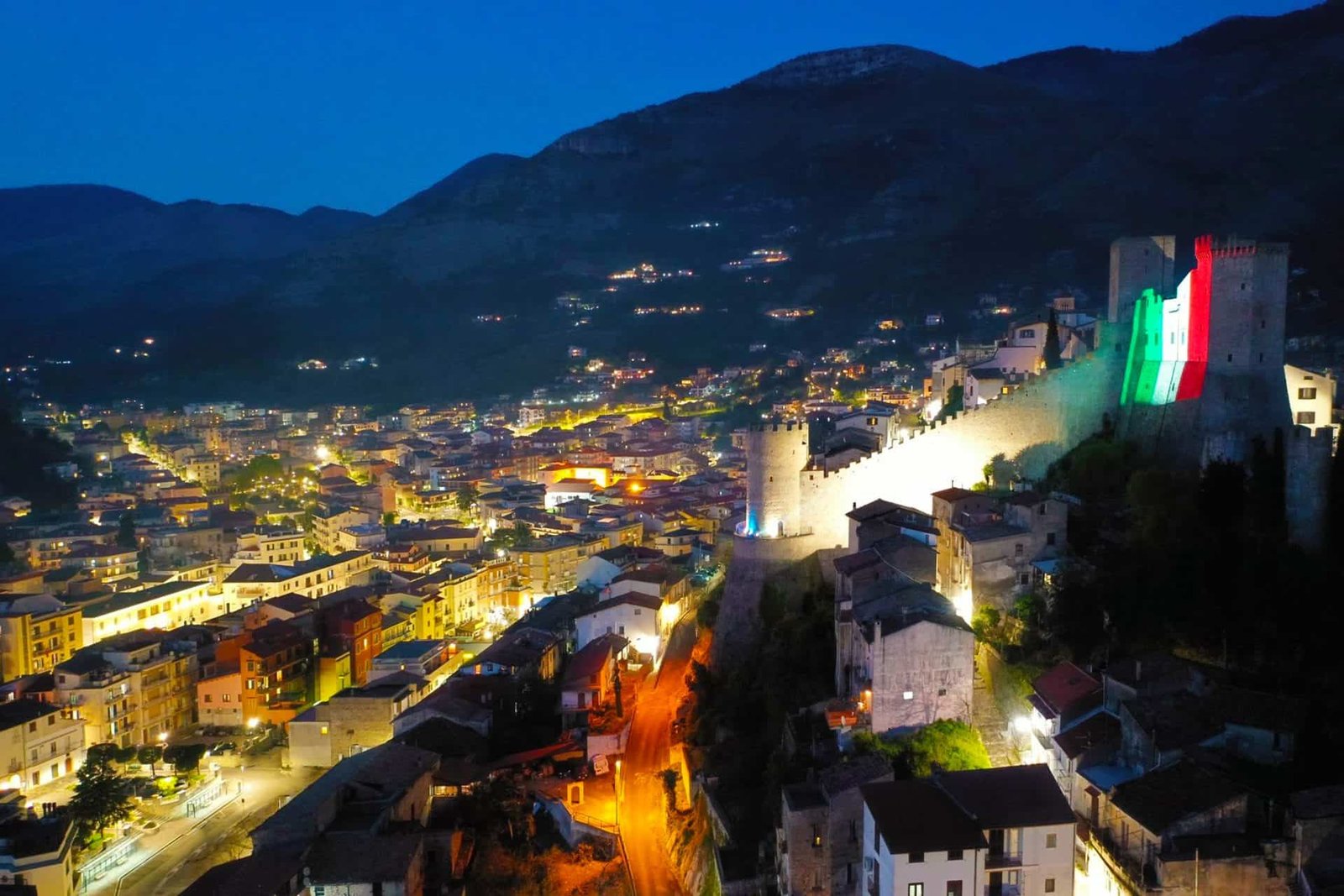
Itri (LT) at a glance: a town made of two towns
Itri is made up of two distinct cores, and understanding that before you arrive helps you not waste time. The first, the lower town, developed along Via Appia, in the valley of the Pontone stream (also called Rio Torto). It's the modern, commercial part, with the squares, the shops and the Museo del Brigantaggio. The second, the upper town, is perched on Sant'Angelo hill around the Castle, built starting in the 9th century and enlarged until the 13th. It's the real medieval village, with the mother church of San Michele Arcangelo, the alleys, the Jewish quarter. The two cores are separated by the stream and connected by ramps and narrow stone staircases, which are one of the most typical elements of the old urban structure of Itri. If you want to understand Itri, you have to climb them on foot, not go around them by car.
The position explains everything else. Itri is at the point where Via Appia, after the Fondi plain, slips into the Sant'Andrea gorges and crosses the ridge that separates historic Lazio from the Gulf of Gaeta. For 2,000 years, anyone going from Rome to Naples by land has passed through here: legions, pilgrims, merchants, French armies, brigands. The town was born as a rest stop along that road and has never stopped living off it.
Where the name of Itri (LT) comes from
The name most likely comes from the Latin iter (genitive itineris), "way, path," in evident reference to the route of Via Appia that connected Rome to Capua and then to Brindisi. In support of this etymology, the Municipality's tourist portal points to the plaque set into the wall next to Porta Mamurra, the historic entrance to the village, which carries the word ITER in a Roman inscription of the Republican age. There is also a legendary explanation, which the reader will find further on, tied to the serpent of the town's coat of arms and to the mythical coastal city of Amyclae. It's a nice story, but it has no documentary basis.
How to visit Itri (LT) and how much time you need
A complete visit takes a full day: two hours for the upper village and the Castle, one hour for the churches of the lower town and the Museo del Brigantaggio, half a day for the Civita Sanctuary on the mountain and for the stretch of ancient Via Appia in the Sant'Andrea valley. If you have only half a day, choose the village with the Castle and the stretch of Via Appia, which are a few kilometers from each other and tell the same story from two opposite points of view: from the top of the tower and from the bottom of the road. The Sanctuary deserves a trip of its own, in the morning light.
The Castle of Itri (LT), the fortress on Sant'Angelo hill
Itri Castle is a mighty medieval fortress set on the highest point of Sant'Angelo hill, from which it controlled Via Appia in both directions and, with its gaze, the sea. The official website defines it precisely as a "typical defensive structure meant for territorial control," built on the layout of an earlier fortification. It's the monument that gives the town its shape: the upper village wrapped itself around it like a spiral of houses, alleys and stairs, and from any point of the lower town the silhouette of the towers is the first thing you see.
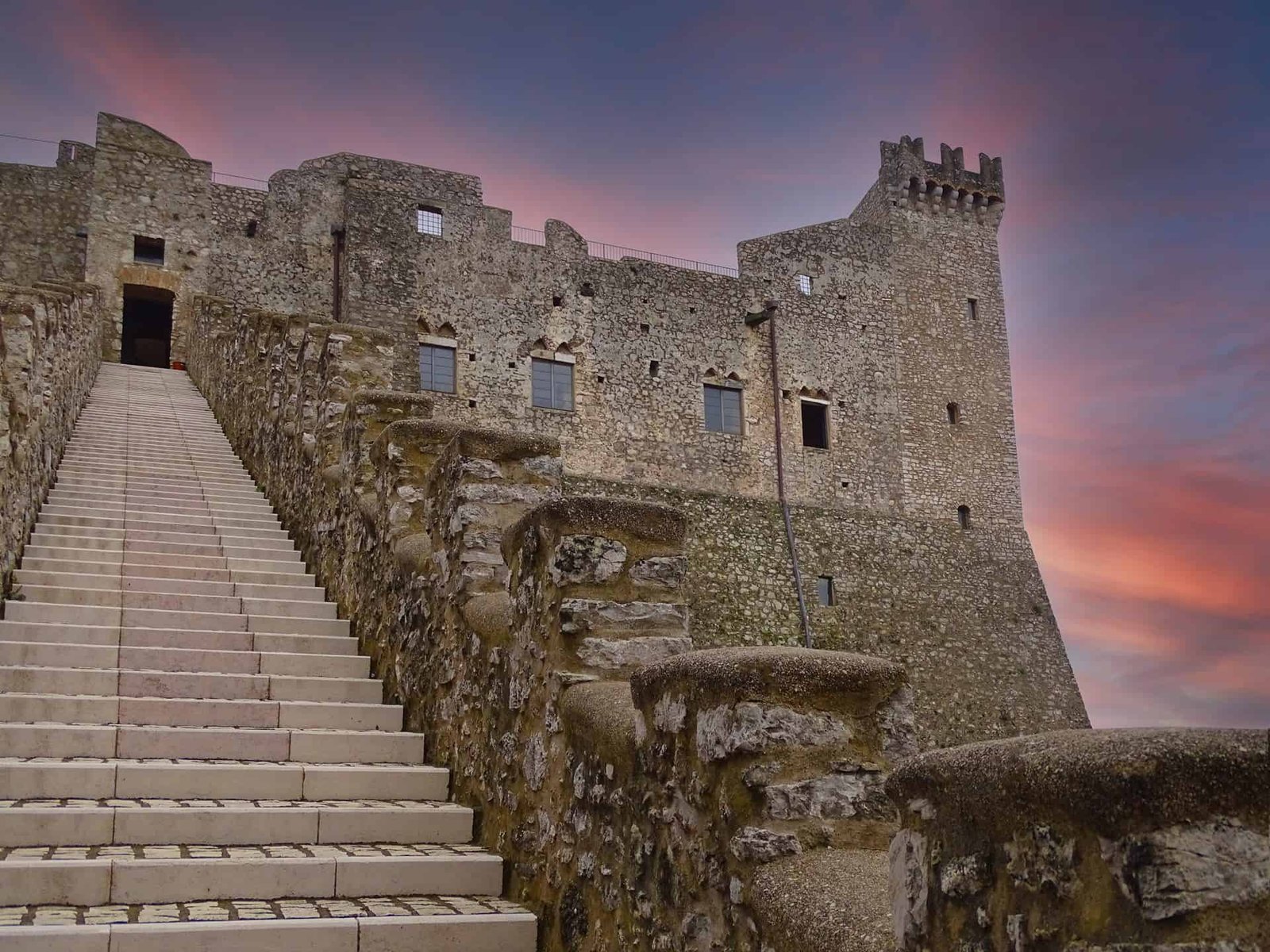
The three towers of the Castle of Itri (LT): 882, 950 and 1250
The Castle is built around a pentagonal tower with a small crenellated wall, which the historiographical tradition attributes to the Duke of Gaeta Docibile I and to the year 882. It was a lookout post against the Saracens, who in those years infested the Gulf of Gaeta and the lower Garigliano. In 950 Docibile's grandson, Marino I, had a second tower built next to the first, square, taller and more majestic. It's the keep of the castle, the one you see from afar. Around 1250 the complex received its final form with the construction of the living quarters, the cylindrical tower and the wall walk that joins the structures. Three centuries, three towers of different shape: pentagonal, square, cylindrical. It's a lesson in military architecture at a single glance, and whoever leads a group should stop at the entrance and have them recognize it before going in.
The Crocodile Tower
The cylindrical tower is also called the "Crocodile Tower," from a legend according to which at its bottom there was a water pool with one of those animals, to which those condemned to death were fed. The same legend circulates at Castel Nuovo in Naples, where it is in fact much more famous. It's a wandering narrative motif of the fortresses of the Kingdom, not a chronicle. But the tower really is the gloomiest space in the complex, and the idea that a prison lay at the bottom of a stone cylinder with no other openings is plausible even without exotic beasts.
The cavea and the ghetto: what you see from the entrance of the Castle of Itri (LT)
The complex also includes a lower stronghold, the cavea, with three small cylindrical turrets set at a lower level and visible from the main entrance. This part was used as shelter for the horses, the servants and the gendarmes: the garrison slept here, the lords above. From the cavea, through a small gate, you can see the Jewish quarter, Vico Giudea, which I talk about further on.
The living quarters of the Castle of Itri (LT)
The part meant for living is spread over two floors, each divided into three rooms. As you enter, immediately on the left, you find the three rooms of the main floor. From the second, a staircase descends to the lower floor, made up of three vast service spaces. Here are the remains of the oven and of the basin used to store food, still visible in the room on the left, and the ancient cistern where rainwater was collected. A castle on a limestone hill with no springs lives off cisterns: without collected water it can't withstand a siege of a week.
On the second floor you can see the remains of a fireplace and a fresco with Saint Anthony Abbot and the Madonna nursing the Child. At this spot the Caetani family, counts of Fondi, had a private chapel built, which suggests that the room in front was a lord's bedroom: people slept next to the altar, as in all the feudal residences of the time. Climbing the last flight of stairs of the square tower, you reach a broad terrace with a 360-degree view, from Via Appia to the sea.
The ghosts of the Castle of Itri (LT)
According to local legends, on stormy nights you can hear the wailing of ghosts and, above all, you can see cloaks floating along the wall walk that connects the castle to the Crocodile Tower. The Municipality's tourist portal reports the story without embarrassment. We report it here, with the warning that the cloaks are usually fog rising from the Pontone.
Giulia Gonzaga and the court of Fondi in the Castle of Itri (LT)
The Castle hosted Giulia Gonzaga (1513-1566), Countess of Fondi and Duchess of Traetto, the most celebrated woman of the southern Renaissance. Married at 13, in August 1526, to the old Vespasiano Colonna, and a widow at 15, she inherited the counties on condition of not remarrying and made the castle of Fondi, with Itri as a supporting fortress, into a court that Vittoria Colonna, Marcantonio Flaminio, Vittore Soranzo, Francesco Maria Molza, Francesco Berni, Pier Paolo Vergerio, Pietro Carnesecchi, the Spanish reformer Juan de Valdés and the painter Sebastiano del Piombo, who made her portrait, passed through. Cardinal Ippolito de' Medici courted her stubbornly and dedicated his translation of the Aeneid to her. The reader will find the story of Ippolito, and of his death right here in Itri, in the chapter on events.
From ruin to restoration: the Castle of Itri (LT) from 1944 to 2007
Damaged by the bombings of May 1944, the Castle was bought by the Province of Latina in 1979, for a symbolic price, from Dr. Francesco Saverio Ialongo, and then handed over to the Municipality of Itri. The initial plan was to house the Museo del Brigantaggio there. During the works, following a funding request to the European Community, the administration decided to place the museum in another area of the town, in the locality of Madonna delle Grazie, along the Appian Way. The first restored part of the Castle was inaugurated on June 4, 2003. The entire complex was opened on September 14, 2007. Today the official website of the castle offers a route of eight points of interest: the construction, the structure, the living quarters on the first and second floors, the service rooms, the assassination of Ippolito de' Medici, the round tower and the terrace.
Tickets and hours of the Castle of Itri (LT)
The official price list provides for €3 for full price, €1 for reduced (ages 10-16 and over 65), free admission under age 10 and for school groups from Itri, €2 for outside school groups and €5 for the combined ticket with the Museo del Brigantaggio (€3 for school groups). The website, however, reports a temporary closure for maintenance work and does not publish hours: call 0771 732208 before setting out. The advice: call the week before, not the same morning.
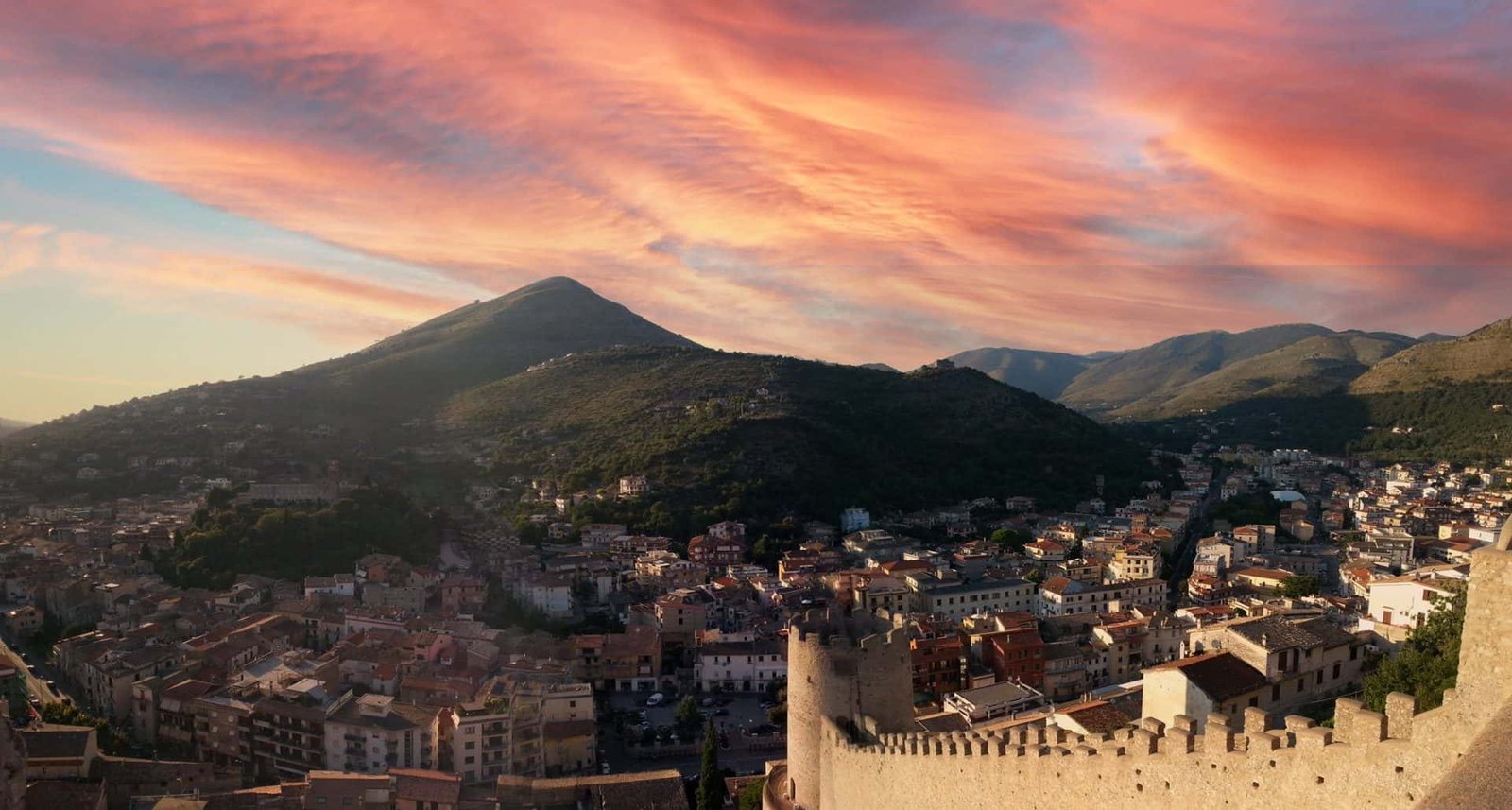
The upper village of Itri (LT): gates, alleys and the Jewish quarter
Porta Mamurra, the historic entrance to Itri (LT)
The visit to the historic center begins at Porta Mamurra, the historic entrance to the medieval village, which period images show with two arches and a circular defensive tower, later absorbed by the buildings that came after. On its sides the gate preserves four bas-reliefs with a snake and a dog's head, the symbols of the heraldic coat of arms of Itri, which the tourist portal of the Municipality cautiously attributes to the Lombards of the late 8th century. On the left side is walled in a slab of about two meters with the Roman epigraph «C. M. AGNIUS M. F. AE AEDIL. ITER», and it is that final word, ITER, that the town reads as its own birth certificate. On the sides of the jambs two stones in Lombard-Roman capital letters proclaim «CUSTODES SUMUS JTRI NOSTRI SAEVISSIMI VOBIS», «we are the guardians of our Itri, most ferocious to you», and, almost entirely covered, «NUI SEMO BILI. SERPENTES», the two-tongued serpents. A gate that threatens the stranger before even letting him in: few villages have such an honest calling card.
Vico Giudea and Vico Uso: the Jews of Itri (LT)
In the 15th century a group of Jews lived near the castle, in the area of present-day Vico Giudea. The tourist portal of the Municipality specifies that it was a reserved quarter, separated from the Christian population, rather than a ghetto in the strict sense. The community was small and had no real synagogue, and the faithful gathered for prayer in the house of the rabbi or of the elder. At the mouth of the alley remains an alabaster step with a hole, in which an iron piece of the gate that closed the passage during the night hours is believed to have been fixed. Opposite opens Vico Uso, whose name points to the trade in used cloth, the «rags», which was the typical activity of the community. Anyone looking for plaques, Hebrew inscriptions or a synagogue will be disappointed: the memory of that presence survives almost solely in the names of the alleys, and that is already a lot.
Lo Straccio, the district of the posting stations
At the foot of the Castle, along the route of the Appian Way, stretches the district called Lo Straccio, one of the oldest in Itri, born as a stopping point for those traveling on the consular road. There are two explanations for the name. The first derives it from the Latin statio, the posting station where tired horses were changed after the climb of the Sant'Andrea gorges. The second links it to the Jewish community, moved from the castle along the Appian Way and devoted to the trade in rags. The two hypotheses do not exclude each other, and in our judgment the first explains the place and the second the name.
Piazza Fra Diavolo and Largo Staurenghi
The route of the historic center proposed by the Municipality also touches Largo Staurenghi, Porta San Martino, Piazza Fra Diavolo and Vico Papa. Those are the names to look for on the signs as you climb toward St. Michael, and the square named after the brigand is the right place to remember that Michele Pezza was born in these houses, in 1771, before becoming an opera character.
The churches of Itri (LT), one by one
St. Michael the Archangel, the mother church of Itri (LT)
San Michele Arcangelo Church, in the upper village next to the castle, dates to the 11th century and is the oldest sacred building in Itri. It is dedicated to the town's patron saint. With three naves, in forms that local tradition calls Arab-Norman, it has a feature you notice right away: the square bell tower, adorned with colored majolica plates set into the masonry, is built against the facade at the main entrance, instead of being placed at the side as almost everywhere. It rises over four levels, from the entrance portal to the two mullioned windows and the triple-light window, with a spire at the top. It's the most photographed bell tower in Itri and the most beautiful monument in town after the castle: the little majolica tiles glittering in the gray stone are a gesture of grace in a defensive architecture.
Inside are kept a 15th-century fresco with the Virgin and Child and the wooden statue of Saint Michael the Archangel, placed in a niche of the high altar. Also kept here are some frescoes detached from the Annunziata church before the bombings of 1944 destroyed it: a last-minute rescue, which few visitors know about.
Santa Maria Maggiore, formerly Santissima Annunziata
Santa Maria Maggiore Church, which is in Piazza Annunziata in the lower town, is entered through a broad Gothic portico with three pointed arches and three portals, rebuilt after the destruction of World War II. The central one, larger, is also pointed and dates to the 14th century. The first records are from March 26, 1363, when the church is mentioned in the will of the Count of Fondi Onorato I Caetani, who left it 20 ounces. The exterior, in Lazio Romanesque taste, is decorated with bands of white stone alternating with brick, with cornices at the end of each level.
In the 1600s the church had three naves: the central one covered with a pitched roof, the high altar and the choir covered with a vault. There were the organ, the pulpit, the baptismal font and a bell tower with two bells. At the beginning of the 1700s it was enlarged and radically restored, and its main feature became the coffered ceiling gilded with pure gold, which was removed after a collapse in 1829, when the building was rebuilt in masonry. In 1944 the bombings destroyed it, with the exception of the 13th-century bell tower, restored in recent years. After the reconstruction the church, which keeps the silver bust of the Madonna della Civita, property of the people of Itri who paid for its making with a collection, took the title of Santa Maria Maggiore, keeping the old one of the Annunziata. The Municipality today indicates it as the Collegiata.
The interior has three naves. On the right opens the Crucifix chapel, with an inlaid marble altar whose altar front carves the Souls in Purgatory and, above the pediment, the Holy Shroud: a work attributable to the 18th century. The vault of the same chapel is decorated in stucco with angels holding the emblems of the Passion. A local tradition says it was made in 1827 by order of Pope Leo XII, but the workmanship places it in the 16th or at the latest the 17th century. In the altar of the left nave rests the body of Saint Constantius the martyr, with the remains covered in embroidered garments. In the predella of the chapel of the left nave there was an interesting canvas with the Preaching of Saint Thomas Aquinas before the Pope and a king, perhaps Charles I of Anjou.
San Francesco Convent and the Madonna by Cristoforo Scacco
San Francesco Convent, with the church of the same name, was founded in 1324 by the Count of Fondi Onorato I Caetani and is one of the first Franciscan convents born in the diocese of Gaeta. It stood in the lower part of the town, in the immediate vicinity of the Annunziata church, and contained an oratory dedicated to Saint John the Baptist, in which the brothers had the right of burial. From the Itri statute of the 1400s we know that Onorato II Caetani lived there for a certain period starting in 1487. A pastoral visit of 1722 describes the church with three altars: the main one with the image of the saint, and two side ones, of the Crucifix and of the Nativity. On the high altar the panel by Cristoforo Scacco with the Madonna enthroned with the Child between Saints Francis and John the Baptist, today in the Capodimonte Museum in Naples, seems to have been located. Scacco, Veronese by birth, was the most refined painter active between Fondi and Gaeta at the turn of the 1500s, and the migration of his altarpiece to Naples tells well how the heritage of the small suppressed convents was scattered in the 1800s.
Little remains of church and convent: the rooms were turned into private homes and a fresco survives in a building on the central Piazza Incoronazione. Two columns of the altar of the Civita Sanctuary and the washbasin of its sacristy come from here.
San Martino Monastery
The Benedictine monastery of San Martino was originally outside the built-up area, near San Martino in Pagnano. Abandoned as a result of the laws suppressing religious corporations of the Kingdom of Italy, when the legal number of nuns fell short, and occupied in a state of decay by the Sisters of the Most Precious Blood, it was then rebuilt inside the walls. Destroyed too by the bombings of 1944, it was rebuilt after the war. The name remains in the Porta San Martino of the upper village.
Santa Maria di Loreto and the Capuchins of Itri (LT)
On a hill once outside the town, now reached by the expansion of the built-up area, stands Santa Maria di Loreto Church with the attached Capuchin convent, from which the area took the name "Cappuccini." The Capuchin Fathers settled there in March 1574, first as owners and then, after the confiscation of church property, under long-term lease. At that time the building was isolated. They stayed until 1897. In 1910-1911, during the cholera epidemic that struck Itri, the convent was used as a lazaretto. The Passionist Fathers arrived on March 30, 1943, the day the deed by which the Municipality donated the complex to them was signed. The reconstruction work, wanted by Senator Pietro Fedele, historian and minister, married in Itri to Donna Tecla De Fabritiis, began in November 1941 and was completed after the war. The church holds, among other works, a painting of Saint Paul of the Cross, founder of the Passionists, attributed to Sebastiano Conca (1680-1764), the painter from Gaeta who was the most sought-after decorator of Rome in the early 1700s. The attribution is traditional, not documented, but the subject and the date of the saint's death (1775) suggest in any case a work from the circle or workshop.
The Sanctuary of the Madonna della Civita, the holy mountain of Itri (LT)
In the territory of Itri, on the summit of Monte Fusco, also called Monte della Civita, in the Aurunci range, stands the Sanctuary of the Madonna della Civita, one of the oldest places of Marian worship in Lazio and the most visited in southern Lazio. It venerates an ancient icon showing a dark Madonna with the Child, of Eastern workmanship and Byzantine style, which tradition attributes to Saint Luke because of three faded letters at the base, L.M.P., read as "Lucas Me Pinxit." Over the entrance stands the inscription "Terribilis est locus iste": this place is awesome, in the biblical sense of sacred.

The legend of the discovery
Tradition says that during the iconoclast persecution of the 8th century two Basilian monks, caught with the icon, were shut in a chest and thrown into the sea. After 54 days the chest landed at Gaeta, but the image vanished and was found by a deaf and mute shepherd on a holm oak on the mountain, and the shepherd regained speech and hearing. The more realistic version, which scholars prefer, speaks of Basilian monks fleeing the iconoclast East who brought the icon to the Aurunci and entrusted it to the Benedictines of San Giovanni in Figline. The first documentary records of the cult date to 1147.
The dates of the Civita Sanctuary
In 1491 Bishop Francesco Patrizi consecrated the enlarged church, dedicating it to the Immaculate. July 21 is the liturgical feast, set by the Bishop of Gaeta Carlo Pergamo in memory of the greatest grace attributed to the Madonna della Civita: the deliverance from the plague of 1527 of all the inhabitants of the surrounding towns. Pergamo himself authorized the first coronation of the icon, on July 20, 1777. The second took place in 1877 by decree of Pius IX. Restorations are documented by a plaque of 1691. In 1820 the engineer De Donatis designed an enlargement. The enlarged church was inaugurated on February 25, 1849 by Cardinal Gabriele Ferretti. On February 10, 1849 Pius IX, then an exile in Gaeta after his flight from Rome, went up to the sanctuary, and local devotion holds that from that visit the pope drew inspiration for the definition of the dogma of the Immaculate Conception, proclaimed in 1854. In that same year King Ferdinand II had the Civita Farnese road built, which is today's State Road 82: the sanctuary owes its carriage road to a Bourbon king and a pope in exile.
What you see inside the Civita Sanctuary
The church has three naves. The high altar, with the icon protected by a crystal, is composed of marbles and inlays of the Neapolitan school by the master Filippo Pecorella (18th century). The side altars are dedicated to Saint Joachim and Saint Anne. The decorations of the vault were executed by Salvatore Cozzolino in 1919 and later retouched by A. Rollo of Bari. The organ, built in 1914 by Pacifico Inzoli of Crema, with mechanical action and an auxiliary electric console by Ponziano Bevilacqua, has 12 stops on a single manual and pedal. The sanctuary keeps works by Sebastiano Conca and of the Neapolitan school, relics and vestments donated by Pius IX, and the two altar columns that come from the San Francesco Convent of Itri. During World War II Don Lidio Borgese hid the icon under his cloak to keep it from the Germans. In 1953 the panel was restored by Professor Edelweiss Frezzan, the same sculptor to whom the town would commission the War Memorial. On June 25, 1989 John Paul II went up as a pilgrim, accompanied by Cardinal Ugo Poletti and Minister Giulio Andreotti. From 1985 to 2024 the sanctuary was entrusted to the Passionists. Since 2024 it has returned to the Archdiocese of Gaeta. Radio Civita broadcasts from here, born in 1988 at the wish of Father Giuseppe Polselli.
The pilgrimages to the Civita from Itri (LT) and the other towns
According to devotional literature, the sanctuary receives almost half a million pilgrims a year, and at least a tenth go up on foot. The longest pilgrimages start from Cellole (42 kilometers) and Pontecorvo (34). The one from Itri is repeated every morning of the seven Saturdays before July 21. On April 25 the town goes up to the sanctuary for the pilgrimage against drought, and every July the program of celebrations in honor of Maria Santissima della Civita involves the whole town, with the statue carried in procession to the castle.

The ancient Via Appia at Itri (LT): the Sant'Andrea valley
In the direction of Fondi, in the Sant'Andrea gorge, a stretch of the ancient route of Via Appia has been brought back to light and enhanced, one of the best preserved of the entire consular road and, for the writer, the most beautiful in Lazio after the Roman park. Since July 2024 Via Appia has been a UNESCO World Heritage Site, inscribed at the 46th session of the Committee held in New Delhi on July 29, and the Lazio Region has indicated Terracina, Fondi, Itri and Formia among the territories involved in the recognition. The Itri stretch runs parallel to the modern Appia, State Road 7, but in another era: whoever walks it is on a paving of basalt blocks that the emperor Caracalla had restored in 216 AD.
The three kilometers of paving
Along the roughly three kilometers of the route, a sort of sidewalk ran on the sides of the Roman road, still visible in some stretches. The downhill side was terraced with imposing walls in polygonal masonry, and along the way you can still see the remains of the defense works against brigands and of the Bourbon checkpoints. Here, from the 13th century until 1860, ran the border between the Papal States and the Kingdom of Naples, and every traveler was stopped and checked. The landscape is one of centuries-old olive groves, citrus groves and Mediterranean scrub. Along the route mausoleums, bridges, remains of villas, polygonal walls and a cistern in opus incertum of the 1st century BC come to the surface. Toward Fondi the route meets a bridge of 1568 built by order of Philip II of Spain, then ruler of Naples. The excellent state of preservation makes this area an open-air museum of Roman road technique, and the Municipality offers it as one of the four thematic itineraries of the town, together with the historic center, the "spiritual path" to the Civita and the "salt road."
Sant'Andrea Fort and the Temple of Apollo
About halfway along the route the road is dominated by Sant'Andrea Fort, built on the remains of an ancient temple dedicated to Apollo, whose vaulted cisterns are still visible inside the terraces. Below are the ruins of a Roman villa of the Republican age (1st century BC). In late antiquity a chapel dedicated to Saint Andrew the Apostle was built on the ruins of the temple, from which the fort and the valley take their name. The little fort, in the form seen today, was built during the reign of Joachim Murat to fortify the pass, in a delicate position because it coincided with the entrance to the Kingdom of Naples. From the 16th century the site was the scene of clashes between Neapolitan, papal and foreign armies. It was used in 1814 against the Austrians and in the defense of Gaeta in 1860. The name most tied to the fort remains that of Fra Diavolo, who from the Sant'Andrea pass organized in 1798-1799 the resistance against the French, for a period preventing the penetration of Napoleonic troops into the Neapolitan area. The brigand Sciarra is also tied to the gorge, who according to a legend granted a passage of honor to the poet Torquato Tasso.
The Museo del Brigantaggio of Itri (LT)
Along Via Appia, at Corso Appio Claudio 268, in the Madonna delle Grazie area, is the Museo del Brigantaggio, inaugurated in 2003 with European Union funds for the recovery of public buildings for cultural use and included in the Regional Museum Organization of Lazio. It's not a museum of relics: it presents itself as a center for research and documentation on southern brigandage, with a route in three sections, "Reasons of History," "Reasons of Myth" and "Reasons of Place," a catalog of brigands with historical documentation and an archive. It also holds a specimen of the "Fra Diavolo" rose, the cultivar created in 1992 by the Hungarian hybridizer Gergely Márk. Regular hours: Thursday 15:00-19:00, Saturday and Sunday 10:00-13:00 and 16:00-19:00. Guided visits and groups by reservation (phone 0771 721061). Here too the website indicates a temporary closure for maintenance, to be checked before the visit. The Municipal Library, which belongs to the Southern Lazio Library System, has a specialized section on the same subject.
More to see in Itri (LT)
The Gioacchino Murat Fountain
The stone fountain called after Gioacchino Murat, originally in Piazza dell'Annunziata and today in Piazza Armando Diaz, is circular, with two basins, and was made, according to tradition, between 1810 and 1812 at the wish of Murat, King of Naples, as part of the improvements to the road that Napoleon's brother-in-law ordered along Via Appia. It's the meeting point for the Municipality's guided visits, and the most convenient place to start from.
The War Memorial and the Arch of Peace
In Piazza Guglielmo Marconi stands the War Memorial, a bronze statue by Edelweiss Frezzan from 1962: the sculptor who nine years earlier had restored the Civita icon. In Piazza Sandro Pertini, the Arch of Peace, an arch with a fountain decorated with two frogs, is the work of the sculptor Peppino Quinto (1989). They are two 20th-century monuments in a town that the 20th century almost leveled, and they should be read that way.
The salt road: San Vito, San Cristoforo and the Roman Sanctuary
The fourth itinerary proposed by the Municipality, the salt road, is a historical and natural route toward the sea that touches the Grotta di San Vito, San Cristoforo Church and the so-called Roman Sanctuary. It's the least trodden and least documented itinerary, to be tackled with a local guide.
Nature around Itri (LT): the Aurunci Park, Ruazzo and the Rave Fosche
Itri belongs to the Aurunci Mountains Natural Park, which extends over 19,375 hectares across 10 municipalities of the provinces of Latina and Frosinone, and to the XVII Mountain Community. The municipal territory goes above 1,000 meters with Monte Cervello (1,004), Monte Trina (1,062) and Monte Ruazzo (1,314 meters), the highest peak of the municipality and one of the most panoramic of the group, with a view over the Gulf of Gaeta. On the southern side the municipality touches the sea along a short stretch of rocky coast, Cala Cetarola, recognized as a Natura 2000 site: a beach of Itri, few people know, between Sperlonga and Gaeta.
The Rave Fosche and Fra Diavolo's cave
The Rave Fosche are a relief east of the town, reachable on foot from the Postacchio area. The geological feature of the mountain is the presence of imposing limestone formations of a whitish-gray color (the Rave Fosche proper) and reddish for the high iron oxide content (the Rave Rosse). Among the walls open caves of singular shape, including the famous cave of Fra Diavolo, where tradition has it that the brigand Michele Pezza hid during his time as a fugitive in the Aurunci. Here, and on the Ruazzo trails, the Park organizes guided hikes. It's worth asking the Park Authority for the calendar before leaving.
The history of Itri (LT) from prehistory to the 20th century
Before Rome: Aurunci, obsidian and Via Appia
The site was frequented already in prehistoric times: stone and obsidian tools of the Neolithic age and remains of the Bronze Age have been found at Valle Oliva (2nd millennium BC). The territory belonged to the Aurunci, the Oscan people who gave the mountains their name, and was conquered by the Romans, who in 312 BC ran Via Appia through it. The place acquired strategic importance but no sizable settlement formed there: the ancient sources name no city between Fondi and Formia, and the presence of a small core, at the very least as a post station, is probable but not documented. An ancient road route, of which remains of paving were found at Calvi, connected the place to present-day Sperlonga.
The castrum and the Counts of Fondi
The first mentions of a settlement called Itri date back to 914, when a deed of sale cites a "Stefano, of Itri." Between the 9th and 11th centuries the first fortified core, the castrum, arose on the hill that controlled the passage of the Appia. The castrum of Itri was part of the duchy of Gaeta and passed around 1140 into the county of Fondi, ruled first by the Norman Dell'Aquila family, then by the Caetani, and later by the Colonna, Gonzaga, Carafa, Mansfeld and Di Sangro families. In ecclesiastical terms it always belonged to the diocese of Gaeta. Another fortified settlement, which arose at Campello (castrum Campelli), was abandoned in the mid-15th century. The medieval settlement arose on Sant'Angelo hill, with the castle and the mother church of San Michele. Only later did it spread into the valley along the Appia. In the second half of the 15th century the Universitas of Itri, with financing from Onorato II Caetani, set up some dye works for wool fabrics in the lower part, and the area took the name "la Foschia." One of the most important activities even then was that of Itri olives and oil, exported through the nearby port of Gaeta.
From the Kingdom of Naples to Latina Province
From the 13th century until 1861 Itri was part of the Kingdom of Naples, later the Kingdom of the Two Sicilies, in the old province of Terra di Lavoro, of which it remained a part even after Unification, until 1927. That year, in the territorial reorganization of the Fascist regime, the northern part of Terra di Lavoro was split off from the newly created province of Caserta and assigned to Lazio: almost all of the district of Gaeta went to the province of Rome. In 1934 Itri was included in the new province of Littoria, present-day Latina. A man from Itri born in 1920 was born Campanian, grew up Roman and grew old Pontine without ever changing houses.
May 1944
During the Second World War, in May 1944, when the Allies broke through the Gustav Line and the Germans withdrew along the Appia, the bombings destroyed the town and its monuments by 75 percent: the Annunziata, San Martino, the castle, entire neighborhoods. In 1961 the President of the Republic awarded Itri the bronze medal for civil valor. That is why the village, though medieval in layout, has so many rebuilt houses: anyone who judges Itri "too redone" should know what was left of it in the summer of 1944.
Fra Diavolo, the Most Famous Son of Itri (LT)
Michele Arcangelo Pezza was born in Itri on April 7, 1771. The nickname comes from his childhood: when the boy fell gravely ill at the age of five, his mother vowed to dress him as a friar if he recovered, and for years the boy wore a habit that earned him the name "fra Michele." An exasperated teacher, annoyed at his lack of interest in studying, shouted at him "tu sei fra Diavolo!" and the name stuck. An apprentice saddler, he killed his master Eleuterio Agresti in a quarrel, and then his master's brother, and fled to the Aurunci, where he lived as a bandit before taking refuge in the Papal States. In 1797 his family obtained the commutation of his death sentence to military service: Pezza joined a Bourbon regiment and took part in the 1798 occupation of Rome.
When the French invaded the Kingdom, he returned to Itri and organized armed resistance along the Appia with guerrilla tactics that cut off enemy supplies: the Sant'Andrea fort was his stronghold. Ferdinand IV made him a captain and Queen Maria Carolina gave him a diamond brooch. In May 1799 he commanded more than a thousand men at the siege of Gaeta, and with Cardinal Fabrizio Ruffo's Army of the Holy Faith he took part in the reconquest of Naples on June 13, 1799, only to be kept out of it with his men and disarmed. On August 14, 1799 he married Fortunata Rachele De Franco in Naples. He was promoted to colonel and named general commander of the department of Itri. In 1806, when Napoleon attacked Naples again, he was among the few commanders who disobeyed the order not to resist: he operated from Gaeta with the "Legion of Vengeance," obtained the title of Duke of Cassano, and was finally overwhelmed by the forces of Marshal Masséna. With a bounty of 17,000 ducats on his head, he was recognized in a pharmacy in Baronissi on November 1, 1806 and hanged in Naples, in Piazza del Mercato, on November 11, 1806, in the uniform of a Bourbon brigadier and with the patent of duke around his neck. The royal family had his funeral celebrated in the cathedral of Palermo.
From there the myth begins: Daniel Auber's comic opera "Fra Diavolo," from 1830, which turned him into a gallant stage bandit, the 1933 film with Laurel and Hardy, and a series of films from 1906 to 2008. Victor Hugo praised him as the prototype of the "patriot brigand" who resists the foreign invader. In Itri the name is on a square, a cave, a rose and the museum. My assessment: Pezza was a murderer turned officer, and the Kingdom used him and dumped him. But his war on the Appia, in 1799, was a real war, and the Bourbons who called it brigandage were the same ones who had given him his rank.
Traditions and Festivals of Itri (LT)
The San Giuseppe Bonfires
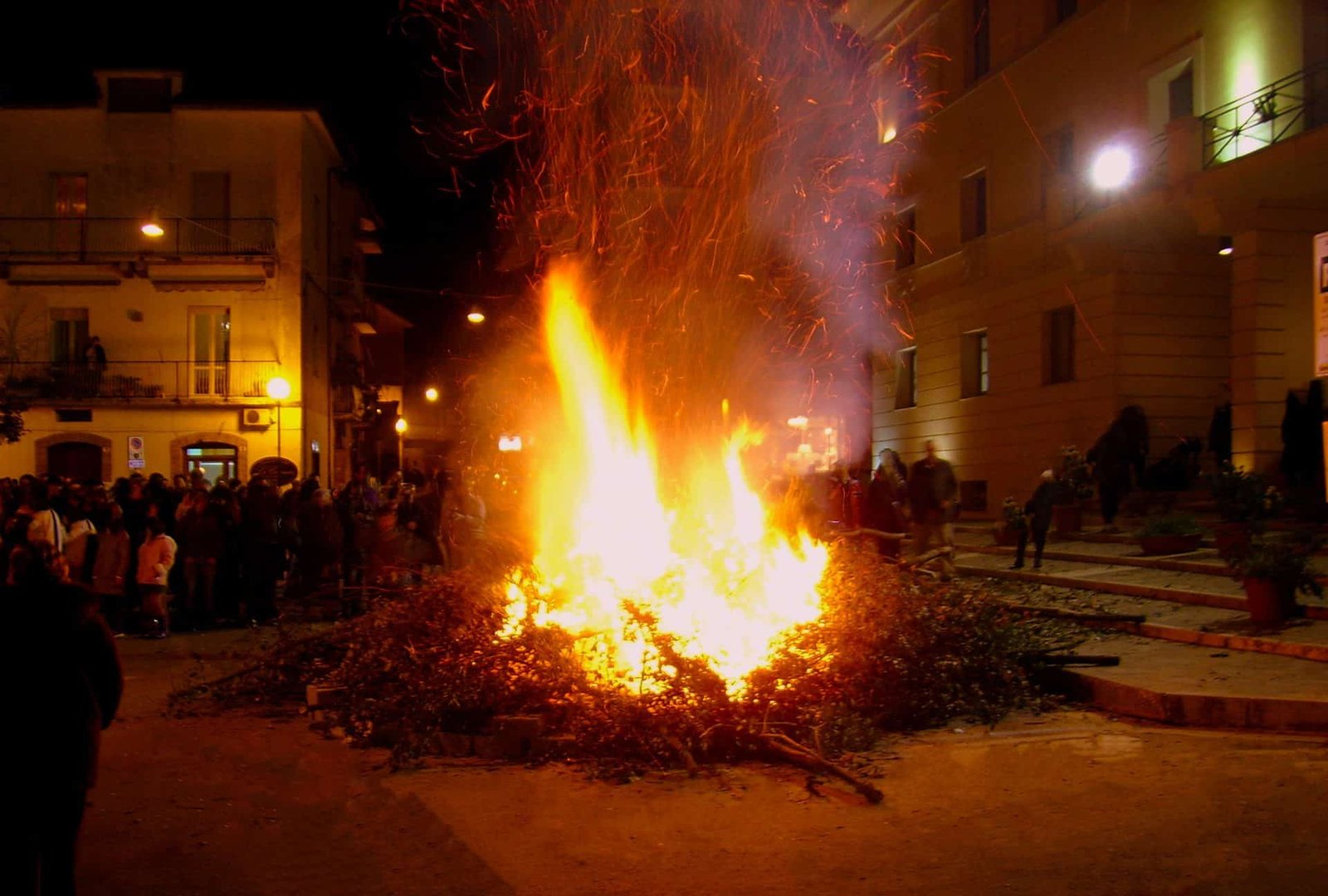
The most characteristic event of the Itri year is the fires of St. Joseph, on the evening of March 19, when huge bonfires are lit in the different districts of the town to celebrate the arrival of spring. That night folk songs and dances ring out, and people eat fried Itri zeppole, Itri sausage, the Itri olive, bruschetta with new oil, marzolino cheese. It is the oldest of the town's traditions and its origins are lost in the centuries: the Christian thanksgiving to St. Joseph blends there with the archaic rite of purifying fire, which, though having no relation to the life of the saint, was associated with him because his feast coincides with the end of winter. It was the carpenters of the village, of whom St. Joseph is the patron, who cleaned the workshops and warehouses of woodworking scraps and set up the bonfires, once smaller but very many. On top of each fire a dummy of old rags, the «màmmuòcc'», was and still is placed, representing the winter that has ended and burning along with it. Anyone who wants to see Itri at its truest has to come that evening, and not in summer.
The feasts of the Civita and of St. Michael
The religious calendar revolves around the Madonna della Civita: the pilgrimage of April 25 against drought, the seven Saturdays of walking before the feast, the feast of July 21 with celebrations throughout the town. The patron saint is St. Michael the Archangel, titular of the mother church of the upper village, whose wooden statue is in the niche of the high altar. Among the recurring events, the tourist portal of the Municipality also lists the Infiorata.
Itri (LT), city of oil: Monna Oliva 2026
Itri belongs to the Associazione Nazionale Città dell'Olio, and on May 29 and 30, 2026 it hosted in the Castle «Monna Oliva 2026», the national prize dedicated to the best Italian table olives, with a technical conference on sustainable olive growing, an in-depth session on table olives in cooking, the awards ceremony and the handover of the flag of the Città dell'Olio. In the program the Municipality included a free guided visit to the village and to one of the historic «trappeti», the traditional oil mills, starting from the Murat fountain. Stewed wild boar is the dish of the festival that the town dedicates to it every year and which can in any case be found in local restaurants.
The cuisine of Itri (LT): the Itrana olive and everything else
The Gaeta olive is an olive from Itri (LT)
The Itri olives, famous all over the world under the name of Gaeta olives, are harvested at the times that farmers' lore knows and brined according to an ancient method from which they come out ready for the table. Since December 15, 2016, the «Oliva di Gaeta» has been a Protected Designation of Origin of the European Union (Regulation 2016/2252, Official Journal L 340), the 290th Italian designation at that time. The specification requires the Itrana cultivar (also called Gaetana), a minimum diameter of 12 millimeters, a color from deep pink to purplish, a flesh-to-pit ratio of at least 3 to 1 and, above all, processing «all'itrana», that is, the natural start of lactic fermentation without the immediate addition of salt or synthetic acidifiers, with the brine topped up from time to time to keep the olives away from the air. The production area covers 44 municipalities among Latina, Frosinone, Rome and Caserta, but the name of the method says who invented it. On restaurant tables the olives arrive in earthenware bowls that bring out their color, purplish and sometimes almost beige, and accompany the whole meal, from the aperitif to the cheeses. The Itrana plant is vigorous and hardy, self-sterile and therefore in need of pollinators such as Leccino and Pendolino, with fruits of 3.5 grams of ovoid, slightly asymmetrical shape. From the same olive, harvested between November and early December, comes a dense, fragrant oil, low in acidity, with notes of green tomato and herbs, which since 2010 falls within the «Colline Pontine» DOP and has earned many national prizes.
Cheeses, cicerchia and dishes of the Itri tradition
The cheeses of the area follow the seasons, and among them stands out the cacio marzolino, made with March milk from sheep and goats and put into typical small molds: it is eaten fresh or salted, also covered with mountain herbs or hot pepper, or preserved in oil. Buffalo mozzarella comes from the Fondi plain and the Garigliano. Cicerchia, a legume of peasant cooking similar to the bean in shape and with a flavor between bean and chickpea, cooked with wild chicory and local broccoli rabe and dressed with Itri oil, is one of the tastiest dishes of the tradition. Then come chicory and beans, the egg and onion soup, pasta with tomato and olives, Itri sausage and the tiella of Gaeta, the savory pie filled with octopus, anchovies, escarole, salt cod or vegetables. For St. Joseph zeppole are fried, dressed with sugar or salted with asparagus or olives. For a quick meal, the stuffed sandwiches from the grocery stores and the pizza by the slice, which in Itri is made with the right oil, are perfectly fine.
Cecubo, the wine of Horace
Among the wines stands out the Cecubo, today made from the Abbuoto grape variety, the historic red of this corner of southern Lazio, of very ancient origins. The Caecubum was the wine of the ager Caecubus, the coastal strip between Fondi and Sperlonga, and Horace cites it in Ode I,37 («Nunc est bibendum») when he invites his friends to bring the Cecubo out of the cellars to celebrate the death of Cleopatra. The link between the modern Abbuoto and the Cecubo of the ancients is a tradition, not a documented descent, but the glass doesn't notice.
A curiosity about Itri (LT)
The coat of arms of Itri bears a serpent, and the serpent generated a legend that the town tells with a certain pride: the founding of Itri would be the work of the inhabitants of Amyclae, the mythical coastal city that ancient sources place between Terracina and Gaeta but that no one has ever identified on the ground, who fled inland because of an invasion of snakes. In this version the very name of Itri would derive from the Hydra of Lerna, the many-headed monster killed by Hercules. The story has no foundation whatsoever, and the name comes from the Latin iter, as the epigraph of Porta Mamurra attests. But the real curiosity is that the town took the legend so seriously as to carve it on its own gate: the four bas-reliefs with the serpent and the dog's head and, above all, the stone with «NUI SEMO BILI. SERPENTES», the two-tongued serpents, are perhaps the only known case of a village presenting itself to strangers as a den of reptiles. In Itri, which spent centuries controlling the passes of the Appian Way and raising the alarm against Saracens, French and brigands, the choice of an ancestor driven out by snakes has its own irony. Look at the gate calmly before going up: the plaque with ITER is the document, the serpents are the character.
Something nobody tells you about Itri (LT)
That the Castle and the Museo del Brigantaggio can be closed even when the guide says they are open. The two official websites, as I write, both report a temporary closure for maintenance, with no reopening date, and the website of the castle has even removed the page of hours, leaving only the price list. No tourist portal writes it prominently, and it happens that you arrive from Rome, climb all the stairs of the upper village and find the gate on Via Sant'Angelo closed. The rule is simple: you phone the Culture Office of the Municipality, 0771 732208, a few days ahead, or write to cultura@comune.itri.lt.it, and if the castle is closed you ask if a visit by appointment is possible, which the website lists among its features. The second thing they don't tell you is that, even with the castle closed, the climb is worth it: the upper village, St. Michael with its majolica bell tower, Vico Giudea with its pierced step, the view from the esplanade under the towers remain free and open, and are half the visit. The third: the combined castle plus museum ticket costs €5 against €3 for the castle alone, and the museum is a kilometer and a half away, in the lower town, on the road to Fondi. It's always worth it, provided you have a car or aren't afraid of the walk along the Appian Way. Last thing: the Civita Sanctuary is at mountain altitude, and even in July, when the town brushes 30 degrees, the wind blows on Monte Fusco. A jacket in the car has never been a mistake.
The advice I give you for visiting Itri (LT)
Arrive early in the morning and start from the bottom: leave the car in the lower town, near Piazza Diaz and the Murat fountain, and walk up toward Porta Mamurra and the upper village, as anyone who has arrived in Itri in the last 1,000 years has done. The stairs are steep but short, and every flight opens a different view of the towers. At the top do the castle, if open, then St. Michael and the alleys, and come down by another staircase so you don't retrace the same route. In the early afternoon take the car and head toward Fondi: after a few kilometers, at the Sant'Andrea gorge, you leave the state road and walk on the Roman paving stones up to the fort. It's the best moment to understand the town, because from the road you see the castle that controls it and from the castle, an hour earlier, you saw the road. The Civita Sanctuary should be left for a second day or for the following morning: the drive up on State Road 82 takes time, and a rushed visit to a place that lives on slowness is a wasted visit. If you have only one day and must choose between the sanctuary and the Appian Way, choose the Appian Way: the sanctuary is an experience of faith and panorama that is repeated in other places in Lazio, while three kilometers of intact Roman consular road with polygonal walls and Bourbon checkpoints can't be found anywhere else. Last advice, the most practical: eat in the village or in the lower town, not along the state road, and order the olives as an appetizer and the wild boar as a main course. If it's March, come back the evening of the 19th for the fires. If it's July, know that on the 21st the whole town is in the street and the rooms sell out.
Another well-known fact, yet rarely cited
Everybody knows that the Gaeta olives are famous. Almost nobody remembers that Gaeta has few olive trees, and that the olives "of Gaeta" are Itri olives, of the Itrana cultivar, which took the name of the port city simply because they were shipped from there. It is a textbook case of how a port steals the name of a countryside: the olive grows on the terraces of the Aurunci, is picked between November and December, ferments in brine with the Itri method and leaves from Gaeta, where the merchants registered it under the name of the pier. The 2016 PDO specification sanctioned the contradiction: the designation is called "Oliva di Gaeta," the mandatory variety is called Itrana, and the processing method is defined as "sistema all'itrana." Itri, which belongs to the Città dell'Olio and hosted the national table olive prize in 2026, has in fact won the game of substance and lost the one of the name. The fact is well known among producers, and even the old trade name "oliva d'Itri" survives on the town's menus next to the official one, but the tourist who buys a jar in Gaeta rarely knows that he is buying Itri. A second fact of the same kind: the liturgical feast of the Civita on July 21 commemorates the end of the plague of 1527, the year the plague swept through Italy in the wake of the Sack of Rome. The grace of Itri, on closer inspection, is a footnote to the Roman catastrophe.
The Right Photo to Take in Itri (LT)
The photo to take home is made from the terrace of the square tower of the Castle, at 360 degrees, with the Appia entering the gorge toward Fondi on one side and the sea of Gaeta on the other. If the castle is closed, the esplanade at the foot of the towers offers a reduced but honest version. The right light is that of late afternoon, when the sun goes down behind the Aurunci and the gray stone towers turn golden, while in the morning the castle is backlit from almost all points of the lower town. The second photo is the bell tower of San Michele with its colored majolica, to be shot from below, with a telephoto lens if you have one, because the ceramic plates are small and the facade is tall. The third, for those who have time, is from the Sant'Andrea valley: the Roman paving stones in the foreground, the polygonal walls on the side and, in the background, the fort on its crag. Whoever comes for the San Giuseppe bonfires should photograph the màmmuòcc' before it burns, because afterward it lasts only a moment. And whoever climbs to the Civita should photograph the sanctuary from the road, one hairpin bend before the arrival, with the church on the ridge and the gulf below: up close the building, enlarged in the 19th century, is less photogenic than its position. One last professional note: in the upper village the alleys are narrow and the houses tall, and the best photo is often the vertical one of a staircase with the tower at the top.
Some Important Events That Happened Here in History
Itri is a border town, and borders manufacture events. In 312 BC the censor Appius Claudius Caecus had his road pass through here, and in 216 AD Caracalla redid its paving. In 882 Docibile I of Gaeta raised the pentagonal tower against the Saracens, and in 914 a deed of sale names a man from Itri for the first time. In 1527 the plague of the landsknechts spared the towns around Monte Fusco, and the Civita got its feast from it. On the night between August 8 and 9, 1534 the corsair Khayr al-Din Barbarossa landed to kidnap Giulia Gonzaga and take her to Sultan Suleiman: the countess fled from Fondi to Campodimele across these mountains, and the pirate sacked the towns of the surrounding area. The following year, on August 10, 1535, Cardinal Ippolito de' Medici died in Itri, 24 years old, natural son of Giuliano, Duke of Nemours, and nephew of Leo X, portrayed by Titian in Hungarian costume. He was traveling toward Tunis to denounce to Emperor Charles V the abuses of his cousin Alessandro, Duke of Florence, when he fell ill and died within these walls. Suspicion of poisoning fell on his seneschal Giovanni Andrea de' Franceschi of Borgo San Sepolcro, who stood trial, and behind him on Duke Alessandro. The castle's official site devotes to the episode one of its eight points of visit, "the murder of Ippolito de' Medici." Ippolito was buried in Rome, in San Lorenzo in Damaso. In 1798-1799 fra Diavolo held the Sant'Andrea pass against the French, and in 1806 he was hanged in Naples. In 1849 Pius IX, an exile in Gaeta, climbed to the Civita and Ferdinand II had the road built. On July 12 and 13, 1911, during the works on the fifth lot of the Rome-Naples Direttissima, a quarrel on payday in Piazza Incoronazione between Sardinian workers and a man from Itri degenerated into two days of manhunt. The Sardinian workers, about 500 in the municipality out of about a thousand who had arrived for the railway, paid less than the others and forced to pay protection money by the camorra infiltrated in the contract, had refused to pay and tried to form a self-defense league. Mayor Gennaro Bureli D'Arezzo banned the rally, and on the evening of the 13th a crowd armed with rifles, pitchforks and knives, gathered at the Caffè Unione, chased the Sardinians through the streets with the participation of notables and in the indifference or complicity of the police. The toll established, amid difficulties and reticence, was 8 dead and 60 wounded, all Sardinian. The Sardinian deputies Carboni-Boi, Cocco-Ortu and Pais-Serra brought the case to Parliament in February 1912, and the trial in Naples, in May 1914, ended with the acquittal of the defendants from Itri and nine convictions in absentia. It is the "Itri massacre," told recently in the book "I giorni del massacro" by Antonio Budruni (2011), and the town still has no plaque to remember it. In May 1944 the bombs destroyed three quarters of the town, and in 1961 came the bronze medal for civil valor. On June 25, 1989 John Paul II climbed to the Civita. On July 29, 2024, in New Delhi, the Appia that crosses Itri became a World Heritage Site.
Who Passed Through Itri (LT)
Anyone who traveled the Appia between Rome and Naples passed through Itri, which makes the list endless. Here only those who left a trace are recalled. Horace, in Satire I,5, tells of his journey to Brindisi in 37 BC with Maecenas and Virgil: from Fondi to Formia the group necessarily crossed the Sant'Andrea gorges, and the stop at Formia, in Murena's villa, is the first quiet dinner of the poem. Onorato II Caetani, Count of Fondi, stayed there in 1487. In 1534 Giulia Gonzaga held court there with Vittoria Colonna, Juan de Valdés, Sebastiano del Piombo, Pietro Carnesecchi and the others of her circle, and in 1535 Cardinal Ippolito de' Medici died there. Fra Diavolo was born there in 1771. Joachim Murat left there the fountain and the fort. On February 10, 1849 Pius IX, guest of Ferdinand II at Gaeta, climbed to the sanctuary, and afterward sent relics and vestments there. Vittorio De Sica shot some scenes of "Two Women" there in 1960 with Sophia Loren, who won the Oscar for that film. John Huston shot scenes of "The Bible" there in 1966, and Luigi Magni shot "Scipione detto anche l'Africano" there in 1971. On June 25, 1989 John Paul II climbed to the Civita with Cardinal Ugo Poletti and Giulio Andreotti. The Giro d'Italia passed through there in 1992 and 1996. Senator Pietro Fedele, Minister of Public Education and historian of the Middle Ages, married there and rebuilt the Capuchin convent there. Thousands of pilgrims pass through every July on foot from Cellole and Pontecorvo. And in 1911 about a thousand Sardinian railway workers passed through, eight of whom never went home: the least celebrated and most important passage of all.
Itri (LT) and Its Surroundings: What to Combine in the Same Day
Itri is a quarter of an hour from Gaeta, with the Angevin castle, the Montagna Spaccata and the Sant'Agostino beach, 20 minutes from Sperlonga, the white village with the Villa of Tiberius and its grotto, 20 minutes from Formia and the tomb of Cicero, and half an hour from Minturno and the archaeological area of Minturnae on the Garigliano. Those arriving from the north can stop first at Sermoneta and the Ninfa Garden, the two places of the Caetani, who were lords of Itri too, or at the Circeo National Park. Those heading toward Cassino have on the way, along State Road 82 and the Liri valley, the Montecassino Abbey. Ferries to the island of Ponza leave from Formia. And anyone who wants to compare the paving stones of Sant'Andrea with the Roman one has the Appia Antica Park at the gates of Rome: they are the two Lazio ends of the same road.
Quick Questions About Itri (LT)
Where Is Itri and How Far Is It from Rome?
Itri is in Latina Province, on Via Appia between Fondi and Formia, about 130 kilometers south of Rome and eight from the sea of Gaeta and Sperlonga, at an elevation of 170 meters.
How Do You Get to Itri (LT) Without a Car?
By train on the Rome-Formia-Naples line, getting off at Itri station, or at Fondi-Sperlonga or Formia-Gaeta and continuing with Cotral buses, which connect Itri with Fondi, Formia, Gaeta, Minturno, Terracina and Latina.
How Much Does the Castle of Itri (LT) Cost?
Full price 3 euros, reduced 1 euro for young people from 10 to 16 and for those over 65, free under 10. Combined with the Museum of Brigandage 5 euros. The official site, however, reports a temporary closure for maintenance: call 0771 732208.
What Are the Hours of the Museum of Brigandage in Itri (LT)?
Usually Thursday 15-19, Saturday and Sunday 10-13 and 16-19, at Corso Appio Claudio 268, with guided visits by reservation at 0771 721061. Here too the site reports a temporary closure, to be checked.
Can You Visit the Village of Itri (LT) for Free?
Yes: the upper village, Porta Mamurra, Vico Giudea, San Michele Church, Santa Maria Maggiore, the squares and the stretch of Appia in the Sant'Andrea valley are free. You pay only for the castle and the museum.
How Long Does a Visit to Itri (LT) Take?
Two hours for the village and castle, one hour for the churches and museum, two hours for the ancient Appia, half a day for the Santuario della Civita. A full day for everything, half a day for the essentials.
Is the Castle of Itri (LT) Good for Children?
Yes, and it's free under 10: towers, cistern, oven, the Crocodile Tower with its legend and the terrace appeal to the little ones. The stairs are steep and there is no elevator, so strollers stay down.
Is Itri (LT) Wheelchair Accessible?
The lower town and the museum are. The upper village is made of staircases and the castle is a medieval building on several levels, without an elevator. The stretch of Appia at Sant'Andrea is irregular paving, passable only with someone accompanying you. For up-to-date conditions it's best to ask the Culture Office.
Can You Take Photos in the Castle of Itri (LT)?
In the village, on the terraces and along the Appia without limits. Inside the castle and the museum the rules posted at the entrance apply: in general they are allowed without flash, but you have to ask the staff.
When Is the Madonna della Civita Celebrated in Itri (LT)?
The liturgical feast is July 21, in memory of the deliverance from the plague of 1527. There is then the pilgrimage of April 25 against drought and the seven Saturdays of walking that precede the feast. The July celebrations involve the whole town.
When Are the San Giuseppe Bonfires in Itri (LT)?
The evening of March 19, with the bonfires in the districts, the zeppole, the Itri sausage and the dummy of rags, the màmmuòcc', burned on top of each fire.
Who Is the Patron Saint of Itri (LT)?
Saint Michael the Archangel, titular saint of the oldest church in the town, from the 11th century, in the upper village next to the castle, where a wooden statue of the saint occupies the niche of the high altar.
What Are Itri Olives?
Olives of the Itrana cultivar, brined with natural fermentation, known commercially as Gaeta olives and since 2016 protected by the "Oliva di Gaeta" PDO. The oil of the Colline Pontine PDO comes from the same fruit.
Where Was Fra Diavolo Born?
In Itri, on April 7, 1771, with the name of Michele Arcangelo Pezza. He was hanged in Naples on November 11, 1806. The town dedicates to him a square, a cave on the Rave Fosche and the Museum of Brigandage.
Why Is Via Appia in Itri (LT) a UNESCO World Heritage Site?
Because since July 29, 2024 the entire Via Appia from Rome to Brindisi has been on the World Heritage List, and the stretch in the Sant'Andrea valley, with paving stones, polygonal walls and fort, is one of the best preserved in Lazio.
How Far Do You Walk on the Ancient Appia in Itri (LT)?
About three kilometers of paving stones in the Sant'Andrea gorge, on a gentle climb toward the fort, in closed shoes: the Roman paving is smooth and slippery after rain.
What's the Difference Between Itri and Fondi?
Fondi is the town of the plain, with the Caetani castle and Giulia Gonzaga's court, the lake and the farming plain. Itri is the mountain village that controlled the pass of the Appia between the plain and the gulf. The same lords, two opposite landscapes, 15 minutes apart.
What's the Difference Between Itri (LT) and Sperlonga?
Sperlonga is the white village on the sea with Tiberius's villa and grotto. Itri is the inland town, with the castle and the Appia. They are connected by the provincial road and are easy to visit on the same day, Itri in the morning and Sperlonga for a swim in the afternoon.
Is It Worth Going Up to the Santuario della Civita?
Yes, if you have time and a vehicle: State Road 82 climbs with many hairpin bends and at the top, besides the church and the icon, there is the view over the gulf. It's cooler on the mountain than in town. Mass times are on the sanctuary's site, phone 0771 727116.
Where Do You Eat in Itri (LT) and What Should You Order?
In the restaurants of the village and the lower town: Itri olives and marzolino to start, cicerchia with chicory or pasta with tomato and olives, wild boar stew or Itri sausage, a glass of Cecubo. For a quick lunch, the sandwiches from the grocery stores and pizza by the slice.
Does Itri (LT) Have a Beach?
Yes, though few know it: Cala Cetarola, a short stretch of rocky coast between Sperlonga and Gaeta, recognized as a Natura 2000 site. For sand, though, you go to Sperlonga or to Sant'Agostino in Gaeta.
What Happened in Itri in 1911?
The Itri massacre: on July 12 and 13, 1911, eight Sardinian workers employed in building the Rome-Naples railway were killed and 60 wounded by an armed crowd from the town. The 1914 trial in Naples acquitted the defendants present and convicted nine in absentia.
What Can You See in Itri (LT) in an Hour?
Porta Mamurra, the climb to the upper village, the bell tower of San Michele and the esplanade under the towers of the castle. If the castle is open, another 40 minutes inside.
If I may leave you one last opinion: Itri is not a postcard village, it's a frontier place that for a thousand years lived off those who passed through and those who stopped those who passed through, and it should be visited in that spirit. Climb the stairs instead of looking for the road, look at the gate before the castle, walk on the paving stones of the Appia before judging the town, and eat the olives calling them by their real name. Whoever does so goes back to Rome with one thing more than they had been looking for.
Article written by the editorial team of TourLeaderPro, contact them for Private/Corporate/V.I.P. Tours and Experiences.
Planning a trip to Rome? The English guides for visiting the city are on ItalyPlanner.com.