Neptune Fountain
In short. The Neptune Fountain closes the north side of Piazza Navona, at the opposite end from the Moor Fountain and about 30 steps from Bernini's Four Rivers Fountain, which occupies the center of the square.
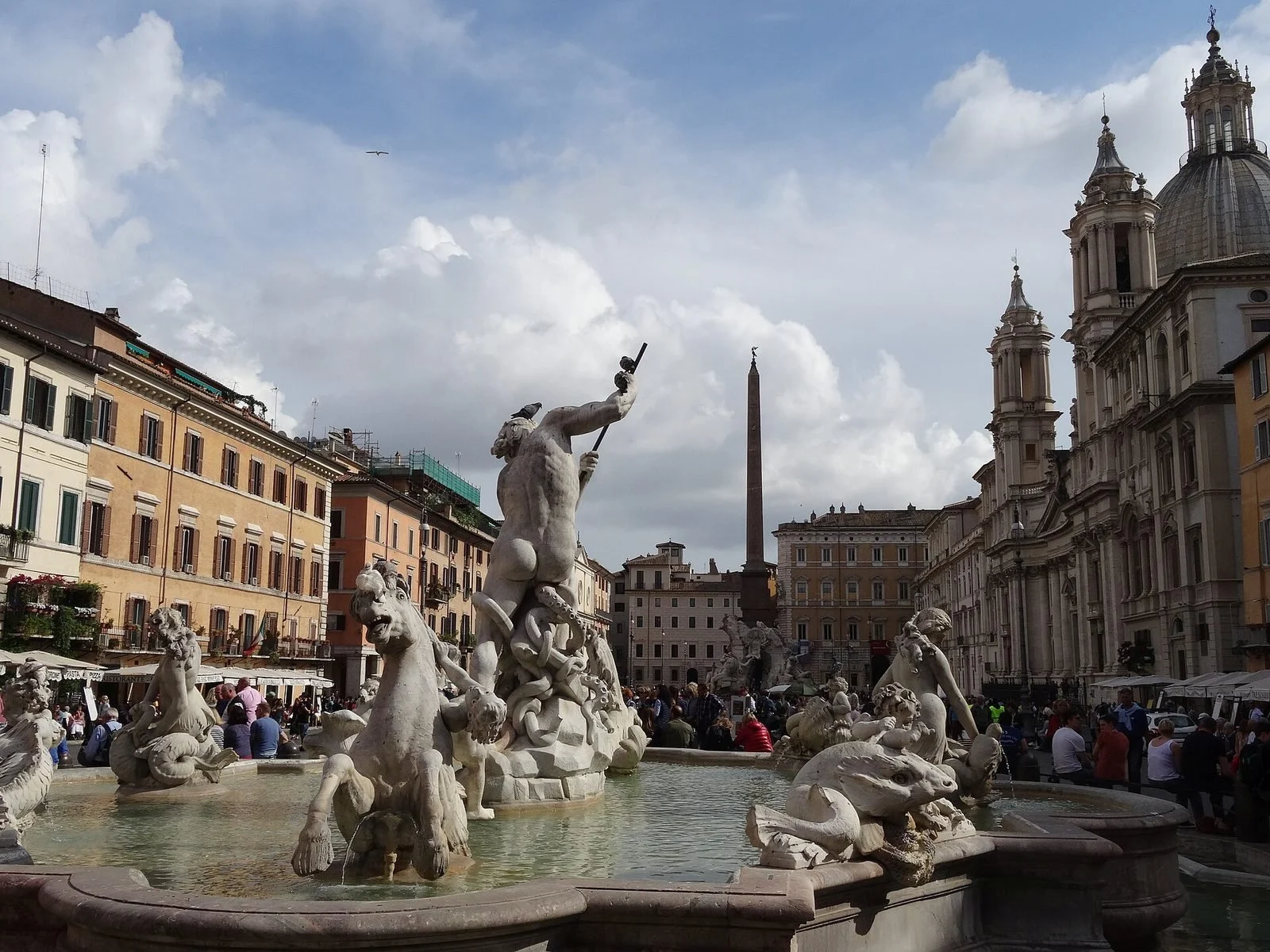
The Neptune Fountain closes the north side of Piazza Navona, at the opposite end from the Moor Fountain and about 30 steps from Bernini's Four Rivers Fountain, which occupies the center of the square. It is the least looked at of the three, and it is also the one most often attributed to the wrong author: you can hear an improvised guide explain that the three fountains of the square are Baroque and from the same period. They are not. The basin that carries everything dates to 1574, designed by Giacomo della Porta, while the statues that fill it today were sculpted between 1873 and 1878, after a competition announced by the Municipality of Rome. In between are three centuries in which that basin stayed empty, without a single figure in it. It is the fact that explains almost everything about this monument, and it is also the reason why it is worth spending 10 more minutes to really look at it instead of crossing the square diagonally toward the obelisk. The lines that follow tell who did what, when, why, which data are solid and which the sources report in conflicting ways, and how to visit the north corner of the square without falling into the three or four traps around it.
Where the Neptune Fountain Is and How to Get There
The Neptune Fountain stands at the northern end of Piazza Navona, in the Parione district, a few dozen meters from Via Agonale and Piazza di Tor Sanguigna. If you enter the square from Corso del Rinascimento via Via Agonale, you find it almost immediately in front of you, on the right. If instead you arrive from Corso Vittorio Emanuele II and enter the square from the south side, you meet first the Moor Fountain, then the Four Rivers, and only at the end the Neptune. Access is free: Piazza Navona is a public square, with no gates, no ticket office and no closing time.
On Foot from the Historic Center
From the Pantheon it takes five or six minutes, passing by the Church of San Luigi dei Francesi and crossing Corso del Rinascimento. This is the route we recommend, because it brings you out into Piazza Navona exactly on the Neptune side and not the opposite one. From Campo de' Fiori the walk is about 10 minutes, crossing Corso Vittorio Emanuele II near Pasquino. From Castel Sant'Angelo it takes just under 15 minutes passing by Ponte Sant'Angelo and Via dei Coronari, and here too you arrive from the right side, the north.
By Public Transport
There is no subway stop at Piazza Navona, and this is the first piece of information that someone arriving from outside Rome needs to have clear. The nearest stations on Line A are Barberini and Spagna, both about 20 minutes' walk away, while Line B does not serve this sector of the Campo Marzio at all. Surface buses, on the other hand, pass a few meters away: the lines that run along Corso del Rinascimento have stops a short walk from the north entrance of the square, and those that run along Corso Vittorio Emanuele II let you off on the south side, near Palazzo della Cancelleria. Line numbers change fairly often, especially in the months of roadworks: it is best to check the updated route on the transport company's website the same day, instead of trusting a printed list.
By Car, Taxi, Bike
Piazza Navona is inside the limited traffic zone of the historic center, active in wide time bands and monitored by electronic gates. If you don't have a permit, you must not enter it by car, period. Taxis can get close along Corso del Rinascimento and along Corso Vittorio Emanuele II, but they don't cross the square, which is pedestrian: the last stretch is on foot anyway. For bikes the square can be crossed at walking pace, with the warning that on summer evenings the density of people makes it uncomfortable. If you arrive from outside the city by car, you do well to leave it in a park-and-ride lot connected to the subway and finish the trip by public transport: it is faster and costs much less than an hour of paid parking in the few free spaces in the area.
Which Side to Enter From
An operational judgment, since this page is meant to help you choose: if your goal is the Neptune Fountain, you enter from the north, that is from Via Agonale or from Piazza di Tor Sanguigna. Entering from the south you cross the whole square against the crowd, pass in front of the two most photographed monuments and reach the Neptune already tired and already distracted. Entering from the north the fountain is the first thing you meet, with the morning light coming from the left and the square opening in front of you like a stage set. The difference between the two entrances seems a subtlety and instead changes the visit completely.
What You Actually See: A 1500s Basin and 1800s Statues
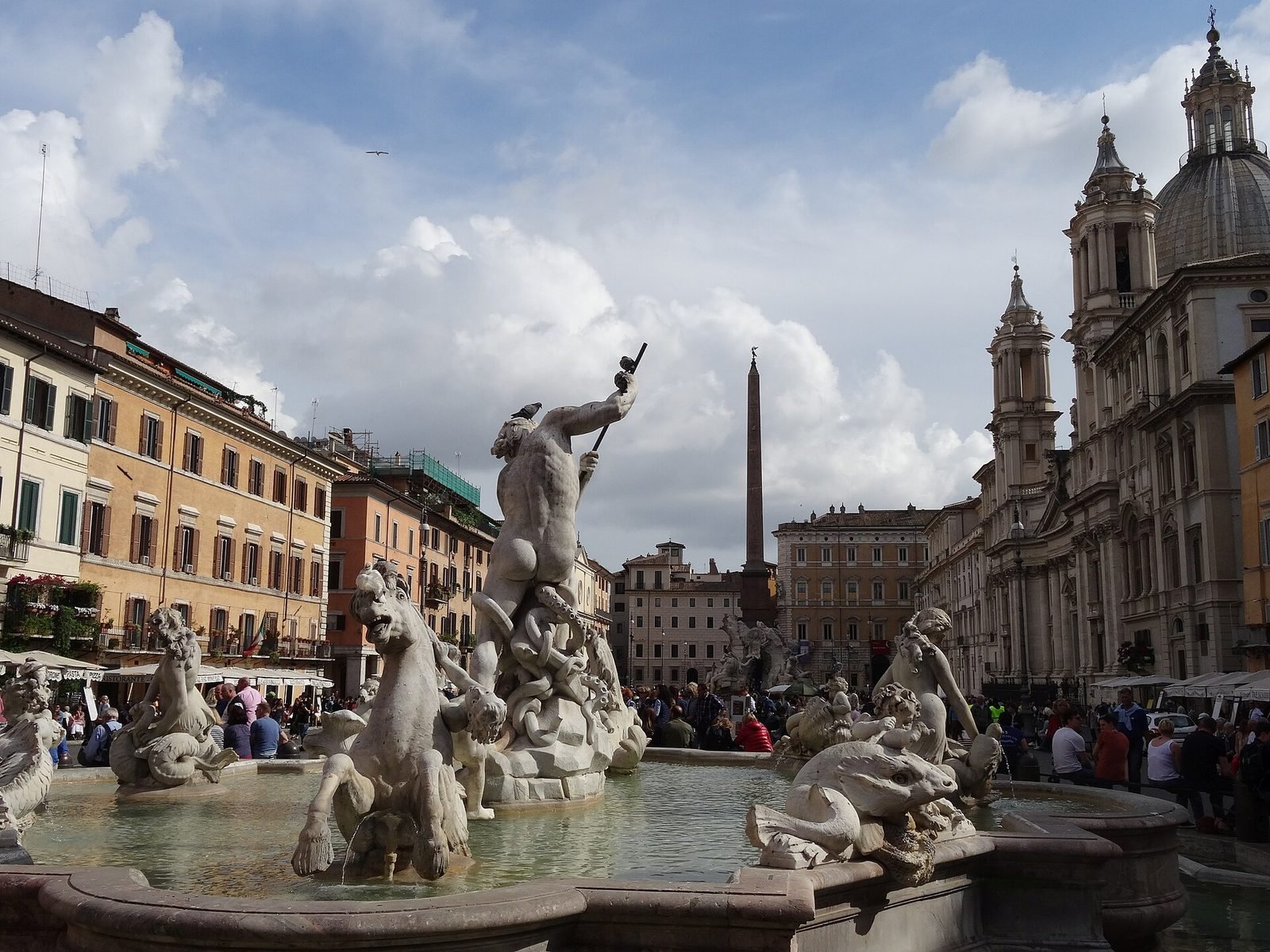
The Neptune Fountain is made of two parts from eras very far apart: a marble basin designed by Giacomo della Porta in 1574 and a sculptural group made almost 300 years later, between 1873 and 1878. Someone who looks at the fountain without knowing this sees a unified whole, because the 1800s sculptors worked carefully on the relationship with the existing basin. Someone who does know sees two overlapping projects, and immediately recognizes the difference in the treatment of the marble between the 1500s rim, sober and architectural, and the 1800s figures, animated and narrative.
The Basin: The Oldest Element
The basin is the work of Giacomo della Porta, a Lombard architect active in Rome in the second half of the 1500s, the same man responsible for the Turtle Fountain in Piazza Mattei and the arrangement of the facade of the Church of the Gesù. It is a polygonal basin resting on the ground, with a molded rim and a low profile, designed to be looked at from above and to serve as a watering trough and a point for drawing water. The fountains of that period were not born as sculptures: they were born as water infrastructure, and form followed function.
The Group of Neptune Fighting the Octopus
At the center of the basin, on a rock, stands the group sculpted by Antonio Della Bitta: Neptune standing, trident in hand and arm raised, striking an octopus wrapped around his legs. The scene is not taken from a specific mythological episode codified by ancient tradition: it is an 1800s invention, built to give the fountain a strong subject, readable from far away, with a diagonal that breaks the stillness of the basin. The movement is violent, the god's body is tense, the octopus has tentacles climbing up the calf. It still works today, and it is the reason why this is the fountain that children like to look at more than the other two.
The Surrounding Figures
Around the central group, arranged along the inner edge of the basin, are the figures sculpted by Gregorio Zappalà: nereids, putti, sea horses. They are the part that almost nobody looks at and that instead holds up the composition, because it builds the low crown that makes Neptune's vertical stand out. The nereids are treated with a soft naturalism, typically late 1800s, very far from the muscular tension of Bernini's Four Rivers. Anyone who wants to understand the difference between the Roman 1600s and post-unification sculpture has here, in the same square and 20 meters apart, the two terms of comparison set face to face.
What It Is Not
This fountain has nothing to do with Bernini. He did not design it, did not sculpt it, did not direct it. The only Bernini intervention in Piazza Navona concerns the Four Rivers at the center and the figure of the Moor at the south end. If you want to really follow the sculptor's traces in the city, you will find an orderly route on our page devoted to Bernini in Rome, and for his great antagonist there is the one on Borromini in Rome, who designed the facade of the church of Sant'Agnese in Agone in Piazza Navona.
Giacomo della Porta's Basin, 1574: How the Fountain Began
The basin of the Neptune Fountain dates to 1574 and is the work of Giacomo della Porta, commissioned by the papal administration to equip Piazza Navona with public fountains fed by the Acqua Vergine aqueduct. The project covered two twin fountains, one at each end of the square, conceived as a symmetrical pair from the start. The southern one would become the Moor Fountain, the northern one is ours.
The Context: Rome Fills Up with Fountains
In the second half of the 1500s Rome goes through a season of major hydraulic works. The ancient aqueducts are put back into operation one after another and every new branch ends in a series of public fountains, which serve to distribute water to the districts and, at the same time, to show who brought the water. It is the logic that produces the Acqua Paola Fountain on the Janiculum a few decades later, and that in the 1500s fills the inhabited center with stone basins at the crossroads. Della Porta signs a very long series of them, and his language is recognizable: low polygonal basins, molded rims, little narrative and a lot of geometry.
A Market Fountain
Piazza Navona, in 1574, hosted the city market. It was not the Baroque living room we know, with cafes and portrait painters: it was the square where fruit, vegetables, fish and hardware were sold, and where the dominant noise was that of haggling. Della Porta's two fountains served that world. The water served the stalls, the draft animals, the washing of the paving. The market stayed here until 1869, when it was moved to Campo de' Fiori, where it is still held today. This fact alone explains why for centuries nobody felt the need to put statues inside a utility basin.
The Material and the Form
The basin is marble, with a continuous rim and a profile that keeps it close to the level of the paving. On the sources, the exact definition of the stone and of its possible later replacements is not uniform, and we prefer to point this out instead of reporting a fact as certain: what you see today has undergone maintenance and restoration over four and a half centuries, and not all of it is precisely documented. The overall design, however, is recognizably 1500s and was not distorted by the 1800s addition.
The Old Name: The Fountain of the Calderari
Before being called the Neptune, the northern fountain of Piazza Navona was known by another name, tied to the calderari, that is the copper artisans who had workshops in that sector of the district. The name is reported by several local sources and we record it as an established place-name tradition, not as an archive fact verified line by line: on its precise origin and the exact period in which it was in use, the testimonies do not agree. It is worth pointing out because someone reading an 1800s guidebook or a period document may come across that name without understanding which fountain is meant.
Three Centuries Without Statues: The Real Fact of This Fountain
From 1574 to 1878 the basin of the Neptune Fountain stayed without sculptures: almost 300 years of water running into an empty basin, in one of the most visited squares in Europe. This is the central point of its history, and it is also the one that no plaque tells to people passing by.
What Visitors Saw in the 1600s and 1700s
Whoever arrived in Piazza Navona in the 1600s found an unbalanced scene. At the center, from 1651, Bernini's Four Rivers, with the obelisk on top. To the south, from about 1653, the Moor. To the north, an empty basin. The engravers of the time draw it that way: a circle of stone with water inside and nothing else. The great Grand Tour travelers who write about Piazza Navona, from Goethe to Stendhal to Dickens, saw that empty basin, not the group we see. None of them could know the Neptune with the octopus, because it did not exist yet.
Why It Stayed Empty So Long
The reasons are mundane and for that reason are rarely told: there was no money, and there was no political will. Roman fountains were completed when a pope or a family decided to tie their name to them, and nobody did so for the northern basin of Piazza Navona. The pope who had invested in the square, Innocent X Pamphilj, had concentrated the spending at the center and on the side where the family palace stood. The north end remained peripheral to that design, and it stayed that way.
An Empty Basin Is Not a Flaw for Everyone
In the 1800s, when the debate on completion opened, not everyone agreed. There were those who argued that the bare, essential basin was consistent with the 1500s design and that filling it would mean betraying della Porta. It is an objection that today sounds modern and that at the time lost. Someone who looks at the fountain with this in mind sees something different: a compromise between two eras, not a monument born whole.
The 1873 Competition and the Sculptures of Della Bitta and Zappalà
The statues of the Neptune Fountain come from a public competition announced by the Municipality of Rome in 1873, three years after the capture of the city and Rome's passage to the Kingdom of Italy. The work was completed in 1878. The group of Neptune fighting the octopus is by Antonio Della Bitta. The nereids, putti and sea horses around it are by Gregorio Zappalà.
Antonio Della Bitta and the Neptune
Antonio Della Bitta sculpted the central group, dated 1878. The choice of subject, the god of the sea fighting a sea monster, answers a compositional need before an iconographic one: it needed a vertical, dynamic figure with a broad gesture, able to hold its own against the obelisk of the Four Rivers that faces it along the axis of the square. The octopus is a clever solution, because it makes it possible to wrap the rock and fill the low space without adding other large figures.
Gregorio Zappalà and the Surround
Gregorio Zappalà, a Sicilian sculptor, made the surrounding figures in the same span of years. They are nereids with putti and sea horses, arranged along the inner perimeter of the basin, in attitudes of play and transport. Their job is rhythmic: they mark the rim, keep the basin from looking empty around the rock, and lower the gaze of whoever arrives before letting it rise toward the trident. Looking at them up close you notice remarkable care in the rendering of wet surfaces, a theme that late 1800s sculpture loved very much.
The Judgment We Feel Able to Give
Critics treated these sculptures with condescension for much of the 1900s, considering them academic and late. The judgment has a basis: Della Bitta's group is theatrical in a predictable way, and Zappalà's nereids are sweeter than the subject requires. But the fountain works, and it works for a technical reason that you only see on site: the scale is right. The figures don't crush the 1500s basin and don't get crushed by the very long perspective of the square. This is the fountain where people most gladly stop to look at the details, because the story it tells is understood in three seconds and without explanations.
An Attribution Mistake You Hear Every Day
Putting the Neptune Fountain next to the Four Rivers as a work of the same moment means being wrong by two and a half centuries. The two works are separated by over 200 years of art history: Bernini finishes the Four Rivers in 1651, Della Bitta delivers the Neptune in 1878. In between come the late Baroque, Neoclassicism, the Napoleonic age, Purism, the Unification of Italy. If only one piece of information is to stay with you from this page, let it be this one.
The Symmetry with the Moor Fountain, at the South End
The Neptune Fountain and the Moor Fountain are the two twin fountains designed by Giacomo della Porta for the two ends of Piazza Navona in the mid-1570s. The symmetry between them is the principle that holds the whole square together, and understanding how it was broken and how it was mended explains four centuries of Roman history in a few meters.
The Original Project: Two Identical Basins
Originally the two fountains were conceived as a pair: same layout, same function, same sobriety. The square, long and narrow because of the shape of the ancient stadium on which it is built, needed two visual stops at its ends, closing the perspective without competing with the center. The center, at the time, had nothing yet: the obelisk and the Four Rivers would arrive 70 years later.
How the Symmetry Was Broken
In the 1600s the southern fountain received the figure that gives it its name, the Moor, through Bernini's intervention, while the northern one stayed as it was. From that moment the square had one populated end and one bare end, and the imbalance lasted more than two centuries. The 1873 competition was born precisely to close this asymmetry, and the result is what you see today: two full fountains, one Baroque in its main figure, the other late 1800s, on basins of the same age.
The Copies of the Moor and the Originals at Villa Borghese
There is a detail that almost nobody knows and that concerns the fountain at the other end of the square: in 1874 the original sculptures of the Moor Fountain were removed and replaced with copies, while the originals were taken to Villa Borghese, in the area of the Giardino del Lago. It means that in the same years in which the Neptune was being filled with new marbles, the Moor was being emptied of its old marbles. Anyone crossing the square today looks, at the two ends, at two mirror-image and opposite situations: in the north the 1800s put where there was nothing, in the south the 1800s put in place of the 1600s.
How to Read the Square in Three Stops
The right way to look at Piazza Navona, if you want to understand it instead of crossing it, is to stop three times along the central axis: at the Neptune, at the Four Rivers, at the Moor. From each of the three positions the square has a different shape, because the eye changes the vanishing point. It takes 20 minutes in all and costs nothing. It is the best investment of time you can make in this corner of Rome.
The Water That Feeds It: The Acqua Vergine
The Neptune Fountain is fed by the Acqua Vergine, the aqueduct of Roman origin inaugurated in 19 BC on the initiative of Marcus Vipsanius Agrippa and put back into operation several times in the Renaissance. It is the same aqueduct that feeds the Trevi Fountain and the Barcaccia Fountain in Piazza di Spagna.
Low Pressure and the Consequences for the Design
The Acqua Vergine reaches the center at modest pressure, because the arrival elevation is low. This explains a feature you notice right away when looking at the fountains it feeds: the jets are low and wide, never vertical and forceful. The Neptune Fountain has no high sprays and the Tureen Fountain on Corso Vittorio, fed by the same branch, has an even more restrained jet. The high-jet fountains of Rome, like the one on the Janiculum, are fed by aqueducts that arrive from higher elevations.
A Curiosity About the Neptune Fountain
The curiosity about the Neptune Fountain is that for centuries Piazza Navona was flooded in summer, and the fountains were used to do it. The ritual was called the lake of Piazza Navona: the drains of the fountains were closed, the water spread over the concave paving of the square and formed a sheet of water a hand deep, through which carriages, horses and barefoot boys passed. The practice ended for reasons of hygiene and urban decorum, and the rebuilding of the road surface later made it technically impossible.
How It Worked Technically
The paving of Piazza Navona was slightly hollowed toward the center, a shape that served to drain rainwater. By closing the drain openings of the three fountains, the water of the Acqua Vergine collected on the floor of the square instead of flowing away. No additional equipment was needed: you just had to plug. The Neptune Fountain, with its low basin flush with the paving, took full part in this domestic hydraulics, and in period prints you can see the water lapping at its outer edge.
When It Was Held
The tradition took place in the hot months, usually on August weekends, and was a popular festival with a strong component of aristocratic spectacle: the carriages of Roman families paraded through the water, the people watched and got wet. On the year it began and the year of the last edition the sources report slightly different dates, and the most widespread reconstruction places the start in the mid-1600s, under the pontificate of Innocent X, and the end around the mid-1860s. We record the uncertainty instead of choosing a date and presenting it as certain.
Something Nobody Tells You About the Neptune Fountain
The thing that is almost never told is that the Neptune Fountain, in its current form, is a monument of united Italy, made through a public competition procedure between 1873 and 1878, and that its execution was also an operation of symbolic appropriation of Roman public space by the new civil administration.
A Risorgimento Fountain in a Baroque Square
Between 1871 and the end of the century the Municipality of Rome intervened heavily on the historic center: new road axes, new embankments on the Tiber, new ministry buildings, and a policy of completing monuments left half-finished. Completing the basin of Piazza Navona with a sculptural group commissioned, judged and paid for by the civil administration, in a square that had been for centuries the theater of papal magnificence, had a meaning that went beyond decorum. Nobody wrote it in these terms in the official documents, and in fact we present it as a historiographical reading and not as a statement of the period.
The Sculptors, Two Names Nobody Remembers
Antonio Della Bitta and Gregorio Zappalà are not names known to the general public, and this says something about the fate of Italian public sculpture of the late 1800s. They were established professionals in the Rome of the time, active on civil and religious commissions, and their work in Piazza Navona is the thing of theirs that most people in the world see, probably several million people a year. Almost none of these people know their names. Anyone who wants to check the signature will not find it on a sign: information on attributions has to be looked for in the records of the Sovrintendenza Capitolina, the body that manages the city's monumental fountains.
My Advice for Visiting the Neptune Fountain
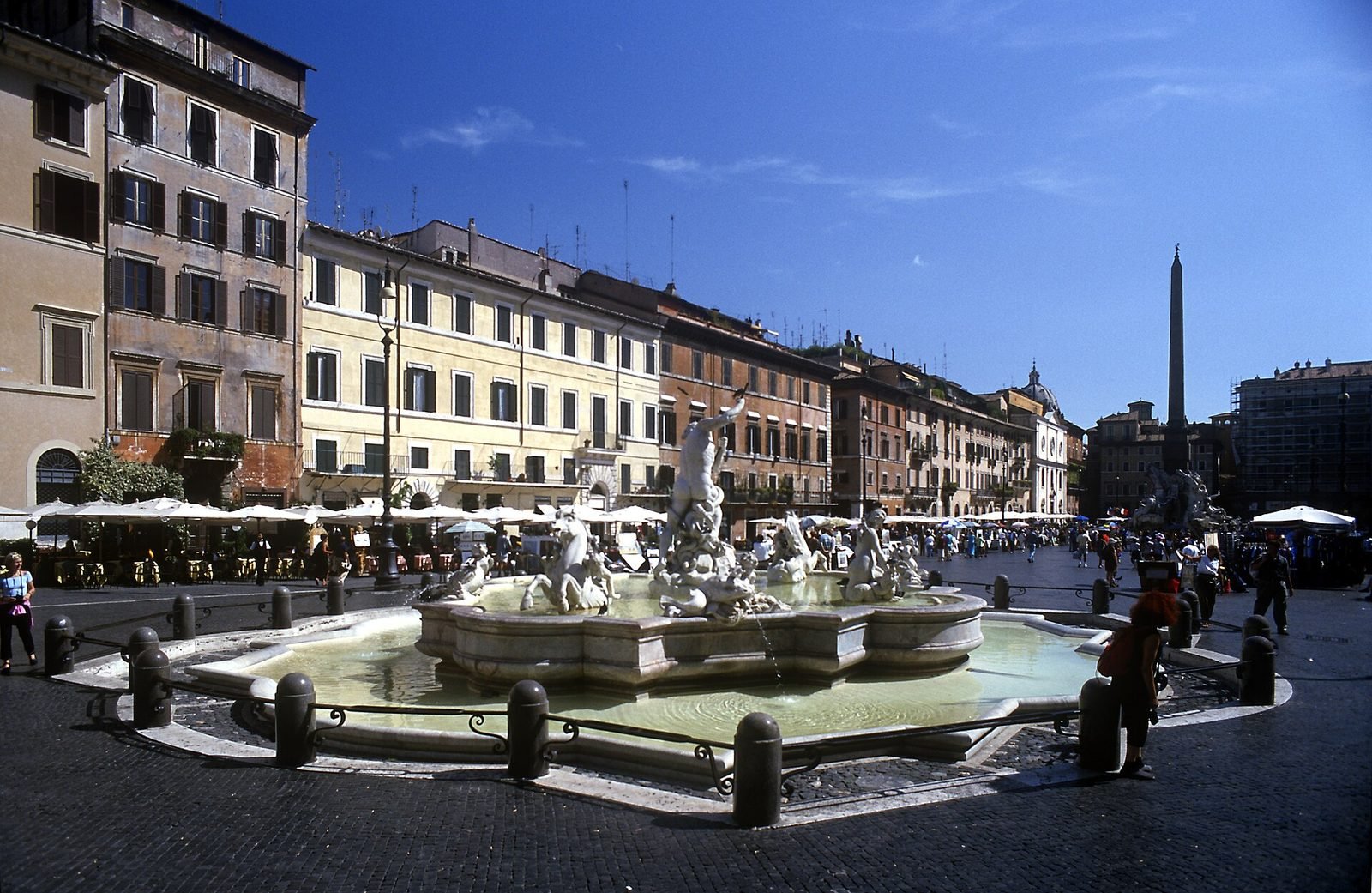
The practical advice for visiting the Neptune Fountain is to go in the first hour after dawn or after 23:00: these are the two windows in which the north side of Piazza Navona is workable, because the crowd that fills the square from 10:00 in the morning to midnight gathers mostly around the obelisk and the tables of the cafes. Entry is always free and there is no closing time.
The Time Slots, Concretely
Piazza Navona never closes and has no checks at the entrances, so you can enter at any hour. From 7:00 to 8:30 in the morning the square is almost empty, with the cleaning crews and the suppliers of the venues, and you can walk around the fountain with nobody in front of you. From 10:00 on the groups arrive. The peak is between 16:00 and 20:00, and on Saturday evenings from May to September the density of people makes it hard even to stop and look. After 23:00 the square slowly empties and the fountain stays lit.
How Much Time You Need
For the Neptune Fountain alone 10 minutes is enough: time to walk around it once, look at the central group from three different angles and observe the nereids up close. For Piazza Navona as a whole, with the three fountains and the facade of Sant'Agnese in Agone, count 40 minutes. Anyone who adds the visit to the underground of the Stadium of Domitian has to allow at least another hour, with ticket and hours to be checked on the operator's website before showing up.
With Children
The fountain works well with children, because the subject is narrative and is understood without mediation: there is a man with a pitchfork whacking an octopus. The edge of the basin is low and this is both an advantage and a risk, because the temptation to climb on it is strong. Climbing on the edge, sitting, getting in the water or dipping your feet in Rome's monumental fountains is forbidden by the municipal regulation and is punished with a fine: the amount is updated periodically and it is best to check it in the ordinances in force, while the ban itself doesn't change. The municipal police pass by, and in high season they pass often.
What Not to Do
Two practical warnings. The first concerns the sellers of trinkets and the fake artists who in the good season guard the entrances to the square: don't buy anything and don't accept anything that is put in your hand, because what looks like a gift immediately becomes a request for money. The second concerns the tables with a view: sitting in one of the venues that face the square directly costs much more than sitting 50 meters away on a side street, and the service is no better. We come back to this later with concrete criteria.
Another Well-Known Fact, Yet Rarely Mentioned
The fact is that Piazza Navona has the shape it has because it is built on top of the Stadium of Domitian, a facility for athletic contests inaugurated at the end of the 1st century AD, and that the Neptune Fountain stands exactly over the curved side of the ancient building.
The Stadium Under the Square
The stadium was built on the initiative of the emperor Domitian and hosted Greek-style games, races and athletic competitions, on a model that in Rome had less following than the gladiatorial games of the Colosseum. The facility had an elongated plan with one straight end and one curved end, and medieval and Renaissance houses leaned against its structures until they fossilized its perimeter. That is why Piazza Navona is long, narrow and rounded at one end: the square is the track, the buildings around it are the stands filled with homes.
The Curved End Is the Neptune's
The north side, where the Neptune Fountain stands, corresponds to the hemicycle of the ancient stadium. It is the point where the square rounds off, and whoever stops in front of the fountain looking south has before them the whole length of the ancient track. The Roman structures are visible below street level in the archaeological area accessible from Piazza di Tor Sanguigna, a handful of meters from the fountain: they are remains of brick arcades and travertine blocks that belonged to the outer ring of the building.
What You See Today of the Ancient World
At square level, almost nothing of the ancient world is visible: a few curves in the alignment of the facades, the profile of the hemicycle to the north, and little else. Anyone who wants to see the structures has to go down into the underground archaeological area, which has its own entrance, ticket and hours, to be checked directly with the operator before going. It is worth the hour it requires, especially for those who have already seen the great ancient monuments and are trying to understand how the modern city formed inside the shell of the ancient one, a mechanism that repeats everywhere in Rome, from Largo di Torre Argentina to the Mausoleum of Augustus.
The Right Photo to Take at the Neptune Fountain
The photo that does justice to the Neptune Fountain is taken from the northwest, crouching, with the lens just above the rim of the basin, so that Neptune's raised arm and trident stand out against the sky instead of against the facades. It is the only framing in which the group reads for what it is, a diagonal, and not as a confused white mass.
The Light, Hour by Hour
The north side of Piazza Navona gets direct sun on the sculptural group in the middle hours, and the white marble at noon burns: the highlights blow out and the faces lose all modeling. The best window is the first hour after sunrise, when the raking light comes in from the east along Via Agonale and sculpts the muscles of the figure. The second useful window is twilight, when the square's artificial lights come on and the sky still keeps a deep blue: 15 minutes, no more, and you have to take it with the camera already ready.
The Three Framings That Work
The first is the one described above, from low down and from the northwest, with the sky as background. The second is taken from the east side of the basin looking west, and includes behind the group the facade of the church of Sant'Agnese in Agone and the domes: it is the photo that tells the context, and it asks for a wide aperture to keep everything in focus. The third is the detail: a nereid, a putto, a tentacle climbing the god's leg, taken with a short telephoto lens. It is the photo nobody takes and that is often the best of the three.
What Ruins Photos
Three things, in order of frequency: people sitting on the rim of the basin, who besides being in violation always end up in the frame. The stalls and portrait artists who in the good season occupy the perimeter of the square. And scaffolding, because the fountains of Piazza Navona periodically go into maintenance and can stay covered for weeks. Before planning a photo session it is best to check if work is in progress, information that the Sovrintendenza Capitolina publishes on its channels.
Some Important Events That Happened Here in History
The north corner of Piazza Navona has a dense chronology that begins with the Stadium of Domitian at the end of the 1st century AD and reaches the 1900s by way of the market, the summer lake and the 1873 competition. Here are the dates that matter, with an indication of those on which the sources do not agree.
End of the 1st Century: The Stadium
Domitian has the stadium built for athletic contests in the northern Campo Marzio. The facility stays in use for centuries and then is gradually occupied by homes, in a process that also concerns the other large entertainment buildings of the area.
1574: Giacomo della Porta's Basin
Della Porta builds the northern basin as part of the program of public fountains fed by the Acqua Vergine. The southern twin, which will become the Moor Fountain, dates from the same years.
1651: Bernini's Four Rivers
At the center of the square the Bernini fountain with the obelisk is inaugurated, commissioned by Innocent X Pamphilj, whose family had its palace on the west side of the square. The square changes nature: from a market it becomes also a dynastic showcase.
Mid-1600s: The Lake of Piazza Navona Begins
The summer flooding of the square becomes a custom. On the exact start date the sources diverge and the link with the pontificate of Innocent X is the one reported most often.
1869: The Market Moves to Campo de' Fiori
The historic market of Piazza Navona is moved to Campo de' Fiori. The square loses the function it had for centuries and begins its career as an urban living room.
1873: The Competition Is Announced
The Municipality of Rome announces the competition to complete the northern basin, left without sculptures since 1574. It is the first major intervention on the square after Unification.
1874: The Original Moor Sculptures to Villa Borghese
The original sculptures of the Moor Fountain are removed and replaced with copies, and the originals end up at Villa Borghese. The square lives through two opposite operations a few months apart.
1878: Della Bitta's Neptune
The group of Neptune fighting the octopus is put in place, and with Gregorio Zappalà's surrounding figures the fountain takes on its current look. 304 years after the basin.
The 1900s and Recent Years
During the 1900s the square is pedestrianized and the fountains come under the protection and maintenance regime of the Sovrintendenza Capitolina. Cleaning and restoration work has followed repeatedly, including in recent decades: the precise dates of the individual projects are not reported uniformly in the popular sources and we prefer not to list any without an archive check.
Who Has Passed by the Neptune Fountain
Practically everyone who has written about Rome in the last five centuries has passed through Piazza Navona, and the Neptune Fountain has a peculiarity that sets it apart: almost all the great travelers who left a description of it saw the empty basin, not the sculptural group.
The Grand Tour Travelers
Goethe, who stays in Rome between 1786 and 1788, describes the life of the square and its market. Stendhal, in the 1820s, includes it among the places of his Rome. Charles Dickens, who visits the city in the mid-1840s, writes about it in the account of his Italian journey. All three walked next to a stone basin without statues. It is a detail that changes how you read their pages, and that is rarely pointed out in anthologies.
The Artists Who Drew It
The square is one of the most frequent subjects of the Roman veduta, the genre that between the 1700s and the 1800s produced prints for foreign travelers. In the views that show the summer flooding the north end appears regularly, and the empty basin is documented with a precision that the written sources do not reach. Anyone who wants to see this material will find the graphic collections and Roman views among the holdings of the Museo di Roma at Palazzo Braschi, which faces right onto the south corner of the square.
The Direct Protagonists
The names that left a material mark on the fountain are four: Giacomo della Porta for the basin, the post-unification municipal administration for the decision to complete it, Antonio Della Bitta for the central group and Gregorio Zappalà for the surrounding figures. On the square, a few meters away, worked Gian Lorenzo Bernini on the Four Rivers and the Moor, Francesco Borromini on the facade of Sant'Agnese in Agone, Girolamo Rainaldi and Carlo Rainaldi on the body of the church and on Palazzo Doria Pamphilj for the same commissioning family.
Eating Around the Neptune Fountain: How to Choose
Around the Neptune Fountain the ratio between price and quality of the food service is among the worst in the center of Rome, and the reason is arithmetic: a table facing Piazza Navona costs a rent that has to be recovered on the bill. Here we don't name venues, as an editorial choice: a list of signs ages in a few months and ends up advertising places that change management the following month. We give the criteria instead, which stay valid.
The Five Signs of a Trap
The first sign is the lady rolling out fresh pasta in the window or at a table on the street: it is a lure designed for passersby, not the mark of a kitchen. The second is the menu with photographs of the dishes, which is for people who can't read the language and not for people who know what they want to eat. The third is the tout at the door inviting you to sit: no place that does good work needs to stop people in the street. The fourth is non-stop hours from morning to night, with no kitchen break, which means reheated dishes and no real service shift. The fifth concerns the venues placed in front of famous monuments, where you may find items not priced on the menu and different price lists between the indoor room and the tables outside: in front of a celebrated fountain the price adapts to the tourist in front of you.
The Downtown Chains
In recent years the historic center has seen a multiplication of venues with repeated signs, with the same menu at several points in the city and the queue with a ticket number on the sidewalk. We don't name them and don't recommend them. The observation that matters is that Romans don't go there: those lines are made up almost entirely of visitors from outside, sent by a video or a ranking. A venue that nobody from the neighborhood enters tells you nothing about the neighborhood.
The Simplest Criterion There Is
Look at who is sitting and in what language they order. If at 12:30 the tables are occupied by people who work in the area and who order in Italian without looking at the menu, the place is good. If they are occupied only by visitors with a backpack and a map, you walk another five minutes. Five minutes' walk from Piazza Navona, toward the Ghetto, toward Via del Governo Vecchio or toward the side streets behind the Pantheon, completely change the average quality and the bill.
The List We Use
Anyone who prefers to start from a selection already made can consult Daniele Dezi's personal list on Google Maps: it is a curated collection, built over time for personal use and not sponsored by any of the venues it contains. No restaurateur pays to be in it and nobody pays to be left out. That is why we point to it.
What Is Around the Neptune Fountain
Within a five-minute walk of the Neptune Fountain are concentrated about 10 places worth a stop, and the north side of the square is the point from which it is best to start them.
To the North, Toward the Tiber
Leaving Via Agonale and turning toward Piazza di Tor Sanguigna you reach in two minutes Palazzo Altemps, home of the ancient sculpture collection of the Museo Nazionale Romano, which is the least crowded and most restful visit in the whole quadrant. Continuing you cross Via dei Coronari and descend toward the river and toward Ponte Sant'Angelo.
To the East, Toward the Pantheon
Crossing Corso del Rinascimento you reach in a few minutes the Church of San Luigi dei Francesi with the Contarelli Chapel, the Pantheon and the Basilica of Santa Maria sopra Minerva. Anyone following the painter's traces will find the complete itinerary on our page on Caravaggio in Rome.
To the West and South
From the west side of the square you exit toward the Bramante Cloister and toward Via del Governo Vecchio. From the south side you reach Pasquino, the Galleria Spada and Campo de' Fiori. Anyone with half a day can close the loop at the Museo di Roma at Palazzo Braschi, which holds the most useful material on the history of the square.
Frequently Asked Questions About the Neptune Fountain
Who Made the Neptune Fountain in Piazza Navona?
The Neptune Fountain in Piazza Navona is the work of two different eras: the basin is by Giacomo della Porta and dates to 1574, while the sculptures were made between 1873 and 1878, the group of Neptune fighting the octopus by Antonio Della Bitta and the nereids, putti and sea horses by Gregorio Zappalà, after a competition announced by the Municipality of Rome.
Is the Neptune Fountain by Bernini?
No, the Neptune Fountain in Piazza Navona is not by Bernini and is not a Baroque work. By Bernini are the Four Rivers Fountain at the center of the square, completed in 1651, and the figure of the Moor at the south end. Attributing the Neptune to the same author means being wrong by more than two centuries, because the sculptural group dates to 1878.
How Much Does It Cost to See the Neptune Fountain?
Seeing the Neptune Fountain costs nothing: it stands in Piazza Navona, which is a pedestrian public square, with no fences, no ticket office and no closing time. You can enter at any hour of the day and night. A ticket is needed only for the archaeological area of the underground of the Stadium of Domitian, which has its own entrance and fares to be checked with the operator.
Why Did the Neptune Fountain Stay Without Statues for Three Centuries?
The Neptune Fountain stayed without sculptures from 1574 to 1878 for lack of funds and of a patron who wanted to tie his name to it. Innocent X Pamphilj concentrated the spending on the center of the square and on the side of the family palace, and the north end stayed a utility basin for the market. Only the post-unification Municipality decided to complete it.
How Do You Get to the Neptune Fountain by Public Transport?
You can't get to the Neptune Fountain by subway, because Piazza Navona has no station: the nearest Line A stops are Barberini and Spagna, about 20 minutes' walk away. You get there instead by the surface buses that run along Corso del Rinascimento, a short walk from the north entrance, and Corso Vittorio Emanuele II. Line numbers change often and should be checked the same day.
Can You Sit on the Edge of the Neptune Fountain?
No, you can't sit on the edge of the Neptune Fountain: the regulation of the Municipality of Rome forbids climbing, sitting, getting in the water or dipping your feet in the city's monumental fountains, and the violation carries a monetary fine. The amount is updated by successive ordinances and it is best to check it in the rules in force. Checks in high season are frequent.
How Much Time Do You Need to See the Neptune Fountain?
For the Neptune Fountain alone 10 minutes is enough, time to walk around it and observe the central group from three angles and the surrounding figures up close. For Piazza Navona as a whole, with the three fountains and the facade of Sant'Agnese in Agone, count 40 minutes. With the visit to the underground of the Stadium of Domitian add at least an hour.
Is the Neptune Fountain Accessible for People with Mobility Difficulties?
The Neptune Fountain can be reached without steps, because Piazza Navona is flat and entirely pedestrian, with free access on all four sides. The sampietrini surface does however require care with a wheelchair or a walker: the most regular route is the one along the east side of the square, toward Corso del Rinascimento. There are no public restrooms in the square.
Who Wrote This Page
This page is edited by the team of Tour Leader Pro, the Roman project office that designs and coordinates visits, itineraries and cultural events in Rome and Lazio. Hours, fares and access conditions given here are verified as of the publication date against the official sources indicated in the text: it is best to recheck them before leaving, because they change often. If you find an out-of-date piece of information, let us know.
Anyone building an itinerary in the historic center of Rome and wanting to fit Piazza Navona together with the Pantheon, Campo de' Fiori and the Tiber without losing hours in transfers will find planning tools and operational support at Tour Leader Pro, which works on Rome and Lazio with groups, schools and companies.
For a broader picture, including connections between Italian cities, transport and building a multi-day trip in and out of Rome, a good reference resource is Italy Planner.