Moro Fountain
In short. The Moro Fountain closes the south end of Piazza Navona, on the side of Via di Pasquino and of the palace that now houses the Museo di Roma at Palazzo Braschi.
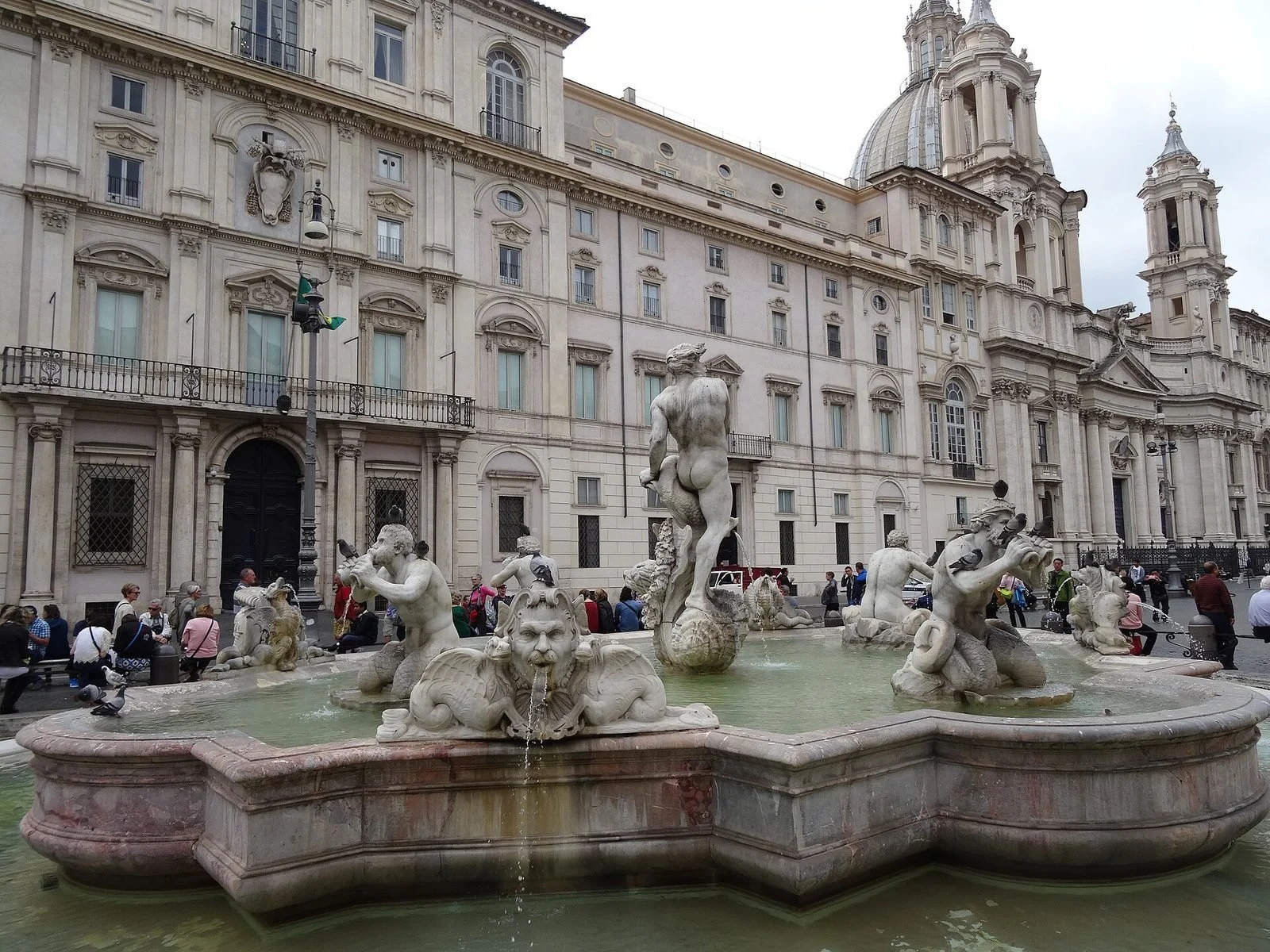
The Moro Fountain closes the south end of Piazza Navona, on the side of Via di Pasquino and of the palace that now houses the Museo di Roma at Palazzo Braschi. It is the oldest of the three fountains in the square. The mixtilinear marble basin, with the masks and the tritons spouting water from the edges, is the work of Giacomo della Porta and dates to 1575, almost 80 years before Gian Lorenzo Bernini got his hands on the center. The figure of the Moor wrestling with a dolphin arrives only in 1653, designed by Bernini and physically sculpted by Giovanni Antonio Mari. And there is a detail that almost none of the 3,000 or 4,000 people passing each day notices: the marbles you see in the square today are copies. The originals were dismantled in the 19th century and taken to the Giardino del Lago of Villa Borghese, where they still are, outdoors, free, looked at by very few. These lines explain what you really see, who did what, why that name, how to photograph it without taking home 40 heads of strangers, and how to avoid the round of venues that live off whoever sits at the first table with a view.
Where the Moro Fountain is and how to get there
The Moro Fountain is at the southern end of Piazza Navona, in the Parione district, about 150 meters from Corso Vittorio Emanuele II and a little over 300 meters from Campo de' Fiori. Access is free, the square is public and open 24 hours a day, there is no ticket and no schedule. The only real constraint is the crush, which in high season between 10:00 and 18:00 makes the south basin the most congested point of the whole square together with the Fountain of the Four Rivers.
On foot from the center
From the Pantheon it's a walk of barely 8 minutes via Piazza Sant'Eustachio and Corso del Rinascimento. From Castel Sant'Angelo you need 12 or 13 minutes, crossing Ponte Sant'Angelo and continuing along Via dei Banchi Nuovi and Via del Governo Vecchio. From Largo di Torre Argentina you arrive in seven minutes along Corso Vittorio Emanuele II, and anyone coming from Trastevere crosses Ponte Sisto and cuts through Via dei Pettinari and Via dei Giubbonari in a quarter of an hour.
Anyone arriving on foot from the north, that is, from Via di Ripetta or Piazza del Popolo, enters from the opposite side and meets the Neptune Fountain first. In that case the Moro Fountain is the last of the three, at the end of 270 meters of square. It's worth knowing as a practical warning: almost all organized groups enter from the north, stop in the middle in front of Bernini and turn back. Anyone entering from the south, from Via di Pasquino, finds the Moro basin right away, often with a 10 minute head start on the bulk of the flow.
By public transport
Piazza Navona has no subway stop. The nearest stations are Spagna and Barberini on Line A, both about 20 minutes' walk away, and Largo di Torre Argentina, which is not a subway stop but is the reference surface hub, reached by tram 8 from Trastevere and by many bus lines. The lines that pass closest to the square run along Corso del Rinascimento and Corso Vittorio Emanuele II: among these, according to the picture we have, are the 30, 70, 81, 87, 492 and 628. The routes of Roman lines change fairly often because of construction sites and detours. We recommend checking the updated route on the transport company's website the same day, especially on Sundays and on days of demonstrations in the center.
By car: the short answer is no
The whole area is inside the limited traffic zone of the Historic Center, with electronic gates active during the day and on weekend nights. There is no parking in the square or in the immediately adjacent streets, which are largely pedestrian or four meters wide. Anyone arriving from outside Rome is quicker leaving the car in a park-and-ride lot on the subway and finishing by subway plus 10 minutes on foot. The taxi drops you at most on Corso Vittorio Emanuele II or Corso del Rinascimento, and the last stretch is on foot anyway.
Which side is best to enter from
Our practical advice, for those who want to see the fountain and not the backs of the people looking at it, is to enter from Via di Pasquino, the lane that connects Piazza di Pasquino to Piazza Navona and comes out exactly behind the Moro basin. It's 20 meters of narrow passage and then the fountain is right there, on the left. From that direction you arrive with the light behind you in the early morning, and you avoid the bottleneck of Corso del Rinascimento. A few steps away, in the lane, there is also the talking statue of Pasquino, which for centuries hosted the Romans' anonymous satires against the popes: two stops 30 seconds apart that almost no itinerary lines up.
What you really see: the basin, the masks, the central group
The Moro Fountain is made of two distinct historical layers, separated by 78 years and by two different commissions. Below is the 16th-century basin by Giacomo della Porta, with its mixtilinear outline and the marine figures on the edge. Above, in the center, is the 17th-century group of the Moor with the dolphin, added in the Pamphilj era to a design by Bernini. Recognizing the two layers is the key to understanding everything else, including the proportions, which to an attentive eye look slightly forced.
The basin and its design
The basin is a low pool, mixtilinear in plan, in marble, resting on a step that raises it slightly from the paving. The edge is not a circle. It alternates convex stretches and recesses, drawing a lively outline that changes shape at every step of someone walking around. It is a solution typical of the school of Giacomo della Porta, the architect who between 1570 and 1590 filled Rome with public fountains on behalf of the Apostolic Chamber, from the Turtle Fountain in Piazza Mattei to the basin we now call the Terrina, in front of the Chiesa Nuova.
The tritons and the masks on the edge
On the edge of the basin four marine figures and four masks alternate. The figures are commonly called tritons: fish-like creatures with a human torso and the lower part resolving into fish tails, leaning on the edge in an attitude of support. The masks are grotesque heads, with an open mouth from which the water comes. Anyone expecting surface refinement will be disappointed by the copies now in the square. The modeling is legible, but dull, lacking the vibration of the marble that you recognize instead in the originals kept at Villa Borghese. It is a difference visible to the naked eye, without needing to be an art historian, and we talk about it in the dedicated chapter.
The central group
In the center, on a shell-shaped base, a nude, muscular male figure, wrapped in drapery that goes around his waist, grips a large dolphin between his legs and arms, twisting its muzzle upward. The main jet comes out of the animal's mouth. The pose is a spiral, built to be seen from several points and not from just one: the body rotates, the right leg pivots, the head looks in one direction while the pelvis points to another. It is the kind of invention that the Bernini idiom had made current in Rome in the 1650s, and that is found, on a different scale, in the Triton Fountain in Piazza Barberini.
The relationship with the square
The fountain occupies the south vertex of the elongated square, the narrowest one. Opposite, in the center, is the Fountain of the Four Rivers with the Agonal Obelisk. At the north end is the Neptune Fountain, which stayed an empty basin for almost three centuries and was completed only in the 19th century. The three fountains were not born together nor conceived as a system. The system is a 19th-century idea, built after the fact by filling the north basin for reasons of symmetry. Anyone who looks at the square as a unified project is looking at the result of three building sites separated by almost 300 years.
Giacomo della Porta's basin and the Acqua Vergine
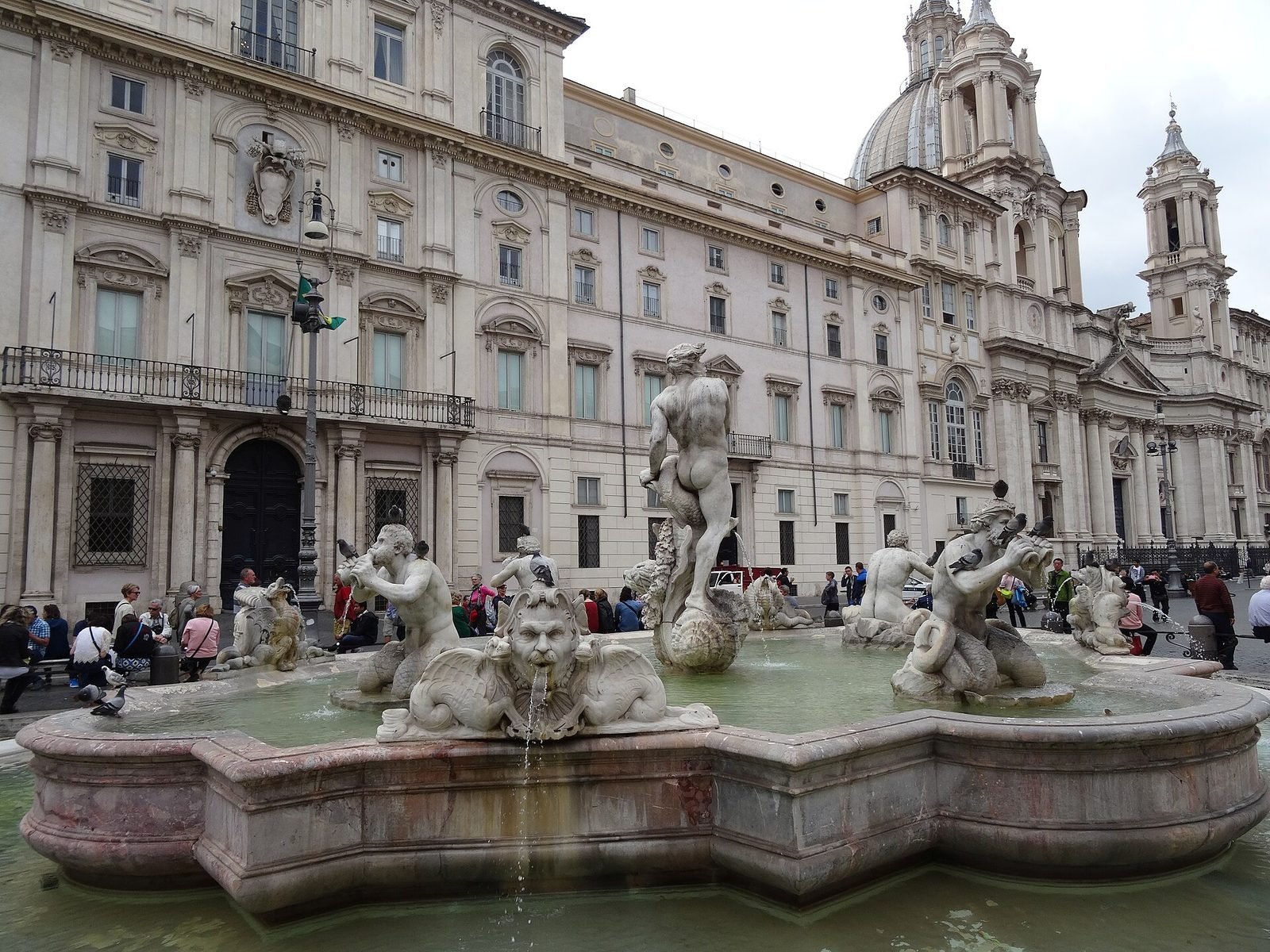
The basin of the Moro Fountain was built in 1575 to a design by Giacomo della Porta, as part of the program of public fountains fed by the Acqua Vergine promoted by the papacy in the second half of the 16th century. It was not born as a work of art to contemplate. It was born as a water collection point for a district that needed it and that held a market in the square three times a week.
What the Acqua Vergine is
The Acqua Vergine is the Roman aqueduct inaugurated in 19 BC by Marcus Vipsanius Agrippa to serve his baths in the Campo Marzio. It is the only ancient aqueduct of Rome that has never completely stopped working. It runs almost entirely in tunnel, below ground level, and this protected it from the cuts and destruction that in the 6th century put the others out of use. Its underground course comes from the Salone area, east of the city, and descends toward the Historic Center with a minimal slope.
Restored and put back into working order during the 16th century, the Acqua Vergine became the water backbone of the whole quadrant between the Tridente and the Campo Marzio. The Trevi Fountain, which is its monumental terminal display, the Barcaccia in Piazza di Spagna and the fountains of Piazza Navona belong to the same network. When you watch the water come out of the dolphin's mouth, you are watching water that made a journey begun 20 kilometers away in a conduit dug in the Augustan age.
Low pressure, and the consequences
The Acqua Vergine arrives in the center with a modest hydraulic head, because the starting elevation is low. This determined the form of all the fountains that depend on it: short jets, wide basins, effects of veils and overflow instead of tall vertical spouts. The Moro Fountain is a textbook case: the water doesn't rise, it opens out. Anyone arriving expecting the vertical spectacle of the 19th-century fountains or of the Fontanone on the Janiculum, fed instead by the Acqua Paola and served by an enormous drop in elevation, is thrown off. It's a technical difference, and you can read it in the eyes of visitors waiting for something that won't happen.
Who Giacomo della Porta was
An architect and sculptor from Lombardy active in Rome in the second half of the 16th century, Giacomo della Porta was the man who gave the city its landscape of water before the Baroque. He completed the dome of St. Peter's with Domenico Fontana, signed the facade of the Church of the Gesù and designed a long series of public fountains: those of Piazza Navona, the Turtle Fountain, the Terrina basin, others in the districts. His work is recognized by one precise trait: the design of the basin counts as much as the sculpture, and often more.
The first layout of the fountain
In the 16th-century layout the basin did not have in the center the figure we see today. The sources agree that the Moor group is a 17th-century addition and that before it there was in the center a simpler element, of a decorative character, replaced when the Pamphilj took the square in hand again. On the exact form of that original element the reconstructions are not unanimous, and we prefer not to state more than can be documented. What is certain is that the basin dates to 1575 and that the Moor arrives in 1653.
1653: Bernini designs, Giovanni Antonio Mari sculpts
In 1653 Gian Lorenzo Bernini designed the central figure of the Moro Fountain, which was however physically sculpted by Giovanni Antonio Mari to his design and under his direction. This clarification is not a specialists' quibble. It changes the reading of the work and also changes what can honestly be said to someone standing in front of it.
Why the distinction matters
Bernini's workshop functioned like a company. The master supplied the model, often in clay or plaster, defined the pose, the twist, the relationships between masses, and entrusted the marble execution to chosen collaborators, intervening on the parts he considered decisive. The Moor of Piazza Navona belongs to this category: Berninian invention, Mari's hand. Attributing it generically to Bernini, as many captions and signs do, is an oversimplification that erases an artist and lets people believe that marble was worked by the master's chisel. It wasn't.
Who Giovanni Antonio Mari was
A sculptor active in Rome in the heart of the 17th century, Giovanni Antonio Mari worked in Bernini's orbit during a period of great papal building sites. His biography is documented in a fragmentary way and the catalog of his works is small: the Moor of Piazza Navona remains his best-known and most visible work. This is also why the correction of attribution has a practical sense, as well as a philological one: without that line, almost nothing of Mari would remain in the city's public memory.
The context: the Pamphilj and the square
The patron was Innocent X Pamphilj, the pope who between 1644 and 1655 transformed Piazza Navona into the monumental drawing room of his own family. On the west side of the square stands the family palace. Next to it is the church of Sant'Agnese in Agone, whose building site passed from the Rainaldi to Francesco Borromini, whose Roman works the site recounts in the page dedicated to Borromini in Rome. In the center is the Fountain of the Four Rivers, won by Bernini in 1651 with a court maneuver that became legendary. In this setting the old 16th-century basin on the south side looked poor, and the remaking of its center was a matter of dynastic decorum before it was a matter of taste.
The Moor and the rest of Bernini's work in the city
Anyone who wants to follow the thread of Bernini's invention across Rome finds the complete itinerary in the page Bernini in Rome, from the Galleria Borghese with the youthful groups to the colonnade of St. Peter's Square, by way of the angels of Ponte Sant'Angelo and the little elephant of the Minerva Obelisk. The Moro Fountain in that route is a minor stop in size and an instructive stop in method: it shows how a public commission really worked in mid-17th-century Rome.
Why it is called the Moro Fountain
The name Moro Fountain is popular, not official, and comes from the look of the central figure: complexion made dark by the marble and the deposits, facial features read by the Romans as African, a turban or twisted drapery on the head in the freer interpretations. The name caught on in use and ended up replacing any other. Already in 18th- and 19th-century guides the fountain is this one, and its name is that one.
Moor, Ethiopian, or sea deity
On the real subject of the statue the discussion is open and has never been closed. Part of the literature reads the figure as a Moor, that is, an African, in continuity with the 17th-century iconography of slaves and distant peoples that appears elsewhere in the square too. Another part interprets it as a sea deity: a triton, or even a Neptune, mastering a dolphin, a subject entirely consistent with the repertoire of fountains and with the marine figures already present on the edge of della Porta's basin.
The arguments in favor of the marine reading are solid. The pose that dominates the aquatic animal belongs to the language of the sea gods, the shell under the feet is a marine attribute, and the rest of the fountain was already populated by tritons. The arguments in favor of the ethnic reading are more physiognomic: the structure of the face, the nose, the rendering of the hair. The writer of these lines has no standing to close a discussion that art historians have kept open for two centuries, and reports it for what it is: a problem of interpretation, not an established fact.
What's in the square is a copy: the originals are at Villa Borghese
The sculptures you see today on the Moro Fountain are copies. The originals were removed in the 19th century and moved to the Giardino del Lago of Villa Borghese, where they still are today, outdoors and freely visible. It is the fact missing from almost all the explanations heard in the square, and it is the one that changes the value of a visit the most.
What was moved and when
The move concerned the original marbles of the fountain, replaced in the square by copies. The dating most often reported by the sources places the operation around 1874, in the framework of the works that followed Rome's passage to the Italian State and the reorganization of the monumental areas of the center. On some details, and in particular on how many pieces were transferred on that occasion and how many in later interventions, the reconstructions do not coincide. We prefer to flag the discrepancy instead of taking one version as settled. The fact itself, instead, is undisputed: in the square there are copies, the originals are at Villa Borghese.
Where exactly they are, inside Villa Borghese
The originals are in the Giardino del Lago, the romantic sector of the villa organized around the artificial lake and the Temple of Aesculapius. It is a free-entry area, open during the hours of the public park, reachable from the Pincio in about 10 minutes on foot or from the Porta Pinciana entrance. Nearby are also the Museo Carlo Bilotti in the Aranciera, the Museo Pietro Canonica and Piazza di Siena hippodrome: a whole afternoon, if you like, with an entrance cost of zero for the park and its open spaces.
Why it's worth the trip
The difference between original and copy, in this case, is visible without instruments. On the marbles in the Giardino del Lago you can read the passes of the chisel, the variation of finish between the polished parts and those left rough, the zones where the surface was treated to catch the light. On the copies in the square all this is flattened. Anyone with two hours who wants to really understand what those figures were should do the route in reverse: first Villa Borghese, then Piazza Navona. It works better, because the eye arrives in the square already trained.
A curiosity about the Moro Fountain
For over two centuries, from 1652 until 1866, in August the square was deliberately flooded by closing the drains of the fountains, and the Moro Fountain ended up with its basin inside an artificial lake a few dozen centimeters deep. It was the Lake of Piazza Navona, a city custom that lasted a few summer weekends and that drew carriages, nobility, common people and trade.
How the flooding worked
The mechanism was simple and exploited a feature of the terrain: the floor of the square, heir to the arena of the Stadium of Domitian, is slightly concave toward the center. It was enough to block the drain mouths of the fountains for the water of the Acqua Vergine, which kept flowing in, to accumulate on the paving until it formed a shallow sheet of water. The nobles' carriages drove around in it throwing up spray, boys splashed in it, vendors sold iced drinks on the edge.
Why it ended
The custom was interrupted in 1866, a few years before the end of the Papal State. The reasons reported by the chronicles concern decorum, hygiene and the practical problems of a square periodically turned into a pool: stagnant water in summer, in a city that still knew epidemics, was not a good idea. Since then the square has not been flooded by custom, and the images that remain are prints, paintings and descriptions.
What remains today
What remains is the shape of the ground, which you can check yourself: stand on the north edge of the square and look south at paving level and the slight central depression becomes evident. What remains is the layout of the Stadium of Domitian, visitable in the underground remains on the north side with a paid ticket, which explains why the square has that elongated plan with one curved end. And what remains, in the warm months, is the recurring temptation to get into the water of the fountains: it is forbidden by the urban police regulation and fined, and over the last few years the fines have been raised several times. The exact amount in force today is best checked on the updated municipal ordinance, because it has changed more than once.
One thing nobody tells you about the Moro Fountain
The Moro Fountain has changed orientation. Today the Moor looks toward the center of the square, but originally the fountain faced outward, toward Via di Pasquino and the front of the Pamphilj palace. The rotation took place in the modern era, and it explains an oddity that many notice without being able to name it, namely the fact that the figure seems to turn its back on anyone arriving from the south.
What you notice, without knowing it
Stand south of the fountain, on Via di Pasquino side, and look: you will see the Moor's back and the dolphin's tail. Walk around the basin to the north side and the scene comes together. Anyone entering the square from the south, that is, the majority of those coming from Corso Vittorio Emanuele II, therefore meets the fountain from the wrong side, and usually deals with it by taking a crooked photo and moving on. It's 15 seconds more of walking to see it the way it should be seen.
Why the orientation changed
The reasons reported concern the restructuring of the layout of the square and the wish to put the three fountains in relation along the central axis. On the exact date of the rotation the sources we consulted do not agree, and place the intervention generically between the 19th century and later works. We report the fact and flag the uncertainty on the chronology, without fixing a year that we cannot document.
A second thing almost nobody looks at
The masks on the edge are not all the same. Anyone walking slowly around the basin, with five minutes of calm, sees that the expressions change: one mouth is more open, one brow more furrowed, one beard thicker. It is the normal variation of a hand-carved series, and in the copies it is less marked than in the originals, but it remains legible. It is also the only way to spend 10 minutes in front of this fountain without getting bored: stop looking at the Moor and look at the edge.
My advice for visiting the Moro Fountain
The practical advice is just one and is worth more than all the rest: come before 8:00 in the morning, or after 23:00. Between 10:00 and 19:00, in the months from April to October, the south side of Piazza Navona is a funnel of groups, portrait artists, street vendors and tables, and you look at the fountain while being shoved.
Early morning
From 6:30 to 8:00 the square is practically empty. There are the street sweepers, a few runners, the waiters putting out the tables, and the raking light from the east that comes in between the buildings on the long side and catches the fountain from the side. It is the only time slot in which you can walk around the basin with nobody in the frame, and the only one in which you can hear the sound of the water. In the daytime the sound of the water simply cannot be heard, covered by the hubbub.
Late evening
After 23:00 the square empties by degrees. The outdoor tables gradually close, the groups have been gone for hours, and what remain are the portrait artists and a few strollers. The artificial lighting warms the marbles and makes them darker than they are, which accentuates the impression that generated the nickname. It's the time slot in which the fountain is most beautiful and least practiced by those who visit Rome in a day.
How much time you need
For the Moro Fountain alone 10 minutes are enough, 15 if you walk around the basin looking at the masks one by one. For Piazza Navona as a whole, including the three fountains and the facade of Sant'Agnese in Agone, allow 40 minutes. Anyone adding the underground remains of the Stadium of Domitian should allow an hour more and a paid ticket, with hours best checked beforehand because the site has closing days and timed visits.
Eating and drinking around Piazza Navona: how to choose
No venue is named on this page, by editorial choice: signs change management, prices change with the season, and a list ages in a few months. What doesn't change are the criteria, and around a monumental square they are needed more than elsewhere. The perimeter of Piazza Navona is one of the stretches of Rome with the highest concentration of businesses living exclusively off tourist foot traffic.
The trap signals, one by one
The menu with photographs of the dishes is the first. A place that has to show a photograph of a carbonara is saying that its customer will never come back and doesn't need to be convinced twice. The second signal is the person at the entrance who invites you to sit, lists the languages spoken and offers a discount: a kitchen isn't promoted that way. The third is continuous opening from morning to late night with no break. A real kitchen has shifts, and between 15:00 and 19:00 it is closed.
The fourth signal is the woman rolling fresh pasta behind the window or directly in the street. It is a scenic lure aimed at passersby, not a sign of quality: you now find it identical in dozens of windows in the center, always at the same hours of foot traffic. The fifth, the simplest, is the position: venues with tables placed in front of a famous monument tend to adjust the price to the customer they have in front of them, with items not priced on the menu and price lists that change between the indoor room and the outdoor area.
The phenomenon of repeated signs
In the center of Rome in recent years a model of venue has multiplied that you recognize at a glance: the same sign in several points of the city, the same identical menu, a queue organized with numbered tickets, a standardized product designed to be photographed. We don't name them and we don't recommend them. The observation that interests us is a different one, and anyone living in Rome can confirm it: the Romans are not in those queues.
The criterion that always works
Look at who is seated and in what language they order. If at 19:30 in the evening the rooms are full of foreigners, the venue works on an early shift built on tourism. If at 20:30 there are tables of Romans talking among themselves and ordering without opening the menu, it's a different kind of place. It works in every neighborhood and doesn't require knowing a single sign.
Where to actually eat, in practice
The advice we give to those who ask is to move 300 meters away. Toward Via del Governo Vecchio, toward the Pellegrino, toward the Ghetto, toward Trastevere across the river: five minutes of walking is enough to get out of the monument price band. Anyone who wants a concrete, non-sponsored reference can consult Daniele Dezi's personal list on Google Maps, a collection curated over the years and with no commercial agreements. For grocery shopping and the historic stalls, instead, we refer you to the page on the markets of Rome and to that of Campo de' Fiori, which is six minutes on foot and is a market in the morning and something else entirely in the evening.
Another well-known fact, yet rarely cited
Piazza Navona follows the plan of the stadium that Domitian had built in AD 85 for athletic contests on the Greek model, and the Moro Fountain occupies roughly the point where one end of the arena stood. It's a notion that appears in every guide, and that almost nobody translates into something to look at on the spot.
How the stadium can be read in today's square
The square is about 270 meters long and less than 60 wide, with the north side closed by a curve and the south side straight. That shape is not a baroque urban planning choice. It is the cast of the ancient layout, with houses built over the stands and the foundations of the arches absorbed into the palaces. The term agone, from which the church's name in Agone derives and the adjective agonal of the obelisk, comes precisely from the contests, from the Greek agon.
Where you can touch it with your hand
On the north side, below street level, the remains of the structure can be visited: arcades, brick masonry, the ancient floor more than four meters deeper than the present one. The page dedicated to the Stadium of Domitian gives the practical information on access, which is by ticket and in limited hours. It is the only point where you go from the notion to the brick.
Why it matters for the fountain
It matters for two concrete reasons. The first is hydraulic: the concavity of the floor, a legacy of the arena, is the same one that made the summer flooding possible. The second is about foundations: building a basin on fill layered over ancient structures poses settlement problems, and it is one of the reasons why the fountains of the square have needed recurring work on pipes and seals over the centuries. We don't give lists of the individual dates of these works, because the accessible documentation is partial and fragmented.
The right photo to take at the Moro Fountain
The photograph that works at the Moro Fountain is taken from the north side of the basin, crouching to the height of the edge, with the dome of Sant'Agnese in Agone cropped out and the dolphin's jet backlit in the first hour after dawn. It is a precise choice and goes against instinct, which would lead you to do the opposite.
From where, exactly
Position yourself on the side of the basin facing the center of the square, about two meters from the edge. Lower the camera or phone to the height of the parapet, don't hold it at eye level: from 1.70 meters the Moor's profile is squashed against the background of the buildings, from 80 centimeters it detaches against the sky. That is the difference between an ordinary photo and a photo in which the figure breathes.
The light
From the east the light of early morning comes in low along the axis of the square and hits the fountain at three quarters, drawing the volumes. At noon the light is vertical and flat, the marble turns washed-out white and the shadows vanish under the figures: it is the worst possible time and it is when 90 percent of photographs are taken. In the evening, with artificial lighting, the color turns warm and you need to rest the phone on the edge to avoid blur, since exposure times get longer.
The detail few people photograph
The masks on the edge, framed up close and isolated, give stronger images than the central group. A grotesque head with water coming out of the mouth, filling the frame right to the edges, without context: it is the photograph nobody takes in the square and that stands on its own. We suggest taking three or four, one per mask, and comparing them afterward. The differences in the chisel work show up better on the screen than on the spot.
Rules and common sense
Photographing the fountain is free and costs nothing, as in all the public spaces of the city. It is not allowed to climb on the edge of the basin, get into the water or sit on the parapet, and in recent years checks on these behaviors have increased, with monetary fines. For drones the rules on the Historic Center of Rome are restrictive and the area is closed to flight without specific authorization: anyone who tries risks having the device seized. For professional filming with equipment, tripods included, a municipal authorization is needed, to be requested in advance.
Some important events that happened here in history
The Moro Fountain has lived through four and a half centuries of the square's life: the market, the August lake, the passage to the Italian State with the transfer of the originals, the transformation into a tourist square in the late 20th century and the vandal damage of 2011. Below are the passages with a verifiable date.
1575: Giacomo della Porta's basin
The basin is built as part of the program of public fountains fed by the Acqua Vergine. The square in those years hosts the city market, moved here from the Capitoline Hill in the 15th century, and the fountain is born first of all as a service: water for the stalls, for the animals, for the houses around.
1653: the central group
Under Innocent X Pamphilj, Bernini designs the figure of the Moor, which Giovanni Antonio Mari executes in marble. It is the year in which the square is an open building site on three fronts, with the central fountain just finished, the church of Sant'Agnese under construction and the family palace being enlarged.
From 1652 to 1866: the August lake
For more than two centuries the summer flooding of the square becomes a fixed appointment on the Roman calendar, with the fountain immersed up to the step. The custom ends in 1866.
Around 1874: the transfer of the originals
The original marbles are removed and taken to the Giardino del Lago of Villa Borghese, replaced in the square by copies. The most recurrent dating is 1874, but on this point the sources are not entirely aligned and we flag it.
2011: the vandal damage
In 2011 the Moro Fountain was seriously damaged by an act of vandalism: a man repeatedly struck the sculptures with a blunt object, breaking off fragments from the face and hands of the central figure. The episode got wide coverage in the national press and reopened the debate on the surveillance of outdoor monuments in the center of Rome. The fragments were recovered and restoration went ahead. On the exact duration of the works and the extent of the intervention we give no figures, because we have no confirmation we consider reliable. The fact that the damaged pieces were 19th-century copies and not the 17th-century originals limited the historical loss, and this is the only consoling aspect of the affair.
Who has passed by the Moro Fountain
In front of the Moro Fountain have passed, in the proper and documented sense, the protagonists of the baroque Rome that built that square: Innocent X Pamphilj, patron of the central group in 1653, Gian Lorenzo Bernini who designed it, Francesco Borromini who was working a few meters away on the facade of Sant'Agnese in Agone, and Giacomo della Porta who 80 years earlier had laid out the basin.
The popes and the square
Gregory XIII promoted the program of public fountains within which the 16th-century basin was born. Innocent X transformed the square into the stage of his own family between 1644 and 1655, and it was he who wanted the remaking of the center of the south basin. From him, and from the family palace facing the square, descends a good part of the present look of the whole west front.
The Romans
This is the least told part. For centuries this was the market's fountain, then the neighborhood's, then the one in front of which people working in the shops of Via del Governo Vecchio and in the surrounding palaces arranged to meet. Today the Romans cross the square mostly to go somewhere else, and late in the evening they become again the majority of those sitting on the steps around. Anyone who wants to see this side of the square has to come out of season, on a Tuesday in November, around 22:00.
Visiting today: costs, accessibility, rules
The Moro Fountain can be seen free of charge at any moment of the day and night, with no ticket, no reservation and no barriers. It is in a public pedestrian square, flat, with sampietrini paving. There are no opening hours because there is no closing.
Accessibility
The level of the square has no steps and can be reached from all the side entrances without significant changes in level. The sampietrini surface makes passage uncomfortable with wheelchairs, strollers and suitcases, particularly in the central stretch where the paving is more irregular. The edge of the basin is low and allows a close view even from a seated position. The nearest public restrooms are the paid ones of the commercial businesses on the perimeter, which in practice means buying something.
The rules in force
The urban police regulation prohibits entering the basins, climbing on the edges, immersing objects and bathing in the monumental fountains, and in recent years it has extended the ban to sitting on the parapet of the historic fountains. The penalties provided have been changed several times and can reach several hundred euros. The updated amount should be checked on the municipal ordinance in force, because it changes. Drinking from the nasoni, on the other hand, is allowed and encouraged.
What is overrated here
We give a judgment, because it's useful. The portrait artists and souvenir stalls on the perimeter are the least interesting part of Piazza Navona and absorb a good part of visitors' attention. The Moro Fountain, which is the oldest piece of the square, receives on average a quarter of the time given to the central fountain. The ratio should be reversed, or at least rebalanced. And the coffee with a view, paid three or four times the price of a counter 200 meters away, is the least justified expense you can make in this part of Rome.
What to see within a 10 minute radius
Around the Moro Fountain there is a density of monuments rare even for Rome: within a radius of 600 meters there are five churches with first-rate works, three civic and state museums, two historic squares and one of the institutional seats of the Republic.
Under five minutes away
The talking statue of Pasquino is 20 meters from the south exit of the square. Palazzo Braschi closes the corner between the square and Corso Vittorio Emanuele II. The church of Santa Maria della Pace, with Bramante's cloister and Raphael's Sibyls, is behind the west side. Palazzo Altemps, home of the ancient sculpture collection of the Museo Nazionale Romano, is just to the north.
10 minutes away
The church of San Luigi dei Francesi with the three Caravaggios of the Contarelli chapel, the Basilica of Sant'Agostino, the Church of Sant'Ivo alla Sapienza with Borromini's spiral lantern, Palazzo Madama, the Museo Barracco of ancient sculpture, the Cancelleria, the Galleria Spada with Borromini's perspective, the Basilica of Sant'Andrea della Valle and the Pantheon, which is under 800 meters from the south side of the square.
If you have half a day
A route that works well starts from the Moro Fountain, continues toward the Pantheon and the Minerva with its obelisk and little elephant, touches the Church of Sant'Ignazio with Pozzo's vault and comes out at Piazza Colonna, from where in five minutes you are on Via del Corso and in 10 at the Trevi Fountain. It is an hour and a half of slow walking, all on the flat, without ever taking a vehicle.
Frequently asked questions about the Moro Fountain
Where is the Moro Fountain?
The Moro Fountain is at the south end of Piazza Navona, in Rome, in the Parione district, on the side of Via di Pasquino and Palazzo Braschi. It is one of the three fountains in the square, the southernmost of the three, about 150 meters from Corso Vittorio Emanuele II. Access is free and the square is pedestrian.
How much does it cost to see the Moro Fountain?
Seeing the Moro Fountain is free. It is in a public square, has no fence or ticket office and is visible at any hour of the day and night. The only possible cost concerns the underground remains of the Stadium of Domitian on the north side of the square, which are a separate site with a paid ticket and their own hours to check before the visit.
Is the statue of the Moro Fountain by Bernini?
The central figure of the Moro Fountain was designed by Gian Lorenzo Bernini in 1653 and physically sculpted by Giovanni Antonio Mari to his design. Attributing it outright to Bernini is a widespread oversimplification: the invention is his, the marble execution is not. The basin that houses it is almost 80 years older and is due to Giacomo della Porta, who built it in 1575.
Why is it called the Moro Fountain?
The Moro Fountain takes its name from the look of the central figure, read by the Romans as that of a dark-skinned man. The nickname is popular and not official. On the real subject scholars still argue: according to one reading it is a Moor, according to another a sea deity, a triton or a Neptune, wrestling with a dolphin, a hypothesis consistent with the other marine figures of the basin.
Are the statues of the Moro Fountain original?
No. The sculptures visible today on the Moro Fountain in Piazza Navona are copies. The originals were removed in the 19th century, with a dating the sources most often place around 1874, and moved to the Giardino del Lago of Villa Borghese, where they still are today outdoors and visible free of charge during the opening hours of the public park.
How do you get to the Moro Fountain by public transport?
The subway does not reach the Moro Fountain: Piazza Navona has no station. The reference hub is Largo di Torre Argentina, seven minutes on foot, served by tram 8 and by many bus lines. Other lines pass along Corso del Rinascimento and Corso Vittorio Emanuele II. The Spagna and Barberini stations of Line A are about 20 minutes' walk away. It's best to check the updated routes the same day.
What is the best time to visit the Moro Fountain?
The best time to see the Moro Fountain is before 8:00 in the morning or after 23:00. Between 10:00 and 19:00, from April to October, the south side of Piazza Navona is the most crowded stretch of the square and the basin is hard to look at. Early morning offers raking light from the east, silence and the chance to walk around the fountain without crowds in the frame.
Is the Moro Fountain wheelchair accessible?
The Moro Fountain can be reached by wheelchair because Piazza Navona is pedestrian, flat and without steps at the entrances. The real difficulty is the sampietrini paving, uneven and tiring, and the crush in the middle hours, which reduces the room to maneuver between tables and groups. The early morning hours remain the most practicable time slot.
Can you get in the water or sit on the edge of the Moro Fountain?
No. At the Moro Fountain, as at all the monumental fountains of Rome, the urban police regulation prohibits getting in the water, climbing on the edges and sitting on the parapet, with monetary fines. Photographing is free and costs nothing, while for drones the Historic Center area is closed without specific authorization and for professional filming with a tripod a municipal permit is needed.
Who wrote this page
This page is edited by the team at Tour Leader Pro, the Rome-based project office that designs and coordinates visits, itineraries and cultural events in Rome and Lazio. Hours, rates and access conditions given here were checked at the publication date against the official sources indicated in the text. Before you leave it's best to check them again, because they change often. If you find an outdated detail, let us know.
Anyone building an itinerary in the Historic Center of Rome who wants to fit this stop together with the other stops of the Campo Marzio, with the civic museums of the area and with the real walking travel times, will find planning tools and operational support at Tour Leader Pro, which works in Rome and Lazio with groups, schools and corporate trips.
For a broader picture, covering connections between Italian cities, trains, distances and the planning of a trip that doesn't end in Rome, a useful resource is Italy Planner, which brings together transport, destinations and travel times on a national scale.