Palazzo della Cancelleria
In short. Palazzo della Cancelleria stands in Piazza della Cancelleria, in the heart of the Parione district, a few steps from Campo de' Fiori and from the stretch of Corso Vittorio Emanuele II that leads toward Piazza Navona.
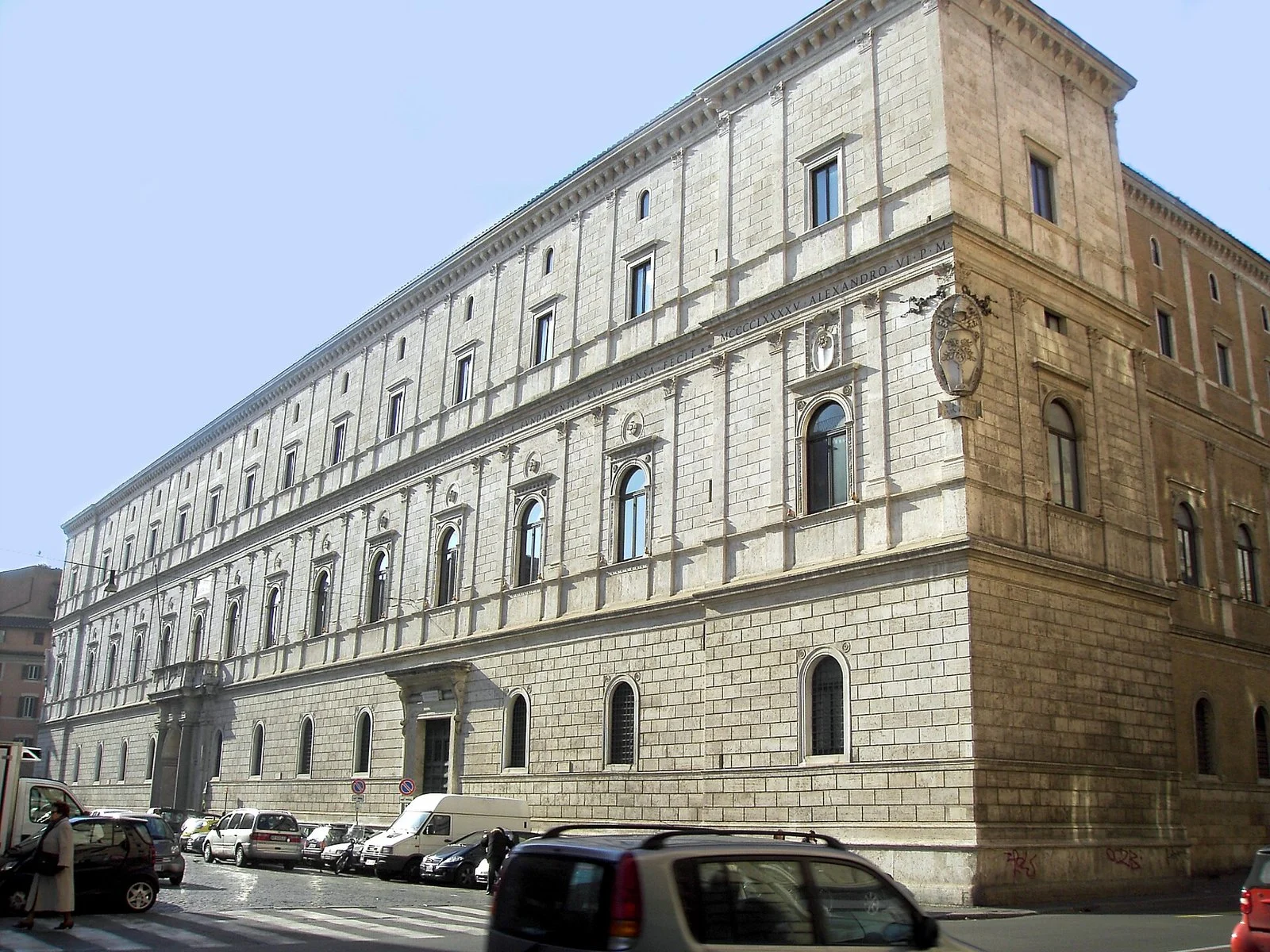
Palazzo della Cancelleria stands in Piazza della Cancelleria, in the heart of the Parione district, a few steps from Campo de' Fiori and from the stretch of Corso Vittorio Emanuele II that leads toward Piazza Navona. It is the first great Renaissance palace built in Rome on a unified design, commissioned by Cardinal Raffaele Riario between the end of the fifteenth century and the first decade of the sixteenth, and it is still today extraterritorial property of the Holy See. Within its walls coexist a courtyard of rare elegance, an early Christian basilica incorporated into the facade and the offices of two Vatican tribunals, which makes it both a monument to look at from outside and a building that, on certain occasions, can also be visited from inside. If you are instead looking for the exhibition on Leonardo da Vinci's machines that is periodically hosted in some rooms of the palace, you will find the page dedicated to that event here: Leonardo da Vinci Exhibition at Palazzo della Cancelleria, a piece of content distinct from this page, which instead tells the story of the building itself, its history and its architecture. Among Rome's great Renaissance palaces, the Cancelleria occupies a particular place because it unites in a single building three levels of history that elsewhere are found separate: the ancient stratification under the basilica, the architectural invention of the Renaissance in the facade and the courtyard, and the ecclesiastical institutional function that is still fully active today. Understanding these three levels together is the best way not to reduce the visit to a simple photo of the facade from afar.
Where Palazzo della Cancelleria is and how to get there
The square that bears its name opens onto Corso Vittorio Emanuele II, the axis that cuts through the historic center from Largo di Torre Argentina to Ponte Vittorio Emanuele II and the Vatican. Palazzo della Cancelleria occupies an entire block between the square, Via del Pellegrino and Vicolo del Malpasso, in an urban fabric that has kept its medieval and Renaissance layout despite the nineteenth-century demolition that opened the Corso right in front of it.
On foot from the main points of the center
From the Pantheon the distance is about 10 minutes on foot, passing through Piazza Navona and Via del Governo Vecchio. From Piazza Venezia you walk along Corso Vittorio Emanuele II for about a quarter of an hour. From Campo de' Fiori 3 or 4 minutes are enough, crossing Via dei Baullari: it is the most natural connection, the one walkers in the Parione district take without even noticing, going from a neighborhood market to a palace of ecclesiastical power within two blocks.
By public transport
There is no metro stop at a useful distance: lines A and B touch the historic center only at the edges, and the nearest station, Spagna on line A, is about 20 minutes away on foot. The most practical solution is the bus: the lines that run along Corso Vittorio Emanuele II stop a few tens of meters from the square, and whoever arrives from Termini can take a direct bus without having to change. The tram doesn't come this far. The historic center in this area is designed to be crossed on foot, and most visitors do so without even considering the alternative.
By car and parking
The area falls within the ZTL of the historic center, active during daytime hours on weekdays: anyone without a permit risks a fine if they enter with their own car. The nearest paid parking is along the Tiber embankments and in some underground structures in the Campo de' Fiori area. It's best to leave the car there and continue on foot, because traffic inside these narrow streets is almost always congested in the middle hours of the day.
The history of the palace: from Cardinal Riario to the legend of the night of gambling
The Riario family and the shadow of Sixtus IV
To understand how a single cardinal could afford a building site of this size, you have to look at the family context. Raffaele Riario was the nephew of Pope Sixtus IV, born Francesco della Rovere, who during his pontificate systematically promoted the members of his own family to leading posts in the Roman curia, according to a practice of nepotism that in those years was the norm of papal government rather than the exception. Raffaele received the cardinal's hat very young, still an adolescent, and with it an income and an economic power that few other cardinals of the time could claim. It was precisely this concentration of resources, combined with the office of camerlengo, that is administrator of the assets of the Roman Church, that put in his hands the means needed to start a building site that would change the face of an entire neighborhood.
Riario was also one of the involuntary protagonists of the Pazzi conspiracy of 1478 in Florence, the attack on Lorenzo and Giuliano de' Medici that took place during a religious service: although, according to most historians, he had no active role in the plot, he was present in the cathedral that day and in turn risked his life in the tumult that followed the attack. It's an episode that shows how much his biography was intertwined with the harshest political intrigues of his time, long before the affair that would involve him in Rome in 1517.
The collector of ancient art
Beyond the political affair, Raffaele Riario was also one of the great collectors of antiquities in the Rome of his time, with a collection of classical sculptures that he kept in his own palace and that helped strengthen the taste for the antique already widespread among the humanist cardinals of the Roman curia at the end of the fifteenth century. This personal interest in ancient statuary is not unrelated to the choice to build a palace that, in its architecture, looked explicitly to classical models reinterpreted in the language of the Florentine Renaissance: the sensibility of the patron and the design of the building, in this case, reinforce each other more than happens in many other great Roman building sites of the same period.
The construction of Palazzo della Cancelleria is tied to a single name, that of Cardinal Raffaele Riario, camerlengo of the Roman Church and nephew of Pope Sixtus IV. Work began in the 1480s and continued for more than two decades: the sources indicate a start of the building sites around 1489, with a main building phase concluded by the end of the century and a completion of the decorations and interiors that dragged on until about 1513. Some scholars move the start of the works earlier, already to 1486, which explains why slightly discordant dates are found in different sources: the construction of a palace of this size was not a single event, but a building site open for more than 20 years, and placing it with absolute precision within a single year is an exercise the sources themselves do not allow.
The legend of the gambling win
The most told story about this palace concerns the way it was supposedly paid for. According to an anecdote reported by the writer Pietro Aretino and taken up by later chroniclers, Cardinal Riario supposedly won a huge sum in a single night of gambling against Franceschetto Cybo, the natural son of Pope Innocent VIII, and used that money to finance the construction. It is a legend hard to verify in its details, but not entirely without indirect historical confirmation: the fame of this origin was so widespread and so awkward that, when in 1517 Pope Leo X confiscated the palace from Cardinal Riario following a conspiracy against him, the official justification for the confiscation also recalled the unclear origin of the funds used. From there the palace passed to the Medici family, who kept it until it became the permanent seat of the Apostolic Chancery, the office from which it takes the name it still bears today.
The name and the original function
The term Cancelleria (Chancery) describes not the architecture but the administrative function: here was the seat of the office in charge of drafting and authenticating the most important papal documents, a sort of ministry of justice and of official acts of the Holy See. The name remained even after the concrete functions housed inside changed several times over the centuries, up to the tribunals that have their seat there today.
The disputed architect: Pontelli, Sangallo and the shadow of Bramante
On who actually designed Palazzo della Cancelleria the sources do not agree, and it is honest to say so clearly instead of flattening the question onto a single name. The name that appears most often in the archive documents as architect of the building is that of Baccio Pontelli, a Florentine architect active in Rome at the end of the fifteenth century also on other papal building sites. Many studies instead attribute the design of the inner courtyard, considered the most refined part of the whole complex, to Antonio da Sangallo the Elder, while an older tradition, still very widespread in Roman popular culture, assigns the credit for the overall design, or at least of the courtyard, to Donato Bramante.
Why the attribution remains open
The problem arises from the fact that, when the works began, Bramante is not yet documented in Rome with certainty: his permanent presence in the city is usually traced back to the mid 1490s, therefore after the start of the Cancelleria building site. This does not rule out an intervention by him at a later stage, perhaps precisely on the courtyard, which stylistically anticipates solutions that Bramante would develop fully in the cloister of Santa Maria della Pace, a building a few steps from here that still bears his name today in the Chiostro del Bramante. The more cautious historians of architecture prefer to speak of a circle of architects working in dialogue with one another, rather than of a single author, and this uncertainty, far from being a defect, tells well how a papal building site of the Roman Renaissance worked: a collective job, where the prestige almost always ended up attributed to the most celebrated name available at the moment, not necessarily to whoever had really designed every detail.
A debate that continues among scholars
The debate on the attribution of the courtyard has never really closed, and is still the subject of academic publications that compare archive documents, stylistic analyses and comparisons with other certain works of the three candidate architects. Whoever reads general tourist guides often finds categorical statements one way or the other, but the most recent specialist literature tends to remain cautious, preferring to speak of probable attribution rather than documented certainty. It is worth arriving in front of the courtyard knowing that the mental label with a single author's name, which we are used to associating with every great work of the Renaissance, in this case does not entirely stand up to the test of the documents.
The travertine facade: a manifesto of the early Roman Renaissance
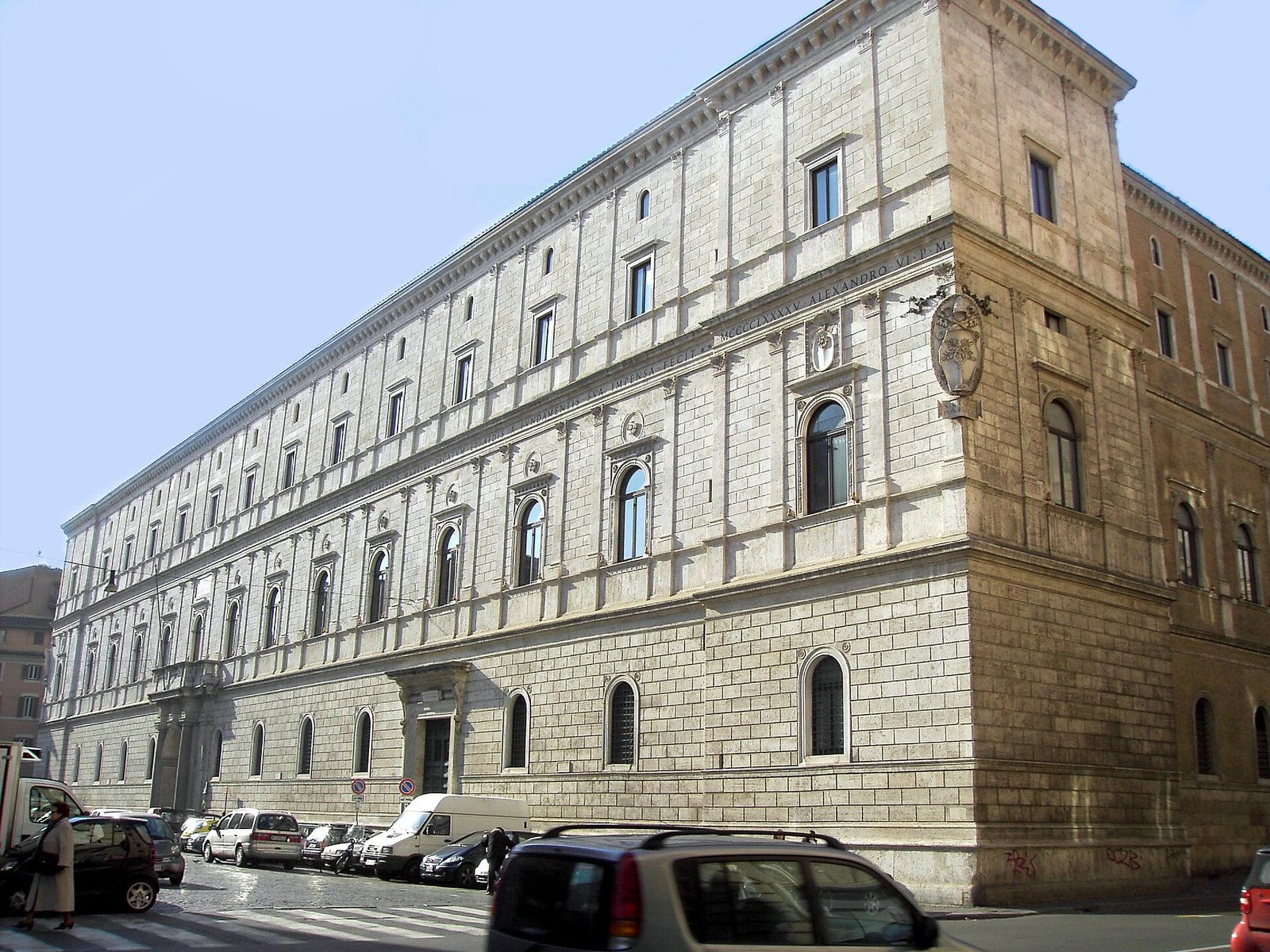
The facade of Palazzo della Cancelleria on Piazza della Cancelleria is long and extended, marked by flat pilasters that divide the surface into regular fields, with two orders of framed windows and a base of smooth rustication that gives visual stability to the whole front. It is a solution that derives directly from the Florentine palaces of the second half of the fifteenth century, in particular from models such as Palazzo Rucellai, where for the first time a classical architectural order had been applied systematically to the surface of a civil building. Bringing this language to Rome, in a context where civil architecture was still largely medieval, was a gesture that contemporaries perceived as radically new.
A long building site, in phases
The length of the front, which occupies the whole side of the square, was not the fruit of a design carried out in one breath: as already said, the works dragged on for more than two decades, and the stylistic coherence we perceive today when looking at the facade is in reality the result of very rigorous site control by the patron, capable of keeping a single architectural language even years apart between the start of the works and their completion. It was not a given: many contemporary Roman palaces instead show visible seams between different building phases, while the Cancelleria presents itself today as a compact and homogeneous block.
The dedicatory inscription and the Riario coat of arms
On the facade there is an inscription recalling the patronage of Cardinal Raffaele Riario, together with the heraldic coat of arms of his family, the rose, repeated also in the interiors and in the courtyard. It is not a secondary decorative detail: in Renaissance Rome, a palace of this scale was first of all a political manifesto, a way of making visible to the whole city the economic power and prestige of the house that had it built, and the Cancelleria in this sense worked perfectly for Cardinal Riario, at least until the confiscation of 1517.
The Renaissance courtyard and the columns of the Theater of Pompey
The inner courtyard of Palazzo della Cancelleria is, for many art historians, the highest point of the whole building. It develops on three superimposed orders, with arcades on columns on the ground floor and loggias in the upper orders, in a sequence of proportions that introduces to Rome a classical language revisited with a measure until then unknown in the city. It is a courtyard designed to be crossed and looked at, not only to connect the rooms of the building, and it remains today one of the most cited references when speaking of the civil architecture of the early Roman Renaissance.
The salvaged columns from the Theater of Pompey
A detail that tells well how people built in Rome in those years concerns the materials. A large part of the travertine of the facade and of the columns of the courtyard comes from spolia, that is from the reuse of ancient materials taken from Roman monuments by then in ruins or abandoned: the Theater of Pompey, which stood right in this area of the city between Campo de' Fiori and Largo di Torre Argentina, was one of the main quarries. Some sources also indicate the Colosseum among the places from which blocks of travertine were taken, and the Egyptian granite columns that mark the courtyard probably date back precisely to the structure of the Pompeian theater, reused here after having already passed, in some cases, through the earlier ancient basilica of San Lorenzo in Damaso. It is a concrete reminder of how much Renaissance Rome was literally built on top of and with the remains of the ancient one, a theme that returns in many other palaces of the historic center, including the nearby Palazzo Farnese, another great sixteenth-century Roman building site born not far from here, in a square that bears the same name as the family that had it built.
The heraldic decorations
On the capitals and on some decorative elements of the courtyard the heraldic emblem of the Riario family, the rose, appears several times, a sign of belonging that Renaissance patrons never failed to leave on their buildings. Walking under the arcades you find several, as a reminder that, before being a public and then Vatican building, this had been conceived as the private residence and the calling card of a very rich and very powerful cardinal at the papal court.
The comparison with other Roman courtyards of the early sixteenth century
The courtyard of the Cancelleria is often compared with that, chronologically later, of Palazzo Farnese, and with other examples of Roman porticoed courtyards built in the decades immediately following, as a term of comparison to measure how quickly the classical language was refined in Rome within a generation. Compared with later solutions, the courtyard of the Cancelleria keeps a closer and more direct relationship with the ancient models from which it draws inspiration: the proportions between solids and voids, the sequence of the superimposed architectural orders according to the classical hierarchy, Doric, Ionic and Corinthian from bottom to top, give an almost textbook layout, which historians of architecture regularly cite as a reference point for introducing students to the study of the Roman Renaissance.
The basilica of San Lorenzo in Damaso inside the palace
One of the most unusual features of Palazzo della Cancelleria is that it has, incorporated in its facade on Piazza della Cancelleria, a basilica dedicated to San Lorenzo in Damaso. It is not a private chapel added at a later time, but an ancient church, founded by Pope Damasus I during the fourth century, which already existed on this site long before Cardinal Riario decided to build his palace next to it. When the Renaissance building site took shape, the basilica was rebuilt and integrated into the new building, with its own entrance on the square and a facade that dialogues directly with that of the palace.
What remains of the early Christian layout
Archaeological excavations carried out between the end of the 1980s and the early 1990s brought to light, under the present floor, remains of an even older place of worship, with traces dating to the early Christian period and evidence of a necropolis used until the early Middle Ages. These finds confirm that the area around Piazza della Cancelleria was a Christian place of worship already many centuries before the Renaissance, and that Cardinal Riario's palace has, in a sense, been superimposed on an already very ancient religious stratification.
The interiors and the works
Inside the basilica there are paintings from several centuries, among them an altarpiece attributed to Federico Zuccari and a cycle with the Last Supper by Vincenzo Berrettini. The church also holds the relics tied to Saints Damasus and Eutychian. San Lorenzo in Damaso functions as an active parish church, with opening hours and regular celebrations that follow the liturgical calendar of the diocese of Rome, and it is normally the only simple and free way to set foot inside the perimeter of the building without having to wait for an organized guided visit.
A cardinalatial title still active
San Lorenzo in Damaso, besides being a parish church in operation, also keeps the role of cardinalatial title, that is of a church formally assigned to a cardinal of the Catholic Church as a sign of his symbolic bond with the clergy of Rome, according to a tradition that goes back to the very origins of the College of Cardinals. This double level, that of the concrete parish serving the faithful of the neighborhood and that of the honorary title tied to international ecclesiastical diplomacy, is another example of how in this corner of Piazza della Cancelleria the everyday dimension and that of great institutional representation constantly intertwine.
The interiors: the monumental rooms and the historical archive
Beyond the courtyard and the facade, Palazzo della Cancelleria keeps inside a sequence of reception rooms that, over the centuries, have hosted receptions, audiences and official ceremonies of the Roman curia. The most famous remains the Sala dei Cento Giorni, frescoed by Giorgio Vasari with episodes from the life of Pope Paul III, but it is not the only room of note: the piano nobile keeps a sequence of halls with coffered ceilings and painted decorations of different eras, layered one on top of the other as the successive occupants of the palace left their mark.
The archive and the historical library
Over the centuries, as the seat first of the Apostolic Chancery and then of the tribunals of the Holy See, the building has accumulated a considerable documentary heritage, with archival holdings covering centuries of judicial and administrative acts of the Roman Church. This heritage is not open to free consultation like a state archive, and access is reserved for authorized scholars who apply according to the procedures of the Holy See, a further sign of how the building, while being a historic monument of the first rank, remains first of all an active workplace.
The rooms used for exhibitions
It is precisely some of these rooms on the ground floor and on the piano nobile, those less tied to daily judicial activity, that are occasionally opened to host temporary exhibitions, like the one dedicated to Leonardo da Vinci's machines described further on in this page. It is a use that allows the public to cross at least part of the inner rooms without necessarily having to book a guided visit on a strictly architectural theme.
A curiosity about Palazzo della Cancelleria
Under the palace, according to several sources that tell the history of the building, there is what is called, in a somewhat theatrical way, the underground lake: not a real natural body of water, but a large cistern or hypogeal space tied to the ancient foundations on which the palace was built, the subject in some seasons of themed guided visits that promise to take visitors to the lowest and least known levels of the building. It is one of those details that almost nobody associates with such a solemn Renaissance palace, and that is precisely why it strikes you the most: under the frescoed rooms and the loggias of the courtyard, the subsoil still keeps fragments of the ancient stratification on which this whole area of Rome has grown over the centuries.
Something nobody tells you about Palazzo della Cancelleria
Almost all guides tell the legend of the gambling win as a colorful anecdote, but few dwell on how much that story was, in reality, a political weapon. Pope Leo X did not confiscate the palace out of a simple moral scruple about gambling money: he did it after discovering that Cardinal Riario was involved, together with other cardinals, in a conspiracy to assassinate him, the so-called conspiracy of Cardinal Petrucci of 1517. Riario was arrested, forced to pay an enormous sum to be pardoned and stripped of property and offices, and the palace passed to the papal state precisely in that context. The legend of the lucky night at the gaming table is therefore, in all likelihood, a story that survived and was handed down because it was simpler and more tellable than the truth, which concerned instead a very harsh power struggle inside the Roman curia, with an attempted murder of the pope in the background. Whoever visits the elegant courtyard of the palace today rarely knows this backstory, and it is worth knowing before strolling under it.
Extraterritoriality and the tribunals of the Holy See
After the Lateran Pacts of 1929, which regulated relations between the Italian state and the Holy See, Palazzo della Cancelleria was included among the properties that enjoy extraterritoriality, even though it is physically in the middle of Italian territory and not inside the perimeter of Vatican City. It means that, even though it stands a few hundred meters from Campo de' Fiori, the building enjoys the same guarantees of inviolability recognized for diplomatic premises, and is administered according to the rules of the Holy See and not those of the City of Rome.
What it houses today
The palace is currently the seat of two important tribunals of the Catholic Church: the Apostolic Signatura, the highest judicial instance of the Holy See after the pontiff, and the Tribunal of the Roman Rota, which deals in particular with canonical matrimonial cases. In the past the Apostolic Penitentiary was also based here. This use explains why daily public access is limited: it is not a museum with fixed hours, but a working building where real ecclesiastical judicial activities take place, with staff, archives and hearings under way.
What extraterritoriality means in practice
The concept of extraterritoriality, applied to Palazzo della Cancelleria as to other Roman buildings tied to the Holy See under the Lateran Pacts, does not amount to saying that the building formally belongs to the territory of the Vatican City State: it remains administratively and geographically part of the City of Rome and of the Italian state, but enjoys guarantees of inviolability similar to those of a foreign embassy, with limits on the entry of the Italian police without authorization and with exemption from some taxes. It is the same legal principle that governs other Roman properties of the Holy See, such as the patriarchal basilicas and some palaces tied to the Vatican dicasteries, and it is one of the least visible but most concrete aspects of what the Lateran Pacts changed in relations between Italy and the Catholic Church starting in 1929.
The advice I give you for visiting Palazzo della Cancelleria
The most useful advice I can give is not to expect free and continuous access, as happens in a state museum, and to organize yourself in advance. Palazzo della Cancelleria is almost always visited through themed guided visits organized by Roman cultural associations, often announced a few weeks ahead and with limited places: it's best to keep an eye on the city's cultural event calendars in the weeks before a trip, book as soon as you find an available date and show up with an ID, because access to an extraterritorial building with judicial functions involves closer checks than at an ordinary museum.
What to see if you can't get in
If you can't find an available guided visit, it's still not a wasted trip. The facade on Piazza della Cancelleria can be admired freely at any time, and it is already in itself a lesson in Renaissance architecture in the open air. The basilica of San Lorenzo in Damaso stays open to the public during the hours of the celebrations, with free entry, and it's the simplest way to see at least part of the interiors without a reservation. I recommend arriving in the late afternoon, when the raking light lights up the travertine facade well and the square is quieter than in the middle hours of the day, when the passing traffic on Corso Vittorio Emanuele II makes the area noisier and more crowded.
A smart pairing with the rest of the historic center
The most practical advice, for those who have only a few hours, is not to treat Palazzo della Cancelleria as an isolated stop to tick off a list, but to put it in a walking itinerary that also includes Campo de' Fiori and Piazza Navona, a few minutes from each other. This way even an exterior visit, without access to the interiors, still gives a coherent picture of what the Parione district was in the Renaissance: a dense weave of ecclesiastical power, market life and architectural experimentation, all concentrated in a handkerchief of streets that you can comfortably walk in a single morning.
The Parione district, Campo de' Fiori and the Roman Renaissance around the Cancelleria
Palazzo della Cancelleria is not an isolated monument, but the heart of one of the districts densest in Renaissance history in all of Rome. The Parione district, where it stands, takes its name from an ancient wall and still keeps today a weave of narrow alleys, craft workshops and noble palaces that overlapped over the centuries without ever completely erasing the previous layer.
Campo de' Fiori, a stone's throw away
Campo de' Fiori is a few minutes' walk away and is the popular, everyday counterpart to the solemnity of the Cancelleria: fruit and vegetable market in the morning, bars and street life in the evening. The two places together tell two faces of the same Renaissance Rome, that of ecclesiastical power and that of life in the square, and it's a route I recommend doing in sequence, perhaps starting from the market first thing in the morning and arriving at the Cancelleria when the square is still not very crowded.
Palazzo Farnese and the season of the great sixteenth-century building sites
A few minutes' walk away, past Campo de' Fiori, you arrive at Palazzo Farnese, another colossus of sixteenth-century Roman civil architecture, built at the will of the Farnese family in a building site that saw pass, in different phases, some of the greatest architects of the era. Comparing the two palaces, that of Riario and that of the Farnese, helps understand how the language of Roman civil architecture changed within two generations, from the still fifteenth-century rigor of the Cancelleria to the more mature monumentality of the full sixteenth century.
The Theater of Pompey and the ancient memory of the district
It's worth spending a few more words on the Theater of Pompey, already mentioned in connection with the columns and the travertine reused in the Cancelleria, because its legacy in the Parione district goes beyond building materials. The theater, inaugurated in 55 BC, was the first permanent masonry theater built in Rome and one of the most imposing public buildings of the ancient city, with a capacity that the sources estimate at several thousand spectators. In the Middle Ages its enormous curved structure, by then in ruins, conditioned later urban growth: many streets and the very shape of some blocks of the district still follow today, in a way almost imperceptible to those who walk without knowing it, the ancient curve of the theater's cavea. Strolling between Campo de' Fiori and Piazza della Cancelleria you are therefore, without realizing it, retracing the outline of a Roman monument that disappeared centuries ago, whose building material is today incorporated right in the walls of the Renaissance palace you are about to visit.
Toward Piazza Navona
From Piazza della Cancelleria, taking Via del Governo Vecchio or Corso del Rinascimento, you reach Piazza Navona in a few minutes, closing an itinerary that touches three of the most representative places of Rome's Renaissance and Baroque historic center without ever having to use a means of transport.
Another well-known fact, yet rarely mentioned
Many know, at least by hearsay, that Palazzo della Cancelleria was the first great Renaissance palace built in Rome with an organic and unified design, different from the medieval palaces that were enlarged by accumulation over the centuries. What is cited much less often is why this primacy really matters: before the Cancelleria, Roman civil architecture was still largely tied to late medieval models, while in Florence the great Renaissance palaces, from Palazzo Medici to Palazzo Rucellai, had been an established reality for decades. With the Cancelleria, Rome imports and reinterprets that Florentine language, adapting it to the monumental scale that only the power of the papal curia could afford, and in fact opens the season of the great Roman Renaissance building sites that will lead, within a few decades, to Palazzo Farnese and to many other buildings of the historic center.
The right photo to take at Palazzo della Cancelleria
The most effective photo is not taken head-on from the center of the square, as most passing visitors would do, but slightly from the side, from the corner between Piazza della Cancelleria and Via del Pellegrino: from this position you frame together the depth of the main facade, the rounded corner of the building and a glimpse of the basilica of San Lorenzo in Damaso, capturing in a single shot the double nature of the complex, civil and religious at once.
The best light
The facade is oriented in such a way as to receive full light in the late afternoon, when the low sun accentuates the relief of the pilasters and the travertine cornices, bringing out the geometric structure of the composition much more than in the middle hours, when the vertical light flattens the volumes. If you manage to get in during a guided visit, the photo not to miss is that of the courtyard shot from the ground floor upward, with the three rows of superimposed arcades lining up in a single vertical vanishing point: it is the image that best tells the architectural quality of this space.
Temporary exhibitions and events at Palazzo della Cancelleria
Over the years, some rooms of Palazzo della Cancelleria have been opened to the public for temporary exhibitions, which often represent the simplest way to visit the interiors without having to wait for a guided visit dedicated to architecture. Among these is the exhibition dedicated to Leonardo da Vinci, with working wooden reconstructions of his machines drawn from the Vinci codices, hosted periodically right in some rooms of the palace: those interested in this specific event, distinct from the history of the building that this page tells, will find all the details on the page dedicated to the Leonardo da Vinci Exhibition.
How to know if an exhibition is on
There is no fixed, recurring calendar: the exhibitions are announced from time to time by the organizers and stay open for limited periods, often a few months. The most reliable way to know before organizing a trip to Rome is to check the announcements of the city's cultural events in the weeks immediately before departure, because the programming of these spaces changes with relatively short notice compared with the big state museums.
Why these exhibitions matter for those who love the palace
Beyond the specific theme of each single exhibition, the value of these temporary openings lies in the fact that they allow, even those who can't take part in a guided visit dedicated to architecture, to physically cross some of the historic rooms of Palazzo della Cancelleria, to perceive their proportions and the natural light that filters from the windows on the courtyard, an experience that no photo of the exterior facade can give back. I therefore recommend, to those planning a trip to Rome well in advance, to check if an exhibition inside is announced for that period: it can turn a stop made only from the outside into a complete visit.
Cultural associations and themed visits
Several Roman cultural associations offer, on a non-continuous basis, themed routes dedicated to Palazzo della Cancelleria that go beyond the simple architectural visit: some focus on the lesser known spaces, such as the lower levels tied to the hypogeal cistern already mentioned, others offer itineraries centered on the figure of Cardinal Riario and on the court life of the Roman Renaissance, still others combine the visit of the palace with that of other buildings of the Parione district, reconstructing a broader historical route that also includes Campo de' Fiori and the surroundings of Piazza Navona. The variety of these offers changes from season to season, and it is another good reason to check the calendars of the city's cultural events before fixing the dates of a trip to Rome.
Some important events that happened here in history
Over more than five centuries, Palazzo della Cancelleria has been the stage of episodes that go well beyond its original administrative function.
The conspiracy of 1517 and the confiscation
As already told, in 1517 Cardinal Raffaele Riario was involved in the conspiracy hatched by a group of cardinals against Pope Leo X. Once the plot was discovered, the pope had the conspirators arrested, among them Riario himself, who was stripped of the palace and forced to pay an enormous sum to regain his freedom. It was one of the most dramatic episodes of internal struggle in the Roman curia of the sixteenth century, and it forever marked the fate of the building, which from then on passed under the direct control of the Church.
The seat of musical oratorios between the seventeenth and eighteenth centuries
Between the end of the seventeenth century and the early years of the eighteenth, the rooms of the palace hosted musical performances of great importance, including first performances of oratorios by the composer Alessandro Scarlatti. In this period the Cancelleria was also one of the meeting places of the Accademia dell'Arcadia, the famous Roman literary circle founded at the end of the seventeenth century, which held some of its official meetings there.
The murder of Pellegrino Rossi in 1848
In November 1848, on the staircase of the palace, Pellegrino Rossi, minister of the Papal State, was stabbed to death, in an episode that accelerated the political crisis of those months and that shortly preceded Pope Pius IX's flight from Rome and the proclamation of the short-lived Roman Republic of 1849, whose parliament met right inside this building before the restoration of papal power.
The discovery of the tomb of Aulus Hirtius
In 1938, during works in the subsoil of the Cancelleria area, the tomb of the Roman consul Aulus Hirtius came to light, who died in 43 BC during the war of Mutina against Mark Antony: a find that further confirmed how densely occupied and frequented this part of Rome already was in Roman times, well before the early Christian basilica and then the Renaissance palace rose there.
The twentieth-century archaeological excavations under the basilica
Between 1988 and 1991, on the occasion of restoration works, systematic excavation campaigns were carried out under the floor of the basilica of San Lorenzo in Damaso, which brought to light, as already told, structures attributable to a place of worship of the early Christian period and traces of a necropolis in use until the early Middle Ages. These excavations represent one of the most important moments in the recent history of the complex, because they made it possible to reconstruct with greater precision the chronological sequence of the site, from the first basilica of the late antique age to the Renaissance reconstruction commissioned by Cardinal Riario, passing through the intermediate medieval phase of which fewer direct traces remain.
The twentieth-century use and institutional stability
During the twentieth century, after the Lateran Pacts of 1929 and the definition of the status of extraterritoriality, Palazzo della Cancelleria kept a substantially stable institutional function as the seat of tribunals of the Holy See, unlike many other great Roman palaces that in the same period changed their use several times, passing from private residences to diplomatic seats, public offices or museums. This continuity helped preserve the historic interiors from invasive transformations, but it also made the building less accessible to mass tourism than monuments with a museum function declared from the start.
Who has passed through Palazzo della Cancelleria
Besides Cardinal Raffaele Riario, who commissioned it, and the Medici family, who took possession of it after the confiscation of 1517, other figures of note in European history have passed through Palazzo della Cancelleria. In the seventeenth century Queen Christina of Sweden resided there for a period. After abdicating the throne and converting to Catholicism, she chose Rome as her residence, frequenting several noble and cardinalatial palaces of the city. In the eighteenth century the office of vice-chancellor, tied administratively to this building, was held for a long time by Cardinal Henry Benedict Stuart, last direct descendant of the British royal house of Stuart, who spent most of his life in Rome after the failure of his family's dynastic claims to the throne of England.
The artists who worked here
Among the artists who left a mark in the palace we must remember Giorgio Vasari, painter and architect from Arezzo, author of the frescoes of the so-called Sala dei Cento Giorni, called that because Vasari completed them, according to tradition, in just 100 days of work. When Michelangelo Buonarroti, to whom Vasari proudly told of the speed of the undertaking, was informed of the time taken, he replied with a quip that has remained famous in the history of art: it shows, alluding to the fact that the haste could be seen in the quality of the work. It is one of the most cited anecdotes among art historians when they tell of the often pointed relationship between the great artists of the Roman sixteenth century.
The cardinals at the head of the Apostolic Chancery
After the confiscation of 1517 and the passage to the Medici family, the office of vice-chancellor, which involved the administrative management of the office housed in the palace, was entrusted over the centuries to a sequence of cardinals of the first rank in the ecclesiastical hierarchy, often destined for careers of great importance within the Roman curia. Reconstructing this whole sequence of names would require specialized archive work, but it remains significant that for centuries whoever directed the Cancelleria was, in fact, one of the cardinals closest to the reigning pontiff, confirming how central this building was considered in the governing machine of the Roman Church, well beyond the purely architectural value of its facade.
The visitors of the present
Alongside the names of great history, Palazzo della Cancelleria continues today to be crossed by a broader and less illustrious but no less interested public: historians of architecture, art history students, enthusiasts of the Roman Renaissance and simple curious people who join the guided visits when they are organized. It is a public that, unlike the cardinals and sovereigns who lived in or frequented these rooms in past centuries, comes here not to exercise power, but to understand how that power was translated, 500 years ago, into stone, travertine and architectural proportions.
Frequently asked questions about Palazzo della Cancelleria
Can you enter the courtyard of Palazzo della Cancelleria?
Palazzo della Cancelleria does not have free and continuous access like a state museum, because it houses active tribunals of the Holy See. The courtyard is almost always visited through guided visits organized periodically by cultural associations, to be booked in advance when they are announced.
How much does it cost to visit Palazzo della Cancelleria?
There is no fixed entrance ticket for Palazzo della Cancelleria, because it does not work like a museum with set hours. The organized guided visits have a variable cost set by the association that offers them, while access to the basilica of San Lorenzo in Damaso is free.
Can you enter San Lorenzo in Damaso?
Yes, the basilica of San Lorenzo in Damaso incorporated in the facade of Palazzo della Cancelleria is a parish church open to the public during the hours of religious services, with free entry, with no need to book.
Who built Palazzo della Cancelleria?
Palazzo della Cancelleria was commissioned by Cardinal Raffaele Riario between the end of the fifteenth century and 1513. The official architect indicated by the documents is Baccio Pontelli, while the attribution of the courtyard to Antonio da Sangallo the Elder or to Donato Bramante remains debated among scholars.
Is it true that the palace was paid for with a gambling win?
The legend about Palazzo della Cancelleria tells that Cardinal Riario financed the construction with a win at cards in a single night against Franceschetto Cybo. It is an anecdote handed down by historical sources, but hard to confirm with certain documents.
Why is Palazzo della Cancelleria extraterritorial?
Palazzo della Cancelleria has been extraterritorial since 1929, under the Lateran Pacts between Italy and the Holy See. Although it is in the middle of the historic center of Rome, the building is administered according to Vatican rules and enjoys the same guarantees recognized for diplomatic premises.
What does Palazzo della Cancelleria house today?
Palazzo della Cancelleria houses today two tribunals of the Catholic Church, the Apostolic Signatura and the Tribunal of the Roman Rota. For this reason daily access is reserved for staff and authorized visitors, not the general public.
How long does a visit to Palazzo della Cancelleria last?
A guided visit to Palazzo della Cancelleria generally lasts between an hour and an hour and a half, depending on the route offered and the rooms actually open that day. Whoever limits themselves to the exterior facade and the basilica may need only half an hour.
Is Palazzo della Cancelleria near Campo de' Fiori?
Yes, Palazzo della Cancelleria is a few minutes' walk from Campo de' Fiori, in the same Parione district. It is one of the most natural pairings for those organizing a walk in Rome's Renaissance historic center.
To organize a stay in Rome that includes the Renaissance historic center, the guided itineraries offered by Tour Leader Pro help build a tailor-made route, while those who are also planning the rest of the trip in Italy can find useful resources at Italy Planner.