Leonardo da Vinci Exhibition at Palazzo della Cancelleria
In short. The Leonardo da Vinci Exhibition occupies the ground-floor rooms of the Palazzo della Cancelleria, at Piazza della Cancelleria 1, rione Parione, 00186 Rome.
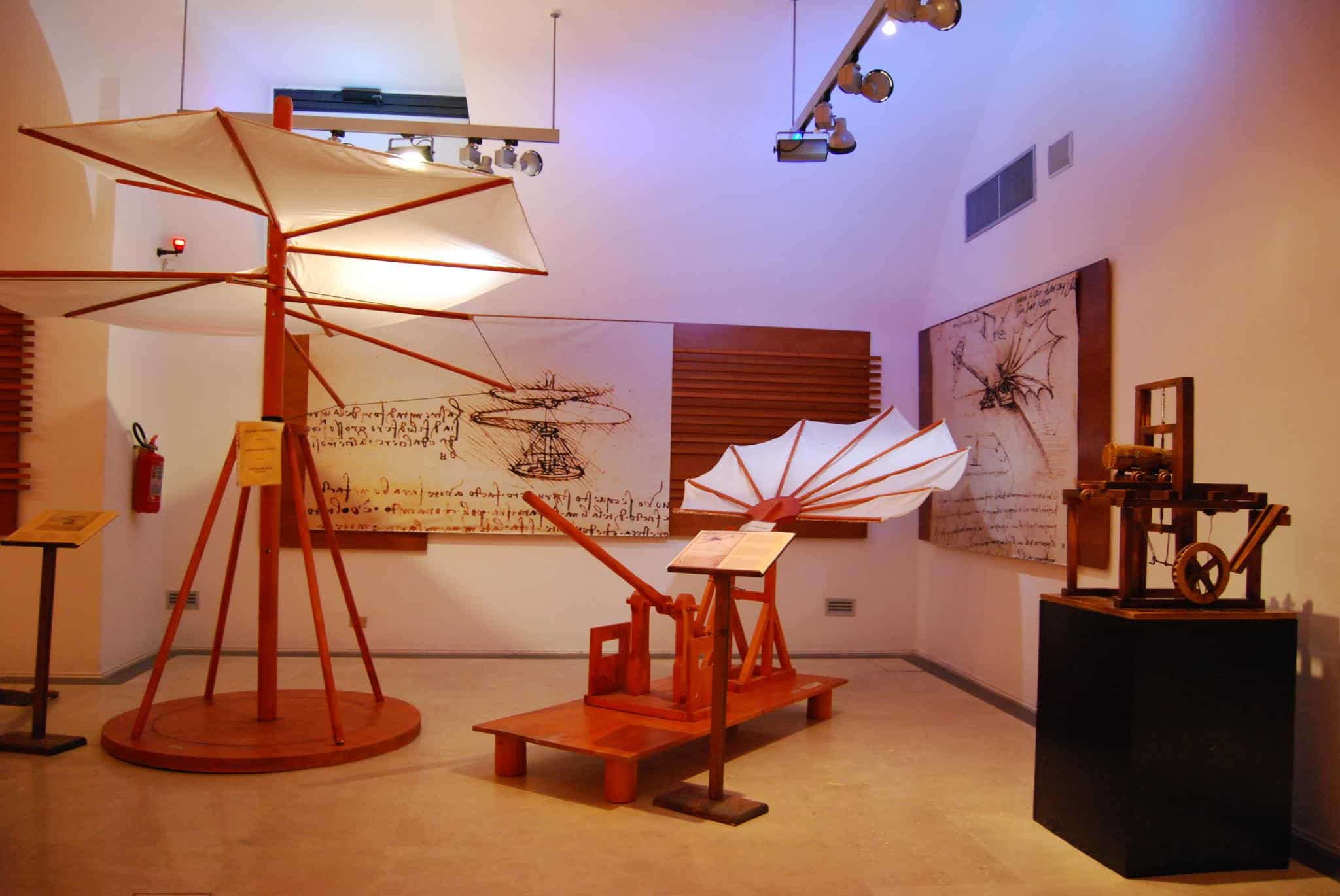

The Leonardo da Vinci Exhibition occupies the ground-floor rooms of the Palazzo della Cancelleria, at Piazza della Cancelleria 1, rione Parione, 00186 Rome. The building faces Corso Vittorio Emanuele II along its long side and the square opens on the opposite side, a two-minute walk from Campo de' Fiori and six or seven from Largo di Torre Argentina, which is the nearest surface interchange between trams and buses. The metro doesn't reach this stretch of the historic center: you get off on Corso Vittorio Emanuele II with surface transport, or you walk from Piazza Venezia in just under 12 minutes. It is best to check the exact lines in service on the transport company's website, which changes them with a certain nonchalance. The official website of the exhibition indicates opening every day from 9.30 to 19.30, full ticket €9, reduced €7 for young people from 13 to 18, over 65s, students and teachers, reduced €6 for children from 5 to 12, with family packages between €25 and €29. Hours and prices must be reconfirmed on the exhibition's website before setting out, because a long-running installation inside a building of the Holy See may suspend opening for ceremonies, court hearings or construction work. The phone is +39 06 69887616, the email addresses are info@mostradileonardo.com and desk@mostradileonardo.com, the second dedicated to guided visits and groups. Individual visitors enter without booking. School classes and tour groups book. Realistic duration: a full hour on your own, a good two hours with children who want to operate every crank.
If you are fitting this visit into a wider tour, you will find the other proposals on the page of the museums of Rome, which collects the city's civic, state and private venues.
What the Leonardo da Vinci Exhibition at the Palazzo della Cancelleria really is
The full title of the installation is Leonardo da Vinci. The Genius and the Inventions, The Great Interactive Machines, and the direction is by Augusto Biagi. Under that title there is something very precise: about 50 machines built at full scale, not display-case models, derived from the drawings in Leonardo's codices and assembled in wood, rope, metal and leather with carpentry solutions that imitate those of a 15th-century workshop. Nearly all of them work, and the word that counts is in the second half of the subtitle: interactive. The visitor turns a crank, pulls a lever, pushes a cart, and the machine responds. At a time when technology museums boil down to screens and headphones, a wooden chest that moves under your hands produces an effect that works as well on 10-year-old kids as on 60-year-old engineers.
The verdict, flat out: this is not an art exhibition and shouldn't be judged as one. No autograph painting, no original sheet, no loan from the Biblioteca Ambrosiana or the Royal Collection. It is an exhibition of historical engineering, and as such it remains one of the few in Rome that explains the mechanism instead of merely displaying it. Anyone who goes in expecting the Mona Lisa comes out disappointed and is completely wrong. Anyone who goes in to understand how Leonardo took a problem apart comes out with something in hand.
The route through the Leonardo da Vinci Exhibition, section by section
The installation is organized in five thematic sections that follow the partition with which Leonardo himself reasoned about the forces of nature: water, air, earth, fire and mechanisms. It is not a grid invented at a desk to bring museum order: it is the way the codices group the problems, because for Leonardo the motion of water and the motion of air were the same phenomenon seen at two densities, and in fact his studies on river vortices flow straight into the drawings of the wings.
The water section in the Leonardo da Vinci Exhibition
Here you find the hydraulic machines: the Archimedes screw reread and improved, the pumps, the lifting systems, the flap locks, the hydraulic saw driven by the wheel, the diving suits and the floats for walking on water. It is worth stopping at the saw: it is a piece that sums up in two meters of wood the conceptual leap of the Renaissance, that is the transformation of a continuous rotary motion into an alternating rectilinear motion through a connecting rod. Anyone who has taken a course in applied mechanics recognizes the scheme at first glance. Anyone who hasn't understands it in 30 seconds by watching the crank. Leonardo worked for a long time on the Lombard canals and on the navigation locks, and these machines are born from that concrete building site, not from an exercise of fantasy.
The air section and the dream of flight
It is the section that fills phones with photographs, and rightly so. There are the aerial screw, the flying machine with flapping wings, the glider, the pyramid-shaped parachute and the anemometer. The parachute deserves a note: Leonardo's drawing provides for a pyramidal structure of impregnated cloth mounted on wooden rods, and the note beside it states that a man can throw himself from any height without injury. It was not a joke: modern tests carried out with materials of the period have shown that the device comes down, and comes down stable. The aerial screw, which marketing is happy to call a helicopter, would never have lifted a man with the muscle power available, and this has to be said honestly: it was a right principle without an adequate engine. Leonardo knew it, and in fact in the later sheets he abandons the screw for the flapping wing and then for soaring flight, studying birds of prey on Lake Como.
The earth section, the construction-site machines and the mechanics of weights
Cranes, winches, jacks, compound pulleys, machines for lifting great weights and for moving columns. They are the workshop machines, the ones Leonardo saw working as a boy in the building works of Florence Cathedral when Verrocchio mounted the bronze ball on Brunelleschi's lantern, in 1471. Anyone who visits the Leonardo da Vinci Exhibition without knowing that detail misses the key to reading it: many of the earth machines exhibited here are the reasoned reworking of Brunelleschian equipment that the young apprentice studied from life, with the eye of a building site and not of a library.
The fire section and the war machines
Bombards, multi-barreled machine guns, giant crossbows, mobile bridges, assault ladders, and the piece everyone photographs: the covered cart, the one we call the tank. The full-scale reconstruction exhibited in Rome weighs two tons and measures roughly six meters in diameter by three in height, and it was assembled here for the first time in the capital. It is worth getting close and looking at the internal transmission mechanism: in the original drawing the gears that drive the two pairs of wheels are mounted so that the wheels turn in opposite directions, which would have jammed the vehicle on the spot. Scholars have been divided for a century between those who read an error of distraction and those who read deliberate sabotage, a way of handing the patron an unusable project. Neither hypothesis is proven, and both tell something true about the man who wrote that he detested war while offering himself to Ludovico il Moro as a military engineer.
The mechanisms section and the principles of the machine
The fifth section is the most technical and the least spectacular, and it is the one I recommend not skipping. Ball bearings, joints, cams, kinematic mechanisms, worm screws, the alternating-motion mechanism, transmission ratios. They are the elements that Leonardo isolated from the context of the single machine to study them as autonomous components: a way of thinking that anticipates by three centuries the manuals of applied mechanics. Here you understand why this man was not just a brilliant draftsman: he was the first to build a vocabulary of standard parts and to reason in modules.

Holograms, video mapping and treasure hunt at the Leonardo da Vinci Exhibition
Alongside the machines, the route uses video mapping projections and three-dimensional holographic figures that animate some inventions and some plates. The result depends a lot on the room and the light: the holograms work where the dark is real, and in the Palazzo della Cancelleria the high windows don't always help. The video mapping on the surfaces, on the other hand, holds up well and serves above all to show the passage from the two-dimensional drawing of the codex to the machine in three dimensions, which is exactly the mental leap the visitor has to make.
The management has introduced a treasure hunt designed to combine the visit with discovering the city. The mechanism is simple: you start from the exhibition and go out looking for monuments, squares and details, with the participant free to choose the route, what to visit and how long to linger at each stop. It works well with families and school groups, and has the merit of not turning the historic center into a list of obligations. To parents I say something that is worth more than any brochure: the treasure hunt succeeds if you don't take it as a race. Whoever runs looks at nothing.
Virtual tour and school programs of the Leonardo da Vinci Exhibition
For those who cannot get to Rome there is a remote visit option in live streaming, with a guided route among the machines and the inventions. The most solid chapter of this offer concerns schools: distinct programs have been built for elementary school, middle school and high school, with virtual visits calibrated to age, teaching worksheets, audiovisual materials supplied through the connection and the chance to ask questions live. The high resolution of the footage makes it possible to enlarge details that in person, behind a barrier, you wouldn't see, and an operator with art-historical training accompanies the reading. For a technology or art history teacher it is a serious tool, not a stopgap.
The machines and the codices: where the objects of the Leonardo da Vinci Exhibition come from
The machines on display are not born from a generic idea of Leonardo the inventor. They are born from precise sheets, and knowing them changes the visit.
The Codex Atlanticus
It is the largest collection of Leonardo's sheets, today in the Biblioteca Ambrosiana in Milan, assembled at the end of the 1500s by the sculptor Pompeo Leoni, who cut out and pasted materials of different origins onto large support sheets, hence the name tied to the atlas format. It contains over a thousand sheets and covers 40 years of work: hydraulic machines, war devices, studies of flight, mathematics, architecture, workshop notes and shopping lists. A good part of the construction machines and mechanisms displayed in the exhibition goes back to this corpus.
The Codex on the Flight of Birds
Kept in the Royal Library of Turin, it is a small notebook of a few sheets written around 1505, and it is worth as much as a treatise. In it Leonardo observes the bird of prey that exploits rising currents, measures the angle of the wings, reasons about the center of gravity and about recovering attitude after a gust. The flying machines displayed at the Leonardo da Vinci Exhibition descend from these pages more than from the flapping-wing fantasies of the early years.
The manuscripts of the Institut de France
They are 12 notebooks taken to Paris in the Napoleonic era, identified with the letters from A to M. They contain studies of optics, anatomy, mechanics and some of the clearest pages on transmission ratios and friction. The famous drawing of the pyramidal parachute is instead in the Codex Atlanticus.
The Madrid Codex
Two volumes that resurfaced in 1965 at the Biblioteca Nacional of Spain, where they lay misfiled. The first is in fact a treatise on theoretical and applied mechanics, with a systematic survey of machine elements: screws, springs, gears, joints. The display cases of the mechanisms section of the Leonardo da Vinci Exhibition find here their most direct documentary foundation.

The Palazzo della Cancelleria that hosts the Leonardo da Vinci Exhibition
Whoever buys the ticket for the machines takes home, without having looked for it, entry to one of the most important civil buildings of the Italian Renaissance. The Palazzo della Cancelleria is considered the first Roman palace built entirely from scratch in Renaissance forms, and this record is not a textbook detail: it means that here, and not elsewhere, the Florentine language of measure and proportion entered a city that until then had built by accumulation, readapting medieval towers and ancient ruins.
Raffaele Riario and the founding of the palace
The patron was Cardinal Raffaele Riario, great-nephew of Pope Sixtus IV, camerlengo of the Holy Roman Church and cardinal deacon of San Giorgio. The epigraph that runs under the cornice of the piano nobile says so with notarial precision: RAPHAEL RIARIUS SAVONENSIS SANCTI GEORGII DIACONUS CARDINALIS SANCTAE ROMANAE ECCLESIAE CAMERARIUS A SIXTO IIII PONTIFICE MAXIMO HONORIBUS AC FORTUNIS HONESTATUS TEMPLUM DIVO LAURENTIO MARTYRI DICATUM ET AEDIS A FUNDAMENTIS SUA IMPENSA FECIT, with the date MCCCCLXXXXV under the pontificate of Alexander VI. Riario, that is, declares that he built at his own expense, from the foundations, both the temple dedicated to Saint Lawrence the martyr and the house. On the chronology of the building site the studies do not agree: some place the design and first construction between 1486 and 1496, others widen the span from 1489 to 1513. The certain fact is the engraved date, 1495, and the fact that the palace was standing and habitable in the first decade of the 1500s.
On the money, instead, Rome has always had its own version. The rumor, already reported by contemporaries and taken up by Pietro Aretino, has it that the funds came from a colossal winning at gambling at the expense of Franceschetto Cybo, son of Pope Innocent VIII. It is tradition, not document: no account book proves it. But the fact that Romans have repeated it for five centuries says something about the way the city looked at the fortunes of the popes' nephews.
The confiscation by Leo X and the Apostolic Chancery
Riario lost everything at the hands of the first Medici pope, Leo X, who confiscated the just-completed palace from him: the sources date the seizure to 1513 or to 1517, the year in which the cardinal was involved in the conspiracy hatched by Alfonso Petrucci against the pontiff and had to buy his way out with a ruinous fine. In the background there was a much older account. In 1478, at the Pazzi conspiracy, the Riario and Sixtus IV had backed the attempt to overthrow the Medici in Florence, and Raffaele Riario, barely more than an adolescent and a cardinal for only a few weeks, had found himself inside Santa Maria del Fiore on the day Giuliano de' Medici was assassinated. Four decades later the account came back to the sender with interest.
From 1517 the building housed the offices of the Apostolic Chancery, transferred from the palace called Cancelleria Vecchia, on the street of the Banchi, today Via dei Banchi Vecchi. That seat had belonged to Cardinal Rodrigo Borgia, the future Alexander VI, who had bought from his uncle Callixtus III the ruins of the old Mint, and later Cardinal Chancellor Ascanio Sforza had lodged there. From then on the Palazzo della Cancelleria remained without interruption the residence of the cardinal vice chancellors.
Henry Benedict Stuart, the vice chancellor who signed himself king
Between 1763 and 1807 the vice chancellor was Henry Benedict Stuart, Cardinal Duke of York, last direct descendant of the British royal house in exile and, for the Jacobites, Henry IX of Great Britain. He lived in this palace for 44 years, signing acts of the Roman Curia and claiming a throne he would never see. The story has an epilogue that few people know: fallen into poverty after the Napoleonic invasion, he received an annuity precisely from the king of Great Britain George III, that is from the sovereign of the dynasty that had replaced his own.
The facade of the Palazzo della Cancelleria
The facade on Corso Vittorio Emanuele II and on Piazza della Cancelleria is very long and has to be looked at from afar, standing on the opposite sidewalk. The design plays on a rhythm of pilasters set at alternating spacings, wide and narrow, between which open the windows crowned by arches. It is a solution of Florentine matrix, comparable with that of Palazzo Rucellai by Leon Battista Alberti, and it produces a pulsing effect: the eye runs along the wall and feels a regular beat, like a musical scansion. The rustication of the base is barely hinted at, almost smoothed, and this choice to give up Florentine roughness makes the palace elegant and a little haughty.
The great portal is not 15th-century: it was added in the 1500s by Domenico Fontana at the wish of Cardinal Alessandro Peretti Montalto, great-nephew of Pope Sixtus V. The inscription on the pediment declares it: R. CARD. RIARIIS SIXTI IV PRONEP. CAM. AEDES FECIT. A. CARD. MONT. SIXTI V PRONEP VICECANC. PREFECIT AN. SAL. 1589 SIX. V PONT. AN. V. In Italian: Cardinal Raffaele Riario, great-nephew of Pope Sixtus IV and camerlengo, had this house built. Cardinal Alessandro Montalto, great-nephew of Pope Sixtus V and vice chancellor, completed it in 1589, the fifth year of the pontificate of Sixtus V. Two great-nephews of two popes, 90 years apart, on the same pediment.
The stone tells yet another story. The travertine of the facade comes, according to tradition confirmed by topographic proximity, from the ruins of the Theater of Pompey, the first permanent masonry theater in Rome, inaugurated in 55 BC and buried under the blocks between Campo de' Fiori and Largo Argentina. Other materials are said to have been taken from the Colosseum and from an arch attributed to Gordian. This is the Roman Renaissance in its least romantic truth: the new was built by dismantling the ancient, and the quarry was the city itself.
Bramante's courtyard
The courtyard is the reason an architect comes here. Rectangular, with the two lower orders resolved as open loggias on columns and the third closed as a wall, it is considered by art historians among the most elegant porticoes ever built in Rome. The granite columns, 44 in number, are reused and also come from the complex of the Theater of Pompey, perhaps by way of the old basilica of San Lorenzo in Damaso.
On the author the discussion has never closed. The recurring name is Donato Bramante, and the paternity of the courtyard is attributed to him by the majority of studies. Others have proposed Andrea Bregno, Baccio Pontelli, Antonio da Sangallo the Elder. The chronological difficulty is well known: Bramante arrives in Rome around 1499, when the building site is already under way, and this has led part of the critics to imagine an intervention of his on someone else's layout. Personally I remain convinced that whoever drew those loggias knew the cloister of Santa Maria della Pace very well, and anyone who wants to make the comparison will find a few minutes' walk away the monumental cloister to measure against in another season of Roman architecture.
The Hall of the 100 Days and Michelangelo's quip
On the piano nobile opens the hall of honor, which everyone calls the Hall of the 100 Days. The name comes from the time of execution: Giorgio Vasari painted an immense fresco cycle there in a clean 100 days, to meet the deadline of the patron, Cardinal Alessandro Farnese, who wanted the room ready for an imminent wedding. The cycle celebrates the deeds of Pope Paul III Farnese, with painted architecture, allegories and court portraits.
Tradition, reported by Vasari himself, tells that the author boasted of the speed to Michelangelo Buonarroti, and that the old master replied in two words: it shows. It is the most quoted anecdote in the history of Italian art and has to be handled with measure, because it comes from the one who suffered it and because Vasari, a mediocre painter and an immense historian, had the honesty to report the put-downs that concerned him. The fact remains: that hall is a masterpiece of building-site organization and an uneven work of painting.
Pietro Ottoboni, music and Juvarra's theater
The most fascinating chapter of the palace's life is from the 1700s. When Cardinal Pietro Ottoboni lived there as vice chancellor, the Palazzo della Cancelleria became the center of Roman musical life. Between 1694 and 1705 several oratorios by Alessandro Scarlatti received their world premieres there, along with many cantatas for Christmas. Ottoboni had Arcangelo Corelli in his employ as concertmaster, and the palace's musical chapel was the best in Europe.
In 1709 the cardinal had a real theater built inside the palace to a design by Filippo Juvarra, at the time a young architect from Messina in his service. It was dismantled after Ottoboni's death, on February 28, 1740, and today no visible trace of it remains. In that theater at least one gathering of the Accademia degli Arcadi was held, at Christmas 1712, in honor of the Child Jesus, spiritual patron of the Academy: so tells the first custodian Giovanni Mario Crescimbeni in his history of the institution. Walking in this courtyard knowing that behind one of these walls Juvarra set up a theater and Corelli conducted an orchestra changes the weight of the visit.
The Parliament of the Roman Republic of 1849
During the Roman Republic of 1849 the constituent assembly met for a period in this palace. It was here, in the chamber carved out of the rooms of the Cancelleria, that the acts of that brief republican experience, crushed by French military intervention, were discussed. Anyone who wants to reconstruct the Roman parliamentary story over its long arc finds the natural sequel at Montecitorio, where the Chamber of Deputies settled 30 years later.
Extraterritoriality: why the Palazzo della Cancelleria is not Italian territory
The palace is the exclusive property of the Holy See and, by virtue of the Lateran Pacts of 1929, enjoys the condition of extraterritoriality with the immunities recognized for foreign embassies. Jurisdiction inside belongs to the Vatican, which when needed detaches a unit of the Gendarmerie Corps there. It means, concretely, that the visitor to the Leonardo da Vinci Exhibition crosses a legal border without noticing, and that the Italian police do not enter on their own initiative.
The palace still hosts today three tribunals of the Holy See: the Apostolic Penitentiary, which deals with the internal forum and reserved absolutions, the Supreme Tribunal of the Apostolic Signatura, which is the supreme court of the canonical system, and the Tribunal of the Roman Rota, competent on appeal and known to the general public for marriage cases. They are not symbolic offices: they are bodies that work every day while you turn the crank of a 15th-century crane two floors below.
The basilica of San Lorenzo in Damaso, the church inside the palace
On the right of the long facade, with the front of the palace continuing straight without yielding a centimeter, opens the entrance of an entire basilica. It is San Lorenzo in Damaso, palatine church and cardinal titular church of the vice chancellor, and it is perhaps the most elegant architectural swallowing in Rome: a place of worship absorbed inside a private palace without the facade declaring it.
The foundation by Pope Damasus I
The first church was founded by Pope Damasus I, who sat from 366 to 384, and dedicated to the martyr Lawrence. Damasus is the pontiff of the epigrams in the catacombs, the man who gave Christian Latin a monumental language and who entrusted Jerome with the revision of the Scriptures. Next to the basilica he had the archive of the Roman Church built, and this detail explains everything else: the Apostolic Chancery arrived centuries later in a place that already was, from the beginning, the place where the Church kept its papers. Hadrian I and Leo III, between the 8th and 9th centuries, restored the building.
What the excavations under the courtyard found
Between 1988 and 1993 the archaeological investigations carried out under the courtyard and under the palace brought to light the foundations of the Damasian basilica, dated between the 4th and 5th century, restoring to the church the rank of one of the most important early Christian constructions of Rome. An adjacent cemetery was also identified, in use from the 8th century until shortly before the construction of the Renaissance palace. Underneath there are Roman structures, and learned tradition holds that the area included a Mithraeum, as happens under San Clemente: it is a hypothesis that must be treated as such, not as an established fact.
The most sensational find came in 1938, during work in the palace: the tomb of Aulus Hirtius, consul of 43 BC, lieutenant of Caesar, author of the eighth book of De bello Gallico and the man who died on April 21 of 43 in the battle of Modena fighting against Mark Antony. A Roman consul buried under a papal palace, with an exhibition of Renaissance machines on the ground floor: if you are looking for an image of Rome's stratigraphy, this is it and there is no need to go further.
The interior of the basilica and its works
Riario rebuilt the church together with the palace, starting around 1495 and with the protection of Alexander VI. The names of Antonio da Montecavallo and Bramante are tied to the work. The interior has three naves divided by quadrangular pillars, preceded by an articulated vestibule, and has undergone remakings such that it is a catalog of four centuries of Roman taste.
In the apse stands the Coronation of the Virgin with Saints by Federico Zuccari, and the high altar is surmounted by a ciborium of neoclassical forms. Gian Lorenzo Bernini remodeled the apse giving it a semicircular course and added stucco decorations to it. Also by Bernini is the cenotaph of Alessandro Valtrini, chamberlain of Urban VIII, one of those monuments in which the winged skeleton holds the portrait of the deceased and death becomes an actor on stage. In the vestibule there is a statue of Saint Charles Borromeo by Stefano Maderno.
Cardinal Alessandro Farnese, the same patron of the Hall of the 100 Days, had the coffered wooden ceiling with gilded reliefs made and called Giuseppe Cesari, known as the Cavalier d'Arpino, and Niccolò Circignani to paint the walls. A chapel designed by Nicola Salvi, the architect of the Trevi Fountain, preserves frescoes by Corrado Giaquinto and an altarpiece by Sebastiano Conca of 1743. The chapel of the Sacrament has frescoes by Andrea Casali. In the side chapels there are monuments by Filippo Gnaccarini, Pietro Tenerani, Giovanni Antonio Dosio and Paolo Taccone, and among the burials are those of Annibal Caro, translator of the Aeneid, and of Pellegrino Rossi, the papal minister assassinated in 1848 on the staircase of the Cancelleria.
The wounds of the basilica
During the Napoleonic occupation the church was reduced to a stable, and the damage was such as to require the restoration entrusted to Giuseppe Valadier under Pius VII. Between 1875 and 1882 the altar, sacristy and chapels were redone. At the end of 1939 a fire devastated the ceiling and apse, requiring new reconstruction. The parish dates the event to December 31, 1939. Since then the building has kept its present layout, and it remains Vatican property in a regime of extraterritoriality like the palace that contains it. A piece of advice: go into the church before or after the exhibition, entry is free and the basilica is almost always empty. Nobody looks for it, and it is one of the best silences in the historic center.
Piazza della Cancelleria and Campo de' Fiori around the Leonardo da Vinci Exhibition
The square in front of the palace is small, irregular and strangely quiet for the rione Parione. It was born as a respect space for the cardinal's palace and for centuries was a place of passage: the real artery was Via Papale, the ceremonial route that led from the Vatican to the Lateran crossing this block. The opening of Corso Vittorio Emanuele II, between 1876 and 1886, tore through the medieval fabric to the north and stripped bare the flank of the palace, which until then had been seen only at an angle. It is an urban wound that today we consider a panorama.
Campo de' Fiori is a short walk away, with the market in the morning and the statue of Giordano Bruno in the center, erected in 1889 on the spot of the burning at the stake in 1600. Heading north, you reach Piazza Navona in seven minutes, and under the piazza you can visit the remains of the Stadium of Domitian, which explains its shape. A little further on is the Museo di Roma at Palazzo Braschi, and in the opposite direction, toward the Tiber, the Galleria Spada with its famous Borromini perspective. The Pantheon is a quarter of an hour's walk away, Castel Sant'Angelo 20 minutes along Via dei Banchi Nuovi.

The three Leonardo da Vinci exhibitions in Rome and how to tell them apart
Rome has three exhibits dedicated to Leonardo, and they get mixed up all the time, even by agencies. It's worth keeping them separate.
Leonardo da Vinci Exhibition at Palazzo della Cancelleria
This is the one: Piazza della Cancelleria 1, full-size wooden machines, five sections, a strong hands-on component, the covered cart as the main draw, the palace's Renaissance setting as added value. It's the best fit for anyone who wants to understand mechanics and for anyone bringing children aged six and up.
The Leonardo da Vinci Museum in Piazza del Popolo
The Leonardo da Vinci Museum is in Piazza del Popolo, in rooms on the basement level, and it also offers machines rebuilt from the codices with a strong educational emphasis. Its location makes it very convenient for anyone coming down from the Pincio or arriving by metro.
Leonardo da Vinci Experience in Via della Conciliazione
The Leonardo da Vinci Experience is very close to St. Peter's and focuses on reproductions of the painted works and on the multimedia side, with the room devoted to full-scale reproductions. If you're short on time and want to see only one of these three, choose by this criterion: machines and hands-on at the Cancelleria, educational overview in Piazza del Popolo, reproduced painting and screens in Via della Conciliazione.
Five curiosities about Leonardo da Vinci to take with you into the exhibition
The Mona Lisa and the lost eyebrows
Anyone who has stopped in front of the portrait at the Louvre notices that Mona Lisa has no eyebrows or eyelashes. The most accredited hypothesis is that they were there, painted with very thin glazes, and that they disappeared over the course of old restorations or aggressive cleanings. Very high-resolution analyses carried out on the painting have detected traces compatible with an original eyebrow stroke. It remains a technical hypothesis, not a certainty: Florentine fashion of the Quattrocento really did call for plucked foreheads.
Leonardo and the language of the learned
The most famous intellectual of the Renaissance was not a man of letters by training, and he knew it perfectly well. In his pages he calls himself omo sanza lettere, that is, a man without regular humanistic studies, without academic Latin and without Greek. It is a polemical statement more than a confession of inferiority: he claims the primacy of experience over the authority of books. Anyone who looks at the machines of the Leonardo da Vinci Exhibition sees that claim translated into wood and rope.
The Last Supper and the Sistine Chapel, two different timeframes
The Last Supper in Santa Maria delle Grazie in Milan occupied Leonardo for about three years, between 1495 and 1498, and was painted with an experimental dry technique that began to deteriorate within a few decades. Michelangelo frescoed the vault of the Sistine Chapel between 1508 and 1512, four years, with the correct buon fresco technique. The difference between the two worksites is not one of speed but of method: Leonardo wanted to experiment and lost the bet on preservation, Michelangelo accepted the rule and his work is still there.
The price paid for anatomy
Leonardo's anatomical plates come from the direct dissection of corpses, carried out in the hospitals of Florence, Milan and Rome. It was a practice barely tolerated and surrounded by suspicion. Tradition has it that in Rome, during his years with Giuliano de' Medici, the accusations made against him made it impossible for him to continue, and that the anatomical work stopped. The result of those nights in the morgue is a set of sheets that no printed treatise will equal for two centuries.
The fascination with looms and weaving
Among the technologies of his time, weaving is the one that returned most often under his pencil: automatic looms, machines for carding, for twisting thread, for shearing cloth. It's not a whim. The textile industry was the economic engine of northern Italy, and designing a machine that did the work of 10 workers meant touching the point where technology meets money. Many of those devices appear in the mechanisms section of the exhibition.
The Leonardo da Vinci Exhibition with children
This is the audience this exhibit was made for. The entry threshold is low: a six-year-old understands that if you turn that crank the saw moves, and everything starts from there. With middle schoolers the fire section, with the war machines, works particularly well, because it lets you introduce the more adult theme of the engineer's responsibility in the face of war. Practical advice: before going in, give your kids a specific task, for example finding all the machines that turn circular motion into straight motion. They come out knowing what a connecting rod is, and they won't have learned it from a panel. Anyone looking for an experience calibrated for the youngest, under six, will do better to head for Explora, the children's museum, while the Leonardo da Vinci Exhibition is at its best from age six up.
Accessibility, facilities and visiting the Leonardo da Vinci Exhibition
The exhibition spaces are on the ground floor of the palace, and in a building from the 1400s that's already half the battle. The typical limits of protected historic buildings remain: thresholds, minimal level changes, corridors not always as wide as a modern code would want. For a precise assessment regarding wheelchairs, accessible restrooms and assistance for people with sensory disabilities, it's best to call the exhibition's number in advance: the accessibility information for extraterritorial buildings changes with the exhibits and doesn't always find confirmation on the generalist portals. Photographs without flash and tripod are generally allowed, and it's one of the reasons this place is so popular on social media.
When to go to the Leonardo da Vinci Exhibition and when to avoid it
The first two hours of the morning, right at opening, are the best: school groups usually arrive around 10:30 and fill the rooms with a noise that wipes out any chance of listening. Early afternoon on weekdays is the second good window. On weekends from March to June and in October, with the historic center saturated, it's best to arrive early or put it off. If possible, avoid days of heavy rain: half of Rome pours into the indoor museums of the center and this is one of the most sought-after fallbacks. If you have to choose a season, choose January or November: the exhibition is the same and the palace is yours.
How much the Leonardo da Vinci Exhibition costs and how to save
Nine euros for the full price is an honest figure for what you see, and the family rates between €25 and €29 make the visit affordable for a group of three or four people. Reductions cover the 13-18 age group, over-65s, students and teachers at €7, and children between 5 and 12 at €6. Since it is a private exhibit inside a building of the Holy See, it doesn't fall under the free-admission initiatives of Italian public museums: anyone looking for free admission will find the updated list on the page of free museums in Rome, which however covers state and city-run sites, not this one. Tickets are bought at the box office or online through the authorized reseller indicated on the exhibition's official website.

A curiosity about the Leonardo da Vinci Exhibition at Palazzo della Cancelleria
The curiosity nobody tells concerns the floor you're walking on. In 1938, during work in the palace, the tomb of Aulus Hirtius came to light: Roman consul of the year 43 BC, lieutenant of Caesar in Gaul, author of the eighth book of the De bello Gallico, who died on April 21 of that same year in the Battle of Modena fighting against Mark Antony alongside the young Octavian. A consular tomb of the Republican age, right in the area of the southern Campus Martius, beneath a Renaissance cardinal's palace that today hosts machines rebuilt from the codices of an engineer of the 1400s and three tribunals of the Holy See.
There are deeper stratigraphies in Rome, none more eloquent. In 15 vertical meters you pass through the Roman Republic in its twilight, the basilica of Pope Damasus with the archive of the early Church, an early medieval cemetery, the first Renaissance palace of the city, the office that wrote the papal bulls, an 18th-century theater designed by Juvarra, the parliament of the Republic of 1849, and an aerial screw made of wood that children make turn.
There is a second layer of curiosity, and it concerns the stone. The travertine of the facade and the 44 granite columns of the courtyard come, according to a tradition supported by topography, from the ruins of the Theater of Pompey, that is, from the building in whose complex, in the attached Curia, Julius Caesar was assassinated on the Ides of March in 44 BC. The consul who died a year after him rests beneath the palace built with the stones of the place where Caesar was killed. Whoever visits the Leonardo da Vinci Exhibition moves inside this coincidence without knowing it, and the ticket doesn't mention it.
One thing nobody tells you about the Leonardo da Vinci Exhibition at Palazzo della Cancelleria
This: when you walk in, you are no longer in Italy. Palazzo della Cancelleria is the exclusive property of the Apostolic See and, by effect of the Lateran Pacts of 1929, enjoys extraterritoriality with the immunities recognized for embassies. Jurisdiction inside belongs to the Vatican, which if necessary detaches units of the Pontifical Gendarmerie Corps there. It's not a lawyers' quibble: it means that a foreign police force is competent over the building, that Italian law does not automatically apply there, and that Rome's most familiar exhibition of machines technically takes place abroad.
The practical consequence that matters to the visitor is another one, and you only discover it on site. The palace is the seat of three active tribunals of the Holy See: the Apostolic Penitentiary, the Supreme Tribunal of the Apostolic Signatura and the Tribunal of the Roman Rota. They are working offices, with hearings, Rotal lawyers, case files and schedules. This means that access to some parts of the palace is barred, that the extraordinary openings of the courtyard and the Salone dei Cento Giorni depend on the calendar of the Curia, and that a ceremony can change the routes from one day to the next without notice.
The advice that follows is banal and nobody gives it: if your interest is as much the palace as the machines, call beforehand and ask if the courtyard can be visited that day. The courtyard is the masterpiece of the building, but it is not a guaranteed part of the exhibition ticket, and going home without having seen it happens more often than you'd think. I'll add a detail worth an afternoon: the basilica of San Lorenzo in Damaso, incorporated into the same facade, can be visited for free during hours of worship, and it's full of Bernini, Zuccari and Maderno that no generalist tourist guide ever names.
The advice I give you for visiting the Leonardo da Vinci Exhibition at Palazzo della Cancelleria
Flip the mental order of the visit. Don't go in thinking about Leonardo: go in thinking about a construction site. Before buying the ticket, stop for five minutes on the opposite sidewalk of Corso Vittorio Emanuele II and look at the whole facade, with the alternating rhythm of the pilasters and the smooth rustication of the base. Then pick out, on the right, the entrance of the incorporated basilica. Then go in. This way, when you arrive in front of the machines, you already have in mind the real theme of the day: how you build something complicated with the technologies available.
Inside the exhibition, the operational advice is not to follow the route like a queue. Choose three machines and give them 10 minutes each instead of giving 30 seconds to all 50. It's worth looking for the hydraulic saw, which explains the conversion of motion better than any textbook, the covered cart, for the puzzle of the gears mounted in reverse, and any one of the compound pulleys, where you get a hands-on feel for the multiplication of force. Turn the cranks slowly. The wood gives back the resistance, and that resistance is the information you're taking home.
One last recommendation, and it applies to parents: arrive at opening, at 9:30. School groups come in later, and the difference between an empty room and a room with 60 kids is the difference between a visit and a crush. Count on an hour and a quarter for yourselves and two hours if you have children who want to try everything. On the way out, turn left and go into San Lorenzo in Damaso: the wood-stone-Bernini sequence in 10 minutes is the best thing this block has to offer.
Another well-known fact, and yet seldom cited
Everybody knows that Giorgio Vasari painted the palace's grand hall in 100 days and that Michelangelo, hearing him bragging, replied "it shows." The anecdote circulates in every guide to Rome. What almost nobody adds is the circumstance that makes the haste understandable and shifts the judgment.
The patron was Cardinal Alessandro Farnese, nephew of Pope Paul III, and the hall was needed ready for a fixed date, tied to an imminent wedding. Vasari did not choose speed out of bravado: he had it imposed as a contractual clause. To pull it off he organized a workshop of collaborators, distributed the painted areas, and kept the directing parts for himself. The cycle celebrates the deeds of Paul III among painted architecture, allegories and portraits. The pictorial result is uneven and Michelangelo was right, but as a feat of construction-site management it remains a case study.
The detail that is really seldom cited is the third: the one who reports the scathing verdict is Vasari himself, in the Lives. The man who wrote the history of Italian art and who could have kept that line quiet put it on record, against himself. It's worth keeping in mind when you read his judgment on others: that foundational book, with all its Tuscan partialities, is the work of an author who knew how to recognize when he had been beaten. It's a well-known thing that nobody cites the right way, and it concerns the room above your heads while you visit the Leonardo da Vinci Exhibition.
The right photo to take at the Leonardo da Vinci Exhibition at Palazzo della Cancelleria
The photographs that circulate of this place are almost all wrong, and they are wrong for the same reason: they frame the whole machine, head-on, centered. What comes out is a wooden object on a dark background, indistinguishable from the one in any other Leonardo exhibit in Europe.
The right photo is a detail on the diagonal. Get close to a wooden gear, put the lens 20 centimeters away, and frame the point where the tooth enters the slot, with the machine blurring out of focus in the background. The wood has a grain that raking light brings out, the teeth show the wear of movement, and the image tells the thing that matters: that this contraption works. If you have a phone with portrait mode, now is the time to use it. No flash: it flattens the grain and gets you thrown out by the guard.
The second shot, the one to take home, is not inside the exhibition. It's the covered cart shot from below, almost resting the phone on the ground, with the conical shape closing the frame at the top: the forced perspective gives back its two tons and its six meters of diameter much better than a shot at mid-height. The third, the best of all, is outside: the facade of Palazzo della Cancelleria photographed at an angle from the sidewalk of Corso Vittorio Emanuele II toward late afternoon, when the raking sun on the travertine lights up the rhythm of the pilasters and the very long wall stops looking flat. With that light the three photos tell a whole day. And if on that day the courtyard is accessible, the shot to keep is the one looking up under the loggia, with the granite columns lining up and the sky cut out by the cornice.

Some important events that took place here in history
The first is the founding itself. Between 1486 and 1513, with the date 1495 carved on the cornice, the first Roman palace conceived entirely in Renaissance forms rose here. It was not a matter of taste: it was the moment when Rome stopped being a medieval city that reused ruins and began to design entirely. All of 16th-century Rome, from Palazzo Farnese onward, passes through this facade.
The second is the confiscation. Between 1513 and 1517 Pope Leo X stripped Cardinal Raffaele Riario of the just-finished palace, closing, 40 years late, the account opened by the Pazzi conspiracy of 1478. From 1517 the building became the seat of the Apostolic Chancery, the office from which bulls, briefs and papal acts issued: the administrative machine that governed Western Christendom had its address here for centuries.
The third is musical, and it's the most beautiful. Between 1694 and 1705, under Cardinal Pietro Ottoboni, oratorios by Alessandro Scarlatti and Christmas cantatas were performed in this palace in world premieres. Arcangelo Corelli was concert master in the cardinal's service. In 1709 Ottoboni had a theater built in the palace to a design by Filippo Juvarra, dismantled after his death, which occurred on February 28, 1740. At Christmas 1712 that theater hosted a gathering of the Academy of Arcadia in honor of the Baby Jesus, spiritual patron of the Academy, as its first custodian Giovanni Mario Crescimbeni recounts.
The fourth is a political murder. On November 15, 1848, Pellegrino Rossi, minister of Pius IX, was assassinated with a stab to the throat as he climbed the staircase of this palace to present himself to the Council of Deputies. The murder precipitated events: a few days later the pope fled to Gaeta and the season of the Roman Republic opened. Rossi is buried in the basilica of San Lorenzo in Damaso, inside the building in front of which he was killed.
The fifth is parliamentary. In 1849, for a time, the assembly of the Roman Republic met right here, in rooms of the Cancelleria. It was the most advanced political experience of pre-unification Italy, with a constitution that abolished the death penalty and recognized freedom of worship, and it lasted a few months before the French military intervention.
The sixth is archaeological. In 1938 the tomb of the consul Aulus Hirtius re-emerged beneath the palace. Between 1988 and 1993 excavations under the courtyard brought to light the foundations of the Damasian basilica of the 4th and 5th centuries and an adjacent cemetery in use from the 8th century. The seventh, legal, dates to 1929: with the Lateran Pacts the palace entered the regime of extraterritoriality of the Holy See, which is the condition it is still in today while it hosts the Leonardo da Vinci Exhibition.
Who has passed through the Leonardo da Vinci Exhibition at Palazzo della Cancelleria
The list is long and begins with the popes. Sixtus IV, the pontiff of the Sistine Chapel, is the great-uncle of the patron and his protection made the building site possible. Alexander VI Borgia was reigning when the date 1495 was carved on the cornice. Leo X, the first Medici pope, entered here as a victor to strip the owner of it. Sixtus V appears by proxy in his great-nephew Alessandro Peretti Montalto, who had the portal added in 1589.
Then come the architects and artists. Donato Bramante, to whom the majority of critics assign the courtyard, and with him the alternative names of Andrea Bregno, Baccio Pontelli and Antonio da Sangallo the Elder, in an attribution debate that is still open. Antonio da Montecavallo at the basilica. Domenico Fontana, the engineer who raised the obelisk of St. Peter's, for the portal. Giorgio Vasari, who left his 100 days of frescoes in the grand hall. Michelangelo Buonarroti, who spent enough time there to see that cycle and dismiss it in two words. Gian Lorenzo Bernini, who remodeled the apse of San Lorenzo in Damaso and left there the cenotaph of Alessandro Valtrini. Federico Zuccari, Stefano Maderno, Giuseppe Cesari known as the Cavalier d'Arpino, Niccolò Circignani, Corrado Giaquinto, Sebastiano Conca, Nicola Salvi, Andrea Casali, Pietro Tenerani: a list that alone is worth a small history of Roman art.
Then the musicians. Alessandro Scarlatti, who presented oratorios here in first performances, and Arcangelo Corelli, who in Ottoboni's service led the most famous orchestras of his time. Filippo Juvarra, who before being the architect of the Savoys built a theater in this palace. The Arcadians in full, with Crescimbeni taking the minutes.
Then the political figures. Henry Benedict Stuart, cardinal Duke of York and last Jacobite pretender to the British throne, who lived there as vice-chancellor between 1763 and 1807. Pellegrino Rossi, who climbed its staircase for the last time on November 15, 1848. The deputies of the Roman Republic of 1849, and among them passed the hopes of Mazzini. And today the judges of the Rota, the Signatura and the Penitentiary, whom nobody sees but who are the true inhabitants of the building.
Only one name is missing, and it's the one on the poster: Leonardo da Vinci did actually live in Rome, between 1513 and 1516, a guest of Giuliano de' Medici in the Belvedere, in the years of the interrupted anatomical studies and of the burning mirrors. There is no record that he ever entered this palace, then just finished and already confiscated. Five centuries later his machines have taken possession of the ground floor, and the thing has a touch of posthumous justice.
Frequently asked questions about the Leonardo da Vinci Exhibition at Palazzo della Cancelleria
Where exactly is the Leonardo da Vinci Exhibition at Palazzo della Cancelleria?
The Leonardo da Vinci Exhibition at Palazzo della Cancelleria is at Piazza della Cancelleria 1, 00186 Rome, on the ground floor of the palace, in the Parione district, a few steps from Campo de' Fiori and with the long side of the building facing Corso Vittorio Emanuele II.
How much is a ticket for the Leonardo da Vinci Exhibition at Palazzo della Cancelleria?
The official site of the Leonardo da Vinci Exhibition lists €9 for the full price, a reduced €7 for ages 13-18, over-65s, students and teachers, and €6 for children between 5 and 12. Family rates cost between €25 and €29.
What can you see at the Leonardo da Vinci Exhibition at Palazzo della Cancelleria?
The exhibit presents about 50 full-size machines, drawn from the designs in Leonardo's codices and built in wood, rope, metal and leather, organized in five thematic sections that follow the way Leonardo reasoned about natural forces: water, air, earth, fire and mechanisms.
Is the Leonardo da Vinci Exhibition at Palazzo della Cancelleria suitable for children?
Yes, this is the audience this exhibit was made for: the entry threshold is low, because a six-year-old immediately understands that by turning a crank the machine on display moves, and with middle schoolers the section devoted to the war machines also works well.
When is the best time to go to the Leonardo da Vinci Exhibition at Palazzo della Cancelleria?
The first two hours of the morning, right at opening, are the best, because school groups usually arrive around 10:30. Early afternoon on weekdays is the second good window for avoiding crowds.
Is the Leonardo da Vinci Exhibition at Palazzo della Cancelleria wheelchair accessible?
The exhibition spaces are on the ground floor of the palace, which makes access much easier, but the typical limits of a protected historic building from the 1400s remain, such as thresholds and minimal level changes: for a precise assessment it's best to call beforehand.
What can you see besides Leonardo's machines inside Palazzo della Cancelleria?
Visitors to the exhibition also step into one of the most important civil buildings of the Italian Renaissance, the first Roman palace built entirely from scratch in Renaissance forms, which houses within it the basilica of San Lorenzo in Damaso, absorbed into the building without the facade declaring it.
Are there other exhibitions on Leonardo da Vinci in Rome that shouldn't be confused with this one?
Yes, Rome has three exhibits dedicated to Leonardo da Vinci that are often confused with one another. The one at Palazzo della Cancelleria stands out for its full-size wooden machines, its five thematic sections and the palace's Renaissance setting as added value.
Guides, itineraries and private visits around the Leonardo da Vinci Exhibition
Anyone organizing groups, corporate incentives or private visits in this area of the historic center can rely on the network of tour leaders and guides of TourLeaderPro in Rome, which works with tour operators, DMCs and international groups. For small groups and custom requests there is the line of custom experiences in Rome, while quotes and direct requests go through the contact page.
Anyone who instead is preparing the trip in English, for themselves or for friends arriving from abroad, will find the general guide to things to see in the city at Best things to do in Rome and the section devoted to museums, churches and palaces at Art and history in Italy. They are practical guides, indicating what to book and what to skip.
Quick questions about the Leonardo da Vinci Exhibition at Palazzo della Cancelleria
Where exactly is the Leonardo da Vinci Exhibition?
At Piazza della Cancelleria 1, 00186 Rome, on the ground floor of Palazzo della Cancelleria, in the Parione district. The long side of the building faces Corso Vittorio Emanuele II, a few steps from Campo de' Fiori.
How much is a ticket for the Leonardo da Vinci Exhibition?
The official site lists €9 for the full price, a reduced €7 for ages 13-18, over-65s, students and teachers, €6 for children between 5 and 12, with family rates between €25 and €29. Prices should be reconfirmed on the exhibition's website before the visit.
What are the hours of the Leonardo da Vinci Exhibition at Palazzo della Cancelleria?
The stated opening is every day from 9:30 to 19:30. Since it is an extraterritorial building of the Holy See, extraordinary closures for ceremonies or works are possible: a call to the exhibition's number avoids surprises.
Do you need to book to visit the Leonardo da Vinci Exhibition?
For the individual visitor, no, you buy the ticket at the box office. For school groups, groups and guided visits, booking is required and is requested at the address dedicated to groups.
How long does a visit to the Leonardo da Vinci Exhibition take?
An hour and a quarter for an adult who stops at the main machines, a good two hours with children who want to operate every device. Anyone adding the basilica of San Lorenzo in Damaso should allow another 20 minutes.
How many machines are there at the Leonardo da Vinci Exhibition?
About 50 full-size machines, almost all working and operable by the public, distributed across five thematic sections: water, air, earth, fire and mechanisms.
Can you touch the machines on display?
Yes, and that is the whole point of the exhibit: the machines are interactive and are operated with cranks, levers and carts. Some large pieces are protected and can only be looked at.
Can you take photographs at the Leonardo da Vinci Exhibition?
Photographs without flash are generally allowed and the place is very photogenic. Tripods and professional equipment require prior authorization.
Is the Leonardo da Vinci Exhibition suitable for children?
It is among the most suitable Roman offerings for the six to 13 age range, precisely because of the hands-on component. Under six the interest drops and it's better to turn to venues designed for the very little ones.
Is the Leonardo da Vinci Exhibition wheelchair accessible?
The exhibition spaces are on the ground floor, which helps a lot, but the building is a protected palace from the 1400s and has thresholds and level changes. For a precise answer for your own case, it's best to call the exhibition before leaving.
What is Leonardo's tank on display in Rome?
It is the full-size reconstruction of the covered cart designed by Leonardo: about six meters in diameter by three in height and two tons in weight, set up at Palazzo della Cancelleria for the first time in the capital. In the original drawing the gears would make the wheels turn in opposite directions, and the debate between error and deliberate sabotage has lasted a century.
Does the exhibition ticket include a visit to Palazzo della Cancelleria?
The ticket gives access to the exhibition spaces. The monumental courtyard and the Salone dei Cento Giorni are not a guaranteed part of the route, because the palace houses offices and tribunals of the Holy See: it's best to find out the same day.
Is Palazzo della Cancelleria free on the first Sunday of the month?
No. The free-admission initiative applies to Italian state and municipal museums, and this is an extraterritorial building of the Holy See hosting a privately run exhibit. No free Sunday.
Can you visit the basilica of San Lorenzo in Damaso?
Yes, and it's free. The entrance is on the right of the palace facade, with access independent of the exhibition. It holds the Coronation of the Virgin by Federico Zuccari, a cenotaph by Bernini and the burials of Annibal Caro and Pellegrino Rossi.
What is the difference between the Leonardo da Vinci Exhibition and the Leonardo da Vinci Museum in Piazza del Popolo?
They are two distinct exhibits with different management. At the Cancelleria the emphasis is on large interactive machines inside a Renaissance setting. At Piazza del Popolo the approach is more compact and educational. The third Roman venue is the Leonardo da Vinci Experience in Via della Conciliazione, oriented toward the reproduction of the painted works.
Are there guided tours of the Leonardo da Vinci Exhibition?
Yes, they are requested at the email address dedicated to groups. There is also a live-streamed virtual visit format, with programs differentiated for elementary school, middle school and high school.
Why isn't Palazzo della Cancelleria Italian territory?
Because it is the exclusive property of the Apostolic See and the Lateran Pacts of 1929 recognize its status of extraterritoriality, with the immunities of embassies. Internal jurisdiction belongs to the Vatican, which can detach the Pontifical Gendarmerie there.
Who designed Palazzo della Cancelleria?
The attribution has been debated for centuries. The courtyard is assigned by the majority of scholars to Bramante. Andrea Bregno, Baccio Pontelli and Antonio da Sangallo the Elder have also been proposed. The portal is certain: Domenico Fontana, 1589.
What is the Salone dei Cento Giorni?
It is the grand hall on the piano nobile, frescoed by Giorgio Vasari in 100 days for Cardinal Alessandro Farnese, with the celebration of the deeds of Pope Paul III. To Vasari's bragging about speed Michelangelo reportedly replied with two words that have remained proverbial.
What is there to see around the Leonardo da Vinci Exhibition?
Campo de' Fiori two minutes away, with the morning market and the statue of Giordano Bruno. Piazza Navona and the underground of the Stadium of Domitian seven minutes away. The Museo di Roma at Palazzo Braschi. The Galleria Spada toward the Tiber. The Pantheon a quarter of an hour away. Castel Sant'Angelo 20 minutes away along Via dei Banchi Nuovi.
What is the best time to visit the Leonardo da Vinci Exhibition?
Opening time in the morning, at 9:30, before the school groups. Alternatively, early afternoon on weekdays. Avoid spring weekends and days of heavy rain, when the indoor museums of the center fill up.
Is there a coat check or luggage storage?
The spaces are those of a historic palace and ancillary services are limited. Anyone arriving with suitcases or bulky backpacks should call first: not all extraterritorial venues accept large luggage.
Is the Leonardo da Vinci Exhibition worth the ticket price?
At €9, yes, as long as you know what you're buying: reconstructed engineering, not original painting. Anyone who wants to see autograph works by Leonardo won't find them here, nor in any other Roman venue.
The final advice, in front of this facade: buy the ticket for Leonardo and use it to step into the Quattrocento. The machines are excellent and the children adore them, but the biggest thing you'll see today is a wall 80 meters long built with the stones of the Theater of Pompey, with a 4th-century basilica inside and a hall painted in 100 days above. Turn the crank of the hydraulic saw, then go out, cross Corso Vittorio Emanuele II and turn around. That is the real invention of this block.
Article written by the editorial team of TourLeaderPro, contact them for Private/Corporate/V.I.P. Tours and Experiences.
Planning a trip to Rome? The English guides to visiting the city are on ItalyPlanner.com.