Sant’Antonio dei Portoghesi Church
In short. The Church of Sant'Antonio in Campo Marzio dei Portoghesi is at Via dei Portoghesi 2, in the Campo Marzio district, a few tens of meters from Via della Scrofa and barely 5 minutes from Piazza Navona.
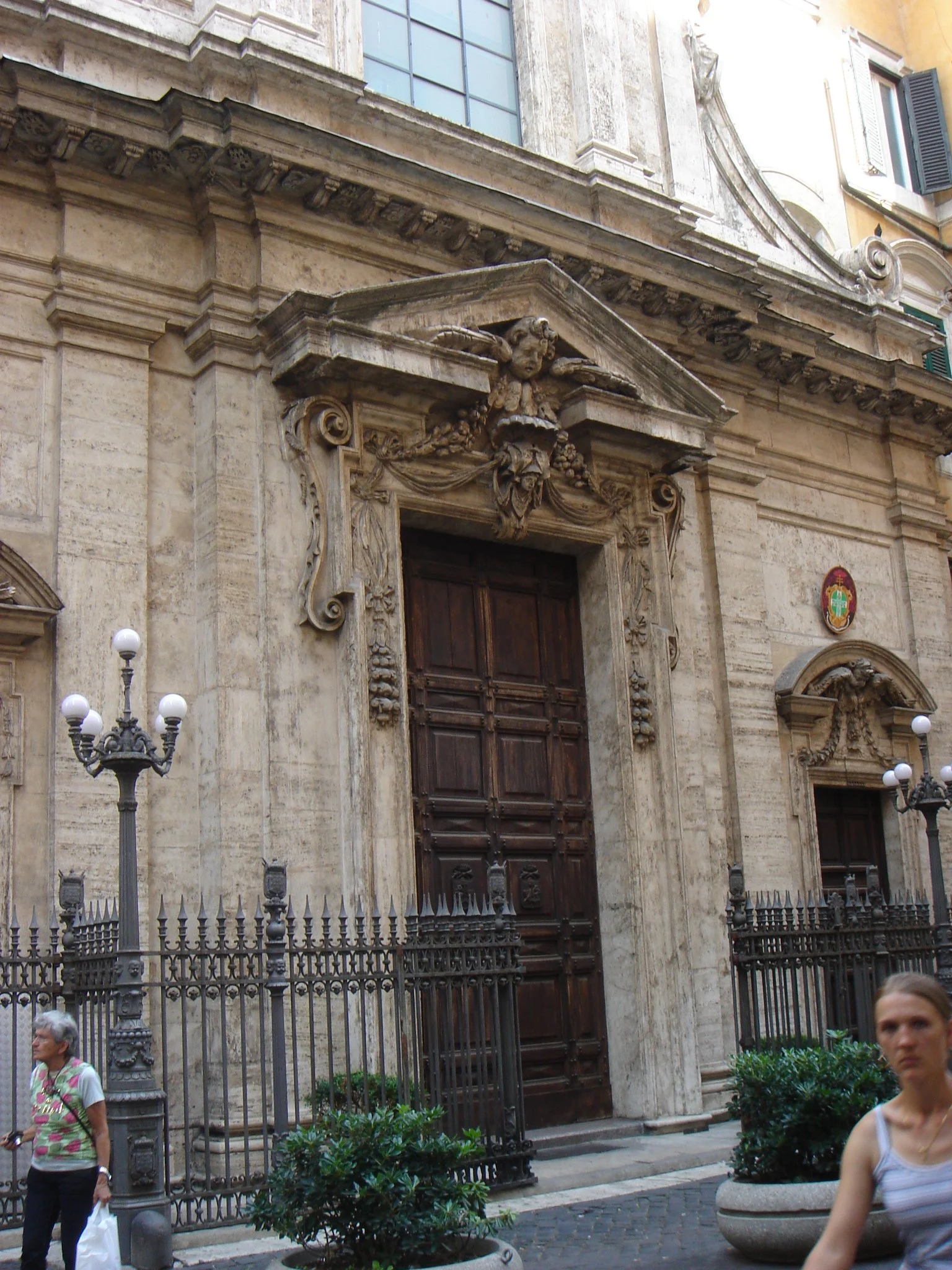
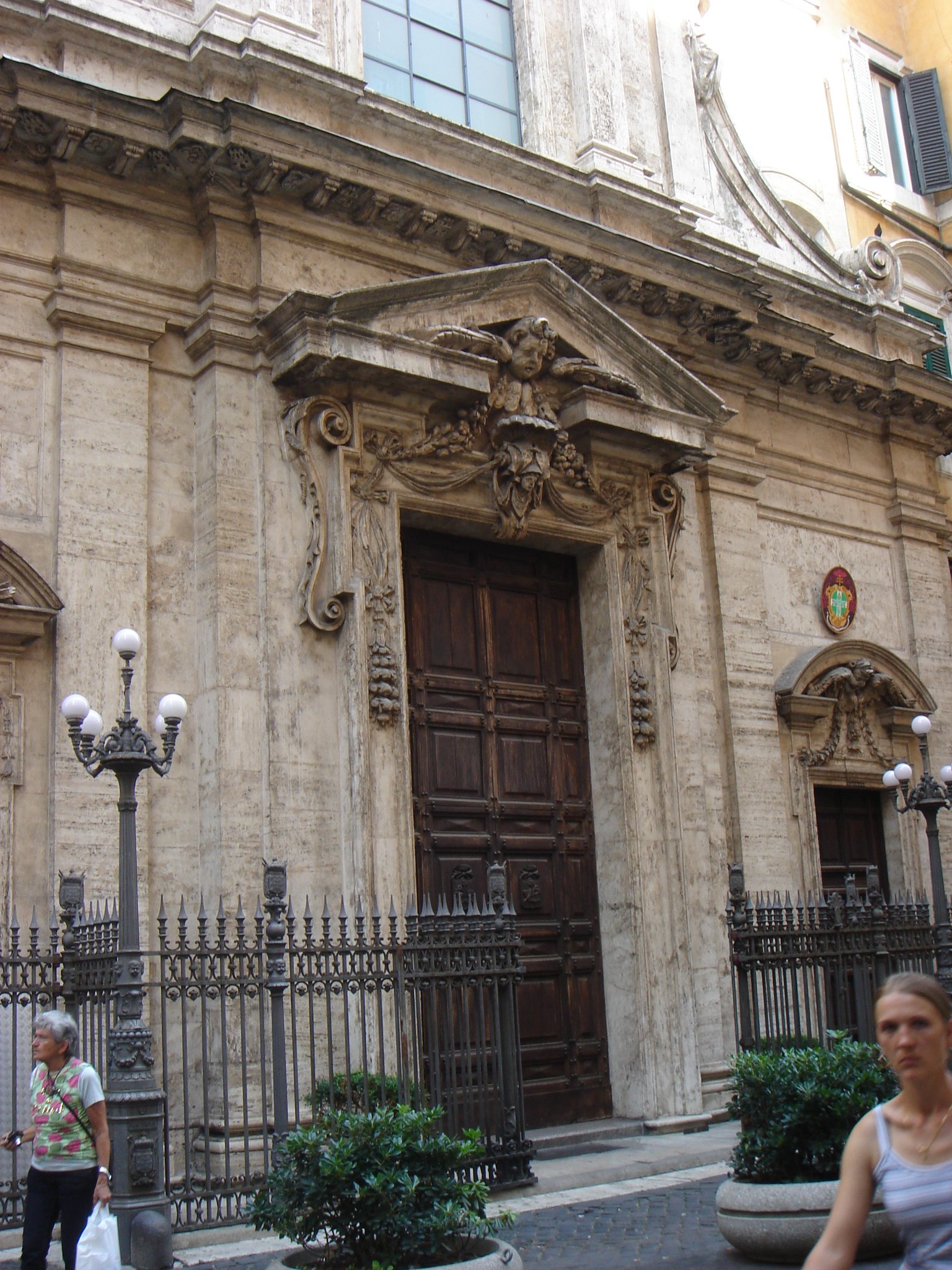
The Church of Sant'Antonio in Campo Marzio dei Portoghesi is at Via dei Portoghesi 2, in the Campo Marzio district, a few tens of meters from Via della Scrofa and barely 5 minutes from Piazza Navona. It is the national church of Portugal in Rome: not a tourist definition, but a precise legal and institutional status, which has its roots in the Middle Ages and which still today ties this building to the Portuguese and Brazilian communities of the capital. Those who walk down Via dei Portoghesi come across it almost by chance, because the Baroque facade opens onto a narrow street that almost never grants the right distance to look at it whole, and because the neighborhood around is full of more famous names: the Church of San Luigi dei Francesi with its Caravaggios, the Basilica of Sant'Agostino in Campo Marzio, the Palazzo Altemps. And yet it is enough to step inside to understand that here there is something different: an interior of polychrome marbles, gold and stucco that sharply contradicts the modesty of the street, and that can be explained only if you understand what a national church was, in the Rome of past centuries. The lines that follow tell the history of the building, the system of national churches that generated it, what you really see inside, the attributions that circulate and don't hold up to checking, and the Torre della Scimmia that stands a few steps away, with the legend that for two centuries has accompanied this corner of Rome.
Where the church of the Portuguese is and how to reach it
The address is Via dei Portoghesi 2, Campo Marzio district, and the street takes its name precisely from the church and from the Portuguese hospice that preceded it. We are in the heart of the historic center, in the quadrilateral between Via della Scrofa, Via dell'Orso, Piazza di Sant'Agostino and the Lungotevere Marzio: a sector of the city where within a few hundred meters are concentrated three national churches, a first-rate archaeological museum, the Senate of the Republic and one of the most photographed squares in Europe.
On foot from the center of Rome
From Piazza Navona you arrive in 5 or 6 minutes: you leave from the north side of the square, take Via dell'Anima or skirt Palazzo Altemps up to Piazza Sant'Apollinare, then turn onto Via dei Portoghesi. From the Pantheon the route is just as short, passing through Piazza della Maddalena and Via della Scrofa. From Castel Sant'Angelo you cross the Tiber on Ponte Umberto I and you are on Via dei Portoghesi in under 10 minutes on foot. Whoever arrives from Via del Corso and from Montecitorio crosses the central stretch of the Campo Marzio and takes a little over a quarter of an hour.
By public transport
The area is not served directly by the metro: the nearest stations are Spagna and Barberini on line A, both about 20 minutes away on foot, and Colosseo on line B, much farther. The most practical solution remains the bus: the lines that run along Corso del Rinascimento and Corso Vittorio Emanuele II drop you a few minutes' walk from the church, as do those that go up Via della Scrofa and Via di Ripetta. Whoever arrives from Termini station can take metro A to Spagna and finish on foot, or use a bus heading to the historic center: the overall times are roughly equivalent, and the choice depends mainly on the traffic at that hour.
Landmarks so you don't get lost
Via dei Portoghesi is a short and narrow street, easy to miss if you walk distracted. Three landmarks help you find it with certainty: the pale mass of Palazzo Altemps on Piazza Sant'Apollinare, the stretch of Via della Scrofa with its historic restaurants, and above all the Torre della Scimmia, the medieval crenellated tower that rises at the intersection of Via dei Portoghesi and Via dei Pianellari and can be seen from afar. Whoever looks for the church and spots the tower has already found the right street: the two buildings are a few meters from each other and form, together, the true face of this corner of Campo Marzio.
What a national church in Rome is: the system that explains this building
The national churches of Rome are Catholic churches each entrusted to a particular national community, and their system was born in the Middle Ages around a practical need: assisting the pilgrims who arrived in the city of the popes from every corner of Christendom. Without this fact, the church of the Portuguese remains incomprehensible, because nothing in its position or its size would otherwise explain the richness of its marbles.
Where the word natio comes from
In medieval Latin the noun natio did not indicate the modern national state, which did not yet exist in the form we know, but the set of people who shared the same geographic origin and the same language. It is the same usage we find in medieval universities, where students were grouped in nationes according to origin: the natio germanica, the natio gallica and so on. Rome, which received thousands of pilgrims every year from all over Europe, applied the same criterion to hospitality: each natio organized itself, raised funds among its countrymen living in the city and built its own structures.
The three pieces that make up every national church
The model repeats with striking regularity, and is always made of three elements. The first is the hospice, that is a reception facility that offered bed, meals and assistance to fellow-countrymen pilgrims arrived in Rome, often flanked by a real hospital for those who fell ill during the journey. The second is the confraternity, an association of laypeople and clergy of the same nation that ran the hospice, administered the assets, collected alms and testamentary bequests and organized community celebrations. The third is the church proper, which almost always began as the oratory of the hospice and then grew, century after century, until it became an autonomous and monumental building.
To these three elements a fourth was often added, less visible but decisive for European cultural history: the college, that is the training school for the clerics of the nation, who came to Rome to study and then returned home carrying with them the language, the artistic taste and the liturgical habits of Rome. It is through these colleges that the Roman Baroque spread across half of Europe and the Americas, much more than through architecture books.
Why national churches are so rich
Here we come to the point that explains the sumptuous interior of the church of the Portuguese. A national church was not only a place of worship: it was a nation's calling card in the capital of Christendom, the place where the sovereign, the ambassador and the merchants of that country showed Rome, and through Rome all of Europe, how much they counted. The churches and their riches were a direct sign of the importance of the nation and of the prelates who supported it, and the competition among the different national communities was one of the least told engines of the great Roman artistic season between the sixteenth and eighteenth centuries.
The resources came from three channels: the alms of the faithful, the income from the testamentary bequests of the richest benefactors, and the rents of the properties that the confraternities accumulated in the surrounding neighborhood. Many national confraternities ended up owning entire blocks in the center of Rome, and the proceeds of those rents financed the chapels, the marbles, the altarpieces and the organs. The money you see crystallized today in the polychrome marbles of the church of the Portuguese is, literally, the yield of two centuries of real estate managed by a foreign community in the heart of Rome.
The map of Rome's national churches
The list is long and covers almost all of Catholic Europe, plus a substantial part of the world. For France there is the Church of San Luigi dei Francesi, consecrated in October 1589 after a very long building site financed in part by Catherine de' Medici, and famous worldwide for the Contarelli Chapel with the three canvases by Caravaggio dedicated to St. Matthew. For the German-speaking world there is Santa Maria dell'Anima, born in the fourteenth century as the oratory of the German hospice and placed under papal protection by Innocent VII in 1406, with the funerary monument of Pope Adrian VI made on a design by Baldassarre Peruzzi between 1524 and 1527. For Croatia there is San Girolamo dei Croati, near the port of Ripetta, whose congregation was authorized by Pope Nicholas V in 1453 for a community of refugees who arrived from the other shore of the Adriatic. For Spain there is Santa Maria in Monserrato, for Scotland Sant'Andrea degli Scozzesi, for Belgium San Giuliano dei Fiamminghi, for Romania San Salvatore alle Coppelle.
The system extended also to the Italian regions, which before national unity had been fully sovereign states and which in Rome behaved exactly like foreign nations: the Basilica of San Giovanni Battista dei Fiorentini for Tuscany, Spirito Santo dei Napoletani for the Kingdom of Naples, San Giovanni Battista dei Genovesi for Liguria, San Salvatore in Lauro for the Marche, Santissimo Sudario dei Piemontesi for Piedmont, San Marco al Campidoglio for Venice. Walking through the historic center reading the dedications of the churches means, in fact, reading the geopolitical map of early modern Catholic Europe.
What happened to the national churches after 1870
The turning point comes with Italian unification and with the 1873 legislation on the suppression of religious corporations, which led to the dissolution and expropriation of very many Roman confraternities and ecclesiastical institutions. The national churches were involved in this affair, which reopened a complex dispute also on the diplomatic level, because it touched properties tied to foreign governments. The question was closed only much later, through successive agreements culminating in the Lateran Pacts of 1929, which returned a substantial part of the assets to the Catholic Church. Some confraternities turned into charitable works and foundations still operating today, and this is exactly the path followed by the Portuguese institution of Via dei Portoghesi.
The history of the Church of Sant'Antonio in Campo Marzio dei Portoghesi
The church of the Portuguese was founded in 1445 by the Portuguese cardinal Antonio Martínez de Chaves, and rose on the site where a hospice for Portuguese pilgrims already existed, established in the fourteenth century by the noblewoman Guiomar of Lisbon, with a small place of worship dedicated to Our Lady of Bethlehem. It is the typical sequence of Roman national churches, and in this case the documentation makes it particularly readable: first hospitality, then the organized community, finally the monumental building.
The foundation of 1445 and the name of the church
Cardinal Antonio Martínez de Chaves, a Portuguese prelate active in the Roman Curia in the mid fifteenth century, transformed the oratory of the hospice into a church proper in 1445. The initial dedication was to St. Anthony Abbot, the Egyptian hermit saint very widespread in medieval devotion, and only later did the dedication shift to St. Anthony of Padua, who for the Portuguese is not Paduan at all: Fernando Martins de Bulhões was born in Lisbon around 1195 and in Portugal is called, simply, Santo António de Lisboa. The passage from one Anthony to the other is one of the most eloquent details of the whole story, because it shows the precise moment when the church stops being a generic place of worship and becomes an assertion of national identity.
The seventeenth-century building site: the dates on which the sources diverge
On the great Baroque rebuilding the available reconstructions do not entirely agree, and it is worth reporting both instead of arbitrarily choosing one. According to one reconstruction, the enlargement works began in 1624 and ended in 1638 under the direction of Martino Longhi the Younger. According to another, the rebuilding started precisely in 1638. The two versions are not necessarily in contradiction, because a building site of that size proceeded in successive phases and the same date can mark the end of one campaign and the start of the next, but whoever looks for a single, definitive date should know that the current documentation does not offer it unambiguously.
What is certain is the name of the protagonist: Martino Longhi the Younger, one of the most interesting architects of the Roman Baroque, belonging to a dynasty of builders spanning three generations that left traces in half of Rome. His grandfather Martino Longhi the Elder rebuilt, between 1588 and 1589, on commission from Sixtus V, precisely the Croatian national church of San Girolamo, and this genealogical detail says a lot about how the market for Roman architecture worked: the national communities turned to professionals who had already worked for other national communities, and solutions circulated from one building site to another.
The dome by Carlo Rainaldi
The ribbed dome of the church is attributed to Carlo Rainaldi, the architect who in Rome signed the facade of Sant'Andrea della Valle and the twin churches of Piazza del Popolo. Here too the dates reported by the sources diverge: some reconstructions place the intervention in 1657, others in 1674. It is a difference of almost 20 years, which does not affect the attribution but is worth pointing out to whoever wants to use this page as a precise reference. The dome does not dominate the skyline of the district like that of Sant'Andrea della Valle, because the proportions of the building are modest and the surrounding streets are too narrow to grant the right distance, but seen from inside it gives the nave an unexpected verticality.
From the Napoleonic closure to the twentieth century
The church was closed in 1799, during the Napoleonic occupation of Rome, and reopened only in 1842: 43 years of silence, which in the history of a place of worship are not a detail but a deep break, because in that span furnishings are lost, archives scattered and liturgical traditions interrupted that no later restoration manages to fully mend. In 1873 Francesco Vespignani, an architect very active in papal and post-unification Rome, carried out restorations and made interior decorations. The Portuguese government kept the patronage of the church until 1910, the year of the proclamation of the republic in Portugal and the end of the Braganza monarchy: from that moment management passed permanently to the Portuguese ecclesiastical institution, and the tie with the state became a tie with the community.
A last step, recent and little cited, concerns the status of the church in the Roman ecclesiastical structure: on February 21, 2001 Pope John Paul II established the cardinalatial title of Sant'Antonio in Campo Marzio, assigning it to the patriarch of Lisbon José da Cruz Policarpo, titleholder until his death in 2014. Since February 14, 2015 the title has belonged to Cardinal Manuel José Macário do Nascimento Clemente, patriarch emeritus of Lisbon. It is a recognition that formalizes, after five and a half centuries, the relationship between this church and the Portuguese Church.
The facade: Martino Longhi the Younger and Cristoforo Schor
The facade of the church of the Portuguese is a Baroque front on two orders, with three portals and the coat of arms of the royal house of Braganza declaring without ambiguity who the patron of the building was. It was begun by Martino Longhi the Younger and completed by Cristoforo Schor, an architect and stage designer of Tyrolean origin active in Rome in the second half of the seventeenth century, with works that according to some of the sources continued until 1695.
Who Cristoforo Schor was
The name of Cristoforo Schor almost never appears in general guides, and yet he is one of the most interesting figures of the late Roman Baroque. He belonged to a family of artists of Tyrolean origin deeply rooted in Rome, active in decoration, stage design, ephemeral machines for public festivals and architectural design. The Roman Baroque was also this: a world of temporary apparatus, catafalques, 40-hour devotions, triumphal arches of wood and papier-mâché set up for a procession and taken down the following week, within which worked professionals capable of moving from the ephemeral to stone and vice versa. The facade of the church of the Portuguese bears the signature of one of them.
The Braganza coat of arms and politics on the facade
The coat of arms of the Braganza dynasty on the facade is not just any heraldic ornament. The House of Braganza rose to the Portuguese throne in 1640, with the restoration of Portugal's independence after 60 years of dynastic union with the Spanish crown: displaying that coat of arms in the heart of Rome, in the same decades in which the church was being rebuilt, meant publicly asserting before the Roman Curia that Portugal had once again become a sovereign kingdom. The facade of a national church, put differently, was a diplomatic document sculpted in travertine, and whoever looked at it at the time understood it perfectly.
A curiosity about the Church of Sant'Antonio in Campo Marzio dei Portoghesi
Between 1740 and 1747 the church of the Portuguese was the building site of a work that today is no longer in Rome but in Lisbon: a Baroque chapel built entirely in the Italian capital, in prefabricated modules, and then dismantled, shipped and reassembled in Portugal. It is one of the most extraordinary stories in eighteenth-century art history, and it is almost completely unknown to those who visit the neighborhood.
The chapel that crossed the sea
The commission started in 1740 from King John V of Portugal, a sovereign who had the gold of Brazil at his disposal and who decided to spend part of it to endow Lisbon with a chapel made by the best Roman artists of the moment. The project was entrusted to Nicola Salvi, the architect of the Trevi Fountain, and to Luigi Vanvitelli, who shortly afterward would design the Royal Palace of Caserta. The chapel was built in Rome piece by piece, with a modular assembly technique that allowed it to be taken apart and put back together, and it was blessed by Pope Benedict XIV in 1744. The works ended in 1747, and at that point the structure was dismantled, loaded onto ships and transported to Lisbon, where it was reassembled in the church of San Rocco, where it still stands. Having the work made in Rome and blessed by the pope meant importing to Lisbon not only marbles and mosaics, but the very authority of the capital of Christendom, and the national church of Via dei Portoghesi was the logistical and institutional base of the whole operation.
The Baroque interior: polychrome marbles, chapels and works of art
The interior of the church of the Portuguese is laid out as a Latin cross in a space that the sources put at around 30 meters by 20, with six side chapels, a barrel vault and a decoration of polychrome marbles that produces, in a volume all in all modest, an effect of richness and splendor out of proportion to the real dimensions. It is exactly the effect the patrons wanted to obtain.
The panel by Antoniazzo Romano
The oldest piece preserved in the church is a gold-ground panel attributed to Antoniazzo Romano, the painter who, between the second half of the 15th century and the very first years of the 16th, was the most important Roman-born artist in a city dominated by foreigners. Antoniazzo painted Madonnas with full, motionless faces, on gold grounds that in contemporary Florence were already considered archaic and that in Rome, by contrast, were still in demand from devotional patrons, because they recalled the ancient icons venerated in the city's basilicas. Finding one of his panels inside a national church rebuilt at the height of the Baroque means finding the surviving trace of the 15th-century building that stood here before.
The high altar altarpiece and the 18th-century canvases
The altarpiece of the high altar is the work of Giacinto Calandrucci, a Sicilian painter trained in the circle of Carlo Maratta, and it bears the date 1707. The apse and the high altar were arranged by Cristoforo Schor, according to some of the sources as early as 1657, while the decoration of the transept is attributed to Luigi Vanvitelli, in the same years in which he was working on the chapel intended for Lisbon.
The side chapels hold three canvases by Antonio Concioli dated 1782, with the Adoration of the Magi, the Nativity and the Rest on the Flight into Egypt, and an Immaculate Conception by Jacopo Zoboli, a Modenese painter active in Rome, dated 1756. This last date is important and worth keeping in mind, because it is the key to untangling a misattribution that circulates with some insistence and that is discussed further on.
The funerary monument by Antonio Canova in the Portuguese church
In the Portuguese church there is a work by Antonio Canova: the funerary monument dedicated to Alexandre de Sousa Holstein, made in 1808. It is the only documented Canova intervention in this building, and it is a clear example of the Neoclassical language applied to funerary sculpture.
Who the commemorated man was
Alexandre de Sousa Holstein belonged to a family of the high Portuguese aristocracy and was a diplomat in the service of the crown, with postings that brought him to Rome in a particularly turbulent historical phase, the decades straddling the French Revolution and the Napoleonic wars. That Rome's Portuguese community decided to commemorate him with a monument entrusted to the most celebrated living sculptor in Europe says a lot about how much the national church also functioned as a pantheon of that nation's diplomacy and nobility on foreign soil.
Canova in 1808 and the language of the funerary monument
The year 1808 places the work in Canova's full maturity, in the years when the sculptor was by then the absolute point of reference of European Neoclassicism and received commissions from all the courts of the continent. The Neoclassical funerary monument deliberately breaks with Baroque theatricality: no winged skeletons, no drapery blown by the wind, no allegories leaning out of the marble toward the viewer. In their place come a flat composition, still figures, restrained gestures and an idea of death as a silent suspension rather than as drama. Anyone who wants to understand this shift has the ideal points of comparison in the same city: the Baroque monuments of the Roman basilicas on one side, Canova's works on the other.
Canova in Rome, beyond this church
Antonio Canova lived and worked in Rome for much of his career, and the city preserves many traces of his passage, starting with the studio on Via del Babuino that after his death was taken over by his pupil Adamo Tadolini and that today can be visited as the Atelier Canova Tadolini, one of the few 19th-century sculptors' studios to have come down to us intact with its plaster casts and models. Anyone interested in Canova's Rome finds in the Portuguese church a stop that is minor in size but perfectly consistent with the rest of the route.
Something nobody tells you about the Church of Sant’Antonio in Campo Marzio dei Portoghesi
Two attributions circulate around the Portuguese church that do not hold up when checked against the sources, and it is worth tackling them openly instead of repeating them: the funerary monument of the Polish prince Alessandro Sobieski, which many place in this church, and a chapel of the Immaculate Conception attributed to Antonio Canova.
Alessandro Sobieski's monument is not here
Alessandro Benedetto Sobieski, son of the King of Poland John III Sobieski, the commander who in 1683 broke the Ottoman siege of Vienna, died in Rome on November 16, 1714. Shortly before dying he expressed the wish to be buried in monastic habit in the crypt of the church of Santa Maria della Concezione dei Cappuccini, on Via Veneto, and that is where he was laid to rest. 14 years later, his brother Giacomo asked that in place of the anonymous tomb a monument worthy of the rank of the deceased be erected: the marble monument was sculpted in 1728 by Camillo Rusconi and stands to the left of the high altar of the Capuchin church, not on Via dei Portoghesi.
The best detail of this story concerns the fate of the building that houses the tomb. When in the 19th century the renovation of the whole Via Veneto area was being planned and the demolition of the Capuchin complex was under discussion, it was precisely the presence of the burial of a Polish royal prince that saved the convent from the bulldozers: a tomb, and the rank of the person buried in it, counted for more than any artistic consideration. Anyone who wants to see the monument will find it in the church attached to the Capuchin Friars Museum and Ossuary Crypt, which deserves a visit in its own right anyway for the famous crypt decorated with the bones of about 4,000 friars.
The chapel of the Immaculate Conception is not by Canova
The second attribution to correct concerns the Immaculate Conception. In the Portuguese church there is indeed an Immaculate Conception, but the sources available attribute it to Jacopo Zoboli and date it to 1756, that is, a generation before Antonio Canova was born: the Venetian sculptor came into the world in 1757. The only documented Canova work in this church remains the funerary monument of Alexandre de Sousa Holstein of 1808, mentioned above. The misunderstanding most likely arises from the coexistence, in the same building, of a genuine Canova and of an Immaculist Marian devotion deeply felt in the Lusitanian world, and it then spreads from one guide to the next without anyone going back to check.
My advice for visiting the Church of Sant’Antonio in Campo Marzio dei Portoghesi
The most useful advice concerns opening hours, and it is advice about method before it is about content: the Portuguese church is not a museum with a ticket office and a fixed calendar, but a national church in full liturgical and cultural activity, and its opening hours follow the life of the community that uses it. There is no fixed schedule that I can report here with confidence, and anyone who publishes one without citing the source should be treated with caution: what to do, before showing up on Via dei Portoghesi, is to contact the Istituto Portoghese di Sant’Antonio, which is based in the same complex and runs both the church and the related cultural activities.
How to organize the visit without surprises
The most reliable time to find the church open, in any Roman church of this type, is the window before and after services. Anyone arriving right around a Mass almost always finds the doors open, but also finds a church in use, where wandering around with a camera in hand is out of place. The reasonable compromise is to show up at the end of a service, wait for the congregation to disperse and then spend 10 or 15 minutes looking calmly at the side chapels, which are the most interesting part of the building and the one almost everyone neglects as they rush toward the high altar.
The itinerary I actually recommend
The itinerary that works best starts from the Church of San Luigi dei Francesi, the French national church, where you look at the Contarelli Chapel with the three Caravaggio canvases. You continue toward Santa Maria dell'Anima, the German-speaking national church, and toward Santa Maria della Pace a little farther on. You go back toward the Basilica of Sant'Agostino in Campo Marzio, which holds Caravaggio's Madonna of the Pilgrims and Raphael's prophet Isaiah, and from there in three minutes you reach Via dei Portoghesi. Anyone with energy left goes down toward the Ripetta port and arrives at San Girolamo dei Croati, or heads back up toward Piazza Navona to close the loop in front of the Fountain of the Four Rivers. In an hour and a half you cross five centuries and five nations.
Another well-known fact, yet rarely mentioned
A few meters from the church, at number 18 on Via dei Portoghesi, rises a crenellated medieval tower that is both the most photographed and the least visited monument of the whole block: the Torre della Scimmia, absorbed into Palazzo Scapucci. Nobody can go in, because it is private property and not open to visitors, but everybody looks at it, and the legend attached to it is the best narrative hook of this corner of Rome.
The tower: history, families and crenellations
The structure dates to the Middle Ages and is traced, according to the most widespread reconstruction, to the Frangipane family, one of the baronial dynasties that in the Rome of the central centuries of the Middle Ages competed for control of the neighborhoods by fortifying ancient monuments and building towers. Around the 16th century the tower passed to the Scapucci family, who absorbed it into their palace, and that is why today you see it emerging from a residential building front instead of standing isolated like a defensive tower. The characteristic crenellation that crowns it is dated to the 15th century, and on the western side, near the battlements, the heraldic coats of arms of both families remain visible: a palimpsest of ownership carved in stone, which you read by looking up from the sidewalk.
The legend of the monkey
The story has to be told for what it is, that is, a Roman popular tradition and not a documented historical fact. According to the most widespread version, one of the owners of the palace kept a monkey as a pet, a habit not unusual in the noble houses of the modern era, when exotic animals arrived along the trade routes and became status symbols. When a child was born in the family, the animal snatched him from the cradle and climbed with the newborn in its arms all the way to the top of the tower, holding him suspended in the void before the helpless eyes of the parents. The child was saved. A variant says that the father, in despair, made a vow to the Madonna to obtain his son's release, and that the monkey then calmly climbed down, returning the newborn unharmed.
The lamp that stays lit
The detail that makes the legend visible even today is at the top of the tower, on the eastern side: a 19th-century statue of the Virgin Mary, surrounded by a wrought-iron halo, accompanied by a votive lamp. Tradition ties that light to the vow made by the child's father, and holds that it must never go out. Here it is best to be precise: that the statue dates from the 19th century is a fact reported by the sources, while the connection with the episode of the monkey belongs to the legend, not to the historical documentation. The fact that the statue is much more recent than the tower and the alleged event should in itself suggest caution to anyone who wants to treat the tale as chronicle.
Hawthorne and The Marble Faun
The legend owes much of its international fortune to an American writer. Nathaniel Hawthorne, who stayed in Rome between 1858 and 1859, noted the story of the tower in his Italian notebooks and then took it up again in the novel The Marble Faun, set in the very Rome of his years and populated by foreign artists, catacombs, ancient statues and unsettling atmospheres. It is the classic mechanism by which a neighborhood rumor becomes European literary heritage: a foreign writer collects a story that Romans had been telling each other for generations, puts it in a book read throughout the Anglo-Saxon world and returns it to the city with an authority it did not have before.
The right photo to take at the Church of Sant’Antonio in Campo Marzio dei Portoghesi
The photo that really tells the story of this place is not the front view of the facade, which the narrow street does not let you frame in full, but the diagonal shot from Via dei Pianellari that keeps in the same frame the Baroque facade of the church and the medieval crenellation of the Torre della Scimmia. Two eras 300 years apart, lined up in a single image.
The interior: how to photograph it without spoiling it
Inside the church the rule is simple: no flash, no tripod, no filming during services. Flash is useless in an interior of this size, because it violently lights the foreground and leaves everything else black, and in churches it is banned almost everywhere for conservation reasons. The correct technical solution is to rest the camera or phone on a stable surface, for example the edge of a pew, raise the sensitivity and let the natural light from the dome do the work. The best photographs of Roman Baroque interiors are almost always obtained this way, and in any case it is always wise to check if filming is allowed at that moment.
The Marian shrine at the top of the tower
A third subject, the hardest and the most rewarding, is the shrine with the statue of the Virgin at the top of the Torre della Scimmia, with the wrought-iron halo backlit. It requires a long focal length, because the tower is tall and the street is narrow, and it gives the best results in the blue hours, just after sunset, when the votive lamp is already lit and the sky still keeps a deep tone instead of burning out white. It is the image that, more than any other, tells the tower, the legend and Roman popular devotion all at once.
Some important events that happened here in history
The chronology of the Portuguese church can be read as a sequence of moments in which European history passes through a building of a few hundred square meters in the Campo Marzio district.
The 17th century: the great Baroque construction project
Between the third and fourth decades of the 17th century the construction project opens that gives the building its present appearance, with Martino Longhi the Younger, and then continues with the dome by Carlo Rainaldi and the interventions by Cristoforo Schor on the apse, the high altar and the facade. In 1640 the House of Braganza ascends the Portuguese throne and Portugal regains its independence from Spain: the Braganza coat of arms on the facade dates the monument better than any inscription.
1744 and 1747: the blessing and the departure of the chapel for Lisbon
Pope Benedict XIV blesses in 1744 the chapel commissioned by John V of Portugal and designed by Nicola Salvi and Luigi Vanvitelli. In 1747 the work is completed and the structure is dismantled and transferred to Lisbon, where it is reassembled in the church of San Rocco. It is the moment of greatest international visibility for the Portuguese institution in Rome.
1808: Canova's monument
In the full Napoleonic period, while the church is closed to ordinary worship, the funerary monument of Alexandre de Sousa Holstein signed by Antonio Canova is made. The coexistence of the two dates, the closure of 1799 and the monument of 1808, is one of the knots that would deserve archival study and on which the current popular sources offer no explanations: it should be flagged as an open and unresolved question here.
Who passed through the Church of Sant’Antonio in Campo Marzio dei Portoghesi
For five and a half centuries this church has been the obligatory point of reference for anyone arriving in Rome from Portugal, and the list of those who passed through it resembles a sampler of Lusitanian history on Roman soil.
The pilgrims
They come first: men and women who traveled thousands of kilometers from the Iberian peninsula to reach the Roman basilicas, and who on Via dei Portoghesi found a bed, a meal and someone who spoke their language. They are the people for whom the institution was born, and they are also the only ones of whom we know almost no names: the archives of the confraternities recorded the benefactors, not those they assisted.
The architects and artists
For the construction of the church and for the chapel intended for Lisbon, Martino Longhi the Younger, Carlo Rainaldi, Cristoforo Schor, Nicola Salvi, Luigi Vanvitelli and Francesco Vespignani passed through here, along with the painters Giacinto Calandrucci, Antonio Concioli, Jacopo Zoboli and Salvatore Nobili and the stucco artist Pompeo Gentile. Antonio Canova left a signed monument here, and Antoniazzo Romano a panel that predates everything else by almost two centuries.
The sovereigns and the diplomats
John V of Portugal never came in person, but from the other side of Europe he financed the most sensational undertaking linked to this building. Pope Benedict XIV blessed the chapel here in 1744. The Portuguese ambassadors to the Holy See have used this church as a diplomatic chapel for centuries, and Alexandre de Sousa Holstein rests here under a Canova marble. The Patriarchs of Lisbon who have held its cardinalitial title from 2001 onward took possession of it according to the prescribed rite.
Today's Portuguese and Brazilian community
The church is not a museum-piece monument: it continues to serve the Portuguese community of Rome and also welcomes Portuguese-speaking worshippers from Brazil, to whom are added the students and researchers who attend the activities of the attached institute, including language courses, lectures and concerts. Anyone who enters on a weekday may find a liturgy in Portuguese, and understands in three minutes what the formula national church means in 2026.
The organ and the musical life of the Portuguese church
The Portuguese church hosts an organ concert season, and it is one of the places in Rome where you can hear organ music in a Baroque acoustic setting. The sources report two distinct instruments and it is best to keep them separate.
The 2008 Mascioni
Much better documented is the modern instrument: in 2008 the large Mascioni organ opus 1181 was installed, with four keyboards and 47 stops, expanded between 2015 and 2016 to 60 stops. It is one of the most substantial organs installed in Rome in recent decades, and by itself justifies the concert season that the Portuguese institute organizes in the church.
What to see around the Portuguese church
The 300-meter radius around Via dei Portoghesi is one of the densest in Rome. To the south you reach in a few steps Palazzo Altemps, home of the section of the Museo Nazionale Romano devoted to the great collections of ancient sculpture, and right after it Piazza Navona, beneath which are preserved the remains of the Stadium of Domitian that determined its elongated shape. To the east you get to Palazzo Madama, seat of the Senate, and continuing to the Pantheon and the Chiesa di Sant’Ignazio di Loyola in Campo Marzio, which is also the national church of Guatemala. To the north, beyond Via di Ripetta, you find the Mausoleum of Augustus and the Ara Pacis, the two monuments that recall that this district takes its name from the ancient Campus Martius.
Frequently asked questions about the Church of Sant’Antonio in Campo Marzio dei Portoghesi
Where is the Church of Sant’Antonio dei Portoghesi in Rome?
The Church of Sant’Antonio in Campo Marzio dei Portoghesi is at Via dei Portoghesi 2, in the Campo Marzio district, about five minutes on foot from Piazza Navona and not far from Via della Scrofa. The area is not served directly by the metro: you reach it on foot from the historic center or by the buses that run along Corso del Rinascimento and Via della Scrofa.
Do you pay a ticket to enter the Portuguese church?
The Church of Sant’Antonio dei Portoghesi is a place of worship and not a museum with a ticket office, so there is no entrance ticket as there is for archaeological sites or galleries. Voluntary offerings remain possible, of course. For the concerts and other cultural activities organized in the church, different conditions may apply, which are best checked each time with the Portuguese institute that organizes them.
What are the opening hours of the Portuguese church?
The hours of the Church of Sant’Antonio dei Portoghesi follow the liturgical life of the Portuguese community and not a fixed museum calendar, so it is not possible to give one with certainty on this page. The most reliable route is to contact the Istituto Portoghese di Sant’Antonio directly, which is based in the same complex on Via dei Portoghesi and runs both the church and the cultural activities.
What is a national church in Rome?
A national church in Rome is a Catholic church entrusted to a particular national community, born in the Middle Ages together with a hospice for the pilgrims of that nation and run by a confraternity of fellow countrymen. The model repeats for dozens of communities: San Luigi dei Francesi for France, Santa Maria dell'Anima for the German-speaking world, San Girolamo for the Croats, Sant’Antonio dei Portoghesi for Portugal.
Is there a work by Canova in the Portuguese church?
Yes, in the Church of Sant’Antonio dei Portoghesi there is the funerary monument of Alexandre de Sousa Holstein, made by Antonio Canova in 1808: it is the only documented Canova work in this building. The Immaculate Conception preserved in the church is instead attributed by the sources to Jacopo Zoboli and dated 1756, therefore earlier than Canova's very birth, which took place in 1757.
Where is the tomb of Alessandro Sobieski in Rome?
The tomb of Alessandro Sobieski is not in the Portuguese church but in the church of Santa Maria della Concezione dei Cappuccini on Via Veneto, where the Polish prince, son of John III Sobieski, asked to be buried in monastic habit after his death in Rome on November 16, 1714. The marble monument was sculpted by Camillo Rusconi in 1728.
Can you visit the Torre della Scimmia on Via dei Portoghesi?
The Torre della Scimmia, at Via dei Portoghesi 18, is private property and not open to visitors: you can only look at it from the street. The medieval tower, absorbed into Palazzo Scapucci, preserves its 15th-century crenellation, the heraldic coats of arms of the Frangipane and Scapucci families and, at the top, a shrine with a 19th-century statue of the Virgin and a votive lamp.
How long does it take to visit the Portuguese church?
To visit the Church of Sant’Antonio dei Portoghesi, 20 minutes is enough, half an hour if you want to take your time over the six side chapels, the gold-ground panel by Antoniazzo Romano, the 18th-century canvases and the Canova monument. It pays off much more if included in an itinerary devoted to the national churches of Campo Marzio, which can be walked in about an hour and a half.
Is the Portuguese church suitable for children and is it accessible?
The Church of Sant’Antonio dei Portoghesi is a short, quiet visit, suitable also for those traveling with children, especially if combined with the legend of the Torre della Scimmia a few meters away. On accessibility for those with mobility difficulties there is no detailed official information available online: it is best to ask the Portuguese institute for confirmation before the visit.
One last piece of advice for those planning the itinerary
The Portuguese church works best as a smart stop within a broader route rather than as a destination in itself. Anyone with few days in Rome who has to choose will do well to include it in a walk among the national churches of Campo Marzio, adding a pause in front of the Torre della Scimmia: in an hour and a half you take home a piece of European history that no standard itinerary tells, and you walk streets that in the same half hour give back the Middle Ages of the towers, the Baroque of the nations and the institutional Rome of today.
Anyone planning a broader itinerary in the historic center, crossing this stop with the other stops in Campo Marzio and Piazza Navona area, can find useful planning tools on Tour Leader Pro, while for a broader picture of transport and destinations in Lazio Italy Planner is a good resource.