Basilica of Sant’Eustachio
In short. The Basilica of Sant'Eustachio is less than 100 meters from the Pantheon, in the block between Via della Palombella, Via di Sant'Eustachio and the square of the same name, and it has a feature that makes it recognizable from afar even…
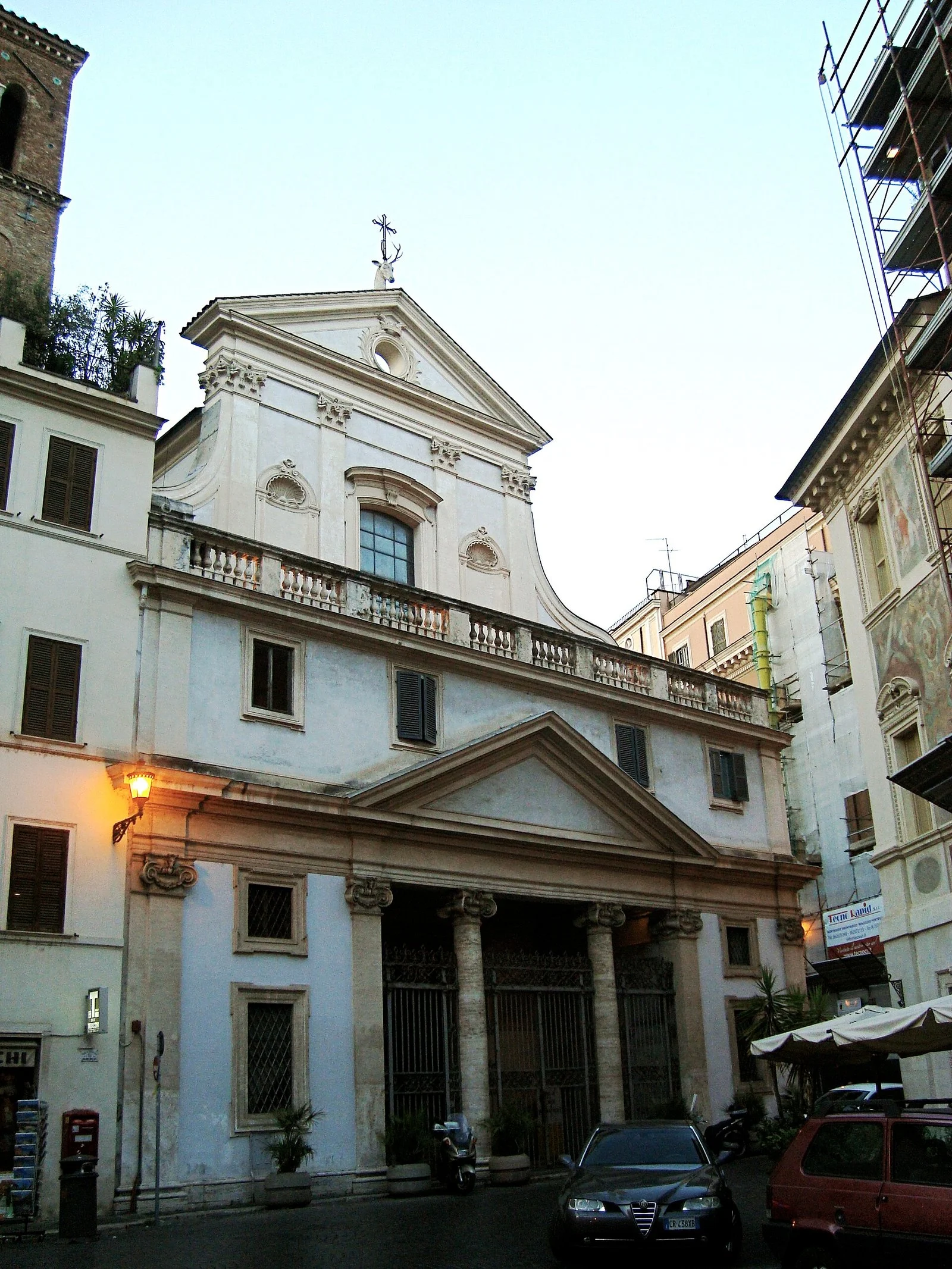
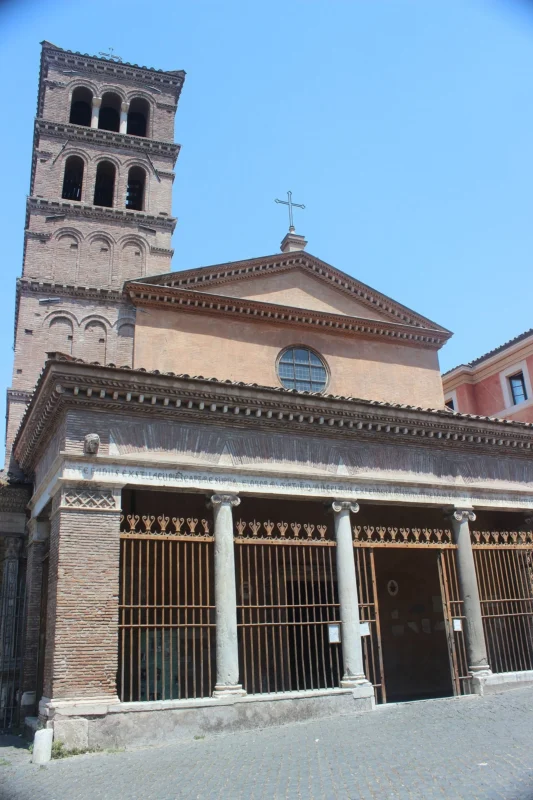
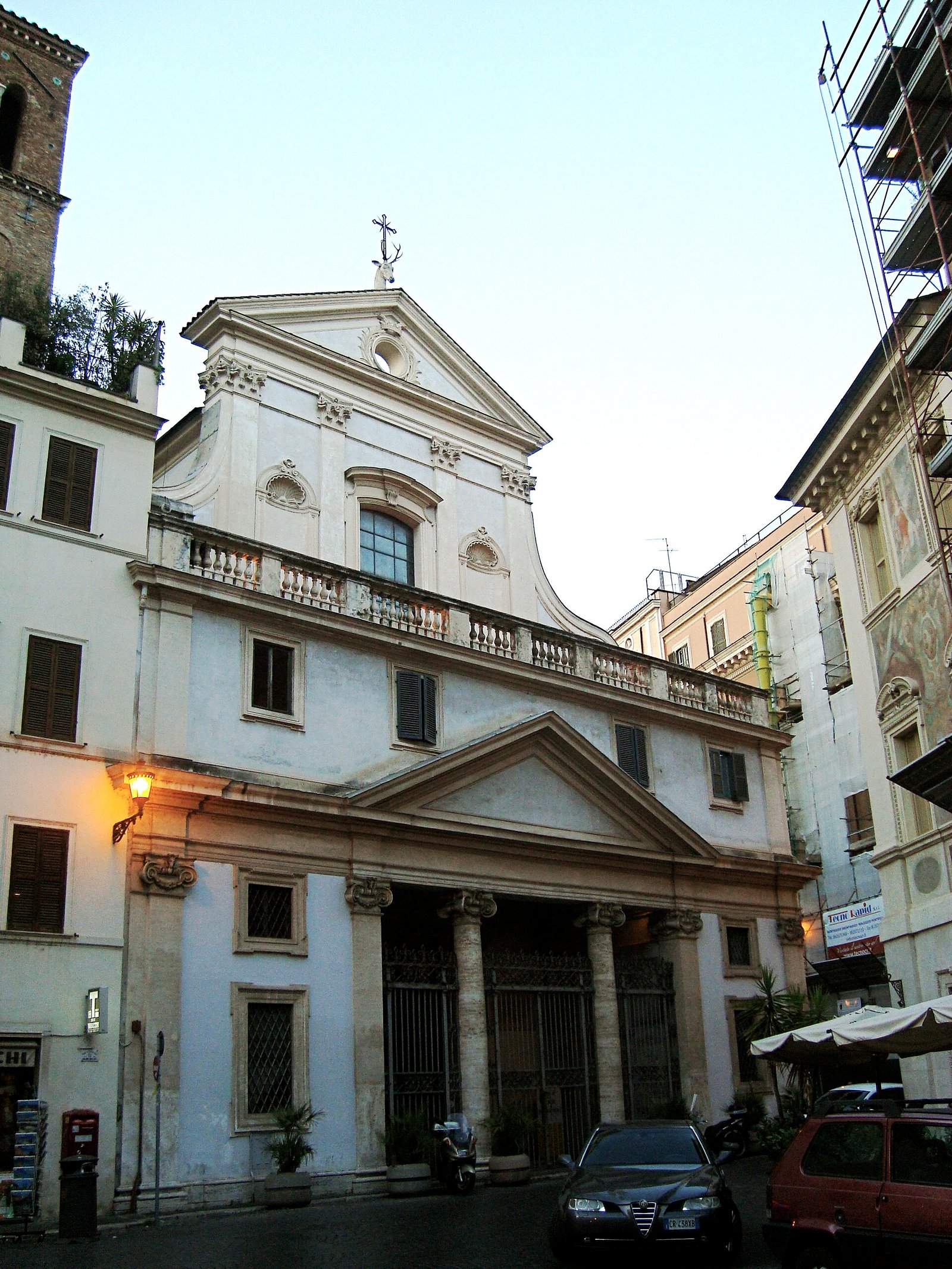
The Basilica of Sant'Eustachio is less than 100 meters from the Pantheon, in the block between Via della Palombella, Via di Sant'Eustachio and the square of the same name, and it has a feature that makes it recognizable from afar even to someone who knows nothing about Roman churches: at the top of the facade's pediment there is a stag's head with a cross between the antlers. It is not a random decorative ornament or a Baroque joke: it is both the summary of the legend that gives the church its name and the coat of arms of the family that paid for a large part of the 1700s reconstruction, and the fact that the two meanings coincide is one of the small marvels of symbolic economy that Rome produces when nobody is looking. The church gives its name to the eighth rione of the city, which in turn bears on its coat of arms a golden stag's head on a red field, and for 30 years it hosted the University of Rome. Coming from Piazza della Rotonda you find a Baroque building leaning against a 12th-century Romanesque bell tower, a 1700s single-nave interior and, in the basement, a canteen for the poor. The lines that follow tell what this basilica is, where the stag comes from, what remains of the Middle Ages, what happened in the 1700s and how you visit it today.
Where the Basilica of Sant'Eustachio Is and How to Get There
The Basilica of Sant'Eustachio stands in the rione of the same name, Rione VIII, in the block immediately west of the Pantheon and immediately east of Sant'Ivo alla Sapienza: the facade looks onto Piazza di Sant'Eustachio, while the address that appears in many administrative listings and in the parish contacts is Via di Sant'Eustachio 19. The two indications do not contradict each other, because the complex occupies a whole corner of the block and is entered both from the square and from the street running beside it: if you are looking for the church entrance, head for the square, if you are looking for the parish offices, the street.
On Foot from the Pantheon and Piazza Navona
The shortest route starts from Piazza della Rotonda, in front of the Pantheon: you take Via della Palombella, the narrow street that runs along the rear flank of the ancient rotunda and the apse area of the Baths of Agrippa, and in less than two minutes you come out on the side of the basilica, with the medieval bell tower suddenly appearing above the rooftops. Coming instead from Piazza Navona you cross Corso del Rinascimento at the height of Palazzo Madama or Sant'Ivo, take Via degli Staderari or Via della Dogana Vecchia and find yourself on the square in three or four minutes of walking. From Largo di Torre Argentina, the nearest big public transport hub, it takes about seven minutes going up Via di Torre Argentina and Via dei Cestari or passing through Piazza della Minerva.
By Public Transport
The Sant'Eustachio rione has no metro station: the nearest stops remain those of the lines serving the outer perimeter of the historic center, and from none of them do you reach Piazza di Sant'Eustachio without at least 10 minutes of walking. The practical reference for those using public transport is Largo di Torre Argentina, terminus and hub of many surface lines crossing the center, from which you continue on foot. A second base is Corso del Rinascimento, served by the lines linking the Vatican and the Lungotevere with the historic center. The area is inside the limited traffic zone of the historic center, so arriving by private car is not a good idea: those who do almost always end up looking for parking outside the perimeter and walking anyway.
Landmarks So You Don't Take a Wrong Turn
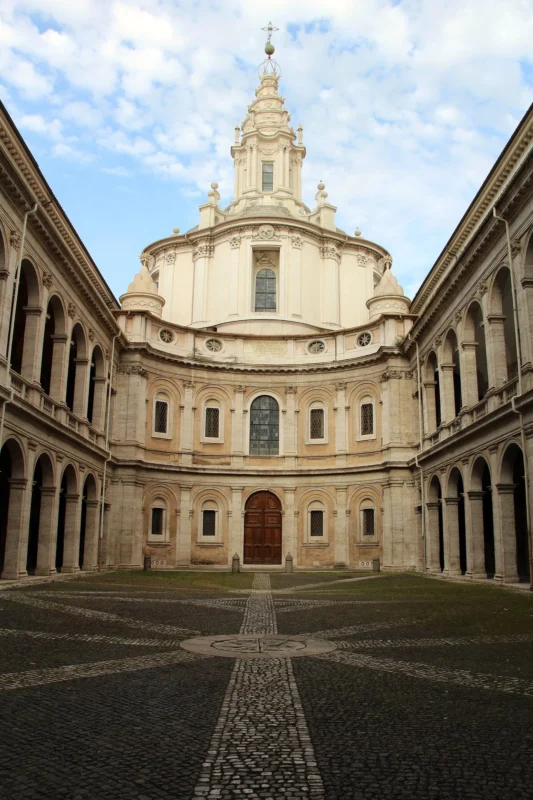
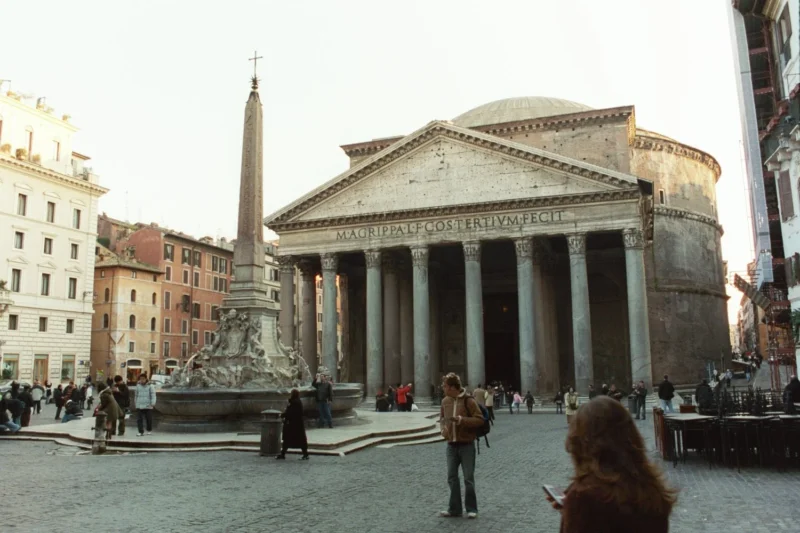
If you do not know the neighborhood, orient yourself on three elements visible even from afar. The first is the dome of the Pantheon with the Macuteo obelisk planted in front of it, on the fountain of Piazza della Rotonda: the Basilica of Sant'Eustachio is on the opposite side of the block from the Pantheon's facade. The second is the spiral lantern of Sant'Ivo alla Sapienza, which rises above the rooftops of Palazzo della Sapienza and which, once spotted, points precisely to the direction of Corso del Rinascimento. The third is the Romanesque bell tower of the basilica itself, partly hidden by the houses built up against it but still easily recognizable from Via della Palombella side, where the view opens that all the photography guides of the area recommend.
What the Basilica of Sant'Eustachio Is: A Diaconia Turned Minor Basilica
The Basilica of Sant'Eustachio is a parish church of Rome that bears the title of minor basilica and is the seat of one of the oldest cardinal titles of the city, the diaconia of Sant'Eustachio. The word diaconia is not an erudite detail: it indicates what this church was in the early Middle Ages, that is, a center for assistance to the poor and the sick run by the Church of Rome, with warehouses for distributing food and dedicated staff. The first documentary mention dates to 795, under the pontificate of Leo III, and already remembers it as an ancient diaconia, that is, as an institution that at the end of the 8th century was considered to be of not recent foundation.
The Cardinal Title and Why It Matters
The diaconia of Sant'Eustachio was erected, according to the documentary tradition, around 600 under Pope Gregory the Great, in an area that in Roman times was occupied by the Neronian and then Alexandrine baths. Over the centuries the title has been assigned to cardinal deacons who in several cases would later become popes: among them Ugolino dei conti di Segni, the future Gregory IX, Rinaldo di Ienne, the future Alexander IV, Francesco Nanni Todeschini Piccolomini, the future Pius III, and Alessandro Farnese, the future Paul III. A cardinal title does not imply that the titular cardinal habitually officiates in the church, but it establishes a formal link that over the centuries has often had practical effects, because the titular holders financed restorations, furnishings and works of art in the church assigned to them.
Why It Is Called in platana
In some documents of the 10th and 11th centuries the church appears with the specification in platana, that is, among the plane trees. The traditional explanation ties that name to a plane tree that supposedly grew in the garden of the house of the martyr Eustachio, on which the emperor Constantine is said to have had a first oratory built on the very spot of the martyrdom. It must be said clearly that this is a devotional tradition and not an ascertained archaeological fact: no excavation has turned up a Roman house identifiable with that of a historical figure named Placido, and the Constantinian foundation of the church belongs to the same category of founding stories that in Rome are repeated for dozens of places of worship. Other medieval names for the church are more prosaic and far more useful to historians, because they describe its position: ad Pantheon in regione nona and iuxta templum Agrippae, that is, near the Pantheon in the ninth region and beside the temple of Agrippa.
The Stag's Head with the Cross Between the Antlers: The Sign Everyone Photographs
The stag's head with the cross between the antlers that crowns the pediment of the Basilica of Sant'Eustachio is the work of the sculptor Paolo Morelli, who died in 1719, and so dates to the first decades of the 1700s, in the phase when the facade was being completed. It is the element that makes the church immediately recognizable and that has put it in all the collections dedicated to what someone has called Rome's stone zoo, that is, the census of animals sculpted on the city's buildings.
Two Readings, Both Correct
The stag points to the legend of the conversion of Sant'Eustachio, which will be told further on, but it also points, and just as explicitly, to the arms of the Maffey family, who took part with a substantial donation in the rebuilding of the church and who had their residence on Via della Pigna, not far away. The two readings do not exclude each other: the patron chose a symbol that was at once his own family crest and the hagiographic sign of the titular saint, thus obtaining a monument to his own generosity that nobody could have contested as vain, because it coincided with the story of the church. It is a clear case of how Roman patronage worked between the 1600s and 1700s, where devotion and family promotion traveled on the same track without anyone finding it embarrassing.
The Stags Hidden in the Capitals
Anyone who stops under the portico and looks up discovers that the stag's head on the pediment is not alone. The lower order of the facade is marked by four pilasters and two columns with Ionic capitals, and at the center of each capital, at the point where the classical Ionic order calls for a rosette or a flower, there is a small stag's head. The spirals of the volutes are linked by a laurel wreath. It is a detail that almost always escapes notice, because it is in an awkward position for the eye and because nobody expects a zoological variation on an Ionic capital: once you notice it you can no longer not see it.
The Facade: Two Orders and a Crowned Oculus
The facade was built under the direction of Cesare Corvara, who died in 1703, with the collaboration of other architects. It is organized in two orders, with the upper one set back from the lower. The lower order, open onto the portico, is the one marked by the pilasters and the Ionic columns with decorated capitals. The upper order is divided by four pilasters and joined at the sides by two large volutes, with at the center a large window with an arched frame and at the sides two niches adorned with shells. At the top is the triangular pediment, inside which opens an oculus surrounded by palm branches and surmounted by a crown, and above the pediment, precisely, Morelli's stag's head. The palm is the attribute of martyrdom, the crown the sign of victory over the torment: the whole facade, read from bottom to top, tells the same story in a compact way.
The Plaque of the 1495 Flood
On the right side of the facade is a plaque set into the wall recalling a flood of the Tiber in 1495, whose waters reached the basilica. It is one of the many flood-level plaques scattered around the historic center of Rome, stone memorials of the floods that before the 1800s embankment walls regularly flooded the Campo Marzio. That plaque is not a colorful detail: it explains, together with the chronic dampness of the subsoil, why the medieval church ended up being demolished and rebuilt from scratch. The foundations of a building put up in a low area, on ground that in Roman times had been an artificial water basin, give way sooner and worse than those of a church on the hill.
The Legend of Sant'Eustachio: Hagiography, Not Chronicle
The story of Sant'Eustachio is a hagiographic legend, and it is worth saying so before telling it, because it is exactly the kind of tale that tourist guides report as if it were a documented fact. According to tradition, the saint was named Placido and was a Roman general in the service of the emperors Titus and Trajan, victorious against the Parthians. One day, during a hunt, he was chasing a stag that stopped in front of a ravine and turned toward him, showing between its antlers a luminous cross surmounted by the figure of Christ, who said to him: Placido, why do you persecute me? I am Jesus, whom you honor without knowing it.
What the Legenda Aurea Tells
The text that fixed the story in the form later repeated everywhere is chapter 161 of the Legenda Aurea of Jacopo da Varazze, compiled in the 13th century. According to that account Placido went home and told his wife of the vision, and she in turn told him she had had a dream that night in which a stranger announced that the next day she would go with her husband to him. The family presented itself to the bishop, converted and received baptism: Placido took the name Eustachio, from the Greek Eustáchios, meaning one who gives good ears of grain, his wife Tiziana took that of Teopista, believer in God, and the two sons were called Teopisto and Agapito. From that moment the story is built as a Christian reworking of the story of Job: Eustachio loses his possessions, then his wife, then his sons, does not rebel against providence, and after years miraculously finds his family again. Called back to arms by Trajan, he returns to fight with valor. Discovered to be a Christian, he is condemned to death by the emperor Hadrian together with his family. Tradition has it that they were spared by the beasts of the Colosseum and finally killed inside the Bull of Phalaris, the hollow bronze statue in which the condemned were roasted, on September 20 of a year that the hagiographic sources place in 120.
What Historians Think
Critical studies of hagiography have demolished the documentary value of this story. The Bollandist scholar Hippolyte Delehaye argued that Eustachio never existed as a historical figure and that the first Greek redactor of his passio drew on popular legends, with a family story that follows an account of Indian origin. The main argument is the absence of mentions of the saint until the fifth century and the fact that neither the Depositio martyrum of the Chronograph of 354 nor the Martyrologium Hieronymianum names him: two lists that, for Roman martyrs really venerated in the early centuries, are the decisive reference. The identification of Eustachio with the general Placido cited by Josephus, taken up in the 1500s by Cesare Baronio in the Annales Ecclesiastici, is a learned reconstruction of the modern age, not an ancient testimony.
Why the Stag, and Why the Cross
The stag entered Christian iconography early as a figure of Christ fighting the devil, based on a belief widespread in antiquity that the stag was an implacable enemy of the serpent, which it flushed out and killed. Against this symbolic background the image of the stag with the cross between its antlers works as an immediate visual synthesis, and that is why it has had an enormous iconographic fortune. It should be noted that the same scene is also attributed to another saint, Hubert of Liège, patron of hunters like Eustachio: in representations the two are told apart because Eustachio wears military dress. Anyone who meets a stag with a cross on a sign or in a painting and automatically attributes it to Sant'Eustachio therefore runs a real risk of getting the wrong saint.
The Cult and the Feast of September 20
Eustachio is counted among the 14 Auxiliary Saints, the group of saints to whom late medieval devotion attributed particular efficacy in emergency situations. The feast falls on September 20 in the West and November 2 in the East. He is the patron of hunters and forest guards and is invoked in situations of difficulty, and his iconographic attributes are the stag, the crucifix, the palm of martyrdom and the Bull of Phalaris. The Roman basilica is considered his main sanctuary, and under the table of the high altar, inside an urn of antique red porphyry, are kept the relics attributed to the saint and his family, placed in the church according to the sources in the time of Pope Celestine III.
A Curiosity About the Basilica of Sant'Eustachio
The stag of this church has done something that very few Roman religious symbols have managed to do: it has left the facade and invaded the neighborhood. The golden stag's head on a red field is the coat of arms of Rione VIII, and it appears, with the bust of Christ between the antlers in the oldest versions and with the cross in others, on plaques, signs and street furniture all over the area.
The Stag on the Fontana dei Libri
The most conspicuous example is a few steps from the basilica, on Via degli Staderari: the Fontana dei Libri, made in 1927 to a design by the architect Pietro Lombardi, a small travertine composition with four old volumes arranged on two shelves and, at the center, a stag's head. The books allude to the Sapienza university, which had its seat in the next block, and the stag to the coat of arms of the rione. The water comes out of four spouts, two of which are shaped like a bookmark slipped between the pages of the upper volumes. The fountain is part of a series of neighborhood fountains that the Comune commissioned from Lombardi in the 1920s with the idea of giving the center's neighborhoods back their own heraldic symbols and the memory of vanished trades, in this case that of the staderari, the makers of steelyards and scales who had given the street its name.
The Mistake Carved in the Travertine
On the same fountain there is a mistake that nobody ever corrected and that has over time become part of the monument's appeal: the number of the rione carved at the center of the composition is IV instead of the correct VIII. A wrong Roman numeral sculpted on a public fountain dedicated precisely to the identity of a rione is one of those details that in Rome are part of the landscape, and that works well as practical proof that attention to detail has never been a constant feature of the Capitoline administration in any era.
The Romanesque Bell Tower of 1196: The Oldest Part You Can See
The bell tower of the Basilica of Sant'Eustachio is the only medieval element to survive the reconstruction of the 1600s and 1700s, and its construction is linked to the great building site of 1195 and 1196 promoted by Pope Celestine III, when the old building was completely rebuilt and enlarged. A plaque kept in the sacristy records the consecration of the church in 1196.
What You See and What Is Hidden
The bell tower has a square plan, in brick, with the typical structure of Roman Romanesque bell towers: superimposed orders marked by cornices and opened by mullioned windows. It stands on the left side, toward the back of the church, and is largely hidden by the houses built up against it over the centuries, which is why anyone looking only at the facade risks not noticing it exists. The best view opens from Via della Palombella, the street linking the Pantheon area to Via di Sant'Eustachio: from there the tower emerges above the rooftops and you can read in full the relationship between the medieval volume and the Baroque shell that grew around it.
The Mullioned Windows Walled Up to Keep It from Falling
One detail that explains a lot about the building's structural history concerns the openings. To guarantee the stability of the tower, all the mullioned windows were walled up in the past except those of the upper order. It is a drastic and visually heavy intervention, which turns a bell tower designed as an openwork, light structure into an almost blind block, but it was the only way to reduce the stresses on a masonry that, like the whole complex, rests on damp and unstable ground. Anyone who compares this bell tower with those of Santa Maria in Cosmedin or of Santi Giovanni e Paolo, which stayed open, grasps the difference at once.
Something Nobody Tells You About the Basilica of Sant'Eustachio
Under the Basilica of Sant'Eustachio there is no early Christian crypt or visitable hypogeum, but something less spectacular and far more relevant to understanding the history of the building: the subsoil of this block belonged to one of the largest water complexes of the ancient Campo Marzio, among the Baths of Agrippa, the Neronian baths later Alexandrine, and the Stagnum Agrippae, the artificial basin that occupied part of the space between the two installations.
The Stagnum Agrippae and the Nemus
The Forma Urbis, the great marble plan of Severan Rome, places in this area the Nemus Thermarum, the grove attached to the baths, which also included the space on which the church later rose. The Stagnum Agrippae was an artificial lake fed by the Vergine aqueduct, and its waters drained into the Euripus, the canal that ran toward the Tiber passing near the present Sant'Andrea della Valle. In 1876, during occasional excavations near Palazzo dei Crescenzi and in the stretch between it and the church, curvilinear steps were found, interpreted as belonging to a basin of the lake. Building a church on the bed of an artificial Roman lake, in an area the Tiber flooded regularly, is the most direct explanation of the chronic dampness that by the 1600s had by then compromised the medieval structures.
The Granite Basin That Came Back to the Surface
Of that submerged world one trace has become visible again in spectacular fashion a few meters from the basilica. In 1985, during excavations in the courtyard called della Palma, between Palazzo Madama and Palazzo Carpegna, a large basin of Egyptian granite from Aswan was found, broken into eight fragments, coming from the complex of baths built by Nero around 62 AD and restored by Alexander Severus in 227, whence the name of Alexandrine Baths. Restored, the basin was placed in Largo della Costituente, along Via degli Staderari toward Piazza di Sant'Eustachio, and the Senate donated it to the city: the fountain was inaugurated on December 22, 1987, on the 40th anniversary of the Italian Constitution, as a plaque on Palazzo Madama records. Anyone walking from Sant'Ivo to the basilica almost always passes in front of it without knowing they are looking at a piece of Nero's baths.
Casa della Misericordia in the Basement
There is a second underground level that concerns the present. In the 2010s the basilica became the seat of an ongoing assistance activity on the initiative of the rector don Pietro Sigurani, who in the rooms under the church set up the so-called Casa della Misericordia: daily meals for about 120 people in difficulty, medical and legal assistance services, showers and laundry. Sigurani, who had been rector of the basilica until 2021 and died on July 4, 2022 at the age of 86, after 61 years of priesthood, had organized the activity on daily canteen shifts and had the rooms renovated to equip them with sanitary facilities suited to those who live on the street. The initiative made news also because it involved the restaurants of the Pantheon area in a project of donated lunches, and because it drew criticism and even threats against the rector from those who considered the presence of homeless people incompatible with the decorum of the historic center.
My Advice for Visiting the Basilica of Sant'Eustachio
The most useful advice concerns hours, and it is also the point on which the greatest caution is needed. The Basilica of Sant'Eustachio is an active parish church and entry is free, but the opening hours published by the different tourist sources do not match each other and some institutional pages simply refer to direct contact with the basilica for the hours of services and visits. Some secondary sources indicate daily opening with an afternoon closure and continuous hours on weekends, with closure in August, but these indications are not confirmed by an official parish source: anyone planning the visit should make a phone call or check the basilica's website before setting out, especially in summer and on weekdays.
Respecting the Function of the Church
A warning that applies to all the parish churches of Rome but matters here more than elsewhere: during services you do not walk around the nave and you do not take photographs. And since the basilica hosts a daily activity of assistance to the poor, you may come across people in line or waiting in the service areas. They are not part of the colorful furnishings of the historic center: anyone arriving with a camera should remember this and keep the lens pointed at the architecture.
How to Fit It into a Half-Day Itinerary
The Basilica of Sant'Eustachio works badly as an isolated destination and very well as a stop within a walking route in the Campo Marzio. An itinerary that holds up on its own starts from the Pantheon, goes down Via della Palombella to the basilica, continues on Corso del Rinascimento to Sant'Ivo alla Sapienza with its Borromini courtyard, enters Piazza Navona and the Fountain of the Four Rivers, and if you like goes down to Campo de' Fiori. In the opposite direction, from Sant'Eustachio you reach in a few minutes the Basilica of Santa Maria sopra Minerva with the Minerva obelisk on the back of the little elephant, and a little farther the Church of Sant'Ignazio di Loyola. In all cases the stop inside the basilica takes between 20 and 30 minutes, which becomes 40 for those who want to really read the chapels one by one.
The 1700s Interior: A Single Nave, Six Chapels and an Altar by Nicola Salvi
The interior of the Basilica of Sant'Eustachio has a Latin cross plan with a single nave and three chapels on each side, communicating with one another, and is the work of Cesare Corvara and Antonio Canevari. The nave is marked on each side by pilasters on a wide base, faced with fluted white marble and crowned by composite capitals. The vault is decorated in stucco with motifs of flowers and leaves, and the crossing is covered by a dome with a depiction of the Holy Spirit at the center.
The Building Site: Who Did What and When
The reconstruction between the 17th and 18th centuries tore down all the medieval structures except the bell tower. Cesare Corvara directed the work from 1701 to 1703. Giovan Battista Contini added the chapels and the portico. Antonio Canevari, Nicola Salvi and Giovanni Domenico Navone completed the work with the apse and the transept. The choir and the sacristy were designed by Canevari and built by Giovanni Moscati. The sources diverge on the overall chronological framing: some place the bulk of the building work between 1650 and 1703 with a second phase between 1724 and 1728, others speak generically of a reconstruction between the 1600s and 1700s. The solid fact is that the present church is the result of a building site lasting decades and passed through the hands of at least five different architects, which also explains the lack of that unity of design recognizable instead in the Roman churches built all at once.
The High Altar and the Canopy
The high altar, in bronze and polychrome marbles, is the work of Nicola Salvi from 1739, commissioned by Cardinal Neri Corsini. Salvi, the architect who shortly afterward would link his name to the Trevi Fountain, built here a synthesis of marble and gilded metal of great restraint, far from the scenographic emphasis that the Roman Baroque had practiced half a century earlier. Above the altar was placed, around 1746 according to some sources and in 1749 according to others, a gilded wooden canopy attributed to Ferdinando Fuga, decorated with stags, doves, putti and palms: another point where the stag symbol comes back in through the window. The altar table rests on an urn of antique red porphyry that contains the relics attributed to the titular saint and his family.
The Chapels on the Right Side
On the right side open three chapels. The first is dedicated to the Holy Family and dates to 1854: the altarpiece is by Pietro Gagliardi, a painter of the 1800s Rome, and on the right wall is a white marble funerary monument with the bust of Luigi Greppi, who died in 1673, a member of the confraternity of the Most Holy Sacrament. The second is the chapel of the Annunciation, whose decoration was completed in 1874: above the 1600s altar rise two columns of breccia corallina holding a broken pediment with a stucco bas-relief of the Virgin and Child, and the altarpiece of the Annunciation is by Ottavio Leoni, a painter and portraitist who lived between 1578 and 1630. The third is the chapel of the Sacred Heart of Jesus, restored between 1934 and 1937 by Corrado Mezzana, who is also the author of the altarpiece and of the two side paintings with the Last Supper and Christ on the Cross with Saint Longinus.
The Chapels on the Left Side
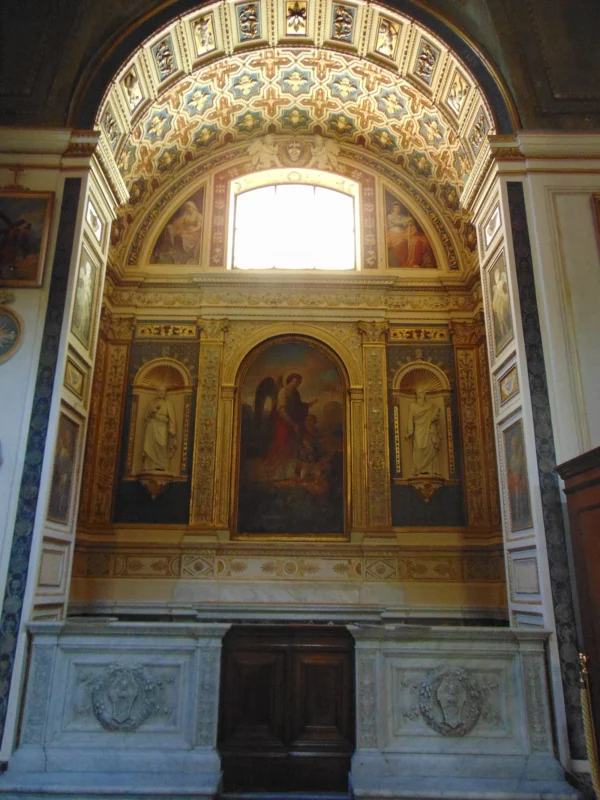
On the left side, next to the entrance, is the baptistery, with a 16th-century baptismal font and a stained glass window of the Baptism of Jesus. Next comes the chapel of Saint Julian the Hospitaller, renovated starting in 1706, with an altarpiece by Biagio Puccini, a painter who lived between 1675 and 1721, showing the saint treating a leper and welcoming an old pilgrim, and a fresco of God the Father on the vault. The third is the chapel of Saint Michael the Archangel, the largest in the church, made between 1716 and 1719 by Alessandro Speroni: the altarpiece is by Giovanni Bigatti, with the archangel triumphing over Satan, flanked by paintings of Saint Raymond Nonnatus and Saint Frances of Rome. On the walls are the funerary monuments of Teresa Tognoli Canale, who died in 1807, and of Silvio Cavalleri, secretary to Popes Innocent XII and Clement XI, who died in 1717, the work of Lorenzo Ottoni. The last is the chapel of the Immaculate Heart of Mary, renovated from 1771 by the architect Melchiorre Passalacqua and around 1800 by the sculptor Agostino Penna, with two columns of verde antico, an oval painting copied in 1848 from an original by Giovanni Battista Casanova, a Flight into Egypt by Étienne de La Vallée Poussin from 1774 and a Holy Family by Tommaso Conca from the same year. A seventh chapel, that of the Crucifix, opens on the left side of the high altar and houses the tomb of don Pirro Scavizzi, parish priest of the church between 1919 and 1932, for whom a cause for beatification has been opened.
The Two Zobolis of the Transepts
The paintings that gave the church the greatest renown among art historians are the two large canvases by Giacomo Zoboli, a painter who lived between 1681 and 1767, placed in the transepts: the Meeting of the Virgin and Elizabeth, that is, the Visitation, dated 1727, and Saint Jerome Listening to the Trumpet of the Last Judgment, dated 1729. They are works that marked Zoboli's Roman career and that are worth looking at calmly, because they represent well the moment when Roman painting leaves Baroque emphasis and approaches a drier classicism. The sources vary by a couple of years on the dating of the two canvases, a sign that the archive documentation is not entirely univocal.
The Stained Glass: French 1800s and Roman 1900s
On the inner facade, above the organ gallery, stands out the stained glass window of the Penitent Magdalene, made in the last decade of the 1800s by Gabriel and Louis Gesta of Toulouse, one of the major French stained glass manufacturers of the period. The more recent figurative windows are instead the work of Corrado Mezzana together with the master glassmaker Cesare Picchiarini, made around 1936: the one with the Baptism of Jesus in the chapel of Saint Julian, the one with the seven gifts of the Holy Spirit in the chapel of the Sacred Heart and a third in the chapel to the right of the entrance. Picchiarini is a key figure of Italian artistic stained glass of the 1900s, and finding his work in a parish church of the center, next to a French window from 40 years earlier, is a small sampler of the history of the technique.
The Portico and Its Plaques
The entrance is preceded by a portico by Contini, closed by an iron railing by the same architect, whose walls are a small walled-in archive: inscriptions and memorials dedicated to Cardinal Neri Corsini, to the Roman-dialect poet Filippo Chiappini and to the playwright Giovanni Giraud, the funerary monuments of the criminal law scholar Filippo Maria Renazzi, of the philologist Francesco Cecilia and of the traveler Michelangelo Mondani, and on the right wall a 1600s painting of a Virgin and Child within a frame of little angels. Inside, a pulpit in polychrome marbles from 1937 commemorates Pope Benedict XV, who as Cardinal Giacomo della Chiesa often preached here and whose mother lived in the building opposite.
Another Well-Known Fact, Yet Rarely Mentioned
Between 1431 and 1460 the Basilica of Sant'Eustachio and the buildings around it were the seat of the University of Rome. Pope Eugene IV, in 1431, ordered the transfer of the Studium Urbis, founded in 1303, from its seat in Trastevere to the buildings around the church of Sant'Eustachio. It is a fact that appears in almost all the historical pages on the church and that almost nobody stops to consider, yet it explains the whole layout of the rione.
Why the Square Was Called della Schola
Before taking its present name, the square in front of the basilica was called Piazza della Schola, referring precisely to the presence of the university. The place name has disappeared from current use but remains in the antiquarian sources, and it links the name of the square directly to the function of the neighborhood before the university moved to Palazzo della Sapienza, the building that today houses the State Archive of Rome and that contains Borromini's church of Sant'Ivo.
The Graduates Proclaimed in Church
The most interesting detail concerns what happened after the transfer. Even after 1460, when the seat of the university became Palazzo della Sapienza on the present Corso del Rinascimento, graduates continued to be solemnly proclaimed in the Basilica of Sant'Eustachio. It means that for centuries this church was, in effect, the ceremonial great hall of the University of Rome: students were examined and taught elsewhere, but the public and solemn moment of graduation took place here, under the vault of the nave. It is the kind of civic function that churches in Rome performed for centuries without almost any visible trace of it remaining today.
The Right Photo to Take at the Basilica of Sant'Eustachio
The photo that tells the story of this church better than any other is not the whole facade, which in a narrow square is distorted by perspective, but the detail of the pediment with the stag's head backlit, taken from the opposite side of the square with a medium or long focal length lens. The stag stands out against the sky and the cross between the antlers reads as a silhouette: it is the image that anyone who has visited the basilica remembers.
The Bell Tower from Via della Palombella
The second shot, less obvious and in many ways more interesting, is taken from Via della Palombella, the street running behind the Pantheon. From there you frame the Romanesque bell tower emerging from the houses, with the medieval bricks and the walled-up mullioned windows, and with a bit of luck you can get a fragment of the ancient rotunda into the same frame: two buildings a thousand years apart, in the space of an alley. It is the image that explains, with no need for captions, what urban layering means in Rome.
The Flood Plaque and the Portico
Finally, the 1495 plaque on the right side of the facade deserves a shot of its own, ideally framed so as to show how high it sits above street level: it is a photograph that tells in one stroke why the Rome of the Campo Marzio spent centuries fighting with water and why this church was rebuilt from scratch. The portico, with its walled-in plaques and Contini's railing, offers instead good backlit shots toward the square, with the sharp chiaroscuro between the half-light of the portico and the outside light.
Some Important Events That Happened Here in History
The chronology of the Basilica of Sant'Eustachio reads as a sequence of thresholds, in which each time the church changes function without changing place. The first certain date is 795, when under Pope Leo III the church is mentioned for the first time and is already remembered as an ancient Roman diaconia. Some sources move back the registration as a diaconia to the end of the pontificate of Gregory II, between 715 and 731.
1195 and 1196: The Rebuilding by Celestine III
The medieval building site is the first great moment of rupture: between 1195 and 1196, under Pope Celestine III, the old building is completely rebuilt and enlarged, and on that occasion the Romanesque bell tower is added. A plaque in the sacristy records the consecration of 1196, and the sources attribute to the same pontiff the placing in the church of the relics attributed to Eustachio and his family. It is the phase that defines the layout of the church for the following five centuries.
From 1701 to 1749: The Church We See
The great modern building site stretches across the first half of the 1700s. Corvara directs the work from 1701 to 1703. Contini builds the chapels and portico. Canevari, Salvi and Navone complete the apse and transept, with Navone active from 1728 according to some reconstructions. Salvi signs the high altar in 1739. Fuga adds the canopy around the end of the 1740s. In the meantime the altarpieces and decorations of the chapels are made, from Zoboli's canvases of 1727 and 1729 to the altarpiece of the martyrdom by Francesco Ferdinandi, and the organ is built between 1747 and 1749.
Who Has Passed Through the Basilica of Sant'Eustachio
The list of those who have passed through this church is longer than you would expect from a neighborhood parish, and it depends largely on the fact that the diaconia of Sant'Eustachio is one of the oldest cardinal titles of Rome: whoever held this title had a formal and often practical link with the church.
Four Cardinal Deacons Who Became Popes
Among the holders of the diaconia there are several future pontiffs. Ugolino dei conti di Segni was cardinal deacon of Sant'Eustachio from December 1198 to May 1206 and then became Pope Gregory IX. Rinaldo di Ienne held the title from September 1227 to October 1232 and was elected pope with the name Alexander IV. Francesco Nanni Todeschini Piccolomini held it from 1460 until 1503, when he was elected Pope Pius III. Alessandro Farnese had it from 1503 to 1519 and then became Pope Paul III, the pontiff of the Council of Trent and of the Michelangelo building project on the Campidoglio. The list also includes Baldassarre Cossa, titular from 1402 to 1410, who was later elected with the name John XXIII and is now counted among the antipopes.
Saint Philip Neri and the Devout 1500s
Among the people who frequented the church the best-known name remains that of Saint Philip Neri, for whom the sources indicate Sant'Eustachio as one of his favorite places of prayer in the 16th century. Neri is the figure who in post-Tridentine Rome reinvented popular devotion, taking it out of the sacristies and into the streets, and the fact that one of his usual stops was a parish church of the Campo Marzio and not a great basilica is entirely consistent with his way of understanding religious life.
Two Parish Priests of the 1900s
Finally, two 1900s figures tied to the pastoral life of the church. Don Pirro Scavizzi, who lived between 1884 and 1964, was parish priest here between 1919 and 1932 and his tomb is in the chapel of the Crucifix. A cause for beatification has been opened for him. Don Pietro Sigurani, rector until 2021 and dead in 2022, is the figure who brought the basilica back into the national newspapers with the canteen and the services for the homeless set up in the basement. They are the two names that, in the memory of the neighborhood, weigh more today than many cardinals.
The Sant'Eustachio Rione: The Square and the Neighborhood Around the Basilica
The Sant'Eustachio rione is the eighth rione of Rome, indicated by the abbreviation R. VIII, and takes its name from the basilica. Its coat of arms is a golden stag's head on a red field, with the bust of Christ between the antlers in the classic heraldic version and with the cross in Falda's map, the great 1600s view of Rome.
The Coffee and the Life of the Square
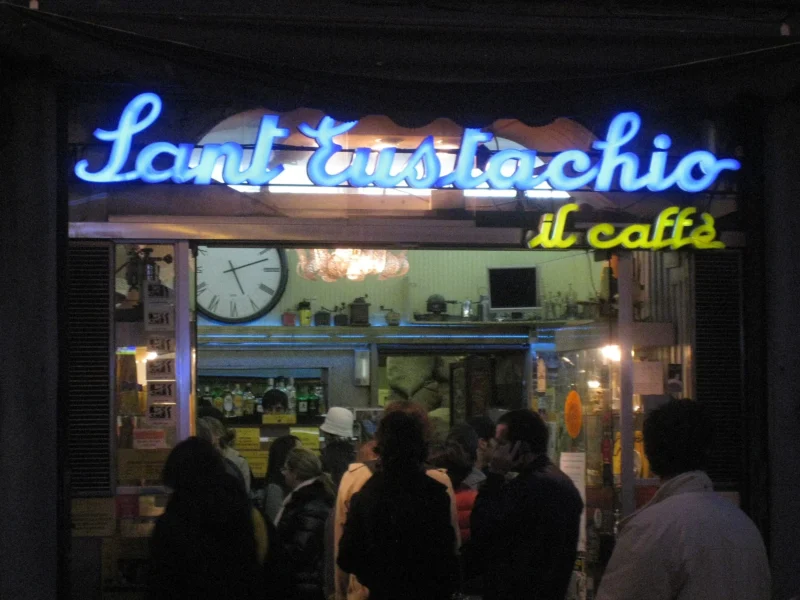
On the square there is also the famous bar Sant'Eustachio il Caffè, which has made the name of the rione familiar well beyond the borders of Rome and which should be kept distinct from the basilica, with which it shares only the place name: many visitors arrive here looking for the coffee and discover the church by chance, which explains why the square is, at certain hours, more crowded than you would expect from a widening of that size. For the rest the square remains a passing space between the Pantheon and Corso del Rinascimento, with the constant flow of people moving between the two tourist poles and with the share, anything but negligible, of Senate employees and visitors to the State Archive.
The Nearby Churches to See on the Same Round
Anyone here has within reach a density of churches hard to match: San Luigi dei Francesi with the Contarelli chapel and the three large canvases by Caravaggio, Sant'Ivo alla Sapienza with Borromini's spiral dome, Sant'Agostino with the Madonna of the Pilgrims, Santa Maria sopra Minerva with Michelangelo's Christ and the tomb of Saint Catherine, and of course the Pantheon, which has been a church since the seventh century. Sant'Eustachio is the least visited of all of these, and for this very reason it is the one where you can still stay a few minutes in silence.
Frequently Asked Questions About the Basilica of Sant'Eustachio
Where is the Basilica of Sant'Eustachio?
The Basilica of Sant'Eustachio is in the rione of the same name in Rome, less than 100 meters from the Pantheon, with its facade on Piazza di Sant'Eustachio and its administrative address at Via di Sant'Eustachio 19. It is a few minutes' walk from Piazza Navona, from Sant'Ivo alla Sapienza and from Largo di Torre Argentina, the nearest public transport hub, since the rione is not directly served by the metro.
How much does a ticket for the Basilica of Sant'Eustachio cost?
The Basilica of Sant'Eustachio has no entrance ticket: it is an active parish church and access is free and without charge during opening hours, as for almost all the churches of Rome that are not part of museum circuits. There is no mandatory reservation or paid visit route, and no dedicated official audio guides are known.
What are the opening hours of the Basilica of Sant'Eustachio?
The opening hours of the Basilica of Sant'Eustachio do not appear to be published uniformly by the sources that can be consulted: some institutional pages of Roman tourism simply refer to direct contact with the basilica for Mass and visiting hours, while other secondary sources indicate daily opening split between morning and afternoon, continuous hours on weekends and closure in August. It is best to phone or check the parish website before the visit.
Why is there a stag's head on the Basilica of Sant'Eustachio?
The stag's head with the cross between the antlers on the Basilica of Sant'Eustachio points to the legend of the conversion of the saint, the Roman general Placido who according to the hagiographic tradition saw a cross between the antlers of a stag during a hunt, but it also recalls the coat of arms of the Maffey family, who financed the rebuilding of the church. The sculpture is the work of Paolo Morelli, active in Rome until 1719.
Is the story of Sant'Eustachio true?
The story of Sant'Eustachio is a hagiographic legend and not a documented historical fact: the saint's name is unknown to the ancient sources and the information comes from late accounts, in particular from chapter 161 of the Legenda Aurea of Jacopo da Varazze. The scholar Hippolyte Delehaye denied his historical existence, noting that neither the Depositio martyrum nor the Martyrologium Hieronymianum names him.
How long does it take to visit the Basilica of Sant'Eustachio?
To visit the Basilica of Sant'Eustachio 20 minutes are enough if you limit yourself to the facade, the portico, the nave and the high altar by Nicola Salvi. Anyone who wants to look calmly also at the six side chapels, the baptistery, the 1900s stained glass windows by Corrado Mezzana and Cesare Picchiarini and the two large canvases by Giacomo Zoboli in the transepts easily reaches 40 minutes.
Can you take photographs inside the Basilica of Sant'Eustachio?
In the Basilica of Sant'Eustachio the rules common to Roman parish churches apply: photographs without flash and without a tripod are generally tolerated outside the hours of services, but there is no regulation published online that confirms it explicitly, so it is best to ask in the sacristy. During Mass you do not take photographs and you do not walk the nave.
Is the Basilica of Sant'Eustachio the same thing as the bar Sant'Eustachio il Caffè?
No: the Basilica of Sant'Eustachio is a parish church with the dignity of a minor basilica, while Sant'Eustachio il Caffè is a well-known bar that looks onto the same square and bears the same name only because both take the place name from the rione. They are two distinct things: if you are looking for the church, look for the facade with the pediment and the stag's head.
What is there to see near the Basilica of Sant'Eustachio?
Near the Basilica of Sant'Eustachio are the Pantheon with the Macuteo obelisk, Sant'Ivo alla Sapienza with Borromini's spiral lantern, San Luigi dei Francesi with the Caravaggios of the Contarelli chapel, Palazzo Madama seat of the Senate, Piazza Navona with the Fountain of the Four Rivers and the Fontana dei Libri on Via degli Staderari, all reachable on foot in under 10 minutes.
A Last Note for Those Building the Itinerary
The Basilica of Sant'Eustachio is the kind of stop that improves a day in Rome without weighing it down: it costs a few minutes, it lies exactly on the route between the Pantheon and Piazza Navona that almost everyone takes anyway, and it gives back something that gets lost in the great monuments, namely the feeling of a church still used by the people who live and work in the neighborhood. Anyone who skips it does not miss an absolute masterpiece. Anyone who adds it to the round gains a piece of context that makes all the rest of the Campo Marzio easier to understand.
Anyone organizing a wider itinerary in the historic center of Rome, putting this stop together with the other stops of the Campo Marzio and the Pantheon area, can find useful planning tools on Tour Leader Pro, while for a wider picture of transport and destinations in Lazio Italy Planner is a good resource.
Nearby
 Caffè Sant’Eustachio100 m
- Borromini in Rome: a route through his architecture100 m
- Basilica of Neptune100 m
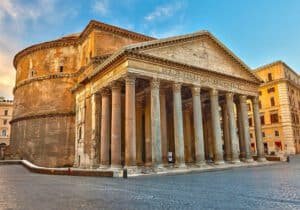
- Pantheon100 m
- Macuteo Obelisk100 m
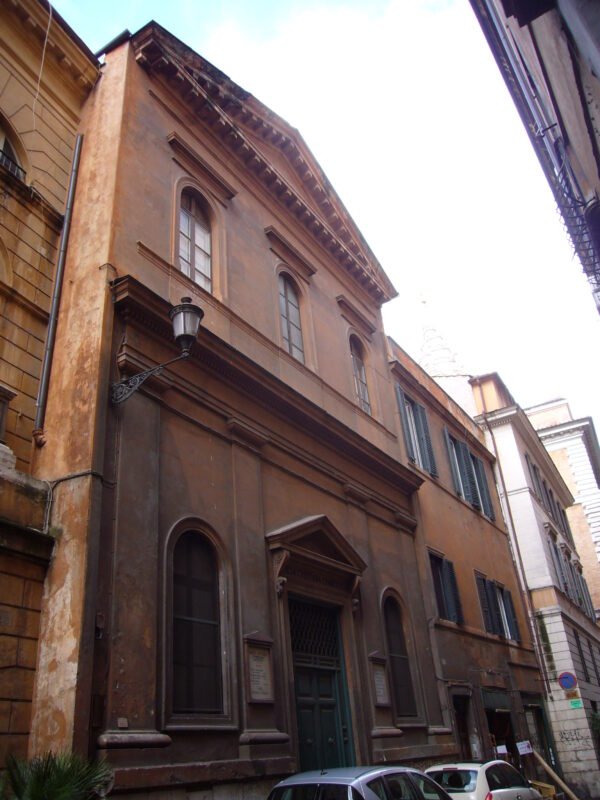
- Evangelical Baptist Church on Via del Teatro Valle100 m
Upcoming events nearby
- Memoria di ragazza at Teatro Valle, November 10 to 22, 2026200 m
- «Che dolore terribile è l’amore», from Han Kang, directed by Daria Deflorian: Thursday, November 26 to Sunday, December 6, 2026200 m
- «Casanova dell’infinita fuga» by Ruggero Cappuccio: Wednesday, December 9 to Sunday, December 13, 2026200 m
- «Equus» by Peter Shaffer, directed by Carlo Sciaccaluga: Tuesday, December 15 to Saturday, December 19, 2026200 m