Santa Maria della Luce
In short. Santa Maria della Luce is on Via della Luce, in Trastevere, in the stretch of the district that goes down toward Porta Portese and that the tourist flow almost never touches.
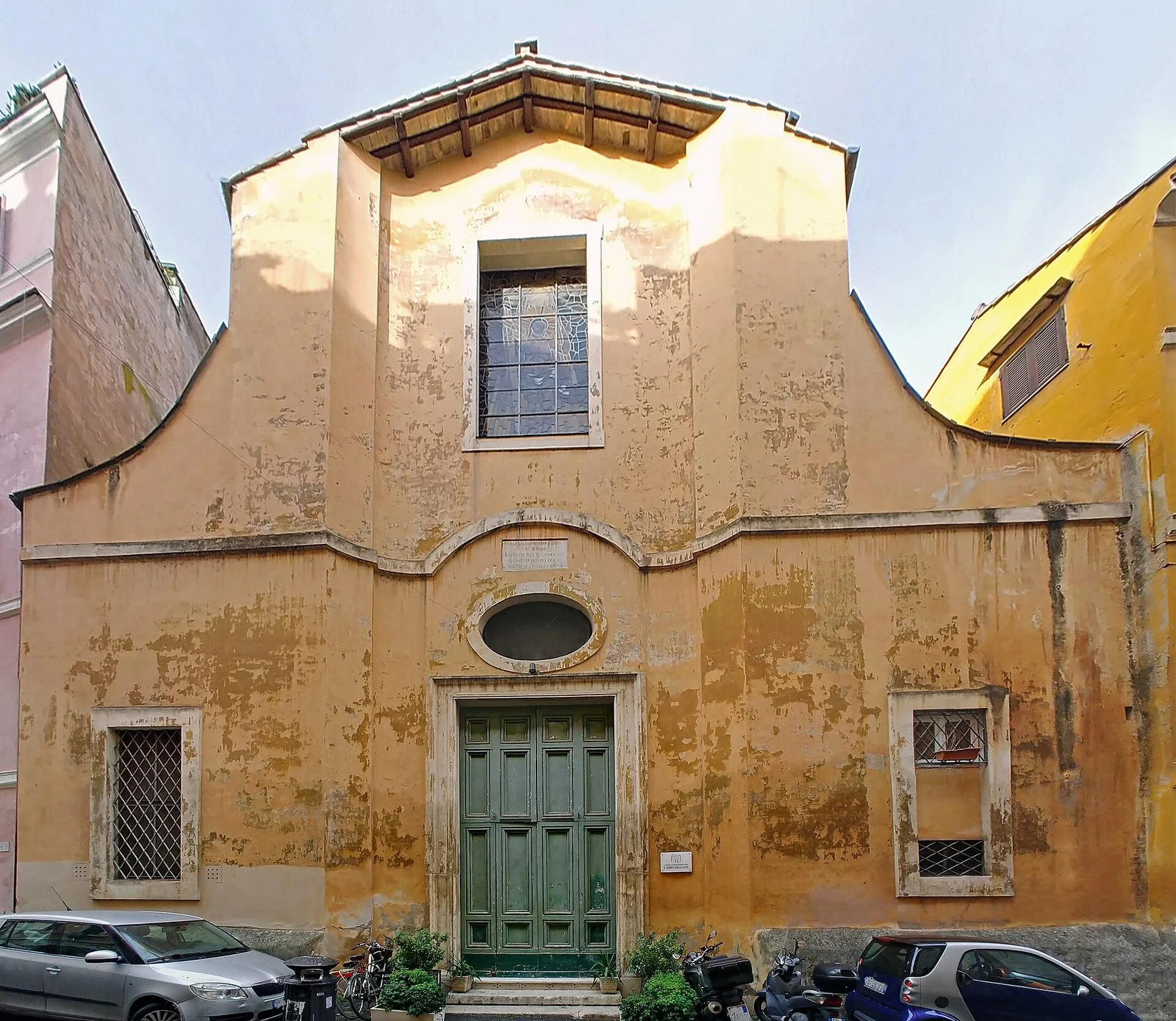
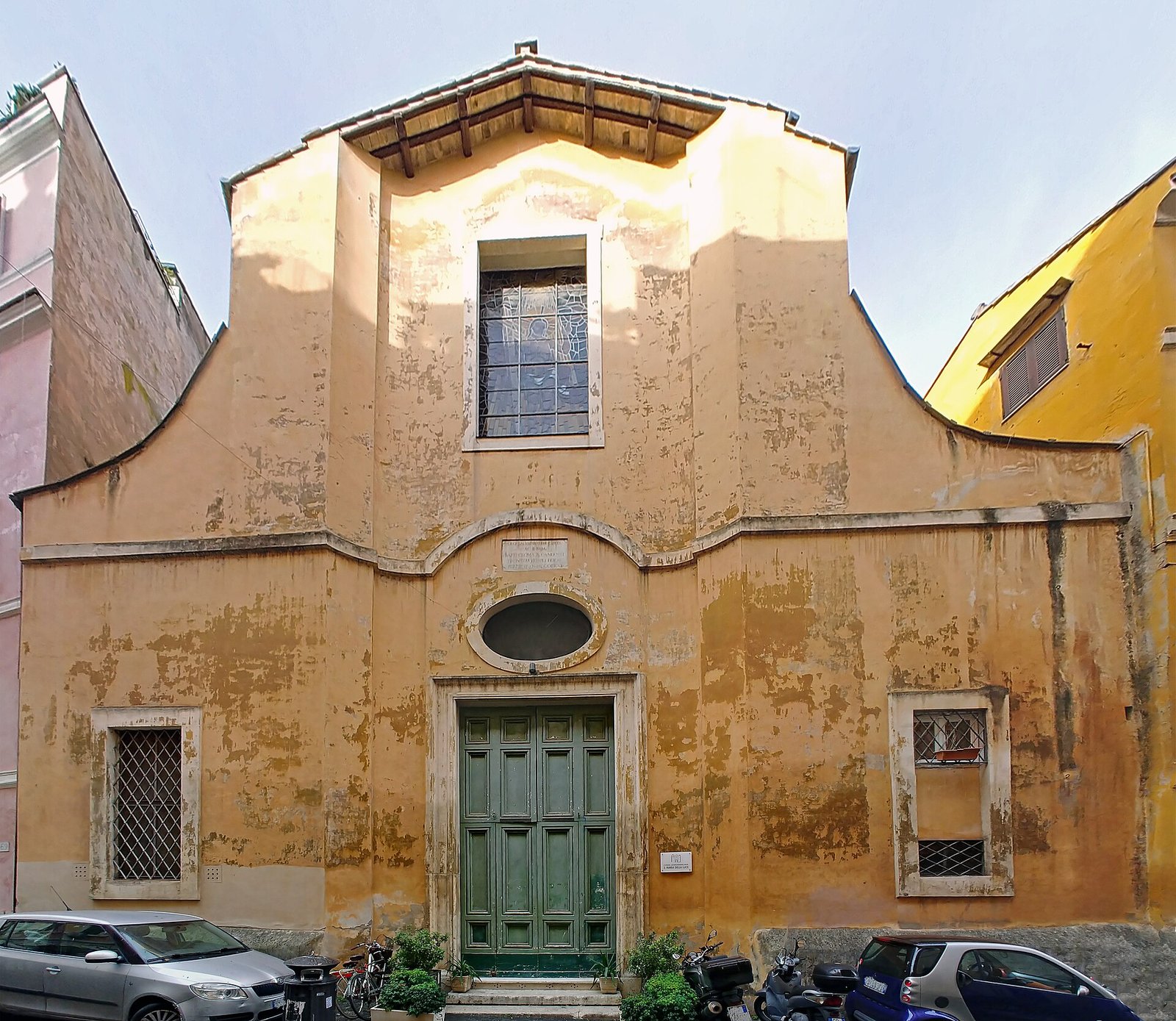
Santa Maria della Luce is on Via della Luce, in Trastevere, in the stretch of the district that goes down toward Porta Portese and that the tourist flow almost never touches. Coming from Piazza Santa Maria in Trastevere it takes seven or eight minutes on foot, and you quickly notice that the air changes: fewer tables, fewer signs, low doorways, laundry hanging out, people who live here. The church has a facade that never quite finishes being a facade, a medieval bell tower that pokes up on the side and an 18th-century Greek-cross interior that almost no guide talks about. The current name is less than 300 years old and replaced a much older one.
This page explains where that name change comes from, what stands up to verification and what remains legend, what you see on entering, when it is open and who runs it today, which is a Spanish- and Portuguese-speaking community and not just any Roman parish.
Where Santa Maria della Luce is and how to get there
The church's address is Via della Luce 5, in the Trastevere district, a few dozen meters from Via della Lungaretta and Piazza Sidney Sonnino. Some listings give a contact address on Via della Lungaretta: it refers to the offices of the community that runs the church, not to the entrance door. Anyone who sets the navigator to Lungaretta arrives at the wrong side of the block and has to walk around.
By tram and bus
The most convenient is Tram 8, which from Largo Argentina crosses the Tiber on Ponte Garibaldi and stops at Piazza Sonnino, in front of the Basilica of San Crisogono. From there you take Via della Lungaretta toward the south and turn into the first side street on the right after about a hundred meters. It is four minutes on foot, all on the flat. The surface lines in Trastevere often change route because of construction and events, so check on the same day on the transit company's app. The general picture of Roman transport is on our page on how to get around Rome.
By urban rail
The Trastevere station of the regional lines is about a kilometer and a half away, toward the southwest, and serves those arriving from Fiumicino or the coast. The walk goes along Viale Trastevere and is not pleasant, because the avenue is wide, noisy and without shade. If you have luggage, you do better to take Tram 8 at the station and get off at Sonnino.
On foot from the center
From Ponte Sisto you arrive in 12 minutes walking on Via della Lungaretta, and the route is worth it in itself, because it crosses the part of the district where you go from the postcard Trastevere to the Trastevere of homes. From Tiber Island it is eight minutes passing in front of San Crisogono. Anyone coming down from the Janiculum takes 20 minutes downhill and arrives tired in summer, because the last stretch is all in the sun.
By car, that is, badly
Trastevere is a limited traffic zone with different hours between day and night, and the streets around Via della Luce are narrow, one-way and full of scooters parked on the sidewalks. There is no reasonable parking within 300 meters. If you come from outside Rome, leave the car in a park-and-ride lot and finish by metro and tram. By bicycle the district is easy to get around, but the cobblestone paving is uneven and thin wheels suffer: an honest assessment of Rome's cycling routes is on the page on Rome by bike.
What you see on entering, and what you don't
The first thing to say concerns the facade, because it is the reason why so many people walk past the church without noticing. The front on Via della Luce has remained unfinished, plastered and bare, without architectural orders and without decoration. On this point the sources diverge: the encyclopedia entries speak of a facade never completed, while a local entry indicates a completion in 1821. Looking at it today, the impression is of a front finished on the cheap.
The Greek-cross interior
Inside the picture changes completely. The Dizionario Biografico degli Italiani describes the 18th-century intervention as a Greek-cross layout with a central sail vault, inserted inside the perimeter of the pre-existing medieval church, with a longitudinal rhythm obtained by adding bays toward the entrance and a transept toward the apse. In practical terms: the architect had to fit a centralized plan inside an old rectangular box, and the solution reads very well if you raise your eyes toward the vault.
The apse and the fresco
The apse semi-dome keeps its Romanesque layout even after the Baroque remodeling, and this survival is the most interesting fact about the building. On the semi-dome there is a fresco by Sebastiano Conca of God the Father blessing among the angels. Conca, born in Gaeta in 1680 and died in Naples in 1764, was one of the most sought-after painters of the Rome of those years, and finding him in a neighborhood church gives the measure of how seriously the project was taken.
The bell tower
The bell tower dates to the 12th-century reconstruction and is seen better from the outside, from the side of the church, than from the inside. An entry on a schedule-aggregator site places it in the ninth century: it is an isolated figure, which appears in no encyclopedic or institutional source, and we do not report it as good. The dating to the 12th century is the one on which the diocese's entries and the encyclopedia entries converge.
What you don't see
You see almost nothing of the early Christian and medieval church, except the bell tower and the layout of the apse. You do not see a dome, because the current covering is a vault, and a single local source claims that a dome was damaged by an explosion in 1891 and then replaced by a skylight. The explosion of 1891 is a real fact, the blast of the Vigna Pia powder magazine which on April 23 of that year shattered the windows of half of Rome, but the direct link with this church we found in only one popularizing entry and not in institutional sources. We point it out for honesty, we do not take it as established.
San Salvatore della Corte: the name that was there before
The original title of the church is San Salvatore della Corte, and it also appears in the form San Salvatore in Corte. It is the name under which the building is recorded for almost all of its documented history, and the change to Santa Maria della Luce comes only in the 18th century. Anyone looking for news of this church in old guides to Rome has to look for the old name, otherwise they find nothing.
What "della Corte" means
The word "corte" in this place name does not indicate a courtyard or a princely court. It refers in all likelihood to the excubitorium of the Seventh Cohort of the vigiles, the fire brigade that Augustus established in AD 6, distributing it over the 14 regions of the city. The Seventh Cohort garrisoned Trastevere, and its guard station was found a few dozen meters from here. The mechanism is the classic one of Roman place names: the name of a military structure survives in the name of a church for 15 centuries after the structure has disappeared.
The excubitorium, and why it can't be visited today
The station of the Seventh Cohort is at Via della Settima Coorte 9, eight meters below the current street level, and was discovered between 1865 and 1866. The walls preserve hundreds of graffiti left by the vigiles, including references to the sebaciarii, those in charge of the tallow for the torches of the night shifts. It remained abandoned until 1966, when it received a covering, and was restored again in 1986. The entry on the city tourist portal lists it as closed for safety reasons on the decision of the commission on unsafe buildings, with works in progress. Anyone who reads about a visit to the excubitorium on an outdated page and goes there finds a gate.
Santa Bonosa, the founder who is also a vanished church
Tradition attributes the founding of the church to Saint Bonosa, a martyr, in the fourth century, and adds that Pope Julius I raised it to a parish in the same century. The report circulates in all the entries and is hagiographic in kind: no archaeological source confirms it, and the first certain documentary attestations are much later. It is worth keeping in mind, however, for a different reason: in Trastevere there really was a church of Santa Bonosa, which stood between the Lungaretta and the Tiber and was demolished in 1888 to open Viale del Re, today Viale Trastevere. The two Bonosas, the founding saint and the lost church, are regularly confused.
Under San Crisogono until 1595
For all of the Middle Ages and a good part of the modern age San Salvatore della Corte depended on the nearby Basilica of San Crisogono, which is the great titular church of the district and is 200 meters away, on Piazza Sonnino. Autonomy came in 1595, when the church became a parish. The relationship between the two churches also explains their urban layout: San Crisogono faces the square and the traffic, San Salvatore faces an inner alley.
1730: the image, the light and the name change
The passage that turns San Salvatore della Corte into Santa Maria della Luce dates to 1730 and is documented in its consequences much better than in its facts. The sources agree on this core: a Marian image painted on the exterior wall of a nearby house was seen shining with its own light, a popular cult formed around the phenomenon, the image was detached and brought into the church and the church changed its dedication. Everything else varies from source to source.
The minimal version, the one that holds up
In the driest form, reported by the encyclopedia entries and institutional listings, it speaks of a series of miracles tied to an image painted on an exterior wall nearby, seen to shine. The transfer of the image into the church and the name change are the only two elements on which there is no discussion, because they left a trace in the title and in the building work that followed.
The detailed version, the one to treat as legend
The collections of neighborhood memoirs add much more vivid particulars: a blind man who calls for help in Vicolo delle Due Mole, the image of the Virgin appearing to him surrounded by light, the man who recovers his sight and shouts "Luce! Luce!", two other faithful who report similar visions, and finally Pope Clement XII authorizing the transport of the fresco into the church. These are narrative elements that circulate in local literature and that we did not find in first-level documentary sources. Clement XII was elected in July 1730, so the chronology is compatible, but compatible does not mean proven.
Why a story like this changes a church's name
The mechanism is more concrete than it seems. A sudden popular cult brings offerings, and offerings pay for building works. Within a very few years the church goes from a dependent, run-down neighborhood building to a project entrusted to a top architect, with an apse fresco by a painter of European fame. The change of dedication records on the doorway the reason why that money arrived. Rome is full of churches that changed their names this way, and this is one of the cases where the sequence reads clearly.
The Minims, who arrived two years earlier
A detail that almost all summaries put in the wrong order: the Minim Fathers of Saint Francis of Paola were installed in the church in 1728, by bull of Benedict XIII, so two years before the events of 1730. They did not arrive because the Madonna della Luce had drawn devotees: they were already here when the cult was born, and they were the ones who ran it. Anyone who reverses the order builds themselves a story in which a religious order is called in to ride a phenomenon, while the documents say the opposite.
A curiosity about Santa Maria della Luce
The street took its name from the church, and not the other way around, which is anything but a given in Rome. Before the 18th century this street had two other names, both much less luminous: Via delle Rimesse, from the stables where horses were changed, and Via dei Morticelli, from the cemetery attached to the hospital of Santa Maria dell'Orto. Within a generation a street of stables and burials becomes Via della Luce.
The semantic leap, read on the spot
Walking along Via della Luce today knowing that it was called Via dei Morticelli changes the way you look at it. It is a narrow street, in shade for much of the day, with low houses and little air. The current name does not describe the street: it describes an episode of devotion that overturned the place names. Rome does this continually, and almost no one notices because the old names are written nowhere.
Two churches of the same name 300 meters away
In the district there are two other churches whose name begins the same way and which are constantly mistaken for this one: the Basilica of Santa Maria in Trastevere, which occupies the main square and is on a completely different scale, and the Church of Santa Maria della Scala, on the other side of the district, with the old apothecary attached. Anyone booking a visit or arranging a meeting must give the full name and the street, because "Santa Maria" in Trastevere identifies nothing.
A church owned by the State
According to the entries consulted, the church belongs to the Ministry of the Interior through the Fund for Places of Worship and is given in management to the Diocese of Rome. It is the legacy of the 19th-century suppressions, which transferred to the Italian State hundreds of places of worship that had belonged to religious orders. We were not able to match the item against the Fund's official catalog, so we report the datum as we find it, pointing out the limit. If it is correct, it explains why the restorations here follow state timetables and not parish ones.
Something nobody tells you about Santa Maria della Luce
This is no longer a Roman parish and for more than 20 years it has not functioned as one. Since 2003 the church has been the seat of the Latin American Catholic Mission of the Diocese of Rome, entrusted to the Scalabrinian Fathers, the congregation born at the end of the 19th century to assist migrants. Masses are celebrated in Spanish and Portuguese, and the calendar follows the feasts of the countries the faithful come from, not that of a Roman neighborhood.
Where the Mission comes from
The Latin American Mission was established by decree of Cardinal Vicar Ugo Poletti in September 1996, to serve Latin American migrants living in the Diocese of Rome, and only in 2003 did it find a permanent seat in this church. These are two distinct dates and are often merged into one. Seven years separate the Mission's legal birth from its arrival on Via della Luce.
What changes inside
The consequence is visible to the naked eye as soon as you enter. Beside the 18th-century altars appear devotional images that are not found elsewhere in Rome: the national Madonnas of the different countries of Latin America, brought and cared for by the respective communities. The Brazilian community has its own reference in Nossa Senhora Aparecida. Anyone who comes in on a Thursday evening or on Sunday finds a full church, with singing and languages that are not Italian, and understands that the place is alive in a way that has nothing to do with tourism.
Why this also changes how to visit it
A church that serves a migrant community has no staff to welcome visitors, no bookshop, no panels. It does have opening hours tied to the celebrations, which means that outside those bands the door can be closed even in the middle of the day. Anyone arriving at 15:00 on a Tuesday risks finding everything shut without anyone having made a mistake.
The other side of the coin
The Mission offers services ranging from social support to training to help with bureaucracy, and the church is also a practical point of reference for people arriving in a difficult city. Anyone who comes in during a meeting or a distribution should behave accordingly. Nobody here is waiting for visitors, and at that moment the place is occupied with something else. Wandering around with a camera raised while someone waits for an interview is the kind of thing to avoid.
My advice for visiting Santa Maria della Luce
The advice is to get there around a Mass time, and to accept that this is the way the church opens. The hours that emerge from the sources consulted indicate celebrations on Thursday in Portuguese and Spanish, and on Sunday in Spanish in the morning and in Portuguese in the afternoon. On the exact time of the Sunday Mass in Spanish the sources diverge between 11:00 and 12:00, and for the afternoon one they indicate 17:00. A schedule aggregator instead reports weekday evening Masses from Tuesday to Friday and Sunday morning at 10:00. Faced with such a divergence, the only sensible move is to call the published number, 06 5800820, and ask.
The verdict, plainly
Santa Maria della Luce does not justify a dedicated trip. It works very well as a stop inside a walk through Trastevere, and in that role it gives a lot: 10 minutes inside, five minutes on the side for the bell tower, and the feeling of having entered a Rome that 200 meters from here no longer exists. Anyone expecting a church from an illustrated guide comes away empty-handed. Anyone looking for the real district has found the right place.
When to go
Early in the morning on weekdays the alley is almost deserted and the light comes in from the bell tower side. On Sunday around the celebrations you see the church in its real function, and it is the most interesting moment to understand it, as long as you stay at the back and don't get in the way. In summer, and in particular between mid-July and the end of August, the communities reduce their activities and the hours thin out: in those weeks calling is not a precaution, it is the only way not to lose time.
How much time to allow
For the church itself a good 20 minutes is enough, including the walk outside to see the bell tower and read the facade. Inserted in a route that starts from San Crisogono, touches this church, goes down to Santa Cecilia and ends at San Francesco a Ripa, the stop fits into a full morning. Our overall itinerary for the district is on the page on what to see in Trastevere.
How to behave
Shoulders and knees covered, phone on silent, no wandering during the celebration. If a Mass is under way you go in, sit at the back and wait for the end, or come back later. The people you meet are volunteers and religious of the Mission, and almost always speak Spanish better than Italian: a question asked calmly gets an answer, a question tossed out in a rush does not.
Another well-known fact, yet rarely cited
The church was entrusted to the Minims of Saint Francis of Paola in 1728 and this left a mark that can still be read in the decoration. The Minims are a mendicant order founded in Calabria in the 15th century, with a very strict rule that requires perpetual abstinence from meat and animal products, and in Rome their main house is Trinità dei Monti. Their presence in Trastevere for almost 150 years is one of those things that are known and that nobody tells.
What remains of it in the works
The entries attribute to the church paintings tied to the devotion of the Minims, among them a canvas with a miracle of Saint Francis of Paola attributed to Onofrio Avellino, and other 18th-century canvases. On these attributions we are cautious: they circulate in popularizing entries and in the English version of the encyclopedia entries, with dates that in at least one case do not hold. A canvas attributed to Pietro Labruzzi and dated 1753 is impossible, because Labruzzi was born in 1739 and would have been 14. We point out the presence of the paintings, not the individual attributions.
The method, explained once
When a date does not fit with the artist's biography, either the date is wrong or the artist is someone else. There is no third possibility. Online entries copy one another and a typo in a table becomes a datum that appears on 20 different pages. For this church there is no specialist bibliography easily found online, so anyone who needs certain attributions has to go to the general catalog of cultural heritage and to the art history literature, not to a popularizing page, this one included.
The building project of Gabriele Valvassori
Gabriele Valvassori was born in Rome on August 21, 1683 and died there on April 7, 1761. He trained at the Accademia di San Luca, where he was awarded prizes for architecture projects between 1702 and 1704, and his best-known work is the completion of the Doria Pamphilj palace on the Corso between 1731 and 1734, with the Galleria degli Specchi, which is one of the Roman interiors closest to the taste of French residences. Whoever wants to see the famous Valvassori goes into Palazzo Doria Pamphilj. Whoever wants to see the neighborhood Valvassori comes here.
The chronology of the works
Work starts in 1730, coinciding with the transfer of the image, and the Dizionario Biografico degli Italiani indicates a completion around 1768, that is, seven years after the architect's death. It was therefore a project lasting almost 40 years, carried out in parts and probably depending on how much came into the till. The unfinished facade should be read in this key, more than as a choice.
The problem Valvassori faced
The patron wanted a new church, the available perimeter was the medieval one and the money was that of the offerings. The solution adopted is a centralized Greek-cross plan with a sail vault, lengthened toward the entrance with additional bays and closed toward the apse by a transept. It is a technical compromise, and the interesting part is precisely that it shows: inside this church you understand how Roman architects of the 18th century worked when they had neither space nor budget.
The comparison that helps
Whoever knows the Galleria degli Specchi struggles to recognize the same hand here, and that is why the comparison is worth making. The same architect, in the same years, produces one of the most sumptuous showpiece interiors in Rome and a restrained, essential district church. To understand what Roman architecture of that season could do with ample means you can look at our page on Baroque Rome, bearing in mind that this church is the exact reverse of that repertoire.
The right photo to take at Santa Maria della Luce
The photograph that works is not the facade, which is poor and does not hold up in a frontal frame. It is the medieval bell tower shot from the side alley, with the plastered wall of the church cutting the frame on the diagonal and the laundry hanging from the houses opposite in the upper part. You need first thing in the morning, when the light comes in low and the alley is not yet in full shade, and you need a moderate lens, around 35 millimeters equivalent, holding the camera parallel to the wall so the verticals don't fall.
The photo everyone gets wrong
The standard attempt is to stand in front of the door and photograph the whole facade. It doesn't work, for three reasons: the street is narrow and you can't back up far enough, the facade has no articulation and in a photograph becomes a flat rectangle, and parked cars always take up the lower band. Anyone who insists goes home with an image that says nothing about the place.
Inside
Inside the subject is the sail vault above the crossing of the Greek cross, shot from below with the camera resting on the back of a pew, without flash and without a tripod. The light is scarce and you need to raise the sensitivity rather than slow the shutter. The apse fresco by Sebastiano Conca is high up and backlit against the windows: photographing it well takes patience and a side position.
The rules
In Roman churches photography without flash and without a tripod is generally tolerated when no celebrations are under way, and it remains at the discretion of whoever looks after the place. Here a specific consideration must be added: during celebrations the church is full of people praying in their own language far from home, and photographing them without asking is rude. You shoot before or after, not during.
Outside, in the district
The stretch of Via della Luce and the side streets toward Porta Portese are among the few points in Trastevere where you can still photograph a lived-in district and not a stage set. Doorways, surviving artisan workshops, scooters, laundry. The difference from Piazza Santa Maria in Trastevere area shows in the images before it shows in the legs.
Some important events that took place here in history
The history of this church reads as a succession of dependencies and assignments, more than as a sequence of great events. What follows is the skeleton with the dates found in multiple sources, and with explicit indication of those that remain tradition.
Fourth century: the traditional founding
Tradition places the church's birth in the fourth century, on the initiative of Saint Bonosa, near the excubitorium of the Seventh Cohort of the vigiles, and attributes to Pope Julius I its elevation to a parish. It is a hagiographic account reported by all the entries and without direct archaeological confirmation. A local source notes that the first documentary attestations date to the pontificate of John XV, between 985 and 996, so much later.
12th century: the reconstruction and the bell tower
The church is rebuilt in the 12th century together with the bell tower, which is the medieval part still readable. In this season Trastevere is a populous and densely built district, with dozens of small churches tied to guilds, hospitals and confraternities, of which a minority survives today.
1595: parish autonomy
Until 1595 San Salvatore della Corte depends on the Basilica of San Crisogono. That year it becomes an autonomous parish. The date falls in the post-Tridentine season, when the Roman Church reorganizes the city's parish network and detaches many minor churches from the great basilicas.
1728: the Minims
By bull of Benedict XIII the church is entrusted to the Minim Fathers of the order of Saint Francis of Paola. Benedict XIII, born Pietro Francesco Orsini, is the pope who in those same years redistributes many Roman churches among the religious orders, and this operation falls within that policy.
1730: the image and the new name
The events tied to the Marian image seen shining lead to the transfer of the painting into the church and the change of dedication. In the same year the building project entrusted to Gabriele Valvassori begins. It is the year that determined everything you see today, including the name of the street.
1730-1768: the 18th-century building project
The works drag on for decades and end around 1768, after the architect's death. The Greek-cross layout, the sail vault and the interior decoration come into being, with the apse fresco by Sebastiano Conca. The facade remains unfinished, and on its possible completion in 1821 the sources do not agree.
19th century: the suppressions
With the suppression of religious orders and the confiscation of ecclesiastical property, the church enters the State's holdings through what would become the Fondo Edifici di Culto, remaining open for worship and managed by the diocese. In the same period Trastevere is torn open to build Viale del Re, today Viale Trastevere, and in 1888 the church of Santa Bonosa disappears.
1891: the Vigna Pia explosion
On April 23, 1891 the blast of the Vigna Pia powder magazine, on the Portuense side, shatters the windows of half the city. A popularizing entry links to that event the damage and later demolition of a dome of this church, replaced by a skylight. The explosion is documented, the link with this church is not.
1996 and 2003: the Latin American Mission
In September 1996 Cardinal Vicar Ugo Poletti establishes by decree the Latin American Catholic Mission of the Diocese of Rome. In 2003 the Mission settles in this church, entrusted to the Scalabrinian Fathers. It is the current arrangement, and it is the most recent and least told chapter in the building's history.
Who has passed through Santa Maria della Luce
The list of figures tied to this church is short and includes no cover names. No famous saint lived here, no pope held a memorable ceremony here, no writer made it famous. It is worth lining them up anyway, because each of these people left a mark that you can still see on entering: a plan, a fresco, a bull, a language spoken from the pews.
Gabriele Valvassori
The Roman architect who between 1730 and his death in 1761 gave the church its current form. A local entry claims that he worked for free, to fulfill a vow made during an illness. We found no confirmation of this particular in the biographical sources, and the Dizionario Biografico degli Italiani entry does not report it: we point it out as tradition, because it is the kind of detail that plays well and needs to be handled with caution.
Sebastiano Conca
A painter born in Gaeta in 1680 and died in Naples in 1764, a pupil of Francesco Solimena, he was a principe of the Accademia di San Luca and one of the most sought-after names of the Rome of Clement XI and his successors. His God the Father blessing among the angels on the apse semi-dome is the most important work of art in the church, and by itself is worth the visit for those who know what they are looking at.
Benedict XIII
The Dominican pope Pietro Francesco Orsini, elected in 1724 and died in 1730, signed the bull that in 1728 installed the Minims here. His pontificate is the one that redrew the map of religious orders in Rome, with effects lasting until the 19th-century suppressions.
Clement XII
The Florentine Lorenzo Corsini, elected pope in July 1730, appears in the neighborhood memoirs as the authority who authorized the transport of the Marian fresco into the church. The chronology holds, the documentation we have not found. Of his family there remains in Trastevere the Palazzo Corsini on the Lungara, a kilometer from here.
Ugo Poletti
Cardinal Vicar of Rome from 1973 to 1991, he signed in September 1996 the decree establishing the Latin American Mission. The date of the decree is later than the end of his term as vicar and this is a point on which the available entries are not clear: we report the attribution as we find it, noting that it would deserve checking against the diocesan bulletins.
The nameless faithful
The true history of this church is made by people whose names do not survive: the vigiles of the Seventh Cohort who scratched graffiti on the walls of their guard station, the artisans and boatmen of the district who paid for the 18th-century building project with their offerings, and today the Peruvian, Ecuadorian, Bolivian and Brazilian families who fill the pews on Sunday. In 2,000 years the language changes, not the function.
What to see around, without going far
This church alone does not justify the trip, but it sits at the center of one of the densest concentrations of monuments in Rome. Within a kilometer you can line up medieval mosaics, a cycle by Cavallini, a sculpture by Bernini, a Renaissance villa frescoed by Raphael and the largest secondhand market in the city.
The churches of the district
200 meters away is the Basilica of San Crisogono, with the early Christian basilica under the floor, which can be visited for a fee. Five minutes farther on the Basilica of Santa Cecilia in Trastevere preserves the Last Judgment by Pietro Cavallini, which can be seen only at limited hours and with a separate ticket. A little beyond, San Francesco a Ripa holds Bernini's Blessed Ludovica Albertoni.
On the opposite side of the district are the Basilica of Santa Maria in Trastevere with its apse mosaics, the Church of Santa Maria della Scala, the Church of Sant'Agata and, toward the port of Ripa Grande, Santa Maria dell'Orto, which is the church of the market gardeners' guilds and should be seen for its interior.
Toward Porta Portese
Going down Via della Luce and continuing you arrive at Porta Portese, home of the Sunday secondhand market, which takes up the morning and has to be done early or not at all. To get your bearings among Rome's markets, which differ from one another, there is our page on Rome's markets.
Toward the Janiculum and the Lungara
Going up toward the west you meet Villa Farnesina with the Loggia of Galatea, the already mentioned Palazzo Corsini and the Botanical Garden, which is the place where you can breathe in summer. Climbing farther you reach the Janiculum, the Acqua Paola Fountain, San Pietro in Montorio with Bramante's Tempietto, Sant'Onofrio and the Museum of the Roman Republic. A little below is Villa Sciarra, which almost no tourist reaches.
Toward the river and the other bank
From the district you cross to the other bank in a few minutes: Tiber Island with the Ponte Rotto opposite, then the Ghetto with the Synagogue, the Basilica of San Nicola in Carcere and the Mouth of Truth. Toward the south, beyond the bridge, begins Testaccio, with the Nuovo Mercato and Monte dei Cocci.
In summer
Between June and September the banks of the Tiber below Trastevere host the summer riverside program, with temporary stalls and venues between the bridges: the program is on the page on Lungo il Tevere. The overall picture of the season is on the page on Estate Romana, while those looking for things to do without spending will find a selection in Free Rome and those traveling with kids on the page on Rome with kids. For the hours after dinner there is Rome at night, which on Trastevere tells it like it is.
Accessibility
The church entrance is preceded by steps and the interior has level changes and old paving. No accessible route is declared, nor the presence of equipped services. The district's streets are of uneven cobblestones, with narrow or missing sidewalks and scooters parked everywhere: anyone getting around in a wheelchair should allow for a tiring route and should check in advance by phone. The general picture for the city is on the page on Accessible Rome.
Eating in the area: Trastevere is the textbook case of the Roman trap
Trastevere is the place where in Rome you can best see the difference between a district that cooks and a district that serves. The dividing line is geographic and you can walk it: on one side Piazza Santa Maria in Trastevere and the streets that circle it, on the other the strip that runs down from Via della Luce toward Porta Portese and toward Ripa. They are 10 minutes from each other and they are two different economies.
The part this church stays away from
Around the main square and along the routes that lead to the bridges the density of venues is very high and the clientele is almost entirely passing through. Under those conditions a business has no need at all for the customer to come back, because tomorrow another one arrives. Everything else follows from here: portions calibrated for the photo, menus identical from one place to the next, prices that rise without anything else rising. It is nobody's wickedness, it is how a market works in which customer loyalty is not needed.
The part where Via della Luce lies
Going down toward Porta Portese the fabric changes: fewer tables outside, more shop shutters, old signs, hours that break off in the afternoon. Here the clientele is still partly from the neighborhood, and this changes the incentives. Careful, though, not to take geography for a guarantee: in recent years the pressure has spread to these streets too, and the fact that a place is on a side street does not make it automatically reliable. The rule remains observation, not the address.
The signs to recognize in 30 seconds
The menu with photos of the dishes is the first. No place that cooks needs to show how the carbonara turns out, because whoever orders it already knows what it looks like. The second is the woman rolling out pasta dough in the window or directly on the sidewalk: it is a staged lure built for passersby with a phone in hand, and it says absolutely nothing about what comes out of the kitchen. The third is the person at the entrance who intercepts passersby and invites them to sit: a place with its tables booked sends nobody out on the street to collect customers.
The other three signs, less known
The place open without a break from 09:00 to 01:00 does not have a brigade organized around defined services, because no kitchen holds up for 16 straight hours: it means reheated dishes. Items with no price on the menu, typically fish and cuts of meat, leave the bill to the discretion of whoever writes it. Different price lists between the indoor room and the outdoor tables, or between the Italian version and the translated one, are the crudest case and in Trastevere they are still found. Anyone who notices one of these three things gets up before ordering, which is always possible and is not rude.
The chains with a repeated sign
In the center of Rome chains have grown that repeat the same sign and the same menu at several points of the city, often with a line and a number ticket at the entrance. They work as a tourist attraction in every respect, with their marketing logic and their social media content, and on that level they work well. Romans don't go there, and the reason is not snobbery: it is that this model sells something standardized and predictable, and people who live in the city choose on other grounds. If the line outside is made up only of people with backpacks, that line is saying something.
The criterion, just one
Look at who is sitting and in what language they order. If at the tables there are people speaking Italian and ordering without opening the menu, the place holds up. If the room is made up entirely of customers with a map and a backpack, you keep walking. It is a criterion you apply from the street, in 10 seconds, without going in and without asking anyone anything. If you want an already filtered reference you can consult Daniele Dezi's personal list on Google Maps, a curated and unsponsored collection.
Where you really eat, as a way of thinking
The simplest solution for those visiting this church is to move a short way: the strip toward Ripa and toward the market, or cross the bridge and go up to Testaccio, which is the neighborhood where Roman cooking of tripe, oxtail and offal still has a supply chain and a local public. The Nuovo Mercato Testaccio solves lunch at an honest price. The full reasoning on how to choose in Rome is on the page on where to eat in Rome, and for places with a story behind them the one on historic cafes and shops.
Frequently asked questions about Santa Maria della Luce
How much does it cost to enter Santa Maria della Luce?
Admission to Santa Maria della Luce is free, as in all Roman churches open for worship, and there is no ticket office. No paid guided visits organized by the church itself appear. If you find a price online referring to this church, it is a package sold by a third-party operator that includes other stops.
What are the opening hours of Santa Maria della Luce?
The hours of Santa Maria della Luce depend on the celebrations of the Latin American Mission and the sources consulted do not agree with each other: there are indications of Masses on Thursday in Portuguese and Spanish and on Sunday in Spanish in the morning and in Portuguese at 17:00, plus an aggregator reporting weekday evening Masses. Before leaving it is best to call the published number, 06 5800820.
Why is the church called Santa Maria della Luce?
The name Santa Maria della Luce dates to 1730, when a Marian image painted on the exterior wall of a nearby house was seen shining with its own light and became the object of a sudden cult. The image was brought into the church and the dedication changed. The previous title was San Salvatore della Corte, which also appears in the form San Salvatore in Corte.
What does San Salvatore della Corte mean?
The term "corte" in the old title San Salvatore della Corte refers in all likelihood to the excubitorium of the Seventh Cohort of the vigiles, the guard station of the fire brigade established by Augustus in AD 6. The remains of that station were discovered a few steps from here, on Via della Settima Coorte, between 1865 and 1866.
Who rebuilt Santa Maria della Luce in the 18th century?
The 18th-century rebuilding of Santa Maria della Luce is the work of Gabriele Valvassori, a Roman architect born in 1683 and dead in 1761, the same man who completed Palazzo Doria Pamphilj on the Corso. Work started in 1730 and the biographical sources say it was finished around 1768, after the architect's death. The facade was left unfinished.
What artworks can you see at Santa Maria della Luce?
The main work at Santa Maria della Luce is the fresco in the apse basin with God the Father blessing among the angels, by Sebastiano Conca. The church holds other 18th-century canvases tied to the devotion of the Minims, but the attributions and dates that circulate online contradict each other and at least one is impossible, so we list them only as present.
Is the story of the healed blind man true?
The detailed version of the 1730 miracle, with the blind man calling for help in vicolo delle Due Mole, regaining his sight and shouting “Luce! Luce!”, circulates in the literature of neighborhood memoirs and we have not found it in top-level documentary sources. The encyclopedic and institutional sources only mention miracles tied to an image seen shining. Treat it as local tradition.
Who holds services at Santa Maria della Luce today?
Since 2003 Santa Maria della Luce has been the seat of the Latin American Catholic Mission of the Diocese of Rome, entrusted to the Scalabrinian fathers, and services are held in Spanish and Portuguese. The Mission was established in September 1996 and moved in here seven years later. Next to the altars you find devotional images from the different countries of Latin America.
How long does it take to visit Santa Maria della Luce?
20 minutes is enough to visit Santa Maria della Luce, including the walk around the outside to see the medieval bell tower from the side. The church works as a stop within a walk through Trastevere that includes San Crisogono, Santa Cecilia and San Francesco a Ripa, and in that case the morning fills up without effort.
Is Santa Maria della Luce accessible to people with mobility difficulties?
The entrance to Santa Maria della Luce has steps, and the interior has level changes and old paving, with no declared accessible routes and no equipped facilities. The streets around it are uneven sanpietrini cobblestones, with narrow sidewalks and parked scooters. Wheelchair users should ask in advance and expect a tiring approach.
Who wrote this page
This page is edited by the team at Tour Leader Pro, the Rome project office that designs and coordinates visits, itineraries and cultural events in Rome and Lazio. Hours, contact details and access conditions given here are checked on the publication date against the sources named in the text, and in this case the sources disagree with each other: call to double-check before you go. If you find an outdated detail, write to us.
Anyone building a Roman itinerary soon runs into churches that open only around services, religious communities with no staff for visitors, hours published on sites that contradict each other, and walking distances that look like nothing on paper and are not nothing on sanpietrini. For yourself or for a group, the planning tools and the materials made for people who lead visits and for people who organize on their own are on Tour Leader Pro.
For the wider picture on trains, rentals, airports and destinations in Lazio outside central Rome, from the Castelli to the lakes and the coast, a good resource is Italy Planner, which keeps connections, travel times and seasonality together in a way that helps someone landing at the airport who has to decide right away how to get around.