Santa Maria dell’Orto
In short. Santa Maria dell’Orto is the church of the Universities of arts and trades of Rome, and stands in Trastevere at the crossing of Via Anicia and Via Madonna dell’Orto, in the stretch that descends toward Porta Portese and toward the river.
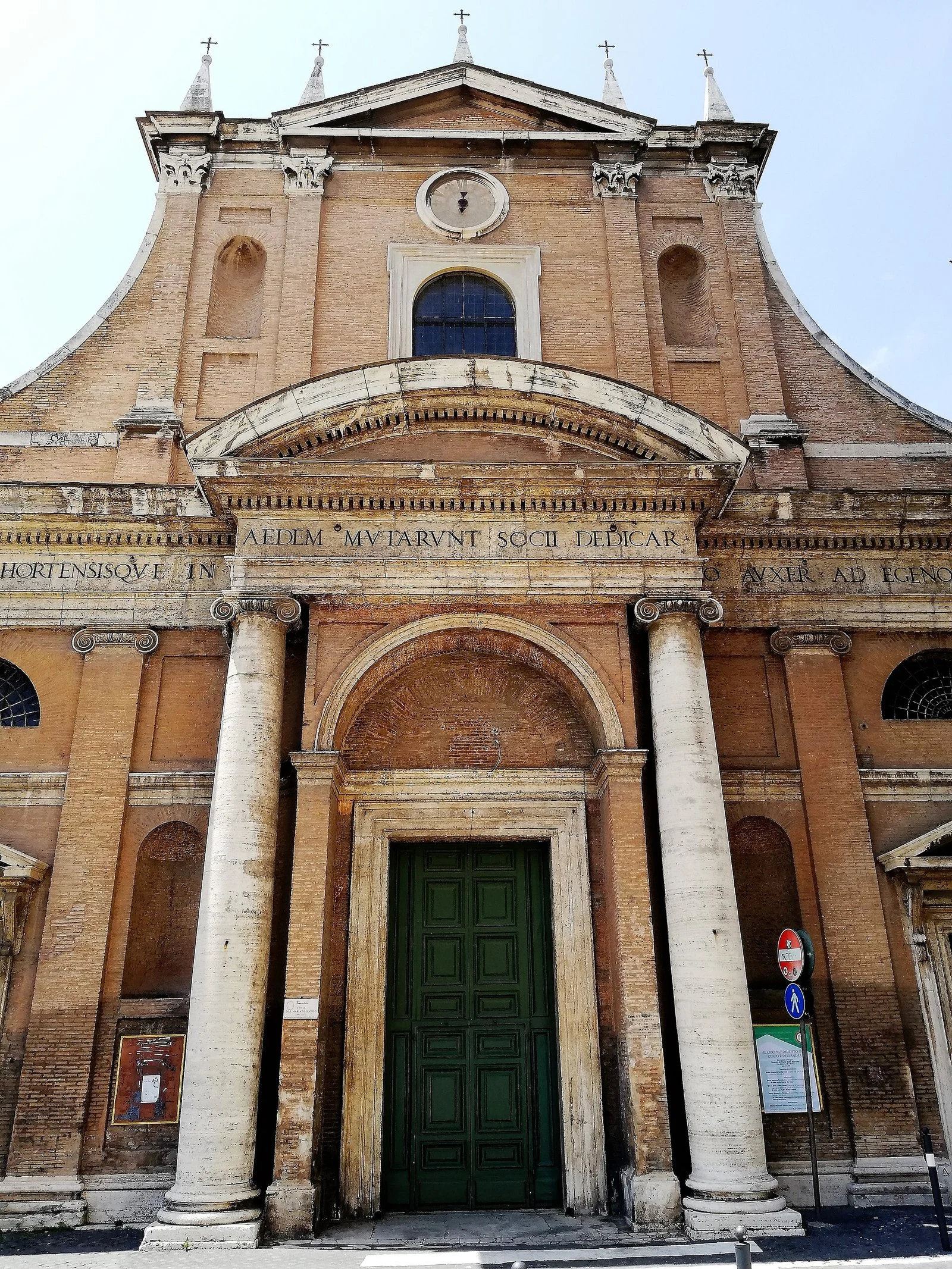
Santa Maria dell’Orto is the church of the Universities of arts and trades of Rome, and stands in Trastevere at the crossing of Via Anicia and Via Madonna dell’Orto, in the stretch that descends toward Porta Portese and toward the river. It is not the church of a religious order or of a noble family: it was built, paid for and maintained for centuries by the guilds of Roman labor, the fruttaroli, the pizzicaroli, the molinari, the vermicellari, the port sensali, the scarpinelli. This is the thread of everything you see inside. The name comes from a real garden: in 1488 or so, according to the tradition collected by the archconfraternity, a sick man recovered by praying in front of an image of the Madonna painted next to the entrance of his own garden, in this area of fields and warehouses behind the river port. The shrine became a chapel, the chapel became a church, and the church became the common seat of a dozen trades that each had here their own altar and their own coat of arms.
Anyone who arrives in Trastevere following the classic route, the one that circles the basilica of Santa Maria in Trastevere and the lanes north of Viale Trastevere, never meets this church. It stands on the other side of the avenue, in a network of low, wide streets where the rione changes face. The pages that follow tell where it comes from, who built it, what you see on the facade and inside, what the Quarantore machine preserved here is, and above all how the visit works: because the main problem with Santa Maria dell’Orto is not understanding it, it is finding it open.
Where Santa Maria dell’Orto is and how to get there
Santa Maria dell’Orto is on Via Anicia, in Trastevere, at the corner with Via Madonna dell’Orto, about 300 meters from the basilica of Santa Cecilia in Trastevere and a little over 500 meters from Porta Portese. It is the southern part of the rione, the one between Viale Trastevere and Lungotevere Ripa, where the streets widen, the buildings are lower and tourism thins out sharply after the first block.
The simplest way: tram 8
Tram 8 runs along Viale Trastevere from Piazza Venezia to Casaletto and is the most direct way to reach the area from central Rome. You get off on Viale Trastevere at the central stops of the avenue and walk toward the river for five or six minutes, taking Via dei Genovesi or Via Anicia. The avenue is also served by the bus lines that cross it and by the terminal at Trastevere station, a useful hub for those arriving by train from the Fiumicino direction or from Ostiense.
From the metro
The nearest metro stop is Piramide, on line B, on the other side of the Tiber. From there you cross the river on Ponte Sublicio and enter Via Anicia in about 10 minutes on foot, a flat route with no steps that passes next to the Pyramid of Cestius and Porta San Paolo. It is the best way for those coming from the Aventine or from the Testaccio rione, and it has the advantage of bringing you to the church from the right side, the port side, which is the side from which the church was born.
On foot from the historic center
From the center you go down crossing the river on Ponte Sisto or on Ponte Garibaldi, and from both you need between 15 and 20 minutes of walking. Those who pass through the Tiber Island can use Ponte Cestio on the Trastevere side and go down along Via della Lungaretta and Via dei Genovesi: a good 20 minutes, but it is a route that crosses the whole rione and shows the difference between the two Trasteveres, the postcard one and the one beyond the avenue.
By car, that is: not by car
Trastevere is a limited traffic zone with its own hours, and parking on Via Anicia is for residents. Anyone getting around Rome by car will do well to check the hours of the Rome ZTL first and leave the vehicle outside, toward Testaccio or toward Trastevere station. For the general picture of getting around the city we have a dedicated page on how to get around Rome, which is worth reading before leaving.
The garden that gives the church its name
The name Santa Maria dell’Orto is not a metaphor and not an abstract Marian title: it indicates a material garden, one of the many cultivated plots that occupied this part of Trastevere between the river and the slopes of the Janiculum at the end of the 1400s. On a boundary wall, next to the entrance door, an image of the Virgin was painted, of the kind that in Rome is called an edicola and that you still meet in the hundreds at street corners.
The vow of 1488
The tradition collected and preserved by the archconfraternity tells that around 1488 a man struck by paralysis made a vow before that image: if he recovered, he would keep a lamp lit in front of the Madonna. He recovered, and the promise was kept. It must be said clearly that this is devotional tradition, not a historically documentable fact in the terms in which it is told: what is documented is the effect, that is, the rapid birth of a local cult around a street shrine and the raising of money to build something stable on it. The dates the sources give for the episode range between 1488 and 1490, and not all agree.
From chapel to church
The votive chapel was raised at once and turned out at once to be insufficient. In 1492 Pope Alexander VI approved the confraternity born around the image, and this is the decisive step: from that moment the devotion has a legal structure, a budget and the capacity to receive bequests. Work on the church proper began in the years immediately following, with dates the sources place between 1489 and 1494, proceeded in fits and starts throughout the 1500s and ended around 1567. In 1588 Sixtus V raised the confraternity to the rank of archconfraternity, the title it still bears.
The Universities of arts and trades: who built this church
Santa Maria dell’Orto is the only church in Rome built and maintained entirely by a consortium of trade guilds, which in papal Rome were called Università: compulsory professional associations that regulated access to work, prices, the quality of goods and assistance to sick or old members. Each had a patron saint, a common fund and, where it could, an altar. A dozen of them converged here, and each took charge of a chapel, a piece of decoration or part of the ordinary expenses.
How many there really were
On the number the sources do not agree and it is best to say so before listing them. The figure that recurs most often is 13 Universities, and it is the one the archconfraternity itself uses. Other reconstructions count 12, still others speak generically of 12 founding associations plus those aggregated later. The divergence is easily explained: some Universities merged with each other, others came and went over three centuries, and at a certain point the fruttaroli appear united with the limonari. Anyone visiting the church does not find an official list hanging on the wall: they find the coats of arms, and the coats of arms are counted by eye.
The market gardeners and the pizzicaroli
The market gardeners are the natural founders, the church having been born from the garden of one of them, and together with the pizzicaroli they make up the original core. The pizzicaroli were the sellers of cured meats, cheeses, lard and preserves, the richest and best-organized food category of modern Rome, the one that in fact kept the budget standing. Their economic weight shows: where their fund is involved, the decoration gets richer.
The fruttaroli
The fruttaroli, that is, the fruit sellers, left the most recognizable mark in the whole church: a polychrome marble inlay dated 1747 in which the Marian monogram is composed of festoons of fruit of every kind, rendered in colored stones. It is a piece of goldsmith's work in marble made by a category of street vendors, and it is worth the detour on its own. In the sources they then appear united with the limonari, the citrus sellers, in one of the many mergers that explain the dance of the numbers.
The molinari and the vermicellari
The molinari were the millers of the floating mills anchored on the Tiber, machines that no longer exist and that until the 1800s were part of the river's scenery. Their trade is depicted in the church, and the sources point to mills painted on the panels of the organ gallery, on the inside of the facade. The vermicellari were instead the makers of dried pasta, vermicelli precisely: a category that in Rome had its own statutes and that here appears among the chapel holders.
The sensali of Ripa and Ripetta
The sensali were the brokers who handled the cargoes arriving at the city's two river ports, Ripa Grande downstream and Ripetta upstream. They produced nothing: they brought together those who sold and those who bought, and took a percentage. That a category of intermediaries financed an altar in a church of trades says a lot about how the river economy worked, where without a sensale a lot of grain did not move.
Scarpinelli, pollaroli, vignaroli
The scarpinelli were the cobblers, those who patched other people's shoes, a poor and large category. The pollaroli sold chickens and eggs. The vignaroli, also called vignaiuoli, cultivated the vineyards that even in the 1700s occupied a good part of the land inside the walls of Rome, Trastevere included. In the lists they appear with slightly different wordings depending on the source, and some reconstructions specify that they were padroni, affittuari and mezzaroli of vineyards, that is, owners, tenants and sharecroppers, three distinct social conditions within the same trade.
Mosciarellari, barilari and merchants
The mosciarellari sold mosciarelle, chestnuts dried in the oven, one of the popular goods of the Roman winter. The barilari made and repaired casks and barrels, indispensable in a city that ran on wine and oil. Among the Universities some sources also list a generic category of merchants and the so-called giovani, that is, the apprentices and dependent workers, who in several Roman guilds had their own sub-association distinct from that of the masters. Here too the lists diverge, and we report them as we found them.
Why this is rare
In Rome guild churches exist and are varied: the goldsmiths have Sant'Eligio degli Orefici, painters and architects have Santi Luca e Martina, charitable confraternities have places like Santa Maria dell'Orazione e Morte or San Giovanni Decollato. What makes Santa Maria dell’Orto different is the plurality: here there is not one trade, there are 12 or 13 together, each with its own chapel and its own coat of arms, inside the same building, for four centuries. It is a photograph of Roman labor, not the monument of a single category.
The facade, Vignola and the obelisks on the crowning
The facade of Santa Maria dell’Orto is attributed to Jacopo Barozzi called il Vignola, with works the sources place starting in 1566, but the attribution is disputed and should be presented as such. Several reconstructions assign the design to Martino Longhi the Elder, and almost all agree that the execution was completed by Francesco da Volterra. There is no document that closes the question definitively, and whoever writes the opposite is simplifying.
What you see
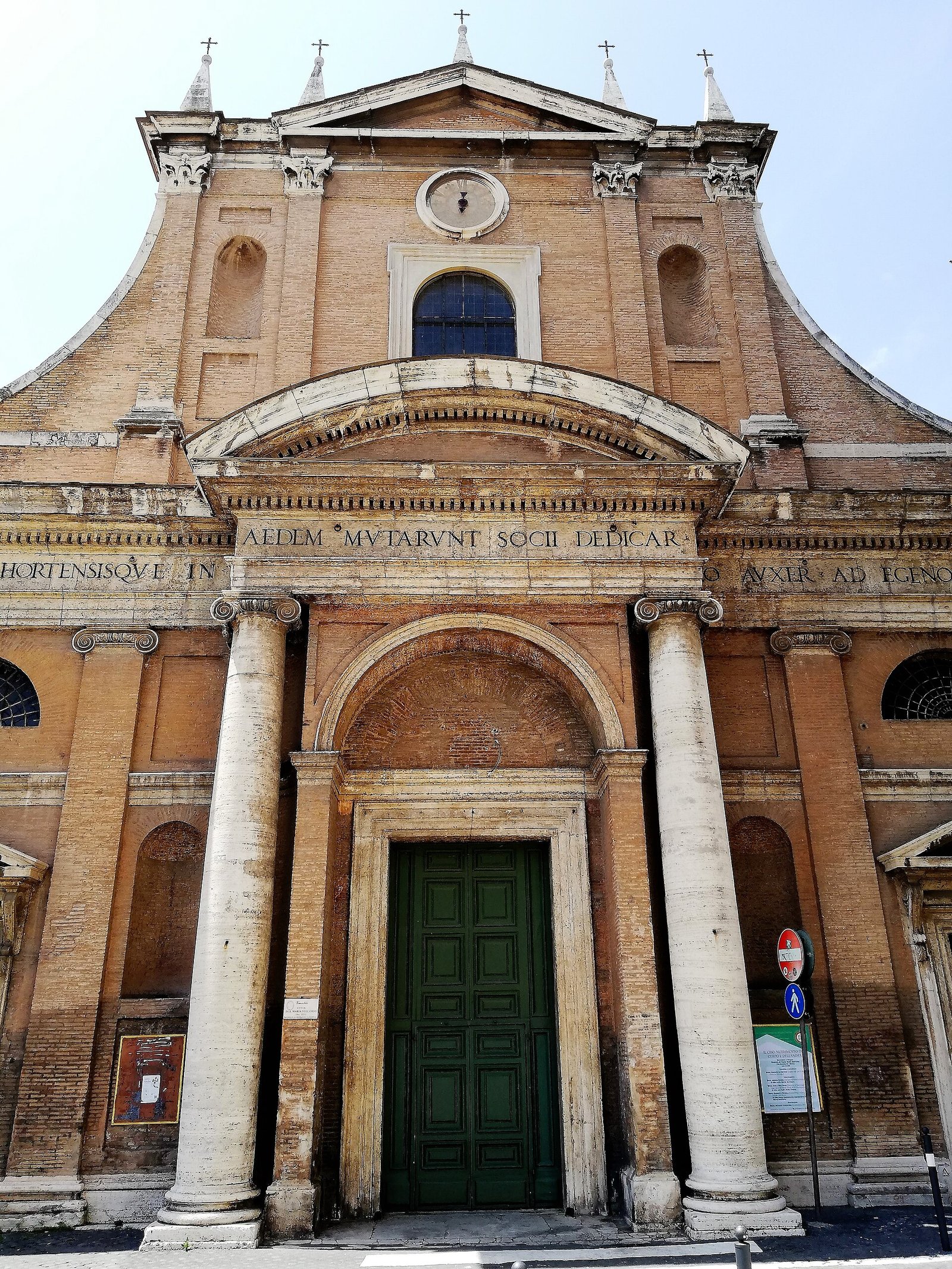
It is a two-order facade marked by pilasters, with the central portal framed between columns and a pediment above. The material is travertine, the register is the sober one of the second half of the Roman 1500s, without the depth effects that would arrive with the following century. Anyone who has in mind the facades of Baroque Rome finds here something more severe and flatter, which stands exactly in the passage between the two moments.
The obelisks: how many there really are
The thing that makes this facade recognizable among a thousand is the pyramidal travertine spires, topped by crosses, lined up on the crowning and at the pilasters. They are an unusual element in Roman religious architecture, where crownings are usually resolved with scrolls and statues, and at a glance they give the church a serrated profile that resembles no other in the rione.
On the number, however, the sources diverge and the figure circulates in different versions. A detailed reconstruction counts six flanking the pediment at the pilasters and five above it, for a total of 11, and other descriptions likewise speak of 11 pyramidal spires. But the figure of 14 obelisks also circulates with some frequency, and it is the one you hear repeated most often on guided visits. We did not find a primary source that settles the question, and the difference probably depends on what is counted: if only the spires of the upper crowning, if also those of the lower order, if also the minor elements. The practical advice is to count them on the spot from the opposite sidewalk, which is anyway the best way to notice they are there.
The clock
On the facade there is also a clock, which the sources date to the 1700s. It is a detail that seems minor and instead tells the civic function of the place: a public clock on a guild church, in an area of warehouses and quays, served to mark the shifts and the opening times of the markets, not only the canonical hours.
Inside: the plan, the coats of arms and the artists
The interior of Santa Maria dell’Orto has three aisles with side chapels, and is the result of a change: the original project called for a centralized Greek-cross plan with four apses, and it was Guidetto Guidetti, an architect trained in Michelangelo's circle, who transformed it into the longitudinal plan seen today. It is a fact still legible in the presbytery area, where the structure keeps a certain squareness.
The Zuccari
Among the highest names present in the church are the brothers Taddeo and Federico Zuccari, authors of frescoes that the sources place in the summer of 1561. Taddeo died young in 1566 and Federico then had a very long career that took him as far as Spain and England: finding them here, in a church of fruit sellers and pizzicaroli, gives the measure of how much money circulated in the funds of the Roman food guilds in the mid-1500s.
Baglione, Calandrucci, Giaquinto
Giovanni Baglione, painter and biographer of the artists of his time, worked in the church between 1598 and 1599 and in the following years. The vault with the Assumption of the Virgin is the work of Giacinto Calandrucci and is dated 1706, with stuccoes the sources attribute to Camillo Rusconi. Among the artists present the sources also cite Corrado Giaquinto, Giuseppe and Andrea Orazi. The high altar is credited to Giacomo Della Porta, and the polychrome pavement to Gabriele Valvassori, an architect active in Rome in the first half of the 1700s.
The coats of arms of the trades
This is the part nobody looks at and which is instead the heart of the church. On the floor, on the plaques, on the chapels and on the decorative apparatus appear the emblems of the titular Universities: tools of work, products, category symbols. The inlay of the fruttaroli of 1747 with the Marian monogram made of fruit is the most striking piece, but it is not isolated. Anyone who enters with the idea of looking for them spends an hour in the church instead of 10 minutes, and leaves with something that you see in no other church in Rome in the same way.
The organ of the molinari
On the inside of the facade is the organ, and the sources point out that on the balustrade of the gallery appear depictions of mills. They are the floating mills of the Tiber, those anchored to the banks that ground grain using the current and that were dismantled with the 19th-century regulation of the river. It is the only place in the city where a vanished category has left its working tool painted above an organ.
The Quarantore machine
The Quarantore machine of Santa Maria dell’Orto is an apparatus of carved and gilded wood, as tall as the apse, that holds more than 200 candles and that was assembled in the church for the Eucharistic adoration of the Quarantore, starting on Holy Thursday. It is the main reason this church appears in the discussions of scholars of ephemeral apparatus: machines like this were built by the dozens in Rome, for every great feast, and were dismantled and lost. This one survived.
What the Quarantore were
The Quarantore are a devotional practice of 16th-century origin: the consecrated host stays exposed for the adoration of the faithful for 40 continuous hours, in memory of the time Christ spent in the tomb. To give the exposition the greatest effect the Roman churches equipped themselves with wooden apparatus, painted canvases, fake architectural perspectives and candle lighting systems, designed by the same architects who made the real churches. They were scenographies to all effects, and indeed the history of Roman ephemeral architecture passes through here.
Dating: the sources diverge
On the date, the most detailed reconstruction we found gives 1848 as the year of making, by the hand of a master carpenter named Luigi Clementi, on a design however of 17th-century origin, and the number of candles given is 213. Other sources limit themselves to calling it 19th-century on a 17th-century design, and some descriptions place it generically in the 1700s, in line with the golden season of Roman ephemeral apparatus. We report both versions because we have no basis to settle the question: what all agree on is that the original design is much older than the preserved object, and that the preserved object is a faithful remaking of a Baroque model.
Can it be seen today
Caution is needed here. The machine was assembled and lit on Holy Thursday, and according to what the sources report, the lighting stopped after 2019. We find no stable public calendar for reassembly, and extraordinary openings with the machine set up are generally announced case by case by the archconfraternity or by cultural associations that organize visits. Anyone who cares must inquire in the days before Holy Week and take nothing for granted: it is not a permanent installation and it is not visited on request.
The national church of the Japanese in Rome
Santa Maria dell’Orto is the national church of the Japanese community in Rome, and the reason goes back to 1585. In that year the so-called Tenshō embassy arrived in Italy, a delegation of young Japanese nobles converted to Christianity sent to Europe by the Jesuit missionaries. According to the preserved account, during the navigation on the Tiber toward Ostia the delegation was surprised by a storm and invoked the Madonna of this church, and the storm ceased, and from there the bond was born.
What you see today
Since 2007, Rome's Japanese community has taken part in the church's feast day, which falls on the third Sunday of October. In October 2009, a portrait of Giuliano Nakaura was placed in the church. He was one of the four ambassadors of the 1585 delegation, was martyred in 1633 and beatified in 2008. It's an episode that links an alley in Trastevere to the history of the missions in Asia, and it almost never appears in the city's general guidebooks.
What's under the church
Remains from the Roman era have been found under Santa Maria dell’Orto, in a part of Trastevere that was fully built up in antiquity. The available descriptions mention a stretch of ancient road, residential structures of the insula type later turned into a high-status domus, frescoes and mosaics from the imperial era, and lime kilns.
The lime kilns
The kilns deserve one more line, because they explain what happened to the Roman statues. In the Middle Ages and beyond, ancient marble was fired to make building lime: it was the quickest way to turn a statue into construction material. The kilns found in this area have been linked to the building sites of nearby Santa Cecilia. It's one of the least comforting pages of Rome's history, and one that people visiting underground Rome run into again and again.
A curiosity about Santa Maria dell’Orto
The most concrete curiosity about Santa Maria dell’Orto is that the Madonna's monogram, in a marble inlay from 1747, is made of fruit: festoons of apples, pears, citrus, bunches of grapes and figs rendered in colored marbles, which together form the Marian symbol. It was paid for by the fruttaroli, the fruit sellers, and it's their signature on the wall.
Something nobody tells you about Santa Maria dell’Orto
What you almost never read is that Santa Maria dell’Orto is a church you tend to find closed. It's not a parish church with continuous opening hours: it's the church of an archconfraternity, run by a private body of very ancient origin, and the openings follow the needs of the brotherhood and the availability of volunteers. If you show up at 3 in the afternoon on a Tuesday in January, you have a very good chance of finding the door barred.
The practical consequence
Plan it, don't improvise it. The rule we give people who ask us for an itinerary is not to build half a day around this church, but to fit it into a route through southern Trastevere that holds up even if the door is closed: Santa Cecilia, San Francesco a Ripa, the Lungotevere, Porta Portese. If it opens, you gain an hour of things you won't find elsewhere. If it doesn't, the day still stands.
Hours, admission and accessibility
Admission to Santa Maria dell’Orto is free, as in all the churches of Rome open for worship, but the opening hours are limited and we don't report them as certain, because the secondary sources that list them are not up to date and don't replace the official channel.
What we know and what we don't
The sources we consulted indicate a Sunday and holiday Mass in the morning, around 11, and some listings from a few years ago reported weekday openings in the morning and afternoon, with a reduced window on the weekend. We have no way to confirm that this schedule is still in force, so we don't publish it as an opening time. The reference to use is the archconfraternity of Santa Maria dell’Orto, which runs the church, or the Rome city tourism portal for general information on the site. If you're coming from out of town, make a phone call or send an email before planning the visit.
Accessibility
The church is at street level in a flat area, which is already an advantage over many Roman churches. However, we have no verified information on if there are steps at the entrance or on the accessible facilities, and anyone with specific needs would do well to ask the archconfraternity directly. For the general picture of the city, see our page on accessible Rome.
My advice for visiting Santa Maria dell’Orto
There's only one practical piece of advice: come on Sunday morning, before noon, and combine it with Porta Portese. It's the only time slot in which the chance of finding the church open is reasonably high, because there's Mass, and it's also the moment when the Porta Portese market, a five-minute walk away, is in full swing.
The combination that works
The Porta Portese market is held on Sunday morning and closes around lunchtime. The sequence we recommend is: market early, while you can still walk, then back up Via Anicia toward the church, then Santa Cecilia and out toward the river. It works because it puts together two faces of the same neighborhood, the commercial one and the devotional one, which for four centuries were the same thing. For an overview of Rome's markets we have a dedicated page on the markets of Rome.
When to avoid it
Saturday afternoon and weekdays in August are the worst times: reduced openings and no certainty. If it rains, the good news is that the interior is one of the richest things in this part of the rione, but it still has to be open. For an indoor plan B we have a page on Rome when it rains.
Another well-known fact that is rarely mentioned
That Trastevere was for centuries a working neighborhood on the river is something everyone knows, and nobody takes it into account when visiting. Today the rione reads as an area of bars and photogenic alleys, and its economic history has vanished from common perception. Yet until 1870 there was an active port here, Ripa Grande, with quays, a customs house, warehouses and a population of porters, boatmen, millers and brokers.
What's left of the port
Little, and you have to look for it. The construction of the Tiber embankment walls after 1870 wiped out the low banks and the landing stairs on both sides of the river, and the port of Ripa Grande was dismantled. Today the Lungotevere is where it used to be. There's no dedicated entry on the port on our site, because in practice there's no longer a place to visit. What remains is the street names, with Via di Ripa Grande and Via dei Vascellari, and the memory of the trade inside the churches, Santa Maria dell’Orto first among them.
The river as an economic boundary
Looking at the bridges helps. Ponte Palatino, Ponte Rotto and the two bridges of Tiber Island, Ponte Fabricio and Ponte Cestio, mark the ancient part of the crossing. Farther downstream the river was a work zone, with mills anchored in the current and boats coming up from Fiumicino. Anyone walking along Lungotevere Ripa with this in mind sees a different city from the one seen by someone who is only looking for the view.
The same story in other churches
The phenomenon of trade and national churches in Rome is vast and systematic: San Giovanni dei Fiorentini for the Florentines, San Luigi dei Francesi for the French, Santa Maria dell’Anima for the Germans, Santa Maria in Monserrato for the Spanish, Sant’Antonio dei Portoghesi for the Portuguese. Those are churches of foreign communities. Santa Maria dell’Orto belongs to the other family, the churches of professional categories, and it's the most crowded case.
The right photo to take at Santa Maria dell’Orto
The right photo at Santa Maria dell’Orto is the crowning of the facade with the travertine spires against the sky, shot from the opposite corner of Via Anicia in the early afternoon, when the light comes in at an angle and separates the pinnacles from the background.
How to frame it
Via Anicia is narrow and forces you to tilt the lens upward, so the verticals converge and the facade looks like it's falling backward. Two fixes: step back to the opposite wall and use a focal length that isn't too wide, or accept the convergence and compose vertically, with the portal at the bottom and all the spires at the top. With a phone, it's best to lock the exposure on the travertine and not on the sky, otherwise the stone comes out gray.
The photo almost nobody takes
The detail of the eighteenth-century clock on the facade, isolated with a telephoto lens, with the masonry around it. It tells the civic function of the church better than any wide shot, and nobody has it. If you want a wider context of the rione, the classic shot is still the alleys around Santa Maria in Trastevere, which however everyone photographs the same way.
Some important events that happened here in history
The history of Santa Maria dell’Orto reads as a succession of dates in which a street cult becomes an institution: around 1488 the healing and the vow, 1492 the approval of the confraternity, 1567 the completion of the church, 1588 the elevation to archconfraternity.
1588: the elevation to archconfraternity
Sixtus V, the pope of the obelisks and of Rome's urban reorganization, raises the confraternity to the higher rank. The title carries the power to aggregate other confraternities to itself, and it's the moment of the institution's greatest expansion.
The 1800s: the machine and the end of the guilds
In 1848, according to the most detailed reconstruction, the current Quarantore machine is built to a seventeenth-century design. It's the same century in which the Universities of arts and trades are suppressed and the port of Ripa Grande is dismantled with the river works after 1870. The church survives the disappearance of the world that built it.
Recent years
Since 2007, the Japanese community has taken part in the October feast day. In 2009, the portrait of Blessed Giuliano Nakaura was placed in the church. According to the sources, the lighting of the Quarantore machine stopped after 2019, and we know of no stable calendar since then.
Who passed through Santa Maria dell’Orto
Some of the greatest names in Roman art between the 1500s and the 1700s passed through Santa Maria dell’Orto, working here: Taddeo and Federico Zuccari, Giovanni Baglione, Giacinto Calandrucci, Corrado Giaquinto, Camillo Rusconi, and for architecture Guidetto Guidetti, Francesco da Volterra, Giacomo Della Porta and Gabriele Valvassori, as well as Vignola, to whom the facade is attributed.
Giovanni Baglione
Baglione is a double figure: a painter of good craft and above all the author of the Lives of the Painters, Sculptors and Architects, one of the main sources for knowing Roman art of the 1600s. He's also the man who sued Caravaggio for defamation, in one of the most cited trials in the history of art. If you want to follow that story, you'll find the context on our page on Caravaggio in Rome.
Giacomo Della Porta
The high altar is attributed to Della Porta. He's the architect who completed the dome of St. Peter's with Domenico Fontana, who signed the facade of the Gesù and who designed a number of Roman fountains. In the list of building sites of late sixteenth-century Rome, his name turns up almost everywhere.
The confratelli
The most important passage, though, is not that of the artists. It's that of thousands of Roman workers who for four centuries paid their dues, walked into processions in the habit of their own University, buried their dead here and left their own coat of arms on the floor. They have no famous names. But they have the most visible collective signature of any commissioning cardinal, and it's the whole church.
What to see around Santa Maria dell’Orto
Around Santa Maria dell’Orto, within a 10-minute walk, you'll find Santa Cecilia in Trastevere, San Francesco a Ripa, the Porta Portese market and Lungotevere Ripa. It's the southern part of the rione, less trodden than the one around Santa Maria in Trastevere and much more readable as an urban fabric.
Toward Santa Cecilia
The Basilica of Santa Cecilia in Trastevere is three minutes away, with its courtyard, Arnolfo di Cambio's ciborium and Cavallini's Last Judgment in the nuns' choir, which is visited on its own schedule. It's the natural pairing, and together the two churches tell of two different Trastevere: the monastic and aristocratic one and the working one.
Toward San Francesco a Ripa
The Church of San Francesco a Ripa is five minutes away and holds Gian Lorenzo Bernini's Blessed Ludovica Albertoni, one of the most extreme sculptures of his last season. If you're following the sculptor's thread, you'll find the whole route on our page on Bernini in Rome.
Toward Porta Portese and the river
Porta Portese is the seventeenth-century gate that gives its name to the Sunday market. From there the Lungotevere goes up toward Ponte Sisto and down toward the Testaccio area, on the other side of the river, where you'll find the Nuovo Mercato Testaccio and the Museo diffuso del rione Testaccio, and farther downstream the Centrale Montemartini.
The better-known Trastevere
Going up past Viale Trastevere, you enter the busiest part: the Basilica of Santa Maria in Trastevere with its apse mosaics, the Basilica of San Crisogono with its lower levels, Santa Maria della Scala with the old apothecary, the cloisters of San Cosimato, the Church of Sant’Agata and the Museo di Roma in Trastevere. The full picture of the rione is on our page on Trastevere.
Climbing the hill
Behind the rione is the Janiculum, with San Pietro in Montorio and Bramante's Tempietto, and lower down the Villa Farnesina with Raphael's frescoes and the Botanical Garden, which despite the name has nothing to do with the vegetable garden this church comes from. If you have time, you can continue to Villa Sciarra.
Across the river, toward the Aventine
From Ponte Sublicio you climb in 10 minutes toward the Aventine, with the Basilica of Santa Sabina and the Orange Garden, and going down toward the Forum Boarium you reach Santa Maria in Cosmedin and the Mouth of Truth.
Where to eat around here, and how not to go wrong
Trastevere is one of the areas of Rome most exposed to passing tourism, and the concentration of places built for people who come only once is high. The part around Via Anicia, though, toward Porta Portese and the Lungotevere, is noticeably less trodden than the alleys north of Viale Trastevere: here the density of signs drops and you can still see local customers. It's not a tourist-free zone, and anyone who describes it as one is exaggerating. It's simply the side of the rione where choosing is easier.
Why we don't name names
On this site we don't point to specific restaurants. A list of places goes stale within a few months. They change management, they change menus, and in the meantime someone uses it as a guarantee that we can't give. We prefer to give the criteria, which stay valid even when the place closes. The only collection we point to is Daniele Dezi's personal list on Google Maps, curated and unsponsored, which counts as one person's opinion and not as a ranking.
The signs that you're about to go wrong
There are five, and in Trastevere you meet all of them on the same block. The lady rolling out fresh pasta in the window or on the sidewalk: it's an advertising lure, not a sign of the cooking. The menu with photos of the dishes: it's for people who don't read Italian and don't have to ask questions. The tout at the door inviting you to sit: where you eat well, there's no need for one. The place open from morning to night with no kitchen break: it means reheated food. And the places set in front of the most photographed monuments, which often adjust the price to the tourist in front of them, with unpriced items on the menu or different price lists inside and outside.
The chains
In central Rome there is by now a tier of places with repeated signs, identical in several parts of the city, with the same menu and an organized line at the entrance. We don't name them and we don't recommend them. The thing to notice is simple: Romans don't go there. They're formats built on tourist flow, and they work exactly as long as the flow is there.
The quickest criterion
Look at who's sitting at the tables and what language they order in. If at 2 in the afternoon on a Tuesday the place is full of people speaking Roman and ordering without looking at the menu, that's a good sign. If at 7 in the evening, an hour when almost nobody in Rome eats dinner, the place is full, it's the opposite signal. For the general picture of the city, we have a page on where to eat in Rome.
How to fit Santa Maria dell’Orto into an itinerary
Santa Maria dell’Orto works as a stop within a southern Trastevere route, not as the destination of a trip of its own: it's three minutes from Santa Cecilia, five from San Francesco a Ripa and five from Porta Portese, and the uncertainty about opening hours makes it a bad idea to build a day around it.
A full day in Trastevere
Morning in the southern part, with this church, Santa Cecilia and San Francesco a Ripa. Lunch away from the high-traffic areas. Afternoon in the northern part with Santa Maria in Trastevere, the Villa Farnesina and the climb up the Janiculum for sunset. If you have only one day in the city and have to choose, though, refer to our page on Rome in a day: this church is a stop for a second or third trip.
The route of the trade churches
For those who get passionate about the theme, there's an all-Roman itinerary that lines up the churches of the guilds and confraternities. From Santa Maria dell’Orto you go to Sant’Eligio degli Orefici for the goldsmiths, to Santa Maria dell’Orazione e Morte for the confraternity that buried abandoned dead, to San Giovanni Decollato for the one that assisted the condemned, to Santi Luca e Martina for the artists. It's a reading of the city that no standard itinerary offers.
Frequently asked questions about Santa Maria dell’Orto
What is Santa Maria dell’Orto?
Santa Maria dell’Orto is a church in Trastevere, in Rome, built and maintained from the 1400s onward by the Universities of arts and trades, that is, the guilds of Roman workers such as fruttaroli, pizzicaroli, molinari, vermicellari, sensali and scarpinelli. The name comes from an image of the Madonna painted next to the entrance of a vegetable garden, in front of which, according to tradition, a healing took place around 1488.
Where is Santa Maria dell’Orto and how do you get there?
Santa Maria dell’Orto is on Via Anicia, in Trastevere, at the corner with Via Madonna dell’Orto, in the southern part of the rione between Viale Trastevere and Lungotevere Ripa. The most convenient way is tram 8 along Viale Trastevere, from which it's a five- or six-minute walk. Alternatively, get off at the Piramide metro station, line B, and cross the river on Ponte Sublicio in about 10 minutes on foot.
How much does it cost to enter Santa Maria dell’Orto?
Admission to Santa Maria dell’Orto is free, as in all the churches of Rome open for worship: there's no ticket office, no mandatory reservation and no paid audio guide. If a guided visit organized by an association asks for a contribution, that covers the guide service and any special opening, not access to the church itself.
What are the opening hours of Santa Maria dell’Orto?
The hours of Santa Maria dell’Orto are limited, and we don't publish a calendar because the data available online doesn't appear to be up to date. The church is run by an archconfraternity and doesn't have the continuous opening of a parish: it's easily found closed. The sources indicate a Sunday and holiday Mass in late morning. It's best to contact the archconfraternity before planning the visit.
Why is it called Santa Maria dell’Orto?
Santa Maria dell’Orto takes its name from a real vegetable garden, one of the cultivated plots that occupied this part of Trastevere at the end of the 1400s. On the boundary wall, next to the entrance door, an image of the Virgin was painted. A local cult grew up around that shrine, then a votive chapel and finally the current church. The Orto Botanico of Rome, which is in another part of Trastevere, has nothing to do with it.
What is the Quarantore machine of Santa Maria dell’Orto?
The Quarantore machine of Santa Maria dell’Orto is an ephemeral apparatus of carved and gilded wood that holds more than 200 candles and that was set up in the church for the Eucharistic adoration of Holy Thursday. It's one of the very few surviving examples of a genre that in Rome produced dozens of installations later dismantled and lost. The sources differ on the date: the most detailed reconstruction indicates 1848, to a seventeenth-century design.
Who designed the facade of Santa Maria dell’Orto?
The facade of Santa Maria dell’Orto is attributed to Jacopo Barozzi, known as Vignola, with work begun around 1566 and completed by Francesco da Volterra, but the attribution is disputed and some reconstructions assign it to Martino Longhi the Elder. The crowning is marked by pyramidal travertine spires topped with crosses, whose number varies depending on the source between 11 and 14.
How long does it take to visit Santa Maria dell’Orto?
To visit Santa Maria dell’Orto, 20 minutes is enough if you limit yourself to a glance at the interior, while you need 40 or 50 to look for the coats of arms of the Universities of arts and trades one by one on the floor, on the plaques and in the chapels, which is the real reason to come all the way here. Adding Santa Cecilia and Porta Portese, you comfortably reach half a day.
Who wrote this page
This page is curated by the editorial team of Tour Leader Pro, the Rome-based project office that designs and coordinates visits, itineraries and cultural events in Rome and Lazio. The hours, fares and access conditions given here were checked on the official sources named in the text as of the publication date. Before you leave, it's worth checking them again, because they change often. If you find outdated information, let us know.
If you're building a Roman itinerary that crosses the guild churches, the less-trodden Trastevere and the river strip between Porta Portese and Testaccio, you can find planning tools and operational support at Tour Leader Pro, which works across Rome and Lazio with groups, schools and organized trips.
For the wider picture, that is, travel between Italian cities, travel times, seasonality and Lazio destinations to pair with a day in Rome, a good planning resource is Italy Planner.